01 · Driver's license
How do I get a driver's license in Colorado?
Short answer
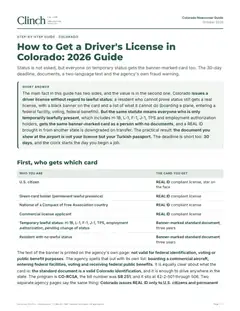
The most important fact on this page has two sides, and the value is in the second one. Colorado issues a driver license without regard to lawful status: a resident who cannot prove status still gets a real license, with a black banner on the card and a list of what it cannot do (boarding a plane, entering a federal facility, voting, federal benefits). But the same statute means everyone who is only temporarily lawfully present, which includes H-1B, L-1, F-1, J-1, TPS and employment authorization holders, gets the same banner-marked card, and a REAL ID brought in from another state is downgraded on transfer. The practical result: in Colorado the document you show at the airport is your Turkish passport, not your license. The deadline is short too: 30 days, and the clock starts the day you begin a job.
Steps, documents and official links
First, who gets which card
Licenses in Colorado are issued by the state Division of Motor Vehicles. There are two products, and the difference between them shapes this entire page.
| Who you are | The card you get |
|---|---|
| U.S. citizen | REAL ID compliant license, with a star on the front |
| Green card holder (permanently lawfully present) | REAL ID compliant license |
| Citizen of a Freely Associated State | REAL ID compliant license |
| Commercial license applicant (temporary or permanent) | REAL ID compliant license |
| Temporarily lawfully present: H-1B, L-1, F-1, J-1, TPS, employment authorization, pending adjustment | Banner-marked standard credential, three years |
| Resident without lawful status | Banner-marked standard credential, three years |
The text of the banner is written on the agency's own page: not valid for federal identification, voting or public benefit purposes. The DMV spells that out in its own list: boarding commercial airplanes, entering federal facilities, voting and federal public benefits. It is equally clear about what the card is: a standard credential is a valid Colorado identification, and it lets you drive anywhere in Colorado.
The program is called CO-RCSA (the Colorado Road and Community Safety Act), its legislative number was SB 251, and it sits in Part 5 of Article 2 of Title 42 of the Colorado Revised Statutes (42-2-501 to 506).
If your status is temporary, the REAL ID never comes
Do not skip this paragraph, because the consequence appears at the airport. Two separate DMV pages say the same thing. The first: Colorado issues REAL IDs only to U.S. citizens and permanent residents, and someone arriving with a REAL ID from another state can transfer the driving privileges but the credential is downgraded to a standard license or permit displaying the restricted banner. The second: temporarily lawfully present applicants are not eligible for a REAL ID in Colorado, regardless of whether their current out-of-state credential is REAL ID compliant; the only exception is commercial license holders and applicants from Freely Associated States.
And the door is one-way: the DMV writes that these credentials cannot be upgraded to REAL ID compliant. Not at renewal and not after a document update. The only thing that changes it is your status becoming permanent.
So we put this sentence in bold: in Colorado, the document you present for a domestic flight, or for any federal errand that requires identification, is your Turkish passport with its visa or I-94, not your license. Since May 7, 2025 adult travelers over 18 must present a REAL ID-compliant credential or an acceptable alternative at the checkpoint, and the DMV writes on its own page that the temporary paper receipt does not work for air travel: the receipt's own text says it is not a REAL ID proof of identity document and that an expired license would be required alongside it. For federal buildings the DMV refuses to generalize: it says that residents should consult the policy of the agency operating the facility before arriving, and we say the same, so we do not write here that a banner-marked card will get you into a USCIS office or an immigration court.
The other side of the same coin deserves saying honestly as well: a person with no status at all gets exactly the same card, on broadly the same terms, and can drive legally.
Thirty days, and the trigger is the first day of a job
Colorado publishes a residency definition with three triggers, and each one is enough on its own: owning or operating a business in Colorado, being employed in Colorado, or residing in Colorado for 90 consecutive days. Once you are a resident you must transfer the license within 30 days.
The trap is exactly here, and it is a hard one: because employment alone is enough, the 90 days is an alternative, not a precondition. An engineer who starts work in Denver on a Monday does not have 90 days; they have 30 days from that day. This is the shortest license deadline we have seen in this series and it belongs at the top of the page. Vehicle registration runs on a separate and longer clock, 90 days, covered in the car section.
There is also a surprise at the counter: your old license is hole-punched and voided (Colorado Revised Statute 24-60-1106). If you will need the number, photograph it before you hand it over.
Documents for an applicant without lawful status
The agency's own checklist (DR 2300C, Spanish DR 2300CS) asks for:
- Proof of identity and date of birth: a passport from your home country, a consular card from your home country, or a home-country military ID. The document must be unexpired or expired for less than ten years.
- A CO-RCSA affidavit (see the conflict below).
- One proof of current Colorado address: it must show your full name and a physical Colorado address (no P.O. boxes), be dated within the past year and be in English. Accepted: a bank statement, a pay stub, a utility or credit-card bill, a lease or mortgage statement, a vehicle registration or title, a homeowner's or renter's insurance policy, first-class mail from a government agency, or a USPS change-of-address form. Rejected: junk and bulk mail, handwritten documents or receipts, documents showing only a P.O. box, and envelopes with labels or handwritten corrections. A proof of address is required at every issuance, not just the first one.
- Name-change documents, if applicable: a current passport, consular card or military ID from your country of origin. On this track, marriage certificates and certified court-ordered name changes cannot be used.
- If you are transferring from another U.S. state: a valid license expired less than one year, or a driver history record from the previous state dated within 30 days. Neither substitutes for the identity documents.
A detail that matters for a Turkish reader: the one document a Turkish applicant almost certainly holds, an unexpired Turkish passport, sits at the top of Colorado's accepted identity list, and Colorado will take a foreign passport expired by up to ten years as primary identity. We have not seen another state in this series do that.
Documents for a temporarily lawfully present applicant
This is the track most of our readers will actually use: H-1B, L-1, F-1, J-1, TPS, pending adjustment and employment authorization holders.
- Proof of identity and date of birth: the full accepted list is in checklist DR 2300B (Spanish DR 2300BS). We could not read the checklist itself, so we do not enumerate it here; download the form before your appointment.
- Proof of lawful presence: a valid employment authorization card (EAD), a temporary resident stamp, or an I-94 with a valid passport, or another document from DR 2300B.
- One proof of current Colorado address: the same list and the same rules as above.
- Name changes, and here there is a sequencing trap. A name change must be supported by an updated USCIS document: an I-94 with a foreign passport, an I-766 EAD, or an I-797 Notice of Action with a foreign passport. Marriage certificates and court-ordered name changes cannot be used to change a name on a temporary-status record, and the name on the Colorado credential must match current USCIS data.
What this means in practice for a reader who marries: if you marry in Colorado and take your spouse's surname, you cannot change the name on a temporary-status driving record with the Colorado marriage certificate. USCIS has to reissue your I-94, EAD or I-797 in the new name first. Getting the order wrong costs months, so keep it in mind when you read the marriage section.
A conflict: the statute repealed the affidavit, the agency still publishes the form
Here two official sources do not agree, and instead of settling it quietly we print it as it stands.
On one side, the statute. SB25-276, signed on May 23, 2025, according to the General Assembly's official summary of the act as enacted, repeals the affidavit requirement under which a person without lawful immigration status had to state that they had applied, or would apply, for lawful presence when seeking in-state tuition classification or a CO-RCSA identification document.
On the other side, the agency. The Division of Motor Vehicles still publishes a CO-RCSA affidavit on its own SB 251 page, and under two different numbers: DR 2212A in the first-application section and DR 2122A in the renewal section. Both sit on the same page.
Two explanations are possible: what was repealed may be only the lawful-presence declaration while a different CO-RCSA affidavit survives, or the agency page may not have been updated. The statutory text was not read, only the General Assembly's official summary, so we do not settle it here and we quote no statutory language.
What we tell you is this: fill in and bring whichever form the agency lists on the day of your appointment, and ask at the counter. We do not say you must sign an affidavit and we do not say it is no longer needed. And do not trust a guide that gives a single universal form number, because the agency's own page gives two.
The appointment, the tests and how the card arrives
- Pre-register online first. The agency's own sentence is that all first-time applicants should pre-register online.
- Then book the appointment. Every applicant track on the DMV site repeats that all applicants must make an appointment; walk-in driver service is not the norm.
- Check-in: arrive shortly before the appointment; you can check in online or at a kiosk no earlier than 15 minutes beforehand.
- At the appointment: the technician gives a basic vision exam, fingerprints are submitted (Colorado Revised Statutes 42-2-107 and 42-2-302), and a new photograph is taken (eyeglasses, bulky clothing and hats removed, religious headwear excepted).
- A temporary paper credential is issued at the appointment and is valid immediately; you carry it until the permanent card arrives.
- The permanent card is centrally issued and mailed within 30 days. You can check its status on the agency's own page, by email, on 303-205-5600 (press 1, then 3), or by returning to the issuing office without an appointment.
Let us be plain about the fingerprints: an applicant on this track is fingerprinted by a state agency as part of getting the card, with or without status. We write that not as a warning but as a fact you should know; if you are unsure what it means for your own file, write to us before you apply.
Interpreters: the agency says translation devices are available at some offices, or that an applicant may bring a friend or family member. The condition is that the interpreter must show an unexpired driver license or ID card, and the interpreter's name and license or ID number go into the applicant's permanent motor vehicle record.
Documents and translation: Colorado's own rule
The translation rule is unusual in this series and it is the kind of detail that sends people home from the counter, so we write it out.
- Originals only. No copies, photos or laminated versions, and no abbreviated, miniature or hospital-style birth certificates.
- Certified copies must bear an official court, county, city or state seal or stamp. The agency's own sentence: a notary public cannot certify.
- Every document must show the full legal name, date of birth, date of issuance, country of issuance and a photograph.
- English only. A non-English document needs a complete certified translation, and the translation must carry a specific affirmation typed on the same page as the translation, not on a separate sheet, in which the translator affirms that the text is a complete and accurate translation from the foreign language into English and that they are competent in both languages.
- And here is the unusual part: the same translation must also show the number and state of issuance of the translator's own unexpired driver license, instruction permit or ID card, and all of it goes into the applicant's permanent motor vehicle record. The applicant pays the translation costs.
Why it matters: Colorado does not publish a list of approved translators; instead it makes the translator identify themselves by license number. So a translation bought in Türkiye, or one from a translator who does not hold a U.S. state license or ID, does not satisfy the rule. If you are having a Turkish birth certificate or a Turkish license translated, the translator must hold a U.S. state license or ID themselves. This is one of the first things to check before the appointment.
Two restrictions with dates on them
| Restriction | Status |
|---|---|
| Commercial licenses for temporary status are paused | Following new federal regulations, from Monday, September 29, 2025 the agency paused the issuance and renewal of term-limited (non-domiciled) commercial driver licenses and commercial learner permits for temporarily lawfully present residents until further notice. No restart date has been published. |
| Exceptions processing is closed to undocumented applicants | The agency's own sentence: customers without lawful status are currently not eligible for exceptions processing, check back on January 1, 2027. Temporarily lawfully present customers may be eligible if they can establish lawful presence but are missing an identity or date-of-birth document. |
Renewal: the logic is inverted
This is the most surprising part of the section, and it is the opposite of what a reader expects.
- A holder without lawful status may renew online. It requires the proof document last presented plus a newly completed CO-RCSA affidavit (the number given in the renewal section is DR 2122A). In person, they bring the most recently issued Colorado license or permit (or the identity documents if unavailable), one proof of physical Colorado address dated within the previous year, and the new affidavit.
- A temporarily lawfully present holder may renew only in an office. The agency's own sentence: temporarily lawfully present customers are not eligible to renew online. Every time, they must bring the most recently issued Colorado credential, the most recently issued unexpired lawful-presence documents or extension letters, and one proof of Colorado address dated within the previous year.
So the H-1B holder with a job and a visa takes time off work and goes to an office every time, while a person with no status can renew online. That is the most inverted outcome we have seen in this series and it should be said plainly.
There is a convenience that applies to everyone else: as announced on September 16, 2026, the online renewal window was extended to 11 years from the date of the last in-office photo, allowing two consecutive online renewals before an in-office photo is required. It does not help temporary-status holders, who cannot renew online at all.
Fees, and the extra a person without status pays
The agency publishes two fee tables on one page, and the comparison is itself a piece of information.
| Activity | REAL ID track | Standard (CO-RCSA) track |
|---|---|---|
| Driver license | $34.00 | $36.00 |
| Instruction permit (including motorcycle) | $20.00 | $23.00 |
| Identification card (under 60) | $14.00 | $14.00 |
| Identification card (60 and over) | Free | Not separately listed |
| Duplicate permit or license | $12.30 | Not separately listed |
| Subsequent duplicates | $16.40 | Not separately listed |
Other fees that apply to everyone: a motorcycle endorsement $2.00 on top of the license fee, a rehabilitation permit $16.80, a knowledge retest $11.50, a road retest $15.40, reinstatement $95.00 (plus $25 if reinstating from a DUI), a replacement for a surrendered license $6.25, a driving record $9.25, a certified driving record $10.25 (by post or at the Lakewood office), a one-year civilian extension $6.65 ($7.50 with a motorcycle endorsement), a three-year military extension free, and a short-check penalty $71.00.
The combined picture, worth saying once: the standard credential costs $2 more than the REAL ID license, the standard permit $3 more, and the standard credential expires in three years. So a person in Colorado without permanent status pays slightly more, more often, for a card that does less.
Payment: state driver license offices take cash, a check payable to DOR, Visa, MasterCard, American Express and Discover, and Apple Pay, Google Pay and Samsung Pay. Payroll and third-party checks are not accepted. Fees cannot be combined into a single card charge or check, so expect several separate transactions.
The agency's own fraud warning
For a Turkish reader this paragraph is worth more than most of the fee tables. The agency's motor vehicle investigation unit published a warning on August 10, 2026 naming exactly the scams that target newcomers:
- unauthorized brokers booking and reselling driver license office appointments for profit,
- individuals accepting fees to register vehicles on someone else's behalf,
- applicants paying third parties to fraudulently complete written knowledge tests,
- driving schools or individuals promising a passing score. The agency's own sentence is that legitimate driving schools cannot guarantee a passing score.
The agency's instruction is equally clear: start every transaction at mydmv.colorado.gov, book appointments only through the agency's own appointment page, register a vehicle at a county motor vehicle office, online, or at a CO MV Express kiosk, and take the knowledge test only through the official at-home service. The agency also runs a free chat service and publishes a list of nonprofit partners who help with standard-credential appointments. We could not read the names on that list, so we name no organization here; see the agency's own page.
Voter registration is offered at the license office. Decline it.
This is one of the most important warnings on this page, and the consequence can be serious on the immigration side. The agency's own sentence is that all Colorado driver license offices provide voter registration services. Voting in Colorado requires U.S. citizenship, and the banner-marked standard credential itself says not valid for voting. So for a non-citizen the service is not available and should be declined. The agency's page carries no warning for non-citizens, so we give it: tell the technician you are not a citizen, and if a registration is created by mistake, do not throw away the notice that arrives. See the voting and jury section.
Which office to go to
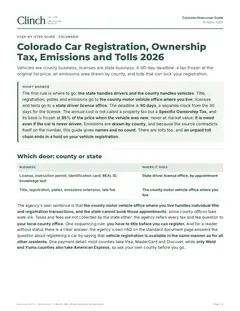
As a writing rule we never use "the DMV" as a single place on this page, because Colorado has two different agencies: the state handles drivers and the county handles vehicles. License, permit, ID card, REAL ID and the knowledge test go to a state driver license office, by appointment; title, registration, plates, emissions extensions and late fees go to a county motor vehicle office. The state publishes a dedicated page explaining the split.
These are the state driver license offices in and around Denver that a newcomer is most likely to need. The general number is 303-205-5600 and all of them work by appointment.
| Office | Address | Hours | What it does |
|---|---|---|---|
| Denver Northeast | 4685 Peoria St., Suite 115, Denver, CO 80239 | Mon-Fri 08:00-17:00 | Full service: renewals and first-time license, permit and ID issuance, motor vehicle records, written test |
| Denver Regional Service Center | 1351 5th St., Suite 100, Denver, CO 80204 (Auraria Campus, entrance on 5th Street) | Mon-Fri 08:00-17:00 | Limited: renewals, new ID cards only, motor vehicle records. No first-time driver license, no written test |
| Aurora | 14391 E. 4th Ave., Aurora, CO 80011 | Mon-Fri 08:00-17:00 | Full service including the written test |
| Westgate (Lakewood) | 3265 S. Wadsworth Blvd., #3A, Lakewood, CO 80227 | Mon-Fri 08:00-17:00 | Full service including the written test |
| Boulder | 4800 Baseline Rd., Suite A102, Boulder, CO 80303 | Mon-Fri 08:00-17:00 | Full service including the written test |
| Centennial | 5120 E. Arapahoe Rd., Centennial, CO 80122 | Mon-Fri 08:00-17:00 | Full service including the written test |
| Golden | 16950 W. Colfax Ave., Suite 104, Golden, CO 80401 | Mon-Fri 08:00-17:00 | Renewals and new license, permit and ID (written test not listed) |
| Westminster | 8464 Federal Blvd., Westminster, CO 80031 | Mon-Fri 08:00-17:00 | Full service including the written test |
| Parker | 17924 Cottonwood Dr., Parker, CO 80134 | Mon-Fri 08:00-17:00 | Full service including the written test |
The single most useful line for a reader living in Denver: there are only two state driver license offices inside the city, and only Denver Northeast issues a first driver license and gives the written test. The downtown office on the Auraria Campus issues ID cards only. Someone who books at the wrong one loses the day.
Other offices exist and some are limited: Highlands Ranch and Lone Tree handle only renewals, first-time ID cards and out-of-state transfers (both on 303-660-7400), while the Castle Rock office carries a notice that driver services are suspended. The date on that notice has already passed, so we do not know whether it is current; call before going to Castle Rock.
02 · Foreign license
Will Colorado exchange a Turkish license?
Short answer
It will not. Colorado publishes the countries it grants a retesting exemption to (Canada, France, Germany, South Korea, Taiwan, Japan) and Türkiye is not among them, so a Turkish driver takes both tests: the knowledge test and the driving skills test. There is one convenience for adults, no minimum time for holding the permit. There are two difficulties too: the knowledge test exists only in English and Spanish, and the state does not give the road test, private schools do. And the translation rule is the one that sends people home from the counter: the translator must write their own U.S. license number on the translation.
Steps, documents and official links
There is a reciprocity list, and Türkiye is not on it
The agency's own sentence is that Colorado has reciprocal agreements with certain countries that exempt retesting requirements for driver licenses, and those countries are Canada, France, Germany, the Republic of South Korea, Taiwan and Japan. Türkiye is not named. The same page states the consequence: international applicants must follow the complete process for issuance of a Colorado driver license.
The complete process means instruction permit, knowledge test, vision test, driving skills test, license. And the starting point is the adult permit: the agency's rule is that anyone who has never held a license, or whose license has been expired or canceled for over 12 months, starts with a permit regardless of age. A foreign license does not count as a U.S. license for this purpose, so a Turkish adult settling in Colorado starts at the adult instruction permit.
The good news: no waiting period
The agency is explicit: there is no minimum time for holding an adult permit, and adults are eligible to take the driving test immediately after receiving it. The 12-month wait that applies to applicants under 18 does not apply to an adult. Against states in this series that make an adult sit through hours of mandatory instruction, that is a real convenience.
While practising on the permit you must be accompanied by a licensed driver 21 or older in the front passenger seat, holding a valid Colorado license (or a military ID plus a valid out-of-state license).
The knowledge test: two languages, and an accommodation we could not find
We write this as it is. The agency's own answer is that at-home driving knowledge tests are available in English and Spanish, like those offered in-office. Turkish is not offered. The test can be read aloud by the application, again only in those two languages and only if the computer has speakers.
And there is a gap we have to be honest about. On the Arizona page in this series we wrote about a state rule providing a spoken test for an applicant who reads a language in which no written test exists. The research found no Colorado equivalent. The agency's interpreter rule is also written for the appointment and not for the knowledge test itself: no statement was found about whether an interpreter may be used during the test. So we promise no interpreter here. Ask at the appointment and ask for the answer in writing.
The test can be taken at home
Here is a genuine convenience. The knowledge test can be taken online, at home, from any desktop or laptop with a front-facing webcam. The agency opens it to any Colorado resident who needs to take a driving knowledge test and attaches no status condition. You get 60 minutes.
| Item | Amount or rule |
|---|---|
| At-home test | $5 testing fee plus $1.50 card processing, $6.50 in total (first attempt included) |
| State knowledge-test fee | $11.50, payable in office or, from April 1, 2026, online through myDMV |
| Retakes | As many as needed, but only twice in one day |
| Knowledge retest fee | $11.50 |
| Where it can be taken | Online at home, at a state driver license office, or at a driving school |
Anti-fraud measures are firm: the application takes a photo before the test starts and further photos at random during it, and technicians cross-reference those images with the person who turns up at the appointment. And passing does not by itself produce a permit: you still need an appointment at a state driver license office, though it can be booked immediately.
For study material the agency publishes the Colorado Driver Handbook and its own practice quiz on the driver education page. The research could not establish whether the handbook exists in Turkish, so we promise no Turkish handbook.
The state does not give the road test
This is the first time we have met this in the series, and it changes the budget. The agency's own sentence is that the appointment for the drive skills test is made with an approved third-party testing school, and that the DMV does not book those appointments.
The only fee the state charges is the retest: $15.40 after a failed road test, and the agency notes it cannot currently be paid online. The school's own fee comes on top: the agency's wording is that testing at a third party can make you subject to additional fees levied by that business, and it does not publish those prices. Neither do we, because no verified price exists. Before booking, ask for the first-test and retest prices, the refund policy, the fee charged for missing documents or an unroadworthy vehicle, and the no-show fee.
And we carry the agency's own warning here, because it operates at exactly this door. The agency's investigation unit published a warning about unauthorized brokers booking and reselling appointments for profit and about driving schools promising a passing score; its own sentence is that legitimate driving schools cannot guarantee a passing score. A person who does not speak English and cannot find an appointment is the primary target of that scam. Book only through the agency's own page or through the approved school itself.
How many days can I drive on a foreign license?
The honest answer: the research found no official Colorado page stating a separate acceptance period for a foreign license. The only thing found is the residency rule above: 30 days from the moment you become a resident. So we do not say that none exists; we say the research did not find one, and we suggest asking the agency about the period before you become a resident. In the same way, no Colorado page was found that requires or even mentions an International Driving Permit, and no rule prohibiting one was seen either. An IDP is in any case not a license but a translation of one, and it is obtained in Türkiye.
There is an exemption, but whether it covers you is unclear, so we write both halves. Colorado does not require a Colorado license from a student temporarily living in the state for educational purposes who holds a valid license from their home state and is treated as a non-resident for tuition purposes by their institution, and it recognizes that student's out-of-state plates too. But the text says "home state", and the research could not confirm whether that extends to a Turkish license. So we do not tell a student arriving on F-1 that this exemption covers a Turkish license; ask your international student office and the agency.
The translation rule: this is where most people are turned away
If you are taking a Turkish license or any other Turkish-language document to the counter, this paragraph saves your appointment. Colorado requires a complete certified translation of every non-English document, and the translation must carry, on the same page as the translation rather than on a separate sheet, an affirmation that the translator has translated the text completely and accurately from the foreign language into English and is competent in both languages.
And the detail that matters: the same translation must also show the number and state of issuance of the translator's own unexpired driver license, instruction permit or ID card. Colorado publishes no list of approved translators; instead it identifies the translator by their own license number. The practical consequence is clear: a translation bought in Türkiye, or one from a translator who does not hold a U.S. state license or ID, does not satisfy the rule. All of this goes into the applicant's permanent motor vehicle record, and the applicant pays for the translation.
One more note: notarization is not enough. The agency's sentence is that a notary public cannot certify; certified copies must bear an official court, county, city or state seal.
All three in one sentence
Colorado does not exchange your Turkish license; you have 30 days from the day you become a Colorado resident and you start with an adult permit; you can take the knowledge test at home in English or Spanish, but you buy the road test from a private school. Any guide that drops one of those three sentences costs you either money or a day.
03 · Car
How do I register a car in Colorado?
Short answer
The first rule is where to go: the state handles drivers and the county handles vehicles. Title, registration, plates and emissions business go to the county motor vehicle office where you live; licenses and tests go to a state driver license office. The deadline is 90 days, separate from the 30 days for the license. The annual cost is not called a property tax but a Specific Ownership Tax, and its base is frozen at 85% of the original list price, never at market value. Emissions are drawn by county. And for a person without status the agency is explicit: vehicle registration is available in the same manner as for all other residents.
Steps, documents and official links
Which door: county or state
Getting this wrong costs a day, so it comes first.
| Task | Where |
|---|---|
| License, instruction permit, ID card, REAL ID, knowledge test | State driver license office, by appointment |
| Title, registration, plates, emissions extension, late fees | The county motor vehicle office where you live |
The agency's own sentence is that the county motor vehicle office where you reside handles individual title and registration transactions, and the state cannot book those appointments; some county offices do take walk-ins. The state does not collect the fees either: it directs all questions about taxes and fees to your local county office. One sequencing rule: you must title the vehicle before you can register it.
An important answer for a reader without status: the agency's own FAQ on the standard credential page answers the question "can I register my car in Colorado" with vehicle registration is available in the same manner as all other residents.
Deadlines and the late-fee machine
| Situation | Deadline |
|---|---|
| New Colorado resident | Register within 90 days of becoming a resident (the license deadline is 30 days; both clocks start the same day and run different lengths) |
| Existing resident buying a vehicle | Within 60 days of the sale or transfer date, including from an out-of-state dealership |
| Renewal | One grace month: registration must be renewed no later than the last day of the month following expiry |
| Late fee | $25 per month or part of a month, capped at $100 (trailers $10) |
| Temporary tags | No grace period at all. The grace month applies only to annual renewals, and an expired temp tag also invites a police ticket |
Two warnings come from the agency's own sentences and both cost money. First: a dealer's or county's processing delay is not an excuse; if the temporary tag is about to expire, get a second temporary tag from the dealership or the county office before the first one runs out. Second: a USPS delay, or not receiving the renewal card, is not a statutorily allowable reason to waive or refund a late fee. The owner is expected to know their own expiry date, so put the renewal date in your own calendar.
Statutory late-fee exemptions exist but they are narrow: acts of God, weather-related delays, office closures, furloughs, medical hardship on form DR 2538 signed by a medical professional, IT failures and active-duty military service. A refund is requested on form DR 2468. And one detail: inoperable and stored vehicles must still be registered on the same timetable. For registration questions the state call center is 303-205-5608.
The annual cost: the Specific Ownership Tax
Colorado has no car tax called a property tax; it has the same idea under the name Specific Ownership Tax. The agency's own framing is: think of the Specific Ownership Tax as a property tax for your vehicle, which you pay annually when you register it.
And the mechanics diverge exactly here: the tax has nothing to do with market value. The base is 85% of the original manufacturer suggested retail price when the vehicle was new, and that base never changes. The rate falls with the model year.
| Year of service (Tax Class C: cars, SUVs, vans) | Rate |
|---|---|
| 1st year | 2.1% of taxable value |
| 2nd year | 1.5% |
| 3rd year | 1.2% |
| 4th year | 0.9% |
| 5th to 9th years | 0.45% |
| 10th year and after | A flat $3.00 |
One more sentence, and nobody expects it: the tax is owed even if the car is never driven. The agency states that vehicles do not need to be operated in order to be assessed this tax.
The honest and useful advice that follows: in Colorado an older car is dramatically cheaper to keep registered, and the saving is in the tax rather than the fee. Because the base is frozen at the original list price, an expensive car stays expensive until it turns ten; after ten years the ownership tax drops to three dollars. We cannot print one total figure, because it varies with weight, county and added items; ask your county office.
Items added on top of the ownership tax
| Item | Amount | Note |
|---|---|---|
| Road Safety Surcharge (FASTER), 2,001-5,000 lbs | $19.30 | Until August 31, 2027; $23.00 from September 1, 2027. Most passenger cars fall in this band |
| Bridge Safety Surcharge, 2,001-5,000 lbs | $18.00 | Under 2,000 lbs and motorcycles $13.00 |
| Age of Vehicle fee | $12 under 7 years, $10 at 7-9 years, $7 at 10 years and over | Effective July 1, 2026 |
| Clerk hire fee | $4 | On every registration transaction |
| Emissions-area air account fee | $1.50 | Only for vehicles registered in the emissions program area |
| Emissions program county fee | $0.70 | Charged statewide, whether or not the vehicle is subject to testing |
| Statewide air account fee | $0.50 | Statewide |
| Emergency medical services fee | $2.00 | All vehicles except trailers and low-power scooters |
| Police training fee | $1.00 | |
| Insurance database fee | $0.10 | |
| Material fees | Year tab $0.48, month tab $0.45, plates on issuance $7.38 embossed set / $11.27 digital set | |
| Title fees (county) | Duplicate title $8.20; lien release and transfer of ownership title $7.20 | |
| Electric vehicle fees | Annual road usage fee $63.05; plus, for July 1, 2026 to June 30, 2027, $26 for a battery electric vehicle and $13 for a plug-in hybrid | That second item rises every July 1, reaching $96 and $27 in 2031-32, and is indexed to inflation from fiscal year 2032-33 |
And there is a real opportunity for a newly arrived family, with no equivalent in this series: at registration you can opt into the Keep Colorado Wild Pass. The annual state parks pass costs $80, but chosen at registration it is $29, valid until the registration expires, and it turns the registration card itself into a parks pass: entry to all Colorado state parks by car, by bike and on foot, with no extra sticker. Residents 64 and over get $3 off most campsites Sunday through Thursday, excluding holidays. What it does not cover is equally clear: national parks, local parks, state wildlife areas and state trust lands are outside it, and camping, fishing and hunting still need their own reservations or licenses.
Payment: county offices generally take cash, check or card, with a possible card processing fee. Most counties take Visa, MasterCard and Discover; only Weld and Yuma counties also take American Express. Confirm with your own county before you go.
Emissions: the boundary is drawn by county, and the source contradicts itself
Colorado draws the emissions boundary by county, then adds a commuter rule on top. The program area covers these counties:
Adams, Arapahoe, Boulder, Broomfield, Denver, Douglas, Jefferson, Larimer and Weld.
We deliberately print no county count, and a reader should know why: the program operator's FAQ contradicts itself. One answer on that page refers to "the seven Denver metropolitan area and North Front Range counties" and then lists nine; another answer on the same page refers to the "nine-county program area". So read the names, not the number. What decides the question is whether your address sits in one of the counties above. If you see a figure quoted somewhere, know that it reflects an inconsistency inside the source; call the program's line if you need certainty.
The commuter rule catches people who live outside the area: even if your vehicle is registered in a county outside the program area, a test is required if it is driven into the program area at least 90 days a year for employment or school. The operator names students and military personnel keeping a car locally as examples. In Arizona the boundary is drawn by ZIP code and there is no such clause; in Colorado there is.
| Topic | Rule |
|---|---|
| Exemption | Gasoline vehicles are exempt for the first seven model years, diesels for the first four |
| The exemption breaks on a sale | If ownership of a gasoline vehicle is transferred in the last year of the seven-year exemption, a test is required anyway; the same applies to a diesel in the last year of its four-year exemption |
| Frequency | Every two years for 1982-and-newer vehicles more than seven model years old; annually for 1981-and-older vehicles without collector plates |
| Fee | $35 for 1982 and newer; $20 for 1981 and older; VIN verification $25. Cash, checks and cards accepted, with a 2% transaction fee on credit cards |
| Permanently exempt regardless of age | Kit cars, all-electric vehicles, motorcycles and autocycles, horseless carriages, street rods, farm vehicles |
| Stations | 18 stations across the Denver metro area and the North Front Range. No appointments, first come first served. Mon-Fri 08:00-17:30, Sat 08:00-13:00; closed Sundays and state holidays |
| Weather closure | When temperatures fall below 15 degrees Fahrenheit (about minus 9.4 Celsius) the stations close, and they do not open in the morning until the temperature rises above 15. Snow rarely closes them |
| Test types | OBD (plug-in, no driving), I/M240 (the four-minute dynamometer test, the common one in the Denver metro), and the two-speed idle test for 1981-and-older vehicles |
| The seller pays | The agency's sentence: at the time of sale the seller is required to provide the buyer with a passing emissions test that has not been used previously. Colorado dealers must provide a passing test or a voucher for one |
When to go, in the operator's own advice: the middle two weeks of the month, late afternoons and Saturdays are quieter; avoid Mondays, the last few days of the month and the day after a holiday.
And you may never need to visit a station. The state runs RapidScreen, roadside data units in the form of white vans or small green boxes that sit on approved highway on-ramps, photograph the plate and measure emissions with infrared and ultraviolet beams as the car drives past. A clean reading matched to your registration record makes the renewal postcard say passed roadside emission, and the station visit is skipped. Unit locations are published weekly.
The message on the postcard is the authority: the renewal postcard prints one of three messages, emissions test required (due by the end of the registration expiry month, plus a one-month grace), passed roadside emission, or no emissions test required.
If the test is failed there are three kinds of waiver, each valid for one emissions cycle: repair, diagnostic and economic hardship. No waiver is available for a vehicle that smokes, has missing or tampered emission components, or failed on a gas cap, and only labor charged by a professional mechanic counts toward a repair waiver limit. The dollar limits on the waivers were not read, so we print no figure.
If the car is out of state when the test falls due, file form DR 2376 (emissions extension) with the county, along with a passing test from where the car is, proof of current insurance, the renewal postcard and payment. If the car sits in a state or county with no testing, a VIN verification (DR 2698) completed by a law enforcement officer substitutes. The car must then be emissions tested within 15 days of returning to Colorado.
A final note: the research found no periodic mechanical safety inspection requirement in Colorado. The inspection regime it found is emissions only. We do not say none exists; we say none was found. If your vehicle is salvaged, rebuilt or assembled, separate rules may apply, so ask the county.
Compulsory insurance, and two coverages that arrive by default
Liability insurance is compulsory and the minimum limits are $25,000 per person for bodily injury, $50,000 per accident and $15,000 for property damage, or 25/50/15. Colorado is an at-fault state: in the regulator's words, liability coverage pays damages that are the result of an accident in which you are found to be at fault. For a reader comparing Colorado with Michigan's no-fault system, that difference matters.
The two coverages to watch are in the policy by default:
- Uninsured and underinsured motorist coverage (UM/UIM) is optional, but it is included in your policy unless you reject it in writing.
- $5,000 of medical payments coverage is likewise included unless you reject it, in writing or by the same method used to apply. It pays before your health insurance and can be applied to your health plan's coinsurance or deductible. It need not be offered on motorcycles, low-powered scooters or off-road vehicles.
And we state why it matters using the regulator's own estimate: 15 to 20 percent of Colorado drivers are uninsured. A newcomer who takes the cheapest online quote may be looking at a policy where both coverages have been struck out to make the price look better. In a state where roughly one driver in five is uninsured, uninsured motorist coverage is the line to think hardest about keeping. We recommend no company; we state the rule as the regulator states it.
Collision coverage must be offered with a $100 or $250 deductible, and higher deductibles may be chosen. The regulator does not approve prices: in its own words there is no minimum or maximum amount a company can file. And it states plainly that Colorado has no law on diminished value.
The state checks insurance by database, not by paperwork
Colorado runs the Motorist Insurance Identification Database (MIIDB, also called Drive Insured), created by the legislature in 1998 and codified at 42-7-601 to 609. It works like this: registration records are matched against insurance company policy data by VIN; the agency feeds registration updates daily, insurers report policy updates at least weekly, and the database reports status changes back to the agency daily. Those who can see it are law enforcement, state entities and counties during the registration process. The agency writes one sentence deliberately: this is not a consumer platform for individuals to manage their own car insurance. If something looks wrong, go to your insurance agency rather than the motor vehicle office; the insurer is legally required to report.
What this means at a traffic stop: a Colorado officer does not need to see your paper card to know whether the car is insured. Driving uninsured is therefore not a matter of being unlucky. The research did not find the statutory penalty amount on an official page, so we print no figure.
PDF: Colorado Car Registration, Ownership Tax, Emissions and Tolls 2026
04 · Toll roads
Are there toll roads in Colorado, and should I get a transponder?
Short answer
There are, and there are two separate worlds: E-470, a toll road from end to end, and Express Lanes, toll lanes inside otherwise free motorways. The statewide account and transponder is ExpressToll; an account opens with $35 prepaid and, in the authority's words, saves 35% or more on E-470. Driving without an account is allowed but costs more. A carpool of three rides free on some corridors and not on others. And an unpaid toll chain ends in a hold on your vehicle registration.
Steps, documents and official links
First the account: ExpressToll
Colorado's statewide account and transponder is ExpressToll, run by the E-470 Public Highway Authority. Opening an account works like this: the transponder is shipped to you and $35 is prepaid into the account, with tolls then drawing down from the balance. Not a marketing line but the authority's own information: save 35% or more on E-470 and pay the lowest rate on all Colorado toll roads. Customer service is (303) 537-3470 or 1-888-946-3470. Mounting instructions are published separately for cars, motorcycles and switchable transponders.
Driving without an account: the license plate toll
No account is needed. Cameras read the vehicle's front and rear plates and a statement is posted within 30 days to the owner listed in the motor vehicle record. The authority explains why it costs more: the operational cost of tracking and billing a license plate toll customer is significantly higher, so the toll rates for those customers are higher.
And the warning a newcomer most needs sits here, in the authority's own words: drivers must update their vehicle registration when they move; Colorado law requires that update within 30 days, and updating a driver license address does not update the vehicle registration on file. Two separate records, two separate updates. Someone who moves and changes the address only on the license never sees the toll statements going to their old address.
A license plate toll customer can also open a free online account: paying individual tolls before a statement is generated, prepaying any amount, storing a card, or setting up auto-debit.
The chain on an unpaid toll, ending in a registration hold
For someone who moves without updating the registration, this is the most expensive line on the page. It is Colorado's counterpart to the Connecticut rule where a town can stop your registration.
| Stage | Consequence |
|---|---|
| Statement unpaid by the due date | A second statement with a one-time $5 late fee |
| Second statement unpaid | A third statement, no extra fee |
| Unpaid for 90 days | The account becomes delinquent and is sent to a collections law firm for up to four months. Now owing: tolls plus the $5 late fee plus a one-time $20 collection fee |
| Still unpaid | A civil penalty assessment notice printed on pink paper, adding $25 per notice. A hearing may be requested on receipt |
| Civil penalty unpaid for 30 days | A hearing officer's final order: tolls plus $5 plus $20 plus $25 plus a $20 court fee |
| Final stage | E-470 and the state's transportation investment office run a program, authorized by Colorado law, asking the Department of Revenue to place a hold on the vehicle registration of owners who have not paid |
Disputes (a sold or stolen vehicle, a divorce decree, a death certificate) are filed on the authority's toll transaction dispute form with supporting documents. An appeal from a hearing officer's final order goes to county court. Forms exist for a request for hearing, a request for continuance and a notice of additional evidence, each with its own filing deadline.
E-470: the toll road to the airport
E-470 is 47 miles long and has been all electronic since 2009: no cash, no booths, no stopping. It is the fast way to Denver International Airport and bypasses central Denver. A family landing at the airport and driving off in a rental car usually pays its first toll here without noticing. The authority defines "passenger vehicle" broadly: any vehicle with two to five axles, including cars, trucks, SUVs, motorcycles, trailers and campers. Free roadside assistance runs 24/7 across all 47 miles, dial *470. The authority's address is 22470 E. Stephen D. Hogan Parkway, Aurora, CO 80018, phone (303) 537-3470.
We print no E-470 toll amount on this page. The rate page returns no readable content and the amount varies by entry and exit point; use the authority's own toll calculator. For the same reason we do not describe how E-470 tolls are billed on a rental car: the authority has a dedicated page for rentals but it could not be read, so ask the rental company.
There is a second toll road northwest of the metro area that continues E-470, the Northwest Parkway, but its site could not be reached by any method, so we write nothing here about its rates or rules.
Express Lanes: toll lanes inside a free motorway
This is the second world and it is easy to confuse with the first. The operator is the Colorado Transportation Investment Office inside the state transportation department. The corridors open today are: US 36 (Federal Blvd to Table Mesa Dr), C-470 (I-25 to Wadsworth Blvd), I-70 (Idaho Springs to Empire, the Mountain Express Lane), I-25 (downtown Denver to US 36), I-25 (US 36 to E-470), I-25 (Berthoud to Fort Collins), I-25 (Monument to Castle Rock) and I-70 (I-25 to Chambers Rd, Central 70). Under construction: I-70 from Evergreen to Idaho Springs and I-25 from Mead to Berthoud.
Payment is by an ExpressToll pass or sticker pass, or by license plate toll, in which case a bill goes to the registered owner at higher rates.
Three people ride free, but not on every road
This is the fact that deserves to headline the section. The agency's own sentence is that a driver with two or more passengers can use the US 36, I-25 and Central 70 Express Lanes for free with a switchable transponder pass. And the sentence immediately after it: the I-70 Mountain Express Lane and the C-470 Express Lanes do not include a free HOV3+ policy.
Two further details. First, in Colorado HOV3+ includes the driver, so three people means the driver plus two passengers; a couple does not qualify. Colorado moved its lanes from HOV2+ to HOV3+ on January 1, 2017. Second, the free ride works only with a switchable transponder: the pass carries a physical switch mounted on the windscreen below the mirror, set to green TOLL when driving alone and red HOV when carrying three or more. In the agency's words it is the only pass that allows the free HOV3+ option.
We do not state the switchable transponder price as settled: the agency's pages indicate that the switchable HOV transponder is supplied free to drivers who will use it only for carpooling on I-25 and US 36, and that the general switchable HOV3+ transponder is otherwise $18 including shipping, but those two figures came from a search summary rather than a full page read. Confirm with the agency before ordering.
Other rules: motorcycles ride free on the I-25, C-470, US 36 and Central 70 Express Lanes but must pay the posted toll on the I-70 Mountain Express Lanes. Vehicles with four or more axles pay a $25.00 surcharge. Enforcement is by camera: a violation brings a civil penalty by mail, and if it is unpaid within 20 days the penalty rises to $150.
The practical consequence in one sentence: a family of four driving to the mountains for a weekend uses the same kind of lane it crossed free on I-25 and pays for it on the I-70 mountain section. Know which corridor you are on before you set out.
There is also a temporary situation: for the US 36 and Central I-25 Express Lanes, the operator decided not to pursue administrative law remedies for adjudicated toll transactions caught in its billing transition. That applies only to those transactions, everything else follows the ordinary process above, and because it is specific to that transition it should not be treated as permanent.
05 · Getting around
How do I get around Colorado without a car, and is there a nonstop to Istanbul?
Short answer
Buses and trains in the Denver metro area are run by RTD; the fare structure has two zones and is simple (Local and Airport), youth 19 and under ride free, and you can board by tapping a contactless card without opening an account. The intercity coach network is run not by a private company but by the state transportation department. Amtrak's California Zephyr calls at Denver once a day, but it is a 51-hour route and not a fast one. And after fifteen states the answer is yes for the first time: there is a nonstop flight from Denver to Istanbul.
Steps, documents and official links
RTD: two zones, one fare table
Buses and trains in the Denver metro area are run by the Regional Transportation District (RTD), based at 1660 Blake Street, Denver, CO 80202. RTD covers the Denver metro area rather than the whole state, so none of this applies in Colorado Springs or Fort Collins.
The fare structure is among the simplest in this series: there are only two zones, Local and Airport. Any trip starting or ending at Denver International Airport needs an airport product; everything else is valid system-wide.
| Product | Standard | Discount (includes the airport) |
|---|---|---|
| 3-hour pass (valid 3 hours after validation) | $2.75 | $1.35 |
| Day pass (the whole service day) | $5.50 | $2.70 |
| Airport day pass (all day, whole system, airport included) | $10 | No additional charge |
| Monthly pass (whole month, whole system, airport included) | $88 | $27 |
The discount fare (50% off) applies to seniors 65 and over, people with disabilities, Medicare recipients and people enrolled in LiVE. Proof of eligibility is required, and every discount product includes travel to and from the airport at no extra charge. Youth 19 and under ride free on all RTD services, and active-duty U.S. military ride free as well.
If you already hold a standard pass you can upgrade for the airport: $7.25 from a 3-hour pass and $4.50 from a day pass, paid in cash on the bus or at a rail station machine in cash, credit or debit. ADA paratransit (Access-a-Ride) is $4.50 one way, or $2.25 on LiVE; to the airport $19, or $9.50 on LiVE.
Boarding without an account, and fare capping
These are the two most useful features for a newcomer. The first is Tap-n-Ride: tap a contactless credit or debit card, or Apple Pay, Google Pay or Samsung Pay, directly on the validator. No RTD card or account is needed to ride. Cash is still accepted on buses and at rail station ticket machines.
The second is fare capping, and it protects your money: using Tap-n-Ride or signing in to a MyRide account means 3-hour passes automatically convert to day and monthly passes as you travel, and you never pay more than the pass price. But capping applies per payment token: trips on a MyRide barcode in the app accumulate separately from trips on a MyRide card linked to the same account. Use one method consistently.
Where to buy: the RTD NextRide app, the agency's online store (monthly passes and ten-ride ticket books ship weekly or monthly, so order ahead), outlets at RTD transit facilities, and more than 150 King Soopers and Safeway stores across the metro area. Tickets are also sold in the Uber and Transit apps. One note: unused 2024 and 2025 ticket books are still valid in 2026 and need no exchange. And there are no refunds on any fare product.
The income-based discount: LiVE, and what the application route means
LiVE gives a 50% discount on regular fares and is valid on all RTD buses, light rail, Access-a-Ride and commuter rail, including trips to and from the airport. Who qualifies: people 20 or older (19 and under already ride free) and with gross household income at or below 250% of the federal poverty level. The program's own wording is that it applies to customers in and out of district, so living inside the RTD district is not required.
You apply at colorado.gov/PEAK: "Apply for Benefits", create an account or apply as a guest, "I know what benefits I want to apply for", then RTD LiVE. What you need: a valid mailing address to receive the LiVE card (the program's own sentence is that the address can be a shelter or a human services office), a clear photo of the applicant, and the completed application. If the photo cannot be uploaded, the application can be submitted and the photo emailed. If you are not already on Medicaid, SNAP or Colorado Works, income verification is requested: all pay stubs from the last 30 days, employer letters, self-employment income and expense statements, or award letters for unemployment, retirement or social security, for each adult in the household.
On immigration we say two things together. First, the program's factsheet says nothing about immigration status and does not ask for a Social Security number. We write that exactly as it is; read it as neither invitation nor barrier. Second, the application runs through PEAK, Colorado's public benefits portal, the same front door as Medicaid and SNAP. The discount itself is a local transit discount and not a federal public benefit, but the application route runs through a benefits system. If you have a pending immigration matter, read the public benefits section rather than assuming, and write to us.
Other programs named on RTD's own pages: EcoPass and the neighborhood EcoPass (employer and neighborhood bulk passes), CollegePass, a new SemesterPass being created for technical schools and colleges not covered by CollegePass, a nonprofit program for eligible nonprofit and governmental social service organizations, and a $1 million transit assistance grant program providing ticket books to organizations serving people in immediate need. We do not name the organizations that use those programs.
Fare evasion reaches your driving license
We put this in bold, because for a reader whose immigration file needs to stay clean it is not a trivial fine. RTD's own wording: failure to present a valid transit pass, ticket, transfer or coupon could result in a fine of up to $106.50 including court costs; fare evasion is punishable under the Colorado traffic code and failure to pay may result in the loss of a person's driving privileges. Multiple fare citations lead to suspension from RTD services.
So in Colorado, not paying a $2.75 bus fare is handled under the traffic code, and an unpaid citation can cost you your license.
Rail lines: which ones are running
RTD's light rail and commuter rail network serves more than 50 stations across the metro area. The lines running are: A (Union Station to Denver Airport Station), B (Union Station to Westminster), C (Union Station to Mineral), E (Union Station to RidgeGate Parkway), G (Union Station to Wheat Ridge Ward), N (Union Station to Eastlake & 124th), R (RidgeGate Parkway to Peoria), T (Lincoln to I-25/Broadway) and W (Union Station to Jefferson County Government Center-Golden).
Three lines are suspended: D, H and L. RTD lists them as suspended on its own rail page. Do not plan a journey around one of those lines on the strength of an old map or a third-party app.
The main interchanges are Union Station Transit Center, 1700 Wewatta St (bus and rail connections, parking, bike lockers), Denver Airport Station, 26800 E 84th Ave (the airport end of the A Line), plus 16th St / California Station (1516 California St) and I-25 / Broadway Station (901 S Broadway).
An address trap: Amtrak's Union Station address is 1701 Wynkoop Street, while the entrance to RTD's Union Station Transit Center is 1700 Wewatta Street. Same complex, two addresses, and directions that use one for the other make people miss trains.
The airport, and the Istanbul flight
Across the fifteen states in this series the answer to "can I fly home without changing planes" has usually been no. In Denver it is yes.
Turkish Airlines began nonstop service between Denver (DEN) and Istanbul (IST) on June 11, 2024, and the airport's own announcement describes it as the first-ever flights between Denver and Istanbul. The airline's own words are that the Denver route represents its first-ever endeavor in the Rocky Mountain region of the United States. The aircraft used for the scheduled service is a 316-seat Airbus A350-900; the inaugural flight itself was flown with a Boeing 777-300. And the distance: at 6,130 miles it is the longest route operated from Denver, nearly 400 miles longer than Denver to Tokyo. Denver became Turkish Airlines' 14th U.S. destination, and the airline became the airport's 26th carrier and its 5th Star Alliance member.
We do not publish the current frequency. The 2024 launch pattern (Tuesday, Thursday and Friday, with a Sunday frequency added on July 9, 2024) was confirmed, but the frequency current as of October 2026 could not be confirmed from an official source. For the same reason we do not present the departure times announced in 2024 as current, because schedules change seasonally. Check the timetable on the airline's own site.
Between the airport and the city: by train, the A Line between Union Station and Denver Airport Station; the fare is the $10 airport day pass, or nothing extra with the $88 monthly pass or any discount product. By road, E-470 is the fast way and it is tolled: in a rental car the bill goes through the rental company, in your own car it goes to the address on your vehicle registration. The airport's own ground transport menu also lists taxis, rental cars, Uber and Lyft, car sharing, hotel shuttles, charter buses, shared vans and mountain carriers; none of those prices was verified, so we print no figures.
Colorado's other commercial airports were not researched in this round, so we give no list here.
Intercity rail and coach
Amtrak. Denver's Amtrak station is Union Station, 1701 Wynkoop Street, Denver, CO 80202, with a station building and a waiting room. The route through it is the California Zephyr: Chicago to Emeryville (San Francisco), daily, with a total journey of 51 hours 20 minutes. Its Colorado stops are Denver (Union Station), Fraser-Winter Park, Granby, Glenwood Springs and Grand Junction. Amtrak's Denver page also names a seasonal ski train, the Winter Park Express, but its season dates and fares were not read, so we do not publish them.
The honest framing: the Zephyr is a once-a-day scenic long-distance train, not a commuter or business-travel option. Denver to Chicago or to the Bay Area by train is a two-day journey. Anyone booking it with European intercity habits in mind will be disappointed.
Bustang: the state runs the coach network. This is a Colorado distinctive: the intercity coach network is operated not by a private company but by the state transportation department.
| Service | What it is | Destinations named on its own site |
|---|---|---|
| Bustang | The main lines | I-25 from Fort Collins to Colorado Springs and I-70 from Denver to Grand Junction. Hubs: Denver, Fort Collins, Grand Junction, Colorado Springs |
| Outrider | Rural connections | Alamosa, Craig, Crested Butte, Durango, Lamar, Sterling, Trinidad, Telluride |
| Snowstang | Seasonal, Denver to ski resorts | Arapahoe Basin, Breckenridge, Copper Mountain, Loveland Ski Area |
| Pegasus | A shuttle van with I-70 Mountain Express Lane access and WiFi | Denver to Avon, with stops along the corridor |
We print no Bustang fare on this page: fares are published route by route on pages that could not be reached. See the agency's own fares page. Bustang has a Spanish site, a trip planner, text alerts, a bus tracker and online ticketing. Greyhound, FlixBus and other private intercity coaches were not researched in this round, so we do not list them.
06 · Regions
How is Colorado governed, and which office do I go to?
Short answer
In Colorado counties are real governments: each has its own assessor and treasurer, and vehicles are handled by the county while licenses are handled by the state. But Denver is an exception: Denver is a city and a county at the same time, so there is no separate county building. Outside Denver the county layer is real and separate, and Aurora spreads across three counties. There is also a constitutional rule that shapes every tax sentence on this page: TABOR, which requires voter approval for new taxes and rate increases.
Steps, documents and official links
Denver is a city and a county at once
Denver's official name is the City and County of Denver, a single consolidated government. There is no separate county board, no separate county seat and no second set of offices. The Assessor, the Treasury Division, the Clerk and Recorder and the Sheriff are all officers of the City and County of Denver.
That has a drafting consequence we apply on this page: for a Denver address we never write "then contact your county" as a separate step, because the city and the county are the same government. Outside Denver the normal Colorado pattern returns: a county assessor and a county treasurer separate from the city, in separate buildings. If you are moving to Aurora, Thornton, Colorado Springs or Keenesburg, the county layer is real and separate.
And a warning: Aurora spreads across three counties (Arapahoe, Adams and Douglas). For an address in Aurora, the property tax, the jury summons, the vital records office and the health department all depend on which county you are in. The research could not confirm that Aurora straddles exactly those three counties, so do not read the names as a settled list; confirm which county your own address sits in on the city's or the county's own site.
| Task | Who handles it in Denver |
|---|---|
| Property valuation | Assessor, Assessment Division of the Department of Finance. 3-1-1 or 720-913-1311, staff Mon-Fri 07:30-16:30 |
| Property tax billing and collection | Treasury Division, Department of Finance, same number |
| Deeds, marriage licenses, elections | Clerk and Recorder, 200 W. 14th Ave. (see the marriage section) |
| Birth and death certificates | Denver Department of Public Health & Environment, 120 W. 5th Ave. (see the records section) |
| Vehicle title, registration, plates | Denver county motor vehicle offices, all on 720-865-4600 (see the car section) |
| Driver license, ID card, written test | State driver license office, by appointment (see the license section) |
Denver 311: one front door for city services
The single front door for city services is Denver 311. Dial 3-1-1 inside Denver and 720-913-1311 from outside. Live agents are available Monday to Friday 07:00-20:00 and Saturday 08:00-17:00; you can also transact online at denvergov.org/pocketgov. We do not publish a TTY number for Denver: the city prints two different numbers on the same page (720-913-8497 and 720-913-8479) and we could not confirm which is correct; call 311 and ask about hearing-impaired service.
Denver's structure is a strong mayor and council model: the mayor is the chief executive, the council has 13 members (11 from equally populated districts and 2 elected at large), and there is also an independently elected auditor. The auditor checks every expenditure and may refuse to allow one; minimum wage and prevailing wage enforcement also sit there. Elected officials serve concurrent four-year terms with a 12-year limit per position. Part of this structural description comes from indirect sources because the pages would not render in full, and the names change with every election, so we name no office holder here.
TABOR: the rule behind every Colorado tax sentence
Colorado voters approved Amendment 1 at the 1992 general election, adding Article X, Section 20 to the state constitution: the Taxpayer's Bill of Rights, known as TABOR. It has two consequences a newcomer actually feels.
- Voter approval is required for a new tax, for an increase in a tax rate, a mill levy or a property assessment ratio, and for tax policy changes producing a net revenue increase, at state level or in the affected local jurisdiction. That is why you see separate line items such as Affordable Housing, Library and Capital Maintenance on a Denver property tax bill: each is a separately voted item.
- Revenue above the limit must be refunded unless voters authorize keeping it. Most local governments that collect excess revenue refund it through a temporary reduction in the mill levy. So a Colorado property tax rate can go down from one year to the next for a reason that has nothing to do with the budget.
These two points come from the state legislature's own research publications, but those pages could not be read directly, so for the detail of how TABOR works ask your own county assessor.
Do not generalize from Denver
This is the most useful sentence in the section. Denver is a consolidated city and county under its own charter; other Colorado municipalities are either home-rule or statutory, and counties are separate governments with their own assessors and treasurers. None of the Denver detail on this page transfers directly to Thornton, Aurora, Colorado Springs or Keenesburg. For each of those you need to establish separately: the county assessor and treasurer, the mill levy, the trash arrangement, the water provider, whether there is landlord licensing, and whether there is a head tax.
The sharpest example is on the utility side: in Denver, electricity and gas come from a state-regulated company, which is why an account route that does not use an SSN, a deposit cap and a weather-triggered disconnection rule all apply. In Colorado Springs none of those protections applies automatically, because the utility there is owned by the city and is not regulated by the state commission.
Sales tax: the local tax you meet every day
This is the tax a newcomer notices in the first week. In Denver the rates are:
| Item | Rate |
|---|---|
| Denver city sales tax | 5.15% on the purchase price of taxable retail sales |
| State of Colorado | 2.90% |
| RTD (the regional transportation district) | 1.00% |
| Combined general rate in Denver | 9.15% (plus a 0.10% special district in some cases) |
| Restaurant food and drink | A city rate of 4.0% instead of 5.15% |
| Short-term car rental | 7.25% |
| Aviation fuel | $0.04 per gallon |
The state, RTD and combined figures were read indirectly, so we do not present them as settled; see the city's own tax guide. And there is one item we do not print at all: the city's own tax guide contradicts itself on the recreational marijuana rate, giving one figure in words and another in parentheses, and that is an error in the official document rather than a reading error on our side. So there is no marijuana sales tax rate on this page.
The document carrying the combined-rate breakdown is marked effective January 1, 2025; check whether a 2026 sheet has replaced it.
A library card: the door that asks for the fewest documents
For a newcomer this is the city's lowest-document door, and in Denver there is even a route for someone who cannot prove an address. A Denver Public Library card is free for any Colorado resident.
- Accepted identification: a valid school or government-issued photo ID. The library's newcomer material names a state ID, a passport from any country and a consular ID among the acceptable photo IDs; those three items come from an indirect source, while the borrowing policy page itself says only "school or government-issued photo ID" and gives a driver's license as the example. Take your passport, but call first if you need certainty.
- Proof of address: either printed on the photo ID, or shown with another document such as a current utility invoice whose account name matches the photo ID.
- If you cannot prove a Colorado address a provisional library card is issued, aimed at new Colorado residents and at visitors staying at least a month, with limited borrowing. A computer user card valid at all locations is also available.
- Under 13 a parent or guardian must be present with their own photo ID and address verification. Thirteen and over can get a card independently; an unaccompanied teenager aged 13 to 18 gets a provisional card.
- Social Security number: no library page found asks for one. But we apply our rule: no SSN requirement was found in the published policy, and we do not write that none exists in any circumstance.
And the library runs a program aimed at newcomers: it is called Plaza, and on its own pages it is described as open community spaces where immigrants from all over the world connect with resources and meet new people: English language practice, citizenship test preparation, computer help, arts and crafts, and resource navigation. No library card is needed to take part in Plaza activities, and it runs at locations across the city. Computer classes and storytimes are offered in English and Spanish.
A small connecting note: in Denver the library is funded by a separate 1.544-mill line on the property tax bill. The card is free because it is already paid for in the property tax.
Internet
We have to be honest here, because there is a lot of stale information online. The research found no municipal broadband utility in Denver and no city-operated internet service. The city's work in this area is a plan rather than a service: a digital equity plan for 2023 to 2025. The plan's own data says that 30.3% of Denver residents in the $10,000 to $19,999 income bracket have no internet subscription.
And one closure that must be written down: the federal Affordable Connectivity Program (ACP) ended on June 1, 2024. The $30 a month internet credit no longer exists. Do not rely on third-party pages that still describe it. The state-level successor work is run by the Colorado Broadband Office, but those are infrastructure and grant programs, not a consumer discount you can sign up for today.
Which internet providers serve a given address, and whether any of them opens an account without an SSN, could not be verified, so we name no provider and describe no identification rules. Before you sign a lease, ask the landlord or the neighbors which providers reach that address.
07 · Electricity and gas
Can I open an electricity and gas account in Colorado without an SSN?
Short answer
With the utilities the state regulates the answer sits in a written rule, and it is one of the strongest written answers in this series: every utility requiring deposits must offer at least one payment alternative that does not require the use of the customer's Social Security number. Alongside it, a deposit may not be based on grounds such as national origin, it is capped at an estimated 90-day bill, it may be paid in installments, and there is a guarantor route. But those rules bind only regulated companies. In Denver electricity and gas come from one regulated company; water, sewer and trash sit on the city side and outside those protections.
Steps, documents and official links
Who supplies what in Denver
| Service | Provider in Denver | State-regulated? |
|---|---|---|
| Electricity | Xcel Energy (Public Service Company of Colorado) | Yes, an investor-owned utility |
| Natural gas | Xcel Energy, the same company, the same account and the same bill | Yes |
| Drinking water | Denver Water, a charter agency of the city and county | No |
| Sanitary sewer and storm drainage | City and County of Denver, charged on the Denver Water bill | No |
| Trash, recycling and compost | City and County of Denver, solid waste management in the transportation and infrastructure department | No, a city department |
This is the two-regime split we saw in Arizona, drawn on a different line. The regulation that protects a newcomer without an SSN binds Xcel and does not bind Denver Water or the city's trash service. The simplifying side in Colorado is that in Denver electricity and gas sit on one account and both fall inside the protective rule; only water, sewer and trash are outside it.
The SSN rule and the deposit, in the regulation
The rule sits in the regulator's electric rules, in the part dealing with applications for service, customer deposits and third-party surety arrangements.
| Rule | What it says |
|---|---|
| An SSN-free route is mandatory | All utilities requiring deposits shall offer customers at least one payment alternative that does not require the use of the customer's Social Security number |
| Non-discrimination | No deposit may be required because of race, sex, creed, national origin, marital status, age, number of dependents, source of income, disability or geographical area of residence |
| Cap | No more than an estimated 90-day bill (60 days where bills are paid in advance) |
| Installments | The deposit may be paid in installments |
| Ways to avoid a deposit | Documentation of 12 consecutive months of good payment history from a previous utility; participation in an energy assistance program in the last 12 months; or two or fewer late payments in the previous 12 months |
| Guarantor route | A third-party surety from someone in good standing with the utility is an accepted alternative, and it stays effective for 12 months of satisfactory payment |
| Interest and return | Deposits earn simple interest, paid annually or on return, and the utility must return the deposit of a customer with no more than two late payments in 12 consecutive months |
| Form of application | An application may be oral or written, and the utility must apply non-discriminatory criteria |
What the company itself asks for. Xcel's Colorado customer support material states that it asks for your Social Security number, your driver's license number or a state ID to verify identity, which means that in the company's own wording a driver's license or a state ID is an accepted alternative. A new Colorado customer may be asked for a deposit, and the deposit is held until 12 consecutive months of on-time payments or until the account closes; it can be waived by a credit check or by enrolling in auto pay. That paragraph comes from an indirect source, because the company's own page could not be read; ask the company directly when you open the account.
And we repeat our rule: do not say that Colorado never asks for an SSN. The accurate sentence is that a state-regulated company must offer at least one route that does not use an SSN, and that you first have to find out which company serves your address.
Water, sewer and trash: the city side
- Denver Water. To start service, customer care is 303-893-2444, Monday to Friday 07:30-17:30. The published checklist asks only for the service address, the billing address, a phone number and the start date. The page says nothing about identification, a Social Security number or a deposit. We apply our rule here too: the research found no published Denver Water policy on an SSN or a deposit; do not read that as "not required" and do not read it as an obstacle. Ask when you call.
- Sewer and storm drainage are not a separate bill: they appear as City and County of Denver charges on the Denver Water bill. That detail comes from an indirect source, so check the lines when your bill arrives.
- Denver charges for trash, and the price depends on the cart size you pick. The city uses volume-based pricing: carts in 35, 65 and 95 gallons, with the monthly fee rising with size, and the figures published with the City Council decision were $9, $13 and $21 a month. Those figures come from the council decision document rather than a current rate sheet, so confirm the 2026 fee on the city's solid waste page. Recycling and compost are included at no extra charge. Trash is weekly, compost weekly and recycling every other week. Billing runs through Denver Utilities Online.
In some states in this series trash came bundled into the property tax bill; in Denver it does not, and it is charged separately. If you rent, that line usually stays with the landlord, but get it in writing in the lease.
Disconnection is weather-triggered, not seasonal, and it runs both ways
Colorado has no calendar moratorium. The regulator's rule on discontinuance of service requires a utility to postpone a residential disconnection in the following situations:
| Trigger | Rule |
|---|---|
| Cold | On any day when the National Weather Service local forecast issued between 06:00 and 09:00 predicts the temperature will be 32 degrees Fahrenheit (0 Celsius) or lower at any time in the following 24 hours; also during any period when utility staff would not be available to restore service |
| Heat | On any day when that same 06:00 to 09:00 forecast predicts 95 degrees Fahrenheit (35 Celsius) or higher |
| Medical | 90 days from the date of a certificate from a Colorado-licensed physician or authorized practitioner stating that disconnection would aggravate or create a medical emergency for the customer or a permanent member of the household |
| Small or wrong balances | No disconnection for amounts under $50, for amounts not yet past due, for a previous account holder's debt, for unregulated charges, or for a disputed amount |
| Payment | Paying in full to an authorized utility employee stops it; so does paying at least one tenth of the amount owed and entering a payment plan |
| Timing | Disconnections may happen only between 08:00 and 16:00, Monday to Thursday, and not on days near holidays |
| Transparency | Utilities must file annual disconnection data by zip code and income level and publish customer-rights information on their websites |
The difference from Arizona is exactly this: Arizona's protection is a fixed summer window on the calendar. Colorado's is a daily forecast test that works in both directions. There are two consequences and you need both: the protection is real but cannot be looked up on a calendar, and a mild January day carries no protection at all. A freezing day in October is covered and so is a 95-degree day in July.
And the scope is the same as before: these rules bind regulated companies and do not bind Denver Water or the city's trash service.
The practical advice in one sentence: call on the day you realize you cannot pay the bill. Most of the doors above (a payment plan, a medical certificate, installments) open more easily before a disconnection notice arrives, and the one-tenth rule works only if you call and ask for a plan.
08 · Renting
What are tenant rights in Colorado, and can a landlord ask about my immigration status?
Short answer
This section carries the strongest finding in the series for this audience. Colorado has a statute called the Immigrant Tenant Protection Act: a landlord may not request, collect, disclose or threaten to disclose information about a tenant's immigration or citizenship status, may not demand different documents because of a perceived status, and may not refuse to rent, harass or retaliate on that basis. Denver adds immigration status to its own protected classes. Alongside it: cause is required to evict, arrest records cannot be considered at all in an application, and an income requirement may not exceed 200% of the annual rent.
Steps, documents and official links
The Immigrant Tenant Protection Act: what a landlord cannot do
Colorado's C.R.S. 38-12-1201 to 1205, the Immigrant Tenant Protection Act, governs what a landlord may do about a tenant's immigration status. Unless required by law or a court order, a landlord may not:
- demand, request or collect information related to a tenant's or prospective tenant's immigration or citizenship status (the single exception: where the landlord is also the tenant's employer, they may collect what a state or federal employment form requires);
- request different or additional information or documentation because of how the landlord perceives the tenant's immigration or citizenship status;
- disclose or threaten to disclose information about a tenant's immigration or citizenship status to any person, entity, or immigration or law enforcement agency;
- harass, intimidate or retaliate against a tenant for exercising rights under the act;
- refuse to rent, or refuse to approve a sub-tenancy, based solely or in part on immigration or citizenship status;
- influence a tenant not to live in a unit because of their status;
- try to evict a tenant, or push them to leave voluntarily, because of their status.
And we state the limit in the same place: the statutory text was not read. These provisions were read in Denver's official renters' handbook, with the statutory citation, and the statute's own wording could not be examined line by line. So no statutory language is quoted on this page; we describe the effect and cite the handbook and the statute section. In litigation or a dispute the full text of the statute has to be consulted.
And one further boundary should be clear: this is a tenancy protection, not an immigration-enforcement protection. It binds your landlord; it does not bind a federal officer. What to do if a federal officer comes to your door is a separate matter, and for that see the immigration section.
Denver goes a step further
Statewide, the Colorado Fair Housing Act (C.R.S. 24-34-501 to 509) protects disability, race, creed, color, religion, sex, sexual orientation, gender identity, gender expression, marital status, family status, national origin, ancestry, veteran or military status, and source of income.
Denver's own ordinance (D.R.M.C. 28-95) expands that list to include ethnicity, citizenship and immigration status, age 40 and over, and protective hairstyles. So in Denver immigration status is a protected class in housing.
The handbook also says in its own words that immigrant, undocumented and refugee individuals and families have the same tenant rights and protections as all Denver residents. In no other state covered in this series have we found an immigrant tenant statute and a city ordinance naming immigration status as a protected class in housing side by side.
Applying: the most favorable regime for someone with no U.S. credit history
This part means money and time directly for a newcomer with no U.S. credit file. The Rental Application Fairness Act (C.R.S. 38-12-901 to 905) provides:
| Rule | What it means |
|---|---|
| A seven-year limit | Rental and credit history may be considered back seven years from the application date; anything older cannot |
| Arrest records cannot be considered at all | Arrest records may not be considered in any way |
| Convictions | Convictions older than five years generally may not be considered; the exceptions are methamphetamine production and distribution, homicide and related offenses, stalking, and offenses requiring sex-offender registration |
| A ceiling on the income requirement | A landlord may inquire into the applicant's annual income only to establish that it is at least 200% of the annual rent, and may not require more than that |
| Portable screening reports must be accepted | A report prepared in the previous 30 days at the applicant's own request and expense must be accepted, and no application fee may be charged to an applicant who provides one. The landlord must also tell applicants this before collecting information that would generate a fee |
| Equal fees | The same application fee must be charged to every applicant for the same unit |
| Reasons can be demanded | A rejected applicant may demand the reasons for the denial in writing, and a copy of the report if a screening system was used |
| Penalty | $2,500 plus court costs and attorney fees, reduced to $50 if the landlord cures within seven calendar days of notice. The Attorney General may bring an enforcement action independently |
There is one escape from the portable-report duty: a landlord who holds only one application fee at a time per unit and refunds it within 20 calendar days of either side declining is outside that obligation.
The practical result: for someone with no U.S. credit file this is the least obstructed application regime we have seen in this series. Setting an income threshold is still lawful, it simply has a ceiling: twice the annual rent. Pulling a portable screening report before you start applying usually saves both fees and time.
Deposits: a two-month cap, treble damages, and a step people skip
| Rule | Detail |
|---|---|
| Cap | A deposit may not exceed two monthly rental payments under the agreement |
| Return deadline | The full deposit, or a written statement explaining each deduction, within 30 days of lease termination or return of the property; up to 60 days if the lease says so. If the lease is silent, 30 days applies |
| Penalty | A landlord who misses the written-statement deadline forfeits the right to withhold any part of it. Wrongful withholding costs three times the withheld amount plus attorney fees and court costs |
| What must be done first | A certified letter, return receipt requested, must be sent: the property address, the dates of occupancy, the deposit amount, the tenant's mailing address, the disagreement, and notice that the tenant will sue for treble damages. The letter must give the landlord seven days. Only then can a claim be filed |
| Deductible | Unpaid rent, unpaid utilities, repair of damage beyond normal wear and tear, cleaning the tenant agreed to pay for, expenses arising from a lease violation |
| Not deductible | Normal wear and tear: carpet fading, paint chips, grout discoloration, small dings in the floor |
| Pets | An additional pet deposit is capped at $300 and must be refundable. Additional pet rent is capped at $35 a month or 1.5% of the monthly rent, whichever is greater (C.R.S. 38-12-106). No additional deposit or rent may be charged for emotional support animals or service animals |
Changes in force since January 1, 2026 declare the deposit to be the tenant's property and make the landlord a fiduciary custodian of it; fold uncleanliness into the definition of normal wear and tear; and require the landlord, at the tenant's request, to produce photographs, inspection forms or reports, receipts, invoices or estimates relevant to the retention within 14 days. That paragraph was read from official and professional summaries, not from the enacted text of the statute; in a dispute the text has to be consulted.
One radon detail changed on the same date: the handbook notes that after January 1, 2026 a tenant may void the lease for a failure of radon disclosure only if the lease is longer than one year.
Rent increases and rent control
| Rule | Detail |
|---|---|
| Frequency | A landlord may not increase rent more than once in any 12-month period of continuous occupancy, regardless of whether there is a written lease and regardless of whether the tenancy is fixed-term, month-to-month or indefinite (C.R.S. 38-12-701) |
| Notice | Where there is no written agreement, at least 60 days' advance written notice of a rent increase |
| During a fixed lease | Rent stated in a lease generally cannot be raised before the term ends |
| Anti-circumvention | A landlord may not terminate a tenancy without a written agreement using a notice to quit whose primary purpose is to raise the rent, and may not use the 21-day month-to-month termination notice to get around the 60-day rule |
Rent control is prohibited in Colorado, and has been since 1981: the statute bars counties and municipalities from enacting rent control on private residential property (C.R.S. 38-12-301). Two bills to repeal that ban failed: one did not get past Senate second reading in 2019, and the other passed the House in 2023 and was then postponed indefinitely in a Senate committee on April 25, 2023. So there is no rent control anywhere in Colorado, including Denver, and Denver could not adopt it even if it wanted to. The research found no 2025 or 2026 enactment changing this; because the statutory text was not read, we write it as the most current position found rather than as a certainty.
Two more bills in the same direction failed, and they are worth a line because they show where the argument is going: one would have declared a rent increase reasonable if it matched market rent evidenced by comparable properties (postponed indefinitely on February 19, 2025), and the other would have required documentation on eviction filings, redaction of personal information in demands, suppression of eviction court records, and at least one rent payment method requiring no online portal and carrying no transaction fee (postponed indefinitely on February 24, 2026).
Cause is required to evict, and no other state in this series has that
HB24-1098, signed on April 19, 2024, bars a landlord from evicting a residential tenant without cause, including at the end of a lease. Cause exists in only three situations:
- the tenant is guilty of unlawful detention under existing law (in practice non-payment of rent or a lease or rule violation);
- the tenant's conduct creates a nuisance or disturbance interfering with the quiet enjoyment of the landlord, other tenants or an immediately adjacent property, or the tenant negligently damaged the property;
- a no-fault ground exists.
The no-fault grounds are listed: demolition or conversion of the premises; substantial repairs or renovations; the landlord or a family member moving in; withdrawal of the premises from the rental market in order to sell it; the tenant refusing to sign a new lease with reasonable terms; and the tenant having a history of non-payment of rent.
Where a no-fault ground is used the tenant gets at least 90 days after notice, and stays on the terms of the existing rental agreement during that period. A landlord who evicts without cause exposes themselves to the unlawful-removal remedies, and the violation is an affirmative defense in the eviction case. These provisions come from the General Assembly's official bill page; the enacted text could not be read, so we quote no statutory language.
| Situation | Notice | Note |
|---|---|---|
| Non-payment of rent | A 10-day demand for rent or possession | A longer federal notice applies to property covered by federal law |
| Lease or rule violation | A 10-day demand for compliance or possession | Curing or moving out within those 10 days blocks the lawsuit |
| Repeat of the same violation after a prior 10-day demand | A notice of repeat violation, move out within 10 days | Domestic violence or domestic abuse experienced by the tenant cannot be counted as a repeat violation |
| Ending a month-to-month tenancy | 21 days' written notice | Subject to the for-cause statute |
| No-fault ground | 90 days | The existing lease terms continue |
| Denver-specific: the owner of a building with four or more units intends to vacate it for remodeling, demolition, a change of use or a sale (D.R.M.C. 27-31) | At least 30 days' notice to all residents, plus a notice posted at each entrance, plus a copy filed with the City Clerk | 90 days if the state for-cause statute covers the property |
Habitability: a promise built into every lease
In every lease the landlord warrants that the premises is fit for human habitation at the start of the tenancy and will be kept so throughout (C.R.S. 38-12-503). The handbook's examples of what is uninhabitable include: plumbing, running water, hot water or sewage problems; no heat or electrical problems; a broken oven, stove or refrigerator; broken exterior doors, windows or locks; mold associated with dampness from a leak or other water intrusion (other than minor surface mold); gas problems; and infestation by insects, pests or vermin.
Remedies include terminating the lease and raising the breach as an affirmative defense to an eviction or a rent-collection action. Written notice to the landlord is required first; a 2024 change extended acceptable notice to electronic notice (that last detail comes from an indirect source).
A Denver landlord needs a license
This is the exact opposite of Arizona, which forbids cities from licensing landlords: Denver requires a license for every rental. Denver City Council passed the program on May 3, 2021, and it is administered by the Department of Excise & Licenses, 201 W. Colfax Ave., Dept. 206, Denver, CO 80202, phone 720-865-2740, fax 720-865-2881.
| Element | Detail |
|---|---|
| Who needs one | Anyone offering, providing or operating a residential rental property in the City and County of Denver; any building, structure or accessory dwelling unit rented as a residence for 30 days or more. The text names single-family homes, duplexes, townhomes and condos |
| Phase 1, January 1, 2022 | A copy of Denver Tenant Rights and Resources must be given to the tenant when the lease is signed and again if a rent demand is served |
| Phase 3, January 1, 2023 | A license is required for two or more rental dwelling units on a single parcel |
| Phase 4, January 1, 2024 | A license is required for a single rental dwelling unit on a single parcel: a single-family house for rent, or a triplex with one unit rented |
| Inspection | A passing inspection from a certified private home inspector is required |
| Term | Four years, lapsing if ownership changes |
| Fees | $50 for a single unit; $100 for 2 to 10; $250 for 11 to 50; $350 for 51 to 250; $500 for 251 or more. Those fees were read indirectly, so confirm them |
| Written lease | From January 1, 2022 a written lease is required for all new tenancies longer than 30 days |
| Enforcement | Unlicensed units cannot legally be rented and are subject to fines and citations; the city says enforcement is a last resort |
For a tenant this is a usable tool: you can ask whether the unit is licensed before you sign, and an unlicensed unit is a sign of a landlord operating outside the system. If you ask for the license and it is not produced, treat that as a signal that the other protections on this page will also be hard to enforce.
How many people may live together
An important rule for extended families and shared housing: HB24-1007, approved on April 15, 2024 and effective July 1, 2024, prohibits counties, cities and counties, and municipalities from limiting how many people may live together in one dwelling based on familial relationship. Local occupancy limits may rest only on demonstrated health and safety standards (the building code, the fire code, the state health department's wastewater and water quality standards) or on affordable-housing program guidelines. So a rule to the effect that only one family may occupy a dwelling is unenforceable to the extent it rests on family relationship.
Do not use the phone list at the back of the handbook
One final warning, for honesty's sake: the main source for this section is Denver's own official publication, the renters' housing handbook, which cites the statute for every rule. But the contact telephone table at the back of that publication was scrambled when extracted: the agency names and the numbers do not line up. So no telephone number on this page comes from that table. Get the number you need from the relevant department's own page.
09 · Property tax
How is property tax calculated in Colorado, and is there an exemption?
Short answer
The formula is simple, but inside it sits a detail that is new to this series: Colorado applies two different assessment rates to the same house, one for the local-government lines and one for the school lines. Denver has a single base rate because the city is also the county and there is only one school district; the complication lies in special taxing districts. On exemptions the answer disappoints a newly arrived family: there is no general homestead exemption for a working-age buyer. And there is a local income tax, but it is not a percentage: it is a flat dollar amount per person per month.
Steps, documents and official links
The formula and two different assessment rates
The formula is printed on the Denver Assessor's own publication:
(actual value minus exemption) times the assessment rate times the mill levy, divided by 1,000 = property tax
And the new detail inside it: Colorado applies two different assessment rates to the same house. One is for the local-government part of the bill and the other for the school part. For assessment year 2025 the state-approved rates were:
| Class | 2025 assessment rate |
|---|---|
| Residential, local-government share | 6.25% |
| Residential, school district share | 7.05% |
| Non-residential | 27% |
| Renewable energy and agricultural | 26.40% |
For tax year 2026 we saw the local-government share reported as 6.8% and the school share as 7.05%, applied after first subtracting 10% of actual value capped at $70,000. But those figures were read only indirectly, so we do not present them as settled. Confirm the 2026 rate with your own county assessor.
Denver has a single base rate, the opposite of Phoenix
Yes, Denver has one base levy for the whole city. The reason is structural: the city and the county are the same government, and Denver School District No. 1 is the only school district in the city. So every Denver address carries the same three base levies:
| Item (assessment year 2025, payable 2026) | Mills |
|---|---|
| City and County of Denver, total | 26.328 |
| General fund 9.628 · bond principal 4.768 · bond interest 1.732 · social services 2.473 · developmentally disabled 1.030 · fire pension 0.994 · police pension 1.185 · capital maintenance 2.576 · affordable housing 0.398 · library 1.544 | |
| School District No. 1, total | 52.274 |
| General fund 38.935 · bond redemption 9.339 · special revenue mill 4.000 | |
| Urban Drainage & Flood Control District | 1.000 |
| Total general taxes | 79.602 |
The complication is not school districts but special taxing districts. Denver's own publication lists roughly eighty metropolitan districts, business improvement districts, general improvement districts, sanitation districts and fire districts inside the city, and in 2025 they raised more than $161 million on top of the general taxes above. Most of them sit in newer developments, so if you are buying in a development built in recent years or in a new neighborhood, the chance of an extra line on your bill is high, and sometimes a large one.
We print no individual district rate on this page: the columns in that table of the source report were scrambled when extracted and individual rows cannot be trusted. The accurate sentence is this: Denver's base rate is the same everywhere in the city, but a newer development may sit inside a metropolitan district that adds its own levy on top. Check the district lines on the Assessor's property record before you buy.
The payment and protest calendar
| Date | What happens |
|---|---|
| January | Tax bills are issued; they may be paid in one or two installments |
| March 2 and June 15 (for taxes due in 2026) | The two installment deadlines |
| April 30 | If paying in one installment, the day the whole amount must be received or postmarked |
| January 1 | All taxable property is listed and valued by its status on that day |
| By May 1 | Real property valuation notices are mailed |
| May 1 to June 9 | The Assessor hears protests on real property valuations. This window is the same every year; do not miss it |
| By December 15 | Taxing entities certify their mill levies to the Assessor, so the figures above are refreshed every December |
The exemption: nothing for a working-age buyer
Colorado's property tax relief is called the Senior Citizen and Veteran with a Disability Property Tax Exemption: 50% of the first $200,000 of actual value of a qualifying applicant's primary residence is exempt.
| Who qualifies (2026) | Test |
|---|---|
| Senior | Born on or before January 1, 1961, and having owned and occupied the home as a primary residence continuously since January 1, 2016: a ten-year occupancy test |
| Veteran with a disability | No age test. Owning and occupying the home as a primary residence as of January 1, 2026; a VA service-connected disability rated 100% permanent and total, or, from tax year 2025, an award of individual unemployability status |
| Gold Star surviving spouse | Administered with the veteran exemption |
Those tests were read indirectly, so confirm them with the state property taxation division before applying. A 2025 bill may also change how the benefit is calculated, from "50% of the first $200,000 of actual value" to the lesser of 50% of actual value or 50% of the estimated state median home value; that too was read from the bill file rather than from the enacted text. Confirm the figure before you apply.
The page's honest answer is this: a newly arrived, working-age family that buys a home in Colorado gets no property tax relief at all. The ten-year continuous occupancy test means that even someone who moves in at 70 waits a decade. The opposite of Texas and Florida, and the same disappointment as Connecticut.
One more point to add: because of TABOR a Colorado property tax rate can fall for a reason that has nothing to do with the budget. Most local governments that collect excess revenue refund it through a temporary reduction in the mill levy; the detail is in the regions section.
The local income tax: not a percentage but a flat amount per person
Colorado's local tax takes an unusual shape in this series: not a percentage of wages but a fixed dollar amount per working person per month. It is called the Occupational Privilege Tax, or OPT, informally a head tax. In Arizona no municipality levies a local income tax; in Colorado several do.
The figures read in Denver's 2026 tax guide:
| Item | Amount |
|---|---|
| Employee OPT, withheld from pay by the employer | $5.75 a month, from an employee who performs services in Denver and earns at least $500 from that employer for that calendar month |
| Business OPT, paid by the employer | $4.00 a month for each taxable employee, and $4.00 a month for each owner, partner or manager engaged in business in Denver regardless of what they earn |
| Minimum for any entity | Any entity carrying on any business, trade, occupation or profession in Denver owes a minimum of $4.00 a month for each month it has activity in Denver, whether or not it keeps a permanent location there |
| The $500 threshold | Does not apply to owners or partners, because they are not employees |
Three details matter and the third one costs money.
- The tax arises where you work, not where you live. Someone living in Aurora and working downtown pays Denver's tax.
- Because the amount is flat, it is trivial for a high earner and visible for a part-timer.
- With two Denver employers you pay the employee tax only once, but only if you file Form TD269 with the second employer. You can obtain the form by calling 720-913-9400. Without it both employers withhold, so you pay twice. The second employer still owes its own $4.00 business tax.
And one further boundary: Denver's own tax guide names Aurora as another head-tax city, and writes that if an individual works for two or more employers in two different jurisdictions imposing a head tax, such as Denver and Aurora, the employee is liable for the employee tax in each jurisdiction if the earnings requirements are met in each. We could not confirm the rates and thresholds of other Front Range cities, so we print no list of cities; ask the finance page of the city where you work.
The treatment by entity type is also published: a corporation has only employees and no "working owners", so every employee over $500 a month is subject to both taxes. A limited liability company is taxed by Denver according to its federal tax election: as a corporation, as a partnership (all working members taxed as owners), or as a disregarded entity (the single member taxed as an owner).
The state's own income tax and filing with an ITIN are in the taxes section; in short, the state rate is flat and Colorado taxable income starts from federal taxable income, which keeps the return short.
10 · School
How do I enroll my child in school in Colorado?
Short answer
First an honest limit: the research found no statewide Colorado enrollment document list. What it found was one district's list, Denver's, so read the following that way. The documents asked for are proof of address, an immunization record or an approved exemption, proof of the student's age for a mid-year enrollment, and transcripts for grades 9 to 12. A Social Security number is not on the list, but no written district statement confirming that was found either. And a structural surprise: Denver does not assign you to a neighborhood school automatically; a city-wide choice system runs instead.
Steps, documents and official links
Which district, which office
Denver Public Schools is the city's only school district and the only school line on the property tax bill (School District No. 1, 52.274 mills). The central office is 1860 Lincoln Street, Denver, CO 80203, phone 720-423-3200, email [email protected].
Outside Denver the districts are different, and Colorado follows the rule we have learned across this series: district boundaries do not have to match city boundaries. Find out which district your address sits in before you sign a lease; one street over can fall into a different district.
The documents asked for (the Denver example)
| Document | Detail |
|---|---|
| Proof of address | A current utility bill showing the service address, a valid rental or lease agreement, a warranty deed, a current mortgage statement, or a property tax notice. If the document is not in the guardian's name, a landlord letter is required |
| Immunization record | Required at admission: documentation of immunization status or an exemption, on the certificate of immunization or alternate certificate supplied and approved by the state health and environment department |
| Proof of the student's age | Required for a mid-year enrollment |
| Transcripts | Required for grades 9 to 12 |
| Social Security number | Not listed as a required document on any enrollment page found. But the research did not find a written district statement that enrollment cannot be refused for lack of one |
We frame this document list correctly: the district's enrollment pages would not render in full and the list was compiled from search summaries within the official domain. Confirm it on the district's live page before you set out.
On the SSN question we apply our rule and say so openly. In some states in this series, Connecticut among them, the education department publishes a written statement that a child cannot be turned away for lack of an SSN. No such statement from Colorado or from Denver was found in the research. So we do not say it is not required and we do not say it is; we say it is not on the list and no written statement was found. Ask directly at the enrollment appointment, and ask them to confirm the answer by email.
Denver does not assign a neighborhood school automatically
This is the most important structural fact for a newly arrived family. Denver runs a city-wide school choice system called SchoolChoice, with a first round and a second round of applications, a separate preschool enrollment, waitlists, admission priorities and published boundary schools and enrollment zones.
There is a separate route for a family arriving mid-year: families outside the first-round window go not through the lottery but through Current-Year Enrollment. The system also publishes a school finder and district and boundary maps.
We do not print the dates on this page, because they change every year and the research could not confirm this round's dates. If you are planning for a school year, check the application windows on the district's own page, because missing the first round narrows the list of schools your child can attend.
The languages the district actually resources, and Turkish
We write this as it is, because it has a direct consequence for a Turkish family. In a district announcement dated August 21, 2024, the district named the eight languages most commonly spoken by its families:
Spanish, Arabic, Vietnamese, Amharic, French, Somali, Nepali and Dari (labeled Persian on the district website).
The same announcement notes that Chinese is no longer among the eight most common languages. Turkish is not on that list, and no district page found names Turkish as a bilingual program, an interpretation language or a dual-language option. So we do not promise Turkish-language support in Denver schools.
But we also write down what is usable: the same announcement says that translation and interpretation are available for any language, whether or not it is among the eight, by contacting your school. The district also reports more than 30,000 multilingual learners and more than 200 languages across the district, and runs 19 dual-language or immersion schools (Spanish-English, Mandarin-English and French-English); that second set of figures was read indirectly. The multilingual communications office provides translation at no cost in the eight most common languages for defined categories of document.
The practical sentence: ask the school for an interpreter, and put the request in writing. On the district's own wording that is possible for any language, but there is no established Turkish program, so send the request in advance and treat it as a service request.
Immunization: an exemption exists, but it is documented
Proof of immunization is required at enrollment, and an exemption is also accepted: the documentation has to be on the certificate of immunization or alternate certificate supplied and approved by the state health and environment department. The research could not find the detail of how an exemption is obtained, where it is documented, or whether an education session is required, so we print no procedure here. In some states in this series an exemption is documented only at a county health department and only after an education session; we could not confirm that for Colorado. Ask your district and your county health department before the school year starts, because an incomplete immunization file delays enrollment.
The order for a newly arrived family
- Settle the address. Find out which district you are in before you sign a lease; in Colorado district boundaries do not match city boundaries.
- Get the address document ready. A lease or a bill showing the service address; know from the start that if the document is not in your name, they will ask for a landlord letter.
- Have the immunization file translated. Prepare an English rendering of the vaccination card brought from Türkiye and ask the district what certificate format it requires.
- Birth certificate or passport. A document showing the child's age is requested for mid-year enrollments; nothing is published anywhere about whether a Turkish birth certificate needs a translation or an apostille, so ask the district. For apostilles see the apostille section.
- Transcripts. For a high-school-age child, request transcripts and course descriptions from the school in Türkiye; getting them after you arrive in the United States is much harder.
- Put the interpreter request in writing. Tell the district in advance and in writing that you want a Turkish interpreter for the enrollment meeting.
PDF: Enrolling a Child in School in Colorado: Documents and Languages 2026
11 · Health
What can I do in Colorado if I have no insurance?
Short answer
Colorado has four separate doors for this question and keeping them apart matters: Health First Colorado (Medicaid) and CHP+; Cover All Coloradans (children 18 and under and pregnant people, regardless of status); EMS/RHCS (emergencies and family planning, no SSN needed); and OmniSalud (buying a plan regardless of status, but it is not free and the discount inside it is handed out by lottery). Alongside them sits a right to a capped bill: Hospital Discounted Care. And watch two federal dates: October 1, 2026 for Medicaid and January 1, 2027 for the marketplace.
Steps, documents and official links
Four doors, and what each one does
| Program | Who it is for | Immigration status | What it costs the patient |
|---|---|---|---|
| Health First Colorado (Medicaid) and Child Health Plan Plus (CHP+) | Low-income Coloradans generally | Federal immigration rules apply | No cost or low cost |
| Cover All Coloradans | Children 18 and under and pregnant people | In the state's own words, no matter what their immigration status is | Most covered services at no cost; a $1,100 annual dental cap for children |
| Emergency Medicaid Services and Reproductive Health Care Services (EMS/RHCS) | Adults 19 and over who meet every Health First Colorado requirement except the immigration one | Open regardless of status | No cost for a genuine emergency; family planning at no cost |
| OmniSalud | People who cannot get any of the above because of immigration status | Open regardless of status | You buy a private plan. Full price unless you win the discount |
Alongside these sits Hospital Discounted Care, which is not a coverage program but a discount on a bill; we cover it separately below and never describe it as a program that pays for care.
Ways to apply on the Medicaid side: online at CO.gov/PEAK; by phone on 800-221-3943 (State Relay 711), Monday to Friday 08:00-16:00; by mail with a printable paper application (English and Spanish); or in person at your county department of human services or a local application assistance site.
October 1, 2026: the federal Medicaid change, and the most urgent item on this page
We put it first because the date has already passed. The state's own opening sentence is this: starting October 1, 2026, some immigrants who currently qualify for Colorado's Medicaid program, Health First Colorado, will lose health coverage because of federal changes to Medicaid.
Federal law now makes full Medicaid payment to a state only for four groups: U.S. citizens and nationals, green card holders, Cuban and Haitian entrants, and people living here under a COFA agreement. The list is closed: refugees, people granted asylum and humanitarian parolees are not on it. Two things survive: emergency Medicaid for everyone, and coverage for lawfully residing pregnant people and those under 21, which is left to each state's option. The text is in section 71109 of the federal act.
And Colorado's own administration published this change on its own page. According to the table the state publishes:
| Current immigration status | Full coverage after October 1, 2026 |
|---|---|
| U.S. citizens and nationals | Yes |
| Lawful permanent residents who meet or are exempt from the five-year requirement | Yes |
| Citizens of the Marshall Islands, Micronesia or Palau living in the U.S. | Yes |
| Certain current Cuban or Haitian entrants | Yes |
| Children aged 18 or younger | Yes |
| Pregnant people, or pregnant within the last 12 months | Yes |
| Current refugees and people granted asylum | Only if pregnant or 18 or younger |
| People granted humanitarian parole | Only if pregnant or 18 or younger |
| People granted withholding of removal | Only if pregnant or 18 or younger |
| Survivors of domestic violence with a pending or approved VAWA application | Only if pregnant or 18 or younger |
| Survivors of trafficking with a pending or approved T-visa application | Only if pregnant or 18 or younger |
| Refugees with conditional entrant status granted before 1980 | Only if pregnant or 18 or younger |
| People not lawfully present or undocumented | No |
The state's own footnotes add three things: the children and pregnancy row is not a complete list of the lawfully present statuses that may qualify; the people in the "only if pregnant or 18 or younger" rows may qualify for Cover All Coloradans regardless of immigration status; and someone not lawfully present may apply to Cover All Coloradans if pregnant or 18 or younger, or to EMS/RHCS as an adult.
This is the most important reversal in the series. In earlier state guides it was safe to write that refugees and people granted asylum qualify for Medicaid. In Colorado that sentence is no longer true, and it is wrong in a way that can cost a reader their medicine.
But note what the law actually cuts: not a person's coverage but the federal payment made to the state. So we do not say nothing is left; we say ask what remains. And remember that coverage for lawfully residing pregnant people and those under 21 is a state option: do not assume how Colorado has exercised it, ask plainly when you apply.
The four things the state tells you to do
- Update your information. Call or visit the county human services office, or update through the Health First Colorado app or at co.gov/PEAK.
- Use your coverage now. This is the state's most actionable sentence: book your medical, dental and behavioral health appointments, refill your prescriptions to the limit allowed, and do not wait.
- Watch for official letters and open them. The state says it will mail you a notice before anything changes in your coverage. Open and respond to every letter. And the notice goes to the address on file, so read the address reporting section too.
- Reach out to someone you trust. The state names no organization here, and neither do we.
The state's own fallback list names: Emergency Medicaid Services; Reproductive Health Care Services; Hospital Discounted Care; community health centers (sliding-scale fees); Connect for Health Colorado (private insurance); OmniSalud; Cover All Coloradans. Note that the state itself writes "community health centers (sliding-scale fees)", not "free clinics". That is this page's rule too, which is why we carry the phrase exactly as written.
Two further changes are announced for 2026 and 2027: work requirements for some adults aged 19 to 64 and six-month renewals instead of annual ones. Neither rule text was read, so we do not describe their content. The practical consequence in one sentence: renewals will come more often and some adults will have to prove work activity, so keep your address current and open every letter. A missed renewal is now twice as likely as it used to be.
January 1, 2027: the marketplace premium credit narrows
This is the second federal date, and this time it affects buying insurance. From January 1, 2027 the premium tax credit is limited to the same three categories: green card holders, Cuban and Haitian entrants, and people living here under a COFA agreement.
So people granted asylum, refugees, TPS holders and all nonimmigrant visa categories (H, F, U, T, R and the like) lose the credit whatever their income. They can still buy a plan, but without a discount. And DACA recipients cannot access marketplace coverage at all. Source: the federal marketplace immigration status page.
A Colorado-specific detail: Colorado runs its own marketplace, Connect for Health Colorado, so you do not use the federal site. The main marketplace's enrollment dates for plan year 2027 could not be read on an official page in this round, so we print no dates; the November dates below are for OmniSalud only, and you should not assume the main marketplace uses the same window.
One more note: the marketplace website, application and customer service will be unavailable from October 20 to 27, 2026 for maintenance. That falls immediately before the enrollment window, so plan accordingly.
OmniSalud: buying regardless of status, but it is not free
This is what sets Colorado apart from most states in this series. The state marketplace describes the program on its own page as health insurance options regardless of documentation status.
| Question | The program's own wording |
|---|---|
| What it is | A program that lets Coloradans compare and enroll in health insurance plans on a secure online platform regardless of documentation status |
| Who it is for | People who live in Colorado and do not qualify for Health First Colorado, CHP+ or Connect for Health Colorado because of immigration status |
| The platform | Enrollment runs through Colorado Connect, a separate public benefit corporation owned and operated by Connect for Health Colorado, with its own application and its own database |
| Status is not asked | The program's published wording: we will not ask for your immigration status |
| Data sharing | Colorado Connect does not share personal information with federal partners for any purpose, and the information provided cannot be used for immigration enforcement |
| Public charge | The program states that this type of coverage and assistance is not considered in a public charge determination |
| What the application asks | Only name, address and income |
| If a letter asks for an SSN | An insurer may write asking for a Social Security number, because insurers are required to ask. The program's published answer is that you do not need to respond and your coverage is not affected |
Now the limits, and they are what this section cannot do without.
- OmniSalud is not free. It is a way to buy a plan, and without the discount the customer pays full price.
- OmniSalud is not Medicaid and it is not CHP+. Anyone who qualifies for Health First Colorado should use that.
- The discount inside it is capped and handed out by lottery. The discount is called SilverEnhanced Savings.
SilverEnhanced Savings: the income limit and the lottery calendar
Eligibility for 2027: living in Colorado, household income below 150% of the federal poverty level, and not qualifying for Health First Colorado, CHP+ or Connect for Health Colorado because of immigration status.
| Household size | 2027 annual income ceiling | Monthly |
|---|---|---|
| 1 person | $23,940 | $1,995 |
| 2 people | $32,460 | $2,705 |
| 3 people | $40,980 | $3,415 |
| 4 people | $49,500 | $4,125 |
| 5 people | $58,020 | $4,835 |
| 6 people | $66,540 | $5,545 |
Write the calendar down, because missing it means waiting a year:
| Date | What to do |
|---|---|
| November 1-30, 2026 | Existing savings customers from plan year 2026: your spot is reserved, but you must complete enrollment in this window to keep the financial help |
| November 1-30, 2026 | Current OmniSalud customers without the savings: enter the lottery in this same window |
| December 1, 2026 | The random lottery is drawn |
| December 1, 2026 to January 15, 2027 | The enrollment window for those selected. Enroll by December 31 for coverage from January 1; enroll January 1 to 15 for coverage from February 1 |
Entering the lottery is free, and the program stresses this: anyone asking for money to enter the lottery is running a scam, and official communications carry the Colorado Connect logo. A confirmation number is issued on submission and can be printed from the results page.
One family detail: a new household member (a new spouse, a dependent, or a relative not previously enrolled) is not automatically eligible for the savings and cannot be added to a re-enrollment; they may enter the lottery, and if not selected they may still enroll in a full-price plan.
The honest sentence for this page: Colorado is one of the few states where a person without immigration status can buy a health insurance plan through a state-run platform, but the discount that makes it affordable is limited and allocated by lottery, with only a one-month window each year. There is no such thing as free health insurance for undocumented immigrants, and we promise no subsidy.
Cover All Coloradans: children and pregnant people, regardless of status
The agency's own sentence: Cover All Coloradans is a program that helps children and pregnant people get health coverage, no matter what their immigration status is. The benefits are similar to Health First Colorado and CHP+.
- Who may qualify: living in Colorado, meeting the income and household rules for Health First Colorado or CHP+, and being pregnant, having had a pregnancy end after January 1, 2025, and/or being 18 years old or younger.
- Covered: check-ups and preventive care, doctor and specialty visits, pregnancy and postpartum care, well-child visits and immunizations, limited behavioral health, hospital and emergency care, prescription medicines, vision, and most dental.
- Cost: most covered services cost the member nothing. Children aged 0 to 18 have an annual dental cap of $1,100, with anything above it falling to the family, and orthodontics are not covered. Pregnant and postpartum members have no $1,100 cap.
- A person can be enrolled in both Cover All Coloradans and EMS/RHCS at the same time, and the state recommends it: that way coverage does not stop entirely when Cover All Coloradans eligibility ends, for example when a child turns 19 or a postpartum period closes.
And the program is being narrowed on January 1, 2027. This is the most important dated change in the Colorado health section:
- Members will no longer be assigned to a regional organization, so case management, inpatient hospital psychiatric care and residential behavioral health services will not be covered.
- Members 18 and under enrolled on or after January 1, 2027 will not receive long-term services and supports: home and community-based services, Community First Choice, long-term home health, private duty nursing, hospice and nursing home care will all be outside the coverage.
On privacy we carry the state's own sentence, because that is the honest version: the information given to the agency to determine eligibility, including immigration status, is private and secure under state and federal law; but in the same breath the state adds that it cannot know how federal laws or processes may change in the future, and that the current laws contain exceptions for law enforcement. So we do not write that your information is safe; we write what the state writes.
CHP+: the step above Medicaid, with published numbers
Child Health Plan Plus (CHP+) is, in the agency's words, public low-cost health insurance for certain children and pregnant people who earn too much to qualify for Health First Colorado but not enough to pay for private health insurance.
| Question | Detail |
|---|---|
| Who qualifies | Children 18 and under and pregnant people, with household income under 260% of the federal poverty level, who are Colorado residents, are not eligible for Health First Colorado, and have no other health insurance |
| Approximate monthly income to qualify, effective April 1, 2026 | Family of 1: up to $3,458; 2: up to $4,689; 3: up to $5,920; 4: up to $7,150 |
| Covers | Primary care; emergency and urgent care; hospital services; dental; prescriptions; immunizations; maternity care (prenatal, delivery and postpartum); mental and behavioral health (excluding pediatric behavioral therapy); vision |
| It is free to enroll | But the cost of services varies with household size, income and the managed care organization |
| Co-pays | No co-pays for preventive care, such as prenatal care and check-ups. Other services may carry small co-pays that vary with income |
| Annual out-of-pocket limit | 5% of your annual income for all household members enrolled in CHP+ |
| Maternity | The agency's sentence: it is free to enroll in CHP+ and you do not have co-pays. All pregnancy care is free, including prenatal care, labor and delivery, and visits after you deliver. Doulas and lactation support are now covered |
| Twelve months of postpartum cover is assured | If you qualify for CHP+ while pregnant, your coverage is assured for 12 months after the pregnancy ends, provided you tell CHP+ that you are pregnant |
| Newborns | A newborn qualifies for a full year from the date of birth; call customer service on 800-359-1991 to add the baby to the case |
| Presumptive eligibility | If you need care immediately, a PE site can do a quick review and enroll a child or a pregnant member for up to 60 days while the full application is decided. This is the fastest door in the Colorado health system |
| Dental | CHP+ dental is provided by DentaQuest: preventive, diagnostic, restorative, endodontic, periodontic, prosthodontic, oral surgery and limited orthodontic services. 1-888-307-6561, TTY 711 |
| How to apply | co.gov/PEAK or the marketplace site; in person; by phone on 800-221-3943 (State Relay 711); by mail. CHP+ customer service 800-359-1991, Mon-Fri 08:00-18:00 |
The managed care organizations serving Denver County are Colorado Access (800-511-5010), Denver Health Medical Plan (303-602-2100) and Kaiser Permanente (303-338-3800). Your county of residence determines which are available, and where more than one serves a county a plan is chosen for you but you may change for up to 90 days after qualifying.
Read the link to the October 1, 2026 change alongside this: the federal change applies to both Health First Colorado and CHP+. A child stays covered, because 18 and under sits on the "may qualify" side of the state's table; but an adult in the same household may not. Know that two different outcomes can arise in the same home.
EMS/RHCS: emergencies and family planning, and you can apply in advance
The name is long but the logic is simple, and it is far broader than the "emergency Medicaid" arrangements we have seen elsewhere in this series.
- Eligibility: meeting every Health First Colorado requirement except the immigration or citizenship requirement.
- The state's own published list of who may qualify includes: DACA recipients; people without a qualifying immigration status; nonimmigrant visa holders such as tourists and students; people with Temporary Protected Status; and adult green card holders who have not been lawfully in the U.S. for at least five years.
- The most useful detail: you can request it at any time, even if you have not had an emergency. That is unusual and belongs on the page: you apply in advance, not at the hospital door.
- You do not need a Social Security number to apply.
- What EMS covers: treatment of an emergency medical condition that without immediate attention could place health in serious jeopardy, seriously impair a bodily function or seriously affect an organ; conditions such as chest pain, a heart attack and appendicitis; labor and delivery; and dialysis for end-stage renal disease at a freestanding dialysis center.
- What EMS does not cover: follow-up care after the emergency, routine appointments, prenatal and postnatal care, organ transplants, or anything that is not an emergency.
- What RHCS covers, at no cost: a 12-month supply of birth control (pill, ring, shot, patch), long-acting methods (IUD, implant) including the device, insertion, monitoring and removal, sterilization (tubal ligation, vasectomy), basic fertility assessments, contraceptive counseling, abortion services, diagnosis, treatment and follow-up for sexually transmitted infections and for lower genital tract and urinary tract infections, cervical cancer screening, and related preventive services such as tobacco cessation and depression screening in a family-planning setting.
- Coverage lasts 12 months and must be renewed like any other Health First Colorado program. Any Health First Colorado provider may be used.
The careful sentence: EMS/RHCS is not health insurance. It pays for an emergency and for family planning. It does not pay for a check-up, for prenatal care or for the follow-up after an emergency, and that prenatal gap is exactly why a pregnant person should also apply for Cover All Coloradans.
There is also a live federal risk the state itself flags: the agency writes on its own emergency Medicaid page that the federal government has proposed a change to the public charge rule and that it is reviewing what that may mean for members and households in Cover All Coloradans, EMS and RHCS. So this area is moving; before you apply, read the public benefits section and write to us if you are unsure.
A statutory right about a hospital bill
It is called Hospital Discounted Care, it comes from HB 21-1198, and it has few close equivalents in this series. Say the first thing first: this is a discount on a bill. It is not a clinic, it is not insurance, and it is not free care.
| Element | Detail |
|---|---|
| Screening is mandatory | Every uninsured patient must be screened for Health First Colorado, CHP+, Medicare, emergency Medicaid and discounted care, or must formally waive the screening. Insured patients may request screening by asking for financial assistance |
| A cap on charges | Service charges are set annually by the agency at the greater of the Medicare rate or the Medicaid base rate, and that is the maximum that may be charged. Rates are updated annually by July 1, with new codes on January 1 |
| A cap on the payment plan | A hospital bill may not exceed 4% of monthly household income, a health care professional's bill 2%, and a combined hospital and professional bill 6% |
| Forgiven after 36 months | After 36 months of payments the remainder of the bill is forgiven |
| Limits on collections | The law also limits collection actions against the patient |
| Covered services | All medically necessary care received in a general acute or critical access hospital or a free-standing emergency department, plus services by health care professionals in those settings |
| Immigration status is not a bar | The agency's own published words: the patient does not have to be lawfully present in the U.S. to be screened or to receive services; someone may be a Colorado resident even if they are not lawfully present; and facilities must allow undocumented patients who reside in Colorado to apply and qualify |
| Residency | The program is generally available to Colorado residents, though facilities may extend it to non-residents by policy or case by case. Residency and lawful presence are two separate things |
| Homelessness | Patients experiencing homelessness are exempt from income documentation and may self-attest their monthly income |
| Appeals | 30 days from the determination to appeal to the facility; the facility must acknowledge within 3 business days and redetermine within 15 calendar days. If still unsatisfied, the patient may appeal to the agency in writing within 15 calendar days, and the agency reviews within 15 calendar days |
| How long a determination lasts | Generally one year from the earlier of the date of service it was applied for or the application date |
The most useful thing is a form: the Patient Rights form
The agency publishes a Patient Rights form, in English and Spanish, effective July 1, 2025. And since September 1, 2022 every general acute care hospital, critical access hospital and free-standing emergency department must:
- post the Spanish and English Patient Rights forms conspicuously on its website with a link from the main landing page;
- make the form available in patient waiting areas;
- give the information to every patient or guardian verbally (which may include a professional interpretation service) or in writing in their preferred language before discharge;
- state on the billing statement that the patient has the right to apply for discounted care, together with the website, email and telephone number where the information can be obtained in the patient's preferred language.
So in Colorado a hospital must tell you about discounted care in your own language before you are discharged, and must repeat it on the bill. If that did not happen, it is a failure of a legal duty, not an oversight.
But we write the limit too: the duty refers generally to a "preferred language", Turkish is named nowhere, and the published forms exist only in English and Spanish. We promise no Turkish form; ask for an interpreter and ask them to record that you did.
On the income threshold we have to be careful: the agency's FAQ repeatedly works with 250% of the federal poverty level as the relevant line, and the same page publishes a federal poverty guidelines sheet for April 2026 to March 2027 and a maximum payment calculator effective April 1, 2026. But the research did not read a page stating the statutory eligibility ceiling in terms, so we print no percentage or dollar figure here as "the limit". Ask the hospital's financial counselor for the figure that applies to your own household.
And this area is currently in motion: a statute called SB 26-138 was signed on June 2, 2026, and the agency is now rewriting the rules on screening, applications, determination notices and appeals through stakeholder meetings, including meetings on October 6 and October 21, 2026. So the procedural detail in this section may change after publication; check the agency's page before you apply.
What happens in the emergency room
The federal EMTALA rule applies in Colorado exactly as elsewhere: a hospital emergency department that takes Medicare must give a medical screening examination and stabilizing treatment regardless of ability to pay, insurance or immigration status. But it does not make the care free: it produces a bill.
What Colorado adds on top is the part worth writing: the hospital must screen you for public coverage and discounted care or take a signed waiver; the bill is capped at roughly Medicare or Medicaid rates; the payment plan is limited to 4%, 2% or 6% of monthly household income; the remaining balance is forgiven after 36 months; and you do not have to be lawfully present.
And a reminder: for an adult who has already applied for EMS/RHCS, the cost of a genuine emergency may be paid outright. So apply before you need it.
One program has closed: CICP
This is the most clearly dated fact in the Colorado health section and it helps you filter out stale guides: the Colorado Indigent Care Program (CICP) ended on July 1, 2025. Co-pay cards may no longer be valid on or after that date. Any guide, in Turkish or English, that still tells you to get a CICP card is out of date.
The published transition rules are these: former CICP hospital patients automatically qualify for Hospital Discounted Care. Hospitals must give applicants a letter stating whether they qualify, and that letter can be used at other hospitals; the hospital's financial team must help fill in the application. Former CICP clinic patients have to ask their own clinic: clinics may still issue co-pay cards for their own programs, but some clinics will not accept those cards after July 1, 2025.
Everything about clinics and sliding fees is in the free and low-cost clinics section.
12 · Health
Are there free clinics in Colorado?
Short answer
The honest answer: no provider read around Denver says on its own site that its care is free. The state does not use the word either: listing what remains, it writes community health centers (sliding-scale fees). A sliding fee is not free: the price falls with household income, and it does not reach zero unless the provider says so in its own words. The number of options is not small but large: 85 federally funded sites and nine parent organizations within 10 miles of downtown. But living inside Denver now makes a difference.
Steps, documents and official links
A note on method, and why it matters
No address in this section comes from the federal locator service. The reason: earlier in this series the same service returned corrupt address fields and one county's sites pointed at nine different states; the coordinates and phone numbers were right, the addresses were not. So on this page an address comes from the provider's own page or it is not printed. What we took from the database is only the site count, the parent organization name and the county.
The scale is this: according to the federal locator there are 85 federally funded sites within 10 miles of downtown Denver, belonging to nine parent organizations. So the safety net in Denver is broad; the question is not access but what the price is and who is covered.
| Parent organization | Sites within 10 miles | Its own site |
|---|---|---|
| Denver Health and Hospital Authority | 39 | denverhealth.org |
| The Colorado Coalition for the Homeless | 19 | coloradocoalition.org |
| Metro Community Provider Network / STRIDE Community Health Center | 10 | stridechc.org |
| Uptown Community Health Center | 4 | uptowncommunityhealth.org |
| Clinica Campesina / Clinica Family Health | 3 | clinica.org |
| Salud Family Health | 3 | saludclinic.org |
| La Clinica Tepeyac / Tepeyac Community Health Center | 2 | tepeyachealth.org |
| Inner City Health Center | 2 | innercityhealth.org |
| University of Colorado, Sheridan Health Services | 2 | nursing.cuanschutz.edu |
What the providers actually say about cost
We reproduce only their own words.
| Provider | Published wording |
|---|---|
| Denver Health | No one living in the Denver Health primary service area will be denied access to services due to inability to pay, and a discounted sliding fee schedule based on family size and income is available. It also runs an enrollment services division that screens for Medicaid, CHP+ and discount programs and enrolls you. Note: applications for many medical assistance programs must be completed within 30 days from the date of service |
| Tepeyac Community Health Center | Patients without insurance are welcome and there is a sliding fee discount program. It also provides free assistance with health insurance coverage applications. The insurers it accepts include Kaiser Permanente, Aetna, Cigna, Anthem, Medicaid, CHP+, Medicare and Denver Health Medicaid. It describes itself as a nonprofit community health center in Denver of more than 30 years |
| Tepeyac, on immigration status | The page says nothing. We write that as it is: read it as neither invitation nor barrier, know what it does not say, and ask by phone |
| STRIDE, Inner City Health Center, Salud Family Health, Clinica Family Health, Uptown Community Health Center, Sheridan Health Services | The cost and immigration-status wording of these organizations could not be read on their own pages, so we write nothing here about their pricing or policies. You know the names; check the rest on their own sites or by phone |
And a new development we have to print: living inside Denver makes a difference
This is the most current and most practical finding in the section. Denver Health states on its own page that it is creating new policies for referrals and is reconsidering specialty care for patients who live outside the City and County of Denver, in order to keep capacity for Denver residents. Non-Denver uninsured patients already receiving an elective procedure or specialty service continue through that course of treatment.
The practical result: your address now matters at Denver Health, and that is new. If you are thinking about moving to an address outside Denver and you have treatment under way at Denver Health, ask them about the referral policy before you move.
Denver Health's discount program, and the program that died
Denver Health replaced both the state CICP program and its own former financial assistance program with the Denver Health Sliding Fee Discount Program (DHSFDP), effective July 1, 2025; existing enrollees were transitioned automatically and did not need to reapply.
| Question | The organization's own wording |
|---|---|
| What it is not | DHSFDP is not health insurance. That is the organization's own sentence |
| Income thresholds | Households up to 250% of the federal poverty level qualify for hospital discounts; up to 200% for discounted care in its federally funded clinics |
| How it works in the clinics | You pay a flat fee based on the service and on where your household income sits against the federal poverty guidelines |
| How it works in the hospital | For non-emergency hospital services a financial counselor determines the total cost before treatment, based on a percentage of your income; part may be requested up front and payment plans are available |
| Dental | DHSFDP Dental is for Denver County residents with no insurance or medical assistance program; it is based on family size, income and resources, covers only a portion of some dental services, and a deposit or partial payment is requested at the time of service (not required, but asked for) |
| Medicaid is screened first | Enrollment services assesses Medicaid eligibility and only screens for DHSFDP if you do not qualify |
| How to apply | Complete an application form and provide proof of income and family size, through enrollment services, who can also apply for Medicaid and CHP+ on your behalf. No immigration document is named in the published requirements, but we could not verify whether a status document is requested in practice |
And the program that closed: the Colorado Indigent Care Program (CICP) ended on July 1, 2025 and co-pay cards may no longer be valid after that date. Former CICP hospital patients automatically qualify for Hospital Discounted Care, hospitals must give a letter stating the eligibility position, and that letter can be used at other hospitals. Former CICP clinic patients have to ask their own clinic, because some clinics no longer accept those cards.
What a sliding fee means, and what it does not
This is the most important sentence in the section. A sliding fee is not free. It means a bill calculated after you show your income, one you can afford: a bill, not the absence of one. The state uses the word the same way and writes community health centers (sliding-scale fees) in its own fallback list.
When you book, ask this in a single sentence: "Based on my income, what will I pay for this visit, and can I have that in writing before I come?" Ask for a written answer; a verbal estimate on the phone may not match the bill. For Denver Health add a second question: "Is my address inside your primary service area?"
The things we call free on this page
We use that word in only three places and we list all three:
- A genuine emergency and family planning services under EMS/RHCS, which the agency itself describes as being at no cost. The detail is in the health section, and you can apply before you need it.
- Most services under Cover All Coloradans, for children 18 and under and pregnant people, regardless of status.
- Help with an insurance application: Tepeyac describes this as free on its own site, and Denver Health's enrollment services division does the same work.
Beyond those three there is nothing in this section that we describe as free care. A hospital financial assistance policy is not a clinic; it is a discount on a bill, and the detail is in the health section.
13 · Marriage
How do I get a marriage license in Colorado?
Short answer
On every measure a newly arrived couple cares about, Colorado is the most permissive regime in this series. The fee is $30, there is no blood test, no waiting period, no residency requirement and no witness requirement, and the couple may marry themselves. A passport that includes English is an accepted identity document, so a Turkish passport works at this counter. If you have no Social Security number you do not need to get one in order to marry, and there is a published form for exactly that. Two documents are not accepted: birth certificates and foreign consular IDs.
Steps, documents and official links
Which office, and in Denver an appointment is required
The license is issued by a county clerk and recorder. In Denver that office is the Denver Clerk and Recorder, recording division, at 200 W. 14th Ave., Denver, CO 80204, phone 311 (or 720-913-1311 from outside Denver). Hours are 08:00-17:00 Monday to Friday, closed on city holidays.
Two procedural details cost people their appointment in Denver: marriage and recording business is handled by appointment only, appointments can be booked up to seven days in advance, and arriving more than 10 minutes late requires rescheduling. Applying online first and then booking the appointment is the cleanest route, and both parties must be at the appointment.
We print no corner for Denver's drop box: the same city page describes it in one place as being at the corner of 14th Ave. and Bannock St. and in another as being at the corner of 13th Ave. and Bannock St. We do not know which is correct; go to the office address or call 311 and ask.
Fees and payment
| Item | Fee |
|---|---|
| Marriage or civil union license | $30 |
| Committed partnership (a Denver creation) | $25 |
| Copy of the license or the application | $0.25 |
| Certified copy | $1.25 |
| Certified copy of a recorded document | $1 per document plus $0.25 per page |
| Late recording after 63 days | $20, plus $5 for each additional day, up to $50 |
Payment: cash, check or debit or credit card (MasterCard, Visa, Discover). Checks are payable to the Manager of Finance. Temporary checks are not accepted and card details are not taken by phone. A 2.5% service fee applies to card transactions processed by the City and County of Denver from May 1, 2025. Couples using online appointments must pay by card.
The full list of what is not required
- No blood test and no waiting period. The page says so in those words: you can apply and marry the same day. For comparison, Connecticut introduced a 48-hour wait on October 1, 2026; Colorado has no such period.
- Applicants need not be Colorado residents. The only condition is that a couple applying online needs a Colorado address to receive the application and the license by post.
- Witnesses are not required. Up to two people may attend the appointment if you wish.
- The license is valid from the date issued and must be signed in Colorado within 35 days. It is valid only inside Colorado.
- The completed certificate must be returned for recording within 63 days. Recording within 63 days is free; after that the late fees above apply.
- No premarital testing or counseling is required.
The couple may marry themselves
This is the Colorado fact most worth putting in a box. The statutory list of who may solemnize a marriage (C.R.S. 14-2-109) includes a judge, a court magistrate, a retired judge, a public official whose powers include solemnization, Indian tribe officials, clergy and the parties to the marriage.
Denver confirms it on its own page: you may marry in front of a judge, in a religious ceremony, or by self-solemnizing (signing the certificate yourselves), and a valid self-solemnization requires neither witnesses nor an officiant. A self-solemnizing couple is responsible for obtaining, completing and returning the license to the county clerk and recorder. Proxy marriages may not be self-solemnized. And one further convenience: clergy ordained out of state do not need to register in Colorado to perform a wedding.
What that means in practice for a Turkish reader: a couple with no officiant, no congregation and no local contacts can still marry legally, with no third party involved at all. We name no place of worship on this page; wherever you wish to hold the ceremony, this rule is open to you too.
A note: this list was read on the state health department page that cites the statute and on Denver's own page; the statutory text itself was not read in this round, so we quote no statutory language.
Identification: a passport is accepted, two documents are not
| Accepted |
|---|
| A U.S. state-issued driver's license or permit |
| A U.S. state-issued ID card |
| A U.S. military ID |
| A passport that includes the English language, or a passport with a certified English translation |
| Not accepted |
|---|
| Birth certificates (usable only alongside one of the valid IDs, to confirm a date of birth) |
| Baptismal certificates |
| Foreign consular IDs |
The answer for a Turkish passport is clear here, and that has not always been so in this series: Turkish passports are printed in Turkish and English, so they meet the stated condition and are an accepted identity document for a Denver marriage license. For anyone carrying a passport that contains no English, the certified English translation route is open.
And a foreign consular ID is not accepted. We say that specifically, because in some states in this series a consular ID was an accepted document. At this Colorado counter it is not, and it does not appear on the primary list at the vital records counter either.
No Social Security number? There is a form
This is one of the cleanest "no SSN required, and here is the form" findings in the series. The page's own wording: you are required to provide a Social Security number if you have one. If one of the parties does not have a Social Security number, they are not required to have one to get married.
And Denver publishes a form for it: the Affidavit to Accompany Marriage License, which must accompany the application if the applicant does not have a U.S. Social Security number. Write the form's name down and download and complete it before the appointment.
What else the application asks
The application form asks for: the wedding date; where you are marrying (the license is valid only in Colorado); the exact date and location of a divorce or of a previous spouse's death, if applicable, from both parties; the name of a former civil union partner if you are marrying someone else; whether you are related by blood; and the city and state where the parents of both parties were born.
Two further procedural details: if a divorce became final within the 30 days before the application, a certified copy of the divorce decree is required. And for a party who cannot apply in person there is a Marriage License Absentee Affidavit (notarized, valid 30 days from notarization), while for a spouse who cannot attend the ceremony there is a Power of Attorney for Marriage Ceremony (notarized).
Where the records live: marriage records are kept only by the county that issued the license. So if you married in Denver, you go back to Denver for a certified copy. At state level a verification is available, which is a confirmation rather than a certificate; the detail is in the records section.
Denver also runs a Committed Partnership Registry for unmarried couples: the fee is $25 and both partners must be in the room at the same time. This is a Denver creation, not a statewide status, and you should not assume it substitutes for a marriage for immigration purposes.
Colorado recognizes common-law marriage, and we write it as a caution
The state health department's page says that Colorado recognizes both ceremonial and common-law marriages. But right next to it, it also says that official verification of a common-law marriage is not available. Parties who want to create a record may sign an affidavit of marriage before a notary and file it with a Colorado county clerk and recorder, and the department publishes a sample affidavit.
That should be read as a caution rather than a convenience. A common-law marriage is a real marriage with real consequences and must be dissolved by a court; and because the state issues no verification, it is awkward to prove to an immigration officer, a bank or the Turkish authorities. The clean route is the $30 license. If you are considering an immigration application based on marriage, write to us before relying on a common-law marriage.
We also note a gap: the minimum age to marry in Colorado could not be established in the research, so we print no age here.
The sequencing trap between a name change and your license
This paragraph is one of the most practical warnings on the page, and skipping it costs months. If you marry in Colorado and take your spouse's surname, you cannot change the name on a temporary-status driving record with the Colorado marriage certificate. The motor vehicle agency's rule requires a name change on a temporary-status record to be supported by an updated USCIS document (an I-94 with a foreign passport, an I-766 employment authorization card, or an I-797 with a foreign passport), and marriage certificates and court orders cannot be used on that record.
The right order is this: marry first, then have USCIS reissue your document in the new name, then go to the license office. The detail is in the driver license section. For the name record with the Turkish authorities see the consulate section.
14 · Birth
Where do I get a birth certificate in Colorado?
Short answer
There are two pieces of good news. The first saves a journey: if you were born in Colorado you can get your certified birth certificate at any Colorado county vital records office; you do not have to travel to the county where you were born. The second concerns identification: a foreign passport is on the primary identity list, so a Turkish passport is enough on its own, and state IDs marked not valid for federal purposes are also accepted. But a Turkish birth certificate is not accepted as identification and a foreign consular ID does not appear on the primary list.
Steps, documents and official links
Which office, and which hours
In Denver, birth and death certificates come from the Denver Department of Public Health & Environment at 120 W. 5th Avenue, Denver, CO 80204, phone 720-295-7964.
And the access rule at this office is the opposite of the marriage office: walk-ins are always welcome, with hours of 08:00 to 15:00 Monday to Friday. Note that the counter closes at three, not five, and it is closed on city holidays. The marriage license requires an appointment; a certificate does not. If you plan to do both in one day, allow for that difference.
The Colorado rule: any county can issue any birth
This is the most useful fact in the section, and the city's own sentence reads: if you were born in Colorado, you can request a certified copy of your birth certificate at any Colorado county vital records office; you are not required to visit the county where you were born or where you currently live. All Colorado counties can issue birth certificates for individuals born anywhere in the state.
But if you were born outside Colorado that door is closed: Denver cannot help, and you must contact the vital records office of your state of birth. For someone born in Türkiye there is no birth certificate this office can issue; for the Turkish civil registry see the consulate section.
Fees and ways to order
| Item | Fee or rule |
|---|---|
| First certified birth or death certificate | $25 |
| Each additional copy of the same record | $20 |
| Paying at the counter | VISA, MasterCard, American Express, Discover, checks and cash |
| Paying by post | Check or money order; no cash |
| Postal address | Denver Department of Public Health & Environment, Birth and Death Certificates, 120 W. 5th Avenue, Denver, CO 80204. A response within 30 days |
| Online | Through the city's authorized partner VitalChek; a response within 30 days |
| Form languages | Denver publishes the birth and death certificate request forms in English, Spanish and Vietnamese. Not Turkish |
Who may order a Denver birth certificate
| Eligible | Condition |
|---|---|
| The person named on the record | With approved identification |
| Immediate family, with proof of relationship | Your mother, father, children, spouse (a marriage license is required), and siblings (a birth certificate showing one common parent is required) |
| Accepted proof of relationship | Birth certificates, marriage certificates, court-approved guardianship paperwork |
The difference from Connecticut is here, and it helps the reader: in Connecticut a sibling was not eligible; in Colorado a sibling is, with a birth certificate showing a common parent. At state level the general rule is that proof of your relationship or of a direct and tangible interest is required.
Identification: a foreign passport is a primary document
Denver publishes its accepted identification in two columns: one primary document is enough, otherwise two secondary documents are needed. The primary entries relevant to a Turkish reader:
| Primary document | Published condition |
|---|---|
| Foreign passport | The list's own wording: foreign nationals in the United States should be in possession of a valid passport; in most circumstances a U.S.-issued visa will be contained within the passport, and if a visa is present it should be the primary mechanism for verifying their identity. The document must be verifiable using the official guide |
| Non-U.S. or international driving license | Issued by a foreign country or state government; must contain a photograph, must be valid per its expiry date, and must be verified using the guide |
| Employment authorization card (I-766) | |
| Alien registration receipt or permanent resident card (I-151 / I-551) | |
| Temporary resident card (I-688, I-688A, I-688B) | |
| U.S. B1/B2 visa card | Must be accompanied by a currently valid I-94; an electronic I-94 printout from the official site is acceptable |
| U.S. passport book or card; certificate of U.S. citizenship; certificate of naturalization | |
| U.S. state or territory photo driver license or photo ID card | IDs marked not for federal purposes are acceptable |
| School, university or college ID | Must be from a U.S. school; non-U.S. student IDs are not acceptable |
The line that matters especially in Colorado: state IDs marked not for federal purposes are accepted. So the banner-marked Colorado license works at this counter, even though it does not work at the airport; the detail is in the license section.
The secondary list (two are needed) includes: a work ID, a paycheck stub or pay statement (a stub issued within the last three months, a W-2 within the last tax year), a marriage license or certificate, the applicant's own birth certificate, a Medicaid or Health First Colorado card (Colorado only), a Social Security card, a Medicare card, a motor vehicle registration or title, a divorce decree, a court order for adoption or a name change, a non-U.S. or international driving license, a Colorado hunting or fishing license, a Colorado gaming license, a Mexican voter registration card, a Selective Service card or letter, an acknowledgment of parentage document, and a hospital birth worksheet (valid six months from the event).
Two warnings that must be read
- A Turkish birth certificate will not be accepted as identification. Birth certificates issued by a foreign government are excluded by name; they may be used only to support an appeal or to prove a relationship. So do not arrive at the counter treating a Turkish birth certificate as identification.
- A foreign consular ID is accepted neither for a marriage license nor on the vital records primary list.
Corrections, additions and delayed registration
| Task | How |
|---|---|
| A child under 1 | Submit the birth certificate correction form, a copy of ID, verification of the change and a $25 processing fee to the state vital records office (by appointment) |
| A person over 1 | First obtain a certified legal name change order from the county court, then submit the correction form, ID, verification and the $25 fee |
| Adding a second parent who is not listed | Submit the Voluntary Acknowledgement of Parentage form (published in English and Spanish) to the state |
| The sex field | Since December 19, 2018 a Colorado birth certificate offers four options: male, female, X and intersex |
| Delayed registration | Registering a birth for someone over a year old is possible: first a record search is requested; if no record is found you receive a notification of no record plus the delayed-registration application, and you must apply within one year of the notification's issue date |
| Adoptees | Since January 4, 2016 the state processes requests from Colorado adult adoptees for their original birth certificates; this is handled only by the state office, 303-692-2200 |
Death certificates
The same counter, the same address, the same walk-in hours (08:00 to 15:00 Monday to Friday) and the same fees: $25 for the first certified copy and $20 for each additional copy of the same record.
Who may order: a current spouse, a parent, people with shared parentage, siblings or half-siblings, children, or a legal representative of those named.
There is a state rule that matters for a Turkish family, because it governs the repatriation plan: Colorado's rules on the disposal of remains state that embalming is not required if disposal happens within 24 hours, but that a body kept more than 24 hours before burial or cremation must be embalmed or properly refrigerated. Transport must be in a container sealed against the leakage of fluids or odor. Burial or the scattering of ashes outside an established cemetery may be permitted by whoever manages the land (a city, a county, the National Park Service, the federal land agency), and that body must be asked first.
The 24-hour point settles exactly one question: how long a body can be held while repatriation to Türkiye is arranged. For transport and consular steps see the consulate section.
The state office: when to use it instead
The state-level office is the Office of the State Registrar of Vital Statistics, inside the state health and environment department, at 4300 Cherry Creek Drive South, Denver, CO 80246, phone 303-692-2000 (the direct vital records line is published as 303-692-2200 on the adoptee page).
| Question | Detail |
|---|---|
| Access | By appointment only, no walk-in service. Because Denver's county counter does take walk-ins, the county counter is the faster door for an ordinary certified copy |
| Ordering online | GoCertificates (births and deaths only; 800-324-6380, option 1) and VitalChek (866-632-2604 / 866-300-8540). A surcharge applies to card payments |
| The backlog | The position published as at October 6, 2026: online orders received on or before September 10, 2026 and postal orders received on or before September 15, 2026 were being processed, roughly a three to four week queue. Normal online processing is stated as thirty business days. This figure changes constantly, so read the current one on the site |
| Marriage and divorce | The state office issues a verification of a marriage, civil union or dissolution, not a certificate. Marriage certificates themselves stay with the county clerk and recorder that issued the license; divorce records are with the district court clerk |
| Heirloom versions | Decorative, higher-fee versions of birth certificates and of marriage verifications are available |
| Historical records | Held by the Colorado State Archives |
Four doors, in the agency's own breakdown: county vital records offices for birth and death records; county clerk and recorder offices for marriage records; district court clerks for divorce, separation or annulment records; and the Colorado State Archives for historical data.
A list of Colorado's county vital records offices outside Denver could not be read in this round, so we print no other county address here; the state publishes an office locator.
15 · Social Security
How do you get a Social Security number in Colorado?
Short answer
There are two routes, and which one applies to you is decided before you arrive in the United States. On an immigrant visa application, Form DS-260 asks whether you want a Social Security number and card; if you said yes, the card is mailed to the U.S. address you gave and you never visit an office. If you said no, or you came on a nonimmigrant status, you file Form SS-5 in person at a Social Security office. There is no fee. This page carries no Colorado office address: we could not verify federal agency addresses against a current official page, so use the agency finder, and if you are holding an appointment notice, the address on that notice is the one that counts. The genuinely useful Colorado finding is what stays open without a number, and part of it is written into state law.
Steps, documents and official links
Which route is yours?
- With the green card. If you checked the SSN box on Form DS-260, the card is produced automatically and arrives by mail. No office visit. If it has not arrived within a few weeks, call 1-800-772-1213.
- Form SS-5, in person. In every other case you go to an office and take your original immigration documents: passport, visa, I-94, and in categories with work authorization the employment authorization document or approval notice. These two points carry over from our other state studies and were not separately re-verified this round; call the line and confirm which documents are expected.
- Finding the office. Enter your own ZIP code at secure.ssa.gov/ICON. The national line is 1-800-772-1213; appointments are booked, changed and cancelled there. Ask for a Turkish interpreter, and say so at the start of the call.
When to go: wait a few days after you enter the country. It takes time for your immigration records to reach the system, and going early is a wasted day.
What a Colorado state agency may not ask for
This is where the Colorado-specific part starts. A state law known as SB21-131 generally bars state agencies from collecting place of birth, immigration or citizenship status, and information taken from passports, permanent resident cards, alien registration cards or employment authorization documents. The bar has three exceptions, and all three are real: where state or federal law requires it, where the information is necessary for the agency to perform its duties, and to verify eligibility for a government-funded housing or economic development program.
Hold two things together as you read that. The law does not give you general immunity, because the exceptions are written broadly. But if your immigration status is asked for at a state counter, there is a rule you can point to and ask what the basis for the question is, and in most states in this series no such rule exists at all. One limit: we did not read the text of this law. The provision comes from the legislature's own official bill page, as enacted. We do not quote statutory language on this page, and the exact scope needs the text.
What stays open in Colorado without an SSN
- Health programs, and this is the clearest answer. The state health policy and financing department writes on its own page that a Social Security number is not required to apply to its programs, covering Health First Colorado, CHP+, Cover All Coloradans and emergency coverage. The detail, and the 1 October 2026 change, are in the health section.
- Marriage license. You must give a number if you have one, but if you do not, Denver keeps a published affidavit form for exactly that. The absence of a number does not close the door, it changes the paperwork. See the marriage section; Colorado is the most permissive regime in this series on that point.
- Vital records, and the comparison that runs backward. At a Colorado vital records counter a foreign passport is a primary identity document on its own, while a Social Security card counts only as secondary, with two secondary documents equal to one primary. At that counter your Turkish passport is stronger than your SSN card. See the birth certificate section.
- School enrollment. Enrollment is not a public benefits application and status is not asked. See the school enrollment section.
- Electricity, gas and water. What each provider says about the SSN question, and which alternatives it accepts, is in the utilities section.
- Taxes. Someone who cannot get an SSN but must file a U.S. return uses an ITIN; that is the next section.
- Voter registration: the one place a non-citizen reader should stay away from. Colorado has a neighboring trap involving jury summonses, so do not skip the voting and jury section: in this state a jury summons can land in a non-citizen mailbox.
The number and the card are not the same thing
These get confused in practice: the SSN is a number, the card is the piece of paper carrying it. Employers usually want the number, not the card. A replacement card is free and limited in number per year; your number does not change. Do not carry the card in your wallet, keep it at home. Once a number is stolen, cleaning up after it takes months.
16 · Taxes
What is the income tax in Colorado, and is there a local one?
Short answer
State income tax is a flat rate, 4.4 percent for the 2026 tax year. There are no brackets: whatever you earn, the share going to the state is the same. What makes Colorado distinctive is where the arithmetic starts: Colorado taxable income starts from federal taxable income, which makes the state return unusually short. The rate figure comes from the revenue department's 2026 estimated-tax material and we publish it with medium confidence; confirm it against the department's own income tax guide before you file. On top of that sits a second layer, and it is not a percentage but a fixed monthly dollar amount per working person: the local occupational privilege tax, often called a head tax. We set that out with its figures and its two-employer trap in the property tax and head tax section, and do not repeat it here.
Steps, documents and official links
The state layer
| Item | 2026 tax year |
|---|---|
| State income tax rate | 4.4 percent, flat, no brackets. Medium confidence: from the department's 2026 estimated-tax material; confirm against the income tax guide |
| Where the calculation starts | From federal taxable income. In practice you cannot finish the Colorado return before the federal one |
| Local income tax | Yes, but not a percentage: a fixed monthly amount tied to where you work. See the head tax section |
| Does the state return replace the federal one | No. They are two separate returns |
The practical upshot: for a newcomer, the Colorado state tax calculation is among the easiest in this series. One rate, no brackets, and the starting point is a federal line. The complexity is not at the state layer but in the local layer and the property tax districts; both are in that section.
Withholding: what to do on your first day of work
The moment your first pay stub is in your hand, read every deduction line: federal, state, and the local head tax if it applies. Withholding set wrong comes back as a bill in April, and April is the most expensive time to notice. On the Colorado side, the department's withholding material and estimated-tax forms are gathered in its income tax guide.
We repeat the local layer's trap once here because it is a payroll matter: if you have two employers in the same city and you do not give the relevant form to the second one, the monthly amount is withheld twice. The amount is small, but the deduction keeps recurring and recovering it is paperwork. The form, its number and the phone number to call are in the head tax section.
The ITIN
Someone who cannot get an SSN but must file a U.S. return applies for an ITIN on Form W-7. The normal route is mailing your original passport to the IRS unit in Austin, Texas. If you would rather not, the IRS provides in-person document verification at some Taxpayer Assistance Centers: the officer checks your passport and hands it back, and the original document never enters the mail.
We could not establish which Colorado centers provide that service, so there is no list of cities here. Before booking, check your own area against the IRS in-person verification list and the office locator. An ITIN application is normally filed together with a return; sending a W-7 on its own outside filing season usually does not work.
Two practical notes on the ITIN. First, an ITIN is not work authorization and not an immigration status; it is a tax number only. Second, ITINs that go unused on returns for a long stretch lose validity over time, and renewing is a separate job. If you skipped a filing year, have someone check that the number is still valid before the next return.
Questions that come up in order
- If you moved from another state during the year, you may owe part-year returns in two states. That is something to learn from a person looking at your return, not from a general page.
- If you still have income or accounts in Türkiye, separate federal reporting obligations can arise. That is outside this page, but ask about it in your first year.
- When you move, the agency you deal with for tax can change too; we put the address checklist in the address change section.
17 · Starting a business
How do you form an LLC in Colorado and where do you register a trade name?
Short answer
Colorado's structural difference fits in one sentence: the trade name, the DBA, is filed with the Secretary of State, not the county. In several states covered earlier in this series the DBA is a county filing; in Colorado both the LLC and the trade name go through the same door, online, and cheaply. Articles of Organization for an LLC cost $50, a Trade Name Statement is $20, a trade name renewal is $5, and the annual periodic report that keeps an entity in good standing is $25. There is also an item not seen elsewhere in this series: a certificate of good standing is free. On lawful presence we write a careful sentence: we found no published lawful-presence requirement on the Secretary of State's business pages, and Colorado law generally restricts state agencies from asking about immigration status, but that is not a direct answer about company formation.
Steps, documents and official links
Secretary of State fees
| Filing | Online fee |
|---|---|
| LLC Articles of Organization | $50 |
| Trade Name Statement (DBA) | $20 |
| Trade name renewal | $5 |
| Trade name withdrawal | $10 |
| Change or correction of trade name information | $10 |
| Periodic report (the annual filing every Colorado entity must make) | $25 |
| Periodic report late filing penalty | $50 |
| Amend or amend and restate Articles of Organization | $25 |
| Dissolve an LLC | $10 |
| Reservation of name, transfer or renewal | $25 each |
| Statement of change (entity name, principal office address, registered agent) | $10 each |
| Reinstatement; statement curing delinquency | $100 each |
| Profit or nonprofit corporation Articles of Incorporation | $50 |
| Certificate of good standing, certificates of fact, certified copies | Free |
| Apostille (per document) | $5 routine, $15 expedited. Read the payment rule in the apostille section |
| Expedited business document filing (within three business days) | $150 |
| The complete business, trademark and trade name dataset | Free |
The figures come from the Secretary of State's own fee schedule. Most filings are online only; where a paper route exists the fee is usually far higher, so file online.
Put the annual duty on the calendar, because the penalty is twice the filing
Read two rows of that table side by side: the periodic report is $25 and the late penalty is $50. Forgetting for one year costs more than the filing itself, and if the delinquency persists the entity's standing breaks; restoring it is a $100 item. Set an annual reminder on the day you form the company. The Secretary of State also lets you attach an e-mail notification to a business record, which both prompts the annual duty and gives early warning if someone files a change on your record without your knowledge.
Lawful presence: which sentence is the right one?
We write this item carefully, because two wrong sentences are easy to produce.
- What we found: we found no immigration status or lawful presence requirement on the Secretary of State's business pages or in the fee schedule.
- What sits beside it: Colorado's own law, SB21-131, generally restricts state agencies from asking about immigration status and from collecting information taken from passports, permanent resident cards, alien registration cards or employment authorization documents; the exceptions are not narrow, but they exist. We did not read the statutory text; the provision comes from the official bill page.
- What we do not write: no status is required to form a company in Colorado. That would claim more than the material supports. The accurate sentence is that we found no published lawful-presence requirement, and that Colorado law restricts state agencies from asking the question.
- And the point not to skip: forming a company does not grant work authorization. If your status does not permit you to work, opening an LLC does not change that, and working in your own business can put the status at risk. Ask someone who is looking at your file before you form anything.
Get the order right
- Check name availability on the Secretary of State's name search; reserve it for $25 if you need to.
- Decide whether you will operate as a sole proprietor or an LLC. That decision has a tax side; ten minutes with an accountant is often the cheapest decision of the year.
- If it is an LLC, file the Articles of Organization online ($50). If you will trade under a name other than your own, file the Trade Name Statement with the state too ($20), not with the county.
- Get an EIN from the IRS, online and free. An SSN is not required for an EIN: Form SS-4 covers that situation.
- Open the bank account last; banks almost always want the formation document and the EIN together.
- Set the periodic report reminder and attach e-mail notification to your record.
Regulated trades are a separate matter
In fields such as food, alcohol, hairdressing, care services, construction and transport, registering with the Secretary of State is only step one; you also need permits from the relevant state regulator and from the municipality where you will operate. Local business licensing and sales tax registration vary from city to city, and in Colorado some cities collect their own sales tax themselves. We set out the regional structure in the regions section; call both the state regulator and the city before you open the door.
18 · Public benefits
Will using public benefits affect my immigration case?
Short answer
On the federal side the date is clear: a new public charge rule took effect on 18 September 2026, and it rescinded the 2022 regulations. Watch the direction of the change, because it runs against intuition: the rule does not narrow the criteria, it widens the officer's discretion. The answer therefore became more case-specific than before, and it cannot be read off a general page. On the Colorado side there is a contradiction we have to print: the state's own health department page still describes this change as a federal proposal and links the 2025 proposed text, although the final rule took effect in September. That page was out of date as at 6 October 2026. Colorado also has a positive item: in 2025 the state repealed the lawful-presence affidavit requirement that applied to people without status.
Steps, documents and official links
The federal side: the public charge rule and 18 September 2026
- The final rule was published on 20 July 2026 and took effect on 18 September 2026, rescinding the 2022 public charge regulations. The agency's own abstract says the rescission restores broader discretion for officers to evaluate all pertinent facts, and the rule also revises the breach and cancellation of public charge bonds. The text is on the Federal Register.
- The proposed rule that preceded it was published on 19 November 2025 and comments closed on 19 December 2025. Keeping that distinction matters, because most older guides still describe the proposal stage.
- The practical consequence: wider discretion makes the answer case-specific. This is not something to take from a neighborhood conversation or a forum post; it is a question for someone looking at your file.
The contradiction we have to print: the state page is out of date
Two official sources say different things about the same thing, and we do not quietly pick one:
| Source | What it says |
|---|---|
| Federal Register, 20 July 2026 | The final rule was published and took effect on 18 September 2026 |
| The Colorado health policy and financing department's emergency Medicaid page, as at 6 October 2026 | Still describes the change as a proposal, says the department is reviewing what it may mean for members, and links the 2025 proposed text |
The effective date comes from the federal source, and that source is the final rule itself. The state page is behind. If you still need an answer from the state, frame the question this way: how is the final rule that took effect on 18 September 2026 being applied to my program, and note who told you what, and on what date.
1 October 2026: a change in federal Medicaid payment
This is not specific to Colorado, but it applies in Colorado and the date is recent. Federal law now makes full Medicaid payment to a state for only four groups: U.S. citizens and nationals, green card holders, Cuban and Haitian entrants, and people living here under a COFA agreement. The list is closed: refugees, people granted asylum and parolees are not on it. Two things survive: emergency Medicaid for everyone, and coverage for lawfully residing pregnant people and people under 21, which is left to the state's option.
Note what the law cuts. It does not cut a person's coverage; it cuts the federal payment to the state. So we do not say nothing is left; we say ask what is left. This page does not assume whether Colorado exercised that option; ask the state health department. The statutory text is on govinfo, section 71109. Colorado's own doors, enrollment windows and the 1 January 2027 narrowing are in the health section.
One more date for the calendar: from 1 January 2027, the marketplace premium tax credit is limited to the same three categories (green card holders, Cuban and Haitian entrants, COFA). People granted asylum, refugees, TPS holders and all nonimmigrant visa categories (H, F, U, T, R and the like) lose the credit whatever their income; they can buy a plan, but without the discount. DACA recipients cannot enter marketplace coverage at all. healthcare.gov lists these categories on its own page.
What Colorado itself says
| Topic | What the state writes |
|---|---|
| The status-blind coverage platform and public charge | The state marketplace writes that enrolling through that platform does not make you a public charge and that this type of coverage and assistance is not considered in a public charge determination |
| Confidentiality of what you give | The health department says the information given to determine eligibility, including immigration status, is private under state and federal law. But it adds two things in the same place: that it cannot know how federal laws may change, and that current laws contain law-enforcement exceptions. Read both together |
| The lawful-presence affidavit requirement was repealed | Before a 2025 law, a person without lawful immigration status had to sign an affidavit saying they had applied, or would apply, for lawful presence when seeking in-state tuition classification or the state identification document issued regardless of status. SB25-276 repealed those affidavit requirements. The provision comes from the legislature's official bill page; the statutory text was not read |
On the affidavit item there is a second contradiction to print: although the requirement was repealed, the agency still publishes those affidavit forms on the license and identification side. We set that out in detail in the driver license section; ask about it when you go to your appointment, and note what you are told.
There is a state-funded legal defense fund
Colorado has an immigration legal defense fund created by HB21-1194. It is administered by the state labor and employment department and awards grants to nonprofit organizations that provide legal advice, counseling and representation for indigent clients subject to an immigration proceeding. It was seeded with $100,000 from the general fund. The provision comes from the legislature's official bill page.
We name no organization on this page, because we could not establish whether the fund is still being appropriated in the 2026-27 budget or which organizations hold grants today. Knowing the fund exists is still useful: when you approach a legal aid organization you can ask whether it holds a grant from it.
And the doors that do not close
So this section is not left looking like nothing exists: emergency medical care, school enrollment and free or low-cost clinics are not the subject of this section. School enrollment is not a public benefits application and status is not asked; see the school enrollment section. The clinic side is in the clinics section, and hospital bill discounts and status-blind coverage are in the health section. Colorado has a real statutory right on the hospital bill side, and it is not a benefits application.
19 · Address change
How do you report a move to USCIS from Colorado?
Short answer
The deadline is short: 10 days after you move. As a general rule most non-citizens are under this obligation, green card holders included; A and G visa holders and visitors arriving under the visa waiver program are exempt. If you have a case pending before an immigration court there is a second and shorter deadline: 5 days, on Form EOIR-33. USCIS prefers the online report over the paper Form AR-11. Colorado adds two items to the list: the state has two separate immigration courts and which one is yours depends on the kind of case, and because the state issues licenses regardless of status, your address record also feeds the jury pool. Do not skip the second one; we set it out in the jury section below.
Steps, documents and official links
How it is done
- Online, with a USCIS account. What you need: your receipt number if you have a pending case, the old and new addresses, and an e-mail address. Start at the USCIS address change page.
- Form AR-11 by mail. It satisfies the obligation but may not automatically update the address on a pending case.
- The address on a pending case is a separate job. The AR-11 obligation and updating the address on a pending application are not the same thing; do both. That matters especially in Colorado because, as we explain below, it is that notice which tells you which office and which biometrics center to go to.
- Mail forwarding does not replace it. The forwarding instruction you give the post office is not an AR-11.
Something changed in 2026, and it belongs beside the address duty
A federal final rule that took effect on 29 June 2026 adjusted which forms count as an alien registration form and which documents serve as evidence of registration. It followed the interim final rule of March 2025 and asks for further comments. We mention it here because the answer to "which document proves I am registered" changed in 2026; someone acting on an older guide may be carrying the wrong paper.
We do not enumerate the new lists on this page, because we did not read the rule text; all we have is the Federal Register abstract. Ask a lawyer whether the document you carry still counts as evidence of registration. It is a short, cheap question.
How many notifications does a move in Colorado mean?
- USCIS: within 10 days, online.
- Immigration court: within 5 days if you have a pending case, on EOIR's own form. Colorado has two courts and the notice goes to the one hearing your case; we set both out in the court section.
- The state revenue department's motor vehicle and license units: the address on your license and on your registration. The license deadline in this state is the shortest in the series and the detail is in the driver license section; the registration has its own separate deadline.
- State health and benefit records, if any. Changes to your coverage are notified by mail and some items narrow in early 2027; if the address is stale the notice never reaches you. See the public benefits section and the health section.
- The county clerk. County is a real layer of government in Colorado: marriage licenses and vital records sit with the county, and the flagship city is also its own county. We set out the regional structure in the regions section; if you changed county, all of those counterparts change.
- School. If you have children, changing district means enrollment paperwork; see the school enrollment section.
- Voter rolls: only if you are a U.S. citizen and registered. If you are not a citizen this item is not yours, and Colorado has a trap on this point: do read the voting and jury section.
If you have a regular reporting obligation to ICE, report the address change to the office named in your own reporting instructions as well. There is no ICE office address on this page, because the agency's site could not be reached in this study and we do not publish an address we could not verify; your counterpart is always the office printed on the notice you hold.
20 · USCIS
Where are the USCIS offices in Colorado, and where do you go for biometrics?
Short answer
This section gives you no street address, and we say why plainly: USCIS removed office addresses from its live pages and replaced them with a ZIP-code locator that automated readers cannot run, and the agency's site was closed to this study. We do not publish an address we could not verify. The right source is already in your hands: the address on your appointment notice is the one that counts, and that is USCIS's own instruction. Four rules matter: no walk-ins, no paying at the office, the biometrics center is a separate address, and some items may not enter the building at all. On the last point there is a detail worth repeating: pepper spray is banned even if you hold a permit.
Steps, documents and official links
A note on sources first
The USCIS and ICE websites were closed to direct access in this study. Every rule below was read from an archived capture of the agency's field offices page and is policy in nature: it applies at every field office. But an address is not a policy, so under this series' rule we do not publish a federal office address taken from an old capture. Going to the wrong building in this process can cost not a day but an appointment cycle.
What USCIS says itself
| Rule | Detail |
|---|---|
| No walk-ins | Field offices do not accept walk-ins. You must have an appointment. If you hold no notice, start from your USCIS account or the contact center instead of going to an office |
| The address is on your notice | In its own words, USCIS tells you to confirm the field office address for your visit from your interview or appointment notice |
| Weapons and pepper spray | Federal law bans firearms, knives, pepper spray and ammunition at any USCIS facility, even with a permit. Violators may be fined or imprisoned |
| Recording ban | Mobile phone, video and audio recording and all photography are prohibited in field offices. The only published exception is where it is specifically allowed during a naturalization ceremony |
| You cannot pay at the office | Payment is made with Form G-1450 (authorization for credit card transactions), printed, filled in and mailed with your request. The one exception: a Form I-131 for emergency advance parole is filed and paid in person after you call the contact center for an appointment |
| Your case can move offices | USCIS may move application work between field offices, so a notice can arrive from an office that has never handled your case. That is not an error |
| But biometrics stays at the closest center | USCIS writes that even when work moves, you are still sent to the closest application support center |
| Weather and emergency closings | Check the agency's office closings page before you travel. It snows in Colorado, and in winter this is a real item |
What a field office does
- Interviews for all non-asylum cases, for example a green card interview.
- Naturalization ceremonies.
- Information and applicant services appointments for matters that cannot be handled online or by phone.
Biometrics: we do not write the address, your notice does
Fingerprints and photographs are taken at an application support center. We could not establish the addresses of the Colorado centers, because USCIS publishes that information only through the locator we could not run. So we do not write it.
- Your biometrics appointment notice (Form I-797C) states the date, the time and the full address of the center. That document is more reliable than this page or any directory. Take it with you; it is asked for at the door.
- If you lost the notice, or you went to an old address because yours changed, check your USCIS account or the official office locator.
- If you cannot attend, follow the instruction on the notice. Not attending can end in a denial.
A scam warning, in the agency's own terms
USCIS publishes a standing warning about immigration services scams and says this: anyone who is not an attorney must be accredited by the Department of Justice's Office of Legal Access Programs in order to provide immigration services. So if an office offers to prepare your case while calling itself a consultant or a notary, ask about its accreditation. A title that sounds like a notary in Türkiye does not carry authority to represent you here; that is one of the commonest misunderstandings in this series.
One more thing we do not write
We could not establish, in this round, the asylum office that covers Colorado, which ZIP codes the field office serves, or the addresses and phone numbers of ICE enforcement units in the area. These are not findings of absence, they are an incomplete search. The answer to "which office is mine" is, again, on the notice you hold.
PDF: Official Offices in Colorado: USCIS, Courts, Social Security and Passports 2026
21 · Court
Where is the immigration court in Colorado?
Short answer
Colorado has two immigration courts and they are not interchangeable. Both are in the Denver metro area. The Denver court hears non-detained cases and sits downtown at 1961 Stout Street, Suite 3101, Denver, CO 80294, phone 303-844-5815. The Aurora court hears detained cases, and the most important sentence in this section is here: that court is inside a detention center, at 3130 North Oakland Street, Aurora, CO 80010, phone 303-361-0488. Confusing the two sends a detained person's family to the wrong building. At both courts public hours are 8:00 to 16:30 and window filing hours are 8:00 to 16:00, Monday to Friday except federal holidays.
Steps, documents and official links
Which court is yours?
| Court | Address and phone | Which cases |
|---|---|---|
| Denver Immigration Court | 1961 Stout Street, Suite 3101, Denver, CO 80294 303-844-5815 [email protected] | Non-detained cases |
| Aurora Immigration Court | 3130 North Oakland Street, Aurora, CO 80010 303-361-0488 [email protected] | Detained cases. The court is inside a detention center |
The addresses, phone numbers and hours were read on EOIR's own court pages on 6 October 2026. We do not publish the agency's judge and administrator lists on this page, because those lists change often and a stale list of names is of no use to a reader.
We treat the Aurora court separately, because getting through the door is its own job
EOIR's own wording is this: the court is located in the GEO Detention Center and parking is limited; the agency also writes that this immigration court is located in a Department of Homeland Security controlled detention facility, and directs visitors to the facility's own site for entry rules.
What follows in practice:
- Entry is granted by the facility, not the court. Hearings being open to the public applies to the courtroom; the door you must pass to reach that room is governed by the Department of Homeland Security and the facility operator. Read the facility's own entry rules before you set out.
- Parking is limited. Plan to arrive early; this is not a downtown building.
- If a relative of yours is detained, this is your court. Track hearing information by case number through EOIR's automated information line and its online case information.
Hearings are open to the public, and knowing that is useful
- Hearings are open to the public with limited exceptions, and you do not need to notify the court in advance to observe. For someone about to attend a first hearing, going a week earlier to watch a session is the most practical way to understand how the room works.
- Every time you enter you pass a metal detector and handbag screening; you may have to remove your shoes. No food or drink. No cameras or recording devices anywhere in EOIR space; attorneys and accredited representatives of record may use electronic devices only for immediately relevant court business.
- Snow closures are a real item. Weather and emergency closings are published on EOIR's operational status page; check it on the morning of your hearing in winter.
- Both courts are reachable by public transport; we set out the regional transit agency and the routes in the getting around section.
The rule on corresponding with the court is strict, do not skip this line
For general enquiries the counterpart is e-mail only: the two addresses in the table above. And EOIR says this plainly: the court does not accept faxes or other electronic submissions unless staff specifically asked for them, and unauthorized transmissions are discarded without notice to the sender. So faxing a filing can amount to not having filed it. If something is going into your case, confirm the route in advance.
Corrections to the asylum employment authorization clock go to a separate mailbox: [email protected] and [email protected], and the message must carry the applicant's name, A-number and the reason. That mailbox answers nothing else.
Attorneys and accredited representatives must be registered with EOIR eRegistry to appear in a case. You may ask whoever will represent you about that registration.
Your I-94 record and ICE
- You can retrieve your I-94 yourself. Your entry record and admitted-until date come from CBP's I-94 site, free of charge. The stamp in your passport and the date on the record do not always agree; download and keep your record before you travel.
- There is no ICE address on this page. The agency's site could not be reached in this study, so we do not publish the address or phone number of the enforcement unit in the area. If you have a regular reporting obligation, your counterpart is the office in your own reporting instructions.
- If you are detained: ask to speak with a lawyer before saying anything about your status, and if you are a Turkish citizen ask that the consulate be notified. What Colorado's state laws do and do not do is set out in the next section; do not rely on state law before reading it.
22 · State law
Do Colorado state laws protect me from federal immigration enforcement?
Short answer
No, these laws do not protect you, and we put that sentence at the top of the section because it is the single most misunderstood thing in this series. Colorado has four laws restricting local cooperation, and they are the broadest regulations we have seen in this series. But what they do is set limits on state and local officials; they do not bind federal officers, they give you no status and no defense, they do not close the federal detention facility in the state, and every data-sharing restriction carries real exceptions: federal law, state law, a court-issued subpoena and a court order. Below we set out what they do and what they do not prevent in the same place. We did not read the text of any of these laws: the provisions come from the legislature's official bill summary pages, as enacted, and no statutory language is quoted in this section.
Steps, documents and official links
What they do not prevent: this list sits beside the description, not below it
- They do not stop ICE from operating in Colorado. Federal officers are federal; a state law binds state and local officers, not them.
- They do not prevent an arrest, a detention or a removal. The detainer rule says a Colorado officer may not arrest solely on the basis of a civil immigration detainer. It does not prevent an arrest on any other basis, and it expressly permits cooperation on a federal judicial warrant.
- They do not close the federal detention facility in the state. This is the most misread item in the section. The law banning private detention contracts binds Colorado governments; it does not stop ICE from contracting directly with a private operator. The Aurora immigration court still sits inside a detention center and EOIR still describes that building as a Department of Homeland Security controlled detention facility. See the court section. A reader who takes this to mean there is no immigration detention in Colorado will be badly wrong.
- They do not make your information unreachable. Every information restriction carries the same exceptions: where federal or state law requires disclosure, and where a court-issued subpoena, warrant or order compels it. The state health department says so on its own page: the information is private, but current laws contain law-enforcement exceptions, and it adds that it cannot predict how federal laws may change.
- They do not create immigration status, work authorization or any immigration benefit.
- They do not apply to private employers or landlords on the basis of anything read in this round. Colorado does have a separate and genuinely strong rule on the renting side, but it does not come from these four laws; see the renting section.
- Nothing assures they survive a change in federal law. The state's own agency writes that it cannot predict future federal changes.
The four laws, and what they do
Everything below is taken from the legislature's official bill summary pages, as enacted. The statutory text in the Colorado Revised Statutes was not read, and no statutory language is quoted in this section.
The 2019 law (HB19-1124): no arrest on a civil detainer, and an advisement before an ICE interview
- Prohibits a law enforcement officer from arresting or detaining an individual solely on the basis of a civil immigration detainer.
- Prohibits a probation officer or probation department employee from giving an individual's personal information to federal immigration authorities.
- What it allows: officers may cooperate with federal immigration authorities in executing a warrant issued by a federal judge or magistrate, and may honor a writ from any state or federal judge about transferring a prisoner to or from federal custody.
- The advisement duty, and this item is genuinely useful. If an officer is arranging a telephone or video interview between federal immigration authorities and someone in a jail or other custodial facility, the individual must be told: that federal immigration authorities are seeking the interview; that they have the right to decline it and remain silent; that they have the right to speak to an attorney first; and that anything they say may be used against them later, including in federal immigration court.
The 2021 law (SB21-131): personal information held by state agencies
- Bars a state agency employee from disclosing or making accessible non-public personal identifying information for the purpose of federal immigration enforcement. Exceptions: as federal or state law requires, and to comply with a court-issued subpoena, warrant or order.
- Bars the revenue department from sharing motor vehicle records with law enforcement or other agencies for immigration enforcement purposes, with the same exceptions. That item matters especially in Colorado, because the state issues licenses regardless of status.
- From 1 January 2022, bars state agency employees from asking about immigration status to check compliance with federal immigration law, and bars state agencies from collecting place of birth, immigration or citizenship status, or information from passports, permanent resident cards, alien registration cards or employment authorization documents. Exceptions: as law requires, as necessary to the agency's duties, and to verify eligibility for a government-funded housing or economic development program where verification is a funding condition.
- Requires a third party seeking database access to that information to have certified, under penalty of perjury within the past year, that it will not use or disclose it for immigration enforcement.
- Provides a civil penalty of up to $50,000 per violation against a state agency employee who intentionally violates the act, plus injunctive relief.
- Adds an identification document issued to a person not lawfully present to the records the revenue department may not let the public inspect under the state open records act.
The 2023 law (HB23-1100): no private immigration detention contracts
- From 1 January 2024, bars the state and any local government (including their agencies, officers, employees and agents) from entering an agreement to detain individuals in a privately owned, managed or operated immigration detention facility; from selling government property for such a facility; from paying any cost relating to one; from receiving any payment relating to detention in one; and from giving a private entity financial incentives connected with one.
- Bars a governmental entity from entering or renewing an agreement to house or detain people for federal civil immigration purposes, and required any entity with an existing agreement to exercise its termination clause by 1 January 2024 or as soon as possible thereafter.
- What it expressly does not prohibit: a governmental entity providing health and safety resources to people detained for immigration purposes, and a local government contracting for health, utility and sanitation services to immigration detention facilities.
- Approved by the Governor on 6 June 2023; effective 7 August 2023.
- And again: this law does not close the federal detention facility in the state and does not stop ICE contracting directly with a private operator.
The 2025 law (SB25-276): the broadest of the four, signed 23 May 2025
- Repeals the affidavit requirements under which a person without lawful immigration status had to state that they had applied, or would apply, for lawful presence when seeking in-state tuition classification or the state identification document issued regardless of status.
- There is a contradiction to print here. Although the requirement was repealed, the agency still publishes those affidavit forms on its own page: separate forms for a first application and for a renewal. Two readings are possible: the affidavit that was repealed was the lawful-presence declaration and a different affidavit survived, or the agency's page is stale. We did not read the statutory text and this contradiction is not resolved. We tell you neither that you must sign a lawful-presence affidavit nor that you need not: take whatever form the agency's page lists on the day, and ask at the counter. The license side in full is in the driver license section.
- Prohibits a jail custodian from delaying a defendant's release for the purpose of an immigration enforcement operation. Existing law generally requires release within six hours of a personal recognizance bond or readiness to post bond.
- Widens post-conviction relief. The existing right to petition a court to vacate a guilty plea where the defendant was not adequately advised of adverse immigration consequences, did not knowingly waive counsel, or where the plea was constitutionally infirm, is extended from class 1 and 2 misdemeanors and municipal offenses to class 3 misdemeanors, traffic misdemeanors and petty offenses.
- Extends the 2021 law's personal-information duties from state agencies to political subdivisions and their employees, that is to cities, counties and their staff, and repeals the annual reporting requirement about requests for personal identifying information.
- Creates minimum requirements for a public child care center, public school, local education provider, public institution of higher education, public health care facility or publicly supported library, concerning collection of information and access to their information, facilities or property, with a civil penalty for an intentional violation of certain requirements.
- Extends the civil-detainer arrest prohibition to any peace officer designated as such by the state; previously it covered the state patrol, municipal police, town marshals and county sheriffs.
- Extends the probation-officer information prohibition to pretrial officers and pretrial services office employees.
- Prohibits a military force from another state from entering Colorado without the Governor's permission, unless it is acting on federal orders as part of the U.S. armed forces.
- Extends freedom from civil arrest: existing law protects a person at a courthouse or its environs, or going to, attending or coming from a court proceeding; the act extends this to while a person is receiving treatment in a related facility.
- Amends the state privacy act's definition of precise geolocation data and prohibits a controller from selling a consumer's sensitive data without consent.
The flagship city's own position
Denver publishes a federal immigration enforcement response hub with three parts: news and updates on the city's response to federal operations, a know your rights section that the city says is provided by community partners, and an immigrant support toolkit gathering resources from the city, its partners and neighboring cities. We verified that the hub exists, but we did not read the documents underneath it, and the city attributes the know your rights material to community partners rather than to itself. So we do not summarize its content here; we only link the hub.
The one sentence of this section
Colorado limits what state and local officials may do, and that is real. It changes nothing about what federal officers may do, and it is not a defense in an immigration case. If you are detained, or you receive any document from the Department of Homeland Security or an immigration court, the thing that helps is a lawyer, not a state statute.
And finally: do not use this section to decide where to live. These are all statewide laws, they all carry exceptions, we read none of their texts, and we are not saying that any place is safer than another, because we cannot.
23 · Voting and jury duty
I got a jury summons in Colorado and I am not a citizen: what do I do?
Short answer
Do not ignore the summons, and do not turn up and serve either. The right route is the third one: fill in the disqualification request form the courts publish. In Colorado this situation appears in this form for the first time in the series, and the reason is this: the state courts draw jurors from driver license records, the revenue department and voter registration lists by a computerized method. Because Colorado issues driver licenses regardless of lawful immigration status, a non-citizen can perfectly well be in the license pool and receive a jury summons. Receiving one is not evidence that you are qualified, and it is not an accusation. The first qualification on the published list is clear: being a citizen of the United States. On voter registration there is only one sentence: if you are not a citizen, stay away.
Steps, documents and official links
Voter registration first, and we keep it short because the answer runs one way
For a non-citizen, registering or voting in a federal or state election is a federal crime and carries ruinous consequences for an immigration case. Even having been registered by mistake is a problem in itself.
We could not read Colorado's own registration and penalty wording on an official page in this round, so we do not state a state-specific provision or penalty amount here. What we do state is the federal warning above. If a voter registration form has been put in front of you, or a voter card was mailed to you, ask a lawyer before you fill anything in or check any box.
Jury duty: the qualifications Colorado publishes
From the state courts' own page, 6 October 2026:
| Qualification |
|---|
| You are a citizen of the United States |
| You are 18 years of age or older |
| You can read, speak and understand the English language |
| You reside in the State of Colorado for at least 6 months of the year |
| You have not served on a jury in any court within the past 12 months |
| You are not a primary caregiver responsible for the daily care of a permanently disabled person in the same household and do not work outside the home (a current statement from a licensed physician, physician assistant, advanced nurse practitioner or authorized practitioner is required) |
| You do not have a physical or mental disability that would prevent you from serving (same medical statement requirement) |
The courts add that exemptions are not based on profession, employment status, enrollment in school, financial situation, religious affiliation or age, except that all jurors must be at least 18.
So a non-citizen is not qualified in Colorado. Unlike Connecticut, which we looked at earlier in this series, there is no route for a lawful permanent resident either.
And the trap: the pool is drawn from license records too
The courts publish where the names come from: driver license records, the revenue department and voter registration lists, selected at random by a computerized method. By state law, Colorado also issues driver licenses and identification documents to people without lawful immigration status; the detail is in the driver license section. Put the two together and the result is this: a non-citizen can be in the license pool and a jury summons can land in their mailbox.
Keep two things apart as you read that:
- Receiving a summons is not evidence that you are qualified. The pool is not a vetted list of qualified people, it is a list of addresses.
- A summons is not an accusation. Nobody is alleging anything; a computer picked an address.
So what do you do? There are three routes and two are wrong
| Route | Result |
|---|---|
| Leaving the summons unanswered | Wrong. Failing to respond to a court summons creates a problem of its own |
| Turning up and serving | Far worse. A non-citizen serving on a jury amounts in substance to a claim of citizenship, and a false claim to U.S. citizenship is among the most damaging things in immigration law |
| Using the disqualification request form | The right route. The courts publish an online disqualification request. A person who is not a U.S. citizen uses that form, not silence |
The courts also publish a postponement request form for up to six months, but that is not your situation: postponement is for a qualified person moving the duty to a later date. If you are not a citizen, your form is the disqualification form.
If you are unsure, ask a lawyer. It is a short, cheap question with a very expensive wrong answer. If two summonses arrived at the same address, the courts' own explanation is that duplicates are usually caused by a variation in the spelling of a name across the license records, the revenue department and the voter roll. The practical lesson: spell your name the same way everywhere, especially with names containing Turkish characters.
And the one reassurance that can honestly be given, and no more
The 2021 state law bars the revenue department from sharing motor vehicle records with law enforcement or other agencies where the information is to be used for federal immigration enforcement, except where federal or state law requires it or a court order compels it; and it removed identification documents issued to a person not lawfully present from public inspection under the state open records act.
But that is a restriction on sharing, not a promise of secrecy. The exceptions are real and we did not read the statutory text; the provision comes from the legislature's official summary page. What the laws do and do not do is gathered in the state law section.
24 · New citizens
I became a citizen: how do I get a U.S. passport?
Short answer
Here Colorado departs from most states in this series: it has its own U.S. passport agency, inside the Denver metro area at 7245 S Havana Street, Suite B-600, Centennial, CO 80112. In most states we have covered we had to send readers hundreds of miles; in Colorado that is not necessary. But the agency is not open to everyone: to get an appointment you must have international travel within 14 calendar days, the appointment must be within 28 calendar days of travel if you also need a foreign visa, and you must pay the $60 expedite fee. For anyone who is not in a hurry the route is not the agency but an acceptance facility: Colorado has 130 of them. One warning up front: anywhere that charges you for an appointment is fraudulent, and that sentence is the agency's own.
Steps, documents and official links
Which route is yours?
| Situation | Where to go |
|---|---|
| No hurry, first passport | An acceptance facility (post office, county clerk or city hall), by appointment. See the table below |
| Renewal, with the previous passport in hand | By mail, without visiting an acceptance facility. Check the conditions on the agency's own page |
| International travel within 14 days | The Colorado Passport Agency in Centennial, by appointment only |
| You also need a foreign visa before travel | Same agency, but the appointment must be within 28 days of travel |
| You do not meet the 14-day rule but it is urgent | Not the agency: request expedited service by mail |
| A life-or-death emergency | There is a separate route; the agency's ordinary appointment rules do not govern that situation |
The Colorado Passport Agency
- Address: 7245 S Havana Street, Suite B-600, Centennial, CO 80112.
- By appointment only, closed on federal holidays. There are no opening hours on this page, and that is deliberate: the hours we hold come from an archived capture dated January 2026, and a stale hours table costs a wasted day. Confirm the hours when you book. Check the address once more on your appointment confirmation too.
- How to book: through the online passport appointment system, or by calling 1-877-487-2778 (TDD/TTY 1-888-874-7793).
- What to bring: your printed appointment confirmation, printed proof of international travel, the printed form, all supporting documents, photocopies of your citizenship and identification documents, one passport photo, and the fees.
- What counts as proof of travel: a flight receipt or itinerary; for travel to Canada, Mexico, Bermuda or the Caribbean by road or boat, a hotel reservation, cruise or bus tickets, or international car insurance.
- Fee: the $60 expedite fee on top of the application fees.
- Application locator numbers handled here begin with 17.
A scam warning, in the agency's own words
The State Department writes this: it does not charge a fee to make appointments, and if you are asked to pay for an appointment you should consider the request to be fraudulent. The department also says it is not affiliated with third-party appointment booking services and may not honor appointments booked through them. We carry that warning here verbatim in substance, because paid-booking sites do appear in search results. Appointments come from the department's own system or the number above.
Acceptance facilities in the Denver metro area
The list below comes from the State Department's own acceptance facility data file, read on 6 October 2026. Colorado has 130 acceptance facilities in total; these are the metro-area ones. Hours are reproduced as the facility publishes them, and you should always book through the facility's own scheduler and confirm the hours.
| Facility | Address | Phone | Published days and hours |
|---|---|---|---|
| Denver Downtown Station (USPS) | 951 20th Street, Denver, CO 80202 | 303-296-2071 | Mon-Fri 08:30-15:30 |
| University Park Post Office | 3800 Buchtel Blvd., Denver, CO 80210 | 303-504-4721 | Mon-Fri 09:30-14:30; Sat 09:45-12:00 |
| Arapahoe County Clerk and Recorder | 490 S Chambers Rd, Aurora, CO 80017 | 303-795-4520 | Mon-Fri 07:00-16:00 |
| Arapahoe County Clerk and Recorder | 5334 South Prince St., Littleton, CO 80120 | 303-795-4520 | Mon-Fri 07:00-16:00 |
| Jefferson County Clerk and Recorder | 100 Jefferson County Pkwy., Suite 2530, Golden, CO 80419 | 303-271-8191 | Mon-Thu 08:00-17:00 |
| Aurora Altura Post Office | 15355 E. Colfax Ave., Unit A, Aurora, CO 80011 | 303-366-1058 | Tue-Fri 07:00-19:00; Sat 07:00-17:00 |
| City of Englewood | 1000 Englewood Pkwy, Englewood, CO 80110 | 303-762-2300 | Mon-Fri 09:00-16:00 |
| City of Centennial | 13133 E. Arapahoe Rd., Centennial, CO 80112 | 303-325-8000 | Tue-Fri 08:15-16:00, closed 12:00-13:00 |
| City of Thornton | 9500 Civic Center Drive, Thornton, CO 80229 | 303-538-7230 | Mon-Fri 08:30-15:30 |
| City of Northglenn | 11701 Community Center Drive, Northglenn, CO 80233 | 303-450-8999 | Mon-Fri 08:30-16:30 |
| City of Westminster | 4800 West 92nd Avenue, Westminster, CO 80031 | 303-658-2400 | Mon-Fri 08:00-17:00, closed 12:00-13:00 |
| City and County of Broomfield | One Descombes Dr., Broomfield, CO 80020 | 303-438-6390 | Mon-Fri 08:30-16:00, closed 11:00-14:00 |
| City of Golden | 911 10th Street, Golden, CO 80401 | 303-215-8860 | Mon 09:00-16:00; Wed 08:00-10:00 |
| Lakewood (USPS) | 10799 W Alameda Ave., Lakewood, CO 80226 | 303-969-3200 | Mon-Fri 10:00-16:00; Sat 09:30-12:30 |
| Arvada post office | 5885 Allison Street, Arvada, CO 80004 | 303-432-2092 | Mon-Fri 11:00-16:00; Sat 11:00-13:00 |
| Highlands Ranch Post Office | 9609 South University Blvd, Littleton, CO 80130 | 303-227-5500 | Mon-Fri 08:30-16:30, closed 12:30-13:00; Sat 10:30-12:30 |
| Eagle View Station (USPS) | 8800 West 116th Circle, Broomfield, CO 80021 | 303-466-9669 | Mon-Fri 10:30-15:30; Sat 10:00-12:00 |
| Golden S and DC (USPS) | 1100 Johnson Road, Golden, CO 80401 | 303-445-8900 | Mon-Fri 10:30-15:30; Sat 09:00-11:00 |
| Westminster Post Office | 3051 W. 105th Ave, Westminster, CO 80031 | 303-464-9941 | Mon-Fri 09:00-16:00, closed 12:30-13:30; Sat 10:30-12:45 |
There are two practical lessons in that table. One: only two acceptance facilities sit inside the flagship city's own boundaries, and both are post offices. Two: the county clerk facilities open earlier, Arapahoe County from seven in the morning. For anyone wanting to get this done before work, the county is more convenient than downtown.
One thing we do not write: the data file does not say which facilities take passport photos, so we promise a photo service nowhere. Ask when you book; if you do not, you may need a second stop for the photo.
Dual citizenship and your Turkish passport
After you become a U.S. citizen, the status of your Turkish citizenship, your records in Türkiye and matters such as military service are a separate subject and consular business. We cover those in the consulate section. One practical note: as a U.S. citizen you must use your U.S. passport to enter the United States, and keeping both passports valid is usually the route with the least friction.
25 · Things to do
What are the places to visit in Colorado?
Short answer
This section starts with two money items. The cheap one first: when you register a car in Colorado you are offered a $29 state parks pass, and if you say yes your vehicle registration card itself becomes the pass, admitting you to every Colorado state park for a year. The state parks agency writes itself that this is 60 percent less than the traditional $80 annual pass. The second item is the one to know before you drive anywhere: from 2026, National Park Service free entrance days are for U.S. citizens and residents only, and non-residents of the United States pay a $100 fee per person at eleven parks. One of those eleven is Rocky Mountain National Park, about ninety minutes from the flagship city, which is where a Denver family drives on a Saturday. And the critical part: the Park Service does not define the word resident on any official page.
Steps, documents and official links
State parks: your registration card becomes the pass
| Item | Detail |
|---|---|
| Price | $29 |
| What the pass is | Your vehicle registration card itself, printed with the agency's logo. No window sticker, nothing is mailed to you. The agency also says explicitly: do not display your vehicle registration on your dashboard |
| What it covers | Car, bike and foot entry into all Colorado state parks, for one year or until the current vehicle registration expires |
| The agency's own comparison | 60 percent less than the traditional $80 annual state parks pass |
| Where you buy it | Only at the motor vehicle office, when registering a motorcycle, recreational vehicle, motor vehicle or light truck. It cannot be bought at a parks agency location |
| How to opt in or out | During annual registration: online or at a kiosk there is a yes or no prompt; by mail, the renewal card shows the total with and without the pass, so writing the check for the amount without it declines it; in person you tell the county clerk. Same-day reversals can be done at any motor vehicle office. You choose again every year |
| Refunds | Within 60 days of registration only, and you must first link the pass to the agency's own shop account. Traditional annual park passes are not refundable at all; only the $29 pass is |
| It is tied to the plate | The pass is linked to the specific vehicle and license plate and is not transferable. A two-car household that wants to drive both into a park buys two |
| On foot or by bike | The pass admits you plus up to three more visitors aged 16 and over. Coloradans aged 16 and under enter state parks free anyway |
| Digital version | Link the pass to the agency's shop account and show it on your phone through the agency's app |
| What it does not cover | National parks. City and local parks. State wildlife areas. State trust lands. And camping, fishing and hunting still need their own reservations or licenses |
| The one named extra charge | Cherry Creek State Park visitors also pay the Cherry Creek Water Basin fee, even while holding the pass. That is the big reservoir park in the Denver suburbs, so the item matters locally |
| Senior camping discount | $3 per night off for Colorado residents aged 64 and over, Sunday to Thursday, excluding holidays. But only if the pass is linked to the shop account before booking, and the discount is never applied retroactively |
| Parks agency call center | 303-297-1192, 08:00 to 17:00 Monday to Friday |
If money is tight there is a second route: a $14 Centennial Pass for income-eligible Colorado residents. To use it you decline the $29 pass at registration and buy the Centennial Pass at a state park or an agency office. We could not read the income qualification rules in this round, so no threshold is stated here; check the agency's own eligibility page.
The practical sentence: when you register your car, say yes to the $29 pass unless you are sure you will never visit a state park. At some parks it is less than a single day's parking, it renews with your registration, and you can reverse the decision the same day at any motor vehicle office. The rules of registration itself are in the car registration section.
National parks: read the 2026 restriction before you set out
This is the warning that makes the most difference in this series, and its sharpest version is in Colorado, because the restriction touches the park closest to the flagship city.
| Item | Position |
|---|---|
| Free entrance days | From 2026, for U.S. citizens and residents only. A non-resident pays the regular entrance fee and any applicable non-resident fee |
| The $100 fee at eleven parks | A non-resident of the United States aged 16 or over pays a further $100 per person on top of the entrance fee, unless admitted with an annual or America the Beautiful pass. Rocky Mountain National Park is one of those eleven. The same $100 applies to non-residents in commercial tour, commercial use authorization and concessionaire tour groups |
| Annual pass prices | Resident annual pass $80; non-resident annual pass $250, covering the whole vehicle, or two motorcycles, or the holder plus three additional adults where fees are per person. The senior annual pass for U.S. citizens and permanent residents aged 62 and over is $20, with an $80 lifetime version. All other versions of the America the Beautiful pass are for U.S. citizens and residents only |
| Free entrance days left in 2026 | Tuesday 27 October 2026 and Wednesday 11 November 2026. The year's other dates have passed. The agency's page carries no 2027 dates, so neither does this one |
And what does resident mean? We are not inventing one
The most important sentence in this section: the Park Service does not define the word resident. We read the page on 6 October 2026 and there is no definition. More than that, the agency uses two different formulations on the same page: in one place it writes that free entrance days are for U.S. citizens and residents, and in another that they apply only to U.S. citizens and permanent residents. Those are not the same set, and the page does not say which is meant.
So this page does not tell you who counts as a resident. What we do say is this: if you are not a U.S. citizen, call the park and ask before you travel and before you buy a pass. Do not assume that a visa, or even a green card, settles the question. For a family of four adults at Rocky Mountain, the difference between buying the right pass and the wrong one can be several hundred dollars.
One note the agency adds itself: all entrance fee money stays with the Park Service and at least 80 percent stays in the park where it was collected.
Rocky Mountain: timed entry, separate from the entrance fee
This park also runs a timed entry reservation system, and it is entirely separate from the entrance fee:
- The reservation costs a non-refundable $2 processing fee, and that sits on top of the entrance fee and any non-resident fee.
- There are two reservation types: one for the park generally, and one that also covers the Bear Lake Road corridor.
- In the 2026 season the general reservation was required from 22 May to 12 October, daily between 09:00 and 14:00; for Bear Lake Road, from 22 May to 18 October, daily between 05:00 and 18:00.
- The free workaround: you may enter without a reservation as long as you arrive before 09:00 or any time after 14:00. Going early needs no reservation and is also the quietest part of the day.
- A reservation admits you within a two-hour window; once inside you may stay as long as you like, with no departure time. Miss your Bear Lake Road window and you are turned around and must return after 14:00.
- Both 2026 windows closed in mid-October. The system is dormant until the 2027 season is announced; the dates come out each spring.
A health note that is in no brochure: altitude
The flagship city sits at 5,280 feet, and Red Rocks Park and Amphitheatre, just west of it, at 6,400 feet. For a family that has just arrived from Istanbul, which is at sea level, that is a real difference. Take the first week gently, drink more water than feels necessary, and do not plan a mountain hike for your second day. Shortness of breath and headaches are expected in the first days; if they do not pass, see a doctor. The health side in full is in the health section.
Why there are not more place names on this page
We could not read the official pages of Colorado's other National Park Service units (Mesa Verde, Great Sand Dunes, Black Canyon of the Gunnison, Florissant Fossil Beds, Bent's Old Fort, Dinosaur and the rest) or of the state capitol tours in this round. We could not establish which of them charge an entrance fee, and we could confirm only that Rocky Mountain is on the list of eleven parks with the $100 non-resident charge. That is not a finding that there is nothing else to visit; it is an incomplete search. The state has other parks, and their rules should be checked on their own official pages.
26 · Free and family-friendly
What is free to do in Colorado, and where can you go with kids?
Short answer
For a family with children the strongest item in this state is not the free days but the rule that applies every day: at the flagship city's two big museums, everyone aged 18 and under enters free on every day the museum is open, with no booking and no queue. A parent can take the children on an ordinary weekday and pay for one adult ticket. Alongside that there are places that ask for nothing at all: at Red Rocks Park and Amphitheatre, admission and parking are free, and the first floor of one building at Denver Botanic Gardens is always free with no reservation. The region also has a free-days system, but with conditions: the zoo releases tickets online only and does not accept walk-ups at all, and the botanic gardens require registration and sell out.
Steps, documents and official links
Free every day: 18 and under
| Institution | Children | Adult admission and hours |
|---|---|---|
| Denver Art Museum | Free general admission to all visitors 18 and under, every day the museum is open. Ticketed exhibitions are $5 for them | Adult general admission $22 or $25 for Colorado residents, $27 or $30 for non-residents; Fridays, Saturdays, Sundays and holidays carry peak pricing. Seniors 65 and over, students, teachers, active military and veterans with ID pay $19 or $22 resident, $24 or $27 non-resident. Closed Wednesdays; Sunday, Monday, Thursday, Friday, Saturday 10:00 to 17:00; Tuesday 10:00 to 20:00 |
| History Colorado Center | General admission for anyone 18 and under is always free at all History Colorado museums | Adult admission for 19 and over is $20; groups of ten or more paying adults $18 each. Open 10:00 to 17:00 daily; closed Thanksgiving, Christmas Day and New Year's Day, and closing at 15:00 on Christmas Eve and New Year's Eve |
So in practice a parent can walk into either museum with the children on an ordinary weekday and pay for one adult ticket. No waiting for a free day, no reservation, no queue.
Do not skip three conditions. First, at the art museum general admission does not include ticketed exhibitions; one current exhibition carries a $7 supplement and runs through 31 January 2027. Second, at History Colorado the free children's admission does not apply to school groups or child care organizations; those go through a separate field trip booking process. Third, the art museum's Colorado resident price requires proof of residence, and what counts as proof was not specified on the pages we read; ask at the desk.
History Colorado adds two practical conveniences: you may bring your own lunch and eat it on the third floor or outside (no food or drink in the galleries), and photography is allowed, handheld, with no flash and no tripods. Strollers are allowed, wheelchairs are available on loan with ID, small lockers take a returnable quarter, and pets are not allowed. Allow two to three hours.
Two places that ask for nothing
Red Rocks Park and Amphitheatre
A park owned and operated by the flagship city. In its own words, admission and parking are free to the park, the amphitheatre, the visitor center and the trading post. The park is open every day of the year, from one hour before sunrise to one hour after sunset, and self-guided visits are free.
But it has a trap, and you need to know it before you drive out: on event days the park opens an hour before sunrise and closes at roughly 14:00, and in the venue's own words, closure times are not determined until the week of an event and can change at any time. During the concert season, March to November, the amphitheatre and visitor center close early every day. The fix is simple: call the automated daily recording on 720-865-2494 before you set out.
Visitor center hours: 07:00 to 19:00 March to October, 08:00 to 16:00 November to February, open every day. Inside are exhibits on the park and amphitheatre, a hall of fame, a restaurant, restrooms and retail. One note: the amphitheatre sits at 6,400 feet and is a popular place to exercise; if you have just arrived, do not put running the steps in your first week.
One building's first floor, for winter
At the botanic gardens' main site, the first floor of the Freyer-Newman Center is always free admission for members and the general public, with no reservation required. Access includes the Helen Fowler Library and the coffee shop, and the herbaria are visible. In a Colorado winter, an indoor space that needs no ticket and no booking is genuinely valuable. The rest of the gardens is paid, except on free days.
The city's municipal park system is also free to enter. We did not read individual park pages in this round, so no specific city park's hours or facilities appear here. What can safely be said: city parks are free to enter, and the state parks pass does not cover city parks, because they do not charge in the first place.
Free days: there are dates, but the conditions matter more
A regional district funds many area cultural institutions to open free several times a year: the Scientific and Cultural Facilities District (SCFD). Institutions name it on their own pages, which is how we verified the dates.
| Institution | Free days left in 2026 | The condition, which cannot be skipped |
|---|---|---|
| Denver Art Museum | Tuesday 13 October 2026, Saturday 7 November 2026, Tuesday 8 December 2026 | Free general admission does not include ticketed exhibitions |
| Denver Zoo Conservation Alliance | Wednesday 11 November 2026, Saturday 14 November 2026, Sunday 22 November 2026 | Tickets are only available online and walk-ups are not accepted at all. A limited number of tickets per day, first come first served. Up to five tickets per free day, one registration per person per free day. Every guest needs a timed ticket, including children aged two and under. Ticket release dates: 28 October for the 11 November day, 31 October for 14 November, 8 November for 22 November |
| Denver Botanic Gardens | Friday 27 November 2026 (the day after Thanksgiving), the only one left in the year | Registration is required, with separate registrations for the different sites. Free days sell out: the August day was marked sold out on the page, with a note that tickets would not be available on site. Free days cover regular hours only and do not include ticketed events |
| History Colorado | Saturday 7 November 2026 | The institution states plainly that it is not funded by the SCFD, but runs free days anyway thanks to donors and sponsors |
Two lessons follow. First: Saturday 7 November 2026 is free at two museums on the same day, the art museum and History Colorado. One Saturday, two museums, no ticket money. Second and more important: these are not walk-in days. For the zoo you must be online on the release date, and walk-ups are not accepted at all; for the botanic gardens you must register and they sell out. Put the ticket release date in your calendar, not the free day.
And the rule that applies on every free day: free admission does not include ticketed special exhibitions. None of the pages we read mentions ID for a free day, but we do not publish that as an assurance: check what is asked for when you register.
All of these dates are for 2026 and expire at the end of the year. The institutions' pages carry no 2027 dates, so neither does this one.
For households receiving SNAP: a discount, not free admission
If your household receives SNAP, two separately published schemes apply:
- History Colorado: anyone receiving SNAP gets $1 general admission per person on showing the EBT card at the front desk, valid for the cardholder and up to nine other people on the day of purchase. Not available online, not for a future date, and not for school field trips or special ticketed programming or lectures.
- The Explorer Pass: Colorado resident SNAP cardholders may buy discounted tickets into many Denver-area museums, including the art museum, for $1 to $5. You present the card at the visitor services desk on arrival.
Both are discounts, not free admission, and both require a SNAP EBT card. Here we write a careful sentence: a one-dollar museum ticket is not a reason to apply for SNAP. A SNAP application is a federal benefits application with a public charge side, which we set out in the public benefits section, and that is the section to read before applying. We present these two schemes as something a family already receiving SNAP should know about.
Before you go: parking, in the institution's own words
History Colorado writes on its own page that parking is a real problem. There are meters, garages and surface lots nearby, but the covered lot next to the museum is not available to visitors and the museum does not validate parking. A disability placard or plate parks free at a meter for up to four hours or the posted time, whichever is greater. Members park all day for $8 at the Chancery Garage, 1120 Lincoln Street, with a voucher from the front desk before leaving; at weekends that garage's street door is closed and parking must be bought online in advance. Bike racks are on the south side of the building.
Tickets are non-refundable but transferable to another day within 90 days. Public transport is often easier; the routes and ticketing are in the getting around section.
One note on multi-attraction passes: both institutions publish that a seven-day multi-attraction city pass exists, but they give two different savings percentages for the same product. So no percentage appears on this page; we say the pass exists and leave the figure to be checked on their own pages.
Why there are not more institutions in this section
We could not reach the pages of several large institutions in the flagship city this round: the nature and science museum, the children's museum, the state capitol tours, library programming and individual city parks are not on this list. We are not saying they run no free days; we are saying we could not read their pages. The nature and science museum, for instance, is very likely part of the regional district, but because we could not read its page we do not write that. Check those institutions' own pages when you make your plan.
27 · Turkish consulate
Which Turkish mission covers Colorado?
Short answer
The Consulate General in Los Angeles. Not Houston, not Chicago, not the Embassy. We are not assuming this: we read all three candidate missions' own jurisdiction statements and the lists do not overlap. Los Angeles names Colorado in its own district; Colorado appears on neither the Houston nor the Chicago list. The address is 8500 Wilshire Blvd., Suite 900, Beverly Hills, CA 90211, phone +1 (424) 313-8800. The practical consequence, stated plainly: Los Angeles is roughly 1,000 miles from Denver, so every in-person consular act means a flight. And here is the costliest detail: in-person applications are taken only between 09:00 and 12:30. Book the appointment first and the ticket second.
Steps, documents and official links
Which mission covers which states?
| Mission | Its own published jurisdiction |
|---|---|
| Consulate General in Los Angeles | Alaska, Arizona, California, Colorado, Hawaii, Idaho, Montana, Nevada, Oregon, Utah, Washington, Wyoming and the Pacific Islands (Northern Mariana Islands, Guam, American Samoa) |
| Consulate General in Houston | Texas, Alabama, Arkansas, Louisiana, Mississippi, New Mexico, Oklahoma, Tennessee. Colorado is not on the list |
| Consulate General in Chicago | Thirteen Midwest states: Illinois, Indiana, Iowa, Kansas, Kentucky, Michigan, Minnesota, Missouri, Nebraska, North Dakota, Ohio, South Dakota, Wisconsin. Colorado is not on the list |
The lists were read on the missions' own pages on 6 October 2026. Los Angeles also states that it is one of six Turkish consular missions in the United States, with Boston, Chicago, Houston, Miami and New York, plus the consular section of the Embassy in Washington D.C.
Contact details
| Item | Detail |
|---|---|
| Address | 8500 Wilshire Blvd., Suite 900, Beverly Hills, CA 90211 (at this address since June 2020) |
| Switchboard | +1 (424) 313-8800 |
| Out-of-hours emergency line | +1 (310) 779-3288 |
| Consular Call Center, 24 hours a day, seven days a week | +1 (888) 566-7656. This is the first thing to do from Denver, because it can tell you what can be done by mail or online before you buy a plane ticket |
| [email protected]. Note: the mission's about page prints this address with a spelling error; use the contact page version, which is the one above | |
| In-person application hours | 09:00 to 12:30, Monday to Friday. Telephone enquiries are answered in the afternoon |
| Office of the Attaché for Religious Services | Same building, Suite 900; +1 (424) 313-9449 |
| Office of the Educational Attaché | 5455 Wilshire Blvd., Suite 804, Los Angeles, CA 90036; +1 (310) 342-5222; [email protected] |
| Office of the Commercial Attaché | 5455 Wilshire Blvd., Suite 1120, Los Angeles, CA 90036; +1 (323) 852-1894; [email protected] |
There is a contradiction in the opening hours, so we do not print a single line
The mission's own site publishes two different versions:
| Where | What it says |
|---|---|
| The about page | Working hours 09:00 to 17:00, Monday to Friday; in-person applications 09:00 to 12:30; telephone enquiries answered 14:00 to 17:00 |
| The home page sidebar | Monday to Friday 08:30 to 12:30 and 14:00 to 17:00; in-person application hours 09:00 to 12:30 |
The two agree on the only part a reader acts on: in-person applications are taken 09:00 to 12:30. So this page carries no full opening-hours line; we publish the in-person window and tell you to confirm the rest through the appointment system and the call center.
Appointments and the categories of business
The consulate runs an online appointment system with separate paths for Turkish citizens' consular transactions and for foreigners' visa pre-applications, plus separate appointment query and cancellation pages, all linked from the mission home page. The consulate's own enquiry form sorts business into these categories: birth, civil registry, marriage, passport and military service. So for a Turkish citizen living in Colorado, all of that runs through Los Angeles.
The 2026 holidays, and this list expires at the end of the year
From the Consulate General's own page: 1 January, 19 January, 16 February, 20 March (Eid al-Fitr), 25 May, 27 May (Eid al-Adha), 19 June, 3 July, 7 September, 12 October, 29 October (Turkish Republic Day), 11 November, 26 November, 25 December and 1 January 2027. This list is for 2026; check the mission's page again for 2027.
Planning around the distance
The distance between Denver and Beverly Hills is roughly 1,000 miles. We computed that figure from the two cities' locations; it is not an official figure and we do not present it as one. What it means in practice is that this is a flight, not a drive, and it is the longest consulate journey this series has recorded outside Alaska and Hawaii.
Get the order of planning right:
- Call the 24-hour call center first (+1 888 566-7656) and ask whether your business requires you to attend in person. Some matters run by mail or online, in which case you do not need to fly.
- If attendance is required, book the appointment and then the ticket.
- The in-person window closes at 12:30. If you plan to fly out and back the same day, you need a flight that lands in time for it.
- Account for the time difference: Los Angeles is one hour behind Denver, so 09:00 in Los Angeles is 10:00 Denver time. That hour works in your favor when planning a same-day trip, not against you.
- If a document will be used in Türkiye, it may need an apostille first, and that is handled inside Colorado; see the apostille section. That is the thing to do before boarding.
PDF: Turkish Consulate and Apostille Business from Colorado 2026
28 · Apostille
How do you get an apostille in Colorado?
Short answer
The Secretary of State does apostilles: 1700 Broadway, Suite 550, Denver, CO 80290, phone 303-894-2200. The fee is among the lowest in this series, $5 routine and $15 expedited, per document. But two rules send people away empty-handed. First: payment by check or money order only, payable to the Colorado Secretary of State; credit cards are not accepted for authentications, and there is no online apostille. Second, the rule that turns back the most Turkish documents: the document may be in another language, but the notary's statement must be in English. There is also a free service here with no equal in this series: you can e-mail a PDF of the document and have it reviewed before you file.
Steps, documents and official links
First, what can be apostilled
- Documents bearing the signature of a Colorado notary public.
- Documents certified by Colorado Vital Records, for example a Colorado birth certificate or death certificate.
- Documents certified by a Colorado county clerk's office, for example a marriage license.
- Typical examples the office itself names: marriage licenses, school transcripts, Colorado birth certificates, powers of attorney, death certificates and adoption dossiers.
Since 2 April 2018 the Secretary of State issues a single combined certificate of authentication; in countries party to the Hague Convention that certificate serves as the apostille. Türkiye is a party to the Hague Apostille Convention, so this is the certificate a Turkish authority expects.
The notarization trap, stated exactly
This is the most useful part of the section. The office publishes that a properly notarized document must have:
| Requirement | What it means |
|---|---|
| Original signatures | Signatures must be original: stamped or photocopied signatures are not accepted |
| No blanks left | All blanks filled in or crossed out |
| A complete notary statement | The statement must include the state and county of notarization and the date |
| And the critical one: the document may be in another language, but the notary's statement must be in English | Your power of attorney may be written in Turkish, but the Colorado notary's block must be in English. This is precisely the line that sends Turkish documents back |
In practice: remind the notary of those four points when you sit down. If you have a Turkish-language power of attorney notarized with a Turkish-language notary block, the document comes back at the apostille stage and you start again.
Fees and the payment rule
| Item | Amount and condition |
|---|---|
| Routine apostille | $5.00 per document |
| Expedited apostille | $15.00 per document. Only for documents hand-delivered before 16:30. The office tries to process while you wait but may ask you to return later; it usually takes under an hour |
| Method of payment | Check or money order only, payable to the Colorado Secretary of State. Credit cards are not accepted for authentications |
| Online apostille | None. You either bring the document in or post it, together with the completed apostilles and authentications request form (PDF) and the fee |
| Languages of the request form | English and Spanish. There is no Turkish version |
The check-or-money-order rule looks small but it is the commonest reason for leaving the office with nothing done. For someone who has not yet opened a U.S. bank account, it means a money order from a post office; arrange it before you go.
The free pre-check service, and do not skip it
Before you file, the office lets you e-mail a PDF of the document to [email protected] and it will review the document and give you feedback, free of charge. We have not seen another Secretary of State do this anywhere in this series. If you are working with a Turkish-language document, or you are unsure whether the notary block is sufficient, get that check done before you set out. One e-mail saves a day.
Three things Colorado cannot do
- It will not notarize your document. Before it arrives, the document must already be notarized by a Colorado notary or certified by Vital Records or by the county.
- It cannot authenticate another state's government document, unless a Colorado notary public makes a certified copy of it. So Colorado does not apostille a birth certificate issued by another state; that apostille comes from the issuing state.
- It does not apostille a Certificate of Naturalization. A certified true copy must be obtained from the Department of Homeland Security and then apostilled by the U.S. State Department's Office of Authentications, not by Colorado. If you need to prove your U.S. citizenship in Türkiye, that is the route.
Know before you go: waits and parking
The office writes on its own page that it is experiencing longer than normal wait times, that posted documents pass through a state distribution center before entering the mail, and that nothing is processed at weekends or on holidays. It also publishes its own warning: parking downtown is difficult and always paid, and the office does not validate parking. Public transport is often easier; we set out the routes in the getting around section.
An issued Colorado apostille can be checked on the Secretary of State's verification page.
Other documents for use in Türkiye
A document chain for use in Türkiye usually has three steps: obtain the document in Colorado, have it apostilled, and then if needed have it translated by a sworn translator. How marriage, birth and death certificates are obtained in Colorado is in the marriage section and the birth certificate section. Ask the consulate which translation will be accepted in Türkiye and where it must be done; that is learned on the phone, not at the counter.
29 · Time and flights
What is the time difference between Colorado and Türkiye, and is there a direct flight?
Short answer
Both answers are good news in this series. The time difference: Colorado keeps Mountain Time and observes daylight saving, while Türkiye is on UTC+3 all year and does not change its clocks, so Türkiye is 9 hours ahead during U.S. daylight saving time and 10 hours ahead during standard time. From 1 November 2026 the gap becomes 10 hours and stays there until March 2027. On flights, after fifteen states the answer is yes for the first time: there is a nonstop flight from Denver to Istanbul. The route opened on 11 June 2024, it was Turkish Airlines' first ever in the Rocky Mountain region, and at 6,130 miles it is the longest route operated from Denver. We do not publish the current frequency, because we could not verify it from an official source.
Steps, documents and official links
The time difference
| Period | How far ahead Türkiye is |
|---|---|
| U.S. daylight saving time (in 2026, 8 March to 1 November) | 9 hours |
| U.S. standard time (from 1 November 2026 until March 2027) | 10 hours |
The rule itself: U.S. daylight saving time begins at 02:00 on the second Sunday in March and ends at 02:00 on the first Sunday in November. Colorado observes daylight saving time: the national standards institute's published list of places that do not observe it names Hawaii, American Samoa, Guam, Puerto Rico, the Virgin Islands and Arizona, and Colorado is not on it. That is useful when comparing with the neighboring state: Arizona does not change its clocks, so the arithmetic for Arizona is different.
We publish Colorado's place in the Mountain Time zone with medium confidence: time zone boundaries are regulated by the Department of Transportation and we could not reach the department's boundary material in this round. The daylight saving observance was verified at high confidence.
What that means in practice
- In winter, 09:00 in Denver is 19:00 in Istanbul. A Denver resident who wants to call a Turkish government office, a bank or family during Turkish working hours has to do it before about 08:00.
- 1 November 2026 is a threshold. The gap widens by an hour that day; if you speak to Türkiye regularly, put the date in your calendar.
- Los Angeles is one hour behind Denver. The consulate's 09:00 in-person window is 10:00 Denver time, so that hour works in your favor if you are planning a same-day trip. See the consulate section.
- For the official daylight saving dates, the national standards institute page is the source; time zone boundaries are regulated by the Department of Transportation.
The Istanbul flight: for the first time in this series, the answer is yes
| Item | Detail |
|---|---|
| Route | Denver (DEN) to Istanbul (IST), nonstop, Turkish Airlines |
| Opened | 11 June 2024. The airport's own announcement describes it as the first-ever service between Denver and Istanbul |
| Why it matters | In the airline's own words, the route represents its first-ever endeavor in the Rocky Mountain region of the United States. It is the only Istanbul nonstop in the region |
| Distance | 6,130 miles, the longest route operated from Denver |
| In the airport's rankings | Denver became the airline's 14th U.S. destination; the airline became Denver's 26th carrier and its 5th Star Alliance member |
| Current frequency | Not on this page. Neither the airport's nor the airline's own page could be opened in this study; the frequency has changed since launch and we do not publish a number we cannot verify. Check on turkishairlines.com |
| Departure and arrival times | Not on this page. The times we hold come from the 2024 launch schedule and schedules change seasonally; we do not present them as current |
One more item, with its condition attached: the airline offers a stopover accommodation service on certain connecting bookings from select U.S. destinations, two nights in Economy and three in Business. That comes from a 2024 announcement and the terms are set by the airline; do not assume it still applies, ask when you book.
Getting to the airport
Denver's airport has a rail connection from downtown, which is a real convenience when you are traveling with luggage. The line, the journey time and the ticketing are in the getting around section. One practical note for a long flight: the Istanbul route is the longest operated from Denver, so the flight time calls for different planning than a European connection, and if you are traveling with children, put no appointments in the arrival day.