01 · Driver's license
How do you get a driver's license in Connecticut?
Short answer
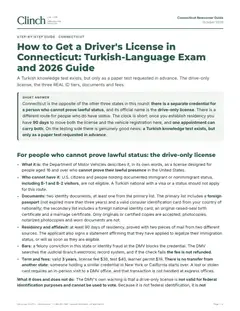
Connecticut is the opposite of the other three states in this round: there is a separate credential for a person who cannot prove lawful status, and its official name is the drive-only license. There is a different route for people who do have status. The clock is short: once you establish residency you have 90 days to move both the license and the vehicle registration to Connecticut, and one appointment can carry both. On the testing side there is genuinely good news: a Turkish knowledge test exists, but only as a paper test requested in advance.
Steps, documents and official links
For people without lawful status: the drive-only license
The Connecticut Department of Motor Vehicles (DMV) describes it in its own words as a license designed specifically for undocumented individuals who are 16 years of age or older and unable to establish lawful presence in the United States. The details that matter:
- Who cannot have it: U.S. citizens and documented immigrants and non-immigrants, including B-1 and B-2 visitors, are not eligible. A Turkish national with a visa or status should not apply for it; take the ordinary route below.
- Documents: two identity documents, at least one from the primary list. The primary list includes a foreign passport (not expired more than three years) and a valid consular identification document from your country of citizenship. The secondary list includes a foreign national identity card, an original birth certificate with a raised seal, and a marriage certificate. Originals or certified copies only: no photocopies, no notarized photocopies, no damaged documents.
- Residency: at least 90 days in Connecticut, proven with two pieces of mail from two different sources.
- Affidavit: the applicant signs a statement that they have filed, or will file as soon as they are eligible, an application to legalize their immigration status.
- Bars: a felony conviction in Connecticut, or identity fraud at the Connecticut DMV, disqualifies. The DMV searches the Judicial Branch electronic criminal record system and there is no refund if the check fails.
- Term and fees: valid three years, license fee $36, plus $40 testing and $19 for the learner permit, both paid online when booking.
- No out-of-state transfer. The DMV does not accept transfers of drive-only or similar driving-privilege licenses from other states. Someone holding a comparable card from New York or California starts the Connecticut process from the beginning.
- Lost or stolen means an in-person visit to a DMV office, and this cannot be done at an express office (see below).
What it does and does not do. The DMV's own warning is that a drive-only license is not valid for federal identification purposes and cannot be used to vote. Because it is not a federal-purpose credential, it does not work for a domestic flight. Its standing in other states is uncertain by the DMV's own wording: the card may be honored elsewhere, but you should check with the other state before driving in it. We could not confirm the exact legend printed on the card; the DMV page says only that it is not valid for federal identification. Ask when you apply: DMV 860-263-5700 or 1-800-842-8222.
The ordinary first license for a lawfully present newcomer
- Coming from another U.S. state, it is a transfer. If your current license is valid, or expired no more than two years, no knowledge test and no road test are required; you take a vision test at a full-service office. Documents: the current license, acceptable identification, a completed Form R-229, and the fees. The cost is $84 license plus $40 application, and if you pay by check that means two separate checks, both payable to DMV.
- If the license expired more than two years ago, you need a Connecticut learner permit and an eight-hour safe driving practices course at a Connecticut-licensed driving school before the skills test. If the license was lost, a certified out-of-state driving record dated within 60 days is required.
- If you have never held a license (a Turkish license does not count here, see below): learner permit, knowledge and vision tests, driver training, road test, license. An adult learner permit is required at 18 and over and is valid for two years.
- Since January 1, 2026 there is a new requirement: every learner permit applicant must complete the free online Connecticut Work Zone Safety Course, which takes under an hour, print the certificate and hand it to the DMV before the knowledge test. A guide written in 2025 will not mention it.
- The card is not handed over at the counter. Connecticut uses central issuance: the license arrives by mail within 20 business days and can be tracked at dmvcardtrack.ct.gov.
If you are not a U.S. citizen, the DMV states that proof of legal status in this country is required. Some people do not have to get a Connecticut license at all: a full-time student living here but keeping a permanent residence out of state or out of the country, active-duty military and their dependents, and a person in the U.S. on a visitor visa.
What languages is the knowledge test in?
This has to be stated precisely, because Turkish exists but is not on the screen.
| Test format | Languages |
|---|---|
| Standard test (at the office, on screen) | Albanian, Arabic, Mandarin Chinese, English, French, Italian, Polish, Portuguese, Russian, Spanish, Vietnamese. Turkish is not on this list. |
| Hard-copy test requested in advance | Amharic, Armenian, Bosnian, Chinese Simplified, Croatian, Dari, German, Greek, Haitian Creole, Hindi, Japanese, Khmer, Korean, Nepali, Pashto, Persian Farsi, Brazilian Portuguese, Punjabi, Romanian, Somali, Thai, Turkish, Ukrainian, Urdu. |
So a Turkish-language knowledge test does exist in Connecticut and has to be requested in advance as a paper test. The DMV page does not say how far in advance or at which offices, and we could not establish it. When you book, call the DMV and have the request for a Turkish paper test put on the record (860-263-5700 or 1-800-842-8222). For languages not offered, a printed foreign dictionary free of markings may be brought, and the DMV can supply a headset for an audio version. The driver manual itself is published only in English and Spanish, with no Turkish edition. The language menu on portal.ct.gov is a machine-translation widget for the website, not Turkish-language customer service.
Test mechanics
- The knowledge test is 25 questions with 20 correct to pass, drawn from the Connecticut driver manual.
- The Class D vision standard is 20/40 with or without lenses and 140 degrees of binocular peripheral field. The vision test comes first in the same appointment.
- The exam fee is $40. Fail the knowledge test and you wait seven days and pay $40 again. Fail the vision test and you can rebook immediately.
- Bring: acceptable identification, a completed and signed Form R-229, the $40, any Connecticut non-driver ID card you hold (it is surrendered when the learner permit issues), glasses or contacts, and the Work Zone Safety Course certificate. Photocopies and faxes are not accepted.
REAL ID: three tiers, and the tier decides whether the card works at an airport
This is the most consequential part of the page for a Turkish reader. A REAL ID is identified by the gold star in the top right corner; an ID card without the star is stamped "Not for Federal Identification".
| Tier | Who | Result |
|---|---|---|
| Full-term REAL ID | In the DMV's own words, only U.S. citizens, permanent residents and asylees or refugees with acceptable documentation. | Gold star. Works for domestic flights and federal buildings. |
| Limited-term REAL ID | The DMV's frequently-asked-questions section: "Currently, only residents with Deferred Action for Childhood Arrivals (DACA) status are eligible to apply." The DMV adds that it is working on including other residents. | Gold star plus the words "LIMITED-TERM" next to it. Expiry aligns with the expiry on the status document; if the document has no expiry, one year. |
| Drive-only license | People who cannot establish lawful presence. | No REAL ID at all. The DMV: "Under current law, a drive-only license does not qualify for a verified license/REAL ID." |
And here the DMV contradicts its own page. The general text on the license page says holders of other visa categories may be eligible for a limited-term REAL ID; the frequently-asked-questions section on the same page says DACA only. We are not resolving that contradiction, we are printing it: a Turkish national in Connecticut on H-1B, L-1, F-1 or J-1 should call the DMV before applying and ask which answer applies to their own status (860-263-5700).
Four more things about the limited-term card:
- The six-month rule: the status document must have at least six months remaining. With less than six months left, the DMV says the person may be eligible for a full-term regular credential, meaning an ordinary license without the star.
- A one-way door: "Once you obtain a limited-term REAL ID, you cannot revert to a regular full-term credential."
- The SAVE check: status is verified through the federal SAVE system, and this "may take up to ten (10) business days or more to process". Build it into every timeline.
- Limited-term Class D learner permits are not currently available. The limited-term credential comes only as a license or an ID card.
Where you can do it. Identity verification is done at DMV hub and branch offices and at participating AAA and Nutmeg State Financial Credit Union locations. But the DMV's own sentence is flat: "Non-U.S. citizens must visit a DMV office." The express offices run by the motoring club and the credit unions are closed to a Turkish reader. Verification is free and is a one-time review; if you are not due for renewal and want a REAL ID anyway it is a $30 duplicate fee. The document checklist PDFs come only in English and Spanish. You can also decline verification and simply renew: a license without the star is fully valid to drive, it just does not meet the federal standard, and a valid passport works at the airport instead.
Fees
| Transaction | Fee |
|---|---|
| Out-of-state license transfer | $84 license + $40 application (two separate checks if paying by check) |
| Knowledge and vision exam | $40 (and $40 again after a failed knowledge test) |
| License renewal, six years / eight years | $72 / $96 |
| License renewal, age 65 and over | $24 for two years (optional) |
| DMV ID card, six years / eight years | $24 / $32 |
| REAL ID outside a renewal (duplicate) | $30 |
| Limited-term REAL ID, new Class D license | $84 (plus $40 on an out-of-state transfer) |
| Limited-term REAL ID, non-driver ID | $28 |
| Drive-only: testing / learner permit / license | $40 / $19 / $36 (three-year license) |
| Work Zone Safety Course | Free |
Limited-term renewals are prorated by the year, because the credential cannot outlive the status document. We do not publish registration, plate, title or emissions test fees on this page: the DMV fee schedule could not be opened by any route during the research, and we would rather leave a gap than print a guess. Confirm the figure with the DMV before your transaction.
Appointments and offices
Almost nothing in Connecticut is done by walking in. The DMV banner carried on every page reads: walk-in services are not available at the Cheshire, Putnam and Stamford locations; no location offers walk-in services on Saturdays; residents should expect long wait times without an appointment. The same banner has a line worth using: the appointment system is updated in real time, with new appointments added regularly. So someone who finds nothing available should check again rather than give up. There are three kinds of office: hub and branch offices are full service, while express offices sit inside AAA and Nutmeg State Financial Credit Union branches and are limited, and non-citizens cannot use them.
Mailing address: Department of Motor Vehicles, 60 State Street, Wethersfield, CT 06161. Titles go to ATTN: Title Section, Room 305 at the same address; insurance matters to the Insurance Compliance Unit, CT 06161-4020. Phone: 860-263-5700 or 1-800-842-8222, insurance compliance 860-263-5725.
PDF: How to Get a Driver's License in Connecticut: Turkish-Language Exam and 2026 Guide
02 · Foreign license
Can a Turkish license be exchanged in Connecticut?
Short answer
No. Connecticut gives the easy, out-of-state-style treatment to exactly three foreign countries: Canada, Germany and France. Türkiye is not on the list. A Turkish license is accepted only for one year, and the DMV pairs it with an International Driving Permit (IDP) issued by your country of origin. You have to get the IDP before leaving Türkiye, because the issuing body is your own country.
Steps, documents and official links
The DMV's own sentence is this: "You may operate a vehicle in Connecticut for one year with a valid out-of-country license and an international driver permit (IDP) issued by your country of origin." So in the DMV's framing the foreign license alone is not enough, and the window is one year.
The practical sequence
- Get the IDP before you leave Türkiye. This is the single most expensive assumption a Turkish reader can get wrong: an IDP cannot be bought in Connecticut.
- Drive on the Turkish license plus the IDP for the first year.
- Use that same year to get the Connecticut adult learner permit, complete the Work Zone Safety Course and sit the knowledge and vision tests.
- Take the road test and collect the Connecticut license.
The DMV confirms the list from the other direction too: "If you already have a driver's license from another U.S. state or territory, Germany, Canada, or France, you can transfer your license to Connecticut without getting an adult learner's permit." Türkiye does not appear in that sentence, and the research found no reciprocity arrangement between Connecticut and Türkiye. Because the DMV's dedicated sub-page on requirements for holders from U.S. territories, Canada, Germany, France and Puerto Rico could not be opened, we write the conclusion that no other route exists as probable rather than settled. Confirm with the DMV at 860-263-5700.
If your Turkish license is used as a supporting document and it is not in English, it has to be translated by a DMV-approved translator. The DMV publishes an approved translator list; ask for it before your appointment, because an arbitrary sworn translation may not be accepted.
03 · Car
How do you register a car in Connecticut?
Short answer
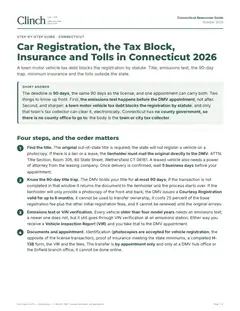
The deadline is 90 days, the same 90 days as the license, and one appointment can carry both. Two things to know up front. First, the emissions test happens before the DMV appointment, not after. Second, and sharper: a town motor vehicle tax debt blocks the registration by statute, and only that town's tax collector can clear it, electronically. Connecticut has no county government, so there is no county office to go to: the body is the town or city tax collector.
Steps, documents and official links
Four steps, and the order matters
- Find the title. You need the original out-of-state title; Connecticut will not register a vehicle on a photocopy. If a lienholder or leasing company holds it, the original must be mailed to the DMV by the lienholder directly: ATTN: Title Section, Room 305, 60 State Street, Wethersfield, CT 06161. A leased vehicle also needs a power of attorney from the leasing company. Wait five business days after delivery is confirmed before attending the appointment.
- The 90-day title trap. The DMV holds your title for up to 90 days and then returns it to the lienholder if the transaction is not completed, and the whole process restarts. If the lienholder will only supply a photocopy of the front and back, the DMV issues a Courtesy Registration valid up to six months; it cannot be used for an ownership transfer, costs 25 percent of the base registration plus the other first-time fees, and cannot be renewed until the original title arrives.
- Emissions test or VIN verification. An emissions test is required for a vehicle older than four model years and not required for one younger than that, but an exempt vehicle still needs VIN verification, also done at an emissions station. Either way you leave with a Vehicle Inspection Report (VIR) and take it to the DMV appointment.
- Documents and appointment. Identification (photocopies are accepted when registering a vehicle, the opposite of the license counter), proof of insurance meeting the Connecticut minimums, a completed Form H-13B, the VIR and the fees. The transfer is by appointment only and only at a DMV hub office or the Enfield branch office. It cannot be done online.
The town tax blocks the registration, and the verb is "requires"
This is the sharpest practical fact on the page. The DMV's own words: "CT state law requires the DMV to deny vehicle registrations in the name of a person who is reported as tax delinquent by a Connecticut town or city." Four consequences follow:
- It is person-based, not vehicle-based. The denial attaches to the person's name, so a debt on one car blocks the registration of a different car and blocks any renewal in that name.
- Paper releases are dead. The DMV note reads: "The DMV will no longer accept paper tax releases. Your tax collector will need to clear you online." Arriving at the counter with a stamped receipt from the town hall will not work.
- The body is the town. You contact the city or town named on the notice, settle the obligation, and that town's tax collector clears the record electronically. County government was abolished in Connecticut in 1960, so there is no county office in this process.
- Parking tickets use a different verb. For unpaid parking tickets, state law allows the DMV to deny a registration; it does not require it. Tax delinquency is a must, parking tickets are a may. The distinction is small on paper and large in practice: the tax debt is a hard wall.
How long the electronic clearance takes is not published, and we could not confirm whether a town can do it the same day. Call your town tax collector weeks, not days, before a renewal is due.
There is a third gate: emissions status. The vehicle you are registering must be current on emissions, and a test done 30 days past the deadline carries a $20 late fee. Commercial vehicle safety records form a fourth: a person flagged over a roadside inspection (860-263-5446), a school bus inspection (860-263-5447) or a federal out-of-service order (860-263-5163) cannot register a vehicle.
Insurance: minimums and a $200 fine
| Coverage | Minimum |
|---|---|
| Bodily injury, per person | $25,000 |
| Bodily injury, per accident | $50,000 |
| Property damage, per accident | $25,000 |
On property damage the DMV says in its own words that you are strongly encouraged to consider higher levels of coverage. Coverage must be continuous for as long as the vehicle is registered: the duty ends when the registration or the plates are cancelled, not when the car stops being driven. Insurers report lapses automatically, and a lapse of more than 14 days triggers a mailed suspension notice. The fine is $200 per lapse; pay it and supply proof and the suspension is rescinded, and the fine can be rescinded entirely if continuous coverage is proved. Ignore the notice and the registration and all registration privileges are suspended, which means nothing can be registered or renewed in that name.
To stop coverage legitimately, return and cancel the plates or put them on hold with the "Customer held" option, and get a receipt. The DMV notes this also stops taxes accruing, which takes us back to the town car tax again. For a seasonal vehicle, request a suspension of liability in writing through the insurer and keep comprehensive cover; the vehicle may not be driven during that period. Acceptable proof of insurance is a declaration page, a letter of experience on the insurer's letterhead, or a valid permanent CT Insurance Identification Card. Temporary cards, bills and binders are not accepted.
Equipment traps for a car driven in from another state
- Window tint is legal only if each window carries a valid tint compliance sticker, or the vehicle has a manufacturer's safety certification label. A car legally tinted elsewhere can fail here.
- Aftermarket side-pipe exhaust is illegal. A factory-fitted working side pipe is allowed; a modification is not.
- Connecticut law requires two outside rear-view mirrors.
Registration, plate, title, Greenhouse Gas and administrative fees, the sales or use tax collected at registration, and the emissions test fee are not published on this page: the DMV fee pages could not be opened by any route during the research. We leave the gap rather than guess. For the same reason we could not confirm how often the emissions test repeats.
PDF: Car Registration, the Tax Block, Insurance and Tolls in Connecticut 2026
04 · Toll roads
Are there toll roads in Connecticut?
Short answer
None. Connecticut has no tolls on any highway, bridge or tunnel, and has not since the late 1980s. The last toll in the state was paid on the Charter Oak Bridge in Hartford on April 28, 1989. One consequence follows: there is no "E-ZPass CT", because Connecticut is not an E-ZPass member. A resident who wants a transponder opens an account with a neighboring state's agency.
Steps, documents and official links
A reader arriving from New York or Massachusetts assumes the opposite, so it has to be said first. Tolls came off the Connecticut Turnpike, I-95 and several Connecticut River bridges between 1983 and 1985, the legislature ended tolling on the Merritt and Wilbur Cross Parkways in 1986, and the Charter Oak Bridge was last in 1989. I-84, the motorway through Hartford, never had tolls at all. There is an independent check too: the E-ZPass Group's own member list names agencies across twenty states and no Connecticut agency appears on it.
Connecticut holds one of the federal Value Pricing Pilot Program slots, and the legislature's research office concluded in 2018 that reimposing tolls under a federal program would not require repaying the 1983 federal agreement. So the legal obstacle is gone and only the political one remains. No Connecticut toll was found in force or scheduled as of October 6, 2026, but this is the fact on this page most likely to change.
What happens when you leave the state
You meet tolls as soon as you cross the line, and because there is no Connecticut transponder you have to open an account with a neighboring state's agency. One tag covers the whole network: E-ZPass spans twenty states with more than 64 million devices in circulation, and a tag from any member agency is read by every other member.
| Into New York City (rates effective January 4, 2026, passenger car) | With E-ZPass | Tolls by Mail |
|---|---|---|
| Bronx-Whitestone, Throgs Neck and Robert F. Kennedy bridges; Hugh L. Carey and Queens Midtown tunnels | $7.46 | $12.03 |
| Verrazzano-Narrows | $7.46 | $12.03 |
| Henry Hudson | $3.42 | $8.87 |
| Cross Bay Veterans Memorial, Marine Parkway-Gil Hodges | $2.80 | $6.02 |
Look at the spread: on the main crossings, no transponder costs $12.03 instead of $7.46, roughly 61 percent more for the same crossing. For anyone commuting, that is the whole argument for opening an account before the first trip.
Do not let the word "resident" mislead you. The MTA's Staten Island Resident and Rockaway resident discounts turn on living in a named New York neighborhood. A Connecticut resident qualifies for none of them.
In Massachusetts tolling is all-electronic with no booths; the program is EZDriveMA and it covers the Massachusetts Turnpike (I-90), the Tobin Bridge and the Sumner, Callahan and Ted Williams tunnels. With no transponder, an invoice is mailed to the registered owner. We do not publish a Massachusetts rate here because the rate pages could not be read. The Rhode Island Turnpike and Bridge Authority is an E-ZPass member, so your tag works on the Newport Pell Bridge, but its rates could not be read either. The New York State Thruway rate table and the amount of the Manhattan congestion charge were also not read, so we print no figure for any of those three.
05 · Public transit
How does public transit work in Connecticut?
Short answer
The bus side belongs to the state: CTtransit runs under the Department of Transportation, and the local fare is a two-hour pass rather than a single ride, so $1.75 buys unlimited local rides for two hours. On rail there is CT rail Hartford Line up the river valley and Shore Line East along the coast. There is no single train to New York: Hartford Line to New Haven, then Metro-North to Grand Central. The airport is Bradley International (BDL) and there is no nonstop to Istanbul.
Steps, documents and official links
Buses: CTtransit and CT fastrak
| Ticket | Fare |
|---|---|
| Two-hour local pass (unlimited rides) | $1.75 |
| All-Day Pass (until 2 a.m. the following day) | $3.50 |
| 10-Ride Ticket | $15.75 (ten rides for the price of nine) |
| 3-day / 5-day / 7-day / 31-day | $8.75 / $14 / $19.25 / $63 |
| Express (routes 901-971), 10-ride | $28.80 (2 zones) to $54.00 (5 zones) |
| Express, 31-day | $108.80 (2 zones) to $204.00 (5 zones), local rides included |
All tickets and passes include unlimited transfers. On the bus you need exact fare: the fare boxes do not give change. One catch: an All-Day Pass activated between midnight and 2 a.m. expires at 2 a.m. the same day. CT fastrak is the bus rapid transit line running out of Hartford on its own dedicated busway, and the Go CT Card works on both CTtransit and CT fastrak buses, so you do not need a separate product. The CT fastrak alignment, station list and frequency could not be read during the research.
Which fare medium? There are three, and the one to use is the Go CT Card, because it caps automatically: the card "calculates the lowest fare, capping your rides at daily, weekly, and monthly rates". The card costs $2, needs a minimum $10 loaded before first use, and neither the card nor the money on it expires. The Token Transit app sells two-hour, all-day, 31-day and 10-ride passes but does not work for express fares.
| Discount | Who | Fare |
|---|---|---|
| Youth | Ages 5 to 18. From October 1, 2026 a student ID is required. | $0.85 two-hour / $1.70 all-day / $7.65 10-ride / $30.60 31-day |
| Senior and disabled | 65 or over, or a qualifying disability. A Go CT senior/disabled card or a Medicare card must be shown, after a CT Reduced Fare Photo ID application | Same rates. Express 10-ride $14.40 to $27.00 by zone |
| Veterans | U.S. veterans and active-duty military. Began October 1, 2026, so older guides do not have it | Same rates. Not available on express service |
Do not call U-Pass CT free. The pass given to students at participating Connecticut colleges is, in CTtransit's own words, "included in student fees": the student has already paid for it through a mandatory fee. No general fare-free arrangement was found: every fare page read today publishes a positive fare for every category, youth, senior, disabled and veteran included.
Rail: CT rail Hartford Line
The line runs from New Haven through Wallingford, Meriden, Berlin, Hartford, Windsor and Windsor Locks to Springfield, Massachusetts, so it crosses the state line. Fares effective July 1, 2026:
| From Hartford to | One-way | 10-trip | Monthly |
|---|---|---|---|
| New Haven | $9.25 | $72.75 | $191.00 |
| Meriden | $5.25 | $42.00 | $110.00 |
| Berlin | $4.00 | $31.00 | $81.00 |
| Windsor | $3.50 | $26.50 | $69.50 |
| Springfield, MA | $6.75 | $55.25 | $144.75 |
Buying on board costs more: Hartford to New Haven is $9.25 in advance and $12.25 on the train. The cheapest family option in this file is here: up to four children aged 2 to 12 travel for $1 each with a paying adult, and under 2 is free. Seniors 65 and over and people with disabilities pay half on one-way fares. A one-way ticket is valid 60 days and a 10-trip 180 days, and a lost ticket is neither refunded nor replaced.
One ticket, any train. Amtrak accepts all CT rail Hartford Line tickets on its Regional and Shuttle trains between New Haven and Springfield, and the reverse holds. The exceptions: the Vermonter (trains 54, 55, 56, 57) always needs an Amtrak ticket, and on sold-out Amtrak trains only Amtrak-purchased tickets are accepted. It does not work the other way round: CTtransit tickets of any type are not accepted on the trains. Ticket channels are the CT rail eTix app, station vending machines and on board (cash or card, nothing larger than a $20 note). Tickets are not sold on hartfordline.com itself.
The bus bridge: Monthly Plus Bus adds unlimited CTtransit local service to any monthly rail ticket for $10, valid in all CTtransit and CT fastrak areas except Waterbury and Stamford. CTtransit Express route 950 accepts CT rail single-ride, weekly and monthly tickets between New Haven Union Station, New Haven State Street, Meriden and Hartford Union Station with no Plus Bus needed, though 10-ride rail tickets are not accepted on it.
Reaching New York by rail
There is no one-seat commuter ride. The standard route is two trains: Hartford Line to New Haven, then Metro-North's New Haven Line to Grand Central.
| Leg | One-way |
|---|---|
| Hartford to New Haven (CT rail) | $9.25 |
| New Haven to Grand Central (Metro-North Zone 21), off-peak | $20.25 |
| New Haven to Grand Central, peak | $27.25 |
| Total, one way | about $29.50 off-peak and about $36.50 at peak |
What counts as peak decides the difference: weekday trains arriving in New York terminals between 6 and 10 a.m. or departing between 4 and 8 p.m. Everything else on a weekday, all day Saturday and Sunday, and holidays are off-peak. Metro-North Zone 21 is $518.50 monthly and $184.25 weekly; bought on board it is $35.00 at peak and $28.00 off-peak, a surcharge of nearly $8. A combined ticket called UniRail exists and costs less than two separate tickets, but the Hartford row in the official fare chart carries no origin or destination heading, so we do not publish a UniRail price; price it at a ticket machine. Two warnings: reduced fares are not valid on morning peak New Haven Line trains to Grand Central, and a passenger who buys on board a CT rail train and changes to Metro-North must show the receipt or the onboard surcharge is charged again.
The airport: Bradley International (BDL)
The airport is not in Hartford. It is about 15 miles north at Windsor Locks, and its name contains neither "Hartford" nor "Windsor Locks", which is why booking sites label it "Hartford (BDL)" or "Hartford/Springfield". There is a single terminal, so no inter-terminal shuttle. CTtransit route 30, the Bradley Flyer, runs between Hartford Union Station and the airport, and route 24 runs between Windsor railroad station and Windsor Locks. Timetables and journey times could not be read.
There is no nonstop to Istanbul, or to anywhere in Türkiye. Bradley's only transatlantic nonstop is Dublin, and no other European city appears on the official airline list. A trip to Türkiye means either one stop (typically a U.S. hub, or Dublin) or a drive of about two hours to New York or Boston. By road, JFK is roughly 185 km from Hartford, Boston Logan roughly 160 km and Newark roughly 200 km. That is a real disadvantage against New York or Boston, and the guide is more useful for saying so. We could not confirm which airlines fly nonstop to Istanbul from JFK or Boston, how often or how long the flight takes, so we name no carrier and no flight time here.
Hartford's intercity station is Hartford Union Station, and one building does everything: CT rail, CTtransit buses including the Bradley Flyer, and Amtrak. Amtrak runs Northeast Regional and Shuttle trains plus the Vermonter on the New Haven to Springfield corridor. A holiday trap: Northeast Regional trains 140, 141, 143, 146, 147, 148 and 157 do not accept U-Pass CT during holiday blackout periods, and a sold-out Amtrak train can refuse a CT rail ticket outright. Anyone relying on a CT rail ticket on an Amtrak train at Thanksgiving or Christmas should expect to be turned away. We publish no Amtrak fares or times because they are dynamically priced; check amtrak.com for your date. We could not confirm which private intercity coach operators serve Hartford, so we name none.
06 · Regions
Which office do you go to in Connecticut?
Short answer
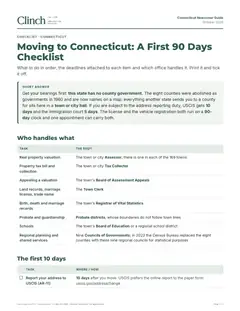
The most important sentence on this page is this: Connecticut has no county government. The eight counties were abolished as governments in 1960 and are now names on a map. There is no county executive, no county council, no county clerk, no county assessor and no county tax collector, and no county seat with offices. Everything another state sends you to a county for sits here in a town or city hall. In 2022 the U.S. Census Bureau replaced the eight counties with nine regional councils for statistical purposes, saying in terms that the counties "have not served a functional role since county government was abolished in 1960".
Steps, documents and official links
Who actually does what
| Function | Who does it in Connecticut |
|---|---|
| Property valuation | The town or city Assessor, one in each of the 169 towns |
| Property tax billing and collection | The town or city Tax Collector |
| Assessment appeals | The town Board of Assessment Appeals, not a county board |
| Land records, marriage licenses, trade names | The Town Clerk |
| Birth, death and marriage records | The town Registrar of Vital Statistics |
| Probate and guardianship | Probate districts, whose boundaries do not follow town lines |
| Schools | The town Board of Education or a regional school district. There are no county school systems. |
| Regional planning, transit coordination, shared services | Nine Councils of Governments (COGs), which are also Connecticut's official county-equivalent geography for federal statistics |
So nowhere on this page do we tell you to go to the county office, because there is no county office to go to. For a Hartford address the body is Hartford City Hall, 550 Main Street. The nine regional councils are Capitol (CRCOG), Greater Bridgeport (MetroCOG), Lower Connecticut River Valley (RiverCOG), Naugatuck Valley (NVCOG), Northeastern Connecticut (NECCOG), Northwest Hills (NHCOG), South Central Connecticut (SCRCOG), Southeastern Connecticut (SCCOG) and Western Connecticut (WestCOG). Hartford, Newington, East Hartford and West Hartford are in Capitol; New Haven, Milford and Meriden are in South Central.
What fills the county-shaped hole
Three things. Regional planning, regional transport coordination and shared municipal services sit with the COGs. Probate runs through probate districts whose boundaries do not follow town lines, so the name of your town does not tell you which probate court you belong to. And the most striking one: in the Hartford area water and sewer do not come from a city department. They come from The Metropolitan District (MDC), a multi-town municipal corporation chartered by the legislature in 1929 and run as a non-profit. Its eight member towns are Bloomfield, East Hartford, Hartford, Newington, Rocky Hill, West Hartford, Wethersfield and Windsor. The address is 555 Main Street, Hartford, CT 06103 and customer service is 860-278-7850. Household hazardous waste collection is also an MDC program, not a city one.
There is no three-digit service line: write down the ten-digit number
Hartford's non-emergency line is Hartford 311, and it handles potholes, bulky waste, snow violations, housing code issues, trash and recycling violations, blighted properties, blocked sidewalks, illegal dumping and zoning violations. But note: the city publishes the full ten-digit number on its own page and never tells people to dial the short one. The number to save is 860-757-9311, weekdays 8 a.m. to 5 p.m., email [email protected], at Hartford City Hall, 550 Main St., Suite 001. The city's page does not say whether plain 311 connects from a Hartford phone, so use the ten-digit number.
If you have no identity document yet: the library card and the city ID
For a newcomer, the least demanding door in the city is the library. A Hartford Public Library card is free, and for an adult the requirement is a photo ID showing your Hartford address, or a photo ID plus documentation of your current Hartford address: a lease, a recent utility bill, or a piece of mail in your name from the past 30 days. A Social Security number appears nowhere in the requirements. A passport or a green card counts as the photo ID, in which case the address is proven separately. For children aged 0 to 12 the application goes home and a parent's signature is sufficient to prove the child's identity and residency, with no document for the child at all. And the part that matters most: if you cannot produce photo ID or prove your address, the library issues an E-Card, renewable every two years, giving internet access and the online resources. You cannot borrow physical items on it, but the door does not close entirely.
Hartford also issues a municipal identity card, the Hartford City ID, described by the city as "an accessible and secure document that enables residents to access City services and grant admission to City buildings, such as schools". The applicant must be a Hartford resident and must bring three documents: one proof of identity with photograph and date of birth from a primary list, one proof of identity from a secondary list, and one proof of Hartford residency. Fees, cash only: $25 for adults 18 and over, $15 for youth 17 and under, $15 for seniors 65 and over, $15 to renew. You call 860-695-6300 for a phone consultation and the appointment is held at the Hartford Public Library. The guide says the card can serve as identification in police interactions and, depending on the bank, for banking. The page names neither immigration status nor a Social Security number. Do not read that as "open to everyone": read it as the page saying nothing about it, and confirm before you apply. Check the city's own pages on hartfordct.gov for the current program and fees.
Why Hartford has the highest tax rate in the state
One line: the city is under state fiscal oversight. Connecticut's Municipal Accountability Review Board runs a four-tier oversight system for financially distressed municipalities, and Hartford moved from Tier III to Tier II in late 2023. As a Tier II city Hartford files monthly financial statements and its annual budget with the board, and the board approves the city's revenue assumptions every year.
One last note: none of the town-level detail here transfers to another town. New Haven, Milford, Meriden and Newington each set their own mill rate, run their own assessor and tax collector, and, being over 25,000 in population, each must have their own Fair Rent Commission. Do not carry any Hartford figure to another town.
07 · Electricity and gas
How do you start electric service in Connecticut?
Short answer
For someone with no credit history, Connecticut's answer sits in regulation rather than on a help page, and it is the clearest answer in this series. The regulation puts a Connecticut identity card or driver's license alongside a Social Security number in its definition of identification, and a deposit may be required only where the applicant fails to give positive answers to at least three of six credit questions. The deposit is capped at three twelfths of a year's estimated billing, it earns interest, and service may not be refused because the customer cannot afford it. The supply half of the bill changes on a fixed calendar, every January 1 and July 1.
Steps, documents and official links
The two halves of the bill
Connecticut has retail electricity choice, so the bill splits in two:
- Delivery: your distribution company. Across most of the state that is Eversource (the regulated company is still legally The Connecticut Light and Power Company); on the Bridgeport to New Haven coast it is United Illuminating (UI). You cannot shop for this. A handful of towns have a municipal electric utility and sit outside the framework.
- Supply: either Standard Service, bought by the distribution company through a competitive procurement under regulatory supervision, or a third-party supplier you choose yourself.
| Standard Service supply rate | Eversource | United Illuminating |
|---|---|---|
| July 1, 2025 | 9.748 cents/kWh | 11.6841 cents/kWh |
| January 1, 2026 | 12.64 cents/kWh | 13.695 cents/kWh |
| July 1, 2026 (in force now, through December 31, 2026) | 11.58 cents/kWh | 11.95 cents/kWh |
The January 2026 rise added about $20 a month to an average Eversource household using 700 kWh a month, roughly a 29 percent jump in the supply rate. The July 2026 fall, combined with a May 2026 adjustment, brought average monthly bills down by about 18 percent. Connecticut electricity is among the most expensive in the United States, and the supply half can swing about 30 percent in a single step on a date known in advance. The practical consequence: anyone signing a fixed-price supplier contract in December is comparing it against a Standard Service rate that is about to change. The next change is January 1, 2027. The regulator publishes its own supplier comparison board rather than leaving shoppers to commercial sites, so start there.
There is no municipal aggregation, and that is not an accident
Connecticut has no Boston-style city default supply, and no legal framework for one. A 2026 bill, H.B. 5245, would have let a municipality, alone or jointly with others, set up an opt-out aggregation program with a proposed effective date of October 1, 2026. Its bill history ends on April 2, 2026 with the bill tabled for the calendar: it was never voted on the floor and did not become law. So in Hartford the choice is down to two, Eversource Standard Service or a supplier you find yourself.
I have no SSN. Will they ask for a deposit?
Connecticut answers this in regulation. First the definition: "'Identification' means a social security number, the number of an identity card issued pursuant to section 1-1h of the Connecticut General Statutes, the number of a motor vehicle operator's license issued pursuant to section 14-36 of the Connecticut General Statutes or any other means of identification approved by the Department of Public Utility Control" (now the state utility regulator). So a Connecticut non-driver identity card or a Connecticut driver's license is explicitly as good as an SSN.
On deposits the rule is that a deposit may be required from a new customer only if they fail to give positive answers to at least three of six credit questions, asked in order and stopped as soon as three positives are given. The six cover the employer, length of time with that employer, whether you own or rent and whether there is a written lease, bank accounts, credit references, and any significant income other than employment. What matters to a newcomer is which answers count as positive:
- A written lease of one year or more, or having lived at no more than two addresses in the past two years, or owning the home.
- A checking or savings account held for at least one year and not overdrawn.
- A job, or the employment of a spouse living with the applicant. Where the employment history is shorter than 18 months, school, college, a training program, active military duty, illness or hospitalization are accepted as explanations.
- Two of the last three years as a customer of the same type of utility from another company with a clean record, or a major credit card in good standing, a verifiable store account or verifiable bank credit.
- Other more-than-nominal income such as a pension, real estate, stocks, alimony or welfare.
Even where a deposit is required it is bounded. It is capped at three twelfths of a year's estimated billing, in effect three months of estimated bills, and the company may allow instalments. It must earn interest, accruing daily and credited annually, with accrued interest paid when the deposit is returned. And most important: the company may not refuse service because the customer cannot afford the deposit. "Lacks the financial ability" is defined to include people receiving listed public assistance, people whose only support is social security, veterans or unemployment benefits, anyone whose income is below 125 percent of the federal poverty level, and anyone for whom paying would threaten the necessities of life for themselves or dependent children. The company must decide and notify within five working days and must explain before the credit questions that they are asked only to determine credit standing.
Two limits. First, the regulation covers gas and electric distribution companies and electric suppliers, so Eversource and the gas company; it does not cover the MDC water and sewer bill or municipal trash charges. Second, there is no guarantor or co-signer route in the regulation; the research found none. Against that, the package above is arguably stronger protection than a guarantor rule. What each company asks for in practice from an applicant with no SSN is not stated in the regulation, so call the company and ask, citing this provision.
Gas, water, trash and internet
- Natural gas: in the Hartford area it is Connecticut Natural Gas (CNG), founded in 1848, with about 183,000 customers across 26 communities including Hartford, East Hartford, West Hartford, Newington, Bloomfield, Windsor, Wethersfield, Rocky Hill, Farmington, Glastonbury, Manchester and New Britain.
- Water and sewer: the MDC, which as explained above is not a city department. 860-278-7850.
- Trash and recycling: in Hartford this is the city's Public Works department, not billed separately but covered by the property tax. On bulky waste, each non-commercial property of 1 to 6 units gets two free collections per unit per year, five items or fewer each; an extra collection costs $75, or you buy a $10 permit (up to four visits) and take the items to the transfer station yourself. Confirm these figures with 311.
- Internet: the state Broadband Office sits inside the Office of Consumer Counsel and publishes its own provider list and its own broadband map. At a Hartford address the realistic wireline choices are Comcast (Xfinity) and Frontier; the state list also names Altice (Optimum), Charter (Spectrum), Cox, Atlantic Broadband, Verizon, AT&T and T-Mobile. Check your address on the map; the list is not a promise.
Shut-off protections, which matter to a tenant
A company must give at least 13 days' notice before cutting service. It will not cut off where someone in the home is seriously ill (a doctor's written notice plus partial payment), nor on a Friday, Saturday, Sunday, legal holiday, the day before a holiday or a day the business office is closed, and once at least 20 percent of the amount due is paid the process stops and a fresh 13-day notice is required. And service may not be shut off at all from November 1 to April 15 for a low-income household on SSI, TANF or general assistance, or whose only income is social security, veterans compensation, a pension or unemployment compensation. The regulator is at 10 Franklin Square, New Britain, CT 06051, toll-free 1-800-382-4586.
08 · Renting
What are your rights as a tenant in Connecticut?
Short answer
There are two sides and you have to read them together. The deposit rules are strict: at most two months' rent (one month if the tenant is 62 or over), held in escrow at a Connecticut bank, with interest paid every year, and a landlord who returns it late can owe double the deposit. Against that, there is no right to advance notice of a rent increase unless your lease says so. Rent control is illegal, but every town above 25,000 people must have a Fair Rent Commission, and it has real powers.
Steps, documents and official links
The security deposit
| Rule | Detail |
|---|---|
| Cap | Two months' rent. One month's rent if the tenant is 62 or older. |
| What counts | Any advance rental payment or instalment other than the first month's rent, a key deposit or a deposit for special equipment. |
| Whose money | The deposit remains the tenant's property; the landlord holds only a security interest in it. |
| Where it sits | In an escrow account at a financial institution located in Connecticut. |
| Interest | At least the average commercial bank savings rate set annually by the Banking Commissioner, paid on the anniversary of the tenancy or credited against the next month's rent. The 2026 rate is 0.49%. Earlier years: 2025 0.52%, 2024 0.55%, 2023 0.27%, 2022 0.06%. Current-rate line 860-240-8199. This figure changes every January. |
| Losing the interest | The tenant forfeits the interest for any month in which rent was more than ten days late, unless the landlord charged a late fee already agreed in the rental agreement. |
| Penalty | A landlord who misses the deadline may have to pay the tenant twice the deposit. The tenant can sue. |
The return deadline: two current official publications disagree
We are not resolving this, we are printing it. The Department of Banking booklet revised May 2026 gives the landlord 21 days from the end of the tenancy to return the deposit with interest or give written notice of the damages claimed, or, if the tenant gave no written forwarding address, 15 days after receiving one in writing. The Judicial Branch booklet revised January 2026 still says 30 days. The banking booklet is newer and comes from the agency that enforces the statute, so take 21 days as the figure, but know that the court's own booklet still prints 30 and act on the shorter one. A notice of damages must be itemized: the nature and amount of each item, unpaid rent and utilities included, together with the balance of the deposit and the interest.
To complain: Connecticut Department of Banking, Consumer Affairs, 280 Trumbull Street, 16th Floor, Hartford, CT 06103-1800, 860-240-8154 or toll-free 1-800-831-7225 extension 8154. The Commissioner can investigate, issue cease-and-desist orders, or refer the matter to the Attorney General. The alternative is a small claims action in a Housing Session. Note that the department moved offices on November 24, 2025, so older pages carry the old address.
Rent increases: you have no right to advance notice
This is a sharp contrast with the other states in this series and it belongs on the page plainly: a landlord is not required to give any particular notice of a rent increase, not even 30 days, unless the lease says so. Rent cannot be raised during the term of a written lease unless the lease allows it. If landlord and tenant cannot agree a new rent, the tenant must pay what they honestly believe is the fair rental value, and as long as they do the landlord may not be able to evict for non-payment, though the landlord may still move to evict for lapse of time.
The eviction grace period is nine days: on a yearly or month-to-month lease the rent must be paid by midnight of the ninth day after it is due (the fourth day on a week-to-week lease). After that the landlord may start proceedings. Eviction happens only through a court action: first a notice to quit served by a state marshal, then a summons and complaint; the tenant must file an appearance within two days of the return date or lose by default; after judgment a marshal may remove the tenant in as little as five days.
Retaliation is barred for six months after a tenant in good faith tries to bring the home into compliance with the law (filing a fair rent commission complaint counts), asks for repairs, or starts an action to make the landlord meet legal duties. The same protection follows notice of a municipal health or safety violation, or organizing or joining a tenants' union. There is also a category of protected tenants: generally tenants in buildings of five or more units who are 62 or older or have a disability cannot be evicted solely because the lease expired, and where a town has no fair rent commission they may go to Superior Court over an excessive increase.
Rent control is illegal, and Fair Rent Commissions take its place
Connecticut law does not permit a municipality to adopt rent control. What stands in its place is this: any municipality may create a fair rent commission, and every municipality with a population of at least 25,000 must have one. Its purpose is to control and eliminate "harsh and unconscionable" rental charges and to enforce the statutes against landlord retaliation and against certain lapse-of-time evictions. Its powers are real: it conducts studies and investigations, holds hearings, requires people to appear, issues subpoenas and administers oaths, and may amend or suspend its own orders. It may not hear complaints about seasonal accommodation rented 120 days a year or less.
Hartford's commission sits in the Housing Division of the Department of Development Services, at 860-757-9049. Three things make it usable:
- Only tenants may file. Any tenant resident in Hartford can. No written lease is required. No lawyer is required.
- It can make three kinds of order: set the rent at a fair level and require the landlord to accept it; order the increase phased in gradually; or delay the increase until repairs are made. It can also reduce the rent or hold it at the current level until the landlord completes needed repairs. If it finds the increase fair, it orders the tenant to pay.
- Among the 13 statutory factors it weighs is the tenant's own position: rents for similar apartments in the neighborhood, the health and safety condition of the unit, the number of baths and toilets, the services the landlord supplies, the size and number of bedrooms, the repairs needed to make it liveable, the landlord's taxes and expenses, compliance with the housing code, the tenant's income and whether there are other apartments the tenant can afford, which utilities are in the unit and who pays, damage beyond ordinary wear and tear, how much the landlord has raised the rent in the past, and how much of the increase will go into improving the apartment and building.
Complaint forms exist in English and Spanish. One warning: two official sources disagree on the address. The city's own guide gives 260 Constitution Plaza, Plaza level; the Judicial Branch booklet of January 2026 gives 250 Constitution Plaza, 4th Floor. The phone number agrees in both. Call 860-757-9049 and confirm the address before you go. And again: New Haven, Milford, Meriden and Newington each have their own commission, address and forms; there is no single statewide intake point. In the Hartford region alone the commission sits in the town manager's office in Bloomfield, social services in West Hartford, the human rights office in New Britain, community development in Windsor and the town attorney's office in Manchester.
Hartford licenses landlords, and the current phase is open
Since 2019 Hartford has run a Rental Licensing Program: every residential rental building of three or more units, plus hotels, motels, rooming houses and group living, must hold an active rental license. To get one the owner must pass Fire Marshal and housing code inspections and submit a lead-safe inspection report from a Connecticut licensed lead risk assessor; the license runs four years, conditional on annual Fire Marshal inspections. The window for three-unit buildings that are not owner-occupied is July 1 to October 31, 2026, so it is open right now, and a late application costs $1,000 plus a notice of violation and possible daily fines per dwelling unit.
Buildings outside the program still need a Certificate of Apartment Occupancy before each change of tenancy, at $25 per unit covering the application and the housing code inspection. If the unit fails, the owner has 30 days to fix the violations; a re-inspection requested later costs an extra $100. One- and two-unit buildings, owner-occupied units, new construction and substantially reconstructed buildings are outside it. As a tenant, ask: a unit let legally in a building of three or more should have a current rental license, and a unit in a smaller covered building should have a certificate issued for this change of tenancy. You can ask the landlord for it and report a problem through the 311 housing code route. The research found no statewide Connecticut rental registration or licensing requirement: this is a Hartford ordinance, so New Haven, Milford, Meriden and Newington have to be checked separately.
Official sources
09 · Property tax
How is property tax calculated in Connecticut?
Short answer
The rate is written in mills, not percent: one mill is $1 of tax for every $1,000 of assessed value. Assessed value is 70 percent of market value. The town-to-town spread is the widest in this series: in fiscal 2027 the lowest town is 9.80 mills and the highest city is 69.95 mills. On top of that Connecticut taxes your car as property every year. Against all that, there is no local income tax and no local sales tax anywhere, which is the exact opposite of Maryland and Ohio.
Steps, documents and official links
What a mill is, and how the sum works
This series has never needed to explain it before, so plainly: the formula is (assessed value x mill rate) / 1000 = annual tax. Assessed value is fixed by statute at 70 percent of fair market value, so a $200,000 house is assessed at $140,000. At Hartford's fiscal 2027 rate of 69.95 mills that is 140,000 x 69.95 / 1000 = $9,793. A 69.95 mill rate is 6.995 percent of the assessed value, which is why Connecticut rates look alarming next to a Texas or Georgia percentage.
Three dates. Every town must revalue every five years, with a physical inspection every ten. Everything is measured on October 1, the grand list date. And the bill from the October 1, 2025 grand list is the fiscal 2027 bill, payable from July 2026, so the rate a newcomer pays in their first year came off a list compiled before they arrived. In Hartford, bills over $100 are paid in two instalments due July 1 and January 1, each with a one-month grace period, and delinquent interest runs at 1.5 percent a month, 18 percent a year, minimum $2.
| Fiscal 2027 mill rates (sample) | Real property | Motor vehicle |
|---|---|---|
| Hartford (highest in the state) | 69.95 | 32.46 |
| Hamden | 53.67 | 32.46 |
| New Haven | 39.962 | 32.46 |
| Meriden | 29.99 | 29.99 |
| Milford | 28.67 | 28.67 |
| Greenwich | 10.125 | 10.125 |
| Salisbury (lowest in the state) | 9.80 | 9.80 |
Hartford carries three rates at once. It is 69.95 on real and personal property, 32.46 on motor vehicles (the statewide cap), and the Tax Collector also publishes a residential effective rate of 36.20, meaning residential property is assessed at a lower ratio than the statutory 70 percent. On top of that three special services districts add mills inside their boundaries: Park Street plus 3.5, Columbia Street and Park Terrace plus 2.3, the Business Improvement District plus 1.7294. A property inside the Park Street district pays 69.95 plus 3.5, so 73.45 mills. Statewide there are 525 separate rates across 169 towns, counting fire districts, sewer districts, boroughs and private association districts. We do not publish the residential assessment ratio as a figure, because it could not be confirmed outside unofficial sources; use the effective rate and ask the Assessor for the exact number (Hartford Assessor: City Hall, 550 Main St, Room 108, 860-757-9640).
The car is taxed as property every year, and the method changed on October 1, 2024
Connecticut taxes cars as property every year, at town level. There is no state vehicle property tax and no county vehicle tax: the town where the car is garaged on October 1 sends the bill. The method changed as follows:
- Until the 2023 grand list, assessors used a price guide at 100 percent of average retail. Beginning with the October 1, 2024 grand list, a car is valued from its manufacturer's suggested retail price (MSRP), reduced by a statutory depreciation schedule.
- The MSRP is fixed once and then depreciated; the result is multiplied by the statewide 70 percent ratio, then by the motor vehicle mill rate, divided by 1,000. No vehicle may be assessed below $500.
- The default depreciation schedule: up to year 1, 85 percent of MSRP; year 2, 80; year 3, 75; year 4, 70; year 5, 65; year 6, 60; year 7, 55; year 8, 50; year 9, 45; year 10, 40; year 11, 35; year 12, 30; year 13, 25; year 14, 20; years 15 to 19, 15; year 20 and beyond, not less than $500.
- But a town may adopt an alternative schedule five points higher at every age (90 / 85 / 80 and so on), by a vote of the town's legislative body. So two towns can tax the same car differently. We could not confirm which schedule Hartford uses; ask the Assessor on 860-757-9640.
The state's own worked example, a 2020 Honda Accord LX: under the old method $20,325 retail x 70 percent = $14,227.50 x 32.46 mills = $461.83; under the new method MSRP $24,020 x 65 percent = $15,613 x 70 percent = $10,929.10 x 32.46 mills = $354.76.
The cap is a ceiling, not a rate: the motor vehicle mill rate cap is 32.46 mills, and it is the combined limit on the town plus any taxing district inside it. It only bites where the town's real property rate is above it. In fiscal 2027 only 31 of the 169 towns sit at exactly 32.46, Hartford and New Haven among them. Towns below the cap simply use their own rate for cars. So in Hartford the car rate (32.46) is less than half the house rate (69.95).
Registering mid-year brings two bills. The list is taken on October 1. A car registered in Connecticut between October 2 and July 31 is not on that list; it goes on the supplemental motor vehicle list and the tax is prorated for the months remaining in the assessment year. The supplemental bill has historically been due January 1, and from the October 1, 2024 assessment year the law added a second supplemental due date. So someone who registers a car in November pays nothing at first, gets a prorated supplemental bill months later, and then gets a full-year bill the following July: two car tax bills inside about seven months, with nothing in the registration process warning them. Ask your town tax collector for the exact due date on your own supplemental bill (Hartford Tax Collector: 550 Main St, Room 106, 860-757-9630).
A few more details: snowmobiles, all-terrain vehicles and residential trailers used only for personal use are now exempt (DMV registration is still required). Antique vehicles 20 years and older are capped at a $500 assessed value. Unregistered and inoperable vehicles are valued like any other from the 2024 assessment year, so a car sitting on the drive is still taxed. You may appeal the MSRP used; boards of assessment appeals meet in March and September, and the September meetings are for motor vehicles only. To be heard in March, file by February 20; a further appeal goes to Superior Court within two months of the board's notice.
There is no homestead exemption
Connecticut has no homestead exemption in the Texas or Florida sense. Relief runs on age and disability only, plus veteran, blind and disability exemptions, plus a credit on the state income tax return. A working-age newcomer who buys a house generally gets nothing. We say that plainly.
| Program | What it gives | Who | Filing window |
|---|---|---|---|
| Homeowners' Elderly/Disabled (Circuit Breaker) | A credit on the property tax bill of up to $1,250 (married) / $1,000 (single) on a graduated income scale | Owner in residence, 65 or over or totally disabled, income under the limit | February 1 to May 15, at the town Assessor's office. Form M-35H, information line 860-418-6290 |
| Renters' Rebate (elderly and disabled renters) | A cash rebate of up to $900 (married) / $700 (single) based on rent and utility payments (excluding telephone) made in the prior calendar year | Applicant or spouse 65 or over; or a 50 or over surviving spouse of a qualified renter; or 18 or over and eligible for Social Security Disability. One year of Connecticut residency required | April 1 to September 30, no extensions, at the town assessor's office or a social service agency. Form M-35r |
The 2026 renters' rebate window closed on September 30, 2026. If you are reading this in October, the next window opens on April 1, 2027. Payment is made by November 30; if no check has arrived by December 15, call 860-418-6377. The application never goes to the state, it goes to the town.
Hartford adds its own programs. The state program as administered in Hartford has income limits of $46,300 single and $56,500 married; on top of that the City of Hartford Elderly Tax Relief Program gives a $1,000 tax credit ($1,500 on a four-family home), with limits of $70,950 single and $81,050 married. Both run February 1 to May 15 and are filed every two years. For the veteran's exemption the DD-214 must be filed with the Town Clerk by October 1; the blind exemption is $3,000 and the disability exemption $1,000 of assessment, both filed before October 1; motor vehicle tax is eliminated on vehicles equipped for a person with a disability; and Connecticut residents on active duty get an exemption for one passenger vehicle, applied for by December 31 each year.
The one thing everyone can use: a $300 state credit
Connecticut residents may claim a credit of up to $300 on the state income tax return for property tax paid on a primary residence or an automobile in Connecticut, so part of the car tax is creditable. The credit tapers with income: the maximum applies up to Connecticut adjusted gross income of $49,500 single, $35,250 married filing separately, $54,500 head of household and $70,500 married filing jointly, and no credit is available above $109,500, $65,250, $114,500 and $130,500 respectively. Those figures come from an official report dated November 2024, and we could not confirm they are unchanged for tax year 2026, so check before you file.
And there is no local tax on your pay
Connecticut municipalities may not levy a local income tax or a local sales tax. Local revenue authority is limited to the property tax (real property, motor vehicles, business personal property) and the real estate conveyance tax, and the property tax is over 98 percent of all local taxes, making Connecticut's local revenue structure the least diverse of any state. This is the exact opposite of the two states researched alongside it. In Maryland the county taxes your income on the state return. In Ohio the city where you work withholds from your pay, and 210 school districts levy an income tax based on where you live. In Connecticut your town takes nothing from your pay. The town's money comes almost entirely from the property tax, which is also why the mill rates vary so wildly from one town to the next.
10 · School
How do you enroll a child in school in Connecticut?
Short answer
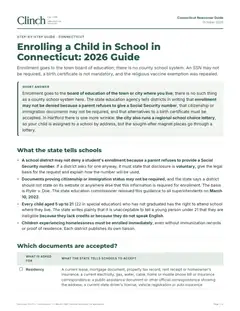
Enrollment goes to the board of education of the town or city where you live; there is no such thing as a county school system here. The state education agency tells districts in writing that enrollment may not be denied because a parent refuses to give a Social Security number, that citizenship or immigration documents may not be required, and that alternatives to a birth certificate must be accepted. In Hartford there is one more wrinkle: the city also runs a regional school choice lottery, so your child is assigned to a school by address, but the sought-after magnet places go through a lottery.
Steps, documents and official links
What the state tells districts
- "A school district may not deny enrollment to a student if his or her parent refuses to provide a social security number." If a district chooses to ask for one anyway, it must say that disclosure is voluntary, give the basis for the request, and explain how the number will be used.
- Districts must not ask for documents establishing citizenship or immigration status, and the state says a district "should not state on its website or elsewhere that such information is required to enroll a child". The authority is Plyler v. Doe. The state Commissioner of Education reissued this guidance to every superintendent on March 10, 2022.
- Every child 5 or over and under 21 (22 in special education) who has not graduated is entitled to attend school where they live. The state states expressly that it is not permissible to tell an under-21 non-graduate they are ineligible, including for lack of credits or English language skills.
- Children experiencing homelessness must be enrolled immediately, even without immunization records or proof of residence, and every district publishes its liaison.
What documents are accepted
| What is asked for | What the state tells districts to accept |
|---|---|
| Residency | A current lease, mortgage document, property tax record, rent receipt or homeowner's insurance; a current electric, gas, water, cable, home or mobile phone bill, or insurance correspondence; current proof of government benefits (disability, Medicare, SNAP) or other government correspondence showing the address; a current Connecticut driver's license, vehicle registration or car insurance. If the family lives with someone else, an Affidavit of Residence signed before a notary or a commissioner of the Superior Court may be used. |
| Age | A birth certificate is not required. Accepted alternatives include a photocopy of one, earlier school records, a state identification document, a driver's license or passport, a parent's sworn or unsworn statement of the date of birth, a physician's certificate, or even immunization records. The state's own words: "A student should not be barred from enrolling because the student's family cannot produce a birth certificate... a birth certificate may not be available to a foreign born child." |
| Immunization | Measles, mumps and rubella; polio; diphtheria, tetanus and pertussis; hepatitis B (preschool through grade 12); Haemophilus influenzae type b under age 5; hepatitis A in preschool and kindergarten. Varicella and meningococcal requirements also apply by grade. Check the state health department page for the current grade-by-grade schedule. |
The religious vaccine exemption is gone
This is a difference worth knowing for a family arriving from Türkiye. Public Act 21-6, effective April 28, 2021, removed the non-medical (religious) exemption. No religious exemption submitted after that date is valid. A narrow grandfather clause survives: the student must have been enrolled in grades K-12 on or before April 28, 2021 and have filed a valid religious exemption on or before April 27, 2021, both conditions together. The medical exemption remains, on a form developed by the state health commissioner. The repeal was upheld in court.
Hartford: where you register, and the lottery question
Registration is run by the Hartford Public Schools Office of Enrollment and School Choice, whose public office is the Welcome Center at 280 Trumbull Street, 9th Floor, Hartford, CT 06103, phone 860-695-8000. Mail and deliveries go to the district's main address, 330 Wethersfield Avenue, Hartford, CT 06114. Registration can also be done online at hartfordschools.org/enroll. Call ahead to confirm the floor and the hours. The district's own rule: "If your student is new to the district, you must submit a physical and immunization record to the school before school starts."
Now the thing a newly arrived family most needs to know: Hartford is not a simple neighborhood-school district. There are two separate processes:
- District placement. Hartford students are assigned to Hartford neighborhood schools and parents may express choices. Students entering a transitional grade, meaning grades 6 and 9, are not required to apply: they are assigned to their next school based on their resident address.
- The regional school choice lottery. About 45 interdistrict magnet schools across Greater Hartford, the Hartford Region Open Choice program (a Hartford child attends a suburban public school, or the reverse) and the technical high schools are allocated by lottery.
So the lottery is an opportunity, not a gate: your child gets a place without entering it. But the good magnet places come through it and the application windows open early, historically around February for the following school year. A family arriving mid-year registers at the Welcome Center and the child is placed; a family arriving in autumn who wants a magnet or Open Choice place is already looking at the following September. Confirm the exact dates on the district's own choice page.
English learner services, and be careful about Turkish
The district has a Department of Services for Multilingual Learners, World & Dual Language Programs, and Hartford uses the term "multilingual learners". The named bilingual programs are Dwight-Bellizzi Dual Language Academy and Dr. Michael D. Fox School, the latter running kindergarten to grade 2 in English and Spanish. The district says its families come from nearly 70 towns and speak nearly 90 languages.
But we do not claim Turkish support, because the district does not claim it. Turkish does not appear among the district's bilingual programs or among the languages in which it has awarded the state Seal of Biliteracy. The only place Turkish appears is the automatic "Select Language" translation widget in the district website's header. That is machine translation of a website: not an interpreter, not a bilingual program, not a translated enrollment service. There is a state-level backstop: Connecticut's bilingual education mandate is triggered by the number of speakers of the same language in one school, so a small language group gets English as a second language support rather than a bilingual program. Ask for an interpreter at registration and ask in writing which languages are provided.
Official sources
11 · Health
What can you do in Connecticut without health insurance?
Short answer
The most important health fact on this page for a family is this: Connecticut pays for its own coverage for children aged 0 to 15 who cannot get regular coverage because of their immigration status. The programs are called State HUSKY A and State HUSKY B for Children. No equivalent program for adults was found. Connecticut also runs its own insurance marketplace (not HealthCare.gov but Access Health CT), and state law bars a hospital from collecting more than the cost of care from an uninsured patient below 250 percent of the federal poverty level.
Steps, documents and official links
HUSKY Health: four letters, and use the letters
Connecticut's Medicaid program is called HUSKY Health, and it is not one program but four lettered parts. Learn the letters, because every Connecticut form and every clinic receptionist uses them.
| Part | Who it is for |
|---|---|
| HUSKY A | Medicaid for children and teens up to age 19, parents or relative caregivers |
| HUSKY B | The Children's Health Insurance Program (CHIP) for uninsured children and teens up to age 19 |
| HUSKY C | Adults aged 65 and over, and adults with disabilities |
| HUSKY D | Medicaid for low-income adults aged 19 to 64 without dependent children |
Regular HUSKY is open, in the marketplace's own phrasing, to "U.S. citizens, naturalized citizens, Lawful Permanent Residents (LPRs), and other immigrants", and the page does not enumerate which categories count as "other immigrants". One thing is stated flatly: "DACA recipients are not eligible to enroll in regular HUSKY Health programs." We could not confirm the full list of qualifying non-citizen categories, or whether the federal five-year bar applies in Connecticut; call 1-855-805-4325 before you apply.
State money for children: ages 0 to 15
This is the real answer to "can my undocumented child see a doctor in Connecticut", and it is a named program rather than a statement of goodwill.
- The programs are State HUSKY A for Children and State HUSKY B for Children.
- They cover, in the marketplace's own words, "uninsured children ages 0-15 who cannot enroll in regular HUSKY A (Medicaid) or HUSKY B (Children's Health Insurance Program (CHIP)) because they are undocumented immigrants."
- The age limit stops at 15. The program is published as ages 0 through 15.
- There is no online enrollment. In the program's own words: "You must enroll by phone or paper application; there is no online enrollment at this time." Apply by phone on 1-855-805-4325, or ask Access Health CT or a state service center for a paper application.
- The income limit of 323 percent of the federal poverty level, and the rule that a child enrolled before turning 16 may keep coverage through age 18, both come from a state social services page that could not be opened during the research. Do not treat those two points as settled; confirm by phone.
So the honest summary is this: a child in Connecticut can be covered with state money from birth to age 15 regardless of immigration status; a child enrolled before 16 may stay on it to 18; but a young person who arrives at 16 or older has no state-funded children's route and is in the adult position. And the program does not cover adults: the research found no Connecticut program covering undocumented adults.
Access Health CT: Connecticut runs its own marketplace
Connecticut does not use HealthCare.gov. It has its own state marketplace at accesshealthct.com. That matters, because a reader sent to the federal site gets lost.
| 2027 enrollment | Date |
|---|---|
| Open enrollment | October 23, 2026 to January 15, 2027. The marketplace moved this a week earlier than usual on purpose. |
| For coverage starting January 1, 2027 | Enroll by December 15, 2026 |
| Enroll December 16 to January 15 | Coverage starts February 1, 2027 |
The calendar is unstable: the marketplace's own announcement says new federal changes had required marketplaces to limit open enrollment to nine weeks and end by December 31, but that this is now subject to a lawsuit. The dates could move again, so check the site before you rely on them. Free help exists: six Navigator locations open year round, a mobile enrollment team running in-person sessions, a phone line on 1-855-805-4325 weekdays 8 a.m. to 4 p.m., and live chat. The marketplace says it supports "over 100 languages" but publishes no list, so we could not confirm whether Turkish is among them or whether a Turkish-speaking Navigator exists; ask when you call. The marketplace also runs a program called Covered Connecticut, which in its own words "provides no-cost insurance for eligible residents"; we could not confirm who qualifies because the site would not load during the research. One more point: buying a marketplace plan requires lawful immigration status under federal rule, and no Connecticut page says otherwise.
Hospital bills: the law caps what can be collected
Connecticut has a real answer here. Conn. Gen. Stat. 19a-673(b) provides that no hospital may collect more than the cost of providing care from an uninsured patient, where "uninsured patient" means a patient with family income under 250 percent of the federal poverty level and no insurance. We could not read the statutory text directly, because the legislature's site would not open by any route during the research, so we carry this as read from official documents rather than as settled text.
But keep the distinction: this is a bill reduction, not a clinic. Section 19a-673 limits what a hospital may collect; it does not promise free treatment. Some Connecticut hospitals also hold free bed funds, money donated for patients who cannot pay, with the Attorney General overseeing their proper use.
Hartford HealthCare's financial assistance policy, updated January 1, 2026, is unusually clear for this series:
| Situation | Discount |
|---|---|
| Uninsured, verified family income at or below 250 percent of the federal poverty level | 100 percent discount |
| Family income between 250 and 550 percent | 15 to 75 percent discount |
| Underinsured, at or below 250 percent | 100 percent discount, applied after insurance and health account payments |
The policy also recognizes presumptive eligibility: a patient may be found eligible for the 100 percent discount without applying, including where analytical software indicates income at or below 250 percent. Free bed fund information is on 860-696-6010. And most important, the policy's own words: "Decisions about financial assistance are made on a case-by-case basis and only consider financial need. Decisions never take into account age, gender, race, color, national origin, marital status, social or immigrant status, sexual orientation or religious affiliation." At National Health Service Corps approved sites, "the only factors considered in determining eligibility for discounts on the sliding fee scale are income and family size", and "failure to provide answers to questions beyond family size and income will not impact eligibility determinations."
Emergencies
In an emergency call 911 and go. Under the federal EMTALA law, a hospital emergency department that takes Medicare must give anyone who comes in a medical screening examination and must stabilize an emergency condition, regardless of ability to pay, insurance or immigration status, and regardless of whether the person is a U.S. citizen. But EMTALA is a screening and stabilization duty, not free care: the hospital may still bill, and that bill is then handled through the financial assistance policy above and the cap in 19a-673. We could not confirm how emergency Medicaid works in Connecticut for a person who fails the status test, because the state social services pages would not open during the research.
12 · Health
Are there free clinics in Connecticut?
Short answer
The honest answer: around Hartford, no clinic was found whose own website says its care is free. The large federally funded health centers say they take patients regardless of ability to pay, which in practice means a discount geared to income: a bill you can afford, not no bill. We keep those two things apart. And a hospital financial assistance policy is not a clinic, it is a bill reduction.
Steps, documents and official links
Federally funded health centers around Hartford
According to the federal agency's own locator, there are 82 service sites within 10 miles of downtown Hartford, belonging to seven parent organizations. One warning though: many of those 82 are outreach sites inside shelters and schools, not clinics you can walk into. Do not read 82 as "82 clinics".
| Parent organization | Sites within 10 miles of downtown Hartford |
|---|---|
| Community Health Center, Incorporated | 27 |
| Charter Oak Health Center, Inc. | 20 |
| InterCommunity Inc | 14 |
| First Choice Health Centers, Inc. | 12 |
| Wheeler Clinic Inc | 6 |
| Community Health Services, Incorporated | 2 |
What each one actually says about cost
We quote their own words and add nothing.
| Organization | The wording on its own site | Is it free? | Does it mention immigration status? |
|---|---|---|---|
| Charter Oak Health Center Hartford's own federally qualified health center, operating since 1978 | "prioritizes respect in the provision of high-quality, patient-centered care to all, regardless of ability to pay" | No. The site never uses the word free for care, and publishes no sliding fee scale. | It says nothing. No statement about immigration status was found on the site. |
| First Choice Health Centers East Hartford, Manchester, Vernon | "serves patients of all ages and backgrounds regardless of insurance status or ability to pay" | No. No free claim, no published scale. | It says nothing. |
| Community Health Services 500 Albany Avenue, Hartford | "Accessible Care for All"; "Compassionate, Affordable" | No. Those are slogans, not a cost policy. The site publishes no fee information, no scale and no ability-to-pay statement at all. | It says nothing. |
Addresses and phone numbers
A method note that matters: the federal locator's address fields came back corrupted for this query. One Hartford site's address came back in Washington state and another in Mississippi. The phone numbers, names and coordinates were right. So none of the addresses below comes from that database; every one was taken from the provider's own site.
| Organization | Address | Phone |
|---|---|---|
| Charter Oak Health Center | 21 Grand Street, 32 Grand Street, 19 New Park Avenue, 175 Main Street and 401 New Britain Avenue, all Hartford, CT 06106 | 860-550-7500 |
| Community Health Services | 500 Albany Avenue, Hartford, CT 06120 | 860-249-9625 |
| First Choice Health Centers | East Hartford, Manchester and Vernon. The homepage names the towns but publishes no street address, so we print none here; ask by phone. | 860-528-1359 |
The Community Health Center, Incorporated site would not load during the research, so we publish neither its address nor its cost wording.
Two practical points
Charter Oak runs an urgent care department open seven days a week, in its own words. For a family with no insurance that is the realistic alternative to a hospital emergency department. Charter Oak also publishes that it employs Outreach and Eligibility Coordinators who help patients "apply for insurance when they are eligible", "whether it is for Medicaid or the new insurance Marketplace". That is a free, in-person door into HUSKY and Access Health CT.
One more thing. The federal database returns "Capitol Planning Region" in the county field for every site around Hartford, not "Hartford County". Even the federal government has stopped using Connecticut counties. If a federal form asks you for your county, the answer around Hartford is the Capitol Planning Region.
13 · Marriage
How do you get a marriage license in Connecticut?
Short answer
The license is issued by the Registrar of Vital Statistics of the town where the ceremony will take place, not the town where you live, and not a county clerk. The fee is $50, the license is valid 65 days, and both parties must appear in person. There is also a very new rule: from October 1, 2026 a minimum 48-hour waiting period applies between completing the application and the license being issued, so you cannot apply and marry on the same day. No source written in 2025 knows about it.
Steps, documents and official links
| Point | Rule |
|---|---|
| Who issues it | The vital records office of the town or city where the marriage will take place. In Hartford: City Hall, 550 Main Street, 1st Floor, Room 103. |
| Waiting period | A minimum of 48 hours from October 1, 2026, between completing the application and the license being issued. |
| Fee | $50 |
| Validity | 65 days |
| Who must attend | Both parties, in person. |
| Hartford license counter hours | Monday to Thursday 8:15 a.m. to 4 p.m., Friday 8:15 a.m. to 2:30 p.m. The license counter closes earlier than the building and earlier than the certificate counter. |
| After the ceremony | The officiant returns the license to the registrar of the town where the marriage took place, and the registered license becomes the marriage certificate. |
The Social Security number problem, read carefully
This is the most important practical warning in this part of the page. Connecticut law (Conn. Gen. Stat. 7-42) directs registrars as follows: "The registrar shall include the Social Security numbers of both persons on all marriage licenses." A separate section requires the numbers to be recorded in the license's administrative-purposes section and on the application.
Hartford's own page asks for "a driver's license or non-drivers photo ID, and social security card (or if non-resident a passport)". Read that exactly as written: the passport is attached to the words non-resident. The page publishes no list of acceptable foreign documents, never uses the words "foreign" or "Turkish", and does not say whether a Turkish passport alone will satisfy the counter for someone who lives in Hartford and has no Social Security card.
And we state this plainly: the research found no published Connecticut rule, waiver or alternative procedure for an applicant who has no Social Security number at all. Not the statute, not Hartford's page, not the reachable state health department material. The comparison makes the silence meaningful: North Carolina, researched in this same round, also requires proof of a full Social Security number, but publishes a route for an applicant who has none, who signs an affidavit instead. Connecticut publishes no equivalent.
So we do not write that a Turkish passport replaces the Social Security number. What we write is: Connecticut law directs the registrar to put both numbers on the license; no published route was found for an applicant without one; if that is your position, call the town registrar before you travel (Hartford: 860-757-9750), take your passport, any U.S. immigration document and proof of address, and take legal advice if you are told the license cannot be issued.
What we could not confirm
To be honest about it, there are questions in this section we could not answer, and we leave them blank rather than fill them. No published blood test requirement was found (we say "found none" rather than "there is none", because the legislature's site would not open). The minimum age and the rules on marriage of a minor could not be confirmed. Whether a divorce decree or a former spouse's death certificate is required could not be confirmed. And who may solemnize a marriage could not be confirmed. Ask the town registrar about all of these.
Who can get a copy of a marriage record
Here Connecticut does the opposite of what it does with births: "Any person eighteen years of age or older may purchase certified copies of marriage and death records." So marriage and death records are open. The one limit is that a copy of a marriage license carrying the Social Security numbers goes only to the parties to the marriage and to entities authorized by law; everyone else gets a copy with the numbers redacted or the administrative-purposes section omitted. The statutory fee for a certified marriage or death certificate is $20.
14 · Birth
Where do you get a birth certificate in Connecticut?
Short answer
There are three counters and they are not interchangeable: the registrar of the town where the birth happened, the registrar of the town where the mother lived at the time of the birth, and the state vital records office at the health department. The town is both cheaper and usually faster: a long-form birth certificate is $20 at a town and $30 from the state. And Connecticut restricts birth records more tightly than most states in this series: a sibling, an aunt, an uncle or a cousin cannot request one.
Steps, documents and official links
Which counter do you go to?
All three options are set by statute. If a baby was born at a Hartford hospital, Hartford's registrar holds the record. If the family was living in West Hartford at the time, West Hartford's registrar holds it too, because the law requires the registrar of the town of birth to transmit an authenticated copy at once to the registrar of the town where the mother lived. The same rule applies to births, marriages and deaths alike. The third option is the state office, which holds the statewide file and is where you go when the town is unknown or far away, but it is slower and dearer.
There is one more useful detail: any registrar in the state with authorized access to the state's electronic vital records system may issue a certified copy of an electronically filed certificate. So for a recent birth you may not need to travel to the town of birth at all: call your nearest town hall and ask.
| Document | Statutory fee |
|---|---|
| Certification of birth registration, short form (wallet size) | $15 |
| Certified copy of a birth certificate, long form | $20 at a town |
| The same birth copies from the state health department | $30 |
| Certified copy of a marriage or death certificate | $20 |
| Death certificate for a veteran, requested by a spouse, child or parent | Fee waived |
In Hartford an online request is $20 per copy plus service fees. A certified homeless young adult may have the birth certificate fee waived.
Identification: the two-bills route
| How you apply | Identification accepted (Hartford) |
|---|---|
| In person | A valid driver's license, or any two of: Social Security card, voter registration, auto registration, release documents from a correctional institution, a utility bill, a firearm permit. |
| By mail or online | A valid driver's license, or two of: Social Security card, employment ID, state or city ID (one must carry a photo); or copies of at least two recent bills showing your name and current address. |
That last line is the real answer for a newly arrived family. Two recent bills in your name require neither a driver's license nor a Social Security card. For a Turkish family that has arrived, opened utility accounts and has no Connecticut license yet, this is the realistic way to get a child's birth certificate. Note that this option appears on the mail and online list.
Who may request a birth certificate
Connecticut restricts birth records less than one hundred years old to a closed list. The statute's own list:
- The person whose birth is recorded, if over 18 (or a certified homeless youth, or a minor emancipated by law). A 17-year-old cannot request their own certificate.
- That person's child, grandchild, spouse, parent, legal guardian, legal custodian or grandparent. A sibling, an aunt, an uncle or a cousin is not on the list.
- The chief executive of the municipality where the birth occurred, or an authorized agent; the local director of health for the town of the birth or for the town where the person who gave birth then lived, or an authorized agent.
- Attorneys at law representing the person, or that person's parent, guardian, child or surviving spouse.
- A conservator appointed for that person.
- A member of an authorized genealogical society, an agent of an approved state or federal agency, and a researcher approved by the department.
Nobody outside that list may examine or receive a copy "except upon written order of a court of competent jurisdiction". So this is not counter discretion, it is a real restriction enforced by a court-order requirement. Confidential files on parentage, adoption, gender change and surrogacy agreements are closed even to the eligible parties and open only on a court order. And the Social Security number of a parent on a birth certificate is never released to any party.
Death and marriage records, by contrast, are open: any person 18 or older may purchase certified copies of marriage and death records, and of birth records at least one hundred years old. That asymmetry is the clearest way to understand Connecticut's regime: tight on births, open on marriages and deaths.
Death certificates
A death certificate must be filed with the registrar of the town where the death occurred, within five business days on paper or three calendar days through the electronic death registry system, and it must be registered before a burial permit can be obtained. The family does not file it: the licensed funeral director or embalmer in charge of the burial completes and files it, normally electronically. Copies come from the town where the death occurred, the town where the deceased lived, or the state office. For deaths from July 1, 1997, the deceased's Social Security number sits in a restricted section open only to the parties on the certificate, the surviving spouse, the next of kin and authorized agencies. The statutory fee is $20; we could not read Hartford's own death certificate fee, but Hartford's birth fees match the statute exactly, so $20 is the expected figure.
Estates and guardianship: the probate districts
Connecticut has no county courts and no county clerk, but it does have Probate Courts, organized into probate districts. Those district boundaries do not follow town lines: one district usually covers several towns, so the probate court for your address is often in a neighboring town rather than your own. There are 60 probate districts, numbered PD-01 to PD-60. Some serve a single town; others are regional, for example Simsbury Regional Probate Court, which covers four towns. Hartford Probate Court is PD-01 and serves the town of Hartford alone, at 250 Constitution Plaza, 3rd Floor, Hartford, CT 06103-2814, phone 860-757-9150, weekdays 8:30 a.m. to 4:30 p.m. Note: the probate court is not in City Hall, it is a different building from 550 Main Street.
You go to a probate court for a narrow but important set of matters: a will and the administration of an estate after a death; a conservatorship for an adult who can no longer manage their own affairs; guardianship of a minor child; guardianship for an adult with an intellectual disability; adoption; and a legal change of name. Everything else on this page, the marriage license, birth and death certificates, land records and a trade name, is the town hall. Because the district does not track the town, look your town up on the court system's own probate court locator instead of assuming the court sits where you live. We print no probate filing fee, because we could not read one; use the court's own calculator. New Probate Court rules of procedure were published in 2026, so check those before you file.
15 · Social Security
How do you get a Social Security number in Connecticut?
Short answer
There are two routes, and which one applies to you was decided before you arrived. The DS-260 immigrant visa form asks whether you want a Social Security number and card; if you said yes, the card is mailed to the US address you gave and you never visit an office. If you said no, or you entered on a nonimmigrant status, you file Form SS-5 in person at a Social Security office. It is free. The agency's own Connecticut page gives the Hartford office as 960 Main Street, 2nd Floor, Hartford, CT 06103, telephone (877) 619-2851, but we could not open that page directly and read the address through a search extract of the official domain. Call before you go.
Steps, documents and official links
Which route is yours?
- With the green card. If you ticked the SSN box on the DS-260, the card is produced automatically and comes by post. No office visit. If it has not arrived within a few weeks, call 1-800-772-1213.
- Form SS-5, in person. In every other case you go to an office with your original immigration documents: passport, visa, I-94, and in work-authorized categories the employment authorization document or approval notice. Those two lines carry over from our other state guides and were not separately re-verified this round, so call the line first and confirm which documents are wanted.
The Hartford office: what we know and what we do not
| Item | Status |
|---|---|
| Address: 960 Main Street, 2nd Floor, Hartford, CT 06103 | From the agency's own Connecticut page, but that host refused us; read through a search extract. Confirm it. |
| Telephone: (877) 619-2851 | Same source, same caveat |
| Opening hours, and whether an appointment is required | We could not establish this. Ask on the national line |
| National line: 1-800-772-1213 | Weekdays 08:00 to 19:00. Appointments are made, changed and cancelled here. Ask for a Turkish interpreter at the start of the call |
| Official office locator | secure.ssa.gov/ICON, using your own zip code |
When to go: wait a few days after you enter the country. Your immigration records take time to reach the system, and going too early wastes a day.
Which doors stay open without an SSN in Connecticut
The picture here is easier than in several states in this series:
- Electricity and gas: when a deposit may be required at all is written into the regulation, and the definition of identification includes the Connecticut identity card. See the utilities section.
- School enrollment: the state education department has told districts in writing that enrollment cannot be refused because a parent declines to give a Social Security number. See the school section.
- A library card: the requirements never mention an SSN, and someone who can show no documents at all is still issued an E-Card. See the regions section.
- Taxes: someone who cannot get an SSN but must file uses an ITIN, and Connecticut offers the most useful route we have seen in this series on that. Next section.
- Voter registration: the one form a non-citizen reader should stay away from. The reason is in the voting and jury section.
16 · Taxes
What is the Connecticut income tax, and how do you get an ITIN?
Short answer
Connecticut has a seven-bracket state income tax running from 2 percent to 6.99 percent, and no town takes a separate slice of your pay. That is the opposite of the two states researched alongside it: in Maryland the county income tax is collected on the state return, and in Ohio the city where you work withholds. On the ITIN side Connecticut carries the most useful fact in this series: the IRS publishes six Connecticut cities where your passport can be checked in person instead of being posted to Texas, namely Bridgeport, Danbury, Hartford, New Haven, Norwalk and Waterbury.
Steps, documents and official links
The state income tax brackets
Rates are marginal, so each band applies only to the income inside it. The structure in force from the 2024 tax year:
| Rate | Single and married filing separately | Head of household | Married filing jointly |
|---|---|---|---|
| 2% | $0 to $10,000 | $0 to $16,000 | $0 to $20,000 |
| 4.5% | $10,001 to $50,000 | $16,001 to $80,000 | $20,001 to $100,000 |
| 5.5% | $50,001 to $100,000 | $80,001 to $160,000 | $100,001 to $200,000 |
| 6% | $100,001 to $200,000 | $160,001 to $320,000 | $200,001 to $400,000 |
| 6.5% | $200,001 to $250,000 | $320,001 to $400,000 | $400,001 to $500,000 |
| 6.9% | $250,001 to $500,000 | $400,001 to $800,000 | $500,001 to $1,000,000 |
| 6.99% | Over $500,000 | Over $800,000 | Over $1,000,000 |
A 2023 law cut the bottom two rates from 3 percent to 2 and from 5 percent to 4.5, effective with the 2024 tax year. One detail to watch: above a certain income the 2 percent rate is phased out, so once your Connecticut adjusted gross income passes $56,500 single, $100,500 filing jointly, $50,250 filing separately or $78,500 head of household, extra tax is added back on the return. Two further recapture steps apply at higher incomes. This table comes from an official legislative research report dated 7 November 2024 and we could not confirm it is unchanged for tax year 2026, so check the current rates before you file.
No local income tax, and no local sales tax
Connecticut municipalities may not levy an income tax or a sales tax. A town's money comes almost entirely from the property tax, which is why the town-to-town mill rate spread is so wide; we set that out in the property tax section. The one relief on the return that anyone can use is a credit of up to $300 against property tax paid on a Connecticut home or car, and it tapers with income.
Withholding: the one thing to do on your first day
Connecticut has its own employer withholding guide, Circular CT (IP 2026(1)), and an employee gives the employer Form CT-W4. The federal W-4 does not replace it. Fill in both on the day you start: an employee who files no CT-W4 is withheld at the highest code, and getting the money back means waiting for the return.
The ITIN, and Connecticut's real advantage
Someone who cannot get an SSN but has to file a US return applies for an ITIN on Form W-7. The ordinary route means mailing your original passport to the IRS in Austin, Texas. If you would rather not, the IRS performs in-person document verification at certain Taxpayer Assistance Centers: a member of staff checks your passport and birth certificate and hands them straight back, so the original never enters the post.
The Connecticut cities on the IRS's own list are Bridgeport, Danbury, Hartford, New Haven, Norwalk and Waterbury. For a reader who does not want to post a Turkish passport out of state, that is one of the most practical facts on this page.
One gap, and we are stating it: we could not establish the street address, the hours or the appointment rule for the Hartford center. The IRS publishes those only through its own office locator, which did not open during this research. The page does say an appointment is the normal route. Get the address and the appointment from the IRS office locator.
17 · Starting a business
How do you form an LLC in Connecticut, and what does it cost?
Short answer
There are two separate doors and they are easy to confuse. The company itself is formed with the state, through the Secretary of the State's business services division. The trade name, or DBA, goes to the Town Clerk, not to the state, because with no county government the DBA lands in the town where you actually trade. The figures: a Certificate of Organization is $120, the annual report is $80 and is filed between 1 January and 31 March, and registering an LLC formed in another state costs $120. And if you have read our Georgia guide, one difference matters: we found no Connecticut requirement for a sworn lawful-presence affidavit to register a company.
Steps, documents and official links
The sourcing caveat first, because these figures need it
The state business portal and the main state portal were both closed to direct access during this research. The fees below were read through search extracts of those official domains rather than from the pages themselves. So confirm the $120 and the $80 on the portal before you pay; every business fee on this page carries that caveat.
The fees
| Filing | Fee | When |
|---|---|---|
| Certificate of Organization (forming a Connecticut LLC) | $120 | Once, at formation |
| Annual Report | $80 | Every year, 1 January to 31 March, online |
| Foreign Registration Statement (an LLC formed in another state) | $120 | Before you begin doing business in Connecticut |
Do not miss the annual report window: it is three months long and closes on 31 March. A calendar reminder costs less than the consequences.
The trade name is a town matter
If you will trade under a name that is not your own, the trade name registration goes to the Town Clerk. Hartford's Town & City Clerk lists trade name applications among its services on its own page. This is the clearest small-business consequence of having no county government: the DBA that would go to a county clerk elsewhere goes here to the town where you trade. If you open in a second town, check that town separately.
We could not establish Hartford's trade name fee or the documents required; the clerk's page for it did not open. Call the Town & City Clerk before you go.
Is there a Georgia-style affidavit here?
The short answer is that we did not find one. As our Georgia guide explains, an applicant for certain public benefits and licenses there signs a notarized affidavit of lawful presence. No equivalent requirement for forming an LLC or registering a trade name surfaced for Connecticut in this round.
We are writing that carefully. Because the state business portal and the main state portal were both closed, what we have is not the certainty of a page read end to end, but the absence of such a requirement from search extracts. So the correct sentence is "we found no such requirement", not "Connecticut has no such requirement."
The one similar thing that did surface is narrower and different: the Department of Consumer Protection's occupational license application carries a verifying affidavit signed before a notary. But that affidavit is about the truth of the application, not a declaration of immigration status, and it covers regulated professions rather than forming a company.
A town-level general business license
We found nothing showing that Hartford requires a general business license beyond the trade name, but we did not read the city's licensing pages exhaustively. That is an incomplete search, not a finding of absence. Regulated trades, food, alcohol, taxis and hairdressing among them, still need both state and town permission, so call the Town Clerk and the state consumer protection side before you open.
18 · Public benefits
Will using public benefits affect my immigration case?
Short answer
On the federal side a new public charge rule took effect on 18 September 2026, and it does not vary by state. On the Connecticut side the honest answer is that we could not read the immigrant eligibility rules for the state's own benefit programs, because the social services department's pages were closed to us. So this section does not give you a Connecticut eligibility list. It explains the federal rule and tells you whom to ask for the rest. The one firm piece of advice: talk to an immigration attorney before you apply for a means-tested benefit.
Steps, documents and official links
The federal side: the public charge rule
- Effective 18 September 2026. It applies to applications for admission made on or after that date and to adjustment of status applications postmarked or submitted on or after it.
- Lawsuits were filed against the rule in federal court. As of 19 September 2026 no court had stopped it. That is a snapshot of litigation, not an official source; check where things stand before you apply.
- The assessment turns on which benefit is counted, who receives it and what stage your case is at. A benefit your child receives does not necessarily appear in your file the same way. That is something to learn from someone looking at your file, not from a general page.
What we know and do not know on the Connecticut side
| Question | Status |
|---|---|
| The state's own programs (SNAP, cash assistance) and their immigrant eligibility rules | We could not establish these. The social services pages did not open during this research. Call the program's own line |
| State HUSKY A and State HUSKY B for Children are state-funded, and state-funded programs are normally the category that sits outside the federal public charge analysis | We could not verify the relationship between those programs and a public charge assessment and we assert it in neither direction. The health side is in the health section |
| Any link between the Trust Act and benefit eligibility | There is none. See the warning below |
Do not mix the Trust Act into this
We have to say this plainly, because the two subjects get confused constantly. Connecticut's Trust Act is a criminal procedure statute that limits how state and local law enforcement may work with federal immigration authorities. It does not change federal benefit eligibility, it does not change the public charge rule, and it does not make a benefit application safe. Two separate subjects, kept separate on this page.
The doors that do not close
So that this section does not read as if nothing is left: emergency medical care, school enrollment and free or low-cost clinics are not the subject of this section. School enrollment is not a public benefit application and no status question may be asked; see the school section. The clinics are in the clinics section, and hospital billing and HUSKY are in the health section.
And do not forget the address rule
Separately from any benefit application, you must report an address change to USCIS within 10 days of moving. That is a federal obligation and does not vary by state; see the address change section.
19 · Address change
I moved to Connecticut. How do I report my address to USCIS?
Short answer
The clock is short: 10 days after you move. Every noncitizen in the United States is under that obligation. If you have a case pending in immigration court there is a second and shorter clock: 5 days, on Form EOIR-33. USCIS prefers the online report over the paper Form AR-11, because the online report both satisfies the obligation and updates the systems quickly. Connecticut adds one item to the list that other states do not have: changing town changes who taxes you.
Steps, documents and official links
How it is done
- Online, with a USCIS account. You need your receipt number if you have a case pending, your old and new addresses, and an email address. Start at the USCIS address change page.
- Form AR-11 by post. It satisfies the obligation but may not update the address on your pending case by itself.
- The address on a pending case is a separate job. The AR-11 duty and updating a pending application are not the same thing; do both. If a biometrics notice goes to the old address you miss the appointment, and that matters especially in Connecticut because, as the next section explains, the notice is what tells you where the biometrics center is.
- Mail forwarding is not a substitute. A forwarding order with the postal service is not an AR-11.
How many notifications does a move in Connecticut mean?
- USCIS: within 10 days, online.
- Immigration court: within 5 days if you have a case pending, on the court's own form.
- Connecticut DMV: the address on your license and registration. Detail in the license section.
- Your new town's tax side. This item is particular to Connecticut. Which town bills your car tax for the year turns on where the vehicle is garaged on 1 October, and moving town changes your assessor and tax collector at the same time. We set that out in the property tax section.
- A city income tax office: there is none. In Ohio and in Maryland a move meant a new local income tax authority; in Connecticut no town may levy an income tax, so there is no such notification. See the tax section.
- The town registrars of voters: only if you are a US citizen and registered. If you are not a citizen this item is not yours, and you should read the voting and jury section.
If you have a reporting obligation to ICE, also notify the office named in your own reporting instructions. We could not confirm which ICE field office covers Connecticut in this research because the agency's site was closed to us, so there is no office name here; the contact details on your own notice are what apply.
20 · USCIS
Where is the USCIS office in Connecticut, and where do biometrics happen?
Short answer
Connecticut has one USCIS field office and it serves the whole state: the Hartford Field Office at 450 Main Street, 1st Floor, Hartford, CT 06103, weekdays 07:30 to 15:30. That is an easier arrangement than most states in this series: Texas, Virginia and Ohio all split their offices by zip code, and it is possible to go to the wrong one. In Connecticut there is nothing to split. But biometrics happen at a different address, and we are not printing that address here. The reason is below.
Steps, documents and official links
The sourcing caveat first
The USCIS site refused every request during this research, and the agency's office locator did not open either. The field office details below come from search extracts of the agency's own pages on its official domain, not from the pages themselves. So confirm the address and the hours before you go. The one exception in this group is the court, which we read directly on the Department of Justice site and set out in the next section.
The Hartford Field Office
| Item | Value |
|---|---|
| Address | 450 Main Street, 1st Floor, Hartford, CT 06103 |
| Hours | Weekdays 07:30 to 15:30, closed at weekends |
| Coverage | The entire State of Connecticut. There is no second office splitting the state by zip code |
| Source | The agency's own page, read through a search extract rather than directly |
A field office is not a walk-in counter: an interview, an oath ceremony or an in-person appointment all require a notice in your hand. If you have no notice, start from your USCIS account or the telephone line rather than from the building.
Biometrics: we are not printing the address, your notice has it
Connecticut has an Application Support Center and it is in Hartford. Fingerprints and the photograph are taken there. But we could not establish its street address in this research, because the relevant USCIS page was closed to us. We do not print an address we have not verified; going to the wrong building here can cost more than a day.
The right source will already be in your hand:
- Your biometrics appointment notice (Form I-797C) carries the date, the time and the full address of the center. That document is more reliable than this page or any directory. Bring it; it is checked at the door.
- If the notice is lost, or went to an old address after you moved, check your USCIS account or the official office locator.
- If you cannot attend, follow the instructions on the notice. Not attending can lead to a denial.
450 Main Street does two jobs
One detail worth knowing: 450 Main Street houses both the USCIS field office and the immigration court. USCIS is on the 1st floor, and the court is in Suite 628 of the AA Ribicoff Federal Building at the same street address. So a reader who knows only "450 Main Street" is in the right building for either. Their hours differ; see the next section.
21 · Court
Where is the immigration court in Connecticut, and how do I track my case?
Short answer
Connecticut has its own immigration court, in Hartford: the AA Ribicoff Federal Building & Courthouse, 450 Main Street, Suite 628, Hartford, CT 06103-3015, telephone 860-240-3881. We read that on the Department of Justice's own page. One detail you should not skip: the public hours run 08:00 to 16:30 but the filing window closes at 16:00. That half hour can cost someone a day. What area the court covers is not stated on the official page, so the Notice to Appear in your hand is what tells you which court will hear your case.
Steps, documents and official links
Hartford Immigration Court
| Item | Value |
|---|---|
| Address | AA Ribicoff Federal Building & Courthouse, 450 Main Street, Suite 628, Hartford, CT 06103-3015 |
| Telephone | 860-240-3881 |
| Public hours | Weekdays 08:00 to 16:30, excluding federal holidays |
| Filing window | Weekdays 08:00 to 16:00. It closes half an hour before the building does |
| [email protected] | |
| Part of | The Executive Office for Immigration Review at the Department of Justice, under the Office of the Chief Immigration Judge |
Faxes and other electronic submissions are not accepted unless court staff or the judge has specifically asked for one. So a filing goes to the window by hand or by post. If it is the last day, be there before 16:00.
The Department of Justice page does not state what geographic area the court covers, and we found no published jurisdiction list. Being the only court in the state makes it likely, but because no official source says so we are not telling you "your court is Hartford." Read the notice you were given.
The court and USCIS share a street address
As noted above, 450 Main Street holds both the USCIS field office (1st floor) and this court (Suite 628). Going to the same building does not mean the two matters are connected; the hours differ and the two agencies operate separately.
The court address change is separate
If you have a case pending in court you must notify the court within 5 days of moving, on a form different from the USCIS one. A hearing notice that goes to an old address can mean you are treated as having failed to appear, and that can run as far as an order entered in your absence.
ICE and CBP
We have to be honest here: we could not confirm which ICE field office covers Connecticut, its address, or the CBP offices in the state. Those agency sites refused every request. Connecticut has a seaport and Bradley International Airport, so a CBP presence is likely, but likely is not a fact and does not belong on this page as one. If you have a regular reporting obligation, the office named in your own reporting instructions is the one that applies; keep that document.
Your I-94 record
- Pull your I-94 arrival record from CBP's own site and print it. How long you may stay is the date on the I-94, not the expiry of the visa in your passport; confusing the two is the most common error we see in this series.
- If your name, date of birth or status is wrong on the I-94, have it corrected early; the record is checked for license, SSN and employment applications.
- Take a copy to your license application and to your SSN application.
22 · State law
What does the Connecticut Trust Act actually do?
Short answer
Plainly, and first: it does not protect you from federal immigration enforcement, and the statute itself says so. The Trust Act is section 54-192h of the Connecticut General Statutes, and it is not an immigration law. It sits in a criminal procedure chapter titled "Detainers." What it does is restrict what state and local law enforcement may do when a civil immigration detainer arrives. It does not bind federal officers. It was last amended by Public Act 25-29, effective 1 October 2025, and that amendment cut in two directions at once.
Steps, documents and official links
The sourcing note first, because it belongs at the top here
This state law section rests on firmer sourcing than any other in the series. We read both the statute as in force and the public act that amended it in full, and we extracted the act's PDF with two separate text extraction methods and compared them; they matched line for line on the operative lists. So the provisions below come from the text itself and not from a summary. Even so, this page is not a substitute for an attorney reading it.
What it prohibits
The prohibition is addressed to a defined set of officials: law enforcement officers, bail commissioners and intake, assessment or referral staff, and employees of a school police or security department. Those people may not:
| Prohibited | The exceptions written into the statute |
|---|---|
| Arrest or detain someone pursuant to a civil immigration detainer | Unless the detainer comes with a warrant issued or signed by a judicial officer; or the person has been convicted of one of a list of named offenses or of any class A or B felony; or the person is identified as a possible match in the federal Terrorist Screening Database |
| Spend time, money, facilities, property, equipment, personnel or other resources communicating with a federal immigration authority about someone's custody status or release | Only through the procedure in subsection (e) |
| Arrest or detain someone on an administrative warrant | No exception |
| Give a federal immigration authority access to interview someone in custody | Unless the person has been convicted of one of the same listed offenses or a class A or B felony, is a possible terrorist-database match, or is the subject of a court order under a specified federal provision |
| Perform any function of a federal immigration authority, whether under the 287(g) agreement provision or any other law, regulation, agreement, contract or policy, whether formal or informal | No exception |
The last one is the sharpest: it bars a Connecticut police department from entering a 287(g) agreement, and the words "whether formal or informal" close the informal route too.
And in the same breath, what it does not prevent
Do not skip this part. It is the most useful thing in the section.
- It does not stop fingerprints or a federal criminal database check. The statute says so expressly: nothing in the subsection prohibits an officer from submitting fingerprints to the automated fingerprint identification system or from accessing information from the National Crime Information Center. So an arrest still puts your fingerprints into a federal system, and that is usually how immigration authorities learn of an arrest. The Trust Act does not close that channel.
- It gives you no right to be released. Subsection (g) states it word for word: no provision of the section is to be construed to provide, expand or ratify the legal authority of any law enforcement agency to detain someone on a civil immigration detainer request. That subsection exists precisely to prevent this misreading.
- It does not bar all disclosure. Confidential information may still go to a federal immigration authority where disclosure is authorized in writing by the person (or a parent or guardian), where it is necessary in furtherance of a criminal investigation of terrorism, or where it is otherwise required by law.
- It does not bind every public body. The prohibitions bind the statute's defined law enforcement officers: the Department of Correction, municipal police departments, the state police, judicial marshals, state marshals and adult probation officers, plus bail commissioners and intake staff, plus the school police or security departments of public schools, districts and the state's higher education units. A hospital, a town clerk's office, a school's non-police staff, a housing authority or a benefits office is not within that definition.
- An immigration judge is not a judicial officer. The statute defines a judicial officer as a judge of the state or federal judicial branches or a federal magistrate judge, and says expressly that it does not mean an immigration judge. So a warrant signed by an immigration judge does not satisfy the exception above.
- It does not bind federal officers at all. This law is written to state and local agencies. ICE and CBP continue to act under their own federal authority.
What happens when a detainer arrives
The statute does not forbid cooperation in every case; it regulates how. An agency that receives a detainer must give the person a copy and say whether it intends to comply. If it notifies the federal authority of a release date, it must promptly give the person, their attorney or one designated contact a copy of that notification and the written reason for complying. So if you are in custody you are entitled to ask for those documents. Ask, and keep them.
The 2025 amendment cut both ways
There is a widespread error here and it needs correcting.
- What is correct: Public Act 25-29, sections 4 and 6, took effect on 1 October 2025. It is not a Trust Act bill; it is a general revision of criminal statutes (House Bill 7259) and the changes rode inside it. The bill passed the House on 21 May 2025 and the Senate on 27 May 2025, became a public act on 30 May 2025 and was signed by the Governor on 9 June 2025.
- Section 4 widened the room for cooperation. Before the amendment the conviction exception was only "a class A or B felony"; now it is that plus a list of named offenses. The Office of Legislative Research describes that list as covering offenses such as risk of injury to a minor, sexual assault, child exploitation and violation of a protective or restraining order. So the 2025 change increased the number of situations in which cooperation is permitted.
- Section 6 added a remedy. A new subsection (h) lets any aggrieved person bring an action against a municipality whose police department or school police or security department violates the section, for injunctive or declaratory relief including a determination of past violations. The action is brought in the Superior Court for the judicial district where the municipality sits, a prevailing claimant may recover court costs and reasonable attorney's fees on the injunctive part, and the action is privileged with respect to assignment for trial, meaning it jumps the queue.
- What is wrong, and often repeated: that Connecticut extended the Trust Act in 2025 to schools, hospitals and all public agencies. That did not happen. The bill that would have done it was House Bill 7212, and it did not become law; its official history ends on 23 April 2025 with a favorable report tabled for the calendar. It died there.
Transparency and oversight
- All records held by law enforcement agencies relating to ICE access are public records under the state's freedom of information law: the number and demographic data of people given access, the dates, the type of access, the resources spent and the communications with federal immigration authorities, subject to the ordinary exemptions.
- Since 1 January 2020, the legislative body of any municipality whose police gave ICE access in the previous six months must report to the state's policy and management office every six months, with identifying information redacted.
- That office must also disseminate the requirements and provide training to the affected agencies.
Where Connecticut sits in this series
| State | On local cooperation |
|---|---|
| Georgia | Forbids local shielding policies and penalizes the official who adopts one |
| Ohio | Forbids a municipality from hindering cooperation; the sanction is losing state homeland security funding |
| North Carolina | Requires jails to query status; where a detainer and an administrative warrant both exist, a judicial official must order the person held, capped at 48 hours |
| Massachusetts | Restricts cooperation; enforcement runs through the Attorney General and there is no private right of action |
| Connecticut | Restricts cooperation, closes both the 287(g) route and the informal one, and since 1 October 2025 lets a resident sue a municipality that breaks the rules, with costs, fees and trial priority. On that right of action it is alone in the series |
Do not use this comparison to decide where to live. These are all statewide laws, and we are not saying any place is safer than another, because we cannot.
23 · Voting and jury duty
Voter registration and jury summons in Connecticut: what should a non-citizen do?
Short answer
Connecticut is different from every other state in this series, and the difference fits in two sentences: a green card holder is qualified to serve on a jury, but may not register to vote. The statute says jurors shall be "electors, individuals lawfully admitted for permanent residence as defined in 8 USC 1101(a)(20), or citizens of the United States." On the voting side, registration requires you to attest under penalty of perjury that you are a US citizen, and doing that when you are not is a felony in Connecticut and a separate federal offense.
Steps, documents and official links
Jury service: Connecticut opens the door to permanent residents
This is the single most striking difference in the state. In all twelve states covered before this one, the first condition of jury service is United States citizenship. Not here. We read the statutory text, and qualification means falling into one of three groups:
- being an elector, or
- being an individual lawfully admitted for permanent residence, that is a green card holder, or
- being a United States citizen.
On top of that you must be at least 18 and a Connecticut resident with a permanent place of abode in the state. So for a Turkish permanent resident living in Connecticut, a jury summons is not a mistake and not a sign that someone has recorded you as a citizen: it is a real civic duty. This reverses the advice our other state guides give, and that advice must not be carried over.
Someone here on a visa, with DACA, with a pending application, or without status is not qualified.
But the list asks nobody about status, which is why a summons can still arrive
Connecticut's jury list is fed from license records, the opposite of Ohio's citizenship-screened feed. And the feed here is the broadest in the series: four source lists, not one. The statute requires, each year on the Jury Administrator's request:
- The Commissioner of Motor Vehicles: the latest file of licensed motor vehicle operators and, separately, the file of identity card holders.
- The Commissioner of Revenue Services: the list of residents who filed a personal income tax return in the last tax year.
- The Labor Commissioner: the list of residents receiving unemployment compensation.
- The registrars of voters of each town: a list of all electors.
The Commissioner of Public Health also supplies the list of deceased persons, which is used to remove names. The lists are combined annually and detectable duplicates deleted.
None of those four feeds is screened for citizenship or immigration status. A driving license, a DMV identity card, a Connecticut income tax return or an unemployment claim will put your name on the master list. The status question is asked only separately, at the qualification stage. The consequence: a Turkish resident of Connecticut who is not an elector, not a permanent resident and not a citizen can still be summoned, because the list that produced the summons never asked. A summons is not an accusation and is not a sign that anyone has recorded you as a citizen.
This matters more here than in most states because the DMV identity card file is a named feed in its own right: someone who never drives but holds a state ID can be listed. A small privacy note: the DMV and revenue feeds carry Social Security numbers to the Jury Administrator, while the elector lists by law may not.
What to do if a summons arrives
In short: answer it, do not ignore it. Ignoring a court summons is never the right move. If you are not qualified, say so on the juror questionnaire.
- The summons comes by first class mail, and the statute treats that as sufficient service.
- You receive a juror confirmation form and a confidential juror questionnaire, both signed under penalty of false statement. Completed questionnaires are not public records.
- The questionnaire asks about race and ethnicity, but it must tell you that the information is required solely to enforce nondiscrimination in jury selection, that supplying it is not a prerequisite to being qualified, and that you need not furnish it if you object.
- You have a right to one postponement of up to ten months. The Administrator may grant more but not beyond one year from the original summons date.
- Failing to appear carries a penalty, but the statute contains no figure: it is a civil penalty whose amount is set by the Chief Court Administrator, and the court may excuse a juror from paying it. That is why there is no dollar amount on this page.
- Disqualifications include a felony conviction within the past three years, being a defendant in a pending felony case, being in the custody of the Commissioner of Correction, and being unable to speak and understand English. A person 75 or older may decline to serve.
We are resolving a conflict here: an official research report describes the felony bar as seven years, while the statute in force says three. The statute governs, so we publish three.
The employer side, which is strong here
- An employer must pay a full-time employed juror regular wages for the first five days of service.
- An employer may not discharge, threaten or coerce an employee over a summons. A violation is criminal contempt, punishable by up to $500 or 30 days, or both.
- A discharged employee may sue within 90 days for lost wages up to ten weeks plus a reasonable attorney's fee.
- Part-time and unemployed jurors are reimbursed for necessary out-of-pocket expenses for the first five days, including 20 cents per mile of travel. Food is excluded.
Which court summons you? Connecticut summons by judicial district, not by county. We could not confirm which courthouse summons a Hartford resident, because the court administration's site was unreachable. Go to the courthouse named on your summons; your court is the Superior Court for the judicial district covering your town.
Voter registration: stay away from this form
The openness on the jury side does not carry across at all, and confusing the two has serious consequences.
- The registration form asks whether you are a United States citizen and requires you to attest, under penalty of perjury, that you are a citizen and eligible to vote.
- Connecticut does not require documentary proof of citizenship to register; the attestation is the mechanism. So the system may not stop you at the door, and that does not protect you.
- The penalty: perjury in Connecticut is a class D felony, punishable by one to five years in prison, a fine of up to $5,000, or both.
- In addition, a non-citizen who registers may be prosecuted under federal law, which makes the knowing false claim of US citizenship by a noncitizen a crime, and the immigration consequences of that can be far heavier than the state penalty.
The voter registration material in this section comes from the state's own pages and official legislative research reports, but those servers did not open directly in this research and the text was read through search extracts of the official domains. The jury material comes from the statutory text itself. That difference is deliberate.
We also could not establish what the driving license application asks about citizenship, or whether it offers voter registration, because the DMV pages were closed. The license itself is covered in the license section, but this particular question could not be answered there either. If you are offered voter registration while applying and you are not a citizen, say no and do not sign the form.
24 · New citizens
I became a U.S. citizen. Where do I apply for a passport in Connecticut?
Short answer
Connecticut breaks the series pattern here. In other states the natural counter for a passport application is the county clerk; Connecticut has no county clerk, and Hartford's Town & City Clerk is not an acceptance facility either. In this state the acceptance facilities are post offices and public libraries. There are 129 facilities statewide, and the list below comes from the State Department's own data file rather than from post office pages, which have repeatedly proven unreliable in this project.
Steps, documents and official links
Facilities in and around Hartford
Hours are as published in the State Department's data file. Post office appointments go through usps.com/scheduler.
| Facility | Address | Phone | Hours |
|---|---|---|---|
| Old State House (downtown Hartford) | 80 State House Square, Hartford 06103 | 860-240-7553 | Weekdays 10:00 to 16:00, closed 12:15 to 13:15 |
| Hartford main post office | 141 Weston Street, Hartford 06101 | 860-524-6147 | Weekdays 10:00 to 16:00; Sat 09:00 to 14:00 |
| Hartford Washington Street post office | 189 Washington St, Hartford 06106 | 860-240-1740 | Weekdays 08:00 to 16:00; Sat 09:00 to 12:00 |
| Bishops Corner post office | 12 Crossroads Plaza, West Hartford 06117 | 860-231-2871 | Weekdays 08:30 to 16:30; Sat 08:30 to 13:30 |
| Elmwood Village post office | 121 Shield Street, West Hartford 06110 | 860-953-4908 | Weekdays 10:00 to 15:00; Sat 10:00 to 13:00 |
| East Hartford main post office | 850 Main Street, East Hartford 06108 | 860-528-6529 | Weekdays 08:30 to 16:30; Sat 08:30 to 12:30 |
| Newington post office | 75 Lowrey Place, Newington 06111 | 860-666-8436 | Weekdays 08:30 to 16:30; Sat 08:30 to 13:30 |
| Wethersfield post office | 67 Beaver Rd, Wethersfield 06109 | 860-563-1941 | Weekdays 09:00 to 16:30; Sat 09:00 to 13:30 |
| Bloomfield post office | 40 Jerome Ave, Bloomfield 06002 | 860-242-0727 | Weekdays 10:00 to 16:00, closed 12:00 to 14:00; Sat 10:00 to 12:00 |
| Windsor post office | 245 Broad Street, Windsor 06095 | 860-688-5259 | Weekdays 09:30 to 16:30; Sat 09:30 to 13:00 |
| Manchester post office | 111 Sheldon Road, Manchester 06040 | 860-643-2735 | Weekdays 11:00 to 16:00; Sat 09:30 to 13:00 |
| Rocky Hill post office | 32 Church St, Rocky Hill 06067 | 860-563-3526 | Weekdays 08:30 to 15:30; Sat 09:00 to 12:00 |
| Farmington post office | 210 Main Street, Farmington 06032 | 860-679-7768 | Weekdays 09:00 to 14:00; Sat 09:30 to 11:00 |
| Avon post office | 15 Enford Street, Avon 06001 | 860-678-0525 | Weekdays 09:00 to 16:00; Sat 09:00 to 12:00 |
| South Windsor post office | 850 Clark Street, South Windsor 06074 | 860-648-1779 | Weekdays 10:00 to 15:00; Sat 10:00 to 12:00 |
| Bristol post office | 151 N Main St, Bristol 06010 | 860-583-1371 | Weekdays 10:30 to 15:30; Sat 10:30 to 12:30 |
| Simsbury post office | 932 Hopmeadow St, Simsbury 06070 | 860-658-7811 | Weekdays 09:00 to 15:30; Sat 09:30 to 11:30 |
| New Britain post office | 135 Chestnut Street, New Britain 06050 | The number in the data file is clearly wrong, so we are not printing it | Weekdays 09:30 to 15:30; Sat 09:30 to 13:00 |
| Bradley air mail facility | 10 Schoephoester Road, Bradley Field Complex 10, Windsor Locks 06096 | 860-292-3304 | By far the longest hours in the region: weekdays 09:00 to 19:00; Sat 10:00 to 21:00; Sun 10:00 to 18:00 |
Libraries take appointments directly
Three library facilities do not go through the postal scheduler and book appointments themselves:
| Library | Address | Phone | Note |
|---|---|---|---|
| Berlin-Peck Memorial Library | 234 Kensington Road, Berlin 06037 | 860-828-7125 | Weekdays 10:00 to 19:00. The data file notes a self-serve photocopier at $0.15 a copy and a notary by appointment |
| Simsbury Public Library | 725 Hopmeadow Street, Simsbury 06070 | 860-658-7663 | Weekdays 09:30 to 16:00. The file says to call extension 2 for an appointment |
| Rockville Public Library | 52 Union St, Vernon 06066 | 860-875-5892 | Varied hours, including two evenings until 20:00 |
Two practical details
- If you are in downtown Hartford, the Old State House is easier than the trek to Weston Street, but it closes for an hour at lunch and the data file records that explicitly. Avoid 12:15 to 13:15.
- If you need a weekend or an evening, the only real option in the region is the Bradley air mail facility in Windsor Locks: Saturday to 21:00 and Sunday to 18:00. Nothing else nearby comes close.
Urgent travel and the passport agency
An acceptance facility and a passport agency are different things: an agency is for urgent international travel, requires an appointment, and issues the passport there. Two points, kept separate:
- No passport agency appears in Connecticut. All 129 Connecticut entries in the State Department's data file are acceptance facilities. But that file is a database of acceptance facilities rather than of agencies, so this is an inference, not a list of agencies we read.
- We could not confirm which agency is nearest. The relevant State Department page was closed to us. The expectation is Boston, but this series was caught out by exactly that kind of assumption in Georgia, so we are not naming a city. The nearest agency is likely to be in another state; if your travel is urgent, check the State Department's own page and book there.
Two notes for new citizens
- Your original naturalization certificate is required at the counter and returned to you when the process finishes. If losing it worries you, take a photocopy with you as well, and do not leave the counter until you have confirmed the original is back in your hands.
- If your Turkish citizenship continues, see the consulate section for the Türkiye side; two citizenships mean two passports and two separate authorities.
25 · Things to do
What is there to see in Connecticut, and what does admission cost?
Short answer
The thing that helps you most in Connecticut arrives with your number plates: once your car is registered here, you pay nothing to park at every state park, forest, beach, trail and historic site, all year. The program is called Passport to the Parks. But we do not call it free and nor should you: you have already paid for it through an $8-a-year surcharge on the vehicle registration, charged on each vehicle you own. Until the plates change over, a car on out-of-state tags pays a day rate of $7 to $22.
Steps, documents and official links
Passport to the Parks: exactly how it works
| Rule | Detail |
|---|---|
| What it covers | Anyone in a Connecticut-registered vehicle parks at no charge at all state parks and forests year-round: parks, forests, trails, historic sites and beaches |
| What it costs | An $8-a-year surcharge on the vehicle registration, which is $24 on the customary three-year non-commercial renewal. Those 65 and over on a one-year renewal pay $8 each year |
| The test is not where you live | It is where the vehicle is registered. The state's own question and answer: I am a part-time Connecticut resident but register my vehicle in another state, can I access the parks for free? No. |
| Out-of-state plates | Pay the day rate: $7 to $22 depending on the park and the time of day |
| Camping | Never covered. Overnight campground reservations are charged to in-state and out-of-state visitors alike |
| Per vehicle or per household | Per vehicle. A two-car household pays twice |
| Which vehicles | Passenger cars, vehicles with combination plates, motorcycles, campers and motor homes, and vehicles with antique plates |
| Exemptions | None for any group, including seniors and disabled veterans. In the state's own words, the law provides no exemptions for any groups |
The state puts park visits at roughly seventeen million a year, and says the fee pays for more lifeguards, better maintenance, a shoulder camping season and longer hours at the museums and nature centers. We could not establish the parking fee at any named individual park, or the application procedure for the passes below; the state pages did not open during this research.
Two passes that really are free to the holder, but only for museums
- Charter Oak Pass: for Connecticut residents aged 65 and over.
- Veteran's Pass: for a Connecticut resident who is a veteran with a service-connected disability.
- Both give free access to state museums including Gillette Castle, Dinosaur State Park and Fort Trumbull. But both holders still pay the Passport to the Parks surcharge, which the passes do not cover.
- We could not read admission prices, hours or content for those three, so there is no price here. Dinosaur State Park at Rocky Hill, just south of Hartford, looks like the one for a family with children; call before you go.
The word "resident" means three different things on this page
This is the most important warning in the section. One word, three different tests:
| Where | What the test actually is |
|---|---|
| The state park pass | Where your vehicle is registered. Nothing to do with where you live |
| The Hartford art museum card | Having an address inside the City of Hartford. Nothing to do with immigration status. Detail in the next section |
| The National Park Service | Undefined. The agency does not define the word on its own page. See the warning below |
What changed at national parks in 2026, carried in full
The National Park Service runs a few fee-free days each year, and it is the single most commonly mis-stated thing in an American relocation guide. From 2026 the rule changed, and the old advice is now wrong for this page's readers. In the words of the agency's own page:
- Beginning in 2026, free entrance on those days is for US citizens and residents only.
- Nonresidents pay the regular entrance fee and any applicable nonresident fees.
- The annual pass is $80 for a resident against $250 for a nonresident. The senior annual pass is $20.
- At eleven named major parks, a nonresident aged 16 and over pays a further $100 on top of the entrance fee, unless admitted with an annual or America the Beautiful pass.
- And the part that makes all of it unusable as advice: the Park Service does not define "resident" on that page. We read it, and there is no definition.
So: if you are not a US citizen, check your own position with the park before you travel and before you buy a pass. Do not assume that a visa, or even a green card, makes you a resident for this purpose. The two fee-free days left after 6 October 2026 are Tuesday 27 October 2026 (Theodore Roosevelt's birthday) and Wednesday 11 November 2026 (Veterans Day). The page carries no 2027 dates, so neither do we.
How much does this bite in Connecticut? Partly, and the honest answer is worth giving. Coltsville National Historical Park in Hartford charges no entrance fee at all, so a non-citizen enters on the same terms as anyone else there, on a fee-free day or any other day. The restriction matters when a household drives to a national park that does charge, which is most of the famous ones. We could not establish which Connecticut units charge an entrance fee, or whether any of them is one of the eleven parks with the extra $100.
Two paid places in Hartford that are worth the money
- Mark Twain House & Museum, 351 Farmington Ave., Hartford, CT 06105, telephone 860-247-0998. Open seven days a week, last tour 4:15 p.m., closed Tuesdays from January through March. Two things matter: the house is shown by guided tour only, and the museum's own warning is that tours sell out days ahead of time. So turning up at the door is not a plan; buy in advance or you may not get in at all. We could not read the admission price, because the museum routes pricing to a separate ticketing host.
- Connecticut Science Center, 250 Columbus Blvd, Hartford, CT 06103: 165-plus hands-on exhibits, live science shows and a 3D theater. Tickets are cheaper bought in advance. Prices and discounts are in the next section.
Dates worth putting in the diary
Every date below falls after 6 October 2026 and was read on an organizer's own page. We print no 2027 date, because no organizer has announced one.
| Date | Event | Note |
|---|---|---|
| 7 October 2026, 10:00 to 12:00 | Tree tour, Elizabeth Park | The park is free, but the page does not say this tour is; the conservancy says only that "many" of its events are free |
| 10 October 2026 | Hartford Marathon | City streets close, which matters whether or not you run. Not confirmed on the organizer's own page |
| 12 October 2026 | Science center open on the holiday Monday | Admission is charged; we could not read the price |
| 13 October 2026, 18:00 to 20:00 | Elizabeth Park conservancy annual meeting | Registration required |
| 17 October 2026 | Science on screen evening, science center | A feature film paired with a talk by a scientist. Price not read |
| 26 October 2026, 19:00 to 20:00 | Full moon history tour of Elizabeth Park | An evening tour under the Hunter's Moon. Registration required. Exactly the sort of evening a newcomer would never find alone |
| 27 October 2026 | National park fee-free day | Do not use it without reading the restriction above |
| 7 November 2026, 07:30 to 11:00 | Riverfront 5K, Riverside Park, 20 Leibert Road, Hartford | You can run, walk, row or erg. Registration required; we could not read the entry fee |
| 11 November 2026 | National park fee-free day | The same restriction |
| 14 November 2026, 08:00 to 13:00 | Community 5K, Mortensen Riverfront Plaza, 300 Columbus Boulevard | Entry fee not read |
| 18 November 2026, from 17:00 | Panoramic river views from the 16th floor of 111 Founders Plaza, East Hartford | A fundraising evening, so almost certainly ticketed. We do not present it as free |
| 27 November 2026 into early January | Winterfest: outdoor ice skating in Bushnell Park | The dates come from the park conservancy's listing, which says this is not its own event, so confirm with the organizer. We could not establish whether skating and skate hire are free |
| Until 31 December 2026 | Sharks (3D) film, science center | Ticketed; price not read |
| Until 3 February 2027 | Wild Asia (3D) film, science center | Snow leopards, tiger families, red pandas. Ticketed |
26 · Free and family-friendly
What is free to do in Connecticut, and where can you take children?
Short answer
The most useful thing on this page, and worth doing in your first week: if you live inside the City of Hartford, you can get a Wadsworth Welcome card for the city's great art museum, the Wadsworth Atheneum. The card admits you and up to four guests, free, every day the museum is open, and there is no cost to enroll. And the part that matters most for a newcomer: you do not need a Connecticut license. The museum's own proof-of-address list expressly accepts a valid passport, a green card, a lease or rent receipt, or a utility bill. So a Turkish family can enroll on a Turkish passport and a tenancy agreement, before anyone in the household holds a Connecticut license.
Steps, documents and official links
The Wadsworth Welcome card: exactly what is needed
| Question | Answer |
|---|---|
| Who qualifies | The museum's own sentence: if your residential address is in the city of Hartford, you qualify. No immigration question is asked |
| West Hartford or East Hartford | Do not qualify. The test is the City of Hartford. There is still a route for them, below |
| What it gives | The holder and up to four guests, free, every open day |
| Cost to enroll | None |
| Documents, the easy way | A Connecticut driver's license or State of Connecticut ID card alone is enough |
| Documents, if you have neither | Two documents, one with a photo and one with your current address. The list expressly includes a valid passport, a green card, a school ID with photo, an employee ID with photo, the current month's utility bill or mail postmarked within the past 30 days, a printed personal check, a lease or rent receipt within the past 60 days, a tax bill or receipt, or a valid car registration or car insurance |
| Opening hours | Wednesday to Friday 11:00 to 17:00; Saturday and Sunday 10:00 to 17:00. Closed Monday and Tuesday |
| Standard admission without the card | Adult $24, 62 and over $20, 12 to 17 $15, student $15, under 12 free |
And now the caveat, because we have to carry it. The museum's own pages refused every route we tried in this research. The figures and the document list above were read from the site's indexed text rather than from the pages themselves. More importantly: we could not read whether the free admission covers special exhibitions, or whether a timed ticket is required. If you are going for a special exhibition, call the museum before you travel; this page makes you no promise about it.
For families outside the city: the second Saturday
If you cannot get the card, there is still a way in: on the second Saturday of every month admission is free all day to everyone, with family activities from 11:00 to 14:00. The next two fall on 14 November 2026 and 12 December 2026, but those two dates are derived by us from the published "second Saturday of each month" pattern rather than read from a list of dates. Confirm before you go.
What is genuinely free in Hartford
- The Museum of Connecticut History. Its own sentence: admission is always free. It is the state history museum and it sits inside the Connecticut State Library on Capitol Avenue, opposite the State Capitol. Hours are weekdays 10:00 to 16:00 plus "select Saturdays", and because the page does not say which Saturdays, call before a weekend trip. The current exhibition, Connecticut's Revolution, was built for the nation's 250th anniversary. The page says nothing about parking, so we are not saying it is free.
- The State Capitol tour. The one-hour guided tour is free and covers both the Capitol and the Legislative Office Building. Weekday times are 9:15, 10:15, 11:15, 12:15 and 1:15, with an extra 2:15 added in July and August. The tour starts at the west entrance of the Legislative Office Building, 300 Capitol Avenue, not at the Capitol. A group of six or more must book at least two business days ahead, on (860) 240-0222 or [email protected]; fewer than six may walk in. If an hour is too long for children, you can walk the buildings yourself, free, any weekday 8:00 to 17:00. The buildings close at weekends and on all state and federal holidays, and tours additionally do not run on holidays, the day after Thanksgiving, or between Christmas and New Year. A virtual tour is available any time, which is useful if you are still in Türkiye.
- Elizabeth Park. Its own sentence: open 365 days of the year, dawn to dusk, free to the public, with no admission fees. Just over a hundred acres of formal gardens, walking loops and an accredited arboretum. The rose garden blooms June to October and the hosta garden July to October, so in October those two are still going. Entrances are on Prospect Avenue and Asylum Avenue. An address trap: the conservancy's postal address is 1561 Asylum Avenue, West Hartford, so searching by address sends you to West Hartford even though this is a Hartford park. Note both. Nothing is published about parking.
- Bushnell Park. Downtown, directly below the Capitol, free, and described by its conservancy as America's first publicly funded park. Picnicking, the playground, running, walking and yoga are all free.
And the trap: free attraction, paid parking
At Bushnell Park the conservancy's own words are that there is ample street parking around the park, just remember to pay at the kiosk. So the tour is free, the park is free, the parking is not. We could not read the kiosk rate, so there is no figure here. The pattern recurs across Connecticut: none of the free places above says its parking is free, and neither do we. If you can get there on public transit, do; see the transit section.
The free tours in Bushnell Park
- Soldiers and Sailors Memorial Arch tours: free, Thursdays 12:00 to 13:30 in a May to October season, 15 to 30 minutes, no booking needed. The Arch is the city's monument to the 4,000 residents who fought in the Civil War. Groups of six or more email [email protected]. The Thursdays left in October are 8, 15, 22 and 29 October 2026, and those four dates are derived by us from the published season rather than read individually. Tours can be canceled in bad weather.
- If you miss the tour: climbing the Arch's 96 steps for the view over the park and the Capitol costs nothing.
- Carousel tour: free, one hour, inside the 1914 Bushnell Park carousel, covering the hand-carved horses and the carousel's history and ending with a free ride. The published pattern is third Fridays, June to October, 12:00 to 13:00. The third Friday in October 2026 is 16 October, and that date is derived from the pattern, not read as a published date. Free, but sign-up in advance is requested.
- The carousel itself is a paid ride, outside the free tour. We could not read the ride price or its hours, so neither appears here. The carousel is typically closed January to March for cleaning and maintenance.
- Tree talks tours are also free, but two official pages contradict each other on the season: one says second Fridays all summer, the other June to September. If the season ended in September there is no such tour in October. We could not resolve the conflict and we print no date; check the registration page if you want to go.
The science center: a discount, not free admission
The Connecticut Science Center at 250 Columbus Blvd has 165-plus hands-on exhibits, live shows and a theater. Naming the discounts correctly matters:
- With a library card: 20 percent off general admission, up to four people. Not income-tested, and open to anyone with a library card. We covered the library card in the regions section, and no SSN is asked for it.
- With a SNAP/EBT card: also 20 percent off, up to four people. This is a discount, not free entry, and it is income-tested. It is not listed here as free and you should not budget for it as free.
- Separate discounts exist for military, educators, college students and homeschoolers, and through some employers; each needs proof.
- Toddler Tuesday: one Tuesday a month, exclusively for children aged 6 and under, 09:00 to 13:00, and the detail a parent actually wants: the galleries are crowd-controlled. October's date is 13 October 2026. Whether it costs extra we could not establish.
- We could not read the admission prices or the opening hours, because both pages route to a separate hours-and-pricing page that did not open. So there is no science center price here. Tickets are cheaper bought in advance, which the center says itself.
And the national park inside Hartford
Coltsville National Historical Park is in the city, and its own sentence is that there is no entrance fee, but some affiliated sites may have entrance fees. Both halves travel together. Visiting hours, what is actually open, whether a reservation is needed and parking we could not establish; the Park Service's own advice is to ring 860-500-6078 and ask what is open.
Official sources
- Wadsworth Welcome: free admission card for Hartford residents
- Wadsworth Atheneum: Second Saturdays for Families
- Museum of Connecticut History: admission is always free
- State Capitol tours: times and reservations
- Elizabeth Park: free, open 365 days
- Bushnell Park: free tours and the carousel
- Connecticut Science Center: tickets and discounts
27 · Turkish consulate
Is there a Turkish consulate in Connecticut, and which mission covers the state?
Short answer
There is no Turkish consulate in Connecticut. The state falls in the consular district of the Consulate General of the Republic of Türkiye in Boston, and we did not assume that: the mission's own contact page lists its district in its own words, and Connecticut is on that list. The address is 31 Saint James Avenue, Suite #840, Boston, MA 02116 and the main line is +1 857 250 47 00. But the number that matters most in this section is not the address: the in-person window for applicants runs 09:30 to 13:30 on weekdays, four hours a day. From Hartford, catching that morning means leaving before about 07:30.
Steps, documents and official links
The Consulate General in Boston
| Item | Value |
|---|---|
| Consular district | As the mission's own page lists it: Massachusetts, Maine, New Hampshire, Rhode Island, Vermont and Connecticut, six New England states |
| Address | 31 Saint James Avenue, Suite #840, Boston, MA 02116 |
| Main telephone | +1 857 250 47 00 |
| Emergency line | +1 857 207 9284 |
| [email protected] | |
| General office hours | Weekdays 09:00 to 13:00 and 14:00 to 17:00 |
| In-person window for applicants | Weekdays 09:30 to 13:30. Much narrower than the office hours, and this is what decides whether a trip from Hartford is worth making |
| Appointments | The mission runs an online appointment system for both Turkish citizens seeking consular services and foreign nationals applying for visas |
Watch the web address: the live site is boston-cg.mfa.gov.tr, with a hyphen. Links written as "bostoncg" or "boston.cg" will not resolve.
Hartford to Boston: these figures are ours, not official
The two figures below were computed for this guide. Neither the consulate nor any transport authority publishes them. Read them as estimates.
- Distance: roughly 100 miles / 160 km from Hartford to 31 Saint James Avenue, essentially I-84 and then the Massachusetts Turnpike.
- Driving time: realistically 1 hour 50 minutes to 2 hours 15 minutes outside the Boston rush hour, and longer inside it.
- There is also a rail option, via the Hartford Line with a change. For the current service and fares see the transit section.
What that adds up to is one sentence: because the window closes at 13:30, someone driving from Hartford has to leave before about 07:30 to be sure of the morning. If you are given an afternoon appointment, confirm it falls inside the window before you set off.
What the consulate handles
- Passport renewal and a first passport.
- Civil registry matters: registering a birth, recording a marriage or divorce in the Turkish registry, reporting a death.
- Powers of attorney and notarial services for use in Türkiye.
- Military service matters. This is Turkish law and does not vary by state; the procedure runs through the consulate or through Türkiye’s e-Devlet portal, and the fee is set for a period at a time, so confirm the current amount with the mission before you pay.
- The blue card, renunciation of citizenship and similar matters.
One question we could not answer, and we are saying so: we could not establish whether the Boston mission runs mobile consulate days in Connecticut. If it does, that would be the most valuable thing on this page, because it would remove the journey entirely. Ask on the main line when you book.
A last note on wording: we say Connecticut falls in the Boston consular district. We did not read the New York mission's page in this round, so we are not writing an exclusion list; we are writing what Boston's own page says.
28 · Apostille
Where do you get an apostille on a Connecticut document, and what does it cost?
Short answer
An authority in Türkiye will usually want a US document to carry an apostille, because both countries are parties to the Hague Apostille Convention. In Connecticut the apostille comes from the Secretary of the State, Authentications and Apostilles: not from a town, and not from a court. The fee is $40 per document, $15 for child adoption documents, and expedited service adds $50 per document. There is a real advantage for a Hartford reader: the office is in Hartford, so you can hand-deliver rather than post.
Steps, documents and official links
The fee caveat first
The state portal was closed to direct access during this research, and the fees below were read through search extracts of that official domain. So confirm the $40, the $15 and the $50 before you send anything. The quickest way is the telephone: (860) 509-6002.
The fees, and two separate addresses
| Item | Amount or address |
|---|---|
| Ordinary document | $40.00 per document |
| Child adoption document | $15.00 per document |
| Expedited service | An additional $50.00 per document |
| By post | Secretary of the State, Authentications and Apostilles, P.O. Box 150470, Hartford, CT 06115-0470 |
| By courier or by hand | 165 Capitol Avenue, Suite 1000, Hartford, CT 06106 |
| Telephone | (860) 509-6002 |
Do not confuse the two addresses. A courier cannot deliver to a post office box, and ordinary mail is not wanted at the Capitol Avenue address. A document sent to the wrong one loses weeks, and this is the most common error we see in this section.
Birth, marriage and death certificates may take a different route
The state public health department operates a separate apostille route for vital records. We could not establish its requirements or its fee. So a birth or marriage certificate destined for Türkiye may need that step before or instead of the Secretary of the State step. Before you send the document anywhere, call (860) 509-6002 and ask which route yours takes; that one call can save a round of postage.
Get the order right
- Obtain the certified original. Birth and death certificates come from the town's Registrar of Vital Statistics; detail in the certificates section.
- Have it notarized if the document requires it. Where a notary is involved, the apostille certifies the notary's authority.
- Get the apostille from the Secretary of the State, or, for a vital record, ask the question above first.
- A sworn translation for use in Türkiye is usually arranged on the Turkish side. Ask the receiving institution in advance where it wants the translation done.
29 · Time and flights
What is the time difference with Türkiye, and are there direct flights to Istanbul?
Short answer
The gap is 7 hours for part of the year and 8 hours for the rest, and both changes are caused by the American clock, because Türkiye never moves its own. Right now the gap is 7 hours; it widens to 8 hours on Sunday 1 November 2026 and narrows back to 7 on Sunday 14 March 2027. On flights the answer has to be short and honest: Bradley has no flight to anywhere in Türkiye, and its only transatlantic nonstop goes to Dublin.
Steps, documents and official links
The time difference
| Period | Connecticut | How far ahead Türkiye is |
|---|---|---|
| Mid-March to early November | Eastern Daylight Time (UTC-4) | 7 hours |
| Early November to mid-March | Eastern Standard Time (UTC-5) | 8 hours |
Connecticut is on Eastern Time and changes its clocks twice a year. Türkiye does not change its clocks and stays on UTC+3 all year, so the thing that moves the gap is always the American side. The rule: US daylight saving ends on the first Sunday in November and begins again on the second Sunday in March.
- Sunday 1 November 2026: the gap widens from 7 hours to 8.
- Sunday 14 March 2027: it narrows back to 7.
In practice: from early November to mid-March, 09:00 in Hartford is 17:00 in Istanbul. So a call home has to be made early in the Connecticut day. If you need to reach an institution, a lawyer or a bank in Türkiye, book it for the first hours of the Connecticut morning; by the afternoon the working day there has ended.
Flights to Istanbul: not from Bradley
We are stating this plainly, because it is a real disadvantage that a reader choosing between Hartford and a larger metro should know about:
- Bradley International (BDL) at Windsor Locks flies to no city in Türkiye. We checked the airport's entire published nonstop list. Istanbul does not appear, and no Turkish city appears.
- Bradley's only transatlantic nonstop is Dublin. No other European city has a nonstop from there.
- So a trip from Hartford to Türkiye means either a connection (typically a US hub, or Dublin) or a drive of roughly two hours to New York or Boston for a nonstop.
| Option | Distance from Hartford | Note |
|---|---|---|
| New York JFK | Roughly 115 miles / 185 km, two to two and a half hours without traffic | The main gateway from the northeast to Istanbul. Also reachable by rail: Hartford Line to New Haven, then Metro-North |
| Boston Logan (BOS) | Roughly 100 miles / 160 km, closer than JFK | The second option, and if you also have consular business it can be combined into one day |
| Via Dublin from Bradley | Hartford's own airport | Technically possible, but we did not check whether the Dublin connection works for Istanbul |
Both distances above are estimates, not figures read from an official source. And one more gap we are stating: we could not verify which airlines fly Istanbul nonstop from JFK or Boston, how often, or how long the flight takes, because no airline's own schedule was readable in this research. So this page names no carrier and no flight time. Check that on the airline's own site when you book.
How to reach Bradley, Hartford Union Station and the Bradley Flyer bus are covered in the transit section.