01 · Driver license
How do you get a driver license in Delaware?
Short answer
Delaware is the first clean two-track state in this series, and the two tracks exclude each other. With lawful presence you apply for an ordinary, federally compliant Delaware license. Without lawful presence the state issues a separate credential called the Driving Privilege Card: a real driving document, but valid only inside Delaware and marked in red with Driving Privilege Only and Not Valid for Identification. You do not get to choose: U.S. citizens and people holding valid legal-presence documents are not even eligible for the second card. That second card also carries the heaviest entry price in the series, because it requires two years of filed Delaware tax returns and a fingerprint file. The deadline is 60 days after you become a Delaware resident.
Steps, documents and official links
Separate the two cards from the start, because switching later is not easy
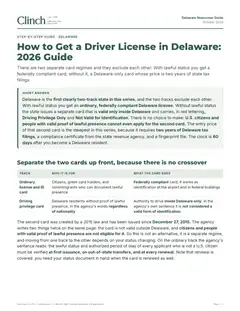
Delaware does not run a single license regime. The agency's own pages describe two tracks, and the dividing line is lawful presence:
| Track | Who it is for | What the card does |
|---|---|---|
| Ordinary license and ID card | Citizens, green-card holders and non-immigrants whose lawful presence can be documented | A federally compliant card. It works as identification at the airport and in federal buildings. |
| Driving Privilege Card | Delaware residents without legal-presence documents, in the agency's words of any nationality | Authority to drive inside Delaware only. In the agency's own sentence, it will not be considered a valid form of identification. |
The second card was created by a 2015 statute and has been issued since 27 December 2015. The agency states two things twice on the same page: the card is not valid outside Delaware, and citizens and people with valid legal-presence documents are not eligible for it. So this is not an alternative. It is a separate regime.
The ordinary license: status is verified again at every application
The agency's sentence reads: the Division must verify every non-citizen applicant's legal status and authorized length of stay in the United States upon initial issuance (including out-of-state license transfers) and upon license renewal, and therefore non-citizens must present their immigration documents. Note that renewal is covered: your status document has to be in your hands when the card is renewed too.
The document structure has two layers: one primary document plus one secondary document. A primary document must contain full name and date of birth and, in the agency's words, must be verifiable, meaning the agency must be able to contact the issuing agency to determine the document's authenticity. On top of that: your Social Security number if you are eligible for one, and two separate proofs of Delaware residence (for example a lease or rent receipt, plus an electric, telephone or other utility bill).
The most important line for a Turkish reader is this: a valid foreign passport is accepted as proof of identity and legal presence, but the agency says in the same breath that an appropriate immigration document is also required. The Turkish passport never travels alone. Other documents on the accepted list: an endorsed I-94 or I-94W inside a valid foreign passport, a Processed for I-551 stamp in a valid foreign passport, an I-327 re-entry permit, an I-571 refugee travel document and an employment authorization card (I-688A, I-688B, I-766).
The same page carries a warning that should not be read lightly: making a false statement, or displaying an invalid license, ID card or document, is perjury, may bring fines and denial of service, and a license may be suspended at any time that false information is found on the signed application.
Delaware prints the ineligible immigration statuses by name
Most states in this series say "lawful presence required" and stop there. Delaware is the first that lists the excluded statuses one by one, and the list speaks directly to a Turkish reader:
- B-1 (visitor for business) and B-2 (visitor for pleasure): not eligible.
- WB / WT (Visa Waiver Program business and tourist entries): not eligible. Türkiye is not a Visa Waiver Program country, so those two lines do not reach a Turkish reader; the B-1 and B-2 lines do.
- C-1, C-2, C-3 (aliens in transit): not eligible.
- D-1 (crew members): not eligible.
- G-1 (resident representative of a foreign government to an international organization, plus staff and dependents): not eligible.
- A-1 (ambassador, public minister, career diplomatic or consular officer and dependents): not eligible, because in the agency's words a person in A status may only be issued a license by the U.S. Department of State.
- A-2 (other foreign government officials and dependents): not eligible unless a foreign military member or dependent, who must provide a valid passport, I-94, visa or assignment orders.
- Anyone whose immigration or passport documents are invalid or expired; I-94 holders without a valid stamp; an attached unexpired temporary I-551 visa: not eligible.
The practical result for someone here on a tourist or business visa is plain: Delaware will not license you. The rental-car and foreign-license route is set out in the foreign license section.
Your card's life follows your visa, and "duration of status" means one year
Delaware answers temporary status by shortening the card rather than marking it. That is the opposite of the states that print a banner across the front, and the consequences are the opposite too:
| Status | Card length |
|---|---|
| U.S. citizen | 8-year driver license, or a 4-year ID card |
| Permanent resident (green card) | 8-year license or 4-year ID card; the Alien Registration Number is mandatory and no document is issued without federal verification |
| Non-immigrant, temporary status | The expiration date is limited by the authorized stay |
| Records showing indefinite or duration of status | In the agency's own sentence, a one-year expiration date |
That last row is the sharpest rule for an F-1 or J-1 reader. If the record says "duration of status", which is the normal student case, Delaware issues a twelve-month card. The trade-off is this: the card works at the airport, it just keeps expiring. So put the renewal appointment in your calendar now and bring your status document to every renewal.
The I-94 number is mandatory for non-immigrants, except where an Alien Registration Number exists (refugee, asylee, parolee). For students: F-1, F-2 and M-1 need the I-20 plus an unexpired foreign passport and I-94; J-1 and J-2 need a valid DS-2019 (or IAP-66). A conditional green card (the two-year I-551) carries the Alien Registration Number, which is mandatory for federal verification.
The Driving Privilege Card: the heaviest entry price in the series
No other state in this series asks for this document list, because it asks for two years of filed tax returns. The sequence runs like this:
- Fingerprints. Taken by appointment at the State Bureau of Identification, and since 11 September 2023 the appointment must be booked online; the agency publishes the address uenroll.identogo.com and the service code 27S424. The bureau collects fingerprints and validates identification. The fee in the agency's own fee file is $52.
- Two years of filed Delaware taxes. The applicant must obtain a Certification of Filing Compliance from the Delaware Division of Revenue, confirming that Delaware taxes were filed for the previous two years. It carries the applicant's name, date of birth, years filed, ITIN or Social Security number, and a Division of Revenue document locator code. On top of that it is re-verified with the Division of Revenue at the DMV counter. Revenue phone 302-577-8200.
- Appear in person at the DMV. Every document must be in original or certified form; photocopied, altered or expired documents are refused. Foreign-language documents must be translated into English by a professional translator, and the original must accompany the translation. The agency verifies, scans and stores an image of every document presented.
- At that same first visit a vision screening and the knowledge exam may be given. On passing the knowledge exam a permit is issued and a road exam is scheduled; the agency requires every applicant to hold the permit at least 10 days before the road exam.
Proof of residence is stricter on this track: two documents from separate sources, each showing a physical address (no post office box), delivered by the postal service, and postmarked or received within the last 60 days. Private courier deliveries are not accepted, and printouts of bills and non-business letters and cards are not accepted.
The identity requirement brings good news, and Türkiye is on the list: a valid, unexpired foreign passport approved by the agency and electronically verified is accepted, and the published country table shows 2010 next to Türkiye, meaning a Turkish passport issued in or after 2010. The agency adds in the same place that the list is subject to change, so confirm it before your appointment.
The card's life: the permit lasts 6 months and the card 4 years. It bears Driving Privilege Only and Not Valid for Identification in red, and the photo sits inside a red box containing the word Privilege. Dependents are eligible if they meet the requirements; minors must also present an original and translated copy of their birth certificate alongside the identity document.
A note about the fee: the agency's prose page carries a broken sentence that drops the number ("The fee for the DPC is and will be valid for a period of 4 years"). The agency's own fee file shows $20 for this card. We take the figure from the file but tell you to confirm it at the counter, because the published sentence is incomplete.
The agency's USCIS sentence: a policy statement, not a statute
In its frequently asked questions the agency writes: DMV does not report Driving Privilege Card information to USCIS and is not in the business of deportation, and its only interest is licensing drivers for road safety. We carry that sentence onto the page as written, and we also say what it is: it is an answer in a list of frequently asked questions, not a statutory provision. Some states in this series wrote the equivalent protection into statute. Delaware did not. So treat it as an administrative policy statement rather than a legal shield, and know that policy can change. If you are weighing a risk tied to your status, do not rest the decision on that one sentence; speak to an attorney who can see your own file.
There is also an enforcement consequence the agency publishes, so go in knowing it: a person who previously obtained a Delaware license under another identity must surrender it, serve a six-month suspension and pay a reinstatement fee to the driver improvement unit, and only then may apply for this card in their true identity.
The exam, and the language of the exam
The published examination has two parts: a vision screening and a highway sign and signal test. The vision standard is 20/40 with or without correction; if correction is needed the card is marked accordingly, and for vision between 20/40 and 20/50 daylight-only driving may be permitted. In the sign test you are asked to identify signs without their labels, by shape, color or symbol alone, and to explain their meaning; the meanings are in the rules-of-the-road part of the driver manual.
We make no promise in either direction about language. The agency does not publish a list of the languages the knowledge test is offered in, so we cannot write that it is available in Turkish and we cannot write that it is not. The only language accommodation we found in writing is this sentence: translators are permitted to assist during the application and testing process, and that sentence sits on the Driving Privilege Card page, not on the ordinary license page. The card's brochure is printed in English and Spanish only. The machine-translation widget on every page is a website translator, not a testing accommodation. So before you book, call 1-877-477-7117 or 302-744-2500 and ask the question in two parts: which languages is the test offered in, and may I bring my own translator.
Fees, from the agency's own fee file
These figures carry a technical note. The agency's fee page loads every dollar amount from a script file, so a tool that reads the page source sees empty cells. The amounts below were read from that file. The page itself states that fees are as of 3 January 2017, with items updated effective 1 October 2025 and 10 October 2025.
| Item | Fee |
|---|---|
| Class D driver license, 8 years | $50 |
| Class D license, 5 / 6 / 7 years | $25 / $30 / $35 |
| Photo identification card | $40 |
| Driving Privilege Card, 4 years | $20 (the published sentence is broken, so confirm at the counter) |
| Fingerprint fee (on the second track) | $52 |
| Duplicate license / duplicate ID card | $20 / $10 |
| Change of address | No charge |
| Change of name | $10 |
| Late renewal | $10 |
| Motorcycle endorsement, 8 years | $12 |
| Driver license record | $25 |
| Reinstatement after suspension / after revocation | $50 / $200 |
| Bad check | $25 |
Where you actually go: there is no DMV in Smyrna
Delaware runs four DMV facilities for the whole state, and none of them is in Smyrna. A Smyrna resident's office is Dover, with Delaware City as the northern alternative.
| County | Facility and address | Phone |
|---|---|---|
| Kent (the Smyrna resident's office) | Dover DMV, 303 Transportation Circle, P.O. Box 698, Dover, DE 19903. The agency's own directions: behind the DelDOT building on Route 113, just south of the Route 13 and 113 split. | 302.744.2500 |
| New Castle | Delaware City DMV, 2101 Mid County Drive, New Castle, DE 19720, reached from State Route 1 at exit 152. | 302.326.5000 |
| New Castle | Greater Wilmington DMV, 2230 Hessler Boulevard, New Castle, DE 19720. | 302.434.3200 |
| Sussex | Georgetown DMV, 23737 DuPont Blvd., Georgetown, DE 19947. | 302.853.1000 |
Read the hours twice, because they do not follow the usual pattern in this series: all four offices open Monday, Tuesday, Thursday and Friday from 8:00 to 16:00, and Wednesday from 11:00 to 18:30. There is no Saturday service, and Wednesday is the only evening. Telephone service runs the same hours. Cash, checks, money orders and credit cards are accepted; a bad check costs $25, and if the original amount plus the penalty is not paid within 10 days the license is suspended. The agency does not allow pets in its facilities or inspection lanes other than registered service animals, and it requires customers to be wearing shirts and shoes.
Before you drive down, check the agency's wait-times page. The general help line is 1-877-477-7117, the email address is [email protected], and accessibility requests go to the same address or to 302-744-2500 in advance of the visit.
If you are on the Driving Privilege Card track, three of your four appointments are in Dover: fingerprints at the State Bureau of Identification's Kent office (655 South Bay Road, Suite 1B, Dover, DE 19901; Monday 8:30 to 18:30, Tuesday to Friday 8:30 to 15:30; 302-739-2528), the two-year tax certification at the Division of Revenue's Kent office (Thomas Collins Building, 540 S. DuPont Highway, Dover; 302-744-1085), and the DMV itself. The northern alternatives are State Police Troop 2 in Bear for fingerprints and the Division of Revenue's Wilmington office for the tax certification (Carvel State Office Building, 820 North French Street, Wilmington, DE 19801; 302-577-8200). We could not read the ZIP code of the Kent revenue office from the agency's page, because the address block is printed broken; confirm it on the Division of Revenue's own site before you drive down.
Smyrna sitting in two counties changes nothing in this section
The Town of Smyrna's charter fixes the town boundary by a map recorded in the Offices of the Recorder of Deeds for Kent and New Castle Counties, so the town legally lies in two counties at once. On the transport side that changes nothing: Delaware has no county motor vehicle offices, the inspection is identical in all three counties, and only distance decides which DMV you visit. But it does change things for deeds, schools, property tax and county services. So when you buy a house, enroll a child or wait for a tax bill, confirm which county your own address falls in; the authority is the town's recorded boundary map and the two Recorders of Deeds. We return to this in the local government section.
Official sources
02 · Foreign license
Can a Turkish license be exchanged for a Delaware license?
Short answer
It cannot. Delaware's reciprocity list is the shortest in this series and it holds three countries: Germany, Taiwan and France. Türkiye is not on it, so you take both the knowledge exam and the road exam. Delaware does compensate in one real way, and it says so plainly: it does not take your foreign license away. The deadline is 60 days after you become a Delaware resident, and until then you may drive on your Turkish license as long as the card is in your immediate possession.
Steps, documents and official links
The agency's two sentences, side by side
The first sentence closes the door: all drivers licensed in other countries and U.S. territories must pass both the knowledge and road exams.
The second defines the only exception: Delaware has a reciprocity agreement with Germany, Taiwan (Republic of China) and France, exempting those drivers from the knowledge and road exams for a Class D license only. The agency adds that endorsements are not included in reciprocity agreements. Türkiye is not among the three.
A comparison is worth making, because you may have read a different answer in another state's guide: some states list Türkiye on a formal agreement list. Delaware does not. The answer genuinely varies from state to state, and in Delaware it is no.
But the card stays with you
This is not a small detail. Some states in this series collect the foreign license at the counter or punch a hole through it. Delaware's own sentence reads: drivers from other countries may retain their foreign licenses. When you go back to Türkiye, or rent a car in another country, the card is in your hand. Mention it at your appointment.
Sixty days, and how the sixty days are counted
The agency puts it this way: sixty days after the non-resident driver becomes a Delaware resident, he or she must apply for a Delaware driver license. Until then, a non-resident driver over 16 holding a valid home-country license may operate a motor vehicle on the state's highways when their license is in their immediate possession. Leaving the card at home is itself a violation.
The same sixty days apply to a transfer from another U.S. state, where the requirements differ:
- You will turn in the out-of-state license or produce a current certified copy of your driving record instead;
- you bring proof of citizenship or legal presence (birth certificate or passport), proof of your Social Security number and two proofs of Delaware residency;
- in the agency's words, if proper documentation is provided you will be issued a federally compliant driver license;
- you sign an application and a surrender agreement form and pass an eye screening; the agency says written and road exams may be given, but they are normally waived if your license is valid;
- a suspended, revoked or restricted license cannot be transferred until the outstanding actions are cleared.
On the commercial side there is detail worth knowing: tanker, doubles and triples, and passenger endorsements transfer; the hazardous materials endorsement requires a knowledge exam, a favorable background investigation and immigration documents; the school bus endorsement requires contacting the state Department of Education first; and the taxi and limousine endorsement is non-transferable. A motorcycle endorsement transfers for an additional fee.
What an international driving permit does and does not do
Getting an international driving permit before you leave Türkiye is a cheap precaution, but know what it is: that document is not a license, it is a translation carried alongside the national license, and it is useless on its own. We did not find any Delaware requirement about it on the agency's own pages, so we do not write that it is mandatory and we do not write that it is pointless. It makes a traffic stop easier; it does not change your legal position.
03 · Vehicles
How do you register a car in Delaware, and how do inspection and insurance work?
Short answer
Three things have to be read together. First, Delaware charges no sales tax on a car; it charges a 5.25% document fee instead, assessed on the purchase price or book value, whichever is greater, so a low figure written on a bill of sale does not reduce it. Second, the inspection is done by the DMV in its own four buildings and it is free, there is no private station, and the county changes nothing except which building you drive to. Third, Delaware makes personal injury protection mandatory, so a quote here is not the same product as a quote from a pure-liability state. And there is one provision that speaks directly to a Turkish reader: nationality is written into the statute as a forbidden input to an insurance score.
Steps, documents and official links
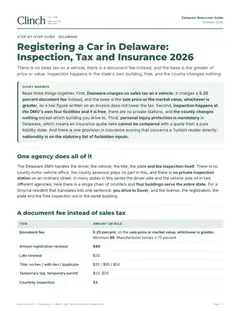
One agency does everything
The Delaware DMV handles drivers, vehicles, titles, plates and the inspection itself. There is no county motor vehicle office, no role for a county assessor and, on the ordinary path, no private inspection station. In many states in this series the driver side and the vehicle side sit in two different agencies; here there is one chain of counters and four buildings serve the whole state. For a Smyrna resident that translates into one sentence: you go to Dover, and the license, the registration, the plates and the free inspection are all in the same building.
A document fee instead of sales tax, and a warning about being taxed twice
| Item | Amount or rule |
|---|---|
| Document fee | 5.25%, assessed on the purchase price or book value, whichever is greater. Minimum $8. Mobile homes 3.75%. |
| Annual registration renewal | $40 |
| Late renewal | $20, repeated by the agency on its inspection page |
| Title (without lien / with lien / duplicate) | $35 / $55 / $50 |
| Temporary tag, temporary permit | $20, $20 |
| Courtesy inspection | $4 |
| Vanity plate | $40 a year |
| Accessible parking placard | No charge |
| Duplicate plate (with / without sticker), validation sticker, registration card | $10 / $5 / $5 / $10 |
| Annual electric and hybrid surcharge, effective 1 October 2025 | Under 6,000 lbs: hybrid $60, plug-in hybrid $85, electric and fuel cell $110, other alternative fuel $110. Electric motorcycles $15; heavier bands run to $900 a year. |
There is a trade-in credit: an owner who trades in a Delaware-titled vehicle may deduct the trade-in value from the purchase price of the new vehicle, with the agency adding that certain limitations apply.
There is credit for tax paid to another state, but the ninety days are hard: Delaware gives credit for sales or transfer tax paid to another state if the vehicle was titled or registered there within 90 days before being registered in Delaware, and in the agency's own words the 90-day rule is strictly enforced.
The reverse, in the agency's own words, and it has to be on this page: Delaware residents who purchase a vehicle from an out-of-state dealer will not receive credit for any taxes paid, and the agency writes that residents need to be aware that they may be taxed twice on vehicles purchased from some states. So a "cheap" car from just over the line is not cheap until the Delaware document fee is in the same calculation. Before you buy, write both the other state's tax and the 5.25% here on the same sheet of paper.
There is also a military exception: a service member or dependent stationed in Delaware on a temporary or permanent basis may keep the vehicle registered in their state of residence or previous duty assignment by producing orders to the DMV within 90 days of relocating or of purchase. There is an air force base in Kent County, so this exception really does come up around Smyrna.
Inspection: in the state's own building, free, and the county makes no difference
The agency's sentence reads: the Division performs vehicle inspection at all four DMV facilities. The inspections are performed for no fee. That is a first in this series, where the test is usually bought from a private station or a contractor.
- In the agency's words, usually all vehicles being titled for the first time in Delaware must be inspected.
- First exception: a new vehicle never titled in any state, where the dealer gives the buyer a Delaware application for title, is not required to be inspected.
- Second exception: vehicles in the newest seven model years, weighing 10,000 lbs or less, being titled for the first time in Delaware, may only need a VIN verification.
- An ordinary car inspection means a safety inspection (tires, brakes, windows), an exhaust emissions test and a fuel-system leak test.
- The inspection window runs up to 90 days before registration expiry, and an early inspection inside that window does not move the expiry date.
- To renew you must give the agency valid proof of Delaware liability insurance and a vehicle inspection report.
- The agency emails or leaves voicemail renewal notices roughly 90, 60 and 30 days before expiry. Some owners may then renew by mail without an inspection; eligibility depends on model year, weight, vehicle type and how many years were renewed in the last cycle. Owners in the first seven model years can go straight to registration renewal.
- Trailers have their own regime: an out-of-state trailer needs a full safety inspection to transfer in, and trailers over 4,000 lbs or with brakes need brake and safety inspections. Once Delaware-titled, trailers registered at 4,000 lbs or less need no inspection to renew, and all trailers over 4,000 lbs need brake and safety inspection every two years.
The county does not change the emissions test, and that is Delaware's answer to this series' usual question. The agency prints the emissions matrix in three county columns, which looks like a geographic rule. It is not: all three columns are identical.
| Model year and fuel | Test in all three counties |
|---|---|
| 1968 through 1995 | Curb idle test |
| 1996 and newer gasoline, under 8,500 lbs | Onboard diagnostics test |
| 1997 and newer diesel, under 8,500 lbs | Onboard diagnostics test |
| 2008 and newer gasoline or diesel, 8,501 to 14,000 lbs | Onboard diagnostics test |
| The current seven model years | Remain the same |
So the county only changes which building you drive to. Smyrna straddling two counties makes no difference whatsoever in this table.
We are printing a conflict here. The agency's general inspection page writes the oldest band backwards ("1996 to 1968") and describes 1996 to 2008 gasoline and 1997 to 2008 diesel as the onboard diagnostics group, while the emissions page writes the bands as 1968 to 1995 curb idle and 1996 and newer gasoline, 1997 and newer diesel on diagnostics, with no upper bound. Both pages are official and they do not agree. We are not picking a side, but on this page we rely on the emissions page bands, because that page is internally consistent and matches its own prose. If you are buying a pre-2008 vehicle, call customer service ([email protected], 302-744-2500), ask which test applies to your model year, and ask for the answer in writing.
Six lines to read before you enter the inspection lane
- Bring the insurance card and the registration card; put an automatic transmission in park or neutral.
- Warm the engine fully; turn off the air conditioning, the heater and the radio; fast-idle for 30 seconds before entering the lane.
- Everyone in the front seat belted, children in a restraint. Know where the hood release is, and bring the key for a locking fuel cap.
- The idle test takes about 1 minute, the diagnostics test about 2 minutes.
- If you have just replaced the battery the car will fail. The monitors will not be ready; drive it for several days first. That is the most useful warning on the page.
- In the lanes there is no smoking, no phone use and no pets other than service animals; staff walk around the vehicle while it is running.
One note in the interest of honesty: the agency's fee file contains a line of $1,054 headed as an emission waiver on vehicles newer than 1981, and we could not find any official prose explaining whether that is a fee, a repair-spending threshold or something else. So that figure does not go on this page. If you are looking for an emissions waiver, the right door is the state environmental agency's inspection and maintenance program.
Insurance: the mandatory package is heavier than in many states in this series
| Coverage | Minimum |
|---|---|
| Bodily injury, per person / per accident | $25,000 / $50,000 |
| Damage to the property of others | $10,000 |
| Personal injury protection, mandatory | $15,000 per person, $30,000 per accident |
We say this plainly, because readers compare prices: because personal injury protection is mandatory, a quote you get in Delaware cannot be compared with a quote from a state where only liability coverage is required. Putting the numbers side by side and concluding "Delaware is expensive" would be wrong; the product you are buying is wider. When you collect quotes, write the two states' coverage lists side by side, not their premiums.
The other rules:
- A valid Delaware insurance identification card must be in the driver's possession or carried in the vehicle, and must be produced on the request of a police officer or any other party involved in an accident.
- The agency's sentence: insurance from other states will not be accepted to title and register vehicles in the State of Delaware. You cannot keep a Pennsylvania or Maryland policy on a Delaware-plated car.
- Penalty: $1,500 for a first offense, $3,000 for subsequent offenses, plus suspension of the registration. The agency audits vehicles for insurance compliance.
- The uninsured-motorist penalty runs separately: $100 for the first 30 days from the mailing date of the notice, then $5 a day after the 31st day; license reinstatement $50, registration reinstatement $50.
- The rule most often missed, and it catches newcomers exactly here: in the agency's words, license plates must be surrendered to the Division prior to cancelling insurance for any reason on vehicles with active registrations. Selling the car and closing the policy is not enough; hand in the plates first. Tags are returned at no charge if proper insurance is provided and the registration has not expired.
Your insurance score cannot be built out of your nationality, and that is in the statute
This is the provision in this section that speaks most directly to a Turkish reader. Delaware permits credit-based insurance scoring but writes the limits into statute: Title 18, Chapter 83 of the Delaware Code, "Use of Credit Information in Insurance". It covers automobile, motorcycle, boat and personal watercraft, recreational vehicle, homeowners, mobile and manufactured homeowners insurance and noncommercial dwelling fire insurance.
The key provision is 18 Del. C. § 8304(a)(1): an insurer using credit information may not use an insurance score that is calculated using the consumer's income, gender, sexual orientation, gender identity, education, address, zip code, race, ethnic group, religion, marital status or nationality as a factor.
Delaware is the first state here to write nationality and ethnic group into the law itself, and it is the most directly applicable provision in the series for a Turkish reader. But the scope has to be drawn correctly: the ban is on what may go into the insurance score. Territorial rating exists in Delaware, so reading this provision as "Delaware banned ZIP-code pricing" would be wrong. The correct reading is this: the law forbids an insurer from building its credit-based insurance score out of your nationality, ethnic group, religion, income, education, marital status or ZIP code.
For a newcomer with no U.S. credit history the critical provision is § 8304(a)(5): an insurer may not consider the absence of credit information or an inability to calculate an insurance score unless it either shows the absence relates to risk and applies the treatment the Insurance Commissioner has otherwise approved, or treats the consumer as having neutral credit information, or excludes credit information entirely and uses only other criteria. In other words, "I have no American credit history" cannot be used against you on its own.
The rest of the section works for you too:
- An insurer may not deny, cancel or non-renew solely on credit information without considering another applicable underwriting factor.
- It may not base renewal rates solely on credit information.
- It may not take adverse action solely because you do not have a credit card account.
- It may not request credit information at renewal unless the consumer or their agent asks. On the consumer's request it must rerate at renewal using a current report and give the benefit of any improvement, and no adverse underwriting decision may result from that rerating. The insurer need not do it more than once in 12 months. So you have an annual, downward-only rerate right: use it.
- It may not use as a negative factor: credit inquiries not initiated by the consumer; inquiries about insurance coverage; collection accounts with a medical industry code; multiple mortgage inquiries within 30 days of each other; multiple car-lending inquiries within 30 days of each other; bankruptcies more than 5 years old; suits and judgments entered more than 5 years ago (or beyond the statute of limitations, whichever is longer); collections or charge-offs more than 7 years old; records of arrest, indictment or conviction where disposition, release or parole is more than 7 years old; any other adverse item more than 7 years old; and the total available line of credit (though outstanding debt in relation to available credit may be considered).
- On a homeowners policy it may not take adverse action based solely on the credit of a spouse who has no title or ownership interest and is not an applicant.
The newcomer's second lever: the "extraordinary life circumstances" exception, § 8305. On written request, an insurer that uses credit information shall provide reasonable exceptions to its rates, rating classifications or tier placement where the information was directly influenced by: a federally or state-declared catastrophic event; serious illness or injury to the consumer or an immediate family member; death of a spouse, child or parent; divorce or involuntary interruption of legally owed alimony or support; identity theft; temporary loss of employment of 3 months or more resulting from involuntary termination; military deployment overseas; or other events the insurer determines. The insurer may require verifiable written documentation, may require proof that the event had a direct and meaningful impact on the credit information, and may require the request within 60 days of application or renewal. In return the insurer must notify consumers that reasonable exceptions are available, and must tell the consumer the outcome in writing within 30 days of receiving sufficient documentation.
Third, error correction, § 8306: if the federal credit-dispute process establishes that an insured's credit information was wrong or incomplete, and the insurer is notified by the credit bureau or the insured, the insurer must re-underwrite and rerate within 30 days and refund any overpayment back to the shorter of the last 12 months of coverage or the actual policy period.
Fourth, disclosure, § 8307: an insurer using credit information must disclose on the application, or when it is taken, that it may obtain credit information; and must disclose that an approved applicant has the right to request an annual re-underwrite or rerate on a current credit report, with notice that the review is for the sole purpose of determining whether the new information would lead to a reduction and will not be used for any other purpose, including an increase in premiums.
The practical result: your first-year quote may still come in high because you have no U.S. credit history, but you hold three concrete tools. Ask to be treated as having neutral credit, request the annual downward-only rerate, and if one of the events above has happened, ask in writing for the extraordinary life circumstances exception. Make all three requests by email and keep the answers in writing.
Tax and business matters sit outside this section: state income tax, withholding and company formation are in the tax section and the business section.
Official sources
- Delaware DMV: read the inspection rules, the exceptions and how to prepare for the lane
- Delaware DMV: compare the emissions test by model year and county
- Delaware DMV: review the mandatory insurance limits, penalties and plate-surrender rule
- Delaware DMV: look up the document fee, registration fees and electric vehicle surcharge
- Delaware Code Title 18 Chapter 83: read the prohibitions on using credit information in insurance
PDF: Registering a Car in Delaware: Inspection, Tax and Insurance 2026
04 · Tolls
How do tolls work in Delaware, and is one transponder enough?
Short answer
It is. Delaware's transponder is E-ZPass, and the network reaches 17 states, including all three of Delaware's neighbors (Pennsylvania, New Jersey and Maryland). Delaware's own tolls sit on I-95, State Route 1 and U.S. Route 301, and three plazas have express lanes you pass at highway speed. Opening an account enrolls you in the frequent-user discount automatically. On the bridge the passenger-car rate has been this since 1 April 2025: $4.75 with a Delaware or New Jersey transponder, $5.00 with another state's transponder, and $6.00 in cash. There is also one concrete unfairness, and we are writing it down: the bridge's multi-trip discount books are open only to a neighboring state's accounts, so a Delaware resident who crosses daily pays the cheapest single trip but is shut out of the discount book.
Steps, documents and official links
One transponder, seventeen states
The E-ZPass group means 38 agencies with toll facilities in 17 states, and in the operator's words more states join every year; there are over 35 million devices in circulation. The operator's own sentence: today E-ZPass customers can travel from Maine to North Carolina and west to Illinois without stopping to pay a toll. It is additionally accepted on an expressway network in Florida.
The states listed as using E-ZPass: Delaware, Illinois, Indiana, Kentucky, Maine, Maryland, Massachusetts, New Hampshire, New Jersey, New York, North Carolina, Ohio, Pennsylvania, Rhode Island, Virginia, West Virginia, South Carolina, Georgia and Florida. So a Delaware account works on Pennsylvania, New Jersey and Maryland roads and on the bridges around Philadelphia.
The reverse is published too: states outside the network are not connected in any way, your device will not work there and their devices will not work here. If you are planning a long trip south or west, check whether the destination state is in the network first.
Delaware's toll roads and the express lanes
The toll points sit on State Route 1 (including express lanes where the toll is collected at posted highway speed), I-95 and U.S. Route 301. The three plazas with express lanes are Newark (I-95), Biddle's Corner (State Route 1, New Castle County) and Dover (State Route 1, Kent County).
We publish no Delaware toll amount on this page, because research did not find a single passenger-car figure published as a static number: the State Route 1 rates come out of the transportation department's interactive calculator, and the I-95 Newark plaza rate does not appear in the department's own published text. To learn the toll on your own route, open the department's toll rate calculator and enter your entry and exit interchanges and your axle count. The edition of the published toll map we worked from is dated January 2019, so the exit numbering may have changed.
Opening an account puts you in the discount automatically: in the operator's words, when you sign up you are automatically enrolled in the frequent user discount plan on State Route 1 and U.S. Route 301. For someone commuting daily from Smyrna, opening an account is not a separate decision beyond the cost of the device.
Ways to fund the account: personal check, money order, cash, credit card, or automatic debit from a checking or savings account. Individual and commercial accounts exist and statements are provided. Non-account alternatives are published too: all-electronic tolling with billing by plate on U.S. Route 301, and a starter package sold at retail. We could not read the current terms of those two programs, so we do not set out their detail.
A Smyrna resident who wants to open an account in person goes to Dover: the E-ZPass Delaware customer service center is at 22-24 West Loockerman Street, Dover, DE 19904, with walk-in and telephone service Monday to Friday 7:00 to 19:00 and Saturday 8:00 to 14:00; the phone number is 888-397-2773. The Saturday opening matters, because the DMV is closed on Saturdays, so you cannot put both errands on the same day.
The Delaware Memorial Bridge: a different authority, the same transponder, an unequal discount
The bridge is run not by the transportation department but by a bi-state river and bay authority; toll questions go to the bridge's toll supervisors ([email protected], 302-571-6373). The schedule took effect on 1 April 2025, and the same E-ZPass device works here as well.
The passenger-car rate, meaning all four-tire vehicle types (vans, SUVs, pick-ups, motorcycles; oversized tires excluded), two axles:
| Payment method | Passenger car, two axles |
|---|---|
| Delaware or New Jersey transponder | $4.75 (no cash equivalent) |
| Another state's transponder | $5.00 |
| Cash | $6.00 |
Rates rise with a trailer ($7.50 with a one-axle trailer on a transponder, $10.00 with a two-axle trailer), and dual-tire, bus and tractor classes sit on their own schedule. The schedule took effect on 1 April 2025. The practical result: for a daily crosser the transponder pays for itself, because the gap between cash and transponder is $1.25 a crossing.
We carry one hedge: we could not read on the authority's rate page whether the toll is collected in one direction only. So we do not describe the figures above as "every crossing" or "round trip"; they are the authority's published passenger-car rates and we could not verify which direction is charged. If you are using the bridge for the first time, ask the toll department, because your monthly budget can differ by a factor of two.
Here is the concrete unfairness: the bridge runs two discount packages, one of 20 trips valid for 90 days and one of 22 trips valid for 30 days. Both are tag specific, both require enrollment, and in the authority's own words both apply only to passenger vehicles with New Jersey E-ZPass accounts. The result is odd but real: a Delaware resident who crosses every day pays the cheapest single-trip rate and cannot get into the 22-trip book. We are not smoothing that over, because it is a checkable asymmetry. If you also have a New Jersey address, ask the authority which account is open to whom.
Two changes are coming: the authority's board adopted the revised schedule on 19 November 2024. Phase one raised cash rates only, leaving electronic rates and the discount plans untouched, and the authority's stated reason was to move cash customers onto electronic tolling and prepare the bridge for cashless operation. Phase two "may impact all customers" and, in the authority's words, would take effect no earlier than 1 January 2027. If you will use the bridge regularly, reopen the schedule in January 2027.
One operational note: all wide loads and oversized vehicles must use toll lane 13, the farthest-right booth, and convoys coordinate with the toll department one to two weeks in advance.
Smyrna's toll geography: a fast paid road and a slow free one
Smyrna sits between two toll points. From the State Route 1 interchange list on the department's toll map:
| Interchange | Serves | Connects to |
|---|---|---|
| 119A / 119 / 119B | North Smyrna and Townsend | U.S. Route 13, State Routes 6 and 300 |
| 114 (southbound, marked a toll ramp) | South Smyrna | U.S. Route 13, State Routes 6 and 300 |
| 104 (marked a toll plaza) | North Dover, Scarborough Road | U.S. Route 13, State Route 8 |
| 136 | Odessa and Middletown, north of Smyrna | State Route 299, U.S. Route 13 |
| 142 | Mt. Pleasant, Boyds Corner, St. Georges | State Route 896, U.S. Routes 301 and 13 |
Both daily commutes pass a plaza: the Dover plaza is at interchange 104, north of Dover and therefore between you and Dover, while Biddle's Corner is north of you on the way to Wilmington. Against that, U.S. Route 13 runs parallel and is free. So there is a genuine choice in Smyrna: the fast tolled State Route 1, or the slower free Route 13. To decide, get your own route's toll out of the calculator and write the fuel and time difference next to it.
We publish no distance or drive time. We could not find any official distance table for Smyrna to Dover, Wilmington, Philadelphia or the airports; the arithmetic from interchange numbers is an approximation, not a measured distance. Measured bus journey times are in the transit section.
Delete the text messages that claim you owe a toll
E-ZPass Delaware publishes a scam warning on its own site about fake text messages claiming an unpaid toll. It is the most common scam a new arrival meets, and it works, because someone who has just moved really might owe a toll. The rule is simple: do not tap the link in the message. If you want to know your balance, log into your account from your own browser or call 888-397-2773.
Official sources
05 · Transit
Bus, rail and airports in Delaware: can you live without a car?
Short answer
Delaware runs the first single statewide transit authority in this series: one agency, 43 bus routes, and fare zones drawn on the county lines. Smyrna has no local route of its own; the town is served by two intercounty routes, and the express trips do not stop in between. Commuter rail is bought in from another state's operator, so you can reach Philadelphia car-free with one bus and one train. On airports the nearest is Wilmington and the full-service one is Philadelphia; the Istanbul flight and the time difference are in their own section. There is one warning to read here too: do not go to the airport without your passport.
Steps, documents and official links
One agency, 43 routes, three zones
In its own words, the state's transit corporation offers "a statewide network of transportation options". The portfolio: fixed-route buses, intercounty routes, a seasonal beach bus, on-demand microtransit, paratransit, commuter rail contracted from a neighboring state's operator, and a ride-matching program.
| Measure | Figure |
|---|---|
| Bus routes | 43 (New Castle 24, Kent 8, Sussex 6, intercounty 4, flex 1) |
| On-demand microtransit | Georgetown, Millsboro and Newark only |
| Commuter trains inside Delaware | 32 weekday and 17 weekend trains |
| Trips in fiscal year 2026 | 6,409,432 (fixed route 4,993,265; paratransit 867,096; microtransit 25,456; train 549,071) |
| Fleet and stops | 250 fixed-route vehicles, 281 paratransit vehicles, 4 rail cars; over 2,300 stops; 25 park and rides, 12 park and pools |
Administrative offices: 119 Lower Beech St., Wilmington, DE 19805 and 900 Public Safety Blvd., Dover, DE 19901. The statewide information line is 1-800-652-3278.
Fares, and the Smyrna sentence inside the fare table
Delaware cut its fare zones from seven to three, and the boundary of each zone is a county line. Pass prices carry the note "effective February 14, 2021".
| Fare | One zone | Two zones |
|---|---|---|
| Adult, cash or app | $2.00 | $4.00 |
| Reduced (65 and over, certified disability, or Medicare card) | $0.80 | $1.60 |
| Student (ID required at 17 and over) | $1.00 | $2.00 |
| Daily pass | $4.00 | $8.00 |
| 7 consecutive days | $16.00 | $32.00 |
| 30 consecutive days | $60.00 | $120.00 |
| 20-ride (app only) | $26.00 | $52.00 |
Children 46 inches tall or under ride free with a fare-paying adult (two children per adult), and blind riders with the state visual impairment photo ID ride free.
We publish no three-zone fare, because the three-zone column of the fare table is restricted to a single route number and that route does not appear in the agency's own live route feed. Either the table is stale or the route has been renumbered. So we print no figure and tell you to ask customer care: 1-800-652-3278, option two.
Here is Smyrna's own sentence in the fare table: the new boundary for each fare zone is the county line. For local routes that travel within Smyrna and Milford, and cross over the county line by a short distance, a one zone fare is charged. That is the clearest official acknowledgment that Smyrna sits on the Kent and New Castle line, and the town is named in the fare table precisely to solve it. In practice: you do not pay a two-zone fare for crossing the county line.
Payment: there is no stored-value smartcard in Delaware. The published methods are:
- The mobile app: buy and pay with the phone, with passes bought in advance or requested from the driver before paying.
- Cash, exact change: coins and $1 bills only, and drivers do not carry change.
- Strip tickets: $2 tickets in strips of six for $12, bought online or at ticket outlets. The older $1 and $3 strips are still accepted.
Passes are nontransferable. Paratransit fares: service covered by federal rules $4.00, non-covered demand response $6.00, and a $4.00 county connector fee for the second or third leg of a trip into another county. The federal rules apply where both ends of the trip are within three quarters of a mile of a local fixed route on the days and at the hours it operates; reservations 1-800-553-3278.
Non-service days: New Year's Day, Memorial Day, Independence Day, Labor Day, Thanksgiving and Christmas, with select routes operating on some of them. Administrative offices are closed too.
Smyrna's actual bus service, with measured times
The agency's live route list contains no Smyrna local route. The town is served by intercounty routes, and the published timetables name it. The stop is the Smyrna park and ride at the rest area.
Route 301, Wilmington to Dover. The published stop list: Wilmington, Christiana Mall, Boyd's Corner (weekdays), Odessa, Middletown, Smyrna, Dover. Weekday rush-hour and mid-day service plus Saturday. The times below were read from the agency's own timetable:
| Trip | Journey |
|---|---|
| Smyrna park and ride to Dover transit center | 32 to 38 minutes |
| Dover transit center to Smyrna park and ride (morning) | 42 minutes |
| Smyrna park and ride to Wilmington transit center | 55 minutes |
| Central Wilmington to Smyrna park and ride (morning peak) | 53 minutes |
Smyrna is an express anchor on this route, and that works in your favor: trips marked express skip the shopping mall and some stops; southbound limited-stop trips do not stop at all between central Wilmington and the Smyrna park and ride, and northbound limited-stop trips do not stop between the Smyrna park and ride and the Wilmington transit center. If you are commuting, look for the limited-stop and express trips in the timetable.
Route 302, Dover to Middletown also stops in Smyrna: Dover, Cheswold, Smyrna, Townsend, Middletown and the north Middletown park and ride. Weekday rush-hour, mid-day and evening service plus Saturday. This route has a named stop at a large employer in Middletown, so it is a real job destination reachable by bus from Smyrna.
The other intercounty routes are 303 (Dover to Georgetown) and 307 (Lewes transit center to Dover). Kent County's local routes run around Dover; a Smyrna resident reaches them by taking route 301 or 302 to the Dover transit center first.
You can reach the Dover DMV by bus: the southbound stop list for route 301 includes Transportation Circle opposite the DMV administration building, one stop before the Dover transit center. Getting to your license appointment without a car is possible.
One timetable warning: route timetables are published seasonally and the file paths carry a summer label. So look at the route page itself rather than a dated file.
Philadelphia by train: one bus, one train, two buildings next door to each other
Delaware is the first state in this series whose transit agency buys commuter rail from a neighboring state's authority. Inside Delaware there are 32 weekday and 17 weekend trains, and fiscal year 2026 saw 549,071 trips on them. The four Delaware stations and the bus routes that feed them:
| Station | Address | Parking |
|---|---|---|
| Claymont Transportation Center | 191 Transit Center Dr., Claymont, DE 19703 | Free, with EV chargers |
| Wilmington station (Joseph R. Biden, Jr. Railroad Station) | 100 French St., Wilmington, DE 19801, inside the transit center | Paid |
| Fairplay at Churchman's Crossing | 1 Fairplay Boulevard, Newark, DE 19713 | Free |
| Newark Regional Transit Center | 100 Station Way, Newark, DE 19713 | Free, with EV chargers |
For Smyrna the chain runs like this, and every link is officially sourced: route 301 reaches the Wilmington transit center in about 55 minutes from the Smyrna park and ride; route 301 is one of the bus routes the agency lists as serving Wilmington station, and the station is in the same building. From there the commuter line runs into Philadelphia. The train leg is direct and, in the trips that were measured, took roughly 30 to 55 minutes. We publish no train fare, train number or departure time: research could not read the operator's fare table, and the times in hand were measured from one afternoon's departures, not from a timetable. For prices and schedules, go to the operator's own fares page.
Wilmington's rail station is officially named the Joseph R. Biden, Jr. Railroad Station, rededicated under that name in the spring of 2011. It is at 100 South French Street, Wilmington, DE 19801 and is an important hub on the country's northeast corridor; it served more than 600,000 passengers in fiscal year 2023 and is the twentieth busiest station on the national rail network. In October 2023 the operator announced that repair, modernization and accessibility work was complete, including two new escalators. The routes listed on the operator's station page: the high-speed service, the regional service, a northeast-to-Vermont route, and two northeast-to-Florida routes. The connections the operator itself lists at Wilmington: the commuter line, Delaware buses, and on-site bike parking. We publish no fare, journey time or frequency for this station; the station page carries route names and amenities, not a timetable.
The Wilmington transit center itself, where route 301 ends, sits at Front and Walnut Streets and opened on 19 May 2020. It has ten bus bays, a covered, seated, smoke-free waiting area, real-time bus displays, ticket sales, wifi, USB charging, bike racks with a repair station, and 90 public parking spaces including two electric vehicle chargers. The agency's 2020 opening release says the center gives access to the national rail service, the commuter line, intercity coach and cabs. We could not confirm that the intercity coach operator is still there in 2026, because the only official statement we have is from 2020; if you are buying a ticket, confirm it on the operator's own site.
The agency also runs a local bus jointly with Maryland (Elkton to Glasgow), and one of the seasonal beach buses goes to a ferry terminal. A statewide stop listing, an interactive stop map, a trip planner, free transit data, park and ride listings and a ride-matching program are all published.
Airports: which one you are going to
The short answer on the Istanbul question: there is no nonstop from Delaware or from Philadelphia, and the nearest nonstop we could confirm leaves Washington Dulles. Which airlines serve Philadelphia, how often Dulles runs the service, the airline stopover program and the time difference with Istanbul are all gathered in one place: see the time difference and Istanbul flight section. This section covers only which airport you are going to and what you will find there.
Wilmington Airport is the closest. It is at 151 N Dupont Hwy, New Castle, DE 19720 and is operated by the same authority that runs the bridge; the phone number is 1-855-FLY-ILG5 and the email [email protected]. Two carriers fly from it; one publishes Florida destinations, North Carolina and Puerto Rico. Know too that a major American carrier sells Wilmington as the origin of the ticket, that the Philadelphia leg runs as a motorcoach transfer and that the screening is done in Delaware; if building your Türkiye ticket that way helps you, the detail is in the flights section.
What the terminal has today, and what it does not: parking is $12 a day in three lots beside the terminal with no limit on length of stay, and the daily rate rises by 50 cents from 1 November 2026. The terminal expansion has opened: a second gate, a much larger holding area, over 200 additional seats with power, upgraded restrooms and a new baggage carousel. Still to come: a future second screening line and new food options expected in late 2026. Today there is no food service in the terminal beyond vending machines in the gate area (including hot coffee and food) and a water bottle refill station; a restaurant sits on airport property. The airport home page publishes live arrivals and departures and live parking availability.
We publish no distance. We could not find any official table giving the road distance or drive time from Smyrna to Philadelphia International, Wilmington Airport or Washington Dulles, so we give no figure; measure your own route on your own map.
Do not go to the airport without your passport: the $45 federal fee
This heading connects straight back to the license section, so read it as planning, not as a threat. The federal Transportation Security Administration has set a $45 fee for people who arrive at the checkpoint without an acceptable form of identification and who choose to use the agency's alternative identity verification program. The fee is non-refundable and applies per person, per 10-day use, provided identity can be verified on each use in that period. The notice is dated 3 December 2025 and effective from that date. The agency's own sentence matters just as much: participation in the program is optional and does not guarantee that an individual will be granted access to the sterile area of an airport.
What that means for Delaware, in one sentence: because the Driving Privilege Card is marked Not Valid for Identification, it is not accepted as identification at the checkpoint, so you do not fly on that card, you fly on your passport. The agency's own page states that a passport may be used in lieu of a compliant license to board domestic flights and visit federal facilities, and that a compliant card is the one carrying a star or a flag, or marked Enhanced. Someone with lawful status who holds the ordinary Delaware card has no problem here, because that card is federally compliant; but since the card's life is tied to your status, check its expiry date against your travel date.
We record one date conflict too: Wilmington Airport's page says the charge begins 1 February 2026, while the federal notice is effective 3 December 2025 and the federal agency's own page presents the fee as in force now. Both dates are in the past today, so it makes no practical difference; on this page we rely on the federal agency's date.
Official sources
- DART First State: read the fare zones, pass prices and the one-zone rule that names Smyrna
- DART First State: open the current timetables for the intercounty routes
- DART First State: find the commuter rail stations in Delaware and the bus routes that serve them
- Wilmington Airport: check the parking rate, terminal services and the coach connection
- Federal Register: read the $45 fee set for travelers without an acceptable identification
06 · Regions
Which office handles what in Delaware?
Short answer
Start with the sentence that shapes this whole section: the Town of Smyrna owns its own electricity, water, sewer and trash service, and the state's public utility regulator is excluded from municipal utilities by statute. For a Smyrna address that means there is no complaint route to the regulator; what governs is the town's own policy. The second structural fact matters just as much: Smyrna legally sits in two counties at once, because its charter fixes the town boundary by a map recorded in the Offices of the Recorder of Deeds for Kent and New Castle Counties. It changes nothing about transport, but it does change things for deeds, schools and taxes.
Steps, documents and official links
Four layers, and which one does what
| Layer | What it handles |
|---|---|
| State | Income tax, driver and vehicle services, and the public library system, run centrally through a state division of libraries. |
| County (New Castle, Kent, Sussex) | Property assessment, recording of deeds, sewer outside town limits, and marriage licenses. |
| Town (Smyrna) | Electricity, water, sewer, trash, police, local planning and the town property tax. |
| School district | Collects the largest single item on the property tax bill, calculated on the county assessment roll. |
Delaware has three counties, and every statewide system here is organized around them. Towns are different: Delaware towns are creatures of individual charters enacted by the General Assembly, and those charters are published on the state's own charters site. The practical consequence is this: every Delaware town's powers have to be read from its own charter. Smyrna having its own electric utility tells you nothing about Newark, Middletown or Dover; you have to read their charters separately.
On the regulatory side the split is clean: the state public service commission is outside municipally owned utilities and municipal electric companies, but it continues to regulate the investor-owned ones. So Delaware runs two separate regimes and your address decides which one you are in. The detail is in the utilities section.
Smyrna sits in two counties, and that is not a figure of speech
The town charter does not describe the boundary in words. The relevant section says the town's boundaries are established as depicted on the most recent map entitled Town of Smyrna Municipal Limits, certified and dated by the mayor and the secretary of the town council, and of public record in the Offices of the Recorder of Deeds for Kent and New Castle Counties. The annexation provision requires the resolution and plot to be filed with the recorders of deeds in and for Kent and/or New Castle counties. The tax provision lets the town set assessed values either through its own tax assessor or by adopting the values shown on the assessment lists prepared by Kent and New Castle County.
So: one town, two recorders of deeds, two assessment offices, two sets of county rates. The concrete consequences:
- Property tax: two different county assessment offices and two different county rates. The Kent County assessments office is 302-744-2401; the county property tax lines published by the state revenue division are 302-736-2077 for Kent and 302-323-2600 for New Castle.
- Deeds, and therefore buying a house: the deed records at the Recorder of Deeds of the county the parcel is in.
- The cold-weather disconnection test is read off "an airport in the same county as the subject dwelling unit", so even the reference weather station depends on which side of the line your house sits.
- Schools and county services raise the same county question.
The town layer, by contrast, is identical on both sides of the line: electricity, water, sewer, trash, town property tax, 311, police and the council district are all Smyrna's own business either way.
Research did not find how much of the town lies in each county, or which streets fall on which side. The only official answer is the recorded municipal limits map held by the two recorders of deeds, and the town's own boundary map. So this page does not tell you which county your address is in; it tells you to have your own address confirmed. Before you buy, enroll a child or wait for a tax bill, ask the relevant town office and get the answer in writing.
How Smyrna is governed
| Item | Detail |
|---|---|
| Form of government | An elected mayor plus six elected council members |
| Terms | Mayor 2 years; council members 3 years, staggered |
| Seats | Three district seats (Districts 1, 2 and 3) and three at-large seats |
| Council meetings | First and third Mondays at 19:00, at the town hall and online; a meeting falling on a holiday moves to the Tuesday |
| Committees | Each committee has at least one council member and at least one citizen, appointed by the mayor. The published list includes audit, board of adjustment, charter and ordinance review, election registration board, ethics commission, finance, historic district review board, parks and recreation, a police accountability board, planning and zoning, public safety, shade tree commission and redevelopment |
| Town hall | 27 S Market Street Plaza, Smyrna, DE 19977; phone 302-653-9231, fax 302-653-3492; weekdays 8:00 to 16:30 |
| Police | Non-emergency line (302) 653-9217, which is also the number for after-hours water, sewer and power emergencies |
Four charter powers are worth knowing, because once you own property they reach you directly: the town may compel any property in town to connect to the water system, and may do the same for sewer; the town may run electric or gas systems and may refuse service outside town limits; the council may grant franchises for heat, light, power, gas, water, sewer, electric, telephone, television and internet services; and the town may take property sold for a delinquent trash, water, electric or gas bill. That last power is reason enough to take the bills seriously.
The county layer: Kent County
Kent County's governing body is called the Levy Court, and the county writes on its own site that the name dates to 1683 and reflects "our responsibility to levy taxes". The departments listed on its own site: administration, the Clerk of the Peace (marriage licenses), community services, the deeds office, finance (assessment and tax billing), planning services, public safety, public works (sewer), the register of wills and the sheriff. The boards include an assessment review board, a board of adjustment, a library advisory committee and a sewer advisory board.
Two practical conclusions for a Turkish reader. First, the marriage license is a county matter, not a town matter, and the office has an unfamiliar name: the Clerk of the Peace. Second, if you are buying a house the deeds office is at the county and the assessment is at the county, but the town keeps a separate assessment roll of its own. Do not conflate the two; the distinction is set out in the property tax section.
Smyrna has a real 311, and it is new
The town's official service-request app runs under the name Smyrna DE 311, built on a service-request platform, with a privacy policy effective 2 June 2026. The same channel appears on the town site under the heading Report a Concern, and requests route directly to public works staff.
But read this warning before you write a request, because it is the town's own: the app is a public application, the information you submit (including descriptions and photos) may be publicly visible, and your display name may also be visible unless you choose to submit anonymously where that is available. The town's sentence on the same page: do not include sensitive or confidential information in your request. Beyond that, submissions may constitute public records retained under the state public archives schedules, possibly permanently, and deletable only under approved records management and legal requirements.
So do not write your status, your passport number, the details of your lease or personal information about a neighbor into 311. Put the issue, the address and, if needed, a photo in the report, and explain the rest by phone. The app lists what it collects: name, email, phone, request details, photos, location, plus IP address and browser and device type.
The channel is for non-emergency matters only. During business hours (weekdays 8:00 to 16:30) urgent but non-emergency issues go through this channel; on weekends and out of hours you call the police department on (302) 653-9217; emergencies are 911. The town also states that the police department should not be contacted for non-emergencies. Contact: [email protected], 302-653-9231. The town's other front doors: a public records request page, a notification and alerts sign-up, inclement weather notifications, a weekly newsletter, and a dig-safely utility locating line.
The library card: no number is asked for
The easiest good news in this section sits here. All Delaware residents are eligible for a free library card. The route: download, fill in and print the county registration form and present it with a photo ID at your local library. Or sign up online for immediate access to digital content only, then contact the library to convert the account to a full account, which unlocks library computers and all materials, programs and services.
No Social Security number is asked for. The 2026 Kent County application form asks for name, a self-chosen four-digit PIN, birth date, phone, mailing address, county, email, an optional secondary address, notification preferences and a signature. There is no number field on the form.
If you do not have a Delaware photo ID, the division's written sentence is: if you do not have a Delaware photo ID, please contact your local library for card registration requirements. That is not a refusal, it is an open invitation to ask, and that is how we carry it onto the page. If you have just arrived, take your passport to the branch and ask what it accepts.
- For anyone under 18 a parent or guardian must be present to sign; the parent also chooses full or limited internet access and accepts responsibility for items and fees until the young person turns 18.
- There are separate card types for children and teens, children's cards carry no late fees, and there is a separate teen card for ages 13 to 17.
- Non-residents may apply for a card with a fee; non-residents who own property in Delaware are also eligible, so ask the branch.
- The division publishes a Spanish-language page about getting a card; we found no Turkish-language material.
- Free with the card: the statewide shared catalog, online resources, free workshops and programs, free wifi, digital book and film apps, interlibrary loan, digital literacy and learning platforms, employment services, business resources, a museum pass and a lending collection of objects.
- Smyrna's branch is the Duck Creek Regional Library, listed among the town's departments.
Trash, recycling and yard waste
A contractor provides the service on the town's behalf under a contract that began 1 September 2025. Collection runs five days a week, the town is divided into five districts, and trash and recycling go out on the same day, collected by different trucks.
| Item | Rule |
|---|---|
| Carts | A blue cart with a black lid is trash; a blue cart with a light blue lid is recycling. Out the evening before or before 6:00, back in by midnight. Stored in the rear or side setback, not visible from the street. All trash inside the cart; recycling need not be bagged. |
| Price | $36.50 a month for one trash plus one recycling cart (rates updated 1 September 2025); $9.63 per additional cart. |
| Bulk items | Wednesdays, one item a week, and you must call by noon on Tuesday (302-653-9231, option one). Mattresses and box springs must be wrapped in plastic and taped or bagged. Appliances must have doors removed, be free of refrigerant and be tagged, or they will not be taken. A one-off pickup outside the program costs $75. |
| Not collected | Yard waste, construction and renovation debris, paint, chemicals, tires, batteries, and anything containing gasoline, kerosene or refrigerant. These may not be mixed into the trash either. |
| Yard waste | Collected Monday to Wednesday by the town's public works department, residential only, and it must be in a town-supplied cart; it cannot be bagged at the curb. Call 302-653-9231 option one for a container. A seasonal yard meter charge applies April through October. |
| Electronics and hazardous waste | Through the state solid waste authority's collection schedule. |
| Holidays | The contractor observes six: New Year's Day, Memorial Day, Independence Day, Labor Day, Thanksgiving and Christmas. A weekday holiday pushes the rest of that week one day later. |
| Clean-up events | Twice a year, spring and autumn; announced on the town site, in the local paper, on electric bills and on the town's social media page. |
Internet: the town publishes no provider list
The charter gives the council power to grant franchises or licenses to use its streets and public places for, among other things, internet services, but we could not find any official source naming the companies that serve Smyrna addresses; the town publishes neither a franchise list nor a provider page. So this page names no internet company. The official way to find out who serves your own address is the federal communications regulator's national broadband map, which reports provider availability by street address from the carriers' own filings.
On free access the answer is clear: Delaware public libraries have free wifi and public computers, including Smyrna's branch, and what unlocks the library computers is a full card rather than the online-only one. If you have just moved and do not yet have an internet subscription, getting a library card is a first-week task.
On cable franchising, the statute gives the commission supervision and review over franchising by municipalities that held that charter power on 28 June 1974. We could not confirm whether Smyrna was in that class on that date, so this page does not say whether the commission has jurisdiction here.
Income tax, sales tax and company formation sit outside this section: see the tax section and the business section.
Official sources
- Town of Smyrna: review the structure of the mayor and council, meeting days and committees
- Delaware charters: read the Smyrna charter and the boundary clause recorded in two counties
- Smyrna DE 311: submit a service request and read the privacy and public records warning
- Delaware Libraries: find the free library card requirements and the application form
- Town of Smyrna: read the trash, recycling, bulk item and yard waste rules
- Kent County: see the county departments and their contact details
07 · Utilities
How do you put the utilities in your name, and is an SSN required?
Short answer
We have to be honest here, because this is the hardest SSN finding in the series. Smyrna's electricity, water, sewer and trash belong to the town itself, and the regulator is excluded from municipal utilities by statute, so the "there must be a route without a number" rule that regulators impose in other states does not exist here. The town's online utility application carries a required Social Security number field and the town publishes no alternative to it. The one published alternative is the written surety on agency letterhead accepted in place of the advance payment. On top of that, the account must be activated by the resident in person, not by an agent or an attorney. We also say what to do: call the business office before you fill in the form.
Steps, documents and official links
Understand the regime first: there is no regulator here
Who serves a Smyrna address:
| Service | Provider | Regulated? |
|---|---|---|
| Electricity | Town of Smyrna, a municipal electric utility buying wholesale power through a municipal electric corporation | No, excluded by statute |
| Water | Town of Smyrna; the town publishes its own annual water quality report | No |
| Sewer | Town of Smyrna, on the same bill; the town also runs a storm sewer program | No |
| Trash and recycling | Town of Smyrna, through public works | No, a town department |
| Natural gas | We did not find it. The town's own pages describe only electricity, water, sewer and trash, and we could not confirm a Smyrna gas franchise page. Many Smyrna homes may be all-electric or on propane. This page names no gas company, and it does not say there is no gas; ask about the house before you move in. | Unclear |
The relevant statute says the public service commission shall not have any supervision or regulation over any public utility that is municipally owned, or over any municipal electric company formed under the relevant chapter. Note what that is: not a choice in a rule book but an exclusion in the statute. The commission could not pull Smyrna into its rules even if it wanted to.
The practical consequence is one sentence: for a Smyrna address the town sets the rate, the town sets the deposit, the town runs the shut-off process, and there is no complaint route to the regulator. Nothing you read about Delaware's investor-owned utilities carries over to Smyrna. There are narrow cases where the commission still touches a municipal electric utility (cost allocation in service-territory proceedings, a regulatory assessment, and territory maps when the town annexes) but none of them gives a residential customer a remedy.
Opening an account: everything the town asks for
| Item | The town's requirement |
|---|---|
| Who may open it | The town's sentence: accounts must be activated by the resident, not an agent or attorney. |
| Application fee | $50, non-refundable |
| Advance payment (deposit) | $200 residential, payable before the account is established |
| Alternative to the deposit | A written surety on agency letterhead, emailed to the business office ([email protected]) |
| Identification | You must upload or photograph a photo ID: a driver license, a state-issued ID, a federally issued ID or a military ID. A passport is not named, though the federal-ID category is the one that would cover it; ask the business office before you rely on that. |
| Social Security number | The online application form carries a field labeled Last 4 of SSN, marked required in the form definition. The town publishes no alternative anywhere on its utility pages. |
| Home buyers | Must upload every page of the settlement sheet; failing to do so results in termination of service |
| Renters | Must attach the lease and the tenant transfer form supplied by the landlord. The town's sentence: if you do not provide these with the application, your application will be denied. |
| Timing | Allow 2 business days. The application is declined if the requirements are not met within 30 days, or if it is filed more than 2 weeks before the service date. No weekend activation, because the town hall is closed. |
| Business office | 27 S Market Street Plaza, Smyrna, DE 19977; 302-653-9231, weekdays 8:00 to 16:30 |
So what do you do if you have no number? This page cannot invent a right the town has not published. The steps, in order:
- Call the business office before you fill in the form: 302-653-9231. Ask the question in three parts: do you accept an ITIN in place of the number, do you accept a passport number, and in what circumstances do you accept a written surety on agency letterhead.
- Repeat the answer by email and ask for written confirmation ([email protected]). If a different answer comes at the counter, you will have something on paper.
- If you are renting, obtain the lease and the tenant transfer form from your landlord up front; without those two documents the application is refused anyway.
- Budget the $200 deposit and the $50 non-refundable application fee, and ask whether the letterhead surety route is open to you.
We are not softening this: protections that might apply to Delaware's regulated utilities do not exist in Smyrna, and research could not verify what the town accepts in place of the number. We do not say "an account cannot be opened without a number"; we say "the town has published no alternative, so you have to ask by phone."
The chain of dependencies: utilities first, school second
That is why this section comes before the school section. The second proof of residency required for school enrollment is a utility bill in the parent or guardian's name dated within the last 60 days (gas, water or electric), or confirmation that the utilities have been transferred into the parent's name. So school enrollment depends on the bill, and the bill depends on the application that asks for the number.
The order should be: sign the lease, get the tenant transfer form from the landlord, call the business office, open the account, wait for the bill, then enroll at school. For a renter there is good news: the signed lease already satisfies the school's first proof of residency, and the landlord's transfer form is part of the utility application anyway. The two processes share the same two documents, so collect them on the same day.
The bill, paying it, and what happens when you are late
| Item | Rule |
|---|---|
| What is on the bill | In the town's words, two to four types of charges: electric, trash, water, sewer. No gas. |
| When it is due | The town's sentence: this bill is due upon receipt; the town does not send reminders. |
| How to pay | Online, by phone through an automated system, in person at the town hall, through the dropbox outside the town hall, by post, or on a direct debit plan. Budget billing is available, and there is a separate page for coming off it. |
| Late fee | 7% of the unpaid balance |
| Returned check | $55 |
| Reconnection after a shut-off | $25 administrative fee on the town's current page. There is a conflict here and we are printing it: the older rate sheet shows $50 during business hours and $100 after hours. The web page is the newer document; confirm it with the business office regardless. |
| Application fee | $50 on the current web page, $25 on the rate sheet. A second conflict; the web page is newer. |
| Deposit | $200 on both the web page and the rate sheet |
| Rate structure | Electricity is a monthly customer charge plus an energy charge per kilowatt hour, split between the first 500 kilowatt hours and everything above, plus an environmental fund rate and a purchased power cost adjustment. Water, sewer and the yard meter are a fixed monthly charge plus per-thousand-gallon tiers, with higher charges outside town limits. |
We are not putting the per-kilowatt-hour and per-thousand-gallon figures on this page. The multi-year columns in the town's rate sheet do not align reliably in any reading mode, and the document contradicts the town's current web pages on two fees, which suggests it is stale. To learn the unit prices, go to a current rate ordinance or to the business office. For the same reason we do not present the water and electric meter purchase charges as firm figures.
On bill help the town links to programs itself: the state health and social services department's low-income home energy assistance program, the Delaware housing assistance program, and the town's own financial assistance list. The town also offers an energy efficiency program and the wholesale power corporation's energy advisor calculators. If you reach the point of not being able to pay, apply to these before a shut-off notice arrives.
The disconnection rules: a measured cold, a forecast heat, and a fixed window
The statute builds Delaware's disconnection regime on three separate tests, and that combination was not found in this form in any other state in the series:
| Trigger | Rule |
|---|---|
| Cold, measured | A gas or electric utility may not terminate for non-payment on a day when the National Weather Service reports the 8:00 temperature at an airport in the same county is 35 degrees Fahrenheit or below on the morning the termination is scheduled. |
| Heat, forecast | An electric utility may not terminate on a day when the 8:00 forecast predicts that the heat index at an airport in the same county may reach or exceed 95 degrees Fahrenheit. Gas is not covered on the heat side. |
| A fixed calendar window | Absent a safety emergency, no shut-off from 21 December to 1 January. |
| Time of day | Absent a safety emergency, no shut-off outside 8:00 to 16:00, Monday to Thursday, unless the utility staffs payment and restoration throughout; holiday substitution rules apply. |
| Medical certification | No termination if an occupant is so ill that it would harm their health or recovery, certified by a licensed physician, physician associate or advanced nurse practitioner. The certificate lasts 120 days and is renewable only if the customer makes a good-faith effort to pay. |
| Notice | At least 72 hours notice of intent to terminate in every case. During the heating season (1 November to 31 March) or the cooling season (1 June to 30 September), 14 calendar days written notice plus two documented contact attempts on separate days (one after 17:00) in the heating season, or one attempt in the cooling season. |
| Third-party notice | Every gas and electric utility must run a voluntary third-party notification program: a customer may name someone in writing to receive a copy of the shut-off notice. A useful tool for a newcomer with limited English. |
| Deferral notice | When a shut-off is deferred for weather, the account holder must be notified that day; in master-metered buildings notice goes to every dwelling unit. |
| Penalty | The commission may assess up to $1,000 per violation, with each day a separate violation. |
Here we pass the uncertainty on to you as it stands, because this is the most important hedge on the page. We could not verify whether this section binds the Town of Smyrna's own municipal utility. The reason: the section's definition of "person" covers an individual, corporation, partnership, association and joint-stock company and does not name municipalities; the very next section, the one about continuing service for activated reserve and national guard personnel, says the opposite in so many words and applies to distributors including municipalities. Two sections drafted side by side, one naming municipalities and one not. And the commission that enforces the penalty has no jurisdiction over Smyrna.
The textual reading is that the military section reaches Smyrna and the weather, medical and notice section probably does not, but no official Delaware source states it either way, and the town's own shut-off information page describes no weather rule, no medical certificate and no 14-day notice. What the town's page does say: immediate payment in full, a $25 administrative reconnection fee, payment at the town hall in cash, cashier's check or money order (personal checks are refused), and reconnection by the end of the same day once payment clears.
Who to ask: for the town's own policy, the business office on 302-653-9231, option three; for whether the statute binds municipal utilities, the state's division of the public advocate. Ask both and get the answer in writing. And remember that the cold test is read at an airport in the same county: because Smyrna straddles two counties, even the reference station depends on your address, which is another reason to find out which county you are in.
Official sources
- Town of Smyrna: read the utility application, the fees and the documents required
- Town of Smyrna: see the reconnection procedure and the payment methods accepted
- Delaware Code Title 26: read the weather, medical certificate and notice rules on disconnection
- Delaware Code Title 26 section 202: review the provision excluding municipal utilities from the regulator
08 · Renting
What are a tenant's rights in Delaware?
Short answer
Delaware is the first state in this series to collect the whole of landlord and tenant law in one code, the Residential Landlord-Tenant Code. The numbers favor the tenant: the deposit cap is one month's rent, the money must sit in a separate escrow account at a bank with a Delaware office, it must come back within 20 days with an itemized list, missing that deadline costs double, and if the landlord fails to escrow the money or to disclose the account, the whole deposit passes to the tenant. Notice runs sixty days both ways. And the strongest record-clearing provision in the series is here: an eviction record can be sealed free of charge, after which the action is deemed not to have been filed and the tenant may answer questions accordingly.
Steps, documents and official links
The deposit: the cap, the escrow account, and the right that is easiest to lose
| Rule | Content |
|---|---|
| Cap | Where the agreement runs for one year or more, no more than one month's rent. For month-to-month or undefined-term primary residences, once the tenancy has lasted one year the landlord must immediately credit back anything above one month's rent. |
| Exception | The cap does not apply to furnished units, and federally assisted housing rules can produce a different result. |
| Pet deposit | Allowed, capped at one month's rent regardless of term, and not allowed at all for a certified, trained support animal for a resident with a disability. |
| Escrow | The deposit must sit in a designated security deposit escrow account at a federally insured bank with a Delaware office, must not be used in the landlord's business, and the landlord must disclose the account's location. The money is held for the tenant's benefit, and the tenant's claim beats the landlord's creditors, including a bankruptcy trustee, even if the money has been commingled. |
| Return deadline | 20 days from expiry or termination, together with an itemized list of damages and estimated repair costs. |
| Silence is a waiver | Failing to send the itemized list within 20 days constitutes, in the statute's words, an acknowledgment by the landlord that no payment for damages is due. |
| The tenant's 10 days | Accepting a payment sent with an itemized list counts as agreeing to the landlord's figures unless the tenant objects in writing within 10 days. This is the single easiest right for a newcomer to lose. |
| Penalties | Missing the 20-day deadline: double the amount wrongfully withheld. Failing to disclose the account location within 20 days of a written request, or failing to escrow the money at all: forfeiture of the whole deposit to the tenant, and double if it is not returned within 20 days of forfeiture. |
| The tenant must give an address | If the tenant gives no address in the lease and no written forwarding address, the landlord is relieved of the notice duty and of double damages, but still owes the unused deposit if the tenant claims in writing within one year. |
| Application fee cap | A credit-worthiness fee counts as an application fee, capped at the greater of 10% of monthly rent or $50; a receipt is mandatory, records are kept 2 years, and overcharging entitles the tenant to double the fee charged. |
| A surety bond instead | The statute lets a tenant buy a surety bond in place of all or part of the deposit; the bond, or the bond plus deposit combined, may not exceed one month's rent. Genuinely useful for a newcomer with no savings. |
| Increases | The deposit may rise with the rent if the lease says so; an increase above 10% of monthly rent must be prorated over the lease term, or over four months in a month-to-month tenancy. |
Two things to do when you move in: when you hand over the deposit, ask in writing where the escrow account is (if no answer comes, the whole deposit becomes yours), and on moving day record every room with dated photographs. When the itemized list arrives at move-out, do not miss the 10-day objection window.
Terms, notice and the right to pay and stay
| Topic | Rule |
|---|---|
| Oral agreement | Cannot run longer than one year; where no term is stated the tenancy is month to month. |
| Ending a month-to-month tenancy | 60 days written notice by either side, with the sixty days beginning on the first day of the month following actual notice. |
| Ending a fixed term | 60 days written notice before the expiry date, by either side. A fixed term still requires notice, which differs from several states in this series and is easy to miss. |
| Non-payment of rent | Before suing, the landlord must send a written demand giving not less than 7 days. |
| Paying to stay before filing | If the tenant or anyone else on the tenant's behalf pays all rent due before the landlord files, the landlord may not then file on that ground, and may not refuse payment made for the tenant. |
| Paying to stay after filing | Paying all rent due after filing but before judgment means the landlord may not maintain the action; after judgment the landlord may insist on a certified check or money order. |
| Court | Justice of the Peace Court, under the summary possession chapter. |
| Writ of possession | Issued only after the time to appeal or to move to vacate has expired; the officer must give at least 24 hours notice and execute between sunrise and sunset. |
| Belongings left behind | The landlord may remove and store property at the tenant's expense for 7 days (30 days for a manufactured home), after which it is deemed abandoned. The writ must carry the statutory warning in capitals. |
| Locks | On repossession the landlord must change the locks before re-letting, and is liable to the next tenant if an old key causes injury or loss. |
| Stay | A tenant may stay the proceedings on a good-faith dispute or on appeal, and may proceed in forma pauperis. |
| Attorney fee clause | A lease clause awarding attorney fees is prohibited. |
| The guide the landlord must hand over | The landlord or real estate service provider must give the prospective tenant the official rights-and-responsibilities guide before the agreement is signed, must take an acknowledgment of receipt, and must repeat it at each renewal of a year or more. A failure is an unlawful trade practice, and a tenant may rely on the guide as an equitable defense. If you did not receive it, ask in writing and leave a dated email behind. |
| Keys and the deposit | A lease may not require keys to be surrendered before the end of the term as a condition of returning the deposit, and if the last day falls on a weekend or holiday when the office is shut, possession counts as returned on the next qualifying day. |
An eviction record can be sealed, and the seal really does erase
This is the strongest record-clearing provision in the series, and anyone who has ever faced an eviction case should know it. The statute lists seven grounds on which the court must grant a motion to shield the record:
- a satisfied judgment five or more years old, provided there is no similar judgment in the last five years;
- a stipulation whose terms were complied with;
- a withdrawn complaint;
- a dismissed complaint;
- a judgment for the tenant;
- the agreement of both parties;
- and shielding being clearly in the interests of justice.
Once shielded, the judgment is set aside, the action is deemed not to have been filed, and in the statute's words the tenant may answer accordingly any questions related to the action's occurrence. The court must purge its public databases within 45 days, and there is no filing fee.
What that means in practice: if an eviction case was filed and then withdrawn or dismissed, that record does not have to follow you into every future rental application. The motion is free. If you have such a file, ask a legal aid organization or an attorney about it.
Source-of-income discrimination is banned, but something changes on 31 December 2028
Source of income is protected twice over in Delaware. The state fair housing act makes it unlawful to refuse to sell or rent, to discriminate in terms, to advertise a preference or to misrepresent availability because of source of income or housing status, alongside race, color, national origin, religion, creed, sex, marital status, familial status, age, sexual orientation, gender identity, disability and military status. The same act defines source of income as any lawful source of money paid directly, indirectly or on behalf of a renter or buyer, expressly including income or rental payments derived from any government or private assistance, grant or loan program, which means housing vouchers. The tenancy code repeats the ban internally: no owner or agent may refuse, decline or cancel a rental agreement, and none may charge higher rent, by reason of source of income, occupation, housing status or any other protected class.
Three qualifications belong on the page:
- There is a small-landlord exemption, and it is the owner-occupancy kind. The statute excludes from the ban (apart from the advertising rule) rentals of rooms or units in a dwelling with no more than four families living independently, where the owner actually lives in one of them. So a Smyrna owner living in half a duplex sits outside the ban; the owner of a separate rental house does not.
- Income sufficiency is still fair game. The statute does not stop anyone from considering the sufficiency or sustainability of income, or the credit rating, so long as it is applied in a commercially reasonable manner and without regard to source of income. For a newcomer with no U.S. credit file that is the real obstacle, and in Delaware we could not verify any statutory ceiling on an income multiple or any portable screening report right.
- The protection steps down on 31 December 2028. The code carries two versions of the two relevant sections. Until 31 December 2028, public housing authorities must use the standardized request-for-tenancy-approval sequence recommended in a consultant report, and a landlord may deny a voucher application only if the authority fails that sequence. From 31 December 2028, those provisions are replaced by the flat rule that a landlord is not required to participate in any government-sponsored rental assistance program, voucher or certificate system, and that non-participation may not serve as the basis for any administrative or judicial proceeding.
Here is the distinction to draw, and it must not be blurred. Discriminating between a salary and an assistance payment, meaning refusing you because your income does not come from work, is banned today and still banned after 31 December 2028, because source of income remains a protected class. The only thing that changes is the obligation to participate in a voucher program. After that date a landlord may say they are not required to join the program itself. If you use a voucher or will use one, note the date and reread the rule at the end of 2028.
Immigration status: we found no provision in the code
This needs writing plainly. The relevant chapters of the tenancy code were read in full and they contain no provision on immigration or citizenship status: nothing barring the question, nothing barring disclosure, no equivalent of the dedicated tenant protection acts found in some states. The nearest cover is national origin, protected by both the fair housing act and the tenancy code.
So the correct sentence is: national origin is protected, and research found no dedicated immigration-status tenancy provision in Delaware. We do not say there is none; we say we did not find one. What do you have? National origin protection. A landlord who demands extra documents only from applicants born abroad, or applies a heavier standard to them, is exposed under both the state and the federal fair housing acts. So keep a written record of what you were asked, the dates, and, if you know it, what others were asked.
On rent control we found nothing either way: no Delaware statute enabling or forbidding municipal rent regulation was located, and no Smyrna ordinance on rent was located. Put the question to the state housing authority and the town manager's office. Likewise, no provision was found forbidding municipalities from regulating tenant screening.
One calendar note: an amendment to the definitions section of the tenancy code takes effect on 8 March 2027 and we could not read its content. If you will be renewing a lease in 2027, reopen the statute then.
Official sources
- Delaware Code Title 25 Chapter 55: read the deposit cap, the escrow requirement and the return deadlines
- Delaware Code Title 25 Chapter 51: review the notice periods, the source-of-income ban and the duty to hand over the guide
- Delaware Code Title 25 Chapter 57: read the eviction procedure and the provision on sealing an eviction record
- Delaware Code Title 6 Chapter 46: see the protected classes of the fair housing act and its exemptions
09 · Property tax
Buying a home and property tax in Delaware
Short answer
Know two things from the start. First, a working-age buyer gets no property tax relief of any kind in Delaware; there is a credit for seniors, but it is tied to a long residency requirement, so someone arriving in 2026 reaches it in 2036. Second, and this is the condition in the series that hits a Turkish reader most directly: the first-time buyer reduction in the transfer tax requires that the buyer has at no time held any direct legal interest in residential real estate, wherever located, so someone who owns or has owned a flat in Türkiye does not qualify. The transfer tax itself is apportioned equally between buyer and seller. On one Smyrna house there are three tax layers and two different assessment logics, and they must not be conflated.
Steps, documents and official links
Three layers on one Smyrna house, and two different assessments
| Layer | Who sets it | Basis |
|---|---|---|
| Town of Smyrna | Town council | The town's own assessment roll, and the town says in terms that it is not based on current appraisals or current market values |
| County (Kent or New Castle) | County government | Reassessed market value; for Kent County, fair market value as at 1 July 2023 |
| School district | The district, on the county roll | The county assessed value |
| Plus per-service charges | County | Streetlights, trash and recycling, stormwater, a library tax district; in the county's words, depending on where you live |
Here is what must not be missed: for the same house the county uses a market-value assessment while the town uses a frozen one. They are separate rolls, separate rates and separate appeal routes. A Smyrna buyer who treats them as the same thing builds the wrong budget.
The town layer
| Item | Detail |
|---|---|
| Town rate | $0.94 per $100 of assessed value, labeled "new for 2025" on the town's page |
| The town's own worked example | $125,000 of assessed value gives $1,175 a year |
| Billing | Bills are issued by 15 May for the following twelve months |
| Due date | 29 September |
| Early payment discount | 2% off the base amount if paid by 1 July |
| Penalty | 1.5% added to anything unpaid before 29 September |
| Assessment roll | New assessments are available in March; the list goes to council before 1 March and becomes public at the town hall after the first March council meeting; public notice is posted in five places and once in a newspaper 14 days before appeals day |
| What triggers a reassessment | Only a completed permit (addition, modification, demolition) or annexation |
| Appeals | Written notice of intent to the town by close of business 30 March, stating the grounds, a daytime phone number, witnesses, whether you are represented by a lawyer, and the time needed (20 minutes maximum). The hearing is before the council in the council chambers. Email [email protected] |
| Senior and disability relief | The town publishes a 2026 senior tax exempt form and a 2026 disability tax exempt form. We could not find the amounts or the eligibility terms on the page; ask the town. |
Note one structural oddity: the town's appeal right exists because the town uses its own assessor. The charter says that if the town ever elects to adopt the counties' assessed values instead, the council shall have no authority to hear appeals. So the Smyrna appeal route depends on a choice the council makes each year.
Kent County finished its reassessment, the first since 1987
From the county's own open letter (revised 11 July 2024):
| Item | Detail |
|---|---|
| Why it happened | A Delaware court declared the existing assessment system unconstitutional; all three counties lost and were forced to reassess |
| Kent's previous reassessment | 1987 |
| Old basis | 60% of the 1987 value |
| New basis | Fair market value as at 1 July 2023, formula based |
| Old county rate | $0.36 per $100 |
| New county rate | $0.0572 per $100, effective 1 June 2024 |
| Revenue effect | Intended to be revenue neutral; roughly a third pay more, a third less, a third the same |
| Parcels reviewed | Over 89,000 |
| Next reassessment | In the county's words, in five years, so around 2029 |
| What the rate excludes | The school district tax, which the county itself calls by far the largest item on most property tax bills, plus streetlight, trash, recycling and stormwater charges and the library tax district rate |
| Appeal ladder | Informal review, preliminary hearing, the board of assessment review, then the Superior Court |
| Assessments office | 302-744-2401; bills are mailed in August |
County tax at the new rate, from the county's own published table:
| Assessed value | County tax |
|---|---|
| $200,000 | $114.40 |
| $300,000 | $171.60 |
| $400,000 | $228.80 |
| $500,000 | $286.00 |
So the monetary answer for a new buyer is this: the reassessment itself is almost costless at county level, a few hundred dollars a year on a typical Smyrna house. The real money is in the school district levy and the town's own rate, and the county's letter covers neither. We could not verify Kent County's 2025-26 county rate or the Smyrna School District rate, so this page carries no total bill figure. Before you make an offer, call three places: the town's tax office, the county assessments office and the school district. Know too that the district has gone to referendum four times recently, approved in February 2020 and March 2021 and not approved in March 2024 and March 2025, which is part of why the rate is hard to pin down.
We could not verify New Castle County's reassessment either, so for a house on Smyrna's New Castle side this page gives no county rate or valuation date. That is one more reason to find out which county your address falls in.
Which relief you can get, and which you cannot
| Relief | Rule |
|---|---|
| A general owner-occupier exemption | We did not find one. No exemption for a working-age owner-occupier was located anywhere in Delaware law. A reader arriving from another state and looking for a homestead exemption application is looking in vain. |
| The statewide senior school property tax credit | 50% of the regular school property tax, up to $500, on a principal residence. The age requirement is 65 by 30 June before the county fiscal year. And the real condition: anyone establishing Delaware domicile on or after 1 January 2018 must have ten consecutive years of Delaware domicile. The deadline is 30 April, the application goes to the county, it is never retroactive, and the bill must be paid in full. A Delaware driver license or state ID is required for each applicant, and the Social Security number is required so the state can verify residency. |
| The county elderly and disability exemption | Age 65 and over, income not over $3,000 a year, on assessed value not over $5,000. It cannot be stacked with another exemption and is blocked if a spouse in the house has income over $3,000. A separate subsection says it does not apply to taxes levied by a municipality. The income threshold is an old figure that was never updated, so in practice it reaches very few people. |
| The town senior and disability exemption | The 2026 forms exist; the terms are not published. Ask the town. |
Let us write it plainly: a forty-year-old Turkish family buying in Smyrna in 2026 gets no property tax relief at all, and even a sixty-six-year-old buyer reaches the statewide senior credit only in 2036. Do not build the budget on an expected discount.
Buying: the transfer tax, and the trap in the first-time buyer condition
| Item | Rule |
|---|---|
| Rate | 3% of value; where the county or municipality has enacted its full 1.5%, the state share falls to 2.5%, so the total is 4% where the local tax is in force |
| Who pays | Apportioned equally between grantor and grantee, so 2% each where the local tax is in force |
| Floor | No tax where the actual value transferred is under $100 |
| First-time buyer reduction | The grantee's share is reduced by 0.5% of the lesser of the value or $400,000, a maximum saving of $2,000. It does not relieve the seller's share. In force for transactions on or after 1 August 2017. |
| Who counts as a first-time home buyer | The statute's words: someone who has at no time held any direct legal interest in residential real estate, wherever located, and who will occupy the property as a principal residence within 90 days (or within 90 days of the certificate of occupancy for new build). Also available to spouses or co-tenants buying together, where neither has ever held such an interest. |
| What "value" means | The actual consideration including liens and ground rents, but never less than the highest appraised value for local property tax purposes unless a lower fair market value is shown; a sale between unrelated parties is sufficient proof of fair market value. |
This is the condition that hits a Turkish reader most directly, and we write it plainly: the statute says wherever located. So if you own or have ever owned a flat in Türkiye, you are not a first-time home buyer in Delaware and you lose that $2,000 reduction. An inherited share in Istanbul, a flat you sold, or a home registered in your spouse's name can produce the same result. Take that reduction out of your closing-cost calculation from the start, and if your situation is arguable, ask an attorney before closing.
This page does not say whether the total is 3% or 4%, because we could not verify whether Smyrna or Kent County has enacted the full 1.5% local transfer tax. That is not a detail; it decides the size of your closing cost. Before you make an offer, ask two offices: the town's finance department and the county's finance department. Get the answer in writing and build the closing sheet around it.
Sales tax, gross receipts tax, income tax and the city wage tax sit outside this section: see the tax section.
Official sources
- Town of Smyrna: read the town property tax rate, the due date and the appeal procedure
- Kent County: review the reassessment, the new rate and the county tax table
- Delaware Code Title 30: read the transfer tax rate, the equal split and the first-time buyer definition
- Delaware Code Title 9 Chapter 80: see the county levy ceiling and the rate rule after a general reassessment
- Delaware Department of Finance: read the amount of the senior school property tax credit and the ten-year residency rule
10 · School
How do you enroll a child in school in Delaware?
Short answer
Start with the good news: school enrollment does not ask for a Social Security number, and the published document list contains no question about citizenship or immigration status. Registration is entirely online. But there is a sequencing trap you should know about from the start: the second proof of residency is a utility bill in the parent's name dated within the last 60 days, and that bill depends on the utility application that asks for a number. So the order is: utilities first, school second. There is one more piece of paper that is specific to Delaware: a tuberculosis risk assessment questionnaire for students.
Steps, documents and official links
Registration is entirely online, and two proofs of residency are required
In the Smyrna School District, registration runs entirely online through the district's own portal. The district office is (302) 653-8585.
The first proof of residency must show the property address and the parent or guardian's name:
- a mortgage statement,
- a deed,
- a property tax bill,
- or a signed rental lease.
The second proof of residency must show the service address and the parent or guardian's name:
- a utility bill dated within the last 60 days (gas, water or electric),
- or confirmation that the utilities have been transferred into the parent or guardian's name at that address.
If the family lives with someone else and the parent's name is on neither proof, you have to call the district's special services office to confirm the address: 302-653-3135. If that is your situation, do not wait for registration day; call ahead.
The documents required for the student
- The student's birth certificate;
- the student's immunization records, on the state health form for kindergarten through grade 6 or for grades 7 through 12;
- the parent or guardian's photo identification;
- custody documentation if applicable;
- for transfers, the most recent report card or transcript, plus the official withdrawal form from the previous school;
- a transportation request form;
- any individualized education program, 504 plan or other service records;
- court documents if another parent appears on the birth certificate but not on the application and is to be excluded from the contact list; and court documents showing guardianship or paternity if the applicant is not on the birth certificate.
| Question | Answer |
|---|---|
| Is a Social Security number asked for? | No. It is not on the published document list, and nothing on the page asks about citizenship or immigration status. |
| Is proof of legal status asked for? | Not on the published list. |
| The trap | The second proof of residency is a utility bill in the parent's name, and the Smyrna utility application has a required number field. Get the order right: utilities first, school second. |
For a renter the two processes share the same paperwork, so collect it all at once: the signed lease satisfies the school's first proof of residency and is also part of the utility application, and the tenant transfer form from the landlord is part of the utility application too. So on the day you sign the lease, ask your landlord for the transfer form; call the business office the next day; and enroll at school once the utility account is open.
A piece of paper specific to Delaware: the tuberculosis risk questionnaire
The district's student health forms page posts the following as state forms: the Delaware Department of Education Tuberculosis Risk Assessment Questionnaire for Students, the Delaware Student Health Form for children from pre-kindergarten through grade 6, the Delaware Student Health Form for adolescents in grades 7 through 12, a prevention and emergency response plan for students with allergies, the sports physical form for high school athletics (in English and Spanish), and a student health history form. The district's own forms cover prescription medication in school, self-carry of inhalers and epinephrine, and a milk substitute for lactose intolerance. A Spanish version of the adolescent health form is posted.
For a family newly arrived from Türkiye the meaning is this: expect a tuberculosis risk question at enrollment. It is not an immigration check, it is routine public health practice, and Delaware has made the step a state form. If you would rather complete the questionnaire with the school nurse, ask for an appointment.
We are not giving the immunization schedule on this page. We could not read which vaccines are required in how many doses, or how a vaccination record from Türkiye is treated; that information lives in the state education and public health regulations, and those pages did not open during the research. So we do not say "these vaccines are required"; we say we did not find it. What you should do is bring a certified English translation of the Turkish vaccination card and ask the district's health office two questions at enrollment: which immunizations are required, and what documentation is accepted for vaccinations given abroad. Ask for the answer in writing.
Schools, school choice and finding your home school
The schools named on the district's registration page: Sunnyside Elementary, Clayton Elementary, Smyrna Elementary, North Smyrna Elementary, John Bassett Moore Intermediate, Clayton Middle, Smyrna Middle and Smyrna High. The district runs a school choice process for attending a school other than the home school, and points families to the state Department of Education's school locator to find the home school.
Because Smyrna extends into two counties, confirm your home school from your own address. The town being recorded in two counties is a reason to verify on the school side too: put your own street address into the state school locator and have the result confirmed by the district office.
One budget note: the district has gone to referendum four times in recent years and lost twice; it was approved in February 2020 and March 2021 and not approved in March 2024 and March 2025. That is also the answer to why the school district property tax rate is hard to pin down.
Language: the district works in English and Spanish
We have to be honest here, because this is something to know before you go.
| Question | Finding |
|---|---|
| Does the district publish an English learner or multilingual services page? | We did not find one. The full site navigation was enumerated on 8 October 2026 and contains no page on English learners, translation or interpretation. The departments listed are athletics, child nutrition, curriculum and instruction, finance, health resources, special services and communications. |
| Is the enrollment page translated? | No, it is English only, and it names no interpretation service. |
| Which languages does the district work in, in practice? | On the published evidence, English and Spanish: the state health form and the sports physical are posted in Spanish and nothing else is. |
| Turkish | No Turkish-language material was found on the district's, the town's, the county's or the state library division's sites. The county's own site offers machine translation, but Turkish is not among the languages offered. |
So do not expect Turkish documents. When you book an appointment or submit the online registration, write your interpreter request explicitly and call the district office to ask which languages they can support. Bringing a family member with strong English, or your own interpreter, is the practical answer; remember too that the county requires one for a marriage license.
PDF: Enrolling a Child in School in Delaware: Documents and 2026 Guide
11 · Health
I have no insurance in Delaware. Where do I go?
Short answer
Delaware's answer is unusual in this series, because the state expanded coverage under the ACA on 1 January 2014 and has no state marketplace of its own, using the federal site instead. Because of the expansion there is no coverage gap caused by low income: an adult too poor for marketplace subsidies is caught by the expansion group. So the sentence has to be built in exactly this shape: whoever is left out of coverage in Delaware is left out because of immigration status, not because of what they earn. And one more thing we write plainly: there is no state program that works regardless of status, and in fact the state has gone backwards on this.
Steps, documents and official links
The gap is cut by status, not by income
Delaware's expansion took effect on 1 January 2014. The result is that the classic hole described as "too poor for the marketplace, too rich for Medicaid" does not exist in Delaware. A low-income adult with a qualifying status falls into the expansion group of the state's managed care program.
But the state's own two sources conflict on the income limit, and we are not printing a single number. The state's program factsheet describes the expansion as reaching 133% of the federal poverty level; the state's 2014 press release described the same change as going from 100% to 138%. Both are official and they do not give the same figure. The usual explanation is the 5% income disregard (133% countable income, roughly 138% gross), but we could not read that explanation on a Delaware page, so we do not present it as the state's own account. The answer on this page is: roughly 133% to 138% of the federal poverty level depending on which figure the state is using, and ask the Medicaid division for the current dollar threshold.
The programs by their own names
| Program | What it is |
|---|---|
| Delaware Medical Assistance Program | The umbrella name for Delaware Medicaid |
| Diamond State Health Plan | The state's mandatory managed care program, running under a federal waiver; the expansion was delivered through it |
| Diamond State Health Plan Plus | For most people eligible for both Medicaid and Medicare, disabled workers, and most people receiving institutional or home and community based care |
| Delaware Healthy Children Program | The state's children's health insurance program: children under 19, resident in Delaware, uninsured or without comprehensive coverage, U.S. citizens or legally residing non-citizens, within income limits |
| Division of Medicaid and Medical Assistance | The division that administers the program |
| ASSIST | The state's online application portal |
There is a second conflict on the children's program income limit, and we are printing it: the state's current page shows 212% of the federal poverty level while older pages show 200%. Those are not the same thing, and we are not picking a side; have the single number confirmed by the division before you apply.
1 October 2026: the federal door narrowed, and Delaware's answer is its own
From 1 October 2026 the federal statute ties full Medicaid payment to the state to just four groups:
- citizens and nationals of the United States,
- aliens lawfully admitted for permanent residence, meaning green-card holders,
- Cuban and Haitian entrants,
- and people lawfully residing in the United States under a Compact of Free Association.
The list is closed, and this matters: refugees and people granted asylum are not on it. Neither are parolees, people with withholding of deportation, trafficking victims, people self-petitioning under the domestic violence statute, or holders of temporary protected status.
What the statute cuts is not the person's coverage but the federal payment to the state. We do not say "nothing is left", because two things survived:
- Emergency Medicaid for everyone. The statute expressly preserves that exception, so treatment of an emergency medical condition remains federally payable even for people otherwise excluded. The same law caps the federal matching percentage for emergency-condition care at the state's ordinary rate; that is a state budget change, not an eligibility change.
- The coverage left to the state's option for lawfully residing pregnant people and children.
And here is Delaware's answer: Delaware has held that option not since 2026 but since 1 July 2010, and it runs the coverage for pregnant people and children under age 21. Note that: 21, not 19. So in Delaware this door is not theoretical, it is live.
But we have to write both halves. The gate is called lawfully residing, and that is not the same thing as "any immigration status." Someone with no status at all is not lawfully residing and does not pass through this door. If you are wondering whether your own situation fits the definition, put the question to the division and ask for the answer in writing.
You can read the source yourself: section 71109 of Public Law 119-21, the full text published on govinfo.gov.
The state's own change page, and the part we could not read
Delaware's health and social services department runs a dedicated information page about this change. Research could not read that page directly, because the department's server is closed to automated requests. So we set out the following as unverified, second-hand material and present none of it as settled:
- that from 1 October 2026 full Medicaid for non-citizens requires one of a listed set of statuses;
- that the page lists, one by one, the groups who will no longer qualify after that date;
- that refugees may have coverage for their first four months, after which emergency services and labor and delivery may remain;
- that pregnant people and children may qualify for full Medicaid;
- that Medicaid renewals for the adult expansion group move to every six months from 1 January 2027;
- and that federal work or community engagement requirements begin for that group on 1 January 2027.
Two things we are deliberately not writing. First, the monthly earnings and hours thresholds for the work requirement: figures are circulating, but we could not read any of them on a state page, so there is no figure here. Second, the scope of coverage for refugees: according to the material passed on, the state's own page refers in one place to a limited refugee medical assistance program and in another to full Medicaid. That is a live internal inconsistency on the state's own page, and rather than interpret it we print the conflict. If you hold refugee status, do not guess at the answer: call the Medicaid division and ask for a written reply.
One date has already passed and we write it anyway: the state asked people whose immigration status had changed to update their information before 1 September 2026. If you missed it, do not wait; call.
The address point deserves its own line. A reader who moved and did not tell Delaware Medicaid will have the renewal notice go to the old address, and the renewal cycle is about to get more frequent. And this is a separate duty from the federal address report: they go to two different agencies, and doing one does not do the other. The federal side is in the address change section.
The marketplace: the federal site, and the narrowing on 1 January 2027
Delaware residents enroll through HealthCare.gov, and the state's own announcements give that site and 1-800-318-2596 as the enrollment route. Research did not find a Delaware state-based marketplace and found no record of such a transition being announced; we do not write the flat sentence "Delaware has no state marketplace", we write research found no state-based marketplace.
The state insurance department announced approved 2027 marketplace rates on 4 September 2026, and carriers attributed the increases to federal policy change and to the expiry of the enhanced premium tax credits. Draw that distinction correctly: subsidies still exist, the enhanced ones that ran from 2021 do not. Open enrollment for plan year 2027 begins on 1 November 2026; we could not verify the closing date, so we print no date and advise you not to leave enrollment until November. The insurance department also warns about a rise in open enrollment scams and tells residents to verify any agent.
What happens on 1 January 2027, in the federal site's own words: due to a law change, from 1 January 2027 only three immigration statuses qualify for savings: lawful permanent resident (green-card holder), Cuban or Haitian entrant, and Compact of Free Association migrant. The next part of the sentence is critical: other immigration statuses may be eligible for marketplace coverage, but not savings.
That distinction is the whole of this section:
- Savings, meaning the premium tax credit and cost-sharing reductions, narrow to three categories.
- Marketplace coverage itself does not narrow. The federal site's list of statuses that may be eligible for coverage is still long: asylee, refugee, parolee, holder of an employment authorization document, non-immigrant work and student visas, crime and trafficking victim visas, deferred action, battered spouse, child or parent, Iraqi and Afghan special immigrant visa holders, withholding of deportation or removal, people self-petitioning under the domestic violence statute, temporary protected status, deferred enforced departure and more.
- DACA recipients are not eligible for marketplace coverage at all. The federal site states that as a separate notice.
- Applicants for adjustment to permanent residence, applicants for special immigrant juvenile classification, applicants for a trafficking victim visa, and children under 14 with a pending asylum or withholding application may be eligible for coverage.
So for a refugee or asylee reader in Delaware the honest sentence is sharp and specific: on 1 October 2026 the federal Medicaid door closed; on 1 January 2027 the marketplace door stays open but the subsidy door closes. What remains is an unsubsidized marketplace plan at 2027 Delaware rates. The federal site's own next sentence sends the reader to a community health center: if you are not eligible for marketplace coverage you may be able to get primary care at a lower cost from a community health center that charges on a sliding fee scale based on your income.
There is no state program independent of status, and the state has gone backwards
We have to write this plainly, because readers may have heard that such programs exist in other states. Research found no Delaware program covering people without immigration status. And the state has in fact moved backwards:
- Delaware ran state-funded full Medicaid for certain lawfully residing non-citizens; that coverage was eliminated on 1 July 2011 and that group was cut back to emergency services and labor and delivery.
- In 2023, a bill intended to build a children's program regardless of status died in committee and did not become law.
So Delaware has no equivalent of the programs in some states that provide a full Medicaid package without regard to status. We write that not as a complaint but as a fact to plan around: if your status does not qualify, the remaining routes are emergency Medicaid, a sliding-fee community health center and hospital financial assistance.
What happens in an emergency: two separate things, do not conflate them
Federal law obliges a hospital with an emergency department to provide a medical screening examination and stabilizing treatment regardless of ability to pay, insurance or immigration status. That is a federal duty and it applies in every Delaware emergency room. Emergency Medicaid is a separate thing: the rule that obliges the hospital to treat you and the program that may pay for the treatment are not the same. If you receive the first and do not apply for the second, the bill can come to you.
The chain we put on the page: 911 or the emergency room, then screening and stabilization regardless of status, then apply for Emergency Medicaid, and if that is refused, apply to the hospital's financial assistance program, for which there is a 240-day window. One practical warning to finish: community health centers work by appointment and tell patients to call 911 for a life-threatening emergency; a health center is not an alternative to an emergency room.
Official sources
- Read section 71109 of Public Law 119-21 on govinfo
- HealthCare.gov: read which immigration statuses qualify for coverage and which qualify for savings
- Delaware Medicaid: open the information page about the change and its contact details
- Delaware: read the state announcement of the 2027 marketplace rates
12 · Health
Are there free or low-cost clinics in Delaware?
Short answer
First a distinction, because it is the most commonly confused point in this series: a sliding-fee clinic is never free. In Delaware there is no need to infer it, because the center writes it on its own frequently asked questions page: "Are medical and dental services provided at no cost? No, but we have a sliding-fee scale for eligible patients." A second sentence on the same page matters just as much: "You must have an appointment to be seen by a provider; we do not accept walk-ins." Reducing a bill is a different route: the financial assistance policy of the region's large hospital system works, in its own words, regardless of social or immigration status.
Steps, documents and official links
The community health center: the Kent County option, and it is not free
Read from the pages of the federally funded community health center in the county where Smyrna sits:
| Question | The center's own words |
|---|---|
| Is it free? | "Are medical and dental services provided at no cost? No, but we have a sliding-fee scale for eligible patients." That sentence is exactly the formulation this series wants for the difference between free and sliding fee. |
| Uninsured patients | People without insurance can still receive medical and dental care; eligible patients are charged on a sliding scale based on income and family size, and what sets the discounted fee is proof of income. |
| No walk-ins | "You must have an appointment to be seen by a provider; we do not accept walk-ins." For a life-threatening emergency, call 911. This is exactly the trap: a reader who turns up at the door expecting a walk-in clinic is turned away. |
| Kent County medical address | 1020 Forrest Ave., Dover, DE 19904, (302) 678-4622. Hours: Monday and Tuesday 8:00 to 17:00, Wednesday 8:00 to 21:00, Thursday a short day, Friday 8:00 to 17:00. |
| A conflict on the Thursday hours | Two of the center's own pages show different Thursday closing times. So we print no time: Thursday is a short day, call before you go. |
| Dental | Available in Dover; dental hours vary with dentist availability, so call the same number. |
| Behavioral health | Provided at three sites, including Dover. |
| Insurance accepted | The state children's health program, Medicaid, Medicare, a screening program, and most private plans. |
| Free enrollment help, open to non-patients too | Certified enrollment specialists assist with the marketplace, Medicaid and state programs. For Kent County, 302-678-2205, email [email protected]. This is the most actionable number in the file for a Smyrna reader. |
| One detail | The center's financial assistance page lists a change in immigration status among the life events that can open a special enrollment period. If your status has changed, do not wait for open enrollment; call. |
| A site in Smyrna | The center's Kent County page lists Dover only. That does not mean there is no site in Smyrna; our finding is that the page lists only Dover. Call and ask. |
What the center does not say is also a finding: its pages say nothing about immigration status as a condition of being seen, and nothing about reporting status to anyone. We pass that on as a silence, not as an assurance. So we do not write "status is not asked about"; we write "the provider's pages do not address immigration status." If you ask when you book, you will have the definite answer for your own case.
Delaware's other federally funded health center organizations are in the state's southern and northern counties. We could not read their 2026 cost language or addresses, so this page carries no location, hours or fee information for them; neither is in Kent County, so neither is the natural referral for a Smyrna reader. One note on method: no address in this section came from the federal health center locator service; every address was read on the provider's own site.
A hospital bill is negotiable, and the policy names status
This is the strongest provider-side finding in the file, and Smyrna sits in this hospital system's catchment. From the system's financial assistance policy:
| Item | Content |
|---|---|
| Catchment statement | The system states that it provides healthcare to patients in Kent and Sussex counties and surrounding areas regardless of their ability to pay. |
| The status sentence | The program provides relief, in its own words, "regardless of age, gender, race, national origin, social or immigration status, sexual orientation, or religious affiliation." An explicit immigration-status non-discrimination sentence in a hospital's own charity care policy is rare in this series, so we carry it as written. |
| Which services | Emergency medical services provided in an emergency room setting, and non-elective, medically necessary services for patients meeting the financial criteria. |
| Thresholds | Effective 1 July 2022: a 100% discount at or below 300% of the federal poverty level, meaning full coverage; a 50% discount between 301% and 350%, conditional on establishing a payment plan. |
| How it is assessed | Individually: a completed application, the prior year's tax return or wage statement, current pay stubs, bank statements, publicly available ability-to-pay data (including credit scoring) and a review of available funds. |
| What approved patients get | A 100% discount on patient-responsibility balances (gross charges for the uninsured, the post-insurance balance for the insured), and patients are not charged more than amounts generally billed. |
| The deadline | 240 days from the first statement date after care. It is the most time-critical number in the file. Billing support 877-744-7081. |
| How to apply | On paper or securely through the patient portal. |
| Language | The policy is published in English, Spanish and Haitian Creole. Not in Turkish. |
| Hospitals | The system has two hospitals, its Kent and Sussex campuses, and also runs walk-in care locations. We could not read the addresses, so this page carries no hospital street address; the address on your appointment or billing document is the one that applies. |
Keep three sentences in this order:
- A hospital bill in Delaware is negotiable, and this system's own policy says immigration status is not a bar.
- It is a bill discount, not insurance. It does nothing for the next illness and does not cover elective care.
- You have 240 days from the first statement. Do not wait for a second letter.
We also write the limit: we did not find any Delaware statute forcing every hospital to screen patients and discount. That matters, because without such a statute every Delaware hospital's policy is its own. So we do not generalize the 300% threshold above to any other hospital system; we did not read the policies of the systems in the north and south of the state. If you were treated at another hospital, ask that hospital for its own financial assistance policy.
Which door for which need
| Need | The right door |
|---|---|
| A life-threatening emergency | 911 or the emergency room. The hospital must screen and stabilize regardless of ability to pay or status. |
| Routine primary care, dental, behavioral health | A community health center, by appointment, on a sliding fee, with proof of income. Not free. |
| A hospital bill that has arrived | The hospital's financial assistance program, within 240 days of the first statement. |
| Finding insurance, applying for Medicaid or the marketplace | The center's free enrollment help, even if you are not a patient: 302-678-2205. The detail is in the health section. |
One last note in the interest of honesty: we did not find a genuinely free clinic whose 2026 operation we could confirm on its own site. We do not say "there are no free clinics in Delaware"; we say we did not find one, and that is why we do not invent a clinic name on this page. If you hear about a free service, confirm it on the organization's own site or by phone, and the moment you see the words "sliding fee", remember that what you are looking at is a discount.
13 · Marriage
How do you get a marriage license in Delaware?
Short answer
The office that issues the license carries a title this series has not met before: the county Clerk of the Peace, not a county clerk and not a court. For a Turkish reader the most critical line is this, and the county writes it on its own page: "A third-party translator is required if one party doesn't speak English; the third-party translator must be at least 18 years old and have proper identification." The county does not provide the translator, so you bring one. The office takes cash only, the ceremony fee is separate from the license fee, and no license is issued to anyone under 18 under any circumstances; there is not even a parental-consent route.
Steps, documents and official links
Where, when and with whom
| Item | Rule |
|---|---|
| Issuing office | The Clerk of the Peace in each county; the state courts site also directs applicants there |
| Address | Kent County Levy Court Administrative Complex, 555 Bay Rd., Dover, Delaware 19901. The complex is open weekdays 8:00 to 17:00 and closed at weekends |
| Contact | Clerk of the Peace direct 302-744-2346, [email protected]; fax 302-760-4763; county switchboard 302-744-2300 |
| License issuing hours | Weekdays 8:00 to 16:15, and both parties must appear together within that window |
| Translator | A third-party translator is required if one party does not speak English; the translator must be at least 18 and must have proper identification. The county does not provide one. |
| Waiting period | The license must be obtained at least 24 hours before the ceremony, regardless of residency |
| Validity | The license is valid 30 days from the issue date, and the ceremony must take place within Delaware |
| Identification | In the county's words: a valid DMV-issued ID or driver license, a passport, or a military ID with date of birth and proof of address is necessary. So a passport is explicitly on the list. |
| Power to ask for more | The sentence on the same page: the Clerk of the Peace may request extra documentation such as a birth certificate or social security card for ID verification. That is why this page does not promise that no number will be asked for. |
| Previous marital status | An original or certified final divorce or annulment decree, or a certified death certificate. If a former name was resumed, name-change court documents are required. |
| Age | All applicants must be 18. The county's sentence: no one under the age of 18 will be granted a marriage license. There is no parental-consent route. |
| Time needed | Allow 15 to 20 minutes for the application process |
| Payment | The office's own words: the Clerk of the Peace office is cash only. There is no card option. |
Fees: the license is one item, the ceremony is another
License fee: $70 total for Delaware residents, $120 total for non-residents.
The ceremony fee is separate, and this is the first time in this series we have found a county pricing the ceremony by day and hour:
| Ceremony | Delaware resident | Non-resident |
|---|---|---|
| Weekday, regular hours | $50 | $100 |
| Weekday, after hours | $75 | $125 |
| Saturday | $100 | $150 |
| Out of office | $100 | $100 |
The concrete arithmetic: a non-resident couple marrying at the office on a Saturday needs $120 plus $150, so $270, and all of it in cash. Do not leave the cash at home.
The person performing the ceremony also has to be on record
The county's rule: the officiant must provide the Clerk of the Peace with a copy of their ordination documentation prior to the ceremony, including name, address, telephone number and the title they use. And there is one specific prohibition: the title may not be "Mr.", "Ms.", "Mrs." or "Officiant." Documentation goes by fax (302-760-4763) or email. The county also encourages couples to make certain that the person performing the ceremony is authorized to do so.
After the ceremony the completed license returns to the Clerk of the Peace for recording, and state law gives the officiant a short deadline. We could not read that deadline in the statute, so we print no number; tell your officiant to ask the clerk how long they have.
The blood test and premarital examination were repealed in 1982
We include this line deliberately, because the requirement still exists in some countries and readers ask. The subchapter of the Delaware Code governing the premarital physical examination and serological test was repealed effective 23 July 1982. So there is no blood test and no premarital medical examination in Delaware.
Three things for a Turkish reader, in this order
- If either of you cannot conduct the application in English, you must bring your own translator: a third person, over 18, with identification. The county does not provide one. This is the most common reason a Turkish couple is turned away at the counter. Arrange the translator around your appointment day and remind them to bring ID too.
- A divorce in Türkiye requires the original or a certified copy of the final decree. In practice that means a certified decree obtained in Türkiye, a certified English translation, and an apostille obtained in Türkiye. Note this carefully: Delaware's apostille office apostilles Delaware documents, not Turkish ones; the detail is in the apostille section. So settle this before you leave Türkiye, or through a relative there.
- Bring cash, and budget for the ceremony as well. The license is $70 or $120, the ceremony is a separate $50 to $150, and the office does not take cards.
What we are not writing, and why
We include this heading on purpose, because we did not find several claims that circulate elsewhere on the county's own current page:
- A waiver of the 24-hour wait for military personnel. It appears on a secondary county listing but not on the Clerk of the Peace's own marriage license page; that page states the 24-hour rule flatly, "regardless of residency". There is no military exception on this page; if that is your situation, ask the clerk.
- A permission letter for applicants on probation. It is not on the current page. Another county reports that the requirement ended at the end of 2025, but we could not read that directly. So we do not write such an obstacle onto the page; it would read as a barrier that may no longer exist.
- Self-solemnization, recognition of common-law marriage, and an affidavit for an applicant with no number. We could not verify any of the three, so we write nothing about any of them.
Finally, the general rule again: the county's fee table is firm, but confirm it by phone before you book (302-744-2346) and repeat the answer by email so you have it in writing. The cash fee is not refunded and both parties have to be present in the same window; one wrong assumption costs a whole day.
Official sources
14 · Vital records
How do you order a birth or death certificate in Delaware?
Short answer
Delaware splits vital records by the age of the record, and that was not found in this form in any other state in the series: newer records sit with the Office of Vital Statistics, older ones with the Delaware Public Archives, and divorce records with the Family Court of the county that granted the divorce. But we state the biggest hole in this section up front: we could not verify the Office of Vital Statistics' address, its fees, its list of accepted identification, or whether a foreign passport is accepted. So this page does not guess at the answer to "can I order my child's birth certificate with my passport"; we say we did not find it and we give you the number to call.
Steps, documents and official links
Which record is where
| Record | Where | Phone |
|---|---|---|
| Birth, 1954 to the present (records newer than 72 years) | Office of Vital Statistics | (302) 744-4549 |
| Birth, 1953 and earlier (older than 72 years) | Delaware Public Archives, through its contact form under the birth records category | (302) 744-5000 |
| Birth records of adoptees, whatever the year | Office of Vital Statistics | (302) 744-4549 |
| Death, 1986 to the present (newer than 40 years) | Office of Vital Statistics | (302) 744-4549 |
| Death, 1985 and earlier (older than 40 years) | Delaware Public Archives, death certificates category | (302) 744-5000 |
| Marriage, 1976 to the present (newer than 50 years) | Office of Vital Statistics | (302) 744-4549 |
| Marriage, 1975 and earlier (older than 50 years) | Delaware Public Archives, marriage certificates category | (302) 744-5000 |
| Divorce, 1979 to the present | The Family Court of the county that granted the divorce. For Kent County: Family Court, 400 Court Street, Dover, DE 19901, records section. For New Castle, 500 N. King Street, Wilmington; for Sussex, 22 The Circle, Georgetown. | From the court |
| Divorce, 1978 and earlier | For Kent County, the Prothonotary at the county court house: 38 The Green, Dover, DE 19901. For New Castle, the Superior Court Prothonotary in Wilmington; for Sussex, the Delaware Public Archives. | (302) 744-5000 (archives) |
| Pardons | The archives research room, with the name at the time of the pardon, the year and the governor who granted it | (302) 744-5000 |
| Military discharge documents | The state office of veterans services holds many of them; where it does not, it assists with a request to the national archives | From its own contact page |
The archives address: 121 Martin Luther King Jr Blvd N, Dover, DE 19901. The state also states that it issues certificates attesting authenticity for birth, marriage, death, divorce and veterans certificates for use nationally and internationally; the office that handles apostilles is separate and the detail is in the apostille section.
Two important warnings about the source page itself
First, the years are not fixed, they drift. The state's page writes the cut-offs in rolling form ("older than 72 years", "newer than 40 years") and then illustrates them with specific years. So 1953, 1985 and 1975 each move forward by one year every year. Read those years on this page as approximate, and if the record you want sits near a boundary, call first.
Second, and stranger: that state guide page still contains unreplaced placeholder text in its "please note", "you will need" and "step one, two, three" blocks, meaning parts of the page are an unfinished template. The content about which office holds which records is substantive and usable, but we quote nothing from those tip boxes, and we read the absence of a documents-required list not as "nothing is required" but as "the page does not say."
What we could not verify, and it is the biggest hole in this file
We are not guessing here, because this is not the place to guess. We did not find:
- the Office of Vital Statistics' street address;
- its fees, including the cost of a first copy and of additional copies;
- its list of accepted identification, and whether a foreign passport is accepted as primary identification;
- whether Delaware offers online ordering and through which vendor;
- and who is eligible to order, meaning the direct and tangible interest test.
The reason: the state health and social services department's server is closed to automated requests and the relevant published document did not open. So this is not a "there is none", it is an access problem.
What you should do: call (302) 744-4549 and ask five questions in this order. One, which identification do you accept for ordering my child's birth certificate. Two, is a foreign passport enough on its own, or do you require a second document. Three, what is the fee and how much is an additional copy. Four, which channels are open (post, phone, online) and how long does each take. Five, who is eligible to order the record. Ask for the answers in writing and place the order after that.
One practical piece of advice too: count up front how many certified copies you will need. School enrollment asks for the birth certificate, the clerk may ask for one at the marriage license counter, apostille work needs its own copy, and consular business and insurance applications may ask for copies as well. In many states in this series additional copies ordered at the same time are cheaper; in Delaware we could not verify those fees, but when you call, be sure to ask the additional copy price and order everything in one go if it is.
15 · Social Security
How do you get a Social Security number in Delaware?
Short answer
An SSN goes only to people with work authorization or another legally required reason, and the agency that issues it is federal: the Social Security Administration. If you arrived on an immigrant visa and asked for the number on the visa application, the card comes by mail. People who adjust to permanent residence inside the United States with an I-485, and people who check the SSN box on an EAD application, also get the card automatically. Otherwise you start the application online and attend an appointment at an SSA office, with no fee. The Delaware-specific point is short: the state has no office that issues an SSN or anything that stands in for one. We could not verify the addresses of the Dover and Wilmington SSA offices in this round, so we do not print addresses here.
Steps, documents and official links
- What to bring: your current immigration document (green card, I-94 or EAD) and a valid passport, plus a birth certificate if you have one. Photocopies and notarized copies are not accepted. SSA suggests waiting a few days after entering the country so DHS records can settle.
- F-1 and J-1: an SSN becomes available only once you have the right to work (on-campus employment, CPT, OPT). It is not issued simply for school enrollment.
- Which office: the SSA offices nearest Smyrna are in Dover and Wilmington. We could not confirm their addresses from an official source this round, and we do not publish an address from an old archive record. Find the office that covers you by entering your ZIP code in the SSA office locator. If you hold an appointment notice, the address on that notice is the one that governs.
- General line: 1-800-772-1213. A replacement card is free and can usually be started online.
- After a name change through marriage: update your SSA record at an SSA office, free of charge.
What can you do in Delaware without an SSN?
The answer here is harsher than the series average and we are not softening it. One door asks for no SSN at all. Another makes the number a required field, and that second form is one of the first things a newly arrived family has to fill in.
- Library card: no SSN asked. The state library division writes that all Delaware residents are eligible for a free library card, and the 2026 Kent County application form has no SSN field at all; it asks for a name, a four-digit PIN you choose yourself, date of birth, phone, mailing address, county, e-mail and a signature. The division also writes, in so many words, that if you do not have a Delaware photo ID you should contact your local library about registration requirements. That is an invitation to ask, not a refusal. Details are in the free and family-friendly section.
- Town utility account: SSN is a required field. Smyrna's own application form carries a required field for the last four digits of an SSN, and the town publishes no SSN-free alternative anywhere on its utility pages. This is the sharpest SSN finding in the series and it belongs to the utilities section, where we also wrote what to do about it. The one-line version: call the town business office before you start filling in the online form.
- Driver license: Delaware's two-track card system and the documents each track requires are in the license section. Read it before you plan, because the two tracks exclude each other.
- Taxes: someone who cannot get an SSN but has to file a return uses an ITIN (see the tax section below).
- Forming a company: the state corporations division's formation page sets no immigration-status condition and asks for no status document. What it asks for is a registered agent with a Delaware address. That is not permission; it is the page being silent, and we explain it below.
One distinction belongs up front, because it is mixed up constantly: an ITIN is not an SSN and does not stand in for one. It confers no work authorization, it is not an identity document, and getting one neither creates nor changes your immigration status.
16 · Taxes
What are the taxes in Delaware, and is there really no sales tax?
Short answer
There really is no retail sales tax: the shelf price is the price you pay, and no percentage is added at the till in a grocery store or a restaurant. But the cost does not vanish, it moves. In place of a sales tax Delaware levies a gross receipts tax on the seller: the rate applies to a business's total revenue and no expenses are deductible at all, not even the cost of the goods sold. So you gain as a consumer and start losing the day you open a shop. On the income side the structure is graduated: 2.2 percent to 5.55 percent on income under $60,000, and 6.60 percent on income of $60,000 or more. Wilmington has a wage tax, but it does not reach someone who lives and works in Smyrna.
Steps, documents and official links
State income tax
- Graduated structure: in the Division of Revenue's own framing, brackets of 2.2 percent to 5.55 percent on income under $60,000, and 6.60 percent on income of $60,000 or over.
- The withholding ceiling: the Division writes that there is no reason to withhold more than 6.6 percent of all taxable distributions and taxable income. If your pay stub shows more than that, you have something to ask about.
- Forms: residents file PIT-RES, nonresidents file PIT-NON.
- Social Security and Railroad Retirement benefits are not taxable in Delaware and are excluded from taxable income.
- Pension exclusion: at age 60 and over, up to $12,500 per person of pension and eligible retirement income (interest, dividends, capital gains, net rental income, IRA, 401(k), Keogh, 457 plans); under 60, $2,000.
- Interest and penalties: one half of one percent per month interest on underpayment; 5 percent per month penalty for late filing with a balance due; 1 percent per month for failure to pay, capped at 25 percent; and 1.5 percent per month on estimated tax.
If you cross a state line to work, two traps
Delaware is a small state and some of the jobs reachable from Smyrna are in other states. The Division answers two situations separately:
- Living in Delaware, working in Maryland: you claim the credit for tax paid to another state on line 27 of PIT-RES and must attach a signed copy of your Maryland return. Delaware and Maryland have no reciprocal agreement, and Maryland charges nonresidents a special nonresident tax. So you file two returns in your first year.
- Working in Delaware, living elsewhere: a New Jersey resident, for example, files Delaware PIT-NON and takes the credit on the New Jersey return. The firm rule here: for as long as the work is performed in Delaware, the Delaware employer must withhold Delaware tax, and you cannot ask the employer to withhold New Jersey tax instead.
Local income tax: Wilmington only, not Smyrna
We draw this line clearly, because it is easy to read "Delaware has a local wage tax" online and panic.
- Wilmington's earned income tax is 1.25 percent. Under the city's own tax regulations the rate applies to city residents regardless of where the services are performed, and to nonresidents for work done or services rendered in the city. A net profits tax applies at the same rate to businesses and professions. The tax has been in force on compensation earned on or after 1 July 1978.
- Nonresident apportionment: the taxable earnings of a nonresident based in the city are apportioned by a fraction rounded to the nearest one-tenth of one percent. There is a refund route too: WCWT-5 for nonresident refunds, WCWT-6 for net profits.
- Are you a resident? The city settles it itself: Wilmington publishes an address coding guide for exactly this question. Do not guess whether your address is inside the city line, look it up there.
- It does not reach a Smyrna resident. If you neither live nor work in Wilmington, this tax does not touch you. On the Smyrna and Kent County side: research did not find any Smyrna or Kent County local income tax or head tax. The town charter's list of revenue sources names real estate tax, a utility-fixture tax, municipal service rates and license fees, and does not name a wage tax. We read the charter list; we are not saying none exists, we are saying it is not on the list.
- But do not conflate two things: the county makes no difference on the income tax side, and it makes a real difference on the property side. Smyrna's chartered municipal limits extend into two counties, Kent and New Castle, and that split shows up in the deed record, in school enrollment and in county property tax. Do not guess which county your address is in; the detail is in the property tax section and the school enrollment section.
If there is no sales tax, where does the money go?
Read this part carefully, because someone who arrives having heard "Delaware is the no-tax state" tends to skip it.
| Item | What Delaware does instead |
|---|---|
| Retail sales tax | Research did not find a Delaware retail sales tax: no rate page, no return, no line on a receipt |
| What stands in its place | The gross receipts tax. In the Division's own definition it applies to a business's total gross revenues regardless of source, and it is paid by the seller of goods or the provider of services, not by the consumer |
| Rate | 0.0945 percent to 1.9914 percent depending on business activity; a variable petroleum products rate up to 2.4218 percent |
| Deductions | None. In the Division's own words there are no deductions for the cost of goods or property sold, material or labor costs, interest expense, discounts paid, delivery costs, state or federal taxes, or any other expense |
| Exclusion threshold | Most businesses get a monthly or quarterly exclusion, generally starting at $100,000 per month and running as high as $1,250,000 by activity |
| Where to find your rate | On the tax tip page for your own type of business activity. There is no single general rate |
- As a consumer: the gain is real. The shelf price is the price you pay, and that is why people drive in from neighboring states to shop.
- If you open a shop, a restaurant or a consultancy: the arithmetic changes completely. The tax falls on turnover, not profit, and nothing is deductible, so tax can arise in a month when you lost money. Put this line in the budget from the first month you cross the exclusion threshold.
- Buying a car is a separate regime: instead of sales tax there is a document fee, and how the base is calculated is its own question. The whole vehicle side is in the vehicle registration section.
How do you get an ITIN?
- Complete Form W-7 and attach it to your federal return unless an exception applies.
- Get your documents verified. Three routes: mail your passport with the application to the IRS address in Austin, go to a Certifying Acceptance Agent, or make an appointment at an IRS office that performs ITIN document review. The last two routes mean you do not put your passport in the mail.
- Wait. Processing normally takes about 7 weeks, longer during filing season.
- Which IRS offices in Delaware: we could not verify this round which Delaware offices perform ITIN document review. Confirm the office and the appointment through the IRS office locator; the appointment line is 844-545-5640.
- Expiry: an ITIN not used on a return for three consecutive years expires.
- The state return: you file your Delaware return with the identifying number on your federal return. We could not verify a separate rule this round on which Delaware credits an ITIN filer can claim; confirm it on the Division of Revenue's income tax FAQ or with a tax adviser.
- There is help at the library: the state libraries list a tax information desk among their own services. Asking there costs nothing before you pay a paid adviser.
17 · Starting a business
How do you form an LLC in Delaware, and what does it cost?
Short answer
Delaware's reputation for company formation brings readers straight to this section, so the fixed cost goes at the top: a Delaware LLC owes $300 a year whether or not it trades, and the due date is 1 June. That is not a profit tax, it is an annual tax that arises even with no filing to make. Second firm rule: every entity must have and maintain a registered agent in Delaware with a physical Delaware street address. If the business is physically located in Delaware it may act as its own registered agent. Third, and the opposite of the series norm: sole proprietorships do not file with the state corporations division at all, which means there is no state-level trade name registration.
Steps, documents and official links
Which structure files where
- LLCs, corporations, limited partnerships, statutory trusts and many general partnerships file with the Secretary of State's Division of Corporations.
- Sole proprietorships do not file. That is the Division's own sentence: sole proprietorships do not file with the Delaware Division of Corporations. The practical consequence is that what you know elsewhere as a DBA or trade name filing has no counterpart in the state corporate registry. Do not search for a "Delaware DBA" state form; you will not find one.
- Licensing sits with a different agency. The Division separately points anyone planning to conduct business in Delaware or hire employees in Delaware to the Division of Revenue and to the state's one stop business registration and licensing system. Forming the entity is not the same as being allowed to operate; the business license and the gross receipts regime live with Revenue.
| Item | Where | Amount and date |
|---|---|---|
| LLC, LP and general partnership annual tax | Division of Corporations | $300, every year, due 1 June. These entities file no annual report, they simply pay the tax |
| Corporation annual report | Division of Corporations | Report fee $50 (non-exempt domestic) or $25 (exempt domestic), due 1 March |
| Corporate franchise tax | Division of Corporations | Minimum $175, maximum $200,000, due 1 March |
| Late corporate report | Division of Corporations | $200 penalty, plus 1.5 percent per month interest on unpaid tax |
| Name reservation (optional) | Division of Corporations | $75, holds the name for 120 days |
| Certificate of Status | Division of Corporations | Short form $50, long form $175 |
| EIN | IRS | Free, on Form SS-4 |
Where to send it, who to ask
- Filing address: Division of Corporations, John G. Townsend Building, 401 Federal Street, Suite 4, Dover, DE 19901. Mail filings require a cover sheet carrying the name or entity name, a return address and a phone number.
- Help line: 302-739-3073.
- Distance from Smyrna: Dover is roughly 11 miles south, so for a Smyrna resident the corporations office is effectively local. That mileage is an ordinary road estimate, not a figure published by the agency.
- Electronic filing is mandated for domestic corporations' annual reports.
- The Division does not provide legal advice and recommends an attorney or a CPA for the choice of entity.
The two things a newly arrived founder actually hits
- The $300 is not a profit tax. It arises even if the LLC never invoices anyone, and its due date differs from the corporate one: 1 June for LLCs, 1 March for corporations. Mixing up the two calendars costs either a penalty or interest. An LLC you formed to test an idea and then shelved keeps owing $300 a year until it is formally closed.
- A registered agent is a service, so it is a cost. If you have no physical Delaware address you buy that service, and we do not print an annual figure because private companies set it and the state publishes no schedule. If you live in Delaware and the business is physically here, the Division's own text says you may act as your own registered agent, so this line can fall to zero. For a reader living in Smyrna that is a concrete saving.
The status question: we report the page's silence as silence
The Division of Corporations' formation page sets no immigration-status condition and asks for no status document. What it requires is a registered agent with a Delaware address. What we are saying is exactly this: the page is silent on the question. We are not writing that foreigners can freely form a Delaware LLC, because the page does not say that and we could not verify whether some other Delaware rule applies. Ask your attorney about your own situation.
There is also a federal item, and we are not paraphrasing it: the Division describes beneficial-ownership reporting under the corporate transparency legislation in a single sentence on its own page, and that single sentence is narrower than the history of the federal rule. So we write no summary here and ask you to read the Division's own transparency page and to ask an attorney or a CPA about your own situation.
18 · Public benefits
Will using public benefits in Delaware affect my green card application?
Short answer
It can. The federal public charge rule that took effect on 18 September 2026 rescinded the 2022 regulations and, in the agency's own summary, gave officers broader discretion to weigh all relevant facts. So the assessment got wider, not narrower. On the Delaware side the framing fits in one sentence, and it is the most useful sentence on this page: in Delaware the coverage gap is cut by status, not by income. The state expanded Medicaid under the ACA on 1 January 2014, so there is no band of people who are too poor for marketplace subsidies and too well off for Medicaid; whoever falls outside coverage here falls outside it because of status, not because of earnings.
Steps, documents and official links
What changed in the public charge rule?
- Dates: the rule was published on 20 July 2026, took effect on 18 September 2026 and rescinded the 2022 public charge regulations. You can read the text and the agency's own summary in the Federal Register entry.
- Direction: the rule does not narrow which benefits count; it widens officer discretion. The assessment is fact-specific and made case by case.
- The Delaware side: research did not find published state guidance on public charge, so we pass on no reassurance from the state.
- Who is outside the test: categories such as refugee and asylee status, U and T visas, VAWA, SIJ and naturalization applications are generally outside this assessment. Have your own category checked against your own file.
1 October 2026: federal Medicaid payment narrowed
Federal law now makes full Medicaid payment to a state for only four groups: U.S. citizens and nationals, green card holders, Cuban and Haitian entrants, and people lawfully residing here under a Compact of Free Association. The list is closed: refugees, asylees and parolees are not on it. Two things survive: emergency Medicaid for everyone, and a state option for lawfully residing pregnant women and children under 21. The law cuts the federal payment to the state, not the individual's coverage, so "nothing is left" would be wrong. The text is Public Law 119-21, section 71109.
Delaware's own answer: it has held the option since 2010, and the age is 21, not 19
Among the states in this round Delaware's answer is the oldest. The state elected the federal option for lawfully residing pregnant women and children with effect from 1 July 2010, and the age it reaches is under 21, not the usual 19.
- Both halves travel together, so read them together: a lawfully residing child under 21, or a lawfully residing pregnant person, may still qualify for Delaware Medicaid after 1 October 2026 even if their status is not one of the four federally payable ones. But the gate is lawfully residing, and that is not the same as "any immigration status." Someone with no status at all does not pass through this door.
- Source note: we read this election in the state's own rulemaking record and in federal tables; the federal Medicaid site was closed to automated access this round, so the state plan amendment attachments were not opened. Before you apply, ask the state agency and ask for the answer in writing.
- Two numbers circulate for the expansion limit and we do not print one: the state's own material puts expansion at 133 percent of the federal poverty level in one place and 138 percent in another. We could not resolve which is current. Get the current dollar threshold for your household size from the state Medicaid division.
- The children's health program has the same problem: the current page says 212 percent, older pages say 200 percent. We print no single figure.
There is no status-blind state program, and there used to be more
We are not softening this, because a reader who has seen other pages in this series will come here looking for a state program.
- State-funded coverage was eliminated. Delaware ran full Medicaid from state funds only for certain lawfully residing noncitizens; that was eliminated on 1 July 2011 and the group was cut back to emergency services and labor and delivery.
- The 2023 attempt did not become law. A bill to cover children regardless of status died in committee and is not law. Do not read it as if it were in force.
- Result: research did not find a Delaware state program providing coverage regardless of status. The broad state program you may have read about on another page in this series has no counterpart here.
The state's own information page, and the conflict inside it
The state health and social services department runs a dedicated page about this change. We could not read it directly this round, because the department's site blocks automated access. The items below are what remains unread, so use them as a list of questions to put to the department:
- The list of statuses required for full Delaware Medicaid after 1 October 2026.
- The list of groups that will no longer qualify, reportedly including asylees, refugees and parolees.
- There is a conflict about refugees and we are printing it: the page is reported to mention coverage for the first four months after refugee status is obtained, to use the phrase "refugee medical assistance" in one place and "full Medicaid" in another. Those are not the same thing. We make no claim about the scope of coverage for refugees; we print the conflict and tell you to ask the department.
- The deadline for people whose status changed to update their information passed on 1 September 2026. If you missed it, do not wait, call.
- From 1 January 2027 renewals in the adult expansion group move to every six months, and on the same date a federal work or community-engagement requirement begins. We print no hour or dollar threshold for that requirement, because we could not read those figures on a state page.
One independent confirmation was readable: the hospital system serving Kent and Sussex counties carries a site-wide alert on its billing page telling patients to go to the state's information page, create an account on the application portal, download the free mobile app, make sure Delaware Medicaid has their current address and phone number, read all mail from the department, and sign up for e-mail and text alerts.
Your address goes to two agencies, and one does not do the other
This gets its own line because two things coincide in Delaware: the renewal cycle is getting shorter and notices go by mail. If you have moved, report your address both to the state Medicaid division and to USCIS. The federal duty has its own rule and a short deadline, described in the address change section. Doing one does not do the other: two agencies, two obligations.
The marketplace: the door stays open, the discount closes
- Delaware uses the federal marketplace. The state's own announcements give healthcare.gov and 1-800-318-2596 as the enrollment route. Research did not find a Delaware state-based exchange and we saw no transition announcement; we are not writing that there is no state exchange, we are saying we did not find one.
- Open enrollment for 2027 begins 1 November 2026. We could not verify the closing date this round; confirm it on healthcare.gov when enrollment opens.
- 1 January 2027, savings narrow: in the federal site's own words, from that date only three statuses qualify for savings: lawful permanent residents, Cuban or Haitian entrants, and COFA migrants. The rest of the sentence matters: other immigration statuses may be eligible for marketplace coverage, but not for savings. So asylees, refugees, parolees, TPS holders and nonimmigrant visa categories can buy a plan, but without a discount regardless of income. DACA recipients are not eligible for marketplace coverage at all. Source: the federal immigration status page.
- Why premiums rose: the state insurance department announced approved 2027 marketplace rates on 4 September 2026, and carriers attributed the increases to federal policy change, including the expiry of the enhanced premium tax credits that had run since 2021. The distinction matters: subsidies have not disappeared, the enhanced ones have.
- A fraud warning from the state itself: the insurance department warns that scams rise during open enrollment and tells residents to verify any agent who approaches them. Do not give any of your numbers to someone selling you a plan by phone or text.
- The whole health side is elsewhere: what each program provides, hospital financial assistance and sliding fee centers are in the health section and the clinics section.
Other benefits
- Food assistance: applications run through the state health and social services department. We could not verify the eligibility rules for noncitizens in Delaware this round, because the department's pages were closed to us. Before you open an application, ask the department and your attorney what applies to your own status. We are not inventing a figure or a rule.
- U.S. citizen children in the household can receive benefits in their own right. A benefit a family member receives in their own name is generally not counted against the applicant, but that too is a case-by-case assessment.
- Application channel: the state's online application portal sits at ASSIST. We could not open the portal this round; we read the address in the state's own index.
- The state immigrant office is another door: access to services is in its remit and its phone number and e-mail address are published. What it is and what it is not is described in the state law section.
19 · Address change
I moved to Delaware. Do I have to report my address to USCIS?
Short answer
As a general rule most noncitizens, green card holders included, must report a new address to USCIS within 10 days of moving. The easiest route is the address change screen in your USCIS online account; the paper AR-11 is also free. If you have a case in immigration court you also notify the court within 5 days on Form EOIR-33. Moving within Delaware counts too. And in Delaware this section carries extra weight: the state Medicaid division is also asking people to update their address, and doing that does not do the federal filing. Two agencies, two obligations.
Steps, documents and official links
- Sign in to your USCIS account and open the address change screen. The online report satisfies the legal duty and you do not also need to mail a paper AR-11.
- Enter the receipt number of every pending application. Otherwise mail can go to the old address.
- Tell the post office separately. A postal change of address does not update your USCIS record, and the post office does not forward USCIS mail to a new address.
- If you have a court case, file Form EOIR-33/IC within 5 days. The court address changes only through that form. Delaware has no immigration court, so your case is most likely in Philadelphia and moving within the state does not move your case to another court. Details are in the court section.
- If you have a reporting obligation to ICE, for example a check-in schedule, also report your address to ICE through the ICE Portal.
Holders of A and G visas and visitors arriving under the visa waiver program are outside the USCIS reporting duty.
The part that bites in Delaware: the address on your health record
The state Medicaid division is running an address update campaign in the autumn of 2026, and we were able to confirm it independently: the billing page of the hospital system serving Kent and Sussex counties tells patients to make sure Delaware Medicaid has their current address and phone number and to read every letter the department sends. There is a calendar side to this as well: from 1 January 2027 renewals in the adult expansion group move to every six months, which doubles the number of notices going into the mail. A record sitting at the wrong address now fails to reach you twice a year instead of once.
We will say the distinction again, because it is easy to see a family conflate them: giving your address to a state agency does not satisfy the federal AR-11 duty, and filing AR-11 does not update your state Medicaid record. Do both jobs in the week you move. The coverage side is in the public benefits section.
One more thing that changed in 2026
Take account of the federal rule that took effect on 29 June 2026 and reworked alien registration and what counts as evidence of registration. The text is in the Federal Register entry. Check that the document you carry still counts as evidence of registration.
20 · USCIS
Where is the USCIS office in Delaware, and where do you go for biometrics?
Short answer
Two things have to be said separately here. First: research did not find a USCIS field office in Delaware. We swept the agency's archived field-office pages in full, 67 offices came back, and none of them is Delaware; the Pennsylvania, New Jersey, Maryland and New York offices are all there. That is a strong finding, but it is the result of a crawl index, not the agency's official roster, so we do not write "Delaware has no USCIS field office," we write that we did not find one. Second: we publish no USCIS street address. The regional field office page builds its address block with a browser script and the archived copy shows the block empty. Only one thing governs: the address on your appointment notice.
Steps, documents and official links
Two sentences from the agency itself, and both are useful
- No walk-ins. The agency's own words: USCIS field offices do not allow walk-ins, and you must have an appointment to visit an office. The same page asks you to refer to your interview or appointment notice to confirm the field office address for your visit.
- Your file can move, your biometrics appointment does not. The agency writes that to process applications faster it may move some application work to other field offices, so you might receive an interview notice or a request for evidence from a field office that has not handled your case before, and it adds: this change does not affect where you will go for your biometric appointment, and we will still send you to the closest application support center. So an unexpected city on a notice is not an error.
Where to look
- Office and appointment: use the USCIS appointment and office finder or the agency's field offices page. We print no address, but these tools will show you the office handling your own case.
- Where biometrics happen: fingerprints and photographs are taken at an application support center, not at a field office. You do not choose which center; it is named on your I-797C notice. We could not establish this round whether there is an application support center inside Delaware, so we say neither that there is nor that there is not; whichever building your notice names is the one that counts. What to bring is in our note on the biometrics appointment.
- Document services and emergencies: passport stamps, advance parole and emergency matters go through an appointment made with the Contact Center, not by turning up. The Contact Center is 1-800-375-5283.
- Appointments are free. Intermediary sites that charge for an appointment are fraudulent.
- Processing times: on the USCIS processing times page, select your form, your category and the office holding your case. The figures are updated monthly.
- Asylum interviews: we could not verify a separate asylum office in Delaware this round. Form I-589 is not hand-delivered to an asylum office; it goes through the filing route USCIS specifies.
Who is authorized to do immigration work in Delaware, and who is not
We put this here because it is the single most useful line readable on the agency's own page. Authorization for a non-attorney to provide immigration services comes from the Department of Justice office of legal access programs, and a copy of the application package also goes to the local USCIS district office. The practical consequence in one sentence: if someone in Delaware offers you "immigration help" and is neither an attorney nor accredited by the Department of Justice, they are not authorized to give legal advice. Ask before you pay, and ask for the answer in writing.
PDF: Official Offices in Delaware: USCIS, Courts and Passports 2026
21 · Court
Where is the immigration court for Delaware, and how do you check your case?
Short answer
Delaware has no immigration court. Not one, none at all: the Justice Department's own court status list contains no Delaware entry. Delaware cases are normally heard at the Philadelphia Immigration Court: 900 Market Street, Suite 504, Philadelphia, PA 19107, listed as open. From Smyrna that is roughly 60 miles, about an hour and a quarter by road; that distance is an ordinary road estimate and does not come from an official table. But here is the firm part: your court is set by where the charging document was filed, not by your state. So do not assume, and read whichever court is named on your hearing notice.
Steps, documents and official links
| Court | Address | Status |
|---|---|---|
| Philadelphia Immigration Court | 900 Market Street, Suite 504, Philadelphia, PA 19107 | Listed as open. The court where Delaware cases are normally heard, and the Pennsylvania court with published internet-based hearing links |
| Baltimore Immigration Court | 31 Hopkins Plaza, Room 440, Baltimore, MD 21201 | Listed as open. The other nearby court on the same list |
| Delaware | No immigration court in the state | The list contains no Delaware entry |
What to know on the court side
- We write the venue question plainly. The absence of a court in the state is a firm finding. The sentence "Delaware cases are heard in Philadelphia" describes the normal pattern, not a rule: the agency assigns venue by where the charging document is filed, not by the respondent's state. The notice in your hand names the court, and that is what governs.
- Internet-based hearings: the agency publishes hearing links and telephonic access codes by court and by judge on its own page. If your hearing is remote, confirm the link there and on your notice.
- Checking your case: the EOIR case information system needs only your A number (A plus 8 or 9 digits), or you can call 1-800-898-7180. The official information is still the hearing notice; the system can be slow to show new dates.
- Court status changes: the agency maintains a page showing whether courts are open or closed. Check it before you set out on a hearing day.
- Hearings are open to the public: no advance notice is needed to observe one. If you want to see the room before your own first hearing, you can.
- You will be crossing a state line. For a Delaware reader that is the most practical point in this section: on your hearing day you travel to another state. Plan the drive, the parking and the documents in your bag a day ahead, and allow for Philadelphia's morning traffic.
ICE and CBP: we print no address here
- We say what we did not find: this round we could not verify the location of any ICE or CBP office in Delaware, because the agencies' pages were closed to automated access and the archive index went down before the sweep finished. We do not publish an address from an old archive record. If you hold a notice, the address on that notice governs.
- Detainee locator line: 1-888-351-4024. Check-in locations are on ICE's own check-in page. If you have a check-in obligation, talk to your attorney before you go.
- If a family member is detained, do not guess which facility holds them; call the information line and reach an attorney immediately. If you are a Turkish national, ask for the consulate to be notified; what Delaware law says about that request is in the state law section.
Where do you find your I-94, and what if it is wrong?
You can download the I-94 for your most recent entry from the customs agency's site. Errors made at entry, meaning the wrong visa class, the wrong name or the wrong period of admission, are corrected by offices known as deferred inspection sites. We could not verify this round whether such an office exists in Delaware and we are not inventing an address. Find the office that covers you from the agency's own list of sites; these offices generally run by appointment or in very short windows, so call or write before you set out.
- These offices are not a general I-94 help desk. They correct errors made at the moment of entry.
- Why it is urgent: your work permit, your driver license and your green card eligibility all rest on what the I-94 says. For Delaware's federally compliant card the DMV asks for your status document along with a valid passport and visa, so an error on the I-94 lands directly on your card. The whole card regime is in the license section.
22 · State law
Will Delaware's September 2026 laws protect me from federal enforcement?
Short answer
No. And we do not have to be the ones to say it, because the state sets the frame itself: the state immigrant office asks on its own immigrant rights page whether the law prohibits all contact with federal law enforcement and answers "No, it does not", adding that Delaware law enforcement must comply with valid court orders and warrants and that federal obligations around criminal record and registry information sharing continue. The framing language in this section is not our interpretation, it is the state's own. The laws are real and in force: they were signed on 3 September 2026 and took effect on signature, as chapters 470, 471 and 472 of volume 85 of the Laws of Delaware. But what they do is set limits on Delaware's own agencies, not bind federal officers. Nowhere in this section is there a promise of protection.
Steps, documents and official links
A source note, because it belongs at the top of this section
For all three laws we cite the chapter number and quote no statutory language. The reason: all three were signed as amended by a House amendment, and those amendment texts were not read. What was read is the substitute texts; what is in force is the law as published under its chapter number. So the lines below describe the subject matter, they do not give the statutory wording, and the law itself is what will be applied to your own case.
| Chapter | Subject | In force |
|---|---|---|
| Volume 85, chapter 470 | No detaining or continued detention on the basis of an immigration detainer or a civil immigration warrant; limits on status inquiries and on support for federal enforcement; four named exceptions; reporting; and an enforcement power for the Attorney General | 3 September 2026, on signature |
| Volume 85, chapter 471 | No police assistance with civil immigration enforcement at four kinds of place: child-serving entities, institutions of higher education, places of worship and health care facilities. An exception where an exigent circumstance exists; written notice within 48 hours and an aggregate report at least every six months | 3 September 2026, on signature |
| Volume 85, chapter 472 | No civil arrest at courthouses or at the offices where the Industrial Accident Board hears matters, including contiguous entryways, driveways, sidewalks, parking areas and grounds. An exception where the officer gives written advance notice | 3 September 2026, on signature |
| A separate law: House Bill 182, as amended by a House amendment | Prohibits state and local law enforcement agencies from entering into 287(g) agreements, meaning agreements to exercise delegated federal civil immigration authority under the immigration statute. We read this on the state immigrant office's own page, and that is the bill it cites as the basis | A separate and earlier measure, not part of the 3 September 2026 package. We give no effective date and no chapter number, because we could not verify them |
Chapter 470: detainers, questioning and the Attorney General
- The core rule: an agency or officer may not detain a person, or continue to detain them, solely on the basis of an immigration detainer or a civil immigration warrant, apart from four exceptions.
- An administrative warrant and a court order are different things. The law defines a civil immigration warrant as a document not approved or ordered by a judge and names specific DHS forms. A valid judicial warrant or court order is outside that definition and continues to be complied with. Looking at the paper presented at your door and asking whether a judge signed it is the most practical thing this law gives you.
- Stops and searches: no stop, arrest, search or detention solely based on actual or suspected citizenship or immigration status.
- Status questions: no inquiring about or investigating immigration status unless it is necessary for an ongoing investigation of an indictable offense by that person and relevant to the offense under investigation.
- A provision of direct relevance to a Turkish reader: the law permits limited inquiries into country of nationality in order to inform someone of the right to communicate with consular officers, or to facilitate that communication, tied to the Vienna Convention on Consular Relations. So if you are detained, asking for the consulate to be notified lines up with a channel the statute itself recognizes. The numbers are in the consulate section.
- What cannot be done without a judicial warrant or court order: participating in or supporting immigration enforcement operations, including coordinating an arrest in a courthouse or other facility; giving an immigration officer access, even by telephone, to someone in custody; transferring a person into immigration custody; providing non-public release or contact information; and permitting an interview unless the detainee signs a written consent form. That form has to state the purpose of the interview, that it is voluntary, that it may be declined and that counsel may be present. Talk to your attorney before you sign it.
- Enforcement: the Attorney General may investigate violations, compel statements under oath, issue subpoenas, and bring an action for declaratory, injunctive or other equitable relief against an agency, an officer or another person. Agencies also report annually to the Attorney General, and those reports contain no personally identifying information.
Chapter 471: four kinds of place, and exactly what "prohibited" means
- Places covered: child-serving entities, institutions of higher education, places of worship and health care facilities.
- The health care facility definition is very broad: hospitals and licensed medical facilities; continual-care communities and other long-term care facilities; custodial or residential facilities providing health, nutritional or personal care, including nursing homes, home health care and adult day care; any physician's office and any individual or group practice; independent clinical and radiology laboratories; and the offices of other licensed providers including a physical therapist, dentist, physician assistant, podiatrist, chiropractor, independently practicing nurse or nurse practitioner, optometrist, pharmacist or psychologist.
- The child-serving entity definition cross-references another statute and we did not read that text, so we do not spell out what falls inside it.
- What the prohibition prohibits: a law enforcement officer directly participating with a federal agency in civil immigration enforcement activities at those places. Direct participation includes assistance with arrests, detentions, searches or the seizure of property during federal civil enforcement actions.
- The exception: where an exigent circumstance exists, meaning a reasonable likelihood of an imminent risk to public safety or to the safety of a person or group.
- The federal criminal side is preserved: the law expressly preserves assistance with federal criminal immigration activity under a valid court order. The prohibition is about civil enforcement.
- Reporting: when the exception is used, written notice goes out within 48 hours with eight specified items, including the nature of the exigent circumstance and why the activity had to happen at that location; the safety department aggregates these at least every six months and delivers them to the Governor, the chairs of the House and Senate judiciary committees and the legislative services division.
- The list of covered agencies is closed and named, and every municipal police force in the state is on it, so Smyrna's own police department is covered by these laws. The limits go right beside that: these laws restrain Delaware officers, not federal ones.
Chapter 472: courthouses and the Industrial Accident Board
- A civil arrest is defined as an arrest or detention for matters not related to criminal law enforcement, or not authorized by a judicial order.
- Where it is prohibited: while going to, remaining at or returning from a courthouse for matters related to a judicial proceeding; and while participating in or attending a judicial proceeding as a party, witness, attorney or observer. The same two protections apply to the office of the Delaware Industrial Accident Board, meaning workers' compensation proceedings. The prohibition extends to contiguous public entryways, driveways, sidewalks, parking areas and grounds.
- Two exceptions, and readers miss the second: arrests under a judicial order are outside the prohibition; and an officer may make a civil arrest in a courthouse or at the Board's office if the officer gives the presiding judge or administrative officer written advance notice naming the individual, the nature of the civil violation, a copy of the documentation, and the time and location of the attempted arrest. So a courthouse is not an untouchable place.
- If it is violated: a person arrested in breach may seek habeas corpus, a knowing violator may be liable for damages in a civil action for false imprisonment, and courts may award attorney's fees and costs. A judicial officer or a Board representative may prohibit activities that threaten access.
And in the same breath: what these laws do not do
This list is not a caveat, it is half the section. The state's own office gives the answer you read above: not all contact with federal law enforcement is prohibited, and the duty to comply with valid court orders and federal obligations on criminal record sharing continue.
- They do not stop ICE. All three bind Delaware state and local agencies and officers. Federal officers are not regulated by them and may act in Delaware.
- Chapter 470 has four named exceptions, and if any of them is in your history you are outside the rule: a conviction for a violent felony, being a registered sex offender, three or more convictions for driving under the influence, and being a perpetrator of domestic violence.
- Chapter 471 does not close a school, a place of worship, a clinic or a university to federal enforcement. What it does is prohibit Delaware police from directly participating there, only in civil enforcement, and only where no exigent circumstance exists.
- Chapter 472 does not make a courthouse an exempt zone. A judicial order overrides it, and an officer who gives the judge written advance notice may make a civil arrest there.
- None of the three changes anyone's immigration status, creates any benefit, or provides anyone a defense in immigration court.
- Immigration court is in Philadelphia, in Pennsylvania, outside the reach of all three. The moment you cross the state line on a hearing day, these laws stay behind you.
And for exactly that reason: do not use this to decide where to live.
We searched in the other direction too
For honesty's sake we record this as well. Looking for a Delaware law that requires or expands cooperation with federal immigration enforcement, we found nothing in force as of 8 October 2026. But the sweep was limited to the September 2026 package and the full session bill list was not read. So this is did not find, not "there is none."
On 287(g) there are two findings and they complete each other rather than conflict. First: the state immigrant office's page states that it is prohibited for state and local law enforcement agencies to enter into 287(g) agreements, and cites House Bill 182, as amended by a House amendment, as the basis. Second: we could not check whether any Delaware agency currently holds an agreement in force, because the relevant federal agency's pages were closed to us. So the law prohibits entering into new agreements, but we are not saying "no county has an agreement", because we did not verify that. If you want to know about your own county, ask the county sheriff's office and ask for the answer in writing.
The state immigrant office: it exists, but it is not a law firm
Delaware has an Office of New Americans, and it is a standing state office rather than a grant program. In the same sentence: it is not a legal services provider. It represents nobody in immigration court and its front page promises no legal representation.
| Item | Detail |
|---|---|
| Phone | 302-577-8767 |
| [email protected] | |
| Remit | In the office's own words, policy coordination, community partnerships and direct support: access to services, workforce development, language access and civic engagement |
| What it publishes | A Know Your Rights page, framed around constitutional protections and the rights and privileges of all Delaware residents regardless of immigration status |
| Commissions under it | African and Caribbean Affairs, Hispanic, Indian Heritage and Culture, Irish Heritage and Culture, Italian Heritage and Culture, and an Asian and Pacific Islander commission listed as coming soon. There is no commission for the Turkish community on that list |
Research did not find a state-funded immigration legal defense fund in Delaware. We make no claim that the kind of fund you may have read about on another page in this series exists here.
23 · Voting and jury duty
I am not a citizen. Can I register to vote in Delaware, and what if I get a jury summons?
Short answer
Voter registration and voting belong to U.S. citizens only, green card holders included. Registering or voting without being a citizen can have severe consequences for your immigration file and is also a crime. On the jury side we have to be honest: we could not verify this round which records Delaware builds its jury master list from. So we say neither that you will get a summons nor that you will not. If one arrives, do not ignore it; call the court named on the letter.
Steps, documents and official links
Voter registration: the rule is clear
- The requirement is citizenship. Voting and registering to vote in federal and state elections belong to U.S. citizens. A green card holder, someone with a work permit, a student or a person with a pending asylum application cannot register.
- The immigration consequence is serious. Registering or voting without being a citizen is a direct problem in front of an officer assessing eligibility and good moral character; the USCIS policy manual treats the subject in its own chapter. A citizenship or green card application failing for this reason is not a theoretical risk.
- Read the box on the form. If a driver license, ID card or public service application contains a voter registration section, signing that section counts in most states as a sworn statement that you are a citizen. We could not verify from an official source this round how a Delaware license application is linked to voter registration, and that is precisely why: read every section of the form put in front of you at the counter, do not sign a section you do not understand, and do not answer yes to a citizenship question if you are not a citizen. If you are unsure, tell the clerk you are not a citizen, ask whether you have to complete that section, and wait for the answer.
- This warning carries extra weight in Delaware: the DMV writes on its own page that a false statement on a signed application is perjury, may bring fines and denial of service, and that a license may be suspended at any time false information is found. So a box signed in a hurry at the counter comes back in two separate places.
- Do not fill in voter registration forms handed to you by volunteers at the door or at events, even if a campaign worker tells you it will not be a problem.
Jury summons: what we know and what we do not
- We say what we do not know: we could not verify this round which records Delaware builds its jury master list from, whether driver license records feed into that list, or whether the list is filtered for citizenship at source. In some states the license pool feeds the jury list and a lawfully present noncitizen can receive a summons; in others the list is filtered at source. We do not know which Delaware is.
- What to do if a summons arrives: do not ignore it and do not throw it away. Call the jury office of the court named on the letter as soon as you can, or respond online as the letter instructs, and state that you do not meet the qualifications. Use the number on your letter, not a general number.
- A summons is not a mistake: lists are built from public records, and your name appearing on one does not mean any action has been started against you. It is not something to panic about, and it is not something to leave unanswered.
- Jury qualifications genuinely vary from state to state, and one state in this series treats a permanent resident as qualified. We could not read Delaware's text, so we write neither that you are qualified nor that you are not. Ask the court and ask for the answer in writing.
- One advantage: the prohibition on civil arrest at a courthouse counts someone attending a judicial proceeding as an observer too. So going to the courthouse in answer to a jury summons may be one of the situations chapter 472 covers. The limit goes right beside it: the prohibition does not bind federal officers and the written advance notice exception stands, so read the state law section.
If you have recently become a citizen: you can now register. Confirm the requirements and routes on the state election agency's own page and take the current form from there.
Official sources
24 · New citizens
I became a citizen. How do I get a U.S. passport in Delaware?
Short answer
A first U.S. passport is applied for in person on Form DS-11: you bring the original of your citizenship document to an acceptance facility. For a reader living in Smyrna the good news is short: Smyrna has its own passport acceptance facility, at the town post office, so a routine passport application does not require leaving town. Delaware has sixteen acceptance facilities in all; fifteen are post offices and one is a public library. The bad news: Delaware has no passport agency. The nearest is in Philadelphia, and it is only for people traveling internationally within 14 days.
Steps, documents and official links
Kent County: Smyrna and Dover
| Facility | Address | Phone | Published passport hours |
|---|---|---|---|
| Smyrna Post Office | 13 South Market Street, Smyrna, DE 19977 | (302) 653-2211 | Mon to Fri 09:00 to 15:30, closed 13:00 to 14:30 |
| Dover Post Office | 445 Bank Lane, Dover, DE 19904 | (302) 734-5822 | Mon to Fri 10:00 to 15:00; Sat 13:00 to 15:00 |
| Dover Public Library | 35 Loockerman Plaza, Dover, DE 19901 | (302) 674-7554 | Mon to Wed 14:30 to 17:30; Fri 10:30 to 16:00 (closed 12:30 to 13:00); Sat 13:00 to 16:00. The facility's own note says appointments are recommended but walk-ins are welcome, and it also runs alternate-Saturday hours 10:30 to 16:00 and alternate-Sunday hours 13:00 to 16:00 |
| Milford Main Post Office | 110 Causey Avenue, Milford, DE 19963 | (302) 422-5618 | Mon to Fri 09:30 to 13:30 |
North and south: the other facilities
| Facility | Address | Phone | Published passport hours |
|---|---|---|---|
| Rodney Square Station, Wilmington | 500 Delaware Avenue, Suite 1, Wilmington, DE 19801 | The number in the official file carries a Philadelphia area code; see the note below | Mon to Fri 10:00 to 15:30 |
| Greenville Branch, Wilmington | 3801 Kennett Pike, Suite A101, Wilmington, DE 19807 | (302) 656-2579 | Mon to Fri 10:00 to 16:00, closed 12:30 to 13:30 |
| Talleyville Postal Store | 3911 Concord Pike, Wilmington, DE 19803 | (302) 478-5753 | Mon to Fri 10:00 to 16:00; Sat 09:30 to 13:30 |
| Wilmington Post Office and Distribution Center | 147 Quigley Blvd., New Castle, DE 19720 | (302) 323-2260 | Mon to Fri 10:00 to 15:00; Sat 09:00 to 12:00 |
| Newark Post Office | 401 Ogletown Road, Newark, DE 19711 | We print no number; see the note below | Mon to Fri 10:00 to 16:00; Sat 09:00 to 12:00 |
| Middletown Post Office | 298 East Main Street, Middletown, DE 19709 | (302) 464-3271 | Mon to Fri 10:00 to 16:00; Sat 08:30 to 11:00 |
| Hockessin Post Office | 651 Valley Rd, Hockessin, DE 19707 | (302) 239-4240 | Mon to Fri 09:00 to 16:00; Sat 09:00 to 12:00 |
| Georgetown Post Office | 115 South King Street, Georgetown, DE 19947 | (302) 855-0184 | Mon to Fri 10:00 to 13:00 |
| Seaford Post Office | 2001 Bridgeville Hwy, Seaford, DE 19973 | (302) 628-3441 | Mon to Fri 09:00 to 15:00; Sat 09:00 to 11:00 |
| Millsboro Post Office | 100 Main St, Millsboro, DE 19966 | (302) 934-9226 | Mon to Fri 09:30 to 14:30; Sat 09:30 to 12:30 |
| Rehoboth Beach Post Office | 179 Rehoboth Avenue, Rehoboth Beach, DE 19971 | (302) 227-8406 | Mon to Fri 09:00 to 17:00, closed 12:00 to 13:00; Sat 09:00 to 12:00. The only Delaware facility whose file entry says walk-in service is available |
| Dagsboro Post Office | 28290 Clayton Street, Dagsboro, DE 19939 | (302) 732-9404 | Mon to Fri 09:30 to 15:30, closed 12:00 to 13:00 |
- Appointments: every post office entry in the file carries the same instruction, book through the postal appointment scheduler. The Dover library has its own separate booking page.
- We withhold two numbers and we say why. In the official data file the Newark facility's number has eleven digits, which is a defect in the source; rather than print a wrong number we tell you to book through the online scheduler. The Rodney Square number appears in a Wilmington listing with a Philadelphia area code; that is what the official file says, but it is odd, so prefer the scheduler there too.
- Which transactions are in person: adults applying for the first time, children under 16, anyone whose passport was lost, stolen or damaged, and anyone whose passport was issued before they turned 16 or is more than 15 years old. Renewals go by mail and need no acceptance facility.
- Two errands in one trip: at the Dover library the passport desk and the children's programs are in the same building, and the passport desk runs alternate-weekend hours. Details are in the free and family-friendly section.
Fees
| Item | Department of State | Acceptance fee |
|---|---|---|
| Adult passport book | $130 | $35 |
| Adult passport card | $30 | $35 |
| Adult book and card | $160 | $35 |
| Book, under 16 | $100 | $35 |
| Card, under 16 | $15 | $35 |
| Expedited service | $60 extra | - |
You make two separate payments: the passport fee to the Department of State, the acceptance fee to the facility you visit. Ask which payment methods the facility takes before you go; some counters do not take cards.
Urgent travel: the nearest agency is Philadelphia
- Who can apply: people with international travel within 14 calendar days; if you also need a foreign visa, the appointment must be within 28 calendar days of travel. Life-or-death emergencies are a separate category with their own route.
- The building: Robert N.C. Nix Federal Building, 9th and Chestnut Street, 9th Street entrance, Suite 100, Philadelphia, PA 19107. Hours are 08:00 to 15:00 Monday to Friday, by appointment only, closed federal holidays.
- The mailing address is not the appointment address: the agency's mailing address is a box address in Virginia and nobody goes there. Confirm the address from your appointment confirmation before you set out, because we read these details from an archive capture dated 20 May 2026 and agency hours change.
- What to bring: your printed appointment confirmation; printed proof of international travel (a flight receipt or itinerary if flying; a hotel reservation, cruise or bus ticket, or international car insurance if driving or boating to Canada, Mexico, Bermuda or the Caribbean); and the application form filled in online and printed.
- Fee: the $60 expedite fee applies on top of the application fees.
- Tracking number: applications processed here carry numbers starting with 58.
- Fraud, in the Department's own words: there is no fee to make an appointment, and if you were asked to pay for an appointment you should consider the request to be fraudulent. The Department adds that it is not affiliated with any third-party appointment booking service, may not honor appointments booked through them, and warns against duplicate bookings. That is exactly what needs to be said about the paid appointment services circulating in Turkish-language groups.
- Distance: the building sits in the same central area as the immigration court, roughly 60 miles from Smyrna. In theory a hearing and an urgent passport errand fit into one trip, but the agency admits nobody without an appointment and the 14-day travel gate applies regardless.
- Routine applications do not go here. They go to one of the sixteen acceptance facilities above, Smyrna's own post office included.
One distinction: this section is about a U.S. passport, for someone who has become a citizen or for a child born in the United States. A Turkish passport is not renewed at a post office; that work goes through the Consulate General in New York.
Not sure about a step?
Ask before you do something that touches your immigration status
Applying for a benefit, changing your address, registering to vote or answering a jury summons can all show up in your file. You can speak with Attorney Asim Clinch, a Turkish-speaking immigration attorney working with clients in Delaware, in English or Turkish.
25 · Things to do
What is there to see in Delaware?
Short answer
Delaware is a small state but it sits in a good place financially for a newly arrived family, because the state's own history museums are free and say so on their own pages. Second, the national historical park charges no entrance fee and requires no pass, which is unusual for a national park unit. Third, the air force museum in Dover is free, and we give it its own paragraph on this page because you do not enter it through the air base. And a note on honesty: this page prints no Delaware state park fee at all. We could not reach the state parks fee page by any route this round, so we could verify neither the daily vehicle entry fee, nor the annual pass price, nor whether any in-state versus out-of-state plate distinction exists at all.
Steps, documents and official links
| Place | Where | What is there | Cost |
|---|---|---|---|
| The Old State House | 25 The Green, Dover | A state-run history museum. Guided tours Wednesday to Saturday at 10:00, 11:00, 13:00, 14:00 and 15:00. Open Wednesday to Saturday 10:00 to 16:00, closed Sunday, Monday and Tuesday. First floor accessible. Phone (302) 744-5054 | Free, in the museum's own words; donations are appreciated. Street parking around the building is limited |
| John Dickinson Plantation | 340 Kitts Hummock Road, Dover | A state historic farm site. Closed Sunday and Monday; Tuesday is outdoor visitation only, 10:00 to 16:00; Wednesday to Saturday the visitor center and grounds are open 10:00 to 16:00. Guided mansion tours Thursday to Saturday at 10:30, 11:30, 13:30, 14:30 and 15:30. The museum notes that hours are subject to change | Free, in its own words; donations accepted. Ample free parking, with room for a bus. The visitor center and the mansion's first floor are accessible |
| Johnson Victrola Museum | 375 S. New St., Dover | Normally free, but currently closed for renovation. The museum's own page says it will reopen in the fall of 2026. Phone (302) 739-3262 | Free when open. Call before you go, the reopening date is not yet confirmed |
| First State National Historical Park | Several separate sites, weighted to the north | In the park's own words, a fee-free park: there is no entrance fee and no requirement for passes. But do not skip the distinction: some locations inside the park are run by partner organizations that may charge for special tours, programs or events | Park entry is free. Published rates for one partner site: adult $12, student aged 6 to 15, military and first responders $7, children 5 and under free; walking the grounds is welcome |
| Air Mobility Command Museum (Dover) | 1301 Heritage Rd, Dover AFB | An aircraft museum in a WWII-era hangar. Wednesday to Sunday 09:00 to 16:00; closed Mondays, Tuesdays and all federal holidays except Veterans Day. The main floor of the display hangar, the museum store and the restrooms are accessible, and the large transport aircraft outside has a wheelchair ramp | Admission and parking free, stated twice on the museum's own page |
| Bombay Hook National Wildlife Refuge | 2591 Whitehall Neck Road, Smyrna, DE 19977 | Eight miles along Delaware Bay and 16,251 acres, four-fifths of it tidal salt marsh. A 12-mile wildlife drive, five walking trails (two of them accessible) and three observation towers. Open year round from half an hour before sunrise to half an hour after sunset. Phone (302) 653-9345 | An entrance pass is required and we could not find its price this round. Do not assume it is free; ask for the current rate on the refuge's page or by phone |
| Delaware state parks and beaches | Statewide, the beaches in the south | The state environmental and natural resources department manages more than 20,000 acres, from a Civil War-era fort to the Atlantic beaches. We print no park count, because the department's own figure and the list the parks service publishes do not agree | We print no figure at all. Walking the beach is free, but a vehicle entry fee applies at the parks that charge one. We could not verify the daily fee, the annual pass price, or whether any in-state versus out-of-state distinction exists |
The air force museum: we can remove the base-access worry right here
Do not skip this paragraph, because it carries perhaps the most useful sentence on this page for this audience. The museum's address looks like it sits inside an air force base, and most newly arrived families think "I would have to go through a base, is my situation all right for that" and never go. The museum answers it itself: you cannot visit the museum through Dover Air Force Base, you use the museum's own main entrance off Route 9. Access is only possible through that gate, so you do not pass through a base checkpoint.
- Directions: from US 113 or DE 1, from the north or the south, take exit 91, go about half a mile along Route 9 and turn left into the museum entrance. Follow the brown museum signs with the red, white and blue star from within three miles.
- House rules: no smoking on the grounds; snacks and non-alcoholic drinks are sold in the store, but no food or drink in the hangar and none on the aircraft. There is a small canteen.
- Pets are not permitted; service dogs trained to assist people with disabilities are welcome.
Bombay Hook: the town's own back yard, but not free
A 16,251-acre refuge with a Smyrna address, so this is not a day trip, it is the town's own nature. Two things still have to be said plainly.
- An entrance pass is required. The refuge's own page says the wildlife drive and the trails are open with an entrance pass. We could not find the price of the pass and we are not inventing one. The national historical park's page names Bombay Hook as one of the places where federal annual passes can be bought, so passes are sold there; call before you go and ask about both the daily and the annual option.
- The page contradicts itself on visitor center hours and we are printing that: one sentence says open daily year round 09:00 to 16:00, while another sentence under "know before you go" says Monday to Saturday 08:00 to 16:00 and most Sundays. Those cannot both be right. So we print no time here: the center is volunteer-staffed and its hours vary, call (302) 653-9345 before you go. Finding the building shut while the trails are open is a real possibility, and a family driving out to see the exhibits should not waste the trip.
Why there is no state park figure
Do not hold the missing number against us; here is the reason. We could not reach the state parks service's passes and fees page this round, neither directly nor through the archive. The only thing readable from the archive was the rules for the annual pass:
- The annual pass is a vehicle decal, and in the service's own words it gives year-round access for your vehicle and its occupants to all parks that charge a vehicle entry fee.
- It does not include vehicle access for surf fishing, which needs a separate permit.
- Orders placed online typically take a few weeks for delivery. So if you want one for this weekend, ordering online will not help; you have to buy in person.
- There is a separate beach annual pass, and holders of an existing state parks annual pass, a surf fishing permit or a lifetime pass get $25 off it. That is the only verified park figure we hold, and it is a discount amount, not a price.
- The beach is free, the car park is not. Walking a public beach costs nothing; driving into the parking lot of a park that charges does. Read the current rate and the pass price yourself on the parks department's page, and allow a few weeks for a pass to arrive by post.
The activities the parks service lists for its own system include birding, biking, hiking and horseback riding, boat ramps, a barrier-free playground, disc golf, fishing, a zipline and adventure park, golf, historic sites, marinas, nature centers, paddle sports, rock climbing, tennis, a waterpark, a passport program, reading in the parks events and summer camps. These are certainly offered somewhere in the state system; we could not verify at which park, at what hours or for how much, so we do not list them individually.
National park fee-free days, and a question we could not settle
- At First State the problem does not arise at all, because the park charges no entrance fee and requires no pass. What follows is useful if you drive to a national park that does charge, in a neighboring state.
- 2026 fee-free days: 16 February, 25 May, 14 June, 3 to 5 July, 25 August, 17 September, 27 October and 11 November. The last day on this year's list is 11 November 2026; a 2027 list will replace it.
- We do not take a side on who is covered. The agency's page uses a particular phrase about who the fee-free days apply to, and "resident" is defined nowhere on any official page; the agency uses more than one phrase, and there are three separate formulations across its pages on the coverage question. We are not inventing a definition.
- What to do: before you set out relying on a fee-free day, call the park you are going to and ask whether that day is free for you, then plan around the answer. If you are buying an annual pass, ask the same question about the discounted rate.
An event in early November, and no claim about its price
The state history division announces an 18th century market fair at the heritage park in Dover on 4 and 5 November: the Old State House runs a quill-pen writing activity on the Saturday and tours on both days, the John Dickinson Plantation joins on the Saturday with a sachet-making activity, and another state museum in the south runs an outdoor program on the Saturday only. The division's page states no fee, so we do not call it free. And this is a 2026 date; treat this paragraph as past after 5 November 2026.
26 · Free and family-friendly
What is free in Delaware, and where can you take children?
Short answer
For a family with children in Smyrna three things stand out, and none of them asks for money. First, the air force museum in Dover: admission and parking are free, it is open five days a week, some of the aircraft can be visited in a wheelchair, and you do not enter through the air base. Second, a library card: all Delaware residents can get one free, the application form has no SSN field, and Dover Public Library carries a passport desk alongside its children's, teen and family programs. Third, the state's two history museums in Dover, both of which say on their own pages that admission is free.
Steps, documents and official links
The ones that ask for nothing
- Air Mobility Command Museum, Dover: admission and parking free, Wednesday to Sunday 09:00 to 16:00, closed on federal holidays except Veterans Day. You use the museum gate on Route 9, you do not pass through the air force base. The main hangar floor, the store and the restrooms are accessible, and the large transport aircraft outside has a ramp. No food or drink in the hangar and no pets, though service dogs are welcome. Directions and signage are in the section above.
- The Old State House, 25 The Green, Dover: free, Wednesday to Saturday 10:00 to 16:00, tours on the hour. Parking is limited, so do not count on the surrounding streets. If you are going with a large group, the heritage park reservation line is (302) 739-9194.
- John Dickinson Plantation, 340 Kitts Hummock Road, Dover: free, with ample free parking that fits a bus. The outdoor advantage matters with children: on Tuesdays only the grounds are open, Wednesday to Saturday the visitor center is open too, and mansion tours run Thursday to Saturday. Because the tours are guided, large groups need to reserve in advance.
- The national historical park's own sites: entry is free and no pass is required. Remember that partner organizations run some locations inside the park and do charge; one of them costs $12 for an adult, $7 for ages 6 to 15, free under 6.
- Bombay Hook, Smyrna: 16,251 acres inside the town, a 12-mile drive and two accessible trails. But an entrance pass is required and we could not find its price, so it sits on this list as "close and worthwhile" rather than as free. Call (302) 653-9345 before you go, and ask whether the visitor center is open that day.
A library card is the most concrete gain on this page
In Delaware a library card does not just mean books, and for a newly arrived family it is the cheapest serious resource in the state.
- Who is eligible: in the state library division's own words, all Delaware residents are eligible for a free library card.
- No SSN is asked. The 2026 Kent County application form has no SSN field at all: it asks for a name, a four-digit PIN you choose yourself, date of birth, phone, mailing address, county, e-mail, an optional second address, notification preferences and a signature.
- How: download, complete and print the county application form and bring it with a photo ID to your local library. Or sign up online for immediate access to digital media only; to turn that account into a full account you contact the library, and the full account opens library computers, all materials, programs and services.
- If you do not have a Delaware photo ID: the division's written sentence, which we pass on as it stands, is this: if you do not have a Delaware photo ID, please contact your local library for card registration requirements. That is not a refusal, it is an official invitation to ask. Ask the branch which document it accepts.
- Under 18: a parent or guardian must be present to sign; the parent also chooses full or limited internet access and accepts responsibility for items and fees until the youth turns 18.
- There are cards made for children and teens: a first library card, a fine-free children's card, and a teen card for ages 13 to 17.
- What comes free with the card: the statewide shared catalog, online resources, free workshops and programs, free WiFi, digital book and film apps, interlibrary loan, a digital literacy program, employment services staff, business resources, a museum pass and a library of things.
- If you are not a Delaware resident: you can apply for a non-resident card with a fee, and non-resident property owners in Delaware are also eligible. Ask the branch.
- There is a guide in Spanish; we did not find one in Turkish. You can ask for language support at the branch.
- Smyrna's branch: a regional library appears on the town's own list of departments. We read that on the town's page but could not verify the branch's hours and services; confirm the branch and the hours through the state library division's page.
Dover Public Library: two errands, one building
| Item | Detail |
|---|---|
| Address and phone | 35 Loockerman Plaza, Dover, DE 19901, (302) 736-7030 |
| Hours | Monday 10:00 to 17:00; Tuesday to Thursday 09:00 to 20:00; Friday and Saturday 10:00 to 17:00; Sunday 13:00 to 17:00 |
| Programs | Separate program streams for adults, teens and children and families, with a full events calendar, plus a teen floor with its own hours |
| Free offerings it names | On its own front page: a children's book program, a book award, an American doll collection, a story walk in the grounds, a seed library, little free libraries, an educator card, an overseas pen pal program, an art gallery and meeting rooms |
| Desks for a newcomer | Entrepreneurship and small business, job and career assistance, social services at the library, tax information and passports |
| Passport desk | Monday to Wednesday 14:30 to 17:30; Friday 10:30 to 16:00 (closed 12:30 to 13:00); Saturday 13:00 to 16:00, plus alternate-weekend hours. Details are in the passport section |
| One caution | The library announces on its own page that print prices are increasing. Copying and printing are not free and the price is changing |
A practical plan for a family: the passport desk has alternate-weekend hours and children's programs run in the same building. So driving down to Dover on a Saturday morning, lodging a passport application and leaving the children at a program in the same building is genuinely possible. Book through the library's own passport page.
A 2026 announcement whose mechanics we did not read
On 30 September 2026 the state announced a program turning student IDs into library cards. If it works the way the headline says, an enrolled child's ID doubles as a library card and removes the proof-of-address and document friction entirely for a newly arrived family. But we could read only the headline and the date, not the body of the release, so we write nothing about how it works. Ask the school office or the library branch.
Smyrna's own side: what exists and what is not published
- The town has a park and has issued a tender for a renovation project on a ball field there, so the field's availability will change. We could not find the town's park inventory, addresses, playgrounds, pool or hours this round, because the town's site is organized around notices and departments rather than attractions.
- The right address: the town has a standing parks and recreation committee that meets publicly, and it publishes an events calendar. To find out what is actually open, use the town's own calendar rather than a fixed list.
- The fee-free day question: national park fee-free days and the uncertainty we could not resolve about who they cover are in the section above. In short: the dates are known, the coverage is not, and you need to call the park before you set out.
27 · Turkish consulate
Where do Turkish consular matters for Delaware get handled?
Short answer
Delaware falls in the district of the Consulate General of Türkiye in New York. We read this on the mission's own site, on two separate pages, and both name Delaware explicitly: the jurisdiction is New York, New Jersey, Pennsylvania and Delaware. One wrong turn is worth closing off up front: the mission writes on its own page that there are six Turkish consulates general in the USA, in New York, Los Angeles, Chicago, Houston, Boston and Miami. There is no consulate general in Washington; consular work there belongs to the Embassy. So if you live in Delaware, your office is New York, not Washington. Manhattan is roughly 130 miles from Smyrna, which makes this a day out, not an errand.
Steps, documents and official links
| Item | Detail |
|---|---|
| Mission | Consulate General of the Republic of Türkiye in New York |
| Address | 821 United Nations Plaza, 10017, New York City, NY |
| Switchboard | +1 (212) 351 7200 |
| Duty officer, emergencies | +1 646 204 0011 |
| Consular call center, 24 hours a day, 7 days a week | 1-888-566-76-56 |
| Fax | +1 212 351 72 04 |
| [email protected] | |
| Jurisdiction | New York, New Jersey, Pennsylvania, Delaware |
| Visa counter hours | Published on the mission's own page as Monday and Tuesday only: 09:30 to 12:30 and 14:00 to 16:00 |
The visa counter being compressed into two days is a planning problem of its own for a Delaware reader. Getting a 130-mile drive onto the wrong day wastes the whole day. Confirm which day and which window your business is handled in by calling the call center before you set out.
What is handled there
- Passport renewals and first passports
- Registering a child born in Delaware, or a marriage performed here, in the Turkish civil registry
- Powers of attorney, signature certification, residence certificates
- Reporting U.S. citizenship to the Turkish civil registry if you naturalize
- Visa pre-applications for people who are not Turkish citizens
Almost all of it runs by appointment. Appointments are taken through the mission's own appointment system and the link sits on every page of the site. Cancel the moment you realize you cannot attend, because at this distance an appointment slot is worth something.
Three things to try before you drive
- The e-Devlet portal. Civil registry, address and some document matters can be handled remotely; check here first which transactions can be done that way.
- The call center, 1-888-566-76-56. Open around the clock and the fastest way to learn which documents you need. Driving to Manhattan with the wrong paperwork is the most expensive mistake on this page.
- Courier or post. Some transactions are handled by sending documents. Ask the call center which ones are accepted; do not send documents on your own initiative.
A note on the drive, honestly
Smyrna to Manhattan is roughly 130 miles, about 210 km, and in practice two and a half to three and a half hours each way depending on the state of the Delaware Memorial Bridge and the New Jersey Turnpike. That distance is an ordinary road estimate, not a figure the mission publishes, and we could not find it in an official distance table. Try to finish more than one errand in a single trip, and take appointments on the same day or on consecutive days.
Other attached offices in the same building
Readers ask for these often and do not realize they are separate desks. The mission's own contact page lists them at 821 First Avenue, New York, NY 10017.
| Office | Contact |
|---|---|
| Office of the Attaché for Religious Services | +1 646 430 6589, fax +1 212 867 7049 |
| Office of the Educational Attaché | +1 212 687 8395, fax +1 212 557 1632 |
| Other desks | The mission also lists Culture and Tourism, Commercial and Economy attachés and a Counselor for Medical Cooperation |
Military service: no figures here, on purpose
Military service matters also run through the consulate, so your contact is again New York. We print no amount and no age limit, and the reason is plain: the terms and the payments change from period to period and we could not verify the current position from an official source this round. Planning around a wrong figure would be the worst service this page could do you. The right step is to call the call center and ask what applies to your own year of birth and status. Two related points: if you have naturalized, having your U.S. citizenship reported to the Turkish civil registry is generally a precondition for the military service side; and if your documents originate in Delaware, get the apostille first and the consulate appointment second.
PDF: Turkish Consulate and Apostille Matters from Delaware 2026
28 · Apostille
How do I get a Delaware document accepted in Türkiye?
Short answer
Türkiye is a party to the Hague Apostille Convention, so a document issued in Delaware needs an apostille, not consular legalization, to be used in Türkiye. The apostille is issued by the Secretary of State's Division of Corporations; there is no separate apostille office and a notary cannot issue one. And the good news: this is the cheapest arrangement the series has found. Personal, meaning non-commercial, documents cost $30 in total for everything presented at the same time. The Division sets that discount itself and tells you to bring them all at once. There are two hard rules: a document notarized remotely or electronically will not be accepted for apostille, and any document in a foreign language must have a notarized English translation attached.
Steps, documents and official links
The fee and where you go
| Item | Detail |
|---|---|
| Personal (non-commercial) documents | $30 for all documents presented simultaneously |
| Commercial documents | $30 per document; expedited service is available for an additional fee |
| By mail | Division of Corporations, John G. Townsend Bldg., 401 Federal Street, Suite 4, Dover, DE 19901. Include a cover memo stating the purpose and the country where the document will be used. The Division writes that mail requests are typically processed on the same business day |
| Return route | Unless you supply a prepaid Priority USPS, FedEx or UPS envelope, the document comes back by regular first-class mail |
| In person | By appointment only. Call (302) 739-3077 to arrange hand delivery. Personal-use documents are typically processed the same business day |
| General questions | (302) 739-3073 |
The distance advantage for Smyrna is real: Dover is roughly 11 miles south. Every other door on this page is out of state (the consulate in New York, the passport agency and the immigration court in Philadelphia); the apostille is effectively a local errand for a Smyrna resident. The mileage is an ordinary road estimate.
Delaware's hard rules, one by one
- Remote or electronic notarization is not accepted. This is the most expensive trap in the section. Someone who uses an online notary service because it is convenient gets turned away at the apostille stage and has to start again with a wet-ink Delaware notary. We did not read what Delaware's notary rules say about electronic acts this round, so we do not write it; what we write is the apostille refusal, and that is firm.
- A document in a foreign language must have an English translation attached, and both the foreign-language version and the English translation must be notarized. The Division does not translate.
- The Division does not provide notarial services. Get the notarization done elsewhere first.
- Who signed it matters: the Division apostilles documents signed by a Delaware notary or a Delaware public official.
- For documents filed with the Secretary of State, each document must be certified separately: a single cover certification is not acceptable for an apostille.
- Publicly recorded documents must be official copies from the issuing Delaware state or county official, and in the Division's own words these documents are never notarized.
- A notary good standing certificate is available, and some countries require it as proof of the notary's appointment. Ask in advance whether the authority in Türkiye wants one.
- What the Division may refuse: documents asserting claims about U.S. citizenship, allegiance or sovereignty, similar "citizenship" documents, and anything usable for fraud. The Division expressly reserves that right.
Know before you start
- An apostille is not a translation. It certifies the original, it does not translate the content. Ask the authority in Türkiye that will receive it whether they also want a sworn translation.
- The document's own cost sits on top of the apostille. The first link in the chain is the birth, death or marriage certificate itself, and which agency issues it depends on the age of the record. Details are in the birth and death certificate section; work out the apostille cost after that.
- A state does not apostille a federal document. Federal documents such as a naturalization certificate or a U.S. passport do not go through the Secretary of State; they go to the State Department's authentications office. People who do not know this distinction send documents to the wrong agency and lose weeks.
- Take them all at once. The $30 total covers every personal document presented at the same time, so going back a week later with a second document costs you another $30. Ask in advance which documents will be wanted in Türkiye and complete the list in one trip.
29 · Time and flights
What is the time difference between Delaware and Türkiye, and how do you fly to Istanbul?
Short answer
All of Delaware is in the Eastern time zone and observes daylight saving time, so Türkiye is 7 hours ahead until 1 November 2026, 8 hours ahead after that date, and back to 7 hours on 8 March 2027. Türkiye stays on the same time all year. On the flight side the answer is clear and not convenient: there is no nonstop to Istanbul from Delaware or from Philadelphia. Turkish Airlines does not appear on Philadelphia airport's own published airline list. The nearest nonstop we could verify is from Washington Dulles, twice daily.
Steps, documents and official links
Time difference
| Period | Delaware | Difference to Türkiye |
|---|---|---|
| 8 October 2026 to 31 October 2026 | Eastern Daylight Time | Türkiye is 7 hours ahead |
| 1 November 2026 to 7 March 2027 | Eastern Standard Time | Türkiye is 8 hours ahead |
| After 8 March 2027 | Eastern Daylight Time | Türkiye is 7 hours ahead |
The most useful sentence in this section: if you want to reach a government office or a bank in Türkiye that closes at 17:00 local time, between early November and early March you have to call before 09:00 Delaware time. In summer you have until 10:00. That window shifts twice a year, so leave yourself a calendar reminder.
The easiest time to call family is a Delaware morning: 08:00 here is 16:00 in Istanbul. A source note: we accepted that all of Delaware sits in the Eastern time zone from the consistency of the times state agencies publish, rather than reading it from a single official time zone page; the arithmetic above is sound and that is the premise it rests on.
Flying to Istanbul: no nonstop, and we report it as it is
- No nonstop from Delaware. The state's only commercial airport is small and operates no scheduled international service.
- None from Philadelphia either. Turkish Airlines does not appear on the airport's own published airline list; the list holds Aer Lingus, Aeromexico, Air Canada, Alaska, Allegiant, American, American Eagle, British Airways, Delta, Frontier, JetBlue, Lufthansa, Qatar Airways, Southwest, Sun Country and United. That is a finding; it does not mean no Istanbul flight has ever existed, it means the airport's own list does not show one.
- One stop out of Philadelphia: routings through the hubs of the carriers on that list, meaning Doha, Frankfurt or Munich, London and Dublin, look sensible. The carriers come from the official list, the routing inference is ours, so we print neither a flight number nor a connection time. Confirm with the airline's own route page when you buy.
- The verified nonstop: Washington Dulles. The airport authority's own page states that Turkish Airlines flies nonstop from Dulles to Istanbul twice daily.
- One detail on the same page is concrete for families: the airline runs a stopover program for passengers connecting at Istanbul with a layover of at least 20 hours, giving two free hotel nights in economy and three in business, available on both the outbound and the return. It turns a long connection from a burden into an option, but confirm the conditions with the airline.
- We print no distance. We could not find the road distance or drive time from Smyrna to Philadelphia airport, Wilmington airport or Dulles in any official table, so we give no figure. Measure your own route on your own map before you buy, because the Dulles option saves flying time while adding hours on the road.
One feature of the small airport that is worth knowing
We put this here because it bears directly on how you build the Istanbul ticket. Wilmington airport is small, but American Airlines sells Wilmington as a point of origin: you buy the ticket from Wilmington, you check in and clear security in Delaware, and the Philadelphia leg runs as a motorcoach transfer; in the airport's own words there is no driving to Philadelphia, no parking there and no second security screening there. If you want to build the Türkiye ticket as a single itinerary, this is the option that settles the bags and the parking in Delaware. We could not find the coach journey time or the check-in cut-off; ask the airline about both.
One warning, and we will name where it lives: which identity document is accepted at a security checkpoint is a particular issue in Delaware, because the state runs two card tracks and one of them is not valid for identification. You carry a passport on an international trip anyway, but on domestic flights the difference is real; the license section explains which card does what. The short version: do not go to an airport without a passport.