01 · License
How do you get a driver license in Alabama?
Short answer
In this state research found no second, status-independent driving card. The agency's own driver manual requires every first-time applicant for a license or an identification card to submit proof of authorized presence in the United States as authorized under federal law, and the same manual states that for non-working authorized foreign national applicants the agency presumes their status to be unauthorized until documents are presented. On the number itself there is a real route: the agency's list accepts verification of the number or a letter from the Social Security Administration stating non-eligibility. This section is not a procedural tip, it is a reason to consult a lawyer; below we keep the agency's own sentences and the statutory text apart.
Steps, documents and official links
Three documents, and no fourth one
Licensing is handled by the Alabama Law Enforcement Agency, through its Department of Public Safety, Driver License Division.
| Document | For whom | Term |
|---|---|---|
| Driver license (standard Class D) | Applicants who meet the document requirements | 4 years |
| Non-driver identification card | People who do not drive but need identification | No term given on the agency page |
| STAR ID | The federal marking added to an existing license or card | Tied to the card |
| A separate, status-independent driving card | Research found no such card. We do not write that there is none; we set out the agency's own texts below. | |
The agency's own three sentences
The three quotations below come from the official driver manual and all three were verified. We present them as neither a promise nor a threat; they are the agency's own words.
- The authorized presence requirement: All applicants for an original Alabama driver license or identification card must submit proof of authorized presence in the United States as authorized under federal law.
- The presumption sentence: ...the Alabama Law Enforcement Agency presumes their status in the United States to be unauthorized until the applicant presents documents evidencing, to the satisfaction of the Department, that their presence in the United States is authorized. It applies, in the manual's framing, to the licensing of non-working authorized foreign national applicants.
- For a person who has been deported: in addition to the identification requirements, such an applicant is asked to present proof from the federal immigration agency that their legal presence status has been restored.
The contrast with Nevada lands directly on this reader. There the agency published a sentence saying that information used to obtain the card would not be released or used to determine legal presence or immigration status. Research found no such protective sentence in Alabama, and the agency's privacy page does not load. We do not write that there is none; we write that research did not find one.
The documents requested
What the agency lists for non-U.S. citizens comes to three items:
- A valid foreign passport with an acceptable visa or a resident alien card.
- Verification of a Social Security number, or a letter from the Social Security Administration stating non-eligibility. For a reader without a number, that letter is the route.
- A document from the secondary list authorizing presence in the United States for more than a stated period.
The secondary list names, among others, an employment authorization document with a valid Social Security card, a valid visa with supporting documents, a valid arrival and departure record, and a notice of action showing approval of a change of status or an extension of stay, or evidencing the timely filing of an extension petition. On the primary list, the items this reader may hold are a valid foreign passport with a valid U.S. immigration document and a resident alien card.
| Source | What it says |
|---|---|
| One agency page | The secondary document must authorize presence for more than 160 days |
| Another page of the same agency | The secondary document must authorize presence for more than 30 days |
| The official driver manual | On the 30-day side |
We publish the contradiction and take no side. Two of the agency's three publications say 30 days and one says 160. Call the office before you go and ask by naming the document you hold.
Accepted visa classifications
The manual names the nonimmigrant categories it accepts: A, B (except B-1), E, F, G-4, H, I, J, K, L, M, NATO, O, P, Q, R, S, T, TN, TD, TPS, U, V. Three points reach this reader directly:
- B-1 is carved out of the list.
- F and M holders must also present Form I-20; J-1 and J-2 holders must also present Form DS-2019 or IAP-66.
- Temporary protected status is on the list.
Test language: no Turkish, but there is an oral examination
The manual states that written examinations are available in eleven languages: Arabic, Chinese, Farsi, French, German, Japanese, Korean, Russian, Spanish, Thai and Vietnamese. Turkish is not on that list. But the same manual names a second route: oral examinations are available for applicants who are unable to read and comprehend the knowledge tests, and may be administered on the agency's automated testing equipment. Research did not find which languages the oral examination is offered in; ask the district office before your appointment.
Fees and terms
| Item | Amount or term |
|---|---|
| Test fee | $5, no checks accepted |
| The license itself (Class D) | $36.25 |
| Non-driver identification card | $36.25, plus $5 document review on first issue |
| Transfer of an out-of-state license | $5 transfer plus $36.25 |
| Paying by credit card | 4 percent processing fee on the total |
| License term | 4 years; the statute sets a separate calculation for a first license tied to the birth year, so your first card may be shorter |
| Renewal window | Opens 180 days before expiry |
| After expiry | 60 days of statutory grace, and renewal without examination for up to 3 years. But driving on an expired license is not lawful. |
| Change of address | Report within 30 days of moving inside Alabama; free, and no new card is printed |
The card is not forwarded: the agency writes that Alabama driver licenses and non-driver identification cards will not be forwarded to another address. If you have moved, do not delay the address update while you wait for a card.
A caveat on status-linked terms: research found no marking on the face of the card tied to the length of a temporary status, but that does not mean the term granted is never shortened to match your status. This item was not verified, so ask the office.
The statutory text, and why we write it with a lawyer's caution
A chapter dating from the 2011 act sits in the Alabama code and touches this counter directly. The text treats applying for or renewing a motor vehicle license plate, and applying for or renewing a driver license or non-driver identification card, as a public records transaction; it requires the person to demonstrate citizenship or lawful presence; and it ties verification to a federal system. The same section also carries two limits: an agency of the state or a political subdivision may not consider race, color or national origin in enforcing the section, and no official shall attempt to independently make a final determination of whether a person is lawfully present.
Be careful here, and so are we. That text is printed in the code today. A text sitting in the code does not mean the provision can be enforced today. The state's own legislative server shows repeals but gives no signal at all about provisions a court has stopped; enjoined text is published in full and with no warning attached. The present status of this section was not verified. So we give you no procedural tip here: discuss your own situation with an attorney before you apply.
What is certain independently of any court order, and what you will meet at the counter, is separate: the agency asks for proof of authorized presence in its own publication. Plan your appointment on that basis.
Where to apply
The agency publishes a county-by-county directory of driver license offices, and office calendars differ enormously between counties. In some small counties the office is open one day a week only, and the last testing hour closes well before the end of the day. Take the days and hours from your own county's page, not from a general statement like this one.
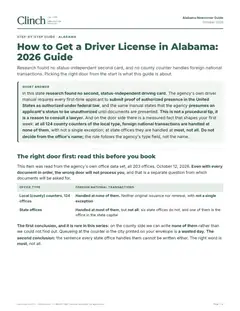
Not every office handles foreign national transactions, and no county counter does
This is the most practical item on this page, and it was read from the agency's own office data set (all 203 offices, October 12, 2026). It shapes your first week directly.
| Office type | Foreign national transactions |
|---|---|
| Local (county) counters, 124 offices | Handled at none of them. Neither original issuance nor renewal, with not a single exception |
| State offices | Handled at most of them, but not all: six state offices do not handle them |
The first conclusion, and it is rare in this series: on the county side we can write none of them rather than we could not find out. In the agency's own office layer, all 124 offices of the local type have foreign national transactions closed. So queueing at the counter in the city printed on your envelope is a wasted day.
The second conclusion, and we write this one too: the sentence every state office handles them cannot be written. Six offices of the state type do not, and one of them is the office in the state capital. The right word is most, not all.
Not one question but two: issuance and renewal are separate fields
In the agency's data set original issuance and renewal are two separate fields, and they can come apart. At one state office issuance is closed while renewal is open.
So do not ask a single question on the telephone. Ask two, and write the answers down separately:
- I am applying for the first time: does this office issue a first license or identification card to a foreign national applicant?
- I am renewing: does this office process a renewal for a foreign national holder?
Do not assume that a yes to one means a yes to the other.
The office name gives the wrong answer
This is the easiest mistake to make here, and it costs time and money in both directions. What decides whether the transaction is handled is the office's type, not its name. And at four offices the name and the type do not match:
- An office carrying the state agency's abbreviation in its name can be of the local type. The reader takes it for a state office, goes there, and the transaction is not handled.
- An office named simply License Office can be of the state type. The reader takes it for a county counter and never goes, even though the transaction is handled there.
We give you no shortcut: do not decide from the office's name. Confirm the type through the agency's own office finder, then ask the two questions above by telephone.
And do not merge this item with the core of this page; they are separate questions. Which documents will be asked for is one matter (the authorized presence requirement and the presumption sentence above); which door does not handle the transaction at all is another. Even with every document in order, the wrong door will not process you.
Official sources
- Official driver manual: authorized presence, visa classes, test languages and oral examinations
- Licenses and ID cards: document list for non-U.S. citizens, and fees
- Document requirements and fees page (conflicts with the other page on the day count)
- Driver license office finder: the office type, days and hours
- Driver license information: out-of-state transfer and renewal
- State statutory text (Code of Alabama) search interface
02 · Foreign license
Can I drive in Alabama on my Turkish license?
Short answer
Short answer: it is not exchanged, you start from scratch. The reciprocity announcement the agency published names Taiwan, Korea and Germany; research found no such agreement with Türkiye, and that announcement dates from 2015, so the list may have changed. The statute itself is clear on timing: every new resident must obtain an Alabama license within 30 days of establishing residence in the state.
Steps, documents and official links
Three questions, three answers
| Question | Answer |
|---|---|
| Is a Turkish license exchanged for an Alabama one? | No. The agency's reciprocity announcement names Taiwan, Korea and Germany, and people covered by such an agreement are exempt from the driving test. Türkiye is not on that list, and research found no other list. |
| Is a Turkish license useful at all? | Partly, as identification. The agency's secondary document list names a current international driver license or permit as an item. That is not a test exemption, it is an identity document. |
| What if I came from another U.S. state? | The agency's own sentence: a holder of an out-of-state license which has not been expired over one year does not have to pass a driver examination. That route is for U.S. licenses only. |
The thirty-day rule, in the statute's own words
The statute provides that every person, except those specifically exempted, shall obtain a driver license before driving on the highways of this state, and that every new resident of the State of Alabama shall procure an Alabama driver license within 30 days after establishing residence in this state.
The manual contains a further sentence about that period, but it is broken across a page boundary and no clear agency sentence could be read applying the same period to someone arriving directly from abroad. So the thirty-day duty is tied to establishing residence; ask the office in writing when you are treated as having established residence, and whether you may drive on your Turkish license until then.
A realistic schedule
- Before you leave Türkiye, obtain an international driving permit and keep a copy of your license in a separate folder.
- In week one, find the right office and call it. Local county counters do not handle foreign national transactions, so call a state office and ask about original issuance and renewal separately; also ask which documents are required and in which languages the oral examination is offered.
- In week two, start the Social Security side: if you have no number, make an appointment for the non-eligibility letter.
- In week three, prepare for the written and driving examinations. Do not plan around an exemption.
03 · Vehicles
How do you register a vehicle in Alabama?
Short answer
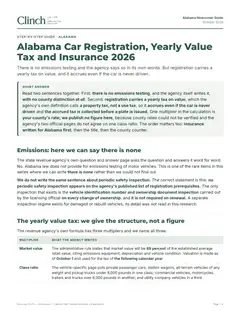
Read two sentences together. First: there is no emissions testing, and that comes from the agency itself. Second: a yearly tax on value is collected at registration, and in the agency's own definition it is a property tax, not a use tax, which means it accrues even when the vehicle is never driven and accrued tax is collected before the plate is issued. One factor in the calculation is your county's rate; we publish no figure on this page, because county rates were not verified.
Steps, documents and official links
Emissions first: this is an item where we can write no
The state revenue department's own question-and-answer page asks and answers it directly: No. Alabama law does not provide for emissions testing of motor vehicles. This is one of the rare items in this series where we can write no rather than we could not find it, and there is not even a county distinction.
We do not write the same sentence about a periodic safety inspection. The accurate statement is this: no periodic safety inspection appears in the agency's published list of registration prerequisites. The only inspection named is the vehicle identification number and ownership documentation inspection carried out by the licensing official each time there is a change in ownership, and an inspection is not required for a renewal. A separate inspection regime exists for salvage and rebuilt vehicles; its detail was not read.
The yearly value tax: the shape of the calculation
The revenue department's formula has three factors:
- Market value. The administrative rule states that the market value shall be 89 percent of the determined average retail value, to account for pollution control equipment, depreciation and the condition of the vehicle. Valuation is based on the vehicle's value on October 1, and that valuation is used for the following calendar year.
- The class ratio. The vehicle-specific agency page places private passenger automobiles, station wagons, sport utility vehicles regardless of weight and pickup trucks of 8,000 pounds or less in one class; vehicles used for commercial purposes, motorcycles, trailers and trucks over 8,000 pounds in another; and vehicles used by utilities in their business in a third.
- Your county's millage rate. This varies between counties, and inside a county between municipalities.
We publish a contradiction and take no side: the agency's general property tax page and its vehicle valuation page do not give the same ratio for private passenger vehicles. The vehicle-specific text looks the more apt one for a vehicle, but we do not present any single ratio as settled.
And the reason we publish no figure: county rates were not verified in this research. On top of that, some cities span more than one county, so two people living in the same city can owe different amounts on the same vehicle. One county license department puts it in its own warning: your tax district may have changed, and the cost printed on your renewal notice may be incorrect. Ask your own county office for the rate.
Sale, destruction or removal from the state
On the sale, trade, total destruction, permanent removal from Alabama, theft without recovery or other transfer of a vehicle, the owner is entitled to a pro rata credit for tax paid for the remainder of the then current period. The claim must be made within 60 days of the event, in the county where the tax was paid. The credit document is valid for 12 months and a small fee applies when it is used.
What the first registration requires
| Step | Detail |
|---|---|
| Certificate of title | For any vehicle requiring a title, the owner must first apply for an Alabama certificate of title through a designated agent of the state revenue department |
| Identification number inspection | Where no title is required, only a registration is issued, and the licensing official or an appointed deputy inspects the vehicle on each change of ownership. Some counties require the vehicle to be present, or an inspection form completed and signed by an Alabama law enforcement officer, and no photocopies |
| Mandatory insurance | The vehicle must be covered by an Alabama liability insurance policy before registration. The official verifies it through the online insurance verification system; if it cannot be verified, an insurance card is required |
| Identification for every owner | The state agency's own brochure requires, in addition to evidence of insurance, a valid state-issued driver license or non-driver identification card for each owner reflected on the vehicle title. Two separate counties state the same requirement on their own pages, one of them in harder language: a valid, unexpired out-of-state driver license or non-driver ID card must be presented |
| Last step | The official collects the registration fees and the accrued value tax, and issues the plate |
One caution: the state brochure contains a phrase that could be read as covering a national driver license, and whether that phrase reaches a foreign license was not verified in any agency text. We do not write, on the strength of that phrase, that a vehicle can be registered on a foreign license.
Deadlines and fees
| Situation | Deadline or amount |
|---|---|
| Moving from another state with a validly registered vehicle | 30 days from the date the vehicle enters the state |
| Buying or otherwise acquiring a vehicle | 20 calendar days; if the last day falls on a Sunday, a legal holiday or a day the office is closed, the next business day |
| Alabama certificate of title | $15, plus $3 to the licensing official |
| Standard passenger plate | $23, plus a $1.25 issue fee |
| Added on top | Local fees, the yearly value tax and sales tax |
| Late penalty | $15 plus interest, for late registration of a newly acquired vehicle, late transfer of a plate to a new vehicle, failure to renew in your own renewal month, and failure to register within 30 days of moving to Alabama |
| Keeping the document in the vehicle | The statute requires the registration and tax receipt to be retained in the vehicle; the fine for failing to produce it is a minimum of $50 |
Your renewal month depends on the first letter of your surname
The revenue department's own sentence: Alabama registers vehicles under a staggered registration system, January through November, based on the first letter of the owner's last name, and registrations expire on the last day of the designated renewal month. Leased, commercial and fleet vehicles renew in October and November.
The full letter-to-month table is not on the agency's own page, which gives only an example. One county license department publishes the table in full and it matches the agency's example. The table below is that county office's published table; for its reach statewide, ask your own county.
| Renewal month | Surnames beginning with |
|---|---|
| January | A, D |
| February | B |
| March | C, E |
| April | F, G, N |
| May | H, O |
| June | M, I |
| July | P, L |
| August | J, K, R |
| September | Q, S, T |
| October | U, V, W, X, Y, Z |
| October or November | Commercial vehicles and certain special plates |
For a Turkish reader there are two separate problems. First, where a vehicle is registered to two people, the renewal month follows the surname of the first person listed on the registration. Second, and sharper: the table has no entry for the letters specific to Turkish (Ç, Ğ, İ, Ö, Ş, Ü). The letter as written on your document is probably what governs, but we could not verify that; ask the county office and write down the answer.
And a notice may never arrive. The agency's own answer: many counties mail renewal notices and many others do not, and failure to receive a renewal notice does not relieve a vehicle owner from renewing on time. Track your own month.
Official sources
- Vehicle valuation: the yearly value tax, classes and the pro rata credit
- Registration prerequisites: title, inspection and insurance
- The official answer on emissions testing
- Renewal months and the staggered registration system
- Renewal notices may not be mailed: the agency answer
- Directory of county license plate issuing offices
- Assessment procedures rule (the 89 percent of average retail value rule)
PDF: Alabama Car Registration, Yearly Value Tax and Insurance 2026
04 · Insurance
Mandatory auto insurance and the rules on rating
Short answer
Three sentences. First: the minimum limits are 25/50/25, and the policy must be issued by an insurer licensed to do business in Alabama, so you cannot register on another state's policy. Second: the regime is built on liability insurance, and research found no no-fault regime. Third: research found no statutory section listing prohibited rating criteria, only a general standard against unfair discrimination. That is not the same as saying nothing is prohibited; the regulatory level could not be read in this research.
Steps, documents and official links
Minimum limits and verification
The state revenue department's mandatory liability insurance brochure summarizes the law in its own words: no person shall operate, register or maintain registration of a motor vehicle designed to be used on a public road unless it is covered by a liability insurance policy. The minimums are $25,000 for death or bodily injury to one person, $50,000 for death or bodily injury to two or more persons, and $25,000 for damage to or destruction of property.
Verification happens at the counter: the plate official attempts to verify liability insurance through the online insurance verification system, and if it cannot be verified the owner must provide evidence. Acceptable proof must display the current effective date, the insurer's identifying number, the vehicle identification number and the policy number.
Two official texts do not agree on the penalty figure
The state agency's brochure gives up to $500 for a first violation; the relevant statutory section gives not more than $200 for the traffic offense, doubling on subsequent convictions. Two official texts do not give the same figure and we take no side. What matters more than the figure is this: the consequence does not end with a fine. Registration suspension and reinstatement fees follow.
If you were uninsured: exemption and appeal
When insurance cannot be verified, a notice goes to the owner. If the vehicle was insured on that date, proof is submitted to the local license office or through the department's online route, and a statement on the insurer's letterhead may be required. If the vehicle was sold, stored or unused, an exemption is possible, but four conditions must all be met:
- Acceptable evidence that the vehicle was not used,
- The exemption has not already been used in the same registration period,
- No accident occurred during the lapse,
- No citation was issued during the lapse.
The appeal route is defined: an appeal from the department's action goes to the state tax tribunal, within 30 days of the notice being mailed.
After an accident: security and suspension
A separate statutory section provides that if evidence of release from liability is not produced within 20 days after an accident, the director sets an amount of security, and if it is not deposited the driver's license and all the owner's registrations are suspended within 60 days. The threshold is injury or property damage to one person above a set amount. The rule reaches non-residents too: their privilege of driving in the state is suspended.
Rating: the most permissive end, with its limit written in
Research read the full text of the two main statutory sections on auto insurance rate-making. Neither contains a list of prohibited criteria; both set only a general standard: rates shall not be unreasonably high or inadequate, shall not unfairly discriminate between risks in this state involving essentially the same hazards, and the insurer shall give consideration to all factors reasonably related to the kind of insurance involved.
In addition, in the downloaded full text of the relevant title, the phrases credit score, credit report, credit history, insurance score, national origin and marital status do not appear at all.
But we stop here. That is a scan of the statute; the state insurance department's regulations could not be read at all in this research (the department's own site did not load). So this sentence cannot be written on this page: nothing is prohibited in Alabama. The accurate sentence is: research found no statutory section listing prohibited criteria, and the regulatory level could not be read.
There is still a practical consequence: do not assume the protections you saw in other states exist here. When you ask for a quote, ask plainly: I have no U.S. credit history, how do you treat that, and ask for the answer in writing.
Official sources
05 · Tolls
Are there toll roads in Alabama?
Short answer
There is no open-road toll highway, but the federal inventory does record toll bridges and two ferries in Alabama. The bridges are all operated by a private company and the electronic transponder is called the Alabama Freedom Pass; the two ferries are operated by the state transportation department. So no account can be given of a state toll road system; there are individual facilities.
Steps, documents and official links
The Alabama facilities in the federal inventory
| Facility | Type | Operator |
|---|---|---|
| Black Warrior Parkway Bridge | Bridge | Private company, Alabama Freedom Pass |
| Alabama River Parkway Bridge | Bridge | Private company, same transponder |
| Emerald Mountain Expressway Bridge | Bridge | Private company, same transponder |
| Foley Beach Express | Road and bridge | Private company, same transponder |
| Mobile Bay Ferry | Ferry | State transportation department |
| Gee's Bend Ferry | Ferry | State transportation department |
We publish no tariff figures here. The cover report of the federal data set is a 2023 compilation, so the maximum amounts in it belong to that compilation's date. For a current tariff, check the facility's own page. Some facilities charge an additional amount per axle for trucks.
Fake toll charge text messages
Fake toll penalty text messages have become common across the United States in recent years, and several state agencies have published warnings. Research found no such warning published by an Alabama state agency, so we cannot give you an agency's own wording here, and we do not write that there is none.
The general rule is the same everywhere and we can write it: official agencies do not send payment demands through links in text messages. If such a message arrives, do not touch the link, do not pay, and if you believe you really did use a toll facility, type the facility's own official address by hand and check your account there.
06 · Severe weather
Severe weather risk in Alabama, and what to do
Short answer
What you learn in this state is not a winter driving regime but a severe weather regime. Three things right away: there are two seasons and the second runs from early November into mid-December; warnings are issued by county, so if you do not know your county's name you will not recognize your own warning; and the time to go to a shelter is the watch, not the warning. All three come from the agencies' own texts.
Steps, documents and official links
Two seasons, and newcomers do not know the second
The national weather service's regional office writes on its own severe weather awareness page that tornadoes can happen any month of the year and any time, day or night, but that there are two distinct severe weather seasons. The primary season is spring, March through May. There is also a secondary season that typically runs from the beginning of November until mid-December. The severity of each varies from year to year, so it is imperative to stay prepared year-round.
That sentence is the most valuable part of this section. A reader who arrives in September having been told the season is spring walks into November unprepared. Turn on weather alerts in the week you move, not in March.
Know where you live: the warning comes with a county name
The same office writes, in its own capitals, KNOW WHERE YOU LIVE, and adds: whatever is in your severe weather plan, it will never be complete until you can pinpoint your location on a map; do not stop at your home location, learn surrounding counties and communities.
The technical reason is this: a tornado warning is usually issued for portions of one or two counties, for an hour or less. So the warning text may name your county, not your city.
For a newcomer this is not administrative trivia, it is a safety question. The city on your envelope does not tell you your county, and some cities span more than one county. On your first day, find out which county your address is in and write the name down.
Watch and warning are not the same thing, and the timing saves lives
| Term | What it means | What to do |
|---|---|---|
| Tornado watch | Conditions are favorable for tornado development | Keep an eye to the sky, turn on a weather radio or local broadcast media. This is the moment to go to a community shelter. |
| Tornado warning | Radar has detected a developing tornado, or a reliable report has come in | Seek safe shelter immediately. Traveling at this moment is not recommended. |
A county emergency management agency puts it plainly in its own text: community shelters are generally opened during tornado watches, and the time to go to a community storm shelter is during a tornado watch before conditions begin to deteriorate, not when a tornado warning has been issued for the area. The same agency adds that traveling during a tornado warning is dangerous and could lead to serious injury or death and is not recommended.
The weather service's own warning points the same way: tornadoes could be obscured by rainfall or come at nighttime; do not wait until you see or hear the tornado, it may be too late. And one bad habit to drop: do not waste time opening or closing windows and doors; it will not protect the structure.
What to do, depending on where you are
| Where | The agency's instruction |
|---|---|
| In a home or public building | Go to the basement, or to a small interior room on the lowest level with no windows (a closet, a bathroom, an interior hall). Close the doors to the hallway. If possible get under something sturdy like a heavy table. Protect yourself with pillows, heavy coats or blankets; bicycle or motorcycle helmets protect your head. Stay away from corners and exterior walls. |
| In a large building or public facility | Go to the designated shelter, usually an interior room on the lowest level. Use the stairs, not the elevator. Stay away from large windows and skylights. Do not remain in large rooms with high, unsupported roofs such as gymnasiums, halls, warehouses and manufacturing facilities. |
| In a manufactured or mobile home | The instruction is to leave, not to shelter inside. The weather service: a mobile home or tent is not safe. A county emergency management agency: mobile homes are one of the most dangerous places to be during a thunderstorm and should be evacuated; residents of mobile home parks without designated shelters should use community shelters if available or make plans to stay with friends, neighbors or family who live nearby. Reach your sheltering place before the storm reaches your location. |
| In a vehicle | Being in a vehicle during a tornado is not safe. Drive to the closest shelter. If you cannot reach a safe shelter, either get down in the car and cover your head, or abandon the car and seek shelter in a low lying area such as a ditch or ravine. Do not take shelter under a highway overpass, where wind speeds can increase because of a tunneling effect. |
| Outside | Seek shelter inside a sturdy building immediately if a tornado is approaching. Sheds and storage facilities are not safe. |
We write the manufactured home item as a housing decision, and here is why: for a newcomer looking for cheap rent, a mobile home park may be a real option, and the official safety instruction for that home is not to be in it. That is a material fact to know before signing. We publish no risk figure, because no numerical ratio could be verified from any agency page; the two agency texts above say the same thing without one. For the rest of the tenancy questions see the renting section.
Community shelters: not everywhere, and there is a naming trap
- One county emergency management agency's shelter document states in its own heading that the agency does not open community safe rooms; the same agency's page says community shelters are managed by the local jurisdiction, not by the county agency.
- Another county's agency is even plainer: the larger cities in its area have no public safe rooms, and in those cities some places of worship and other buildings may announce they are open as a public shelter during severe weather.
- By contrast, some counties publish full lists with capacity, accessibility and pet rules, and even a map showing open and closed status.
- In other counties research found no published list. We do not write that there is none; call your county emergency management agency.
And a naming trap: a page headed emergency shelters on a city website turned out to be a homelessness services directory, not a storm shelter list. Do not confuse the two; for storm shelters go to the county emergency management agency.
We also publish the agency's own disclaimer: each community shelter is managed separately in the community it serves, has its own criteria for opening and closing, and may not always be available.
How to get the alert on your phone
| Channel | Sign-up needed | Detail |
|---|---|---|
| Wireless emergency alerts | No. The agency's own words: no signup is required | Sent automatically to capable phones during an emergency, without need to download an app or subscribe to a service. They reach you away from home as well: if you travel into a threat area after an alert is first sent, your device will receive the message when you enter the area. Sent for tornadoes, severe thunderstorms above a damage threshold, and flash floods |
| Weather radio | No, but a device is needed | The weather service's own broadcast network. A county agency's advice: because they work off radio waves, if you can receive the signal, you will get the alerts |
| The state notification system | Yes, opt-in | Activated by the state emergency management agency in August 2026, reaching cell and landline phones as well as local television and radio stations. Sign up on the agency's own page or by text message |
| County and city systems | Usually yes | Each county has its own mass notification system, and some cities give alerts by address |
We state two limits plainly. First, the announcement of the state's new notification system describes it for floods and other disasters, and no agency sentence could be found confirming that it carries tornado warnings. So we do not tell you to rely on that channel for tornadoes; for tornadoes the primary channel is the automatic phone alert that needs no sign-up. Second, research did not find which languages the state system broadcasts in.
On language there is one answer, and it is valuable. A county emergency management agency writes, on its own page, about a notification app it recommends: no personal information is required to use the app, privacy is protected and nothing is shared with the agency; and the app automatically translates notifications into the language your phone is set to. The same agency says the app can be used anywhere, not just in that county. Its text does not name Turkish; the agency's claim is the phone's language setting. Try it and see for yourself.
Language on wireless emergency alerts: the agency's own sentence says the length and language of the message on a particular device depend on the wireless network and the language setting of the device. The agency publishes examples in English and Spanish; research found no Turkish example.
Road closures: there is no single source
The state transportation department puts the same two lines at the top of every severe weather bulletin: monitor weather forecasts and traffic updates through the department's own traffic app or traffic website; and check local news outlets, county commissions and municipal emergency management agencies for local county and city road closures.
The structural consequence: state roads are in one place and local roads are somewhere else. Your counterpart changes with where you live. The department's advice during a storm is also plain: limit travel to essential trips only; if you must travel, use caution and wait for daylight and improved conditions.
Flooding is a separate risk and its rule is one sentence: do not drive through a flooded road. The name of the weather service's campaign on this is itself the instruction: turn around, do not drown.
Winter and hurricanes
Research found no winter tire or chain requirement regime in this state, and we do not write that there is none. By contrast, hurricanes are a real item here: during the days of this research the state was in an active hurricane response, and the transportation department had announced that it was suspending temporary lane closures in southern counties ahead of the storm. The department writes in its own words that it runs this process together with the national weather service and the state emergency management agency.
Official sources
- Regional weather office severe weather awareness page: the two seasons and county warnings
- Tornado safety rules: instructions by building type
- What to do during a tornado: in a vehicle, outdoors and in a building
- Wireless emergency alerts: no sign-up needed, language follows the device setting
- State emergency management agency: sign up for alerts
- Turn around, do not drown campaign
- State transportation department news channel: road conditions and lane closure bulletins
07 · Towing
What should I do if my car has been towed?
Short answer
The statute lists the circumstances in which a vehicle may be removed, and one of them reaches this reader directly: a vehicle may be removed where it is left unattended because the driver has been arrested. The party removing the vehicle acquires a lien on the vehicle for a reasonable removal and storage fee, so the vehicle cannot be collected until those are paid. We publish no tariff figures: the statute leaves municipalities their own authority, so charges vary between places and none was verified in this research.
Steps, documents and official links
When a vehicle may be removed
The statute lists the circumstances in which a law enforcement officer (and, in municipalities of a certain class, a parking or traffic enforcement officer) may cause a vehicle to be removed to the nearest garage or other place of safety:
- The vehicle has been left unattended on a public street, road or highway or other property for at least 48 hours,
- The vehicle is left unattended because the driver has been arrested, is impaired by an accident, or for any other reason causing a need for immediate removal,
- The vehicle is subject to an impoundment order for outstanding traffic or parking violations.
Lien, notice and thirty days
| Item | What the statute says |
|---|---|
| Lien | A person removing a motor vehicle shall have a lien on the motor vehicle for a reasonable fee for the removal and for the storage. So the vehicle cannot be collected until those are paid |
| Notice | The officer who caused the removal must give written notice, with the description and plate number, to the secretary of the state law enforcement agency within five calendar days |
| Treated as abandoned | A vehicle unclaimed for not less than 30 calendar days from the date notice was sent to the owner and any lienholder of record may be treated as abandoned, and a sale procedure follows |
| Municipal authority is separate | The statute says the chapter is cumulative and does not limit any power a municipality may have under other law. So municipalities can set their own rules on top |
A scope note: when granting towing authority to parking and traffic enforcement officers, the statute refers to a particular class of municipality. That is the statute's own term and we keep it unchanged; which settlements fall into that class was not verified.
What to do
- Find the right counterpart first. Who ordered the tow: city police, the county sheriff, a state officer, or a private property owner? Get the answer by telephoning the law enforcement body for the place where the vehicle was.
- Then call the storage yard and ask whether the vehicle is there, what hours it can be collected, and which documents are required.
- Ask for an itemized invoice. The towing fee and the storage fee are separate items and storage accrues every day. The cost of waiting grows quickly.
- Check the registration and insurance side. If the vehicle was stopped on a registration suspended over an insurance lapse, collecting the car does not close the problem.
Towing and storage tariffs for the individual settlements were not verified in this research, so we publish no figures. Get your own city's rules from the city's own page or by telephone.
08 · Transit
How does public transportation work in Alabama?
Short answer
There is no single answer: each settlement has its own agency and the systems look nothing like each other. Some cities run fixed-route buses, some places have demand-response service you call for, and in one university town the university's own buses are closed to the public while the public system is something else entirely. The good news: research found no Social Security number requirement for riding at the full fare on any agency page it read.
Steps, documents and official links
Five settlements, five separate agencies
No single paragraph can be written in this state beginning with the words buses in Alabama work like this. The divergence runs along three axes:
- Type of service: some cities have fixed-route buses; in some places the service is demand-response, meaning there are no fixed stops and you telephone for a vehicle.
- Operating hours: fixed-route systems may run into the evening, while some demand-response systems close in the early afternoon and do not operate at weekends at all.
- Service area: one small town's own program defines its service area as the city's police jurisdiction, which is wider than the city limit but narrower than the county. If you want to go outside it, the vehicle may not take you.
We single out the trap in one university town, because it is where newcomers go wrong most often: the university's own transit system is closed to the public. The university writes that the general public is not allowed to use its transit when regular transit service is being provided, and directs the reader to the county's public transit system. That system is not fixed-route but curb to curb, and it runs only on weekdays, in a window that ends in the early afternoon.
Are numbers or identification asked for
| Situation | Finding |
|---|---|
| Riding at the full fare | No identification or number requirement was found on any agency page read. Cash or a payment app is enough |
| Discounted fares | Identification is required. For age, disability, student status or certain health cards, agencies require a valid qualifying ID |
| Curb-to-curb service for people with disabilities | Usually an application form |
| Social Security number | No number requirement was found on any agency's own page. But we do not write that no number is required; we write that research did not find one |
Two practical warnings. First, on some systems operators cannot make change and one-way passes are sold only on the bus; carry exact change on your first day. Second, before going to apply for a discount card, telephone and ask whether the document you hold is accepted.
Intercity rail
According to the national passenger railroad's own state fact sheet, Alabama is served by one permanent route, with two intercity trains per day and three stops inside the state. The route runs across the western side of the state and on to the northeast, with one round trip daily.
The consequence: some settlements have their own station and others are entirely off the route and must drive to the nearest stop. We publish no distance figures, because no agency text measures them.
We also do not publish per-station ridership figures: the table in that document aligns differently under two text extraction methods and we could not be confident in the numbers.
Airports and the Istanbul question
The state has two large airports and both have the word international in their names. That is a trap. The nonstop destination lists the airports themselves publish are made up of domestic points; one describes its nonstop flights as reaching cities across the country, the other as 22 airport destinations across the country. One of them carries the word international partly because it is also a major cargo and intermodal center.
Research found no nonstop scheduled flight to Istanbul from any airport in Alabama. We do not write that there is none; the accurate sentence is: no international destination appears in the nonstop lists the two airports publish, so reaching Istanbul involves at least one connection. Plan your search accordingly.
Some smaller airports operate no scheduled passenger flights and serve general aviation only; do not assume that every place with airport in its name has flights.
Intercity bus
The national intercity bus operator serves the state and shares one large city's intermodal center with the railroad and the local transit authority. The stop list for each settlement was not verified in this research; check your own city's stop on the operator's site.
09 · Regions
Which office handles what in Alabama?
Short answer
In this state knowing which county your address is in is not administrative trivia, it is the precondition for almost every section on this page: property tax, vehicle tax, exemption applications, weather warnings and shelter lists all run through the county. On top of that, some cities span more than one county, so two people living in the same city can get different answers. The second rule: where your utility complaint goes depends on what kind of provider you have, and the regulator names on its own page exactly who it does not regulate.
Steps, documents and official links
The one thing to do on day one: look up your address
The most useful tool on this page for a newcomer is an address lookup. The census bureau's address lookup service returns the county and the municipality for an address in a single query, with no key required. The state revenue department also publishes its own address lookup.
Why it matters:
- The vehicle tax varies by county, and one county department puts the warning in its own words: your tax district may have changed, and the cost printed on your renewal notice may be incorrect.
- The property tax exemption is filed with the county; there is no state-level filing.
- Tornado warnings are issued by county and shelter lists are published by county.
- License and plate counters are county offices, and some of them do not process foreign national transactions.
A city system and a county system can be separate
This state has school systems at both city and county level, and some cities run their own district, entirely separate from the county district around it. An address one meter outside a city limit can fall into a different school system. See the school enrollment section for detail.
The same split runs through water, sewer and trash, and there it is even more scattered: in one city water is run by a city department, in another by a water board with its own legal personality, and in a third by a multi-service utility owned by the city. Those three structures sit under different regulatory regimes, and we set out the difference below.
Who is regulated and who is not
The state's public utilities regulator names on its own consumer page exactly who it does not regulate: electric cooperatives, most water companies, municipal utilities, wireless services, cable television systems and a regional federal power producer. And it finishes the sentence like this: therefore, it does not have power to resolve complaints concerning them.
| Your provider | State-level complaint route |
|---|---|
| Investor-owned electric and natural gas company | Yes. The regulator's consumer line and online complaint |
| A municipal utility (an electric, water or gas utility owned by the city) | No. Your counterpart is the utility itself and the city council |
| An electric cooperative | No. The cooperative's own procedure applies |
| Water and sewer utilities | Usually no. The regulator writes that it does not regulate most water companies |
The practical consequence for you: when you have an unresolved billing problem, the door you go to is set by the kind of provider you have. The name and type of your provider is one of the first things to learn when opening an account. Detail in the utilities section.
The state's own translation disclaimer
A state agency publishes this disclaimer about the automatic translation on its own site: site translations are made through an automated and computerized process, are only an approximation, and in some cases may include incorrect or offensive language.
We pass that warning on as written, because making a legal or financial decision on the strength of a state site's translate button is risky. If you need to understand an important document, ask the agency for an interpreter; at some agencies that right is in writing and has even been published in Turkish.
Which office to call about what
| Topic | Counterpart |
|---|---|
| Driver license | The state law enforcement agency's license offices, county by county |
| Vehicle registration and plates | The county's plate issuing official. The title varies by county: probate judge, license commissioner or revenue commissioner |
| Property tax, assessment and exemption | The county revenue or assessing office |
| Recording a marriage certificate | Any county probate court |
| Birth, death, marriage and divorce certificates | The state health agency's records center, and any county health department |
| School enrollment | The city or county school district your address belongs to |
| Weather warnings and shelters | The county emergency management agency |
| Electric or gas billing complaint | Depends on your provider type: the regulator, or the utility itself |
10 · Utilities
Opening power and gas, deposits and disconnection rules
Short answer
There is a shutoff rule, but it fires only in the cold. The regulator's rule prohibits disconnection of residential electric and natural gas service for nonpayment when the temperature at that location is forecast to be 32 degrees Fahrenheit or below for that calendar day. Research found no heat threshold, so we cannot show you any protection against a summer air conditioning shutoff. And most important of all: municipal utilities and cooperatives are outside this regulator's reach.
Steps, documents and official links
The shutoff rule itself
The regulator's general rules provide, in the relevant paragraph: no residential electric or natural gas service shall be disconnected for nonpayment when the temperature at that location is forecasted to be 32 degrees Fahrenheit or below for that calendar day. The controlling forecast is the one issued by the national weather service for that location on the day in question.
Five limits, all of them necessary
- It covers electric and natural gas only. The rule names residential electric or natural gas service. Water, sewer and trash are outside it; for those see the separate section.
- No heat trigger was found. In Nevada the same kind of regime had a hot end that postponed an air conditioning shutoff. Research in Alabama found no such threshold. We do not write that there is none, we write that we did not find one; but neither do we describe a protection we could not find as if it existed.
- Municipal utilities and cooperatives are outside the scope. The regulator writes on its own page that it does not regulate electric cooperatives, most water companies or municipal utilities, and that it has no power to resolve complaints concerning them. So if your provider is one of those, the 32-degree rule may not operate at your address and you have no state-level complaint route.
- Two different regimes can exist inside one city. Most of a city may buy power from a regulated company while some areas buy from a cooperative. Because cooperatives sit outside the regulator's reach, the rule may not operate at those addresses. Learn your provider's name and type.
- The source carries an old date. The effective dates on the rule document the regulator publishes go a long way back, and whether the rule has since been amended could not be verified in this research (the administrative code site's text could not be read). So we name the rule, but we do not claim it applies unchanged today.
Four more things in the same rule that will help you
| Rule | What it says |
|---|---|
| Time limit | Service may not be cut off for nonpayment after 3:30 p.m. on any day immediately preceding a day or days when the utility's office will be closed |
| Notice period | A disconnection notice sent by mail must be posted at least five calendar days before service is to be disconnected |
| The form of the notice | The notice must carry a bold heading (disconnect notice, termination notice, final notice or cutoff notice) and must tell the customer to contact the utility first and then the regulator if the dispute is unresolved |
| The right to installments | Every utility must delegate to at least one employee in each office the power to extend a payment deadline, agree to installments and correct billing errors. This is the sentence a newcomer should be told about |
| Special circumstances | Each utility must adopt tariff rules for termination when life or health may be threatened, when the customer requires special consideration because of age or handicap, or in other circumstances warranting special consideration |
| Paying to the last moment | The customer may pay at any time before the actual disconnection |
Deposits: the cap, the interest and the refund
The deposit paragraph of the same general rules provides, for regulated electric and gas utilities:
- A deposit may be required when, in the judgment of the utility, it is necessary, and it shall not exceed the amount of an estimated bill for two regular billing periods.
- Interest is paid on deposits at 7 percent annually, credited to the customer's account on the December bill.
- A residential customer's deposit shall not be held beyond the December following 24 months of retention where the account is in good standing.
- Each utility shall issue a receipt to every customer from whom a deposit is taken.
- A further deposit may be demanded on five days' written notice if the account falls out of good standing.
Note: these rules apply to regulated electric and gas utilities. If your provider is a municipal utility or a cooperative, its own policy applies and the cap, the interest and the refund period may be different.
I have no number: how do I open an account
There is no single statewide answer here, because every provider has its own identification list. The pattern research found is this:
| Provider type | Finding |
|---|---|
| A municipal utility | The clearest text this series has seen: the utility's own page requires two valid and unexpired forms of government issued identification to establish service, at least one from the primary list. The primary list names a passport and a consular identification card issued by another national government; the secondary list includes an individual taxpayer identification number. The Social Security card is only one of the options on the secondary list |
| A large investor-owned electric company | The company's own question-and-answer page lists a Social Security number among the information required for an online application. No alternative route for a person without a number was found on the company's own site. That is not the same as saying no account can be opened without one; call the company and ask about applying in person, a taxpayer identification number or a passport |
| A water board form | One city's water application prints a field reading Social Security number or taxpayer identification number, and adds this: if you would prefer not to provide a Social Security number on the form, you can request contact by a service representative instead; please indicate contact me in that blank. But the same form's required document list says driver's license, not photo identification, and no sentence could be found stating that a passport is accepted |
Ask the right question. Do not say I have no number on the telephone; ask instead: what do you accept as alternative identification, are a passport and a taxpayer identification number on your list, and does applying in person change the answer. Write the answer down, and ask for it in writing where you can.
One company's own terms
From a regulated large electric company's own question-and-answer page: an account establishment charge is added to the first bill; whether a deposit is required is determined by a credit check through a credit bureau; where one is required the amount is twice the average monthly bill for the residence, and it is credited back with interest after 12 consecutive on-time payments.
Municipal utilities may have their own policies, and some are broader than the regulator's rule. One city-owned utility's own policy postpones disconnection in both high and low temperatures and covers electric, water and gas together. But that is the utility's own internal policy, not a state rule; no outside body binds it and it can change it. Read your own provider's policy on its own page.
And that policy carries two limits important enough to write down: a service already terminated is not reconnected because of the weather; and when a postponed disconnection is resumed once conditions improve, no further notification is provided.
11 · Water and trash
How do water, sewer and trash services work?
Short answer
These three items sit outside the shutoff rule and largely outside the state regulator as well. The regulator writes on its own page that it does not regulate most water companies or municipal utilities and that it has no power to resolve complaints concerning them. The practical consequence is hard: a reader whose water is cut off has no state body to appeal to, and the counterpart is the city or the water board directly.
Steps, documents and official links
Three structures, three counterparts
Across the settlements research read, water is run in three different ways and none of them is the same as the others:
- A city department: water and sewer run directly by a department of the city, and in some cities trash is on the same account.
- A water board with its own legal personality: connected to the city but distinct from it; the account and deposit go through its form, and even the trash deposit can sit on that account.
- A multi-service utility owned by the city: a public utility supplying electric, gas and water on one bill.
The difference you need to know: all three sit outside the state regulator's reach, and that has direct consequences on both the shutoff and the complaint side.
The shutoff rule does not operate here
The regulator's 32-degree rule names residential electric or natural gas service only. Water, sewer and trash are not inside it. Water utilities are in any case outside the regulator's reach.
There is one exception and it must not be confused: a municipal utility supplying electric, gas and water together may apply its own internal policy to all three. But that is not a state rule, it is that utility's own policy and no outside body binds it.
Trash: which account it sits on varies by city
| Pattern | What it means |
|---|---|
| Trash is on the water bill | Collection starts the moment you open the water account; no separate application |
| Trash deposit at the water board, collection by the city | The account sits with a board but the truck is sent by the city street department; if something goes wrong there are two doors |
| Trash is with a private company | In some settlements collection is done by a private firm, and an extra container may cost more |
| The trash charge depends on residency | In one small town the trash charge is set by city residency while the library charge is set by county residency. And neither publishes what counts as proof of residency |
We publish no tariff figures. The water, sewer and trash tariffs and deposits of the settlements read could not be verified, and one application form would not even load. Get your own city's tariff from the utility's own page or by telephone.
What to ask when opening an account
- Which utility serves my address? A city department, a water board, or a multi-service utility.
- What do you accept as identification? Are a passport, a consular identification card and a taxpayer identification number on the list? One city's form offers the option of asking for a representative to call instead of giving a number, but the same form's document list says driver's license and does not say a passport is accepted.
- How much is the deposit and when is it refunded? The cap and interest rule the regulator sets for electric and gas does not bind water utilities.
- If I rent, whose name goes on the account? Some utilities require service to be established in the name of the legal occupant of the property and may refuse to open an account in another person's name at an address where someone with an unpaid balance lives.
- Where do I go if a dispute is not resolved? For water utilities there is usually no state-level body; the counterpart is the utility itself and the elected city council.
12 · Renting
What are a tenant’s rights in Alabama?
Short answer
Know three things together. First, the state's fair housing provision protects national origin, and for a Turkish reader that is the real hook; source of income and immigration status are not on that list. Second, there is a retaliation rule but it is narrow and covers only three grounds. Third, the provision in the 2011 act making it unlawful to rent to a person unlawfully present was permanently enjoined by a federal court, yet the text is still printed in the code. On money the strongest right is this: if the deposit is not returned within 60 days, or no itemized accounting is given, the landlord owes double.
Steps, documents and official links
The rental provision: read all three layers together
The 2011 act contained a provision about renting a dwelling to a person unlawfully present. The correct answer here has three layers and we write all three:
- The text is printed in the code. The state's own legislative server publishes the section and attaches no warning note. A reader who searches will find it.
- A federal court permanently stopped it. The order is Hispanic Interest Coalition of Alabama v. Bentley, Northern District of Alabama, Doc. 180, entered November 25, 2013. It permanently enjoins state officials from implementing that provision and several others, on the ground that they violate the Supremacy Clause.
- The law did not freeze in 2013. Other parts of the same act were amended twice in 2025. So today's text is not the 2013 text, and widely used legal websites carry a snapshot dated December 30, 2024 and miss both amendments.
In this section we describe no provision as in force without a verified injunction record, and none as repealed either. If you have a question specific to your situation, consult a lawyer.
Protected classes: national origin is on the list
The state's own fair housing provision makes it unlawful to refuse to sell or rent a dwelling, to refuse to negotiate, or otherwise to make a dwelling unavailable, because of race, color, religion, sex, familial status or national origin. The same grounds also cover discrimination in the terms, conditions or privileges of a sale or rental.
| Ground | In the state provision |
|---|---|
| Race, color, religion, sex, familial status | Yes |
| National origin | Yes. This is the provision a Turkish reader relies on |
| Source of income (including housing vouchers) | Not on the list |
| Immigration status | Not on the list, and research found no state provision forbidding a landlord to ask about it either |
| Disability | Not named in this section. Disability protection in housing comes from the federal fair housing statute; they are separate laws and must not be merged |
What protection of national origin means in practice: if you believe you were refused an apartment because of your name, your accent or the country you came from, that is the provision to rely on. Complaints under the federal statute go to the federal housing department's office of fair housing and equal opportunity.
An open question: whether the state prevents cities from adopting their own stricter tenant ordinances could not be determined in this research. We do not write that there is no such preemption; your city may have its own ordinance, so ask the city.
The retaliation rule: real, but limited to three grounds
The statute prohibits a landlord from retaliating by discriminatorily increasing rent or decreasing services, or by bringing or threatening to bring an action for possession, but only on these three grounds:
- The tenant has complained to a governmental agency charged with enforcement of a building or housing code of a violation applicable to the premises materially affecting health and safety,
- The tenant has complained to the landlord of a violation under a named section,
- The tenant has organized or become a member of a tenants' union or similar organization.
These three are set out by number and not generalized into the sentence tenants are protected. The statute also leaves the landlord carve-outs: a possession action may still be brought where the code violation was caused primarily by the tenant's own lack of reasonable care, where the tenant is in default in rent, where compliance would require alteration or demolition depriving the tenant of the unit, or for other material violations of the lease.
Deposits: a one-month cap, and a double-damages remedy
| Rule | Detail |
|---|---|
| The cap | A landlord may not demand or receive money as security in excess of one month's periodic rent. Three exceptions: pets, changes to the premises, and increased liability risks to the landlord or the premises |
| Return period | Within 60 days of termination and delivery of possession the deposit must be returned or an itemized written accounting given |
| The remedy for missing it | If the landlord misses the 60 days, the landlord owes the tenant double the original deposit. This is the single most useful tenant protection in Alabama law |
| The tenant's duty | On vacating, the tenant must give a written forwarding address. If none is given the landlord sends to the last known address, and a deposit unclaimed for 90 days is forfeited by the tenant |
Eviction: seven business days, and one default that cannot be cured
If rent is not paid on time, the landlord gives a written notice of termination specifying the rent and late fees owed, and the lease terminates on a date not less than seven business days after receipt. If the tenant pays within those seven business days the lease does not terminate. The cure period for other material breaches is the same.
But one default cannot be cured and it is a real risk for a newcomer: the statute treats the intentional misrepresentation of a material fact in a rental agreement or application as something that may not be remedied or cured. A statement on the rental application cannot be put right afterwards. Do not sign a form you do not fully understand, and do not let someone else fill it in for you.
The other non-curable defaults are: illegal drugs in the unit or common areas; the illegal use, manufacture, possession or discharge of a firearm or ammunition on the premises (with self-defense exceptions); criminal assault of a tenant or guest; and a repeat of substantially the same breach within six months of a cure. The statute also allows no more than two cures in any 12-month period.
On periodic tenancies: a month-to-month tenancy ends on 30 days' written notice and a week-to-week tenancy on 7 days'. Holding over willfully and in bad faith is expensive: the statute allows up to three months' rent or actual damages, whichever is greater, plus the landlord's attorney fees.
A note on sources
Some of the tenancy provisions above were read first-hand from the state's own server (the protected classes and the retaliation rule among them). The provisions on deposits, eviction and notice periods were read from a secondary source carrying a snapshot dated December 30, 2024. So changes from the 2025 and 2026 sessions may not appear in those figures. Verify the current text before making an important decision.
And a safety item: ask before you sign
Renting in this state has a safety dimension that nobody mentions. The official instruction for manufactured and mobile homes is not to shelter inside but to leave before the storm arrives; the national weather service writes that a mobile home or tent is not safe, and a county emergency management agency writes that mobile homes should be evacuated. If you are considering a cheap mobile home rental, that is a material part of the decision.
If you are renting an apartment or a house, ask this before signing: does this building have a designated sheltering space, and where is it. Research could not verify whether an Alabama landlord is required to provide or point out such a space, which is why the question is yours to ask. Detail in the severe weather section.
13 · Property tax
Buying a home, property tax and the homestead exemption
Short answer
Start with the factor of two: an owner-occupied single-family home sits in one class and is assessed at 10 percent of fair market value; a home that is rented out, or not exclusively owner-occupied, sits in another class and is assessed at 20 percent. That is twice the assessed value on the same house. The exemption is filed with the county, not the state, and its calendar is narrow. The state rule mentions no identification number at all, but we also write that the answer lies with the county and that no county's document list could be read.
Steps, documents and official links
The tax calendar starts on October 1
| Date | What happens |
|---|---|
| October 1 | The tax year begins, real property is valued as of this date, this is the lien date, and taxes are due |
| December 31 | Unpaid taxes become delinquent after this date |
| Spring | An administrative fee is added to delinquent parcels, then advertising and the tax lien sale process follow |
Taxes are collected in arrears, with the tax year beginning in October and ending in September.
The factor of two between an owner-occupier and a landlord
A county revenue commissioner's own sentence puts it most plainly: if you own a single family residence occupied by you as the deed holder and not rented out, you qualify for the class taxed at 10 percent of its fair market value; if you own vacant land, or it is not exclusively owner-occupied, your property is in the other class and will be taxed at 20 percent.
That is twice the assessed value on the same house, and it comes from the classification itself, separately from any homestead exemption you may claim. Someone who rents the house out and keeps claiming the exemption falls inside the false-information penalty below.
We also publish a contradiction: one county's own page says in one paragraph that an owner-occupied home is taxed at 10 percent, and two paragraphs later, when giving the formula, prints a different ratio. The state department's figure is 10 percent and that is the one to rely on, but we do not silently correct the contradiction, and no tax estimate should be made from the formula on that page.
The increase cap, and its reset on a change of ownership
A recent act and administrative rule cap the annual increase in the taxable assessed value of certain classes of real property at 7 percent. The base year is October 1, 2024 and the cap applies to collections from October 1, 2025. It bites where the actual valuation rises more than 7 percent over the previous year's taxable assessment.
And here is the trap for a buyer: the cap resets when the property changes ownership, and the property is reassessed at full value. So you do not inherit the seller's sheltered figure. Budget from the new assessment, not the seller's last tax bill. This rule is new enough that nobody may warn you.
The homestead exemption: definition, calendar and types
The state revenue department's definition: a homestead is a single-family owner-occupied dwelling and the land thereto, not exceeding 160 acres. The owner may be entitled to the exemption if they own a single-family residence and occupy it as their primary residence on the first day of the tax year for which they are applying. The first day of the tax year is October 1.
That is the sentence that matters for a newcomer's first year: someone who moves in mid-year may not get the exemption for that year.
The filing calendar, from the administrative rule itself: the owner of homestead property as of the October 1 lien date must apply and submit all supporting documentation to the local tax assessing official in the county where the property is located. An application made between October 1 and December 31 applies the exemption for the current year; an application made at any time during the year applies it for the following year.
There is no state-level filing; the department's own instruction is visit your local county office.
| Type | For whom | What it gives |
|---|---|---|
| Basic homestead exemption | Under 65 and not disabled | $4,000 of assessed value exempt from the state portion and $2,000 from the county portion |
| Age or disability, income limited | 65 or older with income below a set limit on the most recent state return; or retired for permanent and total disability at any age | Exempt from the whole state portion, and a larger exemption on the county portion including school district taxes |
| Full exemption, income limited | 65 or older with net taxable income below a set limit on the combined federal return | Exempt from all ad valorem taxes |
| Full exemption, disability | Permanently and totally disabled | Exempt from all ad valorem taxes, with no income limit |
| Age, above the income limit | 65 or older with income above the limit | Exempt from the whole state portion, plus the regular county exemption |
The land limit for all of them is 160 acres. A person who is permanently and totally disabled, or who is 65 or older and qualifies under the income limits, does not have to claim again every year after the initial qualification; verification is by an affidavit form the county mails. A physician's affidavit is used to verify disability.
The penalty for a false claim is heavy
The administrative rule's own text: any person who knowingly and willfully gives false information for the purpose of claiming a homestead or principal residence exemption, or for the purpose of assisting another person in claiming one, shall be ordered to pay twice the amount of any ad valorem tax which would have been due, retroactive for a period of up to 10 years, plus interest at 15 percent per year. Payment is due within thirty days of written demand and the state may enforce it by civil action.
That is a real risk for someone who rents the house out and keeps the exemption. If your circumstances change, tell the county.
I have no number: can I get the exemption?
There is a gap here we have to be honest about, and we also write what was searched.
- The operative administrative rule was searched in full: no identification number is mentioned anywhere in it. The documents it does name are income evidence (a state or federal return) for the age-65 and disability types, and a physician's certification for disability.
- The state department's exemption page names no identification number either; it says only visit your local county office.
- But the county grants the exemption, and no county's published document list could be read in this research.
The accurate sentence is this: Alabama's own homestead rule asks for ownership, occupancy on October 1, and for certain types income or medical evidence; it does not mention an identification number at all. But the exemption is granted by the county, and we could not read what those counties ask for in practice. If you will apply with an individual taxpayer identification number, assume nothing; call the county revenue office before October 1 and ask which documents they require.
And one detail from the statute
The public records transactions section of the 2011 act, when listing the transactions it reaches, expressly states that it does not include any transaction relating to housing or the ownership of real property, including the payment of property taxes. So that section's closed list does not take in property tax payments or housing transactions.
We do not present that as a guarantee, and we say nothing about whether that section can be enforced today; we only quote the text's own scope sentence.
Official sources
14 · School
How do I enroll my child in school in Alabama?
Short answer
We answer this in four steps, because a reader who searches will find the statute and may be frightened by it: (1) a section requiring schools to determine a student's immigration status is still printed in the code with no warning; (2) that section was permanently enjoined by a federal court; (3) the statute's own general rule already lists school among the services needing no verification; (4) the constitutional backstop exists separately. In practice the districts point the same way: one district's policy says a request for a number is voluntary, another says no student may be denied enrollment solely for failing to meet documentation requirements.
Steps, documents and official links
Step one: the text is printed in the code
A section dating from the 2011 act sits in the Alabama code. It requires every public elementary and secondary school, at the time of enrollment in kindergarten or any grade, to determine from the student's original birth certificate or a certified copy whether the student was born outside the jurisdiction of the United States; it requires the parent in that case to notify the school within 30 days of the student's citizenship or immigration status; and it provides that if no such documentation or declaration is presented, the school official shall presume, for the purposes of reporting under the section, that the student is unlawfully present. It goes on to require data collection by districts, annual reports to the state board of education, and a public report to the legislature.
The text sits on the state's own legislative server today, in full, with the effective and supersession date fields empty, no editorial note of any kind, and the node updated this month. That is exactly the root of the trap: the server shows repeals (the content collapses to a single sentence) but gives no machine-readable signal at all about provisions a court has stopped.
Step two: a federal court permanently stopped it
The order is Hispanic Interest Coalition of Alabama v. Bentley, Northern District of Alabama, Doc. 180, entered November 25, 2013.
The relevant paragraph permanently enjoins the state defendants and the defendant school superintendents from implementing the provision, on the ground that it violates the Equal Protection Clause of the Fourteenth Amendment. The appellate court had earlier held that the provision imposes a substantial burden on the right of undocumented school children to receive an education and that the state's justifications did not support that interference.
Two cautions, both important. First: certain school districts' superintendents are named defendants in that order, but the force of the holding comes from the appellate court finding the provision unconstitutional, which governs Alabama generally. It does not mean districts that were not defendants sit outside it. Second: the confidentiality and damages paragraphs inside that same enjoined section are part of the enjoined text, so we do not present them as live protections.
Step three: the statute's own general rule exempts school
A separate section of the same act lists the services for which verification of lawful presence is not required, and the first item on that list is primary and secondary school education. The full list and the two critical paragraphs beside it are set out in the clinics section.
Step four: the constitutional backstop exists separately
The Supreme Court's decision in Plyler v. Doe applies in Alabama as everywhere on access to public elementary and secondary education. Research in this round did not look for a state education department statement restating it, so we do not write that none exists; it simply fell outside the scope of the research.
In practice: what the districts say
This state has both city and county school systems, and some cities run their own district, entirely separate from the county district around it. So the answer varies from district to district. The pattern from the districts' own texts is this:
| Topic | From the districts' own texts |
|---|---|
| The number | One city district's board policy says, in its own words: a Social Security number may also be requested, but such request is voluntary and is not a requirement of enrollment. Another district's enrollment guide does not mention a number at all |
| Missing documents | One district's enrollment guide states in capitals: no student will be denied enrollment or admission to school due to a failure to provide a birth certificate or other supplemental documentation. The same document says enrollment is provisional pending the documents |
| Birth certificate | One district writes that students entering the system for the first time are not required to submit a birth certificate, but may be asked for a birth certificate or another form of acceptable documentation to verify age |
| Parent identification | One district names, as acceptable photo identification, a driver's license, a state identification card, a passport and an identification card obtained through an official government agency or consulate |
| Immigrant students | One district's policy says that homeless, migrant and immigrant students, children in foster care and English learners will have equal access to the same free appropriate public education, and that their enrollment shall not be denied or delayed due to any barriers that are specifically prohibited by applicable law; the superintendent may accept alternate forms of evidence |
| Proof of address | This is the real obstacle. Districts generally ask for a lease or deed plus a current utility bill, and may require the document to be in the name of the enrolling adult |
| Staying with relatives | Several districts require a separate shared residence affidavit, the host's current bill and photo identification, and mail addressed to the parent at that address; one district states plainly that a home visit by a school official is required |
| Residency rule | Some districts require residence inside the city limits; one writes that it does not accept enrollment via any type of waiver or tuition payment and requires proof to be renewed every year |
We write the home visit item so that it does not come as a shock: it is not an investigation, it is the district's residency verification procedure. But you should know about it and prepare.
Immunizations
Districts require a current certificate of immunization at enrollment, or a certificate of exemption issued by the state health agency. The certificate can be obtained from county health departments, from a family doctor, or from certain clinics. And this item is good news: the statute's list of services needing no verification names immunizations expressly.
Language: Turkish is on no list, but there is a right to ask for
Which languages are actually produced varies by district and cannot be averaged:
- One district publishes its registration forms in English and Spanish.
- One district's English learner plan names no language at all and says only this: if students or parents need an interpreter during the registration process, one will be provided if possible. We keep the words if possible exactly as written; that is the realistic answer from a small district.
- For one district no list of translated languages could be found.
- Turkish appears on none of them.
The sentence for this page is therefore: not that Turkish services exist, but that there is a right to ask for and this is the door. Make the request in writing, and note who you gave it to and when. And remember a detail from the health section: the state health agency publishes its language assistance notice in Turkish. No equivalent text was found on the school side, but that does not mean Turkish support cannot be requested.
PDF: School Enrollment in Alabama: The Answer in Four Steps 2026
15 · Health
How do I get health care without insurance?
Short answer
Know three structural facts from the start. First, this state did not take the federal option left for children and pregnant people, so there is no state route around the five-year wait. Second, the state did not expand coverage; the agency's own income table contains no category at all for a childless adult under 65 who is not disabled, and the coverage gap is real. Third, what remains is emergency coverage, and the state's own regulation sets the number requirement aside there.
Steps, documents and official links
Three agencies, three programs
| Program | Who runs it |
|---|---|
| Medical assistance (Medicaid) | The state medical assistance agency |
| The children's health program | The state health agency, not the medical assistance agency |
| The pregnancy health program | The same state health agency |
| The marketplace | The federal marketplace. Research found no state exchange |
Do not mix the agency names: the agency that runs the children's and pregnancy programs is the same one that holds the vital records. And that agency publishes its language assistance notice in Turkish (below).
The coverage gap: who is left with what
Three conclusions follow from the 2026 income limits table the state medical assistance agency publishes:
- There is no adult expansion group on the list at all. Every category is tied to being a child, being pregnant, being a parent or caretaker relative, age, blindness, disability, institutional care or Medicare. A childless, non-disabled adult under 65 does not appear anywhere.
- The ceiling for a parent or caretaker relative is written as 18 percent of the federal poverty level. A parent earning almost anything is over the line.
- The gap is exactly there: someone above that ceiling but below the poverty line earns too much for the state program and too little for marketplace savings, and gets neither.
| The reader | What is actually available |
|---|---|
| A child under 19, family income above the medical assistance line and up to the program ceiling | The children's health program (with a premium and copayments) |
| Pregnant, income up to the program ceiling, not eligible for and not covered by medical assistance, no comprehensive coverage | The pregnancy program, with no premium and low copayments |
| Pregnant or a child aged 0 to 18 with low income | Medical assistance, but the agency's condition is being a U.S. citizen or being in satisfactory immigration status |
| A parent or caretaker above the ceiling but below the poverty line | Nothing. This is the gap |
| A childless, non-disabled adult under 65 | No category at all; a full-price marketplace plan or a sliding-fee center |
| Anyone, in a medical emergency | Emergency coverage, plus the federal duty on hospital emergency departments |
The October 1, 2026 federal change and the option this state did not take
From October 1, 2026, federal law limits federal funding for full medical assistance and children's health assistance to four groups: U.S. citizens and nationals, lawful permanent residents, certain entrants from particular countries, and migrants under compacts of free association. Refugees, asylees, people with temporary protected status, parolees and visa holders are not on that list.
The federal agency's own implementation document names three exceptions: emergency coverage, an option a state may elect, and certain initiatives designed to improve children's health.
Alabama did not elect that option. The federal agency's published state list is alphabetical and Alabama is not on it; an independent tracker reaches the same result. The federal agency's own wording is that in states which did not elect it, federal funding continues for emergency coverage in medical assistance for people who are not eligible, but that because separate children's health programs contain no emergency equivalent, no federal funding remains for them after October 1, 2026.
The federal agency also says this: states will not be required to provide state-funded health coverage to people for whom federal funding is no longer available. Research found no Alabama health program funded from the state budget and open regardless of immigration status (that is a we did not find it finding, not a there is none finding).
And one date: for states that did not elect the option for all covered populations and run a separate children's health program, the federal agency set a filing deadline of November 30, 2026, and because such filings count as a restriction of eligibility they carry a public notice requirement. Alabama is in that bucket. Research found no state announcement on this; we do not say it has filed or will not file. Follow the agency.
Emergency coverage: the regulation sets the number aside
The strongest source in this section is not a web page but the state's own regulatory text. From the medical assistance agency's administrative code, in its own words: emergency services, as defined by the agency, will be covered for people who would be otherwise eligible except for enumeration, citizenship and alienage requirements. Another rule in the same chapter says that non-qualifying aliens are eligible only for emergency services for treatment of emergency medical conditions.
The key word there is enumeration, which means the Social Security number. In a single sentence the regulation says a person may be covered for emergency services even with no number, no citizenship and no qualifying immigration status, provided they would otherwise qualify on income, residency and category.
Two cautions. First, the expressions the regulation uses are its own legal terms; we quote them as the rule's language and do not adopt them as this page's voice. Second, this is a rule about emergency services, not a general route to coverage.
A second Alabama document points the same way: the statute itself lists, among the services needing no verification, health care items and services necessary for the treatment of an emergency medical condition (excluding organ transplant procedures). Two independent Alabama instruments point in the same direction.
We publish a conflict and take no side
The state's own regulation, listing who counts as a qualified alien, still names refugees, asylees, people whose deportation has been withheld and certain entrants; the regulation's own revision date is earlier than the federal change.
Federal law removes federal funding for those groups from October 1, 2026.
Research found no state announcement reconciling the two, and no amended state regulation. So we name both documents and do not say which is being applied in practice. If this is your situation, call the agency and ask for the answer in writing.
The difference between two published lists
Two eligibility lists sit on the same agency's site, updated in the same month, and only one of them mentions citizenship:
- The children's health program eligibility list says be a U.S. citizen or an eligible immigrant.
- The pregnancy program eligibility list has five items (be a state resident, be pregnant, not be covered by or eligible for medical assistance, not have comprehensive health coverage, be within the income guidelines) and contains no citizenship or immigration status condition.
We write this as the difference between two published lists, not as a promise. The agency nowhere says the pregnancy program is open regardless of immigration status, and whether status is asked for in practice could not be verified. How that program interacts with the October 1, 2026 federal change is also an open question. Telephone before assuming anything.
Do not merge the ages
In the federal option the limits are 21 in medical assistance and 19 in the children's health program. Two different programs, two different ages. Do not collapse them into one figure.
Turkish: the first time in this series an agency publishes in Turkish
The state health agency publishes its free language assistance notice in full, in Turkish, on its own site. The agency's own text reads:
Yardıma mı ihtiyacınız var? İngilizce konuşmadığınız veya engelli olduğunuz için bizimle iletişim kurmakta veya bu bilgileri anlamakta zorluk çekiyorsanız lütfen bizi haberdar edin. Talep edilmesi durumunda ücretsiz dil yardımı veya başka yardımlar ve hizmetler sunmaktayız. Lütfen arayın 1-800-252-1818.
The agency defines the service as the use of an interpreter or other communication services, and names a qualified interpreter, a language line, a sign language interpreter, a qualified reader, large print, braille, video remote interpreting, written notes and note takers.
That agency also runs the vital records and two children's health programs, so the same agency stands behind many of the doors on this page. A state human resources department also lists Turkish among its languages, but the Turkish text on that page could not be read, so we say nothing about its content.
Official sources
- State health agency language assistance notice (including Turkish)
- Children’s health program: eligibility and how to apply
- Pregnancy health program: eligibility list and copayments
- State medical assistance agency eligibility regulation (the emergency services rule)
- Federal marketplace: the coverage gap in states that did not expand
- Federal agency state list: which states elected the option
16 · Health
Where can I go without insurance?
Short answer
First, close a misunderstanding: community health centers are not free. The charge is set on a sliding scale based on household income and family size, but there is still a charge. Second, the federal duty on emergency rooms applies here as everywhere. Third and most important: the statute itself publishes an explicit list of services for which verification of lawful presence is not required, and that list is at the center of this section.
Steps, documents and official links
Sliding-fee centers: not free
We say this first, every time: a sliding-fee clinic is not a free clinic. The discount depends on household income and family size, and there is still a charge. The federal marketplace site puts it in its own words: community health centers provide services on a sliding scale based on your income.
The statewide membership body for these centers is the Alabama Primary Health Care Association, which publishes a find a health center tool on its own site. By the association's own account its network is located in 80 percent of Alabama counties.
We state three limits plainly. First, we publish no center's address from a federal health center data service; look at the center's own site and take the address from there. Second, each organization's service area was not verified, so confirm through the search tool whether the nearest center serves your county. Third and most important: none of the center pages read says anything about immigration status, so we add no sentence saying status does not matter.
The emergency room
The federal emergency care duty applies in Alabama too: a hospital emergency department must screen and stabilize regardless of ability to pay or immigration status. Research in this round did not look for an Alabama-specific restatement of that rule; the federal frame applies.
On the payment side the route behind it is emergency coverage, and the state's own regulation expressly sets the number requirement aside there.
Research did not look for a local indigent care program in any of the six counties. That is a not researched note, not a there is none note; you can ask your own county health department.
The statute's own list: services needing no verification
Alabama law sets a general verification rule for state and local public benefits, but one subsection carves out a list. In the statute's own words, verification of lawful presence in the United States shall not be required for any of the following:
- Primary or secondary school education, and certain state or local public benefits named in federal law,
- Obtaining health care items and services that are necessary for the treatment of an emergency medical condition of the person involved and are not related to an organ transplant procedure,
- Short term, noncash, in kind emergency disaster relief,
- Public health assistance for immunizations with respect to immunizable diseases, for the special supplemental nutrition program for women, infants and children, and for testing and treatment of symptoms of communicable diseases, whether or not those symptoms are caused by a communicable disease,
- Programs, services or assistance such as soup kitchens, crisis counseling and intervention, and short-term shelter specified by federal law or regulation that satisfy all of the following: they deliver in-kind services at the community level, they do not condition the provision, amount or cost of assistance on the income or resources of the individual recipient, and they are necessary for the protection of life or safety,
- Prenatal care,
- Child protective services and adult protective services and domestic violence services workers.
Note what this list says and what it does not. It says no verification is required; it does not say the service is free and does not say everyone is eligible. Each program's own eligibility rules continue to apply. Do not confuse this item with the sliding-fee message above; the two run in opposite directions.
The interim declaration, and the paragraph beside it
Two subsections of the same section must be read together, and we write them together:
- A right: verification runs through a federal program, and the statute says this: if for any reason the verification of a person's lawful presence is delayed or inconclusive, the person shall be eligible for state or local public benefits in the interim period if they sign a declaration that they are lawfully present in the United States.
- And the paragraph beside it: another subsection of the same section makes a false, fictitious or fraudulent statement in that declaration perjury in the second degree, and treats each benefit received on the strength of that statement as a separate violation.
These two are published in the same breath or not at all. Writing only the first would be to encourage you to sign; writing only the second would be to hide a right. If you are asked to sign such a declaration, consult a lawyer before you do.
Two further subsections are worth knowing:
- No state or local official shall attempt to independently make a final determination of whether a person is lawfully present; status is verified by the federal government. Know that paragraph if you meet an official who improvises.
- The declaration duty falls on citizens too: any U.S. citizen applying for state or local public benefits (except those on the exemption list above) also signs a declaration of citizenship. So the form is not aimed only at non-citizens, and for anything on the exemption list nobody signs anything.
A scope caution
These provisions are printed in the Alabama code today and were read from the state's own server. Some other provisions of the same act were permanently enjoined by a federal court and some were amended in 2025; the detail is in the school enrollment and renting sections. No injunction record was found concerning the exemption list above, but we describe no provision as in force or repealed; we set out what the code prints.
Official sources
- State statutory text: the list of services needing no verification and the declaration paragraphs
- Community health center association: find a health center
- The coverage gap in states that did not expand, and sliding-fee centers
- State medical assistance agency eligibility regulation (the emergency services rule)
- State health agency language assistance notice (including Turkish)
17 · Marriage
How do you get married in Alabama?
Short answer
This is the most surprising item in the state: there is no such document as a marriage license. Since August 29, 2019 probate courts have issued none. The new flow is this: the couple completes the marriage certificate form published by the state health agency, signs it before an Alabama notary, and delivers it to any county probate court; once the court records it, the marriage is valid. The 30-day rule is the hardest deadline in this section, and the form cannot be notarized at a consulate abroad.
Steps, documents and official links
What changed, and a naming trap
The state health agency's own question-and-answer page says: as of August 29, 2019, persons wanting to marry in Alabama no longer file an application for a marriage license with the county probate court, and the courts no longer issue marriage licenses. Instead, the Alabama marriage certificate form should be completed by the persons entering into marriage and delivered to the probate court for recording.
The document's official name is the Alabama marriage certificate form; one county court also gives its form number. Do not say marriage license and do not search for one.
But there is a naming trap: county page titles and addresses still carry the old word. One county's page is headed marriage license, another county's address contains the same word, but their content says the license no longer exists. A reader landing on those pages from a search engine should not take the heading at face value.
We also write what did not change, so you do not over-read it: other requirements such as minimum age and not being presently married are unchanged, and the agency's 2019 release says the elimination of the license does not affect any other aspect of marriage in Alabama, including divorce, spousal support, child support and child custody.
The flow, in four steps
- Get the form. The state health agency publishes it on its own server, in two versions, one for adults and one for people aged 16 to 17, with instructions. County probate courts may also post a link, or keep printed copies at their offices.
- Sign before a notary. Each spouse's name must be notarized, and the notarization must happen before filing with the court.
- Deliver it to any county probate court. The agency's own answer: you may record an Alabama marriage certificate form in any Alabama county probate court.
- The court records it and the marriage is valid. In one county court's own words, the form represents a contractual agreement between the parties; once properly completed and recorded, the marriage is valid.
Ceremony, witnesses and the notary
| Question | Answer |
|---|---|
| Is a ceremony required? | No. The agency's answer: a wedding ceremony is optional; you may have one, but it is no longer required for a recognized marriage in Alabama |
| Are witnesses required? | Research found no separate witness requirement. What every source requires is notarization. So the function of a witness is performed by the notary. We do not write that no witnesses are needed; we write that research found no separate witness requirement |
| Who can be the notary? | It must be an Alabama notary. Per an attorney general opinion the agency reports, a form notarized by a notary public not authorized to notarize under the laws of the State of Alabama shall not be accepted for recording by an Alabama probate court. And the same answer adds: a form notarized by a notarizing officer of the U.S. Department of State is also not acceptable |
| Does the court notarize it? | No. Several county courts write on their own pages that they do not provide notary services and that their employees are not permitted to notarize signatures on marriage forms |
| Electronic signature? | Not accepted. An electronic signature of a spouse, a notary or a consenting parent of a minor spouse is not acceptable, and such a form will not be recorded or filed |
| Where do I find a notary? | The agency's own answer names banks, public libraries, shipping stores, some motoring clubs and some pharmacies; your own bank may provide the service free, though a charge is possible. Notaries may charge a nominal fee set by law; notaries who drive to meet you can charge an additional travel fee and the law sets no limit on travel charges |
For a Turkish reader the critical line is the third one: the notary must be an Alabama notary and a notarizing officer of the U.S. Department of State is not accepted. That means you cannot have the form notarized at a U.S. consulate abroad and mail it in.
The 30-day rule: what invalidates a marriage
This is the hardest deadline in this section, in the agency's own words:
- Your marriage is valid when the properly completed, signed and notarized form is recorded by an Alabama probate court.
- The form must be delivered to the probate court within 30 days of the later of the dates of the spouses' signatures.
- The date of the marriage is the date the affidavit on the form is signed by the two spouses; if they sign on different days, the later of the two dates.
- If the 30 days are missed the marriage is considered invalid, and the spouses must complete a new form and deliver it within the 30 days required by law.
- Mailing is allowed but the postmark is not enough. The agency asks that the form be mailed in sufficient time to be received by the court within the 30 days; one county puts it plainly: the postmarked date is not the date the certificate is filed.
- Email is not an option: certificates that are emailed will not be accepted by the probate courts.
I have no number: the clearest published answer in this series
The agency's question-and-answer page asks exactly this: I live in another country, can I marry in Alabama, and what should I put for county and state of residence and the Social Security number.
The agency's answer:
- A resident of a foreign country who meets the eligibility criteria stated on the form and properly completes it can marry in Alabama.
- People residing in a foreign country should enter the name of the state, province or territory of that country in the residence county field, and the name of the foreign country in the residence state field.
- If an individual has never been assigned a Social Security number by the Social Security Administration, the field for the Social Security number should be left blank.
Note what that answer says and what it does not. The agency itself says the field may be left blank by someone who has never been issued a number; that is not an inference. But the answer says nothing about immigration status and we do not add that sentence. No Alabama source says a marriage certificate is refused for want of a number, and none says it is accepted either.
The largest gap in this section: what identification the notary requires
The structural finding is this: Alabama moved the identity check out of a courthouse counter and into a notary's office. And research found no published agency or county rule listing which identity documents the notary must accept for this form.
Assume nothing. Telephone the notary before you travel and ask by naming your document: do you notarize with a Turkish passport.
The content of the form itself could not be verified either: the server where it is published would not connect at all in this research, so whether the form itself asks for an identity document is not known.
The fee: the one thing on this page you can shop for
The agency's own sentence: every county probate court in Alabama sets its own fees for recording documents. Call the office of the probate court for its current recording fees or check the court's website.
Because the form can be recorded in any county and the fee varies, this is the only shoppable item on this page.
| County | Recording fee | Payment and notes |
|---|---|---|
| Tuscaloosa | $75 | Cash or certain cards; no refunds |
| Shelby | $86 | Cash, check or card; a card adds a processing fee. This office gives a certified copy when it records |
| Madison | $89 | In person, cash or credit card only; by mail, certified or cashier's check only. This office requires the form to be typewritten and will not accept handwritten forms |
Three warnings. First, these figures were read on October 10, 2026 and none of the three pages carries a date. The agency's own instruction is call the court first, and we put that next to every figure. Second, the fees of other counties could not be verified in this research and we publish no unverified figure. Third, the practice of giving a certified copy varies by county; the agency's own sentence is that some probate courts provide one but the practice is different from county to county. Do not count on a free certified copy.
After recording
- After the probate court records it, the original is forwarded to the state health agency's center for health statistics; certified copies are requested from that office afterwards.
- Do not send the form directly to the state center. The agency is explicit: marriage certificates must be delivered to a county probate court, not the center, and forms sent directly to the center are returned to the sender without being recorded or filed.
- A correction uses a separate form, obtained from a county probate court, signed and notarized by both spouses, presented to a probate court, and carrying another recording fee. The amendment is permanently attached to and issued with the original certificate on every future certified copy.
- A name change arising from marriage does not require a separate court process; one county court writes that it exempts marriage and divorce changes from the background check it otherwise requires for name changes.
A quotation trap
The public records transactions section of the 2011 act, when listing the transactions it reaches, carves out exceptions, and the carve-out sentence says applying for a marriage license. Because the section was written in 2011 and amended in 2012, its wording predates the 2019 abolition.
The outcome is the same either way (the section's closed list consists of plates, driver and non-driver identification cards, business licenses, commercial licenses and professional licenses, and does not reach the recording of a marriage certificate), but we do not quote that carve-out without saying that the document it names no longer exists, or the reader goes looking for a license that is not there.
And none of this says anything about whether that section can be enforced today; we do not answer that question on this page.
Minors and remarriage after divorce
- Those aged 16 and 17 may marry with parental consent; the consenting parent or guardian completes page 2 of the form, and both pages must be presented to the court together or the marriage is not valid.
- The agency gives no waiting period for remarriage after divorce and directs the reader to the divorce decree, their lawyer, or the court that issued it. Research found no published waiting period; we state none.
18 · Vital records
How do I get a birth, death or marriage certificate?
Short answer
For a reader with no number this is one of the most open doors on this page. There is one statewide register and you can get a certificate from any county health department; in the agency's own words most birth certificates can be issued while you wait. The identification list names a U.S. or foreign passport as a primary document, and no Social Security number appears on either list; the card is expressly not accepted. And an asymmetry: marriage certificates are unrestricted, birth certificates are not.
Steps, documents and official links
One register, a counter in every county
The records are held by the state health agency's center for health statistics. The agency's own sentence: you may go to any county health department in the State of Alabama to obtain a certified copy of an Alabama birth certificate; most birth certificates can be issued while you wait. The marriage certificate page carries the identical sentence.
For a reader in a small settlement that is structurally helpful: you do not have to reach a large city or the capital, and the record is a state record regardless of which county the event happened in.
The years held: birth certificates from 1908, marriage certificates from August 1936. Information on marriages before August 1936 must be obtained from the probate office in the county where the license was issued.
How to apply: in person at a county health department; by mail, on the agency's application form (also published in Spanish; no Turkish version was found); or through an online service provider. The online route costs more than the counter, and the agency says so itself: there are additional fees for the service and for upgraded shipping.
Who may order: an asymmetry, and two documents
| Record | Restriction |
|---|---|
| Marriage certificate | Unrestricted. The agency's own sentence: by Alabama law marriage certificates are unrestricted; they may be requested by anyone who can provide enough information to search for the record and submit payment |
| Birth certificate | Restricted for 125 years from the date of birth. Those who may obtain one: the person named on the certificate, mother, father or legal guardian, husband or wife, son or daughter, sister or brother, and the legal representative of an authorized person |
| Death certificate | Restricted for 25 years from the date of death |
Read those two lines in the same paragraph or you will be misled: a person with no acceptable photo identification at all can still obtain a copy of a marriage certificate in Alabama, because that record is unrestricted. The same person cannot obtain a recent birth certificate without identification.
Good news for a newcomer parent: mother, father or legal guardian appears on the authorized list without qualification. So a Turkish parent of a child born in Alabama is an authorized requester, and what they must produce is identification, not proof of relationship.
The identification list: a foreign passport is a primary document
The rule: the applicant submits a completed request plus one identification from the primary list. If they cannot provide one from the primary list, they may provide two different forms from the secondary list. If someone else collects the certificate, both the applicant and the designee must provide acceptable identification. And one note: a copy of all identification submitted is retained by the office processing the request.
| List | The items that matter here |
|---|---|
| Primary (one is enough) | U.S. or foreign passport · state driver's license or out-of-state driver's license · state-issued non-driver identification · certificate of naturalization or citizenship · alien resident card (temporary or permanent) · employment authorization card · military identification · school identification (must include the current school term) · work identification · certain other official documents |
| Secondary (at least two) | Expired government-issued identification · a utility bill no more than 6 months old · vehicle registration or title · property tax bill · health insurance card · Social Security correspondence, not the card · voter registration card · immunization record · certain other documents |
Three observations. First, a Turkish passport is a primary document: the agency's list says U.S. or foreign passport, with no qualifier. Second, no Social Security number appears on either list, and the card is expressly not accepted; only Social Security correspondence, not the card appears, and only as a secondary document. We write that as an observation about these lists, not as a claim about every Alabama form.
Third, and a trap: a primary document may be expired no more than 60 days. For a newcomer whose passport is waiting for renewal at the consulate, that is a real obstacle; do not miss the 60-day window.
And an escape route, in the agency's own words: in special cases where an applicant is unable to provide any of these documents, the agency tells the reader to contact the center for health statistics. That is not an invented route, it is one the agency published. If you have nothing in hand, call that number first.
Fees
| Item | Fee |
|---|---|
| Birth certificate search | $15, including one certified copy of the record or a certificate of failure to find |
| Marriage certificate search | $15, same structure |
| Additional copies ordered at the same time | $6 each |
| Expediting | $15 additional |
| Keepsake birth certificate | $45, and not a legal document; it is for framing |
| Certified copy at a probate court (in one county) | $2; a different office and a different document |
Payment rule: a check or money order is made payable to the agency; do not send cash and fees are not refundable.
Apostille: easy at the counter does not mean easy for an apostille
An Alabama record to be used in Türkiye must carry two signatures: the state registrar who signs the certificate, and the secretary of state who signs an additional certification. The agency's own page says that certain restrictions apply to apostille and exemplified copies of birth and death certificates; what those restrictions are could not be read in this research.
The practical consequence: an ordinary copy collected at a county health department counter cannot simply be carried to the secretary of state for an apostille; the certificate has to be produced for that purpose. In short, a document that is easy at the counter is not necessarily easy to apostille.
We also write the asymmetry: a marriage certificate is an unrestricted record anyone can order and a birth certificate is not, but both still need the same two signatures before they will travel to Türkiye. For the apostille side see the apostille section.
A caution about a child born abroad
The agency publishes something called a certificate of foreign birth, but it is not a general way to obtain an Alabama record for a child born abroad. By the agency's own definition it is prepared on the request of an adoptive parent or an adopted individual aged 19 or over, and applies to a child who automatically acquired United States citizenship following a foreign adoption and who holds a certificate of citizenship under the relevant federal statute. We do not describe it as a general route.
Official sources
- Birth certificates: who may order, fees and how to apply
- Marriage certificates: an unrestricted record, fees and the years held
- Identification requirements: primary and secondary lists, the 60-day rule and the special case number
- Application forms (including the Spanish version)
- Apostille and exemplified copies
- Map of county health departments that issue vital records
19 · Social Security
How do you get a Social Security number in Alabama?
Short answer
An SSN is issued only to people with work authorization or a legally required reason for one, and the agency that issues it is federal. If you arrived on an immigrant visa and asked for the number on the visa application, the card comes by mail. People who adjust status inside the United States with an I-485, or who check the SSN box on an EAD application, also receive the card automatically. Otherwise you start the application online and attend an appointment; there is no fee. Two things about Alabama, said up front: the state has no office that issues an SSN or anything that stands in for one, and no Social Security Administration street address appears on this page, because we could not verify a single one from an official source this round. If you hold an appointment notice, the address on that notice is the one that counts.
Steps, documents and official links
- What to bring: your current immigration document (green card, I-94 or EAD) and a valid passport, plus a birth certificate if you have one. Photocopies and notarized copies are not accepted.
- F-1 and J-1: an SSN becomes available only once you have a right to work (on-campus employment, CPT, OPT). Enrollment alone does not qualify.
- Which office covers you: enter your ZIP code in the agency's own office locator. Alabama sits in a single time zone, so there is no conversion to do on your appointment time; see the time difference section.
- General line: 1-800-772-1213. A replacement card is free and usually starts online.
- If your surname changed on marriage, update the record at an office, free of charge. In this state a marriage is recorded by a probate court, and the document you use for a name change is the certified marriage certificate from that court; see the marriage section.
The Alabama map for a person with no identity number
In this state the answer changes from counter to counter, and the table is wide open in one direction and firmly shut in another. We separate what was verified from what was not.
| Counter | Is a number required? | Basis |
|---|---|---|
| Marriage certificate form | There is a field, but it is left blank | The state health agency says in writing that a person who has never been assigned a Social Security number should leave the field blank. It is the clearest published answer the series has produced on this question |
| A copy of a marriage certificate | No, and no identification either | The marriage record is unrestricted; no identification is asked of the person requesting a copy |
| Birth and death certificates | No | A Social Security number appears nowhere on either published identification list, while a U.S. or foreign passport is named as primary identification. The trap: the Social Security card is expressly not accepted, only agency correspondence, and only as a secondary document |
| Emergency medical treatment coverage | No | The state's own health regulation places emergency services outside the enumeration, citizenship and alienage requirements. That is a regulation, not a handbook sentence |
| Pregnancy-period child health coverage | Not for the baby | The approved state plan says in its own words that Social Security numbers for the babies will not be required unless and until the child is born and applies for renewal |
| Driver license and ID card | Yes | What is asked for is either number verification or a letter from the Social Security Administration stating non-eligibility. The second route is real and useful; see the driver license section |
| State income tax return | Not established | The word ITIN does not appear anywhere in the revenue department's own return instruction booklet. Set out separately below |
| Forming an LLC | Not established | No statement either way was found on the state filing office's formation page |
| Library card | Not on the published requirements | The library systems read this round ask for photo identification and proof of residence, not a number. This is an absence, not a stated exemption |
The hardest line in that table is the driver license, and the reason is different from other states. In this series some states issue a separate card that exists only to let a person drive, independent of status. Research found no such card in Alabama. What it did find is a sentence in the agency's own driver handbook that touches this reader directly, and we give it in the agency's own words: "the Alabama Law Enforcement Agency presumes their status in the United States to be unauthorized until the applicant presents documents evidencing, to the satisfaction of the Department, that their presence in the United States is authorized." So the agency states in its own publication that it presumes status to be unauthorized until documents say otherwise. Having qualified for a card in another state means nothing here; do not decide anything from this line without reading the driver license section.
And on the question of where the information you give goes there is a gap, which we also state as it is. In some states in this series the agency's own publication carried an explicit protective sentence to the effect that this information will not be used to determine status. Research found no such sentence in Alabama; the agency's privacy page did not open when it was tried. We do not say there is none; we say none was found, and those are not the same thing. The only text found about where the information goes is the statute itself; we set it out, and explain why we write it as a legal warning rather than a procedural tip, in the state law section.
And one practical distinction, because a reader can be turned away at the counter: in this state driver license and ID card business is handled by the state law enforcement agency's own offices, while license plates and registration are handled at county counters. Even in a small town where three counters share one building, the one that takes a foreign national's application is the state agency's office. Which errand belongs at which door is set out in the driver license and vehicle registration sections; call before you go.
ITIN: for tax, not for identity
Someone who cannot get an SSN but must file a federal return uses an ITIN. The application is Form W-7, attached to your federal return unless an exception applies. In the agency's own words an ITIN does not provide or change immigration status and does not authorize you to work in the United States. It is not an identity document either.
- Three ways to have documents verified: post them with your passport to the address the agency gives, go to an authorized acceptance agent, or attend an appointment at a tax office that reviews ITIN documents. The last two mean your passport never goes in the post.
- Which Alabama offices do that review was not established this round, and no federal tax office address appears on this page. Confirm the office and the appointment through the federal tax agency's own locator; the appointment line is 844-545-5640.
- We do not publish the supporting-document list, because the agency keeps it on a separate page that we did not read. Take the list from the agency's own page before you apply.
And in this state the ITIN question comes back a second time
This is the most important open end in this section and we state it plainly. Alabama levies a state income tax (see the tax section below), so there is a state return alongside the federal one. The revenue department's own return booklet has a section headed Social Security Number, and the only route it gives a filer without one is this: get Form SS-5 from the Social Security Administration and file it early enough to have a number before 15 April. The booklet's one explicit accommodation for a missing number is a box for a nonresident alien spouse with no income who files separately.
- The word ITIN appears nowhere in that booklet, and nowhere in the employer withholding booklet either. Both documents were searched in full.
- We do not write this as: Alabama does not accept an ITIN. The documents do not say that. We write it as: research found no ITIN instruction in the revenue department's own booklet.
- What to do: ask a tax adviser before you start work and ask for the answer in writing. A withholding setting discovered in mid-year becomes a single April bill.
20 · Tax and working
What comes out of an Alabama paycheck, and what do you need before you start work?
Short answer
This page will never tell you there is no tax here, because Alabama levies a state income tax. State income tax is withheld from your pay, you file a state return once a year, and the top bracket starts at such a low threshold that almost every working newcomer is effectively at 5 percent. What you pay at the till depends on your address, and although the state cut its own share on groceries, the local shares were not cut. And starting work here carries a precondition the series has not seen stated this broadly: work-authorization checking applies to every employer, with no employee-count threshold, because the statute says every business entity or employer in this state.
Steps, documents and official links
State income tax: the brackets run out quickly
| Filing status | Brackets |
|---|---|
| Single, head of family, married filing separately | 2 percent on the first $500 · 4 percent on the next $2,500 · 5 percent on all taxable income over $3,000 |
| Married filing jointly | 2 percent on the first $1,000 · 4 percent on the next $5,000 · 5 percent on all taxable income over $6,000 |
| Personal exemption | Single and married filing separately $1,500 · married filing jointly and head of family $3,000 |
- The line to read is where the top bracket starts. For a single filer the 5 percent rate begins above $3,000 of taxable income. In practice a newcomer working full time is in the top bracket for most of their income. Do not be misled by a low-looking rate; the threshold is low too.
- The domicile rule matters directly to a reader with income in Türkiye. The revenue department's own words are that a person domiciled in the state is taxed on their entire income, whether earned within or without Alabama, and that this holds regardless of physical presence in the state during the year. The same page adds that the burden of proof on a change of domicile is on the taxpayer. If you have rent, interest or a partnership share in Türkiye, show those two sentences to an adviser.
- A part-year resident reports only income earned while domiciled here and may still claim the full personal exemption. A nonresident must file if Alabama-source income exceeds the prorated personal exemption.
- The deadline matches the federal one: 15 April for most people. There is an automatic six-month extension and no form to file for it, but the extension is for filing only, not for paying.
- Which form: the short form is only for a full-year resident who does not itemize and whose interest and dividend income stays under a stated limit; everyone else files the long form, and nonresidents file their own.
- If you bought from out of state without paying tax, consumer use tax can be reported annually on your income tax return. Untaxed online purchases carry a reporting duty.
- And the ITIN question: no ITIN instruction was found in the department's own return booklet. The detail is in the SSN section; it is the most important unresolved tax item on this page.
Sales tax and grocery tax: two rates, and they did not move together
| State share | Rate |
|---|---|
| General sales tax | 4 percent |
| Food and groceries | 2 percent |
| Automobiles | 2 percent |
| General rental tax | 4 percent |
| Lodgings tax, general | 4 percent (5 percent in some areas) |
- The state cut its grocery share, but the rate you see at the till is not the state rate. Local shares were not cut on groceries: in every settlement measured this round, city and county shares apply to food at the same rate as general goods. So the state's 2 percent carries a full local share on top and the gap closes again. The pattern was confirmed statewide.
- The rate follows the address, not even the city. In the two larger cities measured this round, two people living in the same city pay different tax at the supermarket: a full point apart in one, a point and a half in the other, because the city spreads across two or three counties. Do not carry a rate you heard in another town; read your own from the revenue department's own local rate file.
- This is a retail tax, so it does not scale with income. For a low-income household the burden is proportionally heavier, and here the income tax sits alongside it rather than instead of it.
Local occupational tax: not everywhere, but where it exists it comes out of your pay
- Only one of this round's five settlements was confirmed to levy one: 1 percent of gross wages, deducted by the employer from anyone who works inside the city limits and remitted to the city quarterly. Federal employers are outside it.
- The test is where the work is done, not where you live. Someone who lives in that city but works elsewhere owes nothing on those wages; someone who lives elsewhere but works in the city does owe it. The return deducts wages reported to another municipality or earned outside the city limits, and carries a column for the percentage of time worked in the city.
- And here is the finding that reaches the reader's pocket: the city's individual return has no identification number field at all, only a customer number, business name, address and a signed declaration. The refund form, by contrast, asks for a Social Security number, a W-2 and the employer's notarized signature, and its instructions say plainly that the form will not be processed unless every section is completed. So the money comes out of the pay packet, the route to getting it back asks for a number, and research found no ITIN alternative on any of the city's forms. We do not write that an ITIN holder cannot get a refund. We write that no published route was found, and that the question belongs to the city's revenue division.
- One more tax trap: the state return booklet says that local, city or occupational tax may not be counted as Alabama income tax withheld. So that 1 percent is not creditable on your state return.
- For the other settlements we do not say there is none. Two cities read this round do not list a wage tax among the taxes they levy, and a third city's ordinance code could not be read at all. The right instruction is this: ask your employer whether there is a local deduction on the payslip, because this one belongs to the city, not the state.
Work-authorization checking: no threshold, and three sentences for the worker
We write this part carefully, because it is both the most misunderstood item and the one most likely to need a lawyer. The statute's own words are: "Effective April 1, 2012, every business entity or employer in this state shall enroll in E-Verify." There is no employee-count threshold. The only carve-out the definitions create is a household hiring casual domestic labor inside the household. A cafe, a shop, a one-person company, a nonprofit: all are business entities in the statute's own words. In this state, do not assume an employer is too small to be covered.
- The decision is not the employer's. The statute provides that whether an employee is an unauthorized alien is determined by the federal government, and that a court shall consider only the federal government's determination. An employer telling you what the system said is relaying a result, not making a finding.
- The employer has a good-faith documentary compliance defense, and that has a practical consequence for you. The statute gives an affirmative defense to an employer who complied in good faith with the federal documentation requirements. The result: the Form I-9 is taken seriously, and a mismatch in name, date of birth or number across documents is not a formality but a real problem. For a newcomer whose Turkish documents, Social Security record and immigration documents were created at different times and transliterated differently, fixing this before a job offer rather than after is the highest-value step available.
- And this is the sentence that calls for legal advice: the statute gives an employer who dismisses someone to comply with the section an immunity from that employee's claims, but the immunity is conditional. Its own words require that the termination be made "without regard to the race, ethnicity, or national origin of the employee" and be consistent with anti-discrimination law. So the immunity does not cover a dismissal that was about where someone is from. If you were dismissed and the reason you were given was a document mismatch, speak to a lawyer before you accept it.
- The sanction is the business license. On a court finding of a knowing violation, a first offense brings termination of the unauthorized employment, a three-year statewide probation with quarterly reports, and suspension of that work location's licenses and permits for up to ten business days; a second brings permanent revocation for that location; later ones extend the suspension statewide. That is an employer's problem, but it shows how fast a workplace can stop.
- A stricter regime applies to employers taking state money: the statute makes documented enrollment in the system a condition of any state contract, grant or incentive, and requires subcontractors to enroll before performing work on the project.
- Two provisions run the other way, and we write them carefully: the section denying an employer a business-expense deduction for wages paid to an unauthorized alien, and the section creating a private discriminatory-practice claim against an employer who dismisses or declines to hire a citizen or lawfully present worker while keeping an unauthorized one, were both held preempted on appeal and were never revived. So the checking duty and the license sanction stand; the tax penalty and that private claim do not.
- We publish no federal procedure here. How many days you have after a tentative nonconfirmation, which form is used and in what order are on the federal agency's own page, which could not be read this round, so no deadline and no number of days appears on this page. Read the current procedure at the federal system's own site.
Annual value-based tax on a vehicle: we write the structure, not a figure
- In this state vehicle registration carries an annual tax on the vehicle's value, and it is separate from the one-off sales tax you pay when you buy. The calculation multiplies a share of market value, a class rate and your county's own rate.
- Two practical consequences: it is collected before the plate is issued, and it accrues even if the vehicle is not driven. A car sitting in a garage still generates it.
- We publish no figure, because one multiplier is the county rate and county rates were not verified this round. That matters even more in cities that span two or three counties: the same city produces two different numbers. Ask your registration office for your county's rate.
- We print a conflict and take no side: the revenue department's general property tax page and its motor vehicle page do not agree on one class rate. Two official sources give two figures for the same thing; confirm which one applies to your vehicle at the counter. How registration works is in the vehicle registration section.
21 · Starting a business
How do you form a company (LLC) in Alabama, and what should you watch for?
Short answer
Formation goes to the Alabama Secretary of State, and this round we could read the figures on the office's own page: $200 for a domestic LLC and $150 for an LLC formed in another state registering here. But the line in this section that costs people the most time is not a fee, it is the order: the office's own sentence requires a Certificate of Name Reservation before the formation documents are filed. And there is a second thing a reader starting a one-person business here needs to know: the work-authorization checking duty reaches you too, because the statute's definition of a business entity expressly names self-employed individuals and any entity that registers with the Secretary of State.
Steps, documents and official links
The state filing: figures and sequence
- Fees: domestic LLC formation $200, foreign (out-of-state) LLC registration $150. Both from the state office's own page.
- Name reservation first. The office's own sentence requires a Certificate of Name Reservation before formation documents are filed, and the same step applies to out-of-state companies. We could not read its fee or its turnaround this round, so we publish no figure, but put it in your calendar as a separate step.
- Name requirement: the entity name must contain the words Limited Liability Company or the abbreviation L.L.C. or LLC.
- How it is filed: the original and one copy of the certificate of formation. An out-of-state LLC files two original copies with the business entities division, and online filing is offered at the same fee.
- Address and telephone: Alabama Secretary of State, P.O. Box 5616, Montgomery, AL 36103-5616, telephone (334) 242-7200. That is also the office behind the apostille section; two errands at the same institution, but not in the same envelope.
- Is the name available: use the office's business entity search. Check the standing of any business you are about to join or pay a deposit to before you hand over money.
The duty that arrives with the company, and that most people do not expect
This is the Alabama-specific item in this section. In the statute that imposes work-authorization checking, a business entity is defined as any person or group of persons employing one or more persons in any activity for gain, benefit or livelihood, and the definition expressly includes self-employed individuals, partnerships, limited liability companies, any entity that registers with the Secretary of State, and even a business operating without a license.
- What that means in practice: the duty is on you from the day you hire your first employee. How hiring works and the three sentences a worker needs are in the tax and working section; read it at the formation stage.
- If you intend to work for the state, the regime is tighter: the statute makes documented enrollment a condition of any contract, grant or incentive from the state or a political subdivision, and requires subcontractors to enroll before performing any work on the project. A business planning to bid on public work should budget for this from the start.
- The only carve-out the definitions create is a household hiring casual domestic labor inside the household. Do not invent others.
Local licensing and local tax are a third door
- A city business license is a separate errand and does not follow from the state filing. One city read this round publishes its license schedule from its own ordinance, priced item by item; another requires local sales tax to be reported directly to the city rather than to the state.
- What a self-administered tax jurisdiction means: a business opening in such a city reports local sales, use, rental and lodgings taxes to the city and takes a separate account number from it. One city's own wording says it follows the same rules and definitions as the state revenue department, but that rates may be different. Returns are due by the 20th day of the month following the reporting period.
- So there are three doors: the entity at the state, the license and often the local tax at the city, and the federal employer number at the federal tax agency. Which authority licenses which address is set out in the local services section.
What we do not publish, and why
- We do not describe how a trade name (DBA) is registered. The state office's menu carries trademark headings, but no trade-name page was located and the address tried returned a 404. We do not import another state's answer: in this series the filing is a county matter in some states and a state matter in others, and both have been seen. Ask the office and get the answer in writing.
- We publish no fee for the name reservation. The step was verified; the amount was not read.
- No official answer was found on whether an SSN or an ITIN is needed to form an Alabama LLC. That is exactly this reader's question and we do not fill it with a guess. Ask the business entities division.
- We do not state the registered agent requirement in firm terms, because it could not be confirmed from the office's own text this round. Ask before you open the formation form.
22 · Public benefits
Does taking public benefits in Alabama affect a green card application?
Short answer
It can. The federal public charge rule that took effect on 18 September 2026 revoked the 2022 regulations and, in the agency's own summary, gives officers broader discretion to weigh all relevant facts. The assessment widened rather than narrowed. But the same rule contains one concrete sentence for an anxious reader: benefits received before 18 September 2026 are assessed under the older, narrower rule. On the Alabama side there are two things to know: the state did not take the option left to it in the federal narrowing of 1 October 2026, and its own statute names an express list of services that require no verification. Both are set out separately below.
Steps, documents and official links
What changed in the public charge rule?
- Date and scope: the rule was published on 20 July 2026 and took effect on 18 September 2026. In its own words it applies to applications for admission made on or after that date, and to adjustment of status applications postmarked or filed electronically on or after it. You can read it in the Federal Register record.
- Not retroactive: the rule's own sentence says means-tested public benefits received before 18 September 2026 are assessed under the 2022 rule.
- Direction of travel: the rule does not list which benefits count; it removes the old list and returns to a holistic assessment. That is why no clean list of countable benefits can be published here.
- Statutory exemptions remain: refugees and asylees adjusting status, the special immigrant juvenile category, people applying for or re-registering for temporary protected status, and the special laws for Cuban and Haitian nationals.
1 October 2026: federal payment narrowed to four groups, and this state did not take its option
Federal law now pays a state for full Medicaid and child health coverage only for four groups: U.S. citizens and nationals, green card holders, Cuban and Haitian entrants, and people here under a compact of free association. The list is closed: refugees, asylees, holders of temporary protected status, parolees and visa holders are not on it. The law cuts the federal payment to the state rather than a person's coverage; the text is in Public Law 119-21.
- The federal agency's own implementation deck names three exceptions: emergency Medicaid, coverage under the CHIPRA 214 option, and health services initiatives. The same deck says a state that has taken that option must determine lawfully residing children and pregnant people eligible for full coverage.
- Alabama did not take the option, and two independent sources say so. The federal agency's own list, updated as of 2 April 2026, is alphabetical and Alabama is not in it; an independent state tracker records no for both children and pregnant people. Some states in this series did take it; the sentences on their pages cannot be carried here.
- Do not merge the two age limits: on the federal definition the option reaches age 21 in Medicaid and age 19 in the child health program. Two programs, two ages.
- What is left: in the federal agency's own words, for people outside the option, federal payment for emergency Medicaid remains available after 1 October 2026. It also says that in a separate child health program there is no authority for emergency services. We do not apply that second sentence to Alabama, because no current federal document stating this state's program type could be found; the only one located is fifteen years old.
- There is a date for the calendar: the federal agency expects states in Alabama's position, with a separate child health program and no CHIPRA 214 election for all covered groups, to submit a plan amendment by 30 November 2026, treats it as a restriction of eligibility and attaches a public notice requirement to it. Alabama is in that bucket. No state announcement to that effect was found, and we say neither that it has filed nor that it will not; we print the date and tell you to follow the agency.
- The federal agency does not require states to fill the hole with their own money, and says so in its own deck. Research found no Alabama state-funded health program open regardless of immigration status. We do not write that there is none: the state health agency's site could only be reached through an archive capture this round, so this may be an access failure.
The statute's own list: services that need no verification
This is the most useful piece of statutory text in the round and it comes from the state's own code. After setting out verification of lawful presence as the general rule, the statute carves out a list:
| Service for which no verification is required |
|---|
| Primary and secondary school education |
| Health care items and services necessary for the treatment of an emergency medical condition (not those related to an organ transplant) |
| Short-term, noncash, in-kind emergency disaster relief |
| Immunizations, the supplemental nutrition program for women, infants and children, and testing and treatment of symptoms of communicable diseases |
| Soup kitchens, crisis counseling and intervention, and short-term shelter (where the statute's three conditions are met) |
| Prenatal care |
| Child and adult protective services and domestic violence services |
And three warnings that must sit beside that list:
- The list says no verification is required. It does not say free, and it does not say everyone is eligible. Each program's own eligibility rules still apply. Do not run this together with the sliding-fee clinics section, where the message runs the other way and none of those centers is free.
- If verification is delayed there is an interim right, and the clause beside it is published in the same breath. The statute provides that if verification through the federal system is delayed or inconclusive, the person is eligible in the interim period on signing a declaration that they are lawfully present. But another subsection of the same section makes a false, fictitious or fraudulent statement in that declaration perjury in the second degree, and treats each benefit received on the strength of it as a separate violation. These two sentences are published together or not at all: writing only the first would push a reader toward signing, and writing only the second would hide a right. Speak to your lawyer before signing such a declaration.
- The clerk at the counter does not decide status. The statute provides that no official of the state or a political subdivision shall attempt to independently make a final determination of whether a person is lawfully present, and that status is verified by the federal government. That sentence is useful if someone in front of you is improvising.
One more detail, because the form reaches everyone: for benefits outside the exempt list, the statute requires U.S. citizens too to sign a declaration that they are citizens. It is not a form aimed only at noncitizens. And for the services on the list, nobody signs anything.
Emergency care: two separate Alabama instruments point the same way
The statutory list above puts treatment of an emergency medical condition outside verification. Beside it sits the state's health regulation, which goes further: it says emergency services are covered for people who would otherwise qualify but for enumeration, citizenship and alienage requirements. So a statute and a regulation point the same way independently of each other. That is a stronger footing than the handbook sentences this series has had to rely on elsewhere. The detail and where to apply are in the health section.
A conflict we print without taking a side
The state's own health regulation, as last revised on 15 July 2023, still lists refugees and asylees among qualified aliens. Federal law from 1 October 2026 removes federal funding for them. Research found no amended state rule and no state notice reconciling the two. We name both documents and we do not say which will be applied in your case; this is the easiest place on the page to go wrong and the honest answer is to show both texts. Ask the agency about your own situation and ask for the answer in writing.
A difference between two published lists, offered as a difference and not a promise
On the same state agency's site, in the same month, two child health programs publish eligibility lists. One says you must be a U.S. citizen or an eligible immigrant; the other states no citizenship or status requirement. We write that as a difference between two published lists, not as a promise. Whether status is asked for in practice was not established, and something not appearing in a publication does not create a right. The right step is a telephone call; both programs, their coverage and their costs are described in the health section.
The coverage gap is real, and we say who is left with what
- The state has not expanded Medicaid. Its own published income table contains no category at all for a childless, non-disabled adult under 65. Every category turns on being a child, pregnant, a parent or caretaker, aged, disabled or in institutional care.
- The ceiling for a parent is 18 percent of the federal poverty level. For a one-person household that is $240 a month. The figure is the agency's own and it is the clearest statement of the gap: almost any job puts a person over the line.
- The result: someone above the Medicaid line but below the federal poverty level cannot get Medicaid and sits below the range where marketplace savings begin. That is a gap and it is real. What remains for that reader is emergency coverage and sliding-fee centers, both covered in the health and clinics sections.
- The marketplace here is federal, so you buy a plan through the federal site rather than a state one. Some states in this series run their own; the steps on those pages do not apply here.
1 January 2027: marketplace savings narrow to three statuses
- In the federal source's own words, from that date only three statuses qualify for premium savings: green card holders, Cuban or Haitian entrants, and compact of free association migrants.
- The rest of the sentence matters: other statuses may still qualify for marketplace coverage but not for the savings. An asylee, a refugee, a parolee or a holder of temporary protected status can buy a plan, but at full price whatever their income.
- The 2027 enrollment period opens in autumn 2026 and this restriction affects the plan you choose in it.
What we do not publish
- The noncitizen eligibility rules for food and cash assistance programs were not read this round. The state human resources agency runs them and its site is reachable, but its eligibility pages were not read. We invent no rule and we do not say there is none.
- No Alabama source was found on whether the state Medicaid agency reports applicants to immigration authorities. In this series another state's manual carried an explicit non-reporting sentence; no equivalent was found for Alabama and none should be assumed.
- We name no immigrant services organization, resettlement agency or free legal aid provider, because none was researched this round. The gap stands as a gap; where to start looking for a lawyer is in the state law section.
23 · Address change
I have moved to Alabama. Do I have to report my address?
Short answer
As a general rule most non-citizens, green card holders included, must report a new address within 10 days of moving. That is not an administrative preference but a statutory duty: federal law requires a registered noncitizen to report every change of address in writing within ten days of the change. The easiest route is the address change screen in your online account; the paper AR-11 is free as well. If you have a case in immigration court you also notify the court within 5 days on Form EOIR-33. And in this state the section carries more weight than usual: Alabama has no immigration court, so the only document that tells you where your hearing is, is the notice sent to you. A wrong address on file is the fastest way to miss a hearing in a state where the hearing is in another state to begin with.
Steps, documents and official links
- Sign in to your online account and open the change of address screen. Reporting online satisfies the duty; you do not also need to send a paper AR-11.
- Enter the receipt number of every pending application. Filing an AR-11 does not by itself change the address on a pending case; each file needs its own update.
- Tell the post office separately. A postal change of address does not update the agency's record, and the post office does not forward this mail.
- If you have a court case, file Form EOIR-33/IC within 5 days. The court's address record changes only through that form.
- If you have a regular reporting requirement, also report the address through the enforcement agency's own portal.
Holders of A and G visas and visitors entering under the visa waiver program are outside this reporting duty.
The non-bureaucratic reason this matters here
What triggers the duty is the move itself, not crossing a city or county line. But in Alabama there is a further reason to keep the address right, and it is geography rather than post:
- There is no immigration court in the state, so your hearing is held in another state. Which court that is cannot be worked out from geography, and we set out the source for that in the court section below. The notice sent to you is the only document that names the court and its address. If the address is wrong, that notice goes to the old one.
- Moving within the state is still a move. Changing house inside the same city counts.
- Changing county inside the state has practical consequences too: in this state the tax district, the annual value-based tax on a vehicle, the registration office and the body that issues weather warnings all follow the county. In two of this round's cities the county can even change inside the city limits. After a move, check which county you are in; how to do that is in the local services section.
Add one more thing: in the first week here you will give your address to several state and county offices, from the driver license counter to a school registration desk. None of those is an AR-11. Giving an address to a state or county office does not satisfy the federal duty.
One change in 2026 to account for: a federal rule that took effect on 29 June 2026 restates noncitizen registration and what counts as evidence of registration. You can read it in the Federal Register record. Check that the document you carry still counts as evidence of registration.
24 · Immigration agency
Where is the immigration agency's office in Alabama, and where do biometrics appointments happen?
Short answer
No address appears in this section, deliberately, and the reason is concrete: the agency's pages were closed to both direct and automated reading this round, and the archive service was rate limited. We do not publish an office address from an old archive capture, because that is exactly the mistake that sends people on wasted journeys. The only correct sentence is this: the address you need is the one on your appointment notice. What you do need to know is the office types: a field office conducts interviews, an application support center takes fingerprints and a photograph, and they are not the same place. The agency's own locator tells you which one covers you.
Steps, documents and official links
- Two offices, two jobs: green card and citizenship interviews happen at field offices; fingerprint and photograph appointments happen at application support centers. Confusing them costs an appointment day.
- No walk-ins. Field offices do not take visitors without an appointment; appointments are arranged through the Contact Center. Use your online account for case status and appointment requests.
- You do not choose the biometrics location: the center is named in your I-797C notice. To reschedule, use your online account or the Contact Center. What to bring is set out in our biometrics appointment post.
- And one question stays open here, which we do not close: whether a reader in these five settlements is assigned to a facility inside Alabama or outside the state line could not be verified, because the agency's jurisdiction pages did not open at all this round. That is not a formality in this state: as the court section below shows, where an Alabama case is administered cannot be inferred from geography. We do not guess. Read the notice before you set off, and do not assume that the center nearest your postal address is the one you were given.
- What a center does not do: application support centers give no information about your case and provide no service beyond taking biometrics. Take case questions to the Contact Center.
- Appointments are free: Contact Center 1-800-375-5283. Any intermediary site charging for an appointment is a scam.
- Asylum interviews: we could not verify that there is a separate asylum office in Alabama this round. Form I-589 is not handed in at an asylum office; it goes through the filing route the agency specifies. The office list is on the agency's own page.
- Processing times: on the processing times page, pick the form, the category and the office holding your case. The figures are updated monthly.
Do not confuse the three agencies
The immigration services agency and the enforcement agency are both part of the Department of Homeland Security; the immigration courts sit under the Department of Justice as a separate institution. Readers mix these up constantly, and neither will answer a question addressed to the other. In this state the distinction matters a degree more, because there is no immigration court here and a reader can take a court errand to an agency office.
PDF: Official Offices in Alabama: Immigration, Court and Passport 2026
25 · Court
Where is the immigration court in Alabama, and how do I check my case?
Short answer
This section's answer fits in one sentence, and the series has not been able to write it before: Alabama has no immigration court. The federal agency's own listing of courts is organized by the city each court sits in, and no Alabama city appears on it. The second sentence matters more: which court administers the record of a case for someone living in Alabama could not be determined from the federal agency's own list, and for that reason no court is named anywhere on this page. Inventing a court name, or writing down whichever one looks closest, sends a reader to the wrong building. The most valuable thing this section can give you is this: read the notice you were sent; it names the court and the address.
Steps, documents and official links
What the federal list says, and why it does not answer the question
The federal agency's administrative control list shows, in three columns, which court keeps the record of which cases: the court that keeps the record, its assigned responsibility (which federal office issued the charging documents, and which detention facilities hold the people concerned), and other hearing locations. Read this round, it produced three findings:
- No Alabama federal office is named anywhere in the assigned responsibility column. Everything runs through offices in neighboring states.
- One neighboring sub-office's parenthesis lists the states it covers one by one, and Alabama is not in that parenthesis.
- Two other entries carry open-ended wording about including sub-offices, and neither names Alabama nor excludes it.
The honest conclusion: research could not establish which court administers the record of a non-detained Alabama resident's case. So we name no court and we imply no direction. The only safe sentence is this: there is no immigration court in Alabama; hearings are held at a court in another state, and which one depends on which federal office issued your papers, not on which building is closest.
The name trap: you will find your town's name on the list, in another state
This is the clearest name trap the series has produced and it costs real time and money. The federal agency's own list carries facilities named after Alabama places that are in Texas.
| What you see on the list | Where it actually is |
|---|---|
| Huntsville Department of Corrections | Texas. It shares a name with Alabama's largest city and has nothing to do with it |
| Montgomery Processing Center | Texas. It shares a name with Alabama's state capital; the listed entry belongs to a county in Texas |
| Limestone Detention Center | Texas. Alabama has a county of the same name, but the listed facility is not there |
So searching the federal list for the name of your own town takes you to the wrong state. Do not try to match your case to a court by searching for your town's name. Read the notice.
A conflict we print and do not resolve
On the same federal list, an Alabama detention facility appears in the assigned responsibility column of a court in one state and, as the same facility, in the other hearing locations column of a court in a different state. The two columns mean different things, so this may not be a contradiction at all; but it cannot be resolved from the list and we do not resolve it. The same list also misspells the Alabama city's name. And one entry appears as an abbreviation only, with no state given at all; we do not place it on a map. None of these entries means that any of those facilities currently holds a detention contract; the list says where a case is administered from, and the contract question was not researched this round.
If you are going to a court: the agency's own rules
- Faxes and unrequested electronic submissions are not accepted. Unless court staff or the judge specifically asked for them, documents sent that way are not made part of the record and, in the agency's own words, are discarded without consideration of the document and without notice to the sender. That is a real way to lose a filing.
- Security screening every visit: metal detector and bag check; shoes may have to be removed; no food or drink except as the judge permits; no cameras or recording devices. Registered representatives may use electronic devices in the courtroom only for immediately relevant court business.
- Hearings are open to the public, and in the agency's own words you do not need to notify the court in advance of your visit.
- Anyone representing you must be registered with the agency's own registry. Check that before you engage a lawyer or accredited representative.
- Appearing remotely may be possible, but the judge decides; this page does not promise it. Make the request through your lawyer.
- Plan the journey from the start. Because the hearing is in another state, travel, overnight stay and time off work are part of this file. We publish no distance or driving time, because none came from a source this round; measure it yourself and leave generous time.
Case status and closures
- Online: the case information system needs only your A number; the telephone line is 1-800-898-7180. The official information is still the hearing notice; the system can show new dates late.
- Check closures on the morning of the hearing: the agency's operational status page. In this state severe weather is a real cause of closure: on one day of this round's research three separate institutions were closed by a storm. The detail is in the severe weather section.
- Report an address change to the court separately, within 5 days, on Form EOIR-33. The court's record changes only through that form.
The enforcement and customs agencies: no addresses, just the rule
- No enforcement or customs office address, telephone number or office name appears on this page. Those agencies' pages were closed to automated access this round. Confirm check-in locations on the agency's own check-in page, and if you hold an appointment notice, the address on it is the one that counts.
- Detention information line: 1-888-351-4024. If you have a reporting requirement, speak to your lawyer before you go.
- On the border zone question we write nothing in either direction. In this series we explained the federal reasonable-distance rule for states with a land border. Alabama has no international land border but it does have a coastline in the south, so the question is live here. Whether any part of Alabama falls inside that zone was not measured from any source this round, and we say neither that it does nor that it does not. We also write nothing about what an officer would do; this page makes no prediction about behavior.
Where do I find my I-94, and what if it is wrong?
You can download the I-94 for your most recent entry from the customs agency's site. Errors made at entry, meaning the wrong visa class, the wrong name or the wrong period of stay, are corrected at offices known as deferred inspection sites. We could not verify the location or the hours of such an office in Alabama this round, so no address and no opening day appears here; read the list on the agency's own page.
- Write first, travel second. Some of these offices are open only a few hours a week.
- They correct only errors made at the moment of entry. They are not a general I-94 help desk.
- Why it matters: the length of your work authorization and some application eligibilities depend on what the I-94 says. In this state the secondary document list for a driver license or ID card also asks for a document authorizing presence in the United States; see the driver license section.
26 · State law
What does Alabama law say about federal immigration enforcement?
Short answer
The job of this section is not to produce a fear or a promise but to separate the text standing in the code from the rule that actually applies today. Alabama's 2011 immigration act was never repealed, and a reader who finds its text online meets provisions that cannot be enforced, with no warning attached. The reality has three layers: some provisions were permanently stopped by a federal court order, some were never stopped and remain, and the act was amended twice in 2025. All three are set out below. Read none of it as a promise and none of it as a threat; this section does not tell you what will happen, it tells you what the documents say. This page attaches no label to the state, in either direction.
Steps, documents and official links
A note on sources: this round the statutory text itself was read
For two rounds this series could not reach state statute text. In Alabama that problem closed: the sections were read in full from the state legislature's own server, and the court order was read from the court's own file-stamped document. So the quotations below come first-hand rather than from a commercial reprint. We say so because it produces a warning: widely used legal sites label this chapter as current as of 30 December 2024 and miss both 2025 amendments. Do not rely on them.
And the server itself carries a trap: the state's own server does show a repeal (a repealed section's text collapses to a single sentence), but it gives no signal at all about a court order. A provision that has been permanently stopped comes back with its full operative text and no warning whatsoever. Text standing in the code is never read as a provision that can be enforced, and this whole section is written to that rule.
Layer one: permanently stopped
On 25 November 2013 a federal district court entered an order headed Dismissal Order and Stipulated Permanent Injunction, permanently enjoining state officials from implementing a set of provisions. The case is Hispanic Interest Coalition of Alabama v. Bentley, in the United States District Court for the Northern District of Alabama.
A date warning: the October 2013 date repeated all over the internet is wrong. That is the date of the parties' joint report; the order itself is file-stamped 25 November 2013.
| Provision stopped | Ground |
|---|---|
| The section making it an offense not to carry federal registration documents | Supremacy Clause |
| The subsection making it an offense for an unauthorized noncitizen to apply for or solicit work | Supremacy Clause |
| Two further subsections of the same section | First Amendment |
| The concealing and harboring offense | Supremacy Clause. That section was also repealed in 2025, see below |
| The section barring courts from enforcing a contract to which an unauthorized noncitizen is a party | Supremacy Clause |
| The section requiring immigration-status data at school enrollment | Equal Protection Clause |
| The provision making it unlawful to rent to someone unlawfully present | Supremacy Clause |
- Two employer-facing provisions were also held preempted on appeal and were never revived: the one denying a business-expense deduction for wages paid to an unauthorized noncitizen, and the one creating a private discriminatory-practice claim in favor of a citizen or lawfully present worker. We quote no injunction for those two, because the order in that separate case could not be read; we write only the result on appeal.
- School enrollment and renting answer the two questions readers fear most. Both are set out in detail in the school enrollment and renting sections. On the school side the order is this: the text stands in the code with no warning attached; a federal court permanently stopped it; the statute's own general rule already exempts primary and secondary education from verification; and above that there is a separate constitutional footing.
- Protective subsections inside a stopped provision are not read as live protections. The school section contains subsections making the collected student information confidential and giving a remedy for disclosure; those are part of the stopped text too, and this page does not present them as a safeguard.
- An injunction binds the parties, not the world. The order names its defendants: the governor, the attorney general, the state superintendent of education, the chancellor of postsecondary education, one county district attorney and six school system superintendents. But the school provision's force comes mainly from the appeals court holding it unconstitutional, which governs Alabama generally. The defendant list shows who was sued, not a list of the only places the provision is dead.
Layer two: never stopped
Claims against some provisions were not enjoined but dismissed without prejudice, which means they can be brought again. The joint report says so expressly, and the state side in turn reserved the right to ask for the injunctions to be modified if circumstances change.
And this is the biggest bucket of all: provisions that were never challenged and remain. Among them are the work-authorization checking duty (set out in the tax and working section), the public-benefits verification rule and its exempt list (set out in the public benefits section), and the cooperation provisions below.
Two sentences are never written: this act was struck down; this act is in force as written. Both are wrong.
Layer three: the act was amended twice in 2025
This is the round's unexpected finding. The legislature amended the chapter in 2025 through two separate acts, one effective 1 June 2025 and one effective 1 October 2025. A page written from the 2012 and 2013 litigation alone would describe a law that no longer exists in that form.
| What changed | What the text itself says |
|---|---|
| The concealing and harboring offense was repealed | In place of the text, the state's own code prints a single sentence recording that the section was repealed, effective 1 October 2025 |
| A new offense replaced it: human smuggling | The text makes it an offense to knowingly transport into this state another individual whom the person knows is an illegal alien, and classes it as a felony. The carve-outs are listed in the text: an attorney transporting a client to or from a federal immigration facility or other government facility; an educator or employee of an educational entity transporting a student as part of an official educational excursion; a health care provider transporting or treating a patient; transport for noncommercial religious or charitable purposes; and transport of a person to or from a location for governmental purposes |
| The roadside verification section was rewritten | On a lawful stop, detention or arrest, where reasonable suspicion exists that the person is an illegal alien, a reasonable attempt shall be made when practicable to determine status by contacting the federal government. The same section continues: an officer shall not attempt to independently make a final determination, and may not consider race, color or national origin except as the constitutions permit |
| The jail section was rewritten | The text requires a jail administrator to make a reasonable effort to determine status for people charged with listed offenses, to query the federal agency if that is inconclusive, and, where a detainer and administrative warrant are notified, to hold the person for up to 48 hours. The period also ends if the federal agency takes custody or rescinds the detainer |
| A new section: fingerprints and DNA | The text provides that a law enforcement agency may not release an illegal alien in its custody until it has collected a full set of fingerprints and a known DNA reference sample; the fingerprints go to the state law enforcement agency and the DNA sample to the state forensic sciences department |
- Do not widen the transport carve-outs. The text lists what it lists; a sentence like giving someone a lift is fine is not in the statute and is not written here.
- There is a representation recorded in 2013 and it cannot be quoted on its own. A footnote to the court order records how state officials then interpreted the provisions left standing: that they neither require nor authorize officers to stop, detain, arrest or prolong the detention of anyone for the purpose of ascertaining immigration status. But that is a representation by state officials, not statutory text and not a court holding; the same footnote expressly reserves the question of separate authority under federal law. And the decisive point: both provisions it describes were rewritten in 2025. Whether the representation still describes today's law is a legal question and this page does not answer it. If that sentence is quoted at all, it must come in the same breath as the fact that the provisions were rewritten in 2025.
- Whether the new sections have been challenged in court could not be verified. We do not write that they are unchallenged; we write that research found no challenge.
A consequence of carrying identification: the statutory presumption list
Inside the roadside verification section is a list that reaches this reader's daily life directly. The text provides that a person is presumed not to be an illegal alien if they produce any of the following:
- A valid, unexpired Alabama driver license
- A valid, unexpired Alabama nondriver identification card
- A valid tribal enrollment card or other tribal identification bearing a photograph or biometric identifier
- Any valid United States federal or state government identification document bearing a photograph or biometric identifier, if issued by an entity that requires proof of lawful presence before issuance
- A foreign passport with an unexpired United States visa and a corresponding stamp or notation from the Department of Homeland Security showing admission
- A passport from a visa waiver country with the entry stamp and an unexpired duration of stay annotation or the corresponding form
For a Turkish reader the practical heart is item five: a Turkish passport with an unexpired U.S. visa and the admission record. And the first two items show why getting an Alabama license or ID card early is worth doing in this state. But say what it is: this is a statutory presumption, not immunity, and not a promise about any particular encounter. The document requirements for a license or ID card are in the driver license section.
Cooperation: the answer comes from the statute, not from the county
In this series some states left the relationship between local agencies and federal immigration enforcement to vary county by county. In Alabama the statute largely closes that question, and it closes it in the direction of cooperation. Everything below is the operative text of the code.
| Provision | What it does | What it does not do |
|---|---|---|
| Prohibition on restrictive policies | No official or agency of the state or any political subdivision may adopt a policy or practice that limits or restricts the enforcement of federal immigration law. The sanction is heavy: an offending body becomes ineligible for any state funds, grants or appropriations until the violation has ceased, and a civil penalty of between $1,000 and $5,000 for each day the policy remained in effect | It is about agency policies, not about any individual's case. The statute also excludes a law enforcement officer or jail personnel acting within the line and scope of duty (not the head of an agency), and says it may not be read to interfere with the relationship between an attorney and a client |
| Private petition route | A citizen or lawfully present resident may petition a district attorney or the attorney general to sue; that official must within 90 days either bring an action or publicly state in writing why not | It is an oversight mechanism aimed at institutions, not an individual protection |
| Duty to report | State and local employees have a duty to report violations, and willful failure is treated as a criminal offense | Again an internal duty on institutions |
| Federal agreement | The statute directs the attorney general to attempt to negotiate a memorandum of agreement with the federal homeland security department | Whether such an agreement exists today could not be verified. The statute directs an attempt; it does not prove an agreement |
What this means for a reader, in one sentence: on this question the answer is the same in all five settlements, because it comes from state law. Choosing which city or county to move to on the basis of these lines gains you nothing. And this section uses no label anywhere; we work with provisions, not labels.
What could not be verified, and why it is left blank
- The federal agency's own list of local agencies participating in its cooperation program did not open at all this round. So we hold no agency-sourced status for any Alabama county or city. We do not say there is none, we say we could not verify, and those are not the same thing. Absence from a list would not be a protection either.
- No sheriff's office or police department page in the five counties could be read. Each returned an access block.
- Whether the fingerprint and DNA section provides any review, correction or deletion process could not be verified. The section does not set one out, and research could not establish whether one exists elsewhere. We do not say there is none.
- Whether the 2013 injunction has since been modified, dissolved or enforced was not researched. The case file appears closed, but no post-judgment motion was searched for, and not having searched is not the same as none existing.
- We name no free or low-cost immigration legal services organization, because none was researched this round. We do not say there is none; we say research did not look. You can start with the state bar's lawyer referral service, and this round a volunteer lawyer program running free legal clinics at a public library was seen; whether that program takes immigration questions was not verified.
And one door, written as a legal warning rather than a procedural tip
There is one more section in the code that touches everyday life. The text treats applying for or renewing a license plate, applying for or renewing a driver license or nondriver identification card, and applying for or renewing a business or professional license as a public records transaction, requires a person entering such a transaction to demonstrate citizenship or lawful presence, and says lawful presence may be verified through the federal verification system. Inside the same section, applying for a marriage license and transactions relating to housing and the ownership of real property, including the payment of property taxes, are excluded. A violation is framed as a felony.
- One citation trap, which we close: that exclusion still says applying for a marriage license. But Alabama has had no such document since 2019; the section predates the repeal and its wording still names the old document. It does not change the outcome, but we say it in the same breath so that no reader goes looking for a license that no longer exists. Today's marriage procedure is in the marriage section.
- How this section is applied today was not verified. It is not among the provisions the court order permanently stopped; but research could not establish how it is operated in practice, and we describe it as neither in force nor repealed. For that reason we give no procedural tip here, and we make no prediction about what happens at a counter.
- Independently of the litigation, one thing is settled, and it is the requirement you meet at the door: the agency that issues licenses and ID cards states in its own published driver handbook that it requires proof of authorized presence. That is a document list, not a court question; see the driver license section.
- And the only correct instruction that follows: if there is any uncertainty about your status, speak to an immigration lawyer before you approach one of these counters. This page is not telling you which form to fill in; it is telling you that this door is a legal one.
27 · Voting and jury duty
I am not a citizen. Can I register to vote in Alabama, and what do I do about a jury summons?
Short answer
Registering and voting belong to U.S. citizens only, green card holders included. Registering or voting without being a citizen can have serious consequences for your immigration case and is also an offense. On jury duty we have to be honest: we could not verify which public records Alabama builds its master jury list from this round, so we do not know whether driver license records feed into it. What to do if a summons arrives is clear and set out below.
Steps, documents and official links
Voter registration: the rule is clear
- Citizenship is the condition. Registering and voting in federal and state elections belong to U.S. citizens. A green card holder, a work-authorized person, a student or someone with a pending asylum application cannot register.
- The immigration consequence is serious. Registering or voting without citizenship is a direct problem in front of the officer assessing eligibility and good moral character; the policy manual treats it in its own chapter. A citizenship or green card application failing for this reason is not a theoretical risk.
- Read the box on the form. If a driver license, ID card or public service application contains a voter registration part, signing it is in most states treated as a sworn declaration that you are a citizen. How a driver license application is linked to voter registration in Alabama could not be verified from an official source this round; read every part of the form put in front of you, do not sign a part you do not understand, and do not answer yes to a citizenship question if you are not a citizen. If you are unsure, tell the clerk your situation, ask whether you need to complete that part, and wait for the answer.
- In this state that warning carries extra weight: for public benefit applications the statute requires U.S. citizens too to sign a declaration that they are citizens. So the declaration in front of you is not always a voter form; read which one you are signing. The detail is in the public benefits section.
- Do not fill in voter registration forms handed to you by volunteers door to door or at events, even if a campaign worker says it will be fine.
Jury summons: what we know and what we do not
- We say what we do not know: we could not verify which public records Alabama's master jury list is drawn from. In some states the driver license pool feeds the jury list and a lawfully present noncitizen can be summoned; we do not know whether that is the case here.
- If a summons arrives: do not ignore it and do not throw it away. Call the jury office of the court named on the letter as soon as possible, or respond online as the letter directs, and state that you do not meet the qualifications for jury service. The process varies from county to county, so use the number on your letter, not a general one.
- A summons is not an accusation: lists are built from public records and your name appearing on one does not mean anything has been started against you. It is not something to panic about, and not something to leave unanswered either.
- Qualifications for jury service genuinely vary from state to state. We did not read Alabama's own text on this round, so we say neither that you are qualified nor that you are not. Ask the court and ask for the answer in writing.
If you have just become a citizen: you can register now. Confirm the requirements and routes on the state election authority's own page and take the current form from there.
28 · New citizens
I have become a citizen. How do I get a U.S. passport in Alabama?
Short answer
A first U.S. passport is applied for in person on Form DS-11: you take the original of your citizenship document to an acceptance facility. The federal data file shows 101 acceptance facilities in Alabama, but that number can mislead: some towns have none and some have more than two. The two most useful sentences in this section are these: take the hours from the institution rather than from the federal data file, and search by ZIP code, not by city name. The reason for the second is concrete: a facility's postal city and the city it actually sits in can differ in this state, and that was confirmed first-hand this round through a federal location service.
Steps, documents and official links
An acceptance facility and a passport agency are two different things
This is the distinction readers most often miss. An acceptance facility may be a post office, a county clerk's counter, a library or a university desk, and it takes a routine or expedited application and sends it on. A passport agency is a separate, limited network for urgent international travel, by appointment only. We could not verify the nearest passport agency to Alabama this round, and we name no agency, city or distance; take the current agency list and appointment rules from the federal agency's own site.
Search by ZIP code, not by city name
- The reason was measured: in the federal file one acceptance facility carries a city's name and sits inside that city, but is listed under another city's postal name. That was confirmed in a single query through a federal location service.
- What follows in practice: someone searching by their own city name can miss a facility that is inside their city and named after it. A ZIP code search removes the error.
- And the reverse holds too: a big city's name in a facility's postal address does not mean the facility is in that city. In this state the envelope shows neither authority nor location.
Take hours and payment rules from the institution
- The federal file encodes hours as a code and can understate an institution's own rule. In both examples measured this round the institution's own page was more detailed and more restrictive: one runs some weekdays by appointment only and other weekdays first come, first served; the other is appointment only and requires a separate appointment for each applicant.
- The payment trap costs real money. One county counter read this round states that the federal passport fee cannot be paid by debit or credit card and must be paid by check or money order, while its own execution fee is accepted by check, money order or cash. So you make two separate payments at one counter and the two may not accept the same payment method. Ask before you go.
- We publish no fee figures here, because both the federal fee and the local execution fee change; read both from the page of the institution you are going to.
- Language: one acceptance facility read this round also publishes its own guidance notes in Spanish. No Turkish-language material was found at any of them. We do not say there is none; we say research found none.
Going to the appointment
- A first passport is applied for in person. Form DS-11 is completed but not signed; you sign it in front of the official. The original citizenship document is taken and handed over during the process, and comes back with the passport.
- Identification and a photocopy: the original of your photo identification and a photocopy of it are required. Some acceptance facilities provide photos, photocopying and mailing on site; ask whether yours does before you go.
- For a child's application both parents must usually attend, or the consent document the agency requires must be produced. Where to get a child's birth certificate is in the birth certificate section.
- If you are traveling to Türkiye, settle in advance how you will report your U.S. citizenship to the Turkish civil registry and which passport you will enter on as a dual citizen; that runs through the consulate.
29 · Things to do
What is there to see in Alabama, and what does it cost to get in?
Short answer
Two structural rules govern a day out here, and both break the expectation a reader arrives with from another state. First: state parks charge per person, by age band, not per vehicle. A family of five pays five admissions rather than one car fee. And none of the park pages read this round publishes a license-plate or residency differential, so the problem some states create, where a newcomer pays a visitor rate at every gate until the car is re-registered, does not arise here. Second, and this is the most expensive misunderstanding available: there is no statewide annual pass. An annual pass is valid only at the park that sold it, and the price differs from park to park. Set against that, this state's strongest free offer is federal: six of the seven National Park Service units in Alabama charge no entrance fee at all.
Steps, documents and official links
State parks: the fee follows the person, not the plate
The parks are run by the Alabama Department of Conservation and Natural Resources, which operates the system as Alabama State Parks. The rates below were read from each park's own fee page on 10 October 2026.
| Park | Day admission | Annual pass |
|---|---|---|
| Oak Mountain State Park (Pelham) | $5 ages 12 and over · $2 ages 4 to 11 · $2 ages 62 and over · free 3 and under. The park's own note: the gates take cash and card | senior $80 · individual $180 · family $230 (two passes, up to 4 people per pass). Replacement pass $25 |
| Lake Lurleen State Park (Coker) | $5 ages 12 to 61 · $2 ages 4 to 11 · $2 ages 62 and over and 100 percent disabled · free ages 0 to 3 | individual $130 · family $180 · senior $80 |
| Chewacla State Park (Auburn) | $5 ages 12 to 61 · $3 ages 4 to 11 · $3 ages 62 and over · free under 4 | individual $105 · family $155 (6 immediate family members) · student $75 with identification · senior $55 |
| Cheaha State Park (Delta) | $5 ages 12 and over · $2 ages 4 to 11 · $2 ages 62 and over. The park's own note: gate attendants can take cash or credit card | individual $105 · family $155 (up to 6) · senior and disabled $55 |
| Monte Sano State Park (Huntsville) | $5 ages 12 to 61 · $2 ages 4 to 11 · $2 ages 62 and over · free 3 and under. The only one of the five with a per-vehicle cap: a maximum of $20 for standard passenger vehicles | individual $100 · family $150 · senior $50 |
- A family of five pays five admissions. Some states in this series charge one fee per car; this one does not. For a large household that is a real difference in the budget.
- The child rate is not the same at every park: four charge $2 for a child and one charges $3. A small difference, but worth knowing when you pick the park.
- An annual pass works only at the park that sold it. Two parks say so in their own words. Someone who buys a $180 pass at one park and drives to another pays again. That is the most expensive misunderstanding in this section, which is why the phrase the Alabama State Parks annual pass appears nowhere on this page.
- Passes run 12 months from the date of purchase, not to 31 December. Two parks spell this out with a worked example.
- A numerical conflict is recorded and not resolved: one of the agency's own pages says the system has 21 parks, while its own park menu lists 22 entries. Two official pages give two numbers.
- We publish no fees for parks other than the five above, because only those five fee pages were read this round. Read the rate for the park you are going to from its own page.
Free admission: who gets it, and who does not
- The only general free-admission route the agency publishes has a name: Parks for Patriots. In the agency's own words, veterans and active-duty military personnel get free admission at parks that charge entrance or day-use fees; you ask at the gate and may be asked for identification or documentation.
- We write two limits honestly. The agency's wording is parks that charge entrance or day-use area fees, so this is an admission waiver, not a camping or lodging waiver. And one park's own page adds that the waiver does not extend to dependents; that limit was found on one park page only, so we do not state it as a system-wide rule.
- And the thing that has to be said: this benefit attaches to United States military service. It is not something a newly arrived Turkish family can use, and this page does not raise the hope. It appears here because it is the only free-admission route the agency publishes for the general gate.
Federal sites: six of seven are free
This is the strongest free finding in the file and it is federal. Each line was read from that unit's own page.
| Unit | Entrance |
|---|---|
| Birmingham Civil Rights National Monument | Free. The unit's own sentence says there are no fees; some partner sites may charge their own |
| Freedom Riders National Monument (Anniston) | Free. The unit's sentence: an entrance pass is not required |
| Horseshoe Bend National Military Park (Daviston) | Free. The park's own words: this is a fee-free park |
| Tuskegee Institute National Historic Site | Free |
| Tuskegee Airmen National Historic Site | Free |
| Russell Cave National Monument (Bridgeport) | Free |
| Little River Canyon National Preserve (Fort Payne) | The only unit that charges, and only at one place. See below |
- The sentence to read at the one that charges: in the preserve's own words, entrance passes are only required for one park area. A family can visit the rest of the preserve without paying. Do not write that entry to this preserve costs $15, because it does not.
- At that one place the rates are: standard pass $15.00, annual pass for that park $35.00. The $15 admits everyone traveling in a single private vehicle for one day, so here the fee is per vehicle, the opposite of the state parks. A motorcycle is also $15. Children under 16 do not need an entrance pass when entering on foot or by bicycle.
- The payment warning costs real money: the unit's own note says no checks are accepted, only cash and card, and no bills larger than a $20. The fee booth is staffed only during peak seasons, and you place the receipt face-up on the dashboard. Someone arriving with a $50 note cannot get in. An annual pass bought at the machine must be redeemed at the visitor center, which is closed on Mondays.
- Federal fee-free days: the only two left in 2026 after this page goes live are 27 October 2026 and 11 November 2026. In the agency's own qualifier, free admission applies to U.S. citizens and residents, and other fees such as timed entry may still apply. The 2027 list will be different, so do not freeze one year.
- And one honest note: because six of Alabama's seven units are free every day anyway, a fee-free day changes nothing here except at that single charging location.
A park pass borrowed on a library card: research found none
Two states in this series lend a state-park pass on a public library card, and it is genuinely useful. Research did not find an Alabama equivalent. The park agency's pages do not mention a library card or a borrowable day-use permit anywhere, and the service lists of the library systems read this round carry no park or museum pass.
But we do not write that Alabama has none: only the public pages of five systems were read, no catalog was searched, and the statewide library service's own site could not be reached at all this round. The right instruction is to ask your own branch.
What a library card is genuinely good for here was verified, though: one system describes itself in its own words as serving the whole county, so the card is county-wide rather than city-only; another runs a lending collection of tools, kitchen equipment, games, learning kits and outdoor activity kits, which for a family that arrived with two suitcases is the cheapest way to equip a first picnic or a first repair. Card requirements are in the section below.
The name trap: parks that are not in the town they sound like
In this series the trap usually runs one way. In Alabama it runs both: three of the five parks are not in the town their name suggests, and two genuinely are, so do not try to correct those.
| Facility | The address it publishes |
|---|---|
| Chewacla State Park | Genuinely in Auburn. Do not try to correct this one |
| Monte Sano State Park | Genuinely in Huntsville |
| Oak Mountain State Park | In Pelham. It is the park a Hoover family will use, but it is not Hoover's park and the city does not run it |
| Lake Lurleen State Park | In Coker, not Tuscaloosa |
| Cheaha State Park | Its postal address is Delta. And here two official sources pull in different directions: the park's own address is Delta, while a city government lists the park among its own county's birding trail sites. We record both and do not pick one |
| Moundville Archaeological Park | In Moundville. It is run by a university museum system, and every guidebook lists it as the neighboring city's attraction |
The line for every page: in this state the park named after your area is usually in the next town. Check the address before you drive. And do not look for a distance figure: none was measured this round, so we publish no distance and no driving time.
Language: the agency's own warning, and its own door
- The park agency publishes a language assistance page inviting a visitor who does not speak English to write, in their own language, to an e-mail address and say what help they need: [email protected]. The notice appears there in Korean, Vietnamese and Spanish, with a catch-all line saying to e-mail that address for other languages. No Turkish was found, so that catch-all address is the Turkish-speaking reader's route.
- And the same page carries the state's own translation disclaimer, which has to be printed: site translations are produced by an automated, computerized process, are only an approximation, and in the state's own words in some cases may include incorrect or offensive language. So the state itself is telling you not to rely on the machine translation of its own site. Do not read anything that matters from it; write to that address or telephone instead.
Weather: here a day-out plan is also a safety plan
We write this as a planning item rather than decoration, and we use the agencies' own language.
- There are two seasons and a newcomer does not know the second. The weather office's own sentence is that the state has two distinct severe weather seasons: the primary one in spring, March through May, and a secondary one running from the beginning of November until mid-December. A reader who arrives in September having been told the season is spring walks into November unprepared.
- The warning the office prints in capitals: KNOW WHERE YOU LIVE. The reason is not bureaucratic: warnings are issued by county, and someone three weeks into the country may not know which county they are in. In this state which county am I in is how you find out whether a warning is for you. How to check is in the local services section.
- Do not confuse two English words, because they are not the same thing. In the office's own definitions a watch means conditions are favorable; a warning means one has been detected and you should take shelter immediately. For outdoor plans the office's own advice is to limit your plans or finish them early when tornadoes are possible, and stay close to a sturdy shelter.
- If you are caught outside: the office's rules include do not take shelter under a highway overpass; indoors, use a small interior room on the lowest level with the doors closed and away from windows, and use a bicycle or motorcycle helmet to protect your head. Also in its own words: do not waste time opening or closing windows and doors, it will not protect the structure.
- The alert system: you can sign up for the state's notification system. Whether it carries tornado warnings and which languages its messages go out in were not verified, so we make no claim about its coverage; sign up and read the scope from the agency's own page.
- Check the venue's own page before you set off. That is a measurement rather than a suggestion: on the research day three institutions in three different towns closed on the same day because of weather (a university museum, a botanical garden's butterfly house and a city farmers market), and two days earlier a hurricane had closed two coastal parks. In this state a weekend plan is not finished without a weather check.
What we do not publish in this section
- Any fee for a state park other than the five above. They were not read.
- That any state park has a residency or out-of-state rate. None of the five pages read carries one; but because the whole system was not read, we do not say there is none anywhere either.
- Any distance or driving time, because none came from a source this round.
- Any numerical ratio for tornado risk. The agencies' qualitative warning about manufactured and mobile homes is real and is written in the severe weather section, but we publish no multiple and no percentage, because none could be verified from an agency page.
- Any facility or fee in a national forest, because that agency's site could not be reached at all this round. A city page describing another agency's facility is not a first-hand source.
30 · Free and family-friendly
What is free to do in Alabama, and where can you take children?
Short answer
The free layer here comes from two places: federal park units and the cities' own facilities. The expensive layer is mostly large museums run by private nonprofits. Two things have to be said at the start. First, there is no single university-town answer in this state: one university's art museum is free to everyone, while another university's museums charge the public and admit their own staff and students free. Do not carry the sentence that is true of one town to the other. Second, and this is the line that needs the most care on this page: the published museum discount for a low-income family is keyed to holding a food assistance card, and eligibility for that program depends on immigration status. So can I get this discount is, underneath, a status question.
Steps, documents and official links
What is genuinely free
- Federal park units. Six of the seven units in the state charge no entrance fee, and they are the most substantial free option for a family. The list is in the section above. For a Turkish-speaking family there is a further advantage: most of these are outdoors and tell a story, so they make a day out that needs no ticket and no strong English.
- One university art museum is free to everyone, and says so in a single sentence on its own front page: general admission and all programs are free for everyone. It is the strongest free cultural item in this file. But its visiting hours could not be read this round (the page was password-protected), so we publish no hours; call before you go.
- A university arboretum is free and, on its own page, open daily from sunrise to sunset, with no campus parking pass needed at weekends or on holidays. We publish no acreage, because three of the university's own pages give three different figures; we record the conflict and do not resolve it.
- Inclusive playgrounds: two of the five settlements have a purpose-built playground designed for children with disabilities to use as well. One is documented as free in the city's own words, with restrooms, a family restroom, charging points and a splash pad. The other one's fee status was not read, so we do not call it free; we do not copy one town's answer onto another.
- A year-round Saturday market. One city's own page says its weekly producers' market runs every Saturday from 07:00 to 12:00, all year. Walking a market costs nothing and needs no English; for a family with small children it is the cheapest weekly outing available. But it is canceled when severe weather is forecast, and it was canceled once during this round; check the city's notices before you go.
- Cities run their own free events. One city's parks and recreation department publishes free events on its own calendar, including a family Halloween event and free open-play sports days for all skill levels. The structural rule in this state is this: the expensive things are private nonprofits and the free things belong to the city. For a family without a big ticket budget the right address is not a discount code, it is the city's own event calendar.
- A library card and everything behind it. None of the three systems read this round names a Social Security number in its published card requirements; what they ask for is photo identification and proof of residence. But the terms are not identical: in one system the card is free to county residents, in another to anyone who lives, works or studies in the city, and in a third a student card from one of three named institutions is enough on its own. The same system has a separate courtesy card for people in temporary accommodation, issued on a signed letter from the institution where they are staying. What counts as proof of residence is not published everywhere; call your branch and ask what to bring.
The status question underneath the museum discount
This is the part of the section that needs the most care, and we write it as it is.
- The structure is this: several of the state's larger museums take part in a national discount scheme and key the discount to producing a food assistance card. With the card and a photo identification, the discount is taken on site, at the ticket desk.
- But the terms vary museum by museum and cannot be generalized. In the examples read this round: at one large museum and at a botanical garden it is $3 per person for up to four people; at an art museum it is $5 per person for up to four, and that museum's own note says it does not apply to special events; at a university natural history museum it is not a discount at all but free admission. Same scheme name, different outcome.
- And the sentence that has to be said: eligibility for that food assistance program depends on immigration status. So the reader's question can I get this discount is not a price question at the desk; underneath it is a status question. Better to know that in advance than to find out at the counter.
- This page does not recommend that anyone apply for a benefit. The immigration consequences of a benefit application are a separate subject and are covered in the public benefits section. Here we only state what the discount is keyed to.
- A separate national program for military families gives free admission at some museums. That too is tied to United States military service.
Bring a card, cash is not enough
This is a concrete obstacle for a newcomer and it came up twice in one city: two large venues state on their own pages that they are cashless venues. A family that has not yet opened a bank account cannot buy a ticket with cash. By contrast, state park gates take cash, and one federal unit takes only cash and card and no bills larger than $20. The payment rule changes from venue to venue; ask what they accept before you go.
Two things older guidebooks get wrong
- One city's children's museum has closed. In the institution's own words, after forty years it was closed to the public after 1 August 2026, and it plans to reopen in late 2027 under a different name inside another center. That is a plan, not a fixed date, and we promise no opening date. But we do write this: every older travel guide and forum post still lists it, and it closed nine weeks before this research. And we write the consequence: in that city the honest answer for a rainy day is now a natural history museum or a public library, not a children's museum.
- A transportation museum's web address now redirects to a university museum system's address. Its operator may have changed. We could not read its current operator, hours or admission this round, so we publish no hours and no price. Call before you go.
Season and calendar: two surprises in this state
- A football calendar closes a museum. One university museum states in its own opening hours line that it is closed on the university's home football game days. If you are planning a museum morning on an autumn Saturday, check the fixture list first. Nothing in this series has an equivalent rule.
- Seasonal hour changes are real. One large venue switches to winter hours from 1 November 2026 and its daily window shortens; a botanical garden's seasonal attraction closed its season in mid-October. Do not set off in November on the strength of a summer page.
- There are open-ended closures too: an archaeological park's north half is closed until further notice, and its campground bathhouse closes from 1 December 2026 to 1 March 2027, with no tent camping in that window. Check the park's own notice before you go.
What is not on this list, and why
- A botanical garden, an art museum, a science center and several large parks in one large city are absent entirely; none of their sites could be reached this round. Even whether admission is free was not established.
- We publish no admission figures for two children's museums: one says on its own site that the site is under construction and gives a telephone number instead, and the other's site sits behind a bot challenge.
- One university museum does not publish an admission price on its own page, so neither do we.
- We publish no fee for any facility of a county parks authority, because that authority's own page prices none of them. Not publishing a price is not the same as saying it is free.
- We name no place of worship and no association or cultural center whose 2026 activity could not be verified on its own site.
- Any distance or driving time, because none came from a source this round.
31 · Turkish consulate
Where are Turkish consular matters handled from in Alabama?
Short answer
Alabama falls within the consular district of the Consulate General of the Republic of Türkiye in Houston. We write that on the strength of a two-way check rather than an assumption: the mission's own site lists its district as eight states and Alabama appears on both of the pages that carry the list, and the pages of the five other Turkish consulates general in the United States were read in the same sweep and the word Alabama appears on none of them. It is the strongest verification the series has made on this item. Two things to know before you travel, and both are about hours: the mission publishes a single window for general consular business, and visa applications are taken in a separate thirty-minute window.
Steps, documents and official links
| Item | Detail |
|---|---|
| Mission | Consulate General of the Republic of Türkiye in Houston |
| Address | 5333 Westheimer Road, Suite 1050, Houston, TX 77056 |
| Switchboard | +1 346 439 65 60 |
| After-hours emergency line | +1 832 774 18 61. The contact page prints the same number under two separate headings, so it is one line |
| Consular call center, 24 hours a day | +1 888 566 76 56 |
| [email protected] | |
| Working hours | Monday to Friday, 09:00 to 12:30. The mission publishes no afternoon counter hours for general consular work; this is the only window published |
| Visa application hours | 14:00 to 14:30, a separate thirty-minute window. The mission's own instruction is to make an appointment before visiting. Anyone arriving at another time will be turned away |
| Consul General | Çağrı Sakar. Diplomatic postings rotate, so check before you travel |
The attaché offices are in the same building, and that is a difference
In the previous round of this series the attaché offices sat in a different building from the consulate general, and the page had to send readers to two addresses on two appointments. Houston is not like that: all three attaché offices publish the consulate general's own address.
| Office | Telephone and e-mail |
|---|---|
| Office of the Attaché for Religious Services | +1 832 798 01 35 |
| Office of the Educational Attaché | +1 713 325 28 62 · [email protected] |
| Office of the Commercial Attaché | +1 832 623 7144 (from the United States) · +90 312 204 8179 (the page's own note: for calls from Türkiye only) · [email protected] |
So a school equivalence errand and a consular errand can be done in one building. The appointments are still separate; work out in advance whether both fit in one day, because the general counter window is mornings only.
The consular district: eight states, one mission
On the mission's own list the district covers Alabama, Arkansas, Louisiana, Mississippi, New Mexico, Oklahoma, Tennessee and Texas. The mission's two pages print the list in different orders but the membership is identical; that is an ordering difference, not a conflict.
And we say one thing plainly: for everyone living in Alabama the nearest Turkish mission is in another state. We publish no distance and no driving time, because none came from a source this round. What can be said is this: Houston lies to the west of Alabama and the journey is out of state from all five settlements; a trip from the north, from the center and from the east of the state are not the same trip, so plan around your own town.
What can be done through the mission
The mission's own procedure menu shows what it actually handles:
- Birth notification and civil registry matters
- Marriage notification
- Passport matters
- Military service matters
- Notarial matters, powers of attorney and signature certification
- Turkish citizenship matters
- Estate matters
- Education and visa headings, information requests and appointments
Booking, checking and cancelling appointments run through the mission's own menu, which is split into consular procedures for Turkish citizens and visa pre-applications for foreign nationals.
We do not publish a document list here. Every procedure has its own fee and its own list, and we could not verify them one by one this round. Arriving in another state with the wrong documents would be the most expensive advice this page could give you; confirm the list through the appointment menu and the call center.
And this state carries a notary trap you should read
Alabama no longer issues a marriage license; a marriage is created by filing with a probate court a form signed before an Alabama notary public. And certification at a consulate is not accepted for that form: the signature required is that of a notary commissioned by Alabama. So do not plan to have that form witnessed in Houston. The whole procedure is set out in the marriage section; read it before you book a consular appointment.
Three things to try before you travel
- e-Devlet. Civil registry, address and some document matters can be handled remotely; check here first which of them can.
- The call center. Open around the clock, so the time difference does not apply, and it is the quickest way to learn which documents you need.
- Courier or post. Some procedures run by sending documents. Ask the call center or the mission which ones are accepted; do not send documents on your own initiative.
2026 closing days
The holiday list published on the mission's own contact page includes dates after this page goes live, and two are immediately ahead: 12 October and 29 October. The list also carries 11 November, 26 November, 24 December and 25 December 2026, and 1 January and 18 January 2027. The list is annual and is republished each year; check the current one before you book.
PDF: Turkish Consular and Apostille Matters from Alabama 2026
32 · Apostille
How do I get an Alabama document accepted in Türkiye?
Short answer
The office that does this is the authentication division of the Alabama Secretary of State, and its page was read in its own words this round: the division is responsible for authenticating Alabama public documents that will be used in foreign countries. The fee is $5.00 per document, and applications go by post with the division's own form. But the two most expensive lines in this section are not about the fee. First: every document in a foreign language must be accompanied by a notarized English translation, and that is the likeliest reason a Turkish reader's packet comes back. Second: federal documents are not authenticated at state level, so a document such as a naturalization certificate does not go to Montgomery.
Steps, documents and official links
The office and how to reach it
| Item | Detail |
|---|---|
| Office | Alabama Secretary of State, authentication division |
| Postal address | P.O. Box 5616, Montgomery, AL 36103-5616 |
| Telephone | (334) 242-7200 |
| Fax | (334) 242-4993 |
| Fee | $5.00 per document. It is a fee figure, so confirm it from the office's own page before you pay |
| How to start | The office's own instruction: download the required submittal form, complete it and send it with your document |
The office also publishes a handbook on authentications, a Spanish version of it, and a public official database for finding the right county probate judge.
Apostille or certification: there is a fork and we do not answer it
The office's own sentence is that if the country where the document will be used is party to the Hague Convention, an apostille is affixed; if it is not, a certification is affixed. The same sentence draws a distinction worth noting: being a member of the Hague Conference and being a party to the Convention are not the same thing.
- The office publishes a list of countries with the authentication type that applies to each, and the right step is to read that list.
- That list could not be opened this round, so we make no claim on this page about which route applies to Türkiye. Read the office's own country list or telephone and ask. Requesting the wrong treatment means the packet comes back.
Whose signature the document must bear
- For an apostille: the document must bear the official signature and seal of a currently commissioned Alabama notary public, a county probate judge or the current state registrar. All birth and death certificates requiring an apostille must bear the signature of the current state registrar.
- For a certification: the signature and seal of a currently commissioned county probate judge, a circuit clerk or the current state registrar. And there is an extra step: each notarized document requiring a certification must also carry a county authentication of the notary's commission, issued by the probate judge's office in the county where the notary is commissioned. So that route involves two separate offices.
- The physical requirement: the office's own sentence asks for an original signature and an embossed or ink-stamped seal of a currently commissioned Alabama public official. An ordinary photocopy does not meet it.
The two lines that send a Turkish reader's packet back
- Documents in a foreign language. The office's answer, word for word: all documents in a foreign language must be accompanied by a notarized English translation. Sending a Turkish document without one brings the packet back.
- Federal documents. Again word for word: no, federal documents are not authenticated at the state level, and the reader is directed to the United States Department of State's authentications office. This is a common and costly mistake: a naturalization certificate does not go to Montgomery.
A separate rule for school documents
The office's own answer is that school documents must be notarized first. Documents carrying a school official's signature and the school seal applied by the school registrar are not acceptable; the document must be notarized by an Alabama notary public before the apostille can be affixed. If a certification is required instead, the document must also pass through county authentication. A reader sending a diploma or a transcript should plan for this from the start.
Sending and getting it back
- Sending to a third party is possible: the office's answer is that documents may be directed to a third party when the sender encloses a pre-addressed, pre-paid carrier envelope.
- Without a paid return envelope, documents go back to the sender by ordinary post.
- Which documents are authenticated: the office names birth certificates, marriage certificates, statements of marital status, articles of incorporation, corporate bylaws, certificates of merger, powers of attorney, diplomas, school transcripts, deeds and state investigative background checks.
Do not break the sequence
- Get the document. In this state birth, death and marriage records are held in a single statewide register and copies can be obtained from any county health department. The detail is in the birth certificate section.
- But easy at the counter is not easy at the authentication desk. That is the most important warning in this section: an ordinary counter copy may not carry the signature the apostille requires. When you request the document, say that it is for use abroad and needs authentication, and for a birth or death certificate make sure it carries the state registrar's signature.
- Translate and have the translation notarized if needed, because that is mandatory for a document in a foreign language.
- Take the authentication last. An authenticated document cannot be altered afterwards.
The other direction: using a Turkish document in the United States
For Turkish documents you will use in a U.S. immigration case the direction reverses: those are apostilled in Türkiye and submitted here with a certified English translation. No Alabama office performs that step.
33 · Time and flights
What is the time difference between Alabama and Türkiye, and how do you fly to Istanbul?
Short answer
Alabama uses Central Time; the state's own agencies give times in that zone in their emergency notices. Türkiye stays on one clock all year and does not observe daylight saving; Alabama does, so the gap changes by an hour twice a year on its own: 8 hours in summer, 9 hours in winter. The practical consequence is sharp: the window in which you are awake at the same time as a Turkish government office or bank is very narrow. On flights the finding is this: research found no international destination on the nonstop lists published by this state's airports, so a journey to Istanbul begins with at least one connection.
Steps, documents and official links
How many hours, and when it changes
| Period | Difference from Türkiye | If it is 09:00 here, in Türkiye it is |
|---|---|---|
| During daylight saving time | Türkiye is 8 hours ahead | 17:00 |
| During standard time | Türkiye is 9 hours ahead | 18:00 |
- Clocks go back on the first Sunday in November at 02:00. For 2026 that is 1 November 2026. So in the days this page goes live the gap is 8 hours, and after the first week of November it is 9 hours. Because Türkiye does not shift, you experience the change one-sidedly.
- Clocks go forward on the second Sunday in March at 02:00.
- The whole state is in one zone, so all five settlements share a clock and there is no north-south difference. You never have to convert an in-state office's hours.
- The consulate is in the same zone. The Consulate General in Houston is on Central Time, so its published appointment and telephone hours are already your hours and need no conversion. Remember how narrow the window is, though: the only window published for general business is 09:00 to 12:30, set out in the consulate section.
The practical window for calling Türkiye
- The trap runs the other way: if a bank, hospital or government office in Türkiye works 09:00 to 17:00 on weekdays, your window for calling opens very early in the morning here and closes before noon. When it is 17:00 in Türkiye in summer it is 09:00 here.
- Two channels remove the problem: e-Devlet and the consular call center, which is open around the clock.
- Tell people calling you from Türkiye: evening there is midday here, and the middle of the night there is early afternoon here. Plan appointments and family calls accordingly.
Flying to Istanbul
- The airport in the north: Huntsville International Airport, code HSV, operated by Port of Huntsville. The airport's own words say it offers nonstop flights to 18 cities, and every destination it names is domestic.
- The airport in the center of the state: Birmingham-Shuttlesworth International Airport, code BHM, operated by the Birmingham Airport Authority. The airport's own words say its airlines connect travelers nonstop to 22 destinations across the country, and that other destinations are reached with one stop.
- The conclusion, carefully written: research found no nonstop scheduled flight from an Alabama airport to Istanbul or to any international destination. The basis is the two airports' own nonstop destination lists and the fact that both describe those destinations as domestic. We do not write that there is none; when you search for a ticket, look at connecting options and confirm the route on the carrier's own site.
- And a name trap: both airports carry the word International in their names, but that does not mean they carry scheduled international passenger flights. The northern airport is also a large cargo and intermodal hub, which may be where the word comes from. Look at the flight list, not the name.
- Baggage and identification: the document you use on an international flight is a passport. Where this state's own cards are and are not accepted at an airport or a federal building is set out in the driver license section.
- Weather: factor severe weather into a travel day here. On this round's research day a storm closed three separate institutions, and a hurricane had closed two parks two days earlier. The detail is in the severe weather section.