01 · Driver's license
How do I get a driver's license in Michigan?
Short answer
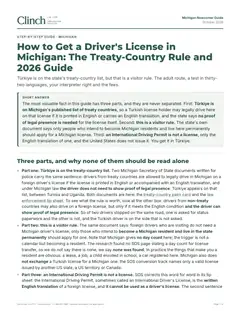
First, the most valuable fact on this page, and its three parts are never separated: Türkiye is on Michigan's published list of treaty countries, so a Turkish license holder may legally drive in Michigan on that license if it is printed in English or carries an English translation, and the state says no proof of legal presence is needed for the license itself. But this is a visitor rule: the state's own document says only people who intend to become Michigan residents and live here permanently should apply for a Michigan license. And an International Driving Permit is not a license, only the English translation of one, and the United States does not issue it. You get it in Türkiye.
Steps, documents and official links
Once you are a Michigan resident: the adult license route
A Michigan license comes from the Secretary of State (SOS). Michigan has no county motor vehicle office: licensing and vehicle registration run entirely through state branch offices, and no county building has such a counter. This page will never send you to a county office.
If you are 18 or older and have not been licensed in Michigan or any other state in the previous four years, the route is:
- Pass the knowledge test, either at an SOS office or online from home.
- Get a Temporary Instruction Permit (TIP), in person at an SOS office.
- Practice for at least 30 days with a licensed adult.
- Take the on-road skills test. The difference matters here: the state does not run the road test. Independent driver testing businesses do, and SOS says in its own words that the fees those businesses charge are not regulated by the department. Before you book, ask about the initial and retest fee, the refund policy, charges for improper documents or defective equipment, and no-show charges.
- After you pass, the testing business reports the result electronically and the card arrives by mail. Meanwhile you can log into e-Services for a Temporary Operator License. If results have not posted within 24 hours, take the skills test certificate, the permit and your ID to an SOS office.
Three clocks run, and all three catch people out. The TIP is valid 180 days: if you do not pass the skills test inside that window, the whole process starts again. A passed knowledge test is valid one year, but if the permit expires and you need a new one, you retake the knowledge test. And every new driver is on probation for three years, whatever their age: an at-fault or had-been-drinking crash, a suspension or a traffic conviction in the last 10 months restarts that 10-month clock.
One piece of good news: driver education is not required for adults. SOS states that driver education classes are not required for Michigan residents aged 18 and older. Several states in this series force an adult course; Michigan does not.
Your car is inspected before the road test
Before the examiner drives with you, the vehicle is checked. SOS says the examiner looks for a valid certificate of Michigan No-Fault insurance, the vehicle registration, and a license plate with the correct year's tab. A broken taillight or a missing mirror cancels the test. Driver-activated features are banned during the test: self-parking, four-way camera, self-driving. Failing any one of the three components (vehicle inspection, basic control, on-road driving) ends the test, and only one skills test is allowed in 24 hours.
Documents a new resident brings
For a first Michigan license or ID card, SOS asks a new resident for four classes of document: proof of legal presence, proof of a Social Security number, proof of identity, and two documents proving Michigan residency. If you are converting a license from another US state, a US territory or Canada, add that valid license. You pre-apply online and then book an office visit.
Acceptable residency documents include a utility or credit card bill issued within the last 90 days (electronic copies accepted), a bank statement from the last 90 days, a Michigan school, college or university report card or transcript, a mortgage, lease or rental agreement, a pay stub showing your name and address, or a Michigan title and registration. We took this list from the SOS frequently-asked-questions page but could not re-read that page line by line, so confirm before your appointment.
A first license, a first ID card and a REAL ID conversion are done in person, not online. SOS offices take cash, check, money order (payable to State of Michigan), Amex, Discover, MasterCard and Visa debit or credit, Apple Pay, Google Pay and Samsung Pay; a service fee applies to card payment, and we could not verify the amount.
If your status is temporary: the limited-term license
SOS puts it plainly: residents with temporary legal presence in the United States are issued a limited-term driver's license, valid only for as long as they are authorized to remain in the country. Anyone in Michigan on H-1B, L-1, F-1 or J-1 is in this category. Your license expiry is tied to your status document, so keep the extension calendar and the license calendar together.
The knowledge test comes in thirty-two languages, and Turkish is not one of them
We write this exactly as it is. On its language services page SOS says every Secretary of State office offers the driver knowledge exam in Albanian, Arabic, Chinese, Dari, English, Farsi, French, Greek, Hindi, Italian, Japanese, Korean, Pashto, Polish, Portuguese, Russian, Spanish, Ukrainian, Vietnamese, Bangla, Burmese, Chaldean, Karen, Kibembe, Kinyarwanda, Kirundi, Lao, Malay, Punjabi, Urdu, Romanian and Swahili. Turkish is not on that list. Chauffeur, moped, motorcycle and recreational endorsement tests come only in English, Spanish and Arabic.
What the state publishes instead is unusual in this series. On the same page SOS writes that for any language not listed, information about approved interpreters is available on 888-767-6424 (888-SOS-MICH), at [email protected], or at a Secretary of State office, and that approved interpreters are prohibited from charging a fee.
Alongside that sits a second route: a one-time volunteer interpreter. A person you choose may interpret for a test, a hearing or a reexamination provided the department authorizes them before the visit. They complete and sign the Application to Provide Volunteer Interpreter Services, select the one-time option, and attach a photo or photocopy of their valid unexpired license or ID. Send it to Michigan Department of State, Enforcement Division, P.O. Box 30708, Lansing, MI 48909; fax 517-335-3241; email [email protected].
And one more detail: an interpreter may sit in the car during the road test. SOS states that if required, a sign language interpreter or a foreign language interpreter may be present in the vehicle to translate the examiner's instructions. For non-testing services at a branch, over-the-phone and device-assisted interpretation can be requested with no advance notice.
The 164 self-service stations are narrower: Arabic, Bengali, English, French, Mandarin, Pashto, Spanish, Swahili and Vietnamese, with a $4.25 service fee per item transacted. The SOS site footer offers translation only in Arabic, Spanish and Mandarin. The driver manual is What Every Driver Must Know, and chapters 4 to 7 are the recommended study.
You can take the test at home, but it costs more
Michigan offers something unusual: anyone 18 or older may take the knowledge test online, and SOS says the online test is identical to the one given in its offices. The technical conditions are strict: a computer or laptop with a keyboard and mouse (no touch screens), a webcam, which takes random photographs during the test, an "Operator" section of about 45 minutes and a "Signs" segment of about 15 minutes, with the result by email.
The money runs the other way: the online test costs $6.50 in convenience and card processing fees, while taking it at an SOS office is free with an appointment. If your driving privileges are suspended, revoked or denied, the $6.50 is still charged, is not refunded, and no license is issued. A third-party vendor runs the online test; support is on 833-939-2364. After passing online you still need an SOS appointment to collect the permit. We could not confirm whether the online version offers the same 32 languages: SOS calls it identical and says it is available in English and a number of foreign languages, without repeating the list.
REAL ID, the Enhanced license, and fees
In Michigan REAL ID is the default rather than an extra step: SOS states that applicants who meet all the requirements will be issued a REAL ID compliant license unless they have asked to opt out. SOS also gives the enforcement date in its own words: as of May 7, 2025, Michigan residents need a REAL ID compliant document to fly within the United States and to enter certain federal facilities. That is current law, not a pending date.
| Item | Fee |
|---|---|
| Standard driver's license | $25 |
| Enhanced driver's license (EDL) | $45 |
| Knowledge test at an SOS office | Free, by appointment |
| Knowledge test online from home | $6.50, not refundable |
| Self-service station, per item | $4.25 |
| Road skills test | Set by the private testing business; not regulated by the state |
Some fees are missing here and we would rather say so: the state ID card fee, the license renewal fee, the duplicate license fee, the limited-term license fee and the amount of the card payment service fee could not be verified in the research. We leave them blank instead of guessing. Confirm the figure with SOS before you transact.
A careful note on the Enhanced license. An EDL costs $45 and is accepted by US border officers as an entry document when returning by land or sea from Canada, Mexico, Bermuda and the Caribbean; it also meets REAL ID. A US passport is still needed for international air travel. The research could not confirm whether a person who is not a US citizen may hold one: the EDL is designed as a document that proves citizenship, which in other states restricts it to citizens, but no SOS sentence saying so was read. Call 888-767-6424 and ask about your own status before applying.
An in-person renewal with a new photo and a vision test is required every 12 years.
Applying for a license registers you to vote automatically
This is one of the most important warnings on the page, and the consequences fall on the immigration side. SOS states that by state law, when an eligible person applies for a Michigan license or ID they are automatically registered to vote and are sent instructions by mail on how to opt out. Michigan's own voter eligibility rules require US citizenship. If you are not a citizen, that registration should not apply to you: tell the clerk at the counter that you are not a citizen, do not throw away the notice that arrives in the post, and opt out if a registration was made. See the voting and jury section.
How your name prints on the card
SOS has a published rule: the first and middle name print on line one and the surname on line two, the system allows 36 characters in the full name fields and shortens longer names automatically, apostrophes cannot be printed and hyphens can. How Michigan renders Turkish letters was not established in the research. That matters, because the spelling on your license has to match the spelling on your bank, employment and immigration documents. Ask at the counter exactly how your name will print, and compare when the card arrives.
Offices and appointments
This page prints no Michigan Secretary of State branch address and no opening hours. The reason is plain: during the research the SOS office locator, the office hours page and the official office list could not be read by any route. Rather than invent them, we leave them out. Find your nearest branch and its hours on the SOS site or on 888-767-6424. You can also find a driver testing business by county through the SOS "Locate a driver testing business" search.
PDF: How to Get a Driver's License in Michigan: The Treaty-Country Rule and 2026 Guide
02 · Foreign license
Can I drive in Michigan on my Turkish license?
Short answer
Yes, and that answer is rare in this series. Michigan sorts foreign licenses into two boxes and Türkiye is in the favorable one: the state publishes a list of treaty countries that includes Türkiye, says drivers from those countries may legally drive in Michigan on their own license, and says they do not need to show proof of legal presence for it. All three parts belong together: this is a visitor rule, a Michigan resident takes a Michigan license, and an International Driving Permit is not a license but a translation.
Steps, documents and official links
Part one: Türkiye is on the treaty-country list
Two Michigan Secretary of State documents written for police carry the same sentence: drivers from treaty countries are allowed to legally drive in Michigan on a foreign driver's license if the license is printed in English or accompanied with an English translation, and under Michigan law the driver does not need to show proof of legal presence. Türkiye appears on that list, between Tunisia and Uganda. We read both documents: the SOS treaty-country palm card and the law enforcement tip sheet.
To see what the rule is worth, look at the other box. Drivers from non-treaty countries may also drive on a foreign license, but only if it is in English or has a written English translation and the driver can show proof of legal presence. That list includes Afghanistan, Iran, Iraq, Kazakhstan, Kuwait, Latvia, Saudi Arabia, Switzerland, Ukraine and Uzbekistan. So of two drivers stopped on the same road, one is asked for status paperwork and the other is not, and the Turkish driver is on the side that is not asked.
The two-box structure comes from a 2016 amendment, which SOS explains itself: before March 2016 only drivers from recognized treaty countries could legally drive in Michigan on a foreign license; in 2016 the law was changed to let drivers from non-treaty countries drive legally with English plus proof of legal presence, and that change did not affect drivers from treaty countries.
For completeness, the documents SOS tells police count as proof of legal presence, which is what a non-treaty driver has to produce: a valid unexpired foreign passport with a US visa plus evidence of entry (an I-94 stamp or printout); a valid Employment Authorization Document (I-766); other immigration documents including Form I-94, a State Department bio-data form and supervision documents. A Turkish driver does not have to produce these for the license to be valid, though there can be other reasons to carry your immigration documents.
Part two: this is a visitor rule, and it changes when you settle
This paragraph must never be separated from the first, because when it is, readers drive on a false sense of security. The same SOS document says: foreign drivers who are visiting do not need a Michigan driver's license; only those who intend to become a Michigan resident and live in the state permanently should apply for one.
Note that Michigan gives no day count here. Most states in this series publish a 30-day or 90-day clock; this document publishes none, and the trigger is becoming a Michigan resident. The research found no SOS page stating a day count for license transfer, so we do not say there is none, we say none was found. In practice the things that make you a resident are obvious enough: a lease, a job, a child enrolled in school, a car registered here. Once one of those is true you are not a visitor, and you should start the adult license route.
One more point: Michigan does not exchange a Turkish license for a Michigan one. The SOS conversion track names only a valid license issued by another US state, a US territory, or Canada, and Türkiye is not in that sentence. A three-country reciprocity list circulates on university pages, but we could not confirm it on any SOS page, so we do not print it. What can be confirmed is this: Türkiye is not among the jurisdictions SOS names for conversion, so a Turkish driver who becomes a Michigan resident takes the ordinary adult route.
Part three: an International Driving Permit is not a license
This is where most readers go wrong, and SOS corrects it word for word in its tip sheet: the International Driving Permit, sometimes called an International Driver's License, is the written English translation of a foreign driver's license, and it cannot be used as a driver's license. On its own it means nothing; your valid Turkish license has to be with it.
The second sentence changes your travel planning: the United States does not issue International Driving Permits to foreign visitors. SOS says that to get one, the driver should contact the motor vehicle department of the country that issued the license. In Türkiye that is handled through the Turkish Touring and Automobile Association. So get the permit before you leave Türkiye. There is no way to obtain it here, and if your Turkish license is not printed in English, without a translation you cannot meet the English condition in the treaty-country rule.
All three, in one sentence
You may legally drive in Michigan as a visitor on your Turkish license; if the license is not in English you must carry an International Driving Permit obtained in Türkiye; and as soon as you settle in Michigan you need a Michigan license. Any guide that drops one of those three sentences will mislead you.
For questions, the SOS Information Center is on 888-767-6424 (888-SOS-MICH), [email protected].
03 · Car
How do I register a car and choose insurance in Michigan?
Short answer
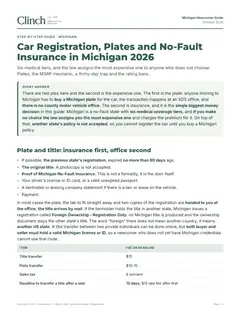
Two jobs, and the second costs more. The first is the plate: anyone moving to Michigan must buy a Michigan license plate for their vehicle, at a Secretary of State office, because Michigan has no county motor vehicle office. The second is insurance, and it is the single biggest money decision in this guide: Michigan is a no-fault state with six medical coverage levels, and if you choose nothing the law gives you the most expensive one and charges the premium for it. On top of that, out-of-state insurance is not accepted.
Steps, documents and official links
Plate and registration
SOS puts it directly: when you move to Michigan, you are required to purchase a license plate for your vehicle. An office visit is required, and you bring:
- If possible, your previous state registration, expired less than 90 days.
- The original vehicle title. Photocopies are not accepted.
- Proof of Michigan No-Fault insurance. See below: this is not a formality, it is the gate.
- Your license or ID, or a valid unexpired passport.
- A lienholder or leasing company statement where one applies.
- Payment.
In most cases the plate, a tab to fit immediately and two copies of the registration are handed over at the office, and the title is mailed. If a lienholder holds the title in another state, Michigan issues a "Foreign Ownership - Registration Only" registration: no Michigan title is issued and the out-of-state title stays the ownership document. "Foreign" there means another US state, not another country.
| Item | Fee or deadline |
|---|---|
| Title transfer | $15 |
| Plate transfer | $10 to $15 |
| Sales tax | 6 percent |
| Deadline to transfer a title after a sale | 15 days, then a $15 late fee |
| Corrected title / duplicate title | $15 |
| Correcting a vehicle registration | No fee |
| New title after a loan is paid off (optional) | $16 |
| Replacement plate / lost, stolen or damaged tab | $5 |
| Recreation Passport state park pass | $15 for one year, $29 for two, $7 motorcycle |
We do not print a registration fee here, because there is no single figure. For passenger vehicles and light trucks of model year 1984 or later, the plate fee is a percentage of the manufacturer's suggested retail price (MSRP) when the vehicle was first titled. That base price is reduced by a set percentage for the next three years, and in SOS's own words, under the present law no further reduction is provided. The result is that a fifteen-year-old car still pays the fee of the expensive new car it once was. That is the opposite of the weight-based systems elsewhere in this series, and it is a real factor when buying an expensive used car. Get your own figure from the SOS registration fee calculator.
The electric and hybrid surcharge is large. SOS publishes these figures: $267 for an electric vehicle, $367 for electric trucks and buses, $113 for a plug-in hybrid, $183 for hybrid trucks and buses. It is charged on registration, on renewal, and when a plate moves from a gasoline car to an EV or PHEV. At $267 a year this is a genuine budget line; count it in before you buy.
Your plate expires on your birthday
Michigan ties the plate to the person rather than the calendar: the plate expires on the owner's birthday. With two owners, either birthday may be used, and at renewal you can ask to move the expiry to the owner's birthday. If the birthday falls on a weekend or a legal holiday, renewing by the next business day avoids a penalty. You may renew up to six months early. Late renewal adds $10 and the fee is not prorated, so being only slightly late does not help.
Three small rules that each earn a ticket. Michigan requires a plate on the rear only (MCL 257.225); a decorative plate may go on the front but a previously registered plate must not. The tab goes in the upper right corner of the plate (lower right for motorcycles and some legacy designs). And you have three days to drive a newly bought car home without a plate, by the most direct route, carrying the assigned title and proof of insurance. Never lend a plate to a buyer.
Two mechanical points: if your insurer does not report the policy electronically to the state, online and self-service renewal are blocked and you renew by mail or at an office with proof. And an online title transfer between two private parties exists, but both buyer and seller must hold a valid Michigan license or ID, so a newcomer with no Michigan credential yet cannot use it; approval can take up to three days.
Inspection and emissions: we do not say there is none
This needs a careful answer. No emissions certificate and no safety inspection certificate appears anywhere in the SOS document lists for titling and registering a vehicle, for a new resident buying a plate, or for annual tab renewal. The only inspections Michigan names are for salvage or rebuilt vehicles (a certified salvage vehicle inspector, forms TR-13A and TR-13B) and for assembled vehicles and off-road conversions.
But we do not write the flat sentence that Michigan has no emissions testing. The state environment department EGLE lists, under the 1994 natural resources act, Part 63, Motor Vehicle Emissions Testing for West Michigan and Part 65, Motor Vehicle Emissions Testing for Southeast Michigan. We could not open the statutory text, so we cannot say whether those Parts are dormant, contingent on a federal designation, or unused in practice. What we write is this: the SOS document lists contain no emissions or inspection certificate, and two emissions-testing Parts remain in the state's air statutes whose text we could not read. If you are told otherwise, ask the Secretary of State.
Insurance: first, out-of-state policies are refused
SOS is blunt: all vehicles must have Michigan No-Fault insurance to be registered or to renew registration in Michigan, and out-of-state insurance is not accepted. Somebody moving from Ohio or Illinois with a year left on their policy cannot register the car until they buy a Michigan policy. Motorcycles need Michigan coverage, though it need not be No-Fault.
The penalty is not light either. Driving uninsured is a misdemeanor carrying a fine of up to $500 and up to one year in jail, and the court may suspend the license for 30 days or until you can provide proof of valid insurance. Failing to present the Michigan No-Fault certificate while driving can lead to license suspension, plate cancellation and impoundment. Keep the certificate in the car.
The three coverages every policy must carry
The state insurance regulator, DIFS, names three basic coverages that must be purchased and carried on every vehicle:
| Coverage | What it does |
|---|---|
| PIP (Personal Injury Protection) | If you are hurt in an auto accident, PIP pays all reasonable and necessary medical expenses for your lifetime, up to the maximum you selected, and pays wage loss and replacement services for up to three years after the accident. |
| PPI (Property Protection) | Automatically up to $1 million for damage your car does in Michigan to other people's property such as buildings and fences, and for damage to another person's properly parked vehicle. It pays for no other damage to cars. Read the two limits inside that sentence: in Michigan only, and parked cars only. |
| BI/PD (residual liability) | Liability for bodily injury you cause and for property damage out of state. Default limits are $250,000 per person, $500,000 per accident, $10,000 property damage. |
You may buy down below the defaults, but only to a floor: $50,000 per person, $100,000 per accident, $10,000 property damage, a floor the statute itself sets (MCL 500.3009). DIFS prints its own warning about buying the floor, and we pass it on as written: if you are responsible for another person's injuries beyond your limit, your assets may be seized or a lien placed on your home, your wages may be garnished, and your license may be suspended. For comparison, the pre-reform minimum on policies issued before July 2, 2020 was $20,000 / $40,000 / $10,000, so Michigan's compulsory floor today sits well above the US average.
The six PIP levels, and the trap for anyone who does not choose
Michigan rebuilt its system with Public Acts 21 and 22 of 2019, and on policies issued or renewed after July 1, 2020 the driver chooses the PIP medical coverage level.
| Level | Condition attached |
|---|---|
| Unlimited | None, open to everyone. Michigan is the only state that still offers unlimited. |
| $500,000 per person per accident | No stated condition. |
| $250,000 | No stated condition. |
| $250,000 with PIP medical exclusions | The person being excluded must hold qualified health coverage that is not Medicare. |
| $50,000 | Only if the named insured is enrolled in Medicaid, and any spouse and all resident relatives have qualified health coverage, are on Medicaid, or are covered by another auto policy with PIP medical. |
| No PIP medical (opt-out) | Only if the named insured has Medicare Parts A and B, with the same conditions for a spouse and resident relatives. |
And here is where newcomers lose money. DIFS states it in its own words: if a PIP medical option is not chosen by the insured, the unlimited PIP medical option is selected by default, and the policy is charged the appropriate premium for that coverage. Somebody who signs without reading the PIP form has bought the most expensive option in the country by doing nothing. The statute says the same (MCL 500.3107c(3)): where no effective selection has been made, the "no limit" option applies to the policy.
The choice is not made verbally. DIFS: you select your PIP and BI limits on paper or electronic forms provided by your agent or company, and those forms must be signed, completed and returned to take effect. The statute prescribes the form too: it must state the benefits and risks of each option in a conspicuous manner, let the applicant mark that they have read and understood it, let them mark their selection, and require a signature.
Which level is realistically open to you? The $50,000 level requires Medicaid and the opt-out requires Medicare Parts A and B. A newly arrived Turkish household usually has neither. In practice the live choice is four: unlimited, $500,000, $250,000, or $250,000 with exclusions if you hold qualifying health coverage.
Qualified Health Coverage, the gate on the cheaper options
DIFS defines it this way: having qualified health coverage means either Medicare Parts A and B (a Medicare Advantage plan counts) or a health insurance policy that does not limit or exclude auto accident injuries and has an annual deductible at or below a set figure. The statute starts that figure at $6,000 and has the director adjust it every July 1 by the medical component of the Consumer Price Index, but only once the accumulated adjustment reaches $500 (MCL 500.3107d(7)(b)). That is why we do not print the current number here: it is indexed and it moves. Ask your insurer or DIFS for the figure on the day.
The letter is not a formality either: the statute requires anyone opting out to give the insurer a document from the provider of the qualified health coverage stating the names of all persons covered. DIFS publishes a sample letter and will help on 833-ASK-DIFS (833-275-3437) if you cannot obtain one.
The sharpest rule: thirty days
Do not skip this paragraph. The statute (MCL 500.3107d(6)) provides that if the qualified health coverage ends, within 30 days after the termination the named insured must obtain insurance that includes PIP medical coverage. If they do not, and someone covered by that election is injured in a motor vehicle accident inside that window, that person is not entitled to PIP benefits and can only claim under the assigned claims plan.
It is easy to see why this hits a newcomer: a job ends, employer coverage lapses, a Medicaid category changes. If you lose your health insurance, put PIP back on the car within thirty days. Put it in your calendar, because nobody will remind you.
Banned rating factors, and why they matter here
This is Michigan's most favorable rule for this audience. DIFS: the new law prohibits auto insurance companies from using sex, marital status, home ownership, credit score, educational level, occupation and zip codes in setting your rates. For a Turkish family with no US credit file, an occupation not yet recognized here and a new neighborhood, none of those can be used against them. Rates and policy forms must also be filed with and approved by DIFS before they are offered.
What is not on the banned list should be said too: how an insurer may treat a short US driving history or a recently converted foreign license is not covered, and the research did not establish it. Ask directly when you take quotes.
Four further details worth knowing
- Your choice binds the whole household. The statute says the coverage level selected applies to the named insured, their spouse, a relative of either domiciled in the same household, and anyone else with a right to claim PIP benefits under the policy (MCL 500.3107c(5)). One person's cheap choice is everyone's cheap choice.
- Excluding a family member to cut the premium is dangerous. A named-driver exclusion is allowed, but only if this notice appears in capitals on the policy face, the declaration page and the certificate: when a named excluded person operates a vehicle, all liability coverage is void and no one is insured, and the owners of the vehicle and others legally responsible for that person's acts remain fully personally liable. A household that excludes a relative to save money has made that relative's driving uninsured.
- Ordinary no-fault does not repair the other driver's car. That is the optional mini-tort: if you are 50 percent or more at fault, you can be sued for up to $3,000 toward the other driver's deductible or damage not covered by collision, up from $1,000. Insurers must provide $3,000 of mini-tort cover for accidents after July 1, 2020 whatever the policy wording says, and the statute bars damages in favor of a party who is more than 50 percent at fault.
- The attendant care rider. Insurers must offer an optional rider for attendant care above the chosen limit to anyone who picks the $50,000, $250,000 or $500,000 option.
One structural point: the Michigan Catastrophic Claims Association reinsures Michigan insurers for PIP claims above a threshold, and the per-vehicle assessment applies only to people who choose unlimited PIP. That structure is the publishable point. We print no figures, because the threshold and assessment numbers on the DIFS page are out of date. If you see that line on a quote, ask your insurer for the current year's amount. Complaints go to DIFS, weekdays 8:00 a.m. to 5:00 p.m., 833-275-3437.
Finally a legal note: DIFS publishes on its own page that an appellate decision held the cost-control fee schedule provisions may not be applied to treatment for people injured before June 11, 2019, and that the matter went on appeal. The research could not establish the current status of that appeal, so we do not state an outcome.
PDF: Car Registration, Plates and No-Fault Insurance in Michigan 2026
04 · Toll roads
Are there toll roads and crossing charges in Michigan?
Short answer
Not in daily life. The research found no tolled highway in Michigan; every toll identified is at a crossing: the Mackinac Bridge at $4 for a car, and the bridges and tunnel to Canada. Michigan is not an E-ZPass state, and its one in-state transponder, MacPass, is described by its own issuer as the Mackinac Bridge Authority's exclusive program. Unless you drive to the Upper Peninsula or into Canada, you will not meet a toll booth here.
Steps, documents and official links
The Mackinac Bridge
On I-75 between Mackinaw City and St Ignace, linking the Lower and Upper Peninsulas.
- Passenger vehicle: $2.00 per axle, so $4.00 for a car. That class covers passenger cars, vans, motorcycles, station wagons, SUVs, pick-up trucks and school buses.
- Everything else: $5.00 per axle (tractor trailers, buses, motor homes, step and cube vans). Classification follows the lead vehicle, and a motor home towing a car is charged the car rate for the towed car.
- At the booth: cash, credit or debit card, Apple Pay, Google Pay and MacPass. A 2.3 percent fee applies to all card transactions; cash and the wallet apps are faster and carry no fee.
- MacPass commuter discount: a passenger vehicle that is not towing and makes a northbound and a southbound trip within 36 hours on the same tag and the same vehicle pays $4 for the first trip and nothing for the return. A trailer voids the discount and the real axle count is charged.
- Opening a MacPass account: $47 personal ($7 set-up plus a $40 starting balance) or $207 business ($7 plus $200), plus $2 per vehicle tag. Card payments carry the 2.3 percent fee; check and bank-account payments do not. Minimum deposits are $20 personal and $50 business. MasterCard, Discover and Visa are accepted, American Express is not, and staff cannot take card details by phone.
- One tag per vehicle, mounted inside the windshield below the mirror, and tags may not be moved between vehicles. Allow up to 14 days for a tag to arrive; online orders are always posted. Changing the plate linked to a tag is not self-service: it is emailed to the Authority with the account number and the old and new plate.
Contact: Mackinac Bridge Authority, N415 Interstate 75, St Ignace, MI 49781, (906) 643-7600.
Crossing to Canada
There are three crossings from the Detroit area and each has a separate operator. We could read the tolls of only one.
The Gordie Howe International Bridge is open and tolling. Published rates: $8.00 CAD / $5.75 USD for a car, SUV, motorcycle or light truck under 2.3 meters; $12.00 CAD / $8.75 USD per axle for vehicles over 2.3 meters and for large trucks, buses, RVs and fifth-wheel tows.
The currency trap is worth printing: the bridge states that for debit or credit card transactions at the toll lane, the Canadian rate applies, subject to the bank's exchange rate at the time of crossing. The US rate is for cash or a Breakaway account. A roof-mounted load such as a roof box or bicycles means using an attended lane so the class is read correctly. The bridge also has a path for cyclists and pedestrians, though we could not read its rules.
The older crossings, the Ambassador Bridge and the Detroit-Windsor Tunnel, are separate operators with their own tolls. We could not read their current rates, so we print no figures; check the operator's own site before you cross.
Crossing to Canada is crossing an international border
We put this beside every Canada crossing, because for a Turkish reader it matters far more than the toll. Going to Canada and coming back is an international border crossing. Re-entry to the United States requires the correct travel document and, for a non-citizen, a valid visa and a valid I-94 position. Whether a person with an expired visa falls under automatic visa revalidation after a short trip to Canada is an immigration question, not a transport one. Even for a day trip to Windsor, ask an immigration attorney about your own position before you set off.
If you drive out of Michigan
Because you never bought a transponder here, driving east into Ohio, Pennsylvania or New York does meet tolls, on the Ohio Turnpike and onward. An E-ZPass tag comes from another state's agency, not from Michigan. Whether MacPass works with any other system was not established: the issuer calls the program exclusive and nothing says it is accepted elsewhere, but nothing rules it out either.
05 · Getting around
How do I travel by train, bus and plane in Michigan?
Short answer
Three things matter directly to a Turkish reader. Detroit has a nonstop to Istanbul, flown by Turkish Airlines from the Evans Terminal. Ann Arbor has the busiest Amtrak station in Michigan, busier than Detroit's, with three trains a day to Chicago. And, time-sensitive: the downtown Ann Arbor transit center is closed, boarding and ticket sales have moved to other addresses, and the operator's own two pages contradict each other about it.
Steps, documents and official links
Trains: three Michigan routes, all to Chicago
Michigan has three state-supported Amtrak routes, all funded in partnership with the Michigan Department of Transportation (MDOT):
| Route | Stations | Frequency |
|---|---|---|
| Wolverine | Pontiac, Detroit, Dearborn, Ann Arbor, Battle Creek, Kalamazoo, New Buffalo, Chicago | 3 round trips daily |
| Blue Water | Port Huron, Flint, East Lansing, Battle Creek, Kalamazoo, New Buffalo, Chicago | 1 round trip daily |
| Père Marquette | Grand Rapids, Holland, Chicago | 1 round trip daily |
In fiscal year 2025 Amtrak ran about 10 intercity trains a day in Michigan, 790,672 passengers boarded or alighted in the state, and MDOT paid $20.2 million in operating support. Amtrak made scheduled stops at 22 locations in Michigan.
Ann Arbor (station code ARB) is the busiest station in the state: 150,296 boardings and alightings in fiscal 2025, against 74,610 at Detroit, 84,043 at Kalamazoo, 73,895 at East Lansing and 67,715 at Dearborn. Michigan's rail hub is a university town, not the big city. Ann Arbor's accessibility work is marked complete.
A useful administrative point: under section 209 of the federal PRIIA law, routes under 750 miles are state-supported, so MDOT, not Amtrak, decides the schedule and frequency on all three Michigan routes. That is the right address for a complaint or a request. MDOT holds federal corridor planning grants covering all three routes, and a figure of $145 million for bridge and rail work on the Michigan Line was announced; we could not re-read those pages directly, so we do not present added frequencies as settled.
No train goes to the airport. From Ann Arbor the train takes you to Chicago, and in the other direction to Dearborn, Detroit and Pontiac.
The Istanbul nonstop: Michigan has one
Turkish Airlines opened Detroit as its 13th US gateway, with Istanbul flights beginning November 15, 2023. At launch the schedule was three flights a week (Monday, Wednesday, Friday) on a Boeing 787-9, rising to four weekly from December 25 with the addition of Saturday.
We could not verify the current frequency, aircraft or flight time, so we do not print them. What we do print: Turkish Airlines flies nonstop between DTW and Istanbul, and it departs from the Evans Terminal. Get the current schedule from the airline's own site or on (800) 874-8875.
At DTW the terminal names on your boarding pass may differ from the names on the signs: the McNamara Terminal can appear as "EM" and the Evans Terminal as "WE". By the airport authority's own directory, McNamara handles Delta, Air France and Aeromexico; Evans handles Air Canada, Alaska, American, Avelo, Frontier, JetBlue, Southwest, Spirit, Sun Country, Turkish Airlines and United. The airport publishes its site in Arabic, German, Spanish, French, Japanese, Korean and Simplified Chinese; Turkish is not offered.
Ann Arbor to the airport: AirRide
AirRide runs daily from downtown Ann Arbor to Detroit Metropolitan Airport and serves both terminals. It is a partnership between TheRide and Michigan Flyer.
- Fares bought online in advance: $16 one way, $27 round trip. A child aged 2 to 16 traveling with a parent or grandparent pays $8 or $13.
- Tickets bought from the driver do not get the advance discount and are $3 to $6 higher per person; the driver takes cash or card but carries no change.
- Tickets are non-refundable. Two changes per ticket are allowed online up to 20 minutes before departure, and only the date and time may change, not the direction.
- For the Istanbul flight you want the Evans Terminal: the north end of the Ground Transportation Center, Stall #1, through the sliding doors marked "Public Transit". At McNamara the stop is on the Departures level by the international ticketing door.
- Transfers between TheRide's local buses and AirRide are not accepted; AirRide is a separate ticket.
- Contact 517-333-0400, phone hours Monday to Friday 6:00 a.m. to 5:00 p.m., Saturday 9:00 a.m. to 2:00 p.m., closed Sunday.
Michigan Flyer also runs East Lansing to Ann Arbor and DTW: East Lansing to Ann Arbor $17 one way or $34 return; East Lansing to DTW $35 / $60; Whitmore Lake to DTW $25 / $46.
To Detroit by coach: D2A2
D2A2 is an express coach between Detroit and Ann Arbor, supported by the Regional Transit Authority of Southeast Michigan and operated by Michigan Flyer. $6 one way. Frequent-rider passbooks: 10 passes for $50 ($5 a trip) or 50 passes for $100 ($2 a trip), with booking ahead recommended to reserve a seat. The Detroit stop is Grand Circus Park, 1508 Park Avenue. D2A2 does not run on Memorial Day, July 4, Labor Day, Thanksgiving, Christmas Eve, Christmas Day, New Year's Eve or New Year's Day. E-bikes and e-scooters are now allowed if the battery is no more than 750 watts, removed and carried in a case.
Around Ann Arbor: TheRide, and the closed transit center
The bus system for Ann Arbor and Ypsilanti is the Ann Arbor Area Transportation Authority, trading as TheRide. Fares: $1.50 a ride, $3.00 a day pass, $45.00 for a 30-day flex pass. On board the fare is cash or token only; passes come by mail, from a sales point, or through the EZfare app, and purchased fares are not refunded. A K-12 student with a student ID pays $0.75 and children 5 and under ride free. Riders 65 and over ride free with the right card, and riders aged 60 to 64 pay $0.75 with a Fare Deal Card. The late-night and holiday curb-to-curb FlexRide service is $5.00 for an adult.
What the reduced-fare card asks for. Fare Deal eligibility is based on income, age or disability, and the application is submitted in person at TheRide's main office (2700 S. Industrial Hwy, Ann Arbor; route information 734-996-0400, Fare Deal line 734-973-6500). The documents listed are a valid state ID card or driver's license, a Medicaid card, or valid proof of a Medicare card or an authorization from a participating social service agency. The page does not ask about immigration status and does not ask for a Social Security number; read that as what the page says, neither a welcome nor a barrier. One practical point: because the ID requirement is a state ID or license, the realistic opening for someone without a Michigan credential is the social service agency authorization. The application is published in English, Spanish, Arabic, Korean and Chinese; Turkish is not among them.
If you are connected to the university: University of Michigan students, scholars, faculty and staff ride TheRide buses with a yellow MCard. We do not call that free: the university pays the fare under a sponsorship agreement, so you pay it through the university. Eastern Michigan University has a similar arrangement. For downtown workers there is go!Pass: employees of organizations inside the Ann Arbor Downtown Development Authority boundary can ride any TheRide route, and the boundary expanded 19 blocks to the north on April 30, 2026, so an employer that was previously outside may now qualify.
Time-sensitive: the transit center is closed, and two official pages disagree
The Blake Transit Center in downtown Ann Arbor is closed. TheRide's own notice says the center is temporarily closed during the Fourth Avenue construction, which is anticipated to last through the end of 2026. Downtown boarding has moved temporarily to Fifth Ave. / Washington St., and a temporary ticket sales location is at 314 E. Washington St. The AirRide and D2A2 downtown stop is at 500 E. Washington Street, between State and Division.
We print the contradiction rather than resolve it quietly: TheRide's airport service page still says AirRide runs directly from the Blake Transit Center, while the same agency's service-change notice says the stop has moved to E. Washington between State and Division. Two official pages disagree. The newer notice governs and the airport page is stale, but before you leave for a flight, call 734-996-0400 and confirm the stop, because waiting on the wrong corner can cost you a flight.
Service adjustments effective August 23, 2026 moved Fifth Ave and E. Washington departures to :15 and :45 past the hour, shifted the hospital routing to McAuley Dr, and renamed the "Wolverine Tower" timepoint "State & Eisenhower". Every stop carries a Text My Bus sign and real-time arrivals are published. Re-check this section in January 2027: when the construction ends, every address here changes.
The rest of the state
In the Detroit region the umbrella body is the Regional Transit Authority of Southeast Michigan, and the operators are DDOT (Detroit city buses), SMART (suburban buses) and the QLINE streetcar on Woodward Avenue. All four sites are live, but the research read no fare, route or pass figure for any of them, so we print none; check which operator covers your address on its own site. The Lansing area operator is CATA and the Grand Rapids one is The Rapid, and again we print no figures.
For intercity coaches, the two links verified here are D2A2 ($6 to Detroit) and Michigan Flyer ($17 to East Lansing). Megabus is said to serve Ann Arbor on a university page, but no route, time or fare was verified. Whether Indian Trails or Greyhound stops in Ann Arbor was not established: we say neither that they do nor that they do not. Ask the carrier.
06 · Regions
Which office do I go to in Michigan?
Short answer
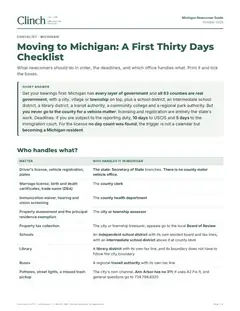
Michigan has every layer of local government, which is the opposite of Connecticut, where county government was abolished: here all 83 counties are real government. On top of that sit the city, village or township, the school district, the intermediate school district, the library district, the transit authority, the community college and the regional parks authority. One property tax bill can carry around thirty lines from eight separate taxing bodies. But you never go to the county for a car: licensing and registration are entirely the state's job.
Steps, documents and official links
Who does what?
| Task | Who handles it in Michigan |
|---|---|
| Driver's license, vehicle registration, plates | The state: Secretary of State branch offices. There is no county motor vehicle office. |
| Marriage license, birth and death certificates, trading name (DBA) | The County Clerk |
| Immunization waiver, hearing and vision screening | The county health department |
| Property assessment and the principal residence exemption | The city or township assessor |
| Property tax collection | The city or township treasurer; appeals go to the local Board of Review |
| Schools | An independent school district with its own elected board and its own millages |
| Library | A library district with its own millage, whose boundary need not match the city limits |
| Buses | A regional transit authority with its own millage |
| Potholes, streetlights, missed collections | The city's own channel. Ann Arbor has no 311, it has A2 Fix It |
And there is a layer this series has not met before: the Intermediate School District. It sits at county level above the individual districts, levies its own operating, special education and debt millages, and administers cross-district schools of choice eligibility. In Washtenaw County it is the Washtenaw Intermediate School District. Most states in this series have no equivalent, but in Michigan it appears line by line on your property tax bill.
The township trap: your address may not be in a city
Michigan's distinctive layer is the township. Outside city limits, a township (or charter township) does everything a city does: the township assessor receives your principal residence exemption affidavit, the township treasurer collects your tax, and the township provides local services. The fact that a city name appears in your postal address does not mean that city governs you.
This is not just administrative detail; it is money and paperwork. If an address is in a township, your counterpart is the township hall, and filing your exemption with the wrong office can cost you a deadline. When you look at a home, ask: is this address inside a city or in a township? The answer also determines your school district, your library district, how your trash is handled and whether you pay a city income tax.
City income tax: Michigan has it, and not every city does
This is the most money-saving fact on this page when you are choosing where to live. The state income tax is a flat 4.25 percent for the 2026 tax year, with a $5,900 personal exemption and withholding at the same 4.25 percent (in 2025 the rate was the same and the exemption was $5,800). On top of that, under the City Income Tax Act of 1964, cities whose voters approve one levy a city income tax.
Rather than saying a city has none, we use the authoritative source: the Michigan Treasury publishes its own list of the cities that impose an income tax. Ann Arbor is not on that list; East Lansing is. So somebody living in Ann Arbor pays no city income tax and somebody living in East Lansing does. The big cities levy one, and the highest rate is Detroit's: for 2026, 2.4 percent resident and 1.2 percent non-resident.
The second mechanic matters even more: the tax is withheld where you work as well as where you live. The Uniform City Income Tax Ordinance sets it up that way and generally applies a lower rate to non-residents. The practical consequence is this: when you look for a home in Michigan you have to check your own address and your employer's address separately. A Turkish engineer living in Ann Arbor who works in a taxing city is withheld at the non-resident rate, and the reverse happens too.
Certain income is exempt from a city income tax: Social Security, public and private pensions, insurance payments, annuities, retirement benefits, disability, welfare, unemployment, workers' compensation, interest on US securities, armed forces compensation and Pell Grants. City income tax paid is also deductible against Michigan income tax and on the federal return, but we do not print the deduction thresholds here: the only source we had was an older document and we could not confirm the figures against current instructions. The Treasury's city tax line is 517-636-5829.
There is no 311 in Ann Arbor: it is A2 Fix It
This is the third time in this series, and dialing the wrong number costs a day. Ann Arbor does not operate a 311 line. Service requests go through the city's own app and website, A2 Fix It: potholes, broken sidewalks, streetlights, missed collections, parks and public-space maintenance, and uncleared snow and ice on sidewalks. A photo can be attached to each request and the city asks for as much detail as possible. For anything A2 Fix It does not cover, the address is the Customer Service Center, 301 E. Huron Street, first floor, on 734.794.6320, [email protected]. The research also did not find a Washtenaw County 311 service; county requests go to individual departments. So this page never tells you to call 311.
If you have no documents yet, start at the library
For a newcomer this is the door that asks for least, and in Ann Arbor there is a published route even for someone with no documents at all. You get a card in person at one of the Ann Arbor District Library's five locations, by filling in a form and showing current photo identification and proof of address.
- Accepted photo ID: a driver's license or state ID from any state, a military ID, a passport, or a current student ID.
- Accepted proof of address: a Michigan license or ID card, mail addressed to you postmarked within the last month, a lease or purchase agreement, or a car registration.
- If you have none of those: ask at the information desk, and the library will mail a form letter to your local address to establish it. That sentence is the most valuable one in this section, because it is the published way to open a card with no US paperwork at all.
- No Social Security number appears anywhere in the card requirements; the application asks for name, address, telephone and date of birth or license number.
- For a child under 18, the responsible adult must sign and show their own ID and proof of address.
But there is a geography trap and it is expensive. The library district is not the city boundary: it follows the Ann Arbor Public Schools boundary, except Northfield Township. People who rent or own inside the district, who teach at or attend a K-12 school inside it, who tutor for a partner literacy organization, or who work for an organization or business located in it get a free card. A Washtenaw County resident outside that line pays $150 a year, in four quarterly installments of $37.50. Because Michigan library districts are their own taxing units (an Ann Arbor property tax bill carries a separate library line), those boundaries need not match city limits. Ask which library district an address falls in before you sign a lease.
One note on sourcing: the library's own site would not open from our research environment, and the card information here comes from an indirect reading of the library's own pages. Requirements and fees may have changed; confirm by telephone before you go.
Internet
Two companies hold franchise agreements for cable service in Ann Arbor and the city's public access channel is carried on both networks. The city also owns more than 44 miles of backbone fiber inside the city limits, with about 20 more planned toward Ypsilanti, but that is dark fiber available to public and commercial organizations under a use agreement, not a retail service a household can buy. Washtenaw County is building countywide broadband: the board of commissioners approved more than $15 million to extend high-speed broadband to all county households and to address affordability, literacy and access, four providers were selected through a 2021 competitive process, and a broadband task force oversees the program.
An important limit: the research found no published Michigan or Washtenaw rule on identification or deposits for a home internet account. Internet is an unregulated retail service in Michigan, and the electricity and gas protections described below do not cover it. We say that plainly, because assuming those protections carry over gives you false confidence.
07 · Electricity and gas
Can I open an electricity account in Michigan without an SSN?
Short answer
With the utilities the state regulates, the answer sits in a written regulation rather than on a help page. The Michigan Public Service Commission's consumer rules for electricity and natural gas list acceptable identification and include a passport and any government-issued photo ID; a Social Security number is not on the list. The grounds on which a deposit may be required are a closed list, and having no US credit history is not among them. There is also a guarantor route. But the scope is limited: these rules bind only utilities the state regulates, not municipally owned ones.
Steps, documents and official links
First, who supplies your address?
Michigan's two large utilities are DTE Energy and Consumers Energy, and which one serves you depends on the address. In Ann Arbor both electricity and natural gas come from DTE Energy: DTE's gas territory covers south-east Michigan including Washtenaw County, and its electric operations cover Washtenaw, western Wayne, northern Monroe and southern Oakland counties. For new gas customers in Washtenaw, Wayne, Oakland and Monroe the number is 1-800-338-0178. Start and stop service at startstop.dteenergy.com. We read those territory details indirectly from the provider's own pages, so get the definitive answer by entering your address in DTE's own start-service tool.
Identification: what the regulation lists
The rule set is the Consumer Standards and Billing Practices for Electric and Natural Gas Service, and its definition of "positive identification information" reads: a driver's license, an identification card issued by a state, a U.S. military card, a U.S. military dependent's identification card, a Native American tribal document, a passport, or other government-issued identification containing a photograph. Read that list from both ends: a passport is on it, and a Social Security number is not.
Under the regulation an applicant becomes a customer by doing three things: providing positive identification information, showing ownership or a lease on request if applying as a non-residential customer, and paying a deposit if the rules require one. Applications may be made in person, in writing, by telephone, by fax or over the internet.
There is a separate accommodation for renters: the utility may require proof of tenancy, but in the regulation's own words, written or oral confirmation by the manager, landlord or owner of the property, or a verified signed copy of the rental agreement, is sufficient proof. So if your lease is not yet in hand, your landlord confirming by telephone does the job.
Deposits: forbidden grounds and a closed list
Two rules here genuinely matter for a newcomer.
First, the prohibitions. The regulation forbids a utility from requiring a deposit based on: a consumer credit score (where the applicant has prior utility credit history with any electric or gas utility in the previous six years), income, home ownership, residence location, race, color, creed, sex, age, national origin, marital status, familial status, disability, or any other criteria not authorized by these rules. Read that last clause carefully: the list is closed, and no ground outside it is valid.
Second, the only grounds on which a residential deposit may be required: an unpaid, undisputed electric or gas balance from the last six years; misrepresenting identity or credit standing; failing to provide positive identification information on request; requesting service at an address where the applicant does not live; unauthorized use of utility service in the last six years, after a hearing; one or more returned checks or denied card payments in the last 12 months; seeking bankruptcy relief in the last six years; and having lived in the last three years with a person who still owes an undisputed delinquent bill for that shared home and now lives with the applicant.
"No Social Security number", "no credit file" and "no US history" are not on that list. We do not write that as a guarantee; we write it as it stands: having no credit history is not among the grounds the regulation allows for a deposit. That is a strong reading of a closed list taken together with the general prohibition beside it, not a sentence the regulation prints word for word. If you are asked for a deposit, ask for the ground and compare it with the closed list.
Three absolute exemptions, and the guarantor route
The regulation removes the deposit entirely in three situations:
- Where the state health and human services department is paying, or has committed to pay, the utility on the person's behalf.
- Where the applicant or customer secures a guarantor who is a customer in good standing with the utility. For a newcomer this is the most useful provision in the whole section: an established friend or relative in Michigan removes the deposit.
- Where the applicant is 65 or older with a satisfactory three-year payment history with any gas or electric utility.
If a deposit is required: cap, interest and return
- The amount may not exceed twice the average monthly bill for the premises, or twice the utility's system-average monthly residential bill where no consumption history exists.
- A low-income customer must be offered two monthly installments.
- Deposits earn 5 percent a year, credited semi-annually or paid on return.
- The deposit comes back after 12 consecutive months of satisfactory payment; if the account closes it is credited to the final bill.
- After 30 days of service the utility may no longer assess a deposit, except where the applicant misrepresented identity or credit standing or failed to give identification when asked.
- The utility must give a receipt and return instructions, apply the standards uniformly, and tell anyone who objects how to contest the deposit.
The same rule set also appears to bar a utility from requiring a Social Security number to enroll in or access its online billing system. We could not locate that line by line in the rule text and took it from an indirect reading of the same rules, so we do not quote it as rule text: the state's utility rules appear to bar a utility from requiring an SSN to register for online billing. Ask your utility.
The limit of the scope: three separate regimes
This is the paragraph that makes everything above safe to publish. The rule set draws its own scope in its first line: these rules apply to utility service provided by electric and natural gas utilities that are subject to the jurisdiction of the Public Service Commission. So:
| Type of provider | Do the protections above apply? |
|---|---|
| Regulated investor-owned utilities (DTE, Consumers Energy) | Yes. An Ann Arbor address is inside this scope. |
| Municipally owned electric utilities | No. They are not subject to Commission regulation, apart from a renewable energy plan filing, and their own boards set their account rules. |
| Cooperatives | Partly. The Commission retains jurisdiction only over safety, interconnection, code of conduct and customer choice. |
That is why we do not write that a passport is enough everywhere in Michigan. The accurate sentence is: with the utilities the state regulates, a passport is on the list of accepted identification and a Social Security number is not. If you move into a municipal utility's territory, the rules may be entirely different. Michigan has several municipally owned electric utilities, one of them serving the Lansing area, so an address such as East Lansing needs its provider type checked separately. Before you commit to an address, ask: is the utility here a regulated company, a municipal utility, or a cooperative?
One more note on sourcing: the rule text we read is the state's own document, but because the state site would not open during the research we could not confirm on the live page that it is the 2026 version. The rule numbers and history lines show 2007 and 2017 amendments. If a dispute arises, ask the utility for the current rule text.
Water, sewer and stormwater: and the deposit your landlord triggers
Ann Arbor runs its own water, sewer and stormwater utility, with no multi-town district in the way as in Hartford. Most addresses get one quarterly bill covering all three. Start or stop service online or on 734.794.6333. The payment and customer service center is at 301 E. Huron Street, first floor; the office is open weekdays 8:00 a.m. to 5:00 p.m. with phone assistance from 7:30 a.m. to 5:30 p.m., on 734.794.6320 (customer service) and 734.794.6333 (water), [email protected]. Paying by phone needs the 12-digit water account number.
And here is an arrangement we have not seen in this series: the water deposit is triggered by the landlord, not by the utility. The city's published fee schedule says in its own words that a fee of $17.00 is charged when a property owner requests that the City of Ann Arbor charge a consumer deposit for each new account, and the fee is collected at the time the signed and notarized affidavit is received. So a consumer deposit on an Ann Arbor water account exists only where the property owner asks for one, through a signed and notarized affidavit.
That raises a practical question: whose name is the water account in? The fee schedule's wording points to the owner controlling the account, but the city does not say so in terms, and the research found no published rule. So we make no assertion: when you sign a lease, ask the landlord whose name the water account is in and whether they will request a consumer deposit. Other fees from the same schedule: a physical turn-on or turn-off during business hours is $79, after hours it is $110 in addition to $377, and $84 is charged if the meter is found out of line at a turn-on. We print no current water, sewer or stormwater rates, because the rate sheet we found was not for the current fiscal year; get the figure from the city's water billing page.
Trash, recycling and compost: a property tax, not a bill
This is one of the budgeting surprises in Michigan. In Ann Arbor refuse is not a utility bill, it is a line on your property tax. The city levies 2.3019 mills for it (2025) under a line called CITY REFUSE, and in return collects weekly at the curb from single-family and duplex addresses. The first 64-gallon cart of each type is free: trash, recycling and compost. Upgrading the trash cart to 96 gallons is $48 a year, each additional trash cart at the same address is $268 a year, and each additional compost cart is a one-off $67. Carts go out before 7:00 a.m. on collection day, with 3 feet of clearance between them and from overhead obstacles.
The compost calendar is seasonal: weekly from early April to early December, and monthly in January, February and March, in the first full week of the month on the normal service day. In 2026 weekly collection was announced to resume on Monday, April 6.
But if you live in an apartment the arrangement is different, and this affects most newcomers. At multi-family properties the city contracts with haulers for trash and recycling, and curbside compost is not offered to multi-family buildings; residents use the city's drop-off site instead. For a cart, a delivery or a pickup, call 734.994.7336. An approval notice shows the city's solid waste chapter was amended in 2025 and we could not read the text, so treat the cart fees as figures to confirm.
Ann Arbor's own clean energy utility: real, but not open to you yet
Ann Arbor voters authorized a city sustainable energy utility in November 2024. Its structure matters: it is opt-in only, supplemental (the customer stays connected to the DTE grid) and community-owned, and it sells local renewable generation and storage.
It is not yet a citywide service. As of September 2026 a pilot was running in one neighborhood: 85 customers had signed up and 44 systems had been installed, and the pilot sign-up closed on September 30, 2026. A citywide launch is planned for 2027. So for someone arriving in 2026 the honest sentence is this: your electricity and gas bill is DTE's, the city's own utility is in a one-neighborhood pilot, and a wider launch is planned for 2027. Registering interest is free of commitment.
And there is a fraud warning worth printing for a newcomer. In the city's own words, this utility and its affiliated vendors do not go door to door. If someone knocks or calls and you are not sure they are genuine, email the city before you agree to anything. One further note: because this is a municipal utility, we read nothing confirming that the state consumer rules above bind it; that point needs settling before the 2027 launch.
08 · Renting
What are a tenant’s rights in Michigan?
Short answer
A two-sided picture. The weak side: there is no rent cap in Michigan and local rent control is prohibited by statute, and on a periodic tenancy the notice is only as long as the rent payment interval. The strong side: since April 2, 2025 source of income is a protected class across the state, but a landlord with fewer than 5 rental units is exempt, and the two halves have to be read together. On deposits Michigan is a six-deadline state, and two of them fall on the tenant: 7 days for the inventory checklist and 4 days for a forwarding address.
Steps, documents and official links
The source-of-income rule, and the five-unit threshold
Michigan's renting rules sit in the Landlord-Tenant Act of 1972, which was amended by three 2024 acts, all effective April 2, 2025. That amendment is the most important renting development in the state.
The Act's own title was rewritten: its purpose is to secure full and equal access to, and full and equal use and enjoyment of, residential rental accommodations regardless of a tenant's or prospective tenant's source of income. The added section forbids a landlord, because of source of income, from:
- Denying or terminating a tenancy.
- Discriminating in price, terms, conditions, fees or privileges.
- Making a unit unavailable or falsely saying it is unavailable.
- Discriminating over emergency rental assistance.
- Excluding a rent voucher or subsidy when applying an income threshold. In practice this is the provision that does the most work.
- Discouraging the rental.
- Publishing a notice or advertisement indicating a source-of-income preference.
- Coercing or retaliating.
The statute defines source of income broadly: housing assistance, Housing Choice Vouchers, public assistance, veterans' benefits, Social Security, SSI and other retirement programs, and other programs run by any federal, state, local or non-profit entity. It also excludes some things: income the tenant cannot show is lawful and ongoing, and housing assistance an agency has not approved within 30 days of the landlord supplying everything required. The remedy is a civil action for injunctive relief or damages, with damages defined as actual loss or up to three times the monthly rent, whichever is less, plus court costs and reasonable attorney fees, filed in the circuit court for the county of the violation or of the defendant's residence or principal place of business.
Now the second half, and leaving it out would mislead you. The same section's second subsection says it does not apply to a landlord with fewer than 5 rental units in Michigan, counting all related entities together. So if you rent from a small private owner, this protection does not cover you. A second limit: the statute protects the source, not the amount. A landlord may still set an income threshold; what is forbidden is leaving a voucher out of it.
Why this matters for someone arriving from Türkiye: a person living on non-wage income, say a pension transferred from Türkiye or a Social Security payment, can no longer be refused on that ground by a landlord with five or more units. But if the place you want belongs to a small owner, you cannot rely on this part of the law.
The deposit: six deadlines, and two are yours
Michigan's deposit mechanics are the most deadline-heavy in this series, and they all sit in the same Act.
| Who | Deadline | What happens |
|---|---|---|
| Landlord | 14 days after you take possession | Give you, in writing, their own name and address, the name and address of the financial institution or surety holding the deposit, and a 12-point boldface warning about your duty to give a forwarding address within 4 days of moving out. If they fail to, your 4-day duty falls away. |
| Tenant | 7 days | Complete and return the move-in inventory checklist. The landlord gives you two blank copies, you note the condition and return one. The form carries a 12-point boldface notice, and you are entitled to request the previous tenant's termination checklist, which shows you what was charged last time. |
| Tenant | 4 days after you move out | Give the landlord a written forwarding address. Missing it relieves the landlord of the notice-of-damages duty, though it does not kill your claim to the deposit itself. |
| Landlord | 30 days after you move out | Mail an itemized list of damages with cost estimates and a check for the balance. The notice must carry a 12-point boldface line telling you to respond within 7 days. |
| Tenant | 7 days from receipt | Reply by ordinary mail, in detail, agreeing or disagreeing. Silence forfeits the amount claimed. The date of mailing counts. |
| Landlord | 45 days after you move out | Sue for the damages claimed; otherwise the balance goes back. |
The rules that sit alongside:
- The cap is one and a half months' rent. Nothing higher is lawful. And the definition of "security deposit" includes any prepayment of rent beyond the first full rental period and rent in a period above the average for the term, so "last month's rent up front" counts against the cap.
- The deposit must sit in a regulated financial institution, unless the landlord has filed a cash or surety bond with the Secretary of State.
- The deposit may be used only for actual damage beyond normal habitation, rent arrears, rent for premature termination, and unpaid utility bills.
- If the landlord misses the 30 days, no damages are due and the full deposit must be remitted immediately. Failing to comply fully can make the landlord liable for double the amount retained.
- The deposit is the tenant's property until the landlord establishes a right to it, and the rights in the Act cannot be waived by the lease.
The sentence worth printing: the two deadlines a family that has just flown in is most likely to miss are precisely the two that fall on the tenant, returning the move-in checklist within 7 days and leaving a forwarding address within 4 days. Put both in your calendar.
Rent increases: no cap, but the lease cannot be changed either
Plainly: there is no ceiling on a rent increase in Michigan, and local rent control is prohibited by statute. A one-section act from 1988 (MCL 123.411) provides that a local governmental unit shall not enact, maintain or enforce an ordinance or resolution that would have the effect of controlling the amount of rent charged for leasing private residential property, and defines a local governmental unit to include a county, city, village or township. The statute carries its own carve-out: the ban does not impair a local unit's right to manage and control residential property in which it has a property interest. The text we read is official but comes from the 2014 compilation, and we could not confirm on the live site whether it has been amended since; the current-law page's heading mentions an incentive provision that is not in the 2014 text. We state the prohibition itself and do not quote the statute's present full scope.
The notice period is short too. During a fixed-term lease, the rent cannot be increased at all unless the lease says so. On a periodic tenancy, the statute (MCL 554.134(1)) says an estate at will or by sufferance may be ended by either party on one month's notice, but if the rent is payable at intervals of less than three months, notice equal to the interval between payments is sufficient. So a weekly tenancy gets a week. The notice is not void for naming a day that does not match the rental period; it simply ends the tenancy at the end of a period equal to the payment interval.
Against that, the protection from an abusive lease is strong. The Truth in Renting Act of 1978 prohibits specified clauses in residential leases and voids any clause that violates it, whether or not the tenant signed. Among the fourteen forbidden categories: clauses that waive or alter a remedy where the premises breach the covenants of fitness and habitability; a waiver of any right under the security deposit Act; exclusion or discrimination contrary to the state civil rights Acts; a confession of judgment; clauses that exculpate the landlord for failing to perform or negligently performing a legal duty; a waiver of a jury trial or of any right of notice or procedure required by law; making a party liable for the other's legal costs beyond what statute permits; clauses giving the landlord a security interest in the tenant's personal property; releasing a party from the duty to mitigate damages; waiving rights in possession or summary eviction proceedings; and requiring the tenant to give a power of attorney.
And one provision is particularly useful: the Act forbids a clause letting the landlord alter the agreement after it starts without the tenant's written consent, except, on not less than 30 days' written notice, for changes required by law, rules needed to protect health, safety or peaceful enjoyment, and rent adjustments to cover increases in property taxes, electricity, heating fuel, water or sewer charges, or liability, fire or workers' compensation insurance premiums. That is the only thing in Michigan law that limits a mid-lease rent change, and it is worth knowing.
Finally, every Michigan residential lease must carry a statutory warning: it must state the landlord's name and the address for notices, and print, in a prominent place in type not smaller than 12 point, the notice that Michigan law establishes rights and obligations for parties to rental agreements, that the agreement is required to comply with the Truth in Renting Act, and that you may want to seek assistance from a lawyer or other qualified person about the interpretation or legality of a provision. If your lease does not carry that notice, that is a signal in itself.
Eviction: the notice periods, and the shortest fuse
The pre-suit notices are: a 7-day notice to pay or quit for non-payment of rent; a 7-day notice to quit or cease where the tenant caused a serious health hazard; and, to end a month-to-month or other indefinite tenancy, a notice to terminate served at least one rental period before the termination date. A tenancy from year to year may be ended by a notice to quit given at any time, which terminates it one year from service.
And there is a period we have not met in this series: 24 hours. The statute (MCL 554.134(4)) provides that where the lease has a controlled-substance termination clause and a formal police report has been filed, the landlord may end the tenancy on a written 24-hour notice to quit. That is the shortest eviction notice found in any state so far, and it deserves one honest sentence: if a police report is filed about something in your home, your notice period can be a single day.
The grounds for evicting a fixed-term tenant are limited: non-payment of rent not lawfully withheld; a willful or negligent serious and continuing health hazard or extensive physical injury to the premises not corrected within 7 days of notice; expiry of the lease period; or a breach of a lease provision important enough to justify eviction.
Self-help eviction is illegal and expensive: using force, changing the locks, disconnecting utilities, or moving the tenant's possessions out without permission, absent a court order or abandonment, exposes the landlord to triple damages. If your landlord has cut off your power or water, that is not a negotiation, it is a violation of your rights.
Ann Arbor's three local rules: found in no other city in this series
Ann Arbor regulates renting more tightly than any city in this series. These are city ordinances, so they apply only inside the Ann Arbor city limits.
First, the right to renew ordinance. It applies to leases entered, renewed or renegotiated after March 17, 2024, of at least 8 months, and cannot be waived by the parties. The timeline: at 180 days into the current lease the landlord must tell the tenant whether a successive lease will be offered, and may not make the offer earlier than 180 days in. The tenant gets at least 30 days to respond, and the landlord cannot demand sooner. After acceptance the landlord has 30 days to produce the lease, the tenant 10 days to return it signed, and the landlord 10 days to countersign. For leases longer than 12 months the clock starts on the first day of the final 12-month period. The offer must state the names of the parties, the unit address, the rent and fees, the term, and a list of every change from the current lease. Good cause not to renew is limited to: the tenant did not accept in writing by the deadline; the tenant did not return the signed lease within 10 days; the owner or an immediate family member will occupy the unit; the owner will not rent it for the next term; or a justification defined in statute. Enforcement: a civil infraction with a fine of at least $500 for a first offense and at least $1,000 afterwards; the tenant may also sue for damages or an injunction, and a court may order up to twice the relocation assistance payment for willful violations, plus costs and attorney fees. The city's own material says that where no good-faith renewal offer is made, a relocation assistance payment equal to two months' rent is owed; we could not read that figure inside the guide text, so confirm it before you rely on it. The contact is the city's rental housing unit, (734) 794-6264, option 1.
And here is a contradiction that has to be printed. The city's right-to-renew guide says the landlord may not show the unit to prospective tenants until 210 days into the current lease. The city's March 2026 tenant booklet says the landlord may not show it until 150 days before the end of the current lease, which it describes as roughly seven months in. On a 12-month lease the two dates are close but not identical. Both are current city publications and we do not resolve it: go by the 210-day rule, and ask the city's rental housing unit for the exact date in writing.
Second, the fee ordinance, and this is the rarest local rule in the series. The city ordinance defines allowable and prohibited fee types and requires the landlord to disclose all fees before the lease is entered. Three consequences: application fees are capped at $50; pre-tenancy fees are prohibited (waitlist, holding, option, lease-preparation and move-in fees); and mandatory tenancy fees are prohibited, meaning no fee the tenant cannot reasonably avoid. Optional tenancy fees, charged only if the tenant does something or fails an obligation, are allowed but must be clearly disclosed in the lease. In practice: if you are quoted a separate "mandatory technology fee", "common area fee" or "move-in fee" in Ann Arbor, ask whether that line complies with the ordinance.
Third, the city's non-discrimination list is far longer than the state's. The city booklet lists race, color, national origin, sex, age, condition of pregnancy, marital status, physical limitations, source of income, family responsibilities, educational association and sexual orientation; the body adds gender identity, student or non-student status, the protected characteristics of the tenant's relatives or associates, and arrest record, criminal history and hairstyle such as braids, locks, twists and headwraps. Stated exceptions include owner-occupied one- or two-family dwellings for sex, housing for people 55 and over or with disabilities, unemancipated minors, age limits required by law, religious institutions' own housing, and certain criminal-history exclusions required by federal or state law. Note the contrast: the state's source-of-income protection exempts landlords with fewer than 5 units, while the city's list, as the city states it, carries no unit threshold. But we could not read the ordinance text, so we present that as the city's own account rather than as settled law.
A fourth local right: a landlord in Ann Arbor must hold a Certificate of Compliance with the city housing code, and the tenant is entitled to demand to see it. If there is none, or there are code violations, the tenant may be entitled to withhold rent. No rule was found preventing Michigan cities from licensing and inspecting landlords; the only limit found concerns the amount of rent. Ann Arbor plainly inspects and requires the certificate. A copy of the housing code is available from the city's rental housing unit at City Hall, 301 E. Huron St., first floor.
One final note: an approval notice shows the city's housing chapter was amended in 2026 and we could not read the text. The renewal and fee rules above may have changed, so ask the city's rental housing unit for the current version before you sign.
09 · Property tax
How is property tax calculated in Michigan?
Short answer
The mechanism is new to this series, and it is exactly what misleads buyers. Assessed value is fixed by the constitution at 50 percent of market value, but the tax is levied on a separate, capped "taxable value" whose annual rise is limited to the lesser of 5 percent or inflation. And the year after a sale the cap comes off, with taxable value jumping to assessed value. So the seller's bill is not the buyer's bill. The principal residence exemption removes up to 18 mills, but the net saving is less than that figure.
Steps, documents and official links
Three values, and you pay on the third
A Michigan home has three separate numbers, and confusing them is expensive.
| Value | What it is |
|---|---|
| Market value | What the house is actually worth. |
| Assessed value | 50 percent of market value, by the Michigan Constitution. Not the 70 percent of Connecticut and not the 100 percent of the southern states in this series. |
| Taxable value | The value the tax is actually levied on, and it is capped. Proposal A of 1994 limits the annual rise to the lesser of 5 percent or inflation, and taxable value can never exceed assessed value. |
The formula is taxable value divided by 1,000, times the millage rate, times 1.01. That last factor is a 1 percent administration fee. The rate is written in mills: one mill is $1 of tax for every $1,000 of taxable value.
Because of the cap, taxable value drifts below assessed value over the years. Somebody who has lived in the same house for a long time may pay far less than a neighbor with an identical market value. For a buyer, that turns into a trap.
The year after a sale, the cap comes off
This is the most important sentence in the section. When a property is sold or ownership is transferred, the taxable value jumps to the assessed value for the following tax year, which Michigan calls uncapping, and only then starts being capped again.
The practical consequence: the tax the seller paid is not the tax you will pay. The tax figure in a listing for a house the same family has owned for twenty years can rise substantially once you buy it. Never build a monthly budget for a purchase from the old bill. Use the city or township's own tax estimator and ask the assessor what taxable value the parcel will carry after a sale.
The calendar: two bills, not one
- Summer taxes are payable from July 1 and are due without interest or penalty by July 31.
- Winter taxes are payable from December 1 and are due by December 31.
- Assessment and taxable-value notices go out in early March.
- The local Board of Review meets starting on the Monday of the third week of March, for four days.
- The next step is the Michigan Tax Tribunal: the deadline is July 31 for residential property and May 31 for commercial and industrial.
The two bills are not halves of the same thing, and an Ann Arbor example shows it: the county's operating millage is on the summer bill while every other county millage is on the winter bill. The school district's four millages are split half summer, half winter, so a family arriving mid-year sees only part of the school tax on its first bill and builds the wrong annual estimate.
The principal residence exemption: how to claim it, and what it really saves
Michigan's homestead equivalent is the Principal Residence Exemption (PRE), and it exempts a principal residence from up to 18 mills of local school operating tax.
How to claim it: file Form 2368, the Principal Residence Exemption Affidavit, with the assessor of the city or township where the property sits, not with Lansing. The dates: filed on or before June 1 it applies from that year's summer bill; filed between June 2 and November 1 it applies from the winter bill. The form can be filed online, in person or by mail, and a stamped copy is emailed back on request. In Ann Arbor the office is the assessor at 301 E. Huron St., 5th floor, 734.794.6530, weekdays 8:00 a.m. to 5:00 p.m.
Now the net figure, because the published 18 mills is misleading. Some school districts levy an extra school millage that applies only to exempt parcels. Ann Arbor is the clearest example, and the city publishes two separate rates.
| Year | Principal residence rate | Non-principal-residence rate | Net difference |
|---|---|---|---|
| 2025 | 52.6657 mills | 68.6263 mills | 15.9606 mills |
| 2024 | 53.0378 | 68.7887 | 15.7509 |
| 2023 | 51.259 | 66.6569 | 15.3979 |
The mechanism explains why it is 15.96 and not 18: an exempt parcel drops the 18.0000-mill school operating line but starts paying a 2.0394-mill supplemental school line levied only on exempt parcels. So a principal residence does not simply pay 18 mills less; it pays 18 mills less and 2.0394 mills more. The net is 15.9606 mills, which matches the difference between the city's two published rates exactly.
In money: about $1,596 a year on a $100,000 taxable value. That is the Ann Arbor figure, it changes every year, and not every city has such an extra line. What to do is simple: ask your own city or township assessor for both rates together and see the difference yourself.
Forgetting to file is expensive, because a home without the exemption pays roughly 15 mills more. Put Form 2368 at the top of your to-do list as soon as you buy.
Renters get something too
This is unusual in the series: the Homestead Property Tax Credit (MI-1040CR) is separate from the property tax exemption, is income-based, is claimed each year with the Michigan income tax return, and is open to tenants as well as owners. For tax year 2025 it had to be filed with the MI-1040 by April 15, 2026 to be timely, and the absolute deadline to claim a 2025 credit is April 15, 2030. Two related forms sit beside it: the Home Heating Credit (MI-1040CR-7) and a veterans and blind version, MI-1040CR-2.
Some cities also run a poverty exemption application for low-income owners. Ann Arbor's 2026 application form is published, but we could not read the income thresholds; ask the assessor.
What is on the bill? Eight taxing bodies, thirty lines
A Michigan property tax bill is not one line. Ann Arbor's 2025 summary carries thirty lines from eight separate taxing bodies, totaling 70.6657 mills. It is the clearest way to show where the money goes:
| Taxing body | What for | 2025 total (mills) |
|---|---|---|
| State of Michigan | State education tax | 6.0000 |
| Ann Arbor Public Schools | Operating (18.0000, dropped on exempt parcels), supplemental line on exempt parcels only (2.0394), debt (4.1000), sinking fund (2.4030) | 26.5424 |
| Ann Arbor District Library | Library operation | 1.8173 |
| City of Ann Arbor | Operating, retiree benefits, refuse (2.3019), streets, park maintenance, land acquisition, sidewalks, affordable housing (0.9863), climate action | 15.6931 |
| Transit authority (AAATA) | Bus system, with separate city and county lines | 4.2780 |
| Washtenaw Community College | Community college operation and debt | 3.3429 |
| Washtenaw Intermediate School District | Operation, special education (5.1280), debt | 5.4713 |
| Washtenaw County | Operating and parks, parks, safety radio system, veterans, roads, mental health and public safety, older persons' services, conservation | 7.3157 |
| Huron-Clinton Metropolitan Authority | Regional parks | 0.2050 |
Two structural points: the county operating millage is on the summer bill and every other county millage is on the winter bill, and the school district's four millages are split half summer, half winter. These are Ann Arbor figures and they are set annually; check the city's own page for the 2026 summer rates. A sinking fund millage proposal is live on the school district's site, and if it passes that line changes.
10 · School
How do I enroll a child in school in Michigan?
Short answer
Two halves, and they belong together. The good half: a Social Security number cannot be required to enroll and immigration status cannot be asked about, and the state education department told every district so in writing. The harder half: districts may ask for two separate proofs of residency and a notarized lease, which is the highest document threshold we have seen in this series. And know this from the start: the district publishes in seven languages and Turkish is not one of them.
Steps, documents and official links
The state's written answer: no status questions, no required SSN
The Michigan Department of Education issued its own memo to districts in January 2025, and it contains the following:
- Every child has a right to equal access to free public education regardless of citizenship or immigration status.
- Registration forms may not ask for citizenship information or anything about a student's or parent's immigration status. The memo's own words are that a district may not ask immigration status or citizenship questions at enrollment.
- A Social Security number is not required to enroll. A school may ask for one, but must say at the same time that it does not require it.
- Districts should not ask for information that may reveal immigration status, such as place of birth.
We read that memo and the accompanying letter indirectly, because the state site would not open from our research environment. The provision itself is strong and has been sent to districts, but if you are told something different at a school, ask for the memo; superintendents are required to have it.
Compulsory attendance runs from age 6 to the eighteenth birthday. A child who turns 6 before December 1 must be enrolled on the first school day of that year; a child who turns 6 on or after December 1 starts the following year. Enrollment goes to the district where the parent or guardian resides, and in Michigan school districts are independent of the city, with their own elected boards and their own millages.
The document threshold: two proofs of residency and a notarized lease
Here we need to be honest, because this is the highest threshold in the series. Ann Arbor Public Schools' published list reads:
| Required | What is accepted |
|---|---|
| Parent or guardian identification | Driver's license, state ID, passport or visa. Only a parent or legal guardian may enroll a student; certified copies of court orders such as a guardianship appointment or divorce decree are required where they apply. |
| Student identity | Birth certificate or passport. If a certified copy of the birth certificate is unavailable, a passport or visa plus a notarized record of birth is accepted. |
| Residency: two documents | One of: the parent's current property tax statement, purchase agreement, closing papers or deed; or a "legal and/or notarized" lease showing the parent's name and address, the landlord or rental company name and telephone, the rental address, the lease start and end dates and all signatures. Plus one current utility bill or set-up confirmation: gas, electric, cable TV, internet or landline telephone are all accepted. |
| Immunization records | Legible records, or a waiver from the county health department. See below. |
| Vision and hearing screening | For kindergarten and pre-kindergarten entrants. |
| Oral health assessment | A dental screening form now required for kindergarteners. |
| Report cards and transcripts | Described as helpful; individual buildings may ask for more. |
The critical point: no Social Security number appears anywhere on that list and there is no question about immigration status. But the requirement of two residency documents and a notarized lease can be a real obstacle for a family that has just arrived. Somebody with a lease and a utility set-up confirmation meets it; somebody staying with relatives does not.
If you are living with someone else, there are three routes: a Notarized Affidavit of Residency, a temporary residence statement and referral, a Caregiver Authorization Form, or a notarized affidavit and statement of guardianship. Ask the enrolling school which one fits your situation.
And if you have no documents at all: under the federal McKinney-Vento Act, a student who meets the federal definition of homeless has the right to enroll immediately even without the required documents; residency details, enrollment status and personally identifiable information stay confidential and are shared only with school officials who have a legitimate educational interest. For a family whose housing is not yet settled, that is a real door.
Immunization: Michigan's waiver rule is one of the strictest in this series
First the requirement. Proof of immunization is asked of a child in one of three groups, by the first day of school: entering kindergarten, entering 7th grade, or newly enrolling in a district in any grade. That third one speaks directly to a family that has just moved: whatever grade your child is in, an immunization file is needed.
A waiver exists, but a signed statement is not enough, and this is the opposite of the signed-affidavit route some states use. The Michigan administrative rule requires, for every child entering a program after December 31, 2014, that a non-medical (religious or philosophical) exemption be certified by the local health department, with the parent recorded as having received education on the risks of not receiving the vaccines being waived and the benefits of vaccination to the individual and the community. All waivers must also use the form prescribed by the department. So since January 1, 2015 a waiver is obtained only in person at the county health department, after an education session. The rule also covers licensed childcare, preschools and Head Start.
For Ann Arbor and Washtenaw County the office is the Washtenaw County Health Department, 555 Towner Street, Ypsilanti, MI 48198, 734-544-6700. We could not confirm whether an appointment is needed, how long the session takes, whether there is a fee or at which sites it is done: the county's waiver page would not render from our research environment. So we publish no procedure, only the telephone number. Call before you travel.
Two further screenings surprise newcomers: a hearing and vision screening certificate before kindergarten, and the kindergarten oral health assessment Michigan now requires. Both are available free at the county. One caution: the state education department issued a vaccine waiver memo in December 2025 and we could not read its contents, so it may have changed practice. Ask your district or the county.
How enrollment runs, and which doors are closed
In the Ann Arbor example the process starts with online pre-enrollment, after which full enrollment is completed by email invitation and documents are uploaded; documents can also be handed in at the school office. Living inside the district boundary secures a place at your zoned school from kindergarten through grade 12, and addresses can be checked with the district's street search tool.
But for 2026-27 some doors are closed, and knowing that saves a year: only neighborhood enrollments are open, in-district transfer applications are closed and schools of choice applications are closed. Two schools admit by annual lottery, and lottery applicants must still meet the district's residency requirements; a family arriving in the autumn has already missed that year's lottery. The academic year runs August 31, 2026 to June 16, 2027. For the early-years program in 2026-27, children turning five between May 1 and December 1, 2026 are eligible, space is limited and a place at the neighborhood school is not assured. The district office is at 2555 S State, Ann Arbor, MI 48104, 734-994-2200.
The district publishes in seven languages, and Turkish is not one
We answer this honestly. Ann Arbor Public Schools' enrollment language support page is published in exactly seven languages: English, Spanish, Chinese, Portuguese, Japanese, Korean and Russian. Each version invites the family to complete an enrollment language support and translation service request if they need help to enroll a child. Turkish is not among those seven.
The languages taught in the district are a separate list and Turkish is not there either: American Sign Language, Arabic, Chinese, French, German, Latin and Spanish. The district says its students speak more than 75 languages, and it has an English learner department with a named coordinator.
What to do: submit the translation service request and write to the coordinator directly to ask what Turkish interpretation is available. We do not claim there is Turkish support, because no district page says so. The district's non-discrimination statement does list linguistic and language differences and national origin among its protected grounds, so putting the request in writing works in your favor.
11 · Health
What can I do in Michigan if I have no insurance?
Short answer
Put two dates in your calendar first, because both are directly about immigration status and every guide written in 2025 is now wrong about them. On October 1, 2026 federal law cut full Medicaid coverage for some non-citizens down to emergency services only. On January 1, 2027 the marketplace premium tax credit narrows, and a set of Medicaid rules changes with it. Use Michigan's program name: Healthy Michigan Plan, you apply through MI Bridges, and the help line is 1-800-642-3195.
Steps, documents and official links
What is Michigan's program called?
Michigan does not give its Medicaid a brand name the way Connecticut (HUSKY) or Massachusetts (MassHealth) do; the umbrella name is plainly the Michigan Medicaid Program. But the expansion group for adults aged 19 to 64 does have a name and you have to use it, because every form, every caseworker and every clinic receptionist does: the Healthy Michigan Plan (HMP).
| Name | What it is |
|---|---|
| Michigan Medicaid Program | The umbrella name the department uses on its own Medicaid page. |
| Healthy Michigan Plan (HMP) | The Medicaid expansion group for adults aged 19 to 64. The department's change notices treat HMP as a distinct category with its own rules. |
| MI Bridges | The state's online benefits account: where you apply, upload documents and set your contact preferences. The department repeatedly tells members to keep their details current there so they do not miss notices. |
| Beneficiary help line | 1-800-642-3195, TTY 1-866-501-5656. The department publishes it as the number for questions, problems or help to translate. |
October 1, 2026: what federal law changed
This is the most time-sensitive fact on the page, and the change took effect only days ago. Federal law now makes the full federal Medicaid payment to a state for only four groups: US citizens and nationals, green card holders, Cuban and Haitian entrants, and migrants under the Compacts of Free Association. The statutory text is Public Law 119-21, section 71109, and the provision is section 71109.
The list is closed, and who is outside it has to be said: refugees, people granted asylum and people granted parole are not on that list. No guide you have read earlier in this series says so.
But pay attention to what the law actually does, because misreading it causes panic: it cuts the federal payment to the state, not the person's coverage. So saying "there is nothing left" would be wrong. The right sentence is: ask what remains in your case.
Two things survive:
- Emergency Medicaid for everyone. See the emergency services section below: in Michigan it has a name, it is free, and it can be applied for after the visit.
- Coverage left to each state's option: for pregnant people and those under 21 who are lawfully residing. Do not assume any state has taken that option; ask whether it has. Michigan's own published page says that most pregnant individuals and most children under 21 who lawfully reside in Michigan continue to receive full coverage, but how that sentence applies to your own situation needs confirming with the help line.
How Michigan describes it on its own page
The state health and human services department published a dedicated page, "Changes to Medicaid for Certain Non-citizens", and in its own words: new federal rules will change Medicaid eligibility for some non-citizens, and these changes begin on October 1, 2026. What the page says:
- Who keeps full coverage, if they meet all other eligibility rules: lawful permanent residents past the five-year waiting period, Cuban and Haitian entrants, and Compacts of Free Association migrants.
- In addition: "Most pregnant individuals and children under the age of 21 who lawfully reside in Michigan will also continue to receive full coverage."
- Everyone outside those categories moves to Emergency Services Only (ESO) coverage.
- Nobody loses everything: the department's own answer to who will no longer be eligible for any Medicaid coverage is that anyone losing full coverage will be switched to ESO coverage.
- Eligibility is determined per person, not per household: in the department's words, eligibility is determined separately for each person in your home, and a change to your coverage does not automatically mean a family member's coverage will change too.
- Advance written notice by mail is promised before any change, and the notice must explain the change, the new coverage and how to appeal.
- The department verifies status from existing data sources first and asks for documents only where the data is insufficient. Documents can be uploaded to MI Bridges or given to the assigned case worker.
There is one thing we deliberately do not print: we could not read the full list of which immigration statuses move to ESO. The department says it publishes such a list; confirm it on the department's own page or on 1-800-642-3195. We state only this plainly: a person who has held a green card for less than five years is in the group this rule can reach, because the published wording conditions full coverage on being past the five-year waiting period.
What does ESO cover and not cover? The department's published definition is that emergency services only coverage includes treatment for emergency medical conditions, an emergency medical condition being one with severe symptoms requiring immediate medical attention to prevent serious harm to health. What it does not cover is a published list: routine doctor visits, preventive care, ongoing treatment for chronic conditions, most prescription medications, and non-emergency procedures.
One note: the department publishes its member letter about this change in English, Spanish and Arabic. The research found no Turkish version. The help line says it provides help to translate, so ask for Turkish by phone.
January 1, 2027: three more Medicaid changes, and these affect everyone
These are not immigration rules, but two of them punish the person who misses the mail, and that is exactly the weak point of a family that has just moved.
| Change | Who it affects | What happens |
|---|---|---|
| Retroactive coverage shortens | All Medicaid members | Medicaid could previously cover services up to three months before the application date. Under the new rule HMP members get one month and other Medicaid groups two months. The department's own stated implication: applying for Medicaid as soon as possible becomes more important to avoid uncovered medical bills. |
| Six-month renewals | HMP adults | Eligibility will be checked every six months instead of annually, and members may receive more requests to confirm information such as income or household size. |
| Work requirements | Some HMP adults | Some members may need to show proof of work or another approved activity. The published approved activities are working a job, school or job training, volunteering, and substance use treatment or recovery programs. The published potential exemptions are anyone under 19 or over 64, people with a disability or serious health condition, people who are pregnant, and people caring for a child or family member. Not meeting the requirement could lead to loss of coverage even if someone is otherwise eligible. |
The practical consequence: report your change of address both in MI Bridges and to USCIS, and check your contact preferences in MI Bridges. The six-month renewal and the work requirement both penalize somebody who misses a letter, and somebody who has just moved is precisely that person. The department itself says these details may change based on federal guidance, so confirm the current rule for your own case.
January 1, 2027: the marketplace and the premium tax credit
The second federal date affects people buying insurance, and its reach is wide. From January 1, 2027 the premium tax credit is limited to the same three categories: green card holders, Cuban and Haitian entrants, and Compacts of Free Association migrants.
Everyone else loses the credit, and the list is long: people granted asylum, refugees, TPS holders, and all nonimmigrant visa categories (H, F, U, T, R and the like). They lose it regardless of income. They can still buy a plan, but without any discount, meaning they pay the full premium. For a Turkish national in Michigan on an H-1B or an F-1, that is a difference of hundreds of dollars a month.
And one group is outside altogether: DACA recipients cannot access the marketplace at all. The federal source is the HealthCare.gov immigration status page.
Michigan has no marketplace of its own and does not use a separate site the way Connecticut's Access Health CT does: Michigan residents enroll through HealthCare.gov. The yearly open enrollment window is published there as November 1 to January 15. We could not confirm the exact 2027 dates on an official page, and one state's marketplace in the previous round of this series published that federal rules were being litigated and the calendar could move. So we print no 2027 date here; check the site. The marketplace call center is 800-318-2596, and the free local help finder is LocalHelp.HealthCare.gov.
One thing stated plainly: a marketplace plan requires a lawful immigration status under federal rule. The research found no Michigan page saying otherwise, and we do not imply that an adult without status can buy a marketplace plan.
Emergency services only: in Michigan it has a name, it is free, and you can apply afterwards
There is good news in this section. In most states in this series "emergency Medicaid" was an unverified line; in Michigan it is named, free and explained in plain language. The clearest explanation we found was published by a local non-profit:
- Medicaid for emergencies is free. That is the word used by the organization that explains it.
- Coverage is the services provided during your emergency room visit, plus dialysis.
- You can apply after the emergency room visit. Apply through MI Bridges, on paper, or by telephone on 855-789-5610; the department is expected to respond within 45 days.
- The published eligible groups are: people without an eligible immigration status, people traveling on a visitor visa, people with a work visa or an employment authorization document, and people holding a green card for less than five years, each subject to meeting the Medicaid income guideline for their age group.
- If somebody on this coverage becomes pregnant, the coverage converts to maternity Medicaid.
- If your immigration status later changes, for example on a grant of refugee or asylee status or on naturalization, give the department proof of the new status: your emergency coverage converts to full Medicaid.
And we print a contradiction. That local page still says retroactive coverage can be requested for up to three months before the emergency room visit. But the state department has published that from January 1, 2027 the retroactive window shrinks to one month for HMP members and two months for other Medicaid groups. The local page has not been updated. Follow the state rule, and treat the three-month figure as valid only through December 31, 2026.
Washtenaw County's own plan: found nowhere else in this series
For an uninsured adult in Michigan this is the most concrete answer, and this series has no equivalent for it. It is the Washtenaw Health Plan, run by a non-profit from 555 Towner Street, Ypsilanti, MI 48198.
| Question | The plan's own answer |
|---|---|
| Who is it for? | "Low-income people living in Washtenaw County who are not eligible for any other health insurance (for example, Medicaid, Marketplace, or Employer Insurance)." |
| Income limit | 217 percent of the federal poverty level. |
| Cost | "The Washtenaw Health Plan does not have a monthly premium." Members pay $5 or $7 per prescription. |
| Is it insurance? | No, and the plan says so on its own page twice. |
| What does it cover? | Doctor and clinic visits; outpatient lab and X-ray; prescriptions on the plan's formulary; limited mental health services; surgery and hospitalization at two named hospitals in Washtenaw County; and urgent care only at an approved location. |
| What does it not cover? | Pregnancy, dental, vision, "many other types of services", and anything provided outside Washtenaw County. |
| Enrollment | Open all year, in person and by appointment: 734-544-3030 or [email protected], office weekdays 9:00 a.m. to 4:00 p.m., closed 12:00 to 1:00 p.m. and on federal holidays. |
| Renewal | Every September to October, on a form mailed to the member's home and returned by mail or in person. Missing it means losing the plan. |
| Languages | Published staff languages are English, Spanish, French and Arabic, plus interpreter services for many other languages. Turkish is not named, and the research found no statement that a Turkish speaker is available. |
Why this matters more than anything else on the Michigan health page: the eligibility sentence says "not eligible for any other health insurance", and that is precisely the position of a person without a qualifying immigration status. The plan does not test status in its published eligibility rule. But we do not write that it covers undocumented residents, because the plan does not say that. We write what it says: it is for low-income Washtenaw County residents who cannot get Medicaid, Marketplace or employer coverage, with a 217 percent income limit, no premium and a $5 to $7 prescription copay. The way to find out is to go to the office.
What if I cannot pay a hospital bill?
The hospital a family in Ann Arbor will actually end up in is Michigan Medicine, and its financial assistance program is called MSupport. The policy itself calls it a charity care program, and its mechanism is not a sliding scale:
- A qualifying patient receives a 100 percent discount on eligible charges. Not a graded reduction but a full write-off.
- Income test: household income must not exceed 300 percent of that year's federal poverty level.
- Asset test: liquid assets must not exceed $10,000, except that up to $100,000 may sit in a retirement account.
- Residency test: "The applicant must be a resident of Michigan."
- And the gate that matters for a newcomer: the applicant must have applied for and been denied by either Medicaid or a plan on the health insurance exchange, or have been deemed ineligible for those programs by an MSupport coordinator. That second limb is a real exit for someone who cannot obtain a refusal letter from either program: a coordinator can make the finding instead.
- Immigration status: the policy's eligibility rules are income, assets, Michigan residence, medical necessity and the Medicaid or marketplace step. The research found no mention of immigration status or citizenship anywhere in the policy. We write that as "the policy does not mention status" rather than as "status is not asked about": neither a welcome nor a barrier.
- Documents required: the most recent tax return, the most recent W-2 and/or 1099, a recent pay stub with year-to-date earnings for each member of the household, proof of other income, a current bank statement, documentation of Michigan residence, retirement account statements, and the response from Medicaid, Healthy Michigan or the marketplace.
- You must reapply every twelve months. Approved applicants receive up to a 90-day supply of medically necessary prescriptions written by the system's own prescribers.
- The program covers only services within that health system and does not cover services that are not medically necessary.
- For an uninsured patient who does not qualify there is a second door: a board at the hospital separately approves discounts above 60 percent.
- Contact: MSupport, (855) 853-3580, toll-free; paper applications and the policy itself are available from that number.
Two cautions. First, this is a bill discount, not a clinic: you get treated, then you apply, and you have to apply with documents. Second, the policy text we read carries a next-review date of December 2025, which has passed. So confirm the 300 percent and $10,000 figures on the live page. One note: the county plan's own covered-services list names this hospital among those where its members' surgery and hospitalization are covered, so the county plan and the hospital's charity care are two halves of the same answer.
In an emergency
Call 911 and go. Under the federal EMTALA law, a hospital emergency department that takes Medicare must give anyone who presents a medical screening examination and must stabilize an emergency medical condition, regardless of ability to pay, insurance or immigration status. But that is a screening and stabilization duty, not free care: the hospital may still bill. For the bill there are two addresses and you should use both: Medicaid emergency services coverage, which is free and can be applied for after the visit, and the hospital's own financial assistance program. For anything that is not an emergency, go to a federally funded health center or the county plan rather than an emergency department; it is far cheaper. Details are in the free and low-cost clinics section.
One final gap: we could not establish whether Michigan law caps what a hospital may collect from a low-income uninsured patient, as Connecticut's law does. We do not say there is no such provision; we say we could not find one.
12 · Health
Are there free clinics in Michigan?
Short answer
The honest answer: around Ann Arbor no clinic was found whose own website says its care is free. There are also fewer options than you would expect: within 15 miles of downtown Ann Arbor there are only seven federally funded service sites, belonging to two parent organizations. "Regardless of ability to pay" does not mean free; it means a bill calculated from your income that you can afford. And a hospital's financial assistance policy is not a clinic, it is a bill discount.
Steps, documents and official links
First the scale: Ann Arbor's safety net is thinner than its reputation
By the federal locator, within 15 miles of downtown Ann Arbor there are seven federally funded service sites, belonging to two parent organizations: six are Packard Health and one is the Whitmore Lake clinic of an organization called Hamilton Community Health Network.
The comparison makes that meaningful: in the same series, a smaller radius around Hartford (10 miles) returned 82 sites from seven parent organizations. So Ann Arbor is a wealthy university town, but the free-clinic infrastructure a newcomer might expect from its reputation is not here. The direct consequence is that in Washtenaw County the county-level plan matters far more than a comparable program would elsewhere.
A method note, and an important one: the federal locator's address fields proved unreliable in this series (in the previous round one county's addresses pointed at nine other states). So no address in this section comes from that database; addresses come only from the provider's own site. What we took from the database is the site name, the telephone number, the parent organization name and the county.
Packard Health: what it actually says about cost
| Question | What the site itself says |
|---|---|
| Is it free? | No. The site never uses the word free for medical care and publishes no sliding-fee scale. What it says is that it accepts new patients "regardless of your ability to pay." |
| What is the one free thing? | The insurance enrollment appointment. The organization says its staff are certified application counselors who can help a patient apply, and that the appointment is free. |
| What does it say about immigration status? | Nothing. The research found no statement about immigration status anywhere on the site. Read that as neither a welcome nor a barrier; know that it says nothing, and ask by telephone. |
| Which languages? | The published languages are English and Spanish. No statement was found that Turkish is available. |
Addresses and telephone (all from the organization's own page, all on the same number: (734) 971-1073):
| Site | Address |
|---|---|
| Packard Health Main | 2650 Carpenter Road, Ann Arbor, MI 48108 |
| Packard Health West | 1915 Pauline Boulevard, Ann Arbor, MI 48103 |
| Packard Health Ypsilanti | 200 Arnet Street, Suite 150 (first floor), Ypsilanti, MI 48198 |
Hours are Monday to Friday 8:00 a.m. to 5:00 p.m. and Saturday 8:00 a.m. to 12:00 noon, and the organization's own page says an appointment should be made before you arrive. It also sees patients at two community sites; those are outreach locations, not walk-in clinics, and their days and hours vary, so we do not print them here.
We publish nothing about the seventh site: we could not read the Whitmore Lake clinic's own website, so we publish no address, hours or cost statement for it. You know the name; check the rest on its own site.
What "regardless of ability to pay" means, and what it does not
This is the most important sentence in the section. It does not mean free. It means a bill calculated after you show what you earn, one you can afford: a bill, not the absence of one. When you book, ask this plainly and in one sentence: "What will I pay given my income, and can I have that in writing before I come?" Ask for a written answer; a verbal estimate on the telephone may not match the bill.
The only things in Michigan that are genuinely free
We use the word free in only two places on this page, and this is one: Medicaid emergency services coverage is free. That is the word used by the organization that explains the program. It covers the services provided during your emergency room visit plus dialysis, and it can be applied for after the visit: through MI Bridges, on paper, or by telephone on 855-789-5610. The second is Packard Health's insurance enrollment appointment. Beyond those two, there is no care on this page that we describe as free.
For an uninsured adult, the real answer is the county plan
If you live in Washtenaw County, the most useful item in this section is not a clinic but a plan: the Washtenaw Health Plan. In brief: for low-income county residents who are not eligible for Medicaid, the marketplace or employer insurance, with an income limit of 217 percent of the federal poverty level, no monthly premium, and $5 or $7 per prescription. It covers doctor visits, outpatient lab and X-ray, formulary prescriptions, limited mental health services, an approved urgent care location, and surgery and hospitalization at two named hospitals in the county. It does not cover pregnancy, dental, vision or anything outside the county, and it is not insurance. Enrollment is open all year, in person and by appointment: 734-544-3030, [email protected], 555 Towner Street, Ypsilanti, weekdays 9:00 a.m. to 4:00 p.m. Renewal is every September to October, and missing it means losing the plan, so put it in your calendar now. Details are in the health section.
And if a hospital bill has arrived
Michigan Medicine's MSupport program gives a 100 percent discount on eligible charges to a Michigan resident whose household income is at or below 300 percent of the federal poverty level and whose liquid assets do not exceed $10,000, and the policy does not mention immigration status at all. But this is a bill discount, not a clinic: you apply after treatment, with documents, you reapply each year, and you must first have been refused by Medicaid and the marketplace or have been told by a coordinator that you cannot qualify. (855) 853-3580. The policy's next review date has passed, so confirm the figures.
13 · Marriage
How do I get a marriage license in Michigan?
Short answer
The license comes from the County Clerk, and in Michigan counties are real government. Three things make this state stand out in the series: there is a published document list for foreign-born applicants and a foreign passport is on it; the statute publishes an exemption from the Social Security number requirement and directs the clerk to tell the applicant about it; and one county runs a remote application by video appointment. The harder parts: a three-day wait and the government-issued birth certificate asked of both of you.
Steps, documents and official links
Which county, and where is the license valid?
The license is issued by the clerk of the county where at least one applicant lives. If neither of you lives in Michigan, you apply to the clerk of the county where the ceremony will take place. The difference matters:
- If one of you is a Michigan resident: the license is valid anywhere in Michigan.
- If both of you are out-of-state residents: the license is valid only in the county where you applied, and the wedding must take place there.
Residency is proved by the license or ID card you bring. In Washtenaw County the application is made at Vital Records, 200 N. Main Street, Suite 100, Ann Arbor, weekdays 8:30 a.m. to 4:00 p.m., no appointment required for an in-person application, telephone 734-222-6720.
And there is a route we have found in no other county in this series: a remote application. The county runs a secure submission site for uploading each applicant's identification, and the marriage page offers a video-conference appointment to apply remotely. We confirmed the route exists; we could not confirm how it works or whether it is still running in 2026, so ask by telephone first.
Fees, deadlines and who has to appear
| Item | Amount or period |
|---|---|
| Fee per couple, Michigan resident | $20 |
| Fee per couple, both out of state (wedding must be in that county) | $30 |
| Waiving the three-day wait | $50 |
| The waiting period | The license becomes valid on the third day following the application. Apply Monday, use it Thursday; apply Friday, use it Monday. The statutory basis is MCL 551.103a. |
| Deadline for the ceremony | 33 days from the application. |
| Who must appear | One or both applicants must appear in person. If only one is present, that person must bring all the required items for both people. |
| Age | Both parties must be 18 or over; those 18 and over marry without parental consent. |
| Premarital testing | No longer required, so no blood test. Counseling is not required either. |
| Certified copy | Available 7 to 10 business days after the wedding date. |
| Payment | Cash, check, money order, debit or credit card (Visa, MasterCard and Discover only). |
An important sourcing warning: the county's marriage page would not open from our research environment, and the details above were read from an archive capture dated August 1, 2024. The statutory anchors (the three-day rule, the fee bands) appear unchanged since then and the fees are set by Michigan statute, but confirm every figure here on 734-222-6720 before you travel.
The published document list for a foreign-born applicant
This is uncommon in the series, and the opposite of Connecticut, where no list of foreign documents is published at all. But the sentence has to be read in full.
The three documents asked of each person are: an unexpired driver's license, Michigan state ID card or county ID card showing a correct address; a birth certificate (it need not be certified but must be issued by a government office, and a hospital certificate is not accepted); and a Social Security card (if the card is not to hand, you must know the number).
For foreign-born applicants, in addition, one of the following is asked for: a green card; an unexpired employment authorization card; naturalization papers; a valid passport, US or foreign (with acceptable visa status where applicable); or, for applicants born in Canada or Mexico, a translated birth certificate.
Note carefully: the passport does not replace the state identity document, it is added to it. So a newly arrived couple with neither a Michigan license nor a Michigan state ID does not satisfy the first item on the list. If that is your position, ask about the county ID card route, or call before you travel. We do not write that a passport is enough.
The Social Security number: the statute publishes an exemption
This is the most valuable part of the section, because the statute writes both the requirement and its exception. MCL 551.102 works like this:
- The first subsection requires the affidavit form to contain a space for each applicant's Social Security number, and it does so as required by federal law.
- The third subsection publishes the exemption: a requirement under that section to include a Social Security number on an application does not apply to an applicant who demonstrates they are exempt under law from obtaining one, and then adds: the county clerk shall inform the applicant of this possible exemption.
- The number is not displayed on the license: the statute says the state registrar shall not require an applicant's Social Security number to be displayed on the marriage license.
- The marriage application is not a public record, is exempt from the freedom of information act, and is released only to the people named in it.
- Misusing a Social Security number collected on a marriage application is a crime: a misdemeanor for a first offense and a felony for a subsequent one.
Washtenaw County's page adds a practical sentence: an applicant who has no Social Security number must appear in person. That is not a refusal, it is a procedure. Michigan does not publish an affidavit form the way North Carolina does, but it does publish something Connecticut does not: a route and a stated consequence. That is exactly what we say and no more. We do not promise the license will issue, but the statute publishes an exemption and the clerk is required to tell you about it.
The birth certificate requirement, and the unanswered question
This is the biggest trap in the section. Both applicants are asked to bring a birth certificate issued by a government office. For a Turkish applicant that means a Turkish civil registry document.
But the research found no published Washtenaw rule on whether a foreign birth certificate must be translated or apostilled. The county's page mentions translation only in the context of Canadian and Mexican birth certificates used as identity documents. So: the requirement exists, and the answer on translation and apostille is not published. What to do is call: 734-222-6720. If an apostille is needed, see the apostille section, because for documents going to or coming from Türkiye that step takes its own time.
Who performs the ceremony?
The county keeps a list of judges, magistrates and mayors who perform marriages in that county, available on request. For a civil ceremony in Ann Arbor the city's own court provides the service: marriages are performed by the magistrate, in Courtroom #1, on Fridays by appointment only, and the appointment is made by emailing [email protected] at least six weeks ahead. You must already hold a valid Michigan marriage license, bring two witnesses and pay a $10 marriage fee. Take the six weeks seriously, because your license is valid 33 days and you have to make the two calendars meet.
14 · Birth
Where do I get a birth certificate in Michigan?
Short answer
Two counters hold the same record: the clerk of the county where the birth happened and the state vital records office in Lansing. And for a Turkish reader the most valuable document finding on this page is on identification: the state sorts acceptable identification into three tiers, and the Tier 1 list of documents that are sufficient on their own begins with "U.S. or Foreign Passport." So a Turkish passport on its own is enough to request a Michigan vital record. Two traps: the $34 search fee is not refundable and it searches one named year only.
Steps, documents and official links
Two counters, and which is faster?
| Counter | What it holds |
|---|---|
| The county clerk, vital records (Washtenaw County: 200 N. Main, Suite 100, Ann Arbor, 734-222-6720) | Records of births that occurred in that county, since 1867. |
| The state vital records office (333 South Grand Avenue, Lansing, MI 48933) | The statewide file: birth, death, marriage and divorce records registered in Michigan back to 1867, divorce back to 1897, and affidavits of parentage back to June 1, 1997. |
The practical sentence: for a baby born at a hospital in Ann Arbor, the county counter is the fast route and Lansing is the fallback and slower. The state's own published processing time is 4 to 6 weeks by regular mail and 2 to 3 weeks rush, before postal time. If you are waiting on a newborn's certificate for an immigration or consular step, that difference is weeks.
Identification: a Turkish passport is enough on its own
The state registrar is authorized to require proof of identity before releasing a copy of a vital record, and the department sorts acceptable documents into three tiers.
| Tier | What is accepted |
|---|---|
| Tier 1 (one document is enough; current, or expired less than one year ago) | 1. U.S. or Foreign Passport. 2. U.S. passport card. 3. A U.S. or U.S.-territory driver's license or ID card. 4. A U.S. military ID with picture and signature. 5. Another unexpired U.S. document carrying a photograph plus name, date of birth, expiry date, signature and address. |
| Tier 2 (specific combinations) | A Tier 1 document expired within the past 5 years plus one Tier 3 document issued within the past year; or an employment ID with photo plus a pay stub or W-2 from the past year; or a student ID with photo plus a current report card or proof of enrollment from the same institution. |
| Tier 3 (at least three different document types, one issued within the past year) | Tier 1 documents expired more than 5 years ago; a signed Social Security card; a marriage or divorce certificate; your child's birth certificate; a W-2; a pay stub; a bank statement; voter registration; a motor vehicle registration; a health insurance card; a utility bill; a doctor, hospital or dentist bill; school records; a letter or benefit statement from a government agency; a land or rental agreement. |
| Last resort | For applicants with access to none of those documents, the department points to an approved online provider that verifies identity through questions about past addresses, family and other information; in the department's words it is the only online service provider approved for establishing identity without documentation. |
We write it plainly: in Michigan a Turkish passport, on its own, is enough identification to request a vital record. That is the opposite of the Connecticut finding in the previous round of this series, where no foreign-document list exists. Note the one restriction: Tier 1 accepts a passport that is current or expired by less than one year, not one older than that.
Who may request a birth record?
Michigan is strict on births and open on everything else. Birth records less than one hundred years old go only to a closed list:
- The person named on the record.
- A parent named on the record. This is the route for a Turkish parent getting a US-born child's certificate.
- A legal guardian: court papers must be enclosed. Whether a power of attorney works depends, in the department's words, on the limitations of the power of attorney and is handled case by case.
- A legally licensed representative of the person named. A letter on official letterhead naming the client is required, plus a photocopy of the representative's valid photo ID and the client's. This is the route where a law firm is genuinely useful, and it is in the statute.
- An heir, if the person named is deceased: the relationship must be stated and the decedent's married name at death given; if the death happened outside the United States, a copy of the death certificate translated into English must be supplied.
- A court of competent jurisdiction, paying the fee and supplying a court order.
By contrast, death, marriage and divorce records are open: in the department's words, anyone may request a certified copy of a Michigan death, marriage or divorce record in writing on prepaying the search fee, and a birth record over one hundred years old is open to anyone too. The department's ordering page states that photo ID is not required for those three.
Two more Michigan quirks: the department does not issue wallet-sized birth records or genealogy copies, only certified long-form copies printed on security paper with a raised embossed seal; and a confidential probate court marriage record is available only to the two people who married.
Fees, and two traps
| Item | Fee |
|---|---|
| Basic search fee, certified copy of any Michigan vital record (includes one copy, or a no-find letter) | $34.00 |
| Apostilled or exemplified record (for use outside the United States), search fee | $42.00 |
| Online provider processing fee | $14.00 on top of the search fee |
| Age 65 or older, ordering their own birth record | $14.00 for one certified copy |
| Expedited search by mail | plus $12.00 |
The first trap is real: the $34 basic search fee is non-refundable and searches ONE NAMED YEAR only. The department says so twice: that the fee is non-refundable, and that applying for a Michigan vital record does not mean a record will be found. Give the wrong year and you pay $34 for a letter saying the record is not on file. For a family reconstructing dates from memory after a move, that is money lost. Confirm the year first, and call the county counter if you need to.
The second trap is a contradiction, and we print it: the department's fees page still carries a line from the pandemic period saying that same-day walk-in service and appointment pickup are not available. But the same department's ordering page, which is the newer of the two, publishes an active in-person service: by appointment only, Tuesdays and Thursdays 10:00 a.m. to 2:00 p.m., will-call pickup on the same days, and a drop box in the main lobby at 333 S. Grand Ave., weekdays 7:00 a.m. to 5:30 p.m. Follow the ordering page, not the stale pandemic line. Customer service is 517-335-8666, with phone lines weekdays 10:00 a.m. to 12:30 p.m. and 1:00 p.m. to 3:30 p.m. Eastern.
A document for use in Türkiye: ask for the apostille
If you will use the document in an official process in Türkiye, an ordinary certified copy is not enough: you must order the apostilled (exemplified) product, the search fee is $42, and the application must name the foreign country where it will be used. The department's own words are that an apostilled record required by a foreign government must include the name of the foreign country where it will be used and is not for use within the United States. So you do not get both in a single order; order the one for Türkiye with Türkiye named. See the apostille section for what comes next.
Death certificates, and who files them
The structure is the same: the county clerk holds records of deaths that occurred in that county since 1867, and the state office holds the statewide file. The fees are the same: a basic search is $34 and an apostilled copy for use abroad is $42. Anyone may obtain a certified copy of a Michigan death record in writing on paying the fee, and the department's page states that photo ID is not required. We could not establish Washtenaw County's own fee for a death certificate, so we print no county figure; call 734-222-6720.
And something that eases a family's burden: the family does not file the death certificate. Under the statute, the funeral director who first takes custody of the body reports the death and obtains the personal data and the medical certification. The medical certification must be completed and signed within 48 hours of death by the attending physician, a physician acting as the attending physician's authorized representative, the county medical examiner, the county health officer or a deputy medical examiner, or, for an institutional death, the institution's chief medical officer or a pathologist. The record must be certified by the licensed funeral director and filed with the local registrar of the district where the death occurred within 72 hours of the death. A physician who neglects or refuses to certify a death record properly presented by a funeral director commits a misdemeanor.
Two things follow for a family: filing is the funeral director's job, not yours, and the record is filed in the district where the death occurred, not where the person lived. For a death that must be reported to Türkiye, the document you need is the apostilled one: order the $42 product and name Türkiye on the application.
15 · Social Security
How do you get a Social Security number in Michigan?
Short answer
There are two routes, and which one applies to you was decided before you arrived. The DS-260 immigrant visa form asks whether you want a Social Security number and card; if you said yes, the card is mailed to the US address you gave and you never visit an office. If you said no, or you entered on a nonimmigrant status, you file Form SS-5 in person. It is free. We could not verify any Michigan Social Security office address in this research, so there is no street address on this page; find yours by zip code in the agency's own locator. But Michigan carries something on the SSN question that no other state in this series has published: a statutory exemption from the Social Security number requirement on a marriage license application.
Steps, documents and official links
Which route is yours?
- With the green card. If you ticked the SSN box on the DS-260, the card is produced automatically and comes by post. No office visit. If it has not arrived within a few weeks, call 1-800-772-1213.
- Form SS-5, in person. In every other case you go to an office with your original immigration documents: passport, visa, I-94, and in work-authorized categories the employment authorization document or approval notice. Those two lines carry over from our other state guides and were not separately re-verified this round, so call first and confirm which documents are wanted.
- Finding the office. Enter your own zip code at secure.ssa.gov/ICON. The national line is 1-800-772-1213, weekdays 08:00 to 19:00, and appointments are made, changed and cancelled there. Ask for a Turkish interpreter at the start of the call.
When to go: wait a few days after you enter the country. Your immigration records take time to reach the system, and going too early wastes a day.
The marriage license exemption, written into the statute
This is one of the clearest positive findings on the Michigan page, and Connecticut, researched one round earlier, publishes nothing like it. Section 551.102 of the Michigan Compiled Laws requires the marriage application form to carry a space for each applicant's Social Security number, as federal law requires. But subsection (3) of the same section says the requirement does not apply to an applicant who demonstrates that they are exempt under law from obtaining a Social Security number and that the county clerk must tell the applicant about that possible exemption.
| What the statute says | What it means |
|---|---|
| The exemption is for an applicant who demonstrates they are exempt under law from obtaining a number | It is not a general waiver for everyone who does not have one yet. We found no published Michigan guidance on what satisfies that demonstration. Ask the county clerk first |
| The county clerk must inform the applicant of the possible exemption | This is something the clerk is meant to raise even if you do not. If nobody mentions it, ask |
| The number is not printed on the license: the statute says the state registrar may not require it to be displayed there | Your number does not travel onto a public document |
| The marriage application is not a public record; it is exempt from the Freedom of Information Act and is released only to the people named in it | The application and the license are different documents, and what is on the application stays there |
| Misusing a Social Security number collected on a marriage application is a crime: a first offense is a misdemeanor (up to 90 days or $500), a second or later offense is a felony (up to 4 years or $2,000) | The legislature attached a separate penalty to protect the person who hands the number over |
On the practical side, Washtenaw County (Ann Arbor) publishes its own consequence: an applicant with no Social Security number must appear in person. So the door is not closed, the procedure is different. Counties can differ, so call your own county clerk before you travel. The license itself is covered in the marriage section.
Which doors stay open without an SSN in Michigan
- Vital records, and this is one of the cleanest answers in the series. On the state health department's identity list, the first Tier 1 document is a US or foreign passport. A Turkish passport on its own is enough identification to request a Michigan vital record. The one limit is that the passport must be current or expired by less than one year. See the birth and death certificate section.
- A marriage license: the statutory exemption above.
- Electricity and natural gas: at utilities the state regulates, the identification that counts is listed in the regulation and a passport is on the list. See the utilities section, and read the scope limit there, because the rule does not reach every supplier.
- School enrollment: no SSN is required and status is not asked. See the school section.
- A library card: the requirements never mention an SSN. See the regions section.
- Taxes: someone who cannot get an SSN but must file uses an ITIN. Next section.
- Voter registration: the one place a non-citizen reader should stay away from, and in Michigan it is one of the quietest traps in this series, because registration happens automatically through a license application. The reason is in the voting and jury section.
16 · Taxes
What is the Michigan income tax, and is there a city tax?
Short answer
The state income tax is flat: 4.25 percent for the 2026 tax year, with a $5,900 personal exemption and withholding at the same rate. There are no brackets, so whatever you earn the state share is the same percentage, which is the opposite of Connecticut's seven brackets a round earlier. A second layer sits on top: Michigan lets cities levy their own income tax, withheld where you work as well as where you live, and we set that out with the authoritative list in the regions section. This section covers the state layer, withholding and the ITIN.
Steps, documents and official links
The state layer
| Item | Tax year 2026 |
|---|---|
| State income tax rate | 4.25 percent, flat, no brackets |
| Personal exemption | $5,900 (2025: $5,800) |
| Withholding rate | 4.25 percent |
| How the rate is set | The statute provides for an automatic cut when certain conditions are met; they were not met for 2026 and the rate did not move |
Michigan's flat structure is the opposite of Connecticut's seven brackets: whatever you earn, the state share is the same percentage. The state return is a separate return; filing federally does not file Michigan.
The second layer: city income tax
On top of the state tax sit the city income taxes that local voters approve under the City Income Tax Act, 1964 PA 284, and the tax is withheld not only where you live but where you work. We set that layer out, with the authoritative list of which cities levy it, in the regions section; do not choose a home or a job without reading it. Here we repeat only the part that belongs to this section: how many forms you have to fill in on your first day depends on it.
Withholding: the thing to do on day one
Michigan has its own employer withholding guide (Form 446) and an employee gives the employer a Michigan withholding form. The federal W-4 does not replace it. If you work in a city that taxes, there is a third form, the city's own. When your first pay stub arrives, check all three lines: federal, state and, where it applies, city. A badly set withholding comes back as a bill in April.
The ITIN
Someone who cannot get an SSN but has to file a US return applies for an ITIN on Form W-7. The ordinary route means mailing your original passport to the IRS in Austin, Texas. If you would rather not, the IRS performs in-person document verification at certain Taxpayer Assistance Centers: a member of staff checks the passport and hands it straight back, so the original never enters the post.
We could not establish which Michigan centers offer that service, so there is no city list here. Before booking, check your own area on the IRS in-person verification list and the office locator. A W-7 is normally lodged together with a return, so sending it alone outside filing season usually achieves nothing.
17 · Starting a business
How do you start an LLC in Michigan, and where does a trade name go?
Short answer
Michigan has two separate doors and the commonest mistake is mixing them up. A sole trader or a partnership trading under a name other than the owner's own files its trade name with the county clerk, and the statutory fee is $6. An LLC is formed with the state, at LARA's Corporations Division: Articles of Organization $50, and an LLC's trade name is a separate $25 state filing, not a county one. One more detail: the county filing is made in every county where the business operates. And if you read our Georgia guide: we found no Michigan requirement for a sworn lawful-presence affidavit to register a business.
Steps, documents and official links
The county side: the assumed name
Section 445.1 of the Michigan Compiled Laws says that a person doing business under a name other than their own real name files a certificate with the clerk of the county or counties in which the business is conducted. Three things follow:
- The statutory fee is $6.00, and the clerk certifies the duplicate and returns it to you.
- One filing per county. If the business operates in two counties, you file twice. A business working in both Ann Arbor and Detroit registers in both.
- Corporations and limited partnerships are outside this section. The statute's definition of "person" carves them out, which is why a company's trading name goes to the state instead.
There is a written exception: selling by sample, through a traveling salesperson, or by mail order does not count as conducting business for this section.
And a warning: the statute lets a charter county with a population over 2,000,000 set its own assumed-name fee by ordinance, capped at the cost of the service. In Michigan that reaches Wayne County, which is Detroit. So $6 is the statewide default and may not be Wayne County's figure; call the county clerk if you are filing there.
An Ann Arbor illustration, because readers ask: in Washtenaw County the assumed name is filed at the same counter that issues birth certificates, the clerk's vital records office. Two errands, one trip.
The state side: LARA fees
| Filing | Form | Fee |
|---|---|---|
| LLC Articles of Organization | 700 | $50 |
| Professional service LLC Articles of Organization | 701 | $50 |
| LLC Certificate of Assumed Name | 541 | $25 |
| Application for reservation of name | 540 | $25 |
| Certificate of amendment to the Articles of Organization | 715 | $25 |
| Change of registered office or resident agent; resignation of resident agent | 520, 521 | $5 each |
| Corporation Certificate of Assumed Name | 541 | $10 |
| Expedited service, in addition to the filing fee | 272 | 24-hour formation $50; 24-hour existing entity $100; same-day formation $100; same-day existing entity $200; two-hour $500; one-hour $1,000 |
The oddity in that table is real and worth reading twice: the same form 541 costs $25 for an LLC and $10 for a corporation. It is not a typographical error; the fee schedule carries both figures in two separate sections. Assume the fee from the form number and you send the wrong amount.
What we could not establish, and therefore do not print
- The Michigan LLC annual statement fee and deadline: not established in this research. No figure here; ask LARA. Missing an annual obligation can affect the entity's standing, so put a reminder in the calendar on the day you form it.
- Whether an LLC can be formed without an SSN, and what a non-resident organizer must supply: we could not confirm this from a Michigan official page. That is an incomplete search, not a negative finding.
- A lawful-presence affidavit: Georgia requires a notarized affidavit for certain licenses and public benefit applications. Nothing of the kind surfaced for Michigan business registration: neither the assumed-name statute nor the LARA fee schedule mentions immigration status. The correct sentence is "we found no such requirement", not "Michigan has none".
Put the steps in the right order
- Check that the name is available, and reserve it for $25 if you need to.
- Decide whether you will trade as yourself or as an LLC. That decision has a tax side; ten minutes with an accountant is often the cheapest decision of the year.
- If it is an LLC, file the Articles of Organization with LARA ($50). If you are a sole trader or partnership, file the assumed name with the county clerk ($6, in every county).
- Get a federal EIN, online and free.
- Open the bank account last; the bank almost always wants the formation document and the EIN together.
18 · Public benefits
Will taking a public benefit affect my immigration case?
Short answer
On the federal side a new public charge rule took effect on 18 September 2026, and it does not vary by state. On the Michigan side there are two things to know. First, the door to benefits is MI Bridges, and the state asks you to keep your contact details current there. Second, and this is the most practical sentence in this section: in Michigan you have two address duties, not one, AR-11 with USCIS and your own details in MI Bridges, and they are not the same filing. From 1 January 2027 some coverage is re-checked every six months, which means a letter that goes to the wrong address can cost you coverage.
Steps, documents and official links
The federal side: the public charge rule
- In force from 18 September 2026. It applies to admission applications made on or after that date and to adjustment of status applications postmarked or submitted on or after it.
- The assessment turns on which benefit is counted, who received it, and what stage your case is at. A benefit your child receives may not appear in your file the same way; that is something to learn from someone looking at your case, not from a general page.
- Litigation over the rule is before the federal courts and this page does not report a case status; have the current position checked before you file.
1 October 2026: a change in the federal Medicaid payment
This is not specific to Michigan, but it applies in Michigan and the date is recent. Federal law now makes the full Medicaid payment to a state for four groups only: US citizens and nationals, green card holders, Cuban and Haitian entrants, and people living here under a COFA agreement. The list is closed: refugees, people granted asylum and people paroled into the country are not on it. Two things survive: emergency Medicaid for everyone, and coverage for lawfully residing pregnant women and people under 21, which is left to each state's option.
Read what the law cuts carefully: it cuts the federal payment to the state, not a person's coverage. So we do not say "nothing is left"; we say ask what is left. This page does not assume whether Michigan has taken that option; ask MDHHS. The statute is on govinfo, section 71109. The health side is set out in the health section.
One more date for the calendar: from 1 January 2027 the premium tax credit is limited to the same three categories (green card holders, Cuban and Haitian entrants, COFA). People granted asylum, refugees, TPS holders and every nonimmigrant visa category lose the credit whatever their income; they can still buy a plan, but without the discount. healthcare.gov lists those categories on its own page.
The Michigan side: MI Bridges and who to call
| Item | Status |
|---|---|
| Where benefit applications start | MI Bridges, michigan.gov/mibridges. You are asked to keep your contact details current there |
| Medicaid application line | 1-855-789-5610 |
| Beneficiary help line | 1-800-642-3195, TTY 1-866-501-5656. The state publishes this number for help with translation as well |
| The cash assistance program | Family Independence Program |
| Other programs named on the department's own menu | Food assistance, child care assistance, WIC, Refugee Assistance and Migrant Services |
| Eligibility rules for non-citizens under those programs | We could not establish them. The individual program pages did not open in this research. Ask on the line above and write down the answer with its date |
Two address duties, and confusing them is expensive
- AR-11 with USCIS, within 10 days of moving. A federal duty, unconnected to any benefit application. See the address change section.
- Your own details in MI Bridges, for the state side. The department says that if your coverage changes you will receive a written notice by mail. An out-of-date address means the notice never reaches you.
Why that matters more this year is published too: from 1 January 2027 Healthy Michigan Plan eligibility is re-checked every six months instead of annually, and some members will have to show work activity. On a six-month cycle a missed letter turns into lost coverage faster than on a yearly one.
And the doors that do not close
So that this section does not read as "nothing is available": emergency care, school enrollment and free or low-cost clinics are not what this section is about. Enrolling a child is not a benefit application and status is not asked; see the school section. Clinics are in the clinics section, and hospital bills and Medicaid in the health section.
19 · Address change
I moved to Michigan. How do I report my address to USCIS?
Short answer
The window is short: 10 days after you move. As a general rule most people who are not US citizens, green card holders included, are subject to this duty; holders of A and G visas and visitors on the visa waiver program are exempt. If you have a case pending in immigration court there is a second and shorter clock: 5 days, on Form EOIR-33. USCIS prefers the online notification to the paper Form AR-11. In Michigan two more items join the list, and neither exists in the other states in this series: MI Bridges and city income tax.
Steps, documents and official links
How it is done
- Online, with a USCIS account. You need your receipt number if you have a pending case, your old and new address, and an email address. Start at the USCIS address change page.
- Form AR-11 by mail. It satisfies the duty but may not update the address on a pending case by itself.
- The address on a pending case is a separate job. The AR-11 duty and updating a pending application are not the same thing; do both. That matters more in Michigan, because as the next section explains the notice itself is what tells you which office and which biometrics center to go to.
- Mail forwarding does not replace it. A forwarding instruction at the post office is not an AR-11.
How many notifications does a move in Michigan mean?
- USCIS: within 10 days, online.
- Immigration court: within 5 days if you have a pending case, on EOIR's own form.
- Michigan Secretary of State: the address on your license and your vehicle registration. See the license section.
- MI Bridges. This item is specific to Michigan. The state human services department says that if your coverage changes you will receive a written notice by mail, and it asks you to keep your contact details current in MI Bridges. From 1 January 2027 some coverage is re-checked every six months, so a missed letter costs more after that date. See the public benefits section.
- The city income tax office, where there is one. Also specific to Michigan, and absent in Connecticut. City income tax depends on both where you live and where you work, so changing city can change who collects from you. See the regions section.
- The county clerk and the county treasurer. In Michigan the county is a real layer of government: marriage licenses, birth certificates, assumed names and property tax all run through a county or a municipality. Change county and all of those contacts change.
- The city or township clerk for voter records: only if you are a US citizen and registered. If you are not a citizen this item is not yours, and you should read the voting section.
If you have a duty to report to ICE, give the address change to the office named in your own reporting instructions as well. The ICE field office covering Michigan and Ohio is in Detroit and we give its details in the next section, but the office you answer to is always the one named on your own notice.
20 · USCIS
Where is the USCIS office in Michigan, and where do you go for biometrics?
Short answer
This section gives you no street address, and we will say plainly why: USCIS removed office addresses from its live pages and replaced them with a locator that no automated reader here can run, and the only Michigan address we hold comes from an old archive capture. We do not publish an address we could not verify. The right source is already in your hands: use the address on your own appointment notice, which is USCIS's own instruction. Three rules are worth knowing: no walk-ins, no paying at the counter, and biometrics is a different address.
Steps, documents and official links
The source caveat first
The USCIS site was closed to direct access in this research and the agency's office locator could not be run. For the Michigan field office we hold only an old archive capture. Under this series' own rule we do not publish a federal office address taken from an old archive record, because going to the wrong building costs not a day but sometimes an appointment cycle.
Three rules USCIS states itself
| Rule | Detail |
|---|---|
| No walk-ins | You must have an appointment to visit an office. With no notice in hand, start from your USCIS account or the contact center rather than the building |
| The address is on your notice | In its own words, USCIS tells you to confirm the field office address for your visit from your interview or appointment notice |
| Your case can move to another office | USCIS may shift casework between offices, so you may get a notice from an office that has never handled your case before. That is not an error |
| But biometrics stays close | USCIS states that even when work moves, it will still send you to the closest application support center |
| You cannot pay at an office | Applicants, petitioners, requestors and their attorneys or accredited representatives are not permitted to come to a field office to make a payment. The one published exception is Form I-131 for emergency advance parole: you call the contact center for an appointment and file in person |
What a field office does
- Interviews for all non-asylum cases, a green card interview for example.
- Naturalization ceremonies.
- Appointments for applicant services that cannot be handled online or by phone.
Biometrics: we do not print the address, your notice does
Fingerprints and the photograph are taken at an application support center. We could not establish which centers serve Michigan, or their addresses, because USCIS publishes that only through the locator we could not run. So we do not print one.
- Your biometrics appointment notice (Form I-797C) carries the date, the time and the center's full address. That document is more reliable than this page or any directory. Take it with you; it is asked for at the door.
- If the notice is lost, or went to an old address, check your USCIS account or the official office locator.
- If you cannot attend, follow the instruction on the notice. Not attending can go as far as a denial.
One more thing we do not print
We also could not establish which zip codes the Michigan field office covers, because the locator could not be queried. So there is no jurisdiction list on this page. The answer to "which office is mine" is, again, on your own notice.
21 · Court
Where is the immigration court in Michigan, and what does the Canadian border change?
Short answer
The court is in Detroit: 477 Michigan Avenue, Suite 440, Detroit, MI 48226, telephone 313-226-2603. We read that on the Department of Justice's own page. Two details should not be skipped: public hours are 08:00 to 16:30 Monday through Thursday and 08:00 to 16:00 on Friday, while the filing window closes at 16:00 every day, and the court accepts no faxes and no unrequested electronic filings: such a submission does not become part of the record and is discarded without notice to the sender. And the thing that sets Michigan apart from the fifteen states before it: this is a Canadian border state.
Steps, documents and official links
Detroit Immigration Court
| Item | Value |
|---|---|
| Address | 477 Michigan Avenue, Suite 440, Detroit, MI 48226 |
| Telephone | 313-226-2603 |
| [email protected] | |
| Public hours | Monday to Thursday 08:00-16:30, Friday 08:00-16:00, except federal holidays |
| Window filing hours | 08:00-16:00 every day, which is half an hour before the building closes earlier in the week |
| Faxes and electronic filings | Not accepted unless court staff or the judge specifically asks. Unauthorized transmissions are not made part of the record and are discarded without notice to the sender |
| Security | A metal detector and bag screening on every visit; shoes may have to come off. No food or drink; no cameras or recording devices in courtrooms. Attorneys and accredited representatives of record may use electronic devices for immediately relevant court business |
| Parking and transit | Two-hour metered parking nearby, adjacent surface lots at $5 to $10 a day, and a Detroit People Mover stop across from the building on Cass Avenue |
The fax rule may be the most expensive detail on this page: there is no last-minute electronic route, and what you send is quietly discarded. A document goes to the window by hand or by mail. To make the window on the last day, be there before 16:00.
We could not establish whether Michigan has a second immigration court, so we do not say Detroit is the only one. Which court will hear your case is stated on your Notice to Appear.
There is a second institution in the same building, and that helps you
477 Michigan Avenue houses both the immigration court (Suite 440) and the Detroit Passport Agency (3rd floor). They are entirely separate institutions in one building; the passport side is in the new citizens section.
The two Detroit addresses people confuse
We spell this out because the names are similar and the consequences are not:
- The immigration court: 477 Michigan Avenue, Suite 440, within the Department of Justice.
- ICE Enforcement and Removal Operations, Detroit field office: 985 Michigan Avenue, Suite 207, Detroit, MI 48226, telephone (313) 771-6601. Its area of responsibility is Michigan and Ohio.
Same street, a few blocks apart, two different institutions. Going to the ICE office for a hearing, or to the court for a reporting duty, is a common mistake.
The Canadian border: Michigan's most structural difference in this series
Michigan is the first land border state in this series. The international boundary runs down the Detroit River and the St Clair River, just east of Ann Arbor.
- Federal regulation defines "reasonable distance". 8 CFR 287.1(a)(2) defines the phrase, as used in section 287(a)(3) of the Immigration and Nationality Act, as within 100 air miles of any external boundary of the United States, or any shorter distance a responsible chief officer fixes. The same regulation provides that a distance greater than 100 air miles can be treated as reasonable only through a formal declaration in unusual circumstances.
- What that means here: the populated south of Michigan, including the Detroit and Ann Arbor corridor, lies inside that zone, where the framework gives immigration officers powers they do not have in the interior of the country.
- We do not itemize those powers on this page, because what this research read was the definition of "reasonable distance", not the whole of the statutory section. If you are stopped or questioned, take advice from a lawyer rather than from a page.
In Border Patrol's own account, the Detroit Sector is responsible for 863 miles of international water boundary with Canada and over 3,802 miles of lakeshores and riverbanks, and the sector covers four states: Illinois, Indiana, Michigan and Ohio. Its Michigan stations are Detroit, Marysville, Sault Ste. Marie and Gibraltar, and sector headquarters is not downtown but at Selfridge Air National Guard Base in Mount Clemens. The agency's own explanation is that the lakes and rivers allow waterway access for nine months of the year, and that ice bridges form in winter.
Your I-94 record
- Pull your I-94 arrival record from CBP's own site and print it. Your permitted stay is the date on the I-94, not the expiry of the visa in your passport; confusing the two is one of the most frequent errors we see in this series.
- In Michigan that carries an extra meaning: even a day trip into Canada means a new entry record. On your return, check that the I-94 record was created correctly.
- If your name, date of birth or status is wrong on the I-94, have it corrected early; this record is checked for a license, an SSN and job applications.
- Take a copy with you to the license application and the SSN application.
22 · State law
Is there a Michigan law on cooperation with federal immigration enforcement?
Short answer
In this research we found no law in force, in either direction, neither requiring cooperation nor forbidding it. That is a "we did not find one" sentence, not a "there is none" sentence: the legislature's own site was closed to us and we could not read its bill status pages. What actually operates in Michigan is agency policy, not statute, and the practical consequence of that difference is heavy: a policy can change at any time and binds only the agency that published it. The state police policy is the most protective document we have seen in this series, but we do not present it as a promise of protection and you should not read it as one.
Steps, documents and official links
The statutory side first, because this is where bad information comes from
- In this research we found no Michigan law in force that either requires or restricts local cooperation with federal immigration enforcement. A prohibition provision like Georgia's, a restricting provision like Connecticut's, a funding provision like Ohio's: we could not establish a Michigan equivalent of any of them.
- In the 2025-2026 session the legislature has bills pulling in both directions: one that would void local limits on cooperation, and others that would restrict enforcement at sensitive locations and bar certain cooperation agreements. We did not find any of them enacted, and the legislature's bill status pages did not open in this research. So this page prints no bill name or number: naming a text that is not in force is the easiest way to leave the impression that it is.
- 287(g) agreements: ICE publishes a national total on its own page, and as of 2 October 2026 that was 2,617 agreements across 39 states and 2 territories. We could not establish which Michigan agency holds one, or under which model, because ICE publishes the list in a file that would not open for us. We are not saying there are none in Michigan. Check your own county on ICE's own page.
What is in force: the state police published policy
The Michigan State Police publish a dedicated transparency page on immigration, and the text is clear, specific and the most protective agency policy we have found in this series. The points below come from the agency's own published policy summary; we did not read the full policy texts, so we paraphrase the published summary rather than quoting the underlying documents.
| Policy point | What it says |
|---|---|
| The basis for a stop | Longstanding department policies prohibit members from stopping or detaining anyone based solely on race, ethnicity or possible immigration status |
| A traffic stop cannot be prolonged | A person is not to be stopped or detained, and a traffic stop is not to be prolonged, solely to establish citizenship status, unless it is necessary to identify the person where an investigation reveals a crime or a civil infraction |
| Asking about status | Enforcement members are not to require proof of immigration status, citizenship or place of birth, or otherwise ask about status, unless that information is necessary as part of a criminal investigation |
| Detainers and administrative warrants | Enforcement members are not to stop, interrogate, search, arrest or detain anyone based on an immigration administrative warrant or an immigration detainer, forms I-200, I-205, I-274A and I-203 included |
| Victims and witnesses | A crime victim's or witness's immigration status is not asked and proof is not required, unless the question relates to an ongoing criminal investigation or to obtaining immigration relief services available to victims |
| Interpretation | In non-emergencies, department language services come first and then the department's contracted language provider; contacting CBP or ICE for interpretation is permitted only in an emergency where neither is available |
| Doubt about a foreign document | Members trying to confirm or investigate the authenticity of a foreign-issued document are to contact the issuing consulate or embassy first. For a Turkish document that means the Consulate General in Chicago, not an immigration agency |
And now the real sentence of this section: this is not protection
The text above may be useful to you, but it promises you nothing, for three reasons:
- It is a policy, not a law. Changing a law takes a legislature; changing a policy takes the agency's own decision. It can change at any time, and nobody tells you when it does.
- It binds only that agency. The state police policy binds the state police. A city police department, a county sheriff's office or a university public safety division is a separate agency writing its own policy.
- This research read only the state police policy. We did not read the published policies of local police departments or sheriff's offices. So this page does not know what the agency where you live has written; look at that agency's own page.
Add to that the 287(g) gap above: we do not know which Michigan agency holds a federal agreement, and we are not saying none does. What we actually have is one agency's written policy plus an unverified agreement list.
Where Michigan sits in this series
| State | How it is regulated |
|---|---|
| Georgia | Statute: bans local protective policies and penalizes the official who adopts one |
| Ohio | Statute: bars a municipality from hindering cooperation; the penalty is loss of funding |
| North Carolina | Statute: requires a status query in jail and an order to hold in defined circumstances |
| Connecticut | Statute: limits cooperation and gives a person a right of action against a municipality |
| Michigan | We found no statute. What operates is agency policy, and policy varies from one agency to the next |
How you read that table matters. The absence of a statute is not better or worse than the presence of one; it is less certain. A statute is written, published and takes a process to change; a policy sits in the agency's own hands.
And the closing sentence of this section: do not use this to decide where to live. This page does not say that any state, any city or any county is safer than another, because it cannot.
23 · Voting and jury duty
Voter registration and jury duty in Michigan: what should a non-citizen do?
Short answer
Michigan has a trap here, and it is one of the quietest in this series: applying for a driver's license or a state ID automatically registers an eligible person to vote, and the instructions for opting out are sent afterwards, by mail. The Secretary of State states this on its own page. The first requirement for voting in Michigan is US citizenship. So for a reader who is not a citizen the critical moment is not the polling station but the license counter.
Steps, documents and official links
What happens at the license counter
The state's own page for new residents says that, by state law, when an eligible person applies for a Michigan license or ID they are automatically registered to vote and are provided instructions by mail on how to opt out. Michigan's own voter eligibility list begins with being a US citizen.
For an applicant who is not a citizen, what that means is clear:
- Be alert at the counter. When you are asked about citizenship, or a voter registration box appears in front of you, say plainly that you are not a citizen and do not sign that section.
- Do not throw away the letter that arrives. The opt-out instructions come by post; if your address is out of date, or you mistook the envelope for advertising, you can stay registered without knowing it.
- If you think you were registered by mistake, speak to an immigration attorney before you contact election officials or any other agency and before you answer a citizenship question on any official form.
Why this is so serious
- A voter registration form carries a declaration that you are eligible to vote, and that declaration means stating that you are a US citizen.
- For a foreign national to knowingly claim US citizenship is a federal offense, and the immigration consequences of registering or voting without citizenship are usually heavier than the criminal ones.
- Nobody may have checked your documents at the counter. That does not protect you; the mechanism is the declaration itself.
Do not fill in voter registration forms handed to you by volunteers at the door or at an event either. Do not fill one in even if a campaign worker says it will be fine.
Jury summons: here we have a gap to be honest about
We could not establish which records Michigan builds its jury list from. In some states the list comes only from the voter roll, in others from license records, in others from both, and that difference decides whether a non-citizen can be summoned at all. We could not answer that question for Michigan, so we are not telling you that a summons will come, or that it will not.
If one does arrive, what to do is still clear:
- Respond. Do not ignore it. Ignoring a court summons is never the right route and creates a separate problem of its own.
- If you are not qualified, say so on the form. The questionnaire that comes with a summons asks about eligibility; answer it honestly.
- Your contact is the court named on the summons. The Michigan judiciary is organized at county level, so it is whichever court and whichever telephone number the summons prints. This page names no court and no number, because we do not know which one would summon you.
- A summons is not an accusation, and it is not firm evidence that somebody has recorded you as a citizen.
24 · New citizens
I became a citizen. Where do I apply for a U.S. passport in Michigan?
Short answer
There are two institutions and confusing them wastes a day. The ordinary route is an acceptance facility: the State Department's own data file lists 287 acceptance facilities in Michigan, mostly post offices and some county and city offices. The second route is the Detroit Passport Agency, and that is only for people with international travel within 14 days, by appointment, with printed proof of travel and a $60 expedite fee. We carry the agency's own warning as it stands: there is no charge for making an appointment, and a request for payment should be treated as fraudulent.
Steps, documents and official links
The ordinary route: an acceptance facility
- Who goes: adults applying for the first time, children under 16, anyone whose passport was lost, stolen or damaged, and anyone whose passport was issued before they were 16 or is more than 15 years old. A straight renewal goes by mail and needs no acceptance facility.
- Where to find one: use the State Department's acceptance facility search with your own zip code. With 287 facilities in Michigan, most readers have one nearby.
- Appointments: usps.com/scheduler for a post office, a direct telephone call for a county or city office.
As an illustration, on the Ann Arbor side the facility to put first is the Washtenaw County Clerk, 200 N Main Street, Suite 120, Ann Arbor, MI 48104, telephone 734-222-6730, weekdays 08:30 to 16:00. The reason is practical: a long weekday window with no lunchtime break, and the vital records counter is in Suite 100 of the same building, so a birth certificate and a passport application can be done in one trip. The suite numbers are different; do not merge them.
The Detroit Passport Agency is not a faster post office
| Item | Value |
|---|---|
| Address | 477 Michigan Ave., 3rd Floor, Detroit, MI 48226 |
| Hours | Monday, Tuesday, Thursday, Friday 08:30-15:30; Wednesday 10:00-15:30. Closed federal holidays |
| Appointments | By appointment only |
| Who qualifies | People with international travel within 14 calendar days; if you also need a foreign visa, your appointment must be within 28 calendar days of travel |
| What to bring | Printed proof of international travel, plus the $60 expedite fee with your application fees |
| A small detail | Passports issued by this agency have application numbers starting with 56 |
| Fraud warning | In the agency's own words: there is no fee to make an appointment, and if you are asked to pay for one you should consider the request fraudulent. The agency is not affiliated with third-party booking services and may not be able to honor appointments booked through them |
So going to the agency is not a choice about speed, it is a question of eligibility. If your travel is not within two weeks it is closed to you, and everyone else uses one of the acceptance facilities above.
Two institutions in one building
As noted above, 477 Michigan Avenue houses both the passport agency (3rd floor) and the immigration court (Suite 440). Going to the same building does not mean the two matters are related; two separate institutions, two different sets of hours.
Two notes for new citizens
- Your original citizenship document is required with the application and is returned to you when the process is complete. If you are anxious about losing it, take a photocopy as well and do not leave the counter until you have confirmed it was handed back.
- If your Turkish citizenship continues, see the consulate section for the Türkiye side: two citizenships mean two passports and two institutions.
25 · Things to do
What is there to see in Michigan, and what does it cost to get in?
Short answer
In Michigan the decision that saves a family a whole year is not made at a park gate but in the license plate renewal queue. The state does not sell a ticket at the gate; it sells an annual permit attached to your car. The Recreation Passport costs $15 a year for a Michigan-registered passenger vehicle, and it opens 103 state parks and recreation areas, more than 140 state forest campgrounds and nearly a thousand boating access sites to vehicle entry all year. Two conditions: buy it at plate renewal, and have a Michigan-registered vehicle. Buy it later and it costs $5 more, and for a Michigan-plated car there is no such thing as a day ticket.
Steps, documents and official links
The Recreation Passport, exactly how it works
| Rule | Detail |
|---|---|
| What it opens | In the department's own words, 103 Michigan state parks and recreation areas, 140-plus state forest campgrounds, nearly 1,000 boating access sites and thousands of miles of trails, all year long, for motorized vehicle entry |
| Price, passenger vehicle | $15 for one year, or $29 for two, at plate renewal |
| Motorcycle and moped | Motorcycle $7 at plate renewal. Moped $7, bought at state parks and most natural resources customer service centers |
| The cost of buying it late | A $5 convenience fee is added whenever the passport is not bought at plate renewal, with Belle Isle Park the one exception. There is no convenience fee for a moped |
| No daily rate | Michigan-registered passenger vehicles, motorcycles and mopeds can buy only the annual or the two-year passport. A commercial daily pass is $22, and only for commercial vehicles over 24,000 lbs or seating 16 or more |
| Can it be bought online | For a Michigan resident, only as part of the plate renewal process |
| What it looks like | Bought at plate renewal, your plate tab carries the letter "P". Bought separately, you get a sticker that must be permanently fixed to the lower passenger side of the windshield |
| Validity | One year and/or until your plate registration expires |
| Towed vehicle | A separate passport is required for an unhitched towed vehicle |
| Payment | State parks take debit and credit, cash and check (with the $5 fee); natural resources customer service centers take cash or check only, and the Baraga and Bay City centers do not sell it at all |
| The price can move every year | The fee rose by $1 on 1 January 2026, and the department says it does not set the rate itself: adjustments are based on the Detroit Consumer Price Index. So this figure moves on a published mechanism; re-check it each January |
| Out-of-state plates | The page carries a separate nonresident tab, but it was not read in this research, so we print no nonresident figure here |
For a newcomer the sentence is this: tick the Recreation Passport box on the plate renewal form and pay the $15 there. That one line opens 103 state parks for a year to everyone in the car. Plates and titling are covered in the car registration section; this decision is made at the same counter.
The 2026 change at national parks, carried in full
The National Park Service has a handful of fee-free entrance days each year, and this is the thing most often written wrongly in guides about moving to America. From 2026 the rule changed, and for this page's reader the old advice is now wrong. As the Park Service's own page puts it:
- Beginning in 2026, free entrance on those days is for US citizens and residents only. Nonresidents pay the regular entrance fee and any applicable nonresident fee.
- All other America the Beautiful passes are for US citizens and residents only. There is a separately priced annual pass for everyone else: the America the Beautiful Non-Resident Annual Pass at $250, covering a vehicle, or two motorcycles, or the holder plus three adults where fees are charged per person.
- At eleven named parks, a nonresident aged 16 or over pays $100 on top of the entrance fee unless they hold an annual or America the Beautiful pass. None of the eleven is in Michigan, but the list matters for a family traveling out of Michigan on vacation, because it is made up of the most visited parks in the country.
- And the thing that makes all of it uncertain: the agency does not define "resident." We read the page and there is no definition. More than that, the agency uses two different phrasings on the same page: in one place "US citizens and residents", in another "US citizens and permanent residents". Whether those mean the same thing is not written down, and we are not inventing a definition.
What that means in practice: if you are not a US citizen, ask the park about your own situation before you travel and before you buy a pass. Do not assume that a visa, or even a green card, makes you a "resident" for this purpose. The dates of the fee-free days are published on the agency's page linked above; read them there, because the dates and the restriction sit in the same place.
Michigan's own national park sites and what they charge
| Site | Published entrance fee |
|---|---|
| Sleeping Bear Dunes National Lakeshore | Standard pass $15 to $25; annual pass $45; America the Beautiful pass accepted |
| Pictured Rocks National Lakeshore | Standard pass $15 to $25; annual pass $45; America the Beautiful pass accepted |
| Isle Royale National Park | $7 per person per day; children 15 and under exempt; a season pass pays for itself once daily fees pass $60; the park takes no cash for entrance fees, card only |
One sentence on the budget: Michigan's state parks cost $15 a year for the car, while its national park sites charge per visit, and the fee-free days no longer cover nonresidents. For a family watching the money, the Recreation Passport is the better buy by a wide margin.
And a museum rule: free depends on your county
This is the clearest example in Michigan of "where you live" reaching straight into a culture budget. The Detroit Institute of Arts, 5200 Woodward Avenue, Detroit, MI 48202, says on its own page that general admission is always free for members and residents of Macomb, Oakland and Wayne counties, and that showing ID at the front desk is enough to get it.
- Washtenaw County is not on that list. So a family living in Ann Arbor pays, while the same family living in Detroit, Warren or Troy walks in free. Moving changes what this museum costs you.
- Hours: Monday closed; Tuesday to Thursday 09:00-16:00; Friday 09:00-21:00; Saturday and Sunday 10:00-17:00. Closed New Year's Day, Juneteenth, Independence Day, Thanksgiving, Christmas Eve and Christmas Day.
- Read this before you travel: the museum's own page says that since 4 March 2025 select galleries and other public spaces on the second floor are temporarily closed for improvements, and that notice is still on the page in October 2026. If you are going for one particular work, call first.
- The museum offers a free digital guide and a free PDF map, both separate from admission.
What we do not print
Other well known Michigan destinations were not verified in this research: Mackinac Island, the Henry Ford and Greenfield Village, the state historic sites, and Belle Isle. We are not saying they are paid or free, only that we did not check. If you plan to go, read the price on the site's own page.
26 · Free and family-friendly
What is free to do in Michigan, and where can you take children?
Short answer
The strongest free offer on this page is in Ann Arbor, for a simple reason: the University of Michigan runs four separate public attractions and none of them charges admission. Each of them says so in its own words on its own page. If a family with children wants one recommendation for a first weekend, it is Nichols Arboretum: open seven days a week, sunrise to sunset, with no ticket and no booking. But learn the Michigan pattern early: admission is free, parking usually is not.
Steps, documents and official links
Ann Arbor: the university's four free places
| Place | Admission | Hours | Address |
|---|---|---|---|
| University of Michigan Museum of Art (UMMA) | Always free, no ticket needed. The museum's own words: admission to UMMA is always free | Monday closed; Tuesday and Wednesday 10:00-17:00; Thursday and Friday 10:00-20:00; Saturday and Sunday 11:00-20:00. The shop and cafe keep different hours | Ann Arbor, the university's central campus |
| Kelsey Museum of Archaeology | Free and open to all, no tickets and no admission fee | Tuesday to Friday 10:00-16:00; Saturday and Sunday 11:00-16:00. Closed Mondays and university holidays. Open late until 19:30 on the third Thursday of each month | 434 South State Street, Ann Arbor, MI 48109, telephone (734) 764-9304 |
| University of Michigan Museum of Natural History | Free for individuals and families. Note: groups of 10 or more pay and must reserve | The page contradicts itself, see below | Biological Sciences Building, 1105 North University Avenue, Ann Arbor, MI 48109 |
| Matthaei Botanical Gardens | Free (the site's own word). Parking is metered | Tuesday to Sunday 10:00-16:30; Wednesday until 20:00. Closed Mondays | 1800 N. Dixboro Rd., Ann Arbor, MI 48105 |
| Nichols Arboretum | Free. Limited metered parking | Seven days a week, sunrise to sunset. The visitor center is closed for the season | 1610 Washington Hts., Ann Arbor, MI 48104 |
For a working parent the most useful line in that table is UMMA's hours. The museum is open until 20:00 on Thursday, Friday, Saturday and Sunday, and street parking on the surrounding streets is free after 18:00 Monday to Saturday and all day Sunday. So someone finishing work at 17:00 can both get there and park for nothing. That combination is rare in this series.
What is at Matthaei: eleven outdoor gardens, nearly three miles of nature trails and a year-round indoor multi-climate conservatory. A small trap: the conservatory can be closed on a day the gardens are open, and the site's own banner says so day by day. If the indoor conservatory is the reason for the trip, check the site before you set off.
And if a family wants one recommendation, make it Nichols Arboretum: open every day of the year from sunrise to sunset, no ticket, no booking, a short walk from central Ann Arbor, and it works equally for a stroller, a toddler and a teenager.
A conflict we are printing: the natural history museum's hours
The museum's own page publishes two different opening calendars and they do not match:
- In one block: July to August daily 10:00-17:00; September to April Tuesday to Sunday 10:00-16:00, closed Mondays.
- In another block on the same page: September to May Tuesday to Sunday 10:00-16:00; June to August daily 10:00-17:00.
May and June fall on different sides of the line in the two versions. We did not resolve this and we are not picking a side; if you are going in May or June, ask the museum before you travel. The museum also says on its own page that you may meet temporary closures in some exhibit areas. Holiday closures: Memorial Day, Independence Day, Labor Day, Thanksgiving, Christmas Eve, Christmas Day, New Year's Eve and New Year's Day.
Do not treat the paid things as free
- The natural history museum's planetarium and dome theater are separately ticketed. The free-admission sentence covers the museum, not the planetarium. We could not read its price, so there is no figure here; we do not call the planetarium free and you should not plan on it.
- Groups of 10 or more pay at the same museum and must reserve. So "free" means free for a family, not for a school party.
- The Ann Arbor Hands-On Museum is a paid children's museum. Its site publishes ticket prices in a way this research could not read, so we print neither a price nor a discount, and we say nothing about whether it takes part in any income-tested admission scheme.
- Parking: Matthaei is metered and Nichols Arboretum has limited metered parking. Free to enter, paid to park, and those two belong in the same sentence. Take transit where you can; see the getting around section.
- State parks without a Recreation Passport: for a Michigan-plated car there is no daily rate. A resident who has not bought the passport cannot simply pay for the day at the gate. See the previous section.
- Detroit's big art museum is paid for a Washtenaw County resident; free admission belongs to residents of Macomb, Oakland and Wayne counties only.
One address trap
Two different numbers appear for Nichols Arboretum across the university's pages, 1610 and 1600 Washington Hts. The number on the Visit page is 1610 and that is the one we print. Put that into your navigation and do not keep both.
27 · Turkish consulate
Is there a Turkish consulate in Michigan, and which mission covers me?
Short answer
There is no Turkish consulate general in Michigan. The state falls in the district of the Consulate General in Chicago, and we did not assume that: the mission lists its own area of responsibility in its own words and Michigan is on that list. The address is 455 N. Cityfront Plaza Dr. (NBC Tower), Suite 2900, Chicago, IL 60611, switchboard +1 312 263 0644. The most expensive detail in this section is not the address but the clock: Chicago is on Central time and Michigan is on Eastern. A 09:30 appointment is 10:30 by your clock, and that one-hour shift is the commonest way people miss a consular appointment from Michigan.
Steps, documents and official links
The Consulate General in Chicago
| Item | Value |
|---|---|
| Area of responsibility | As the mission's own page puts it, thirteen Midwest states: Illinois, Indiana, Iowa, Kansas, Kentucky, Michigan, Minnesota, Missouri, Nebraska, North Dakota, Ohio, South Dakota and Wisconsin |
| Address | 455 N. Cityfront Plaza Dr. (NBC Tower), Suite 2900, Chicago, IL 60611 |
| Switchboard | +1 312 263 0644 |
| Emergency line | +1 773 386 3213, published for emergencies outside office hours |
| Fax | +1 312 263 1449 |
| [email protected] | |
| Office hours | Weekdays 09:00-12:30 and 13:30-16:30 |
| Visiting hours, by appointment | 09:30-12:00. Telephone applications 14:00-16:00. Much narrower than office hours, and this is what decides whether a trip from Michigan is worth making |
| Appointments | Compulsory, and made through the mission's own online system. The site offers booking, checking and cancellation separately, with separate tracks for Turkish citizens' consular transactions and for foreigners' visa pre-application. There is no walk-in counter |
| Time zone | Chicago is Central, Michigan is Eastern. The consulate's 09:30 is 10:30 by your clock. Work that out when you book, not on the day |
Three attached offices at the same address
The mission's own contact page lists three attaché offices at the same address, and one of them is directly useful to readers in a university town:
- Education Attaché: extension 811, [email protected], chicago.meb.gov.tr. School, equivalence and diploma questions and student matters go here.
- Press Attaché: extension 835, [email protected].
- Commercial Attaché: extensions 888 and 812, [email protected].
There is an Honorary Consul General in Detroit, but do not take paperwork there
The mission's own page states that there is an Honorary Consul General in Detroit. But the same page publishes no list of services, no address and no telephone number for that post, and neither do we.
The practical consequence should be said plainly: do not assume that a passport, a civil registry matter, a power of attorney or a military service matter can be handled in Detroit. An honorary post does not carry the same authority as a consulate general, and we could not establish what this one can and cannot do. Ask the switchboard before you book; if the answer is yes, you have saved yourself the journey.
The journey to Chicago: we have no figure
There is a gap here and we are stating it: we did not measure the distance or the driving time from Michigan to Chicago in this research, and neither the consulate nor any transport authority publishes it. So there is no mileage or duration figure on this page. Three things can be said with certainty, and you should plan around them:
- The consulate is in another state, in downtown Chicago.
- It is one hour behind, because it is on Central time.
- Appointments are compulsory and the visiting window is two and a half hours a day.
If you travel by train, Michigan is actually well placed: the state's Amtrak routes run to Chicago. See the getting around section.
What is done at the consulate
The categories on the mission's own contact form are birth, civil registry, marriage, passport, military service, notarial acts, citizenship, estates, education and visas. In practice:
- Passport renewal and a first passport.
- Civil registry matters: registering a birth, recording a marriage or a divorce in the Turkish registry, reporting a death.
- Powers of attorney and notarial acts for use in Türkiye.
- Military service matters. This is Turkish law and does not vary by state; the procedure runs through the consulate or through Türkiye’s e-Devlet portal, and the fee is set for a period at a time, so confirm the current amount with the mission before you pay.
- The blue card, renunciation of citizenship, inheritance and estate matters.
One final note: we say Michigan is in the Chicago district because Chicago's own page says so. We did not read other missions' pages in this research, so we print no list of which missions it is not.
PDF: Consulate General in Chicago: A 2026 Transactions Guide
28 · Apostille
Where do you get an apostille on a Michigan document, and what does it cost?
Short answer
An institution in Türkiye usually wants your American document apostilled, because both countries are parties to the Hague Apostille Convention. In Michigan the apostille comes from the Office of the Great Seal at the Michigan Department of State. And the figure is this: $1.00 per document, by a wide margin the lowest apostille fee we have recorded in this series. Two rules should not be skipped: payment is by money order or check, and a document in a foreign language must be accompanied by a written English translation. Michigan also sells, by name, the document a Turkish citizen is asked for before marrying in Türkiye.
Steps, documents and official links
Fee and procedure
| Item | Value |
|---|---|
| Apostille or authentication fee | $1.00 per document |
| How to pay | Money order or check payable to the State of Michigan |
| Mailing address | Michigan Department of State, Office of the Great Seal, 7064 Crowner Drive, Lansing, MI 48918 |
| What goes in the envelope | The completed and signed authentication request form, the $1-per-document fee, a self-addressed stamped return envelope, and the documents themselves, bearing the signature of an authorized official or a commissioned notary |
| In person | By appointment only, Mondays or Wednesdays, 08:30 to 16:00, booked through the online appointment system. If you cannot book online, call (888) 767-6424 |
| Where it can be done | The Office of the Great Seal in Lansing and select Secretary of State offices |
| Not available online | An apostille cannot be done over the internet and cannot be done at a self-service station |
Where Turkish families most often get stuck
The office's own wording is that verified records must be certified copies, and that documents in foreign languages must also include a written English translation. So sending a Turkish-language document straight to the apostille counter does not work; the translation travels with the document. The office also publishes guidance by document type, including a birth certificate, a death certificate, a marriage license, a court document, a criminal background check, a LARA document and an estate true copy certification.
There is a cheaper route for a vital record
A Michigan vital record that will be used abroad can be bought pre-authenticated from the state health and human services department:
- The vital records office sells authenticated or exemplified copies of birth, death, marriage and divorce records for a search fee of $42.00 instead of the standard $34.00.
- The application must name the foreign country where the document will be used. The department's own wording is that this product is the apostilled record a foreign government requires and that it is not for use within the United States.
- That turns two steps into one: instead of sending a second round of post to Lansing, you buy the record already authenticated. The records themselves are covered in the birth and death certificate section.
The no-marriage statement: Michigan sells it by name
A Turkish citizen marrying in Türkiye is asked for a certificate of no impediment to marriage, and in most states that document either does not exist or nobody knows its name. In Michigan it exists as two separate products:
- Statement of No Marriage, a statement that the records show no marriage.
- Statement of No Divorce, a statement that the records show no divorce.
- Both are available in an apostilled version, and the department explains their purpose in its own words: they are typically used to allow marriage in a foreign country.
- One detail matters: if you buy the statement without the apostille and then find you need one, the department says you have to work directly with the Office of the Great Seal for further processing. Asking for the apostilled version from the start saves a round of post.
Put the steps in the right order
- Get a certified original. If it is a vital record, ask for the apostilled version and write Türkiye on the application.
- Have it notarized where notarization is required. On such documents the apostille certifies the notary's commission.
- Add an English translation to any document in Turkish or another foreign language; the office requires it.
- Get the apostille from the Office of the Great Seal: by post for $1 with a return envelope, or in person by appointment.
- For use in Türkiye, the sworn translation is usually done on the Turkish side. Ask the receiving institution in advance where it wants the translation done.
29 · Time and flights
What is the time difference with Türkiye, and is there a nonstop to Istanbul?
Short answer
The gap is 7 hours for part of the year and 8 hours for the rest, and the American clock makes the change both times, because Türkiye never changes its own. Right now it is 7 hours; it goes to 8 on Sunday 1 November 2026 and back to 7 on Sunday 14 March 2027. On flights, Michigan gives an answer this series has rarely been able to give: yes, there is a nonstop from Detroit to Istanbul. And a second clock detail specific to Michigan: four Upper Peninsula counties are an hour behind the rest of the state.
Steps, documents and official links
The time difference
| Period | Michigan (most of it) | How far ahead Türkiye is |
|---|---|---|
| Mid-March to early November | Eastern Daylight Time (UTC-4) | 7 hours |
| Early November to mid-March | Eastern Standard Time (UTC-5) | 8 hours |
Most of Michigan is on Eastern time and changes its clocks twice a year. Türkiye does not change its clocks and stays on UTC+3 all year, so the thing that moves is always the American side. The rule: US daylight saving ends on the first Sunday in November and begins on the second Sunday in March.
- Sunday 1 November 2026: the gap goes from 7 hours to 8.
- Sunday 14 March 2027: the gap drops back to 7.
In practice: from early November to mid-March, 09:00 in Michigan is 17:00 in Istanbul. A call home has to be made early in the Michigan day. If you need to speak to an institution, a lawyer or a bank in Türkiye, book it for the first hours of the Michigan morning; by the afternoon the working day there is over.
Michigan has two time zones inside it
This is a detail most states in this series do not have, and it is written into federal regulation. Four Upper Peninsula counties are on Central time rather than Eastern: Gogebic, Iron, Dickinson and Menominee. The boundary the regulation draws runs along the west line of Gogebic County and the north and east lines of Iron, Dickinson and Menominee Counties, leaving those four on the Central side.
So:
- Move to one of those four counties and the gap to Türkiye grows by an hour: 8 in the American summer, 9 in winter.
- The rest of the state, Detroit, Ann Arbor, Lansing and Grand Rapids included, is on Eastern time.
- Drive west for a weekend and your clock can shift an hour on the way. Allow for it on a return ticket or a booking.
And the consular side: Chicago is on Central time, so for a reader on Eastern time the appointment time is an hour ahead of their own clock. We also say this in the consulate section, because it is the commonest reason for a missed appointment.
The Istanbul nonstop: Michigan has one
- Turkish Airlines flies nonstop between Detroit Metropolitan Wayne County Airport (DTW) and Istanbul. In the airport authority's own announcement, Detroit opened as Turkish Airlines' 13th US gateway and the service began on 15 November 2023.
- Turkish Airlines is in the Evans Terminal at DTW. Reservations (800) 874-8875. Terminal names can appear differently on a boarding pass at DTW: McNamara may read "EM" and Evans "WE". Confirm the terminal with the airline rather than from the abbreviation.
- We could not verify the current frequency, aircraft or flight time in this research, so there is no frequency or duration figure on this page. Check it on the airline's own site or the number above when you book.
- In most of the fifteen states before this one the answer to this question was no. In Michigan it is yes, and for a reader who values the connection home that is a real advantage.
A small detail: DTW publishes its own site in several languages, but Turkish is not one of them. Plan on reading the airport pages in English.
How to reach the airport, the Amtrak routes and the coach connections are in the getting around section.