01 · Driver license
Do I need proof of status to get a driver license in Minnetonka?
Short answer
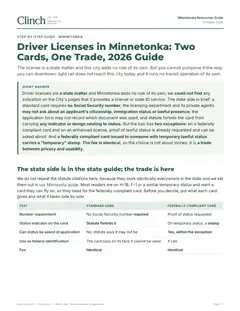
This rule is the same statewide, so we keep it short. A standard license requires no Social Security number, and the statute forbids the card from carrying any indicator or design that relates to the lawful presence or the citizenship of the license holder. Driver and Vehicle Services (DVS) and private licensing agents also may not inquire about an applicant's citizenship, immigration status or lawful presence, and the application form may not record which document was used. But the prohibition has two exceptions that matter directly to you: on a REAL ID or an enhanced license application, proof of status is required and may be asked for. And a REAL ID issued to someone with temporary lawful status is marked "temporary." So the choice is not about money: the fee is the same either way, and the trade is between privacy and usability. The detail is in our state guide.
Steps, documents and official links
See the dilemma in one table
Most readers are on H-1B, F-1 or a similar temporary status and want a card they can use at the airport, which points them toward REAL ID. Before you decide, put what each card gives and takes side by side:
| Test | Standard card | REAL ID card |
|---|---|---|
| Number requirement | No Social Security number required | Proof of status required |
| Status marking on the face | Prohibited by statute | Marked for temporary status |
| Can status be asked at application | No, the statute forbids it | Yes, within the exception |
| Use as federal identification | The card says it cannot be used | Can be used |
| Fee | The same for both | |
Do not miss the inverted trap: a card issued to a person with temporary lawful status expires on the last day of that person's legal stay, or one year after issuance if that last day is not identified. So someone who arrived on a visa and showed documents gets a shorter card than someone who never documented status at all. Build your renewal calendar around that, because extending your status and renewing the card are two separate tasks and one ends before the other.
What changes on the Minnetonka side
Nothing, and we say so plainly: licensing is Driver and Vehicle Services (DVS) business and the City of Minnetonka has no authority over it. We found no indication on the City's own pages that it provides driver license or state ID service; use the DVS page for appointments and service locations.
The one practical takeaway for a Minnetonka resident: for licensing look to the state, for everything else look to your address. In this city the winter parking rule, the garbage system and the school district are set by the City's own arrangements and are not the same as in the neighboring settlements; the sections below cover each one.
PDF: Driver Licenses in Minnetonka: Two Cards, One Trade, 2026 Guide
02 · Vehicles
Is there a vehicle inspection in Minnetonka, and why do insurance quotes look expensive?
Short answer
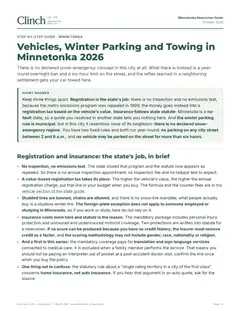
There is no inspection and no emissions test, and the proof is in the statute book itself: the metro emissions program was repealed in 1999 and the section shows as repealed on the revisor's site. The money goes instead into a value-based registration tax, so it is cheap on an old car and expensive on a new one. On insurance the real point is this: Minnesota is a no-fault state, with mandatory personal injury protection plus mandatory uninsured and underinsured motorist coverage. That is why quotes here cannot be compared with quotes from Texas or South Carolina; a different price for the same car and the same driver is normal. Studded tires are illegal, chains are allowed.
Steps, documents and official links
Registration: what you pay and what you do not
- No inspection, no emissions test. The state closed that program and the statutory text shows the section as repealed. So there is no annual inspection appointment, no inspection fee and no tailpipe test to plan for.
- A value-based registration tax takes its place. The higher the vehicle's value, the higher the annual registration. Put that line in the budget when you buy.
- Studded tires are illegal. Chains are allowed. And a detail: the out-of-state plate exception does not apply to a person working or studying in Minnesota, so if you work or study here, do not rely on it.
- There are no toll roads. MnDOT runs four E-ZPass Minnesota express lanes and one of them, on I-394, runs right past this city; we cover it in the transit section.
One thing we could not verify, and we will not write it as "not required": whether a Social Security number or an ITIN is needed to register a vehicle. We could not find a counterpart in the vehicle chapter to the explicit provision in the licensing chapter. So there is a statute saying no number is needed for a license, and nothing saying the same for a vehicle. If you have no number, call and ask before the registration appointment.
Insurance: two protections and a bonus
For a newcomer with no credit history, the statute gives you two concrete protections:
- If no score can be produced because you have no credit history, the insurer must exclude credit as a factor. So "you have no score" cannot be used to put you in the highest band.
- The scoring methodology may not include sex, race, nationality or religion. This is the provision most directly relevant to a Turkish reader.
And a bonus we are seeing for the first time in this series: the mandatory coverage pays for translation and sign language services tied to medical care. It is excluded if a family member provides the service. In plain terms, you should not have to pay out of pocket for an interpreter at a doctor's visit after an accident; confirm that line once when you buy the policy.
One warning about confusion: the statute contains a rule about a single rating territory in a city of the first class, but it concerns homeowner's insurance, not auto. If an auto quote comes with an argument that "this counts as one territory," ask for the source.
Parking citations and local enforcement
In Minnetonka, parking rules are enforced through the traffic and parking side of the Minnetonka Police Department, and the Minnetonka Public Works line is 952-988-8400. The structure of the rules here differs from the neighbors and that is the whole subject of the next section: there is no declared snow-emergency concept, and in its place run a year-round overnight ban and a six-hour limit on street parking. We could not verify which office a citation is paid to; if you receive one, read the payment address off the ticket rather than paying on an assumption.
03 · Winter
Where do I park when it snows in Minnetonka?
Short answer
The most expensive misconception on this page sits right here: Minnetonka has no declared snow-emergency regime. The City's rule does not depend on an announcement; it applies the same way at every snow event. You have two fixed rules. First, no parking on any city street from 2 to 6 a.m., year-round, snow or no snow, July included. Second, and this is a first in this series: no vehicle may be parked on the street for more than six hours. On top of that there is a third prohibition: a vehicle may not be parked so as to interfere with snow removal, and a vehicle or trailer that obstructs removal may be towed at the owner's expense. For plowing the threshold is two inches, but that is an operational trigger, not an emergency declaration.
Steps, documents and official links
What all four neighbors have, and this city does not
The real job of this section is to show you a gap. In this state a "snow emergency" is not a statewide regime but municipal business, and five settlements run five different logics. What sets Minnetonka apart is this: there is no declared-emergency concept here at all. So you do not have to track whether an emergency has been declared; the rules are in force every day already.
| Test | In the neighboring settlements | Here |
|---|---|---|
| Declared emergency | Minneapolis, St. Paul, Plymouth and Crookston all have some form of it | None at all |
| Overnight street parking ban | 2 to 5 a.m. in Plymouth, separate regimes in Minneapolis and St. Paul | 2 to 6 a.m., year-round |
| How long a car may sit on the street | No verified limit found in the other four settlements | Six hours |
| Switching sides by address number | Yes in Minneapolis and in Crookston | Not in the snow rule |
| Plowing threshold | Varies by settlement | Two inches, citywide plowing |
The most important line in that table is the third one. In another settlement in this region, a car left on the street during the day is not a problem as long as you respect the overnight ban; here the six-hour limit runs during the day too. So leaving the car on the street while you fly out, or keeping a guest's car there for a day, is a violation in this city.
How plowing works
- The threshold is two inches. Once accumulation reaches two inches or more, citywide plowing begins. We repeat that this is an operational test and not a declaration: the announcement you are waiting for is not coming.
- Operations typically start between 2 and 4 a.m. So the crews work squarely inside the overnight ban, and a car left on the street drives straight into their path.
- In an average snowfall the goal is nine hours. The City aims to clear streets and cul-de-sacs within that window.
- A car that is left is plowed in. A vehicle that is not towed may simply be left buried, so even if you escape a citation, digging the car out is yours to do.
A conflict we are printing: two different ordinance numbers
The City of Minnetonka cites the same parking rules on two different pages under two different ordinance numbers. We are not picking a winner, because picking one would rest your case on a possibly wrong number. The practical consequence: if you plan to contest a citation or rely on the wording of a rule, read the City Code itself and take the number from there. A second caveat: the sources for this section are the City of Minnetonka's snow removal page and the Minnetonka Police Department's traffic and parking page, but those pages did not open directly during research and the content was read from their search index. The substance of the rules is reliable, but confirm the hours and the threshold on the City of Minnetonka's own page before your first winter.
Sidewalks, where snow may go, and your mailbox
State statute and municipal ordinances prohibit plowing, shoveling or blowing snow onto a public roadway; that is the common rule across this region. So throwing your driveway's snow into the street is both a citation risk and a quarrel with the neighbors. Keeping the area upstream of your driveway clear reduces how much comes back after the plow, and keeping a path around the hydrant is expected in every settlement in this region.
04 · Towing
What do I do if my car is towed in Minnetonka?
Short answer
The City of Minnetonka's own language is plain: a vehicle or trailer that obstructs the removal of snow, sleet, slush or ice may be towed at the owner's expense. So towing here is not a possibility, it is a written authority. To find your car, start with the Minnetonka Police Department, which handles parking enforcement; the Minnetonka Public Works line is 952-988-8400. One point we state openly: Minneapolis publishes an official page saying that vehicles abandoned due to ICE detention are released to their owners or a representative at no cost. Research could not confirm an equivalent in Minnetonka. We are not saying there is none, we are saying we did not find one; do not plan around such a waiver, and ask about it explicitly if you need to.
Steps, documents and official links
The order of work
- Find out whether the car was actually towed. Make the first call to Minnetonka Public Works and the parking side, 952-988-8400. In this city there is a second possibility, so ask about it too: the car may not have been towed but plowed in, because the City of Minnetonka writes that a vehicle that is not towed may simply be left buried.
- Ask which lot it went to and who may collect it. We could not find an official list of the impound address, the fee schedule or who may collect a vehicle in this city, which is why we print no figure and no address. The neighbors' rules differ from one another: in one, a relative with the same surname may collect it; in another, only the registered owner may. Ask three questions on the phone: who may collect the vehicle, which documents are required, and which payment methods are accepted.
- Gather the documents in advance. The items common to practice in this region: proof of ownership (title document, bill of sale or lease), valid photo ID, proof of insurance for that vehicle, and the keys. Whoever drives the car out of the lot generally needs a valid driver license.
- Treat the citation as a separate task. The tow charge and the parking citation are two different items; paying one does not close the other. And remember that in this city a violation can arise from two separate rules: the overnight ban and the six-hour limit.
A car left behind during a detention
We write this item carefully. The City of Minneapolis's own impound lot page states that vehicles abandoned due to ICE detention are released at no cost on evidence of the detention and proof of ownership. That is a valuable provision, but it belongs to Minneapolis. In Minnetonka, as in St. Paul, Plymouth and Crookston, research could not confirm an equivalent.
The practical consequence: in a situation like that, do not assume, ask. The sentence to use on the phone is simple: is there a fee waiver or a payment arrangement for a vehicle that cannot be collected because of a detention. Ask for the answer in writing and note who you spoke to, with the date and time. Storage fees in this region run daily, so delaying that call costs money directly.
And do not conflate two things: the Minneapolis provision is a fee waiver, with no effect on the detention itself or its outcome. The vehicle side and the immigration side are two separate files, and trying to combine them in one phone call usually slows both down.
05 · Transit
How do I get downtown from Minnetonka without a car, and is there light rail?
Short answer
There is no light rail today, and the city has no transit agency of its own either. So you are neither a rail core like Minneapolis and St. Paul, nor a suburb with its own municipal bus company like Plymouth. Today you have three things: Metro Transit's bus routes, Plymouth Metrolink and SouthWest Transit routes that pass through, and the Metropolitan Council's Transit Link dial-a-ride, which covers all of Hennepin County. What is coming is the biggest change for this city: the METRO Green Line Extension is planned and one of its stations, Opus, will be in Minnetonka. We could not verify the opening date and we print no date on this page.
Steps, documents and official links
Getting around without a car today
- Metro Transit bus routes. The city is served by Metro Transit's routes; with no municipal operator of its own, the routes and the schedule belong to Metro Transit.
- Plymouth Metrolink and SouthWest Transit routes that pass through. These two neighboring suburban operators run a few routes through Minnetonka. If you commute suburb to suburb, ask about those routes separately; the finding is medium confidence.
- Transit Link dial-a-ride. The Metropolitan Council's regional service: not a fixed route but a door-to-door reservation service, and it covers all of Hennepin County. This is the most useful one for a newcomer, because you can use it without learning a route map. We also give this finding at medium confidence; ask the Metropolitan Council before relying on it.
The regional card and fares: the item that matters most to a newcomer
A single Go-To Card works on buses, on the light rail lines and on the bus rapid transit lines, so you will not need a new card when rail arrives. The Transit Assistance Program cuts the fare to $1 a ride for low-income riders, and its most useful feature is this: instead of income documents, a community organization enrolled in the Eligible Community Organization program can vouch for you. For a newcomer with no U.S. pay stubs yet, that is the door. The discount expires 365 days after first use, so put it on your calendar as an annual renewal. We could not verify whether an ID or a number is required to obtain a Go-To Card or to enter the Transit Assistance Program; call Metro Transit and ask before you apply.
The light rail that is coming: we skip the date and explain why
The METRO Green Line Extension is planned; the line runs through Hopkins and St. Louis Park to Target Field in Minneapolis and one of its stations, Opus, will be in this city. Know two things together. First, it does not serve the airport directly; for the airport you transfer to the Blue Line downtown. Second, and we say this openly: we are not giving an opening date on this page. The Metropolitan Council project page did not open directly during research and the date came only from a search summary, and we do not want an unverified date to be the basis of a housing or job decision. Confirm the date on the Metropolitan Council's own project page, and make your lease or purchase decision on the transit that exists today rather than on the assumption that rail is coming.
Driving downtown: the express lane and two traps
The main corridor from the western suburbs into downtown Minneapolis is I-394, which carries an E-ZPass Minnesota express lane, and this city sits right on it. It works like this: at weekday peak hours a solo driver pays a dynamic price that changes every few minutes, while two or more occupants ride free. The corridor also has reversible lanes with longer hours of their own, and those are tolled any time the lanes are open. Two traps. First, on one segment of the corridor the E-ZPass option is unavailable in both directions from February through November because of construction, so having a transponder does not mean it works on every segment. Second, and this is a fraud filter: MnDOT warns on its own page about toll scam text messages. Do not tap the link in a text claiming you have an unpaid toll; check any balance only through the official channel. We cover the statewide express lane framework in our state guide.
Official sources
- Metropolitan Council: the METRO Green Line Extension project page, route, stations and opening information
- Metropolitan Council: Transit Link service areas and hours
- Metro Transit: where the Go-To Card works and how to get one
- Metro Transit: the Transit Assistance Program, $1 a ride and organizational vouching
06 · Utilities
How do I open a water account in Minnetonka, and why is my sewer bill unrelated to my usage?
Short answer
Water and sewer are the City of Minnetonka's own service, residential bills arrive quarterly on a staggered schedule, and the bill covers water, sewer, stormwater, the state testing fee and recycling. Two answers together. First: the City does not put accounts in a renter's name and all bills are issued to property owners; the upside for a renter is that the number and deposit problem is zero, the downside is that no bill and no credit history build in your name. Second, and this is money: the sewer charge is tied to your winter-quarter water consumption, and a new resident is assigned a default figure until actual usage is established: 15,000 gallons. So your first period is billed on a number unrelated to what you used.
Steps, documents and official links
The winter-quarter rule: the most expensive detail on this page
The logic is that with no lawn irrigation in winter, the winter quarter is taken to represent the household's true indoor use, and sewer volume is derived from it. On the 2026 schedule the sewer side has three parts:
| Item | 2026 charge | Based on |
|---|---|---|
| Sewer infrastructure fixed charge | $31.50 per quarter | Independent of usage |
| Municipal sanitary sewer | $0.66 per 1,000 gallons | Winter-quarter usage |
| Regional sanitary sewer | $4.50 per 1,000 gallons | Winter-quarter usage |
The weight in that table sits in the last row, and for a new resident that row is multiplied by the default figure. So whether two people live in the house or six, your first period's sewer charge is computed from the same default. The way to correct it is not an appeal but waiting for the next winter quarter to be measured.
Three concrete tasks follow:
- Wait for your first bill and read it. The City of Minnetonka's own page tells a new resident to wait for the first bill before registering for autopay, so do not lose time trying to set up the account the day you move in.
- Ask which consumption figure the sewer charge was computed from. City of Minnetonka utility billing is 952-939-8255. Phrase it this way: which quarter's usage was the sewer line on this bill calculated from.
- Keep your water use under control through your first winter. Once that quarter is measured, a full year of sewer billing runs off it; a running toilet or a tap left open in winter follows you for twelve months. Meters are read monthly by remote electronic metering but billed quarterly, so the data exists if you want to track usage, and the reader does not enter the home.
The no-renter-account rule: both faces together
The City of Minnetonka's language is plain: all bills are issued to property owners and the city does not put accounts in renters' names. The City tells renters not to register for the online service but says they may make a one-time online payment. We write out both consequences separately:
| Consequence | What it means for a renter |
|---|---|
| Being asked for a number | Not a problem: you are not opening the account, so no number is asked of you |
| Deposit | Not a problem: the opening deposit is not your item |
| A bill in your name | Does not happen: you have no utility bill to use as proof of address |
| Credit history | Does not happen: you build no history through a regularly paid bill |
| Who the bill goes to | The owner. Asking whether the water has been paid is your job |
For a newcomer that disadvantage is real: one of the easiest ways to build credit history in the U.S. is a bill paid regularly in your own name, and that door is closed here. Ask for two things in writing in the lease: whether water is inside the rent or charged separately, and if separately, by what method it will be passed through. Learn the billing rhythm from the owner as well: residential accounts are billed quarterly, commercial, industrial, institutional and multi-residential accounts monthly, and irrigation accounts only from June through November.
The summer watering ban: a penalty per day
For a newcomer this is the easiest surprise fine on the page. Three rules run from May 1 through September 30:
- No watering between 11 a.m. and 5 p.m. The hottest part of the day is closed entirely.
- Even-numbered addresses water on even days, odd-numbered addresses on odd days. The test is your house number, so your neighbor may be allowed to water when you are not.
- Penalties are assessed per day of violation. A week-long habit means seven of them, so telling the household about this rule saves money directly.
If you have put in new sod, seed or shrubbery there is a route: the City of Minnetonka issues permits for those. Ask before you plant rather than arguing after the fine. And a separate requirement for anyone whose yard, or whose rented house, has a well: private wells must be registered with the City of Minnetonka and must carry a yard sign. So "this water does not come from the city, it is not my problem" does not work. When viewing a property, ask whether there is a private well, whether it is registered, and whether the sign is up.
The water itself: expect scale
The City of Minnetonka's treatment chain includes chlorination, fluoridation at state-mandated levels, iron removal and corrosion control, but hardness is not reduced. Expect scale in the dishwasher, the kettle and the shower head; make any decision about a household softener with that in mind, and if you rent, ask whether the house has one. The system is large: eight treatment plants, roughly 280 miles of main, 16,000 service connections, eight elevated storage facilities and one reservoir, about 8 million gallons a day.
The City of Minnetonka describes frozen pipes as rare but possible in exceptionally cold weather. Its advice is a pencil-width continuous cold stream, open cabinet doors and insulation; if you lose service, call Minnetonka Public Works at 952-988-8400.
Garbage is an open system: do not confuse it with the neighboring big cities
The City of Minnetonka's own phrase is that Minnetonka has an open garbage collection system, meaning the resident chooses from the City's licensed commercial haulers. In Minneapolis and St. Paul the model is entirely different: there collection is the City's business or that of an arrangement the City runs, and in one of them opening your water account enrolls you in garbage automatically. There is no such automatic enrollment here. If no cart arrives, the reason is probably that you never subscribed.
But there is a split worth knowing, because it saves money: recycling and organics are the City of Minnetonka's own arrangement. Recycling is collected every two weeks and organics weekly, and the cost sits inside your utility bill at $38.70 per quarter on the 2026 schedule. The same fee also covers organics, brush and leaf drop-off and special drop-off events, so after a move or a yard clear-out you have a right you can use without paying again.
Read the other lines on the bill once: in 2026 stormwater is $26.40 per quarter, the state testing fee $3.89, and the fixed water infrastructure charge $63; water consumption is tiered, so the unit price rises as you use more. Some properties also carry a separate line for decorative street lighting. We print no hauler name on this page: the City of Minnetonka publishes the list on its own page, research could not read the list itself, and license lists change from year to year. All of these charges are set annually and will change for 2027; open the City of Minnetonka's schedule again in January.
Phone numbers: City of Minnetonka utility billing 952-939-8255, Minnetonka Public Works water and sewer service 952-988-8400, after hours 952-258-5321, and a 24/7 automated payment line 855-945-3661. Minnetonka City Hall is at 14600 Minnetonka Blvd.
Electricity and gas: the winter shutoff ban, but no provider name
Electricity and natural gas do not come from the City of Minnetonka. We print no provider name on this page, because research read that information from the search index of the City's own pages rather than fetching the pages directly; confirm the names and each one's deposit and reconnection rules with the provider itself. And one thing we are not carrying here: in Plymouth it was confirmed that the regime changes inside the city, by street address, so that one household is under one statute and its neighbor under another. Research did not confirm such a split for Minnetonka and we are not importing that account; we are also not saying there is none. After you move in, keep your first bill: the type of entity printed on it is your evidence of which section covers you in winter.
The substance of the rule is the same statewide, so we keep it short and open the full text in our state guide:
- The window is October 1 to April 30. There is no temperature trigger; the dates are fixed.
- The income ceiling is 50 percent of state median household income, and the protection applies where the disconnection affects your primary heat source.
- A practical shortcut you should use: if you receive any public assistance whose threshold sits at or below that level, you are deemed to meet the income test.
- The rule lives in two separate sections: investor-owned companies in one, municipal utilities and electric cooperatives in another. The second carries extra protections: no disconnection on a Friday, on a weekend, on a holiday, while the utility's offices are closed, or after close of business, and the utility must confirm occupancy before disconnecting. The notice periods also differ.
- The protection is not automatic. The household has to apply, file the inability-to-pay declaration and keep an accepted payment agreement. Do not assume you are covered without applying.
- Water and sewer are entirely outside this regime. So there is no such protection against a winter water shutoff, and in this city water is the City of Minnetonka's own service.
Official sources
- The City of Minnetonka's utility billing page: the quarterly rhythm, the no-renter-account rule and the 2026 schedule
- The City of Minnetonka's water page: treatment, watering restrictions and private well registration
- The City of Minnetonka's garbage and recycling page: the open system and the licensed hauler list
- Minnesota statute: shutoff ban for cooperatives and municipal utilities (216B.097)
- Minnesota statute: shutoff ban for investor-owned utilities (216B.096)
07 · Renting
Is there a rent cap in Minnetonka, and can a landlord ask about my immigration status?
Short answer
The honest answer to both questions lands in the same place: we found no local ordinance on either subject in this city, so your protections are whatever the state floor is. On rent control, Minnesota law does not impose a flat ban on cities; it attaches a referendum condition: the first clause prohibits, the second lifts the prohibition where the rule has been approved at a general election. St. Paul went through that door; Minneapolis never held the vote. No such vote or ordinance was found for Minnetonka. Likewise, Minneapolis has a municipal provision barring a landlord from asking about a tenant's immigration status or refusing an application over an ITIN; we could not verify an equivalent here and we are not carrying that provision over. We are not saying there is none, we are saying we did not find one.
Steps, documents and official links
Do not carry the neighboring cities' answers here
The most important job of this section is a warning. A reader living in a suburb sees the Minneapolis and St. Paul tenant protections all over the internet and assumes they apply to them too. Four items are especially often confused:
| Item | In the neighboring big cities | Here |
|---|---|---|
| A percentage cap on rent increases | St. Paul has it, by referendum; Minneapolis does not | Research found none |
| Ban on a landlord asking about status | Minneapolis has an explicit municipal provision | Research could not confirm one |
| A city extension of the pre-eviction notice | 30 days in Minneapolis, temporarily longer in St. Paul | Research found none, the state floor applies |
| Rental license or certificate of occupancy | A license in Minneapolis, a fire certificate of occupancy in St. Paul | Research found none |
So when you sign a lease, do not relax on the belief that "there is a rent cap in this region" or that "a landlord cannot ask about my status." The city limit is the limit of those protections too. The last row has a practical consequence: we could not verify a public record in which you could look up a building's inspection history before signing, so view the building yourself, check the basement and the heating before winter arrives, and always put repair requests in writing.
What you genuinely do have, statewide
We keep this short and leave the detail to our state guide, but these items apply in Minnetonka exactly as elsewhere:
- Source-of-income discrimination is prohibited, under a different name. The state human rights act makes status with regard to public assistance a protected class in housing. So paying with a voucher or with assistance cannot be a ground for refusal. The exemption is narrow: only a resident owner renting a room in a one-family home.
- A landlord contacting immigration authorities is prohibited, BUT that is a retaliation provision. The statute lists, among a landlord's prohibited acts, contacting federal or state law enforcement about a tenant's immigration status; but the prohibition is triggered by the tenant having done a protected act, such as reporting a code violation or reporting to the news media or a community organization. So writing "a landlord cannot report you" would be wrong. This is not a screening provision. Where a landlord acts unlawfully and in bad faith, the remedy is up to $1,000 per occurrence plus reasonable attorney fees.
- There is no statutory cap on the deposit amount, but the landlord owes one percent simple annual interest and must return the deposit, or a written statement of the reasons for withholding it, within three weeks after the tenancy ends. Miss the deadline and the retention is presumed to be in bad faith, and bad-faith retention carries punitive damages of up to $500 per deposit. When you move out, leave your mailing address or delivery instructions in writing; the clock starts with it.
- Late fees cannot exceed eight percent of the overdue rent payment and apply only where there is a written agreement that also specifies when the fee applies. If you see a higher figure in a lease, ask for the source.
- Ending a tenancy at will takes written notice as long as the rent interval or three months, whichever is less, so one month on monthly rent.
- Eviction only through a court action. Unlawfully and intentionally excluding a tenant, or interrupting utilities to do it, is a misdemeanor. Changing your lock or cutting your power is not an eviction procedure.
One concrete door in this city: tenant advocacy
The City of Minnetonka's own immigration resource page names HomeLine as the tenant advocacy agency that provides free legal advice on landlord-tenant rights, and HousingLink for vacancies and housing-assistance waiting-list information. So the City points you somewhere, and that referral sits on the City's own page. It may be the first door to knock on with a tenant rights question; but do not confuse two things: free advice from an advocacy agency and legal representation in an immigration case are not the same thing.
Two concrete consequences if you rent here
- The water and sewer account is never in your name. The City of Minnetonka says so in writing; we write out the upside and the downside together in the utilities section.
- Garbage is an open system, so you choose the hauler yourself. Have the lease state clearly who the garbage account belongs to; otherwise you move in to a service nobody has signed up for.
Official sources
- Minnesota statute: the rent control prohibition and its referendum exception (471.9996)
- Minnesota statute: the landlord retaliation ban and its immigration status clause (504B.212)
- Minnesota statute: deposit interest, the three-week return deadline and punitive damages (504B.178)
- Minnesota statute: the eight percent cap on late fees (504B.177)
- Minnesota statute: public assistance status in housing discrimination (363A.09)
- The City of Minnetonka's Immigration Resources page: HomeLine, HousingLink and housing resources
08 · City services
Where do I report a problem in Minnetonka, is there a 311?
Short answer
There is no 311 number. The Hennepin County suburbs have no county-wide 311; Minnetonka's channel is the report-a-concern and service-request form on the City of Minnetonka site, plus a staff directory and a text and email notification service. If you prefer the phone: utility billing 952-939-8255, Minnetonka Public Works water and sewer service 952-988-8400, after-hours failures 952-258-5321; Minnetonka City Hall is at 14600 Minnetonka Blvd. On libraries this city has a concrete advantage: two Hennepin County Library branches sit inside the city, cards are free, and no Social Security number, citizenship or immigration-status requirement appears anywhere in the published requirements.
Steps, documents and official links
Reporting: what exists instead of 311
- The report-a-concern and service-request form is the City of Minnetonka's main channel. Potholes, street lights, snow, garbage and the other everyday matters go through it.
- The staff directory is the second channel: if you know which department owns the issue, you can write to that person directly. For a newcomer this can be faster than the form.
- The text and email notification service is the third channel, and set it up in your first week. This city announces rules on the water, garbage and watering side, and notices come through here. But know one thing from the start: not having received a notice is not an excuse.
- Phones: City of Minnetonka utility billing 952-939-8255; Minnetonka Public Works water and sewer 952-988-8400; after hours 952-258-5321; 24/7 automated payment 855-945-3661.
Minneapolis has a genuine 311 line through which you can look up things like a rental license. Do not carry that line here; in Minnetonka the equivalent is the three channels above.
The library card: the most practical way past the ID barrier
Hennepin County Library has two branches in the city: Minnetonka Library at 17524 Excelsior Blvd. (612-543-5725) and Ridgedale Library at 12601 Ridgedale Dr. (612-543-8800). The system has 41 locations in all, so your card works outside the city as well. The card requirements suit a newcomer:
- Cards are free and give access to materials, library computers and online resources.
- Hennepin County residents and property owners can get a card in person at any branch, or apply online and receive a digital card immediately. Cards are not mailed; online applicants get their account information by email.
- To check out physical items for the first time you must visit a service desk and provide proof of your address. The card number and a four-digit PIN arrive by email.
- No Social Security number, citizenship or immigration-status requirement appears anywhere in the published requirements. What is required is Hennepin County residence or property ownership, plus proof of address.
- Most residents elsewhere in Minnesota can register their own local library card with Hennepin County Library; a handful of libraries that are not part of a regional system are outside that option. For residents of other states there is a fee card at $60 a year; it allows physical borrowing but not downloadable content or remote access to subscription resources, and it expires 12 months after issue.
When proof of address is requested you will have your lease, but note this: because the water account is not in your name, you will not have the classic utility bill. Call the branch before you go and ask which documents are accepted; this is a snag specific to this city.
City government: which channel for whom
The City of Minnetonka operates under the council-manager form of government: residents elect a mayor and council, the council sets policy, and it employs a city manager who runs day-to-day operations. The council's structure is a mayor, plus two at-large councilmembers, plus four ward councilmembers; terms are four years and each member has one equal vote. So the person to write to about a neighborhood-scale matter is your ward member, and you need to find out who that is.
One detail carries practical weight: the council also sits as the Economic Development Authority, and in that capacity it handles economic development, housing and redevelopment. If you are writing about housing or a redevelopment project, ask in which capacity the matter is being heard. The city also has a standing Charter Commission and planning, park, sustainability, senior advisory, economic development advisory and Diversity, Equity and Inclusion commissions, plus a Local Board of Appeal and Equalization. That last commission is directly relevant to this page's reader: the City of Minnetonka's Immigration Resources page sits under the Diversity, Equity and Inclusion commission.
Official sources
- The City of Minnetonka's report-a-concern and service-request page
- The City of Minnetonka's text and email notification service
- Hennepin County Library: card requirements and proof of address
- The City of Minnetonka's schools and libraries page: the Minnetonka Library and Ridgedale Library addresses and phone numbers
- The City of Minnetonka's council and mayor page: ward representation and the city manager form
09 · Property tax
I bought a home in Minnetonka. Is an ITIN enough for the property tax reduction?
Short answer
Yes, an ITIN is enough, and both the Minnesota Department of Revenue and Hennepin County say so plainly: an Individual Taxpayer Identification Number may be used in place of a Social Security number on the homestead classification application. There are three conditions: you must own the property, occupy it as your sole or primary residence, and be a Minnesota resident. The rule is the state's, the application is the county's: if your property is in Minnetonka, the application goes to the Hennepin County Assessor. There are two real traps: the identifier of a spouse who does not live in the house is also required, and December 31 is a hard date. If you rent there is a separate item with real money in it: the Renter's Credit.
Steps, documents and official links
Homestead classification: two traps
- The name and identifier of a spouse who does not live in the house are also required. The statute asks for the number of every occupying owner named on the deed, and of each owner's spouse, even if that spouse does not live at the location. Failing to supply it is treated as electing partial homestead treatment, so you do not get the full reduction. In a newly arrived family that spouse is often still in Türkiye; call Hennepin County before filing and ask which affidavit they want.
- December 31 is a hard date. Even if your closing was in October, a property without a timely application is classified nonhomestead for that year and the reduction is lost for a year. The December 15 figure in older sources is wrong.
Once granted, no annual reapplication is needed, but the Hennepin County Assessor may request a new application or documentation at any time to verify continued eligibility. And you carry a reporting duty: if you move, sell, your marital status changes or your spouse's occupancy changes, you must notify the Hennepin County Assessor within 30 days; failing to do so can bring a penalty.
There is also a relative homestead route: an application can be made where a parent, grandparent, sibling, child, grandchild, aunt, uncle, niece or nephew of the owner or the owner's spouse occupies the property; but relative homesteads do not qualify for a property tax refund. If you are buying a property occupied by a family member, know that distinction up front.
We print no county property tax rate on this page, because research could not verify a single one. Before making an offer, ask the Hennepin County Assessor for that parcel's current valuation; two parcels on the same street can carry different tax. One more thing: in this city the appeal route also runs through the Local Board of Appeal and Equalization within the council, so if you intend to challenge a valuation, ask about that calendar as well.
The Renter's Credit: no longer a standalone form
If you rent, you have a refundable credit most people do not know about. It is no longer claimed on a separate form but inside your state income tax return. The conditions: a valid Social Security number or ITIN, full-year or part-year Minnesota residency, rent paid on a Minnesota property that was assessed property tax, household income below the threshold, and not being claimed as a dependent on someone else's return.
The most important part of the mechanism is your landlord's obligation: they must give you the certificate showing the rent you paid by January 31. If they do not, your route is not closed: from February 1 you can ask the Minnesota Department of Revenue for a rent paid affidavit, and you file that affidavit with proof of rent along with your return even if the certificate arrives later. If you file by mail, remember that you must attach copies of all rent certificates; a missing attachment delays or denies the refund. If you email a request for the affidavit, follow the Minnesota Department of Revenue's own rule: include only the last four digits of your number in the email.
In Minnetonka this item has a concrete snag: because the water account is not opened in a renter's name, you have to build proof of your rent payments from bank records and rent receipts. If you pay cash each month, ask for a receipt and keep it; at year end that is the basis of this credit.
The maximum credit and the income threshold depend on the tax year and change annually; we list the figures in our state guide, so open the current page before you file.
Official sources
- Minnesota Department of Revenue: homestead classification, ITIN acceptance and the December 31 date
- Minnesota statute: homestead classification and identifier requirements (273.124)
- Minnesota Department of Revenue: the Renter's Credit, the January 31 certificate and the affidavit route
- Hennepin County: the homestead application
10 · School
Which school will my child attend in Minnetonka, and is an SSN required to enroll?
Short answer
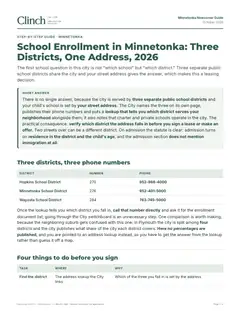
There is no single answer, because the city is served by three separate public school districts and your child's school is set by your street address. The City names the three on its own page, publishes their phone numbers and puts a lookup that tells you which district serves your neighborhood alongside them; it also notes that charter and private schools operate in the city. The practical consequence: verify which district the address falls in before you sign a lease or make an offer. Two streets over can be a different district. On admission the statute is clear: admission turns on residence in the district and the child's age, and the admission section does not mention immigration at all.
Steps, documents and official links
Three districts, and your address decides the school
The City of Minnetonka's own language is that Minnetonka is served by three public school districts. That differs from Plymouth: there the city is split into four districts and the city publishes what share of its area each one covers. Here the City of Minnetonka publishes no percentages; it points you to an address lookup instead, so you need to get the answer from the lookup rather than guessing from a map.
| What to do | Where | Why |
|---|---|---|
| Find the district | The address lookup the City of Minnetonka links to | Which of the three you fall in is set by the address |
| Confirm the school | The district's own address search | Attendance boundaries inside a district are drawn separately |
| Get written confirmation | The landlord or the seller | A pre-signature item, not a courtesy question |
| Compare the calendars | The calendar of the district you chose | The three districts' calendars, hours and busing need not match |
Do not skip the last row: if you plan your move date around a school calendar, you need to know which calendar you are using, and in this city there are three.
The City of Minnetonka publishes the three districts' names and phone numbers on its own page: Hopkins School District (No. 270) 952-988-4000, Minnetonka School District (No. 276) 952-401-5000, and Wayzata School District (No. 284) 763-745-5000. Once the address lookup tells you which district you fall in, call that number directly and ask for the enrollment document list there; going through the city switchboard is an unnecessary step.
Enrollment documents: what we can and cannot say here
We write this item honestly. The statute keys admission on residence and age and says nothing about immigration status. The same statute also says something that matters directly to some families: a district may not deny free admission to a homeless pupil merely because it cannot determine that the pupil is a district resident.
Immunization is also regulated statewide, with two practically useful details: a transferring student may attend for up to 30 days while records are submitted, and there are two exemption routes: a physician's signed statement that a vaccine is contraindicated for medical reasons or laboratory confirmation of immunity, or a notarized statement from the parent based on conscientiously held beliefs, a copy of which goes to the Minnesota Department of Health. The notarized route is not common in this series, so we state it plainly.
But research could not read these three districts' own enrollment document lists, so we do not write the sentence "no Social Security number appears in the list" on this page. We can write it for Crookston, where Crookston Public Schools (ISD 593)'s list was read and contains only immunization records and a birth certificate; we are not carrying that here. What to do: call the district, ask which documents are required to enroll, and ask for the answer in writing. If a number is requested, you can point out that the statute keys admission on residence and age and says nothing about immigration status.
The same honesty on language support: we could not verify which languages these three districts actually serve. Turkish is not among the languages the Minneapolis and St. Paul districts actually translate into, so do not expect it to be waiting here either. The route is to request a rarely-used-language interpreter, and to do it in writing, at enrollment.
Adult and family programming: where the English classes sit
Adult and family programming, where English classes usually sit, lives in each district's community education office: Hopkins Community Education, Minnetonka Community Education Services and Wayzata Community Ed. The City of Minnetonka publishes all three phone numbers on its own page, and Hopkins even lists a separate unit and a separate number for adult education, Hopkins Adult Options in Education. That is a concrete benefit of the City of Minnetonka's page: you can call the program directly rather than the district switchboard. Two questions to ask: in which terms the adult English class opens, and which documents are required to register. Ask for the second answer in writing, because we could not verify the document list in this pass.
Official sources
- The City of Minnetonka's schools page: the Hopkins, Minnetonka and Wayzata districts, phone numbers and the neighborhood lookup
- Minnesota statute: public school admission, age thresholds and the homeless pupil provision (120A.20)
- Minnesota statute: immunization requirements, exemptions and the 30-day transfer window (121A.15)
PDF: School Enrollment in Minnetonka: Three Districts, One Address, 2026
11 · Health
I have no insurance. Where do I apply in Minnetonka?
Short answer
The answer is the same statewide and it turns on a date, so we keep it short. Minnesota once provided coverage regardless of status through MinnesotaCare, but the statute today says that undocumented noncitizens aged 18 and over are ineligible for MinnesotaCare beginning January 1, 2026. A child under 18 can still enroll, and the status of the adults in the household does not affect the child's application. What remains for an adult without status is Emergency Medical Assistance, plus two specific doors: for pregnant people ineligible for federally funded medical assistance because of immigration status, coverage through pregnancy, labor, delivery and 12 months postpartum; and, for a person receiving care and rehabilitation at a nonprofit center established to serve victims of torture, coverage without federal financial participation.
Steps, documents and official links
Where things stand today, by provision
| Who | What exists today |
|---|---|
| A child under 18, regardless of status | Can enroll in MinnesotaCare |
| An adult without status | Emergency Medical Assistance; MinnesotaCare closed to this group |
| A pregnant person ineligible for federal Medicaid because of status | Pregnancy, delivery and 12 months postpartum |
| A person in care at a center serving victims of torture | Covered even if eligible by no other route |
The last row is a provision we are seeing for the first time in this series and it is directly relevant to a reader with an asylum claim. The statute says a person receiving care and rehabilitation at a nonprofit center established to serve victims of torture is covered even if they are eligible by no other route. We do not name the center, we describe the provision; if you are receiving that kind of care, say so in your application.
A note on the pregnancy coverage: the state used the October 1, 2026 option and wrote it into its statute, and the frame it wrote is broader than the federal option's. So this door sits in the state's own statutory text rather than in an administrative practice.
Emergency Medical Assistance: what it covers and what it does not
The broadest emergency coverage in this series is here, and it deserves to be stated plainly: alongside the emergency room and the ambulance it expressly covers dialysis and, where there is a cancer diagnosis, surgery, chemotherapy and radiation. But state the limit in one sentence: this is not insurance and it is not a clinic. Check-ups, routine prenatal care, outpatient prescriptions, dental, vision, immunizations and addiction treatment are outside it.
The marketplace: not the federal site here
Minnesota runs its own marketplace, MNsure, so you compare plans on MNsure rather than the federal site, and that platform has been the state's own for years. This differs from some neighboring states and it changes the first address you go to when shopping for a plan.
On the federal side there are two dates and we write both. As of October 1, 2026, federal law narrowed full federal Medicaid payment to four groups; refugees and asylees are not on that list, and what survives is Emergency Medical Assistance plus the pregnancy and under-21 coverage left to the state's option. The state used that option and wrote it into statute. As of January 1, 2027, the premium tax credit on the marketplace narrows to three categories. We could not verify whether MNsure applies that federal restriction in the same way, so we do not assume: ask MNsure directly when you choose a plan during the enrollment period.
We print no street address for the Hennepin County office that takes the application; proceed by phone for an appointment. The detailed state framework is in our state guide.
Official sources
- Minnesota statute: MinnesotaCare eligibility and the January 1, 2026 closure (256L.04)
- Minnesota statute: Emergency Medical Assistance, pregnancy coverage and the torture survivors provision (256B.06)
- Federal statutory text: the October 1, 2026 Medicaid change
- Federal marketplace: eligibility by immigration status and the January 1, 2027 restriction
12 · Health
Is there a clinic in Minnetonka I can use without insurance?
Short answer
For regular care the door is sliding-fee community health centers, and do not confuse one phrase: a sliding fee is a reduced fee, not a free one. You pay an amount that falls with your income. We print no clinic name and no address on this page, because research could not verify a single center in this area from an official source; instead we give you the official search tool, because it returns a current list for your address, while a list we wrote would be wrong six months from now.
Steps, documents and official links
How to use it
- Open the official search tool and enter your Minnetonka address or ZIP code. The tool returns the centers near you.
- Call and ask two questions: how do I apply for the sliding fee scale, and which income documents are accepted. If you have no U.S. pay stubs yet, say so on the phone; most centers have alternative declaration routes.
- Ask for an interpreter, and ask when you book. Asking on the day of the appointment is usually too late.
- Bring to the first appointment: ID, proof of address, income documents if you have them, a list of the medications you take, and immunization records for a child.
On proof of address there is a snag specific to this city, and we repeat it here: because the water account is not opened in a renter's name, you will not have the classic utility bill. Your lease, bank correspondence or a letter from a government agency may do, but ask on the phone which they accept.
And we say one thing plainly: these centers are not an emergency room. In an emergency go to the emergency room; Emergency Medical Assistance covers that side and the broadest coverage in this series is here.
No named center or umbrella organization could be verified statewide in this pass; the Minnesota Department of Health pages that were tried did not open. So the brevity of this section is an access problem, not an indication that there is no center in the area.
13 · Marriage
Where do I get a marriage license in Minnetonka, and how much is it?
Short answer
The license comes from Hennepin County, not the City of Minnetonka, and the transaction runs through the Hennepin County Service Centers; the general line is 612-348-8240, weekdays 8 a.m. to 4:30 p.m. The procedure has two stages: complete the online pre-application first, then go in person for the final application and payment, and Hennepin County asks that both parties attend the appointment. Know three procedural rules in advance: appointments cannot be booked more than four weeks ahead, walk-ins are accepted only on a limited basis depending on staffing and space, and one transaction per appointment. So do not plan to get a license and pull a birth certificate on the same day. There is a conflict on the fee and we are not picking a side.
Steps, documents and official links
A conflict we are printing: the fee
We write this item as it stands, because two official sources give two different figures:
| Source | License | Reduced with the education program |
|---|---|---|
| The text of the state statute | $125 | $50 |
| Hennepin County's own page, October 2026 | $115 | $40 |
We are not choosing which is right; one of the two has to change. What to do is simple: when you book the appointment, ask the fee on the phone and ask about the payment method too. We wrote in our state guide that three official sources give three different answers on the statewide marriage license fee, and that the statute is inconsistent with itself.
The appointment system: three rules, three consequences
- Appointments cannot be booked more than four weeks ahead, and Hennepin County cites staffing shortages as the reason. So you cannot set the appointment around the wedding date; build the calendar forward and book on the day the window opens.
- Walk-in service is limited. It is possible, but do not plan your day around it.
- One transaction per appointment. A second task means a second appointment. For a reader whose family is flying in, that is a direct planning item.
Documents
Hennepin County asks for identification such as a driver license, a state ID or a birth certificate, and says the full document list arrives on the confirmation screen or by email after the online pre-application. So the right route is not for us to write the list but for you to complete the pre-application and receive it. On the number declaration, see the relevant section of the statute; we explain how the number declaration works on a license application in our state guide.
Source caveat: the Hennepin County marriage license and service center pages could not be reached directly and the information was read from their search index, so we give the procedural detail in this section at medium confidence. Confirm by phone before you go.
14 · Vital records
Where do I get a birth certificate in Minnetonka, and does where I live matter?
Short answer
No, and this is the most reassuring answer on the vital records side in this state: according to the Minnesota Department of Health, all 87 counties work from the same system and serve you regardless of where you live. So if the birth took place in Minnesota, which county you ask is not an obstacle. The nearest door for Minnetonka is the Hennepin County Service Centers, general line 612-348-8240; the same appointment system applies, meaning one transaction per appointment. For a person with no ID the statute provides a route: a statement of identification.
Steps, documents and official links
Who can obtain a record, and what if you have no ID
Not everyone can obtain a certified vital record in Minnesota; the statute defines the person with a tangible and direct interest in the record. Your own birth certificate, your child's, and the certificates of people with a close family tie fall within that.
For a newcomer the real item is this: if you do not have an accepted photo ID, the route is not closed. The Minnesota Department of Health publishes a statement of identification form, and that route is open to an applicant whose identity documents are missing. Fill it out in advance and take it with you; preparing it at home rather than learning about it at the counter saves a visit.
The order of work
- Determine which state issued the record. If it was issued in Minnesota you can proceed through any authorized office in the state; if another state issued it, you have to go to that state's own system.
- Book an appointment at a Hennepin County Service Center and plan the transaction on its own; do not try to fit a second task such as a marriage license into the same appointment.
- If your ID is missing, download and complete the statement of identification form.
- Ask the fee and the accepted payment methods by phone. We print no fee on this page, because we could not verify an approved fee schedule for Hennepin County, and we recorded more than one conflict on the fee side in this state.
Civil registry, power of attorney and apostille matters on the Türkiye side are outside this section; they are in the consulate section at the end of the page.
15 · Social Security
How do you get a Social Security number in Minnetonka?
Short answer
The agency that issues the number is federal, the Social Security Administration, so the rule is the same in Minnetonka as anywhere else in the state and we set it out in full in our Minnesota guide. What this page adds is a suburban reality: there is no federal counter in this city, and the office that serves you is somewhere else in the metro. The transit side here does not look like a big city's either: Minnetonka runs no transit operation of its own and is served by Metro Transit routes, and the light rail line does not reach this city today. So on the day of your appointment you either drive or make at least one transfer. Even so, we publish no Social Security Administration street address on this page, because we could not verify a single one from an official source this round. If you are holding an appointment notice, the address on that notice is the one that counts.
Steps, documents and official links
- Who does not have to apply: if you arrived on an immigrant visa and requested the number in your visa application, or you adjusted status inside the United States and checked the SSN box on your work permit application, the card arrives by mail. Otherwise you start the application online and attend an appointment. There is no fee.
- What to bring: your current immigration document and a valid passport. Photocopies and notarized copies are not accepted.
- Which office serves you: enter your ZIP code in the agency's office locator. The general line is 1-800-772-1213.
- F-1 and J-1: the number only becomes available once you have the right to work. Enrolling in school alone does not qualify.
- Without a car, plan the journey as a transfer from the start. This city has no bus operation of its own; you use Metro Transit routes that pass through, Plymouth Metrolink and SouthWest Transit routes, and the Metropolitan Council Transit Link dial-a-ride that covers all of Hennepin County. So reaching a federal office usually means combining two pieces: Transit Link or a Metro Transit route to a transfer point, then onward to the office. We set out the routes and fares in the transit section; build your appointment time around that.
- One calendar note about light rail, with no date attached. The METRO Green Line Extension is planned and it will have a station, Opus, in this city. That would genuinely change the city's transit picture, but we could not verify the opening date this round; the source page was closed to automated access and we saw the date in a search extract. So we print no date here and you should not plan around one. Today's position is simple: there is no station yet.
- Winter appointments: federal offices can close in a snowstorm. For a January or February appointment check the agency's closure notices that morning. And one reflex needs correcting here: Minnetonka does not declare snow emergencies, the rules apply at every snow event anyway. Where you leave the car is therefore not something that waits on a declaration; details in the winter section.
What can you do in Minnetonka without an SSN?
Minnesota has an unusual answer to this, and it comes from statute: rather than leaving the person without a number to guesswork, the legislature wrote a box into the law. We left the full list and the statutory citations in the state guide; here we only say where you go in Minnetonka.
- Marriage license: the statute says the number is collected for the application but does not appear on the license itself, and that a party without one states that in the application or a supplementary document. The text is at Minn. Stat. 517.08. In Minnetonka the errand runs through the Hennepin County Service Center network, and that model brings two constraints of its own: one service per appointment, and no booking more than four weeks ahead. Which counter, what is required and the three different official answers on the fee are in the marriage license section.
- Driver's license: the standard card does not require a number and carries no status marking, but you cannot fly with it, and the card you can fly with has a cost of its own. We set out the trade-off in the driver's license section.
- Vital records: no number is needed for a birth certificate. The Minnesota Department of Health says all 87 counties work from the same system and serve you regardless of where you live, so a Minnetonka resident goes to the nearest Hennepin County counter. Details in the birth certificate section.
- Utilities: here the City of Minnetonka has an answer of its own and both sides of it have to be read together. The City issues every water and sewer bill to the property owner and does not open accounts in renters' names, so no SSN question and no deposit ever arises; by the same token, no bill and no payment history is built in the renter's name either. On top of that there is the rhythm of the bill: it comes quarterly, and the sewer portion is based on your winter quarter water use. We set out both in the water and trash section; do not build your first year's budget without reading it.
- Taxes: someone who cannot get an SSN but must file uses an ITIN (the tax section below).
- Passport acceptance: there is none in this city. That is not an SSN matter, but it is planned the same way. The nearest facilities, the one that opens at 7 a.m. and the one open on Saturday morning, are in the U.S. passport section.
One distinction up front, because it is often confused: an ITIN is not an SSN and does not substitute for one. It grants no work authorization, it is not an identity document, and getting one neither creates nor changes your immigration status.
16 · Taxes
Is there a city tax in Minnetonka, and is it withheld from my wages?
Short answer
No city tax comes out of your wages, and the reason is not a choice by the city of Minnetonka but a state statute: the relevant section allows no county, city or town to impose a new tax on sales or income, or to increase an existing one, and the text contains no exception. But there is a half-truth trap here that belongs on exactly this page: there is no local income or payroll tax, and there is a local sales tax. The legislature grants individual cities sales tax authority by special law, and that other law sits outside the prohibition. We print no sales tax rate for Minnetonka on this page, because we could not verify it this round; we give you the mechanism and you read the figure from its own source.
Steps, documents and official links
Which sentence is right, and which is wrong
- The right sentence: Minnetonka has no income tax and no payroll tax of its own, and the city could not create one by itself. The section is headed with the prohibition on new taxes and its text is a single sentence; if you want to read it yourself, Minn. Stat. 477A.016 is here. Your pay stub shows federal and state withholding only. You do not file a separate city return the way you would in Ohio or Oregon.
- The wrong sentence: "there is no local tax in Minnetonka." That would be wrong. Despite the same prohibition, local sales taxes do in fact exist, because the legislature authorizes them one at a time in a separate law. Minnesota House Research lists the exceptions as local sales taxes and local lodging taxes; the exceptions do not extend to income or payroll taxes.
- What that means for a reader in this city: because the authority is granted city by city, the metro is not one single rate area. Living here and shopping in the municipality next door, or the other way round, can change the sales tax rate you pay. Minnetonka borders several municipalities to the east, west and south and its retail is close to those lines, so this is not a theoretical distinction here.
- Small on a grocery run, real money on a large purchase. On furniture, a remodeling invoice or a vehicle purchase the difference becomes noticeable.
- Where to look: read the rate for your own address in the Minnesota Department of Revenue's sales tax rate lookup and on the City of Minnetonka's own finance or tax page. The reason to check both is this: the legal basis sits with the state and the rate that is actually charged sits with the city. If you do not see a rate on this page, that is not an omission but a deliberate decision.
State income tax: the rate is high, and that is a salary negotiation fact
- There are four brackets and the top rate is 9.85%. That is above the top rate in most states in this series. When comparing an offer in Minnetonka with an offer in another state, compare net figures rather than gross.
- We do not put the bracket table on this page. The rates are written into statute and do not move, but the dollar amounts marking the bracket boundaries are reindexed every year. We set out the table and that distinction in the state guide; confirm the amounts that apply to your own filing year from the Minnesota Department of Revenue's own indexed table. The source for the rates is Minn. Stat. 290.06.
- Withholding: your employer withholds both federal and Minnesota income tax. You fill out the form that sets the state withholding in your first week; the Minnesota Department of Revenue's withholding page for employees explains it.
- If you rent there is real money on the table: the renter's credit is no longer a separate form but a credit claimed inside your income tax return, and your landlord must give you the certificate by January 31. It matters to renters here for an extra reason: because the water and sewer bill is issued to the property owner, no payment history is built in your name, and this certificate is one of the few documents you are left holding. Details are in the property tax section.
How do you get an ITIN?
- Complete Form W-7 and attach it to your federal return unless an exception applies.
- Have your documents verified. Three routes: mail the passport to the address the IRS specifies, use a certifying acceptance agent, or attend an appointment at an IRS office that does ITIN document review. The last two routes do not involve putting your passport in the mail.
- Wait. Processing normally takes about seven weeks, longer in filing season.
- Which office for a Minnetonka filer: we could not verify the list of Minnesota offices doing ITIN document review this round, and we publish no IRS office address on this page. Confirm the office and the appointment through the IRS office locator; the appointment line is 844-545-5640. Since you live in a suburb, assume the nearest office is not in this city and plan the trip.
- Expiry: an ITIN not used on a return for three consecutive years expires.
- There is one place an ITIN plainly works: Minnesota accepts it on a homestead credit application. But that application has two traps and both involve money; see the property tax section.
- State return: you file the Minnesota return with the identifying number from your federal return. We could not verify a separate rule this round on which Minnesota credits an ITIN filer may claim; confirm with a tax adviser.
17 · Starting a business
How do you start an LLC in Minnetonka, and what does it cost?
Short answer
You file with the Minnesota Secretary of State rather than with the City of Minnetonka, so the fees in Minnetonka are the same as anywhere in the state: $135 by mail for LLC articles of organization, $155 in person or online, and annual renewal is free. We left the full fee table and the conflict inside the fee schedule in the state guide. What this page opens up is the one item that changes in Minnetonka: if you register an assumed name, it must be published in a qualified legal newspaper for two consecutive issues in the county of your principal place of business, which for a business here means the Hennepin County market, and that cost sits outside and on top of the state fee.
Steps, documents and official links
The newspaper notice: the county is set by your business address, not your home
- The rule: once an assumed name is registered, it must be published in a qualified legal newspaper for two consecutive issues in the county of the business's principal place of business. Paying the state fee does not finish the job.
- We print no publication cost, because the publisher sets it and the state publishes no schedule.
- But we can tell you the direction: because the notice runs in your own county, a business formed in Minnetonka publishes into the Hennepin County market, and notices in the metro counties generally cost more than in the state's small rural counties. Budget it as a separate line next to the state fee.
- In this city that line is a genuine decision point. Running a business from home is common here, and the address of the principal place of business determines which county the notice runs in. If you live in Minnetonka but run the business from an office, workshop or warehouse in another county, the notice goes to that county; if your home is the principal place of business, it goes to Hennepin County. Check which address you are entering before you submit the form.
- We could not open this directly. The Minnesota Secretary of State's assumed name page renders its content in the browser and the raw text comes back empty; we read the rule through the search index of that page. Ask the Minnesota Secretary of State to confirm the publication requirement before you fill in the registration form.
The state side: briefly, and where it links
| Filing | By mail | In person or online |
|---|---|---|
| LLC articles of organization | $135 | $155 |
| Assumed name registration (first filing) | $30 | $50 |
| LLC annual renewal | $0 | $0 |
| Employer identification number | Free, from the IRS on Form SS-4 | |
| Reinstatement after a missed renewal | We print no amount. Two separate official publications of the Minnesota Secretary of State give two different figures for this item and we could not establish which is current. Call before you pay | |
A source warning, because this is directly about your money: we read the figures above from the Minnesota Secretary of State's own fee schedule document, but that document carries a 2017 revision date. Read the current amount yourself on the Minnesota Secretary of State's live fee schedule before you set off.
Three separate doors in Minnetonka, and do not confuse them
- Minnesota Secretary of State: forms the entity itself and registers the assumed name. Counter service is by appointment and the counter is not in this city but in St. Paul; do not set off without one. You can check the registry status of a company you are about to partner with for free in the Minnesota Secretary of State business search, and that is the first thing to do before making any advance payment.
- Minnesota Department of Revenue: this is where you register if you will collect sales tax, employ anyone or withhold. Forming a company is not the same as being permitted to operate and to employ. Confirm the rate you will be collecting for your own address, as we wrote in the tax section above; the metro is not one single rate area and in a retail business that goes straight into your prices.
- The City of Minnetonka's licensing unit: a restaurant, a salon, child care and similar activities may need the City of Minnetonka's or Hennepin County's own license, and that sits entirely outside the state filing. We could not verify which activity requires which license this round, so we list no license type or fee here. Before you finish forming the entity, ask the City of Minnetonka through its own service request channel and ask for the answer in writing. Minnetonka City Hall is at 14600 Minnetonka Blvd.
The status question: we report the form's silence as it stands
The Minnesota Secretary of State's formation forms and formation page impose no immigration status requirement and ask for no status document. That is precisely what we are saying: the form is silent on the subject. We do not write "foreign nationals may freely form an LLC in Minnetonka", because the form does not say that and we could not verify whether some other Minnesota rule applies. Ask your attorney about your own position.
18 · Public benefits
Will using public benefits in Minnetonka affect my green card application?
Short answer
It can. The federal public charge rule that took effect on September 18, 2026 removed the 2022 regulations and, in the agency's own summary, gives the officer broader discretion to weigh all relevant facts; the assessment did not narrow, it widened. The two big answers on the Minnesota side are written into statute and we set each of them out in the state guide. On this page we write the two things that actually change in Minnetonka: where you file, and the fact that for refugee cash assistance your counterpart is the Resettlement Programs Office of the Minnesota Department of Human Services rather than Hennepin County.
Steps, documents and official links
What changed in the public charge rule?
- Dates: the rule was published on July 20, 2026 and took effect on September 18, 2026. You can read the text and the agency's own summary in the Federal Register record.
- Direction: the rule does not narrow which benefits count; it widens the officer's discretion. The assessment is fact-based and individual to each file.
- The items that most often frighten people wrongly: Emergency Medical Assistance, the children's health program, nutrition assistance for pregnant and nursing mothers, school meals and disaster relief.
- Who sits outside the rule: refugee and asylee status, U and T visas, VAWA, SIJ and naturalization applications are generally outside this assessment.
- The Minnetonka side: we could not find published guidance of its own on public charge from either the City of Minnetonka or Hennepin County this round, so we pass on no local assurance. The City of Minnetonka does publish an Immigration Resources page and we set it out in detail in the state law section, but that page says nothing about public charge.
Where you file: three doors in Minnetonka
- Hennepin County Human Services. For a reader living in Minnetonka, Hennepin County takes your application. We publish no Hennepin County office address on this page, because the county site was closed to automated access this round and we could not verify a single address. Get the number from the Hennepin County switchboard. Because you live in a suburb with no transit operation of its own, ask one question first: is the errand done in person, by phone or online. It may save you a trip.
- The Minnesota Department of Human Services, 1-800-657-3672.
- MNsure, 1-855-366-7873. All three take applications for the same programs.
Refugee cash assistance: in Minnetonka the counterpart is not the county
This is a concrete difference between the metro reader and a reader in Crookston, and it frequently sends people to the wrong door.
- Who administers refugee cash assistance depends on your county, and Hennepin County is on the list of counties where the Resettlement Programs Office administers it. So a refugee newly settled in Minnetonka goes to the Resettlement Programs Office of the Minnesota Department of Human Services rather than to Hennepin County. In a small county such as Polk County the same errand is a county one.
- This item is at medium confidence. The Minnesota Department of Human Services pages were closed to us this round so we read it through the search index. Have it confirmed, and when you make your first call, ask whether they are the ones administering it.
- The time trap at the Resettlement Programs Office: eligibility is described as open to people who currently hold a qualifying status and have held it for five years or less, so the door is not open indefinitely. The refugee and immigrant helpline is 1-800-814-4806.
- And the Resettlement Programs Office is not a lawyer. What the state's two immigrant bodies are and are not is set out in the state law section.
October 1, 2026: federal Medicaid payments narrowed
Federal law now makes full Medicaid payments to the state for only four groups: U.S. citizens and nationals, lawful permanent residents, Cuban and Haitian entrants, and COFA migrants. The list is closed: refugees, asylees and people admitted on parole are not on it. Two things survive: Emergency Medical Assistance for everyone, and the pregnancy and under-21 coverage left to the state's option. What the law cuts is the payment to the state rather than a person's coverage, so saying "nothing is left" would be wrong. The text is Public Law 119-21, section 71109.
Minnesota used the option, and you read it the same way in Minnetonka
- Pregnancy coverage is in statute: pregnant noncitizens ineligible for federally funded Medicaid because of immigration status are covered through pregnancy, labor and delivery, and 12 months postpartum. The provision is in subdivision 4 of Minn. Stat. 256B.06.
- On the adult side the door closed and we are not softening it: undocumented noncitizens aged 18 and over have been ineligible for MinnesotaCare since January 1, 2026, but a child under 18 can still enroll in MinnesotaCare. The provision is in subdivision 10 of Minn. Stat. 256L.04.
- What remains for an adult is Emergency Medical Assistance, and Minnesota's emergency coverage is the broadest in this series. What it does and does not cover is set out in the health section; do not plan without reading it.
- The marketplace is not the federal site: you buy a Minnesota plan on MNsure. From January 1, 2027 only three statuses qualify for premium savings: lawful permanent residents, Cuban or Haitian entrants, and COFA migrants. Other statuses can still buy a plan but without savings, and DACA recipients are not eligible for marketplace coverage at all. The source is the federal site's immigration status page. We could not verify that MNsure applies the restriction in the same terms; do not assume it, call MNsure during open enrollment and ask for the answer in writing.
- Food assistance: applications run through the same channels. We could not verify the eligibility rules for noncitizens from a state source, and we are not inventing a rule. Before you open an application, ask the Minnesota Department of Human Services and your attorney what applies to your own status.
- Citizen children in the household can receive benefits in their own right. A benefit a family member receives in their own name is generally not counted against the applicant, but that too is a file-specific assessment.
19 · Address change
I moved to Minnetonka. Do I have to report my address to USCIS?
Short answer
As a general rule most noncitizens, lawful permanent residents included, must report a new address to USCIS within 10 days of moving. The easiest route is the address change screen in your USCIS online account; the paper AR-11 is also free. If you have a case in immigration court you also notify the court within 5 days on Form EOIR-33. For a Minnetonka reader the most commonly skipped sentence in this section is this: moving from one suburb to another is still a move, and the metro is not one single place.
Steps, documents and official links
- Sign in to your USCIS account and open the address change screen. The online report satisfies the legal obligation; you do not also have to send a paper AR-11.
- Enter the receipt number of every pending application. Filing an AR-11 does not by itself change the address on a pending application; each file needs its own update.
- Tell the post office separately. A postal change of address does not update the USCIS record, and the post office does not forward USCIS mail to your new address.
- If you have a court case, file Form EOIR-33/IC within 5 days. The court address changes only through that form.
- If you have a reporting obligation to ICE, for example a periodic check-in requirement, report your address to ICE as well through the ICE Portal.
A and G visa holders and visitors arriving under the visa waiver program are outside the USCIS reporting obligation.
Where this section bites in Minnetonka
Two separate mistakes get made here and both come from the same false assumption.
- The first mistake is treating the metro as one city. Minnetonka is a separate city with its own municipal government; Hopkins and Wayzata next door are separate municipalities too, and St. Paul across the river is in a different county, Ramsey County. Moving between the western suburbs is not "staying put." A newly arrived family that moves its rental from one suburb to another in the first year makes the same report each time.
- The second mistake is not reporting because no line was crossed. What triggers the obligation is the move itself, not having crossed a county or city boundary. Moving from one neighborhood of Minnetonka to another, or even to another unit in the same building, starts the 10 days.
- Changing neighborhoods here also changes one other thing: your school district can be any one of three, and the City of Minnetonka publishes a tool that answers which district serves your address. Details are in the school section. But the AR-11 does not depend on that: if you moved, you report.
- Renting a mailbox is not a solution, because USCIS wants the address where you actually live.
And add this: someone who moves to Minnetonka tells several state and county agencies their address in the first week, from Driver and Vehicle Services to Hennepin County Human Services, and tells the City of Minnetonka as well. None of that is an AR-11. Having given your address to a state agency, to Hennepin County or to the City of Minnetonka does not satisfy the federal obligation.
One thing changed in 2026: account for the federal rule that took effect on June 29, 2026 and restates alien registration and what counts as evidence of registration. You can read the text in the Federal Register record. Check that the document you carry still counts as evidence of registration.
20 · USCIS
Where is the USCIS office for Minnetonka, and where do you go for biometrics?
Short answer
We deliberately print no address in this section and the reason is concrete: the USCIS pages were closed to automated access this round and the archive record was unreachable. We do not publish an office address from an old archive, because that is exactly the mistake that sends people on wasted journeys. The only correct sentence is this: the address you go to is the address on your appointment notice. What you do need to know is the office types: a field office does interviews, an application support center takes fingerprints and a photograph, and the two are not the same place. Add one suburban reality for Minnetonka: assume there is no federal counter in this city, both roads lead somewhere else in the metro, and this city has no transit operation of its own and relies on Metro Transit.
Steps, documents and official links
- Two offices, two jobs: green card and citizenship interviews happen at field offices, fingerprint and photo appointments at application support centers. Confusing them costs an appointment day.
- No walk-ins. Field offices do not take walk-in visitors; appointments are arranged through the Contact Center. Use your online account for case status and appointment requests.
- You do not choose the biometrics center: which one you go to is written on the I-797C notice. And there is a trap common to suburbs in this series: the center is usually not in the applicant's own municipality but somewhere else in the metro. We could not verify this round which center covers which counties for Minnetonka, so read the address on the notice and plan the journey around it.
- Allow for the morning corridor. The main corridor from this city toward downtown Minneapolis is I-394, busy on weekday mornings and carrying an E-ZPass Minnesota express lane; driving it alone means a dynamic toll, and on part of that corridor the E-ZPass option is out of service because of construction. Details are in the vehicle and road section; leave early.
- Without a car, plan it as a transfer. Minnetonka has no bus operation of its own; you use Metro Transit routes that pass through, Plymouth Metrolink and SouthWest Transit routes, and the Transit Link dial-a-ride that covers all of Hennepin County. Light rail does not reach this city today. So for a morning appointment add up a transfer plus walking time. Details are in the transit section.
- To reschedule, ask through your online account or the Contact Center. We set out what to bring in our article on the biometrics appointment; do not go to any center without the notice.
- What the center does not do: application support centers give no information about your case and provide no service other than taking biometrics. Ask case questions of the Contact Center, not the center.
- Appointments are free: the Contact Center is 1-800-375-5283. Intermediary sites charging for an appointment are a fraud.
- Winter closures are a real risk: federal offices can close in a snowstorm or another emergency and the agency publishes closures on its own notices page. For January and February appointments check that page that morning. And one reflex needs correcting: Minnetonka does not declare snow emergencies; street rules apply at every snow event and there is a year-round overnight parking ban, so thinking "nothing was declared, I can leave it" means a ticket or a tow here. See the winter section.
- Asylum interviews: we could not verify this round that there is a separate asylum office in Minnesota. Form I-589 is not handed in at an asylum office; it is sent through the filing route the agency specifies.
- Processing times: on the processing times page select the form, the category and the office holding your file. The figures update monthly.
We set out how the office types are distributed across the state, and what changes for a reader in the far corner of it, in our Minnesota guide.
PDF: Minnetonka Official Offices Directory 2026: Court, City and Passports
21 · Court
Where is the immigration court for Minnetonka, and how do I check my case?
Short answer
The name first: there is no such place as a "Minnetonka immigration court", and someone searching under the names of the metro's big cities will not find it either. Minnesota's only immigration court is the Fort Snelling Immigration Court, at the Bishop Henry Whipple Federal Building, 1 Federal Drive, Suite 1850, Fort Snelling, MN 55111, telephone 612-725-3765. For a suburban reader the real news in this section is the parking: parking at the building is free, so arriving by car costs nothing on arrival, and in a city with no transit operation of its own that makes the car the most predictable option. The second sentence is the honest one: the Metro Transit Blue Line's Fort Snelling stop is at the court's door, but that line does not come to Minnetonka, so arriving without a car is a transfer journey. And the most expensive mistake up front: the court does not docket faxes or electronic submissions it did not ask for, and discards them without notifying the sender.
Steps, documents and official links
| Item | Detail |
|---|---|
| Court | Fort Snelling Immigration Court, the only immigration court in Minnesota |
| Address | Bishop Henry Whipple Federal Building, 1 Federal Drive, Suite 1850, Fort Snelling, MN 55111 |
| Telephone | 612-725-3765 |
| Public hours | 8 a.m. to 4 p.m., weekdays, closed on federal holidays |
| Filing window | 8 a.m. to 4 p.m. |
| General email | [email protected] |
| Asylum clock requests | [email protected]. The request has to give your name, alien registration number and why the clock needs correcting; the court states that this address is only for those requests and that other subjects will not be answered |
| Parking | Free at the building. Visitor and accessible parking is reached from the road in front of the building, through the security booth |
| Transit | The Metro Transit Blue Line's Fort Snelling stop is beside the court; the Blue Line does not come to Minnetonka, and to board it you have to reach downtown Minneapolis or the airport branch. The court directs readers to Metro Transit's trip planner |
Getting to court from Minnetonka: the most concrete planning item on this page
- Free parking is the most useful line on this page. If you live in a city served by Metro Transit but with no bus operation of its own and no light rail, the car is already the sensible choice on a hearing day, and you pay nothing to park on arrival. Entry goes through the security booth, so there is no scenario where you circle looking for a space; just allow the time the booth takes.
- Without a car this is a transfer, not a "stop at the door", and certainly not a walk. The Blue Line's Fort Snelling stop really is beside the court, but the line does not pass through this city. The journey has three pieces: a Metro Transit route through the city or Transit Link, a transfer in downtown Minneapolis or on the Blue Line's airport branch, then the Blue Line to the Fort Snelling stop. For someone living in Minneapolis or St. Paul that is a single ride; for you it is three pieces, each with its own wait. Allow at least an hour and a half over your hearing time and read the routes in the transit section.
- The future METRO Green Line Extension does not fully solve this. The extension will have a station, Opus, in this city, but it does not connect directly to the Blue Line's airport branch, so getting to the Fort Snelling stop will most likely still mean a transfer in downtown Minneapolis. This item is at medium confidence and we could not verify the opening date, so there is no date on this page and you should build today's plan around today's routes.
- The address carries no city name. The court is inside Hennepin County but has its own ZIP code, 55111, and no municipality in its name. Typing a city name plus "immigration court" into a cab app or a navigation system does not work; enter 1 Federal Drive.
- Check on the morning of your hearing whether the court is closed. The court itself lists severe weather among the reasons it closes, and announces closures on the EOIR operational status page and its own social media accounts. On a snowy morning that is a question about both the roads and the car on your street; see the winter section.
What to know about the court side
- Faxes and electronic submissions are destroyed. This is the court's own statement: unless staff or the judge specifically asked for it, faxes and electronic submissions are not accepted, and unauthorized transmissions are not docketed and are discarded without review and without notice to the sender. Faxing a time-limited document gives you the same result as never sending it. File in person during the filing window or ask your attorney which channel they will use. For a suburban reader that means: filing in person is possible but it is half a day, so do not leave it to the last day.
- Security at every visit: there is a metal detector and bag check, you may be asked to remove your shoes, food and drink are not allowed except where the judge permits it, and cameras and recording devices are prohibited in courtrooms and other EOIR spaces. Attorneys of record and government counsel may use electronic devices in the courtroom only for matters directly related to the hearing.
- Hearings are open to the public and, in the court's own words, no advance notice is required for your visit. If you want to see a courtroom before your first hearing, that is possible; from Minnetonka it is a drive, and because parking is free it is genuinely doable and it does reduce the stress of a first hearing.
- Checking online: the EOIR case information system needs only your A number (A plus 8 or 9 digits); the telephone line is 1-800-898-7180. The official information is still the hearing notice; the system can be slow to show new dates.
- A remote hearing is a possibility, not a right. EOIR publishes an internet hearing link and a telephone access code for each judge. Whether a case is heard remotely is the judge's decision; this page does not promise it to you.
ICE and CBP: we print no addresses, we print the rule
- No ICE or CBP office address, phone number or name is published on this page. Those agencies' pages were closed to automated access this round and there was no archive record. Confirm check-in locations on ICE's own check-in page, and if you hold an appointment notice, the address on that notice is the one that counts.
- Detainee information line: 1-888-351-4024. If you have a check-in obligation, speak with your attorney before you go and do not go alone.
- Whether there is an immigration court inside a detention facility in Minnesota, which facilities are used, and whether any Minnesota county jail holds a detention contract could not be verified this round. Nor could we verify it for Hennepin County. We print no guesses; if a relative has been detained, call the information line.
- Towing: the City of Minneapolis states on its own page that vehicles abandoned because of an ICE detention are released to the owner at no charge. We could not verify an equivalent in Minnetonka and we do not carry the Minneapolis rule over here; details are in the towing section.
The federal "reasonable distance": this is live in the north of the state, not in the metro
Minnesota has a land border with Canada and that has a legal consequence, but it is not a consequence to be read in a metro suburb, and the most honest thing this page can do is say so. Federal regulation defines a "reasonable distance" from an external boundary as within 100 air miles for the purposes of the relevant section of the immigration statute; the same regulation lets district officials fix a shorter distance and, in unusual circumstances, treat more than 100 miles as reasonable. In fixing the distance, terrain, transport arteries leading from the border, population density, inconvenience to the traveling public, types of conveyance and information about illegal entry traffic are weighed together. You can read the text at 8 CFR 287.1.
- Minnetonka is far from the border. This matters to people living in the north and northwest of the state; for a reader in a metro suburb it is not a practical issue. If you are thinking of moving northwest, read the state guide and that region's guide.
- We give no distance figure. We did not take the distance from any particular Minnesota city to the border from an official source and we are not inventing one.
- And we write no sentence about what an officer will do. The regulation is a framework of authority, not a prediction of behavior.
Where do I find my I-94, and what if it is wrong?
You can download the I-94 for your most recent entry from CBP's site. Mistakes made at entry, meaning the wrong visa class, the wrong name or the wrong period of stay, are corrected by offices called deferred inspection sites. We could not verify the location and hours of that office in the metro this round, so we print no address and no days here; read the list on CBP's own page. In this series these offices are often inside an international airport terminal, but we did not verify that for this metro and we do not print an assumption as an address.
- Write first, then travel. Some of these offices are open only a few hours a week. Describe your situation in writing first and ask what to bring. Driving in from a suburb and finding a closed door costs a day.
- These offices only correct mistakes made at the moment of entry. They are not a general I-94 help desk.
- Why it matters: the length of your work permit, the expiry date of your driver's license and some of your filing eligibility depend on the information on the I-94. In Minnesota a license issued to a person with temporary lawful status expires on the last day of their stay, so an error on the I-94 goes straight onto your card; details in the driver's license section.
22 · State law
Do the laws in Minnetonka protect me from federal immigration enforcement?
Short answer
No. This section contains material that appears on none of the other Minnesota guides, and we set it out in detail: the City of Minnetonka publishes an official Immigration Resources page of its own. Its value is not that it offers reassurance but that it says plainly what cannot be done; it carries a joint statement by the Hennepin County Chiefs of Police Association and a frank, city-written question and answer section about what the City of Minnetonka cannot do. But frame it correctly from the start, because it is easy to misread: it is not a council ordinance, not a regulation and not state law. At the state level we could not verify a statute in force; what we have is two Minnesota Attorney General opinions, both at medium confidence. And Hennepin County's position is unknown. No line here is a promise of protection.
Steps, documents and official links
A source warning, because it belongs at the top of this section
This section has two layers of source and they do not carry the same confidence; do not blend them.
- The City of Minnetonka's Immigration Resources page: high confidence. We read the page and report its content in the page's own language. One thing the page says about itself: the resources it lists do not necessarily reflect the City of Minnetonka's views and are not legal advice.
- The two Minnesota Attorney General opinions: medium confidence. The Minnesota Attorney General's own server never opened from this machine this round, and we read the content of the opinions through the search index of that office's own pages and documents. We are talking about material that needs verification before publication and we are not hiding that from you. Do not take a step in your own case on the strength of these lines; they need to be confirmed by an attorney.
The City of Minnetonka page: what it says
Under its Diversity, Equity and Inclusion heading the City of Minnetonka publishes an Immigration Resources page. It is divided into know your rights, housing, legal assistance and food sections, and it provides links in English, Spanish, Somali, Oromo and Hmong. There is no Turkish, and we report that as it stands. The housing organizations and the tenant-law help it names are dealt with in the renting section.
- The Hennepin County Chiefs of Police Association statement is the most quoted part of the page. The City of Minnetonka reproduces the association's statement as it stands: "Our officers do not ask for citizenship status or immigration papers." The same statement says that civil immigration violations fall outside their jurisdiction and are the responsibility of federal authorities. The statement appears on the page in English, Spanish, Somali and Russian.
- But we have to place that statement correctly in law: it is a Hennepin County Chiefs of Police Association statement about practice, not a City of Minnetonka ordinance and not a statute. A statement can be withdrawn, a practice can change, and an association statement creates no right in court. That is why we do not present it as a protection.
- We print a conflict rather than correcting it. The page dates the statement January 25, 2025, while almost every surrounding item on the page is dated 2026. So either a 2025 statement has been republished in a 2026 context, or the page has a year error. We do not correct the year ourselves and we do not speculate. If the date of the statement matters to you, ask the City of Minnetonka and ask for the answer in writing.
The page's "we cannot" section: the text this series looks for, and we give it equal weight
This is the most valuable part of the page, because in the City of Minnetonka's own words it says what it cannot do. The lines below come from the page's own question and answer section, and each one describes a limit.
| Question | The page's answer |
|---|---|
| Do federal immigration agents notify local police before an action? | No. The page states that federal agents do not notify the Minnetonka Police Department in advance of an action |
| Do they have to report afterwards? | No. The page says there is no obligation to report to the Minnetonka Police Department after an action |
| Are Minnetonka officers dispatched to observe an action? | They are not. The page says officers would not be dispatched to observe, but that incoming emergency calls are answered |
| Can the Minnetonka council prohibit agents from wearing masks? | It cannot. In the page's own words federal policy allows officers to wear masks, so this is not within the City of Minnetonka council's power |
| Can Minnetonka police arrest a federal agent for a rights violation? | They cannot. The page says officers cannot arrest federal agents for civil-rights violations, but that they may intercede, investigate and ask questions |
| Does the answer change for the National Guard? | It does not. The page says the same answers apply to the National Guard |
How this table is read matters. A reader might take these lines to mean "the city protects me", when every one of them says the opposite: the City of Minnetonka has no way to foresee an action, to prevent one, or to hold anyone to account afterwards. That is exactly where the page's value lies, because it gives you a reality instead of a reassurance, and lets you build your plan on it.
The rest of the page: a coalition, links and a disclaimer
- The City of Minnetonka is a founding member of Cities for Safe and Stable Communities. The page states that it is a founding member of that nonpartisan coalition of cities, and it lists several joint statements the coalition issued during 2026 along with two mayoral statements from January 2026. In the page's own framing the coalition was formed in response to the federal operation it calls Operations Metro Surge.
- But coalition membership is not a power. The table above already shows why: issuing a joint statement does not make the things the page itself says it cannot do possible. Read the two together.
- The page links to organizations providing free legal help, to housing and energy assistance bodies, and to the state's own guide for newcomers. We do not list those organizations by name on this page, because we could not verify any of them on its own site this round and we do not want to publish a referral list. Read the list on the City of Minnetonka's own page.
- We also pass on the City of Minnetonka's own disclaimer: the page says the resources it lists do not necessarily reflect the City of Minnetonka's views and are not legal advice. So not even the City of Minnetonka vouches for that list.
- We could not verify a municipal ordinance. Whether Minnetonka has an ordinance in force on cooperation with immigration enforcement could not be verified this round. We are not saying "there is none"; we are saying we could not confirm it. What we have is an Immigration Resources page and a Hennepin County Chiefs of Police Association statement.
The state side: not a statute, two opinions
The City of Minnetonka's page does not stand in for a statute, and we did not find one at state level either. The bill usually cited is reported to have moved out of committee, but we found no record of passage on the floor or of signature. That is why we describe neither the state nor this city in those terms. The real material is two formal opinions of the Minnesota Attorney General, meaning legal advice; not a statute and not a court ruling.
The February 2025 opinion: a detainer is not a command
The first opinion is dated February 6, 2025 and was issued at the request of a county attorney. What it says, and what it does not say, stand together.
| What the opinion says | What the opinion does not do |
|---|---|
| An immigration detainer is a request, not a command; the federal regulations themselves describe them as requests and federal courts have recognized this | It does not prohibit every contact or every form of cooperation between Minnesota police and federal immigration authorities |
| Holding someone past the point at which they would otherwise be released, solely because of a detainer, is an arrest and a constitutional seizure | It does not limit what happens while a person is lawfully in custody on a state charge |
| Minnesota statutes do not authorize state or local officers to arrest on an administrative detainer, and federal law does not supply that power; agencies that do so face significant civil liability risk | It does not prevent the immigration agency from taking custody of someone on its own authority, and it does not touch any detention that state law independently authorizes |
| And something more important than either column: this is a Minnesota Attorney General opinion, meaning formal legal advice. It is not a statute and not a court ruling. Part of its reasoning is reported to rest on a 2025 court of appeals decision that the opinion itself describes as nonprecedential | |
The December 2025 opinion: a sheriff cannot sign alone, a county board can by resolution
The second opinion is dated December 12, 2025 and concerns the agreements that delegate federal immigration authority to local agencies. On this page the opinion acquires meaning through a county name, because what it addresses is where the authority sits, and Minnetonka sits in Hennepin County. We write both directions in one breath, because reading only one of them builds a false expectation.
- A sheriff cannot sign alone. The opinion concludes that Minnesota law does not authorize sheriffs to enter these agreements. The reasoning: a sheriff's powers come from statute, and while the legislature wrote a detailed statute for sheriffs contracting with cities and towns, it wrote no provision for contracts with the federal government; the opinion treats that omission as deliberate.
- But a county board can. The same opinion places the authority with the county board, which for Minnetonka means the Hennepin County Board: a limited exception in the joint powers statute allows a county board, by resolution, to take on a function another unit of government could perform. So the opinion does not prohibit these agreements; it says who can sign one.
- Such an agreement does not create authority to hold someone on a detainer, because Minnesota law prohibits that regardless of whether a valid agreement exists, and officers deputized under one remain bound by state arrest law.
- The other direction, in the same breath: that does not mean the agreement is ineffective for everything else it covers, and it does not stop any detention that state law independently authorizes.
- And the status of existing agreements is unsettled. The Minnesota Attorney General's office itself says the guidance calls into question existing agreements that did not receive county board approval. Whether a particular agreement is valid today is not a settled question.
Hennepin County: "research could not confirm", and exactly what that means
- We could not verify this round whether Hennepin County has such an agreement. The federal agency's participating agencies list and all three data files we tried were unreachable, and the archive was down.
- We are not saying "there is none." We are saying we could not confirm it, and those are not the same thing. Reporting from December 2025 names other Minnesota counties, and the federal agency is reported to have claimed agreements with several sheriff's offices in the state. The counties named in that reporting are not Hennepin, but that does not confirm Hennepin's position.
- Where to look is clear, and it is the only practical output of this part: because under the December 2025 opinion such an agreement can exist only through a county board resolution, a resident who wants to know their county's position looks at the agendas and meeting minutes of the Hennepin County Board. Those records are public and a resolution would appear only there.
- And do not conflate two things: a statement about Minnetonka police practice and a federal agreement held by the Hennepin County Sheriff's office are two separate matters. The City of Minnetonka's page speaks to the first and says nothing about the second.
- Positions change. This area moved throughout 2025 and 2026; something you read today may not hold in six months. Do not look once and treat the answer as permanent.
Neighboring municipalities' positions do not carry over here, and this city's does not carry over there
We say this plainly, because it is the most common mistake in the metro. A page published by one municipality speaks only for that municipality. The lines on the City of Minnetonka's Immigration Resources page say nothing about Plymouth, Hopkins or Wayzata, and we could not verify those municipalities' own pages this round. By the same token we could not verify an equivalent here of a towing concession we found in the City of Minneapolis; we wrote that up in the towing section and did not carry it over.
The federal lawsuit: not finished, and we take no side
A Minnesota Attorney General press release dated July 21, 2026 reports that a count of the federal lawsuit challenging the February 2025 opinion was dismissed. We record that as the state's own account and go no further. The only honest sentence this page can offer is this: there has been federal litigation about this and the process is not finished. We do not summarize a court order in our own words, because we did not read its text.
The state has two immigrant bodies, and neither is a lawyer
We say this in the same sentence, because the names build the wrong expectation. We set out each body's statutory remit in the state guide; here we keep the part that concerns a Minnetonka reader.
- The Office of New Americans exists in statute and sits inside the Minnesota Department of Employment and Economic Development. The statute gives it the jobs of acting as a point of contact, helping people navigate professional licensing boards, connecting employers and job seekers, and establishing and coordinating language access practices across every state agency; the statute's own phrase is best practices for language access. You can read the text at Minn. Stat. 116J.4231.
- The Resettlement Programs Office is a separate body inside the Minnesota Department of Human Services. The point that concerns a Minnetonka reader directly: Hennepin County is on the list of counties where refugee cash assistance is administered by the Resettlement Programs Office. So for that benefit you go to the Resettlement Programs Office rather than Hennepin County; details are in the public benefits section. The helpline is 1-800-814-4806, and this item is at medium confidence, so have it confirmed.
- Neither is a legal services provider. The statute establishes the Office of New Americans as a point of contact, a convening body and a grant maker; no provision authorizes it to represent anyone or to give legal advice. The Resettlement Programs Office is a benefits and resettlement services body; it represents no one in immigration proceedings.
- We found no commission or program specific to Türkiye. The ethnic councils named in statute are councils for Asian Pacific Minnesotans, Minnesotans of African heritage and Latino affairs. We also could not verify whether one of those councils defines its constituency so as to include a person of Turkish origin; we assert neither direction.
The Minnesota Attorney General's own information documents
The Minnesota Attorney General's office publishes guidance for immigrant communities and separate guidance for educators on immigration enforcement. These are the state's own plain-language material and therefore more valuable than third-party summaries, but we could not read their contents this round, because that office's site never opened from this machine. So we quote not a single sentence from them. The City of Minnetonka's Immigration Resources page also links to a Minnesota Attorney General federal action reporting form; read what that form does on the Minnesota Attorney General's own page.
How not to use this section
We say this plainly, because this page sets out the City of Minnetonka's Immigration Resources page in detail and that is easily misread. That page is not an ordinance; the Hennepin County Chiefs of Police Association statement is a statement about practice and its date carries a conflict; the page's own question and answer section says the City of Minnetonka cannot foresee an action, cannot prevent one and cannot arrest a federal agent; we could not verify a statute in force at state level; the Minnesota Attorney General opinions we have are at medium confidence and the source server never opened; Hennepin County's position is unknown; and the position is moving. Beyond all of that, even the opinions themselves do not prevent the immigration agency from acting on its own authority. So do not use this to decide where to live.
23 · Voting and jury duty
I am not a citizen. Can I register to vote in Minnetonka, and what if I get a jury summons?
Short answer
Registering and voting belong to U.S. citizens only, lawful permanent residents included. Registering or voting without being a citizen can have severe consequences for your immigration file and is also a crime. On jury duty we have to be honest: we could not verify this round which records Minnesota builds its jury master list from. So we do not tell you "you will not be summoned." If a summons arrives, do not ignore it; if you live in Minnetonka it most likely comes from the state court in Hennepin County or from the federal court, but the heading at the top of the letter tells you which, and the number to call is there too.
Steps, documents and official links
Voter registration: the rule is clear
- Citizenship is the requirement. Voting and registering to vote in federal, state and Minnetonka municipal elections belong to U.S. citizens. A lawful permanent resident, a work permit holder, a student or someone with a pending asylum application cannot register. Do not treat the municipal election as an exception; some cities in this series debate a separate door for local elections, and we did not verify that such a door exists here, so we do not claim one.
- The form of local government does not change the right to vote. Minnetonka runs a council-manager system: an elected mayor, two at-large councilmembers and four ward councilmembers, on four-year terms, and the council also sits as the Economic Development Authority. So housing and redevelopment decisions are taken at the same table. The contest in your own ward may concern you, but voting still depends on citizenship.
- The immigration consequence is heavy. Registering or voting without being a citizen is a direct problem in front of the officer assessing eligibility and good moral character; the USCIS policy manual treats the subject in its own chapter. A citizenship or green card application failing for this reason is not a theoretical risk.
- Read the box on the form. If a driver's license, identity card or public service application has a voter registration section, signing that section counts in most states as a sworn statement that you are a citizen. We could not verify from an official source this round how a Minnesota license application is linked to voter registration, and that is exactly the reason to read every section of the form put in front of you at the counter, not sign a section you do not understand, and not answer yes to a citizenship question if you are not a citizen. If you are unsure, ask the clerk "I am not a citizen, do I need to complete this section" and wait for the answer.
- Do not fill in voter registration forms handed to you by volunteers at the door or at events. In a suburb these forms circulate at neighborhood events and shopping center entrances; even if a campaign worker says it will not be a problem, do not fill one in and do not take one.
Jury summons: what we know and what we do not
- We say what we do not know: we could not verify which public records Minnesota builds its jury master list from, that is, whether driver's license records feed that list. In some states the license pool feeds the jury list and a lawfully present noncitizen can be summoned; we do not know whether that is the case in Minnesota.
- A summons can come from two places. In Minnetonka a summons comes either from the state court in Hennepin County or from the federal court. The heading at the top of the letter tells you which, and the number to call is there too; do not waste time calling a general number.
- What to do if one arrives: do not ignore the letter and do not throw it away. Call the jury office on the letter as soon as possible, or respond online as the letter instructs, and tell them you do not meet the jury requirements. The process differs from county to county and court to court.
- A summons is not a mistake: lists are built from public records, and your name appearing on one does not mean any action has been started about you. It is not something to panic about; it is also not something to leave unanswered.
- Eligibility for jury service genuinely varies from state to state, and in this series one state treats a permanent resident as qualified too. We could not read Minnesota's text on this, so we write neither "you are eligible" nor "you are not." Ask the court and ask for the answer in writing.
- Fraud: courts do not ask for identification numbers by telephone or email and do not demand a fine or bail payment over the phone. If you get a call like that, hang up and call the court yourself on the official number in the letter.
If you have just naturalized: you can now register. Confirm the requirements and the routes on the Minnesota Secretary of State's own page and get the current form there; for polling places and registration deadlines in Minnetonka use the City of Minnetonka's own service request channel or go to Minnetonka City Hall at 14600 Minnetonka Blvd.
Official sources
24 · New citizens
I have naturalized. How do I get a U.S. passport in Minnetonka?
Short answer
A first U.S. passport is applied for in person on Form DS-11: you take the original of your citizenship document to an acceptance facility. And the Minnetonka answer to this section fits in one sentence: there is no passport acceptance facility in this city. The Department of State's own data file lists 125 facilities in the state across 112 different cities, but none of them is in Minnetonka. The good news: this city sits inside the metro and is tightly bordered by its neighbors, so the distances are short. Two facilities are particularly useful: the Hopkins Post Office is open on Saturday morning, and the City of Wayzata Motor Vehicle Dept opens at 7 a.m. On the urgent side, the state's only passport agency is in downtown Minneapolis; from here that is not a walk but a drive plus an appointment.
Steps, documents and official links
The acceptance facilities nearest to Minnetonka
Ordered by distance: the first two rows are in Hopkins and Wayzata, which border this city directly, the rest are a little further out.
| Facility | Address | Phone and hours |
|---|---|---|
| Hopkins Post Office | 910 1st Street South, Hopkins, MN 55343 | 952-933-4880; weekdays 10 a.m. to 4 p.m., closed 2 p.m. to 3 p.m.; Saturday 10 a.m. to noon |
| City of Wayzata Motor Vehicle Dept | 600 Rice St E, Wayzata, MN 55391 | 952-404-5320; Monday to Thursday 7 a.m. to 4 p.m., closed 11 a.m. to 1 p.m.; Friday 7 a.m. to 10:30 a.m. An appointment is preferred, walk-ins accepted case by case |
| USPO - Wayzata | 229 Minnetonka Ave S, Wayzata, MN 55391 | 952-475-6809; weekdays 10 a.m. to 4 p.m., closed noon to 1 p.m. |
| Normandale Post Office | 5108 W 74th St, Edina, MN 55439 | 952-835-1150; there is a conflict here: the data file gives both weekdays 10 a.m. to 3 p.m. and, separately, Friday 10 a.m. to noon. We take no side; if you plan to go on a Friday, call |
| City of Bloomington | 1800 W Old Shakopee Rd., Bloomington, MN 55431 | 952-563-8728. The published note is explicit: appointments are taken only online through its own site |
| Crystal Retail Station | 5550 West Broadway, Crystal, MN 55428 | 763-536-0493; weekdays 9 a.m. to 3:30 p.m., closed 1 p.m. to 2 p.m. |
| USPO - Hamel | 105 Hamel Rd., Hamel, MN 55340 | 763-478-6741; weekdays 9 a.m. to 3:45 p.m., closed noon to 1:45 p.m. |
- The Saturday facility is the most valuable line on this list. For an employee who cannot take a weekday off, the Hopkins Post Office is open Saturday from 10 a.m. to noon, and Hopkins is right next to this city. It is a two-hour window, so allow for a queue and go in the first hour.
- The 7 a.m. counter is the second most valuable line. At the City of Wayzata Motor Vehicle Dept the door opens at seven Monday to Thursday, so it is an errand you can finish before work. But it closes over the middle of the day and Friday is mornings only; do not go at midday.
- The appointment arrangements differ from one facility to the next, and in a suburb that distinction is sharper, because each facility is in a different municipality with its own rules. Wayzata prefers an appointment but takes walk-ins case by case; Bloomington takes appointments only through its own site; the post offices use the USPS scheduler. "The nearest facility" and "the facility open today that can give me an appointment" are two different questions.
- Whether photocopy service is available can save you a day. Some city counters do photocopies on site. If a copy of your document turns out to be missing it is solved there; at a facility without copying you have to go somewhere else. Ask before you go.
- Get the full list from the search tool. Find the one nearest you by ZIP code in the Department of State's acceptance facility search. We set out how the position changes elsewhere in the state in the Minnesota guide; some county counters in the northwest are open only two days a week, so the abundance here is a metro privilege.
- The hours were decoded from a data file. We took the hours above from the Department of State's own acceptance facility data file and counted every phone number digit by digit, but the data file contains malformed rows elsewhere and you can see a trace of that in one row above. Do not set off on the strength of a single row; call.
- Which transactions are in person: first-time adult applicants, children under 16, anyone whose passport was lost, stolen or damaged, and anyone whose passport was issued before they turned 16 or is more than 15 years old. Renewals go by mail and need no acceptance facility. If you live in Minnetonka that is a real convenience: you do not have to travel to Hopkins or Wayzata to renew.
Fees
| Item | Department of State | Acceptance fee |
|---|---|---|
| Adult passport book | $130 | $35 |
| Adult passport card | $30 | $35 |
| Adult book and card | $160 | $35 |
| Book, under 16 | $100 | $35 |
| Card, under 16 | $15 | $35 |
| Expedited service | $60 extra | - |
You make two separate payments: the passport fee to the Department of State, the acceptance fee to the facility you visit. Ask which payment methods the facility takes before you go; some counters do not accept cards.
Urgent travel: the state's only agency is in downtown Minneapolis
- Who qualifies: international travel within 14 calendar days, or a foreign visa needed within 28 calendar days. Death and life-threatening situations are a separate category: travelling within 14 days because an immediate family member abroad has died, is dying or in hospice care, or has a life-threatening illness or injury.
- The building: 212 3rd Ave S, Minneapolis, MN 55401, by appointment only, weekdays, closed on federal holidays. From Minnetonka this is a downtown Minneapolis trip: either the car plus parking downtown, or a Metro Transit express route through the city into downtown and a walk. We set out the routes in the transit section, and reaching the door by light rail is not possible from this city.
- We print a conflict: two official sources give two different opening times for the agency, one 8 a.m. and the other 8:30 a.m.; both give 3 p.m. for closing. We could not establish which is current and we take no side. We also could not read this address and these hours from the agency's live page; we took them from the search index, and the index shows the page has not been updated in over a year. Rely on the time in your appointment confirmation and call 877-487-2778 before you set off.
- Booking is free. The system checks eligibility against your travel details, verifies your email and phone with a code, asks you to confirm within 15 minutes of picking a slot, and allows up to seven people from one household in a single booking. Sites charging to book are a fraud, and the agency itself says it may not honor appointments booked through third parties.
- After you have applied: 877-487-2778, weekdays 8 a.m. to 10 p.m. and weekends 10 a.m. to 3 p.m. Eastern time.
- On the day: arrive about 15 minutes early. Government-issued identification is required to enter the building. Bring a printed appointment confirmation and printed proof of travel (itinerary or receipt), the application form, the required supporting documents with originals and photocopies, a passport photo, and a card to pay with.
- Do not take non-urgent business to the agency: routine and expedited applications go by mail through the Department of State's national passport center. The agency is a door built for travel inside the 14-day threshold.
One distinction: this section is about a U.S. passport, meaning for someone who has naturalized or for their child born in the United States. A Turkish passport is not renewed at a post office; that errand runs through the Consulate General in Chicago and from here it is a travel plan.
Not sure about a step?
Ask before you do something that touches your immigration status
Applying for a benefit, changing your address, registering to vote or answering a jury summons can all show up in your file. You can speak with Attorney Asim Clinch, a Turkish-speaking immigration attorney working with clients in Minnetonka, in English or Turkish.
25 · Things to do
What is there to see in and around Minnetonka?
Short answer
We have to open this section by settling a debt, because in this city the name and the geography do not line up: the lake the city shares its name with is not inside this city. Lake Minnetonka Regional Park has an address in Minnetrista, and Noerenberg Gardens on the same lake has an address in Wayzata. So going by name rather than address will take you to the wrong place, and we say that at the very top of the page. The metro's big names are not here either: the Minneapolis Institute of Art and the Minneapolis Sculpture Garden are in Minneapolis, and Como Park Zoo & Conservatory, the Minnesota State Capitol and a science museum are in St. Paul. Against that there is one free item and it comes from an unexpected place: the library. The Minnesota Department of Natural Resources (DNR) lends the state park vehicle permit through public libraries, and Hennepin County Library has two branches in this city.
Steps, documents and official links
The name trap: settling the debt
A reader who lives here, or is thinking of moving here, pictures a lakeshore the moment they hear the name. The honest answer: the lake the city shares its name with is not within the city limits, and the public places on that lake's shore have addresses in neighboring municipalities. Our evidence is the addresses read from the Three Rivers Park District's own pages:
- Lake Minnetonka Regional Park is at 4610 County Road 44, Minnetrista, MN 55331, that is, in Minnetrista.
- Noerenberg Gardens, on a bay of the same lake, is at 2865 Northshore Drive, Wayzata, MN 55391, that is, in Wayzata.
- Inside this city's limits we found no verified large park belonging to the Three Rivers Park District. That is not a claim of absence; as we write below, the City of Minnetonka's own park and facility pages were closed to us this round, so we write nothing about the city's own parks.
We did not verify from an official source whether the city takes its name from the lake, so we tell no origin story. What we are saying is the practical part: type an address into the navigation, not a name.
| Place | Where | What is there | Fee |
|---|---|---|---|
| Lake Minnetonka Regional Park | Its name echoes this city but it is not in this city: 4610 County Road 44, Minnetrista, MN 55331. Telephone 763-694-7754, open 6 a.m. to 10 p.m. | A large nautical-themed play area, a chlorinated, sandy-bottom swimming pond, picnic spots, a three-hole disc golf practice area, a fishing pier, a boat launch and 3.2 miles of paved biking and hiking trails; plus the permanently stabilized ruins of an 1876 farmhouse, open as a self-guided interpretive feature | We print no fee. We could not verify whether the swimming pond charges admission; do not assume it is free |
| Noerenberg Gardens | On the same lake, but in Wayzata: 2865 Northshore Drive, Wayzata, MN 55391. Telephone 763-559-6700, open 8 a.m. to sunset | Perennials and annuals, ornamental shade trees, a stand of conifers, azaleas and a gazebo; Three Rivers Park District describes it as one of the finest formal gardens in the state. And the critical part: under the terms of the donation, food and drink, swimming, and launching or docking boats are prohibited inside the park, and pets are not allowed. These are not house rules that can be changed; they are conditions of the deed of gift | We print no fee, we could not verify it |
| Other Three Rivers Park District sites | Across the metro's western and southwestern suburbs. The district's own locations list names Elm Creek Park Reserve, Hyland Lake Park Reserve, Hyland Hills Ski Area, Hyland Hills Disc Golf, Hyland Greens Golf, the Hyland Visitor Center and the Lake Minnetonka Regional Trail | Their existence is verified from the district's own list, their details are not. So we do not print their hours, their facilities or which municipality they are in | We print no fee |
| State parks | Statewide | Entry is by vehicle permit, split into an annual permit, an additional-vehicle permit, a daily permit and a motorcycle permit | We print no amount, because the DNR site was closed to us this round. Read the current schedule on the DNR's own permit page. There are free permit categories and we list them below |
At Lake Minnetonka Regional Park, do not confuse what is free with what needs a pass
- One distinction up front: at Three Rivers Park District sites walking and biking are one thing, water facilities, boat launching and skiing are another. The phrase "regional park" does not mean everything inside it is free, and that is the most commonly confused point in the metro suburbs. Some of the Three Rivers Park District's aquatic facilities do charge.
- A sandy-bottom chlorinated pond is a genuine advantage with small children, because it is easier to manage than a lake beach. But we could not verify whether it charges admission, so do not build a weekend plan on an assumption from this page; call before you go.
- The trail conditions page earns its keep in winter. Three Rivers Park District publishes the day's trail conditions; if you are planning to ski or snowshoe, read it before you set off.
What is not in this city, and where a reader would go wrong looking for it here
Read this part carefully, because the free places the metro is most widely known for are not in this city.
- The Minneapolis Institute of Art, free every day, and the Minneapolis Sculpture Garden, free every day of the year, are in Minneapolis, not here. Both really are free and both are worth the trip, but it is a drive or a transit journey with transfers.
- Como Park Zoo & Conservatory, free to enter, the free Minnesota State Capitol tour and a science museum are in St. Paul, that is, at the far end of the metro. From here those are a full-day plan rather than half a day.
- Lake Minnetonka Regional Park is not in this city, it is in Minnetrista; and Noerenberg Gardens is in Wayzata. We wrote them by address in the table above.
- And the City of Minnetonka's own parks, community facilities, ice arena and pool are not on this list. The City of Minnetonka's park and facility pages were closed to automated access this round and the archive was not working either, so we print no address, hours, fee or facility detail. That is a gap and we are not hiding it from you. One thing in particular we could not verify, so do not assume it: whether the City of Minnetonka's facilities charge residents and non-residents different rates. That is a common arrangement in Minnesota and a real difference for a family; before you sign up, ask the City of Minnetonka through its own service request channel. Minnetonka City Hall is at 14600 Minnetonka Blvd.
The state park permit: three alternatives to paying
This section is on the page because of money, and for a reader with a car in a suburb this is the item that actually helps.
- Borrowing a permit from the library. The DNR lends the state park permit through public libraries and this is reported to happen at more than 200 libraries. The rules: each permit expires after seven days, it must sit visibly on the dashboard, the number of permits is limited, and it is picked up in person. The permit covers only the vehicle entry fee; a campsite is reserved and paid for separately. For Minnetonka there is one caution and one convenience: Hennepin County Library has two branches in this city, Minnetonka Library at 17524 Excelsior Blvd. and Ridgedale Library at 12601 Ridgedale Dr., so physical access is easy; but we could not verify this round that Hennepin County Library takes part in the program. So we do not write "your library lends them"; ring your branch and ask. How to get the card is in the city services section.
- Four free days a year. The DNR announces four free entry days each year and no vehicle permit is required on those days. Three of 2026's days had already passed on the date this page was published; the remaining one is November 27, 2026. Read the 2027 days from the DNR's own free entry days page, because the list is announced afresh each year. The waiver covers only the entry fee, not camping, lodging or equipment rental.
- Free and reduced permit categories. The categories the DNR lists: a free annual permit for active-duty military personnel, veterans with a service-connected disability and holders of a particular medal; a free permit for members of the state's 11 federally recognized tribes on presentation of tribal identification; a free daily permit for school vehicles on school activities arranged with the park in advance; and a reduced annual permit with a Minnesota disability plate or placard or a federal access pass, together with proof of vehicle ownership.
- There is no age discount and we say so specifically, because readers generally assume there is. The DNR itself writes that there is no discount outside the categories it lists.
- We read every item in this section indirectly. The DNR site was closed to automated access this round and we took the rules through the search index of the DNR's own pages. That is why the categories and the mechanism are described and no amounts are printed.
- What the permit does for you: it is not needed for Three Rivers Park District sites, because those belong to a different authority. The permit makes a difference when you drive out of the metro to a state park. We set out how it works statewide in our Minnesota guide.
National park free entry days: we take no side
National parks have a few free entry days a year and they are a real saving. But they carry an uncertainty we could not resolve in this series, and we are not hiding it: there are three different formulations on the agency's own pages about who those days cover, and who counts as a "resident" is defined on no official page. No period, no document and no status is named. We are not inventing a definition and we are not choosing one of the formulations. If you are not a citizen, call the park you are heading to before you rely on a free entry day and ask whether it is free for you.
Winter is not an obstacle, it is a planning item
A winter plan in this city has two sides. On one side a long winter and snow sport across the metro; on the other the street rules. Here there is no such concept as a snow emergency, so thinking "nothing was declared, I can leave the car" does not work: the rules apply at every snow event, there is a year-round overnight parking ban, and there is a limit on how long a vehicle may sit on the street. A weekend trip can end with the car being towed. We set out the snow regime in the winter section and the towing risk in the towing section; do not leave the car on the street without reading those.
26 · Free and family-friendly
What is free and family-friendly in Minnetonka?
Short answer
For a family with children the honest answer here comes in two parts. First: inside this city's limits we found no single verified major outing, because the City of Minnetonka's own park and facility pages were closed to us this round; so we list no playground, pool or ice arena here. Second: the surroundings are rich and the addresses are close. With small children, Lake Minnetonka Regional Park in Minnetrista has a large nautical-themed play area and a chlorinated, sandy-bottom swimming pond, and Wayzata has Noerenberg Gardens, but that garden allows neither food nor pets. The permanently free big items are not in this city: the Minneapolis Institute of Art, free every day, and the Minneapolis Sculpture Garden, free from 6 a.m. to midnight every day of the year, are in Minneapolis, and Como Park Zoo & Conservatory, free to enter, and the free 45-minute Minnesota State Capitol tour leaving on the hour are in St. Paul.
Steps, documents and official links
Heading west and north: two name traps, and we attach each to the right place
Read this part carefully, because a family setting out from this city gets into the car by name rather than address and ends up somewhere else. The Three Rivers Park District, which covers the metro's western suburbs, read cleanly this round, and two places have misleading names.
| Place | Which settlement | What is there, what is prohibited |
|---|---|---|
| Lake Minnetonka Regional Park | Its name echoes this city, but it is not in this city: 4610 County Road 44, Minnetrista, MN 55331. Telephone 763-694-7754, open 6 a.m. to 10 p.m. | A large nautical-themed play area, a chlorinated, sandy-bottom swimming pond, picnic spots, a three-hole disc golf practice area, a fishing pier and 3.2 miles of paved biking and hiking trails; plus the permanently stabilized ruins of an 1876 farmhouse. For a family with small children this is the strongest single recommendation toward Minnetrista, because a chlorinated pond with a sand bottom is easier to manage than a lake beach. We could not verify whether the pond charges admission |
| Noerenberg Gardens | On the same lake, in Wayzata: 2865 Northshore Drive, Wayzata, MN 55391. Telephone 763-559-6700, open 8 a.m. to sunset | Perennials and annuals, ornamental shade trees, a stand of conifers, azaleas and a gazebo. And the critical part: under the terms of the donation, food and drink, swimming, and launching or docking boats are prohibited inside the park, and pets are not allowed. These are not house rules that can be changed; they are conditions of the deed of gift |
One sentence for the family packing a picnic: you cannot take food into Noerenberg Gardens, and the reason is not a ranger's preference but the condition on which the land was given. You cannot take your dog either. If you are thinking of going there, plan the meal somewhere else.
And we print the fee for none of these parks and gardens, because we could not verify them. Whether the chlorinated pond charges admission was not verified either; call before you go.
In the metro, what is permanently free and which city it is in
- The Minneapolis Institute of Art is free every day, with no ticket and no reservation required; only special exhibitions are ticketed. It is in Minneapolis, so from here it is a trip east. Because the collection rotates constantly the same family can go several times, and it is a good default for a cold Sunday.
- The Minneapolis Sculpture Garden is free from 6 a.m. to midnight every day of the year and has free wireless internet; a self-guided tour suitable for every age and free guided tours are published. That is in Minneapolis too. One distinction: the garden is free, the galleries of the Walker Art Center next to it are ticketed.
- Como Park Zoo & Conservatory is free, with a voluntary donation: $8 is suggested for an adult and $5 for a child, and the institution's own sentence says you are welcome whether or not you donate. In St. Paul. The zoo is open 10 a.m. to 4 p.m. every day. The conservatory varies by season: from September 8, 2026 to April 30, 2027 it is open Tuesday to Sunday 10 a.m. to 4 p.m., extended to 6 p.m. on selected Mondays, and from May 1 to Labor Day it is open every day 10 a.m. to 6 p.m. On four dates the extended Monday hour does not apply and the conservatory closes at 4 p.m. because of event rentals: October 5, 2026, November 9, 2026, December 21, 2026 and February 22, 2027.
- The one detail for a parent, because nobody thinks to check: Como Park Zoo & Conservatory has no stroller rentals, single or double. A wheelchair is $10 a day and an electric scooter $30 a day, and a valid ID is required as a deposit for a rental; the electric scooter also requires a credit card. Bring your own stroller.
- The Minnesota State Capitol tour is free and 45 minutes, leaving on the hour, weekdays 9 a.m. to 3 p.m. and Saturday 10 a.m. to 2 p.m., starting at information desk 126 on the first floor, telephone 651-296-2881. If the weather allows, the tour goes up to the golden horses on the roof; that depends on the season, so ask at the desk on the day. This is in St. Paul too.
- One more distinction, because it is often confused: the science museum is also in St. Paul, not in Minneapolis, and we could not verify its prices.
- From here all of these are a full-day plan, not an afternoon, and light rail does not reach this city today, so if you are going by Metro Transit, allow for the transfer. Put the two items in Minneapolis on one day and the three in St. Paul on another; squeezing both into one day is tiring for a family.
Three Rivers Park District fee assistance: it covers transportation too
Three Rivers Park District publishes separate programs for households who cannot afford the fees and writes, in its own words, that it believes everyone belongs in the parks. The published programs are:
| Program | What it gives |
|---|---|
| Extended recreation pass | Free equipment rentals and recreation passes, plus discounts on programs and events |
| Military pass | Free recreation passes for military personnel |
| Program fee assistance | A discount for groups with financial need to access fee-based programs and activities |
| Golf scholarship program | A scholarship for a youth program combining golf instruction with life skills |
| Ski scholarship program | A scholarship at the Three Rivers Park District ski area helping local youth learn and continue skiing and snowboarding |
| Transportation fee assistance | Designed to connect groups to park facilities and programs, and in the Three Rivers Park District's own words with an emphasis on new visitors and those unable to visit the parks |
The first and last rows mean the most for the reader of this page. The recreation pass includes free equipment rentals; the transportation assistance says in writing that it emphasizes new visitors, and in a suburb with no bus operation of its own that is a real door for a family without a car. But we could not verify the eligibility rules and the application route this round, so we do not write who qualifies; read it on the Three Rivers Park District fee assistance page or call and ask.
And the library card
The real key to a cheap weekend with children in this state is a library card: you can borrow a state park vehicle permit from the library, valid for seven days, required to sit visibly on the dashboard, and limited in number. Hennepin County Library has two branches in this city, Minnetonka Library at 17524 Excelsior Blvd. and Ridgedale Library at 12601 Ridgedale Dr., so the statewide program should work here, but we could not verify that Hennepin County Library participates in it; ring your branch and ask. How to get the card and which documents are asked for is in the city services section. The branches also run language and education classes; the City of Minnetonka's Immigration Resources page lists that among the items it names, with details in the state law section.
What is not on this list, and why
- The City of Minnetonka's own parks, playgrounds, pool, ice arena and free events calendar. The relevant pages were closed to automated access this round, so we print no address, hours or fee. We claim neither their existence nor their absence.
- The Minneapolis Park & Recreation Board's own park system, meaning the chain of lakes and the park with the waterfall. That board's site was closed too; its existence is certain, the detail is not on this page.
- A science museum and a history center, among other institutions, whose admission prices we could not verify. To write that a place is free we have to read it on the institution's own page, and we could not read these.
- We name no community organization, cultural center or place of worship. We could not verify any of them on its own site this round.
27 · Turkish consulate
Where do Turkish consular matters get handled from Minnetonka?
Short answer
All of Minnesota, Minnetonka included, falls within the jurisdiction of the Consulate General of Türkiye in Chicago; the mission's own page lists its area of responsibility as 13 Midwest states and Minnesota is on that list. There is no Turkish mission anywhere in Minnesota, and the Midwest honorary consul general is in Detroit. From the metro the distance is about 650 kilometers, so it is a flight or a long day's drive. And the detail that governs your planning is this: in-person visits by appointment run only between 9:30 a.m. and noon, two and a half hours a day. Seen from a suburb that also means counting the first leg of the journey: this city has no transit operation of its own and light rail does not reach it, so getting to the airport or downtown is a trip in itself.
Steps, documents and official links
| Item | Detail |
|---|---|
| Mission | Consulate General of the Republic of Türkiye in Chicago |
| Address | 455 N. Cityfront Plaza Dr. (NBC Tower), Suite 2900, Chicago, IL 60611, 29th floor |
| Switchboard | +1 312 263 0644 |
| Out-of-hours emergency line | +1 773 386 3213 |
| [email protected] | |
| Consular call center, 24/7 | +90 312 292 29 29 |
| Working hours | Weekdays 9 a.m. to 12:30 p.m. and 1:30 p.m. to 4:30 p.m. |
| In-person visits by appointment | 9:30 a.m. to noon only |
| Telephone applications | 2 p.m. to 4 p.m. |
| Consul General | Tahir Bora Atatanır |
Getting there from Minnetonka: this is what the section is really about
- The time zone works in your favor: Chicago and Minnesota are both on Central Time. You can read the working hours in your own clock, so there is no conversion to do. That is not always the case in this series.
- The in-person window is two and a half hours a day. You have to build your departure around it: the first flight of the morning if you fly, or leaving the day before if you drive. A plan that arrives in the afternoon wastes the day.
- Do not skip the first leg of the journey. Minneapolis-St. Paul International Airport (MSP) sits on the METRO Blue Line, but the Blue Line does not come to this city and the City of Minnetonka runs no bus operation of its own. So a car-free plan looks like this: a Metro Transit route through the city or Transit Link to a transfer point, then the Blue Line to the airport. Driving and parking at the airport is also an option and on some winter mornings it is the more predictable one. Details are in the time and flights section, with routes and fares in the transit section.
- Finish more than one errand per trip. Book appointments on the same day or on consecutive days. Because the in-person window is narrow you may need two separate appointments for two separate errands; ask the call center.
- Cancel the moment you know you cannot go. One mission covers the whole Midwest and at this distance a place in the queue is genuinely valuable.
What runs through the mission
The mission's own list of procedures carries these headings separately:
- Birth registration and civil registry matters
- Marriage registration and death registration
- Passport renewal and first passports
- Military service procedures
- Notarial acts, powers of attorney and signature certification
- Turkish citizenship matters, including reporting U.S. citizenship to the civil registry
- Judicial matters, criminal record certificates and service of documents
- e-Devlet password
- Turkish driving licence renewal
- Employment and social security documents
Almost all of them are seen by appointment. We do not print the document lists on this page. Each procedure has its own fee and its own document list and we could not verify them one by one this round. Driving 650 kilometers with the wrong document would be the most expensive advice this page could give you; confirm the list from the appointment menu and the call center. The full jurisdiction list and the detail of the procedure menu are in our Minnesota guide.
On military service, deliberately without figures
Military service procedures run through the mission, so if you live in Minnetonka your counterpart is the Consulate General in Chicago and military service is a separate heading in its own procedure menu. We print no figure, no age limit and no amount here, and the reason is plain: the conditions and the fees for the paid and overseas-residency routes change from period to period and we could not verify the current position from an official source this round. Call the call center at +90 312 292 29 29 and ask what applies to your own year of birth and status. Amounts circulating on forums and private advisory sites generally belong to earlier periods, and some steps cannot be undone once a payment is made. If you have naturalized, reporting your U.S. citizenship to the Turkish civil registry is generally a precondition on the military service side.
The attaché offices in the same building
| Office | Contact |
|---|---|
| Education attaché | Same address, +1 312 263 0644 ext. 811, [email protected] |
| Commercial attaché | Same address, +1 312 263 0644 ext. 888 and 812, [email protected] |
| Press attaché | Same address, +1 312 263 0644 ext. 835, [email protected] |
Having the education attaché in the same building is a concrete convenience for a family in Minnetonka: school registration and equivalence matters for Türkiye do not require a trip to another city and can be added to the same appointment day. There is an extra detail here: three separate school districts share this city, and the City of Minnetonka's own lookup tool tells you which one serves your address. The equivalence errand runs independently of the district, but you need to know which district you are in when you request the document from the school, so see the school section.
PDF: Turkish Consular Matters and Apostilles from Minnetonka 2026
28 · Apostille
How do I make a document from Minnetonka usable in Türkiye?
Short answer
Türkiye is a party to the Hague Apostille Convention, so a document issued in Minnetonka needs an apostille rather than consular legalization to be used in Türkiye. The Secretary of State issues it and the fee is $5 per apostille certificate; because an apostille is issued per document presented, two documents cost $10. For a Minnetonka reader this section has two practical sentences. First: the office is in the state capital, at the far end of the metro, and this city sits in the metro's western half, so the choice between mail and going in person is a real one, but going in person is more than half a day. Second: in-person service is by appointment and appointments open only 14 days ahead, so set your calendar accordingly.
Steps, documents and official links
Where, how much, how
| Item | Detail |
|---|---|
| Who issues it | The Secretary of State's authentication desk, which certifies the signature of a state public official or a Minnesota notary public on a document to be used outside the United States |
| Fee | $5 per apostille, and an apostille is issued per document presented |
| Mailing address | First National Bank Building, 332 Minnesota Street, Suite N201, Saint Paul, MN 55101 |
| Telephone | (651) 296-2803 or 1-877-551-6767, 9 a.m. to 4 p.m. |
| [email protected] | |
| Payment by mail | Check or money order made out to the Secretary of State |
| In person | By appointment, and appointments open 14 days ahead |
| Return route | The document is mailed to the address on the form; if the form has no address, to the address on the check or money order. For tracking you can enclose a self-addressed stamped envelope or a prepaid courier label |
- From a suburb this is close to a full day rather than half of one. The office is at the eastern end of the metro and this city is in the western half; crossing that corridor at the morning peak takes time, and driving the express lane alone means a dynamic toll. Missing your appointment means waiting for one 14 days out. Without a car the journey is a series of transfers: a Metro Transit route through the city, a transfer in downtown Minneapolis, then a regional connection. That is why mailing is the more sensible option for most Minnetonka readers.
- But the appointment window is narrow: because appointments open only 14 days ahead, do not plan on "going tomorrow to pick it up." Open the calendar, book the appointment, then prepare the documents.
We give no processing time figure, and that is deliberate. The office states that documents are processed in the order received and that overnight mailing for the return of documents does not expedite processing. There is no published turnaround, and we are not inventing one. A "six to eight weeks" figure that circulates on the site relates to notary commission renewals, not apostilles; do not plan around it.
Reasons for rejection: the office's own list, read it as a checklist
- Improper notarization: no notarial certificate at all, or an invalid notary commission, including a stamp that does not match the signature. For examples of the certificate see Minn. Stat. 358.66.
- A private document that has not been notarized.
- An insufficient fee, or no fee enclosed.
- A document issued outside Minnesota.
- No original signature on the document.
The fourth reason wastes the most time: most of the documents a newcomer to this city is holding come from another state or from a federal agency, and the Minnesota Secretary of State cannot apostille those. A federal document such as a certificate of naturalization or a U.S. passport goes to the U.S. Department of State's authentications office; another state's document goes to that state's own office. Do not write to the state capital about a document you brought with you when you moved.
A conflict in the payment route, and who to ask
We print this as it stands: the office's mail-in form asks for a check or money order, while the same office's mobile-service page says only credit or debit cards are accepted and that cash, checks and money orders are not. The two may describe different channels, but the difference is enough to make you send an envelope for nothing. Confirm which payment method applies to the channel you will use by writing to [email protected] or calling (651) 296-2803.
The document itself: which door in Minnetonka
The first link in the apostille chain is the document itself, and in Minnesota that link is easier than you would expect. In the Minnesota Department of Health's own words, all 87 counties work from the same statewide system and serve you regardless of where you live. So if you live in Minnetonka you do not have to travel to the county where the birth took place; the nearest Hennepin County counter does the job.
- Where to get the document itself, which IDs are accepted, and the witness statement route provided for someone without ID are set out in the birth certificate section. Read that before you start the apostille chain.
- For a marriage certificate the same chain applies; which Hennepin County unit issues the license in Minnetonka, the appointment constraints of the service center model, and the conflict over the fee are in the marriage section.
- Translation is a separate job. An apostille certifies the original document; it does not translate the content. Ask the authority in Türkiye you will submit it to whether they require a sworn translation.
- Do not break the order. You obtain the document first, have it notarized if required, and the apostille comes last. Nothing can be changed on a document after it has been apostilled.
29 · Time and flights
What is the time difference between Minnetonka and Türkiye, and how do you fly to Istanbul?
Short answer
Minnetonka is on Central Time and Türkiye is currently 8 hours ahead; when U.S. daylight saving ends on November 1, 2026 the gap becomes 9 hours. Türkiye stays on the same clock all year and does not observe daylight saving, so the gap shifts twice a year on its own. On flights the source is the airport's own route list: Istanbul does not appear on the metro international airport's nonstop list. Amsterdam is listed as its European gateway, so the realistic routing is one stop. And from here there is one more detail: the METRO Blue Line serves both airport terminals, but the Blue Line does not come to this city and the City of Minnetonka runs no bus operation of its own, so getting to the airport is a leg you have to plan for itself.
Steps, documents and official links
The time difference
| Period | Time zone | Difference with Türkiye |
|---|---|---|
| October 9, 2026 to October 31, 2026 | Central Daylight Time | Türkiye is 8 hours ahead |
| After November 1, 2026 | Central Standard Time | Türkiye is 9 hours ahead |
- The practical window: 9 a.m. in Minnetonka is currently 5 p.m. in Türkiye, and 6 p.m. after November. So the easiest time to reach family or a government office in Türkiye is your morning.
- The trap in the other direction: if a bank or an agency in Türkiye works 9 to 5 on weekdays, the window from here opens after midnight and closes at 8 a.m. That is why handling Turkish errands through e-Devlet and the call center also solves the time difference; the call center is open around the clock.
- The consulate is in the same time zone. Chicago is also on Central Time, so you do not have to convert your appointment time.
- Put November 1, 2026 in your calendar, because it is very easy to be an hour out when working out a connection while booking.
Flying to Istanbul
- The airport's own answer: the metro international airport publishes its nonstop routes on its own page and Istanbul is not on that list; Amsterdam appears as the European gateway and Cancún as the Mexican one, and no Middle East or Türkiye destination is listed. We read this from the airport's own route list rather than an airline page. The honest formulation is: it is not listed. We do not write "definitively absent", because the page's interactive map did not fully render this round.
- The realistic routing: one stop, through a European hub such as Amsterdam, or by connecting at a U.S. gateway the Turkish flag carrier serves. We do not name that U.S. gateway, because we did not verify it from the airline's own route list and naming the wrong city makes the ticket more expensive.
- The airport's size is good news: in the Metropolitan Airports Commission's own announcement, more than 36 million passengers and 35 nonstop international destinations were reported for 2025, eight of them in Europe. So connecting options are plentiful and the first leg leaves from your own metro; what is missing is the Istanbul route.
- We do not list the other European routes announced in past years, because we could not verify which of them are operating in the 2026-27 season. Seasonal routes are a real issue; check whether a route is flying in your month before you buy.
- Getting to the airport, and here this city has its own situation: the light rail line stops at both terminals and travel between the two terminals is free, but the line does not come to this city. There are three realistic options: drive and park at the airport, have someone drop you off, or take a Metro Transit route through the city to a transfer point and switch to the Blue Liil. With luggage the third option is awkward; do not make it your first choice for a morning flight. We set out the routes and fares in the transit section.
- The planned METRO Green Line Extension does not fully solve this picture either. The extension will have a station in this city, but it does not serve the airport directly; for the airport you would transfer in the center. This item is at medium confidence and we could not verify the opening date, so there is no date on this page and you should not build a flight plan around one.
- Winter morning planning: if your flight day falls on a snowfall, both the roads and where you left the car become issues. In Minnetonka there is no such concept as a snow emergency, but that is not a convenience: overnight street parking is banned year-round and there is a limit on how long a vehicle may sit on the street, so leaving the car on the street for a week and boarding a plane is not a plan that works here. See the winter section.
Rail: the station is at the far end of the metro
- The interstate rail service stops in the metro, but its station is the old depot building in the state capital's downtown. If you live in Minnetonka that means crossing the metro from one end to the other; catching a train requires planning a separate leg inside the metro first. For someone living in the capital's downtown the same station can be within walking distance. A plan that treats the metro as one place breaks down here.
- You cannot reach Türkiye by train, but you can travel toward Chicago by train; if you want an alternative to flying for a consular appointment, check the schedule on the carrier's own page.
- Intercity buses connect the metro to cities in neighboring states. We could not verify the stop addresses and schedules in the metro this round; confirm them on the carrier's own page.