
01 · License
How do you get a driver's license in Indianapolis, and does an ID card also require status?
Short answer
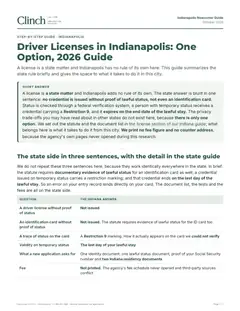
A license is a state matter and Indianapolis has no rule of its own here. The state answer is blunt in one sentence: no credential is issued without proof of lawful status, not even an identification card. A person with temporary status receives a credential carrying a Restriction 9 and it expires on the end date of the lawful stay. The privacy trade-offs you may have read about in other states do not exist here, because there is only one option. We set out the statute and the document list in the license section of our Indiana guide; what belongs on this page is what it takes to do it in this city.
Steps, documents and official links
Three things that belong on this page
- We print no counter address, and we say why. The state agency's own site never opened during this research; we could not verify the branch list inside Marion County, the opening hours or the appointment procedure. Rather than invent an address we say this: book through the agency's own appointment system and confirm on the booking screen where you are going.
- The two-residency-document rule is what trips up a newcomer. A new credential calls for one identity document, one lawful status document, proof of your Social Security number and two Indiana residency documents. That is why putting the utilities in your own name in your first week is urgent: a bill in your name is the easiest item on that list to produce. We could not read the official list of accepted documents, so take more than two with you.
- We print no fee figures. The agency's fee schedule never opened and third-party sources contradict each other. Call and ask what you will pay at the counter before you go.
Driving on a Turkish license, and whether the test is offered in Turkish
We could not find out either, and we write that plainly. We could not read an official text showing that Indiana grants a test waiver to the holder of a valid foreign license, we could not confirm an exchange arrangement with Türkiye, and we could not establish how many days a newcomer may drive on a Turkish license. Third-party guides say sixty days and cite a statutory section, but the text of that section as we read it contains no such period. We also could not verify whether the knowledge test is offered in Turkish; the agency offers it in several languages, the sources conflict on how many, and Turkish appears in none of the lists we read. We are not saying there is nothing; we are saying the research could not confirm it. The only waiver we could verify is for someone arriving with a valid license from another US state: no written test, only a vision screening. We gathered the open questions in the foreign license section of the state guide.
Can you postpone the license?
Indianapolis is the one settlement in this guide where postponing a car is genuinely workable. The city has its own transit agency, rapid bus routes run, and what you need to open a fare account is an email address or a smartphone. The detail is in the transit section. One thing you cannot postpone: photo identification is asked for here not only for driving but when your car is towed, when you apply for a library card and at the marriage license counter, and in Indiana an identification card is itself tied to proof of lawful status.
PDF: Driver Licenses in Indianapolis: One Option, 2026 Guide
02 · Car
How do you register a car in Indianapolis, and is there an emissions test?
Short answer
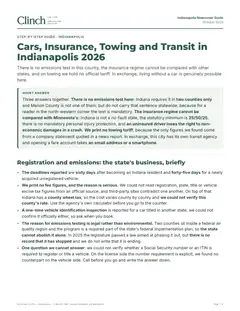
There is no emissions test here. Indiana requires emissions testing in two counties only, and Marion County is not one of them; the program is tied to a federal air quality region covering the northwest corner of the state. Do not carry that sentence statewide: for a reader living in that corner the test is mandatory. We also could not find a periodic safety inspection for an ordinary passenger car. Registration is the state agency's business, and the periods reported are sixty days after becoming an Indiana resident and forty-five days for a newly acquired unregistered vehicle.
Steps, documents and official links
The state side: a short summary and where to look
- We print no fee figures, and the reason is serious. We could not read registration, plate, title or vehicle excise tax figures from an official source, and third-party sites contradict one another. On top of that Indiana has a county wheel tax, so the cost varies county by county and we could not verify the Marion County rate. Use the agency's own calculator before you go to the counter.
- A one-time vehicle identification inspection is reported for a car titled in another state; we could not confirm it officially either, so ask when you book.
- The insurance regime cannot be compared with Minnesota's. Indiana is not a no-fault state; the statutory minimum is 25/50/25 and there is no mandatory personal injury protection. Uninsured and underinsured motorist coverage must be offered but can be rejected in writing. And one rule hits a newcomer directly: an uninsured driver loses the right to non-economic damages in a crash. A quote you obtained in another state tells you nothing here.
- The most valuable insurance rule for a newcomer is about pricing: the statute bars an insurer from taking the absence of credit history, or an inability to calculate a score, into account unless the consumer is treated as having neutral credit information. The same section bars an insurance score calculated using income, gender, address, ZIP code, ethnic group, religion, marital status or nationality. An important limit: that ban applies to what goes inside the score, not to territorial pricing generally. Do not confuse the two.
One question we cannot answer, and we say so: we could not verify whether a Social Security number or an ITIN is required to register or title a vehicle. On the license side the number requirement is explicit; we found no counterpart on the vehicle side. Call before you go and write the answer down.
Emissions: why not here, and why elsewhere
The reason is legal rather than environmental. Two counties sit inside a federal air quality region and the program is a required part of the state's federal implementation plan, so the state cannot abolish it alone. In 2025 the legislature passed a law aimed at phasing the program out, but there is no record that it has stopped and we do not write that it is ending. For an Indianapolis resident the practical upshot is simple: no emissions appointment is needed when you renew your registration. If you move to the northwest of the state the rule changes; check your new county before you move.
The toll road does not pass through this county, but the texts arrive anyway
Indiana's toll road crosses the northern edge of the state and does not touch Marion County. But toll scam text messages arrive statewide, and the message does not care whether you have ever used the road. Three separate agencies warn about it: the company that operates the road, the state transportation department and the state police. Their shared message is this: we do not send text messages about unpaid tolls, do not reply, do not open the link, and if you are unsure call the agency on its own published number. The usual pattern is an unpaid toll plus a late fee and pressure to pay within twelve hours. A newcomer is more exposed to this, because you do not yet know which agency is entitled to write to you.
PDF: Cars, Insurance, Towing and Transit in Indianapolis 2026
03 · Winter
Do parking rules change in Indianapolis when it snows?
Short answer
This section is deliberately short, because Indiana is not a state with a severe winter regime and we could not find the equivalent of the three-day snow emergency calendars from our previous guide series. We could read no rule at all from the city's own material about an Indianapolis snow emergency declaration, an odd-even parking rule or a sidewalk clearing duty. We are not saying there is none; we are saying the research could not find one. In winter the line that actually costs money is not snow but towing.
Steps, documents and official links
What we know and what we do not
- We found no statewide winter tire requirement and no studded tire ban. Both were set by statute in Minnesota; we could not read a counterpart for Indiana.
- We could not verify an Indianapolis snow emergency rule. Whether street parking is allowed when it snows, which routes are plowed first and how a declaration is announced: we could read none of the three from the city's own pages.
- We do know where to ask. In Indianapolis there is no number called 311; the city's counterpart is the Mayor's Action Center and the reporting platform is Request Indy. Snow, ice and pothole reports go there, and reports can be filed anonymously. The number and the detail are in the city services section.
Three things to do before winter
- Ask about parking when you rent, and get the answer into the lease. A car towed twice in one winter usually costs more than a seasonal parking space.
- Sign up for the city's alert channels. Not knowing a snow rule is a three-figure bill overnight, and it is one of the traps newcomers fall into most.
- If you think your car has been towed, call the police first. One phone call tells you whether it was towed or stolen; the wrong assumption costs days.
One more note, because it matters when you plan a trip on a short winter day: Indiana is not on a single clock. Indianapolis is on Eastern time, but twelve counties in the state are on Central time and there is an hour between them. Allow for that when you drive northwest inside the state; the difference with Türkiye is in the time and flights section.
04 · Towing
What do you do if your car is towed in Indianapolis, and what does it cost?
Short answer
We print no tariff, and we say why: the only figures we found come from a towing company's statement quoted in a news report, not from an official schedule published by the city. Two things we can verify. First, the city council adopted a waiver that cancels the tow fee and a few days of storage for someone recovering a stolen vehicle; the conditions reported include being the registered owner, living in Indianapolis, and having reported the theft to the city's own police department. Second, we found no fee waiver in Indiana for vehicles left behind because of immigration detention; our Minnesota guide covered such a provision, and here we do not say there is none, we say the research could not find one.
Steps, documents and official links
What we could verify and what we could not
| Question | Status |
|---|---|
| Tow fee and daily storage | Not printed. The figures we found come from a company statement in a news report; we could not read the city's own schedule |
| Who carries out police-ordered tows | A news source points to a private company called Auto Return; we could not confirm this from the city's own page |
| Fee waiver for a recovered stolen vehicle | Reported as adopted. We could not verify the effective date or the period in the final text |
| Fee waiver for immigration detention | Not found. We do not say there is none |
| Address and hours of the storage lot | Not verified |
The order of operations
- Call the police first and ask whether the car was towed. Rule out theft on the first call; the route is different for each.
- Ask which lot it went to and how payment is taken. We print no lot address because we could not verify one; write down what you are told on the phone.
- Assemble proof of ownership: the title, the current registration or the lease, plus the plate or vehicle identification number.
- Do not underestimate the photo identification requirement. In Indiana that is a separate problem, because an identification card is itself tied to proof of lawful status. If you do not hold a state card, take your passport and ask at the counter whether it is accepted.
- If the car was stolen, ask for the waiver by name. Nobody will mention it to you, and the program comes from a city council measure. Having reported the theft to the city police is one of the conditions, so do not delay the report.
If a family member is detained
Read this part the way you would read a note pinned up at home. The first hours of a detention go to phone calls, a lawyer and childcare; the car is the last thing anyone thinks about, and meanwhile storage accrues every night. In our Minnesota guide a city's own impound page stated that vehicles abandoned because of immigration detention are released at no cost. We found no equivalent in Indiana. So our advice here is different and more cautious: collect the car early, keep a copy of the title somewhere accessible at home, and ask in advance who is allowed to collect it. The detention case itself is federal rather than municipal; we set that out in the court section and the address reporting section.
05 · Transit
How does public transit work in Indianapolis, and do you need documents for a fare card?
Short answer
The city has its own transit agency: the Indianapolis Public Transportation Corporation, known as IndyGo. The central transfer point is the Julia M. Carson Transit Center and the backbone of the network is rapid bus. The fare system is called MyKey+, and the agency's own page states that opening an account takes a valid email address or a smartphone. The real gain for a newcomer is fare capping: once you reach a daily or weekly amount, nothing more is charged for the rest of that day or week, so there is no need to buy a day pass in advance. But capping works only with the card; cash payments do not count toward the cap.
Steps, documents and official links
Fares, from the agency's own page
| Item | Full fare | Half fare |
|---|---|---|
| Two hours unlimited | $2.75 | $1.35 |
| Daily cap | $6.00 | $3.00 |
| Weekly cap | $24.75 | $12.15 |
| Door-to-door paratransit, one way | $5.50 to $15.00 | $1.35 |
| Children five and under, with a fare-paying rider | Free | |
On the veterans pass the first card is $2.00 and a replacement $5.00, and rides are free once the card is issued. Discharge papers, a veterans identification card or the veteran designation on the back of a state license are accepted as proof. Fares can change during the year; check the agency's own page before you ride.
The fare card and the honest answer on documents
The agency's own sentence is this: a valid email address or a smartphone is all you need to open an account. A reloadable physical card is issued at the service desk in the central transfer center. We found no record that a Social Security number or an immigration document is requested, but the agency does not say so explicitly either, which is why we do not write that no documents are required. The accurate sentence is: the published card requirements do not mention a number.
The discounted card is different and documents are asked for there: for riders over sixty-five, a government-issued health card or the agency's own half fare identification; for riders under eighteen, a valid school identification; for riders with disabilities, the agency's identification plus a form completed by a health professional or institution. Half fare cards are free, a replacement is $5.00, and the information line is 317-635-3344. The application form exists in English and Spanish, not in Turkish. That is the first instance of a pattern you will meet several times on this page: Turkish appears on none of the language lists Indianapolis publishes.
Routes, and one warning
- The backbone is rapid bus: the red and purple lines are running, and we could not verify the current status of the blue line, which appears to be in project phase. Open the route map on the agency's own page.
- Route change warning: the agency announced on its own site that route changes take effect from October 11, 2026. Do not rely on an old screenshot of a route.
- For pre-tax commuter benefits through an employer there is a regional body, the Central Indiana Regional Transit Authority, on 317-327-7433. If your employer offers such a program your commuting cost drops.
- Check whether a route reaches an address before you choose it. Two settlements in this state have no fixed-route service at all; Indianapolis is not one of them, but not every neighborhood here is served at the same frequency.
The airport, the train and the Istanbul question
The city's airport is Indianapolis International Airport. The honest answer: there is no nonstop from here to Istanbul. Türkiye does not appear in the airport's 2026 nonstop listing; the single European nonstop is Dublin, with connections onward to several European hubs. The realistic routing is one stop through a US gateway or a European hub. We give no distance figures, because none came from a source; the detail and the time difference are in the time and flights section.
On rail, the city's station is Indianapolis Union Station and the passenger train that calls there runs three days a week rather than daily; the service that used to run daily was withdrawn in 2019. We print no train day or time, because the sources we read contradict each other on which days and which direction the service runs, and the only official timetable we could find carries an obsolete date. Check the carrier's own site. On intercity coaches, the stops and carriers serving Indianapolis could not be verified in this research.
06 · Renting
Can an Indianapolis landlord ask about my immigration status, and where is my eviction case heard?
Short answer
Two answers, together. First: the city cannot pass an ordinance on this at all. Indiana bars municipalities from regulating tenant screening, security deposits, lease applications, lease terms, required disclosures and landlord fees, and treats a conflicting ordinance as void and unenforceable. In our Minnesota guide a city was able to bar a landlord from asking about status through its own ordinance; Indianapolis cannot do that. Second, and very practical: your eviction case is not heard in a city court but in the small claims court of the township you live in, and there are nine of them in the county. The city and the county merged; this layer did not.
Steps, documents and official links
Preemption: why the city's hands are tied
The rule itself is the state's and we set it out provision by provision in the renting section of our Indiana guide. What belongs to Indianapolis is this: in 2020 the city adopted two tenant ordinances, one of which required a landlord to give the tenant a notice of rights and responsibilities; the legislature closed off that power by statute. News reports contradict each other on the year and on the governor's position and we take no side; what is certain is that today's statutory text treats local regulation as void.
But one thing survives and it is useful: the city continues to publish the Notice of Tenant Rights and Responsibilities and keeps it available for download. We could not verify whether the duty to hand it to a tenant still exists, but the document itself is published and worth reading as a tenant.
And here is a gap that touches a Turkish reader directly, so we write it plainly: the document is published in four languages, English, Spanish, Burmese and Portuguese. Turkish is not among them. For another language the city gives an email address: [email protected]. The same pattern runs through the city's own site: its translation menu lists twelve languages and Turkish is not there either.
Source of income and immigration status: what you are left with
- We found no statewide ban on source of income discrimination, and what we did find runs the other way: a separate section bars a municipality from compelling a landlord to take part in the federal housing voucher program.
- We also found no state provision protecting a tenant's immigration status. We do not say there is none; we say the research could not find one. No such local ordinance was found in Indianapolis or in any other Indiana city, and for the reason above none could be passed.
- What you are left with is national origin. The state's fair housing provisions protect race, color, religion, sex, familial status, disability and national origin. For a tenant from Türkiye that is the ground. Source of income and immigration status are not on that list, and the two are not the same thing.
Eviction: nine separate courts, and you need to know which one
This is where consolidated government touches a tenant most directly. In Marion County eviction and small claims cases are not heard in one court but are spread across the townships. The city's own page names them: the Center, Decatur, Franklin, Lawrence, Perry, Pike, Warren, Washington and Wayne township small claims courts, plus Marion Superior Court. The small claims courts keep hours of 8:30 a.m. to 4:30 p.m., and the superior court 8:00 a.m. to 4:00 p.m.
What that means: whichever township your address falls in is where your case is heard. Find that out before you sign a lease, because once a notice is in your hand you will have little time to work out the right address.
Free legal help: there is a program and it has a name
Indianapolis runs a program connecting tenants facing or at risk of eviction to free legal help and support services, and it is called the Eviction Diversion Program. The city's own page names the partners in full: the Indianapolis Office of Public Health and Safety, the Lawrence Township Small Claims Court, the Indiana Bar Foundation, Indiana Legal Services and the Indianapolis Legal Aid Society.
- Tenant information hotline: 317-327-2228. The city's own wording is blunt: if you have received an eviction notice or think you will, call as soon as possible and be sure to attend your hearing.
- The city's housing unit: 317-327-4291, [email protected], City-County Building, open 8:00 a.m. to 5:00 p.m.
- There is also a separate division for homelessness and eviction prevention.
- We found no equivalent program in the other four settlements in this guide. So this is a genuine Indianapolis advantage.
One limit, stated: these programs may have their own rules about immigration status and we verified no eligibility condition for any of them on this page. You do not have to state your status before you call; call the line and ask which service is open to you.
Five things before the hearing
- Call the tenant information hotline and give the hearing date; help comes in before the hearing.
- Confirm which township court you are going to. The address on the notice should match the township you live in.
- Attend. Not turning up is the most expensive mistake in an eviction case.
- Gather your correspondence: the deposit receipt, repair requests, payment records. Without a local ordinance, the lease and the paper trail are your only evidence.
- Ask for an interpreter, in writing. Turkish is absent from every language list the city publishes; make the request early and on paper.
07 · Registry
Is your building registered in Indianapolis, and how do you check?
Short answer
In Indiana the document is called a registration, not a license, and the reason is statutory: the annual registration fee a local government may charge per rental unit is capped at five dollars. One caveat: the statute does not apply that cap to a registration or inspection programme created before 1 July 1984. We could not verify when the programme here was created, so do not assume the cap applies in this city; ask the city department for the fee. That cap makes the inspection and licensing regimes seen in other states hard to fund here. Indianapolis runs its own program: owners of residential rental units inside the city must register the property, and the registry is public, which means you can look up a landlord before you sign. And here consolidated government has written itself into the rule text: the city's own page states, in these words, Properties in excluded cities are exempt.
Steps, documents and official links
Excluded city: a distinction that does not stay on paper
Indianapolis and Marion County are consolidated, but the merger left four municipalities outside and the statute has its own term for them: excluded city. We set that out in the city services section. What matters here is this: the rental registration rule does not apply at those four addresses. Living at an address inside Marion County therefore does not mean the building will appear in the city's registry. A building you cannot find is not necessarily unregistered; first check which municipality the address is in.
How a tenant uses this
- Open the public landlord registry before you sign and search for the property. The city updates the list regularly and publishes an annual program report alongside it.
- If there is no registration, turn that into a question. Registration is the landlord's obligation, not yours; but its absence is the first signal about the landlord's relationship with the city.
- Short-term rentals are a separate matter. The city created a program requiring an annual permit for every short-term rental unit; the first permit carries a one-time charge of $150, there is no renewal fee, and the unit must be a lawfully built dwelling that complies with the building code. There is a separate public registry for short-term rentals too.
- The registration fee can reach your bill. The statute says a fee imposed by a municipality on a rental unit may be disclosed to and recovered from the tenant; the only exception is fees relating to the construction of the building.
Who runs the program
The program is run by the Department of Business and Neighborhood Services; the telephone is 317-327-8700 and the hours are 9:00 a.m. to 4:00 p.m., Monday to Friday. Registration is filed through the city's own online application portal.
One limit, stated plainly: this is a registration program, not an inspection program. In our Minnesota guide a city ran a tiered inspection system that gave tenants a building's inspection history. We found no such tiered inspection regime for Indianapolis, and the state's five-dollar fee cap makes one hard to run. So a building that appears in the registry is not a building that has been inspected. Check the condition yourself: smoke detectors, heating, water pressure, windows and locks. Photograph any problem before you move in.
08 · Utilities
How do you open utility accounts in Indianapolis, and does the winter shutoff ban cover water?
Short answer
Indianapolis has two doors, and knowing that in advance saves a week. Gas, water and wastewater come from Citizens Energy Group on one bill; electricity comes from a separate company, AES Indiana; and trash is handled by the consolidated city and county's own Department of Public Works. That creates a risk peculiar to this city: the winter shutoff ban covers only electricity and gas, not water, and here water and gas are with the same company on the same bill. So even in a winter when your gas cannot be cut, your water can be because of the same unpaid bill.
Steps, documents and official links
Which service comes from whom
| Service | Provider |
|---|---|
| Natural gas, water and wastewater | Citizens Energy Group, one account and one bill |
| Electricity | AES Indiana, a separate account |
| Trash and recycling | Department of Public Works, the consolidated city and county unit |
| Stormwater | Billed as a separate charge by the same city unit |
The structure of the water and gas provider is unusual, and knowing it tells you where to complain: it was established as a public charitable trust under an 1887 agreement, so it is neither a conventional municipal utility nor an ordinary company. Being a trust does not place it outside regulation: its gas, water and wastewater services sit under the Indiana Utility Regulatory Commission, and on the consumer side there is also the Indiana Office of Utility Consumer Counselor. So a rate or billing complaint has a state address to go to.
Is a number asked for when you open an account?
The rule is set at state level and we tabulated it in the utilities section of our state guide: what is asked for at the door is not a number but creditworthiness, the criteria are employment, housing and credit, and even where a deposit is taken, its ceiling, the right to pay in installments, the interest and the refund condition are set by rule. What belongs to Indianapolis is one warning and one way around it:
- The warning: the online application of the water and gas provider asks for a Social Security number, a date of birth and a previous address in your name, and without them the form cannot be submitted.
- The way around it: this does not mean you cannot get service. There is a route that opens by telephone, and the company may ask for a notarized identity verification form. Being unable to complete the form does not mean the door is closed; call.
- The documents accepted for a deposit waiver are listed and a number is not among them: a dated letter on an employer's letterhead, pay stubs, a school transcript, discharge papers, purchase documents or a copy of the lease, and a credit report no more than thirty days old. Documents go by email, fax or post and are assessed within five business days; where creditworthiness is established, a deposit already paid is credited back to the account.
The honest translation: the rule looks at creditworthiness rather than a number, but a newcomer holds few of the criteria. No two-year employment record, no two years at an address, no US credit history. So in practice a newcomer pays a deposit and gets it back later. The one visible shortcut is the third limb of the employment test: someone who has just started work out of school, or has just been discharged from military service, is treated as meeting it.
The shutoff ban and the trap peculiar to this city
The statute bars a utility from cutting electricity or gas for non-payment between December 1 and March 15 for a residential customer who is eligible for and has applied for heating assistance, and the rule applies to municipally owned, privately owned and cooperatively owned utilities alike. Do not confuse two things:
- The protection is not automatic. Being eligible is not enough; you must have applied. You do not have to wait for the money to arrive; the application alone triggers the protection. Apply in October, not in November.
- Water and sewer are outside it. The statute names only electricity and gas. The water and gas provider also states in its own notice that during the moratorium an energy assistance customer's water and wastewater service can still be disconnected; that notice carries an old date and we could not verify that it is current, but the state's consumer counselor says the same thing.
We print the conflict and take no side: one local news source wrote that the moratorium covers water as well. Two institutional sources point one way and one news source the other. The practical consequence for you does not change: do not defer a water bill in reliance on the winter protection. That matters especially in Indianapolis, because water, wastewater and gas arrive on one bill and one unpaid bill puts three services at risk. We found no separate protective rule for water; we do not say there is none.
The procedural side does work, and it is the same statewide: fourteen days of written notice, a postponement on a physician's certificate, a right to installments in financial hardship, no disconnection for a previous occupant's debt, and disconnection only during business hours. We set out the provisions in the state guide.
Trash: the most visible trace of consolidation
When the city describes its trash service it uses the name Marion County, because the city and the county are the same institution. What you need to know:
- Residential trash is collected five days a week and collection starts at 7 a.m.; the day depends on your address.
- Trash must be bagged and inside the cart. On collection day the cart goes to the curb before 7 a.m., a step back from the curb, arrows facing the street, and at least five feet clear of any object.
- Bulky items are collected once a month and two pieces at most. Put that in your calendar for the clear-out after a move.
- If something unacceptable goes in, the provider leaves a tag on the cart explaining how to comply; what may and may not go in is on a separate city page.
- On public holidays collection slides by one day. If the holiday falls on a weekend it does not slide. The listed holidays are New Year's Day, the January remembrance day, Memorial Day, Juneteenth, Independence Day, Labor Day, Thanksgiving and Christmas.
- There are separate drop-off sites for electronic waste; do not put televisions or appliances in the cart.
- The unit's telephone is 317-327-4000, at the City-County Building, open 8:00 a.m. to 5:00 p.m.
We could not verify how the trash charge is billed (with the property tax or separately), so we print no figure. Stormwater is billed as a separate charge and the city publishes its own rate and credit manual.
Official sources
- Indiana statute: the winter shutoff ban and the duty to offer installments
- Administrative rule: creditworthiness, deposit ceiling, installments and refund
- Administrative rule: notice before disconnection, medical certificate and hardship
- The city trash collection rules, days and holiday schedule
- The state utility consumer counselor: rates and complaints
09 · City services
How do you reach the city in Indianapolis, and how do you get a library card?
Short answer
Three things to know first. One, the city and the county are consolidated: property tax, deeds, courts, the sheriff and voter registration all go to the same door, and for most tasks the question of city or county is meaningless. Two, there is no number called 311 in this city; the counterpart is the Mayor's Action Center and the reporting platform is Request Indy, on 317-327-4622, and anonymous reports are possible. Three, a library card asks for identification and an address rather than a number, but the card's own condition shows where consolidation stops: Marion County, except Speedway.
Steps, documents and official links
Consolidated government and the three layers left outside
Indianapolis and Marion County were consolidated on January 1, 1970 and the official name of the combined unit is the Consolidated City of Indianapolis and Marion County. The city's own list of agencies names municipal and county bodies under one roof: on one side public works, business and neighborhood services, metropolitan development, public health and safety, the police and fire departments, parks, the mayor's office and the City-County Council; on the other the Marion County assessor, auditor, treasurer, recorder, clerk, sheriff, prosecutor and courts.
But three layers did not merge, and all three reach you:
| Layer left outside | Where it finds you |
|---|---|
| School districts | The county has eleven separate districts and the city's own district keeps only the old, pre-merger city limits. The detail is in the school section |
| Township government | Eviction and small claims cases are heard in nine separate township courts. The detail is in the renting section |
| Four excluded cities | Beech Grove, Lawrence, Southport and Speedway. Some city rules do not apply at those addresses |
Excluded city is the statute's own term, not a newspaper label: the statute defines it as a municipality in the county, outside the consolidated city, whose population exceeds a set threshold; every other municipality becomes part of the consolidated city. The four are not named one by one in the statute; they follow from the population and date tests. One warning: the text we hold states that a different version of this section takes effect on January 1, 2027, so the definition may change.
And this does not stay on paper. It reaches you in two places: the city's rental registration page says, in these words, Properties in excluded cities are exempt, and the library card is conditioned on Marion County, except Speedway. So of two neighbors in the same county, one is subject to a city rule and the other is not.
A naming trap belongs here too: in population comparisons you will see a unit called Indianapolis city (balance). That is the consolidated city with the excluded cities taken out, not the whole of Marion County, and the two are constantly confused.
Reporting and complaints: no 311, but a counterpart
- Telephone: 317-327-4622. During business hours you speak to someone at the Mayor's Action Center. The three-digit 311 number does not appear on the city's own page. That is easy to get wrong, because elsewhere in this state there are cities where you really can dial 311.
- Portal: Request Indy, open twenty-four hours a day, and you can track a request from submission to resolution. There is a phone app as well.
- Anonymous reporting is possible and it is one of the most valuable details on this page: a request can be sent with the personal fields left blank. Some case types do require personal details, and if you give an email you receive a tracking link. For someone wary about their status the door is not closed.
- In the city's own agency record the center's hours appear as Monday, Tuesday, Wednesday and Friday, 8:00 a.m. to 5:00 p.m.; the record does not list Thursday and we pass it on as it stands.
- There is also a separate structure of neighborhood advocates: named people assigned by neighborhood with published telephone numbers, some of whom keep regular office hours at library branches. You can find your own area's advocate on the city's site.
The library card: identification and address, not a number
The institution is The Indianapolis Public Library. What a card requires:
- Applying in person: a photo identification showing your name and current address. If the photo identification does not show your current address, or has no address at all, one of these will do: a piece of mail postmarked within the last thirty days, a current lease, or a checkbook with the correct address. For a newcomer the lease is the easiest.
- If you have no photo identification the door is not closed: the library's own page says to contact your nearest branch in that case. We quote that sentence as it stands, because it promises no outcome but it does point to a route.
- Applying online is narrower: living in Marion County, being eighteen or over, a valid email address, and not already holding a card.
- Free cards are not limited to residents: property owners in the county, teachers in county schools, students enrolled at any school, college or university in the county, and owners of a business in the county can also get a free card.
- There is a separate first card for children under six, with no late fines on print materials. The library charges no late fines at all, and cards are renewed every three years.
- For people living in Indiana but outside Marion County there is a separate statewide card; its fee is set annually by the state library and we print no figure, because it changes every year.
The honest answer on numbers: the library's published requirements never mention a Social Security number or immigration status, and the statutory test is not a number either but residence and liability for property tax. So writing that no number is asked for is accurate; writing that it can never be asked is not, because the page is silent on the point and each library sets its own registration practice.
And the same gap on language: the library publishes its paper application in thirteen languages. Turkish is not among them. Nor is it in the city's translation menu, nor in the tenant rights notice. We repeat this in several places on this page, because it means you will have to ask for an interpreter rather than expect one.
10 · Property tax
I bought a home in Indianapolis. What do I need to do about the homestead deduction?
Short answer
The application goes to the Marion County Auditor's Office, and thanks to consolidated government the door is the city's own site. Know three things. First, the dates conflict: the county's own page says January 15 and a version of the state form we hold says January 5; a ten-day gap can cost a year, so plan to the earlier date. Second, the deduction amount conflicts too, with three sources giving three figures; we take no side. Third, and most critical: the form asks for the last five digits of a Social Security number, there is an alternative field if you do not have one, but we could not verify whether an ITIN is accepted in that field.
Steps, documents and official links
We print the conflicts and take no side
| Source | Filing date | Standard deduction |
|---|---|---|
| The consolidated government's own page | January 15 | 60 percent of assessed value or at most $48,000, plus 40 percent of the remainder |
| The version of the state form we hold | January 5 | $45,000, with different rates for the supplemental deduction |
| The statutory text | January 15 | $40,000 for 2026, with the deduction shrinking year by year |
The likely explanation is that the form and the page versions are out of date, but we could not prove it. Do not rely on a single figure when you do your own arithmetic: ask the county auditor before you file and ask for the answer in writing. Remember too that the deduction shrinks in steps; today's arithmetic is not your bill in five years. The cap mechanism and the rates are in the property tax section of our state guide.
The number question: the form has two fields
The application asks for the last five digits of the claimant's Social Security number, and beside it sits a second field: the last five digits of a driver's license, identification or other number. The note under that field says, in these words, that it applies only if the applicant does not have a Social Security number. The same pair of fields exists for a spouse.
- The good news: not having a number does not by itself close the door; the form carries an alternative field.
- The honest gap: the word ITIN does not appear on the form. The field is called a driver's license, identification or other number. Whether an ITIN is accepted there we could not verify; ask the county auditor. Note that the position is different on the withholding form; two different agencies, two different rules, and confusing them is a common mistake.
- A spouse's number is required even if the spouse does not live in the home. In a newly arrived family that spouse is often still in Türkiye; call the county before you file and ask which declaration they want.
- Leaving it blank costs real money: in a state tax review board decision, a homeowner who did not enter the last five digits was discussed as having lost the standard deduction the following year; the person recovered it by filing again in time. Numbers entered on the form are confidential by statute.
File once, but refile in three situations
- You file once and it carries over to later years.
- Refile if the title changes: an owner added or removed, the property put into a trust.
- If you stop living in the home you must notify the office and have the deduction removed.
- If you move during the year: if you move to a new principal residence after the assessment date in the same year, the deduction stays in place on the first property for that tax cycle and you may also apply for the new property for the same cycle. The deduction comes off the first property at the next assessment date. If you apply for two properties in the same year the auditor may deny both.
- The deduction depends on principal residence: a part you rent out or use to earn income is excluded. The form's own examples include the rented half of a duplex, a rental apartment inside the building and a shop run in part of the home. Property held by a company or a limited liability company does not qualify unless listed conditions are met.
Which office you go to
The advantage of consolidation shows here: all three offices are in the same building and behind the same web door. The Marion County Assessor's Office sets the value, the Marion County Auditor's Office applies deductions and takes the application, and the Marion County Treasurer's Office collects. There is a separate property tax assessment board of appeals. The auditor's contact details: 317-327-4646, [email protected], City-County Building, open 8:00 a.m. to 4:30 p.m.
We print no property tax rate, because this research could not verify a single one. Before you make an offer, ask the assessor for the parcel's current valuation and build your estimate from that.
11 · School
Which school will my child attend in Indianapolis, and is an SSN required to enroll?
Short answer
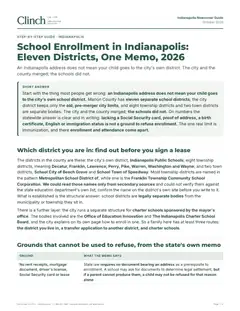
Start with the thing most people get wrong: an Indianapolis address does not mean your child goes to the city's own school district. Marion County has eleven separate school districts; the city district keeps only the old, pre-merger city limits, and eight township districts and two town districts are separate bodies. The city and the county merged; the schools did not. On numbers the statewide answer is clear and in writing: lacking a Social Security card, proof of address, a birth certificate, English or immigration status is not a ground to refuse enrollment. The one real limit is immunization, and there enrollment and attendance come apart.
Steps, documents and official links
Which district you are in: find out before you sign a lease
The districts in Marion County are these: the city's own district, Indianapolis Public Schools; eight township districts, Decatur, Franklin, Lawrence, Perry, Pike, Warren, Washington and Wayne; and two town districts, School City of Beech Grove and School Town of Speedway. Most township districts are named in the pattern Metropolitan School District of, while one is the Franklin Township Community School Corporation.
We could read those names only from secondary sources and could not verify them against the state education department's own list; confirm the name on the district's own site before you write to it. What is established is the structural answer: school districts are legally separate bodies from the municipality or township they sit in, and the city district keeps its pre-merger boundaries.
There is a further layer: the city runs a separate structure for charter schools sponsored by the mayor's office. The bodies involved are the Office of Education Innovation and The Indianapolis Charter School Board, and the city explains on its own page how to enroll in one. So a family in Indianapolis has at least three routes: the district you live in, a transfer application to another district, and charter schools.
Grounds that cannot be used to refuse, from the state's own memo
A memorandum from the state education department's attendance officer to principals lists the situations in which enrollment cannot be refused. Those that bear directly on a newly arrived Turkish family:
- Not having rent receipts, a mortgage document, a driver's license, a Social Security card or a lease. The memo states that state law requires no document bearing an address as a prerequisite to enrollment; a school may ask for documents to determine legal settlement, but if a parent cannot produce them, a child may not be refused for that reason alone.
- Being undocumented and not being a citizen. The memo says that where a child intends to remain in Indiana for at least thirty days, enrollment must be immediate and without regard to legal domicile, and cites a 1982 Supreme Court decision.
- Not speaking English. Also set out in writing, also grounded in a Supreme Court decision.
- Not having a birth certificate. A school may ask a first-time enrolling student for a certified copy of the birth certificate or other reliable proof of date of birth; if it is not produced within thirty days the school notifies the state clearinghouse for missing children. That notification is a routine step rather than an accusation and the child is not removed from the roll. We say so expressly so that it does not frighten a newly arrived family.
- Not having a stable residence, moving during the year, living with a relative, arriving late in the term and not having an individualized education program document are also on the list.
The one real limit: immunization
The memo's own sentence is that children must be enrolled whether or not they have the required immunizations. But if they do not and the school does not grant the statutory twenty-day waiver, the child may not attend beyond the first day of school. So enrollment must happen in every case; attendance need not, and the two are not the same. Bring your child's immunization record from Türkiye and have it translated into English if you can.
An honest gap, and it is the biggest on this page
For none of the eleven districts in Marion County could we verify the enrollment documents, the immunization requirements, the English-language support or the languages the district actually serves. We do not say there are none; the research could not reach the districts' own enrollment pages this round. So this page gives you no document list; open your own district's enrollment page and take the list from there.
The one indicator we could measure is at city level and it points to a gap of its own: the city's tenant rights notice exists in four languages (English, Spanish, Burmese and Portuguese) and the city site's translation menu lists twelve. Turkish is in neither. The library application form exists in thirteen languages and Turkish is not there either. So rather than expecting Turkish support in Indianapolis, plan on asking for an interpreter at enrollment and in writing.
One statewide mechanism does work and you can use it: a home language survey is completed once at enrollment; if a language other than English is indicated the student is given a placement screener and English learner status is determined within thirty calendar days. Leaving Turkish off that survey deprives your child of support.
We write one tension as it stands
Districts' own enrollment pages can ask for more than the state memo does; in this state we saw a district's enrollment letter stating that proof of residency must be collected for all students, which is the opposite of what the memo says. We take no side but we do state the hierarchy: the state memo is the higher source. Our advice: take as many of the documents on the district's list as you can, but do not postpone enrollment because something is missing. If you are turned away, mention that you can take the matter to the department's attendance officer; the memo was written for exactly these situations.
PDF: School Enrollment in Indianapolis: Eleven Districts, One Memo, 2026
12 · Health
I have no insurance in Indianapolis. Where do I apply?
Short answer
The answer is the same statewide and we found no separate program that Indianapolis adds to it. Know three things. One, Indiana has no marketplace of its own; insurance is bought on the federal marketplace. Two, the state programs have their own names and you may never see the word Medicaid in the letter: Healthy Indiana Plan, Hoosier Healthwise, Hoosier Care Connect, Indiana PathWays for Aging. Three, and most important: from October 1, 2026 federally matched Medicaid is open to four status groups only, and refugees and asylees are not on that list. What remains is emergency services coverage, and for a pregnant reader the slightly wider Package B.
Steps, documents and official links
Who takes the application
The agency is the Indiana Family and Social Services Administration, the whole set of programs is called the Indiana Health Coverage Programs, and the unit that takes applications is the Division of Family Resources. You apply online, by telephone or in person at a local office, and a decision takes roughly forty-five to ninety days depending on the program. We print no address for the Marion County office, because we could not verify one; start the application online or book by telephone.
Four groups, and who is not on the list
Federal law ties matched Medicaid payment, from October 1, 2026, to four groups: citizens and nationals, lawful permanent residents, Cuban and Haitian entrants, and people covered by a Compact of Free Association. Refugees and asylees are not on that list; nor are temporary protected status, parole and temporary visas. Indiana's own Medicaid program announced that the change is being applied, and the notice says it affects all programs other than the emergency services package.
Congress left states an option for lawfully residing children and pregnant women, but we found no record that Indiana has taken it. We do not write that as a certainty: we do not say such coverage does not exist, we say the research could not find it, and the one Indiana document bearing directly on the question could not be reached this round.
Emergency coverage, and Package B for a pregnant reader
What is left to someone outside the four groups is emergency services coverage, and in Indiana it has two tiers:
- Package E: only services meeting the emergency criteria. The program's own document states that for pregnant women with that coverage labor and delivery are considered emergency medical conditions.
- Package B: the same benefits plus prenatal and postpartum care. For a pregnant reader whose status does not reach full coverage this is the single most useful fact on this page, and you have to ask for it by name because nobody will offer it.
But we write the open end too: the 2026 notice says the change affects all programs other than the emergency services package while not naming Package B. Whether that package is affected we could not verify, and it is the most consequential uncertainty in this section. Ask about both packages by name when you apply and ask for the answer in writing.
One help sits in the state's own policy manual: for emergency coverage the citizenship, immigration status and Social Security number requirements fall away. The same manual says that restrictions tied to an applicant's status apply to that applicant only, not to other family members: so a child who is a US citizen can be covered regardless of the parents' status. We read those sentences in an archived document and we state its date plainly; ask for the current position before you apply.
One more detail, seen for the first time in this series: the same federal law also lowers the federal match rate for emergency Medicaid. That does not change who is eligible; it changes what the state pays, which is the kind of pressure that drives later tightening.
The second date: January 1, 2027
On the federal marketplace, premium help narrows from January 1, 2027 to three statuses: lawful permanent residents, Cuban and Haitian entrants, and people covered by a Compact of Free Association. Other statuses may still buy a plan but without the discount, which in practice means full price. Put both dates in your calendar and plan your coverage around them; the detail is in the health section of our Indiana guide.
13 · Health
Who sees an uninsured patient in Indianapolis, and are these clinics free?
Short answer
The rule for this section, stated first: a health center that charges on a sliding scale is not a free clinic. It charges less, but it charges. A bill will come, proof of income will be asked for, and you have to request the discount by name. For Indianapolis the research found two organizations, and both state that they provide services on a sliding fee scale: HealthNet and Eskenazi Health. We print no addresses, and because a substantial part of this information came from third-party directories, do not set out without confirming by telephone.
Steps, documents and official links
How a sliding fee works
Federally qualified health centers charge on a scale graded by household income. One center's published rule in this state requires combined household income to fall within the federal poverty guidelines and requires the applicant to document gross income. The documents accepted include the most recent tax filing and wage statements, Social Security or disability award letters, and unemployment statements.
Note what that list does not require: an immigration document. So if you can document your income the door to the discount is open. Take proof of income to your appointment and ask for the sliding fee discount by name; in most places it is not applied automatically if you do not.
What we found for Indianapolis, and our reservation
| Organization | What the research found |
|---|---|
| HealthNet | States that its services are provided on a sliding fee scale, that uninsured patients may qualify for a discount, and that a financial screener is available at its centers |
| Eskenazi Health | Its health centers include federally qualified health centers, with fees assessed on a sliding scale based on household income |
Our reservation: this information came largely from third-party directories and could not be verified in detail from the organizations' own pages. For that reason we print no fee scale, opening hours or telephone number. Find the center nearest your neighborhood through the federal locator and call it.
The emergency room: the door is open, the bill is open too
A federal law places a duty on hospitals with an emergency department to screen and stabilize, and that duty does not turn on insurance, immigration status or ability to pay. Indiana's own Medicaid policy manual grounds its definition of an emergency medical condition in that federal rule.
But read the two limits together. First, this is a duty to screen and stabilize, not a duty to provide free care; the bill follows. Second, an emergency room is not a substitute for a family doctor; managing a chronic condition through the emergency room is both expensive and too late. If a bill arrives, rather than refusing to pay, apply to the hospital's financial assistance office; most hospitals have one and the application has its own form.
Medication and dental care
We could not produce a verified list of free medication or dental programs for Indiana. We do not say there are none. Most federally qualified centers also provide dental care on a sliding scale; ask about that when you book. On medication, do not skip asking about your pharmacy's own discount program and the manufacturer's patient assistance program.
14 · Marriage
Where do you get a marriage license in Indianapolis, and what if you have no SSN?
Short answer
You do not choose the county. The statute says the license comes from the clerk of the circuit court of the county where one of you resides; if you live in Indianapolis that means the Marion County Clerk, at the City-County Building. If neither of you lives in Indiana, the license comes from the county where the marriage will be solemnized. Two warnings: a Social Security number is asked for and we found no official Indiana source saying what a person without one should do; and we could not read Marion County's own marriage page in this research, so confirm the fee, the payment method and the hours by telephone before you go.
Steps, documents and official links
The fee: the statutory figure and a conflict
| Source | Indiana resident | Out of state |
|---|---|---|
| The statute | $25 | $65 |
| The state judiciary's own page | $25 | $65, adding that some offices also charge a $4 document fee |
| A county clerk in a university town in this state | $29 | $69 |
| The Marion County clerk's own page | Could not be read. Third-party sources give the statutory figure; unconfirmed | |
The statute sets $15 for the license and $10 for the certificate, $25 in total; for a non-resident $15 plus $50, $65 in total. One county charges four dollars more at both tiers and does not say why on its own page. The gap matches the $4 document fee the state judiciary mentions, but no source says that about that county, so we invent no explanation. We could not verify Marion County's own figure or payment method; one source says cards are accepted with a processing charge, and we could not confirm it. Most clerks in this state ask for cash, so take cash with you.
The number question: the honest answer
The state judiciary's own page says, in these words: you will also be required to provide your Social Security number, although your Social Security card may not be required. The source of the requirement is clear: the statute requires the record of marriage form developed by the state health department to include each applicant's number; the numbers are kept confidential and used only for the purposes of the federal child support program.
And here is what we did not find: no statute, no state rule, not the judiciary's page and no county clerk says what a person who has never been issued a Social Security number should do. A third-party guide claims an affidavit may be signed in Marion County; we could not verify that and we do not write it as the procedure. We do not invent: the clerk will ask for a number, Indiana's published material offers no route for someone without one, so call the Marion County clerk before you go and write the answer down.
The most critical sentence for a Turkish reader: translation
The state judiciary's page lists the documents accepted as proof of date of birth, and the list includes a passport, a birth certificate or copy of a birth record, a judicial decree, a photo identification issued by a governmental entity, and an immigration or naturalization record showing date of birth. The sentence that follows is the decisive one: if that documentation is in any language other than English, it may need to be translated and notarized before it is submitted to the clerk.
So do not take your Turkish birth certificate straight to the counter: sworn translation first, then the notary, then the appointment. The same order applies to apostille work, and planning both together saves you a trip.
What else happens at the counter
- Both of you must appear in person. You can start the application in advance through the state judiciary's system, but that does not remove the in-person requirement.
- The license is valid sixty days, there is no waiting period, the marriage can take place the same day, and it is valid only inside Indiana. Claims of a three-day or sixty-day wait in third-party guides contradict the state's own page; do not repeat them.
- Genealogical information is asked for: both parents' full names (including a mother's maiden name), last known address and place of birth. For a reader from Türkiye that is something to ask older relatives in advance.
- The record is public: the statute says the clerk records the application, license and certificate in a book and that this book is a public record.
- A religious ceremony alone is not a legal marriage. The legal marriage is completed by the license and by the return of the certificate to the clerk. A county clerk in this state lists who may solemnize and names an imam expressly among the clergy.
- Each certified copy of the marriage certificate is charged separately and that is the document needed for a name change. Order several.
15 · Vital records
Where do you get a birth certificate in Indianapolis, and what if you have no identification?
Short answer
There are two pieces of good news here for a Turkish reader. First: a foreign passport is on the primary identification list and is sufficient on its own. Second, and stronger: the statute says a local health officer must issue a certificate of an applicant's own birth registration, which means the direct-interest and necessity tests fall away for your own record. The system is double rather than single: the state vital records division and the county health departments are two routes, and which one you use depends on what you need. No Social Security number is required.
Steps, documents and official links
Two routes, two different outcomes
- The county route is faster. The state's own frequently asked questions page says, in these words, that you receive an order more quickly when it is placed through the county in which you were born.
- The long form comes only from the state. If you need a long form birth certificate you must order it from the state division. An apostille also requires the state copy; the detail is in the apostille section.
- There is a conflict between statute and practice, and we print it. The statute says a local health officer may issue a certificate regardless of where the record was filed. But the statute says may, not must, and in this state some county health departments state that they issue only for births that occurred in their county. Both can be true at once. We take no side: before you set out, call your own county health department and ask whether they will issue for a birth recorded in another county.
Identification: a passport is enough on its own
The state health department's identification and relationship form asks for one primary document or two secondary documents.
- The primary list includes a government-issued driver's license or state identification, military identification, veterans identification, one consular identification, and a US or foreign passport. So a Turkish passport is sufficient on its own, and that is one of the most useful sentences on this page.
- The secondary list includes a signed Social Security card, a school or college identification with proof of current enrollment, a work identification with proof of current employment, a voter registration card with an address, a current vehicle registration with an address, discharge papers, and a lease or deed carrying your name, current address and signature.
- Note where the Social Security card sits: on the secondary list, as one of two. It is never required on its own.
The real obstacles are not the number, they are these
- Direct interest. The people who may request a certificate are listed: the person named on the record if eighteen or over, the parents named on the record, grandparents, an adult sibling, an adult child or grandchild, a current spouse, an aunt or uncle, a court-appointed legal guardian, and an attorney representing the person. Each must document the relationship.
- Without the parents' names the order cannot be completed. The state's own page says you must know the name at birth, the date of birth, the place of birth, the mother's full maiden name and the father's full name to place the order.
- The search fee is not refundable. Every order includes a non-refundable search fee to determine whether a record is on file. If none is found you receive a no-record certificate and the money is not returned. We print no vital records fee, because we could not verify one.
- The document is mailed only to the address on your identification. For someone who has just moved that is a real trap: if your identification still shows the old address, that is where it goes.
Two further rights are little known: a local health officer's refusal to issue a certified copy of a birth certificate is subject to review by a court, and on request the officer must provide a certification of death that excludes the cause of death.
We could not read the Marion County health department's own identification policy this round, so we do not print the county counter's list here; the state rules are above and you should ask the county for its own list by telephone. We also could not find Indiana's delayed registration procedure; we do not describe a route for someone whose birth was never registered, so ask the state division.
16 · Social Security
How do I get a Social Security number in Indianapolis?
Short answer
The agency that issues the number is federal, so the rule is the same in Indianapolis as anywhere else in the state and we set it out in full in our Indiana guide. This page adds two things. First, we publish no Social Security Administration street address here, because we could not verify a single one from an official source this round; if you are holding an appointment notice, the address on that notice is the one that counts. Second, living in the state capital creates a false comfort worth naming: being the capital does not mean every federal errand happens in this city. The immigration court is here, but which federal office serves you is still set by the letter you were sent.
Steps, documents and official links
- Who does not need to apply separately: if you arrived on an immigrant visa and asked for the number on the visa application, or you adjusted status inside the United States and checked the SSN box on the work permit application, the card arrives by mail. Otherwise you start the application online and attend an appointment. There is no fee.
- What to bring: your current immigration document (green card, I-94 or employment authorization document) and a valid passport. Photocopies and notarized copies are not accepted.
- Which office serves you: enter your ZIP code in the agency's own office locator. The general line is 1-800-772-1213.
- F-1 and J-1: the number comes only once a right to work exists; it is not issued merely for school enrollment.
- The time zone trap applies here too: Indianapolis is on Eastern time, while the north-western corner of the state is on Central. If you are calling an office or reading an appointment time, ask which clock it is written in; the detail is in the time difference section.
- If your surname changed on marriage, update the record at an office free of charge.
Which doors are open in Indianapolis without an SSN
Indiana answers this clearly on four items and leaves an honest gap on a fifth. We left the full list and the statutory basis in the state guide; here we only say where you go in this city.
- Birth certificate: no number needed. A foreign passport is on the primary identification list and counts on its own. Where to get the document, and the traps in the two-route system, are in the birth certificate section.
- School enrollment: a number cannot be required, and the state education agency says so in writing in its memorandum to principals. In Indianapolis the harder question is not the number but which school district you are in; the county contains eleven of them and the detail is in the school enrollment section.
- Library card: no number is asked for anywhere; what is asked for is identification and proof of address. The card here carries its own residency condition and one exception, which we set out in the city services section.
- Marriage license: a number is asked for, and no official Indiana source says what a person without one should do. We are not inventing an answer; call the county circuit court clerk before you go. Where the license is issued is in the marriage license section.
- Driver license and state ID: the answer is no. Indiana issues no card without lawful status, not even an identification card; the detail is in the driver license section.
- Taxes: a person who cannot get an SSN but must file uses an ITIN, and the Indiana withholding form can be completed with one (the tax section below).
One distinction up front, because it is constantly confused: an ITIN is not an SSN and does not stand in for one. In the agency's own words an ITIN does not provide or change immigration status and does not authorize work in the United States. It is not an identity document either.
17 · Taxes
Is county income tax withheld from my pay in Indianapolis, and at what rate?
Short answer
It is. In Indianapolis two separate income taxes come out of your pay: the state tax and the county tax. The state rate for 2026 is 2.95 percent, and the rate for the county this city sits in is 2.02 percent. The real content of this section is not the rate but the mechanism, because you cannot change the rate and not knowing the mechanism costs money: which county rate you are withheld at is set by your address on January 1, and moving during the year does not change that year. The first line of the withholding form you are handed when you start a job reads Social Security Number or ITIN, so an ITIN is accepted on the form itself. Reciprocity and filing detail are in our Indiana guide.
Steps, documents and official links
The rate: state plus county
| Item | Rate | Note |
|---|---|---|
| State income tax, 2026 | 2.95 percent | The same everywhere in the state |
| County income tax for this city | 2.02 percent | County code 49. The second highest of the five places examined in this round |
| Together | 4.97 percent | A rough total before exemptions; your return will not mirror it exactly |
- The figure comes from the revenue department's own notice, an official document carrying a version number and an effective date; it was read with two separate text extraction methods and the two readings agreed. But it was reached through an archive, because the state's server never answered this machine this round. Confirm the rate live from the department's own notice before you negotiate a salary.
- Do not trust the rate circulating online. A widely used tax site gives 1.62 percent for this county; the department's own document says 2.02 percent. The secondary source is wrong and the gap is hundreds of dollars on a salary.
- The rate did not move during the year. The department's October 2026 version marks with an asterisk every county whose rate changed since the January 2026 publication; this county carries no asterisk. Rates are reannounced every December, so check the table each December.
- Consolidated city and county government simplifies one thing here: because Indianapolis and the county are a single government, there is no separate city income tax on top; the only local rate is the county rate. Your pay stub will show federal withholding, state withholding and county withholding. Do not look for a fourth line.
The mechanism: the county freezes on January 1
This paragraph may be the most directly financial information on the page, because people who move to this city usually move mid-year.
- The order is clear: withholding follows the county you lived in on January 1. If you lived outside Indiana on January 1 but your principal place of work was in an Indiana county on that date, withholding follows the county of that workplace.
- Moving during the year gains you nothing. The withholding form says it in its own words: if you move to another county or begin working there after January 1, your county status does not change until the following calendar year.
- What that looks like here: move in March to a county with a lower rate and you are still withheld at this county's rate for the rest of that calendar year. The reverse is also true: somebody who lived in another county on January 1 and moved here in February is withheld at the old county's rate that year. If you are thinking about a move late in the year, this is a planning item.
- The statute writes the same order at greater length, and its second step is voter registration. Do not do what that sentence suggests: registering to vote when you are not a citizen is a crime and will damage your immigration file. We set that out separately in the voter registration section.
- We read the statutory text from a commercial republisher, because the legislature's own site serves no statute text. The text is stamped current as of January 1, 2026, so any change out of the 2026 session is invisible in it.
The piece of paper you get on your first day
In your first week you are handed the withholding form WH-4.
- The first line reads exactly this: name, then Social Security Number or ITIN. So a person without a number who holds an ITIN completes the form. We verified this from two independent copies.
- There are two separate county lines: your county of residence as of January 1, and your principal county of work as of January 1. For somebody living and working in this city both are the same county.
- If you neither lived nor worked in Indiana on January 1, which is the typical position of a newcomer, you write not applicable on those lines.
- The nonresident alien limit: a noncitizen who meets neither the green card test nor the substantial presence test may claim only one exemption for withholding.
- The form stays with your employer and is not sent to the revenue department. You may file a new form at any time if your exemptions increase; if they decrease you must file within 10 days.
- Both copies of the form we read are older versions. Both carry the same ITIN wording, but the department's October 2026 notice refers to a longer version of the form. We could not verify that the wording survives in the current version; read the first line yourself when you are handed it.
One distinction: an ITIN does not do the same thing at every door
The withholding form names the ITIN explicitly. The homestead deduction on the property tax side does not say the same thing, and confusing the two costs money: the deduction form asks for the last five digits of a Social Security number, opens a field for a driver license or other number for a person without one, and whether an ITIN is accepted in that field could not be verified this round. Which office takes the application in Indianapolis, the filing date and the conflict over that date are in the property tax section; read it before you file.
How to get an ITIN
- Complete Form W-7 and attach it to your federal return unless an exception applies.
- Have your documents verified. Three routes: mail the passport to the address the agency specifies, go to an authorized acceptance agent, or attend by appointment a tax agency office that reviews ITIN documents. The last two keep your passport out of the mail.
- Wait. Processing normally takes about seven weeks, longer in filing season.
- Which office in Indianapolis: we could not verify this round which Indiana offices review ITIN documents, and we publish no federal tax office address on this page. Confirm the office and the appointment through the federal tax agency's office locator; the appointment line is 844-545-5640.
- Expiry: an ITIN not used on a return for three consecutive years expires; on renewal the original assignment date is kept.
A date in the calendar: the local tax regime changes in 2028
We write this as a calendar warning rather than as a statement of law. A statute out of the 2025 session is reported to end all existing local income tax rates on December 31, 2027 and to build a new structure from 2028 split between county services, fire and emergency medical services, and non-municipal units. We could not confirm this from the statutory text, because our statute source is a January 1, 2026 snapshot. Check your rate again at the end of 2027.
18 · Starting a business
How do I set up an LLC in Indianapolis, and what should I watch out for?
Short answer
You file not with the city but with the business services division of the Indiana Secretary of State, through the state's own business portal, INBiz. We deliberately print no fee figure in this section: the agency's pages never opened to this machine this round, and secondary sources give two different numbers for the same item. The one thing geography gives you in Indianapolis is that these offices are in the state capital, which is your city. What actually stops a newcomer, though, is not the fee but the registered agent requirement: the company must name a natural person resident in Indiana or an entity authorized to do business in Indiana, and that agent must have a physical Indiana street address. A post office box is not accepted.
Steps, documents and official links
The steps
- Name check. The name you choose must be distinguishable from names on the register; a name can be reserved for 120 days.
- Articles of organization. For an LLC these are filed online through the portal or on a paper form, and the two routes carry different fees. We print no amount, because the sources we found give two different numbers for the online item.
- Registered agent. A person resident in Indiana or an entity authorized to operate here, with a physical street address.
- Business entity report. Filed two years after formation and every two years after that.
- Employer identification number. From the federal tax agency on Form SS-4, free of charge.
- State tax registration is done through the same portal in one pass. Forming a company is not the same thing as being allowed to operate and to employ people.
Assumed name (DBA): in Indianapolis the door depends on the entity type
- If you are an LLC or a corporation, the assumed business name certificate is filed with the Indiana Secretary of State.
- If you are a sole proprietorship or a general partnership, the same job is done at the Marion County Recorder, the county recorder's office. In Indianapolis both doors are inside the city, but they are not the same door, and going to the wrong one costs a day.
- Indiana requires no newspaper notice. Some states in this series require an assumed name to be published in a legal newspaper, and that notice is a separate cost on top of the state fee; Indiana has no such publication requirement. On the other hand, using an assumed name without registering it is an infraction.
- There is a conflict on the assumed name fee too: a source citing the statute gives two different amounts for electronic and paper filing, while the state's own form prints a single amount per name. We take no side and print no figure.
Local licensing: what the consolidated government makes easier, and one limit
- Because Indianapolis and the county are consolidated, permits for activities such as restaurants, hair salons and child care run through one structure rather than two separate governments; the unit that does this work inside the consolidated government is the Department of Business and Neighborhood Services. Compared with counties made up of many separate municipalities, that is a real convenience.
- But four municipalities sit outside the consolidation, and if your address is in one of them some city rules do not apply to you. Research confirmed this for the rental registration rule; we could not confirm whether the same exception applies on the licensing side. What the consolidation covers and does not cover is in the city services section; read it before you choose a business address, and call the unit.
- We could not verify from the city's own pages which activity needs which permit this round, so we list no permit type and no fee here.
The status question: there is a gap here and we are not filling it
We found no official answer this round to whether an SSN or an ITIN is required to form an Indiana LLC. That is exactly the question this page's reader has, and we are not filling it with a guess. Ask the portal's own support line before you open the formation form, and ask for the answer in writing. The sources we found on beneficial ownership reporting also conflict sharply with one another, so we write nothing on that either.
Something free to do before you pay anybody
You can check the register status of a company you are about to partner with or pay a deposit to, free, through the state's business search. That is the first thing to do before any advance payment.
19 · Public benefits
Will receiving public benefits in Indianapolis affect my green card application?
Short answer
It can. The federal public charge rule that took effect on September 18, 2026 rescinded the 2022 regulations and, in the agency's own summary, gave officers broader discretion to weigh all relevant facts. The assessment did not narrow; it widened. The same rule also contains one concrete sentence for an anxious reader: benefits received before September 18, 2026 are assessed under the older and narrower rule. We open the whole federal framework and the two big state-side answers in our Indiana guide. On this page we write what actually changes in Indianapolis: where you file, and the one place where consolidated city-county government does not help.
Steps, documents and official links
The door is neither the city nor the county: it is the state
In Indianapolis the question "do I go to the city or to the county" usually has the same answer, because the two are consolidated. Public benefits are the exception.
- The door is at the state and it has a name: the Division of Family Resources inside the Indiana Family and Social Services Administration. You apply through the state's own benefits portal, by telephone and fax on 800-403-0864, or at a local division office. An eligibility decision takes roughly 45 to 90 days depending on the program.
- The consolidated government's own site does not take this application. The door you use for property tax, deeds, courts and voter registration is not the door you use for a benefits application; the first is local, the second is at the state.
- We do not print local office addresses on this page, because the state's server never opened this round and we could not verify a single one. Find the office through the portal or the number above.
- The state's refugee program is also run from this city. It is called Indiana Refugee Services and sits inside the same agency's family resources division; the coordinator line is 855-673-0193, extension 5831 or 5838. Read it with two warnings: this is a benefits and program body, not a legal services provider; and we read these lines from a January 2024 archive capture because the state's site was closed. We do not print current coordinator names, because secondary sources conflict on both names and numbers.
What changed in the public charge rule
- Date and scope: the rule was published on July 20, 2026 and took effect on September 18, 2026. You can read the text in the Federal Register record.
- It is not retroactive: the rule's own sentence says that means-tested public benefits received before September 18, 2026 are assessed under the 2022 rule.
- Direction: the rule does not list which benefits count; it removes the old list, returns to a totality of the circumstances assessment and widens officer discretion.
- Exemptions were deleted from the list but did not disappear. The agency itself writes that statutory exemptions continue to stand: refugees and asylees adjusting status, the special immigrant juvenile category, people applying for or re-registering temporary protected status, and the special statutes covering Cuban and Haitian nationals.
- Does emergency Medicaid count: comments raising exactly this question are on the record in the rule's preamble, but we could not find the agency's binding answer this round. We say neither that it counts nor that it does not; it is a question for an immigration attorney.
- The Indianapolis side: we found no published public charge guidance of its own from either the city or the consolidated county government this round, so we pass on no local assurance.
October 1, 2026: federal Medicaid payment narrowed to four groups
Federal law now makes full Medicaid payment to the state for only four groups: U.S. citizens and nationals, green card holders, Cuban and Haitian entrants, and people living here under a compact of free association. The list is closed: refugees, asylees, holders of temporary protected status and parolees are not on it. The law cuts not a person's coverage but the federal payment to the state; the text is in Public Law 119-21.
- Two things survive: emergency Medicaid for everybody, and coverage for pregnant people and those under 21, which is left to the state's option.
- We found no indication that Indiana has taken that option. We do not write this as a flat fact; we say research could not find it.
- There is an open end for a pregnant reader, so do not skip it: the state's Medicaid agency announced that the change affects every Medicaid program other than the emergency services package, but it did not name the second package, the one that includes pregnancy coverage. We explain both packages and this uncertainty in the health section.
- The same law also lowers the federal matching rate the state receives for emergency Medicaid. That does not change who is eligible; it changes the state's cost. Note it as budget pressure, not as a cut in coverage.
The marketplace is federal
- Indiana has no marketplace of its own; plans are bought from the federal site. Steps written for states with their own marketplace do not apply here.
- January 1, 2027, support narrows: in the federal site's own words, from that date only three statuses qualify for premium assistance: green card holders, Cuban or Haitian entrants, and compact of free association migrants. Other statuses can buy a plan but do not qualify for the discount. The source is the federal site's immigration status page.
The form and the policy manual do not ask the same thing
- Readers who do not know this distinction give up on applying. The general application asks for a Social Security number for everybody in the household. The state's own Medicaid policy manual, by contrast, says that for emergency coverage the applicant must meet every requirement other than citizenship and immigration status and the Social Security number.
- The most reassuring sentence for a mixed status family is in the same manual: the restrictions apply only to the applicant's own status, not to other household members. A U.S. citizen child can be covered regardless of a parent's status.
- The no-reporting rule is in the same manual and its wording is plain: with respect to people without documents or whose status cannot be verified, and their family members, applicants for these programs are not reported to immigration authorities under any circumstances. But we do not write that as an unconditional guarantee: the version we read came from an archive and reflects the position before the October 1, 2026 federal change. Get it confirmed in writing for your own file.
- The noncitizen rules for food assistance and cash assistance were not researched this round. We are not inventing a rule and we are not saying there is none.
20 · Address change
I moved to Indianapolis. Do I have to report my address to USCIS?
Short answer
As a general rule most noncitizens, green card holders included, must report a new address within 10 days of moving. That is not an administrative preference but a statutory duty. The easiest route is the change of address screen in your USCIS online account; the paper AR-11 is also free. If you have a case in immigration court you additionally notify the court within 5 days on Form EOIR-33. In Indianapolis the most commonly missed sentence in this section is this one: because the city and the county are consolidated, changing homes inside the city does not feel like moving to most people, but for the federal duty it is a move.
Steps, documents and official links
- Sign in to your USCIS account and open the change of address screen. Online notification satisfies the legal duty and you do not also need to mail a paper AR-11.
- Enter the receipt number of every pending application. Filing AR-11 does not by itself change the address on a pending case.
- Tell the post office separately. A postal change of address does not update the agency's record, and the post office does not forward this agency's mail.
- If you have a court case, file Form EOIR-33/IC within 5 days. The court address changes only through that form. Because the court is in this city you can hand it in at the window, but the window is not open all day; see the court section below.
- If you have a regular reporting requirement, also report the address through the immigration agency's own portal.
Holders of A and G visas and visitors arriving under the visa waiver program are outside this reporting duty.
The consolidated city-county structure produces three separate misunderstandings here
- Moving inside the same county is moving. Because city and county are one government, crossing the county from one side to the other leaves you inside the same administrative structure. What triggers the duty is the move itself, not crossing a boundary.
- Moving into or out of one of the four municipalities outside the consolidation is also a move, even if your postal address barely changes. Why those four addresses are counted separately is in the city services section.
- Changing school district or township does not substitute for a notification. The county has eleven separate school districts and separate township units; changing your child's school, changing which township court would hear an eviction case, or shifting your trash day does not touch your federal address record. We set out that structure in the renting section and the school enrollment section.
And add this: in their first week here people give their address to several state and local agencies, from the license branch to the family resources division. None of those is an AR-11. Giving an address to a state or local agency does not satisfy the federal duty.
Something changed in 2026 as well: take into account the federal rule that took effect on June 29, 2026 and rewrites alien registration and what counts as evidence of registration. The text is in the Federal Register record. Check that the document you carry still counts as evidence of registration.
21 · USCIS
Where is the USCIS office in Indianapolis, and where do I go for biometrics?
Short answer
We deliberately print no address in this section, and the reason is concrete: the agency's pages were closed this round both to direct access and to automated reading, and the archive record was not usable either. We do not publish an office address from an old archive, because that is exactly the mistake that sends people on wasted journeys. The only correct sentence is this: the address you go to is the address on your appointment notice. One more warning for a reader in the state capital: being the capital does not mean every federal office is here, and we could not verify this round which Indiana offices serve which counties.
Steps, documents and official links
- Two different offices, two different jobs: green card and citizenship interviews happen at field offices, while fingerprint and photograph appointments happen at application support centers. Confusing them costs an appointment day.
- No walk-ins. Field offices do not accept visitors without an appointment; appointments are arranged through the Contact Center. Use your online account for case status and appointment requests.
- You do not choose the biometrics location: which center you attend is stated on the I-797C notice. To reschedule, ask through your online account or the Contact Center. What to bring is in our piece on the biometrics appointment.
- Living in the capital does not mean the appointment is here. The appointment is assigned by letter to a specific center. Do not assume that it is, and do not assume that it is not; read the letter carefully.
- What the center does not do: application support centers give no information about your case and provide no service beyond taking biometrics. Take case questions to the Contact Center, not to the center.
- Appointments are free: the Contact Center is 1-800-375-5283. Intermediary sites that charge for an appointment are fraudulent.
- Asylum interviews: we could not verify this round that there is a separate asylum office in Indiana. Form I-589 is not handed in at an asylum office; it goes through the filing route the agency specifies. The office list is on the agency's own page.
- Processing times: on the processing times page select the form, the category and the office holding your case. The figures are updated monthly.
A distinction, because it gets especially muddled in this city
Indianapolis has an immigration court, an apostille office and the headquarters of state agencies. None of those is USCIS. The court belongs to the Department of Justice, the immigration and customs agencies to the Department of Homeland Security, and the apostille unit is a state office. A building being downtown does not attach your case to it; the letter in your hand says which agency has you.
PDF: Indianapolis Official Offices Directory 2026: Court, Passports and Apostilles
22 · Court
Where is the immigration court in Indianapolis, and how do I check my case?
Short answer
This is the most concrete item on the page: Indiana's only immigration court is in this city. It is the Indianapolis Immigration Court, in the Minton-Capehart Federal Building, 575 N. Pennsylvania Street, Suite 617, Indianapolis, IN 46204, telephone 317-464-1399. Living in the city shortens the journey, but arriving without knowing two things still costs a day. First: window filing is not open all day, it happens in three separate windows, and in the court's own words no documents are accepted after 4 p.m. Second: the court does not make unrequested faxes and electronic submissions part of the record and discards them without notice to the sender.
Steps, documents and official links
| Item | Detail |
|---|---|
| Court | Indianapolis Immigration Court, the only immigration court in Indiana |
| Address | Minton-Capehart Federal Building, 575 N. Pennsylvania Street, Suite 617, Indianapolis, IN 46204 |
| Telephone | 317-464-1399 |
| Court hours | 8 a.m. to 4:30 p.m., weekdays, closed on federal holidays |
| Window filing | Three separate windows: 8:15 to 10:30 a.m., 12:30 to 2 p.m. and 3:30 to 4 p.m. |
| Hard cut-off | No documents are accepted after 4 p.m. |
| Entrance | Visitors enter through the west entrance |
| General e-mail | [email protected] |
| Asylum work permit clock requests | [email protected]. The request must include the name, the alien registration number and why the clock should be adjusted. The court states this mailbox is only for those requests and that nothing else sent to it will be answered |
| Parking and transit | The court's own text says only that street parking and garages are available nearby. No free parking is offered and no transit line is named. Some courts in this series offered both; this one does not |
What living in the city buys you, and where that stops
- The advantage is real: for somebody driving in from a distant county a hearing day is a journey; for you it is an errand across town. Getting a time-sensitive filing to two different windows on the same day is possible here and is not possible from elsewhere.
- But the three-window rule binds you too. Miss 10:30 in the morning and the window is shut until 12:30. It is shut again between 2 and 3:30. Work out which window you are aiming for before you leave.
- There is no free parking. You are going to a federal building downtown, so garage or street parking is part of the budget. Because the court names no transit line, check the route yourself; we are not inventing a line name, and we set out the city's transit arrangements in the transit section.
What to know on the court side
- Faxes and electronic submissions are destroyed. This is the court's own wording: unless staff or the immigration judge specifically requested it, faxes and electronic submissions are not accepted, and unauthorized transmissions are not made part of the record and are discarded without consideration of the document or notice to the sender. Faxing a time-sensitive filing produces the same result as not filing it.
- The court can close unexpectedly for severe weather or another emergency. Closures are announced on the agency's operational status page and on the court's own social media accounts. Check on the morning of a hearing before you leave.
- Security on every visit: metal detector and bag screening, shoes may have to be removed, no food or drink except as the immigration judge permits, and no cameras or recording devices in courtrooms or other agency space.
- Hearings are open to the public and, in the court's own words, you do not need to notify the court in advance of your visit. For a reader who lives in the city that is a real opportunity: you can go and see a courtroom before your first hearing, and it is a good idea.
- Checking online: the case information system needs only your A number; the telephone line is 1-800-898-7180. The official information is still the hearing notice; the system can be slow to show new dates.
- A remote hearing is a possibility, not a right. The agency publishes an internet hearing link and a telephone access code for each judge. But whether a particular case may be heard remotely is the immigration judge's decision; this page does not promise it. And because the court is in your own city, this item does not carry the value here that it carries for a reader in a distant corner of the state.
- Attorneys and accredited representatives must register with the agency's own system. Check that the person representing you is registered.
Which court has your case: not the ZIP code, but who issued the papers
- The agency's own list ties a case to jurisdiction rather than to distance. The administrative control list sorts which cases a court may handle by the federal field office that issued the charging document and by named detention facilities. You can see the list on the agency's own page.
- This city's court carries two jails on that list, one of them this county's jail, and no DHS district office is listed against it at all. By contrast the Chicago Immigration Court row names a DHS district office including any sub-offices, and the same row carries two further Indiana entries.
- What that means and does not mean: the list's own wording is may have jurisdiction over. So you cannot conclude "I live in the city, therefore my case is here." Which court hears the case is set by which office issued your papers, not by which building is closest. Read the notice you were sent; it names the office and the court.
Immigration enforcement and customs: we print no address, we print the rule
- No immigration enforcement or customs office address, telephone number or office name is published on this page. Those agencies' pages were closed to automated access this round and the archive was not usable either. Confirm check-in locations from the agency's own check-in page, and if you hold an appointment notice the address on it controls.
- Detention information line: 1-888-351-4024. If you have a check-in obligation, speak to your attorney before you go.
- We could not verify this round whether Indiana has a detention facility, a border patrol unit, a port of entry or a county jail holding a detention contract. We print no guess; if a relative has been detained, call the information line.
Where do I find my I-94, and what if it is wrong?
You can download the I-94 for your most recent entry from the customs agency's site. Errors made at entry, meaning the wrong visa class, the wrong name or the wrong period of admission, are corrected by deferred inspection offices. We could not verify the location or hours of that office in Indiana this round, so we print no address and no days here; read the list on the agency's own page.
- Write first, travel second. Some of these offices are open only a few hours a week.
- These offices correct only errors made at the moment of entry. They are not a general I-94 help desk.
- Why it matters: the duration of your work permit and some filing eligibilities depend on what the I-94 says. In Indiana a license issued to a person with temporary lawful status also expires on the last day of lawful stay, so an error on the I-94 lands directly on your card; the detail is in the driver license section.
23 · State law
Does local government in Indianapolis cooperate with federal immigration enforcement?
Short answer
The state has a statute in force and it requires cooperation: a governmental body or a postsecondary educational institution may not enact or implement an ordinance, resolution, rule or policy that restricts staff from communicating with federal officials, sending information to the Department of Homeland Security, maintaining that information or sharing it with another governmental entity. We set out the provisions one by one in our Indiana guide and do not repeat them here. Read this as neither a protection nor a threat. What this page adds is the two items that change in this city: why the existence of a local agreement is an unanswered question here, and how free legal help actually works in Indianapolis.
Steps, documents and official links
The statute's own final section
The final section of the chapter says it shall be enforced without regard to race, religion, gender, ethnicity, or national origin. We pass that on not as a promise but as the legislature's instruction to those who enforce it. Source warning: we could not read the chapter on the legislature's own site and read it instead from a commercial republisher, where the text is stamped current as of January 1, 2026; confidence is therefore medium and any change out of the 2026 session is invisible in it.
There is a question this chapter does not answer, and we do not treat its silence as an answer: whether a local agency may hold somebody on a federal civil immigration detainer is outside this chapter and was not researched to a source this round. We write nothing in either direction. The chapter's seventh section is a notification duty, not a detention authority; do not confuse the two.
A local delegation agreement: unanswered, and the reason is structural
This paragraph belongs to this page specifically and we have to be honest about it.
- We could not confirm the position for this county. The federal agency's participating agency list and data files were closed to access this round and the archive did not answer. We hold no information from the agency itself.
- We do not say there is none. We say we could not confirm, and the two are not the same. The field moved month by month through 2026.
- And here the question itself is posed wrongly. These agreements are usually discussed at county sheriff level and lists are kept by sheriff's office. But in this county city and county are consolidated and the principal law enforcement agency is the consolidated police department, the Indianapolis Metropolitan Police Department. A sheriff-only list cannot settle anything about this county. The question is unanswered, and that is why.
- The attorney general's own agreement is known from news reporting, and the sources conflict. In the last days of September or the first day of October the attorney general's office was reported to have signed an agreement with the federal immigration agency and to have called on all the state's county sheriffs to do the same. The reporting does not even agree on how many sheriff's offices are involved: some say six, the list as reported runs to seven names. We give no number and take no side. We could not read the office's own announcement, because the state's server never opened.
- We also do not write that any particular local government "has no such policy." The statute's existence is confirmed; what this city may have adopted or repealed in the past is not.
Free legal help: both organizations are headquartered in this city
Two statewide organizations have their head offices here, which means meeting in person rather than by telephone is possible in Indianapolis.
| Organization | Where and how | Its limit |
|---|---|---|
| Indiana Legal Services, Inc. | A nonprofit law firm providing free civil legal assistance across all 92 Indiana counties. Its office here is at 1200 Madison Avenue, Suite 300, Indianapolis, IN 46225, telephone (317) 631-9410, weekdays 8:30 a.m. to 4:30 p.m. The statewide intake line is 1-844-243-8570, Monday to Thursday 10 a.m. to 2 p.m. Eastern; the online application is open five days a week and takes about twenty minutes | There is a status test and we print it in the same breath: the organization may represent only citizens, people with established legal immigration status, and people without status who are victims of crime or trafficking. There are also income and asset tests. A decision comes in about 14 days, and applying does not mean the case is accepted |
| Immigrants and Language Rights Center | The same organization's immigration arm, working statewide out of this city. The case types it publishes: U and T visas for survivors of crime and trafficking, petitions under the Violence Against Women Act, naturalization, affirmative asylum and related matters, removal defense, adjustment of status and family-based immigration | The center states that it holds in-person consultations only on an emergency, case-by-case basis. Being in the same city as the center does not mean you can walk in; the route is the telephone line or the online form |
| Neighborhood Christian Legal Clinic | Provides free services statewide and says itself that it handles immigration matters: green card applications, citizenship, family reunification and more. Its single office is in this city, 3333 N. Meridian St., Suite 201, Indianapolis, IN 46208, telephone (317) 429-4131, office hours Monday to Thursday 9 a.m. to 3 p.m. Text messaging is available on request | The one reversed distinction in this file is below |
| Immigrant Welcome Center | In this city, 2049 N Meridian St., Indianapolis, IN 46202, telephone 317.808.2326. It describes itself as connecting immigrants to educational, legal, language and community partner resources | We found no statement that it provides legal representation itself, so we do not imply that it does. For representation, the verified routes are the three rows above |
On this item Indianapolis is the disadvantaged page, and we say so plainly
In this guide series almost everything runs in the big city's favor. Here the opposite is true. The clinic above offers free general legal advice through an online service open to Indiana residents outside the four metropolitan counties around this city. So a reader in a small town elsewhere in the state can use that door from a laptop; a reader in this county cannot, and is directed to the office instead. Office hours are four days a week and six hours a day, which is a real obstacle for somebody working. Book early and ask about the text message option.
The same reversal appears on one more item: the statewide self-help service Indiana Legal Help offers a search by ZIP code or county, a calendar of clinics where you can speak with an attorney, a route for free questions to a volunteer attorney, and court forms. In a small county that can be the only way to reach a lawyer; in this city in-person options already exist. Even so, items such as the court fee waiver form are useful here too. We print its own disclaimers as well: using the service does not make you a client, and your communications are not protected by attorney-client privilege. Because the site itself does not state which body operates it, we name no operator.
We found no state board, council or program specific to Türkiye, and no Turkish association in this city. We do not say there is none; we say research did not find one.
How not to use this section
The statutory text above comes from a secondary source and from a January 1, 2026 snapshot; the position on local agreements is unknown; and the field is moving. Do not use this page to decide which county to live in. Choosing an address on the strength of these lines will not buy you an outcome and will give you either false comfort or false fear. Ask an attorney about your own situation.
24 · Voting and jury duty
I am not a citizen. Can I register to vote in Indianapolis, and what do I do about a jury summons?
Short answer
Voter registration and voting belong to U.S. citizens only, green card holders included. Registering or voting without citizenship can have severe immigration consequences and is also a crime. Two things are particular to Indianapolis here. The first comes from tax law: one of the statutory steps that decides which county you are a resident of for county income tax is your voter registration, so if ticking that box occurs to you as a way to settle a tax question, stop. The second comes from structure: in the consolidated government election work sits with separately elected county offices, so an election question you put to the city may be answered somewhere else. On jury duty we have to be honest: we could not verify this round which records Indiana builds its jury master list from.
Steps, documents and official links
Voter registration: the rule is clear
- The requirement is citizenship. Voting and registering in federal and state elections belong to U.S. citizens. A green card holder, a person with work authorization, a student or someone with a pending asylum application cannot register.
- The immigration consequence is heavy. Registering or voting without citizenship is a direct problem in front of the officer assessing eligibility and good moral character; the policy manual treats this in a section of its own.
- The trap that comes from tax: for county income tax the residence order runs like this: if you have a single home in Indiana, that home's county; failing that, the county where you are registered to vote; failing that, the county where you registered your car; failing that, the county where you spent most of your time. The second step is not an option for a noncitizen. We set out the tax side in the tax section.
- In the consolidated government election work sits in separate units. The county election board and the board of voter registration are listed as separate agencies in the consolidated government's own agency list. What one office tells you about voter registration may not be what another says; put the question to the election unit and ask for the answer in writing.
- Read the box on the form. If a license, state ID or public service application contains a voter registration section, signing it counts in most states as a sworn statement that you are a citizen. We could not verify from an official source this round how an Indiana license application is linked to voter registration; read every section of the form put in front of you, do not sign a section you do not understand, and never answer yes to a citizenship question if you are not a citizen.
- Do not fill in voter registration forms handed to you by volunteers door to door or at events, even if a campaign worker says it will not be a problem.
Jury summons: what we know and what we do not
- We say what we do not know: we could not verify which public records Indiana builds its jury master list from, meaning whether license records feed that list.
- If a summons arrives: do not ignore it and do not throw it away. Call the jury office of the court named on the letter as soon as possible, or respond online as the letter instructs, and state that you do not meet the requirements for jury service. This county has both courts of general jurisdiction and separate township-level courts, and research could not confirm which of them issue jury summonses, so use the number on your letter rather than a general number.
- A summons is not a mistake: lists are built from public records, and your name landing on one does not mean any action has been started against you. It is not something to panic about, and it is not something to leave unanswered.
- Eligibility for jury service genuinely varies by state. We could not read Indiana's text on this, so we say neither that you are eligible nor that you are not. Ask the court and get the answer in writing.
If you have recently naturalized: you can now register. Confirm the requirements and routes from the state election agency's own page and take the current form from there.
25 · New citizens
I have naturalized. How do I get a U.S. passport in Indianapolis?
Short answer
A first U.S. passport is applied for in person on Form DS-11: you take the original of your naturalization certificate to an acceptance facility. The good news here is substantial: there are nine separate acceptance facilities inside the county, a density not matched anywhere else among the five places examined in this round. The comparison is useful: West Lafayette and Huntertown have none at all, while Covington and Gary have one each. The bad news is statewide: there is no passport agency anywhere in Indiana, and the agencies for emergencies are in neighboring states. And here is the detail that wastes the most time: the question here is not which facility is nearest but which one fits your hours.
Steps, documents and official links
Nine acceptance facilities, and their hours do not match
The rows below come from the Department of State's own acceptance facility data file. Call before you go anyway: the data file stores hours in encoded form and facilities set their own appointment arrangements.
| Facility | Address | Telephone | Hours |
|---|---|---|---|
| Main Office Window Services | 125 W. South St., Indianapolis, IN 46206 | 317-464-6876 | Weekdays 8:30 a.m. to 5 p.m. The longest opening hours of any facility examined in this round |
| Southport Post Office | 1701 E. Edgewood Ave., Indianapolis, IN 46227 | 317-464-6827 | Weekdays 9:30 a.m. to 6 p.m. The latest closing, and the only option you can reach after a working day |
| Castleton Branch | 8710 Bash Street, Indianapolis, IN 46256 | 317-464-6856 | Weekdays 8:30 a.m. to 4 p.m. |
| Eagle Creek Branch | 6401 Gateway Drive, Indianapolis, IN 46254 | 317-464-6854 | Weekdays 10 a.m. to 4 p.m. |
| Eastgate Post Office | 740 N. Shortridge Road, Indianapolis, IN 46219 | 317-464-6819 | Weekdays 9:30 a.m. to 4 p.m. |
| Bacon Station Post Office | 2727 E. 55th Street, Indianapolis, IN 46220 | 317-464-6820 | Weekdays 9 a.m. to 4 p.m. |
| Park Fletcher Post Office | 2760 Fortune Circle East Drive, Indianapolis, IN 46241 | 317-464-6841 | Weekdays 9 a.m. to 3:45 p.m. |
| Nora Post Office | 1300 E. 86th St., Suite 36A, Indianapolis, IN 46240 | 317-464-6840 | Weekdays 10 a.m. to 4 p.m. |
| Oaklandon Post Office | 12125 E. 65th Street, Indianapolis, IN 46236 | 317-464-6836 | Weekdays 10:30 a.m. to 4 p.m. |
- The spread across the nine runs to two and a half hours. One opens at 8:30 and another at 10:30; one closes at 3:45 and another at 6. For a working reader the right question is not which is close but which is open.
- Most facilities work by appointment and the records in the data file point to the postal service's scheduling system. Book an appointment and confirm it by telephone before you go.
- You can search for a facility yourself: the Department of State's acceptance facility finder returns results by ZIP code. Statewide there are 128 facilities across 114 cities.
- The five-settlement comparison is worth making: this county has nine while West Lafayette has none and Tippecanoe County has one only in the neighboring county seat; Huntertown has none either. If a relative lives in one of those places, timing their passport errand to a visit to your city may be a real convenience.
- Which transactions must be in person: first-time adult applicants, children under 16, people whose passport was lost, stolen or damaged, and people whose passport was issued before they turned 16 or is more than 15 years old. Renewals go by mail and need no acceptance facility.
- We print no fee. We could not read passport fees from the agency's own page this round. Read current amounts from the Department of State's fee page. Know that you make two separate payments: the passport fee to the department and the acceptance fee to the facility. Ask which payment methods the facility takes before you go.
Urgent travel: there is no agency in the state
- There is no passport agency in Indiana. On the department's agency list the two nearest to Indiana are in Chicago and in Detroit. We print neither address nor hours for either, because the source pages could not be read directly this round. We also do not say which is nearer to you, because no distance figure came from a source this round.
- The honest sentence for this city: an emergency passport adds travel outside the state on top of a 14-day deadline. Unlike a reader in the state's north-western corner, you do not get to fold the agency and the consulate into one trip.
- Who qualifies: international travel within 14 calendar days, or a foreign visa needed within 28 calendar days. Death and life-threatening situations are a separate category.
- Booking is free, and the agency says so itself. The system checks eligibility against your travel details, verifies e-mail and telephone with codes, requires you to confirm the slot within 15 minutes, and allows up to seven people in one household booking. Sites that charge for an appointment are fraudulent.
- After you have applied: 877-487-2778, weekdays 8 a.m. to 10 p.m. and weekends 10 a.m. to 3 p.m. Eastern. Because this city is on Eastern time, the published hours are your hours.
- A small but useful detail: the first two digits of your application locator number tell you which office holds your file.
- Do not overlook the route that needs no travel: routine and expedited applications go by mail through the National Passport Center. If you are not inside the 14-day emergency threshold, weigh the mail route against a drive to another state.
One distinction: this section is about the U.S. passport, meaning for somebody who has naturalized or for a child born here. A Turkish passport is not renewed at a post office; that work runs through the Consulate General.
Not sure about a step?
Ask before you do something that touches your immigration status
Applying for a benefit, changing your address, registering to vote or answering a jury summons can all show up in your file. You can speak with Attorney Asim Clinch, a Turkish-speaking immigration attorney working with clients in Indianapolis, in English or Turkish.
26 · Things to do
What is there to visit in Indianapolis, and what does it cost to get in?
Short answer
For a household on a tight budget the answer in this state is not free but discounted, and the good news is this: that discount is worth more in this city than anywhere else in Indiana. A statewide card gives Indiana residents enrolled in certain benefit programs admission at participating cultural institutions for five dollars a head, and almost every participating institution is in this city. For the other four settlements the card is a reason to make a day trip; for you it is a neighborhood errand. But two of its conditions hit a newcomer directly: employee and student IDs are not accepted, and out-of-state IDs are not accepted either. On the state park side, set your expectations now: entry is charged at the gate and walking in is not free.
Steps, documents and official links
Two discount schemes: cheap, but not free
We write both as discounts, never as free entry.
| Scheme | What it gives | What it asks for |
|---|---|---|
| The statewide cultural card | $5 per person at participating institutions, covering up to two adults and dependent children under 21 living in the household. Applying is free and the card has no annual cost | Indiana residency and enrollment in one of the named benefit programs; proof of enrollment, plus a government-issued photo ID |
| The national EBT scheme | $3 per person at participating institutions | The EBT card itself and a valid photo ID |
- In this city the card is genuinely local. Reported participants include The Children's Museum of Indianapolis, Newfields, the Eiteljorg Museum of American Indians and Western Art, the Indiana State Museum and Historic Sites, the Indiana Historical Society, the Indiana Repertory Theatre, the Indianapolis Motor Speedway Museum, the NCAA Hall of Champions and the Rhythm! Discovery Center. We do not freeze the list: reported partner counts run from twelve to twenty-one, which means the list moves. Check the institution and the program's own list before you go.
- The accepted benefit programs are named on the card's own list: the state's adult health plan, the children and family health program, the aged and disabled care program, food assistance, temporary assistance for needy families, the women, infants and children nutrition program, the supplemental food program, and a valid foster care license. Proof of enrollment must be a current-year eligibility letter in the name of an adult in the household.
- We print a conflict rather than resolving it: the card's main eligibility page includes traditional Medicaid, while the frequently asked questions page on the same site gives a shorter list and says traditional Medicaid and Medicare are not accepted. Two sections of one official site disagree. We take no side; ask the institution that runs the card.
- Two barriers hit a newcomer directly. First, employee and student IDs are not accepted. Second, out-of-state IDs are not accepted, so a household that has just moved from another state and does not yet hold Indiana identification is shut out. Indiana identification in turn depends on lawful status; that side is in the driver license section.
- The two schemes are different things and ask for different documents. Qualifying for one and not the other is possible.
- Do not trust old blog posts: the per-person rate on the cultural card used to be lower and rose at the start of 2025. A source still quoting the lower figure is out of date.
- And a limit: this page is not advising anybody to enroll in a benefit program. The immigration consequences of a benefits application are a separate subject and we cover them in the public benefits section.
State parks: there is one inside the county, and we print no figure
The agency that runs the parks is the Indiana Department of Natural Resources and the division is Indiana State Parks. There is a gated state park inside this county, Fort Harrison State Park, so you do not have to leave the city to meet the fee regime.
| Item | Structure | Note |
|---|---|---|
| Daily entry, vehicle with Indiana plates | Charged | Driver and all passengers included, every day including holidays |
| Daily entry, vehicle with out-of-state plates | Charged, higher than for Indiana plates | Driver and passengers included in the same way |
| On foot, by bicycle or on horseback | Charged per person | Age 5 and over. There is no free walk-in |
| Annual entrance pass | Charged | Vehicle and occupants, at all agency properties where a gate fee is charged |
| Annual pass for Indiana residents over 65 and those receiving disability payments | Reduced | The cardholder must be in the vehicle at the time of use |
- We deliberately print no figure in this section. We could reach the agency's fee table only through an archive capture dated 11 March 2026, because the state's server never opened to this machine this round. On top of that, for the park inside this county two separate 2026 documents from the same agency give two different out-of-state figures. Both are official, both are 2026. We take no side; we print the structure and tell you to ask at the gate.
- The annual pass runs for the calendar year, 1 January to 31 December. It is not a year from the month of purchase. One state in this series worked that way; this one does not, so a pass bought in November is good for two months. Allow 7 to 10 business days for delivery if you order online.
- And the annual pass has one limit that costs the most money in this city: it does not work at the state museum or at the state historic sites. Both sound like exactly the sort of thing a state pass would cover, and both are in this city. Do not buy the pass and turn up at the museum door.
- We write out two things people assume are free, because copying them from earlier states would be wrong. First, veterans generally do not get in free; the agency's own fee page says there are discounts for disabled veterans and former prisoners of war, but that veteran status alone is not free entry. Second, the federal fourth-grade program does not work at state parks; it applies only at federal sites such as national parks, national wildlife refuges and national forests.
- The categories that really are free: Gold Star families and qualifying foster families receive a free annual pass by application on the agency's own form. Indiana residents who are former prisoners of war, and their surviving spouses, receive the senior pass free.
- Free entrance days: there is a pattern but no date. The agency announces a small number of free days each year, usually an opening day in spring and the Friday after Thanksgiving. The 2026 spring day was announced in May and has passed; we could not confirm a 2026 date for the Thanksgiving one and we print none.
A borrowed park pass from the library: the answer here is open
Indiana public libraries lend state park entrance passes, a practice descended from an older partnership between the state parks division and the state library. But the terms are set by each library rather than by the state, and in reported examples the loan runs from seven days to five; some libraries lend the pass on its own, others only inside a themed backpack that cannot be split.
- A 2026 pass could not be confirmed for this city's library system. So we do not write that every Indiana library lends one. Call your own branch and ask, and when you do, ask whether the pass comes alone or inside a kit.
- On museum passes the only information we hold is weak: a local family guide says the system's branches do not currently lend museum passes for checkout but hand them out during summer reading programs. The article carries no date, so we do not state it as a fact; ask your branch.
- A naming warning, and we take no side: two names for this city's library system are in circulation and we could not establish from an official page which is current. Try both when you search. The card's residency condition and its one exception are in the city services section.
- That is one more reason to get the library card in your first week. No identification number is asked for.
Name traps: three of them cost money on this page
| What gets confused | What is actually true |
|---|---|
| Two conservatories with the same name | One is in this city and charges per person; the other is in Chicago and is reported free for Chicago residents. It is very easy to search for one and land on the other's page; they are not the same place and you should budget for the one here |
| A city park with state park in its name | White River State Park carries state park in its name but is an urban park with no gate fee. The per-vehicle regime above does not apply there, so do not go looking for a gate to pay at |
| The actual gated park in the county | Fort Harrison State Park is inside the county and is gated; it is where the fee regime actually applies in this city. The two-document conflict above is about this park |
| The annual state park pass and the state museum | The pass does not work at the state museum or the historic sites, although the name suggests the opposite. Both are in this city, so the mistake is easy to make here |
| A state park named after a county | There is a state park in the state whose name echoes a county but which is not in that county. When you plan a weekend elsewhere in the state, go by the agency's address rather than by the name |
| The two parks in the north-west | A state park and a national park with almost the same name are two different agencies, two different governments and two incompatible pass systems. The state annual pass does not work at the national park; that is the most expensive mistake available if you plan a weekend north of here |
What we did not print in this section
- No state park fee figure, because the amounts come from an archive capture and because two official documents conflict for the park in this county.
- No out-of-state annual pass price, because two sources give two different numbers.
- No admission figure for a war memorial museum, because two pages of the same organization say free and charged respectively.
- No distance or driving time, because none came from a source this round.
The statewide table and the comparison with the other settlements are in our Indiana guide.
27 · Free and family-friendly
What is free to do with children in Indianapolis?
Short answer
There is a verifiable free list in this city, and it starts in an unexpected place: the guided tour of the state capitol is free and leaves every hour on weekdays. Alongside it sit a nature center on the north side, an outdoor art and nature area that is always free, an eight-mile walking and cycling route, and an art park children can climb on. Beyond those, some items are charged and the free status of others could not be verified; we have separated the two, and we printed no figure where sources conflict.
Steps, documents and official links
Items verified as free
| Where | What is there |
|---|---|
| The statehouse | The Indiana Statehouse tour is free and leaves every hour on the hour on weekdays between 9 a.m. and 3 p.m.; it runs 30 to 45 minutes and goes into available offices and chambers. A self-guided tour brochure is also available and needs no pre-registration. Tours are run by the Indiana Department of Administration, with the tour office open weekdays 8 a.m. to 5 p.m., telephone (317) 233-5293. We print a conflict: an older agency page showed Saturday openings, the newer page says weekends are closed. Call before you go |
| North side | Holliday Park and its nature center are free, and all three parking lots are free. The park covers 94 acres with more than three and a half miles of trails, a playground, walks down to the river, the ruins, a splash pad and a seasonal skating rink. The nature center opens Monday to Saturday 9 a.m. to 5 p.m. and Sunday 1 p.m. to 5 p.m. Inside, a children's hall lets them float boats on a miniature river and lift hinged rocks to find living creatures. For a household with young children this is the strongest all-weather free item in the city |
| North-west side | The outdoor art and nature park at Newfields is always free. Keep the distinction: that park is free, while the art museum galleries and the garden on the same campus are ticketed |
| Downtown | The Indianapolis Cultural Trail is an eight-mile free walking and cycling route linking the cultural districts, with murals and sculpture along it and a two-block sculpture walk inside it. Walking the grounds of White River State Park and using its green space, riverfront and playgrounds is also free; this is an urban park with no gate fee |
| North-east side | The art park in the grounds of the Indianapolis Art Center is free every day and holds more than thirty installations children can touch and climb |
| South side | The sunken garden in Garfield Park is free, but with a warning: a garden page reported the area closed for construction and the notice we saw dated from 2025. We could not verify its status; call before you set out with a child. The conservatory in the same park is a separate place and charges per person |
Free, but only on the calendar
- One free museum evening a month. Newfields runs a day on the first Thursday of each month giving access to the art museum and the garden, with live music, open studio hours and gallery conversations; the October schedule we read ran 10 a.m. to 5 p.m. The institution's own page says advance tickets are recommended but not required, while other sources say they are required. We take no side: there is a free monthly day, but book ahead to be safe.
- On the federal holiday in January, the institutions inside the downtown park, meaning the state museum, the zoo, the large-format cinema at the museum, the museum of American Indian and Western art and the college sports hall, were reported to open free with donations collected at the door for a food bank; Newfields and the children's museum were free the same day. This is a pattern, not a guaranteed date, and we print no date. Check the institutions' own announcements in December.
- Two sources conflict on the children's museum first-Thursday policy, one describing discounted admission and the other free admission. We print neither; ask the museum. Its other reported free days are the January holiday, the February presidents holiday, a family festival and Christmas Eve, and children under two are always free.
Statewide free items that also apply here
- The library card and everything behind it. Beyond books, items verified elsewhere in the state include Wi-Fi hotspots, laptops, board games and puzzles. The card's residency condition and its exception in this city are in the city services section.
- A state park pass borrowed from the library. Terms are set by each library and nothing was confirmed for 2026 in this city; see the section above and call your branch.
- A free annual state park pass for Gold Star families and qualifying foster families, by application on the agency's own form.
- The small number of free entrance days at state parks. We explained the pattern, and why we print no date, above.
- The 2026 fee-free days at the national park in the state's north-western corner come from the federal calendar, and the two still ahead of this page's publication are 27 October 2026 and 11 November 2026. From here that is a day trip, but it is worth putting in the calendar. At the same park, driving through without stopping is free and the fee starts when you stop, and neither of its two visitor buildings charges an entrance fee.
Cheap, but not free
- The cultural card is $5 a head at participating institutions with an Indiana ID. The EBT scheme is $3 a head. We set out the conditions for both in the section above, and this city is where both are worth the most.
- The conservatory in Garfield Park charges per person, Tuesday to Saturday 10 a.m. to 5 p.m. and Sunday 1 p.m. to 5 p.m., closed Monday, with last admission fifteen minutes before closing. One day of free admission was reported for the summer of 2026. Do not confuse it with the conservatory of the same name in Chicago.
- The state park gate fee is per vehicle, higher for out-of-state plates, and per person on foot or by bicycle. We print no figure, for the reasons given above.
What is not on this list, and why
- For a war memorial museum, two pages of the same organization say free and charged respectively; we take no side and print no figure. The monument tower on the same grounds was reported closed indefinitely for repairs, while one of its halls reopened on 10 June 2026. Call before you go; the telephone number is (317) 232-7615.
- We could not verify the construction closure at the sunken garden; the notice we saw dated from 2025.
- We could not verify whether the library lends museum passes.
- We do not write seasonal items as though they ran all year. Splash pads, outdoor events and the skating rink depend on the season; check before you go in October.
- We print no community association, cultural center or place of worship by name. We could not verify any of them from their own sites this round.
28 · Turkish consulate
Where are Turkish consular matters handled for Indianapolis?
Short answer
All of Indiana, Indianapolis included, falls within the jurisdiction of the Consulate General of Türkiye in Chicago; the mission's own site names 13 Midwest states as its area of responsibility and Indiana appears second on that list on two separate pages. There is no Turkish mission inside Indiana. Living in the state capital buys you nothing on this item: a reader in the state's north-western corner treats the consulate almost as a local errand, while from here the same appointment is a journey. And the detail that drives the planning: the consulate is on Central time while this city is on Eastern. The published hours are not your hours, so add an hour when you read them.
Steps, documents and official links
| Item | Detail |
|---|---|
| Mission | Consulate General of the Republic of Türkiye in Chicago |
| Address | 455 N. Cityfront Plaza Dr. (NBC Tower), Suite 2900, Chicago, IL 60611, 29th floor |
| Switchboard | +1 312 263 0644 |
| Out-of-hours emergency line | +1 773 386 3213 |
| [email protected] | |
| Consular call center, 24/7 | +90 312 292 29 29 |
| Working hours | Weekdays 09:00 to 12:30 and 13:30 to 16:30 Central time |
| Visiting hours, by appointment | 09:30 to 12:00 only, Central time |
| Telephone applications | 14:00 to 16:00 Central time |
| Consul General | Tahir Bora Atatanır |
One hour of difference is a real lost telephone call here
- The telephone application window is 15:00 to 17:00 in your own clock. Reading the published time and calling at 14:00 means calling an hour early, and usually means no answer. This is the easiest line on the page to skip and one of the most useful.
- The in-person window is two and a half hours a day, and it too is Central time, meaning 10:30 to 13:00 in your clock. Reaching that window from here without leaving early in the morning is difficult.
- Cancel the moment you know you cannot attend. One mission serves the whole Midwest and a slot is genuinely valuable at this distance.
- We print no distance figure, because none came from a source this round. Whether to drive or fly is your decision; the flight side is in the time and flights section.
Jurisdiction: thirteen states, one mission
On the mission's own list the area of responsibility covers Illinois, Indiana, Iowa, Kansas, Kentucky, Michigan, Minnesota, Missouri, Nebraska, North Dakota, Ohio, South Dakota and Wisconsin. One mission serves the whole Midwest, and the only honorary consul general in the Midwest is in Detroit.
What can be done through the mission
The mission's own procedure menu lists these headings separately:
- Birth registration and civil registry matters
- Marriage registration and death registration
- Passport renewal and first passport
- Military service matters
- Notarial acts, powers of attorney and signature certification
- Turkish citizenship matters, including reporting U.S. citizenship to the civil registry
- Judicial matters, criminal record certificates and service of documents
- e-Devlet password
- Turkish driving license renewal
- Working life and social security matters
- Estate matters
Nearly all of these run by appointment; booking, checking and canceling appear in the same menu on the mission's own site. We do not print document lists here. Each procedure has its own fee and its own list, and we could not verify them individually this round. Travelling with the wrong paperwork would be the most expensive advice this page could give you; confirm the list through the appointment menu and the call center. The jurisdiction detail is in our Indiana guide.
Three things to try before you travel
- e-Devlet. Civil registry, address and some document matters can be handled remotely; check here first which of them can.
- The call center, +90 312 292 29 29. Open around the clock, seven days a week, so the time zone problem does not arise, and it is the quickest way to learn what documents you need.
- Courier or post. Some matters run by sending documents. Ask the call center or the mission which ones are accepted; do not send paperwork on your own initiative.
The attaché offices in the same building
| Office | Contact |
|---|---|
| Office of the Educational Attaché | Same address and floor, +1 312 263 0644 extension 811, [email protected] |
| Office of the Commercial Attaché | Same address and floor, +1 312 263 0644 extensions 888 and 812, [email protected] |
| Office of the Press Attaché | Same address and floor, +1 312 263 0644 extension 835, [email protected] |
Having the education office in the same building is a concrete convenience for a family here: school registration and equivalence matters in Türkiye do not need a separate trip to another city and can be added to the same appointment day.
PDF: Turkish Consular Matters and Apostilles from Indianapolis 2026
29 · Apostille
How do I get an Indianapolis document accepted in Türkiye?
Short answer
Both Türkiye and the United States are parties to the Hague Apostille Convention, so a document issued here and bound for Türkiye needs an apostille rather than consular legalization. On the Hague Conference's list of competent authorities the authority named for Indiana is the Indiana Secretary of State, and this is one of the strongest items on the page: the state's only authentication office is in this city, at 302 W. Washington Street, Room E-018. It has no branches and works by appointment only. For a reader at the other end of the state that is a journey or a mail errand; for you it is an appointment across town. But four rules hit a Turkish reader directly: the office does not translate, a marriage license must first be certified by the county circuit court clerk, only Indiana records are authenticated, and federal documents go to the U.S. Department of State rather than to the state.
Steps, documents and official links
Where, how much, how
| Item | Detail |
|---|---|
| Which office | The authentication department of the Indiana Secretary of State, inside the business services division |
| Address | 302 W. Washington Street, Room E-018, Indianapolis, IN 46204 |
| Branches | None. The office's own answer: the only office in the state is at that address |
| How it operates | By appointment only |
| Fee | $2 per authentication issued, non-refundable |
| Payment | Cash (exact change), check, money order or credit card; checks and money orders are made out to the state office |
| Normal turnaround | One to two business days from the date of receipt |
| In person with an appointment | Up to 10 documents while you wait; beyond that, a self-addressed stamped envelope is required |
| In person without an appointment | Up to 5 documents while you wait |
| By mail | Documents received before noon are mailed the next business day, those received after noon within two business days; requests over 30 documents may take longer. A prepaid return envelope is required |
| Telephone | Two official sources give two different numbers: (317) 232-2677 and 317-234-9768. We could not establish which is current and we take no side; if one does not answer, try the other |
A source warning, because this bears on your money and your calendar: we could not read any of the lines above from the office's own live pages. The state's server never answered this machine this round, and the information comes from archive captures taken between 2023 and 2025 and from a copy of the office's own request form surfaced through a search index. Confirm the fee, the turnaround and the appointment requirement by telephone before you go.
Two practical consequences of living in the city
- You can go without an appointment, but the limit tightens: with an appointment the office processes up to ten documents while you wait, without one it processes five. Being close to the door is not an excuse to skip the appointment, but if you forget a document a second visit is realistic for you.
- Consider the mail route anyway. The office's own warning is that postal mail is not delivered directly to it, which can cause delays, and it recommends an express carrier for time-sensitive documents. Living in the city lets you remove that problem entirely.
The office's own warning, in capitals on its page
The page itself carries this warning: authentications issued by the Indiana Secretary of State may not be used within the United States. An apostille is for sending a document abroad; it is not a domestic certification. If an Indiana institution asks you for an apostilled document, what it wants is probably not an apostille; ask before you pay.
Four rules that hit a Turkish reader directly
- The office does not translate, and the translation must be notarized first. Its own answer: it does not translate documents, and you must have them translated and have the translation notarized before the office can process the document. This is the most important line in this section for a Turkish reader. The order is: obtain the document, have it translated if needed, have the translation notarized, then take it for the apostille.
- A marriage license is a two-stop errand, and in this city both stops are close. It must first be certified by the circuit court clerk of the county where the marriage took place, and only then does it go to the state office. If you married in this county both stops are downtown, which makes it a single morning. But if you married in another Indiana county, the first stop is that county, not the office here. The county side is in the marriage license section.
- Indiana records only. A birth certificate issued by another state goes to that state's own authority. Do not write to this office about a document you brought with you when you moved.
- Federal documents go through another door. A certificate of naturalization, a U.S. passport or a federal background check goes to the U.S. Department of State's authentications office, not to the state. A document issued by a federal court is certified by that court's clerk; the Hague list names both Indiana federal district courts.
Which documents are free: two official pages do not give the same list
We are not resolving this; we are printing it as it stands. One of the office's pages lists the fee-exempt documents as birth and death certificates, adoption documents, student transcripts and diplomas. The same office's frequently asked questions page says Indiana-issued birth and death certificates, Indiana school records, adoption papers and documents prepared by the office itself. The two lists do not match, which leaves open whether your diploma or transcript is exempt. Telephone and ask before your appointment.
The certificate changed shape in 2022
- A single format: since 1 July 2022 the office has used the Hague Conference's model apostille single certificate and no longer distinguishes apostille requests from authentication requests.
- What it looks like: standard letter-size paper, trilingual in English, French and Spanish, attached with two staples to the front of the page bearing the certified signature and seal, and carrying a unique number for verification.
- The gold foil seal is gone, replaced by a blue-ink stamp of the state seal. Do not go looking for a gold seal.
The first link in the chain: the document itself
- The chain starts with obtaining the document. Indiana has two separate routes for a birth certificate and it matters which one an apostille needs; we set that out in the birth certificate section. Read it before you start the chain.
- Most documents need notarization, but in the office's own words marriage, divorce and birth certificates do not. On a notarized document the notarial certificate must be complete: the notary's signature, seal, jurisdiction, the date and the name of the signer.
- Do not break the order. Obtain the document first, have it translated and notarized if needed, and do the apostille last. Nothing can be changed on a document once it has been apostilled.
30 · Time and flights
What is the time difference between Indianapolis and Türkiye, and how do you fly to Istanbul?
Short answer
Indianapolis is on Eastern time and Türkiye is currently 7 hours ahead; when U.S. daylight saving ends on 1 November 2026 the gap widens to 8 hours. Türkiye stays on the same clock all year and does not observe daylight saving, so the gap shifts twice a year on the American side only. There is also an hour inside the state that readers here regularly forget: 12 counties in the north-western and south-western corners are on Central time, so an office you call there is an hour behind you. On flights the answer is clear and it is not good news: there is no direct flight to Istanbul from this city's airport.
Steps, documents and official links
The time difference
| Period | Time zone | Difference from Türkiye |
|---|---|---|
| 9 October 2026 to 31 October 2026 | Eastern daylight time | Türkiye 7 hours ahead |
| After 1 November 2026 | Eastern standard time | Türkiye 8 hours ahead |
- The practical window: 9 a.m. here is 4 p.m. in Türkiye at the moment, and 5 p.m. after November. The easiest time to speak to family or to a government office in Türkiye is your own morning.
- The trap runs the other way: if a bank, hospital or government office in Türkiye works 9 to 5 on weekdays, the window in which you can call them starts around midnight here. That is why handling Turkish matters through e-Devlet and the around-the-clock call center also solves the time difference.
- The consulate is on Central time and you are on Eastern. Read published appointment and telephone hours by adding an hour; the detail is in the consulate section.
- The split inside the state: the state information center's own answer is that most of Indiana is on Eastern time while 12 counties in the north-west and south-west are on Central. The county this city sits in is on Eastern. When you call a relative or an office in the north-west, allow for them being an hour behind.
- We print no statutory section number. The state's own page cites one, but the citation is written unusually and we could not verify the statutory text; we do not invent a section number.
- Do not trust the lists circulating online. Some third-party pages speak of 18 Central counties, or place a city in the middle of the state on Central time; those contradict the state's own list. A group of counties switched once in the mid-2000s and some switched back, which is why older reporting confuses the issue.
- Put 1 November 2026 in your calendar, because it is very easy to be an hour out when you calculate a connection.
Flying to Istanbul
- There is no direct flight to Istanbul from this city's airport. Türkiye does not appear on Indianapolis International Airport's 2026 nonstop list; its only nonstop to Europe is Dublin, reported to be moving to five flights a week from April 2026. The other scheduled international routes are outside Europe: Toronto, Cancún, Punta Cana and a few newer additions.
- The Dublin connection carries an advantage: it is one of the two European airports with U.S. preclearance, so on the return leg U.S. entry formalities happen in Dublin and you arrive here like a domestic passenger.
- The nonstop leaves from Chicago. The Turkish flag carrier's own site shows two nonstop flights a day between Chicago O'Hare and Istanbul, with a flight time of about 10 hours 40 minutes.
- From here there are two realistic shapes: a single connection out of your own airport, or a road leg to Chicago and the nonstop from there. The choice depends on luggage, children and ticket price. We print no distance or driving time figure, because none came from a source this round.
- On this item the state's north-western corner is better placed than you are, and we say so honestly: that corner sits inside the Chicago metropolitan area, making it the closest of the five settlements to an airport with a nonstop.
- A name trap: the airport belonging to the city in the state's north-west carries Chicago in its name, but no scheduled passenger service was found there; it is largely a general aviation field. Do not look for tickets from it.
Trains and buses
- The interstate passenger train passes through this city but does not run daily. The line runs three days a week and calls at Indianapolis, Crawfordsville, Lafayette, Rensselaer and Dyer. The station here is in the old union station building downtown, which can be walking distance for a reader living near the center.
- We print no train times or days. The sources we read contradict one another on which days and which directions run, and the only official timetable we could find is years out of date. Check the service on the carrier's own site.
- You cannot reach Türkiye by train, but if you want an option other than flying for a consular appointment this line faces Chicago; confirm the timetable with the carrier.
- We could not verify intercity bus stops or timetables this round, so we print no stop address.