01 · Driver license
How do you get a driver license in Louisiana?
Short answer
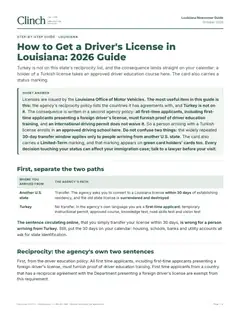
Licenses are issued by the Louisiana Office of Motor Vehicles, part of the Department of Public Safety and Corrections. If you came from another U.S. state you have 30 days: the agency's own sentence requires the license to be transferred within 30 days of establishing a domicile, and the out-of-state license to be surrendered and destroyed. If you came from Türkiye this section is not yours: that path is entirely different and sits right below. The card carries a status marking: every non-citizen, including green card holders, receives a card marked Limited-Term. And visitors are not issued a license in this state at all.
Steps, documents and official links
Card type, duration and fee
From the agency's own pages. Class E is the ordinary passenger license and expires on your birthday, roughly six years after issuance.
| Item | Duration | Fee |
|---|---|---|
| Class E license, up to age 69 | About six years, on your birthday | $32.25 |
| Class E license, 70 and older | Same | $18.75 |
| Office service fee | Per transaction | Up to $8.00 at certain field offices |
| Delinquent fee, under 70 | If more than 10 days past expiration | $15.00 ($10.00 by mail or online) |
| Address change, four-year card | 10 days after a move | $13.00 |
| Address change, six-year card | Same | $17.00 |
The agency's own warning: on expired Class D and E licenses there is no grace period. There is no cushion after the expiration date.
The status marking on the card
The policy governing issuance to immigrants and non-immigrants says that an applicant with less than six years of legal presence remaining receives a credential with a variable expiration date reflecting the last day of legal presence, and that the credential displays Limited-Term.
The same policy then addresses permanent residents separately: the credential expires six years from issuance and will continue to bear the Limited Term branding on the card(s). The same sentence is repeated for refugees, asylees and citizens of certain compact nations. So the marking appears on every non-citizen's card regardless of status. What you receive is an ordinary Class E license; the marking only reflects status.
Two status deadlines
- On a first application: your arrival record or employment authorization document must have at least 180 days remaining. The agency is blunt: otherwise the applicant shall be denied.
- On renewal: at least 30 days remaining on any document showing legal presence is enough.
- If your documents expired and you could not renew on time, no delinquent fee is charged: the agency's own sentence is he/she will not be charged a delinquent (late) fee upon renewal.
- Applicants who filed a timely renewal or change of status and received an automatic extension are given a 180-day renewal.
- No card for visitors. On those rows the agency table reads No issuance by OMV, and the page states: Visitors to the United States are not eligible for a Louisiana Driver's License or Identification Card. The only exception is an issued employment authorization document.
- A detail for students: if your school document names an out-of-state school, the agency also asks for a current document bearing a Louisiana address.
Which documents are required
For someone coming from another state, the agency's list:
- One primary document. For foreign nationals the agency accepts only two as primary: a permanent resident card and the passport of your country of citizenship.
- A Social Security number. The agency says the number must be collected on all driver licenses issued in this state. If you do not have one, a letter from the Social Security Administration is required.
- Proof of residency.
- A photo license from the last issuing state, or an official driving record from that state.
- The name must match on every document. If it differs for a reason other than marriage, the application is refused until the documents are corrected.
And one rule is printed in capitals: OMV DOES NOT ACCEPT PHOTOCOPIES OF THE REQUIRED DOCUMENTS. Everything must be an original or a certified copy. Do not walk up to the counter with photocopies.
Identification cards and the language of the exam
- For an identification card the first application requires one primary and two secondary documents, or two primary documents, or a valid Louisiana license, plus proof of residency.
- A permanent identification card is available at 60 and older, but a permanent card may only be issued marked Not for Federal Identification. If you need the federal standard card, the term must be six years.
- The exam is not given in Turkish. The agency's solution is different: If the applicant does not have a good understanding of the written English language they may bring a translator to assist with any class knowledge (written) tests except CDL. So you may bring your own translator, and that right does not apply to the commercial exam.
Two things we do not write
- We publish no office count and no office list. In this state the work runs on two layers: the agency's own field offices and authorized private Public Tag Agent locations. No machine-readable list of either could be found. Check the agency's own office page for appointments and wait times.
- No protective sentence about where your data goes could be found. The agency's documents contain two sentences running the other way: immigration documents are verified for status before a credential is issued, and arrival records are entered into the federal verification system. A sentence limiting data sharing was not found this round; we do not say there is none.
02 · Foreign license
What can you do with a Turkish license in Louisiana?
Short answer
The most useful item in this guide is here. The motor vehicle agency's reciprocity policy names its partner countries one by one: Germany, Switzerland, Taiwan, South Korea and the Republic of Ireland. Türkiye is not on that list. What follows is written in another policy of the same agency: all first time applicants, including those presenting a foreign driver's license, must furnish proof of driver education training. So someone applying with a Turkish license must complete an approved driver education course, and the same document closes the second door: an international driver's permit does not waive the requirement.
Steps, documents and official links
The agency's own two sentences
First, from the driver education policy:
All first time applicants, including first-time applicants presenting a foreign driver's license, must furnish proof of driver education training. First time applicants from a country that has a reciprocal agreement with the Department presenting a foreign driver's license are exempt from this requirement.
Second, from the same document:
International driver's licenses are not acceptable to waive appropriate driver's education course.
Read together the conclusion is single: a license from a country without a reciprocity agreement provides no exemption here, and an international permit does not change that outcome.
What an applicant 18 or older actually does
| Step | Action | The standard the agency sets |
|---|---|---|
| 1 | Obtain a Temporary Instructional Permit | Required before taking the knowledge exam, driving in behind-the-wheel instruction and taking the road skills exam |
| 2 | Complete an approved driver education course | 6 hours of classroom and 8 hours of behind-the-wheel for applicants 18 and older |
| 3 | Knowledge exam | Passing score 80 percent |
| 4 | Road skills assessment | 70 points or above |
| 5 | Vision test | Done at the counter |
For applicants aged 15 to 17 the load is heavier: 30 hours of classroom and 8 hours behind the wheel.
The sealed envelope rule
The school places the knowledge exam and the completion certificate in a sealed envelope. Only an agency employee or an authorized tag agent may open it; the customer and the parent may not. If the envelope appears opened or tampered with, the matter goes to the agency's training and certification unit. Do not open the envelope out of curiosity; that alone will send you away from the counter.
The certificate has a shelf life too: it becomes invalid five years after the completion date.
We publish a contradiction
The archived copy of the agency's web page dated March 10, 2026 lists the reciprocity countries as Germany, Switzerland, South Korea and Taiwan and does not include Ireland. The agency's live policy document, revised August 1, 2026, has added the Republic of Ireland. The dates explain the gap, but we could not verify whether the page has since been updated. We take no side and publish both. For you the outcome does not change: Türkiye is on neither list.
The list contains one more category: for holders of a specific agricultural work status it names Belize, Costa Rica, El Salvador, Guatemala, Honduras, Panama and South Africa. Several U.S. territories are also exempt from testing.
Is there a course in Turkish?
Research did not find one. Alongside the list of approved driving schools the agency's site has a separate page titled List of Driving Schools (Alternate Languages); the existence of the page was verified, its contents could not be read. Whether any approved school serves Turkish speakers could not be measured this round. Check the agency's own list before choosing, and ask the school directly.
03 · Vehicle registration
How do registration and inspection work in Louisiana?
Short answer
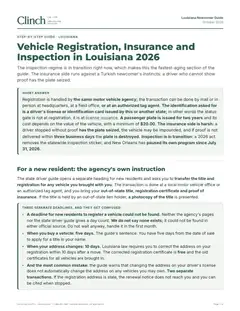
Registration is handled by the same motor vehicle agency; the transaction can be done by mail or in person at headquarters, at a field office, or at an authorized tag agent. The identification required at registration is a driver license or identification card issued by this state or another state, so the status gate opens not at registration but when the license is issued. A passenger plate runs two years and its cost depends on the value of the vehicle, with a minimum of $20. Inspection is in transition: an act passed in 2026 removes the statewide inspection sticker, and New Orleans has paused its own program since July 31, 2026.
Steps, documents and official links
For new residents: the agency's own instruction
The state driver's guide opens a separate heading for new residents:
If you are a new Louisiana resident, you must transfer the title and registration for any vehicles brought with you during the move. You can register your vehicle at the local Motor Vehicle Office or public tag agent. Bring your out-of-state title and registration certificate and proof of insurance. If your title is held by an out-of-state lien holder, a photocopy of the title must be presented.
The same guide says transfer fees are based on the current book value of the vehicle and asks you to bring the receipt for taxes paid in another state. In its own words: Louisiana state tax is 4%. City and parish tax rates vary.
There is a gap here and we state it honestly: no sentence giving a deadline in days for a new resident to register a vehicle could be found, neither on the agency's pages nor in the driver's guide. We do not say there is none; we say research did not find one. The two deadlines that do exist belong to entirely different things:
- When you buy a vehicle: You have five days from the date of sale to apply for a title in your name.
- When your address changes: Louisiana law requires you to correct the address on your registration within 10 days after a move. The corrected registration is free, and you bring the old registration certificate for every vehicle.
And the guide's own warning, the trap most people fall into: Changing the address on your driver's license does not automatically change the address on any vehicles you may own. Two separate transactions. If you skip the registration address, the renewal notice does not arrive and you can be cited if you are stopped.
Fees
| Item | Fee |
|---|---|
| Title | $68.50 |
| Title correction | $68.50 |
| Recording a lien | $15.00 or $10.00, depending on the instrument |
| License transfer | $3.00 |
| Handling fee | $8.00 |
| Local fee | Where applicable, up to $6.00 |
| Passenger plate | Two years, minimum $20.00 |
Two official sources conflict on the plate fee and we publish both. The agency's web page computes the fee at one tenth of one percent of the value of the vehicle per year with a minimum base of $10,000, and because plates are sold in two-year increments it gives the minimum price as $20.00. The driver's guide says plates are based on one percent of the original selling price, yet immediately adds that vehicles valued at $10,000 or less are $10.00 a year, which agrees with the web page's rate. We take no side; the conclusion for a reader is this: the minimum two-year plate cost is $20.
Sales and use tax is computed by where the vehicle is domiciled, which is where the five communities diverge. See the tax section for rates; the agency's own tool is a parish tax table.
Inspection: you are in a transition period
The old system. The state driver's guide still says every automobile, truck, trailer, boat trailer and motorcycle operated on the highways must display a current motor vehicle inspection sticker, and that New Orleans, Kenner and Westwego operate their own inspection programs. Metairie is not among those three.
The new system. An act passed in the 2026 regular session removes the statewide inspection sticker and replaces it with the Louisiana Vehicle Identification Program. In the statute's own words, the sticker shall contain the vehicle identification number and be visible to law enforcement, and the fee shall not exceed six dollars per year and may be assessed biennially.
- Two separate effective dates. In parishes subject to the federal Clean Air Act the act takes effect if and when the federal environmental agency adopts the state plan amendments. In all other parishes, January 1, 2027.
- There is a gap in between and the statute states it plainly: between June 30, 2026 and January 1, 2027 no citation is issued for failing to produce or display a certificate of inspection.
- The agency must publish the rules by December 31, 2026 and is authorized to use emergency rulemaking. We do not write the post-2027 procedure in this guide, because the rules have not been published.
- The act keeps periodic inspection and its fees for commercial vehicles and student transportation vehicles, and preserves inspections required by federal law.
New Orleans: the local name is a brake tag, and it is paused
The city bureau's page gives the local name and ties it to the city code: vehicles registered in Orleans Parish must pass a safety inspection and display a current city sticker, also locally known as a 'brake tag'. The stations and inspectors are private contractors licensed by the city.
But the notice at the top of the page changes everything:
As of July 31, 2026, New Orleans has paused all brake tag enforcement and issuance for the remainder of 2026.
The city's July 31, 2026 announcement adds that officers were instructed to stop issuing citations for failure to display or produce an inspection sticker, that the change applies only to brake tags and not to other traffic laws, and that procedures for 2027 will be announced by the end of the year.
We publish a contradiction: the city's older inspection pages still show the old fee schedule and still say the state change does not apply to the city. The living page says issuance is paused. We take no side, but we tell readers this: rely only on the living page and call the city bureau about 2027. We do not publish the old fees in this guide.
Emissions: Baton Rouge diverges
The same act ties the emissions obligation to parishes and municipalities subject to the federal Clean Air Act and names no parishes. What can be measured is this: Baton Rouge sits inside the federal inspection and maintenance area and its emissions obligation continues; the other four communities do not. The full list of covered parishes could not be read from the state environmental agency's own page this round, so it does not appear in this guide.
One more item: the vehicle you bring to a road skills exam must also be inspected. The agency's sentence about the motorcycle exam is explicit: the vehicle must have a current plate, proof of current insurance and a current inspection sticker.
PDF: Vehicle Registration, Insurance and Inspection in Louisiana 2026
04 · Auto insurance
Auto insurance in Louisiana: what happens if you cannot show proof?
Short answer
The answer here is harsher than in most of the series, and the reverse of a Turkish driver's instinct. The state driver's guide says that if a stopped driver cannot produce proof of insurance, the vehicle's license plate will be seized and the vehicle may be impounded. You then have three calendar days, excluding Saturdays, Sundays and legal holidays, to bring proof to a motor vehicle office; if you do not, the plate is destroyed. And the real reversal: if you stop driving a vehicle you must surrender the plate before the insurance is canceled.
Steps, documents and official links
The guide's own sentences
Any vehicle used upon the highways of Louisiana must be insured. When you apply for a license plate, you must have proof of the required liability insurance or other allowable substitute.
If you are stopped by a law enforcement officer and you are unable to provide the proof of insurance, the vehicle's license plate will be seized and the vehicle may be impounded. You will have three (3) calendar days, excluding Saturdays, Sundays and legal holidays, to provide the proof at a Motor Vehicle office.
If you decide to no longer drive a vehicle on the highways, you should remove the license plate and surrender it to the Office of Motor Vehicles before the insurance is canceled. Penalties will be assessed if the license plate is not surrendered prior to the insurance cancellation.
The chain, in order
- Proof stays in the vehicle. The guide requires proof of insurance to be maintained in the vehicle whenever it is operational and presented whenever an officer asks.
- The insurer must be authorized to do business in this state. A policy from another country or an unauthorized carrier does not count as proof.
- Where to retrieve the plate is written down for you: the office is identified on the notice of violation the officer issues.
- Miss the three business days and the plate is destroyed, and you pay all the fees needed to register the vehicle again.
- False information carries its own penalty: the registration may be suspended, the court may fine you, and jail is possible.
- To get a license back after a refusal-related suspension, a driver must file high-risk insurance or post $30,000 in cash or security, and must maintain that filing for three years from the date of conviction.
How this differs from the habit you bring
In Türkiye, when a car is sold or parked the policy is canceled and the plate stays with the car. Here the order reverses: the plate is surrendered first, the policy is canceled after. Do it the other way around and penalties apply. Note this order if you plan to sell a car or leave it unused for a long time.
The number we do not write
The current minimum liability limits could not be verified. The statute setting them could only be read from a compilation stamped January 1, 2023; the state legislative site and the state insurance department site did not open this round. So we publish no figure. Ask your agent or the state insurance department for the limits in writing. For the same reason, the current state of the rule limiting an uninsured driver's recovery and of recent liability reforms could not be measured.
One more item was not found: there is no sentence from any agency about whether a clean driving history from Türkiye affects your premium here. Ask that question explicitly when you request a quote, and ask for the answer in writing.
05 · Toll roads
Tolls in Louisiana: the bridge, the tag and the fare
Short answer
There are tolls in this state, and for one of the five communities they sit in the middle of daily life. The Lake Pontchartrain Causeway connects the north and south shores of the lake, and the operator's own sentence tells you which dithe toll is collected: Tolls are only collected on the North Shore (Mandeville side of lake). We could not determine from the operator's own text which direction, or how many directions, are charged; a single plaza may charge both ways. Confirm on the operator's own page before you cross. For an ordinary two-axle passenger vehicle the fare is $3.40 with a tag and $6.00 in cash or by card, with an added 3 percent fee on card payments. Going without a tag costs nearly double.
Steps, documents and official links
The bridge fare
From the operator's own table, as of October 14, 2026:
| Vehicle | Tag fare | Cash or card |
|---|---|---|
| 2 axles, under 7 feet (ordinary passenger car) | $3.40 | $6.00 |
| 3 axles, under 7 feet | $7.75 | $8.00 |
| 4 axles, under 7 feet | $10.25 | $11.00 |
| 5 to 7 axles, under 7 feet | $12.75 | $14.00 |
| 2 axles, over 7 feet | $10.25 | $11.00 |
| 3 axles, over 7 feet | $15.25 | $16.00 |
| 4 axles, over 7 feet | $20.50 | $21.00 |
| 5 to 7 axles, over 7 feet | $25.50 | $26.00 |
The operator's note: There is a 3% fee for Credit Card Fares.
How to get a tag
- Opening an account costs $20, and in the operator's words that amount includes a toll tag and $20 of prepaid toll fare in the account.
- The tag goes on the windshield behind the mirror; a warning light appears at the plaza when the balance runs low, and accounts linked to a card reload automatically.
- Tag holders may use the tag-only lanes.
- Both sales offices are in communities this guide covers: the north shore office is in Mandeville, the south shore office at 3939 N. Causeway Blvd., Suite 400, Metairie. Both at (985) 674-3641.
- Linking the statewide tag is not automatic: the operator asks you to call to link a statewide tag to a bridge account.
The statewide system
The state's toll system is called GeauxPass and belongs to the transportation department. Its own description also covers customers without a prepaid account: a pay-by-plate invoice is mailed to the address where the vehicle is registered.
The facilities it covers include the LA 1 Expressway and the Belle Chasse Bridge. Neither sits on the daily route of the five communities; the first serves traffic to the coastal industrial areas, the second traffic south of New Orleans. Their current fares could not be verified because the transportation department's site did not open this round. We publish no figures.
Two warnings
- The scam warning is a real item. The state toll system publishes a toll scam notice on its own site. The risk for a newcomer is concrete: if a text message arrives claiming an unpaid toll, do not tap the link; check your account only at the operator's own address.
- We do not write that any bridge is free. The claim that the twin bridge crossing the Mississippi in New Orleans currently charges no toll could not be verified from the agency's own words. We say neither yes nor no; check before you cross.
- No dispute procedure was found. The bridge collects prepaid at the plaza so there is no invoice cycle, but no page on disputing a toll could be found on the operator's site.
What it means for the five communities
| Community | Tolls in daily life |
|---|---|
| Mandeville | Yes. Going south the bridge is tolled: $3.40 with a tag, $6.00 without |
| Metairie | Going north you pay nothing, because tolls are collected only on the north shore; one of the tag sales offices is here |
| New Orleans, Baton Rouge, Lake Charles | No toll was found on the daily route |
Add it to your budget when you look at housing: for someone living on the north shore and working on the south shore this is a cost that repeats every working day, and the gap between the tag fare and the cash fare shows up monthly. That is not an inference, it is the difference between two published fares; multiply it by your own number of days.
06 · Hurricanes and flooding
Hurricanes and flooding: who orders an evacuation and what do you do?
Short answer
There is no winter snow and ice regime in this state; what interrupts driving and daily life is hurricanes, flooding and evacuation. The season runs June 1 through November 30, and federal, state and city agencies all give the same dates. Correct your expectation: as a rule the order comes from the parish, not the state. The statute's own sequence is that the parish president issues the order, and the governor steps in only if the parish president has not. And going home requires permission: returning without it can lead to arrest.
Steps, documents and official links
Three kinds of evacuation, three outcomes
| Type | What the statute says |
|---|---|
| Voluntary | Issued when the threat is not yet imminent; personal discretion is allowed but staying is not advised. The statute adds that people with special evacuation or transportation needs are particularly encouraged to leave as early as possible |
| Mandatory | A person may remain at home and is not forcibly removed; but in the statute's own words all public services are suspended and anyone failing to comply may not be rescued or provided other lifesaving assistance. In a hurricane, rescue ends once tropical storm winds begin at the coast |
| Forced, by the governor | Same outcomes, plus an automatic curfew |
The curfew is automatic. The statute says that during a mandatory or forced evacuation a twenty-four hour per day curfew is imposed automatically in the evacuation area, and remains until the parish homeland security and emergency preparedness agency lifts or amends it. A nonessential person found traveling through the area is subject to arrest or escorted out.
Going home: the item that surprises readers most
The statute is clear: a mandatory evacuation is lifted only when public services are available in the area and the area is opened for reentry, and that call belongs to the parish emergency agency. Once out of the evacuation area, no unauthorized person, including residents, is permitted to return until conditions permit; someone who does is subject to arrest or removal.
This is the most practical sentence in the guide: when you evacuate, do not plan for three days, plan for as long as it takes to be let back in. Lodging, cash, medication and supplies for children follow from that.
The state's phased schedule
The state's own preparedness guide splits evacuation into three phases with an hour threshold for each. These three lines are simple enough to memorize:
| Phase | Threshold | Area covered |
|---|---|---|
| Phase one | 50 hours before the onset of tropical storm winds | South of the Intracoastal Waterway; outside levee protection |
| Phase two | 40 hours before | South of I-10; levee protected but vulnerable |
| Phase three | 30 hours before | The east bank of the Mississippi in the New Orleans metropolitan area; inside levee protection but vulnerable |
Reversed lanes. In a mandatory evacuation all lanes on major highways are turned outbound; the city calls this contraflow and asks residents to plan a route in advance. The state preparedness guide publishes a map of the covered highways for southeast Louisiana only, which leaves Lake Charles outside that map. That does not mean there is no plan there; readers in that region should ask their own parish emergency agency.
Alert systems: five communities, five doors
This table is vital in a hurricane state. No system substitutes for another, and two communities require two separate registrations.
| Community | System | How many registrations |
|---|---|---|
| New Orleans | The city system | One, because city and parish are the same |
| Baton Rouge | The city-parish system, with an app | One |
| Metairie | The parish system | One, because there is no municipality to register with |
| Mandeville | The city system and the parish system | Two |
| Lake Charles | The city system and the parish system | Two |
Parish emergency management lines published in the state guide: Orleans 504-658-8700, East Baton Rouge 225-389-2100, Jefferson 504-349-5360, St. Tammany 985-898-2359, Calcasieu 337-721-3800. The multilingual phone door is 2-1-1; the state guide says that line is staffed around the clock and provides multilingual services.
If you have no car
A program with an institutional name exists only in New Orleans: City-Assisted Evacuation. In the city's own description, registration is by text message, the assembly hub is announced by the city, and from there people travel by bus, train or plane to a state or federal shelter. There is a baggage limit: one carry-on sized bag per person; medical equipment, a diaper bag and essential personal items are outside that limit. People with medical or mobility needs who complete the medical section of the city's profile system can be picked up at home.
For the other four communities research found no equivalent program. We do not say there is none; we say no named program could be found on the agencies' own pages. In those communities your plan must be your own car or a ride arranged in advance.
Pets
- The state guide's sentence: service animals are allowed in all shelters by law, even those that do not allow pets.
- Your destination may not accept pets; the guide asks you to call 2-1-1. Animal shelters open as needed.
- The packing list: at least three days of food and water, litter and a pan, medications and medical records, a carrier large enough for the animal to stand and turn comfortably, a leash and a current photo.
- The New Orleans assisted evacuation has a weight limit: in the city's words, small pets 20 pounds or less may ride the bus with you; larger animals travel separately.
Generators and outages: the numbers
- Run a generator 20 feet from the house, doors and windows.
- Shut it off and let it cool for 20 minutes before refueling.
- Keep at least 5 feet of clearance above it, with the exhaust pointed away from the building, open windows and vents.
- Never plug it into a wall outlet and never run it in wet conditions.
- Buy a battery-operated carbon monoxide alarm. If anyone has a headache, dizziness, weakness, chest pain, nausea or confusion, get everyone outside and call 9-1-1.
- In an outage use flashlights rather than candles, stay away from downed lines, keep the refrigerator closed, and text rather than call to save battery.
One rule that touches driving, with no counterpart in Türkiye
From the state driver's guide:
When a traffic-control signal is not functioning at an intersection, the intersection shall revert to an all-way or four-way stop.
An intersection with a dark signal is an all-way stop. Every approaching vehicle stops and proceeds in turn. There is no such rule in Türkiye, and in a state where outages are frequent this is a real crash risk for a newcomer. It is not a disaster rule; it is a standing traffic rule.
Live road conditions are published by the state's own tool and can also be reached by dialing 511. Note: that tool carries no evacuation route or contraflow map; it carries traffic, closures, cameras and a weather layer. For an evacuation map go to your own parish emergency page.
07 · Transit
Transit in Louisiana: five communities, five operators
Short answer
There is no single statewide system here: each of the five communities is served by a different agency with different fares. The widest network is in New Orleans, where bus, streetcar and ferry run on the same card and app. Mandeville has no fixed-route bus; service there is demand response, booked by phone. And there is a transfer trap: transfers are not valid between the New Orleans agency and the Jefferson Parish operator; the only ticket covering both costs $6.00.
Steps, documents and official links
Five operators, five fare tables
| Community | Operator and type | Single ride |
|---|---|---|
| New Orleans | Regional transit agency: bus, streetcar and ferry | $1.25 · senior and disabled $0.40 · youth $0.50 |
| Baton Rouge | Capital area bus system | $1.75 · senior (62 and over) and disabled $0.35 · youth $0.35 |
| Metairie | Run by the parish, because there is no municipality: bus and an on-demand zone | $1.25 · senior, veteran and disabled $0.75 · youth $0.50 |
| Mandeville | The parish demand response service; no fixed routes | By distance, $1.50 to $4.00 |
| Lake Charles | The city's own division, five routes | $1.00 · senior $0.50 · disabled and veteran $0.25 |
Community by community
- New Orleans. The same app covers bus, streetcar and ferry. A single ferry ride is $2.00; a 31-day pass is $45.00, $14.00 for seniors and riders with disabilities and $18.00 for youth. Day passes run $3.00 for one day, $8.00 for three and $15.00 for seven.
- Baton Rouge. The payment system changed on August 15, 2026: a reloadable card and a new app replaced the previous app. Transfers are not valid on the issuing route and last two hours; a second bus is $0.25 and a third is $1.75. No change is given in cash; the difference is issued as a value card. A weekday day pass is $4.00, a weekend pass $2.00, seven days $19.00 and thirty-one days $56.00. University students ride free with their own identification.
- Metairie. With no municipality, the parish runs the service. A monthly pass is $45.00 in cash, $47.25 by card; $30.00 for seniors, veterans and riders with disabilities. A roll of ten tokens is $15.00. Day passes are sold only by the operator on board. A special fare applies on the airport and west bank routes.
- Mandeville. The service is curb to curb, booked by phone on a first-come, first-served basis; reservations at 985.327.0185. Riders 60 and over travel free between 7:30 a.m. and 2:30 p.m. Children 6 to 12, riders with disabilities and those 60 and over pay half fare; under five is free. A rider under 17 must be accompanied by someone at least 18. Extra stops must be planned ahead; drivers do not make unplanned stops. The city also has two park and ride lots, at 675 Lafitte Street and 21490 Koop Drive.
- Lake Charles. Five routes on weekdays, departing from 1155 Ryan Street. Drivers carry no change, so exact fare is required. Transfers and bicycles are free; the front rack holds two bikes. For a reduced fare you take your identification to the transit office. Door-to-door accessible service is $1.00 one way and $2.00 round trip, booked a day in advance. Outside the city limits the parish runs a separate service.
The transfer trap
The Jefferson Parish operator's own sentence is plain: Transfers are not valid between JP Transit and RTA vehicles. So a reader living in Metairie and working in New Orleans cannot use a transfer across the two systems. The only bridge is the regional day pass, valid for 24 hours on both systems at $6.00. That is a real daily cost; factor it in when you look at housing.
Airports
- The region's large airport is in Jefferson Parish, in Kenner (1 Terminal Drive, Kenner), but it is operated by New Orleans's own aviation board. So the airport is not inside the New Orleans city limits, yet New Orleans runs it. Its mailing address is in New Orleans as well.
- Two operators serve the airport from the same stop at different fares: the parish route charges $1.50 if the stop is inside the parish and $2.00 if it crosses into New Orleans; the city agency's airport route charges $1.25. The airport repeats the transfer trap in its own words: only the regional day pass works on both systems.
- Every airport trip from Mandeville crosses the bridge, so the toll applies each time.
- No transit connection to the Baton Rouge airport could be found. We do not say there is none; no such page was found on the airport's own site.
- Lake Charles has only two airlines, and in the airport's own words each offers nonstop service to one connecting hub. There are no direct international flights.
Trains
- New Orleans is a terminal station: Union Passenger Terminal, 1001 Loyola Avenue. The national rail carrier lists four routes serving this station, running north, east and west. The terminal is also a bus terminal and connects to a streetcar line.
- Lake Charles has a station at 100 Ryan Street with a waiting room. The list of routes stopping there could not be extracted this round.
- No station was found for Baton Rouge, Mandeville or Metairie. For those three the nearest station is the New Orleans terminal.
Intercity buses were not measured: the carriers' stop addresses and schedules were not read this round. What was verified is that the terminal has a bus bay.
08 · Local government
Which government do you belong to in Louisiana?
Short answer
First, the word. In this state the administrative unit is not a county, it is a parish. A federal registry even lists parishes under its own category label, but that is the registry's classification; the correct word here is parish. And the name of the governing body is not uniform: in Calcasieu it is a Police Jury, in Jefferson and St. Tammany a Parish Council with a Parish President, while in New Orleans and Baton Rouge neither term appears because both have consolidated government. The most important rule is this: your mailing address does not tell you which government you belong to.
Steps, documents and official links
Five communities, five structures
| Community | Parish | Structure |
|---|---|---|
| New Orleans | Orleans | City and parish share one boundary. The city's own mapping metadata reads Official boundary of the City of New Orleans, coterminous with Orleans Parish, grounded in the city's home rule charter |
| Baton Rouge | East Baton Rouge | Consolidated government. In its own words: The City of Baton Rouge and Parish of East Baton Rouge are managed by a single, consolidated form of government. The executive is the Mayor-President, the council is the Metropolitan Council, with 12 districts |
| Metairie | Jefferson | No municipality. It is a census-designated area with no mayor, no council, no municipal tax and no municipal police. Residents deal directly with parish government: a Parish Council and a Parish President |
| Mandeville | St. Tammany | Incorporated: an elected mayor, a council and a municipal court |
| Lake Charles | Calcasieu | Incorporated: a mayor, a city administrator and a council elected from seven districts. Here the parish body is a Police Jury |
Use the agency's own term. Writing parish council as a generic label is wrong in this state, because three different names exist and two of them are not used at all in the two largest communities.
The mailing address trap runs in both directions
Direction one, an address that spills outside the parish. The Jefferson Parish sheriff's own page states that the area around Ochsner Hospital and Elmwood Industrial Park, whose mailing addresses read New Orleans, is in fact in unincorporated Jefferson Parish. So New Orleans on an envelope does not mean the home belongs to the City of New Orleans; the tax rate, the police, the school district, the trash service, the zoning, the elections and the courts may all sit in a different government.
Direction two, an address that splits inside the parish. The East Baton Rouge mapping layer lists five municipalities: Baker, Central, Zachary, Baton Rouge and St. George. The St. George site's own sentence reads St. George was incorporated in 2019 to give residents more control over their community and future. The layer was last edited on March 3, 2026, and St. George covers roughly two thirds of the area of Baton Rouge. So a home whose mail reads Baton Rouge may sit inside the City of St. George; zoning, building permits, policing and municipal tax are then another door.
Mandeville gives the same warning on its own site, with the heading Your mailing address does not tell the whole story! The city offers two concrete tests for whether you are inside the city limits:
- Do you pay your water bill to the City of Mandeville?
- Does your property tax bill carry City Tax and City Mills lines?
If the answer to both is no, you are most likely in unincorporated parish territory and your counterpart is parish government.
We publish a contradiction
The same parish's mapping layer lists St. George as the fifth municipality. The description text of the same government's property lookup tool still names four cities: Baker, Baton Rouge, Central and Zachary, plus the unincorporated area. We take no side. The practical conclusion is this: do not ask one tool and stop there.
A similar count gap exists on the Jefferson side: the sheriff's page names six municipalities in the parish while the assessor's page names five. We publish both. Metairie appears on neither list, so the finding is unaffected.
Official tools for checking your own address
- New Orleans: the tool at the bottom of every city page is called Where Y'At, and its own line reads Type an address to get zoning, district, and service information for your location. The same tool sends you to the state voter portal for your polling place. The city also publishes a property viewer.
- Baton Rouge: three tools, three questions. A property lookup, a sales tax domicile lookup (which in its own words shows which sales tax jurisdiction an address falls in), and a council district lookup covering the 12 districts.
- Metairie and Mandeville: the parish assessor's parcel search for property information, and an address-based official lookup for the sales tax rate. On the Mandeville side the parish also publishes its own map viewer.
- Lake Charles: the city's own mapping page.
311 and where complaints go
In New Orleans the single number for city services and non-emergency requests is 311, also reachable at (504) 539-3266. In Baton Rouge the same function runs by phone, through the city's own app and through an online account. Metairie has no municipal 311 equivalent, because there is no municipality; requests go to parish departments.
Who handles what in Metairie
| Matter | Who |
|---|---|
| General government | Parish government: a Parish President and a Parish Council |
| Policing | The parish sheriff's office; there is no municipal police |
| Traffic citations, minor offenses and civil suits up to $50,000 | First Parish Court, 924 David Drive, Metairie |
| Larger civil and criminal cases | The parish judicial district court, in Gretna |
| Deeds and mortgages, vital records, marriage licenses, passport applications, elections and jury | The parish Clerk of Court |
| Property assessment and exemptions | The parish assessor's office |
| Collecting property tax | The parish sheriff, as tax collector |
| Sales tax, occupational licenses and permits | The sheriff's bureau of revenue and taxation |
| Zoning and building permits | Parish planning and permits departments |
Who assigns an address to a new parcel could not be found. The planning department's page contains no sentence on it; the likely contact is the same department, but we could not verify that.
09 · Electricity
Electricity and natural gas: who supplies, who regulates?
Short answer
In this state both the supplier and the regulator change with your address, and that decides which door you knock on when you dispute a bill. In New Orleans the electric utility's own sentence reads Entergy New Orleans is regulated by the New Orleans City Council. So there the regulator is not the state commission but the city's own council. In Baton Rouge and elsewhere the counterpart is the state commission. And for anyone moving in 2026 the most critical change is in gas: in the two largest cities natural gas distribution changed hands in 2025.
Steps, documents and official links
Gas changed hands in 2025, so older guides online are wrong
The electric company's own corporate page says: Entergy completed the sale of its natural gas distribution business that served Baton Rouge and New Orleans. The buyer is Delta Utilities, headquartered in New Orleans. The buyer's own announcement describes the scope: roughly 109,000 customers in New Orleans and roughly 95,000 in East Baton Rouge Parish, who were transferred automatically with no interruption in service and no change to rate structures.
The consequence is plain: someone moving to New Orleans or Baton Rouge in 2026 applies for gas service with the new company, not the old one. The guides you find online still name the old one.
The exact closing date could not be verified: we could not close the gap between press reports and the company's own announcement, so we publish no day. Terms for opening a new gas account could not be found either: the deposit, the documents required and any route without a number are not published anywhere. Call the company before you apply.
Who supplies which community
| Community | Electricity | Regulator |
|---|---|---|
| New Orleans | Entergy's New Orleans company | The city's own council |
| Baton Rouge | Entergy's Louisiana company | The state public service commission |
| Metairie | Entergy's Louisiana company | The state commission |
| Mandeville | A different company: CLECO | The state commission |
| Lake Charles | Entergy's Louisiana company | The state commission |
Gas is different in Mandeville too: the city's own page names Atmos Energy for gas, Charter Communications for cable and internet and AT&T for telephone. The gas distributors for Metairie and Lake Charles could not be verified from an agency's own page.
The regulator's own scope
The state public service commission describes its jurisdiction as covering electric, water, wastewater, natural gas and certain telecommunications services, with one exception:
Municipally owned and operated utilities are not subject to the jurisdiction of the Commission.
One gap stated honestly: no sentence naming Orleans Parish as an exclusion could be found on the commission's own page. The two firm sentences we have are the utility's regulated by the New Orleans City Council and the gas company's announcement naming the city council for New Orleans and the state commission for East Baton Rouge separately. The result points to the same door, but the exception could not be found in the commission's own words.
How to complain
- New Orleans: the council has a bureau that regulates utilities. The known flow is an informal complaint to the company first, then a formal filing with the bureau within a set period after the company's written response. We could not read those steps on the agency's own page, so we publish no number of days; we took the bureau's name from the council's own documents. Ask the council's site for the right page.
- The other four communities: disputes go to the state commission.
- One state, two companies of the same holding, two different complaint doors. Check this when you move.
Outages
Outage reporting also splits by regulator. For what to do in an outage, generator rules and the dark-signal intersection rule, see the hurricane and evacuation section; that section also explains the main cause of outages in this state.
One adjacent item for readers with a relative in a care facility: nursing homes in this state are required to maintain a generator or an alternate power source approved by the health department. In 2026 that requirement is reported to have been extended to licensed adult residential care providers, but we could not read the statute; ask the facility for the date and scope.
10 · Water and trash
Water, sewer and trash: how do you open an account?
Short answer
Water runs on three different models in this state, and that decides where complaints go: in New Orleans water, sewer and drainage sit in a separate public board; in Baton Rouge water comes from a private company while sewer and trash come from consolidated government; in Mandeville and Lake Charles both are city divisions; in Metairie both are the parish's. And the sharpest divergence is the Social Security card: one city explicitly requires it to open an account, one agency's list includes the number, and another city's page never mentions it at all.
Steps, documents and official links
Who supplies what
| Community | Water and sewer | Trash |
|---|---|---|
| New Orleans | A public board separate from the city; drinking water, wastewater and stormwater drainage in one agency | A city service; the fee is on the water bill |
| Baton Rouge | Water from a private company (about 93 percent of customers); sewer from consolidated government | Consolidated government, through contractors |
| Metairie | A parish utility | The parish, through a contracted hauler |
| Mandeville | A city division | A private firm under contract to the city |
| Lake Charles | A city division | The city's own crews |
The Social Security card item: three situations in three communities
This changes the order of operations for a newcomer, and we do not generalize.
- Lake Charles. The city's own water service page: Photo identification and a valid Social Security Card must be presented before the application can be processed. So a photo ID and a valid Social Security card are required. When transferring service to a new address, the number is again on the list of things to have ready.
- New Orleans. The agency opens new accounts in person and the information it asks for includes a valid photo ID, a Social Security number and proof of occupancy (a damage deposit receipt, a lease, an act of sale or a landlord's statement). Someone applying on another person's behalf needs a signed letter of authorization and identification for both.
- Mandeville. The city's application page never mentions the number, and there is no explicit sentence saying an application without one is accepted either.
- Metairie. Neither a deposit amount nor an identification or number requirement could be found on the parish pages.
An honest limit: the New Orleans agency's page shows no alternative route without a number and never mentions a taxpayer identification number. We do not say there is none; we say it was not found on the agency's page. Call customer service before you go and ask in writing which document they accept. In some communities this changes the order: Social Security first, water second.
Deposits, payment and connection
- Mandeville: applications are made at city hall, and the request must be made by 4 p.m. the previous business day; for same-day service you call. The deposit depends on meter size: at the most common size it is $150 plus a $50 service fee. And a trap: new service fees are payable only by check, cash or money order, and credit cards are not accepted. For a newcomer without a bank account yet, the practical answer is a money order.
- Lake Charles: the residential deposit is $50, and it is waived if you bring a letter of good credit from another utility. Same-day connection costs an extra $60. Service cut for nonpayment is restored the next business day, and the reconnection payment is made only at the business office, with no checks accepted.
- Metairie: a new service application is submitted online and instructions arrive by email; for same-day connection all information and payment must arrive by 2 p.m. The drop boxes do not accept cash.
- New Orleans: accounts are opened in person; the deposit amount could not be found on the agency's page.
Baton Rouge: the sewer bill shock of the first three months
A mechanism measured here for the first time in this series hits new arrivals directly. The sewer fee is not based on this month's water use but on a winter average: in the agency's own words the fee is recalculated each July based on the customer's average water consumption during October, November and December of the prior year and February, March and April of the current year.
A special rule for new customers: with no consumption history yet, the fee is billed on an assumed average of 8.9 units. In the agency's own example that works out to roughly $57.47 per month. Adjustment only happens after three full months of consumption data, and customers below the average receive a credit.
So someone newly arrived in Baton Rouge may receive a higher-than-expected sewer bill before using any water at all. This is not an error; it is the agency's published mechanism. Budget the first three months accordingly. The agency also states the fee increases every January.
Trash fees and schedules
- New Orleans: the trash fee is not a separate bill, it arrives inside the water bill. As of October 1, 2026 the residential fee rose from $24.00 to $32.25 a month, and the commercial fee from $48.00 to $64.50. The previous schedule had been set in 2011. Collection is weekly, including recyclables. The practical consequence: without a water account there is no trash billing.
- Baton Rouge: the monthly garbage fee is $35.23. In the agency's own words all residents in the parish are billed this fee except residents living in the corporate limits of Baker and Zachary. An extra cart is $7 a month.
- Metairie: the service covers residences with four or fewer units. Each unit gets one cart free; a second is purchased. Household garbage is collected twice a week and bulky waste once. Carts may not be set out before 4 p.m. the day before collection and must be brought in by noon the following day. Missed collections are not made up: waste not collected because of a holiday is picked up on the next regular day.
- Mandeville: garbage on Wednesday, green waste Tuesday or Friday, recycling Tuesday. Green waste has limits: branches and trunks may not exceed 50 pounds and 12 inches in diameter, piles may not exceed set dimensions, and leaves must be bagged.
- Lake Charles: the city ordinance defines garbage and trash separately; household garbage goes in the city's 98-gallon cart, in plastic bags. White goods are collected but you must call first. Not collected: construction material, tires and auto parts, and hazardous waste.
11 · Renting and tenant rights
Leases, tenant rights and eviction
Short answer
Here a lease runs on the civil code's own terms and we do not simplify them. The code calls the contract a lease, the parties the lessor and the lessee, real property an immovable, and it characterizes the lease as a synallagmatic contract. Before you sign, look for one clause: the procedure code requires a five-day written notice to vacate, but the same article says a lessee may waive that requirement by written waiver contained in the lease. If that clause is there, your five days are reduced to zero.
Steps, documents and official links
The code's vocabulary
| Term | Meaning |
|---|---|
| lease | The code's name for the contract, not rental agreement |
| lessor | The landlord. The code does not say landlord |
| lessee | The tenant. The code does not say tenant |
| synallagmatic contract | The nature of a lease: binding on both parties |
| immovable | Real property |
| reconduction | Automatic continuation of a lease whose term has ended |
| lessor's privilege | The lessor's legal privilege over movables on the leased premises |
| notice to vacate | The first step of eviction |
The code's definition, verbatim: Lease is a synallagmatic contract by which one party, the lessor, binds himself to give to the other party, the lessee, the use and enjoyment of a thing for a term in exchange for a rent that the lessee binds himself to pay. Your home falls into the code's residential category.
Term, form and automatic continuation
- A lease must have a term, which may be fixed or indeterminate; the maximum is 99 years.
- If no term was agreed, a residential lease runs month to month by operation of law. So I have no written lease, so I have no rights is wrong.
- A lease may be made orally. But a lease of an immovable is not effective against third persons until filed for recordation, and a third person who buys an immovable subject to an unrecorded lease is not bound by it. The practical consequence: if the property changes hands, an unrecorded lease may not protect you against the new owner.
- A fixed-term lease ends at the term without notice, but there is an automatic continuation: if the lessee remains and neither party gives notice within a week, the lease continues with all its provisions, and the continued lease runs month to month. A one-year lease does not simply die when no one says anything.
- Transfer of the leased thing does not end the lease unless agreed otherwise, and the lessee has the right to sublease and assign unless the contract expressly prohibits it; a prohibition is construed strictly against the lessor.
Notice of termination: how far in advance
| Lease period | Notice |
|---|---|
| Measured by a period longer than a month | 30 calendar days before the end of that period |
| Month to month | 10 calendar days before the end of that month |
| A week or longer but shorter than a month | 5 calendar days before the end of the period |
| Shorter than a week | At any time before the period ends |
And a form requirement: if the leased thing is an immovable, or a movable used as a residence, the notice of termination must be in writing. If the contract allows early termination, the applicable period is whichever is longer, the contractual one or the statutory one, and the code adds that the right to receive this notice may not be renounced in advance.
Repairs and belongings
- The lessor must deliver the thing at the agreed time in good condition suitable for its purpose, make all repairs necessary to keep it in that condition during the lease, and pay taxes and charges on the immovable. The lessor may not alter the thing during the lease.
- The lessee has a duty too: you must notify the lessor without delay of any damage or need for repair; failing that, you answer for the resulting loss. This is an obligation, not an option. Give notice in writing and keep a copy.
- If the lessor fails to make a necessary repair within a reasonable time after demand: the lessee may have it made and demand immediate reimbursement or deduct the cost from the rent, to the extent the repair was necessary and the cost reasonable. Because reasonable is undefined, written records are essential.
- The lessee must repair damage caused by their own fault and wear beyond normal use.
- A surprise for readers from other states: the lessor has a legal privilege over the lessee's movables on the leased premises, and that privilege continues for 15 days after the movables are removed.
Security deposits
- The refund period is one month after a residential lease terminates. The lessor may retain only what is reasonably necessary to remedy a default or to remedy unreasonable wear.
- If any part is retained, an itemized statement with reasons must be sent within that same month.
- The tenant's duty: the statute's own sentence requires the tenant to furnish the lessor a forwarding address at the termination of the lease. Move without leaving one and the statement cannot reach you.
- The easiest trap: the statute says the one-month rule does not apply when the tenant abandons the premises, either without giving required notice or before the lease terminates. Leaving early and dropping off the keys can cost you the protection.
- If it is not paid: willful failure to comply entitles the tenant to the portion wrongfully retained plus three hundred dollars or twice that portion, whichever is greater. And the statute defines willful: failure to remit within thirty days after written demand for a refund constitutes willful failure. Suit may be brought in the parish of the lessor's domicile or where the property sits.
- No cap was found. Research did not find a provision capping the deposit amount; we do not say there is none. A 2026 change adding days to the itemized statement period is also reported, but we could not verify it from a primary source. Check your lease and the current text.
Eviction: the calendar and that one clause
The procedure code's own sentences:
The notice shall allow the lessee not less than five days from the date of its delivery to vacate the leased premises.
A lessee may waive the notice requirements of this Article by written waiver contained in the lease, in which case ... the lessor or his agent may immediately institute eviction proceedings.
So what this guide tells readers is: before signing, check whether the lease contains a waiver of notice to vacate. One court's own eviction guide even treats that possibility in a separate heading and asks a lessor relying on it to bring a copy of the lease when filing.
| Step | Timing |
|---|---|
| Written notice to vacate | 5 days (zero if the lease contains a waiver) |
| Filing and service | Suit filed with the court |
| Hearing | Not earlier than the third day after service |
| Judgment | The same day, if the court rules for the lessor |
| Warrant of possession | If the judgment is not obeyed within 24 hours |
| Execution | The officer executes it in the presence of two witnesses |
And an appeal does not automatically suspend execution: it suspends only if the lessee answered under oath, raised a defense entitling them to retain possession, and filed the appeal with security within 24 hours. If the premises appear abandoned or the lessee's whereabouts are unknown, notices may be attached to the door and that counts as personal service.
Changing the locks, removing doors or cutting off utilities to force a tenant out cannot be done without a court judgment. That rule appears consistently in secondary sources and in an appellate decision, but it could not be verified from an official publication of the law.
Which court hears an eviction
- New Orleans: First City Court for the east bank and Second City Court for Algiers. The court's own warning is in capitals: eviction filings are not accepted by mail and must be filed in person. Jurisdiction: small claims to $5,000, civil suits to $25,000. The court announced a fee increase effective July 1, 2026, so we do not publish a current filing fee.
- Baton Rouge: Baton Rouge City Court, and the court's own capitalized warning sets the limit: the rental property must be located within the City of Baton Rouge. A home in St. George, Central, Baker, Zachary or the unincorporated area does not go to this court. Court cost is $161.00 for one defendant, $10.00 for each additional, and $171.00 for a husband and wife. The hearing comes roughly two weeks after filing. The court has a dress code and no cell phones are allowed in the building.
- Metairie: First Parish Court, 924 David Drive, Metairie; jurisdiction covers the east bank of the parish, civil matters to $50,000.
- Mandeville and Lake Charles: which court hears an eviction could not be verified from the agencies' own pages. Mandeville has a municipal court and Lake Charles has a city court, but whether they hear evictions could not be measured. Ask your own city's court clerk.
Court interpreters are free
This touches a rent dispute directly. The Orleans Parish criminal court's own language access page states: Interpreters are provided at no cost for individuals who are parties or witnesses in court proceedings. So if you are a party or a witness the interpreter is free and the court pays. Make the request before the hearing.
One limit worth writing down: the same court publishes its brochures in English, Arabic, Spanish, French, Vietnamese and Mandarin; there is no Turkish. Whether a registered Turkish court interpreter exists in this state could not be verified this round.
For a tenant with no money for a lawyer
One parish clerk of court publishes a list of organizations for self-represented litigants: the state bar's referral service and a modest means panel, a local bar referral service, a volunteer lawyer project and a regional legal services organization, the state's free online legal question platform and a statewide legal help site. The same page also states two things plainly: clerk of court employees are prohibited from giving legal advice, and a self-represented litigant is presumed to know the law.
12 · Property tax
Buying a home: property tax, the homestead exemption and flood insurance
Short answer
A residence is assessed at 10 percent of market value, and the tax is the assessed value multiplied by the millage. The exemption is called the homestead exemption and covers the first $7,500 of assessed value, which is the first $75,000 of market value. The requirement is ownership and actual occupancy; one exemption per person, and the exemption does not follow you. The deed of sale is called an Act of Sale here. And do not break one chain: the exemption application asks for an electricity bill and does not accept a water bill.
Steps, documents and official links
How the system is built
- Assessment ratio: a residence is assessed at 10 percent of market value, commercial buildings and business movables at 15 percent.
- Millage is not one rate. Schools, law enforcement, fire, drainage, water, streets, lighting, libraries, parks and levee protection each carry a separately voted millage. In one parish eighteen different wards apply different millages.
- Property is reassessed at least every four years, and millages are adjusted after a reassessment; certain bond millages are outside that adjustment.
- The assessor sets the value, not the rate. Rates are set by councils and voter-approved boards.
Who collects, by community
| Community | Who collects property tax |
|---|---|
| New Orleans | The city's own bureau of treasury |
| Baton Rouge | The parish sheriff, as ex-officio tax collector |
| Metairie | The parish sheriff |
| Mandeville | The parish sheriff; bills are prepared by the parish assessor and city items appear as separate lines |
| Lake Charles | Collected at parish level; the collector's identity could not be verified from an agency page |
Billing calendars diverge too: in one parish notices are mailed in the last week of November and taxes become delinquent if unpaid by December 31. In another the assessment roll opens for public inspection in August, and appeals are filed in August, not when the bill arrives. That matters: miss the window and you cannot contest the bill.
New Orleans adds a warning in its own words: the city does not send delinquent notices and will not waive interest for non-receipt of a bill. Interest runs at 1 percent per month. The same office offers no formal installment plan. So keeping your address current is your job.
The exemption: who qualifies and how to apply
- Who: an owner who actually and continuously occupies the home. The city's own definition uses the word domicile: a permanent, personally owned residence. A person or a married couple may have only one.
- It does not move: if the home is sold or the owner moves, the exemption is canceled and you must reapply at the new home. The assessor's own sentence: The Homestead Exemption does not follow you.
- It does not renew annually: after the first application you do not reapply each year; a receipt arrives in the mail.
- It does not cover everything. The city's own phrase is most of the property taxes, not all, and the millage table contains lines collected without applying the exemption.
The application procedure diverges by community and that difference was measured:
| Community | How | Documents |
|---|---|---|
| New Orleans | By appointment, virtual or in person; if there is more than one applicant each must be present, including married couples | A completed application; a valid Louisiana license or state ID reflecting the property address; a current unpaid electricity, cable or landline bill in the applicant's name; proof of cancellation if you claimed an exemption elsewhere |
| Metairie | In person, signing is required; if spouses own jointly only one comes | A recorded copy of the act of sale and a photo ID bearing that property's address |
| Mandeville | By video appointment or at the office | A Louisiana ID, active military ID or a voter registration card for that address; plus a transfer document. Proof of cancellation if an exemption exists elsewhere |
Here is the chain readers miss: on the New Orleans side the exemption asks for an electricity bill and the office's own sentence says it does not accept bills from the water board. So an owner who has not put the electricity account in their own name cannot get the exemption. The order is: act of sale, then the electricity account, then the exemption.
What we write and do not write about immigration status. Neither the city's definition, nor the state tax commission's administrative rule, nor the assessors' document lists mention citizenship, residence status or a number. But no agency sentence saying status is not asked could be found either. So we write neither; what we write is the document list: the identification required is a Louisiana license or state identification card whose address matches the property. That is the indirect but real obstacle.
Additional exemptions and freezes
- The 65 and over freeze: for owners who reach 65 and meet an income test, the home's assessed value is frozen. One parish publishes a 2026 maximum adjusted gross income of $102,700, adjusted annually for inflation.
- A disability freeze exists separately, with the same income test.
- What a freeze does not freeze: it freezes the assessed value, not the tax rate. If a taxing district rolls its millage up, your tax still rises. A freeze is broken if construction or reconstruction raises the value by more than 25 percent.
- On veteran exemptions there is a contradiction and we publish both: the same assessor's pages describe the additional exempt value in tiered amounts in one place and as a combined $15,000 exemption for total disability in another. The two accounts do not line up; get the figure confirmed by the assessor before relying on it.
Millage: two cities, two tables
- New Orleans: the 2026 citywide total is 121.20 mills, covering the school board, the law enforcement district, water and drainage, libraries, early childhood education and parks. Additional millages apply depending on where you live, and some neighborhoods carry flat fees rather than millages, ranging from $100 to $1,750. When you look at a home, ask about the neighborhood's security or improvement district fee; the bill varies by hundreds of dollars from one neighborhood to the next.
- Baton Rouge: we publish no total. The resolution we could read was in draft and did not include the school board, library and sheriff millages. So we do not place it beside the 121.20 figure; that would not be a comparison.
Flood insurance: it concerns renters too
The city's own floodplain management page:
Most standard homeowner's insurance policies do not cover losses from flooding. Renters can also buy policies to protect their personnel property. There is a 30 day wait for a flood policy to become effective ... A single-family residence can be insured up to $250,000.
Read three things together. One, a standard homeowner policy does not cover flooding; flood is a separate policy. Two, renters can buy one too, and that policy protects contents; the building is insured by the owner. Three, and most critically, a policy does not take effect the day you buy it: there is a 30-day wait. Buying a policy after a storm appears in the forecast does nothing. Buy it before the season begins, not on the day you move in. Coverage is available separately for structure and contents, and premiums are lower outside a special flood hazard area.
Discounts were measured and they differ:
- Baton Rouge and East Baton Rouge Parish: the parish's own announcement states a 20 percent discount, based on reaching Class 6 in the federal program's community rating system, effective October 1, 2024. The previous discount was 15 percent.
- New Orleans: the city's own page says 10 percent, but carries no date and no class; the currency of that figure could not be verified.
Checking a flood zone is also two different doors: in New Orleans the city asks you to email for flood zone and historic flood information ([email protected]); no city tool returning an instant answer from an address could be found. In Baton Rouge there is a real application process: a flood zone determination is requested through an online permitting portal.
And we publish a contradiction: the metadata of the parish's flood layer dates the data to 2012 while the same data set's open data record says 2016. Two official records, two different years; rely on the official request process above, not on the layer.
Two cities, two flood mechanisms
In New Orleans the city's own account names four sources of flooding: the river, the lake, levee failure and rain; drainage is run as a public service and pumping stations move the water out. That is also why your property tax bill carries a separate levee district millage. In Baton Rouge the mechanism is creek and bayou driven; the parish's own announcement describes the tonnage of debris removed from its creeks.
A direct cost item for anyone buying and renovating: in New Orleans, new construction, repair of a building damaged 50 percent or more or improvement of 50 percent or more triggers the new flood protection requirements. In Lake Charles a minimum floor elevation rule has applied since January 1, 2021: the lowest floor of new construction must sit one foot above the highest of four measurements, and the rule also covers all mechanical equipment.
13 · School enrollment
School enrollment in Louisiana: the five communities split in two
Short answer
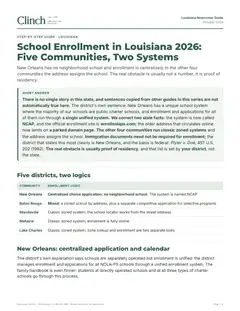
New Orleans does not resemble the other four, and the account you read in any other guide in this series does not apply here. The district's own sentence: New Orleans has a unique school system where the majority of our schools are public charter schools, and enrollment and applications for all of them run through one centralized system. We correct two stale facts: the system is no longer called OneApp, it is NCAP; and the old enrollment address is no longer the district's site, it resolves to a parked domain. In the other four communities attendance zones apply: your address assigns the school.
Steps, documents and official links
Five districts, two logics
| Community | Enrollment logic |
|---|---|
| New Orleans | Centralized choice application; no neighborhood school assignment. The system is called NCAP |
| Baton Rouge | Mixed: a zoned school by address, with a separate competitive magnet application layered on top |
| Mandeville | Classic attendance zones; the school finder works from a street address |
| Metairie | Classic attendance zones; enrollment is entirely online |
| Lake Charles | Classic attendance zones; zone lookup and registration are two separate tools |
New Orleans: one application
The district explains that schools are run separately but enrollment is unified: Even though charter schools are operated by individual Charter Management Organizations (CMOs), the district manages enrollment and applications for all NOLA-PS schools through a unified enrollment system. The family manual is more definite still: students at the district's direct-run schools and at all three charter types must enroll through this process.
The calendar for the 2027-2028 main round:
| Date | Event |
|---|---|
| November 2, 2026 | Main round applications open |
| January 22, 2027 | Application deadline |
| By March 31, 2027 | Placement results released |
| Every May | Open enrollment after the main round |
There is a separate route for families arriving mid-year, and it is one of the most useful sentences in this guide. The district states that families new to the system who need to enroll after September 4, 2026 must visit a Family Resource Center; placement is made in person on a first-come, first-served basis from open seats. So a family arriving from Türkiye after September has missed the main round but the child is not left without a school; what you get, though, is an open seat, not the school you wanted.
Changing schools mid-year is not free: from October 1 students may not transfer purely by preference; a separate request form is required. There is also a screen in the system for placing siblings at the same school, on one condition: every child must rank exactly the same schools in exactly the same order.
Some schools have eligibility criteria: by the district's own count ten schools have them, four academic, five based on foreign language proficiency (French and Spanish) and one on an open house. But entry to kindergarten carries no eligibility requirement; the district's own sentence says students entering kindergarten do not need to meet the criteria.
Immigration status: the clearest sentence in the series
From the New Orleans family enrollment manual, verbatim:
Students shall neither be required nor asked to present documentation pertaining to immigration status, nor shall they be denied admission to school based on immigration status or failure to present documentation of immigration status ... Reference to the immigration status of a child or guardian shall not appear on any forms, materials, paperwork, or records produced, distributed, or collected by the school.
That sentence does not merely say we do not ask; it says no reference to immigration status shall appear on any form, material, paperwork or record. The grounds are stated in the text: Plyler v. Doe, 457 U.S. 202 (1982) and the federal student records privacy law.
That sentence could not be found at the other four districts. We do not say there is none; we say research did not find it. One district's nondiscrimination statement lists age, race, religion, national origin, disability and sex but not immigration status. By contrast, another parish's school district publishes, on its own legal department page, documents titled an immigration enforcement guide and a fact sheet on the rights of all children to enroll in school; the titles were verified, the contents could not be read.
Foreign birth certificates: three districts, three positions
We take no side and publish all three.
- Jefferson Parish (Metairie): accepts them explicitly. Its own sentence: A foreign birth certificate is an acceptable document for verifying the student's information. It is the only one of the five to say so outright.
- St. Tammany (Mandeville): asks only for a State Certified Birth Certificate and never mentions foreign documents. Whether they are accepted could not be verified; families should call the parish child welfare and attendance office.
- New Orleans: lists a birth certificate, a passport or a certificate of live birth as age documents, and for a child born abroad whose birth record cannot be obtained, a passport or citizenship documents may take its place. If no document exists at all, the district's sentence is that the student is registered provisionally and the school takes steps to ensure appropriate grade placement.
Proof of residency: often the real obstacle
- New Orleans: an electricity, water, cable or internet bill from the last 90 days; a housing assistance document; a mortgage agreement or a lease whose end date is in the future; a homestead exemption; or an official letter from a public agency. For a family staying with someone else there is a separate route: a written statement, documents in the host's name and photo identification for both the parent and the host (a license, a passport or a state ID).
- Metairie: two documents are required and the list is broad: a lease, a current bill or deposit receipt, an act of sale, and, notably, a legal document issued or approved by the federal immigration authority appears among the accepted options. That is an option, not a requirement. If none is available the principal gives the family fifteen school days, one of the most generous windows measured in this series.
- Mandeville: the distinction is sharp. For owners, the primary document is a property tax bill or a homestead exemption. For renters, the primary document must be a signed lease from a rental office, apartment management or a mobile home park; the district's own phrase is not from an individual. So a lease from a private individual does not count as a primary document, which is a genuine trap for newcomers. If you are staying with someone, a notarized shared housing form is required. Photocopies are not accepted.
Age and grade rules statewide
- Compulsory attendance runs from age 5 through the end of the school year in which the student turns 18. Without a diploma a student may remain through the year they turn 21, or 22 with an individualized education program.
- The cutoff is September 30: a child must be 5 on that date for kindergarten and 4 for the four-year-old program.
- A real obstacle for a six-year-old arriving from Türkiye. A 2021 statute made kindergarten a prerequisite for first grade; the law's own text requires, as a prerequisite to enrollment in first grade, attendance at a full-day kindergarten for a full school year or passing an academic readiness screening before enrollment. For a child arriving without a kindergarten record, the screening is the second route.
- A student entering fifth or ninth grade from outside: in one parish, students transferring from out of state, from an in-state private school or from approved home study must take the English language arts and mathematics portions of the state placement test. That applies directly to a child arriving from Türkiye into fifth or ninth grade.
- A student arriving with high school credit from an unapproved program must demonstrate proficiency for the credit to count, and that opportunity is one time only.
Immunizations: the exemption here is very broad
Immunization records appear on all five districts' enrollment lists. But the exemption rule is striking; the statute's own text says the requirement does not apply if the student or the parent submits either a physician's statement or a written dissent:
... a written statement from a physician stating that the procedure is contraindicated for medical reasons, or a written dissent from the student or his parent or guardian.
So a medical reason is not required; a written dissent from the parent suffices. The statute also requires that the text and citation of this provision appear on every notice sent to families.
Required vaccines are listed from kindergarten onward, with additional doses at sixth and eleventh grade. We do not publish dose counts on this page: the column alignment of the official table did not read identically under two extraction methods. For dose counts, consult the state health department's own document.
Two neighboring communities, two opposite structures
This contrast belongs in the guide: while New Orleans gathers all charter schools into a single centralized application, the neighboring Jefferson Parish district writes on its own page: Each charter school has its own unique admissions process. So there each charter runs its own admissions. One state, two neighboring communities, two opposite structures.
In Baton Rouge there is a contradiction and we take no side: two pages of the magnet program site give the same opening date (October 14, 2026) under two different school year labels. So we publish no school year label in this guide; we say the round that opened on October 14, 2026 and send readers to the district. The same site asks for two proofs of residency and requires documents to be delivered to the first-choice school within four days of submission.
Language
Enrollment pages and parent documents in this state are published mainly in English, Spanish and Vietnamese, with French, Chinese and Arabic at some districts. No record of Turkish-language service was found at any of the five districts. A separate written sentence about the right to request an individual interpreter could not be found at the New Orleans district either; page translation and multilingual documents exist, but no sentence governing the request. Make your interpreter request to the school in writing and ask for the answer in writing.
PDF: School Enrollment in Louisiana 2026: Five Communities, Two Systems
14 · Health
Health care in Louisiana: which door is open to whom?
Short answer
The state's expanded health program is branded Healthy Louisiana and the expansion took effect July 1, 2016. The agency's four conditions are: be an adult between 19 and 64, be below the income limits, live in Louisiana, and You must be a U.S. Citizen or meet certain immigration requirements. The difference we measured for children is real: this state has removed the federal five-year waiting period for children and has not removed it for pregnant individuals. And on January 1, 2027 the subsidy rule on the federal Marketplace changes.
Steps, documents and official links
Income limits
From the state health department's own table, monthly amounts effective March 1, 2026:
| Program | 1 person | 2 | 3 | 4 |
|---|---|---|---|---|
| Expansion (ages 19 to 64) | $1,836 | $2,489 | $3,142 | $3,795 |
| Children's program (LaCHIP) | $2,887 | $3,914 | $4,941 | $5,968 |
| Children's affordable plan | $3,392 | $4,599 | $5,806 | $7,013 |
| Pregnancy program | $2,489 | $3,142 | $3,795 | $4,449 |
| Family planning program | $1,836 | $2,489 | $3,142 | $3,795 |
The information line is 1-888-342-6207, weekdays 8 a.m. to 4:30 p.m.
Immigration status and the five-year wait
- The federal rule: generally a five-year waiting period applies after obtaining qualified non-citizen status. That period does not apply to someone who held certain statuses such as refugee or asylee before becoming a permanent resident.
- Louisiana has removed the wait for children. The federal agency's state list places Louisiana in the children column for both programs, with a footnote saying those states cover children up to age 19. Louisiana does not appear in the pregnant individuals column.
- That difference matches a difference between two of the state agency's own pages: the expansion page carries the immigration condition, while the children's program page lists only age, lack of insurance and income. That does not mean no condition exists; it means the page does not say so.
- The emergency exception runs independently of status: federal rules say an emergency medical condition may be covered for someone who meets income and residency criteria but does not have an eligible immigration status.
- Public charge warning: the federal page asks you to read its separate guidance before applying. We cover the detail in the public benefits section; consult your attorney before applying.
The children's program
The program is called LaCHIP and the agency describes it on its own page as no-cost: it covers uninsured children under 19 in households below the limits. Coverage includes doctor and hospital visits, dental, vision and hearing, laboratory work, immunizations, prescriptions, medical equipment, medically necessary transportation, speech and physical therapy and mental health services.
An expanded right is written for those under 21: the agency's sentence says children under 21 are entitled to all medically necessary health care, diagnostic services and treatment that the program can cover, including many services not covered for adults. Separate early intervention and support programs exist for children with developmental disabilities.
The January 1, 2027 Marketplace change
Louisiana has no state-based exchange; applications go through the federal Marketplace. We could not verify that from an agency's own sentence (the state selection page could not be read), but no separate Louisiana exchange address was found either.
The federal page's own sentence is explicit:
Due to a law change, starting January 1, 2027, only people with the following immigration statuses qualify for savings: Lawful Permanent Resident (LPR, Green Card holder) / Cuban or Haitian entrant / Compact of Free Association (COFA) migrant. Other immigration statuses may be eligible for Marketplace coverage, but not savings.
Most Turkish readers fall into that second set. Someone on a work visa, a student visa, temporary protected status or an employment authorization document can buy coverage but cannot receive the premium subsidy. That hits your 2027 budget directly. The federal page also states that recipients of the deferred action program for childhood arrivals are not eligible for Marketplace coverage.
Language and interpreters
The state health department's nondiscrimination notice says the agency provides free language services to people whose primary language is not English, including qualified interpreters and written information in other languages. Requests go to its legal services bureau at 225-342-1128. If services are refused, complaints can go to the state agency or to the federal civil rights office.
But there is a limit: the text says qualified interpreter and names no languages, and no written record of Turkish interpretation being provided could be found. Make your interpreter request in writing before an appointment.
15 · Clinics
Sliding fee clinics: not free, but lower cost
Short answer
Let us correct one word up front. Do not call federally funded community health centers free clinics. The federal agency's own sentence is that someone not eligible for Marketplace coverage may be able to get care at lower cost through a community health center, on a sliding fee scale based on your income. So a low income lowers the fee; it does not erase it. And access is not equal in this state: federal data counts 72 sites in Orleans Parish and 4 in St. Tammany.
Steps, documents and official links
Five parishes, very different access
From the federal health resources agency's own data file, with a record date of October 13, 2026. We publish no addresses; only counts, parish and date.
| Parish | Community | Active sites |
|---|---|---|
| Orleans | New Orleans | 72 |
| East Baton Rouge | Baton Rouge | 46 |
| Jefferson | Metairie | 40 |
| Calcasieu | Lake Charles | 5 |
| St. Tammany | Mandeville | 4 |
Statewide there are 554 active sites run by 42 separate organizations. Some are permanent, some seasonal and some mobile vans.
Read this table as these numbers, not as a statement about wealth. Access to this network in Mandeville and Lake Charles runs at about one twentieth of the level in New Orleans. The practical consequence for a newcomer: during an uninsured period there are many doors around New Orleans and Metairie, and few in Mandeville and Lake Charles. Factor that into where you settle, or book early.
What to ask when you go
- Ask for the sliding fee schedule. The fee is set by income; ask in advance which documents they accept as proof of income.
- Request an interpreter before the appointment. The state health department's nondiscrimination notice promises free language services, but no written record for Turkish could be found.
- Fee floors and ceilings in the five communities could not be measured; we publish no figures.
- Emergencies run on a different regime: hospitals' federal obligation to screen and stabilize in the emergency department does not depend on immigration status. We did not separately read that federal rule's own text this round; ask the hospital for the detail, but in an emergency go to the emergency department first.
- The multilingual phone door is 2-1-1. The state preparedness guide says that line provides multilingual services and information for people who are hard of hearing. For which clinic is open, for appointments and for social service referrals, that is the first number to call.
16 · Marriage
Marriage licenses, the waiting period and marital property
Short answer
We begin with two corrections. One, the 72-hour figure circulating online is wrong: three official agency pages and the statute all say 24 hours. Two, in Orleans Parish the Clerk of Court does not issue the marriage license; there it is issued by the state health department's vital records registry. In the other four communities the license comes from the parish Clerk of Court. And there is a calendar item for after the wedding: spouses who move into the state and acquire domicile may make a matrimonial agreement without court approval for one year.
Steps, documents and official links
Who issues the license
| Community | Issuing office |
|---|---|
| New Orleans | The state health department's vital records registry, Orleans Parish marriage license office, 1450 Poydras Street, Suite 407 |
| Baton Rouge | East Baton Rouge Parish Clerk of Court |
| Mandeville | St. Tammany Parish Clerk of Court |
| Metairie | Jefferson Parish Clerk of Court |
| Lake Charles | Calcasieu Parish Clerk of Court |
A license may be issued in any parish of the state regardless of where the ceremony will be held or where the parties live, and it is valid anywhere in the state. But it may be used only inside the state. A license expires after 30 days, and there are no refunds on unused licenses.
The 24-hour rule and waivers
All three agencies say the same thing: 24 hours must elapse between issuance of the license and the ceremony. The statute likewise says twenty-four hours. Writing 72 hours in a guide would be wrong.
How the waiting period can be waived varies by parish:
- Orleans: city court judges may waive it for Louisiana residents, only during weekday business hours. If both parties live outside the state and the ceremony will be performed in Orleans Parish by a registered officiant, that officiant may waive it.
- Metairie: a district judge or a justice of the peace authorized to perform marriages may waive it; the fee is $4.
- Lake Charles: the court's own sentence sets the limit: waivers are issued only under extenuating circumstances at the judges' discretion.
Foreign documents: three agencies, three lists
We take no side and publish all three. Check the page of the parish where you will marry before you go.
| Office | What it asks of someone born abroad |
|---|---|
| Orleans | A certified birth certificate, with a translation if it is not in English; if a certified birth certificate cannot be produced, a statutory waiver. For applicants not born in the United States, also a valid passport from the country of birth or a visa with the arrival record attached |
| Metairie | A certified birth certificate AND a valid passport or a visa with the arrival record. If the document is not in English, a certified translation, and the translator must include a sworn statement of fluency and accuracy |
| Lake Charles | No birth certificate is required. A valid driver's license, a government-issued identification card or a valid passport from the country of birth, or an unexpired visa with the arrival record, is enough. A sworn translation is still required for a birth certificate not in English |
Two things are common to all three: a valid passport from your country of birth or a valid visa with the arrival record, and a sworn translation for anything not in English.
Social Security number: for someone who is not a citizen or permanent resident, a valid passport from the country of birth or a visa with the arrival record is accepted in place of the number. One parish also lists a court-approved waiver.
Other requirements
- A previous marriage: one parish asks for a certified copy of the final divorce judgment or a certified copy of a death certificate. A second considers it enough to know the dates and bring a photocopy. A third considers knowing the date enough but requires a certified judgment if the divorce occurred within 30 days before the application.
- Both parties should appear, with exceptions: if one cannot, that party's signature on the application must be separately notarized, and at least one party must sign in person. One parish offers four signature options; another says appointments are mandatory and walk-ins are not accepted.
- Fees: the license is $27.50. A certified copy of the marriage certificate is $5 at one parish and $10 at others. One parish notes that $12.50 of each license fee goes to the state for family violence victim programs. Another accepts cash or credit card only and will not take bills larger than $20.
- Age: marriage under 16 is prohibited. For 16 and 17 year olds, judicial authorization and the written concurrence of the parents are required; one parish also writes that a person 16 or 17 may not marry an adult where the age difference is three years or greater.
- Who may officiate: a minister, a judge or a justice of the peace. Two competent witnesses must also sign. In Orleans the officiant must also be registered.
- Order certified copies about two weeks after the ceremony; one parish recommends it on its own page, because the record takes time to complete.
Marital property: marrying in Türkiye makes no difference
The default regime is community property and the code calls it the community of acquets and gains. Use the term as written. And the code's own sentence applies the regime to spouses domiciled in this state regardless of their domicile at the time of marriage or the place of celebration of the marriage. So having married in Türkiye does not change the regime; you enter this one the moment you acquire domicile, and your Turkish regime does not simply continue.
And there is an antidote with a deadline:
During the first year after moving into and acquiring a domicile in this state, spouses may enter into a matrimonial agreement without court approval.
For the first year after the move, an agreement can be made without going to court. After that, modifying or terminating the regime requires a joint petition and a court finding that it serves the spouses' best interests and that they understand the governing principles. For a newly arrived couple this is a genuine calendar item.
Name and form: the code calls it a matrimonial agreement; prenup is not the code's term. It may be made before or during marriage, and the form is twofold: an authentic act before a notary and two witnesses, or an act under private signature duly acknowledged by the spouses. It is effective toward third persons only when filed for registry: for immovables in the parish where the property sits, for movables in the parish where the spouses are domiciled. An agreement sitting in a drawer does nothing against creditors.
Community, separate, and the sharpest warning
- Each spouse owns a present undivided one-half interest in community property, and the community may not be judicially partitioned before the regime terminates; neither spouse may alienate, encumber or lease their share.
- Community property includes: property acquired during the regime through the effort, skill or industry of a spouse; property acquired with community things; property donated jointly to the spouses; the fruits of community property; and anything the code does not classify as separate.
- The presumption: things in the possession of a spouse during the regime are presumed to be community, and the spouse claiming otherwise must prove it. Documenting that what you brought from Türkiye remains separate is your job.
- Separate property includes: property acquired before the regime; property acquired with separate things; property acquired by inheritance or by donation to a spouse individually; and damages for personal injury.
- A real item in an oil state: mineral revenues and the bonuses, delay rentals and royalties arising from mineral leases are community property as a rule, though a spouse may reserve them as separate in the manner the code prescribes.
- The sharpest warning: one article provides that a separate or community obligation may be satisfied during the regime out of community property and out of the separate property of the spouse who incurred it. So a spouse's personal debt can reach community property. For a newcomer this is the single most important warning.
- A limit no agreement can cross: spouses may not, before or during marriage, alter the established order of succession. For inheritance itself, read the warnings in the Türkiye section and talk to your attorney.
A second kind of marriage
This state offers covenant marriage, and it should not be signed at the counter without understanding it. In the agency's own account it differs in two ways: the couple legally commits to seek marital counseling if difficulties arise, and divorce and separation are available only on limited grounds.
- The couple signs a declaration of intent: an agreement to live together for life, a statement that they chose each other carefully and disclosed everything that could affect the decision, that they received premarital counseling, and that they will make all reasonable efforts to preserve the marriage if difficulties arise.
- Premarital counseling is mandatory and the counselor signs a notarized attestation.
- The grounds for divorce narrow: where an ordinary marriage requires six months of living separate and apart, this form requires two years. Other grounds are adultery, a felony conviction, abandonment for one year and abuse of a spouse or child.
- Existing couples may convert, including couples married outside Louisiana: a copy of the marriage certificate and the declaration of intent are filed with the official who issues marriage licenses in the parish where the couple is domiciled. So it is an open route for a couple who married in Türkiye and moved here.
17 · Vital records
Birth certificates, vital records and changing your name
Short answer
Records are held by the Louisiana Vital Records Registry, which states that it maintains only births and deaths that occurred in Louisiana. This is a closed record state: birth and death certificates are not public records, and every request requires identification, fees and a completed application. Good news for Turkish readers sits in the identification list: the accepted primary documents include Current U.S. issued or Foreign issued Passport, so a Turkish passport counts as primary identification on its own.
Steps, documents and official links
Who may request
The statute names the person on the record; that person's current spouse; a mother, father, adult child, sibling, grandparent or grandchild; and an attorney who submits a statement of representation. One caution: another adult requesting a child's record needs a court custody judgment, and the agency's own sentence is Notarized custody papers or provisional custody mandates are not acceptable. Notarized custody papers are not enough. Release to anyone else requires a separate authorization form.
Confidentiality periods: birth records remain closed for 100 years from the birth and death records for 50 years from the death; older records are in the state archives.
Identification
One primary document, or two secondary documents.
- Primary: a valid state driver's license; a valid state photo identification card; a valid military identification; a current passport issued by the United States or a foreign country; a certificate of naturalization or citizenship; a current school identification for high school students.
- Secondary (two of them): a college identification with a tuition receipt; a recent tax form with a signed Social Security card; a Social Security card; original adoption papers; a deed; a vehicle registration; an insurance policy bearing your name; a non-handwritten pay stub; a military dependent identification; a certified copy of a voter registration application.
The agency's warning: the person who signs the application is the one prosecuted for false information.
How to apply and how long it takes
| Route | Detail |
|---|---|
| In person | Central office, 1450 Poydras Street, Suite 400, New Orleans; entry 8 a.m. to 3:30 p.m. Cash (exact amount), check or money order |
| By mail | About 8 to 10 weeks |
| Clerk of Court branches | Participating parish clerks issue certified copies; an additional fee applies |
| Online, phone or fax | Only through the agency's contracted vendor. In its own words: Louisiana Office of Public Health does not directly accept credit cards or online orders. The vendor charges extra |
The mail timeline matters to newcomers: if you need a record for school enrollment or a marriage license, put eight weeks on your calendar or apply in person.
Fees
| Document | Fee |
|---|---|
| Birth certificate | $15.00 per copy |
| Birth certificate with short form card | $24.00 |
| Death certificate | $7.00 per copy |
| Orleans Parish marriage certificate | $5.00 per copy |
| Orleans Parish marriage license | $27.50 |
| Long form birth certificate from a clerk of court | $34.00 |
| Death certificate from a clerk of court | $26.00 |
| Correction to a birth record | $27.50 |
| Correction to a death record | $25.50 |
| Delayed registration of a record | $27.50 |
The agency's own note: these fees are set by statute and are not subject to waiver. A small state fee is added to mail and vendor orders.
Divorce decrees come from somewhere else
The agency is explicit: the vital records registry cannot issue a certified copy of a divorce decree; you must obtain one from the Clerk of Court in the parish where the divorce was granted. Orleans Parish marriage records are held at vital records for 50 years, with older records in the state archives.
Name changes: a court matter, not an administrative one
In this state a legal name change is not a form you hand to an agency; it is a proceeding in district court. One court's own form cites the governing statute and adds that it is mandatory that the district attorney of the parish be served with a copy of the petition and be cited to answer it. So the district attorney appears as a party.
- In Orleans, hand delivery to the district attorney is the plaintiff's obligation; the form says so in capitals.
- The petition asks for your name, date of birth, Social Security number, residence in the parish, the name requested and the reason for the change. A sworn verification is attached.
- The court publishes its own form for self-represented applicants; the footnote says the form was prepared with the court's self-help resource center and creates no attorney relationship.
- There is a separate subsection and a separate form for minors.
- The filing fee and any newspaper publication requirement could not be verified. Secondary sources contradict each other; we publish none of them. Ask the clerk of court.
Using documents in Türkiye is a separate process; the two-stage certification is in the apostille section.
18 · Social Security
Social Security number: where is it asked for in this state?
Short answer
The number comes up earlier here than you expect. The motor vehicle agency states that the number must be collected on all driver licenses issued in this state, and for someone not eligible for one it asks for a letter from the Social Security Administration. On water service the answer changes by community: one city explicitly requires a valid Social Security card, one agency's list contains the number, and another city's page never mentions it. We do not generalize.
Steps, documents and official links
Where the number is asked for
| Transaction | Is the number required? |
|---|---|
| Driver license and identification card | Yes. The agency requires the number to be collected on all licenses issued in this state. Applicants not eligible bring a letter from the Social Security Administration; the number may also be given verbally at the counter |
| Water service, Lake Charles | Yes, explicitly: Photo identification and a valid Social Security Card must be presented before the application can be processed. |
| Water service, New Orleans | On the list. Accounts are opened in person and the number is among the items requested. No alternative route without a number is shown on the page |
| Water service, Mandeville | Never mentioned. There is no sentence saying it is required and none saying it is not |
| Water service, Metairie | Could not be verified. No identification or number requirement was found on the parish pages |
| Marriage license | The alternative is written down: for someone who is not a citizen or permanent resident, a valid passport from the country of birth or a visa with the arrival record is accepted instead |
| School enrollment | Varies by district. One parish's list includes a Social Security card; two others' lists do not. Whether it is mandatory or only if available could not be verified |
| Name change petition | The court's form lists the number among what the petition must contain |
| Toll tag account | No number requirement was seen on the sign-up page; what is asked for is vehicle and payment information |
If you do not have a number: the order of operations
In some communities the sequence changes, and knowing that in advance saves time.
- Find out whether you are eligible. A number depends on work authorization or certain statuses. Whether you are eligible is an immigration question, not an administrative one; if in doubt, ask your attorney.
- If you are not eligible, get the letter. The motor vehicle agency asks an applicant without a number for a letter from the Social Security Administration. That letter is the official equivalent of saying I have no number at the counter.
- Call the water utility of the community you are moving to. On the Lake Charles side the card is a written requirement, which can make the order Social Security first, water second. On the Mandeville side the subject never comes up.
- Plan your license file around that. The card process does not advance without a number or the letter, and if you came from Türkiye there is also the mandatory driver education course.
A taxpayer identification number is a different thing
For people who are not eligible for a Social Security number but have a tax obligation, the federal tax agency issues a separate individual taxpayer identification number. The two are not the same and one does not substitute for the other everywhere: among the Louisiana agencies measured this round, no sentence stating that a taxpayer identification number is accepted could be found on any account or registration page. We do not say there is none; we say it was not found. Before going to an agency, call and ask which number they accept, and ask for the answer in writing.
Two things we do not and cannot write
- We do not publish the street address of the Social Security office on this page. Use the agency's own online services for appointments and office information.
- The motor vehicle agency's number verification policy could not be read. A document under that heading exists in the agency's policy manual, but it did not download in three attempts. So we do not publish the detailed procedure for applying without a number.
19 · Taxes
Taxes in Louisiana: sales tax, local rates and occupational licenses
Short answer
The state sales tax is 5 percent and has been since January 1, 2025, under an act passed in 2024. The previous rate was 4.45 percent. But that is not the rate you pay: parish, school board, law enforcement district and, where applicable, city shares are layered on top, and the combined rate depends on your address. In New Orleans it is 10.00 percent, in Baton Rouge 10.50 percent, in Metairie 9.75 percent and in Lake Charles 10.75 percent. And quoting a single figure for a city can mislead.
Steps, documents and official links
Combined rates
| Community | General combined rate | Local rate on food and prescription drugs |
|---|---|---|
| New Orleans | 10.00 percent | 4.5 percent |
| Baton Rouge | 10.50 percent | 3.0 percent |
| Metairie | 9.75 percent | 3.50 percent |
| Lake Charles | 10.75 percent | Not measured |
| Mandeville | Could not be verified | Could not be verified |
Why we publish no figure for Mandeville: the parish sales tax collector's own rate page did not open this round, and that page itself points to an address lookup tool rather than a table. Commercial tax sites circulate a figure, but without the agency's own table we do not publish it. The only piece we could verify from the city's own documents is a one-half of one percent city levy renewed effective July 1, 2021; that is one component, not a total.
A single figure for a city can mislead
Lake Charles is the clearest example. Inside the city limits the general rate is 10.75 percent, but in three economic development districts inside the same city the rate is 11.75 percent. Elsewhere in the parish the rate drops as low as 9.25 percent. The collector's table gives each district its own column on the return.
In Baton Rouge the same effect is sharper: even with a Baton Rouge mailing address, a home or business inside an economic development district can carry a combined rate of 11.50 percent and in some districts 12.50 percent. Which column you fall in is answered by the sales tax domicile lookup.
Metairie has its own trap: the additional rates of municipalities inside the parish do not apply to Metairie, because Metairie is unincorporated. Even if a listing says Metairie, verify which tax district the parcel sits in.
Food and drugs run on a separate regime
The local rate falls on unprepared food and prescription drugs. The New Orleans return uses two columns and defines the second as unprepared food for home consumption, prescription drugs and prescribed medical devices. On the Baton Rouge side the same distinction applies at a lower rate.
The comparison: on groceries Baton Rouge is cheaper than New Orleans; on general purchases it is more expensive. For a reader choosing between the two cities, that difference shows up monthly.
We publish a contradiction
Two publications of the state revenue department do not agree:
- The official bulletin dated December 23, 2024: beginning on January 1, 2025, the Louisiana state sales tax rate is 5%.
- The same department's consumer use tax page: The Louisiana use tax is currently calculated at the rate of 8.45%. The page says that rate stands in lieu of local rates and has applied since July 1, 2018.
These are different taxes (one is the sales tax rate, the other the use tax paid on out-of-state purchases), but because the use tax is built as the state rate plus a local share, it is unclear whether that figure is current after the state rate changed. We take no side and publish both. If you buy from out of state, ask the revenue department.
The bulletin's own caveat is worth repeating: A RIB does not have the force and effect of law and is not binding on the public or the Department. The rate rests on the statute, not the bulletin.
The official rate lookup
The most useful sentence in this section: rather than memorizing three figures, put your own address into the official tool. The statewide uniform local sales tax board's lookup returns, from a street address, the state and local rates, the parish name, the return column and the local interest and delinquency rates. Using it requires creating an account.
Property tax and the rest
- Property tax and the exemption have their own section. In short: a residence is assessed at 10 percent of market value, the exemption covers the first $7,500 of assessed value, and the collector varies by community.
- Sales and use tax on a vehicle purchase is computed by where the vehicle is domiciled; see vehicle registration.
- No local personal income tax was found. None of the five communities' pages mentions a municipal or parish personal income tax. We do not say there is none; research did not find one.
- State income tax rates were not measured this round. We publish no figures; check the state revenue department's own page for rates and filing deadlines.
The occupational license tax is not paid by employees
This state has a local occupational license tax, levied on people who work for themselves, not on wage earners. One city's definition: a tax imposed on each person pursuing or conducting a trade, profession, occupation, vocation, calling or business within a municipality or parish.
- The minimum license fee in one city is $50 until July 1 and $25 for the rest of the year. In one parish it is a minimum of $50 per location.
- Renewal is due January 1 and in one parish becomes delinquent on March 1.
- The license is issued in the owner's name and is not transferable; a new owner applies again.
- Separate taxes exist for chain stores and insurers.
- And one distinction, in a parish's own words: some cities and towns require licenses and permits in place of or over and above the parish permit. In Metairie, with no municipality, the parish is your only counterpart; in Mandeville and Lake Charles there may be both a city and a parish door.
20 · Starting a business
Starting a business in Louisiana: the licensing chain and the notary
Short answer
Starting a business here has two layers and they are separate doors: the entity itself is formed at the state level, while the operating license is issued by the city or the parish. And on the contract side this state differs from the other 49: a document executed before a notary with two witnesses is, in the code's own term, an authentic act and carries full proof. A notary's authority here goes far beyond acknowledging a signature; the statute empowers notaries to receive wills, make matrimonial contracts and conveyances.
Steps, documents and official links
The chain: opening a business location
One city's own procedure document lays out the chain step by step, and it illustrates the general logic of the state well:
- An application at the occupational license office and a building and land survey form; if an inspection is needed the permit center charges a separate fee.
- No license is issued until the certificate of occupancy is complete.
- If food is involved, a separate clearance from the public health office.
- Contractors go to a separate inspection department.
- A copy of the lease, if any.
- If you are a company, proof of registration with the Secretary of State and your formation documents.
- The license is issued once the file is complete.
- A copy of the driver's license of the owner or highest-ranking officer.
Sales tax registration is a separate door: one at the city or parish sales tax office and one at the state revenue department.
Zoning clearance before you open
In an unincorporated area, every new business must obtain an approved zoning clearance before beginning operations. One parish's rules are detailed:
- A parcel's zoning class is checked on a map or discussed with a planner in person. Planners do not give zoning classifications over the phone.
- For a formal written zoning determination: a signed request, a survey or legal description, and a $50 check for each parcel.
- Applications are made online only through a portal, and once a docket number is issued the application must be completed within ten business days.
- The parish's own warning: the published code compilation may not be current.
Contractor licensing is a state matter
This matters if you are renovating a home or a business space: authority over the use of residential and commercial contractor licenses rests exclusively with the state contractors board, not with the city. So check a contractor's license with the state board, not with city hall.
Notaries: the biggest structural difference in this state
In the other 49 states a notary only acknowledges a signature. Here the code gives them a different role.
- What an authentic act is: the civil code defines it as a writing executed before a notary public, in the presence of two witnesses, signed by each party, each witness and the notary. Each signer's name must appear legibly immediately beneath the signature.
- Its evidentiary force: the code says an authentic act constitutes full proof of the agreement it contains against the parties, their heirs and their successors.
- A defect does not destroy everything: an instrument that fails as an authentic act because of a defect of form or a notary's lack of authority may still be valid as an act under private signature.
- The notary's powers: the statute gives notaries, within their parishes, the power To receive wills, make protests, matrimonial contracts, conveyances, and generally, all contracts. Receiving wills, making matrimonial contracts and drafting conveyances are a notary's statutory work here.
- The power to administer oaths runs statewide, and notaries may certify true copies.
Becoming a notary is a different regime too: the commission is for life, a statewide examination is required (members of the state bar are exempt), a $50,000 bond or personal surety is required, and the commission is parish based. If your parish of residence changes, the commission must be transferred. Another state's notary commission does not carry over; the agency's own answer is that the exam cannot be waived because you were a notary elsewhere. And one more detail: a Louisiana notary's signature is the seal.
There is a gap on fees that works in your favor: the agency's own answer states that Louisiana has no statutory fee schedule determining or limiting what a notary may charge. So the price is negotiable; ask before the transaction and get it in writing.
One sentence we do not write
We do not write that a transfer of real estate must always be done before a notary in this state, because the text does not support it. The civil code provides that a transfer of immovable property must be made by authentic act or by act under private signature. A notary's authority is broad, but it is not a monopoly. That said, the code also states that an acknowledged act under private signature cannot substitute for an authentic act where the law prescribes one. So which form a given transaction requires must be asked transaction by transaction.
21 · Public benefits
Public benefits, housing help and mixed status households
Short answer
This section publishes only what we could measure. The health doors have their own section; here you will find housing assistance, legal help and multilingual referral. And we put one warning first: applying for a public benefit can be the subject of a separate assessment in some immigration filings. Even the federal health page asks you to read its separate guidance before applying. Consult your attorney before you apply.
Steps, documents and official links
Housing assistance varies by community
- Lake Charles runs its own program. The city's community development department has set aside federal block grant funds for down payment and closing cost assistance, and in its own words those funds are made available on a first-come, first-served basis. The same department also runs a major home rehabilitation program and a disaster recovery program. Eligibility is not stated on the page: income limits, residency and status requirements could not be verified. Call to ask.
- No down payment assistance program was found on the city of Mandeville's site.
- In Metairie, look at the parish level; the parish site could not be reached, so this could not be measured.
- At the state level there is a housing agency with a homeownership section on its site. We did not measure program names or terms this round; we publish no figures or names. It would be expected to apply across all five communities, but that is an inference.
Legal help: the agency's own list
One parish clerk of court publishes a list for self-represented litigants, covering both statewide and local organizations:
- The state bar's referral service and a modest means panel
- A local bar referral service
- A volunteer lawyer project and a regional legal services organization (both with income tests)
- The state's free online legal question platform (income test)
- A statewide legal help information site
- A free, confidential, around-the-clock domestic violence line: 1-888-411-1333
Two warnings on the same page matter: clerk of court employees are prohibited from giving legal advice, and a self-represented litigant is presumed to know the law and is held to the same standard as an attorney. So handling your own case does not mean the rules will be applied to you more gently.
One multilingual door: 2-1-1
The state preparedness guide's own sentences say the line is staffed around the clock by trained specialists and provides multilingual services and information for people who are hard of hearing. For shelter locations, clinic referrals, and questions about food and rent assistance, that is the first number to call. During disasters, information on shelters that accept pets comes through the same line.
Mixed status households
It is common for some members of a household to qualify for a program while others do not. Two concrete items we could measure this round:
- The five-year waiting period has been removed for children in this state and has not been removed for adults. So in one household a child may qualify while a parent does not. The detail is in the health section.
- An emergency medical condition may be covered regardless of status under federal rules.
The Louisiana eligibility rules for food assistance, cash assistance and energy assistance were not measured this round. We publish no figures or conditions. Check the state department of children and family services' own page, and ask your attorney before applying.
Disaster registrations
One more registration does not sound like assistance but is vital in this state: emergency alert systems. Mandeville and Lake Charles require registration with two separate systems. In New Orleans, registration for the city's assisted evacuation program for people without a car also runs through this channel, and people with medical or mobility needs who complete the medical section of the profile can be picked up at home. These registrations are free and no requirement regarding immigration status was seen.
22 · Address change
Reporting a move: four separate doors
Short answer
Moving does not end with one notice in this state. On the federal side: if you are subject to the reporting rule you must report your new address to the immigration agency within 10 days, and that applies to moves inside the state too. On the state side there are two transactions and people confuse them: the motor vehicle agency requires the address to be corrected within 10 days and in person; but the agency's own warning adds that changing the address on your license does not automatically change the address on any vehicles you own. The third door is voter registration, the fourth is your utilities.
Steps, documents and official links
What to do, in order
| Door | Deadline | How |
|---|---|---|
| Immigration agency | 10 days | The address report form. It applies to moves inside the state too |
| License address | 10 days | The agency's answer: You must appear in person. The fee is $13.00 on a four-year card and $17.00 on a six-year card, plus a service fee at some offices |
| Vehicle registration address | 10 days | A separate transaction. Bring the old registration certificate for every vehicle; the corrected registration is free |
| Voter registration | Tied to the election calendar | To the parish registrar of voters; for citizens only |
| Utilities and mail | Before you move | Each account through its own channel; mail forwarding separately |
The motor vehicle agency adds one more condition, so it is not a surprise at the counter: its own answer states that proof of insurance and proof of residency are required on all vehicle transactions. Bring both when you go to correct an address.
Not correcting the address has two concrete consequences: the registration renewal notice does not arrive, and you can be cited if you are stopped.
Utility accounts run on separate channels
- New Orleans: the water agency has its own change of mailing address and close account forms.
- Baton Rouge: the water company has its own change of address and transfer of service pages; starting, stopping and transferring service is done by phone.
- Lake Charles: to transfer service you call the business office, with your account number, current and new address and move date ready.
- Metairie and Mandeville: requests go to the relevant parish or city department.
Property tax correspondence is a separate door
If you own a home this one costs money. In one parish, changing the mailing address for the property tax notice is the assessor's job, not the sheriff's; the sheriff only handles collection questions. And in New Orleans the agency's own sentences are blunt: the city does not send delinquent notices and will not waive interest for non-receipt of a bill. Interest runs at 1 percent per month.
Schools and other records
- School: if the assigned school does not change you call the current school and update the information; if it does, you enroll at the new school with current proof of residency. One district verifies residency annually and gives a family five school days if a question arises.
- Mail forwarding is the federal postal service's own process; cities and parishes do not handle it. Its mechanics were not measured this round.
- And most important: a change of address can also change which government you belong to. Verify which parish and which city limits the new address sits in before you move, using the official tools.
23 · Immigration agency
Dealing with the immigration agency and the 100 air mile zone
Short answer
This page publishes no street addresses for the immigration agency, the border agency or homeland security offices. Appointments, case status and notices run through those agencies' own online channels, and the right door is always the agency's own site. The one Louisiana item we do write here is a regulatory parameter: federal regulation defines certain border enforcement powers as applying within 100 air miles of an external boundary, and the definition of external boundary includes the territorial sea. Louisiana is a coastal state, so the parameter runs from the coast as well.
Steps, documents and official links
The regulation's own parameters
The federal regulation gives two definitions and we quote both:
- External boundary: The term external boundary, as used in section 287(a)(3) of the Act, means the land boundaries and the territorial sea of the United States extending 12 nautical miles from the baselines of the United States determined in accordance with international law. So the definition is not only the land border; it includes the territorial sea, set at 12 nautical miles.
- Reasonable distance: The term reasonable distance, as used in section 287(a)(3) of the Act, means within 100 air miles from any external boundary of the United States or any shorter distance which may be fixed by the chief patrol agent for CBP, or the special agent in charge for ICE ...
Read three things together. One, the measure is air miles, not highway distance. Two, 100 air miles is a ceiling, not a floor: the regulation lets a sector chief set a shorter distance. Three, in unusual circumstances a longer distance is reported to headquarters.
The regulation also lists what is weighed in fixing a distance: topography, the confluence of transportation arteries leading from external boundaries, population density, possible inconvenience to the traveling public, the types of conveyances used and reliable information about movements.
We do not derive distances from a map. This guide does not say how much of the state falls inside that zone; what it publishes is the regulation's own parameter. If you have a question about your own area, that is a legal question, not a geographic one; ask your attorney.
If you are stopped
This guide does not write a defense strategy, but it reminds you of two things: carry copies of your documents (keep originals somewhere safe), and if you have an attorney, memorize the number or keep it in your wallet. What you should say at a checkpoint or in a transaction depends on your case; we write no general sentence and you should not rely on one.
Which channel to use
- Case status and appointments: the agency's own online account and case status tool.
- Address reporting: covered in the address section; the deadline is 10 days and it applies to moves inside the state.
- Hearings and court files: a different system and a different agency; see the court section.
- Finding where someone is held: again a separate system, in the same section.
What we could not measure
The network of immigration agency offices in Louisiana and their appointment capacity could not be measured this round. The relevant agencies' sites did not open from this network. So we write nothing about office counts, waiting times or how easy it is to get an appointment. We do not say there is none or that it is a certain way; we say it could not be measured. Go directly to the agency's own site.
PDF: Official Offices in Louisiana: Immigration, Courts and Jury 2026
24 · Court
Immigration courts in Louisiana: four of them, one inside a facility
Short answer
There are four immigration courts in this state, a scale most states in this series do not have: New Orleans, Baton Rouge, LaSalle (Jena) and Oakdale. One of them sits inside a detention facility and the agency's own page says so. Hearings are open to the public: all four pages carry the same sentence, Immigration court hearings are open to the public, with limited exceptions, as specified in law. And you do not need to give notice before visiting. Read this section as mechanism; we offer no commentary.
Steps, documents and official links
The four courts
| Court | Address | Public hours |
|---|---|---|
| New Orleans Immigration Court | One Canal Place, 365 Canal Street, Suite 500, New Orleans, LA 70130 | 8 a.m. to 4:30 p.m. |
| Baton Rouge Immigration Court | 451 Florida Street, Suite 500, Baton Rouge, LA 70801 | 8 a.m. to 4:30 p.m. |
| LaSalle Immigration Court | 830 Pine Hill Road, Jena, LA 71342 | 8 a.m. to 4 p.m. |
| Oakdale Immigration Court | 1900 E. Whatley Road, Oakdale, LA 71463 | 8 a.m. to 4:30 p.m. |
All four pages carry two common sentences: the courts are open Monday to Friday except federal holidays, and You do not need to notify the immigration court in advance of your visit.
The court inside a facility
The LaSalle court's own page states where it is:
This immigration court is located in a Department of Homeland Security controlled detention facility.
Rules from the same page: all visitors pass through a metal detector; cell phones are not allowed inside without approval from facility management; food and drink are not allowed except as the judge specifically permits; and cameras and recording devices are prohibited in courtrooms.
The same sentence does not appear for Oakdale. That court's page says nothing about the facility type, and whether the court sits inside a detention or correctional facility could not be verified. Among that court's own rules: attorneys and representatives may use electronic devices in the courtroom only for limited, immediately necessary purposes, and the court does not accept faxes or electronic submissions unless specifically requested.
Attending a hearing, and family members
- You observe by coming to the courtroom. The agency's guidance: Visitors should observe in person at the courtroom in which the hearing is scheduled and held. So family members are directed to observe in the courtroom, not online. For a court inside a facility that means coming to the facility and passing through screening.
- An unrepresented person's hearing is in person by default: Respondents who do not have a representative of record will always have a default hearing medium of in-person.
- Recording and photography are prohibited, and the agency ties that to federal regulation.
- Telephone access exists: the agency uses a single number and access code system for all telephonic hearings.
- If you are unsure whether your hearing is in person or online, the agency's own advice is: call the court handling your case.
- No facility visitor rule for family members attending a hearing inside a facility could be found. Call before you go.
Two official tools, two different questions
- Where is the case, when is the hearing: the court agency's own automated case information system. You enter a case number and country of birth. Its own cautions matter too: Not all cases, or all information about a case is displayed, and the information is provided for convenience only, with the documents the court sends you being controlling.
- Where is a person being held: a different agency's online detainee locator. Our knowledge of this tool is indirect: that agency's site did not open from this network, so we could not read the tool's own text firsthand. The known rules of use: searches run by case number or by name, country of birth is required either way, spelling must match exactly, and the system shows only people currently in custody or released within the last 60 days. People under 18 do not appear. The tool is free.
Do not confuse the two: one tells you where the case is, the other where the person is held.
Appeals: New Orleans is a hub
The Fifth Circuit Court of Appeals sits in New Orleans. The court's own sentence states its scope: it hears appeals from federal district courts in Louisiana, Mississippi, and Texas. The clerk's office is in the F. Edward Hebert Building, 600 S. Maestri Place, New Orleans.
But do not confuse the order: an appeal from an immigration judge goes first to the Board of Immigration Appeals; the Fifth Circuit is the stage after that. We did not separately verify that sequence from the agency's own page; learn the path of your own case from your attorney.
On the federal court side: the state has three federal judicial districts. Central and northern Louisiana fall in the western district, and that court's own page lists five divisions: Alexandria, Lafayette, Lake Charles, Monroe and Shreveport. New Orleans is in the eastern district and Baton Rouge in the middle district. The full parish-to-district list was not measured this round.
Numbers we do not publish
We do not publish the number, names or capacity of detention facilities in this state. None of the relevant agencies' sites opened from this network, and figures compiled from press reports contradict each other. Putting a secondary, contradictory figure in a guide misleads readers. The only thing certain from a primary source is this: the court agency's own list shows four immigration courts in this state, and at least one of them sits inside a detention facility.
The courts' geographic jurisdiction could not be measured either: none of the pages says which parishes it covers. Learn where your case will be heard from the documents sent to you.
25 · State law
State laws: the immigration statute, employer verification and 2026 changes
Short answer
This section keeps two things apart: the effective status of a state criminal statute, and how employers verify workers. On the first we make no definitive statement, because two records conflict and the state's own legislative site did not open this round. On the second we correct a common error: in this state electronic employment verification is not mandatory for all private employers; the statute gives an employer two options. The mandate applies only to private employers contracting for public works.
Steps, documents and official links
The state criminal statute: we publish the contradiction
An act passed in 2024 added a new subpart to the state criminal code titled Unlawful Entry Into This State By An Alien. Its content could be read:
- Definitions: in defining unlawful entry the statute makes no distinction between arriving directly from a foreign nation and arriving from another state; its own phrase is whether or not entry is made directly from a foreign nation or indirectly from another state.
- Penalties: for a first offense, up to six months of imprisonment, a fine of up to $1,000 or both; for a second and subsequent offense, imprisonment for not less than one year nor more than two years, a fine of up to $10,000 or both.
- Two affirmative defenses: that the federal government has granted the person lawful presence or asylum, or that the conduct does not violate the corresponding federal provision.
- One exception: the provision does not apply to a person who is a necessary witness or a victim of the offenses the statute enumerates. The list includes domestic violence, sexual assault, human trafficking, kidnapping, involuntary servitude, extortion and witness tampering.
But two records conflict on the effective date, and we take no side:
| Record | What it says |
|---|---|
| Two major legal compilations | Both sections still carry a note of contingent effectiveness, meaning not in force |
| The legislature's own record page | Shows the provision as effective August 1, 2026 and cites a separate 2026 act |
We could not open that page (the state legislative site does not connect from this network) and the compilations' own currency stamps are old. So this guide makes no definitive statement that the provision is or is not in force. The correct framing is: the effective date was changed in 2026; verify the current status.
Litigation or an injunction: research could not locate a federal suit against these provisions or an injunction. We do not say there is no litigation; we say research did not find any.
The same act also directed the governor and the attorney general to pursue a border security compact with a neighboring state.
We do not have enough on another measure: a statute prohibiting state agencies and local governments from adopting certain policies is known to exist, but we could not read its current text or section numbers. The current state of rules on local law enforcement cooperation with federal immigration authorities could not be verified either. We leave both items without detail.
Employer verification: correcting a common error
The wrong sentence: electronic employment verification is mandatory in Louisiana. That is not how the statute is built.
Layer one, all private employers. The underlying prohibition is this: no person shall employ, hire, recruit or refer, for private or public employment within the state, an alien who is not entitled to lawfully reside or work in the United States. To avoid a civil penalty the statute offers the employer one of two routes:
- Verifying each employee through the federal electronic verification system; or
- Obtaining from each employee a photo identification and a copy of one of the documents the statute lists, and retaining that copy. The statutory list: a United States birth certificate or certified birth card, a naturalization certificate, a certificate of citizenship, an alien registration receipt card, or an arrival record stamped with work authorization.
But the two routes are not legally equivalent: the statute says an employer using the electronic system is presumed to have acted in good faith and is not penalized for relying on the system's accuracy. An employer choosing the second route has no such presumption.
Penalties run per employee: up to $500 for a first violation, up to $1,000 for a second, and for a third and subsequent violation the business license is suspended for not less than 30 days and not more than 6 months along with a fine of up to $2,500 per employee. A penalty may only be imposed after a hearing under the administrative procedure act.
Layer two, private employers on public contracts: here electronic verification really is mandatory. The statute conditions a private employer's ability to bid on or contract with a public entity in this state on a sworn affidavit: that the employer is registered with the system and has verified all new employees, that it will continue to verify for the duration of the contract, and that it will obtain the same sworn affidavit from all subcontractors. A violation can end the contract and bar the employer from public contracts for up to three years. This section applies only to contracts for public works.
What changes for a worker: in this state it is a route the statute expressly names for a private employer to ask you for a photocopy of a birth certificate, a citizenship document, a permanent resident card or an arrival record stamped with work authorization. With a contractor on public work you should expect electronic verification.
One limit: the text of these two provisions could only be read from a compilation stamped January 1, 2023, and whether they changed after 2023 could not be verified.
Other items that changed or are changing in 2026
| Subject | Change |
|---|---|
| Vehicle inspection | The statewide inspection sticker is being removed and replaced by a new sticker bearing the vehicle identification number. January 1, 2027, subject to federal approval in clean air parishes. No citations are issued between June 30, 2026 and January 1, 2027 |
| Sales tax | The state rate has been 5 percent since January 1, 2025 |
| Forms of wills | Changed in 2025: the code now recognizes only two forms; the older articles written for special circumstances were repealed |
| First grade prerequisite | A 2021 statute made kindergarten a prerequisite for first grade |
| Marketplace subsidies | From January 1, 2027 subsidies are limited to specific statuses, under a federal law change |
| Deposit itemization period | A 2026 change adding days is reported, but could not be verified from a primary source |
26 · Voting and jury duty
Voter registration and jury duty: who can and who cannot
Short answer
The most important sentence first: voter registration is for United States citizens only. Registering or voting as a non-citizen carries serious consequences and affects your immigration case directly. In this state the registry is kept at the parish, not the state: every parish has its own Registrar of Voters, and address changes go there. Jury matters are also handled at the parish level; in one parish, juries appear among the clerk of court's responsibilities.
Steps, documents and official links
How registration and address changes work
- The door is at the parish. The office that keeps and changes the registration is the parish registrar of voters; you apply to your parish, not to the state.
- Moving within the same parish: notify the parish office or update the registration online.
- Moving to another parish: the registration in the old parish remains valid only for the three months before an election; you must register again in the new parish.
- Inactive status: if the annual address canvass cannot verify your address, or a verification card is returned, the registration can go inactive. Reactivation happens through an online address change, at the polls before voting on election day, or by completing a card at the parish office.
- Risk of cancellation: if the address is not verified and no vote is cast in two federal general elections, the registration can be canceled. To cancel voluntarily you file a form with the parish registrar.
- Deadlines: online registration is said to close 20 days before an election and in-person or mail registration 30 days before; we could not verify those periods from the state's own page, so ask the parish office for the exact deadline.
- The state publishes a voter portal and a polling place finder; the New Orleans address lookup tool sends you straight there.
The voter registration question at the license counter
This country has a system under which voter registration is offered during license transactions, and the motor vehicle agency has a separate policy on it. But that policy document did not download this round, and what a non-citizen applicant is asked at the counter could not be verified.
So we give readers one practical sentence: if you are handed a form or asked a question about voter registration during a license or identification transaction and you are not a citizen, do not check any box and tell the clerk your situation plainly. Even a box checked by mistake can create a serious problem later. If you are unsure, ask your attorney before signing.
One more detail, from the same agency's own sentence: male applicants between 15 and 26 are automatically registered with the federal selective service system when a credential is issued, but the sentence says who are U.S. citizens. So a non-citizen is not included in that automatic registration.
Jury summons
- Jury service depends on citizenship. A non-citizen cannot serve on a jury.
- Jury matters run at the parish level: one parish lists elections and juries side by side among its clerk of court's duties. So if you receive a jury summons, your counterpart is the parish clerk of court.
- If you receive a jury summons although you are not a citizen, it is usually the result of cross-referenced lists. Do not ignore it: report your situation following the instructions on the summons and keep a copy of what you send. Ask your attorney if you are unsure.
- The detail of jury qualification under state law was not measured this round; we publish no provisions or conditions.
One thing not to confuse
Among the documents one parish accepts for the property tax exemption is a voter registration card. But that is an alternative, not a requirement: the same list also includes a Louisiana identification card. So a non-citizen homeowner can apply with the state identification card and no voter card. The impression that the exemption requires voter registration is wrong.
27 · New citizens
After naturalization: your passport and the records to update
Short answer
After naturalization the first task is usually a U.S. passport, and in this state there is a convenience: passport applications are accepted at the parish clerk of court. One parish lists passport applications alongside deed recording and marriage licenses among its duties. Then there are records to update in order: your license and identification card, your Social Security record, your voter registration, and matters on the Türkiye side. Do not lose your naturalization certificate; in this state that document counts among the primary identification accepted at vital records.
Steps, documents and official links
The passport application
- Acceptance point: parish clerks of court accept passport applications. Ask your own parish clerk which office accepts them, at what hours, and whether an appointment is needed.
- What to bring is set by federal rules: proof of citizenship, photo identification and a photograph. Check the federal agency's own page for the current list and fees; we publish no figures here.
- You may be asked to bring the original naturalization certificate. Keep a copy separately.
Records to update: order matters
| Order | Record | Why |
|---|---|---|
| 1 | Social Security record | If the status information is not updated, verification problems can arise in later transactions |
| 2 | License and identification card | A non-citizen's card carries the Limited-Term marking; after naturalization the card is renewed without it and its term is no longer tied to your status |
| 3 | Voter registration | The door is the parish registrar of voters |
| 4 | Records on the Türkiye side | Dual citizenship and related matters have their own section |
| 5 | Bank, insurance and employer records | Your identity document has changed and the records must line up |
The license item matters in practice: your card's expiration date is no longer tied to your status. The agency's policy states that an applicant with less than six years of legal presence receives a card with a variable expiration date and the marking; naturalization removes that constraint. Bring your naturalization certificate when you go to renew.
The Türkiye side
Becoming a U.S. citizen does not automatically end Turkish citizenship. We set out that distinction and the blue card in the consulate section; in short, the blue card is the document issued to people who left Turkish citizenship with permission to renounce. Someone who keeps dual citizenship continues with a Turkish identity card and passport rather than a blue card.
Military service does not end with citizenship, and one detail is worth noting: under the paid exemption program, a person with multiple citizenship is not required to show employment, only time physically spent abroad. The detail is in the consulate section.
Using documents in Türkiye
If you will handle a matter in Türkiye after naturalization (a deed, an inheritance, a power of attorney), documents issued in the United States require a two-stage certification to be valid there, and Türkiye is a party to that convention. The procedure and the fee are in the apostille section. And we repeat the agency's own limit: that certification is not issued for documents intended for use within the United States.
28 · Things to do
Things to do in Louisiana: what is free and what is not
Short answer
The strongest item for a newcomer is a foundation program: it gives free museum admission to Louisiana residents on a specific day of the week, and it is called Art for All. State parks are cheap too: day use is $3 per person, and people 62 and over and children 3 and under are free. At the federal preserve there is no admission fee at all; the agency's own sentence is There is no admission fee for our park. Prices here were taken from the institutions' own pages as of October 14, 2026; check before you go.
Steps, documents and official links
Free museum days
The program gives Louisiana residents free admission on specific days. What we could verify from the institutions' own pages:
| Institution | Free day | Where |
|---|---|---|
| New Orleans Museum of Art | Wednesday | City Park, New Orleans |
| Ogden Museum of Southern Art | Thursday, 10 a.m. to 5 p.m. | 925 Camp St, New Orleans |
| New Orleans Botanical Garden | Wednesday | City Park, New Orleans |
| Contemporary Arts Center | Sunday | 900 Camp Street, New Orleans |
| New Orleans African American Museum | The third Saturday of the month | New Orleans |
| Louisiana Children's Museum | Every other month, the second Sunday; reservations required | City Park, New Orleans |
The days for the last four come from the foundation's own page and could not be separately verified on the institutions' pages. Check that the institution is open before you set out.
Permanently free
- The Besthoff Sculpture Garden at the art museum: Free and open to the public seven days a week. Donations are appreciated. Summer hours 10 a.m. to 6 p.m., winter hours 10 a.m. to 5 p.m.
- The Historic New Orleans Collection: Admission is free, but tickets are required. The museum is at 520 Royal Street and the research center at 410 Chartres Street.
- Jean Lafitte National Historical Park and Preserve: a federal preserve with free admission and no entrance pass required. It has six units, two of them near this guide's readers: a visitor center in New Orleans and the Barataria Preserve on the west bank of Jefferson Parish.
- New Orleans City Park: entry to the park is free; some facilities inside charge. Facility fees could not be verified; check the park's own page.
- The Louisiana State Capitol: the state tourism page says Free Admission! But the same page carries a warning: Observation deck closed for renovations. The observation deck is closed for renovation; call before you go.
State parks and the fee structure
| Item | Fee |
|---|---|
| State park day use | $3 per person |
| Age 62 and over, age 3 and under | Free |
| Annual park pass | $100, day use at all sites for 12 months |
| State historic sites, general admission | $6 (ages 7 to 61), $4 (62 and over and under 6) |
| Guided tour | $10 and $8; free under 6 |
| Camping | By facilities, from $9 per person up to $49.50 (plus tax) |
Some state sites are entirely free: two historic sites and a state arboretum inside a park. Disabled veterans and prearranged school groups are also admitted free.
State parks near the five communities: Fontainebleau at Mandeville, Sam Houston Jones near Lake Charles, Bayou Segnette across the river from Metairie, and Fairview-Riverside in St. Tammany.
As a budget item: a family of four pays $12 for a day at a state park and nothing at the federal preserve. That is the cheapest family outing in this state.
Community by community
- New Orleans. On the paid side the state museum's historic building is open daily from 9 a.m. to 4 p.m. at $15 for adults and $13 for Louisiana residents, free for children 6 and under. For the zoo, aquarium and insectarium institution prices vary by day, so we publish no range; check its own ticket page. The war museum's discount for residents showing a Louisiana ID in the summer of 2026 was a campaign, not a standing rule. The children's museum charges $22.95 for general admission; the same institution offers reduced admission with a food assistance card and photo ID, but two sources disagree on the reduced amount and we publish both: one says $4.95 and the other $2.00.
- Baton Rouge. The zoo charges $10.00 for adults and youth, $8.50 for 65 and over and $7.00 for ages 2 to 12 (plus tax); 1 and under is free. The state museum's branch here is $10 for adults and $8 for 65 and over and students, free for 6 and under, open Tuesday to Saturday 9 a.m. to 4 p.m. The university's rural life museum runs $12 to $10, free under 3. The parish park agency's neighborhood parks, splash pads and some pools are free. For a nature center, fee information could be read only from a secondary source, so we publish no figure. A museum ship was away for repairs; its current status could not be verified, so check before visiting.
- Mandeville. Of the five, this is the one with the fewest museums and the most outdoors. From the city's own page: a Saturday market every week from 9 a.m. to 1 p.m. at the trailhead at 675 Lafitte Street. The paved walking and cycling path built on a former railroad line passes the same point and has a parallel equestrian trail; whether parking is charged could not be verified. There is also a lakefront walking path, a fishing pier, picnic areas and a playground, plus a nature center at the city's edge. For a newcomer the budget here is close to zero.
- Metairie. With no municipality, the parks and cultural institutions belong to the parish. The large park is at 3000 Downs Boulevard, open daily from 6 a.m. to 9:45 p.m., with two playgrounds, a carousel, a running path, a disc golf course, a spray park and a dog park. The carousel runs on weekends from noon to 7 p.m. and the spray park in summer from Thursday to Sunday. Whether entry to the park is free could not be verified from the agency's own words; fees for the carousel and spray park are reported but the amounts were not verified. No municipal museum or cultural center under Metairie's own name could be found, because there is no municipality; for cultural events readers go either to parish institutions or to New Orleans. That is Metairie's most visible divergence.
- Lake Charles. The city museum charges $5 for adults, $2 for 60 and over and $3 for 17 and under; Tuesday 10 a.m. to 2 p.m., Wednesday to Friday 10 a.m. to 6 p.m., Saturday 10 a.m. to 2 p.m., last entry 45 minutes before closing. A carnival museum opened on April 17, 2026, and its admission fee could not be verified. The children's museum and the nature and science center in the same building are open Monday to Saturday 9:30 a.m. to 4:30 p.m., fees unverified. Outside the city there is a free scenic byway and a lakefront beach. The city runs a year-round program of free family events and announces them in its own news feed.
Festivals
- Free: the New Orleans spring festival's own page says French Quarter Festival is free to attend! and the organizer suggests a voluntary donation. Outside food and drink are not allowed and the grounds are entirely cashless. The Baton Rouge blues festival is free as well; only special passes are paid.
- Paid: the New Orleans jazz and heritage festival is ticketed and offers a discounted category for Louisiana residents; rely on the institution's own page for the price.
- Carnival season: watching the parades is free; balls and grandstand seats are paid. Know that this is not a single holiday but a season spread over weeks. Throughout it, street closures and parking restrictions are normal; the city's own parade planning tool gives dates, times and routes. Lake Charles has a separate spring festival, with 2026 and 2027 dates unverified.
Food and music: get the names right
The food and music of this state rest on two separate traditions whose names should not be mixed: Cajun and Creole are not the same thing. We could not find an official definition of the difference on any agency page, so we invent none; what we write is this: Cajun and Creole are two distinct culinary traditions of Louisiana.
The dish names that appear on the state tourism page, spelled as it spells them: gumbo, jambalaya, étouffée, beignets, boudin balls, charbroiled oysters. Several other names commonly associated with New Orleans could not be verified from an official agency page this round, so we do not present them as if they came from one.
On music, the state's two largest festivals are in New Orleans, one paid and one free, and Baton Rouge has a blues festival. Official definitions of the musical genres could not be read this round.
29 · Free and family-friendly
Free doors: library cards, language classes and families
Short answer
The doors that genuinely help a family in its first month are here. A library card is free in all five communities to residents of that parish, and as far as we could measure the card policies do not mention citizenship, immigration status or a number; what is asked for is a photo ID and proof of address. But there are five separate systems and none automatically honors another's card. On language, free English classes with verified 2026 activity exist.
Steps, documents and official links
Libraries: five systems, five cards
| System | Free to whom | Out-of-parish fee |
|---|---|---|
| New Orleans | Anyone living in Orleans Parish, plus holders of a valid card from two neighboring parishes | $100 a year for an individual, $150 for a family; in person at a branch |
| East Baton Rouge | Parish residents; registration is free | By reciprocity form from a neighboring parish |
| Jefferson (Metairie) | Parish residents or property owners; the card is issued the same day | $25, valid six months |
| St. Tammany (Mandeville) | A first card is free to parish residents; an online card is free for adults | $30 a year |
| Calcasieu (Lake Charles) | Anyone who lives, works, owns property or attends school in the parish | Through a regional reciprocity agreement |
A reader living in Metairie and working in Mandeville needs two separate cards. That is the cheapest and most visible consequence of five communities, five parishes.
Immigration status and the card: what was measured
- One parish library's written card policy never mentions citizenship, immigration status or a number; all it asks for is official photo identification and proof of address. Another parish system's page likewise does not touch those subjects.
- In New Orleans there is one status condition, and it is not for parish residents: people obtaining a paid card from outside the parish must be U.S. residents. No such condition is written for someone living in Orleans Parish.
- So the accurate sentence is this: rather than saying immigration status is not asked for a library card, we write what was measured: what is required is a photo ID and proof of address, and the institutions' written policies do not state a citizenship or status condition.
- The real obstacle is not status, it is photo identification. Whether a foreign passport counts as valid photo identification is not written down in any of the five systems. If you do not yet have a Louisiana ID, take your passport and a proof of address to a branch and ask.
- There is one rescue item: one parish system's own policy states that it provides computer-use-only cards even to people who cannot obtain a regular card. So the door is not closed for job applications, filling out forms and online appointments.
Children's cards
- One system has no minimum age: a card is issued when the parent decides the child is ready, and the child can register on the parent's identification. Age tiers run to 11, 12 to 14, and 15 to 18.
- In New Orleans a person under 18 without a parent present can obtain a card limited to five items at a time; a full card requires the parent to come to a branch.
- In one parish children receive cards from age five and no identification is asked of the child; a parent or guardian with identification is enough.
- Another parish applies five tiers of borrowing privileges for those 17 and under, with a parental application form required.
Free English and adult education
From the New Orleans library system's own list of providers. We name only the organization whose 2026 activity we verified:
- Catholic Charities Archdiocese of New Orleans. Its own page states that it offers free English as a second language classes for adults in Orleans and Jefferson Parishes. The fall 2026 term began on October 12, 2026; registration ran from September 28 to October 10. Classes are offered both in person and online, in morning and evening options, with a mandatory placement test. When classes fill, a message line handles the waiting list. Get in touch now for the next term; the registration windows are short.
- The same list includes two community colleges with free, open-enrollment programs; one covers English language learners and the other offers free high school equivalency preparation and English language acquisition.
- There is a donation-based initiative offering English and citizenship classes, held at library branches in New Orleans and Jefferson Parish.
- A program at the main library building offers adult literacy, mathematics and job readiness instruction.
- The state offers free online high school equivalency preparation, with a mandatory in-person orientation.
A library card also opens digital resources; the New Orleans system's electronic resource list is available to cardholders. We did not verify item by item which language learning platform is on that list.
Free doors for families with children
- Free museum admission for 19 and under: the art museum in New Orleans states in its own words that it offers free general admission to youth ages 13 to 19; children 12 and under are already free. For a family with children this is the strongest item.
- Children 3 and under are free at state parks, and the federal preserve charges no admission at all.
- The cities' own free programs: Lake Charles runs park and music events year round; Mandeville holds seasonal free concerts at its trailhead amphitheater and a Saturday market; Baton Rouge has the parish park agency's programs; New Orleans has the free spring festival and carnival parades.
- In Metairie the large park is the center of daily life with playgrounds, a running path, a spray park and a dog park; whether entry is free could not be verified from the agency's own words.
- Sports and socializing: New Orleans has football and basketball teams, and Baton Rouge and Lake Charles have university teams. Game tickets are the most expensive channel; for a newcomer the order should be a free market, a library program, park and recreation leagues, and then a free museum day.
Language: the measured picture
Institutional language support in this state is built on Spanish and Vietnamese. Court brochures appear in English, Arabic, Spanish, French, Vietnamese and Mandarin; city language access pages list only Spanish and Vietnamese; the state disaster preparedness guide is published in English, Spanish and Vietnamese. Turkish was not found in any institutional channel, and whether a registered Turkish court interpreter exists in this state could not be verified.
Two doors are open, and both are free: a court interpreter is provided at no cost to parties and witnesses and the court pays for it; and the 2-1-1 line provides multilingual service. Make your request in advance and in writing.
30 · Turkish consulate
Which Turkish mission handles consular matters for Louisiana?
Short answer
All of Louisiana falls under the Turkish Consulate General in Houston, which states its own jurisdiction on its pages: the district covers eight states and Louisiana is one of them. So it makes no difference whether you live in New Orleans, Baton Rouge, Metairie, Mandeville or Lake Charles; passports, civil registry matters, powers of attorney and military service all run through the same door. But the mission is not in this state, which forces you to plan: the in-person window is narrow and an appointment is required.
Steps, documents and official links
Jurisdiction and contact
The mission's own sentence lists the district: The Consulate General's area of jurisdiction covers Texas, Alabama, Arkansas, Louisiana, Mississippi, New Mexico, Oklahoma and Tennessee. Eight states, Louisiana among them.
| Item | Detail |
|---|---|
| Address | 5333 Westheimer Road, Suite 1050, Houston, TX 77056 |
| Telephone | +1-346-439 65 60 |
| After-hours emergency line | +1-832-774 18 61 |
| [email protected] | |
| In-person hours | Weekdays 9:00 a.m. to 12:30 p.m. |
| Visa application hour | 2:00 p.m. to 2:30 p.m. |
| Call center | Around the clock: +90 312 292 29 29 · Toll free from the United States and Canada: +1 888 566 7656 |
The same building houses the religious affairs, education and trade attaché offices. The call center page also carries a separate interpreter link.
Appointments
Appointments are made through a single central system, selecting the country and the mission. The same system has separate flows for checking and canceling an appointment. The mission's own page also asks you to book before visiting.
The practical consequence for a Louisiana reader: the mission is in another state and the in-person window is three and a half hours a day. Plan to finish everything in one trip: passports, civil registry matters, powers of attorney and any military service business may each require a separate appointment, so book them for the same day or consecutive days and confirm the full document list in advance.
What the mission handles
The headings in the mission's own catalog of services:
- Births · registering a child born in the United States in the Turkish civil registry
- Civil registry · identity and registry transactions
- Marriage and death records
- Passports · renewals and new passports
- Military service · detail below
- Notarial services · powers of attorney and other notarial acts
- Citizenship
- Judicial matters · criminal record certificates and service of documents
- Electronic government · password transactions
- Driver licenses
- Employment · service certificates and social security
- Savings accounts · an official savings channel for citizens abroad
We do not publish fee amounts or document lists per transaction: each heading has its own subpage and the amounts change. Open that subpage before booking and print the document list.
Powers of attorney: the most used item for matters in Türkiye
A power of attorney for a sale, an inheritance settlement or a lawsuit in Türkiye is executed at the mission under notarial services. We did not measure the procedure or the fee this round; but one practical warning is worth making: the scope and the wording of the powers granted depend on the institution that will act on it in Türkiye. Have the text drafted in advance by your attorney in Türkiye or by the institution that will process it and take that text to the appointment; a power of attorney with insufficient authority means a second trip to Houston.
Military service: the paid exemption and the online course
The mandatory online course for the paid military service exemption is delivered through the defense ministry's own portal, which states that the course is required by law. The portal sets two conditions, and the second turns on multiple citizenship:
| Situation | What is required |
|---|---|
| Turkish citizenship only | Having actually worked abroad for at least three years in one of the listed statuses, holding a residence or work permit |
| Multiple citizenship (for example also a U.S. citizen) | No employment requirement; three years physically abroad is enough |
In both cases time spent in Türkiye does not count. The sequence is: register on the portal with your national identity number, complete the course content and the end-of-section questions, then apply to the consulate to which you are attached with documents proving your residence and employment status and a valid passport. For Louisiana that door is the Houston mission.
We publish no figure for the fee, and we say why. The 2026 amount could not be verified: the figures circulating do not agree, the ministry's own portal does not publish a current amount, and the amount depends on the exchange rate on the day of payment. The correct sentence is: the rate on the day of payment determines the amount; verify the current figure with the mission or the portal.
Deferral procedures could not be reached from the ministry's own text this round, and the current consequences of missed registration were not measured. These are personal matters; ask the mission or a lawyer in Türkiye.
One comparison, from the motor vehicle agency's own sentence: male applicants between 15 and 26 are automatically registered with the federal selective service system when a credential is issued, but the sentence reads who are U.S. citizens. So a non-citizen is not included. That is entirely separate from your obligations in Türkiye; do not confuse them.
An honorary consulate
Whether a Turkish honorary consulate exists in New Orleans could not be verified. The mission's own pages never mention honorary consulates; its contact page lists only three attaché offices under subdivisions. A separate search found honorary consulates of other countries in New Orleans but none for Türkiye. We do not say there is none; research did not find one.
And one rule up front: even if an honorary consulate exists, it may not handle passports. The powers of honorary missions are limited, and we could not read that limit from an institutional text this round. Confirm by phone before you travel.
Dual citizenship and the blue card
Becoming a U.S. citizen does not automatically end Turkish citizenship. Under the foreign ministry's own definition, the blue card is the official document issued to people who were Turkish citizens by birth and lost that citizenship by obtaining permission to renounce, and to the descendants the law names. So the blue card only arises when permission to renounce has been obtained; someone keeping dual citizenship continues with a Turkish identity card and passport.
- Records carry over: the records of people registered in the civil registry who lost citizenship by renunciation are moved to the blue card registry without changing the identity number.
- Rights: apart from the exceptions the law lists, holders continue to enjoy the rights granted to Turkish citizens.
- The exceptions, as the law lists them: no right to vote or stand for election, no duty-free import of a vehicle or household goods, and no obligation to perform military service. Acquired social security rights are preserved.
- Public office: holders may not occupy principal and permanent public service positions tied to a post and governed by public law, but may be employed in public institutions as workers or on a temporary or contractual basis.
- Application: a petition, two photographs and presentation of an identity document or passport issued by foreign authorities.
Retirement and crediting time abroad
Crediting time spent abroad toward a Turkish pension is a separate matter, and one of its steps concerns a Louisiana reader directly: for time spent in a country without a social security agreement with Türkiye, the application must include a service certificate issued by a Turkish mission. In Louisiana that certificate comes from the Houston mission, under the employment heading of its catalog.
- What can be credited: insured periods abroad that are documented after turning 18, periods of unemployment of up to one year between or after them, and time spent abroad as a homemaker. Periods before age 18 are excluded.
- Documentation is mandatory: the agency's sentence requires the periods to be documented at the time of application.
- The amount: 45 percent of a daily earnings figure you choose between the floor and the ceiling in effect on the application date, multiplied by the number of days credited. The assessed amount is paid within three months of notification; if not, a new application is required. Partial crediting is possible.
- What it is good for and what it is not: credited periods count only toward a retirement or old age pension; they are not counted toward disability or survivors' pensions.
- A pension requires a definitive return to Türkiye, and a separate declaration is taken at application.
- We publish a contradiction: two of the agency's publications disagree on the citizenship condition. One page requires Turkish citizenship at the time of the credit (or having been a citizen by birth who renounced with permission); a guide the same agency publishes says a 2014 statute removed the requirement of Turkish citizenship at the time of application. We take no side; ask the agency in writing about your own situation.
PDF: Consular, Military Service and Apostille Matters from Louisiana 2026
31 · Apostille
Apostilles: using Louisiana documents in Türkiye
Short answer
Türkiye is a party to the apostille convention, so using a document from this state in Türkiye takes a two-stage certification. The authority is the commissions division of the state department, and the fee is $20 per document. Order matters: first obtain the certified copy from vital records or the issuing agency, then send it for certification. And know the agency's own limit up front: Apostilles will not be issued for documents intended for use within the United States.
Steps, documents and official links
The two stages
- Get the certified copy. For birth, death and Orleans Parish marriage certificates the door is the vital records registry; for other marriage certificates and court records it is the parish clerk of court.
- Send it to the state department. The agency's own description says an apostille consists of a certified copy plus an additional certification signed by the Secretary of State.
Whose signature is certified
The agency lists the officials whose signatures it certifies: notaries public, clerks of court and their deputies, ex-officio notaries, sheriffs and deputies, judges, justices of the peace and the registrar of vital records. It also covers transcripts and diplomas signed by the registrar, president or dean of an accredited university in this state.
- Documents from clerks of court and vital records do not need notarization. The agency's sentence: Documents issued by the Clerks of court and the Louisiana Department of Vital Records do not have to be notarized for legalization. The next sentence matters too: We cannot accept photocopies of these records. Photocopies are not accepted.
- Other documents must be notarized by a Louisiana notary, and the notary's printed name and notary identification number must appear below the signature.
Fee, address and return shipping
| Item | Detail |
|---|---|
| Fee | $20 per document; $10 if adoption related |
| In person | Weekdays 8 a.m. to 4 p.m. |
| By mail | Louisiana Secretary of State, Commissions Division, P.O. Box 94125, Baton Rouge, LA 70804-9125 |
| By courier | 8585 Archives Ave., Baton Rouge, LA 70809 |
| Telephone | 225.922.0330 |
The agency does not pay for return shipping: you must send a prepaid envelope or label, and its own instruction is not to list the agency's address on the return label. A mail request also requires a cover letter naming the country where the document will be used and a daytime telephone number.
Two limits
- No apostille is issued for domestic use. If you will use a Louisiana document in another state, this is not your route.
- An apostille does not certify the content of a document; it certifies the signature, the seal and the capacity of the signer. The accuracy of the document is a separate matter.
Because Türkiye is a party to the convention, documents from this state receive an apostille; for countries not party to it a different certificate of authentication is issued. The agency's own page lists which countries receive which.
Translation
An apostille does not translate the document. A Turkish translation is a separate task, and the Turkish institution that will accept the document decides what form the translation must take. Ask that institution in advance: some require a sworn translator and a notarization in Türkiye, others accept a translation certified by the consulate. A translation done the wrong way can mean obtaining the document all over again.
The other direction: documents from Türkiye
If you will use a document from Türkiye here, the direction reverses and the Turkish side issues the apostille; Türkiye has its own electronic apostille system. As we saw at the marriage license and at school enrollment, what agencies in this state generally ask for on documents not in English is a sworn translation, and some also require a statement of the translator's competence.
32 · Time and flights
The time difference between Louisiana and Türkiye, and flights to Istanbul
Short answer
All of Louisiana sits in one time zone, and that comes from the federal regulation's own text: Louisiana does not appear in any of the provisions defining zone boundaries, which places the whole state inside the central time zone. Because Türkiye stays in one zone all year, the gap changes twice a year only because of the U.S. daylight saving rule: 8 hours during daylight saving time and 9 hours in the winter period. On flights the answer is clear: there is no nonstop flight from New Orleans to Istanbul.
Steps, documents and official links
The time difference
| Period | Louisiana, relative to Türkiye |
|---|---|
| Daylight saving period (March to November) | 8 hours behind |
| Winter period | 9 hours behind |
- The calendar is in the statute: daylight saving time begins on the second Sunday in March and ends on the first Sunday in November. So in 2026 it ends on November 1, 2026 and in 2027 it begins on March 14, 2027.
- Türkiye does not change its clocks and stays in one zone all year. The gap therefore shifts twice a year solely because of the change on the U.S. side.
- Watch the transition weeks: in March and November the gap changes within one week. If a consular appointment, a hearing or a call to Türkiye falls in that week, confirm the time twice.
What the difference means day to day
- The consular window: in-person hours run weekdays from 9:00 a.m. to 12:30 p.m., and the mission is also in the central zone, so it keeps the same clock as Louisiana. Still, state which zone you are in when confirming an appointment.
- Calling institutions in Türkiye: when the workday ends there it is early morning here. Put calls to banks, lawyers or government offices in the first hours of your morning.
- Federal systems: some federal lines publish their hours in eastern time; remember you are one hour behind.
- Hearings run on local time. For immigration courts and federal appointments, the time is the local time where the court sits.
Flights to Istanbul
What was measured: the region's large airport lists only three nonstop international destinations on its own flight list: London Heathrow (five a week), Toronto (three a week) and Cancun (seasonal). There is no nonstop flight to Istanbul.
The same list also gives the major connecting gateways reachable nonstop and their daily frequencies: Houston (eight a day), Atlanta (nine a day), Dallas Fort Worth (seven a day), Charlotte (five a day), Newark (three a day), New York (two carriers), Chicago (two carriers), Washington (two a day) and Miami (four a day). Boston, Los Angeles, San Francisco, Seattle and Philadelphia are also nonstop destinations.
- We name no airline: which U.S. cities the Turkish carrier serves to Istanbul could not be verified this round, because the airline's site did not open from this network. Check the route map on the airline's own page.
- We publish no flight times or distances.
- If you are leaving from Lake Charles the options are narrower: the airport's own sentence says two airlines serve it and each offers nonstop service to one connecting hub. There are no direct international flights.
- Every trip to the airport from Mandeville crosses the tolled bridge; add that to your travel budget.
- No transit connection to the Baton Rouge airport could be found.
One warning about connections: if you will connect through Europe, check transit visa rules and how your status is treated in that country in advance. That is not a flight question, it is a visa question, and an airline may decline to board you.