01 · Driver's license
How do I get a driver's license in Massachusetts?
Short answer
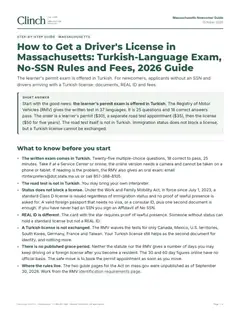
Start with the good news on this page: the learner's permit exam is offered in Turkish. The Registry of Motor Vehicles (RMV) gives the written test in 37 languages, and Turkish is one of them. It is 25 questions and 18 correct answers pass. The order is: learner's permit ($30), a separate appointment for the road test ($35), then the license ($50 for five years). The road test itself is not in Turkish.
Steps, documents and official links
- Apply for the learner's permit. You apply online and then book a Service Center appointment. The fee is $30 and the permit is good for two years or until the end of your lawful stay. A vision screening is done at the application. You must be 16 or older, a Massachusetts resident, and hold no license or permit in another state.
- Take the written exam. Twenty-five multiple-choice questions, 18 correct to pass, 25 minutes, in 37 languages including Turkish. You can sit it at the Service Center or online; the online version needs a camera and cannot be taken on a phone or tablet. If reading is the problem, the RMV also gives an oral exam in a foreign language: email [email protected] or call 857-368-8105.
- Gather the documents. The RMV takes originals only, nothing laminated, and a non-English document needs a certified translation. Identity works two ways (table below). You also need one proof of Massachusetts residency dated within the last 60 days: a lease, a utility or phone bill, a bank statement or a school letter.
- Book the road test separately. It costs $35 and is not refunded if you fail, arrive late or cancel less than 72 hours ahead. You must bring a sponsor: someone 21 or older with a valid U.S. state license and at least one year of driving experience. A person with a foreign license cannot sponsor you. The car is yours to bring, with a valid registration and inspection sticker and a parking brake the examiner can reach. Six road tests per 12 months is the limit. You may bring your own interpreter.
- Get the license. A Class D license is $50 for five years. If your lawful stay is shorter, the license is issued for a shorter term and prorated at $10 per year.
Does immigration status block a license?
No. The Work and Family Mobility Act (WFMA) has been in force since July 1, 2023: a standard Class D license is issued regardless of immigration status and no proof of lawful presence is asked for. Identity Option B exists for exactly this: a valid foreign passport that needs no visa, or a consular ID, plus one second document. If you have never had a Social Security number, you sign an Affidavit of No SSN, which is accepted only with Option B. One warning: the two guide pages for the Act on mass.gov were unpublished as of September 30, 2026. The rules now live on the RMV identification requirements page and in the license document checklist, so work from those.
Which documents count?
| What is asked for | What works for someone arriving from Türkiye |
|---|---|
| Identity, Option A (one document) | A U.S. passport, a green card, an employment authorization document (EAD), or a foreign passport together with a U.S. visa and an I-94. |
| Identity, Option B (two documents) | A valid foreign passport that needs no visa, or a consular ID, plus one of: a U.S. state driver's license, a foreign birth certificate, a foreign national ID card, a Turkish driver's license, or a U.S. marriage or divorce certificate. |
| Social Security | Your SSN; or, if you have never had one, the Affidavit of No SSN (Option B only); or an SSA denial notice issued in the last 60 days together with your passport, visa and I-94. |
| Residency | A lease, an electricity, gas or phone bill, a bank statement or a school letter, dated within the last 60 days. |
What does it cost?
| Transaction | Fee |
|---|---|
| Learner's permit application (2 years) | $30 (duplicate $15) |
| License application and road test | $35 |
| Class D license (5 years) | $50 ($10 per year if issued for less than 5 years) |
| Massachusetts ID card (Mass ID, 5 years) | $25 ($5 per year if shorter) |
| REAL ID upgrade | $50 at renewal, $25 outside the renewal cycle |
| Duplicate license or ID | $25 |
| Foreign license conversion (eligible countries only) | $115 |
These come from the RMV fee schedule revised in May 2025; check the current schedule before you go.
Can I get a REAL ID?
A REAL ID, the card with the star in the top right corner, requires proof of lawful presence. Someone without status can hold a standard license but cannot get a REAL ID. For a REAL ID you bring one lawful-presence document, one document showing your full SSN and two proofs of Massachusetts residency, with an appointment at a Service Center (AAA members can also use certain AAA branches). If you are not a U.S. citizen and your lawful stay is at least 12 months, you get a limited-term REAL ID, which cannot be renewed online. The temporary paper REAL ID is not accepted by TSA, so wait for the real card before you fly.
Service Centers and appointments
License, permit and ID transactions need an appointment through the RMV Online Service Center. When no slot is open you register and receive an email with a personal link that expires within 24 hours. In Boston, the Haymarket Service Center is at 136 Blackstone St., Boston MA 02109 (Monday to Friday 8 a.m. to 6 p.m., Saturday 9 a.m. to 4 p.m., license work by appointment only). Watertown, at 550 Arsenal St., runs road tests Monday to Friday from 9 a.m. to 5 p.m. by appointment. The RMV contact center is 857-368-8000 and the senior and disability appointment line is 857-368-8005. Office detail for the Boston area is in our Boston guide. Never pay anyone for an RMV appointment: the RMV says payments happen only on its own site or at its own locations.
02 · Foreign license
Can I drive on my Turkish license in Massachusetts, and can it be exchanged?
Short answer
A Turkish license cannot be exchanged for a Massachusetts one. The RMV waives the tests for only seven places: Canada, Mexico, U.S. territories, South Korea, Germany, France and Taiwan. Because Türkiye is not on that list, you take both the written exam and the road test like a first-time driver. You may drive on a valid Turkish license as a visitor, but no official grace period has been published for people who become residents.
Steps, documents and official links
- The conversion list: Canada, Mexico, U.S. territories, South Korea, Germany, France and Taiwan. For every other country the RMV page says plainly that you cannot convert. The conversion fee for eligible countries is $115; there is no such route for Türkiye.
- What you actually do: once you are a Massachusetts resident you apply for a license, meet the identity and residency requirements, and sit the learner's permit exam (in Turkish) and the road test. That means two separate appointments.
- Driving as a visitor: under MGL c.90 s.10, the permission to drive on a foreign license is written for nonresidents. If your license is not in English you must carry an International Driving Permit or a photo translation in English, you must be 16 or older, and the license must not be suspended.
- About the grace period: neither the statute nor the RMV page gives a number of days you may keep driving on a foreign license after becoming a Massachusetts resident. We found no official basis for the 30 or 60 day figures that circulate online. The RMV wording is this: you may drive on a valid foreign license as a visitor, and upon becoming a resident you can apply for a license. The safe move is to book the permit appointment as soon as you move.
- Keep the Turkish license anyway: it counts as the second document under identity Option B, next to your foreign passport or consular ID.
- Moving from another U.S. state: that license converts without tests and counts on its own as proof of identity.
03 · Car
How do I register a car in Massachusetts, and what insurance and inspection are required?
Short answer
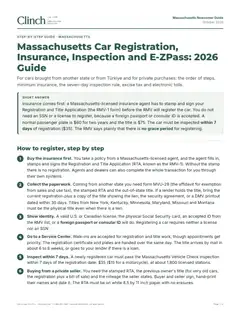
Insurance comes first: a Massachusetts-licensed insurance agent has to stamp and sign your Registration and Title Application (the RMV-1 form) before the RMV will register the car. You do not need an SSN or a license to register, because a foreign passport or consular ID is accepted. A normal passenger plate is $60 for two years and the title is $75. The car must be inspected within 7 days of registration ($35). The RMV says plainly that the law gives no grace period for registering.
Steps, documents and official links
- Buy the insurance first. You take a policy from a Massachusetts-licensed agent, and the agent fills in, stamps and signs the Registration and Title Application (RTA, known as the RMV-1). Without that stamp there is no registration. Agents and dealers can also complete the whole transaction for you through their own systems (B2B/EVR).
- Collect the paperwork. Coming from another state you need form MVU-29 (the affidavit for exemption from sales and use tax), the stamped RTA and the out-of-state title. If a lender holds the title, bring the current out-of-state registration plus a copy of the title showing the lien, the security agreement, or a DMV owner printout dated within 30 days. Titles from New York, Kentucky, Minnesota, Maryland, Missouri and Montana must be the physical title even when there is a lien.
- Identity. Under MGL c.90 s.2 a person shows at least one of: a valid U.S. or Canadian driver's license, the physical Social Security card, an accepted ID document from the RMV list, or a foreign passport or consular ID. So registering a car does not require a license or an SSN.
- Go to a Service Center. Walk-ins are welcome for registration and title work, though appointments get priority. The registration certificate and plates are handed over the same day, with the year decal for the rear plate. The title arrives by mail in about 6 to 8 weeks, or goes to your lender if there is a loan.
- Inspect within 7 days. A newly registered car must pass the Massachusetts Vehicle Check inspection within 7 days of the registration date: $35 for most vehicles, $15 for a motorcycle, at about 1,800 licensed stations.
- Buying from a private seller. You need the stamped RTA, the previous owner's title (for very old cars, the registration plus a bill of sale) and the mileage the seller states. Buyer and seller sign, hand-print their names and date it. The RTA has to be on white 8.5 by 11 inch paper with no erasures. Trailers under 3,000 pounds need no title.
Which fees and taxes come up?
| Item | Amount |
|---|---|
| Passenger registration, normal plate (2 years) | $60 |
| Certificate of title | $75 (duplicate $25) |
| Transfer registration / replacement plate / duplicate registration | $25 / $10 / $25 |
| Annual inspection | $35 ($15 motorcycle) |
| Sales and use tax | 6.25% of the purchase price or the NADA value, whichever is higher |
| Vanity plate | $80 a year ($30 registration plus $50 special plate) |
| Reinstating a registration after an insurance cancellation | $50 (other reasons $100) |
- Sales tax exemption: if you bought the car in another state and registered it there more than six months before you moved, form MVU-29 exempts you from the sales tax. The exemption does not apply to a car bought and delivered in Massachusetts without tax paid.
- Excise tax: this one does not come from the RMV. The city or town where the car is garaged bills it once a year at $25 per $1,000 of value, and the value is a percentage of the manufacturer's list price that falls with the car's age (50% in the year before the model year, 90% in the model year, then 60%, 40%, 25% and 10% from the fifth year on). The minimum is $5 and a part-year bill is prorated by month. Payment is due within 30 days of the bill date. Unpaid excise blocks your license and registration renewals, and clearing the block costs another $20 to the RMV. Cancel the plate when you get rid of the car, or the bills keep coming.
- The sticker month rule: since November 1, 2022 a new sticker carries the month the previous sticker expired. If the last sticker expired in an earlier year, the car gets a January sticker for the current year. A car that fails gets a reject sticker. If the car was out of state for a year or more, the Out of State Inspection Form gives you credit. Driving without a valid sticker is a traffic violation.
How much insurance do I need?
| Coverage | Massachusetts minimum (policies written or renewed on or after July 1, 2025) |
|---|---|
| Bodily injury to others, per person | $25,000 |
| Bodily injury to others, per accident | $50,000 |
| Property damage | $30,000 |
| Personal Injury Protection (PIP) | $8,000 |
| Bodily injury caused by an uninsured auto | $25,000 / $50,000 |
Premiums are built from three things: your driver class (how many years you have been licensed), the territory where the car is garaged, and the Safe Driver Insurance Plan (SDIP). SDIP is a points overlay: for an experienced operator each surcharge point adds 15% to the compulsory coverages and to optional collision, and 7.5% for operators licensed less than six years. A clean record earns credit codes 98 and 99, worth 7% and 17% off. At-fault accidents with more than $1,000 paid out, and surchargeable violations including out-of-state ones, count for six years; a first minor violation carries zero points. You are an "experienced" operator once you have been actively licensed for six years.
Whether an insurer credits your Turkish driving history as experience is not stated on any official page and varies by company, so give the issue date of your Turkish license when you ask for a quote. The Division of Insurance is at 1000 Washington Street, Suite 810, Boston MA 02118, phone 617-521-7794 or 877-563-4467.
PDF: Massachusetts Car Registration, Insurance, Inspection and E-ZPass: 2026 Guide
04 · Toll roads
How do I get E-ZPass in Massachusetts, and how do the tolls work?
Short answer
Every toll in the state is electronic: no booths, no cash. The Mass Pike (I-90), the Tobin Bridge and the Sumner, Callahan and Ted Williams tunnels read transponders and license plates. Two options: a free E-ZPass MA transponder account at the discounted rate, or letting the camera bill your plate (Pay By Plate MA, no discount). With no account, an invoice comes by mail and each invoice carries a $0.60 fee.
Steps, documents and official links
- Opening an account: the E-ZPass MA transponder is free. Walk into a customer service center and you get it on the spot, or it comes by mail. The initial payment is $20 per transponder on auto-replenish and $30 if you top it up yourself. The transponder also works in the other E-ZPass states (Delaware, Florida, Indiana, Kentucky, Maine, Maryland, Minnesota, New Hampshire, New Jersey, New York, Ohio, Pennsylvania, Rhode Island, Virginia and West Virginia). An out-of-state E-ZPass is accepted here, but without the Massachusetts discount.
- Driving without an account: the camera reads your plate and an invoice (Pay By Plate MA Invoice) goes to the registered owner about 7 to 10 business days after the trip, with a $0.60 fee per invoice. You can pay online, by check (EZDriveMA Payment Processing Center, P.O. Box 847840, Boston MA 02284-7840) or at a customer service center. If you do not want a transponder, there is also a registered Pay By Plate MA account, prepaid or billed every 30 days.
- If you do not pay: the official ladder runs like this. You have 30 days to pay the invoice. On days 31 to 60 it becomes a past due invoice and $1.00 is added per overdue toll. On days 61 to 90 a Notice of Non-Payment adds another $1.00 per toll. Past 90 days a Notice of Liability adds a further $1.00 per toll plus a $20.00 RMV fee, your license and registration can be marked for non-renewal, and the account can go to collections. A hold clears 1 to 2 business days after payment, or 5 days if it reached collections. The $2, $5 and $10 late fees quoted on look-alike websites are not the official figures, so use the EZDriveMA fee schedule.
- Tunnel and bridge rates (two-axle car): the Sumner, Callahan and Ted Williams tunnels cost $1.50 with a Massachusetts E-ZPass, $1.75 with an out-of-state E-ZPass and $2.05 by Pay By Plate. The Tobin Bridge is $1.25 with either E-ZPass and $1.55 by Pay By Plate. Both are tolled in each direction. There is a discounted resident rate for East Boston, South Boston and Charlestown residents with a Massachusetts E-ZPass account ($0.20 in the tunnels, $0.15 on the Tobin); ask EZDriveMA who qualifies.
- The Mass Pike (I-90): gantries run west to east through Lee, Blandford, Westfield, Ludlow, Warren, Charlton, Hopkinton, Southborough, Framingham, Weston, Newton, Brighton and Allston. Each gantry is charged separately, so price your own route on the EZDriveMA toll calculator rather than trusting the numbers on unofficial sites.
- Scam warning: EZDriveMA has published a warning about text messages claiming you owe a toll. Customer service is at 27 Midstate Drive, Auburn MA 01501, phone 877-627-7745, [email protected].
05 · Public transit
What is public transit like in Massachusetts, and how do I get to Logan Airport?
Short answer
In and around Boston it is all MBTA, known as "the T". The subway is $2.40, a local bus $1.70, a monthly LinkPass $90, and children 11 and under ride free. Under a pilot that started September 1, 2026, transfers within two hours are unlimited as long as you pay the same way each time, and express buses cost the local fare. Commuter rail runs $2.40 to $13.25 by zone. For Logan, take the Blue Line plus the free shuttle, or the Silver Line SL1, which is free from the terminals to South Station.
Steps, documents and official links
| Fare | Price |
|---|---|
| Subway (Red, Orange, Green, Blue, Mattapan, Silver Line SL1-SL2-SL3), one way | $2.40 |
| Local bus and Silver Line SL4-SL5 | $1.70 |
| Monthly LinkPass (unlimited subway and bus) | $90.00 |
| Commuter Rail, one way | $2.40 to $13.25 by zone (1A to 10) |
| Ferry | $2.40 to $9.75 |
| Children 11 and under | Free |
| Income-eligible reduced fare (ages 18-64, enrolled in a qualifying program) | About half price one way, $10 for a 7-day LinkPass, $30 monthly |
- How to pay: a CharlieCard (the reusable plastic card), a CharlieTicket from a machine, or a contactless bank card or phone (Tap to Ride). Bus fare boxes take up to $20 in cash. EBT cards work at vending machines. Monthly passes are sold from the 15th of the previous month to the 14th of the month they cover.
- The fall 2026 pilots: since September 1, 2026 transfers between subway, bus and ferry inside a two-hour window are unlimited and you pay only the highest fare. The condition matters: you must use the same payment method on every leg, and stored-value CharlieTickets and cash do not qualify. On the same date express bus fares dropped to the local bus fare and express passes stopped being sold; that pilot runs six months, to about March 1, 2027. Both are pilots and can change.
- Commuter rail: priced by zone from 1A to 10. A CharlieCard is accepted only if it holds a monthly commuter rail pass. Buy in the mTicket app (valid three hours after activation) or at a vending machine; buying from the conductor where a machine or window existed adds $3. Monthly commuter rail passes are half price for September, October and November 2026, and monthly pass holders get a $1 weekend companion fare; those promotions end with November 2026.
- Income-eligible reduced fare: for Massachusetts residents aged 18 to 64 who are enrolled in EAEDC, MASSGrant, MassHealth (CarePlus, Family Assistance, Limited or Standard), SNAP or TAFDC. A government photo ID is required and the card is renewed yearly; apply through MyCharlie, at the Charlie Service Center or at a partner location, and the card arrives in 7 to 10 business days. Note the catch: eligibility is tied to enrollment in those programs, so someone who does not qualify for MassHealth or SNAP will not qualify for this card either. Other reduced cards: the Transportation Access Pass for people with disabilities and Medicare holders, the Senior CharlieCard for 65 and over, and student cards. From October 13, 2026 a free-fare program opens for residents 75 and over who hold a Mass ID and no driver's license. The MBTA information line is 617-222-3200, weekdays 6:30 a.m. to 8 p.m.
- Outside Greater Boston: the MBTA serves Boston plus more than 170 cities and towns. In Springfield, Worcester and elsewhere, buses are run by regional transit authorities, so check the authority for your area.
- Trains: Amtrak's Acela and Northeast Regional run from Boston South Station (2 South Station) and Back Bay to New York, Philadelphia and Washington; the Lake Shore Limited makes one daily round trip to Albany, Buffalo, Cleveland and Chicago. The Downeaster to Maine leaves from North Station. Intercity buses use the South Station Bus Terminal, whose new bus concourse was finished in late 2025 and raised capacity by more than 50%.
Getting to Logan Airport
- By subway: the Blue Line to Airport station, then a free Massport shuttle to the terminals (routes 22, 33, 55, 66, or route 88 straight to the terminals). The Blue Line meets the Orange Line at State and the Green Line at Government Center.
- Silver Line SL1: picks up at the curb at all four terminals (A, B, C, E) and runs to South Station. It is free from the airport into town; going out to the airport costs the standard $2.40. The transfer to the Red Line at South Station is free.
- Other ways: MBTA ferries connect Logan with Long Wharf, Hull and Hingham year round. Logan Express buses run from Back Bay, Braintree, Danvers, Framingham and Woburn. Uber and Lyft pick up on level 2 of the Central Garage, taxis at the terminal arrivals curb, and a free shuttle serves the Rental Car Center. Logan has four terminals and more than 40 airlines.
- Turkish Airlines: flies nonstop between Logan (BOS) and Istanbul (IST), about 11 hours. Massport and the airline publish different weekly frequencies, so check days and times with the airline. Time difference is in the Türkiye section.
Station-by-station detail and parking rules for the city are in our Boston guide.
06 · Regions
What changes depending on which Massachusetts city you live in?
Short answer
License rules, tenant and deposit rights, school rights, the income tax and the sales tax are the same everywhere in the state. What changes is which company sells you electricity and gas, which municipality handles water and trash, the property tax rate and any owner exemption, which district enrols your children, and whether your USCIS file sits with the Boston or the Lawrence office. Massachusetts is made up of 351 cities and towns, and most of them run their own affairs.
Steps, documents and official links
| Region | Utilities and services | Official business |
|---|---|---|
| Boston and Suffolk County | Eversource delivers electricity everywhere. Gas is National Grid (Boston Gas) or Eversource (NSTAR Gas) depending on the street. Water and sewer come from the Boston Water and Sewer Commission and trash from the City. Boston also runs its own electricity supply program, Boston Community Choice Electricity. Detail in our Boston guide. | Property tax is billed by the City in four quarterly bills, with a residential exemption for owner-occupants. Birth, death and marriage records are at the Registry Division in City Hall. USCIS Boston field office. |
| Cambridge, Somerville, Newton, Brookline | Electricity from Eversource. Gas from Eversource (NSTAR Gas) in Cambridge, National Grid in Newton and Brookline, and either one in Somerville. Water, sewer and trash run through each city's own department, not Boston's BWSC. | Each runs its own school department, its own assessors and its own tax rate. Cambridge and Newton are in Middlesex County and Brookline in Norfolk County; deeds are recorded at the county Registry of Deeds. |
| Quincy, Revere, Everett, Chelsea | Electricity from National Grid in Everett, Quincy and Revere. Gas from National Grid in all four. The deposit ban and the shut-off protections apply exactly the same way. | Their own city halls, schools and tax rates. USCIS Boston field office, with biometrics at the Application Support Center in Revere. |
| Springfield, West Springfield and western Massachusetts | In Springfield and West Springfield, electricity from Eversource and gas from Eversource (EGMA). Some towns get electricity from their own municipal light plant, and in those towns there is no supplier choice at all. | Most USCIS files here go to the Lawrence field office (280 Merrimack Street), which is a 1.5 to 2 hour drive from the far west. There is an apostille counter in Springfield. Buses are run by regional transit authorities; the MBTA does not reach here. |
| Worcester, Cape Cod and the islands | Water, sewer and trash are entirely municipal. Look up the electric and gas company for your address with the state's company finder. | Cape Cod and the islands belong to the USCIS Boston office and most of Worcester County to Lawrence. A marriage license can be issued by any city or town clerk, with no residency requirement. |
The sales tax is the same everywhere
Unlike Washington or Texas, the Massachusetts sales tax does not change with your address: it is 6.25% statewide. The exemptions are also broad. Groceries, clothing up to $175 per item, prescription drugs, home electricity, gas and heating fuel, Internet access and cable television are all exempt. Restaurant meals are taxed, and cities may add a 0.75% local share. The income tax is a flat 5% and there is no city income tax; details are in the tax section.
- City or county: almost everything in daily life happens at city and town level here. County government has been abolished in eight of the 14 counties (Franklin in 1997, Middlesex in 1997, Hampden and Worcester in 1998, Hampshire in 1999, Essex and Suffolk in 1999, Berkshire in 2000). Counties today mostly matter for Registries of Deeds and for the courts.
- Who does what: property tax, water, sewer, trash, school enrollment and marriage licenses come from the municipality. Driver's licenses, vehicle registration, income tax, MassHealth and apostilles come from the state. Immigration is federal.
- Library card: anyone who lives, works or studies in Massachusetts can get a free library card, usually with a photo ID and proof of address; no SSN is mentioned. Nearly every library issues an instant eCard online, and the Boston Public Library eCard is open to anyone who lives, works or studies in the state.
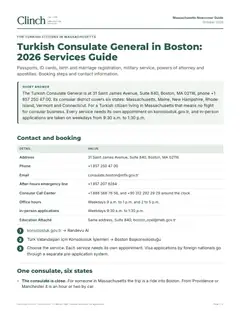
- Turkish mission: the Consulate General in Boston covers Massachusetts along with Maine, New Hampshire, Rhode Island, Vermont and Connecticut (below).
07 · Electricity and gas
How do I start electricity and gas in Massachusetts, and will I be asked for a deposit?
Short answer
No deposit can be asked for. The state regulation (220 CMR 27.00) is blunt: no company may require a deposit from a residential customer to secure payment of bills as a condition of new or continued service. The same regulations also bar late charges for residential customers. For a newcomer with no credit history that is a real advantage. Your address decides the company: Eversource, National Grid, Unitil, or your town's own municipal light plant.
Steps, documents and official links
- Find your company. The Department of Public Utilities (DPU) regulates three electric companies: Eversource, National Grid (Massachusetts Electric) and Unitil. Some towns have a municipal light plant instead. On the gas side there are Berkshire Gas, Eversource (NSTAR Gas and EGMA), Liberty Utilities, National Grid (Boston Gas) and Unitil. Look up your address in the DPU company finder.
- Eversource: a passport instead of an SSN. You open an Eversource.com account to start service. The company writes that the ID used at set-up "could be your Social Security number, driver's license, passport number, military ID, business tax ID or other government-issued ID." If you have no primary ID, you can complete an ID verification online or call customer service at 1-800-592-2000.
- National Grid: call first. The company's new-customer checklist asks for "Legal Name as shown on SSN Card" and the Social Security number, and publishes no alternative. So if you have no SSN, do not fight the online form: call 1-800-233-5325 and ask for the procedure without an SSN (weekdays 7 a.m. to 7 p.m.).
- No deposit and no late fee. The DPU billing and termination regulations prohibit security deposits and late charges for residential customers. The one exception is an unpaid old bill of yours with the same company, which can be required, with an instalment plan of up to three months if you have not missed two consecutive bills. Non-residential accounts are outside the ban.
- Water, sewer and trash are municipal. These three are not run by the state but by each of the 351 cities and towns. In most places the water account is in the owner's name. The Boston rules are in our Boston guide.
Be careful with supplier offers
Electricity splits into "delivery" and "supply": your utility delivers, and you can buy the supply from a competitive supplier if you want. The state's own Attorney General warns against that market. A report dated March 31, 2026 found that residential customers who switched to a competitive supplier paid $738.7 million more over the last decade than they would have on the utility's basic service, with a loss of $87.4 million in July 2024 to June 2025 alone. Low-income customers lost an average of $286 a year, against $181 for everyone else. The Attorney General's own word for the market is "predatory."
- You cannot be switched without consent. Consent must be a signed letter or a spoken statement to an independent verifier; switching you without it ("slamming") is illegal. You have three business days to cancel. A supplier must give you a terms-of-service statement and a contract summary showing the price, the term, the fees, any early cancellation fee and auto-renewal; a fixed-rate contract that renews itself needs notice 30 to 60 days before it expires.
- Sign nothing at your door. According to the Attorney General's fact sheet, utility companies do not send representatives to your door or call you to talk about electricity supply rates.
- The alternative: many cities and towns run their own bulk-purchase program (municipal aggregation) and that becomes the default supply. Boston's program, BCCE, has rates locked through December 2027 (see the Boston guide).
- When the rate changes: under a 2023 DPU order, Eversource and National Grid buy basic service in six-month blocks, February to July and August to January. So the next change is February 1, 2027.
- Complaints: Attorney General consumer hotline 617-727-8400; DPU Consumer Division 877-886-5066 or 617-737-2836.
Winter and help with the bill
- Winter shut-off ban: if a household has a documented financial hardship, the electricity or gas used to heat the home cannot be shut off between November 15 and March 15. At any time of year, with a hardship plus a seriously ill resident, an infant under 12 months, or a household where all adults are 65 or over and a minor lives there, a shut-off needs DPU approval. If everyone in the home is 65 or older, service cannot be shut off at all without written DPU approval. "Financial hardship" means being unable to pay an overdue bill with income at or below the fuel-assistance limit, which is 60% of state median income.
- Last winter the window was longer: the DPU ran the 2025-26 ban from October 27, 2025 to April 1, 2026. No similar extension for 2026-27 had been announced as of October 1, 2026, so check with your own company.
- Discount rates: some gas customers get 25% off and electric customers 32% to 71% off depending on the utility, and people enrolled in certain benefit programs are moved onto the discount automatically. Payment plans and Arrearage Management Programs are also available.
- HEAP (fuel assistance): the Massachusetts name for the federal energy assistance program. It is free, and homeowners and renters can both apply, including people whose heat is included in the rent. The online application opens every year on October 1, the heating season runs November 1 to April 30, and you must reapply each year; first-time applicants need an intake appointment. Applying also opens the door to the heating-system repair program (HEARTWAP) and to weatherization. The income limit is 60% of state median income; for fiscal year 2027 the maximum gross annual income is $53,585 for one person, $70,073 for two, $86,561 for three, $103,049 for four, $119,536 for five and $136,024 for six. Documents: photo ID of the head of household, a list of household members, heating bill information, the lease or mortgage statement and 30 days of income proof. The heating emergency line is 1-800-632-8175, and there is also 211.
- HEAP and immigration status: the state page says nothing about it. The local agencies that run the program may ask you to document citizenship or qualified immigrant status, so a household here on a temporary visa may not qualify. Ask your local agency before applying, and read the public benefits section for your own situation.
- Heat-pump rate: households that heat with a heat pump get a separate, much lower delivery rate from November 1 to April 30: $0.02052 per kWh at Eversource (against $0.06264 on the normal rate), $0.02440 at National Grid (against $0.06677) and $0.03633 at Unitil (against $0.10176).
- Good Neighbor Energy Fund: run by the Salvation Army for households that cannot meet a month's energy bill, are not eligible for state or federal energy help, and have income between 60% and 80% of state median.
08 · Renting
What can a Massachusetts landlord ask for up front, and when does the deposit come back?
Short answer
In Massachusetts the list of up-front payments is closed: the first month's rent, the last month's rent, a security deposit of at most one month's rent, and the cost of a new lock and key. Nothing else may be charged. The deposit has to sit in a separate interest-bearing Massachusetts bank account and must be returned within 30 days of the end of the tenancy. A landlord who breaks the rules owes triple damages plus attorney's fees. Since August 1, 2025 a tenant cannot be charged a broker fee either.
Steps, documents and official links
Up-front payments
- Four items and no more: first month's rent, last month's rent, a security deposit not exceeding one month's rent, and the purchase and installation cost of a lock and key. Last month's rent cannot be used as the security deposit unless both sides agree. If the rent goes up, the landlord may raise the last-month amount to match.
- What is not allowed: application fees, move-in fees, credit or background check fees. Under the rule in force since August 1, 2025, a broker or salesperson may not charge a tenant for services provided primarily to the landlord; the fee comes only from the party that engaged the broker and signed a contract with them. That is the end of the "one month's rent finder's fee" long collected in Boston. A violation is a consumer protection violation: the Attorney General can act and a tenant can sue. The complaint line is 617-727-8400.
- How the deposit is held: in a separate interest-bearing account at a Massachusetts bank. Within 30 days you get a receipt naming the bank, the account number and the amount. If you stay at least a year, interest of 5% a year, or the bank's lower rate, is paid each year on the anniversary of the tenancy. Interest is owed on last month's rent too (5% if it is not held in a bank).
- Statement of condition: you must be given a signed statement of the condition of the apartment when you move in.
Getting the deposit back
- The deadline: 30 days after the tenancy ends. If anything is deducted you get a sworn, itemised list of damages with repair estimates. Normal wear and tear cannot be charged to you.
- The penalty: a landlord who mishandles the deposit, does not return it on time, or fails to transfer it to a new owner owes three times the deposit, plus interest, court costs and attorney's fees. For certain violations the landlord may keep no part of it for damage at all. A new owner must notify tenants in writing within 45 days of receiving the money. The rules are in c.186 s.15B and 940 CMR 3.17(4).
Late rent, notices and eviction
- Late fees: a lease may not require a late fee if the rent is less than 30 days late. A lease also cannot make you pay for ordinary wear or professional cleaning, or make you waive the right to sue or to report Sanitary Code violations.
- Notice to quit: 14 days for unpaid rent (30 days in federally assisted housing), and 30 days for other reasons such as a lease violation or the landlord wanting the unit back. The notice by itself does not mean you have to leave: only a court order can make you go. A nonpayment notice must have the rental-assistance form attached. You have 10 days to appeal after a judgment, and before any removal a sheriff or constable must give written notice 2 days ahead, not counting weekends and holidays.
- Tenancy at will: either side can end it with the longer of 30 days or one rental period of notice, and the rent can change with the same notice.
- There is no rent control. G.L. c.40P s.2 bans rent control and any scheme implementing it. The initiative to repeal that ban and set a 5% cap was blocked by the Supreme Judicial Court on June 23, 2026 and did not reach the November 2026 ballot. So there is no ceiling on rent increases in this state; what protects you is your lease term and the notice periods.
- Heat: during the heating season from September 15 to May 31 the landlord must keep the home at at least 68 F during the day (7 a.m. to 11 p.m.) and 64 F at night (11:01 p.m. to 6:59 a.m.), and no higher than 78 F (105 CMR 410.180). A cold apartment is a complaint for the local board of health.
- No retaliation: a landlord may not raise the rent, change the locks, shut off the heat, start an eviction or report you to the police or to immigration officials because you complained about conditions, went to the board of health or joined a tenants' union. Such conduct within six months of the protected act is presumed retaliatory. Submetering utilities to tenants is also prohibited.
- Emergency rent help: the RAFT program pays up to $7,000 a year to eligible families behind on rent or facing eviction, and a pending RAFT application is a protection in eviction court. We could not find the immigration-eligibility rule on an official page, so ask before you apply.
- If you have no lawyer: the courts' Court Service Centers help self-represented people, and the state says plainly that there are no income or immigration status requirements for them.
09 · Property tax
How does property tax work in Massachusetts, and is there an owner exemption?
Short answer
Property tax is set and collected by the city or town where the home sits, not by the state. The state rule is Proposition 2 1/2: the total a municipality raises cannot exceed 2.5% of total taxable value, and the total cannot grow more than 2.5% a year except for new construction and voter-approved overrides. The fiscal year runs July 1 to June 30 and value is set as of the previous January 1. There is no statewide homestead break, but many cities, Boston among them, give owner-occupants a residential exemption.
Steps, documents and official links
- The municipality bills you. The city or town assessors value the property and the collector sends the bill. Some bill quarterly and some semiannually. Boston bills four times a year, due August 1, November 1, February 1 and May 1 (detail in our Boston guide).
- What Proposition 2 1/2 does not limit: it caps the total levy, not how much any single home's assessment can rise. If values in your neighborhood jump, your bill can rise by more than the average.
- The owner exemption is a local option. The state lets municipalities grant a residential exemption on an owner-occupied home, and some do. Ask your own assessors whether they offer it, what the deadline is and which documents they want. In Boston the exemption application asks for a Social Security number; whether an ITIN is accepted is something to ask the City's taxpayer assistance line (617-635-4287).
- Challenging the assessment (abatement). Each municipality has its own calendar, usually opening once the bill carrying the real rate arrives. If you are refused, you can appeal to the state Appellate Tax Board (100 Cambridge St., Boston, 617-727-3100).
- Buying: the deed excise. The state charges $2.28 per $500 of the price, which is $4.56 per $1,000, on a transfer of a home. It is normally the seller's cost. Municipalities that have adopted the Community Preservation Act add a surcharge to the tax bill (1% in Boston).
- For seniors: the state has a senior "circuit breaker" tax credit and municipalities run their own elderly exemptions. Terms and amounts change from year to year and from city to city, so ask your assessors.
Do not look for a Texas or Florida style blanket homestead discount in Massachusetts: here the break is a local decision and in most places it depends on living in the home. On the income tax side there is an advantage for renters instead, because half of the rent paid is deductible up to $4,000 (see the tax section).
10 · School
How do I enrol my child in a Massachusetts school, and is an SSN required?
Short answer
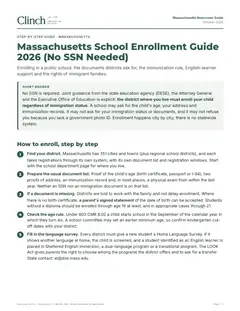
No SSN is required. Joint guidance from the state education agency (DESE), the Attorney General and the Executive Office of Education is explicit: the district where you live must enrol your child regardless of immigration status. A school may ask about your child's age and where you live, and may ask for immunisation records, but it may not ask for your immigration status or immigration documents, and it may not refuse you because you lack a government-issued photo ID. Enrollment happens city by city; there is no statewide system.
Steps, documents and official links
- Find your district. Massachusetts has 351 cities and towns (plus regional school districts), and each takes registrations through its own system and sets its own document list and registration windows. Start with the school department page for where you live. The Boston steps are in our Boston guide.
- The usual document list. Proof of the child's age (birth certificate, passport or I-94), two proofs of address, an immunisation record and, in most places, a physical exam from within the last year. Neither an SSN nor any immigration document is on that list.
- If a document is missing. The DESE guidance tells districts to work with the family to find another way and not to delay enrollment. Where there is no birth certificate, a parent's signed statement of the date of birth can be accepted. Students without a diploma should be enrolled at least through age 18, and in appropriate cases through 21.
- Compulsory age. Under 603 CMR 8.02 a child starts school in the September of the calendar year in which they turn six. A school committee may set an earlier minimum age, so confirm kindergarten cut-off dates with your district.
- The language survey. Every district must give a new student a Home Language Survey. If it indicates another language at home, the child is screened, and a student identified as an English learner is placed in Sheltered English Immersion, a dual-language program or a transitional bilingual program. Yearly progress is measured with the WIDA ACCESS test. The LOOK Act of 2017 gives parents the right to choose among the programs the district offers and to ask for a transfer, and requires English Learner Parent Advisory Councils. The state contact is [email protected].
How the immunisation rule works
The state Department of Public Health (DPH) sets the list and the school enforces it (105 CMR 220.000). For 2026-27, from the document updated in January 2026:
| Grade | Vaccines required |
|---|---|
| Child care and preschool (age 2 and up, K0-K1) | Hib 1 to 4 doses (by product and age), DTaP 4, polio 3, hepatitis B 3, MMR 1 (on or after the first birthday), varicella 1. |
| Kindergarten through grade 6 | DTaP/Tdap 5 doses (4 if the fourth was given on or after the fourth birthday), polio 4 (3 if the third was on or after the fourth birthday and six months after the previous one), hepatitis B 3, MMR 2, varicella 2 (a reliable history of chickenpox or lab evidence is also accepted). |
| Grades 7 through 12 | One Tdap dose plus a DTaP primary series history, polio 4, hepatitis B 3, MMR 2, varicella 2. Meningococcal (MenACWY or MenABCWY): one dose on or after the tenth birthday for grades 7 to 10; for grades 11 and 12 a second dose on or after the sixteenth birthday and at least eight weeks after the first (one dose is enough if it was given on or after the sixteenth birthday). |
Lab evidence of immunity is accepted for hepatitis B, MMR and varicella. A medical exemption must be renewed every year; a religious exemption needs a statement from the parent or student that a vaccine is against sincerely held religious beliefs, and that should be renewed yearly too. Children who are homeless or in foster care cannot be turned away for missing records at registration. The document was updated in January 2026, so confirm the row for your child's grade with the school.
What if the school asks for immigration documents?
The Attorney General's guidance says districts should not collect for enrollment purposes or keep documents containing passport information, visa information or Social Security numbers, may not limit proof of residency to a government-issued ID, and should accept a parent's affidavit of date of birth. If an immigration officer asks to question a student or take a student from school, the school needs either specific informed written parental consent or a valid judicial warrant; federal FERPA law bars sharing student information without consent or a court order. The Attorney General's Civil Rights Division is at 617-963-2917. If a district insists, put your request to the district office in writing first, then call those lines.
PDF: Massachusetts School Enrollment Guide 2026 (No SSN Needed)
11 · Health
What can I do in Massachusetts without health insurance, and is coverage mandatory?
Short answer
Two things matter together here. First, Massachusetts has an individual mandate and the penalty is collected on your state tax return: for tax year 2026 it runs from $26 to $211 a month depending on income, with no penalty at or below 150% of the federal poverty level. Second, there are real places to turn when you are uninsured. MassHealth Limited covers emergency care and the Health Safety Net covers care at hospitals and community health centers. In an emergency no hospital may turn you away because you cannot pay.
Steps, documents and official links
MassHealth (Medicaid) and immigrants
- How to apply: with the "Application for Health and Dental Coverage and Help Paying Costs." MassHealth customer service is 800-841-2900 (TTY 711). There are six coverage types: Standard, CommonHealth, CarePlus, Family Assistance, Premium Assistance and Limited.
- Residency: you live in Massachusetts and intend to stay, with or without a fixed address, or you came with a job commitment or to look for work. Visitors here on vacation or for medical care do not qualify.
- Status categories: Qualified Noncitizen (asylum, refugee, Cuban or Haitian entrant, or a green card held more than five years), Qualified Noncitizen Barred (green card held less than five years), Nonqualified Lawfully Present (for example B1/B2, J-1, F-1, holders of an employment authorization document), Nonqualified PRUCOL, and Other Noncitizen (no status).
- Pregnant people and children: whatever the category, a pregnant person who meets the income rules gets full MassHealth during pregnancy and for 12 months after the birth. Children under 21 who are lawfully present or PRUCOL get comprehensive MassHealth if income-eligible. Children under 19 with no status are covered by the Children's Medical Security Plan (CMSP).
- MassHealth Limited: emergency services only, for residents who meet the income rules but whose immigration status bars broader coverage, including people with no status. The card comes by mail. Combined with the Health Safety Net it can mean no-cost primary care, labs, dental, vision and prescriptions at HSN providers.
- The October 1, 2026 change: because of a federal change, from that date some lawfully present immigrant groups lose comprehensive Medicaid: refugees, people granted asylum, humanitarian parolees, survivors of abuse and trafficking, people with withholding of removal, and certain Iraqi, Afghan and Ukrainian groups plus the noncitizen-veteran category. MassHealth estimates about 7,300 members are affected. Not affected: green card holders, Cuban and Haitian entrants, COFA migrants, children under 21, and people who are pregnant or postpartum. Affected members who are 65 or older or disabled move to Family Assistance; non-disabled members aged 21 to 64 move to MassHealth Limited and the Health Safety Net.
- January 2027: work or education requirements and six-month renewals begin for some members.
The Health Safety Net (HSN)
- For Massachusetts residents who are uninsured or underinsured. With income between 0 and 150% of the federal poverty level there is no deductible; above 150% and up to 300% a deductible applies. You need proof of residency, income and identity, and you renew every year.
- There is no card: HSN is not insurance but a fund that pays the provider. Keep your eligibility letters.
- Where it works: only at acute care hospitals and community health centers. HSN pays the facility charge; hospital doctors who bill separately and private labs can fall outside it. There are no prescription copays, but HSN pharmacies are limited and the prescriber has to be from the affiliated facility. HSN can also act as a secondary payer.
- People with no status: those eligible for both MassHealth Limited and HSN can get care at no cost from HSN providers, and emergency hospital care at any hospital. The fine detail sits in the regulations, so the right move is to apply and ask the provider.
The Health Connector, ConnectorCare and the dates
- Open enrollment for 2027 runs October 23, 2026 to January 23, 2027. For coverage that starts January 1, 2027 you must choose a plan and pay by December 23, 2026; for a February 1 start, by January 23, 2027. The general rule: finish and pay by the 23rd and coverage starts on the 1st of the next month. MassHealth, ConnectorCare and standalone dental can be joined at any time of year. Customer service is 1-877-623-6765 (TTY 711).
- Where 2026 stands: ConnectorCare is for citizens, nationals and lawfully present people with income between 100% and 400% of the federal poverty level. Plan Type 1, for people below the poverty line who were barred by immigration status, ended on January 1, 2026. DACA recipients lost Marketplace eligibility on August 25, 2025.
- The narrowing from January 1, 2027: lawfully present people can still buy a plan, but financial help (APTC) and ConnectorCare will be limited to green card holders, Cuban and Haitian entrants and COFA migrants. People granted asylum, refugees, TPS holders and every nonimmigrant visa category (B, F, U, H, R and so on) lose the subsidies. The Health Connector estimates about 35,000 enrollees are affected.
- The mandate and the penalty: most adults 18 and over who have access to affordable insurance must carry minimum creditable coverage and report it on Schedule HC with the state return. The monthly penalty per adult for tax year 2026: $26 between 150.1% and 200% of the poverty level, $51 from 200.1% to 250%, $76 from 250.1% to 300%, $117 from 300.1% to 400%, and $211 above 400%. In annual terms that is $312 to $2,532. There is no penalty at or below 150% of the poverty level ($23,475 for one person in 2026). Gaps in coverage of up to 63 days carry no penalty.
Clinics: free or income-based?
- Community health centers are not free. Federal rules require every federally supported health center to run a sliding fee discount program based only on income and family size: a full discount (a small nominal fee is allowed) at or below 100% of the poverty guideline, and no discount above 200%. So these centers are reduced fee, not free. Nobody is turned away for inability to pay, but the bill is not zero either.
- How to find one: search the HRSA health center finder for income-based centers near your address. We list the free and reduced-fee clinics in Boston one by one in our Boston guide.
- In an emergency: call 911 or go to an emergency room. Under the federal EMTALA law, hospitals with an emergency department must screen and stabilise you regardless of ability to pay. MassHealth Limited covers emergency services at any emergency room.
- Help lines: MassHealth 800-841-2900, Health Connector 1-877-623-6765.
12 · Marriage
How do I get a marriage license in Massachusetts?
Short answer
Any city or town clerk can issue it and there is no residency requirement. Both partners must be 18 or older, currently unmarried, and must apply together, in person, with an appointment. In Boston the fee is $50. Three rules are the same statewide: there is a three-day waiting period after you file, the license is valid for 60 days after that, and the ceremony has to take place in Massachusetts.
Steps, documents and official links
- Where to apply: the state guide says you may apply to any city or town clerk, not only where you live or where you will marry. Fees vary by municipality; in Boston it is $50 (cash, debit or credit card, or a money order payable to "City of Boston"). Boston handles it at the Registry Division on the second floor of City Hall (1 City Hall Square, Room 213), at windows 24 or 25; phone 617-635-4175.
- An appointment is required. Boston takes no walk-ins. After booking online you get an email link to fill in the Marriage Intention form in advance; you review and sign it at the window.
- ID and the SSN: a valid photo ID is required and a passport works. The form asks for a Social Security number, but if you do not have one you write down why (never issued, or not a U.S. resident). Proof of age by birth certificate or passport is the general rule, so bring the passport. There is no blood test.
- The three-day wait and the 60 days: the wait counts from the day the license is filed. If the license is not used within 60 days after that, it expires and you start again. The license cannot be used outside Massachusetts.
- Skipping the wait: the "Marriage Without Delay" court form (G.L. c.207 s.30) asks a judge to waive it. The total is $195 ($180 filing plus a $15 surcharge), filed at the Probate and Family Court, District Court or Boston Municipal Court in the county where you are getting the license. Ask the clerk which court to use.
- Who may officiate: Massachusetts clergy and justices of the peace; out-of-state clergy need a state petition filed no more than six weeks before the wedding; a friend or relative can get a One Day Designation to officiate a single ceremony (apply between six months and one week ahead, no residency requirement). The officiant completes the license and returns it to the issuing clerk before the 60 days run out.
- A copy of the certificate: in Boston, $12 in person and $14 by mail.
- After a divorce: you cannot apply until the divorce is final, and a Massachusetts divorce becomes final after 90 days. If the divorce was granted in another state, call the clerk and ask what they need.
- If one of you cannot come: there is a separate route for active military duty, hospitalisation or imprisonment; in Boston you arrange it by calling 617-635-4175. Interpretation is free on request, and since Turkish is not on the published language list, ask for it when you book.
Changing your name
- When no court is needed: a name change through marriage, inside a divorce complaint, or at naturalisation (through the N-400 and the oath ceremony) needs no separate case.
- By court order: you petition the Probate and Family Court in your county with form CJP 27, signed before a notary with photo ID. The fee is $165 ($150 plus a $15 surcharge), with another $15 if the court orders notice. One fee covers a family petition, and a fee waiver is available with an affidavit of indigency. For someone born abroad, the "legal name" is taken to be the name on the immigration document.
- The order to follow: take the name change to Social Security first, then the RMV, then USCIS and your passport. A mismatch across documents delays applications.
13 · Birth
How do I get a birth certificate for a baby born in Massachusetts?
Short answer
Two routes. For a birth in Boston, the City's Registry Division issues the certificate: $12 in person, $14 online or by mail. For births anywhere else in the state, the Registry of Vital Records and Statistics (RVRS) in Dorchester issues it: $20 in person, $32 by mail, and $54 for the first copy ordered by phone or online through VitalChek. The hospital does not order the certificate for you, so you have to request it yourself.
Steps, documents and official links
- The state office (RVRS): 150 Mount Vernon St., 1st floor, Dorchester MA 02125, phone 617-740-2600, weekdays 8:45 a.m. to 4:45 p.m. It issues certified copies for any event that happened in Massachusetts. Fees: $20 in person (cash, check or money order), $32 by mail, $42 expedited by mail, $54 for the first copy through VitalChek and $42 for each additional one ($62.50 and $50.50 expedited). VitalChek is reachable at 866-300-8535. For ID they prefer a driver's license, even an expired one, or another government photo ID. Records from 1931 to 1935 have moved to the State Archives.
- Boston records: Registry Division, 1 City Hall Square, Room 213, weekdays 9 a.m. to 4 p.m. It covers births in Boston from 1870 to the present, in a hospital or at home, and births where the parents gave a Boston address: $12 in person, $14 online (shipping included) and $14 by mail (check or money order to the City of Boston, a photocopy of your ID and a self-addressed stamped envelope). Card payments carry a 2.5% fee with a $1 minimum, and PIN debit is not accepted.
- Who may request one: as a rule the person themselves, their parents, a legal guardian or an authorized representative. If the parents were not married at the birth, the record is restricted and only the people named on it, or an unlisted father with paternity documents, may request it with ID.
- What happens at the hospital: new parents sign a birth filing form there. The first certified copy is not free and the hospital does not order it on your behalf.
- Death certificates: Boston issues them from 1956 to the present for people who died in Boston or listed a Boston address ($12 in person, $14 online or by mail). Since July 1, 2026 Massachusetts death certificates no longer carry the decedent's Social Security number unless a requester with a legitimate need asks for it.
- Apostille: a document to be used in Türkiye needs a certified copy, and the apostille comes from the Secretary of the Commonwealth at $6 per document (apostille section). City and town clerks and the state Registrar of Vital Records are among the accepted signers, so ask the Commissions Section which signature they will accept before you order.
- The baby's SSN application is a separate step, covered in the SSN section.
14 · Social Security
How do I get a Social Security number in Massachusetts?
Short answer
SSNs are issued only to people with work authorization or a legally required reason. If you asked for an SSN in your immigrant visa application, the card is mailed to you. People who adjust status with Form I-485, and EAD applicants who checked the SSN box, also receive the card automatically. Otherwise, start online and visit an SSA office by appointment within 45 days; it is free.
Steps, documents and official links
- What to bring: current immigration documents (green card, I-94 or EAD) with a valid passport, and a birth certificate if you have one. No photocopies or notarized copies. SSA suggests waiting 10 days after arrival so DHS records can be verified.
- F-1 and J-1: an SSN is available only once you are authorized to work (on-campus job, CPT, OPT), not just for enrolling in school.
- Which office: SSA's own Boston region page lists 30 field offices in Massachusetts, among them Boston, Dorchester, Roxbury, Roslindale, Cambridge, Malden, Quincy, Lynn, Waltham, Norwood, Framingham, Brockton and Hanover. We do not print street addresses here: your ZIP code decides which office serves you, and addresses change. Confirm yours with the SSA office locator before you go.
- National line: 1-800-772-1213. A replacement card is free and can often be started online.
- Name change after marriage: update your Social Security record at any SSA office, free of charge.
What can I do in Massachusetts without an SSN?
- Driver's license: under the Work and Family Mobility Act, Massachusetts issues a standard Class D license regardless of immigration status. If you have never had an SSN you sign an Affidavit of No SSN. The rules are on the RMV identification requirements page and in our license section. A REAL ID still requires lawful presence.
- School enrollment: under Attorney General guidance, districts should not collect documents containing passport details, visa details or Social Security numbers for enrollment. See the school section.
- Marriage license: the form asks for an SSN, but if you do not have one you write down why. See the marriage section.
- Taxes: people who must file but cannot get an SSN use an ITIN (below).
According to SSA, you do not need an SSN for a driver's license, school registration or private health insurance.
15 · Taxes
What is the Massachusetts income tax, and how do I get an ITIN?
Short answer
Massachusetts has a flat state income tax: 5% on most income and 8.5% on short-term capital gains. For tax year 2026 an extra 4% surtax applies to taxable income above $1,107,750. There is no city income tax anywhere in the state, not even in Boston. Instead of a standard deduction you get a personal exemption: $4,400 single, $8,800 married filing jointly. People who cannot get an SSN apply for an ITIN on Form W-7.
Steps, documents and official links
How the state income tax works
- One rate: 5% on wages, interest, dividends and long-term capital gains; 8.5% on short-term capital gains; 12% on gains from collectibles. The Department of Revenue rates page publishes the figures.
- The 4% surtax: for tax year 2026 an additional 4% applies to taxable income above $1,107,750 (the 2025 threshold was $1,083,150). The threshold is adjusted for inflation each year, and withholding also takes the extra 4% on wages above it.
- No city tax: unlike New York City, neither Boston nor any other Massachusetts city levies an income tax. Local taxes are limited to property tax, motor vehicle excise and the optional local meals and room taxes.
- Exemptions: instead of a standard deduction there is a personal exemption of $4,400 single, $8,800 married filing jointly and $6,800 head of household, plus $1,000 per dependent.
- Moving from Texas? There was no state income tax there. Build the 5% into your budget when you compare salary offers.
Which credits work with an ITIN?
- Filing: DOR requires an SSN or an ITIN on the return; ITIN filers enter the ITIN in the number field on Form 1.
- Earned Income Tax Credit: the state credit is 40% of the federal one, but you, your spouse and any qualifying child must each have a valid SSN, so ITIN-only filers cannot claim it.
- Child and Family Tax Credit: $440 for each qualifying person (a child under 13, a disabled spouse or dependent, or a dependent aged 65 or over). The taxpayer needs an SSN or an ITIN; a qualifying person with neither can be claimed on a paper return using a Massachusetts Alternative Taxpayer Identification Number (MATIN), which cannot be e-filed.
- Rent deduction: 50% of the rent paid for a Massachusetts principal residence, up to $4,000. Security deposits, last month's rent and condo fees do not count as rent.
- Health coverage: the state individual mandate is reported on Schedule HC with your return. For tax year 2026 the monthly penalty runs from $26 to $211 per adult depending on income; there is none at or below 150% of the federal poverty level, and a gap of up to 63 days is not penalized. More in the health section.
How much is sales tax?
Sales tax is 6.25% statewide, with no local add-on, and the exemption list is long: groceries, clothing up to $175 per item (only the amount above $175 is taxed), prescription drugs and prescription eyeglasses, home electricity, gas and heating fuel, Internet access and cable TV, and the first $30 a month of residential telephone service. Restaurant meals, including takeout, are taxed, and a city or town may add a 0.75% local meals tax. If you buy from out of state or online with no tax charged, you report the 6.25% use tax to DOR yourself.
How do I get an ITIN?
- Complete Form W-7 and attach it to your federal return unless an exception applies.
- Get documents verified. Mail originals to the IRS in Austin, use a Certifying Acceptance Agent (CAA), or book an appointment at an IRS office that reviews ITIN documents. With a CAA or an IRS office, your passport does not go in the mail; documents are returned at the end of the appointment.
- Wait. Processing takes about 7 weeks, or 9 to 11 weeks during tax season (January 15 to April 30).
- IRS offices: the IRS list shows in-person ITIN document review in Massachusetts at Boston, Brockton, Fitchburg, Hyannis, Springfield, Woburn and Worcester. The Boston center is in the John F. Kennedy Federal Building at 15 New Sudbury Street and is appointment-only. Appointments: 844-545-5640. Confirm addresses with the IRS office locator.
- Expiration: an ITIN not used on a federal return for three years in a row expires.
16 · Starting a business
How do I start an LLC in Massachusetts, and what does it cost?
Short answer
A Massachusetts LLC is formed by filing a Certificate of Organization with the Secretary of the Commonwealth for $500. The real difference is the running cost: every year, on the anniversary of the original filing, you file an annual report for another $500. Keeping an LLC alive here costs $500 a year. If you trade under any name other than your legal name you also file a business certificate (DBA) with your city or town clerk; in Boston that is $65 and renews every four years.
Steps, documents and official links
- Certificate of Organization: filed with the corporations division of the Secretary of the Commonwealth for $500. The LLC exists only once the state approves it, so do not sign contracts in the company's name before then.
- EIN: free from the IRS. A single-member LLC with no employees may use the owner's SSN, but banks and clients usually ask for an EIN.
- Tax registration: registering with the Department of Revenue through MassTaxConnect requires an EIN.
- Workers' compensation: in Massachusetts every employer with even one employee must carry workers' compensation insurance. Budget for it from the start.
- Annual report: $500 every year, due on the anniversary of the original filing.
| Item | Where | Cost |
|---|---|---|
| Certificate of Organization (LLC) | Secretary of the Commonwealth | $500 |
| Annual report | Secretary of the Commonwealth | $500 every year |
| Name reservation | Secretary of the Commonwealth | $30 |
| Amendment | Secretary of the Commonwealth | $100 |
| Certificate of good standing | Secretary of the Commonwealth | $25 |
| Business certificate (DBA), Boston | Boston City Clerk | $65, every four years |
| EIN | IRS | Free |
How do I register a trade name (DBA)?
- Where: a business certificate goes to the clerk of the city or town where you operate, not to the state.
- Boston example: City Clerk, City Hall, Room 601, One City Hall Square, Boston, MA 02201, phone 617-635-4601. The fee is $65 and the certificate renews every four years. In person it is issued while you wait; by mail it takes two to three days.
- What to bring: a notarized form (the City Clerk notarizes free with photo ID), a real business address (no P.O. box and no virtual address), the home address of everyone with an interest in the business, and a signed lease or a notarized letter from the landlord. An entity must be registered with the state first. The form is available in 12 languages.
- BOI reporting: according to the state's own guide, businesses created in the United States are exempt from beneficial ownership information reporting; those created abroad must file.
17 · Public benefits
Will public benefits in Massachusetts affect my green card application?
Short answer
They can. Under the federal public charge rule in effect since September 18, 2026, officers may consider means-tested benefits received on or after that date. Joint guidance from the Massachusetts Attorney General and the Office for Refugees and Immigrants says MassHealth, SNAP and housing assistance may now be weighed. Refugees, asylees, TPS, U and T visa holders, VAWA self-petitioners and citizenship applicants are exempt. Do not drop a benefit before you talk to an attorney.
Steps, documents and official links
- Who the rule reaches: the state guidance says the new review applies to family-based and employment-based green card applications and to visa applications from abroad. Applications filed before September 18, 2026 are reviewed under the old rule, but benefits you keep receiving after that date can still be considered.
- Which benefits count: MassHealth, SNAP, state and federal housing assistance, and also SSI, EAEDC and TAFDC. No single factor decides a case, while a missing Form I-864 affidavit of support on its own can sink one.
- Who is exempt: refugees and asylees, special immigrant visa holders, U and T visa holders, VAWA self-petitioners, SIJ, TPS, parole-based admissions, deferred action, and citizenship applications.
- The guidance's own words: the new rule does not change who is eligible for public benefits. Whether to keep a benefit is a decision about your immigration file, not about eligibility.
- U.S.-citizen children in the household may receive benefits in their own right, and benefits received by family members are generally not counted against the applicant.
- The October 1, 2026 MassHealth change: MassHealth's noncitizens page says that from this date some lawfully present immigrants (refugees, asylees, humanitarian parolees, survivors of abuse and trafficking and similar groups) lose comprehensive Medicaid. Green card holders, Cuban and Haitian entrants, COFA migrants, children under 21 and people who are pregnant or postpartum are not affected. Those aged 21 to 64 who are affected move to MassHealth Limited and the Health Safety Net. From January 2027 some members face work or education requirements and six-month renewals.
- January 1, 2027 at the Health Connector: lawfully present people can still buy a plan, but subsidies (APTC) and ConnectorCare stay only for green card holders, Cuban and Haitian entrants and COFA migrants. Open enrollment for 2027 runs from October 23, 2026 to January 23, 2027; choose and pay by December 23, 2026 for coverage starting January 1.
- SNAP: applications go through the state Department of Transitional Assistance (DTA). Eligibility for noncitizens is narrow and keeps shifting with federal law, so ask DTA and your attorney what applies to your status before you file.
- Free legal help: the state guidance points to the Boston Bar Association and Massachusetts Bar Association referral services and to the Massachusetts Immigrant and Refugee Advocate HelpLine at (508) 293-1871.
18 · Address change
I moved to Massachusetts. Do I have to report my new address to USCIS?
Short answer
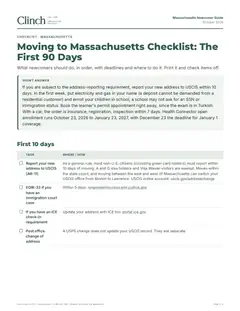
Generally, most noncitizens in the U.S., including Green Card holders, must report a new address to USCIS within 10 days of moving. The easiest way is the change-of-address tool in your USCIS online account; the paper Form AR-11 is also free. If you have a case in immigration court, you must also notify the court within 5 days on Form EOIR-33. Moves within the state count too.
Steps, documents and official links
- Log in to your USCIS account and open Change of Address. Reporting online satisfies the legal requirement; no paper AR-11 is needed.
- Enter the receipt number of every pending case. Otherwise notices may still go to the old address.
- Tell USPS separately. A post office change of address does not update USCIS, and USPS does not forward USCIS mail.
- If you are in court proceedings, file Form EOIR-33/IC within 5 days. The court changes your address only through this form.
- If you have ICE reporting obligations (for example, check-ins set when you were released), update ICE too through the ICE Portal. ICE's page asks for updates within 5 business days of moving.
A and G visa holders and Visa Waiver visitors are exempt from the USCIS requirement.
19 · USCIS
Where are the USCIS offices in Massachusetts, and where do I go for biometrics?
Short answer
Massachusetts has two USCIS field offices: Boston, in the John F. Kennedy Federal Building at 15 New Sudbury Street, Room E-160, and Lawrence, at 280 Merrimack Street, Suite 610. Eastern Massachusetts and Cape Cod are served by Boston; Worcester, the Springfield area and the Berkshires by Lawrence. Biometrics are taken at the support centers in Revere (7F Everett Street) and Lawrence. Neither field office accepts walk-ins.
Steps, documents and official links
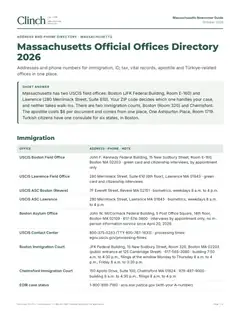
| Office | Address | What happens there |
|---|---|---|
| USCIS Boston Field Office | John F. Kennedy Federal Building, 15 New Sudbury Street, Room E-160, Boston, MA 02203 | Green card and citizenship interviews, service appointments |
| USCIS Lawrence Field Office | 280 Merrimack Street, Suite 610 (6th floor), Lawrence, MA 01843 | Green card and citizenship interviews |
| ASC Boston (Revere) | 7F Everett Street, Revere, MA 02151 | Biometrics, weekdays 8 a.m. to 4 p.m. |
| ASC Lawrence | 280 Merrimack Street, Lawrence, MA 01843 | Biometrics, weekdays 8 a.m. to 4 p.m. |
| Boston Asylum Office | John W. McCormack Federal Building, 5 Post Office Square, 14th Floor, Boston, MA 02109 | Asylum interviews for ME, MA, NH, RI and VT, 617-574-3600 |
- Which office serves me: under the USCIS ZIP-code file dated August 6, 2026, the Boston office covers Suffolk, Norfolk, Plymouth, Bristol, Barnstable, Dukes and Nantucket counties plus most of Middlesex and parts of Essex and Worcester. The Lawrence office covers most of Worcester, plus Franklin, Hampden (Springfield), Hampshire and Berkshire counties and the rest of Middlesex and Essex. So in western Massachusetts your field office can be an hour and a half to two hours away. The only rule that counts is your notice.
- Biometrics: the center is assigned on your I-797C notice and may not be the closest one. Someone living in Boston is sent to Revere, not downtown. Do not go to any center without a notice. Our biometrics guide covers what to bring.
- Other support centers: the ZIP-code file assigns separate center codes to the Cape, the Springfield area, Berkshire County and part of Worcester County, but USCIS publishes no address pages for them. We do not name those centers here; read the address off your notice.
- Asylum cases: the Boston Asylum Office stopped providing in-person information services on April 20, 2026. There are no walk-ins, and interviews are by appointment only.
- Appointments and questions: USCIS Contact Center at 800-375-5283 (TTY 800-767-1833), or your USCIS online account. Appointments are free.
- Processing times: on the USCIS processing times page, pick the form, the category and Boston or Lawrence as the office. Times update monthly.
- Your attorney at the interview: since May 18, 2026, attorneys may no longer join field-office interviews remotely, except in limited circumstances. If your attorney attends, it has to be in person.
20 · Court
Where are the immigration courts in Massachusetts, and how do I check my case?
Short answer
Massachusetts has two immigration courts: Boston, in the JFK Federal Building at 15 New Sudbury Street, Room 320, and Chelmsford, at 150 Apollo Drive, Suite 100. The Boston court shares its building with the USCIS field office and the IRS center; the public entrance is at 125 Cambridge Street. Your hearing notice tells you which court and courtroom. Check your case with your A-number on EOIR's online portal (ACIS) or at 1-800-898-7180.
Steps, documents and official links
| Court | Address | Phone and hours |
|---|---|---|
| Boston Immigration Court | JFK Federal Building, 15 New Sudbury Street, Room 320, Boston, MA 02203 (public entrance at 125 Cambridge Street) | 617-565-3080; open 7:50 a.m. to 4:30 p.m., window filing Monday to Thursday 8 a.m. to 4 p.m. and Friday 8 a.m. to 3:30 p.m. |
| Chelmsford Immigration Court | 150 Apollo Drive, Suite 100, Chelmsford, MA 01824 | 978-497-9000; open 8 a.m. to 4:30 p.m., window filing 8 a.m. to 4 p.m. |
- Getting to Boston: take the MBTA Green or Blue Line to Government Center. There is no public parking at the building, so plan on transit. Both courts have security screening, and cameras and recording devices are not allowed in courtrooms.
- Email: [email protected] and [email protected].
- Online lookup: ACIS needs only your A-number (A + 8 or 9 digits). Your hearing notice is still the official source; the system may show new dates late.
- ICE: ICE's New England office is not in Boston but in Burlington: ICE ERO Boston Field Office, 1000 District Avenue, Burlington, MA 01803, (781) 359-7500. It covers all six New England states. If you have a check-in, the place is named in your paperwork, and you should talk to your attorney before you go.
- Arrests at courthouses: from November 3, 2026 a new Massachusetts law applies to civil arrests at courthouses. We cover it in the new state laws section.
Where do I find my I-94, and how do I fix an error?
Download your most recent I-94 from CBP's website. Errors made at entry (wrong visa class, name or admit-until date) are corrected by CBP Deferred Inspection. The Boston office is at Logan Airport, Terminal E, Lower Level, Room 500, Boston, MA 02128, open Monday to Thursday 8 a.m. to 2 p.m., (617) 568-1810, [email protected]. It fixes only mistakes made at the time of entry.
21 · New state laws
What do the new Massachusetts laws protect, and what do they not?
Short answer
The PROTECT Act, chapter 163 of the Acts of 2026, signed on August 5, 2026, created two rules. The first, in force since September 4, 2026, bars state and local police and court employees from asking about immigration status and from holding anyone solely on an ICE detainer. The second, effective November 3, 2026, requires a judge-signed warrant or order for a civil arrest at a courthouse. Neither law takes away the federal powers of ICE or CBP.
Steps, documents and official links
G.L. c.147 s.64: the rule for police and court staff (since September 4, 2026)
- Who is bound: the State Police, county sheriffs, municipal police, MBTA and Massport police, college and hospital police and employees of law enforcement agencies, plus staff of the Trial Court, the Appeals Court and the Supreme Judicial Court.
- What is barred: asking about or recording immigration or citizenship status; using state or local resources for federal civil immigration enforcement; giving federal immigration authorities non-public personal information, advance notice of release (with exceptions for violent crimes) or custody status; stopping, searching, arresting or detaining someone because of actual or perceived status; questioning people for civil immigration enforcement; holding someone past their release time solely on an immigration detainer; and transporting someone to immigration agents without a judicial warrant or court order.
- The exception: status may be asked about where federal or state law or a judicial warrant requires it, or where the officer has an articulable, case-specific reason, documented in the report, that status is directly material to an element of a specific serious offense. Testing credibility or gathering general information does not qualify. Victims, witnesses and people seeking help can be asked about status for U and T visa certification.
- 287(g): no new 287(g) agreements. The Department of Correction may keep its 2020 agreement, and time-limited, criminal-only agreements are possible with the governor's approval.
What this law does not do
Do not skip this part. The law does not bind ICE or CBP; federal officers continue to act under their own authority. It does not stop criminal investigation, fingerprinting or the sharing of criminal data. And it gives no private right of action: the Attorney General enforces it and has published a complaint process. So it is a limit on state and local officers, not a shield against federal agents.
G.L. c.221D: civil arrests in courts (effective November 3, 2026)
- The rule: no law enforcement officer, employee or representative of a law enforcement agency, including a federal agency, may make a civil arrest at a courthouse unless they are acting officially and show a designated judge or magistrate in the courthouse a judge-signed warrant or order authorizing the civil arrest. It can never happen in a courtroom.
- Where it applies: inside the building and also its lawns, steps, parking lots and walkways.
- The key distinction: an administrative ICE warrant or a document issued by an immigration judge does not meet the requirement. Under the law's definition, those are not judicial warrants or orders.
- Consequences: an arrest in violation counts as false imprisonment and the person can seek a writ of habeas corpus. Here too there is no private right of action; the Attorney General may sue. The Trial Court keeps copies of warrants and publishes an annual report each July 1. Court staff are under no duty either to help or to obstruct federal agents.
- Set your expectations carefully: whether federal agents will comply, or will challenge the law in court on preemption grounds, is not yet known. Before November 3, 2026 the Trial Court's own policy applies.
What the same Act requires of employers
The PROTECT Act also requires an employer who receives notice of an ICE I-9 inspection to give written notice to employees within 48 hours. It requires schools, child care programs and health care providers to adopt policies on access for civil immigration enforcement. And from November 3, 2026 state and local agencies must answer U and T visa certification requests within 45 days, or 14 business days if the person is in removal proceedings, free of charge.
22 · Voting and jury duty
I'm not a citizen. Can I register to vote in Massachusetts, and what if I get a jury summons?
Short answer
Registering and voting are for U.S. citizens only, green card holders included. A jury summons is different: Massachusetts draws jurors from each town's census, not the voter rolls, and the jury office has no citizenship records. Never ignore it. Answer using sections 2A and 2B of the confirmation form and send proof. At the Registry of Motor Vehicles, do not answer yes to the citizenship question unless you are a citizen.
Steps, documents and official links
- The jury list does not come from the voter roll: Massachusetts uses each city and town's annual "numbered resident list," its local census. It covers everyone aged 17 or over who lived in the town on January 1. Neither the voter rolls nor the Registry of Motor Vehicles (RMV) feed it (G.L. c.234A s.10). The jury office states on its own page that it has no access to citizenship or Social Security number records (juror eligibility and disqualification). So a noncitizen living in a town who never registered to vote can still be summoned, and a summons is not evidence that anyone made a mistake.
- Jurors have to be citizens: serving requires U.S. citizenship (G.L. c.234A s.4), and not being a citizen is one of the statutory disqualifications. You can answer the summons online, or complete sections 2A and 2B of the Juror Confirmation Form that arrives by mail. Those sections are where you ask to be disqualified.
- How to send proof: to show you are not a citizen, send your alien card number, your visa status or a copy of your passport to the Office of Jury Commissioner, online, by email ([email protected]), by fax ((617) 422-5869) or by mail. Include the juror badge number from the summons. Confirming that the office received your proof is your responsibility, so make sure they have it. The official steps are on the proof of disqualification instructions page. It gives no separate deadline, so go by the date on the summons.
- Do not ignore the summons: Massachusetts runs a Notice of Delinquency process for people who do not respond. Throwing the letter away does not make it go away, and answering takes a few minutes.
- The spot that needs the most care is the RMV: if you tell the RMV you are a U.S. citizen on a license, permit or ID transaction, you are registered to vote automatically. There is no way to decline at that point any more: the VOTES Act removed the option to decline registration from the application on January 1, 2023. You can only decline afterwards, through your town's election office (RMV automatic voter registration). Read that part of the form carefully, and if you are not a citizen, do not answer yes. A Work and Family Mobility Act license is issued regardless of status, but the voter registration rules do not change.
- The penalty is heavy: registering or voting while knowing you are not a qualified voter can bring a fine of up to $10,000, up to five years in prison, or both (G.L. c.56 s.8 and s.26). Registering or voting without citizenship can also have serious immigration consequences (USCIS Policy Manual).
- Do not fill out voter registration forms handed out door to door or at events, even if a campaign worker says it is fine. Read anything before you sign it.
- Scams: courts do not call or email asking for your SSN, do not demand fines by phone, and never ask for payment in crypto or gift cards.
Recently naturalized? The Secretary of the Commonwealth's registration page explains the requirements and the ways to register. Deadlines change with every election, so check early.
23 · New citizens
I just became a citizen. How do I get a U.S. passport in Massachusetts?
Short answer
A first U.S. passport is applied for in person on Form DS-11, at an acceptance facility such as a post office, with your original proof of citizenship. An adult passport book costs $130 plus a $35 acceptance fee; for a child under 16 it is $100 plus $35. If you must travel abroad within 14 days, the Boston Passport Agency handles urgent cases by appointment, booked at travel.state.gov or 877-487-2778.
Steps, documents and official links
- Find an acceptance facility: wherever you live in the state, use the passport facility locator. These locations accept new applications (DS-11) only, and the acceptance fee is paid separately from the passport fee. Do not assume a city hall or a library offers the service; if it is not on the list, do not go.
- Urgent travel: the Boston Passport Agency serves appointments only, and only with proof of travel within 14 days (or a foreign visa needed within 28 days). Book through the official Boston page or at 877-487-2778; appointments are free. Confirm the agency's address and entrance from your appointment confirmation and the official page rather than from third-party listings. The expedite fee is an extra $60.
- Fees: adult passport book $130, child under 16 $100, acceptance fee $35, expedite $60. Amounts change, so check the fees page before you pay.
- Online renewal: for eligible adults, only through the State Department's own renewal system. Stay away from third-party sites that charge to renew a passport.
- Your certificate: you take the original naturalization certificate to the appointment and get it back at the end. Losing it means a long and expensive replacement.
Official sources
Not sure about a step?
Ask before you do something that touches your immigration status
Applying for a benefit, changing your address, registering to vote or answering a jury summons can all show up in your file. You can speak with Attorney Asim Clinch, a Turkish-speaking immigration attorney serving clients in Massachusetts, in English or Turkish.
24 · Things to do
What are the places to visit in Massachusetts?
Short answer
The state is small and varied. Boston's Freedom Trail is walked on foot, and the federal stops along it charge no admission. Ferries from Long Wharf reach the Boston Harbor Islands in about half an hour, but the season ends on October 12, 2026. Cape Cod National Seashore is about a two-hour drive, and Mount Greylock in the Berkshires, the highest point in the state, closes its summit road on October 30, 2026. In October, Salem pulls the whole state to Essex County.
Steps, documents and official links
| Place | Region | What it is | Admission |
|---|---|---|---|
| Boston and the Freedom Trail | Suffolk County | A historic walking route with 16 official sites. The federal stops are the Faneuil Hall visitor center, the Charlestown Navy Yard, the Bunker Hill Monument and USS Constitution. Off-season hours start October 13: visitor centers Wednesday to Sunday, Bunker Hill Monument 10 a.m. to 5 p.m. (25 people at a time, climbing closed in bad weather), USS Constitution 10 a.m. to 4 p.m. with photo ID for ages 18 and over. | No admission fee at the federal stops; Paul Revere House $6 adult and $1 for ages 5 to 17; Old State House $15 adult |
| Boston Harbor Islands | Boston Harbor | A national and state park of 34 islands and peninsulas. Ferries run from Long Wharf to Georges Island (Thursday to Sunday) and Spectacle Island, and from Hingham to Peddocks Island. The crossing takes about 30 minutes. The fall schedule ends October 12, 2026 and the islands close until spring 2027. | Ferry ticket; 50% off for up to 4 people with a library pass |
| Cape Cod National Seashore | Outer Cape | Six beaches: Coast Guard and Nauset Light in Eastham, Marconi in Wellfleet, Head of the Meadow in Truro, and Race Point and Herring Cove in Provincetown. About two hours by car; public transport is limited. | Beach fees only in season: $25 per vehicle, $20 motorcycle, $15 per person aged 16+ walking or cycling, $60 annual pass. Sold only at the beach entrances and by card only |
| Mount Greylock | The Berkshires, western Massachusetts | The highest point in Massachusetts. The summit auto roads are open May 16 to October 30, 2026, and vehicles over 22 feet are not allowed. The visitor center opens daily 9 a.m. to 4 p.m. (closed Thanksgiving and Christmas), Bascom Lodge sits on the summit, and the Veterans War Memorial Tower is open daily through October 12, 2026, weather permitting. There are hiking trails and primitive camping on Sperry Road. | Park free; some facilities charge |
| Salem | Essex County, north of Boston | Haunted Happenings runs all through October, and 2026 marks the city's 400th anniversary. Weekends get very crowded; ferries and commuter trains run from Boston. | Street events free; museums ticketed |
| Emerald Necklace and the Arnold Arboretum | Boston | A 1,100-acre, seven-mile chain of parks: the Back Bay Fens, the Riverway, Olmsted Park, Jamaica Pond, the Arborway, the Arnold Arboretum and Franklin Park. The Arboretum alone covers 281 acres with more than 15,000 plants. | Parks free every day; Franklin Park Zoo charges admission |
Two things Massachusetts does differently
- Library museum passes: libraries such as the Boston Public Library reserve museum passes that cut admission to nothing or to about half at many places. Examples: the Museum of Science exhibit halls free for 4 people, the Isabella Stewart Gardner Museum at $5 each for up to 4, the Harvard Museums of Science and Culture free for up to 4, the Boston Children's Museum at $12 per person for up to 4, the Museum of Fine Arts at $15 for two adults and $10 for up to four youth, and a New England Aquarium coupon for up to 4. Passes need an active physical library card; digital eCards do not work. Which pass sits at which branch varies, and you must reserve in advance.
- EBT Card to Culture: a Massachusetts-issued EBT card, and at many venues a WIC or ConnectorCare card, brings free or typically $3 admission at more than 600 cultural organizations. You show the card at the desk and pay by other means. Discounts differ by venue and usually cannot be combined, so check the list before you go.
Planning for fall: after mid-October the islands, the summit roads and the coastal facilities close one after another. Put the seasonal trips (ferries, summits, beaches) in the first half of October and leave museums and city walks for November and December.
25 · Free and family-friendly
What are free things to do in Massachusetts, and where can I go with kids?
Short answer
The Arnold Arboretum is free every day, and so are the Emerald Necklace parks. In Boston the 43-mile Harborwalk, the Rose Kennedy Greenway, Castle Island and Boston Common cost nothing, and the federal stops on the Freedom Trail charge no admission. The Museum of Fine Arts is free to all Massachusetts residents on October 12, 2026. Most museums families visit are far cheaper with a library pass or an EBT Card to Culture.
Steps, documents and official links
Free
- Arnold Arboretum: 281 acres in Jamaica Plain with more than 15,000 plants, and in its own words open every day, free every day. Free street parking along the Arborway, Flora Way and Walter Street; the visitor center is at the Arborway Gate.
- Emerald Necklace: 1,100 acres of linked parks including the Back Bay Fens, Jamaica Pond and Franklin Park, open to everyone every day.
- Boston Harborwalk: a near-continuous 43-mile public path along the shoreline, from the Neponset River in Dorchester to Constitution Beach in East Boston.
- Rose Kennedy Greenway: a downtown linear park with free events, public art and fountains. The carousel charges separately.
- Castle Island (South Boston): a 22-acre state park joined to the mainland by walkways. Fort Independence opens in the warm season; autumn tour days shift, so confirm before you go.
- The federal stops on the Freedom Trail: the National Park Service publishes no admission fee for the Faneuil Hall visitor center, the Charlestown Navy Yard, the Bunker Hill Monument or USS Constitution. Photo ID is required on USS Constitution for ages 18 and over.
- MFA Open Houses: free for all Massachusetts residents on October 12, 2026, January 18, 2027, May 31, 2027 and June 18, 2027. A valid Massachusetts ZIP code is enough, there are no advance tickets, and entry is first come first served. Every visitor needs a ticket, even a free one.
- Fee-free days in the national parks: the remaining 2026 dates are October 27 and November 11. On those days Cape Cod National Seashore charges no beach fee. From 2026 the Park Service limits free entrance on these days to U.S. citizens and residents; non-residents pay the regular entrance fee, and at some parks a non-resident fee on top of it. The Park Service page does not say who counts as a resident, so if you are not a citizen, check before you rely on it.
- Boston Family Days: students who live in Boston, plus two guests, get in free at many institutions on the first and second Sunday of each month, announced through December 2026. By that rule the remaining 2026 dates are October 4 and 11, November 1 and 8, and December 6 and 13. Boston public school students are enrolled automatically; other Boston families register on the city's page and receive the pass by email. Participating venues include the MFA, the ICA, the Museum of Science, the Boston Children's Museum, the New England Aquarium, Franklin Park Zoo, the Gardner Museum, the JFK Library and the USS Constitution Museum.
With kids
- A library pass is the cheapest route: with Boston Public Library passes, the Museum of Science exhibit halls are free for 4 people (under 3 always free), a New England Aquarium coupon covers up to 4 people aged 3 and over, the Harvard Museums of Science and Culture are free for up to 4 (17 and under always free), the Isabella Stewart Gardner Museum is $5 each for up to 4 (under 18 always free), and the Boston Children's Museum is $12 per person for up to 4. Zoo New England passes, the Trustees GO Pass, ICA tickets and a DCR parking pass for state parks are also on the list. Passes are reserved online or by phone with an active physical library card.
- EBT Card to Culture: an EBT card brings typically $3 admission at more than 600 organizations, the broadest discount available to a family.
- Boston Harbor Islands: the half-hour ferry ride is an outing in itself for children, and participating libraries offer 50% off tickets for up to 4 people. The season closes October 12, 2026.
- Cape Cod National Seashore: children under 16 who walk or cycle in pay nothing; the beach fee applies only to vehicles and only in season.
- Boston Public Market: an indoor year-round market, open Sunday to Tuesday 8 a.m. to 6 p.m. and Wednesday to Saturday 8 a.m. to 8 p.m., with free public tours and validated parking at $3 for up to three hours.
- Boston Common Frog Pond: the ice-skating season starts in mid-November. The 2026-27 opening date and prices are not published yet, so check the rink's page before you go.
- Mount Greylock: you can drive to the summit, which makes it a mountain trip that works with small children. The roads close October 30, 2026 and tower access ends October 12.
26 · Turkish consulate
Where is the Turkish Consulate General in Boston, and how do I book an appointment?
Short answer
The Turkish Consulate General is at 31 Saint James Avenue, Suite 840, Boston, MA 02116, phone +1 857 250 47 00. Its consular district covers six states: Massachusetts, Maine, New Hampshire, Rhode Island, Vermont and Connecticut. That is a real advantage compared with most states in this series, where people fly across the country for consular business. Every service needs its own appointment on konsolosluk.gov.tr, and in-person applications are taken on weekdays from 9:30 a.m. to 1:30 p.m.
Steps, documents and official links
To book: konsolosluk.gov.tr → Randevu Al → Türk Vatandaşları İçin Konsolosluk İşlemleri → Boston. Visa applications by foreign nationals go through a separate pre-application system.
| Detail | Value |
|---|---|
| Address | 31 Saint James Avenue, Suite 840, Boston, MA 02116 |
| Phone | +1 857 250 47 00 |
| [email protected] | |
| After-hours emergency line | +1 857 207 9284 |
| Consular Call Center | +1 888 566 76 56, and +90 312 292 29 29 around the clock |
| Office hours | Weekdays 9 a.m. to 1 p.m. and 2 to 5 p.m. |
| In-person applications | Weekdays 9:30 a.m. to 1:30 p.m. |
| Education Attaché | Same address, Suite 840; [email protected] |
| Commercial Attaché | 43 Thorndike Street, Suite 1-4, Cambridge, MA 02141 |
A district of six states
The consulate's own contact page gives its district as Massachusetts, Maine, New Hampshire, Rhode Island, Vermont and Connecticut. Turkish citizens across New England handle passports, ID cards, civil registry matters and powers of attorney here. Set against states whose residents fly to another coast, a drive of an hour or two from Providence or Manchester is a genuine advantage. The flip side is that one office serves the whole region, so appointment slots fill up. Do not leave a deadline to the last week.
| Service | How | Fee |
|---|---|---|
| Passport | In person only, by appointment | Ask the consulate for the current fee before your appointment |
| Turkish ID card | In person only, by appointment; not handled by mail | $10.20 cash; $15.50 to replace a lost card |
| Birth registration | In person or by mail | $35 to send the documents to Türkiye; the child's ID is $5 within 60 days of birth, $10.20 after |
| Marriage registration | In person or by mail | Confirm the fee and document list before you apply |
| Death registration | In person or by mail | No fee |
| Power of attorney and notarial acts | At the consulate building only | Ask the consulate for the current fee |
Getting a Turkish ID card
- Who comes in: adults in person; a 15 to 18 year old with a parent; for a child under 15, the parent applies.
- What to bring: one 2x2 inch biometric photo taken within the last six months and the old ID card. Without the old card, a passport, driver's license or marriage book works.
- Payment: cash. The new card is mailed to the consulate; if you need identification sooner you can ask for a temporary ID.
Registering a U.S.-born child with the Turkish civil registry
- Conditions: at least one parent is a Turkish citizen, the child is under 18, and the birth took place in the six-state district.
- Documents: the original certified birth certificate plus a copy (a short-form birth record is not accepted), both parents' identification, a translation if a foreign parent's birth certificate is not in English or Turkish, the marriage certificate if you are married (the marriage must be registered first), and the dual citizenship form.
- Payment: cash or money order; personal and company checks are not accepted.
- Where the certificate comes from: for a baby born in Boston, the city Registry issues it; for a birth elsewhere in the state, the state Registry of Vital Records in Dorchester does. See our birth certificate section.
Fees and document lists are updated during the year. For passports, powers of attorney and criminal record extracts, confirm the current fee by phone or on the consulate's contact page before your appointment, and do not rely on another mission's price list.
Turkish military service (askerlik)
- Registration (yoklama): men born in 2007, and anyone without a deferral, must complete it by December 31, 2026, through the consulate or e-Devlet.
- Paid service (dövizle askerlik): for July to December 2026 the amount is the foreign-currency equivalent of 472,653.60 TL, collected in U.S. dollars at the Turkish central bank rate on the day of payment. Whether the Boston consulate adds a transfer fee is not published on the pages we could read, so ask before your appointment. The amount changes on January 1, 2027.
- Conditions: working in the U.S. with a residence or work permit, at least three years (1,095 days) of work abroad excluding time spent in Türkiye, completion of the Ministry of Defence online course, and residence in the consular district. All of Massachusetts is in Boston's district, and applications are in person by appointment only.
- Dual citizens born in the U.S., or who arrived as minors and naturalized, may defer to the end of age 35, once U.S. citizenship is recorded in the Turkish civil registry. The work requirement does not apply to them; three years abroad is enough.
- F-1 students defer through the Education Attaché at the same address, [email protected].
PDF: Turkish Consulate General in Boston: 2026 Services Guide
27 · Apostille
How do I get an apostille on a Massachusetts document for use abroad?
Short answer
One office issues apostilles in Massachusetts: the Secretary of the Commonwealth, Commissions Section, One Ashburton Place, Room 1719, Boston, MA 02108. The fee is $6 per document, among the lowest of any state. The signature must be original and belong to a Massachusetts official; photocopied signatures are refused. Up to three documents are processed at the counter, and mail service takes two to three weeks. Türkiye is a party to the Hague Apostille Convention, so no further consular legalization is needed.
Steps, documents and official links
- Get the right signature. The Commissions Section apostilles original signatures only from a Massachusetts notary public, a justice of the peace, a city or town clerk or assistant clerk, a court clerk or assistant clerk, or the Registrar of Vital Records. A document carrying a photocopied or scanned signature is turned away. A document issued in another state is apostilled by that state, not by Massachusetts.
- Birth and marriage certificates: the page lists city and town clerks and the Registrar of Vital Records as valid signers, so a certified copy from them can be apostilled. Asking the Commissions Section which signature it accepts before you order the certificate saves a round trip.
- Apply. In person, up to three documents are processed at the counter. Four or more are left and picked up after 3 p.m. the next business day; anything dropped off after 4 p.m. waits another day. By mail, allow two to three weeks from the day your package arrives.
| Route | Where | Time and payment |
|---|---|---|
| In person, 1 to 3 documents | One Ashburton Place, Room 1719, Boston, MA 02108 | Processed at the counter |
| In person, 4 or more | Same office | Pick up after 3 p.m. the next business day |
| By mail | Same office | Two to three weeks; check payable to the Commonwealth of Massachusetts and a prepaid return envelope; no credit cards |
| Regional counters | Southeastern Office in Fall River and Western Office in Springfield | See the Commissions Section page for addresses and turnaround |
- Fee: $6 per document, not per page.
- Phone: the number published for the Commissions Section is 617-727-2836. Confirm it on the official page rather than from search results.
- Federal documents: FBI background checks and naturalization certificates are apostilled not by Massachusetts but by the U.S. Department of State, Office of Authentications, on Form DS-4194, $20 per document.
28 · Time and flights
What is the time difference between Massachusetts and Türkiye, and is there a nonstop flight?
Short answer
Türkiye stays on UTC+3 all year, while Massachusetts is on Eastern Time with daylight saving. So Türkiye is 7 hours ahead until November 1, 2026, and 8 hours ahead from then until March 14, 2027. At 9 a.m. in Boston it is 4 p.m. in Istanbul now, and 5 p.m. after November 1. Turkish Airlines flies nonstop from Boston Logan (BOS) to Istanbul Airport (IST), a flight of about 11 hours.
Steps, documents and official links
- U.S. clock changes: daylight saving time starts on the second Sunday of March and ends on the first Sunday of November: November 1, 2026 and March 14, 2027. The gap therefore shifts twice a year.
- Calling Türkiye: with a 7 to 8 hour difference, Turkish office hours fall between about 2 and 9 a.m. in Boston. Plan early mornings if you need to reach a government office or a bank there.
- Logan to Istanbul: Turkish Airlines appears on Massport's list of nonstop international routes, and the flight runs about 11 hours. Massport and the airline do not agree on the number of weekly departures, so check days and times on the airline's own page.
- Getting to the airport: take the MBTA Blue Line to Airport station and the free terminal shuttle; the Silver Line SL1 is free from Logan to South Station. Logan Express buses run from Back Bay, Braintree, Danvers, Framingham and Woburn. Leave extra time for international bag drop.