01 · Driver's license
How do I get a driver's license in Missouri?
Short answer
Missouri splits the job between two agencies and you have to visit both: the Missouri State Highway Patrol gives the tests, the Department of Revenue sells the card. The good news is on the testing side: the tests are free, need no appointment, and are given in all 114 counties, the written test can be retaken twice in one day, and no proof of address and no Social Security number is asked at the test. Those are only asked when you buy the license at a Department of Revenue license office. The bad news: the written test is not offered in Turkish.
Steps, documents and official links
Two agencies, two visits, one document
Understand this structure first, because it is uncommon in this series. The Highway Patrol does the testing: the written test, the vision test, the road sign test and the driving test are given at a driver examination station. When you pass you are handed Form 100, the Driver Examination Record. The Department of Revenue sells the card, but not from its own branches: Missouri licensing runs through a network of contract-operated license offices. Without Form 100 that office will not serve you.
One detail: for an upgrade, the department tells you to take your identity, status, number and residency documents to the examination station as well, not only to the license office.
What the test does not ask, and what the license office does
We state this split plainly, because it is what wears people out. In the Highway Patrol's own words on its FAQ page, you do not need proof of residency or a Social Security card to take the tests; those are needed later, when you buy the credential at the license office.
On identity at the test, the Patrol's own sentence is this: non-citizens holding either a valid permanent resident card or a valid work authorization card need no other documents; other non-citizens with valid status will most often test using a valid unexpired passport with a valid unexpired visa, accompanied by an I-94.
At the license office, four classes of document are required: proof of identity, Date of Lawful Status, proof of a Social Security number, and proof of a Missouri residential address. An applicant who wants a REAL ID-compliant card brings two residency documents; an applicant who wants a non-REAL-ID card brings one.
Accepted residency documents include any two current utility bills (phone, electric, gas, water, sewer, cable), a property tax receipt, a voter ID card, or an official letter issued within the last 90 days by a state, local or federal agency on its own letterhead. A PO Box is not acceptable as a residential address, and the card is mailed to the address you give. On identity, the documents that work for a non-citizen are an Employment Authorization Document, or a foreign passport with a U.S. visa accompanied by an I-94.
Missouri publishes no credential for someone without lawful status
We write this as it stands. Proof of lawful status is asked at every transaction: as a new resident, as a first-time applicant and at renewal, whether or not the card is REAL ID-compliant. In Missouri the non-REAL-ID card is not a status-free alternative; the only difference is how many residency documents are required. The research found no Missouri equivalent of Connecticut's drive-only credential or Colorado's marked card, and that is not a reading of the statute: the state's statute site was unreachable throughout, so this is a conclusion drawn from every Department of Revenue and Highway Patrol page that could be read.
A second consequence costs you time: online renewal is closed to immigrants. Eligibility requires a United States citizenship document verification indicator on the record, and the department's own sentence is this: persons with USCIS-issued immigration documents must apply in person and submit documents for review and SAVE verification at the time of application. The same restriction is repeated for the online duplicate service. So for a Turkish reader, every license transaction is an in-person one.
Two more details for anyone without a number. Applicants without an SSN may be ineligible for a REAL ID-compliant document depending on lawful status verification, and must present a letter from the Social Security Administration about the status of the number. Applications without a number may go to the central office for final approval before printing, so build a delay into your timeline. There is a written exemption for students: in the department's words, a nonimmigrant foreign student who is not authorized to work in the United States does not have to submit an SSA status letter, provided the immigration document reflects an F or a J classification.
The test is free, walk-in, and repeatable
This is the easiest testing regime in the series. The Patrol's own sentence: there is no cost for either the written or the non-CDL driver skills test. The commercial license is the exception: nothing at the station, but $25.00 on top of the license fee when the CDL is bought at the license office.
- No appointment is needed for the written test or for a non-CDL skills test. Some sites offer optional appointment slots for skills tests and the Patrol recommends using them where offered; CDL skills tests do require an appointment.
- Testing is offered in all 114 Missouri counties.
- Written test: 25 multiple-choice questions, 80 percent to pass, so you may miss five. It may be retaken twice in one day. It is not open book, and every question comes from the Missouri Driver Guide; for Class F the commercial vehicle chapter is excluded.
- Formats: touch-screen PC or tablet, printed paper, an oral test by computer, or read aloud by an examiner.
- Driving test: 70 percent to pass, one per day, and a maximum of three in 12 months without special permission. You supply the vehicle; it need not be yours, but it must be registered and insured, carry current plates and a valid inspection sticker.
- The test includes parallel parking into a 25 ft by 7 ft space (within 18 inches of the curb, within two minutes) and parking on a hill, plus backing, two right and two left turns and intersections. The Patrol's reassuring note: failing the parallel park does not automatically fail you, it counts for only a few points.
- Vision standard: acuity of at least 20/40 with either or both eyes, and peripheral vision of at least 55 degrees in each eye or 85 degrees in one.
Two warnings. A passed test is not a license: in the Patrol's words, your test score document is not legal for any type of driving until you buy a license or permit. And if your license is suspended or revoked, getting it back means taking all four tests again.
The written test is not offered in Turkish, and the internet says otherwise
This is the most important correction on this page. Several third-party driving-test websites list Turkish among Missouri's test languages. The Highway Patrol's own published list does not include Turkish.
The list's own heading says these are the language options available for Class F written testing as of November 12, 2024. The list, in written and/or audio versions, is: American Sign Language (computer video only), Arabic, Bosnian, Chinese, Dari, English, French, German, Greek, Italian, Japanese, Kinyarwanda, Korean, Marshallese, Pashto, Russian, Spanish, Swahili, Ukrainian and Vietnamese. Twenty options including sign language, and Turkish is not among them.
One limit: that list is for the Class F written test. The research found no equivalent published list for Class E or the motorcycle test. And the only readable copy of the list is a June 2025 archived capture; the Patrol's site could not be reached, so we cannot confirm the list is unchanged today.
Two real mitigations do exist. First, the test can be read aloud by an examiner or taken orally by computer; that is an accommodation inside English, not a translation. Second, the test is free and can be retaken twice in one day, so failing the first attempt costs only time. Whether you may bring your own interpreter could not be confirmed: the no-interpreter rule that circulates online is the federal commercial license rule, and the Patrol's page says nothing about interpreters for Class F. We assert neither; ask at the station.
Practical advice: plan to sit the test in English and study the Missouri Driver Guide, because it is the only source of the questions.
Fees
| Transaction | Fee |
|---|---|
| Ordinary driver license (Class F) | $16.50 for up to 3 years, $33.00 for up to 6 years |
| Nondriver ID card (Class ND) | $24.00, expiring on your birthday in the sixth year |
| Instruction permit (Class F) | $10.00 |
| Intermediate license (age 16) | $14.00 |
| Written and driving tests | Free for non-commercial classes, at a Highway Patrol station |
| License office processing fee | $9.00, or $18.00 for a credential longer than three years |
| Duplicate license (Class F) | $16.50 for a 3-year card, $25.50 for a 6-year card |
The processing fees were set at $9, $18, $27 and $45 by a law that took effect on August 28, 2025. The fee chart's own footnote says the written and road test fees are not included; the tests belong to the Highway Patrol, and the Patrol says non-commercial testing is free. Whether a license office charges anything separately for the test record was not found, so we print no figure. On how long an instruction permit lasts, two official documents disagree: the fee chart's column header says up to two years, the Driver Guide says 0 to 12 months. We print no duration; ask at the license office.
The one-credential rule
Missouri keeps only one valid credential per record. You surrender a nondriver ID to get a driver license, and the reverse; any previously issued out-of-state license or ID is invalidated on application, and that state is notified to cancel it. Anyone issued both a license and a nondriver ID before November 2024 surrenders one at their next transaction. The exception: a Class F instruction permit may be held alongside a license for training.
Where to go, and the state-line trap
Kansas City, Missouri sits on the state line, and there is another city of the same name in the neighboring state: Kansas City, Kansas. A licensing office there issues Kansas licenses and cannot issue a Missouri one, and the same applies in reverse. Going to the wrong state's office costs a day. Missouri licenses are issued only at Missouri license offices, and Missouri testing is done only at Missouri Highway Patrol examination stations.
We print no examination station address or opening hours on this page. The reason is plain: the Patrol's station locator and station table could not be read by any route during the research. Rather than invent them we leave them out and send you to the locator. The Highway Patrol troop covering the Kansas City, Missouri metro area is Troop A, Lee's Summit, (816) 622-0800. The Department of Revenue's general information line is (573) 526-3669.
Finally, the deadline: Missouri publishes no number of days for a new resident's license. The Driver Guide says a new resident who wants to drive must hold a Missouri license even if they hold one from another state, but gives no period. The research found no such number; we do not say there is none, we say none was found. The only clear deadlines published are the 30 days for vehicle registration and title.
02 · Foreign license
Can I exchange my Turkish license in Missouri?
Short answer
No exchange. Missouri writes its testing waiver only for a license issued by a U.S. jurisdiction or certain U.S. territories, so a resident holding a Turkish license takes the full four-part examination: written, vision, road signs and driving. The second half is more uncomfortable: no official Missouri page states how many days you may drive on a foreign license. The research found no such rule. We do not say there is none; we say none was found.
Steps, documents and official links
The waiver is written for U.S. licenses only
The Department of Revenue's own sentence runs like this: a person surrendering a valid driver license, or a license within 184 days of its original expiration date, from a U.S. jurisdiction or specific U.S. territories, may be eligible for transfer without additional knowledge or skills testing if all other status and eligibility requirements are met. A Turkish license is not a U.S. jurisdiction license.
Put that together with the Driver Guide's own rule and the result is this: someone applying for a new Missouri driver license takes the four-part driver examination. That is materially harder than Michigan, which publishes a named agreement-country list that includes Türkiye, and harder than a transfer from another U.S. state. In practice it means two separate visits: first the examination station, then the license office.
One note: a driver from another U.S. state whose license was lost or stolen can still get the testing waiver with a current Clearance Letter from that state, or an affidavit giving the license number, class, endorsements and restrictions. That route is also for U.S. documents only.
No reciprocity list was found
Michigan publishes a named list of agreement countries for foreign licenses and Türkiye is on it; Connecticut names Canada, Germany and France. For Missouri the research found no page naming any foreign country at all, for exchange or for recognition. Read that as the absence of a finding, not as a prohibition: the state's statute site could not be reached at any point in the research, which is also why no Missouri statute is quoted anywhere on this page.
How many days may you drive on a Turkish license? The research found no answer
The honest answer: no Missouri rule was found stating how many days a newly arrived foreign-license holder may drive before a Missouri license is required. The only numbers Missouri publishes are the 30 days for vehicle registration and title and the 184-day expiry windows for license validity.
And the International Driving Permit is never mentioned in the state's 100-page driver manual; the full text was searched in that sense and returned nothing. So Missouri neither gives that document a role nor rejects it. The practical consequence for a Turkish reader: do not rely on a grace period. Start the testing process as soon as the things that show you have settled appear, such as a lease, a job, a child in school or a registered car. Because the test is free and needs no appointment, starting early costs very little.
Which list does a Turkish license appear on? None
The Turkish license itself appears in no category on the Driver Guide's document lists. What is accepted as an identity document is a foreign passport with a U.S. visa accompanied by an I-94, and non-citizens are asked for the appropriate immigration documents as proof of lawful status. So your passport works; your license does not.
There is one exemption, and we do not recommend relying on it
When the Driver Guide lists who does not need a Missouri license, it exempts a full-time student who holds a valid license from their home state. That is an unusually broad exemption in this series and looks attractive to a Turkish student. But the research could not confirm whether the department and the Highway Patrol read "home state" as including a foreign country. Driving on an unconfirmed reading can be expensive, so we do not offer it as a route. If this is your situation, ask the license office and the examination station separately before you sit a test.
03 · Car
How do I register a car in Missouri?
Short answer
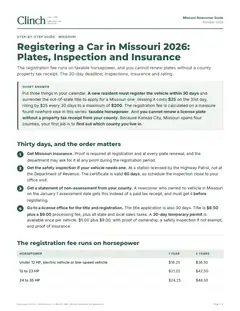
Put three things in your calendar. A new resident must register the vehicle within 30 days and surrender the out-of-state title to apply for a Missouri one; the title application is also 30 days, and missing it costs $25 on the 31st day, rising by $25 every 30 days to a maximum of $200. The registration fee is calculated on a measure found nowhere else in this series: taxable horsepower. And you cannot renew a license plate without a property tax receipt from your county.
Steps, documents and official links
The registration fee runs on horsepower
Not weight, not value, not age: Missouri prices registration by taxable horsepower. The figure is printed on the title or on the Missouri application for title and registration.
| Horsepower | 1 year | 2 years |
|---|---|---|
| Under 12 HP, an electric vehicle or a low-speed vehicle | $18.25 | $36.50 |
| 12 to 23 HP | $21.25 | $42.50 |
| 24 to 35 HP | $24.25 | $48.50 |
| 36 to 47 HP | $33.25 | $66.50 |
| 48 to 59 HP | $39.25 | $78.50 |
| 60 to 71 HP | $45.25 | $90.50 |
| 72 HP and over | $51.25 | $102.50 |
Add a $9 processing fee, or $18 for a two-year registration. Most ordinary modern cars fall in the top band. Electric vehicles are registered in the cheapest band, but do not read that as Missouri charging no extra road-use fee: the department's alternative-fuel decals page could not be read in the research, so we do not know whether one exists.
A two-year registration is only available when the parity matches: in an even-numbered calendar year you may register for two years only if the vehicle's model year is even, and likewise in an odd year. Otherwise it is one year.
The other items: title $8.50 plus a $9.00 processing fee, plus all state and local sales tax. A replacement title, a replacement plate (per plate) and replacement tabs are $8.50 each plus $9.00. Stolen plates and tabs are replaced free up to twice a year with a notarized affidavit, still with the $9.00 processing fee. A 30-day temporary permit is $5.00 plus $9.00, one per vehicle, and to buy one you need an ownership document, a safety inspection unless exempt, and proof of insurance. If you sell a vehicle, a Notice of Sale (Form 5049) is due within 30 days.
Sales tax follows your address, and Kansas City, Missouri is on the chart four times
Motor vehicle sales tax is a state rate of 4.225 percent plus a local rate set by the applicant's address. The detail here shows this state's central trap very well: on the department's own local rate chart, Kansas City, Missouri appears four times with four different rates, because the city spans Jackson, Clay, Platte and Cass counties. So for a Kansas City, Missouri address there is no single city-wide figure.
We do not print the local percentages. The chart file still served at that address is headed August 30, 2023 and set out for the last quarter of 2023. The four-county structure is reliable; the numbers are not. Get your own rate from the department's sales tax calculator.
Plate renewal requires a county property tax receipt
This is the most-missed requirement in Missouri and it is enforced at the counter. The renewal document list includes a paid personal property tax receipt, or a statement of non-assessment, from the county in which you reside (or the city of St. Louis) for the period of your previous registration. With a one-year registration you show the previous year's receipt; with a two-year registration you show both previous years.
That parenthesis about the city of St. Louis is the department's own wording and it has a reason: St. Louis is an independent city and sits inside no county. Kansas City, Missouri is the opposite case: it is not independent, it lies inside counties, four of them. So a Kansas City, Missouri resident gets the receipt from the collector of the county their address falls in: Jackson, Clay, Platte or Cass. Nowhere do we tell you to go to a Kansas City, Missouri office; go to your county.
There is a route for a brand-new arrival: someone who owned no vehicle in Missouri on the January 1 assessment date gets a statement of non-assessment from the county assessor instead of a paid receipt. You need it before you register, and the detail is in the property tax section.
The rest of the renewal list: the renewal notice (or last year's registration receipt, or a copy of the title), a current insurance ID card, a safety and/or emissions certificate done within the last 60 days if applicable, and the fees. Online renewal exists but needs a PIN printed on the renewal notice.
The safety inspection is statewide, but newer cars are exempt
Missouri runs a safety inspection, not an emissions one, across the whole state, and it is done at stations licensed by the Highway Patrol rather than by the Department of Revenue. The fee is capped at $12 ($10 for a motorcycle) and the certificate is valid 60 days (90 days where a Missouri dealer had it done within 60 days before the sale). Book the inspection close to your license office visit.
The big exemption covers most newcomers: in the Driver Guide's wording, motor vehicles for the first ten years following the model year of manufacture and with under 150,000 miles on the odometer are exempt from the safety inspection requirement, including vehicles with an out-of-state title. The department's buying-a-vehicle page states the same rule as less than eleven years old and under 150,000 miles. The two wordings describe the same window from different ends, but printing a single number would be wrong: do not quote an age without saying which wording you relied on, and ask the inspection station or the license office.
Other exemptions: all trailers, vehicles with historic plates, junk, salvage and rebuild sales, dealer-to-dealer sales, low-speed vehicles, intrastate commercial vehicles registered with the transportation department, and vehicles over 26,000 lbs registered for under 12 months. The inspection runs on a two-registration-year cycle tied to model year parity: even model years in even calendar years, odd in odd. Your renewal notice tells you whether one is due.
Emissions testing happens only at the other end of the state
Missouri's emissions program is the Gateway Vehicle Inspection Program, and the program's own page states its scope: vehicles registered in the St. Louis area, which means the city of St. Louis and Jefferson, St. Charles and St. Louis counties. The program's own "does my vehicle need a test" page lists exactly those four registration areas.
So no vehicle registered at a Kansas City, Missouri address is subject to emissions testing. Jackson, Clay, Platte and Cass counties are outside the program. Kansas City, Missouri drivers still need the safety inspection. And note that the boundary is drawn by county, not by ZIP code: if you know your county's name, you know the answer.
There is a conflict here and we are not smoothing it over: the state's own Driver Guide, revised August 2026, lists those needing an emissions inspection as the city of St. Louis and the counties of St. Louis, St. Charles, Franklin and Jefferson. Franklin County is in the Driver Guide and not on the program's own site. We use the program's own list and tell you about the conflict; if you live in Franklin County, call the program's information line on 1-866-623-8378. Who is tested: gasoline vehicles of model year 1996 and newer, diesel 1997 and newer, 8,500 lbs GVWR or less, on an odd/even model year cycle and additionally at any sale or title transfer. Exemptions include low mileage, new vehicles under 6,000 miles in their first model year, plug-in hybrid and fully electric vehicles, motorcycles, school buses and historic vehicles; flex-fuel, dual-fuel and conventional hybrids are tested. We do not print the emissions test fee: the $24 figure in circulation could not be read on the program's own page. The $12 cap on the safety inspection is confirmed from the Driver Guide.
Insurance: 25/50/25, plus the cover Missouri adds
The compulsory liability minimum is $25,000 bodily injury per person, $50,000 bodily injury per accident, $25,000 property damage per accident, or 25/50/25. And Missouri requires one more thing: uninsured motorist coverage of $25,000 per person and $50,000 per accident. Many states do not mandate it at all, so a quote that leaves it out is not a Missouri-legal policy; ask for it by name.
Missouri is a fault-based state in the ordinary way; the research found no Michigan-style no-fault or personal injury protection regime in any Missouri source it read. Alternatives to a policy exist: self-insurance for more than 25 vehicles, a $75,000 surety bond, certificate of deposit or securities filed with the department ($150,000 for a real estate bond), or a $75,000 cash deposit with the State Treasurer.
Proof may be an insurance ID card, the policy or binder, a paid receipt, a departmental self-insurance certificate, or proof on a hand-held electronic device. The cost of having no proof is heavy: 4 points on the driving record, and 8 points in 18 months loses the license. The suspension ladder is 0 days plus a $20 reinstatement fee for a first suspension, 90 days plus $200 for a second within two years, and one year plus $400 for a third or later. Proof of insurance is required at registration and at every plate renewal, and the department may demand it at any time during the registration period.
Rating factors: the opposite of Michigan
This contrast is worth writing. Michigan bans sex, marital status, home ownership, credit score, education, occupation and ZIP code as auto insurance rating factors. Missouri's regulator treats several of them as normal. The Missouri Department of Commerce and Insurance's own page says an individual auto rate is usually based on, among other things, where the automobile is garaged, the age and sex of the insured driver and credit history, and that insurers and rating organizations establish rating territories generally based on claims experience. Missouri publishes no ban on credit-based or territory-based rating; the regulator describes both as ordinary. That page was read from a June 2025 capture and we cannot confirm it is unchanged today.
There is one limit in your favor: Missouri restricts the use of credit. An insurer must disclose at application that it may gather credit information, and may not take adverse action on a credit factor alone without also considering a non-credit underwriting factor. That finding was read through a summary of a page on the regulator's own domain and the page itself could not be opened, so we do not present it as settled: ask your own insurer how it uses credit information. One piece of good news: Missouri regulations prohibit insurers from charging extra for claims under your comprehensive coverage.
What this means for a newcomer with no U.S. credit history: having no credit file in Missouri may affect your rate, and that is lawful. Get quotes from several companies for your first policy, check that each quote includes uninsured motorist coverage, and ask them to review your rate once your credit history has built up.
And the state line: registration does not cross it
We repeat this because Kansas City, Missouri sits on the border. The license, the title, the registration, the plate, the inspection, the property tax receipt and the vehicle sales tax are Missouri business, done at Missouri offices. No counter on the Kansas City, Kansas side can do them. The only thing that crosses that line is the bus.
Official sources
PDF: Registering a Car in Missouri 2026: Plates, Inspection and Insurance
04 · Toll roads
Are there toll roads and crossing charges in Missouri?
Short answer
The research found no operating toll road, toll bridge or toll tunnel in Missouri, and no Missouri transponder to buy. We write that as a finding rather than a denial, but the evidence is strong: the state's own 100-page driver manual never mentions tolls, toll payment or transponders. The tolls a Kansas City, Missouri driver actually meets do exist, and they are all on the Kansas side.
Steps, documents and official links
The state's own manual says nothing
That is evidence rather than a legal finding, but it is strong evidence. Missouri's complete driver manual, the August 2026 edition at 100 pages, was searched in full, and the only hit for "toll" is the Highway Patrol's toll-free emergency number. A statewide manual that needs to explain tolls normally does.
Two additions. The transportation department announced in February 2025 that the toll booths on the Lake of the Ozarks Community Bridge in Camden County were being removed, with removal beginning Monday, February 10, 2025; that announcement could only be read in a search extract because the page itself returned an empty body, so we do not present it as settled. And Missouri statute authorizes tolling in defined cases: a voter-approved transportation development district may charge for the use of a project, and separate bills have repeatedly proposed tolling Interstate 70. Authorized is not operating, and because the texts could not be read, no provision is quoted here.
A warning: the "unpaid Missouri toll" message
The research found no Missouri toll agency and no Missouri transponder. That has a direct use: a text message telling you that you owe an unpaid Missouri toll is not coming from a Missouri tolling authority, because the research found none. Do not tap the link in such a message, do not enter card details and do not pay. If you think you really do owe something, call the number published on the facility's own website rather than the number in the message.
The tolls you will actually meet are in Kansas
A driver leaving Kansas City, Missouri westward or southwestward on I-35 or I-70 enters the Kansas Turnpike: tolled, operated by the Kansas Turnpike Authority, and in another state.
- The Kansas Turnpike went fully cashless on July 1, 2024; in the authority's words there is no longer on-road toll collection. Drivers are identified by transponder or by license plate.
- K-TAG accounts converted automatically to DriveKS accounts when cashless billing began. A transponder (K-TAG or another compatible tag) pays the lowest rate; license-plate billing costs more.
- The authority states compatibility agreements with Oklahoma, Texas and Florida; E-ZPass is not among them. Accounts the system opens itself from a plate alone are outside that interoperability.
These lines could only be read through search extracts of pages on the Kansas Turnpike's own domain, because the site itself and its PDFs would not open by any route and the archive holds no capture. Confirm the rates and account terms on the authority's own page before you open anything.
Practical advice: a Kansas City, Missouri household that uses the Kansas Turnpike regularly should open a DriveKS or K-TAG account on the Kansas side, because there is no Missouri equivalent to open; without one, expect to be billed from the plate at a higher rate. The other tolls within driving range are the Illinois Tollway east of St. Louis and the Oklahoma turnpikes to the south; neither was researched this round, so we state no rules for them.
05 · Getting around
How do I travel by bus, train and plane in Missouri?
Short answer
Three things, and they must not be mixed up. The Kansas City, Missouri bus became paid on June 1, 2026 and takes no cash; it was free for years, so every older guide is now wrong. The streetcar is still completely free. And the bus is the only thing that crosses the state line, because the operator is a bi-state authority. For longer journeys Kansas City, Missouri is a real rail city, but there is no nonstop flight to Istanbul and no nonstop to Europe at all.
Steps, documents and official links
The bus: the only thing that crosses the state line
The operator's own sentence: the Kansas City Area Transportation Authority is a bi-state agency created by a compact between the States of Missouri and Kansas and approved by the United States Congress, authorized by legislation passed in both states in 1965. The compact defines the district as seven counties: Cass, Clay, Jackson and Platte in Missouri, and Johnson, Leavenworth and Wyandotte in Kansas. The authority's jurisdiction is limited to those seven.
So the buses cross the line by design. The route list is published in three blocks: the Missouri routes plus the cross-line routes, the Wyandotte County (Kansas City, Kansas) routes, and the Johnson County, Kansas routes. The brand is RideKC, and bus, bus rapid transit, demand-response routes, microtransit, paratransit and vanpool all sit under it. General information: 816-346-0200.
In one sentence: the bus network is the only thing in Kansas City, Missouri that does not respect the state line. A single fare and a single app carry you from Missouri into Kansas. The driver license, the vehicle registration, the property tax and the income tax do not.
June 1, 2026: the fare came back, the cash went
The operator's own words: RideKC bus service operated fare-free for several years, and starting June 1, 2026 fares returned to the system.
| Pass | Full | Reduced |
|---|---|---|
| Single ride | $2.00 | $1.00 |
| Day pass | $4.00 | $2.00 |
| Weekly pass | $20.00 | $10.00 |
| 30-day pass | $62.50 | $31.25 |
Fare capping exists and it works for you: if you use the same contactless payment method every time, in the operator's own words you will never pay more than $4.00 a day, $20.00 a week or $62.50 a month, and the rest of your rides in that period are free. Capping also applies at the reduced levels, but only once your eligibility has been verified, because the cap needs your payment method logged as a reduced-fare profile.
No cash is accepted on the bus. In the operator's words, all buses carry contactless tap-to-pay terminals, credit cards cannot be inserted or swiped, and no cash will be accepted. The ways to pay are a contactless Visa, Mastercard or Discover credit, debit or prepaid card (American Express is not accepted), Apple Pay, Google Pay or Samsung Pay on a contactless card, the RideKCGO app, or a physical RideKC pass card.
For someone with no bank card and no smartphone: one cash door in the city
This is the most important line in this section. For a newcomer with no U.S. bank account and no smartphone, there is exactly one place on the Missouri side to buy a physical day, weekly or monthly pass with cash: the East Village Transit Center, 13th Street and Charlotte, Kansas City, Missouri. There is a second point on the Kansas side: the Wyandotte County Fleet Campus, 5033 State Ave., Kansas City, Kansas, 913-573-8351. The operator says additional locations will be announced in the fall of 2026, so check the current list before you travel.
Physical passes carry a practical convenience: a pass stays dormant until its first tap, so buying a monthly pass early loses no days. You may pay for family or friends with one card, but you must tell the operator how many before you tap; only the first tap counts toward your own cap. And if the fare network or a validator fails, in the operator's own words that ride is free.
Who gets a reduced fare: children and teenagers aged 6 to 18 (under 6 ride free), adults 65 and over, Medicare card holders, people who qualify for low-income assistance, and people with disabilities. You apply with documents, United Way of Greater Kansas City reviews the application and the transit authority issues the pass. Every applicant provides a copy of a valid ID, and the examples the operator names include a state ID, a driver's license, a school ID and a passport. So the list does not require a U.S.-issued document: a newcomer with no Missouri license can still get a reduced-fare card if they qualify on age or income. Category proof means proof of age, a Medicare card, or proof of participation in SNAP, WIC, TANF, Medicaid, Section 8 or the energy assistance programs; for disability, an SSDI or SSI letter, a Medicare card, a VA disability letter or paratransit enrollment.
The streetcar is still completely free
Do not mix the two: the bus is paid, the streetcar is free. The KC Streetcar's own site says it in capitals: running daily, always free. In the operator's words there is no fare to ride the streetcar as it travels from UMKC to the River Market.
- Route: from UMKC at 51st and Brookside to the River Market at 3rd and Grand, 5.7 miles and 30 stops roughly 2 to 4 blocks apart. One way takes 25 to 30 minutes, a full loop 50 to 60.
- Hours: Sunday to Thursday 5:00 a.m. to midnight, Friday and Saturday 5:00 a.m. to 1:00 a.m. It runs every day, including holidays, on an adjusted holiday schedule.
- The most frequent transit service in the region: every 10 to 15 minutes at peak, 12 to 18 off-peak, seven days a week.
- Bicycles, wheelchairs and strollers board through the middle car; service dogs are allowed; stops are announced by audio and on screen. Everyone gets off at the UMKC terminus for a safety sweep and may then reboard. At the River Market North and Plaza stops the doors open on the left.
Why it can be free: the service is funded by a transportation development district, which means a sales tax inside the district boundary plus special assessments on property there. Downtown property owners and shoppers pay for it, not the fare box. Contact 816.627.2527, [email protected]. The streetcar stays inside Kansas City, Missouri and does not cross into Kansas.
Getting to the airport by bus
The airport bus is route 229 Boardwalk-KCI, described by the operator as a direct connection between the Northland and Kansas City International Airport. Connections are at the Boardwalk Square Transit Center and at the downtown East Village Transit Center. Route 229 is published as weekday service; the page also carries weekend tabs but the route header says weekday, so we promise no weekend airport bus and ask you to check the timetable before you travel. Since June 1, 2026 the 229 charges the ordinary $2 fare and takes no cash.
The airport and Istanbul: there is no nonstop
Kansas City International Airport (MCI) is operated by the Kansas City Aviation Department, a department of the City of Kansas City, Missouri; the same department runs Wheeler Downtown Airport (MKC). MCI is on the Missouri side, north of downtown in the Northland, and in the sources the research read there is no major commercial airport on the Kansas side of the metro area. A single new terminal opened in 2023, replacing the old three-horseshoe layout. The official site is flykc.com; the older flykci.com address no longer works.
Now the uncomfortable part. The airport's own nonstop page says that nonstop and connecting flights are available from Kansas City International Airport to cities throughout the United States, Canada and Mexico. The published nonstop list contains no European, Asian, African or Middle Eastern city. The only non-U.S. points are Cancún and San José del Cabo in Mexico, Montego Bay in Jamaica and Punta Cana in the Dominican Republic, all leisure routes and several seasonal. Türkiye does not appear.
Two notes of honesty. First, the airport's own blurb says Canada while the captured list shows no Canadian city; treat the blurb as marketing and the list as the fact. Second, the readable capture of the list is from October 2025 and the live site could not be reached, so the list may have changed since.
Practical routing: every journey from Kansas City, Missouri to Türkiye has at least one connection. The U.S. gateways reachable nonstop from MCI that Turkish Airlines or its partners use include Chicago O'Hare, New York JFK, Newark, Washington Dulles, Atlanta, Dallas/Fort Worth, Houston Intercontinental and Miami. Which carrier actually sells the through ticket was not researched, so we give no airline-specific advice. Against the New York, Chicago, Washington and Houston guides this is a real disadvantage and we prefer to say so.
Rail: Missouri really is a rail state
Some flagship cities in this series have no rail station at all; Kansas City, Missouri has one and it works. The station is Kansas City Union Station, 30 West Pershing Road, Kansas City, MO 64108-2410, a staffed station building with a waiting room.
- Missouri River Runner: Kansas City, Missouri to St. Louis, daily, about 5 hours 40 minutes, with ten stops: Kansas City, Independence, Lee's Summit, Warrensburg, Sedalia, Jefferson City, Hermann, Washington, Kirkwood and St. Louis Gateway Station. Coach and Business Class, cafe service and onboard Wi-Fi. In the operator's words the service is financed primarily through funds made available by the Missouri Department of Transportation. The number of daily round trips could not be confirmed on an official page, so we print none.
- Southwest Chief: Chicago to Los Angeles, daily, calling at Kansas City, Missouri; over 40 hours end to end, with sleepers, a dining car and a lounge car.
That Independence and Lee's Summit have their own River Runner stops is useful if you live around Kansas City, Missouri: getting to St. Louis without a car is possible.
Intercity buses
Greyhound and the regional carrier Jefferson Lines both serve Kansas City, Missouri. But we print no terminal address on this page: the carriers' Kansas City, Missouri departure point, address and schedules could not be read in the research, and Greyhound has moved its boarding point in this city more than once. Confirm the departure address on the carrier's own site when you buy the ticket.
06 · Regions
Which office do I go to in Missouri?
Short answer
In Missouri everything starts with one question: which county is your address in? The county values your house and your car and the county sends the bill, the county recorder of deeds issues the marriage license, and the tax receipt that lets you renew your plates comes from the county. Two cases break the pattern: St. Louis is an independent city and sits inside no county, while Kansas City, Missouri spans four counties at once. And the flagship city sits on the state line.
Steps, documents and official links
The state line: Kansas City, Missouri and Kansas City, Kansas
We say this at the very top because it can cost you a day. Kansas City, Missouri is a Missouri municipality, in Jackson, Clay, Platte and Cass counties. Kansas City, Kansas is a different city in a different state, in Wyandotte County on the Kansas side, with its own unified government. They are two separate municipal corporations.
Nothing on this page applies on the Kansas side: not the Kansas City, Missouri earnings tax, not Missouri's 19 percent assessment ratio, not Missouri's landlord-tenant law, not the Missouri income tax, and not the Missouri Public Service Commission's utility rules. The Kansas rules were not researched this round and we state none of them here.
The only thing that crosses the line is the bus, because the operator is a bi-state authority (transit section). What does not cross: the driver license, the vehicle registration, the plate, the inspection, the property tax receipt and the vehicle sales tax (car section), plus tenant rights, utility rules, the school district and the health programs. A few useful things do cross: the Turkish consulate, the immigration court and the time zone cover both states (consulate section), and the Kansas City Public Library card crosses the state line, below.
One practical situation is very common: living on one side and working on the other. Someone who lives in Kansas City, Missouri and works in Kansas still owes the city's earnings tax on those Kansas wages, because the city taxes residents wherever the money is earned. The mechanics of the Missouri and Kansas reciprocal credit were not researched this round and we do not state them; both states tax income and each gives credit for tax paid to the other, but ask a tax adviser for the detail.
Who does what
| Task | Who handles it |
|---|---|
| Valuing real property and vehicles | County Assessor |
| Property tax bill and collection | County Collector. No separate bill comes from the city |
| The paid tax receipt or statement of non-assessment for plates | The county (car section) |
| Marriage license | County Recorder of Deeds, not a clerk and not a court (marriage section) |
| Birth and death certificates | The state Bureau of Vital Records or one of 115 local public health agencies (birth certificate section) |
| Driver license and vehicle registration | The state: Department of Revenue license offices and Highway Patrol examination stations |
| Water, sewer and trash | The city (in Kansas City, Missouri, the city's own water utility and the city's own trash service) |
| Electricity and natural gas | State-regulated private companies, depending on the address (utilities section) |
| Schools | Neither city nor county: independent school districts (school section) |
| Income tax | The state, plus in some cities the city's own earnings tax, below |
The flagship city spans four counties
The boundaries of Kansas City, Missouri extend across Cass, Clay, Jackson and Platte counties. The city's own public works page carries geographic information system land-corner coordinate sets for all four, which is the city confirming its own footprint. Most of the city, including downtown, is in Jackson County.
But which addresses fall in Clay, Platte or Cass was not established in the research, so we print no neighborhood list: check your own parcel. The cost of this is real, because the county decides two things: your vehicle sales tax rate and which collector you go to in order to renew plates. And as the marriage section shows, two neighboring counties apply different document rules for a marriage license. So we do not generalize about what happens "in Kansas City"; we cannot.
The counter-example is St. Louis: an independent city, not part of St. Louis County, which performs for itself the functions a county performs elsewhere (assessment, collection, recording, court clerk). St. Louis County is a separate government with its own seat. So an address "in St. Louis" and an address "in St. Louis County" go to different offices. The office names and addresses for St. Louis were not researched this round and we print none; take nothing about St. Louis offices from this page beyond the structural point. Columbia is in Boone County; Bridgeton and Chesterfield are in St. Louis County, not in the city of St. Louis.
The city has its own income tax: the Kansas City, Missouri earnings tax
Some Missouri cities levy their own earnings tax, and Kansas City, Missouri is one of them. The rate is 1 percent and in the city's own words it applies to "salaries, wages, commissions, tips and other compensation"; the city says it is paid by any business or person who lives or works in Kansas City, Missouri. The state income tax itself is a separate matter and sits in the tax section.
The two mechanics are completely different:
- Residents pay on everything, everywhere. The city's sentence: all Kansas City, Missouri residents are required to pay the earnings tax even if they work outside the city, and money earned by residents is subject to the city's one percent tax regardless of where it is earned unless exempted by state statute or municipal ordinance.
- Non-residents pay only on income earned inside the city. In the city's words, non-residents are required to pay the earnings tax on income earned within Kansas City, Missouri city limits.
Normally this costs you no effort at all: your employer withholds it, and by the city's own test, if Box 19 of your W-2 equals 1 percent of Box 1 you do not need to file a return.
But if you live in the city and work outside it, usually nobody is withholding. The city's own sentence is that your employer may be willing to withhold the tax if you are a resident but do not work at a location in Kansas City, Missouri, and that you should check with your employer. So this item is on you: if nobody withholds, you file and pay yourself. Employers set up a withholding account by calling 816-513-1135.
The refund form has two catches and both cost money. A non-resident who works in the city claims back the tax withheld for whole days spent outside it, on Form RD-109NR. Watch for these:
- Any part of a day inside the city makes it a city day. The city's wording is exactly that: if any portion of a day is worked within Kansas City, Missouri, that day is not considered a day worked outside the city.
- Your employer has to sign the form. The city's sentence: non-resident taxpayers are required to obtain their employer's signature when completing the RD-109NR, along with supporting documentation. So you cannot finish this form alone; you have to go through your employer's payroll office.
The standard work year on the form is 260 days, with exceptions for part-time and flex-time employees and partial-year residents, and the city may ask for documentation if you use a different number. The individual return is Form RD-109, and it should not be filed at all if your employer withheld in full. Self-employed residents pay 1 percent on net business profit; rental income falls inside the tax to the extent that the rental, ownership, management or operation of the property constitutes a business activity.
Not taxed: income from qualified deferred compensation plans (401(k), 403(b), 501(c)(3), 457(b)), Social Security payments, and payments related to a permanent disability such as a disability pension. Deadline: the annual return is due April 15, the 15th day of the 4th month after the end of the tax year, moving to the next business day if that is a weekend or a legal holiday. A valid extension gives six more months to file, but the refund claim itself must be in by the original due date. Late payment costs 5 percent a month, capped at 25 percent, plus 12 percent a year in interest.
Working from home creates an obligation for the employer: in the city's words the scope includes employees working from home in Kansas City, Missouri, and a business with remote workers is required to obtain a business license. Taxpayer Services is (816) 513-1120, refunds option 2, [email protected]; the business license section is (816) 513-1135. Filing and payment run through the city's Quick Tax portal; the mailing address is City Hall, 414 E. 12th St., 2nd floor, room 201W, Kansas City, MO 64106. Whether the earnings tax must be periodically re-approved by voters was not researched, so we print no renewal date.
Kansas City, Missouri 311 and language
The city's service line is 311, or (816) 513-1313 from outside, weekdays 8 a.m. to 7 p.m. In the city's description, you contact 311 to report a problem, request a service or ask a question about a city service. And the strongest published language commitment in this series is here: the city's own sentence is that 311 is able to provide assistance with city services in any language, and its instruction is to call and tell the Customer Service Specialist what language you speak, and they will get an interpreter on the line. If you email instead, a reply comes within 24 to 48 business hours.
But read it carefully: it says "any language" and does not name Turkish. So we do not promise you a Turkish-speaking operator; we promise that an interpreter will be brought onto the line. 816-513-1313 is also the city water utility's customer number, so the same number both starts your water service and reports a pothole. The city also runs a myKCMO app for opening a service request and tracking an existing one. Two named bodies sit in the city structure, an Office of Language Access and a New Americans Commission; we confirmed both exist from the city's own directory but could not read their pages, so we do not describe what they do.
If you have no documents yet: the library card, and it crosses the line
This is the most useful line in this section. A Kansas City Public Library card is free, and in the library's own words there are no late fines at all: it charges no late fines on overdue items and imposes no fine-related restrictions on public computers or digital materials.
And residency is defined metropolitan, not municipal: in the library's words, if you live in metropolitan Kansas City, Missouri or Kansas, you have full access to library services. So the card crosses the state line, unlike almost everything else on this page.
No Social Security number appears anywhere in the card requirements. We write that as the absence of a finding: the library asks for "identification and proof of address" for in-person verification but publishes no list of which documents count, so we cannot list the accepted documents here.
For someone with no paperwork yet the real answer is this: sign up online and the card is issued instantly. The limits the library publishes, as of April 6, 2026, are that unverified accounts can check out three items and place five holds, while verified accounts get 75 items and 100 holds. So sign up today, borrow three things, and bring documents in later to verify. One warning: if the portal cannot authenticate your address as a valid residential mailing address, you get a card that expires in 30 days and full privileges are withheld until you sort it out. Cards are renewed every year or two, through the library card portal, on 816.701.3400, or at any branch. Out-of-area users may borrow a limited number of physical items, use public computers and reserve a study space, but most digital resources are unavailable to them.
One addition: the library runs a refugee and immigrant services program called RISE, based at the North-East Branch, with driver education, financial literacy, English Basics, English for Citizenship and a conversation club, plus free naturalization interview practice with volunteers at any of its ten locations. English Basics 1 is described by the library as accessible even for students with no formal schooling. These lines were read through a summary of pages on the library's own domain, because the pages themselves would not open. Central Library: 14 West 10th St, Kansas City, MO 64105, 816.701.3400.
City government, briefly
Kansas City, Missouri uses a council-manager form of government. The City Manager prepares the budget and transmits it to the Mayor and Council on or before the second regular meeting in February, and the city charter requires the Council to adopt an annual budget by the fourth regular meeting in March. The Council has the Mayor plus twelve members: six districts, each with one in-district member and one elected at large. Members and titles change, so we print no name list. City Hall is at 414 E. 12th Street, Kansas City, MO 64106 and has a public observation deck. The departments a newcomer will meet: Finance (earnings tax, business license), the water utility, Health (the rental licensing program, birth and death certificates, immunizations), Neighborhood Services (code violations, vacant property registration), Public Works (trash, snow, potholes), Housing (tenant resources), City Planning and Development, and Civil Rights and Equal Opportunity, which houses the Human Rights Commission.
The county layer handles property assessment, property tax billing and collection, land records and the circuit court; for most of Kansas City, Missouri that is Jackson County, at the Jackson County Courthouse, 415 E. 12th St., Kansas City, MO 64106, one door along from City Hall, with a second seat at the Historic Truman Courthouse, 112 W. Lexington Ave., Independence.
Internet
The research did not find a Missouri state broadband office provider list of the kind Connecticut publishes, and found no official provider list for Kansas City, Missouri either. Read that as a finding rather than a denial. We print no company names here; find out who serves your address by entering it on the federal FCC National Broadband Map. The city has a document called a Digital Equity Strategic Plan under Neighborhood Services, but its contents could not be read.
07 · Electricity, gas and water
Can I start utility service in Missouri without an SSN?
Short answer
There are three separate answers and all three are positive. With state-regulated electric and gas companies the regulation sets out the reasons service may be refused as a closed list, and a Social Security number is not on it; a deposit also may not be based on national origin or source of income. The gas company settles the question in one sentence: no number means a deposit, so having no number does not mean having no gas. And the city water utility is the first provider in this series to name a foreign document as acceptable.
Steps, documents and official links
First, who is regulated and who is not
Skipping this distinction misleads the reader, because the strong written protections exist on only one side.
| Service | Provider (example of a Kansas City, Missouri address) | Regulated by the state commission? |
|---|---|---|
| Electricity | Evergy Metro, Inc., trading as Evergy Missouri Metro | Yes |
| Natural gas | Spire Missouri Inc. | Yes |
| Water and sewer | KC Water, a city department | No, a municipal utility |
| Stormwater | KC Water, a separate line on the same bill | No |
| Trash, recycling, bulky items | The city, through 311 or myKCMO | No |
That the Spire unit covering Kansas City, Missouri is called "Spire West" was read only in a summary of the company's own county map page, which itself shows only an eastern and a western Missouri division; so we do not present the unit name as settled.
With regulated companies: a closed list of refusal grounds, and no SSN on it
The Missouri Public Service Commission's service and billing practices rules for residential customers list, one by one, the reasons a company may refuse to start service. The list is: an unpaid, undisputed delinquent bill for the same type of service from that utility or its regulated affiliate; failure to post a required deposit or surety; refusal to allow inspection, maintenance, replacement or meter reading; misrepresentation of identity; violation of tariff rules affecting safety or system integrity; as provided by state or federal law; a previous owner's or occupant's unpaid bill where that person remains an occupant; and failure to comply with a settlement agreement.
"Failure to produce a Social Security number" is not on that list. We write that as it stands rather than as a promise: the list is closed, and having no number is not on it. This is not an affirmative statement by the regulator but a negative finding from reading the whole list.
Working procedural rules sit alongside it: a refusal must be in writing and the company keeps a record of the notice; the notice must say how the applicant can comply, give a toll-free number and the company's address, and tell the applicant they may contact the Public Service Commission. One language note, for honesty: notices of refusal must carry a statement in Spanish, either telling a non-English reader to have it translated or telling them to call if the company offers Spanish telephone assistance. Spanish is the only language named in the regulation; Turkish is not.
Deposits: three grounds, an exemption list and a cap
A deposit may be demanded from a new customer for only three reasons: an unpaid past-due bill accrued in the last five years for the same type of service; interference with or diversion of service in the last five years; or inability to establish an acceptable credit rating under the company's approved tariff.
And the way out of the third ground is written into the rule. In the rule's own words: if the applicant has insufficient credit history to determine a credit score, the applicant shall be deemed to have established an acceptable credit rating if they meet any of the following: (1) owns or is purchasing a home; (2) is and has been regularly employed on a full-time basis for at least one year; (3) has a regular source of income; or (4) can provide adequate credit references from a commercial credit source. The third criterion is reachable by a newcomer in their first month, and it is this state's most useful utility finding.
The second protection speaks directly to you: in the regulation's words, no deposit, guarantee or additional deposit may be required because of race, sex, creed, national origin, marital status, age, number of dependents, source of income, disability or geographical area of residence. National origin and source of income are named.
The route that replaces cash: in lieu of a deposit a company may accept a written guarantee, and that guarantee may not exceed the amount of a cash deposit; the guarantor is released after twelve billing months of satisfactory payment. If a deposit is required:
- The cap: for a new customer charged a deposit for lack of a credit rating, it is one sixth of the estimated annual bill for monthly-billed accounts (one third for quarterly billing). In other cases the tariff may set two times the highest bill or four times the average bill over the most recent twelve months.
- It earns interest at the rate in the company's approved tariff, credited to the account annually or paid when the deposit is returned.
- It must be refunded after twelve billing months of satisfactory payment, and on a final bill the balance comes back within 21 days.
- You have a right to pay in installments: the company must allow it unless it can show interference with service or a likelihood that you do not intend to pay. And in November, December and January a customer who cannot pay a reconnection-type deposit in full for gas or electricity may spread it over six months.
- You get a written receipt showing the name, date, amount, the name, signature and title of the employee who took the payment, and the terms for retention and return. A customer who has lost the receipt is still entitled to the deposit back within five years on adequate identification.
The electric company's own tariff pages restate the same rules: a residential deposit not exceeding two times the highest bill of the preceding twelve months, or one sixth of the estimated annual bill for a new customer, refunded or the guarantor released after twelve months of payment, with interest at the published prime lending rate plus one percentage point, compounded annually. That line was read through a summary of a tariff document on the company's own domain; the document itself could not be opened.
Whether the electric company asks for a Social Security number at all, and what it accepts instead, the research did not find. No published rule of theirs could be located; the commission regulation above binds them, so raise the regulation when you open the account.
Here is how Missouri differs from Michigan: Michigan's regulator lists the identity documents it accepts and a passport is on that list. Missouri's regulator publishes no accepted-document list at all; instead it publishes a closed list of refusal grounds and an anti-discrimination rule that names national origin. So Missouri's protection is structural (they cannot refuse you for a reason not on the list) rather than documentary. That is why we do not say a passport is enough in Missouri: the research found no Missouri list of accepted identity documents.
Natural gas: the question closed in one sentence
The gas company's start-service page asks for the name of the account holder, the Social Security number of the account holder for residential customers, and the address where service should start. And the page carries exactly this note: if you do not have an SSN or do not wish to provide it, a deposit will be assessed on your account.
So having no number does not mean having no gas; it means having a deposit. And that deposit is not unbounded: because the company is regulated, the cap, interest, installment and twelve-month refund rules above apply to it, and a deposit may not be imposed because of national origin or source of income.
The water utility: the first provider in this series to name a foreign document
The city water utility is a municipal department, so the commission's regulation does not reach it. It publishes its own rule instead, and that rule is unusually explicit.
The ordinary application does ask for a number: the name and contact details of the account holder and all co-applicants, the Social Security number (businesses give a valid Missouri charter number instead), the service address, a mailing address if different, the desired start date, the property owner's name and contact details, and any outstanding debt to the utility resolved.
But there is a written path for someone with no number, and declining to give one counts the same as not having one. The utility lists the situations in which a customer "may be required to provide additional documentation to establish service", and the first one is: the customer does not have a Social Security number, or declines to provide a Social Security number. The others are a number that does not match the name, a number associated with multiple people, an applicant who cannot be verified in the third-party verification portal, and an applicant whose information shows them to be under 18.
And the accepted documents are listed by name. The utility's own list is a valid government-issued photo ID, namely a U.S. passport or passport card, a permanent resident card or alien registration receipt card, a driver's license or ID card issued by a federal, state, or local domestic or foreign government agency, a U.S. military card, or a military dependent's ID card. A license or ID card issued by a foreign government agency is explicitly within the list, and that is the clearest example in this series of a provider naming a non-U.S. document as acceptable.
Other practical details: the utility verifies identity through a third-party website, verifies property ownership through public records and checks for debt owed by the applicant. There is a flat $110.00 security deposit for residential service, appearing on the first bill and payable by the bill due date to avoid interruption. A tenant is not liable for the previous occupant's debt: in the utility's words, tenants are not required to pay existing balances or debt associated with a new rental property where they were not the tenant or the property owner at the time it accrued. The exception: where the account is locked or water was shut off for theft of service, a new account is not opened until the owner's debt is satisfied or ownership changes. There is no same-day service: a minimum of 24 hours is needed, excluding Saturday, Sunday and city holidays. Notices to start, stop or transfer service must be in writing: the city will try to act on an oral order given in person or by telephone but assumes no liability for failing to act on oral orders, so put it in writing and keep a copy. Apply through the online portal, on 816-513-1313, or in person at 4800 E. 63rd Street, Kansas City, MO 64130. Landlords are told to make sure the tenant has service in their own name before handing over the keys, so expect your landlord to ask. The utility also has a financial assistance resources page, but its contents could not be read, so we name no program from it.
The shutoff ban: a winter calendar and a daily temperature test
Missouri runs two separate protections here, and the second is new to this series.
- The winter calendar. Missouri's Cold Weather Rule runs from November 1 to March 31, and in the regulation's own words it takes precedence over other rules on the provision of heat-related utility service during that window.
- A daily temperature test that works regardless of season. Where gas or electricity heats the home, that service may not be disconnected for non-payment, for any residential user including tenants of apartment buildings, on any day when the National Weather Service local forecast between 6:00 a.m. and 9:00 a.m. for the following twenty-four hours predicts that the temperature will drop below thirty-two degrees Fahrenheit. The same ban applies on any day when utility staff will not be available to reconnect during the following days and the forecast predicts a drop below that temperature in that period.
Read them together: on a mild October day outside the calendar window there is no protection, but if an unexpected freeze arrives in October, no disconnection may happen that day. Arizona's ban is written around summer heat and Michigan's around winter; Missouri is a winter state like Michigan but adds a daily forecast test on top.
Registered low-income elderly or disabled customers get a further protection from November 1 to March 31, but it is conditional: you must enter a cold weather rule payment plan, make the initial payment and keep up the payments. "Registered elderly or disabled" means someone who has filed a form attesting they are 65 or older, or who provides a physician's form saying service is needed to maintain life or health, or who holds a federal disability award letter, and the registration must be renewed annually, by October 1. "Low income" means household income under 150 percent of the federal poverty guidelines plus a signed affidavit on file.
The notice process before a winter cutoff is heavy and in your favor: from November 1 to March 31 the company must notify the customer at least ten days before the proposed disconnection by first-class mail; make further contact within 96 hours before disconnection by a second written notice, a door hanger or at least two telephone attempts; attempt contact at the time of disconnection; and, for a registered elderly or disabled customer, make personal contact on the premises with the customer or a family member over 15. Every notice must describe the terms for keeping service, how the required payments are calculated and the availability of financial assistance. The regulation itself names two assistance programs: the federal LIHEAP, administered by the state's Family Support Division, and the federal Energy Crisis Intervention Program.
Trash and recycling
In Kansas City, Missouri trash and recycling come from the city and no separate bill is issued. Weekly curbside collection is for single-family homes and apartment buildings of six units or fewer, Monday to Friday on a day assigned by neighborhood; you find yours with the city's "Find My Collection Day" tool. Recycling is unlimited: clean, dry plastic, cans, paper and cardboard go loose into the blue cart, no plastic bags. Trash beyond the cart is capped and paid for: up to two extra bags a week, each needing a pre-paid tag attached to it. Where the tag is bought and what it costs the research did not find, so we print no price. Bulky item pickup is free and by appointment, for the same property types, booked through 311 or the city's scheduler, with a maximum of 15 items per appointment, each under 500 lbs. The city also runs district waste drop-off events, hard-to-recycle drop-off events, compost and leaf-and-brush drop-off centers, a waste tire program and a neighborhood cleanup assistance program; dates are on the city calendar.
If you live in a building of seven units or more, city collection does not apply to you and your landlord arranges private collection. Since most newcomers rent an apartment, that detail matters: ask how trash is collected before you sign a lease. The trash and recycling lines were read through summaries of the city's own pages, because those pages would not open directly.
08 · Renting
What are a tenant’s rights in Missouri?
Short answer
Missouri's rules are short and among the most landlord-friendly in this series. The deposit cap is two months' rent, one of the highest here; the return deadline is 30 days, a wrongful withholding costs twice the amount withheld, and the tenant has a statutory right to be present at the move-out inspection. Against that, the state forbids its own cities from banning source-of-income discrimination, which is the reverse of Michigan. And no notice is valid unless it is in writing.
Steps, documents and official links
The security deposit
The state attorney general publishes a plain-language guide to Missouri's landlord and tenant law, and the rules below were read in that guide.
- A landlord may not charge more than two months' rent as a security deposit.
- When the tenancy ends the landlord has 30 days to return the deposit, or to return the balance with an itemized list of the damages for which any part is kept.
- Within those 30 days the landlord must give you reasonable notice of the date and time of the move-out inspection, and you have the right to be present, at a reasonable time. Use that right: otherwise you are the only witness to a damage argument you were not present for.
- The landlord may keep only actual damages (not normal wear and tear), unpaid rent, or rent lost because the tenant left without adequate notice.
- The deposit may not be used as the last month's rent.
- If the landlord wrongfully withholds, the tenant may sue for up to twice the amount wrongfully withheld.
- When you move out, give the landlord a forwarding address in writing, or the deposit may not reach you.
We also say what we do not know: whether Missouri requires the deposit to be held in a separate or escrow account, and whether interest must be paid on it, the research did not find. The attorney general's guide does not say and no statute was read. We do not write that there is no such requirement; we write that the research did not find one.
Notice, the type of tenancy and ending a lease
- An oral agreement binds both sides for only one month. In the guide's words, a landlord can evict the tenant or raise the rent with only one month's notice, and likewise the tenant can give notice to vacate on one month's notice.
- "One month's notice" means a full calendar month and must include a full rental period. The guide's own example: if rent is due on the 3rd, the rental period runs from the 3rd of one month to the 3rd of the next.
- The notice must be written. The guide's sentence is that oral notice from either party to the other is not valid. For someone arriving with Turkish habits this is the easiest mistake to make.
- A lease of one year or more must be written and signed by both tenant and landlord.
- When a written lease simply expires on its stated date, neither side has to give notice. But watch for an automatic renewal clause: those renew unless the tenant notifies the landlord they will move.
- Staying on after the lease ends with no written agreement exposes the tenant to double rent, and subletting without the landlord's approval also lets the landlord double the rent.
- Active-duty military may end a lease on 15 days' notice on a permanent change of station, temporary duty orders to a station at least 25 miles away for 90 days or more, discharge or release from active duty, or an order into government quarters, with a full deposit refund if other lease terms are met.
Repairs, interrupted service and other protections
The tenant has a few working tools. In certain circumstances and after giving the landlord 14 days' notice, a tenant may deduct one-half month's rent or up to $300, whichever is greater, to repair code violations the landlord has neglected. That is the attorney general's summary; the statutory conditions were not read, so ask a lawyer before taking the step on your own.
A landlord who willfully interrupts utility service is guilty of forcible entry, unless it is done for health and safety reasons. Occupancy is limited to two persons per bedroom, except for children born during the lease period. A landlord must make the property habitable before the tenant moves in, handle normal wear-and-tear repairs, not shut off utilities without legal process, give written notice when ownership transfers, and not unlawfully discriminate.
One rule runs the other way and you should know it: courts may order the quick removal of tenants involved in drug-related criminal activity or violence, and of persons occupying property without the landlord's permission, and prior written notice is not required in those cases, with no arrest needed.
Rent control: whether Missouri law permits or forbids a city to adopt rent control, and whether Kansas City, Missouri has any rent regulation, the research could not establish this round. We do not say Missouri bans rent control; the research did not settle it either way. Beyond the source-of-income prohibitions below, we state nothing.
The state forbids its cities from protecting source of income
The sharpest contrast of the round is here. In Michigan source of income is a protected class across the state, with an exception for small landlords. In Missouri the reverse is true: the state forbids its cities from creating such a protection.
First the city side. Kansas City, Missouri passed Ordinance No. 231019, adding source of income as a protected trait in housing to the civil rights and health chapters of the city code, requiring an annual report on source-of-income complaints and enforcement, and requiring standard language in rental applications. The ordinance defines source of income broadly: any reasonably verifiable and lawful income from an occupation, profession, contract or activity, and any private, non-profit or government assistance or payment, such as federal housing choice vouchers, military pension payments, disability payments, court-ordered payments, cash or tipped wages and payments from strike funds. The penalty is a $1,000.00 fine, and the director must report to the Mayor and Council annually on June 1. The ordinance's list of protected traits in housing also includes national origin and ethnic background.
Then the state side. A law enacted in 2025, as the legislature's own official summary of the enacted bill puts it, provides that no county or city may enact, maintain or enforce any ordinance that does any of four things:
- Prohibits landlords from refusing to lease a privately owned single-family or multiple-unit residential rental property to a person because that person's lawful source of income to pay rent includes funding from a federal or other housing assistance program.
- Restricts a landlord's ability to use or consider income-qualifying methods, credit reports, eviction or property damage history, or criminal history, or to request that information.
- Limits the amount of security deposit a landlord can require from a tenant.
- Requires tenants to automatically receive a right of first refusal.
Two things the state law leaves alone: a county or city may still enter voluntary agreements with private persons to regulate the rent charged for subsidized rental properties, and a city may still prohibit a landlord from discriminating against a tenant solely because the tenant receives veterans' benefits.
The third point matters to everyone, not only to voucher holders: a Missouri city cannot set a deposit cap below the state's two-month limit. So the two months above is both the floor and the ceiling; no municipal ordinance can tighten it.
And now what we will not say. We do not know whether the Kansas City, Missouri ordinance is enforceable today. The statutory text could not be read; the four points above come from the legislature's own published summary of the enacted bill, which is why no statutory language is quoted here. What has been reported about the ordinance's status could not be confirmed on a court or city record. So this page states only what is confirmed: Kansas City, Missouri enacted a source-of-income protection, and Missouri subsequently enacted a state law forbidding cities to enact, maintain or enforce one. We write neither that the ordinance is in force nor that it is not; if you are looking for housing on voucher or assistance income, ask the city's Civil Rights and Equal Opportunity division about your situation. The law's effective date was also not confirmed (reporting gives August 28, 2025, but no official page confirmed it), so we print no date.
One more thing: the ordinance's national origin and ethnic background protections are not the subject of the state prohibition, only the source-of-income part. But because we could not read the state law's text to see exactly what it struck down, we also give no definitive list of which traits survive.
Landlord licensing: Kansas City, Missouri really does license
This is the reverse of Arizona and it gives a tenant a concrete tool. Kansas City, Missouri runs a program called the Healthy Homes Rental Inspection Program, which under Ordinance 180248 requires all rental property owners to register their properties. The 2026 fee is $25 per unit per year plus a one-time $25 application fee; the city's own worked example is that a first-year applicant with a ten-unit complex pays a one-time $25 plus 25 times 10, a total of $275, and $250 in later years. The program sits in the Health Department's environmental health division at 2400 Troost Ave., Suite 3600, Kansas City, MO 64108, phone 816-513-6464. These lines were read through summaries of the city's own pages, which would not open directly; confirm the address and phone before you travel.
What to do with it: before you sign, ask whether the property is registered under this program. A landlord who is not registered is in breach of a city ordinance, and the Health Department is the office to ask. The city has a separate tenant information page for the same program and a tenant resources section; we could not read either, so we do not summarize their contents and simply link them. The city also runs a vacant property registration and a nuisance abatement program.
Official sources
09 · Property tax
How is property tax calculated in Missouri?
Short answer
Missouri taxes your house and your car every year, and both arrive on one county bill. Residential property is assessed at 19 percent of market value, and vehicles and other personal property at 33 1/3 percent. The rate is written per $100 of assessed value, not as a percentage and not in mills. Everything looks at what you owned on January 1, and the bill is due by December 31. No separate bill comes from the city.
Steps, documents and official links
Two ratios, one bill
The State Tax Commission's own pamphlet and the City of Kansas City, Missouri's own property tax page give identical ratios, which is why these lines are solid.
| Type of property | Assessment ratio |
|---|---|
| Residential real property | 19% |
| Agricultural real property | 12% |
| Commercial and other real property | 32% |
| Vehicles and other personal property | 33 1/3% |
| Manufactured homes | 19% |
| Farm machinery | 12% |
| Historic cars and planes | 5% |
The rate is not a percentage, it is per $100. Missouri does not use Connecticut-style mills: the rate is written as so many dollars per $100 of assessed valuation. The commission's own worked example shows the arithmetic: a $50,000 house and two cars worth $15,000, at a combined local rate of $5.70 per $100. The house at 19 percent is $9,500, the cars at a third are $5,000, the total assessed value is $14,500, and times 0.0570 that is $826.50.
The county sends the bill, the city does not. The City of Kansas City, Missouri says it plainly: all taxable real and personal property within the city is assessed annually by the county assessors; for Kansas City, Missouri residents, real and personal property taxes are included on the county property tax bill, and no separate billing for these taxes comes from the city. So expect one bill, not two, and expect the envelope from the county.
The city's own levy is only a slice of that bill. The city levies the following per $100 of assessed valuation (tax year 2024 actual rates): general purpose 0.5469, health 0.3799, health temporary 0.1672, museum 0.0151, debt service 0.4200, for a total of 1.5291. The school district, the county, the library district and other districts levy on top of that, so the city rate is not what you pay.
And there is a conflict here: a city council record is reported to set the total for fiscal year 2026-27 at 1.5073, but the ordinance itself was not read, and the city's property tax page still showed tax year 2024 when it was captured. We print neither as "the current rate": check the city page, and read the bill for the year in your hand for the real figure.
The calendar: which date does what
- January 1: property is assessed on what you owned that day. A car bought in the middle of the year joins the list on the next January 1, not this year.
- The personal property declaration is due to the assessor before March 1 under state law. But the county's own current notice gives a different date: Jackson County publishes the 2026 declarations as due May 1, 2026, while an older county article says March 1. Follow the county's own current notice, not the state pamphlet, and confirm the date on the county page. The late declaration penalty is $15 to $105, depending on the assessed value of the account; those two lines were read through a summary of the county page, so confirm them.
- Reassessment runs on a two-year cycle keyed to odd years. In the commission's words, in every odd-numbered year each county assessor must adjust the assessed valuation of all real property. The value set in an odd year carries into the even year, and in the even year only physical changes (new construction, an added room) can change it, not market conditions.
- Appeals: assessment rolls go to the county clerk by July 1; boards of equalization hear valuation appeals in July; the appeal deadline is before the third Monday in June in first-class counties and the second Monday in July in all other counties and the city of St. Louis. From the board you go to the State Tax Commission by September 30, or 30 days after the board's decision, whichever is later, and you must have appealed to the board first and lost.
- Rates are certified in September and October, bills follow, and taxes are due on or before December 31 and are delinquent after that.
A constitutional amendment caps the total taxes that may be imposed in a fiscal year by forcing levy rates down to produce roughly the previous year's revenue, and the limit cannot be exceeded without a majority vote. New construction, new personal property and newly annexed areas are outside the limitation.
The car tax: the bill new arrivals do not see coming
Missouri taxes your car every year as personal property, and it is the item that most surprises a newly arrived household. By the county's page, what is taxed is motor vehicles, trailers, mobile homes, watercraft, boat motors, aircraft, livestock and farm machinery. What you owned on January 1 is taxed at a third of value, billed once a year, due on receipt but no later than December 31, with penalties and interest after that.
New residents must open an account with the assessment department. Moving from out of state, take government ID, your current address, your move-in date and your recent out-of-state registration. Moving within Missouri, take the previous county's tax receipt or waiver.
And the document a brand-new arrival needs is this: the statement of non-assessment, often called a tax waiver. A new resident who has never paid Missouri property tax may obtain one, in the county's words, if they are "new to the state of Missouri" or are "licensing the first vehicle in their name". You need it to register a car, as described in the car section. In Jackson County the assessment department is on 816-881-1330, [email protected]; appointments are booked through a kiosk system and walk-in slots are limited.
Relief: for the old, the disabled and surviving spouses
Here we have to be honest: every property tax relief Missouri offers is for someone who is old, disabled or a surviving spouse. There is no general relief for a working family, and no renter's credit for anyone under 65 who is not disabled.
- A county-level senior property tax credit, or freeze. Jackson County runs a program under state law that freezes the real property tax on a primary residence at the amount for the year you first qualify, with credits appearing on later bills. The application deadline is December 31. You apply online, by mail, or in person at the Jackson County Courthouse, 415 E. 12th St., Suite #100, Kansas City, MO 64106 or the Historic Truman Courthouse, 112 W. Lexington Ave., Suite #114, Independence, MO 64050; the phone is 816-881-3232. We print no age threshold here, because two of the county's own documents disagree: the program page gives one age and says no annual reapplication is needed, while a reading of the program's own FAQ document gives a higher age and says annual reapplication is required. We could not settle which is right, so ask the collector's own office for the age and the renewal rule. One limit is certain: the freeze does not cover the car tax, and it does not stop the levy changing; it only holds the owner's real property tax amount.
- A statewide property tax credit (MO-PTC), the circuit breaker. It gives up to $750 if you pay rent and up to $1,100 if you pay real estate tax on a home you own and occupy, to people who are 65 or older, 100 percent disabled, a 100 percent disabled veteran, or at least 60 and the surviving spouse of someone in those categories. The renter income limits are published as $27,200 single and $29,200 married filing combined; those figures were read through a summary of a chart on the department's own domain, so confirm them on the current year's chart. And there is a trap: in the department's own words, if you rent from a facility that does not pay property taxes you are not eligible.
A homestead exemption: whether Missouri has a general homestead exemption for owner-occupiers, beyond the senior freeze above, the research did not find. We do not say there is none; ask your own county assessor.
Official sources
10 · School
How do I enroll a child in school in Missouri?
Short answer
The Social Security number question is closed at state level in Missouri: the state education department tells districts that under a federal statute no government agency, school districts included, may deny a right because someone refuses to disclose the number, and it asks the district to be prepared to substitute an alternative number as an identifier. The district's document list, though, is demanding: two proofs of residency, dated within the last 30 days and in the parent's name. And the immunization file is a real gate: an incomplete record is one of the few lawful grounds to refuse enrollment.
Steps, documents and official links
The state rule: you attend where you live
The state education department's own page, resting on state law, says this: a child is entitled to attend school where the child resides and is domiciled, and the domicile of the minor child is the domicile of the parent or court-appointed legal guardian. So your address determines your school district, not your status.
And the federal footing: Plyler v. Doe requires equal access to basic public education regardless of immigration status. The state department's guidance to districts is built on that decision.
The Social Security number question is closed
This is the strongest line in the section, and the state grounds it in federal law. The department's own guidance: under section 7(a) of the Privacy Act of 1974 it is unlawful for a federal, state or local government agency, including a school district, to deny any right, benefit or privilege because a person refuses to disclose their Social Security number. The department continues: since a refusal cannot be grounds for exclusion from a program, the school district must be prepared to substitute an alternative number as an identifier.
A procedural rule sits beside it: if a district does ask, it must tell you whether answering is mandatory or voluntary, under what authority it asks, and what the number will be used for, and in the department's words in most situations this would require notice that the disclosure is voluntary. These lines were read through summaries of pages on the department's own domain, because the pages themselves would not open directly, so we do not quote them word for word and give the substance instead.
There is one more thing you can use: the state education department publishes a document titled Undocumented Students And Social Security Numbers and a separate guidance page on what to do when a student has no number. We could not read the text of those documents, so we do not describe their contents, but their existence is itself useful: a school office that says it cannot enroll without a number can be told that the state's own department has written guidance for exactly that situation, and pointed to the page.
The few lawful grounds to refuse enrollment, and immunization is one
State law limits when a district may refuse enrollment: a superintendent's finding, after a hearing, that the student poses an immediate danger; a current suspension or expulsion from another school for conduct this district would also have expelled for; removal after being charged with or convicted of certain felonies; and failure to meet the state's immunization requirements.
Immigration status is not among those grounds. But immunization is, and in practice it is the most common obstacle. In the district's own words, students must meet Missouri school immunization requirements before the first day, and a student without the required documentation, an approved exemption, or documentation that immunizations are in progress may not be permitted to attend until the requirements are met. The saving detail is that "in progress" counts. So do not wait for the full series; start the shots and document that you started.
And a warning in the other direction: falsifying a statement of residence is a class A misdemeanor, and the district may sue to recover the cost of the child's attendance. Do not sign a residency affidavit that is not true. At registration the district also asks for a sworn statement about prior expulsions for weapons, drugs, alcohol or intentional acts causing injury; knowingly making a false statement can be a class B misdemeanor and the statement goes into the education record.
The state's residency requirement does not apply at all to some students: those who are homeless, wards of the state in residential care, students placed in residential facilities by a juvenile court or for mental illness or developmental disability, students in interdistrict transfers under court order, and students "residing in a school district with someone other than a parent or court-appointed guardian because they are orphaned, have only one parent living, or are self-supporting and are unable to pay tuition."
What the district asks for in practice
Taking the Kansas City, Missouri public school district as the example, the list is: the parent or guardian's photo ID, the student's birth certificate, immunization records, previous school records (including an individual education plan if there is one) and two proofs of residency.
The accepted proofs of residency are listed as a current utility bill (water, gas or electric only), a valid property deed, a current mortgage statement, a current-year real estate or property tax receipt, a valid signed residential lease agreement, a current-year homeowner or renter insurance policy, a current paystub, a current bank statement, or current social services or government documents. Documents must be dated within the last 30 days and be in the parent or guardian's name. That is one of the higher thresholds in this series.
If nothing is in the parent's name there is a route: the district has a residency affidavit, completed by both the homeowner or leaseholder and the parent or guardian, notarized, with both people present. That is the route for a family living with relatives or a host.
And no Social Security number appears in any district document list that could be read. The published list is ID, birth certificate, immunizations, school records and two residency proofs; no number, with the state rule above standing behind it. We write that as a negative finding, because the district's site runs as an application and its pages could not be read directly; every district line here comes from summaries of pages on the district's own domain.
Where to go: the Office of Admissions, 2901 Troost Ave., Kansas City, Missouri, weekdays 8:00 a.m. to 4:30 p.m., phone (816) 418-7505. The district points families to EnrollKC.org for the full document list and runs an online enrollment process; in recent years enrollment for signature schools, preschool, kindergarten and neighborhood schools has opened in mid-December. Note that this is not a plain neighborhood-assignment district: "signature schools" are applied for and seats are offered. We could not confirm how the selection is made, so we do not call it a lottery. The district also has a Welcome Center, but we could not read its address, hours or function.
Language: Turkish is not on the district's list, and the city's 311 brings an interpreter in any language
This is the most important school finding for a Turkish-speaking family and it has to be told honestly.
The district has a Department of Language Services and Cultural Equity built from two offices: an office of English for speakers of other languages and an office of newcomer family and community engagement. The district reports 64 languages spoken among roughly 15,196 students. It has announced a Language Access Manager, and it runs a Spanish dual language program, Mandarin and Spanish immersion, and a Foreign Language Academy with an International Baccalaureate program.
But the interpreters and translators the district names are eight: Spanish, Somali, Swahili, Kinyarwanda, Kirundi, Arabic, Burmese and Karen. Turkish is not on that list. We write it exactly that way: the district staffs those eight languages, Turkish is not among them, and you should ask the Office of Admissions what interpreting it can arrange and consider bringing your own interpreter to enrollment. A translation widget on a website is not a language service.
Now read the two together, because the city side is broader than the district side. Kansas City, Missouri's 311 line, in the city's own words, can provide assistance with city services in any language: you call, you say what language you speak, and the representative gets an interpreter on the line. So the published commitment for city services is broad, while the school district's commitment stops at eight languages. They are not the same thing, and a family should not trust the wrong door. The 311 number from outside the city is (816) 513-1313, with the detail in the regions section.
Official sources
- Missouri Department of Education: residency and student enrollment
- Missouri Department of Education: Social Security number disclosure notice
- Missouri Department of Education: undocumented students and Social Security numbers
- Kansas City Public Schools: enroll
- Kansas City Public Schools: language services
11 · Health
What can I do in Missouri if I have no insurance?
Short answer
Learn the program's name first, because every form and every caseworker uses it: Missouri's Medicaid program is called MO HealthNet. Missouri did expand Medicaid to adults. But a federal change took effect on October 1, 2026, and Missouri's own administration published it in writing: coverage is now limited to lawful permanent residents, certain Cuban and Haitian entrants and people from the Compacts of Free Association nations, and in the administration's own words it excludes refugees, asylees and other humanitarian groups. Ask what is left.
Steps, documents and official links
The program's name and who decides
The state social services department's own sentence is this: if you are approved for help, you will have healthcare coverage through Missouri Medicaid (MO HealthNet). So both names are official. The program is run by the department's MO HealthNet Division, and eligibility is determined by the Family Support Division. The children's program is MO HealthNet for Kids, which contains the state's children's health insurance program with premiums at higher incomes; the program for the aged, blind and disabled is MO HealthNet for the Aged, Blind and Disabled.
One departmental warning is worth carrying verbatim in substance: if you used to have MO HealthNet coverage and no longer do, you have to apply again. Coverage does not restart by itself.
Two things are separate conditions of eligibility. Immigration status is a named eligibility factor: the manual treats citizenship and alien status as one factor that can be failed on its own. And Missouri residence is never waived: the manual's sentence for the emergency program is that individuals admitted as tourists or visitors, and in the United States as tourists or visitors, are not eligible because they would not meet the residence requirements. So someone here on a B-2 visa does not qualify for any MO HealthNet program, emergency coverage included.
October 1, 2026: the federal Medicaid narrowing
This is the most important health fact on the page, and the date has passed: it has been in force since October 1, 2026. Every Turkish-language guide, competitor page or advice sheet written in 2025 or earlier is now wrong on this.
The statute is section 71109 of Public Law 119-21. What it does is this: from October 1, 2026, a federal Medicaid payment is made to a state only for four groups:
- citizens and nationals of the United States,
- aliens lawfully admitted for permanent residence, that is green card holders,
- people granted the status of Cuban and Haitian entrant,
- people who lawfully reside in the United States under a Compact of Free Association.
The list is closed. Refugees, asylees, humanitarian parolees, holders of temporary protected status, victims of trafficking, people granted withholding of removal and VAWA self-petitioners are not on it.
Missouri's own administration publishes this in its own words, so we do not borrow the line from another state. Its implementation timeline has a row headed "Some Non-Citizens Removed from Medicaid Eligibility," section 71109, which says that Medicaid and children's health insurance eligibility is limited to lawful permanent residents, certain Cuban and Haitian entrants and individuals from the Compacts of Free Association nations, and excludes refugees, asylees, and other humanitarian groups. Effective: October 1, 2026. The department's participant resources page repeats the same sentence.
The same provision hit food assistance a year earlier: the same timeline shows that under section 10108, from November 1, 2025, SNAP food assistance kept the same three surviving categories and excluded refugees and asylees the same way. Someone who lost food assistance last November and is now losing Medicaid is seeing one provision twice.
Note carefully what the statute prohibits, because this is a fine distinction. Its operative words are that no payment "shall be made to a State" under that section: the law withdraws the federal match paid to the state, not a person's coverage as such. A state may in principle still cover someone with its own money. Missouri describes it to the public as a loss of eligibility and that is how it works in practice, but this page does not say "nothing is left": it says ask what is left. The office to ask is the Family Support Division.
And there is something Missouri does not publish, which we also say. Federal law leaves states an option to continue coverage for lawfully residing pregnant women and people under 21; that is a state election, not an entitlement. Michigan and Colorado publish that they use it. Missouri's two readable pages do not mention the option at all, and whether Missouri has elected it could not be confirmed. We do not write that it has, and we do not write that it has not: if you are pregnant or have a child under 21, ask the Family Support Division about it by name.
Two things the federal statute leaves standing: emergency Medicaid for everyone (in Missouri its name is EMCIA, below) and the state-election coverage for pregnant women and under-21s above. The statute also writes in one limit that most summaries omit: care related to an organ transplant procedure is outside emergency coverage.
Emergency Medicaid: EMCIA, and what "emergency only" actually means
Missouri's emergency coverage has its own name, its own manual chapter and its own procedure, and the manual is unusually explicit about its limits. This is the remaining route for anyone who fails the status test from October 1, 2026.
The full name is Emergency MO HealthNet Care for Ineligible Aliens (EMCIA). The manual's definition: the program provides coverage for the emergency medical care of aliens who meet all eligibility requirements for a federally funded MO HealthNet program except citizenship and alien status, and such persons are eligible only for the dates of the emergency medical care.
- It is not ongoing coverage; it covers named dates. The operative sentence is exactly that: eligible only for the dates of the emergency medical care.
- No card arrives. In the manual's words, a MO HealthNet card is not sent to the participant; the approval letter is the verification of coverage.
- You apply after the event, not before. The manual's sentence: the application request must be entered after the emergency medical or labor and delivery event has occurred, and within prior quarter time frames. And: if an ineligible alien applies for healthcare coverage and states they have had no emergency care, the application is not processed as an EMCIA request. You cannot enroll in advance.
- The emergency-condition test: the condition must manifest itself by acute symptoms of sufficient severity, including severe pain, such that the absence of immediate medical attention could reasonably be expected to place health in serious jeopardy, cause serious impairment to bodily functions, or cause serious dysfunction of any bodily organ or part.
- You do not have to arrive through an emergency room: in the manual's words, the individual does not have to enter the hospital or medical facility via an emergency room to qualify. A common belief corrected.
- Pregnancy: the manual's sentence is that all labor and delivery is considered emergency labor and delivery. But labor and delivery excludes pre- and post-partum care. The standard window is one day before delivery and two days after for a normal delivery, and one day before and four days after for a caesarean section. Anything else is "non-standard" and must be justified.
- Prenatal care is not EMCIA. The manual routes it elsewhere: refer individuals who need prenatal care to a qualified provider for Temporary MO HealthNet during Pregnancy (TEMP). TEMP is applied for at a qualified provider, not at a Family Support Division office.
- A Medical Review Team decides, day by day. In the manual's words the team evaluates the medical records and determines whether the criteria for an emergency medical condition were met on each day coverage is requested. Medical records or a signed release are required for everything except standard labor and delivery.
- Undocumented applicants are exempt from the Social Security number requirement. The manual's sentence says exactly that. So no number is needed to file an EMCIA request, and that is a rarely published and genuinely useful fact.
- Income, resources and Missouri residence still apply in full. Failing on income means the file never reaches the review team.
- There is a right of appeal: in the manual's words all rights to an administrative hearing apply to participants requesting EMCIA, including where an approval does not cover all the days requested.
- Premium-paying children's health insurance cases cannot use EMCIA, because EMCIA is applied for after the event while premium coverage does not begin until the premium is paid.
What emergency-only coverage does not pay for, taken from the manual's own structure: a regular doctor, check-ups, prescriptions outside the emergency dates, chronic disease management (diabetes, blood pressure, asthma follow-up), dialysis as routine ongoing treatment, cancer treatment as a course rather than a crisis, mental health therapy, dentistry, eye care, vaccinations, and prenatal and postnatal care.
Which is why this sentence belongs on the page: someone who moved from full MO HealthNet to EMCIA on October 1, 2026 has not kept a slimmer insurance. They have kept a claims process for emergencies that have already happened.
If you are pregnant: the one door your status does not close
This is the most valuable health finding for Missouri and it is not visible from the public-facing pages. Missouri runs a separate children's health insurance program for the unborn child, and because the enrollee is the unborn child rather than the mother, the mother's immigration status is not an eligibility factor. The state's own eligibility manual says so in terms.
The program is called Show-Me Healthy Babies. The decisive sentence the manual quotes from the state regulation is this: the modified adjusted gross income guideline is set at no greater than three hundred percent of the federal poverty level and the pregnant women's citizenship or immigration status is not an eligibility factor, as the unborn child will be a US citizen. The eligibility chapter repeats it: citizenship is based on the unborn child, who will be a United States citizen because they will be born in Missouri, and household composition is determined based on the child.
No Social Security number is required: in the manual's words, a number is not a factor of eligibility for the pregnant mother or other household members, though it should be requested because it may be necessary to verify income.
And the order of operations trips people up, so pay attention. The manual says eligibility for this program cannot be determined until a MO HealthNet for Pregnant Women application has been submitted, processed and denied for excessive income or citizenship. So a non-citizen who is pregnant must first apply for MO HealthNet for Pregnant Women and be refused on citizenship, and only then is this program screened. Applying directly "for Show-Me Healthy Babies" is not the route. And one more thing: a pregnant woman denied for failure to cooperate is not eligible to be screened for it, so even that first application, which is expected to be refused, must be completed properly.
The other conditions: you must be a Missouri resident, be uninsured, have no access to employer-sponsored or affordable private insurance including maternity benefits, and the parent must not be eligible for any other MO HealthNet program. On the citizenship route the income test is not exceeding 305 percent of the poverty level, which is 300 percent plus a 5 percent disregard. And it is not an entitlement: the manual's own sentence is that the program is not an entitlement program but is subject to a federal allotment or other federal appropriations and matching state appropriations. The funding can run out, and we do not hide that.
A date warning: the manual chapters above are dated 2015 and 2019 and we could not confirm whether they have been re-issued since October 1, 2026. So we write this as "Missouri's published rules say" and date it; confirm with the Family Support Division before applying. The department's federal-change FAQ is reported to point people who fail the status test toward this program and emergency coverage, but that page itself could not be opened, so we do not present it as settled.
Remember the three names in order: MO HealthNet for Pregnant Women (apply, expect refusal), then Show-Me Healthy Babies (prenatal, up to 305 percent, no number required), and EMCIA for the delivery itself.
The Marketplace and the January 1, 2027 narrowing
Missouri has no exchange of its own and uses the federally facilitated Marketplace, so you enroll at HealthCare.gov. (Kansas also uses the federal Marketplace, so someone in the Kansas City metro area goes to the same website on either side of the line; what differs is which state's Medicaid agency the application is routed to.) The help line is 1-800-318-2596, and the site runs a "Find Local Help" directory of in-person assisters.
Open enrollment for 2027 coverage: November 1, 2026 to January 15, 2027. Enroll by December 15 for coverage starting January 1; enroll December 16 to January 15 for coverage starting February 1. Outside those dates you need a special enrollment period. Medicaid and children's health insurance can be applied for any day of the year; they have no enrollment window.
On January 1, 2027 the premium tax credit narrows. The site's own words: due to a law change, only people with certain immigration statuses can qualify for savings on their Marketplace plan costs starting January 1, 2027, or be eligible for full Medicaid or children's health insurance coverage: lawful permanent resident (green card holder), Cuban or Haitian entrant, and Compact of Free Association migrant.
And the distinction that matters most for a Turkish reader: in the site's words, other immigration statuses may be eligible for Marketplace coverage, but not savings. So someone lawfully present on an H-1B, L-1, E-2, F-1 or temporary protected status can still buy a plan after January 1, 2027, and simply pays the full unsubsidized premium. Buying is not blocked; the credit is. Asylees, refugees, holders of temporary protected status and all nonimmigrant visa categories (H, F, U, T, R and the like) lose the credit whatever their income. DACA recipients cannot enter Marketplace coverage at all.
Undocumented people cannot buy a Marketplace plan, subsidized or not. That is the site's own notice, but the next sentence matters: an undocumented person may file the application on behalf of a child or spouse who does qualify.
Two more details. The five-year bar bridge: someone still inside the five-year Medicaid waiting period may get Marketplace coverage if otherwise eligible, but from January 1, 2027 that is an unsubsidized bridge unless they are a green card holder, a Cuban or Haitian entrant or a COFA migrant. And a green card holder who previously held refugee or asylee status has no five-year wait. Where the credit is still available, the income band is, in the site's words, an annual income between 100 and 400 percent of the federal poverty level.
The timing trap and the critical advice: the two changes arrive fifteen months apart and in reverse order of visibility. October 1, 2026, already in force: the humanitarian statuses lost full MO HealthNet. November 1, 2026 to January 15, 2027: the open enrollment window, which is when someone who just lost MO HealthNet can buy a plan for 2027. January 1, 2027: the premium credit narrows. So anyone who lost coverage on October 1, 2026 should use the November-to-January window, and should go in knowing they will be quoted an unsubsidized premium for 2027 unless they hold a green card.
The emergency room must examine you, and must also send a bill
The federal EMTALA statute obliges every hospital emergency department taking part in Medicare to give a medical screening examination to anyone who comes in asking for emergency care, and to stabilize an emergency condition, regardless of ability to pay, insurance or immigration status. Nothing Missouri publishes alters that.
But EMTALA is not free care. It governs treatment, not billing: the hospital bills afterwards and the bill is the patient's. The Missouri-specific route to having that bill covered is EMCIA, applied for after the event through the Family Support Division. On hospital bill discounts, let us be honest: a Missouri-specific charity care statute could not be confirmed this round, because the state's statute site and the health department's licensing material could not be reached. Federal tax law separately requires every non-profit hospital to have a written Financial Assistance Policy. The practical advice goes no further than this: ask the hospital for its Financial Assistance Policy.
Save two numbers in your phone: 988 for a mental health crisis and 911 for an emergency.
For low-cost clinics and sliding fee scales see the free and low-cost clinics section.
12 · Health
Are there free clinics in Missouri?
Short answer
The honest answer: none of the centers in this section is free. A sliding-fee clinic is never free, because a bill still reaches you at the end, only a reduced one. The city's most precisely documented center publishes a flat self-pay price, and its own sentence is that all patients will be seen regardless of their ability to pay, and billed accordingly. Read those last three words carefully. Against that, the published lists of accepted identification are among the most generous in this series.
Steps, documents and official links
Using the word correctly first
We call no provider on this page "free", because none of them says on its own website that its care is free. A sliding fee means a reduced bill calculated after you show your income and household size. Hospital financial assistance is not a clinic at all; it is a bill discount.
And a state-line warning, because it is critical in this city: by the federal locator of federally funded health center sites, of the eight parent organizations whose sites lie within ten miles of downtown Kansas City, Missouri, four are on the Kansas side. The Kansas-side organizations serve Wyandotte and Johnson counties and are outside the scope of this Missouri page. Check which state a clinic is in before you go. None of the addresses below came from the federal locator; every address was read off the provider's own website.
Swope Health
This is the clearest example in this series of a provider publishing a flat self-pay price, and its accepted-identification list is the most useful paragraph here for a newcomer.
- The uninsured self-pay fee is published as a flat figure: $35 medical, $55 dental, due at the time of service.
- Caps: a $10 discount applies if you visit more than one medical clinic in a day, so no more than $60 a day for multiple medical clinics and $80 where a dental visit is included; the family cap is $50 medical and $80 dental.
- The medical service fee includes lab and x-ray done at the time of the visit. A separate $35 applies to other imaging (mammogram, ultrasound, bone density) not covered by another payer.
- Ability to pay: the center's own sentence, which we give in full because the end of it matters, is that while payment is expected at the time of service, all patients who come to Swope Health will be seen regardless of their ability to pay, and billed accordingly. So you are still billed. This is not free care.
- The accepted-identification list, in the center's own words: a driver's license (expired is accepted), a consular identification card, a passport (expired is accepted), a school or college identification card, guardianship documentation, a Social Security card, a birth certificate, or an Individual Taxpayer Identification Number (ITIN). Naming an expired passport and a consular identity card is uncommon in this series.
- Proof of income accepted includes paycheck stubs, a letter on company letterhead with the hourly rate and pay period, an unemployment determination, award letters, financial aid papers, tax information, bank statements showing payroll deposits and W-2s. Proof of address includes a utility bill, any mail postmarked within 30 days, a lease or mortgage, or mailed government correspondence.
- Missouri-side sites named on the center's own pages: Swope Health Central, 3801 Dr. Martin Luther King Jr. Boulevard, Kansas City, MO 64130; KidsCARE Tenney Pediatrics, 6501 E 87th St, Kansas City, MO 64138; PACE KC Adult Wellness Center, 4141 Dr. Martin Luther King Jr. Blvd., Kansas City, MO 64130; plus Belton, Hickman Mills, Independence, Northland and Maple Woods. The center operates on both sides of the state line, so confirm which state a site is in when you book.
- Appointment and after-hours line: 816-923-5800.
- Immigration status: the center's published non-discrimination sentence covers socio-economic status, race, national origin, color, religion, sex, sexual orientation, gender identity, physical or mental disability, age, status as a parent and genetic information. It does not mention immigration status, and nothing on the pages read says anything about status either way. Treat that as neither a welcome nor a barrier; the pages are silent.
Samuel U. Rodgers Health Center
- The center runs a sliding fee discount program: in its own words, any patient, whether insured or uninsured, may apply for the sliding fee discount program as outlined by the federal health department. Fees are based on household income and family size.
- It is an application, not an automatic discount. The center's own sentence: patients will not receive the sliding fee discount until they have completed their sliding fee paperwork and have been approved by an employee, and enrollment must be renewed annually. Turn up without the paperwork and you are billed the full fee. Proof of income is required, and self-employment income must, in the center's words, be verified by accounting records from the business.
- Insurers accepted include MO HealthNet and MO HealthNet managed care plus the large private carriers.
- The center has a health insurance services team that helps work out eligibility and apply: (816) 889-4797. Billing questions: (816) 474-4920. The Cabot Westside site: 816-471-0900.
- We print no address: the only address we had came from the federal locator, and this series does not publish addresses from that source. Take the address from the center's own locations page before you travel.
- Immigration status: none of the pages read mentions status. We record it that way: the pages say nothing about immigration status.
KC CARE Health Center
By federal data this organization has nine federally funded sites in Kansas City, Missouri. But its website would not open by any route this round, so we can publish none of its fees, addresses, hours or policies. We know it exists; we do not know the detail. Check it on the organization's own site.
A hospital bill
For a hospital bill, no Missouri-specific charity care statute could be confirmed (the detail is in the health section). What to do is ask the hospital in writing for its own Financial Assistance Policy; federal tax law requires non-profit hospitals to have one. That is a bill discount, not a clinic, and the two should not be confused.
13 · Marriage
How do I get a marriage license in Missouri?
Short answer
The license comes from the county Recorder of Deeds, not a county clerk, not a court clerk and not the state health department. And this state's county difference is proven right here: one county names "Foreign Passport" on its accepted identification list, while the neighboring county twenty minutes away requires a Social Security number and says all documents must be in English. Both are in the same metro area, and we do not generalize about what happens "in Kansas City, Missouri". The license is valid 30 days and both of you must attend.
Steps, documents and official links
Who issues it
In Missouri the marriage license comes from the county Recorder of Deeds. The state health department's own page confirms the division of labor: an actual certified copy of the original marriage certificate may only be obtained by contacting the Recorder of Deeds in the county where the license was obtained.
The state keeps only a central registry of marriages since July 1, 1948, and issues not a certificate but a Certified Statement Relating to Marriage: the names of both spouses, the date of marriage and the county of record. Useful when you do not know which county recorded a marriage.
And because Kansas City, Missouri spans four counties, the recorder you go to depends on your address, and the fee and the rules differ from county to county. That is not a theoretical risk but a documented divergence.
Jackson County: the foreign passport is on the list
Most of Kansas City, Missouri is in Jackson County.
- The office has only one location and it is not in Kansas City, Missouri. The county's own sentence is that the Recorder of Deeds office is located only at the Historic Truman Courthouse. The address is 112 W. Lexington, Suite 30, Independence, MO 64050, phone 816-881-4483, email [email protected], weekdays 8 a.m. to 5 p.m. except legal holidays. The county courthouse at 415 E 12th Street in downtown Kansas City, Missouri does not issue marriage licenses. Anyone who does not know that goes downtown and comes back empty-handed.
- Fee: $52. Cash, credit card (certain brands) or debit card is accepted, with a 2.75 percent bank processing fee on card payments.
- Both applicants must be present.
- A foreign passport is named on the accepted identification list. The county's own list: a driver's license, a Missouri ID or state ID, a U.S. passport, a Foreign Passport, a military ID, and all documents must be valid, that is not expired. This is the clearest "yes" to a Turkish passport in this series; Connecticut, by contrast, published no foreign-document list at all.
- The license is valid 30 days: in the county's words, you need to get married within 30 days of the license issuance.
- Minimum age 18, under the state law the county itself cites.
- Waiting period: the Jackson County page mentions none. The research found no published Missouri waiting period, and we write that as a finding rather than a denial, because the state's statute site could not be reached. For the same reason we say nothing about blood tests or premarital testing.
- Social Security number: the Jackson County page does not mention one. Because the neighboring county does ask for one, we generalize in neither direction.
Clay County: a number is required and documents must be in English
The northern part of Kansas City, Missouri, the Northland, is in Clay County, and here the picture changes.
- Fee: $53.00, payable in the county's words by cash or credit cards only, with processor fees on card transactions.
- Both parties must appear together to complete the application.
- A Social Security number is required. The county's own sentence: you will be required to supply us with your Social Security number, however no documentation is required. So you must state the number; you do not have to show the card. And Clay County publishes no alternative for an applicant who has no number at all, so anyone without one should telephone before traveling. What the county does for an applicant with no number, the research could not establish.
- The English-only document rule: the county's sentence is that a valid driver's license or other form of government-issued photo ID is required, and all documents must be in English. The page does not say whether a foreign passport counts, and a Turkish-language document plainly does not satisfy "in English". For Clay County our advice is specific: call and ask what is required for a Turkish passport and a certified translation. We do not know this for certain and we print no guess.
- The license is valid 30 days from issuance, and it is issued the same day unless you apply more than 30 days ahead.
- Applications are taken weekdays 8:00 a.m. to 4:00 p.m. at the Administrative Building, 1 Courthouse Sq., Liberty, MO 64068. The counter closes an hour before the building day ends, so do not book the late afternoon.
Read the two together: two counties of one metro area, two different experiences. In one, a foreign passport is accepted by name and no number is mentioned; in the other, a number is required and documents must be in English. The rules and fees for Platte and Cass counties could not be read this round, and both lie inside the Kansas City, Missouri city limits; if your address is in one of them, confirm on your own county's page.
The fee conflict: $52 or $53
We are not smoothing this over. A statewide $2 increase to recording and marriage license fees is reported to have taken effect on August 28, 2026, which would put every Missouri county at $53. Clay County publishes $53. Jackson County publishes $52. The statute itself could not be read, so we cannot say which is right.
Practical advice: know both figures and take $53 in cash. We print no single number as if settled, and we do not print the $2-increase story as a fact either: it comes from summaries of county fee schedules, not from a statute that was read.
If you cross the line: Kansas is an entirely different system
Cross to the Kansas side and none of the above applies, and the differences are large. In Kansas the license is issued by the clerk or a judge of the district court, not a recorder of deeds. And two differences read directly from the statute:
- Kansas has a three-day waiting period, written into statute: no clerk or judge of the district court may issue a marriage license before the third calendar day following the date the application is filed, counting Sunday, holidays and days on which the clerk's office is not accessible, unless a judge permits otherwise in cases of emergency or extraordinary circumstances.
- A Kansas license expires after six months, not thirty days: in the statute's words, every marriage license expires at the end of six months from the date of issuance.
- Kansas also sets a minimum age of 18, with a consent regime at 16 and 17 and a judicial route at 15, which is structurally different from Missouri's flat 18.
- The Kansas license fee is reported at $85.50, plus a card or electronic check surcharge. That figure was read in a summary of the Kansas courts' own self-help site, which itself could not be opened, so we write it as reported.
In one sentence: on the Missouri side you can walk in, pay about $52 to $53 the same day and marry within 30 days; on the Kansas side you file, wait three days, pay about $85 and have six months. Two cities with the same name, twenty minutes apart.
14 · Birth
Where do I get a birth certificate in Missouri?
Short answer
There are two counters and they do not issue the same thing. 115 local public health agencies offer walk-in service and are the fastest route, but they can only issue the short form. Consular business and immigration filings usually want the long form, and only the state office in the capital issues that: 4 to 8 weeks by mail. One more trap: a Turkish passport is not on Missouri's primary identification list, although a work ID and a school ID are.
Steps, documents and official links
Who holds what, and the short-form trap
The state office is the Bureau of Vital Records at 930 Wildwood Drive, Jefferson City, MO 65109, email [email protected] (weekdays 8 a.m. to 5 p.m.), telephone 573-751-6387 (weekdays 9 a.m. to 4 p.m.). Front-window service is weekdays 9 a.m. to 3 p.m., an appointment is recommended, and the last slot is 2:30 p.m.
Alongside it, 115 local vital records offices across the state offer walk-in service, namely the local public health agencies. The department's own advice is that usually the fastest way to obtain a copy of a vital record is to request it locally.
But here is the trap, and it is the most important line in this section. A local office can issue births from 1920 to the present, deaths from 1980 to the present, and the short form only. The state office issues births and deaths from 1910 to the present and both the short form and the long form. If you need a long-form birth certificate, which is what a consulate or an immigration filing usually wants, the local office cannot give it to you.
So plan accordingly: mail-in requests to Jefferson City take approximately 4 to 8 weeks. If a consular appointment or an immigration filing needs the long form, order it weeks ahead. Missouri's registry begins on January 1, 1910 for births and deaths and July 1, 1948 for marriages and divorces.
Records are closed: who may request one
The department's own sentence: in the state of Missouri vital records are not open to the general public; state law only allows a certified copy of a vital record to be issued to a person with a direct and tangible interest in the record.
- Birth certificates go to immediate family only: in the department's definition, those family members and in-laws in the direct line of descent up to, but not including, cousins. And the applicant must identify at least one parent on the record. That is the route for a Turkish parent obtaining a US-born child's certificate.
- Death certificates are wider: all family members including in-laws, cousins, great- and step-relationships, plus genealogists.
- A notarized third-party authorization works: in the department's words, another authorized agent must produce a signed and notarized statement by the registrant or a member of their qualified family authorizing release of the record.
Fees: we print no table, but we do print the rules
The fee table on the department's page matches three record types against four figures, but the fee sub-page and the fee document could not be opened in the research, so we could not match each figure to its record type with certainty and we publish no fee table. What we can write is this: a search fee of roughly $14 to $15 per record, with a reduced fee for additional copies ordered at the same time; confirm the exact figure on 573-751-6387 before you post a check.
The parts of the fee rules we are sure of are these, and each can cost money:
- In the department's words a search fee must accompany all requests, and one search fee buys a five-year search. So the fee buys a five-year window around the year you name, not an unlimited search.
- The fee is not refunded if no record is found: in the department's words, if nothing turns up a statement will be issued, and you still paid.
- Payment is by check or money order payable to the state health department and drawn on a United States bank, and the department's instruction is not to send cash or a blank check. A check on a Turkish bank will not work.
- Requests received without the appropriate fee are returned to the sender, and the department warns that a cashed check does not indicate an application has been processed: the fee is banked by a different division before the application even reaches vital records.
Identification: a Turkish passport is not on the primary list
This is Missouri's trap worth printing in bold, and it is the exact reverse of the marriage license.
In person you need a signed application, the fee, and in the department's words one issued identity document that displays a name and photograph, or two alternate forms of identification. Two alternates are required if you have no photo ID. By post the application must be notarized by a notary public, and the department writes that this applies under state regulation regardless of the requestor or the reason or need for the record. There are no exceptions.
The primary identification list is a closed list of six and a foreign passport is not on it. The department names: a state-issued driver's license; a state-issued identification card; a U.S. military identification card; a U.S. passport with photograph; a school identification card or document; and a work identification card that includes the applicant's name, photograph and company name.
This contrast deserves to be written: in the same state, Jackson County accepts "Foreign Passport" by name for a marriage license, but a Turkish passport does not count as primary identification for a vital record. Against that, a work ID and a school ID are on the list, and those can genuinely be within reach for a newcomer.
The alternate list is long and reachable, and in person two of them replace a photo ID: a letter from a government or social agency; a Social Security card or a numident printout; a W-2 plus a signed Social Security card; a payroll stub showing the number, not handwritten; certified deeds or title to property; a vehicle title or registration; proof of auto insurance; an insurance policy; a Medicaid or Medicare card; a canceled duplicate check; utility bills showing your name and address (water, gas, electric, telephone); a shelter name band; court-certified adoption papers; a military discharge document; and a school yearbook. A practical, reachable combination is a utility bill plus an insurance policy.
A warning about the online and telephone route: the state contracts this to an outside company (1-877-817-7363, around the clock) which, in the department's words, can verify an identity electronically online through public record data, for an extra fee. For someone with almost no U.S. paper trail that electronic verification is likely to fail, so the realistic route is going to a local office in person.
And a detail that matters critically for a Turkish reader: foreign notaries. The department's sentence is that the Bureau of Vital Records accepts documents containing notarization from notaries registered in the United States. For documents notarized abroad, the department points to notarizing officers at a U.S. Embassy or Consulate, or to a local foreign notary followed by authentication for use in the United States. So a plain Turkish notary stamp alone is not accepted on a mail-in application. Missouri does accept electronic and remote online notarization for vital record applications and correction affidavits, but the electronically notarized document must still be mailed: remote notarization saves the trip to a notary, not the trip to the post box.
Two Missouri documents you will need for business in Türkiye
The single-status document has an official name and almost nobody knows it: Statement of Single Status. In the department's description it is a document that verifies whether an individual has any recorded marriages on file in the state of Missouri. Only the state office issues it, and it covers marriages and divorces from July 1, 1948. This is Missouri's equivalent of the certificate of no impediment to marriage that Turkish authorities and many foreign registrars ask for before a marriage abroad, and most people never manage to request it because they cannot find the name. Ask for it by name. The immediate-family entitlement rules that apply to birth certificates apply to it too.
And there is an apostille shortcut worth a highlighted box. In the department's words, certified copies of vital records ordered through the outside company can be transferred to the Missouri Secretary of State's office for apostille and authentication and then sent directly to the recipient. To use it you must select "Apostille/Authentication" as the reason at the moment of ordering.
If you missed it there is a window: call 573-751-6387, option 1 on the next business morning between 9 a.m. and 11 a.m. to catch the order before it is processed. A long-form certificate is recommended for an apostille. Certificates go to the Secretary of State about once a week, and that office then contacts the customer for payment.
The normal route is: order the certificate, wait for it, post it to the Secretary of State, wait again. The shortcut collapses that into one order, but only if you select the right reason when ordering, or call inside that two-hour window the next morning.
One date note: the state's vital records system is being replaced in phases during the summer of 2027, and current users may need to re-register during 2026. If you will be ordering in 2027, re-check the timescales.
15 · Social Security
How do I get a Social Security number in Missouri?
Short answer
There are two routes, and which one applies to you is decided before you arrive. On an immigrant visa application, Form DS-260 asks whether you want an SSN and a card; if you said yes, the card is mailed to the US address you gave and you never visit an office. If you said no, or you came on a nonimmigrant status, you file Form SS-5 in person at a Social Security office. There is no fee. We could not verify the office addresses in Missouri, so this page does not print one.
Steps, documents and official links
Which route is yours?
- With the green card. If you checked the SSN box on Form DS-260, the card is produced automatically and arrives by mail. No office visit. If it has not arrived in a few weeks, call 1-800-772-1213.
- Form SS-5, in person. In every other case you go to an office with your original immigration documents: passport, visa, I-94 and, in categories with work authorization, the employment authorization document or approval notice. This document list is carried over from our other state research and was not separately verified for Missouri this round; call the line and confirm what they want to see.
Why there is no address here
| Item | Status |
|---|---|
| Social Security office addresses in Missouri | Not verified. We do not print a federal address we could not confirm. If you hold an appointment notice, the address on that notice is the one that counts |
| Official office locator | secure.ssa.gov/ICON, with your own ZIP code |
| National line: 1-800-772-1213 | Appointments are booked, changed and cancelled here. Ask for a Turkish interpreter and say so at the start of the call |
| The state line | Social Security is a federal agency, so both sides of the line sit in the same system. But booking into the wrong state costs you a day on the road: book the office nearest your address and read which state it is in off the appointment notice |
When to go: wait a few days after you enter the country. Your immigration records take time to reach the system, and going too early wastes the trip.
What stays open if you have no SSN
In this state the answer is unusually long, and several of the clearest written exceptions in the series are here.
- Water service. The flagship city water utility publishes a written exception for a customer who has no SSN or does not want to give one, and the documents it will accept expressly include a driver license or identification card issued by a foreign government. This is the first example in the series of a utility naming a foreign document. See the utilities section.
- Natural gas. The gas company closes the question in one sentence: no SSN means a deposit. So no SSN does not mean no gas, it means a deposit.
- School enrollment. The SSN question is closed at state level, and the district is expected to be ready to issue an alternative student number. See the school section.
- Two written health exceptions. The state pregnancy program manual does not require an SSN from the mother or any household member, and the emergency care program for otherwise ineligible noncitizens excludes undocumented applicants from the SSN requirement outright. Both are in the health section.
- A library card. No SSN, no fee, and the card works on both sides of the state line.
- Taxes. Someone who cannot get an SSN but has to file uses an ITIN. That is the next section.
And the doors that close, or half close
- Driver license. The tests are free and need no appointment, and no SSN is asked to sit them; the SSN is needed when you buy the license. We set that distinction out in the license section, and the state issues no credential at all to someone without lawful status.
- A marriage license depends on your county. One county names a foreign passport on its accepted list; the neighboring county asks for an SSN. Find your county first, then call that county: marriage section.
- Voter registration. This is the form a noncitizen reader must stay away from. The reason is in the voting and jury section.
16 · Taxes
How much is Missouri state income tax, and how do I get an ITIN?
Short answer
Missouri has a bracketed state income tax and the 2026 top rate is 4.7 percent. But the phrase "top rate" is misleading here: the brackets underneath it are seven steps of $1,348, and everything above $9,436 of Missouri taxable income is taxed at 4.70 percent. On an ordinary salary, the rate you actually pay sits very close to the top one. The city earnings tax is a separate tax and it is in the regions section.
Steps, documents and official links
Why the brackets barely matter: the state's own table
The figures below were read from the Department of Revenue's 2026 withholding formula and checked against the document's own worked example.
| Structure | 2026 value |
|---|---|
| Number and width of brackets | Seven brackets of $1,348 each, at 0%, 2.0%, 2.5%, 3.0%, 3.5%, 4.0% and 4.5% |
| Where the top rate starts | Above $9,436 of Missouri taxable income, at 4.70% |
| Overtime and supplemental wages paid separately | The employer withholds a flat 4.7% |
| Tax year 2025 (the return filed in spring 2026) | Top rate also 4.7%, bracket step $1,313, top rate above $9,191. This line was read from a search summary of the department's own PDF on its own domain; the PDF itself was not opened |
The practical consequence: in Missouri there is no such thing as staying in a low bracket. All income above $9,436 a year is taxed at the top rate, and that threshold is adjusted for inflation each year.
Form MO W-4 and the standard deduction
On your first day you fill in Form MO W-4 alongside the federal W-4. The 2026 annual standard deductions used in withholding are:
| Situation | Annual standard deduction |
|---|---|
| Single | $16,100 |
| Married and spouse works | $16,100 |
| Married filing separately | $16,100 |
| Married and spouse does not work | $32,200. This is not a separate filing status, it is a checkbox on Line 1 of Form MO W-4: leave it unchecked and you over-withhold all year |
| Head of household | $24,150 |
For a newly arrived family that checkbox is the line that touches the most money. If your spouse is not working yet and the box is unchecked, withholding runs off a $16,100 deduction; the difference comes back as a refund, but you cannot use that money during the year. To see the arithmetic yourself, the state publishes its own withholding calculator.
What we are not printing, and why
- No future rate. In 2025 and 2026 there were bills proposing a flat 4 percent rate and a single-column return, but none was confirmed as enacted. The only confirmed figure is the 4.7 percent in the department's 2026 withholding formula. Check again before the 2027 filing season.
- No earnings tax rate for any other city. The flagship city 1 percent is confirmed; the large city at the other end of the state is widely said to levy its own earnings tax, but that was not confirmed in this research, so no rate appears here.
- We did not research the credit mechanics between Missouri and the neighboring state. Both states tax income and both give a credit for tax paid to the other, but we are not writing the detail. If you live on one side of the line and work on the other, that is reason enough to talk to a tax preparer in your first year.
The ITIN: status is not asked, but an ITIN is not an ID
Someone who cannot get an SSN but has to file a US return applies for an ITIN on Form W-7. The IRS says it plainly: a resident alien, a nonresident alien, or their spouse or dependent can apply for an ITIN regardless of immigration status. You need one only if you have a federal tax purpose and are not eligible for an SSN; if you are eligible for an SSN, you apply for the SSN instead.
And here is the agency's own list of what an ITIN does not do, because this is where the worst misinformation circulates. An ITIN does not:
- Qualify you for Social Security benefits or the Earned Income Tax Credit.
- Provide or change immigration status.
- Authorize you to work legally in the United States.
- Serve as identification outside the federal tax system.
A few more concrete rules: you are a resident alien for tax purposes under the 183-day substantial presence test or the green card test, with special day-counting rules for students, teachers and trainees on certain visas. An ITIN can be renewed after it expires, and on renewal the assignment date reverts to the original one. To claim certain credits, the ITIN must be assigned by the due date of the return, including extensions.
The normal route is mailing your original passport to the IRS. If you do not want to do that, the IRS verifies documents in person at some taxpayer assistance centers: a staff member checks the passport and hands it back. We did not list the Missouri centers that offer this in this research, so no city names appear here; look yours up in the agency's office locator with your own ZIP code and ask whether an appointment is required.
17 · Starting a business
How do I start an LLC in Missouri, and what does it cost?
Short answer
It all happens at one agency: the Missouri Secretary of State, Corporations Division. And in this state one figure matters more than everything else: an LLC filing costs $50 online and $105 on paper. A $55 gap for the same filing, the widest online-versus-paper spread we have recorded in this series. Registering a fictitious name (a DBA) costs $7, but the warning printed on the state's own form matters: that registration gives your name no protection.
Steps, documents and official links
A sourcing warning first, because the figures need it
Every official state domain refused direct access in this research. The fees below were read from the agency's own fee schedule PDF through an archive copy, and cross-checked with two different text extraction methods that produced identical output. There is one more thing: the fee schedule is dated "June 30, 2015", even though it is the current document linked from the Secretary of State's site and carries the current Secretary's name. The fictitious name form still carries the previous Secretary's name. So treat every Missouri business fee as confirm before you pay.
The fees
| Filing | Fee |
|---|---|
| LLC certificate, filed online | $50.00 |
| LLC certificate, filed on paper (domestic or foreign) | $105.00. The $55 difference exists only because you used paper |
| LLC amendment, merger, winding up, termination, withdrawal | $25.00 each |
| Fictitious name: registration, renewal, correction or amendment | $7.00 |
| Fictitious name cancellation | No fee |
| Certificate of Good Standing | $10.00 |
| Certificate of Fact | $25.00 |
| Reservation of name | $25.00 |
| Change of registered agent or office | $10.00 |
| Qualification fee for a foreign corporation | $155.00 |
| Payment | Electronic payments carry a convenience fee the State does not keep. Checks are payable to "Secretary of State." |
There is also one narrow but real exemption: in the agency's own words, all active duty military in Missouri, including those in the Missouri National Guard, may create new businesses without paying a filing fee with that office.
The fictitious name: $7, five years, and no protection at all
Missouri calls a DBA a fictitious name. Two rules should not be missed:
- The registration expires five years from the filing date and has to be renewed. The renewal is $7 too. Put the five-year date in your calendar now, because nobody will remind you.
- The warning on the state's own form, and the most important line in this section: the agency says this information is for the use of the public and gives no protection to the name being registered; there is no provision in that chapter to keep another person or business entity from adopting and using the same name. So a Missouri fictitious name gives you no exclusive right to the name. Trademark protection is a separate job and we are not covering it here.
What the form asks for: the business name, a physical street address (in the agency's words, a PO box may only be used in addition to a physical street address), and the name, address and percentage of each owner, plus a charter number if an owner is a business entity. More than three owners go on an attached page.
What we say, and do not say, about annual reports
On the fee schedule the annual registration report line sits under general business corporations ($45 on paper, $20 online if timely), and no annual registration report line appears under the LLC chapter. We write that exactly as we read it: the fee schedule lists no annual registration report for LLCs. We are not writing "Missouri LLCs file nothing", because this is an observation about a schedule, not a reading of the statute. Ask the agency or an accountant before you decide.
Is immigration status asked?
The honest answer: we found no published requirement. On no readable Missouri business registration page or form did we find a lawful presence, citizenship or SSN requirement. But the Articles of Organization form itself could not be retrieved at all in this research (not archived, and the host refused access), so we are not writing "there is no such requirement", we are writing "we found no such published requirement." Read the form yourself before you fill it in.
If you are going to be an employer: who E-Verify binds in Missouri
For a reader starting a company, this is the line that touches money and risk. In a summary of a bill that proposed to change the law, the state Senate described existing law this way: current law requires only public employers to enroll and actively participate in a federal work authorization program, while all other employers are permitted, but not required, to enroll and participate.
And the correction that belongs in the same breath: the 2026 bill that would have made it mandatory for all employers did not become law. Secondary sources are reporting that bill's daily fine and its universal E-Verify requirement as if they were Missouri law. They are not. The detail is in the state law section. The statute text itself could not be read in this research, so there is no section number and no statutory language here; the description above comes from the legislature's own summary.
18 · Public benefits
Will using public benefits affect my immigration application?
Short answer
It can, and the rule changed in 2026. On the federal side, a new public charge rule took effect on September 18, 2026. For benefits received before that date, USCIS weighs only public cash assistance for income maintenance and long-term institutionalization at government expense; for benefits received on or after it, USCIS weighs any and all benefits. On top of that sit the October 1, 2026 Medicaid change and the January 1, 2027 marketplace change. None of this varies by state.
Steps, documents and official links
One distinction first
There are two separate subjects on this page and mixing them up is expensive. One is the federal public charge test, which is about admissibility in an immigration application. The other is Missouri law on local police cooperation with federal immigration authorities, which we cover in the state law section. A state law about police cooperation changes nothing about federal benefit eligibility or the public charge test. They sit in separate boxes.
September 18, 2026: the public charge rule
- Effective date September 18, 2026. The DHS final rule rescinding the 2022 public charge regulation was published in the Federal Register on July 20, 2026 and took effect on September 18.
- The dividing line is the date: for means-tested benefits received before September 18, 2026, USCIS weighs only public cash assistance for income maintenance and long-term institutionalization at government expense. For benefits received on or after that date, it weighs any and all benefits.
- It applies to every Form I-485 subject to the public charge ground that is postmarked or filed electronically on or after September 18, 2026.
- The rule has been challenged in federal court and litigation status can change quickly; have the current position checked before you file, not from this page.
- The assessment depends on which benefit counts, who received it and what stage your case is at. A benefit your child receives in their own right may not appear in your file the same way.
What we cannot say about the Missouri programs
We are not skipping this part, because the two programs a Turkish reader is most likely to ask about are exactly here.
- The state pregnancy program is a CHIP program, not a cash benefit, and it enrolls the unborn child, not the mother. Whether that enrollment counts against the mother in a public charge assessment was not established in this research, and we are not asserting it either way. Take advice before applying.
- The same applies to the emergency care program for otherwise ineligible noncitizens: how emergency Medicaid is weighed under the September 18, 2026 test was not established. Same advice.
- We did not read the immigration eligibility rules for the state's food assistance and cash assistance programs this round, so there is no eligibility list for them on this page. Call the program line or ask a benefits counselor.
October 1, 2026: the federal Medicaid payment narrowed
This is a federal change and it applies in every state in this series. Federal law now makes full Medicaid payment to a state for only four groups: section 71109 of the statute limits it to US citizens and nationals, green card holders, Cuban and Haitian entrants, and people living here under a COFA agreement.
- The list is closed. Refugees, people granted asylum and parolees are not on it.
- Two things survive: emergency Medicaid for everyone, and coverage for lawfully residing pregnant people and those under 21, which is left to the state's option. Do not assume whether Missouri has taken that option; ask the state health program.
- Note what the statute cuts: not a person's coverage but the federal payment to the state. So we are not saying "nothing is left"; we are saying ask what is left. The state emergency care program is in the health section.
January 1, 2027: the marketplace discount narrows
The premium tax credit is limited to the same three categories: green card holders, Cuban and Haitian entrants, and COFA. HealthCare.gov says so on its own page.
- People granted asylum, refugees, TPS holders and all nonimmigrant visa categories (H, F, U, T, R and the like) lose the credit whatever their income. They can still buy a plan, but without the discount.
- DACA recipients cannot access marketplace coverage at all.
- For a family arriving in Missouri this winter this is a budget line: calculate the 2027 premium with no discount.
And the doors that do not close
So that this section does not read as "nothing is available": emergency medical care, school enrollment and free or low-cost clinics are not what this section is about. Enrolling a child in school is not a benefits application; see the school section. The clinics are in the clinics section, and the emergency care program and hospital billing are in the health section. If you have moved, remember the 10-day duty to report your address to USCIS; see the address change section.
19 · Address change
I moved to Missouri. How do I report my address to USCIS?
Short answer
As a general rule, most non-US citizens (including green card holders) must report a new address to USCIS within 10 days of moving, on Form AR-11, normally through an online USCIS account. A and G visa holders and Visa Waiver visitors are exempt. And here is the part people miss: filing AR-11 does not change the address on a pending application. Each pending case has to be updated separately.
Steps, documents and official links
Three separate notifications, three separate places
| Where | Deadline | How |
|---|---|---|
| USCIS, Form AR-11 | 10 days | Through your online USCIS account. If you are subject to the address-reporting requirement, this is a duty, not an option |
| Every pending application | As soon as you can | Separately, by receipt number. AR-11 does not do it for you, and this is why people miss their notices |
| A case pending in immigration court | 5 days | On the court's own form, not the USCIS one. See the court section |
Do not mix the deadlines: 10 days for USCIS, 5 days for the court. A hearing notice going to an old address can mean you are treated as having failed to appear, and that can run all the way to an order made in your absence.
A Missouri warning: crossing the line is not a move, it is a change of state
What this page repeats from start to finish applies here too. The flagship city sits on the state line, and a city with the same name sits in the neighboring state. Even if you moved three miles, if you crossed the line you changed states, and that changes all of this at once:
- License and vehicle registration: you start again in the new state. See the license section.
- Health coverage: Medicaid is run state by state; your enrollment does not cross. See the health section.
- Taxes: state income tax and the city earnings tax each change separately. See the tax section.
- Voter and jury records: both the county and the state change.
- Your property tax receipt and vehicle inspection: these do not cross the line at all.
The AR-11 is the easiest of them. A move across the line is reason enough to read the regions section again from the top.
The practical order
- Write down your move date. The ten days run from it.
- File AR-11 from your USCIS account and keep a screenshot or PDF of the confirmation.
- Update the address on every pending case separately. If you have more than one application, go through them one by one.
- Forward your mail, but do not rely on forwarding: USCIS notices are not always forwarded.
- If your spouse and children owe their own notifications, do them the same day.
20 · USCIS
Where is the USCIS office in Missouri, and where do I go for biometrics?
Short answer
Missouri has two USCIS field offices, in Kansas City, Missouri and St. Louis, plus a separate biometrics center on the Kansas City, Missouri side. But this section prints no street address, because we could not verify one. The right source is already in your hands anyway: USCIS does not let you choose your office, and the address on your interview or biometrics notice is the one that counts. Go by the notice, not by a website.
Steps, documents and official links
A sourcing warning first, because it decides this whole section
The USCIS site refused every request in this research, and the archive copies of the Missouri field office pages hit a rate limit on every attempt. So we know from the agency's own page structure that the two offices exist, but we could not confirm their street addresses on a page we actually read. Our rule in this series is plain: we do not publish a federal address that does not come from a current official page we read. Going to the wrong building here is not just a lost day, it can be a lost appointment slot.
| Item | Status |
|---|---|
| Field offices in Missouri | Kansas City, Missouri and St. Louis. The existence of both is confirmed from the agency's own page structure |
| Field office street addresses | Not published here. Not verified |
| Biometrics center address | Not published here. Same reason |
| Office hours | Not published here. There is no record we read |
| The address that counts | The one on your appointment notice. Both the interview notice and the biometrics notice (Form I-797C) carry the date, the time and the exact address |
| Walk-ins | No. Field offices do not take walk-in visits |
| Official locator | my.uscis.gov/findanoffice, with your own ZIP code |
| Booking an appointment | USCIS Contact Center, 800-375-5283. Say at the start of the call that you would like a Turkish interpreter |
And the state line matters here too
For a reader in the flagship metro this is the most expensive line in the section. Both named Missouri USCIS locations sit in a ZIP code around the airport, well north of downtown, on the Missouri side.
- If you live in the same-named city in the neighboring state, do not assume the Missouri office. USCIS allocates by ZIP code, and we could not establish which office covers the county on the other side of the line. We are not writing "it is assigned to X", because we do not know. Your notice decides.
- Even on the Missouri side, read the address off the notice. There are two field offices and they sit at opposite ends of the state; Kansas City, Missouri to St. Louis is not a day trip.
- If your biometrics notice is lost, or went to an old address after you moved, check your USCIS account or the official locator. If you cannot attend, follow the instructions on the notice; not appearing can lead as far as a denial.
21 · Court
Where is the immigration court in Missouri, and how do I follow my case?
Short answer
Missouri has exactly one immigration court, and it is in the flagship city: the Kansas City Immigration Court, 2345 Grand Boulevard, Suite 525, Kansas City, MO 64108, telephone 816-581-5000, open weekdays 8 a.m. to 4 p.m. And the most important state-line fact on this page is here: the neighboring state has no immigration court at all. The Justice Department's own court index does not list that state, so its cases come to this address too.
Steps, documents and official links
The court: one address, both sides of the line
This section was read directly from the Justice Department's own court page, which carried an update date of October 5, 2026.
| Item | Detail |
|---|---|
| Court | Kansas City Immigration Court, 2345 Grand Boulevard, Suite 525, Kansas City, MO 64108 |
| Telephone | 816-581-5000 |
| Public hours and window filing | 8 a.m. to 4 p.m., Monday to Friday, except federal holidays |
| General inquiries | [email protected] |
| Faxes and electronic submissions | Not accepted unless court staff specifically asked for them. In the court's own words, unauthorized transmissions are not made part of the record and are discarded without consideration or notice to the sender. A document faxed in good faith simply vanishes |
| Asylum work-permit clock | A separate mailbox: [email protected]. It must include the applicant's name, the alien registration number and why the clock should be adjusted. That mailbox answers nothing else |
| Security | Screening on the 5th floor; metal detector and bag search every visit, shoes may have to come off, no food or drink, no cameras or recording devices. In the court's words, proper identification is required |
| Parking | A paid garage in the building, plus limited metered street parking within a block |
| Hearings are open to the public | And in the court's own words, you do not need to notify the immigration court in advance of your visit. A real option for a family member who wants to see the room before their own date |
The neighboring state has no immigration court, and we say so plainly, because a reader on the other side of the line loses a day looking for a courthouse in the wrong city. The Justice Department's state-by-state court index runs Michigan, Minnesota, Missouri, Nebraska; the neighboring state is not in it at all. So if your case is there, the hearing is on the Missouri side.
The court also publishes an internet hearing link and a telephonic access code for each judge, but the link for your case comes from your hearing notice; we do not print judge-specific links here. For the same reason there are no staff or judge names on this page: the list changes, and printing a stale name helps nobody.
The address notice for the court is separate
If you have a case pending in court, you must also notify the court within 5 days of moving, and the form is different from the USCIS one. See the address change section.
ICE: one office, both sides of the line, and no address
For enforcement and removal operations Missouri falls under ICE's Chicago field office, and the published area of responsibility includes the neighboring state. So, as with the consulate and the immigration court, one office covers both sides of the line.
- This section publishes no ICE street address. If you have a reporting obligation, your point of contact is the office named in the reporting instructions you hold; keep that document. The field office telephone is (872) 351-3990.
- We could not establish whether a sub-office exists in Missouri. We are not writing "there is none"; the archive copy of the page is paginated and we could not drive the state filter through it.
The I-94 correction desk: at the airport, four hours a day
If your I-94 record was entered wrongly, the place that fixes it is the desk CBP calls deferred inspection. In the flagship city that desk is not downtown, it is at the airport, and the window is narrow.
| Item | Detail |
|---|---|
| Where | The flagship city's international airport, not downtown |
| Hours | 12 noon to 4 p.m., weekdays. Four hours a day. Arriving at 10 a.m. wastes the trip |
| And a conflict we are printing: the agency's own site publishes two different phone numbers | The deferred inspection page prints (816) 760-6100; the port's own page prints 816-780-6100. We could not resolve which is correct; try both, and confirm before you travel |
| A second conflict between the same pages | The port page lists 11 a.m. to 8 p.m., seven days a week, but that is the port inspection operation, not the I-94 counter. The port page was also last updated in November 2025, which makes it the weaker of the two sources |
| I-94 email | [email protected] |
| A second desk at the other end of the state | Its window is 8 a.m. to 12 noon, weekdays, the exact mirror of the flagship city's afternoon. Trying the wrong hours in the wrong city means two trips |
| We found no desk in the neighboring state | So someone on the other side of the line with an I-94 error also crosses to the airport on the Missouri side. We write "we found none", not "there is none" |
Your I-94 record
- Pull your I-94 arrival record from CBP's own site and print it. Your permitted stay is the date on the I-94, not the expiry on your visa; confusing the two is one of the most common mistakes we see in this series.
- If your name, date of birth or status was recorded wrongly, get it fixed early: this record is checked for licenses, SSNs and job applications.
- Take a copy with you to the license counter and to the SSN application. On the license side, Missouri asks for proof of the date of lawful status, and this is exactly the document that serves.
22 · State law
Can a city in Missouri shield immigrants from federal enforcement?
Short answer
No, and state law forbids it directly. A provision in force allows no local government, county, city, town or village, to adopt a sanctuary policy, and the sanction is not criminal but financial: a local government that does so loses eligibility for grants administered by state agencies until the policy is repealed or no longer in effect. But there is a list that belongs in the same breath, and the real value is there: this provision is not an enforcement mandate.
Steps, documents and official links
A sourcing warning first, because it decides this whole section
The statutory text was not read in this research. The site that publishes the state's statutes was not reachable from this environment, so the page never opened. The description of the provision below comes from agency pages. That is why you will not find two things in this section: no quotation of statutory language, and no section number. We are leaving both out, because both require a text we actually read. We describe what the provision does; we do not claim how it is worded. And this page is no substitute for a lawyer reading it.
What is in force: a ban on local sanctuary policies
- Who it binds: the definition reaches counties, cities, towns and villages. So the ban is written not just for big cities but for counties too.
- What is banned: a local measure that limits or prohibits officials or employees from communicating or cooperating with federal agencies and officials in order to verify or report the immigration status of a noncitizen; and a local measure that, contrary to federal law, grants a right of lawful presence or status.
- The sanction is financial: a local government that adopts such a policy becomes ineligible for money provided through grants administered by any state agency or department until the policy is repealed or no longer in effect. Not a penalty, a cut in funding.
- There is also a notification duty: each local government's governing body, sheriff or chief of police must give every law enforcement officer written notice of a duty to cooperate with state and federal agencies and officials on the enforcement of the state and federal laws governing immigration.
- Any member of the state legislature may ask the state attorney general for an opinion on whether a given entity has policies contravening the provision, on a resident's complaint or before funds are awarded.
And in the same breath: what this provision does not do
Do not skip this part. It is the most useful passage in the section and also the one most often reported wrongly online. As published, this provision:
- Does not require any Missouri police officer or sheriff to ask about immigration status.
- Does not create a state immigration offense.
- Does not require a 287(g) agreement.
- Does not require local jails to honor immigration detainers.
- Does not impose a fine on a local government; the published sanction is loss of state grant eligibility.
- Gives an individual no claim at all.
So this is a prohibition on local policy plus a notification duty, not an enforcement program. Read the distinction in both directions: a Missouri city cannot adopt a non-cooperation policy, but that does not mean every official is an immigration officer.
The hard 2026 bill did not become law, and competitors will get this wrong
This heading is one of the places where this page corrects the internet. In the 2026 session a bill was filed that would have sharpened the narrow provision above considerably. It did not become law.
- Where it stopped: the current status on the Senate's own bill page reads "second read and referred to committee." The page shows no amendments, no floor action and no passage. The bill stayed in committee.
- And the field that misleads: the same page has a field reading "effective date: August 28, 2026." That is the default date a 2026 Missouri act would take if enacted; it is not evidence that the bill became law, and the page itself shows that it did not. This is most likely where secondary sources went wrong.
- What the bill would have done, described as a bill: a $25,500-per-day fine on a local government with a sanctuary policy; mandatory E-Verify for all employers, not just public ones; an expansion of the existing transportation offense to cover concealing, harboring or shielding someone and encouraging or inducing a noncitizen to come to or reside in the state; and a new provision allowing any law enforcement officer or agency to enforce federal immigration provisions that carry criminal penalties.
- None of that is Missouri law today. Secondary sources are reporting the daily fine and universal E-Verify as if they were Missouri statute. They are not. The provision in force is the much narrower one described above.
- But there is a direction of travel, and saying so is the honest thing: the Senate's own summary shows that identical or similar provisions have been filed in other bills across consecutive sessions since 2022. So this subject comes back every session and has not so far passed. We are not saying it will not pass; we are saying it has not so far.
E-Verify: who it binds today
In the legislature's own description of existing law: current law requires only public employers to enroll and actively participate in a federal work authorization program, while all other employers are permitted, but not required, to enroll and participate. If you are starting a company, read that line again in the business section. The statute text itself could not be read, so there is no statutory language here.
There is already a criminal provision on the books, and one word in it matters
We write this not to frighten anyone but to give you the right question for a lawyer. In Missouri, knowingly transporting, or attempting to transport, a person who is not lawfully present is a felony where certain purposes are involved. The list of purposes is narrow: trafficking, drug trafficking, prostitution, and employment.
The word to notice is "employment". Giving a friend a lift is not the offense as written; transporting someone for the purpose of employment is inside the list. This is not something a page settles with a confident sentence; it is a question for a lawyer. If you are starting or working in a business that moves workers, ask your adviser. We do not print the section number or the statutory language here, because we did not read the text.
287(g): not established, and we are not inventing it
- ICE's own figure: as of October 2, 2026 the agency had signed 2,617 memorandums of agreement covering 39 states and 2 US territories.
- ICE does not name Missouri among the example states that have passed or are considering legislation mandating that agencies seek an agreement, and we found no Missouri provision mandating 287(g) participation.
- We could not establish which Missouri law enforcement agencies hold an agreement. The agency's participating-agencies file would not open at any address we tried. So this page carries no sentence saying any sheriff does or does not participate. Do not base a decision about where to live on it.
- We found no Missouri provision limiting or restricting local cooperation. We are not writing "there is none": we could not run a full-text search of the statutes and had to look page by page.
Where Missouri sits in this series
| State | On local cooperation |
|---|---|
| Georgia | Bans local protective policies and attaches a criminal sanction to an official who adopts one; a status check duty applies at jail intake |
| Ohio | Bans a municipality from hindering cooperation; the sanction is loss of state homeland security funding |
| Missouri | Bans a local sanctuary policy; the sanction is loss of state grant eligibility. No duty to ask status, no duty to honor detainers, no 287(g) mandate, and no individual claim. There is a written notification duty to officers |
| Connecticut | Limits cooperation and closes off a 287(g) agreement; gives an individual a claim against a municipality that breaks the rule |
| Colorado | Four restricting laws; none is a protection, and the data-sharing limit has real exceptions |
Do not use this comparison to decide where to live. These are all statewide provisions, none of them binds federal officers, and we are not saying any place is safer than another, because we cannot.
23 · Voting and jury duty
Voter registration and jury summons in Missouri: what should a noncitizen do?
Short answer
Two items, two answers, and the first condition is the same for both: US citizenship. A noncitizen reader cannot vote in federal elections and is not eligible for jury service. But a jury summons can still land in your mailbox, because the lists that feed the pool are not screened for status. In this section we did not read the Missouri jury and election statutes, so there are no section numbers and no statutory language here. There is practical advice.
Steps, documents and official links
An honest sourcing note first
We could not write this section from statutory text the way we wrote the others. The site that publishes the state's statutes was not reachable in this research, and we did not read the Missouri provisions on which lists feed the jury pool or what documents voter registration requires. So you will find no rates, no sections and no document list here. What you will find is the two rules that do not change across any state in this series, and the thing a Turkish reader should actually do.
Jury: the qualification is US citizenship
- Jury service is a citizen's duty. Someone here on a visa, with work authorization, with a pending application, or holding a green card is outside that duty. Our Connecticut page in this series describes an exception to that; that description cannot be carried over to Missouri, because we did not read the Missouri statute.
- But a summons can still arrive. In most states the jury pool is fed from administrative lists alongside the voter roll, and those lists are not screened for citizenship. We could not establish which lists feed the pool in Missouri, but we are not ruling out a summons.
- A summons is not an accusation and it is not a sign that someone registered you as a citizen. It is an administrative outcome.
What to do if a summons arrives
- Respond. Do not ignore it. Ignoring a court summons is never the right route.
- Declare on the form that you are not a US citizen. This is not an excuse, it is a statement that you do not meet the qualification: that is the right box. If you cannot find such a box, call the number on the summons and say so.
- The summons says which court called you and where to go. This runs at county level in this state, and the flagship city spreads across four counties: look at the county on the document, not at the city. See the regions section.
- The state-line trap: there are two cities with the same name, and the summons may have come from a court in the neighboring state. Read the state off the document.
- Read the form before you sign it. Never declare on any form that you are a citizen.
Voter registration: stay away from this form
- Voting in federal elections requires US citizenship, and a noncitizen who registers to vote can be prosecuted.
- The immigration consequences can be far heavier than the state penalty. A registration made on a false statement can come back to you years later in a citizenship or green card application.
- You may be offered voter registration at the counter. The question comes up during license and ID transactions. If you are not a citizen, say no and do not sign the form. This is where one of the most common accidents in this series happens.
- We do not print Missouri's accepted document list or its registration calendar on this page, because we did not read them. If you are a new citizen, get the current calendar and documents from your county election authority; elections run at county level in this state, and the flagship city has four counties.
If you have just become a citizen
Three things can be done in the same week after the ceremony: applying for a US passport (the passport section), updating your Social Security record, and, if you wish, registering to vote. Put them in that order, because the passport takes the longest.
24 · New citizens
I became a citizen. Where do I get a US passport in Missouri?
Short answer
The good news and the bad news arrive together. Good news: Missouri has 207 passport acceptance facilities, 64 of them in the flagship metro, and they include post offices, public libraries and county circuit court clerks. Bad news: there is no passport agency in Missouri, and none in the neighboring state either. The nearest are Chicago, Minneapolis, Dallas, Colorado and Houston. So if your need is urgent, you are flying.
Steps, documents and official links
The normal route: an acceptance facility
If this is your first US passport, and everyone who naturalizes is applying for the first time, you apply in person at an acceptance facility. The counts below were read from the State Department's own acceptance facility data file.
| Item | Missouri |
|---|---|
| Acceptance facilities in the state | 207 |
| In the flagship metro ZIP range | 64 |
| Types of facility | Post offices, public libraries and county circuit court clerks. The library sites are a real advantage in this state: several branches stay open as late as 9 p.m., so someone who works does not have to take a day off |
| Appointment rules vary by site | The data file marks some library branches "appointments only." Call before you go |
| Photocopies | Most sites do not copy your documents; in the table below only one record carries a photocopies on site note. Bringing your copies ready from home is the safe route |
| Hours | The data file stores hours as a compressed string and that field drifts. Confirm the hours, especially at sites that close over lunch |
Acceptance facilities in the flagship city
The list below comes from the State Department's own acceptance facility data file, downloaded October 6, 2026; the file holds 7,480 facilities nationwide and is the authoritative source for this. Days and hours are reproduced as the facility itself publishes them, so confirm with its own system before you go. Names and phone numbers are reliable; the hours field drifts.
| Facility | Address | Phone | Published days and hours |
|---|---|---|---|
| KCMO Civic Center | 601 East 12th Street, Kansas City, MO 64106 | 816-221-3083 | Mon-Fri 10 a.m. to 3 p.m., closed 1 to 2 p.m. The record carries a photocopies on site note |
| Civic Center Post Office | 601 E 12th St., Kansas City, MO 64106 | 913-335-6360 | Mon, Wed, Thu, Fri 9 a.m. to 2 p.m.; Tue noon to 2 p.m. The same street address as the record above, with a different phone and different hours |
| Kansas City Missouri Retail | 30 W Pershing Rd, Suite 112, Kansas City, MO 64108 | 816-374-9101 | Mon-Fri 10 a.m. to 4 p.m., closed noon to 1 p.m.; Fri 9 a.m. to 2 p.m. Near the train station |
| Kansas City Public Library, Ruiz Branch | 2017 W Pennway St, Kansas City, MO 64108 | 816-701-3487 | Varies by day, roughly 10 a.m. to 5 p.m. Marked appointments only in the federal file |
| Kansas City Public Library, Westport Branch | 118 Westport Rd, Kansas City, MO 64111 | 816-701-3488 | Mon-Thu 10 a.m. to 6 p.m.; Fri 10 a.m. to 5 p.m. Marked appointments only in the federal file |
| Longview Station (post office) | 8800 Raytown Rd, Kansas City, MO 64138 | 816-737-3255 | Mon-Fri 8:45 a.m. to 4:15 p.m., closed 11:45 a.m. to 2:15 p.m. |
| Martin City Station (post office) | 10 E 135th Street, Kansas City, MO 64145 | 816-412-7751 | Mon-Sat 8 a.m. to 6 p.m.; Sat noon to 4 p.m. The widest hours we found in the city |
There are two practical lessons in that table. First, the midday closure is the rule here, not the exception. Four of the seven close in the middle of the day and one of them is shut for two and a half hours; turning up at lunchtime is the commonest wasted trip in this city. Second, two library branches are appointments only in the federal file, so walking in is not enough.
The suburbs and outer ring, Missouri side
Outside the city the choice widens, and in this state library branches are a real advantage. In Independence there is the Kansas City Public Library Trails West Branch, 11401 E 23rd St S; there are also facilities in Blue Springs, Lee's Summit (two library branches plus the post office), Liberty (a post office plus a library branch), Platte City, Gladstone, Parkville, Raytown and Grandview.
- In the northern and eastern suburbs the most convenient option is a library branch, because several have hours running as late as 9 p.m. on weekdays. For someone who works, that is a day off saved.
- We did not extract the individual addresses, phones and hours for those suburban facilities in this research, so apart from the one address above there are none here. Find the one nearest you in the acceptance facility locator with your own ZIP code.
- One thing we are not writing: the data file does not say which facilities take passport photos, so we promise a photo service nowhere. Ask when you book; if you do not, you may need a second stop for the photo.
And a conflict we are printing
Look at the first two rows of that table. In the flagship city's downtown, at 601 E 12th Street, there are two separate acceptance facility records, and the federal data file gives them two different phone numbers: 816-221-3083 and 913-335-6360. Worse, the second number carries the neighboring state's area code (913 is a Kansas area code) even though the address is in Missouri. The published hours on the two records differ as well.
- We are not resolving this silently. The rule in this series: where two official records conflict, print the conflict and say whom to call.
- What to do: before you go, call the number with the Missouri area code and ask whether the service runs that day, whether an appointment is needed and what the hours are. If nobody answers, try the other number.
- Most post office records also point you at the appointment system for a slot: usps.com/scheduler.
A passport agency: none in the state, and not an alternative anyway
The State Department's list of agencies and centers contains neither Missouri nor the neighboring state. The nearest are Chicago, Minneapolis, Dallas, Colorado and Houston. Distances (we computed these, they are not from an official source): from the flagship city it is roughly 500 miles to Chicago, 440 to Minneapolis, 500 to Dallas and 600 to Denver. In practice you are flying.
But the real point is this: an agency is not a way to skip the line. In the agency's own words, agencies serve customers by appointment only, and only those with urgent travel to a foreign country in the next 14 calendar days or who need a foreign visa in the next 28 calendar days. An agency is an emergency door, not an alternative to the post office.
| Rule | Detail |
|---|---|
| Appointment, if you have not yet applied | Through the online passport appointment system |
| Appointment, if you already applied | 1-877-487-2778, weekdays 8 a.m. to 10 p.m. Eastern, weekends 10 a.m. to 3 p.m. Eastern. TDD/TTY 1-888-874-7793 |
| How long the system holds a slot | 15 minutes. Finish the form inside that window |
| Appointments are not transferable | In the agency's words, if you are not the appointment holder the agency or center will not be able to see you. You cannot go on a relative's appointment |
The right strategy is applying early. If a trip abroad is in the plan, ask for the passport months ahead. Thinking about a summer visit to Türkiye? Apply in the winter; the emergency door costs you a plane ticket and a day off.
Dual citizenship and the Turkish passport
Becoming a US citizen does not by itself end Turkish citizenship, but that subject belongs to Turkish law and has its own procedure. For travel on two passports, military service status and civil registry matters, see the consulate section. If you have a US document to use in Türkiye, read the apostille section.
Not sure about a step?
Ask before you do anything that touches your immigration file
A benefits application, a change of address, a jury summons in your mailbox, or a bill that the internet describes as if it were law. Each of them can show up in your file. You can book an initial consultation with immigration attorney Asim Clinch, in English or Turkish.
25 · Things to do
What is there to see in Missouri, and what does it cost to get in?
Short answer
The answer here is better than in any other state in this series, and the reason is not a promotion but the state constitution. The state natural resources department puts it in its own words: Missouri is one of only eight states that does not charge entrance fees into its parks and historic sites, while other states charge $10 or more for a single visit. So you never pay to enter a state park or a state historic site, anywhere in the state, any day of the year.
Steps, documents and official links
Why it is free, and what we are basing that word on
On this page we use the word "free" only where the agency says so itself, and here the basis is strong. The agency's own page also explains why:
- The source is the Parks, Soils and Water Sales Tax: a statewide sales tax of one tenth of one percent, approved by Missouri voters in 1984 as a constitutional amendment.
- Half the revenue runs the state park system and, in the agency's words, accounts for about 75 percent of the park system's budget. Per person, the agency puts it this way: it averages $10 a year per Missourian.
- Scale: in the agency's words, nearly 20 million visitors and more than one million overnight guests a year.
So this is not a campaign; it is an arrangement written into the constitution. A family with a car and no money has somewhere to go every weekend.
But "free to enter" does not mean everything is free
We are not skipping the conditions. In the state parks' own wording, admission to all state parks and historic sites is free, but some locations may require a fee for museum access or tours. What costs money:
- Camping, lodging and shelter rentals.
- Cave tours.
- Some site museums.
The state parks group their sites into six regions on their own site, one named after the flagship city and one after the large city at the other end of the state. So you can find a park near your own city on the state's own map.
And the state line matters here too: Missouri's free admission rule stops at the line. The neighboring state charges a vehicle permit for its state parks. We did not research that figure this round, so no number appears here: if you are going to parks on that side, ask its own agency. The full list of what is split is in the regions section.
National parks: the 2026 rule and an undefined word
This is the single most commonly mis-stated thing in any relocation guide. Read from the National Park Service's own fee page:
- Fee-free days: in the agency's own words, beginning in 2026, free entrance on those days is for US citizens and residents only. Nonresidents pay the regular entrance fee and any applicable nonresident fees.
- And a conflict we are printing. The same agency states the rule in two different ways: in one place "US citizens and residents", in another "US citizens and permanent residents." Those may not be the same thing, and for someone on an H-1B or a student visa that difference is material.
- What makes it unusable: on the pages we read, the agency defines neither term. There is no definition, and we are not inventing one. If you are not a citizen, ask the park about your own situation.
- The dates left in 2026 after October 7, 2026: Tuesday, October 27, 2026 (Theodore Roosevelt's birthday) and Wednesday, November 11, 2026 (Veterans Day). No 2027 dates are published, so we print none.
The hundred-dollar surcharge, and why Missouri is not on that list
We are writing this plainly because it dispels a misplaced fear. In the agency's own words, nonresidents aged 16 and older must pay a $100 nonresident fee at eleven parks, in addition to the regular entrance fee, unless admitted with an Annual or America the Beautiful pass. The parks on the list are Acadia, Bryce Canyon, Everglades, Glacier, Grand Canyon, Grand Teton, Rocky Mountain, Sequoia and Kings Canyon, Yellowstone, Yosemite and Zion.
No Missouri park is on that list. So the surcharge does not hit you for living in Missouri. Where it does hit: when you drive from Missouri to one of those eleven. From the flagship city, Rocky Mountain, Yellowstone and Grand Teton are all realistic road trips, and that is exactly where the warning belongs.
| Pass | Available to | Price |
|---|---|---|
| Resident Annual Pass | US citizens and residents | $80.00 |
| Non-Resident Annual Pass | Non-US residents | $250.00 |
| Senior Annual / Senior Lifetime | US citizens and residents 62 and over | $20.00 / $80.00 |
| Access Pass | US citizens and residents with a permanent disability | Free |
| 4th Grade Pass | US 4th graders | Free |
Two more details: the $250 non-resident pass covers the whole vehicle, or two motorcycles, or the passholder plus three additional adults where per-person fees are charged; and in the agency's words all other America the Beautiful passes are for US citizens and residents only. Every pass is non-refundable, non-transferable and not replaceable if lost, and valid photo identification must be shown with each pass. Senior passes require documentation of age and residency or citizenship. Ordering online may take up to three weeks; a digital pass is immediate.
The state's own national park site: no entrance fee, and the only money is the tram
The national park site in the large city at the other end of the state is proof that these rules mostly do not bite in Missouri. The agency's own fee page says:
| What | Cost | Note |
|---|---|---|
| The museum under the arch | Free | The agency's words: the museum is always free for all visitors and does not require any tickets |
| The old courthouse | Free | The agency's words: entrance is also free and requires no tickets. The building where the Dred Scott case was first heard |
| Ranger-led tours | Free | On a regular schedule, both outside on the grounds and inside the museum. Special tours by arrangement on 1-877-982-1410 |
| The tram to the top | Paid | Reservation $19.00; adult (16 and over) from $15, child (3-15) from $11, infant 2 and under free, park pass holder from $12. Allow 45 to 60 minutes |
| And exactly what a pass saves | $3.00 | $3 of each ticket for visitors 16 and up is the park entrance fee; an America the Beautiful passholder saves exactly $3, for up to four tickets |
| Security | An airport style security checkpoint is required; no firearms, fixed-blade knives, pepper spray, mace or electronic weapons. Timed entry applies and parking is not included |
The good news here: because there is no entrance fee for the museum or the courthouse at all, a noncitizen visitor gets in on exactly the same terms as anyone else, fee-free day or not. The only money is the tram ticket, and there a pass saves you $3.
We could not establish which other Missouri national park sites charge an entrance fee, so there is no list here. Check the fee page of the site you are going to.
A window for military families, but it has closed for this year
There is a program giving free admission to the museums and historic sites inside the state parks system to active duty US military, including the National Guard and Reserves, and their families, on showing a military ID. The 2026 window ran from May 16 to September 7 and has closed. No 2027 dates are published, so none appear here.
26 · Free and family-friendly
What is free to do in Missouri, and where can I take the kids?
Short answer
In the flagship city there are two concrete answers for your first weekend, and both are free in the provider's own words. The streetcar is free end to end: in the operator's own sentence there is no fare to ride it. And one art museum is free every day, for everyone. But we are not skipping that museum's conditions: its parking garage costs $20 and the museum is closed two days a week.
Steps, documents and official links
The free streetcar: genuinely free, not free with a card
The operator's own headline says running daily, always free, and its fuller sentence reads: the streetcar is free to ride, which means there is no fare to ride it as it travels from the university to the river market.
- The line strings together the museum district, the train station, the central business district and the market in one free ride.
- For a newly arrived family with no car, no bank account and no credit history, this is the most useful free thing in the city.
- Do not confuse the two systems: the bus is not free. It started charging on June 1, 2026 and it does not take cash. The detail, and the one cash payment point in the city, are in the getting around section. The streetcar is free, the bus is paid.
The Nelson-Atkins Museum of Art: free every day for everyone, with three conditions
The museum's own sentence is plain: admission is free every day, for everyone. The address is 4525 Oak St., Kansas City, MO 64111, telephone 816-751-1278. The conditions are these, and skipping them costs you a day:
| Condition | Detail |
|---|---|
| Closed two days a week | Closed Tuesday and Wednesday. Monday 10 a.m. to 5 p.m., Thursday and Friday 10 a.m. to 9 p.m., Saturday 10 a.m. to 5 p.m. Two late evenings a week is rare in this series and a real option for someone who works |
| Parking costs money | In the museum's own words, using its Oak Street garage costs $20 for your visit. Free for members, veterans, active military and ADA placard holders. A free museum with $20 parking is not a free day out: take the streetcar or the bus |
| Check-in is required | Even though it is free, in the museum's words guests are required to check in before they can enter the galleries, either in person or online in advance. You get a wristband; checking in online produces a QR code you must bring with you |
| The sculpture park is separate and free | The Donald J. Hall Sculpture Park is free and open sunrise to sundown, which means it can be visited on the Tuesday and Wednesday when the museum is shut. There are giant shuttlecocks on the lawn and no check-in: the easiest place to take a small child |
| Other free items | Coat check is free; personal photography is allowed with no flash and no tripods; the museum's app offers a free self-guided audio tour and American Sign Language tours; the Spencer Art Reference Library on level two of the Bloch Building is, in the museum's words, a free resource open to all guests, with extra hours on the first Saturday of the month |
| A 2026 warning | The museum's own notice: due to maintenance, galleries in the Bloch Building will close and reopen on a rolling basis throughout 2026. Check the closures page before you travel |
A second free museum, and the most rewarding free evening in the city
There is a second free museum in the same neighborhood: the Kemper Museum of Contemporary Art, whose own navigation carries free admission as a standing item. Its hours: closed Monday and Tuesday, Wednesday 10 a.m. to 4 p.m., Thursday 10 a.m. to 9 p.m., Friday, Saturday and Sunday 10 a.m. to 4 p.m.
Put the two side by side and you get the most practical thing in this section: on Thursday evening both free art museums stay open until 9 p.m., a few minutes' walk apart. That is the most rewarding free evening in the city. The pairing is our own observation, but both sets of hours come from the museums' own pages.
What is not free, and we say so plainly
- The National WWI Museum and Memorial is not free. In the museum's own words, general admission includes the main gallery and all galleries except the featured exhibition, and there are additional costs for the memorial tower and the featured exhibition. We could not read the prices, so no figure appears here. The address is 2 Memorial Drive, Kansas City, MO 64108. Hours: Labor Day to Memorial Day Wednesday to Monday 10 a.m. to 5 p.m., closed Tuesday; Memorial Day to Labor Day daily 10 a.m. to 5 p.m. Because of a light installation running through November 13, 2026, entry points to the memorial courtyard are limited: the south ramps and the east elevator are open, the north stairs are closed. Whether the courtyard and grounds can be visited without a ticket was not established, so we are not telling you the grounds are free.
- The attractions at the train station are ticketed. The building houses shops and restaurants, and the attractions inside are separately ticketed. We did not find a sentence on the page we read saying general entry to the building is free, so we are not asserting it. And there is a current warning from the site's own banner: the model train gallery, the grand plaza and the freight house pedestrian bridge are closed to the public. The model train gallery is exactly what families go for; check before you travel.
- A suggested donation is not free, and a discount is not free. On this page "free" appears only where the provider's own page says admission is free.
The other end of the state: the strongest free museum cluster in the country
The flagship city is the subject of this round, but Missouri's strongest argument on things to do sits at the other end of the state, inside one large park. All of it in the institution's own words:
| Place | Admission | Note |
|---|---|---|
| Saint Louis Art Museum One Fine Arts Drive, Forest Park, St. Louis, MO 63110 | Free every day | Its own sentence: admission to the museum is free every day, and admission to main exhibitions is free on Friday. Hours Tuesday to Sunday 10 a.m. to 5 p.m., Friday to 9 p.m., closed Monday. And the line that matters in this section: free public parking is available in the two lots on the north side of Fine Arts Drive; the underground garage is $15 from March to October and $10 off-peak. Free Wi-Fi, free stroller loan, free coat check. The sculpture garden is open daily 6 a.m. to 10 p.m. Two light-rail stations within walking distance |
| Saint Louis Science Center | Always free | That is the center's own wording: entry is always free. For a family with children this is the strongest free item in the state |
| The museum under the arch and the old courthouse | Free, no tickets | Described in the things to do section above |
| The zoo and the city history museum | We do not know | We could not establish the admission for either, because their price pages could not be read. We are not telling you they are free. This series has been caught once by exactly that kind of assumption; check their own pages before you go |
| The state museum in the capital | Probably free | It appears to be part of the state parks system, where admission is free. But we did not read the museum's own admission page, so we are not stating it as certain |
With children, on no budget
- The sculpture park: sunrise to sundown, outdoors, no check-in, and open on the two days the museum is shut. Free.
- A streetcar ride: an afternoon out on its own for a small child. Free.
- State parks in the flagship city region: the state parks site groups them under a region named after the city, and entry to every one is free. Camping, lodging and cave tours are charged.
- The state parks' own programs: the parks' event list shows a weekly program for toddlers, an explorer program, interpretive programs and a program for seniors. We did not check the dates or whether each is free, so there are no dates and no prices here: look at the park's own events page.
- A library card: free, no SSN asked, can be opened online, and it works on both sides of the state line. If your documents are not in order yet, this is the first place to go in the city: see the regions section.
27 · Turkish consulate
Is there a Turkish consulate in Missouri, and which mission covers me?
Short answer
There is no Turkish consulate in Missouri, but you are covered by a full consulate general: the Consulate General in Chicago. And the most reassuring line on this page is here: the same mission also covers the neighboring state, so the state line that divides almost everything else in the flagship metro does not divide the consulate. The window is narrow: visits by appointment 9:30 a.m. to noon, telephone applications 2 p.m. to 4 p.m.
Steps, documents and official links
The Consulate General in Chicago
The details below were read from the mission's own contact page.
| Item | Detail |
|---|---|
| Mission | Consulate General of the Republic of Türkiye in Chicago |
| Address | 455 N. Cityfront Plaza Dr. (NBC Tower), Suite 2900, Chicago, IL 60611 |
| Switchboard | +1 312 263 0644, fax +1 312 263 1449 |
| Emergency (duty) line | +1 773 386 3213. A different number from the switchboard; this is the one to call for an arrest, a serious accident or a death |
| [email protected] | |
| Counter hours, by appointment | 9:30 a.m. to noon. Two and a half hours a day. This is the figure that decides whether a trip from the flagship city is worth making |
| Telephone applications | 2 p.m. to 4 p.m., so telephone questions are taken only in the afternoon |
| Appointments | An online system runs both for Turkish citizens (consular services) and for foreign nationals (visa pre-application), with separate pages for checking and canceling an appointment |
| Offices at the same address | The Press Attaché (switchboard extension 835, [email protected]) and the Educational Attaché (extension 811) |
| The web address has a hyphen | The live host is chicago-cg.mfa.gov.tr, with a hyphen. Spellings without it do not resolve, which is why a link from a search result sometimes fails |
The consular district: thirteen states, and the state line does not split it
In the mission's own words the district is: Illinois, Indiana, Iowa, Kansas, Kentucky, Michigan, Minnesota, Missouri, Nebraska, North Dakota, Ohio, South Dakota, Wisconsin.
Two names on that list matter for this page: Missouri and Kansas are both on it. So the state line that splits the license, the registration, the property tax receipt and the inspection in the flagship metro makes no difference to consular business. Whichever side you live on, you use the same appointment system, the same window and the same building. The immigration court and the time zone also cover both sides at once. The list of things that are split is in the regions section.
The journey: a same-day round trip is not realistic
The distances and times below are our own calculation; neither the consulate nor any transport authority publishes them.
- From the flagship city to Chicago is roughly 500 miles (800 km) by road, usually eight hours; about an hour and a half by air.
- From the large city at the other end of the state it is roughly 300 miles (480 km), about four and a half hours by road, and that corridor also has a train.
- Because the window closes at noon, a same-day round trip by road from the flagship city is not realistic. By air it is tight but possible. Plan either an overnight stay or the first flight of the morning.
- No hour is lost: Chicago, like Missouri, is on Central Time, so the journey costs you no clock time. In several states in this series that was not the case.
Mobile consular days: the research found none
With a thirteen-state district and an eight-hour drive from the flagship city, the single most useful thing to know would be whether the consulate runs mobile consular days in Missouri. We found no such program in this research. We are not writing "there is none": call the switchboard and ask before you plan the trip, because if there is one it changes everything.
Going to your appointment
- Book through the online system. Arriving without an appointment and missing the window doubles an eight-hour journey.
- Confirm the document list by telephone, and do it between 2 p.m. and 4 p.m., because that is when telephone questions are taken.
- Prepare the US documents Türkiye will want in advance. A long-form birth certificate takes weeks and the apostille is a separate step: see the birth certificate section and the apostille section.
- Ask whether you can combine several matters into one appointment: a passport renewal, a civil registry matter and a military service matter can sometimes be done in one visit, and that is a whole journey saved.
- In an emergency call the duty line, not the switchboard: +1 773 386 3213.
PDF: Turkish Consulate, Apostille and Documents from Missouri 2026
28 · Apostille
Where do I get an apostille on a Missouri document, and what does it cost?
Short answer
An institution in Türkiye will usually want your US document apostilled. In Missouri the apostille comes from the Notaries and Commissions unit of the Secretary of State, at Commissions, Secretary of State Office, 600 West Main, Room 322, Jefferson City, MO 65101, telephone (573) 751-2783, toll free (866) 223-6535 option 3. The fee is $10 per certification. And in this state there is a shortcut: your vital record can go to that office directly.
Steps, documents and official links
The fee, and the office's own worked examples
The fee is $10 for each certification or authentication, and the office's own examples show how the count works:
- If one document contains multiple notarizations all by the same notary, the fee is $10.
- If multiple documents all contain notarizations by the same notary, the fee is $10 per document.
- If one document contains notarizations by different notaries, the fee is $10 per notary.
| Item | Detail |
|---|---|
| Payment | Check or money order payable to "Secretary of State Office", or MasterCard, Visa, American Express, Discover (card payments carry a convenience fee) |
| Required enclosures | A credit card payment sheet and a cover letter must be included with the mailing |
| Return | Regular mail, unless you enclose a pre-paid envelope with an addressed air bill. Special delivery paid by card needs a completed air bill |
| Adoption documents | State law caps the fee at $100 per child per adoption, or per group of children adopted at the same time |
Apostille or authentication? The country decides
In the office's own words, the country in which the documents will be used determines the type of certificate the office will attach. An apostille is issued only for Hague Convention countries; for others the office issues an authentication instead. Türkiye is a party to the Hague Apostille Convention, but we did not re-read the party list in this research, so write "for use in Türkiye" on the request and ask for an apostille, and let the office pick the right form.
What has to be attached to what: the office's own list
This list saves a wasted mailing.
| Document | What is required |
|---|---|
| Birth certificate | A certified copy from the Bureau of Vital Records (573-751-6387) |
| Marriage license | A certified copy from the Recorder of Deeds of the county of the marriage, or a statement relating to marriage from the Bureau of Vital Records |
| Divorce decree | A certified copy from the Circuit Clerk of the county where the divorce is recorded |
| School documents | A certified copy from the school |
| Notarized documents | Must carry the full notarial paragraph, signature and seal. An incomplete notarial paragraph sends the document back |
The shortcut: sending the vital record straight here
This is the most practical thing in the section and most people do not know it. In the agency's words, certified copies of vital records ordered through the external ordering service can be transferred to the Secretary of State's office for apostille or authentication and then sent directly to the recipient.
- How: select "Apostille/Authentication" as the reason when you order. If you do not select it, the shortcut does not run.
- If you missed it, there is a window: call 573-751-6387, option 1 the next business morning between 9 and 11 a.m. to catch the order before it is processed.
- A long-form certificate is recommended for an apostille, and only the state office issues the long form. A short form picked up quickly at a local office may not serve: see the birth certificate section.
- Certificates go to the Secretary of State about once a week, and that office then contacts the customer for payment.
The normal route is: order the certificate, wait for it, mail it to Jefferson City, wait again. The shortcut collapses that into one order, but only if the right reason is selected at the moment of ordering, or inside the two-hour window the next morning if it is not.
The single status document: it has an official name and nobody knows it
The Missouri equivalent of the certificate of no impediment to marriage that Turkish authorities ask a Turkish citizen for exists, and it is called a Statement of Single Status. In the agency's definition, it is a document that verifies whether an individual has any recorded marriages on file in the State of Missouri.
- Only the state office issues it; local vital records offices do not.
- It covers marriages and divorces from July 1, 1948 onward.
- The immediate-family entitlement rules that apply to birth certificates apply to it too.
- Ask for it by name. This is exactly the document Turkish authorities and many foreign registrars want before a marriage abroad, and most people cannot apply for it because they never find the name.
- If it is going to Türkiye, the apostille can be requested in the same order; the shortcut above works for this document too.
What an apostille does not do
A warning worth printing: the Missouri apostille office certifies the official's authority, not the content of the document or its translation. If an institution in Türkiye asks for a sworn translation, you still have to arrange that separately; the apostille does not stand in for a translation and does not bring one with it.
29 · Time and flights
What is the time difference between Missouri and Türkiye, and is there a nonstop to Istanbul?
Short answer
Missouri is on Central Time, so it is one hour further behind than the East Coast states in this series. On daylight saving time, Türkiye is 8 hours ahead; on standard time it is 9 hours ahead. What changes the gap is not Türkiye but the American clock: Türkiye never moves its clocks. On flights the answer is short and negative: there is no nonstop to Istanbul, and no nonstop to Europe at all.
Steps, documents and official links
The time difference and the change dates
| Period | Missouri | Gap to Türkiye |
|---|---|---|
| Daylight saving (mid-March to early November) | UTC-5 | Türkiye is 8 hours ahead |
| Standard time (early November to mid-March) | UTC-6 | Türkiye is 9 hours ahead |
| The next change | Sunday, November 1, 2026 | The gap widens from 8 hours to 9 |
| The one after that | Sunday, March 14, 2027 | The gap narrows back to 8 |
Türkiye stays on UTC+3 all year and never changes its clocks. So the thing that moves twice a year is your clock, not your family's. Between November and March, 9 a.m. in Missouri is 6 p.m. in Istanbul: a call home has to happen early in the Missouri day.
And a state-line note, because readers wonder: the same-named city in the neighboring state is in the same Central zone. Crossing the line does not change the clock. Chicago is in the same zone too, so the consular journey costs you no hour.
The Istanbul flight: none, and none to Europe either
The flagship city airport's own nonstop page says that nonstop and connecting flights are available to cities throughout the United States, Canada and Mexico. But the published nonstop list contains no European, Asian, African or Middle Eastern city. The only non-US points are Cancún and San José del Cabo (Mexico), Montego Bay (Jamaica) and Punta Cana (Dominican Republic), all leisure routes and several seasonal. Türkiye does not appear at all.
- A sourcing warning: this list was read from the airport's own page, but the record we read is about a year old and the live page did not open in this research. So we cannot say for certain that the list is unchanged today; check the airport's own page before you buy.
- And a conflict we are printing: the airport's own blurb names Canada, but the published nonstop list contains no Canadian city. The two statements do not agree; if a Canadian connection matters to you, ask the airport.
How you actually get to Türkiye
Every trip connects. The US airports reachable nonstop from the flagship city that are Turkish Airlines or partner gateways are: Chicago O'Hare, New York JFK, Newark, Washington Dulles, Atlanta, Dallas/Fort Worth, Houston Intercontinental and Miami.
- We did not research which carrier actually sells that route on one ticket and we are not writing it here. When you book, ask whether your bags are checked through and whether both legs sit on the same ticket; on separate tickets one delay breaks the whole plan.
- From the large city at the other end of the state there are connecting options through its own airport; the two airports are a long drive apart, so compare on total door-to-door time rather than on fare alone.
- What you can do by train and bus, in the city and between cities, is in the getting around section.
If you have visitors coming from Türkiye
A connecting trip can be hard on an older relative visiting the US for the first time. Arrange three things in advance: remember that entry happens at the connecting airport (immigration and customs are there, not in Missouri), leave a generous connection window, and request wheelchair or escort assistance from the airline when you book. Have your visitor check their I-94 record at entry; if there is an error, the correction desk is described in the court section, and it sits at the airport and is open four hours a day.