
01 · Driver's license
How do you get a driver's license in Ohio?
Short answer
Ohio is the strictest state on status in this series. Both tiers of card, the federally Compliant card and the plain Standard card, require proof of legal presence and a Social Security number, and status is checked through the federal SAVE system. Say it plainly: Ohio issues no driver's license and no state ID to a person without lawful status. For someone who is lawfully present the clock is short: from the day you take a job, sign a lease, buy a home or enroll a child in school you have 30 days to move your license, your vehicle title and your registration to Ohio.
Steps, documents and official links
Status and the SSN requirement, without softening
The Ohio Bureau of Motor Vehicles (BMV) writes it on its own page: "The Ohio BMV is required to verify your legal presence in the United States." Verification runs through the federal SAVE system, and if USCIS does not verify lawful status, no permit, license or ID card is issued and a denial letter is mailed. The acceptable-documents page lists proof of a Social Security number as a required proof for the Compliant card and the Standard card alike. So Ohio's Standard card is not a status-neutral card the way the standard Massachusetts license is. Georgia at least publishes a form (DDS-351) for an applicant with no SSN; Ohio publishes no equivalent.
There is one nuance worth getting right. The BMV's first-issuance and limited-term pages both say "Social Security number (if assigned)", while the acceptable-documents page lists the SSN flatly as a required proof. The honest reading: a lawfully present applicant who has never been assigned an SSN, for example a spouse in a dependent status with no work authorization, is not automatically barred, but should expect the counter to ask. We could not confirm how an individual deputy registrar applies this, so call the BMV on 1-844-644-6268 and ask about your own documents before you go. One more note: the BMV publishes its acceptable-document lists in English, Spanish and Somali only, with no Turkish version.
The limited term license: it cannot be renewed and it cannot move with you
This is the rule with no parallel anywhere else in the series. A green card holder (I-551) gets an ordinary Ohio license, 4 or 8 years, by choice and qualification. Everyone else who is lawfully present gets a limited term, non-renewable and non-transferable license or ID. The card expires on the same date as your USCIS document, and the BMV page says that applies "regardless of federal grace periods extending the expiration date." What that means in practice:
- The card lets you drive in Ohio and in other states, but it cannot be renewed in Ohio. Every renewal is really a fresh first issuance, with the full document set all over again.
- The card cannot be transferred to another state. Move out of Ohio and you start the next state's process from the beginning. No other state in this series combines non-renewable and non-transferable this bluntly.
- Current USCIS documents plus proof of Ohio residency are required at every single issuance.
The document sets the BMV names: student, a valid passport, visa, I-94 and a DS-2019 or I-20, plus proof of an SSN if one was ever assigned; employment, a valid EAD (I-766) with SSN proof, or a passport, visa, I-94 and I-797 in an accepted employment case type with SSN proof; refugee, an I-94 stamped Refugee; asylum, an I-94 stamped Asylum. An I-94 stamped Asylum is accepted as the main document for a license, ID or temporary permit, but the BMV says verification can take up to 15 days. While an application sits in SAVE verification the BMV warns in writing: "You may or may not have valid Ohio driving privileges at this time." Check your driving status before you drive in that window.
Effective June 30, 2025, limited-term non-renewable applicants must meet driver-training requirements and bring a completed BMV 5791 Fifty-Hour Affidavit to the driving-test appointment. That sentence comes from the BMV's own page; we could not read the underlying Ohio Traffic Safety Office rule page, so confirm the detail at otso.ohio.gov. The same BMV page also carries a standing notice pointing to a separate BMV communication about Temporary Protected Status. We never read that document, so if you hold TPS, ask the BMV directly.
Step by step: the path for an adult with no U.S. license
- Take the knowledge test. 40 multiple-choice questions on motor vehicle regulations and traffic signs, 75% to pass. You can take it online through BMV Online Services, at select deputy registrar locations, or at any driver exam station. Study the free Ohio Digest of Motor Vehicle Laws and the official sample test first.
- Know the online identity check. Online applicants give their full legal name, date of birth and Social Security number, verified electronically, and applicants 19 or older must also pass a LexisNexis identity verification. Online attempts are capped at two in any six-month period; in-person attempts are unlimited, with a 24-hour wait between them.
- Vision screening. At the exam station if you tested there, otherwise at the deputy registrar when you buy the permit.
- Buy the temporary permit (TIPIC). Within 60 days of passing, go to a deputy registrar with proof of full legal name, date of birth, SSN if assigned, Ohio residency and citizenship or legal presence. Any existing Ohio ID card is surrendered. The fee is $26.50. The adult restriction on the permit: you may practice only with a licensed driver aged 21 or over in the car.
- Book the driving and maneuverability test. In-car tests are by appointment only, through "Schedule a Driving or Skills Test" in BMV Online Services. Bring the permit and a roadworthy vehicle.
- If you are 21 or over and fail the first attempt, you must buy a course. An applicant 21 or over who fails the maneuverability or road portion must complete an abbreviated adult driver training course before the second attempt: 4 hours in class (in person or state-approved online) plus 4 hours behind the wheel with a licensed instructor at a licensed school, a certificate, and where it applies a notarized Twenty-Four Hour Affidavit (BMV 5789). Anyone who completed a driver-training course in the previous 12 months is exempt. A second failure does not require the course again, but there is a two-day wait. This trap exists only in Ohio in this series.
- Buy the license. Within 60 days of passing the driving test, at a deputy registrar, with the same document set. At 21 or over the fee is $27.50 for 4 years / $54.00 for 8 years.
Test languages: Turkish is not one of them, but there is a published interpreter route
The BMV's first-issuance page lists the languages one by one. In both text and audio: Arabic, Chinese, English, French, Haitian Creole, Japanese, Russian, Somali and Spanish. In text and video: American Sign Language. Turkish is not on that list. But the same page says this: "If testing in another language is needed, you may schedule a proctored test with your interpreter by visiting a driver exam station." That is a genuine, published accommodation rather than a workaround, and it is the most useful sentence in this section for a Turkish reader. The same page also sets the limit: "Customers must be able to understand directions and read traffic signs printed in English." The interpreter does not remove the English reading requirement, and the driving test itself is conducted in English. The Ohio driver manual is published in English, Spanish, Somali and Haitian Creole, again with no Turkish. Paper tests and an ASL DVD test are available at all exam stations on request, and disability accommodations are requested before you arrive, at [email protected].
Compliant card (REAL ID) against the Standard card
Since May 7, 2025 a Standard card is not accepted by TSA for domestic flights or federal facilities; the Compliant card, the one with the star in the upper part of the card, is. The Compliant card needs your full legal name, date of birth, SSN, two Ohio street-address documents from different sources and proof of legal presence. The Compliant card is not valid for international travel: you still need a passport even for Canada and Mexico. On a first issuance it makes no difference which you pick, because the full document set is required either way; the Standard card is lighter only at renewal. Cards are mailed in a plain white envelope, and the counter hands you interim documentation you must carry. The interim paper lets you drive but is not a form of identification. If nothing arrives in 28 days, call 1-844-644-6268.
Fees
| Transaction | Fee |
|---|---|
| First operator license, age 21 and over | $27.50 (4 years) / $54.00 (8 years) |
| License renewal | $30.25 / $59.40 |
| Temporary instruction permit (TIPIC) | $26.50 ($29.50 if a license has been expired 6 months to 2 years) |
| State ID card | $13.00 new / $25.00 (8-year) |
| Duplicate license | $29.00 |
| Three-year driving abstract | $13.00 |
| Driving without insurance (non-compliance) | $40 first, $300 second within a year, $600 third |
The fee tables carry their own date stamps: the driver license table September 30, 2025, the registration table January 5, 2026. One thing we are not publishing as fact: the ID-card table lists $13.00 and $25.00 and then footnotes that a new, renewal or duplicate card is free of charge "for 17 and older or permanently disabled," which cannot be right as written, because Ohio's free-ID rule is narrower than that. Do not rely on a free ID claim; confirm it at a deputy registrar.
02 · Foreign license
Can you exchange a Turkish license in Ohio?
Short answer
No. The BMV's transfer route is written only for an unexpired license from another U.S. state. A foreign license appears nowhere on the list of transferable credentials, and the BMV sends a foreign-license applicant straight to the first issuance and testing route. So a driver with a Turkish license takes the knowledge test, buys the temporary permit, then takes the road and maneuverability test.
Steps, documents and official links
When a transfer does exist
- An unexpired license from another U.S. state: transferred at a deputy registrar agency with a vision screening and form BMV 5745. No knowledge test, no road test.
- A first-time driver, or someone whose out-of-state license has expired: the full testing process. The BMV sends them to the first-issuance page.
- A foreign license: not in the transfer category at all. The BMV page for non-permanent residents points applicants to "Temporary Permit - Over Age 18," which is the ordinary permit and test path.
One thing stated as we found it: no official Ohio page says either way whether Ohio has a reciprocity or exchange agreement with Türkiye or any other country. The research found no exchange route, but it also found no page that affirmatively rules one out. So read this as "we could not find an exchange route, ask the BMV about your own case" rather than as a settled rule. The BMV customer line is 1-844-644-6268.
An extra condition under 18
An applicant under 18 must have a parent or guardian present who accepts financial responsibility. That requirement has nothing to do with a foreign license; it is Ohio's general rule (ORC 4507.07).
What to do before you leave Türkiye
- Bring the original Turkish license. Ohio will not waive the tests for it, but holding the card still helps later, in another state or another country.
- Get a certified English translation. The BMV generally wants a certified translation of a document that is not in English, and having that done in Türkiye is far faster and cheaper than having it done here.
- Get a copy of your Turkish driving record. Ohio does not require it, but Ohio insurance prices look at driving history, and starting from a blank U.S. record pushes premiums up.
If you are shipping a car from Türkiye
In Ohio that errand goes to the county clerk of courts title office, not the BMV. A vehicle imported from abroad is titled only on proof that it complies with federal motor vehicle safety requirements. Among the documents, the office wants the bill of sale and the foreign title or registration. After titling there is also the $8 out-of-state vehicle inspection, a VIN and odometer check. On the tax side, the single most valuable line you will read is in the next section: a vehicle you owned for more than six months before the move is exempt from Ohio sales tax.
03 · Car
How do you title and register a car in Ohio?
Short answer
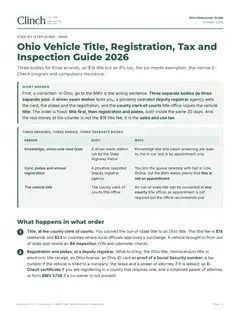
First, correct a habit: in Ohio "go to the BMV" is the wrong sentence. Three separate bodies do three separate jobs. A driver exam station run by the Ohio State Highway Patrol tests you, a privately operated deputy registrar agency sells you the card, the plates and the registration, and the county clerk of courts title office issues the vehicle title. The BMV itself issues no titles and runs no exam stations. The order is fixed: title first, then registration and plates, both inside the same 30 days.
Steps, documents and official links
The order of operations
- Title at a county clerk of courts office. You convert the out-of-state title to an Ohio title at any county's clerk of courts title office. The title fee is $18 statewide, or $23 in counties where local officials approved an additional charge. A vehicle brought in from outside Ohio also needs the $8 inspection, a VIN and odometer check.
- Registration and plates at a deputy registrar. Bring the Ohio certificate of title, memorandum title or electronic title receipt; an Ohio driver's license, Ohio ID card or proof of a Social Security number; a tax ID if the vehicle is titled to a business; the lease agreement and power of attorney if leased; an E-Check certificate if you are registering in a county that requires one; and a notarized power of attorney or form BMV 5736 for an absent co-owner.
- Pay the annual registration. Passenger vehicle registration is $36.00 a year, plus an $8.00 deputy registrar fee for one year ($12 for two years, $16 for three, $20 for four, $24 for five), plus a local permissive tax levied by your taxing district in $5 increments and capped at $30 per vehicle. There is also an annual surcharge by fuel type: $100 hybrid, $150 plug-in hybrid, $200 electric. The electric-vehicle surcharge is among the highest in this series.
- Do not be late. A renewal more than 30 days late adds a $10 late fee. A plate or registration transfer is $9.00, a duplicate registration $9.00, a replacement sticker $9.00, replacing two plates $16.25 (one plate $15.00, plus $10 to keep the same number), and a temporary tag $23.00.
The big number is the sales tax, not the title fee
The title fee is $18 or $23, but the real sum you hand over at the counter is the sales and use tax. The state rate is 5.75% and each county adds its own. In Franklin County, which contains Columbus, the combined rate is 8.00%, and there is a trap inside that number: it rose from 7.50% to 8.00% on April 1, 2025, when COTA's additional 0.5% sales tax took effect. Anything you find online quoting 7.5% for Columbus is out of date. In practical terms, a $15,000 car bought in Columbus costs roughly $1,200 in tax at the title counter.
The rate can also change inside a single county. The COTA sales-tax district is not the same thing as Franklin County: Ohio's rate table carries separate rows for the COTA portions of four neighboring counties, Delaware (COTA) 8.00%, Fairfield (COTA) 7.75%, Licking (COTA) 8.25% and Union (COTA) 8.00%, each higher than the non-COTA part of the same county. Two addresses in the same county can pay different vehicle tax. Check the rate by county and taxing district, not by city name; the table is published per quarter, and the figure here is for October 1 to December 31, 2026. One point we could not confirm: no official page states clearly whether motor vehicle tax is sourced to the buyer's county of residence or to the seller's location. Assume residence and registration, and confirm at the title office.
The six-month rule, the most valuable money fact here
The Ohio Department of Taxation writes it on its own page: "If the vehicle was purchased at least six months before moving to Ohio, no additional Ohio sales tax is due (use the exemption code CV when titling the vehicle)." A vehicle bought less than six months before the move is taxed, though a credit may be available. Separately, a credit is generally allowed for sales or use tax legally paid to another state or jurisdiction; you must show proper proof of the tax paid to the clerk of courts, and if the tax paid elsewhere equals or exceeds the Ohio use tax due, no additional tax is owed. So if you ship or drive in a car you have owned for more than six months, you owe no Ohio sales tax on it, only the $18 or $23 title fee, the $8 out-of-state inspection and the registration.
Two more rules. A trade-in reduces the taxable price on a new motor vehicle, while rebates, manufacturer discounts and down payments do not; a cash discount given at the time of sale does. And a casual, private, non-dealer sale is reviewed by the Ohio Department of Taxation, which writes to buyer and seller with an electronic questionnaire to verify the price. Misstating the price is an offense under ORC 2921.13, carrying up to six months in jail, a $1,000 fine, or both. Buying a cheap first car privately and writing "$1" on the paperwork is the trap. The help line is (888) 405-4039.
Inspection: Ohio has no general safety inspection
Ohio has no statewide periodic safety inspection for ordinary passenger cars. The only inspection in a newcomer's path is the $8 out-of-state vehicle inspection at titling. On emissions there is E-Check, and its reach is narrow: seven north-eastern Ohio counties only, namely Cuyahoga, Geauga, Lake, Lorain, Medina, Portage and Summit. Greater Cleveland and Akron are in; Franklin County and the whole Columbus region are out, so registering a car in Columbus needs no emissions test. In 2026 the program tests even-model-year vehicles plus odd-model-year transfers without a current passing test, by OBDII computer scan.
Write that with a hedge, because it is on a clock: on September 29, 2026 Governor DeWine directed Ohio EPA to begin the process of ending E-Check in north-eastern Ohio, after the U.S. EPA redesignated the region as meeting the federal ozone standard in June 2026. But the program must keep running until the federal government approves the request, so it is still in force today. We could not transcribe the body of the governor's announcement; the headline and substance come from the governor's own domain. If you live in north-eastern Ohio, check the current position on Ohio EPA's E-Check page before you register.
Insurance is compulsory and Ohio checks at random
Minimum liability: $25,000 for bodily injury or death of one person, $50,000 for two or more people, $25,000 for property damage (25/50/25). It is law in Ohio that you must have insurance to drive any motor vehicle, and an owner may not let anyone else drive it uninsured. Proof of insurance must be shown at traffic stops, accident scenes and vehicle inspections (ORC 4507.212 and 4509.101). On top of that Ohio runs a random selection insurance verification program and suspends the license of a driver who cannot show coverage. Driving uninsured costs $40 the first time, $300 the second time within a year and $600 the third. Reinstatement after an OVI or administrative suspension dated on or after April 9, 2025 is $315.
Appointments and queues: Ohio has no single system
The honest sentence is that Ohio has no single appointment system. Three errands, three procedures.
- Deputy registrar (card, plates, registration): you join the queue remotely with "Get In Line, Online" from bmv.ohio.gov. The BMV states plainly that this is not an appointment: "there may be a wait time when you arrive." You can also join the queue at the agency's kiosk or by scanning its QR code.
- In-car tests: genuinely appointment only, booked through BMV Online Services. The knowledge test and vision screening are walk-in during exam station hours.
- Clerk of courts title office: not mandatory, but the office recommends booking.
Title corrections and cancellations go to the BMV Title Support Section, PO Box 16520, Columbus OH 43216-6520, [email protected], 614-752-7671.
PDF: Ohio Vehicle Title, Registration, Tax and Inspection Guide 2026
04 · Toll roads
How do you pay tolls in Ohio?
Short answer
Ohio has one toll road: the Ohio Turnpike (I-80 / I-90), crossing the north of the state from the Indiana line to the Pennsylvania line, run by the Ohio Turnpike and Infrastructure Commission. There are no toll express lanes anywhere else in Ohio, and none in the Columbus region. The transponder is Ohio E-ZPass, and two numbers matter: in 2026 a passenger car pays 7.3 cents a mile with E-ZPass and 10.6 cents a mile paying cash or card. Cash is still accepted, but E-ZPass saves about 33%.
Steps, documents and official links
The Ohio E-ZPass account
- Open it online, or in person at any Ohio Turnpike service plaza or retail location.
- A prepaid personal account takes a minimum deposit of $25.00 per transponder, a one-time $3.00 activation charge, and a $0.75 per transponder per month lease fee. That monthly fee is waived if the transponder made 30 single trips or 15 round trips in Ohio in the previous month.
- A low balance of $10.00 triggers automatic credit-card replenishment. Commercial accounts take a $50.00 deposit and a $20.00 threshold.
- Ohio E-ZPass is interoperable with 25 or more agencies nationwide, including the Pennsylvania, New York and Florida systems.
- Mount the transponder properly. A badly mounted transponder that is not read can be billed as a non-transponder trip at a higher rate.
Three payment tiers and the rates
The governing schedule names four payment methods: a valid E-ZPass transponder; Video E-ZPass (V-Toll) for a license plate linked to a valid account; payment at the time of travel by cash, MasterCard, VISA, Discover, American Express and debit cards networked with a major credit card; and an unpaid toll for anything else. A trip whose plate is on an active account but whose transponder was not read is charged at the higher V-Toll rate. E-ZPass is the cheapest tier.
2026 Class 1 rates, meaning low two-axle vehicles and all motorcycles: $0.073 per mile with E-ZPass, $0.106 per mile cash or card. That was a 2.7% rise on January 1, 2026 from $0.071 and $0.104. The full 241-mile crossing in a passenger car in 2026, and the two directions are not the same:
| Direction | E-ZPass | Cash / card |
|---|---|---|
| Westbound (Pennsylvania to Indiana) | $19.00 | $27.75 |
| Eastbound (Indiana to Pennsylvania) | $16.00 | $23.50 |
The gap is not an error. Westbound traffic through the Eastgate toll plaza near the Pennsylvania border pays a round-trip flat-rate toll, and eastbound traffic through the same plaza pays nothing. Tolls are calculated as vehicle class times the miles between interchanges, rounded to the nearest quarter of a dollar. Class is set by height over the first two axles (under 7 ft 6 in counts as "low"), the number of axles, and length including anything towed.
One date to keep: the 2024 to 2028 schedule of tolls was approved in April 2023 and raises rates every January 1, so a new schedule takes effect January 1, 2027. The 2026 figures above are valid only through December 31, 2026.
If you drove through without a transponder
If your plate is not on an active E-ZPass account, an Unpaid Toll Invoice is posted to the address on the vehicle registration. You have about 25 days to pay; if payment is not received within 30 days, a second invoice adds $5 per unpaid toll. Pay online or post a check to the Cleveland address on the notice. The schedule's "Additional Tolls and Fees" page also lists an administrative fee for an in-lane unpaid toll, giving the amounts $5.00 and $10.00, but on that wide page we could not pin the labels to the amounts with confidence. The $5 second-invoice figure is independently confirmed by the E-ZPass FAQ; the $10 pairing is not certain. The commission's correspondence address is Ohio Turnpike and Infrastructure Commission, 682 Prospect St., Berea, OH 44017-2799.
05 · Public transit
Public transit and flights in Ohio
Short answer
Start with the plain fact: Ohio has almost no passenger rail. Amtrak runs up to five trains a day in the entire state, on three long-distance routes only. And the largest city in the state, Columbus, has no rail transit of any kind: no metro, no light rail, no commuter rail, no streetcar, no airport train. Columbus is also one of the largest American metropolitan areas with no Amtrak station at all. A reader who assumes a metro of two million people has a subway is wrong, so we are saying it plainly. One more: no airport anywhere in Ohio has a nonstop flight to Istanbul.
Steps, documents and official links
Inside the city: buses, and outside Cleveland only buses
Every large Ohio city runs buses. Cleveland is the only one with rail. Columbus's agency is COTA, the Central Ohio Transit Authority, and COTA runs 38 fixed routes, all buses. Fares:
| Fare | Price |
|---|---|
| Single ride | $2.00 |
| Children 5 to 12 | $1.00 (4 and under free) |
| Reduced fare | $1.00 |
| 2-hour pass (free transfers included) | $4.50 |
| Day pass (valid until midnight) | $4.50 |
| 31-day pass | $62.00 (reduced fare $31.00) |
Paying by app or Smartcard turns on fare capping: you never pay more than $4.50 in a day or $62 in a month. Payment works through the Transit app, the COTA Smartcard, cash on board (ask the operator for a transfer), Google Wallet and the Uber app. Reduced-fare eligibility is benefit-based, not status-based: people 65 and over, Medicare card holders, SSDI recipients, veterans, people with disabilities, and recent SNAP, Medicaid or WIC participants pay half. COTA's fare page says nothing about immigration status either way. And there is a fare-free trigger we have not seen at any other agency: when the National Weather Service office in Wilmington issues a heat or cold advisory or warning, COTA waives fares for the rest of that day.
COTA's other services: CMAX, the bus rapid transit line that opened January 1, 2018, running along Cleveland Avenue between downtown and Polaris Parkway / Africa Road at the ordinary $2.00 fare, which is the nearest thing Columbus has to a metro line and is a bus. COTA//Plus, on-demand door-to-door service inside three zones (Grove City, Westerville and the South Side), at $3.00 a ride, $6.00 a day, $20.00 a week, with free transfers to fixed-route stops inside the zone, booked in the app or on 614-308-4400; Grove City and Westerville run weekdays 5:30 a.m. to 8 p.m., the South Side seven days 5:30 a.m. to 8 p.m. Note that COTA//Plus costs more than the $2.00 bus and is a zone service, not a city-wide taxi. There are also Mainstream and Mainstream On-Demand (ADA paratransit), C-pass (employer-sponsored annual passes, worth asking your employer about), Zip to the Zoo, GREAT Workforce Transportation and SmartRide New Albany.
Two services you would assume are running, and are not
- CBUS, the free downtown circulator, is not running. COTA's own CBUS page carries the notice: "We apologize for any inconvenience, CBUS is not currently in service," and says COTA is reevaluating the service as part of future mobility planning. When it ran it was free, Brewery District to downtown to Short North, every 10 to 15 minutes, seven days a week. Do not tell anyone Columbus has a free downtown bus. For updates, (614) 228-1776.
- AirConnect, the airport bus, could not be confirmed as a current service. COTA's
cota.com/airconnect/returns a 404, and AirConnect does not appear in the services menu on cota.com at all. An undated COTA FAQ PDF describes it as running from the airport's lower level to stops on High Street and the COTA transit terminal at 25 E. Rich St., every 30 minutes, $2.00 one way, but a COTA post describes it as returning "for select events." We found no confirmation that AirConnect operates outside convention periods. Do not count on an airport shuttle; use COTA's Trip Planner for the airport instead.
For the future there is LinkUS, and it matters to describe it correctly: LinkUS will build bus rapid transit, not rail. It was funded when COTA's 0.5% sales tax passed in November 2024 with about 57% of the vote in the service area, the same levy that raised Franklin County's sales tax to 8.00% on April 1, 2025. The East Main Street line is planned as eight miles from downtown to Reynoldsburg with 17 stations; the West Broad Street line is at 90% design, awaiting a federal funding decision. No opening date is published. These lines come from summaries of the program's own site; the pages themselves were not transcribed.
Intercity rail: describing what is not there
Amtrak's entire Ohio service is three long-distance routes: the Capitol Limited (Chicago to Toledo, Cleveland, Pittsburgh and Washington), the Lake Shore Limited (Chicago to Cleveland, Buffalo and Boston or New York), and the three-times-weekly Cardinal (New York to Washington, Cincinnati, Indianapolis and Chicago). Amtrak's own Ohio fact sheet says the state's three largest cities, Cincinnati, Columbus and Cleveland, are not connected to each other by passenger rail, and that Columbus and Dayton are not served at all. The nearest stations are Cleveland (Lakefront Station, 200 Cleveland Memorial Shoreway, Cleveland, OH 44114) and Cincinnati Union Terminal, each about a two-hour drive from Columbus, and long-distance trains call there in the middle of the night. Text could not be extracted from the Amtrak and federal railroad PDFs, so these sentences rest on extracts from official-domain searches; confirm the timings with Amtrak directly.
The 3C+D corridor (Cleveland to Columbus, Dayton and Cincinnati, about 260 miles, up to four daily round trips proposed) was put forward by the Ohio Rail Development Commission in the federal Corridor Identification and Development Program: a $500,000 Step 1 obligation dated March 27, 2024, with Step 1 complete as of the federal status report of March 31, 2026. It is a planning program. No service, no date, nothing to wait for.
Intercity buses
Surface travel between Ohio cities means the coach in practice. Columbus's real intercity coach stop is 306 E Mound St, Columbus, OH 43215, shared by Greyhound, FlixBus and Barons Bus. FlixBus's own stop page warns that the bus stops on E Mound St between S Grant Ave and S 5th St, that passengers may not park in the nearby lots, and that it is a curbside stop with a request not to enter neighboring businesses. So there is no waiting room and no parking. Barons Bus confirms the same address on its own stop list, and adds Columbus (Ohio State), 55 W 12th Ave and Columbus (Airport), 4600 International Gateway.
The Columbus Bus Station at 845 N Wilson Rd, Columbus, OH 43204 is open 24 hours with ticket sales, toilets and food, operated by Barons Bus Lines in partnership with Greyhound, but Greyhound's own page describes it as transfer only and says passenger pick-up and drop-off happen on Mound Street. The Greyhound site blocks automated access, so we took that split from search extracts: confirm which address you are boarding from with Greyhound before you buy a ticket. GoBus, the state-supported rural intercity network operated by Hocking Athens Perry Community Action, connects south-eastern Ohio to Columbus; its Columbus stop is 845 N Wilson Rd and its information line is 888-954-6287 (weekdays 8 a.m. to 4 p.m.). We found no Megabus stop page for Columbus, which means we could not find one, not that Megabus does not serve the city.
Airports and the Istanbul flight
Columbus is served by John Glenn Columbus International Airport (CMH), 4600 International Gateway, Columbus, OH 43219. It has about 54 domestic nonstop destinations, and international nonstops only to Toronto (year-round), Montreal (seasonal) and Cancun (seasonal), with Punta Cana from January 8, 2027 and San Juan from February 13, 2027 announced. CMH has no transatlantic nonstop of any kind.
Turkish Airlines' U.S. nonstop gateways are Atlanta, Boston, Chicago, Dallas, Denver, Detroit, Houston, Los Angeles, Miami, New York, Newark, San Francisco, Seattle and Washington, and none of them is in Ohio. That list was assembled from the airline's own destination pages; the route map is an application and could not be transcribed, so confirm days and frequencies with the airline. The practical routing is one stop: CMH has nonstops to Chicago O'Hare, Detroit, Washington Dulles, Newark and New York JFK, all of them Turkish Airlines gateways. Chicago and Detroit are the shortest connections. The nearest transatlantic nonstop in the state is Cleveland Hopkins to Dublin; Cleveland has no other Europe service and nothing to Istanbul.
Getting to CMH: no train, and no dedicated airport bus line is named on the airport's own page. The airport points to COTA's Trip Planner for bus trips to the terminal (customer service 614.228.1776), plus Uber and Lyft from the designated arrivals-level zone, taxis on the ground transportation level (Taxi Management 614.239.8294), and limousine and charter operators.
06 · Regions
How Ohio is divided, and which address to pick
Short answer
When you look for a home in Ohio, the thing to study is not the view but which map you land on. The state has 88 counties, more than 250 cities, more than 650 villages and 1,308 townships, and they do not stack neatly. The consequence: a city line is a tax line. One side of a street pays a municipal income tax and the other does not; one school district levies its own income tax and the district next door does not. This is the sharpest address-level trap in the series.
Steps, documents and official links
Three layers of local government
The Ohio Legislative Service Commission puts it this way in its own members' brief: "Ohio has three types of local government, counties, townships, and municipal corporations (cities and villages)." On top of those come school districts, library districts and regional transit authorities. The number of local governments with taxing power is about 2,300.
- What is a township? The definition runs backwards: "Territory that is not within a city or village is township territory." So every part of the Ohio map that is not a municipality is a township. Townships have four elected officials, three trustees and a fiscal officer, and they provide roads, fire and emergency medical service and zoning, while the county sheriff usually polices them.
- City or village is a population question. A municipality of 5,000 or more is a city; under 5,000 it is a village. About 180 cities and more than 50 villages have adopted a charter, which is why the rules in one suburb do not match the next.
- Who does what at the county? The statutory default is 11 elected officials: three commissioners, the auditor, treasurer, recorder, sheriff, prosecutor, coroner, engineer and clerk of the court of common pleas. The auditor values property and administers the exemptions, the treasurer bills and collects, the recorder records deeds.
Three income taxes, and the third one looks at your address
Three separate bodies can take a share of your income in Ohio, and their logic differs. The detail belongs in the tax section, but the part you need while choosing a home is this.
- State income tax. Ohio taxes the first $26,050 of taxable non-business income at 0%. From tax year 2026 the rest is taxed at a flat 2.75%. Write that with a hedge: the state tax department's rate table still shows brackets only through 2025, but new employer withholding tables took effect August 1, 2026, which is the implementation of the change. Anything quoting Ohio's "3.125% top rate" stops being true for tax year 2026.
- Municipal income tax, and it is generally withheld where you work. Ohio cities and villages levy their own income tax under ORC Chapter 718, and hundreds of them do. The logic is the reverse of Maryland's: Maryland's extra local income tax is a county tax set by where you live and collected on the state return. Ohio's is a city or village tax, normally withheld by the employer for the municipality where the work is performed, filed on a separate city return, and reconciled with your home city through a credit. For example, Columbus levies 2.5% and gives 100% credit for tax paid to another municipality up to 2.5%. So if you live in Columbus and work in a suburb that charges 1.5%, you owe Columbus the gap and nobody withholds it. There are three possible places to file a city return: cities that run their own tax office, and the regional collectors RITA and CCA for the rest.
- School district income tax, and this one looks only at where you live. In the state tax department's own words: "Unlike city taxes, you only pay school district income taxes based on where you live, not where you work." It is only ever imposed by voter approval, and as of January 2026, 210 Ohio school districts have one. If your district's rate is 0% you do not file. Here is the address trap: Columbus City School District has no school district income tax, but neighboring districts do. Westerville's 0.75% began on January 1, 2026; Bexley is 0.75%, Canal Winchester 0.75%, Reynoldsburg 0.50% and Pickerington 1.00%. Moving a few streets out of Columbus creates a tax that did not exist at the old address. If an employer withheld it in error, you still have to file an SD 100 to get it back.
And then the township effect: a township address normally pays no municipal income tax at all, because the municipal income tax is a city or village tax. In exchange, services come from the township and the county. The school district income tax still applies in a township, because that one follows residence. Where a township and a city have set up a joint economic development district, a workplace inside it can still owe a municipal-style tax; we could not confirm that last point against a primary source.
Four maps that disagree on the same street
In Ohio, "which city am I in," "which township am I in," "which school district am I in" and "what does my postal address say" are four different questions, and they can disagree at the same street. A postal address that reads Columbus does not mean you pay the Columbus income tax. The official tool that answers the tax version is the Ohio Department of Taxation's The Finder address lookup. Before you sign a lease, put your full address into it and see for yourself which municipality, which school district and which taxing district you are in.
One example: Columbus is not only in Franklin County. Parts of the city extend into Fairfield and Delaware counties, so a Columbus address can sit under a different auditor, a different treasurer and a different sheriff. The Census Bureau publishes a separate profile for "Columbus city, Fairfield County."
The big regions and what separates them
| Region | Electric distribution utility | What to watch |
|---|---|---|
| Columbus and central Ohio | AEP Ohio (part of the city is served by the city's own Division of Power) | Franklin County sales tax 8.00%; no rail transit; no E-Check required |
| Cleveland, Akron and the north-east | FirstEnergy (Ohio Edison, the Illuminating Company, Toledo Edison) | The only region where E-Check emissions testing applies; the state's only rail transit is in Cleveland; the Ohio Turnpike runs through here |
| Cincinnati and the south-west | Duke Energy Ohio | Amtrak's Cardinal passes through, three days a week |
| The Dayton area | AES Ohio | No passenger rail; a planned stop on the 3C+D corridor |
On the gas side the distribution companies are Columbia Gas of Ohio (Columbus and much of the state), Dominion Energy Ohio / Enbridge Gas Ohio (north-east), Duke Energy Ohio (Cincinnati) and CenterPoint Energy Ohio (the Dayton area). We could not verify each company's territory individually, so confirm your own address on the company's page.
07 · Electricity and gas
How do you start electricity and gas service in Ohio?
Short answer
Ohio has retail choice for both electricity and gas, so you have to separate two things: the distribution utility, which owns the wires or pipes, reads the meter and comes out to a fault, never changes; only the generation or commodity part of the bill can be bought from someone else. Two lines matter most for a newcomer. The state regulator caps a new customer's up-front deposit at $175 between October 12, 2026 and April 16, 2027, and AEP Ohio states in writing that the Social Security number is optional.
Steps, documents and official links
Separate the distribution utility from the supplier
Ohio's energy choice site explains it this way: the electric distribution utility always stays the same, always delivers the power and reads the meter, and only the generation and supply part can be bought from a certified competitive supplier. To judge an offer, you compare the supplier's total generation price per kWh with the "price to compare" printed on your own utility bill. If you never choose a supplier you stay on the utility's Standard Service Offer, which is bought at auction and changes periodically. That is a variable default, not a fixed rate.
To compare offers, use the state's own tool, the Apples to Apples chart. The regulator describes it as "the only comparisons in the state for which suppliers are required to provide accurate and up-to-date information about their latest offers," showing price per kWh, term length, fixed against variable, monthly fees, renewable content, introductory pricing and early-termination fees. The same chart exists for gas, and the regulator says it "verifies each supplier offer to ensure accuracy." Look at that chart, not at the salesperson at your door or on the phone. Complaints go to (800) 686-7826.
There is a third route called government aggregation: Ohio law lets a local government join its residents together to buy electricity as a group and negotiate the terms, and it lets them enroll eligible residents automatically. So anyone who wants out opts out, and anyone who does nothing stays in. Columbus's program is Clean Energy Columbus, running since 2021 and reaching over 220,000 Columbus residents and small businesses; enrollment is automatic and leaving is free of fees and penalties. For June 2026 to May 2027 the supply rate is 10.01 cents per kWh, supplied by AEP Energy, which the program's own page is careful to distinguish from AEP Ohio. For comparison, AEP Ohio's price to compare was 10.97 cents from July 1 to September 30, 2026, so the aggregation rate sat below the utility default that quarter. The program line is 866-856-5654. These numbers are dated: the aggregation rate is fixed only to May 2027, and the price to compare changes every quarter.
What happens with no SSN: the route the regulator publishes
This is the most important part of the section for a newcomer. The regulator's Natural Gas Customers' Bill of Rights lists the ways to establish credit one by one, and a Social Security number is not among the criteria:
- The customer is a property owner or meets the legally accepted practices to verify credit.
- The customer has had a prior account with the gas company for the same class of service within the past two years and, in the prior year of service, did not have a late bill more than twice and did not have service disconnected for nonpayment, fraud or tampering.
- The customer can provide someone with good credit who will pay for up to 60 days of service if they fail to pay their bill.
So there is an explicitly published alternative for someone with no credit file: a guarantor. The electric criteria read word for word the same, and AEP Ohio makes it concrete on its own page: instead of cash it accepts "an acceptable guarantor" or "a letter of credit from another utility showing on time payment history for at least twelve months."
On the SSN itself, two companies say two different things, and we report both as they stand.
- AEP Ohio: "Your Social Security number is used to verify credit history. Providing this information is optional, but a deposit or some other security guarantee will be required if AEP Ohio is unable to perform this verification." AEP Ohio "normally requires security deposits from customers who are new to AEP Ohio," and the amount is based on the type of heat or the usage history at your address.
- Columbia Gas of Ohio: to start service it asks for "Name, SSN/TIN, Phone, Date Of Birth, and Email Address." Because a tax identification number is accepted, that field is open to an ITIN. Keep whichever number you used: later authentication asks for the last four digits of the SSN or tax ID. We could read that line through an official-domain search rather than the company's own page, so confirm it before you apply.
Deposits: three rules and one seasonal cap
| Rule | What it says |
|---|---|
| Cap | The deposit may not exceed 130% of your estimated average monthly bill for regulated services |
| Interest | If the company holds the deposit more than six months it must pay at least 3% interest; the Ohio rate is 3.00% a year |
| Review | After 12 months the company reviews the account and decides whether to return the deposit |
| Instead of cash | A guarantor, or a letter of credit from another utility showing 12 months of on-time payment |
| Extra electric rule | The deposit may be raised or lowered after three consecutive billing periods if what you paid differs by 20% or more from what actual usage would require |
And the most useful line in this section: the regulator's Special Reconnect Order is usually described as help for people facing disconnection, but its text explicitly also covers starting new service. In its own words, customers seeking to establish new electric or natural gas service can, rather than paying the full security deposit, pay up to $175 and have the balance above $175 charged on the next monthly bill. There is no income test, it can be used once per winter heating season, and it is open to any residential customer of a regulated electric or gas utility. This season's window is October 12, 2026 to April 16, 2027, which is open for the life of this page. Under the same order the reconnection charge cannot exceed $36. More than 227,000 Ohioans used it last season.
One limit matters a great deal: all of these protections apply only to utilities the regulator regulates. Municipal utilities are outside the regulator. The City of Columbus runs its own water, wastewater, storm water and part of its electric distribution; customers of the city's Division of Power are outside retail choice and outside the city aggregation, and the $175 cap, the 130% rule and the 3% interest do not apply to them. So "who supplies my electricity in Columbus" has two answers and you have to check the map. The city service line is 614-645-8276 and the Division of Power new-service line is 614-645-7360. We could not find any official page stating what identification the city asks for or whether it charges a deposit, so the honest instruction is to phone and ask.
Disconnection, timing and winter protection
- Call the gas company two to four weeks ahead. With no construction, installation is normally within 5 business days; if a new service line or meter is needed, 20 business days, and the company must notify you of any delay. New electric service is normally 3 business days, or 10 business days after construction is complete.
- There is a 14-day notice before shut-off, plus an extra 10-day notice from November 1 to April 15. But note: service can still be disconnected for nonpayment in winter. There is no absolute winter ban for either fuel.
- A medical certification signed by a certified health care professional holds or restores service for 30 days and may be used three times per household in 12 months.
- Pay before 12:30 p.m. for same-day reconnection. The regulator is at 180 E. Broad St., Columbus OH 43215, (800) 686-7826.
Bill assistance
The programs are HEAP (a once-yearly payment applied to the heating or cooling bill), PIPP (the Percentage of Income Payment Plan, year-round), the HEAP Winter Crisis Program (for households threatened with or already disconnected, or with less than a 25% supply of bulk fuel, and it can help pay the $175), the HEAP Summer Crisis Program, the Electric Partnership Program and the Home Weatherization Assistance Program. The income test is at or below 175% of the federal poverty guidelines for households up to eight. Know one administrative change: these programs moved from the Ohio Department of Development to the Ohio Department of Job and Family Services during 2026, and the old pages now redirect. ODJFS is at 30 E Broad St, Columbus OH 43215, 614-466-6282.
A hedge is required here. An older state HEAP application form listed "proof of citizenship for each member of household" among the required documents. We could not open the current 2026-27 application, so we cannot tell you that a household with non-citizens qualifies. Phone your local energy assistance provider and ask exactly which documents they want before you apply.
Cities can add a discount of their own. Columbus, for example, gives a 30% discount on water and power usage charges to households below 200% of the federal poverty level; a household already on SNAP, Ohio Medicaid or HEAP qualifies regardless of the income table, and qualifying residents 60 and over may have their service charges waived. The document list for the discount has no SSN on it: for each household member over 18, one of an income tax return, a Social Security benefit letter, W-2 forms or a pension award statement. We could not confirm whether a return filed with an ITIN is accepted.
Official sources
- PUCO: Natural Gas Customers' Bill of Rights
- PUCO: Electric Customers' Bill of Rights
- PUCO: 2026-27 Special Reconnect Order ($175 cap)
- Energy Choice Ohio: Apples to Apples supplier comparison
- AEP Ohio: security deposits
- Columbia Gas of Ohio: start, stop or move service
- ODJFS: energy and community assistance
08 · Renting
Tenant rights and deposit rules in Ohio
Short answer
Ohio puts no cap at all on the size of a security deposit, but the slice above one month's rent (or $50) earns 5% interest a year, and the deposit comes back within 30 days of the end of the tenancy with an itemized written statement. A landlord who withholds wrongly owes double the amount plus your attorney's fees. There is one requirement people miss and it is costly: the tenant must give the landlord a forwarding address in writing, and failing to do so costs the tenant the right to sue.
Steps, documents and official links
The deposit: how much, when, with what interest
- No limit on the amount. Section 5321.16 of the Ohio Revised Code regulates the interest and the return, not the size, and we found no statutory maximum. New York caps deposits at one month and Massachusetts at one month with strict escrow; Ohio sets no cap.
- Interest only on the top slice. In the statute's words, any security deposit in excess of fifty dollars or one month's periodic rent, whichever is greater, bears interest on the excess at 5% a year if the tenant remains in possession for six months or more, and it is computed and paid annually by the landlord to the tenant. So there is no interest up to one month's rent, and none before month six.
- Thirty days and an itemized list. Any deduction must be itemized and identified by the landlord in a written notice delivered to the tenant together with the amount due, within 30 days after the end of the rental agreement and delivery of possession.
- The forwarding address requirement. The tenant must give the landlord a forwarding address in writing; failing to do so costs the tenant the right to damages. On the day you move out, send your new address to the landlord by email or certified mail and keep the record.
- The penalty is double. A landlord owes double damages plus attorney's fees on the amount wrongfully withheld.
All of these lines come with a hedge: the official Ohio statute site would not open by any route during this research, so the statutory text was read through official-domain search summaries. The figures, the 5% interest, the 30 days and the double damages, therefore sit in the "confirm before relying on it" class. If you are going to rely on a number in your own case, ask a lawyer or a local legal aid organization first.
Notice, entry and repairs
- Ending a periodic tenancy: at least 30 days before the periodic rental date for month-to-month, at least 7 days for week-to-week. A 3-day termination notice applies on the controlled-substance ground.
- Landlord entry: at reasonable times, with 24 hours of reasonable notice (ORC 5321.04).
- Rent escrow if repairs are ignored: you can pay the rent into escrow with the clerk of the municipal or county court (ORC 5321.07). This is not the same as stopping payment; it is paying the rent to the court. Getting the procedure wrong can become a ground for eviction, so get legal help first.
- Retaliation is prohibited under ORC 5321.02.
How an eviction runs
In Ohio an eviction is called a forcible entry and detainer action and is heard in the municipal or county court. The landlord must first serve the statutory 3-day notice to leave the premises, with the warning language the statute requires, and then file (ORC Chapter 1923). In the Columbus area the case goes to the Franklin County Municipal Court, whose clerk publishes its own eviction-process sheet.
What Ohio has not done, and some cities have
Two things to say plainly. Ohio has no statewide source-of-income protection: the state fair housing law covers race, color, religion, sex, military status, national origin, disability, ancestry and familial status, and source of income is not on the state list. And Ohio has no rent control; we found no state statute authorizing local rent control and no Ohio city with it. Read that as "we could not find one" rather than as a flat statement that none exists.
Some cities fill the gap with their own rules. Columbus has gone further than most Ohio cities, and every one of these rules stops at the city line:
| Columbus rule | What it gives you |
|---|---|
| City Code 4551.04 ("Renter's Choice") | A new tenant asked for a security deposit may choose to pay it over no fewer than 3, or no fewer than 6, monthly installments instead of all at once. For a newcomer with no savings cushion this is the single most useful item here |
| City Code 4551.03 and 4501.378 | Bars rejecting renters based on lawful source of income, including housing vouchers, child support, spousal support and public assistance. It also bars distinctions in price, terms, conditions, fees or privileges, and where an income threshold is applied, voucher income must count toward it |
| City Code 4551.05 and 4551.06 | A right to receipts for rent payments, and a bar on refusing rent tendered by someone other than the tenant, which matters when a relative, employer or charity pays |
| City Code 4509.07 | Retaliation against a tenant for reporting code violations is a criminal misdemeanor, not only a civil wrong |
| City Code 4509.061 | Requires a landlord to provide relocation assistance when the property has problems (added in 2024; we could not establish the amount or the trigger) |
| City Housing Code 4541.01 | A sleeping room must be at least 70 square feet for one occupant and at least 50 square feet per occupant where more than one sleeps in it. Useful against an overcrowded sublet |
There is a right to counsel in eviction, but a narrow one. Columbus City Code 4551.08 and 4551.081, enacted by an ordinance approved in December 2024, create an "Access to Legal Services" policy. Eligibility as published: a Columbus resident, facing eviction, at or below 100% of the federal poverty level, with a child living in the home. Everyone else gets advice and brief service where capacity allows, not guaranteed full representation. It would be wrong to describe this as a general right to a lawyer: a full county-wide right to counsel was costed at $6.1 million a year and has not been funded. The city had already approved roughly $1.5 million in grants in March and April 2024 to the local legal aid tenant advocacy project.
The section numbers and ordinance dates for these Columbus rules are solid, but we could not read the operative text line by line, because the city code is published on a platform that renders only in a browser. Confirm before relying on any threshold or exemption. And again: a tenant in Dublin, Hilliard, Grove City, Westerville or at a township address has only the Ohio Revised Code.
09 · Property tax
Property tax and the homestead exemption in Ohio
Short answer
Correct one misunderstanding first: in Ohio "homestead" is not the general owner shield it is in Texas or Florida. Ohio's Homestead Exemption is an age and disability relief: you must be 65 or over or totally and permanently disabled, and your income must fall below a limit. What most owners actually receive is a separate and much smaller relief, the 2.5% owner-occupancy credit. Do not confuse the two, and note that both are due by December 31.
Steps, documents and official links
How property tax is calculated
- Tax applies to 35% of market value, not to the whole. In the state tax department's words: "Thirty-five percent of the market value represents the assessed or taxable valuation of real property." Rates are expressed in mills, where 1 mill is $1 per $1,000 of assessed value.
- Revaluation every six years. "Real property in all counties is reappraised at 100 percent of market value every six years and updated the third year after each reappraisal," on the Tax Commissioner's order.
- House Bill 920 holds voted levies down. In the Franklin County Auditor's words: "You are protected from unvoted increases in property taxes by Ohio legislation known as House Bill 920, which reduces your rate as property values in your district increase during triennial reappraisals and updates." The practical point: when you compare homes, compare the effective rate, not the full rate.
- Two long-standing reductions survive: a 10% rollback and a 2.5% reduction, both in place for residential owners since the 1970s.
One illustrative figure: the Franklin County Auditor states that for Columbus "the tax as a percentage of market is 1.48%," roughly $1,480 a year per $100,000 of market value before credits. Effective rates differ by taxing district inside the same county, and we could not download the county's full rate schedule, so treat that number as an order of magnitude. Franklin County's 2026 due dates were March 2, 2026 for the first half and July 20, 2026 for the second, after which penalty and interest accrue, and the county puts it bluntly: "Failure to receive a tax bill will not avoid such penalty and interest." The county treasurer is at 373 S. High St., 17th Floor, Columbus OH 43215-6306, 614-525-3438. As an Ohio quirk worth one line, the county's full rate schedule is published by law on a newspaper's website; Ohio still issues some official notices through a newspaper of record.
The Homestead Exemption: who, how much, by when
| Item | Tax year 2026 |
|---|---|
| Who qualifies | Low-income Ohioans 65 and over, those permanently and totally disabled, the surviving spouses of either, and the surviving spouses of public service officers killed in the line of duty |
| Market value exempted | $29,700 (it was $29,000 for tax year 2025) |
| Disabled veterans and spouses of public service officers killed in the line of duty | $59,400, with no income test |
| Income limit (MAGI) | $41,000 (it was $40,000 for tax year 2025). MAGI is your Ohio adjusted gross income plus the business income deduction |
| Age or disability condition | Turn 65 by December 31 of the year you file; or be totally and permanently disabled as of January 1 of that year, certified by a licensed physician or psychologist or by a state or federal agency on form DTE 105E; or be a qualifying surviving spouse who was at least 59 at the date of death |
| Occupancy condition | Own and occupy the home as your principal residence as of January 1 |
| Deadline | On or before December 31 of the year for which the exemption is sought, filed with the county auditor |
The forms: DTE 105A for the general application, DTE 105I for disabled veterans, DTE 105K for surviving spouses of public service officers, DTE 105E for the disability certificate, DTE 105H for an income estimate from an applicant who did not file an Ohio return, DTE 105B for the continuing application and DTE 106B to appeal a denial to the county Board of Revision within 60 days. Once granted, you do not reapply every year: the auditor mails DTE 105B each January and you return it only if something changed. But moving means reapplying at the new address in the January after the move. A false statement on the application is a fourth-degree misdemeanor and bars the exemption for three years.
There is a new, county-by-county variable. House Bill 96, signed in June 2025, authorizes county commissioners to provide an additional homestead exemption. This local-option exemption piggybacks on the state one with all the same eligibility requirements and equals the same amount, essentially doubling the total. No separate application is needed and it is automatic for those already approved. But it applies only if the county commissioners adopt it, and the state does not reimburse local governments for it. We could not establish whether Franklin County has adopted it. For a reader over 65 that is the most valuable open question here, because it doubles the exemption. The Franklin County Auditor's homestead line is 614-525-4663.
What most owners actually get: the 2.5% credit
The owner-occupancy credit is a 2.5% reduction in the taxes charged by qualified levies. The conditions are simple and none of them involve age or income: own and occupy the home as your principal residence as of January 1 of the year you file, complete form DTE 105C, and file it with the county auditor by December 31. Forgetting this form in the first year after you buy is the most common Ohio mistake.
Does immigration status come into any of this?
We put this carefully. The homestead exemption and the owner-occupancy credit turn on ownership, occupancy, age or disability and income. We found no citizenship or immigration condition on the state tax department's page about them, and the page does not ask for a Social Security number either; what it asks for is proof of age, a driver's license or birth certificate, and income documents on DTE 105H if no Ohio return was filed. Read that as "we found no immigration condition on the official page" rather than as a flat statement that none exists, and get confirmation for your own case from the county auditor.
10 · School
How do you enroll a child in school in Ohio?
Short answer
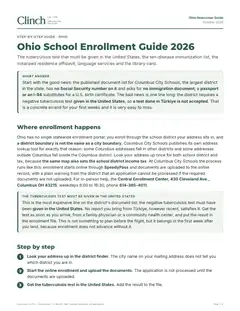
Start with the good news: the published document list for Columbus City Schools, the largest district in the state, has no Social Security number on it and asks for no immigration document; a passport or an I-94 substitutes for a U.S. birth certificate. The bad news is one line long: the district requires a negative tuberculosis test "given in the United States," so a test done in Türkiye is not accepted. That is a concrete errand for your first weeks and it is very easy to miss.
Steps, documents and official links
Where enrollment happens
There is no statewide enrollment portal in Ohio. You register with the school district for your address, and the district boundary is not the same as the city limits. Columbus City Schools publishes its own School Finder address tool for exactly that reason: some Columbus addresses fall in other districts and some addresses outside the city fall inside this one. Look your address up once, for school and for tax at the same time, because the same map decides the school district income tax.
At Columbus City Schools the process runs like this: registration starts online through SpeedyPass, with documents uploaded to the online registration. The district's warning is blunt: "if you do not upload the required documents your application will not be able to be processed." For in-person help, the Central Enrollment Center, 430 Cleveland Ave., Columbus OH 43215, weekdays 8:00 a.m. to 4:30 p.m., phone 614-365-4011.
The document list, as published
| Document | Detail |
|---|---|
| Parent photo identification | The list does not say which IDs count |
| Verification of student identity | A birth certificate; a passport showing the date and place of birth; a certified certificate of baptism or other religious record; a certified transcript of a hospital record; or a birth affidavit. The district's FAQ adds an I-94 or passport as acceptable alternatives |
| Proof of custody or guardianship | If applicable |
| Address verification | A current mortgage statement in the parent's name, a recent gas, water or electric bill, a lease, the two most recent pay stubs showing name and address, a letter from the employer on company letterhead, or W-2 forms. Generally dated within 30 to 60 days |
| Negative tuberculosis result | From a test given in the United States |
| Immunization record | The ten-disease list below |
| Previous school paperwork | Withdrawal papers, the last grade card or a transcript |
| Special education documents | An IEP, evaluation team report or 504 plan, if applicable |
| Extra for pre-kindergarten | The Ohio Preschool Program application and income verification |
We put it this way and no further: the district's published list does not include a Social Security number or an immigration document, and neither the enrollment page nor the FAQ asks for them or asks about immigration status. We say "the published list does not include them" rather than "the district cannot ask," because we could not confirm that the state publishes such a prohibition.
If you are living with a friend or a relative, there is a Residence Affidavit for families permanently sharing a home; it must be notarized and the host must own the home. If you are in a hotel, a shelter or doubled up with another family, the district's McKinney-Vento team, Project Connect, 614-365-5140, handles the enrollment and the usual proof of address is not required.
Immunizations: ten diseases and a 14-day window
Section 3313.671 of the Ohio Revised Code requires protection against ten vaccine-preventable diseases: diphtheria, hepatitis B, measles, meningococcal (ACWY), mumps, pertussis, polio, rubella, tetanus and varicella. A pupil must be protected, in the process of being protected, or hold an exemption within 14 days of starting school. Ohio recognizes two exemptions: a medical exemption certified in writing by a physician, and an exemption on "reasons of conscience, including religious convictions" by a written parental statement. The state health department publishes a quick guide for parents, July 2026 edition, and an annual school immunization summary chart by grade.
What the language situation actually is for a Turkish-speaking parent
State it as it stands: Turkish appears in none of the languages the district names. The Columbus City Schools English learner phone menu is Spanish (press 1), Somali (2), Nepali (3), Arabic (4), French (5), Swahili (6), English and all other languages (8). The district's translated documents library is published in exactly those six languages: Spanish, Arabic, Nepali, Somali, French and Swahili. There is no Turkish translation and no Turkish menu option. The city's own website translates into thirteen languages and Turkish is not among those either.
That is not bad news so much as the right expectation, because free telephone interpretation does exist and asking for it is your right. Choose the "all other languages" option and ask for a Turkish interpreter by phone. The service sits at the EL Language Assistance Center, 270 E. State St., Columbus OH 43215, phone 614-365-8802, weekdays 7:30 a.m. to 4:30 p.m., and it provides immediate emergency interpretation by phone. The district's rule is that students who spoke another language when they first learned to speak, or who use another language frequently, must be assessed for English proficiency, and the assessment is arranged through enrollment on 614-365-4011. The district's own numbers give a sense of scale: across roughly 30,000 households, families from 104 countries speak 95 languages, the most common being Spanish, Somali, Nepali, Arabic and French.
One distinction has to hold. The district's school for newly arrived teenagers, Columbus Global Academy, takes students aged 11 to 21 who are recent arrivals at a beginning level of English, and the school's own About page lists more than 55 countries its pupils come from, with Türkiye among them. But that is a country fact, not a language service. It does not mean there is teaching or support in Turkish at that school; it means families from Türkiye already have children there.
The library card: the least demanding door in the state
For a newcomer short on documents, the library asks for less than any other official counter in Ohio. The Columbus Metropolitan Library board policy reads: "Any person/organization that resides or is established in Ohio is eligible for a Columbus Metropolitan Library card." An adult shows photo ID in a branch for a full access card, and the accepted IDs are listed one by one: a driver's license, state ID, passport, work ID, school ID, green card or consular identity card (Matrícula Consular), or a credit card with a photo. The policy asks for no Social Security number and no proof of address, and it tells staff that they are expected to use appropriate judgment and issue cards in exceptional circumstances where not all of the criteria have been met.
- Apply from home and you get a "Web Only" card number immediately: e-books, databases, meeting-room booking and holds. A full access card for physical items needs the photo ID at a branch.
- There is no minimum age for children. A parent's photo ID is needed. If the child is not present, child verification can be a birth certificate, a Social Security card, an insurance or benefits card, a juvenile state ID, the most recent school report card or a green card or consular identity card, so an SSN card is one option among several and never the only one.
- A children's Kids Card needs no parent signature at all: up to five juvenile or teen books, public computers and the full digital collection.
- A Columbus City Schools student's school ID number works directly as a library card, the Success Card, unless a parent opts out: five physical books, public computers, the full digital collection and up to five lost or damaged items waived per school year.
- Teachers, other school staff, preschool instructors and homeschool educators can get an Educator Card with an 80-item limit, on proof of employment.
Ohio public libraries are independent districts, so card rules are set library by library. The rules above are Columbus Metropolitan Library's own policy; if you live elsewhere, ask your own library for its policy. What is common statewide is the Ohio Digital Library consortium, which your local card opens.
11 · Health
What do you do in Ohio if you have no insurance?
Short answer
One thing changes the shape of this section in Ohio: free hospital care for a person below the poverty line is a statutory duty, not a hospital's favor. Every hospital that takes money under the state program must treat Ohio residents who are not on Medicaid and whose income is at or below 100% of the federal poverty line without charge. Ohio also expanded adult Medicaid, so there is no coverage gap, and for emergencies there is a Medicaid route that requires no Social Security number and no status verification.
Steps, documents and official links
HCAP: a statutory entitlement, not a donation
The program is the Hospital Care Assurance Program (HCAP), administered by the Ohio Department of Medicaid. Its rule (OAC 5160-2-17) and its statute (ORC Chapter 5168) say this: every hospital that receives HCAP funds, which in practice means every general hospital in Ohio, must provide basic, medically necessary hospital-level services without charge to people who are:
- Ohio residents. The program's definition is "voluntarily living in the state of Ohio," and that extends to temporary residents such as students, migrant workers and people temporarily staying with relatives in Ohio.
- Not Medicaid recipients.
- At or below 100% of the federal poverty line.
The hospital runs the application and a signed application is required. So it does not happen by itself: you have to go to the billing office and ask for the HCAP application by name. And keep a distinction in mind: HCAP and the hospital's own financial assistance policy are two different things, so ask about both separately.
Some hospitals go further on their own account. Mount Carmel Health System in Columbus helps patients apply for HCAP, but under its own policy says hospital care is at no charge below 200% of the federal poverty level and discounted from 201% to 400%, decided on income, assets, family size and the size of the bill, with prompt-pay discounts and low-interest loans up to three years. Patient Financial Services is 614-234-8888 or 800-346-1009, weekdays 9 a.m. to 5 p.m.
We leave one question open because it is open: no Ohio government page states whether HCAP applies regardless of immigration status. The accurate sentence is that HCAP is written around Ohio residence and income; the pages we read do not impose an immigration-status test, and they do not say status is irrelevant either. Mount Carmel's financial assistance page says nothing about immigration status in either direction. So when you apply for help with a hospital bill, put that question directly to the billing office.
The emergency room: nobody asks you for money at the door
Under the federal EMTALA law, any Medicare-participating hospital with an emergency department must give a medical screening examination and stabilizing treatment to anyone who asks for it, regardless of ability to pay, insurance or immigration status. But note the limit: that is a duty to screen and stabilize, not a duty to treat for free, and a bill follows. In Ohio there are two things that can erase that bill, and both are described here: HCAP and NCEMA.
Ohio Medicaid: adults are covered and there is no gap
The program is simply called Ohio Medicaid, run by the Ohio Department of Medicaid, with no separate brand for children because the CHIP side is folded into Medicaid. You apply at benefits.ohio.gov or through your county Job and Family Services office. The important point: Ohio expanded adult Medicaid. The ACA adult group is called Group VIII or "MAGI Adult": adults aged 19 to 64 with income at or below 138% of the federal poverty level. So there is no Georgia-style coverage gap and, in what we read, no Georgia-style work requirement.
| Group | 2026 income limit (percent of the federal poverty level) |
|---|---|
| Parents and caretaker relatives | 90% |
| Adults 19 to 64 (Group VIII) | 133%, which with the 5-point MAGI disregard works out at 138% |
| Children with other creditable coverage | 156% |
| Pregnant women | 200% (family size counts each fetus, and the postpartum period is covered) |
| Children without other coverage | 206% |
The monthly dollar figures behind those percentages are published in the state's own 2026 chart, but that PDF would not render as text during this research. So we are not printing dollar amounts: confirm the current figure for your household size at benefits.ohio.gov or at the county office.
Immigration status does matter for ordinary Medicaid. Ohio's rule (OAC 5160:1-2-12, in the version dated February 13, 2026) requires "satisfactory immigration status." Lawful residence as of August 22, 1996 and continuing counts, but a qualified non-citizen granted status on or after August 22, 1996 faces a five-year bar. That bar is waived for refugees, asylees, people granted withholding of removal, Cuban and Haitian entrants, Amerasian immigrants, trafficking victims and Afghan or Iraqi special immigrants. We could not read the rule text on the official site and took it from official-domain search summaries, so get confirmation for your own case.
NCEMA: the most generous emergency Medicaid administration in this series
It is called Non-Citizen Emergency Medical Assistance (NCEMA), its rule is OAC 5160:1-5-06, effective December 1, 2023. It covers treatment of an emergency medical condition for people who do not meet the citizenship or satisfactory-immigration-status test. Two things set it apart in this series:
- The applicant is not required to verify a Social Security number and is not required to verify citizenship or immigration status.
- Once approved, the eligibility span stays open for twelve months from the month of application rather than closing with the episode.
We could not read the rule text directly on the official site and again took it from official-domain search summaries. But it gives you the name of the thing to ask for: if you have been to the emergency room and your status keeps you out of ordinary Medicaid, ask the hospital's financial counselor or the county Job and Family Services office about NCEMA.
If you want to buy insurance: Ohio has no exchange of its own
Ohio runs no state-based exchange; individual coverage is bought on healthcare.gov. In practice:
- The federal calendar applies: open enrollment runs November 1, 2026 to January 15, 2027, and you must choose by December 15, 2026 for coverage starting January 1.
- The federal "lawfully present" list governs who may buy: an undocumented person cannot buy a marketplace plan at any price, and DACA recipients are not eligible.
- There is no Ohio consumer call center of its own; the federal line is 1-800-318-2596.
We could not nail Ohio's lack of an exchange to a state insurance department page; the state's own navigator pages describe a "federally facilitated exchange," which is strong but indirect.
Official sources
- Ohio Medicaid: who qualifies (children, families, adults)
- Ohio Benefits: the application portal
- OAC 5160-2-17: the Hospital Care Assurance Program rule
- OAC 5160:1-5-06: non-citizen emergency medical assistance (NCEMA)
- CMS: EMTALA, screening and stabilization in an emergency
- healthcare.gov: dates and deadlines
12 · Health
Free and low-cost clinics in Ohio
Short answer
Two categories must not be mixed, because the difference is real money. A federally funded health center is cheap, not free: it runs a discount scale based on your income and sets the fee only after it has seen your documents. There are dozens of federally funded sites around Columbus and none of them is free; against that we found one free clinic, open on Monday evenings only. For someone with no documents the most practical option is a third thing: a flat same-day fee with no income test.
Steps, documents and official links
Federally funded health centers: cheap, not free
When we queried the federal health center locator on October 6, 2026, it returned 39 federally funded delivery sites within ten miles of downtown Columbus, run by seven organizations. Being federally funded means the center must, as a federal condition, operate a sliding fee discount scale based on income and bill Medicaid, Medicare and private insurance. It does not mean free.
A note on why there are no street addresses below. In another state's check, the federal locator's address fields came back corrupted, pointing at nine different states, while the phone numbers and coordinates were right. So here we give the organization's name and phone only; take the address from the provider's own page.
| Organization | Phone | Its own site |
|---|---|---|
| PrimaryOne Health (the largest in the area, 11 sites) | 614-645-5500 | primaryonehealth.org |
| Lower Lights Christian Health Center | 614-274-1455 | llchc.org |
| Heart of Ohio Family Health | 614-235-5555 / 614-416-4325 | heartofohiofamilyhealth.org |
| Equitas Health | 614-340-6700 | equitashealth.com |
| Southeast, Inc. (behavioral health led) | 614-225-0990 | southeastinc.com |
| Lutheran Social Services, Health Center at Faith Mission | 614-224-0747 | lssnetworkofhope.org |
| Ohio State University Total Health Care Centers | 614-685-9994 | wexnermedical.osu.edu |
On what you will pay, the two largest organizations say usefully different things.
- PrimaryOne Health runs a sliding fee discount for uninsured patients based on household income and family size, and its own wording is careful: the scale "could determine that you do not have to pay, but it is not guaranteed." So it is not a free clinic and must never be described as one. The fee is set only after income documents are produced and calculated. Accepted income proof: one month of pay stubs for gross household earnings, unemployment benefit, workers' compensation, a Social Security benefit with the award letter, child support, alimony, W-2s, 1099s or a tax return showing adjusted gross income. And here is the thing a reader would not expect: the first-appointment list includes a Social Security number, along with a valid photo ID, all current medications, the previous primary care provider's name and address, and proof of household income. If you have no SSN, call 614-645-5500 first and ask what happens without one, rather than turning up and being turned away.
- Lower Lights Christian Health Center accepts patients with and without insurance and runs a sliding fee scale for those who qualify, with eligibility for uninsured patients at 200% of the federal poverty level or below. But the part that matters most: it also runs a flat same-day fee with no income requirement at all. No more than $60 for a medical visit, $75 for dental, $25 for behavioral health and nutrition. It also runs a walk-in clinic. For someone with no documents and no insurance this is the simplest route we found in Ohio, and we found no equivalent in any other state in this series.
- A note on medicine: PrimaryOne Health runs a 340B cash discount program for prescriptions. That is the practical answer to "I can see a doctor cheaply but I cannot afford the medication."
We read these two organizations' fee and document pages through official-domain searches rather than off their own sites. PrimaryOne's SSN line in particular, and Lower Lights' $60, $75 and $25 figures, should be confirmed by phone before you go. And one more thing stated as it stands: none of the pages we read says anything at all about immigration status, in either direction. That silence is a finding, not a reassurance.
What is genuinely free: one evening a week
Physicians CareConnection operates a free clinic in Columbus, a volunteer physician network described as the largest coordinator of donated health care in Franklin County. The clinic runs every Monday evening, 5:30 p.m. to 9 p.m., phone (614) 220-4023 ext. 224 or (614) 884-2441. The conditions: adults 18 and over, Franklin County residents, uninsured, with income at or below 200% of the federal poverty level by self-report. It also runs a single-tooth-extraction dental clinic on the second and fourth Monday at Columbus Public Health.
State the hedge plainly: we could not get these details from the organization's own site, which did not resolve during this research. They come from Columbus Public Health's own compiled health resources list and a regional charity's agency page. Because this is a volunteer clinic, hours and location can change, so call one of the numbers above and confirm that week's time and place before you go.
That Columbus Public Health list is, incidentally, the most useful link in this section: the city's own compilation of free and low-cost clinics, published in translation and refreshed in March 2026. If you had to give a newcomer household a single link, this would be it.
Do not confuse the categories
To close, because these four things do not substitute for each other:
- HCAP and a hospital's financial assistance policy reduce or erase a hospital bill. Neither gives you a family doctor and neither covers a prescription at a pharmacy.
- A federally funded health center gives you a family doctor but charges a fee, calculated from your income, and it wants documents.
- A flat same-day fee, like Lower Lights' $60, $75 and $25, asks for no income proof. For someone with no documents it is the fastest route.
- A free clinic in Columbus means one evening a week, with conditions. It is not a place to wait in an emergency; in an emergency there is 911 and EMTALA.
13 · Marriage
How do you get a marriage license in Ohio?
Short answer
Ohio is one of the few states in this series where the license comes from a county's probate court, not a county clerk, a town clerk or a health department. Each of Ohio's 88 counties has one. Three traps arrive at once: at least one applicant must live in that county, both must appear in person, and the license expires 60 days after it is issued.
Steps, documents and official links
Where you go
You apply to the probate court of the county where one of you lives. For a Columbus address that is the Franklin County Probate Court: 373 S. High Street, 22nd Floor, Columbus OH 43215, Marriage Department 614-525-3108, [email protected].
If neither of you lives in Ohio, the rule appears to allow applying in the county where the ceremony will take place, but we could not confirm that second branch against the statute, so if you are coming from out of state, call before you choose a court.
The rules and the fees
| Item | Rule |
|---|---|
| Residency | At least one applicant must live in that county |
| Appearing in person | Both are required by law to appear at the probate court |
| License fee | $65.00, non-refundable. Cash, money order, or Visa, MasterCard and Discover with a 3% service charge |
| Certified copy of the marriage abstract | $2.00. Several states in this series charge $10 or more per certified copy |
| Waiting period | None for adults. Arrive with every required document by 4 p.m. and the license is issued the same day |
| Under 18 | Juvenile Court consent, and then a 14-day wait |
| Validity | 60 days from issue. A real trap, because some states in this series issue a license that never expires |
| Previously married | A certified copy of the most recent divorce, annulment or dissolution decree is required |
An open question about identification
We will not describe something that is not there. The court's page requires a valid photo ID but publishes no list of accepted documents: it does not name a passport or a foreign passport, and it does not exclude them either. So we could not confirm whether a Turkish passport alone is accepted. The page is equally silent on whether a foreign-language document, such as a Turkish birth certificate or a Turkish divorce decree, needs a certified translation.
The only sound advice is therefore this: call the Marriage Department on 614-525-3108 before you go and ask two things specifically. First, whether you can apply with the identification you hold, whether that is a Turkish passport, a green card, an Ohio driver's license or a state ID. Second, whether documents from Türkiye need a certified translation and an apostille. That second question matters especially if you have a Turkish divorce decree, because translation and apostille work in Türkiye can take weeks.
After the ceremony
Once the ceremony has taken place the marriage is recorded with the court, and you can get a certified marriage abstract for $2. Registration on the Türkiye side is a separate errand: if you are a Turkish citizen you have to apply to the consulate to have the marriage entered in the Turkish civil register, and that is covered in the consulate section at the end of this page. A U.S. marriage certificate normally needs an apostille before it can be used in Türkiye, and that process is in the same section.
14 · Birth
How do you get a birth or death certificate in Ohio?
Short answer
Ohio runs two tracks, and unusually for this series the state office is cheaper than the city's: the state charges $21.50 and Columbus Public Health, for example, charges $25. But the most critical line for a Turkish reader is not the price: you may not order online for dual citizenship, an international legal matter or an international marriage, and a mail-in application is required instead. The most useful fact in this section is a rule that excludes exactly your use case.
Steps, documents and official links
Two tracks: the state and more than a hundred local offices
Ohio's state-level agency is the Ohio Department of Health Bureau of Vital Statistics, but alongside it there are more than 100 local vital statistics offices inside city and county health districts, each able to print Ohio records on demand. So walking up to a counter and getting a certificate the same day is usually possible.
The state office: $21.50 and a search-fee surprise
- Fees: a certified birth record $21.50, a certified death record $21.50, a fetal death record $21.50, a stillbirth certificate $0, an acknowledgement of paternity $7.00, release of an adoption file $20.00, an heirloom birth certificate $25.00.
- Since January 1, 2025 the $21.50 is a search fee, payable whether or not a record is found (ORC 3705.24). If no birth record exists, a certified statement of no record is issued only to the person themselves or to the legal guardian of a minor child. Any overpayment above $21.50 by more than $2 is refunded.
- Online: Visa, MasterCard, Discover and Amex; processed within five business days, about three weeks by post, and no expedited service. The online copies are abstract copies, and the department says they are "valid for all U.S. legal uses, including passports."
- By mail: Ohio Department of Health, Bureau of Vital Statistics, PO Box 15098, Columbus OH 43215-0098. Checks and money orders only, taking four to six weeks.
- In person: 4200 Surface Road, Columbus, weekdays 10 a.m. to 2 p.m., card payment, and expedited birth records only; no other service is done same day.
- Record ranges: birth records from 1908 to the present. Death records older than 50 years must be requested from the local vital statistics office where the death occurred, and deaths before 1971 sit with the Ohio History Connection.
Exactly what a Turkish reader needs: the mail-in application
The department's own instruction is this: do not order online for genealogy, dual citizenship, international legal matters or an international marriage, because a mail-in application is required for those. If you need a long-form birth record for a Turkish consular file, you fall squarely inside that rule. In practice: build the four to six weeks into your plan from the start and work backwards from any appointment date in Türkiye. You have to wait for the document to arrive in the post before you can start on the consulate or the apostille.
A local office: a same-day counter
Taking Columbus as the example, Columbus Public Health, Office of Vital Statistics, 240 Parsons Ave, Columbus OH 43215, phone (614) 645-7331, [email protected]. It issues Ohio births from 1908, Ohio deaths from 1971 and Franklin County deaths from 1908. The fee is $25 per certified copy, $3.50 more than the state, plus $9.95 if ordered through the online service. Walk-in hours are weekdays 10 a.m. to 4 p.m., closed weekends and holidays, and it takes cash, check, money order and cards. By post it is a personal check, certified check or money order payable to the Columbus City Treasurer, taking 7 to 10 business days. One warning: a new baby's certificate normally takes two to five weeks to become available because of hospital reporting, so you cannot collect it right away.
If you live outside Columbus, call your own city or county health district's vital statistics office. Fees and hours differ office by office, so do not assume Columbus's numbers apply in another county.
What identification is required? No list is published
We have to leave this open. Neither the state's ordering page nor the Columbus Public Health page publishes a photo ID list or an immigration-document list. If there is a list, it lives inside the application forms, and we could not read those forms during this research. So the accurate advice is: take photo identification and expect the office to ask for it, but the published pages do not say which documents count, so phone the office before you set out with whatever you hold.
15 · Social Security
How do I get a Social Security number in Ohio?
Short answer
There are two routes, and which one applies to you was decided before you arrived. The immigrant visa application, Form DS-260, asks whether you want a Social Security number and card; if you said yes, the card is issued automatically and mailed to the U.S. address you gave, with no visit to a Social Security office at all. If you said no, or you came on a nonimmigrant status, you file Form SS-5 in person at a Social Security office. There is no fee. One thing to know up front: an SSN carries more weight in Ohio than in most states in this series, because both tiers of the Ohio license and ID card ask for proof of one.
Steps, documents and official links
Which route is yours?
- With the green card. If you ticked the SSN box on the DS-260, the card is produced automatically and arrives by mail. No office, no appointment. If it has not arrived within a few weeks, call 1-800-772-1213.
- Form SS-5, in person. In every other case you go to an office with original documents: passport, visa, I-94, and for most work-authorized categories the employment authorization document (EAD, I-766) or the I-797 approval notice. Social Security does not accept photocopies, and it does not accept notarized copies either.
Which office in Ohio?
According to the agency's own Ohio page there are three field offices in Columbus: Columbus East, Columbus North and Columbus West. We are deliberately not printing their street addresses. The agency's page would not open in this research, and we are not going to print an address that could send you to the wrong building. Get the address from one place, by entering your own zip code: the official office locator. Then call before you go anyway.
- Phone: 1-800-772-1213, Monday to Friday 08:00 to 19:00. Appointments can be made, changed and canceled on that number. The line serves English and Spanish directly and other languages through an interpreter. Ask for a Turkish interpreter at the start of the call.
- When to go: wait a few days after you enter the country. It takes time for your immigration records to reach the Social Security system, and going too early wastes a day.
- If your surname changed: a name change after marriage or divorce is updated free at any Social Security office. Once the new card arrives, update your BMV record too.
What if I have no SSN?
We have to be straight about this, because Ohio is among the strictest states in this series on status:
- Driver license and ID card: both the Ohio Compliant card and the Standard card ask for legal presence and proof of an SSN. There is no Ohio equivalent of the status-blind standard license in Massachusetts or the published no-SSN affidavit in Georgia. The detail, including what you should expect to be asked at the counter, is in the driver license section.
- School enrollment: you do not need an SSN to enroll your child in school. See the school enrollment section.
- Library card: the Columbus Metropolitan Library policy asks for neither an SSN nor proof of address. For a newcomer short on documents it is the official door in Ohio that asks for the least, and it is covered in the same school enrollment section.
- Electricity and gas: AEP Ohio states in writing that the SSN is optional, and Columbia Gas of Ohio asks for an "SSN/TIN", which is a field an ITIN fits. See the utilities section.
- Taxes: someone who cannot get an SSN but has to file a return uses an ITIN. The tax section below explains how.
16 · Taxes
How many tax returns do I file in Ohio, and how do I get an ITIN?
Short answer
A salaried person in Ohio probably files three or four separate returns: federal, state (IT 1040), a municipal return, and, if your school district levies an income tax, an SD 100. Which address pays which tax is explained in the neighborhoods section; this section covers the forms, where they go, and the ITIN. The point people get wrong most often is this: the city return is not part of the state return. It goes to an entirely different body, and often that body is not even the city itself.
Steps, documents and official links
Four returns, four different desks
| Tax | Form | Where it goes | What it follows |
|---|---|---|---|
| Federal income tax | 1040 | IRS | Worldwide income |
| Ohio state income tax | IT 1040 | Ohio Department of Taxation | Residence |
| Municipal income tax | Varies by city; in Columbus, IR-25 | The city tax office, or RITA or CCA | Both where you work and where you live |
| School district income tax | SD 100 | Ohio Department of Taxation (same body as the state return) | Where you live only |
The city return: three possible recipients
In Ohio the question "where do I file my city return" has three different answers, and which one applies depends on the municipality you live or work in:
- Cities that run their own tax office. Columbus is one. The individual return is Form IR-25, filed with the Columbus Income Tax Division (part of the City Auditor's office), online through crisp.columbus.gov, due April 15. The address is 90 West Broad Street, Columbus OH 43215, and the phone is 614-645-7370.
- RITA, the Regional Income Tax Agency. Hundreds of municipalities that do not run their own tax office have RITA collect for them. If your home or work municipality is a RITA member, the return goes to RITA rather than to the city.
- CCA, the Central Collection Agency. A third group of municipalities has CCA collect. Same logic: the recipient is CCA, not the city.
So if you are new to Ohio, the first question is not "what is my city's rate" but "does my city collect its own tax, or does RITA, or CCA". You can get the answer from the city's tax or finance page, or from your employer's payroll department, which should already know because it is doing the withholding.
Withheld where you work, filed where you live
- Your employer withholds for the municipality where the work is performed. If the municipality you live in also levies the tax, you normally have to file there too and claim a credit for what the work city took.
- The Columbus example: the rate is 2.5 percent, and the city gives a full credit, up to 2.5 percent, for tax paid to another municipality. So if you live in Columbus and work in a suburb with a lower rate, nobody withholds the difference; you pay it yourself on the IR-25. If you expect to owe $200 or more for the year, Columbus requires quarterly estimated payments on April 15, June 15, September 15 and January 15, and you need to have paid at least 90 percent of the current year or 100 percent of the prior year to avoid penalties.
- If you work at more than one site: the 20-day "occasional entrant" rule in ORC 718.011 says that an employer which has to begin withholding for another municipality may elect to withhold for that municipality for the first 20 days, and that if it does, the tax withheld for the principal place of work during those 20 days is refundable to the employee. We could not read the text of that section directly, because the state code site refused every connection in this research, so ask your payroll department if you work across cities.
The school district return (SD 100)
The school district income tax follows where you live only, and it exists in 210 Ohio school districts. If your district's rate is zero, you do not file an SD 100. Two practical points:
- If an employer withheld school district tax by mistake, you have to file the SD 100 to get it back. The withholding does not reverse itself.
- The school district return goes to the same body as the state return, but it is a separate form. Do not assume filing the state return covered it.
- Look up your district with your full address in the Ohio Department of Taxation's Finder tool.
How to get an ITIN, and Ohio has a real advantage here
Someone who cannot get an SSN but has to file a return applies to the IRS for an ITIN, an individual taxpayer identification number. The application is Form W-7, attached to your federal return unless an exception applies. There are three ways to get your documents verified, and in Ohio the second and third are genuinely easy:
- Mail the documents to the IRS. You send your original passport, or a certified copy, with the W-7 and the return. Mailing a Turkish passport means weeks without it.
- Go to an IRS Taxpayer Assistance Center. This is Ohio's advantage. On the IRS's own list, nine Ohio offices do ITIN document authentication: Akron, Canton, Cincinnati, Cleveland, Columbus, Dayton, Lima, Toledo and Youngstown. That is one of the densest networks we have come across in this series; some states had a single office. The practical consequence is worth saying plainly: you do not have to mail your Turkish passport to the IRS. The office verifies it on the spot and hands it straight back.
- Go to a Certifying Acceptance Agent. An authorized agent certifies the document with a Form W-7 COA, and the original stays with you.
- Appointment only: 844-545-5640. The IRS's own warning is that "it may take several weeks to get one", so call before the filing deadline, not after.
- Everyone comes separately: each spouse and each dependent applying for an ITIN must attend in person with their own application package.
- One exception: school and medical records for dependents cannot be authenticated at these offices.
- The Columbus office address and hours: the IRS page links each city to a map rather than printing an address, so we are not printing one. Confirm it through the IRS office locator and on 844-545-5640.
- Expiry: an ITIN not used on a return for three consecutive years expires.
Is an ITIN accepted on the city form?
We cannot answer this, and we have to say so. Nothing on the Columbus Income Tax Division pages we read states whether an ITIN is accepted on Form IR-25, or whether the Division asks for an SSN at all. Filing a federal return with an ITIN is routine; on the city side we cannot assume it. What you should do is make one call: 614-645-7370. Write down what the Division tells you, with the date. If you live in another Ohio city, ask the same question of your own city, or of RITA or CCA, because each one administers its own return.
17 · Starting a business
How do I start an LLC in Ohio, and what does it cost?
Short answer
Forming an LLC in Ohio is one of the cheapest filings in this series: you file Form 610 (Articles of Organization) with the Ohio Secretary of State and the fee is $99. A trade name registration is $39. And for anyone who read the Georgia guide before coming here, the headline is this: nothing in the Ohio formation material we read in this research requires a sworn affidavit of lawful presence. We could not find an Ohio equivalent of the affidavit Georgia requires.
Steps, documents and official links
Fees and forms
- Domestic LLC, Form 610 (Articles of Organization): $99.00. The form was last revised 09/2025. The filing goes to the Ohio Secretary of State.
- Trade name or fictitious name: $39.00. Ohio distinguishes between the two, and the distinction works in your favor: a trade name is registered and gives exclusive rights statewide, while a fictitious name is merely reported and gives you no protection. We could not confirm that distinction against a primary text, only from the Secretary of State's forms and fees page, so check it on that page before you file. This is Ohio's equivalent of a "DBA".
- Statutory agent. What Ohio asks for is not the filer's status but a statutory agent with an Ohio street address. It cannot be a post office box, and service of process goes there. If you do not have an Ohio address yet, you can use a paid agent service.
- Contact: business line 614-466-3910; Client Service Center, 180 Civic Center Dr., Columbus OH 43215-4138, central Ohio 614-728-9200, toll free 877-767-3453.
The lawful-presence affidavit: Georgia has one, we could not find one in Ohio
If you read the Georgia guide in this series, you know that O.C.G.A. 50-36-1 requires a sworn affidavit of lawful presence for certain applications and filings. Here is the Ohio position, stated as it is: nothing in the Ohio Secretary of State material we read in this research imposes any citizenship, immigration status or lawful presence requirement on forming an LLC or registering a trade name. That is a finding of absence. We reached it by reading the filing forms and the start-an-LLC guide, not by finding an official sentence saying no such requirement exists. So we cannot tell you Ohio imposes no such requirement; we can tell you we did not find one. Have your own position checked before you form the company.
The state filing is not the end of it
- A vendor's license for sales tax. If you are going to sell goods, the vendor's license comes from the County Auditor, not the Secretary of State. For Columbus that is the Franklin County Auditor.
- Municipal tax registration. Because Ohio municipal income tax also applies where the work is performed, a business with any activity in Columbus generally has to register and file. The Columbus rate is 2.5 percent and the business return is BR-25. Beyond that, the exact registration flow, the withholding duty for a business with employees, and whether Columbus requires a separate business license, we could not verify in this research. Call the Columbus Income Tax Division on 614-645-7370 and describe your actual activity before you register. In another Ohio city, ask your own municipality, or RITA or CCA; the detail is in the tax section.
- A federal EIN. If you are going to hire or open a bank account, you get an employer identification number from the IRS. A founder without an SSN cannot apply online and uses the Form SS-4 route by phone or fax.
- Which map are you on? In Ohio the business address is a tax decision too. Look up which municipality, which township and which school district your premises sit in, using the Finder, as described in the neighborhoods section.
18 · Public benefits
Will taking public benefits in Ohio affect my immigration case?
Short answer
The rule changed on September 18, 2026, and that date decides everything. The Department of Homeland Security announced a final rule rescinding the 2022 public charge regulation on July 16, 2026, it was published in the Federal Register on July 20, 2026, and it took effect on September 18, 2026. Here is the difference. For means-tested benefits received before that date, USCIS considered only public cash assistance for income maintenance and long-term institutionalization at government expense. For means-tested benefits received on or after that date, USCIS considers any and all benefits. So take advice on your own position before you apply for anything in Ohio.
Steps, documents and official links
What the rule actually says
- Effective September 18, 2026. The USCIS Policy Manual guidance runs from that date and applies to every Form I-485 subject to the public charge ground that is postmarked or filed electronically on or after it.
- The dividing line is the date, not the amount. A means-tested benefit you received before September 18, 2026 is assessed under the old, narrow test; the same benefit received after that date is assessed under the broad one. When you received it can matter more than what you received.
- How USCIS frames it: the agency describes the change as aligning with the congressional expectation that immigrants be self-sufficient and not dependent on taxpayer-funded benefits.
Ohio's two programs, and here we tell you what we do not know
There are two routes a newcomer in Ohio is most likely to meet, and both are covered in the healthcare section: the state program that makes free hospital care a statutory duty for patients below the poverty line, and the emergency Medicaid administration that requires no SSN and no status verification. Now the honest part.
We do not know whether either program counts under the September 18, 2026 test, and we are not going to say either way on this page. Emergency Medicaid has historically been excluded from public charge analysis, but the 2026 rule broadens what is counted, and we could not read the exemption and exclusion lists in full in this research. Saying "it does not count" would have been as misleading as saying "it does". This is a question for a lawyer looking at your file, not for a page. Ask before you apply; asking afterwards costs far more.
Public charge does not apply to everyone
- The rule does not apply to every category. Refugees, asylees, many humanitarian categories and naturalization applicants fall outside it. We did not re-read the exemption list in this research; USCIS publishes it in the Policy Manual, and you should have a lawyer confirm whether your own category is exempt.
- Benefits received by another family member are treated differently from benefits received by the applicant, and benefits for a U.S. citizen child are treated differently again. We are not resolving those distinctions here; we are flagging them as points to ask about.
- One more warning: qualifying for a benefit and the effect of taking it on your immigration file are two separate questions. The state can tell you that you are eligible, and that does not mean it is harmless for your federal application.
Address change: ten days
There is an obligation to keep in mind alongside any benefits question. Every noncitizen in the United States must report a change of address to USCIS within 10 days of moving. A postal forwarding order is not a substitute. In Ohio there is an extra wrinkle: moving creates several separate jobs at once, the USCIS notification, the BMV address update, the county board of elections record and your city tax registration. The detail and the exceptions are in the address change section.
19 · Address change
Do I have to tell USCIS when I move in Ohio?
Short answer
Yes, and the window is short: 10 days from the move. Every noncitizen in the United States is under this duty. The only exceptions are A and G visa holders and visa-waiver visitors. USCIS clearly prefers the online notification over the paper Form AR-11, because the online filing satisfies the duty and updates its systems almost immediately, while a paper AR-11 by mail satisfies the duty but does not update USCIS systems automatically.
Steps, documents and official links
How to do it
- Online, through a USCIS account. This is the preferred route. You need the receipt number if you have a pending case, your old and new address, and an email address. Start at the USCIS change of address page.
- Form AR-11 by mail. It satisfies the duty, but because it does not update the systems by itself, the address on your pending case can stay stale. If you can do it online, do it online.
- The address on a pending case is a separate job. The AR-11 duty and updating the address on a pending application are not the same thing. Do both. If a biometrics notice or a request for evidence goes to the old address, you miss the deadline and the case can be denied.
Mail forwarding is not a substitute
A USPS forwarding order is not an AR-11. It does not satisfy the legal duty, and it does not stop USCIS mail going to the old address. You have to do this separately.
In Ohio, moving means several separate notifications
Even if you move two streets away inside Franklin County, here is the list:
- USCIS: within 10 days, online.
- Ohio BMV: the address on your license and vehicle registration. Detail in the driver license section.
- County board of elections: only if you are a U.S. citizen and registered. If you are not a citizen this line is not yours, and you should read the voter registration section.
- City tax office: because an address is a tax decision in Ohio, you will need to update your registration in your new municipality and probably your new school district. Detail in the tax section, and which address pays what is in the neighborhoods section.
If you have a case pending in immigration court you must notify the court separately; EOIR has its own form for it. If you have an ICE check-in obligation, report the address change to the office named in your own reporting instructions.
20 · USCIS
Where is the USCIS office in Ohio, and which one takes my biometrics?
Short answer
Ohio has three USCIS locations: Columbus (Westerville), Cleveland and Cincinnati. All three function as both a field office and an application support center. The Columbus office is not in the city; it is north of it in Westerville, at 5466 Westerville Pike (Alum Creek Plaza), Westerville OH 43081. One caveat has to come first: we could not read the official zip code assignment from an official source, so this page does not tell you which office serves your address.
Steps, documents and official links
The three offices
| Office | Address | Type |
|---|---|---|
| Columbus | 5466 Westerville Pike (Alum Creek Plaza), Westerville OH 43081 | Field office and ASC |
| Cleveland | 1240 East 9th Street, 5th Floor, Cleveland OH 44199-2085 | Field office and ASC |
| Cincinnati | 550 Main Street, Room 1-710, Cincinnati OH 45202-5298 | Field office and ASC |
We read these addresses from official-domain search returns; the office pages themselves would not open in this research. So confirm before you go.
Which office is mine? We cannot tell you
Let us be straight. It is very likely that a Columbus or Franklin County address is served by the Columbus field office, because Ohio's three offices are spread across the state and Columbus is the central one. But that is an inference, not a verified assignment: we could not read the USCIS zip code assignment in this research. Get the real answer from two places:
- The official office locator: the USCIS find-an-office tool. Enter your own zip code.
- Your own appointment notice. The biometrics notice (Form I-797C) states which center, on which day, at what time. No address on this page replaces that notice; if they conflict, your notice governs.
A second caveat: we also could not verify the Columbus office's own hours, or whether the field office and the ASC are at the same address. The office pages would not open. Read the time and place of your appointment off your notice.
Biometrics: practical notes
- You do not book the appointment. USCIS sets the date and the center and mails the notice. If you cannot attend, request a reschedule using the instructions on the notice; not attending can lead to your application being treated as abandoned.
- What to bring: the appointment notice itself and a photo ID. A passport, a green card or a driver license all work.
- Allow time for Westerville. The office is not downtown. Budget for the drive and the security line. Columbus has no rail transit, so getting there is usually by car; see the public transit section.
- Processing times: track the current time for your case type on the USCIS processing times page. It varies by office.
21 · Court
Where is the immigration court in Ohio, and which ICE office covers me?
Short answer
The immigration court we know of in Ohio is the Cleveland Immigration Court: 801 W. Superior Avenue, Suite 13-100, Cleveland OH 44113, phone 216-802-1100. But we cannot tell you which court hears a case from a Columbus address, because the EOIR page for Cleveland publishes no county list and no geographic area at all. Only your hearing notice tells you your court. On the ICE side, Ohio has no field office of its own: the state is covered from Detroit.
Steps, documents and official links
The court: what we know and what we do not
- Cleveland Immigration Court. 801 W. Superior Avenue, Suite 13-100, Cleveland OH 44113. Phone 216-802-1100. Public hours 08:00 to 16:30, filing window 08:00 to 16:00, Monday to Friday except federal holidays.
- Is it the only court in Ohio? Cleveland is the only immigration court listed in Ohio on the page we read, but we did not read EOIR's full court list in this research, so we are not even stating that as settled.
- Is a Columbus case heard in Cleveland? We could not verify that. The EOIR Cleveland page publishes no definition of jurisdiction: no county list, no zip codes, no region. So we are not telling you "your court is Cleveland". You find out from two places: your hearing notice, which names the court and its address, and the EOIR automated case information system using your A-number.
- Distance: Cleveland is roughly 145 miles / 230 km from Columbus, about 2 hours 15 minutes of driving. We calculated those figures ourselves rather than taking them from an official source.
- Missing a hearing: a hearing can be decided in absentia. That means a removal order can be entered while you are not there. Build in the 2 hours 15 minutes, the parking and the security line, do not rely on a single car, and consider traveling the day before.
ICE: Ohio has no field office of its own
- The Detroit field office covers Michigan and Ohio together. 985 Michigan Avenue, Suite 207, Detroit MI 48226, phone (313) 771-6601. There is no ICE field office in Ohio.
- The Cleveland sub-office: 925 Keynote Circle, Brooklyn Heights OH 44131, appointments Tuesday to Thursday 08:30 to 14:30. Its own page describes its coverage as "northern Ohio".
- We could not verify which office a Columbus address reports to. Columbus is in central Ohio and the Cleveland page says northern Ohio. Anyone on an order of supervision or with a check-in obligation has to go to the office named in their own reporting instructions rather than infer it from a website. Keep that document.
CBP and correcting an I-94
- Columbus port (4103): 6431 Alum Creek Drive Suite A, Groveport OH 43125, +1 614-497-1865. It covers John Glenn Columbus International (CMH) and Rickenbacker (LCK).
- Cleveland port (4101): 6747 Engle Road, Middleburg Heights OH 44130, +1 440-891-3800.
- If your I-94 record is wrong (wrong status, wrong date, misspelled name), the correction is made by appointment with the port, not by turning up at an airport counter. A Columbus reader calls the Groveport number above. Check your record on the CBP I-94 site and keep a screenshot after every entry.
- Do not go to CBP to ask about status. CBP's job at a port is admission and inspection, not applications or assistance.
22 · State law
Can an Ohio city shield immigrants from federal enforcement?
Short answer
No, and state law forbids it. ORC 9.63, in force since April 14, 2006, prohibits a municipality from adopting any ordinance, policy, directive, rule or resolution that would materially hinder local employees from cooperating with immigration services. There is one difference from Georgia that has to be stated correctly: the penalty is not criminal. In Georgia an official who violates the rule faces a misdemeanor; in Ohio the municipality becomes ineligible for state homeland security funding. And in our research we found no Ohio law of the Massachusetts kind that restricts cooperation.
Steps, documents and official links
What ORC 9.63 says
The section's official title is "Compliance with lawful requests under Patriot Act". It was enacted by Senate Bill 9 of the 126th General Assembly and took effect on April 14, 2006. It imposes two separate prohibitions:
- On the employee: no state or local government employee may unreasonably fail to comply with a lawful request for assistance made by federal authorities carrying out the USA PATRIOT Act, a federal immigration or terrorism investigation, or a presidential executive order on homeland security. The section frames that duty as applying to the extent the request is consistent with federalism.
- On the municipality: a municipal corporation may not enact an ordinance, policy, directive, rule or resolution that would materially hinder or prevent local employees from complying with the PATRIOT Act or a homeland security executive order, or from cooperating with state or federal immigration services and terrorism investigations.
The penalty is money, not prosecution, and that is a different mechanism from Georgia
A municipal corporation that enacts a prohibited measure becomes ineligible for any homeland security funding available from the state. The director of public safety finds the violation, certifies the ineligibility and notifies the General Assembly.
If you read the Georgia guide in this series, note the contrast. In Georgia, a local official or employee who knowingly violates O.C.G.A. 36-80-23 faces a misdemeanor personally, aggravated on a repeat. Ohio has no such criminal penalty aimed at the individual; the penalty lands on the institution's budget. Both push the same way, but the mechanisms differ, and one targets a person while the other targets a municipality.
A caveat about the text
We could not read the text of ORC 9.63 directly from the code site. codes.ohio.gov refused every connection in this research, and we read the text through official-domain search returns. What is above is therefore a rendering of the content, not a verbatim quotation of the statutory language. Before you act on it, read the section yourself on codes.ohio.gov or have a lawyer read it.
A bill exists, but we could not confirm whether it became law
We have to be careful here, because one wrong sentence on this subject genuinely misleads a reader.
- The bill is called the "Protecting Ohio Communities Act", introduced as House Bill 26 in the 136th General Assembly on January 28, 2025 and referred to committee on February 5, 2025.
- What it would do: require every Ohio law enforcement agency to report arrestees believed to be unlawfully present, to honor federal detainer requests, to cooperate with federal immigration enforcement, and to allow officers to participate in ICE's 287(g) program, with the loss of state homeland security funding for a local government that refuses.
- We could not confirm its status, and we are saying so plainly. legislature.ohio.gov and statusreport.lsc.ohio.gov both refused every connection in this research, so we could not read what happened to the bill after February 2025. Search results describe the bill's contents in the present tense ("Ohio law requires..."), but that is the normal drafting convention of legislative analyses and is not evidence of enactment.
- So this page does not say that Ohio requires 287(g) participation. That sentence cannot be written from the sources we have. What we are saying is this: a bill was introduced, we could not confirm what became of it, and you should check. Look at the current status on the legislature's own bill page, or ask a lawyer.
- One more claim we are not publishing: there is material saying four Ohio agencies hold active 287(g) agreements, but we did not verify it against ICE's own participation list. That is the only acceptable source, so we are not printing a number. If you want to know about your own county, check ICE's 287(g) page.
And we looked for a Massachusetts equivalent and did not find one
The Massachusetts guide in this series describes a state law that restricts local cooperation. We found no law pointing that way in Ohio. We are not writing that no such law exists in Ohio, because we have not proved an absence; we are saying we did not find one. The law Ohio does have runs the other way, toward cooperation.
The practical consequence, not the politics
The part that matters to you is this: in Ohio, assume that a traffic stop, an arrest or a county jail booking can become known to federal immigration authorities. Three practical consequences:
- Keep the document that shows your status accessible: your I-94 record, your green card or your work permit.
- Save the name and number of an immigration lawyer on your phone before you need one. Finding one from custody is far harder.
- Do not answer questions about where you were born or how you entered the country without a lawyer present. If you are a Turkish citizen you can ask that the consulate be notified.
And one thing never to do: do not mistake a city's welcoming language for a legal protection. In Ohio a municipality adopting such a policy is prohibited by state law. Do not choose where to live on the strength of such an announcement.
23 · Voting and jury duty
Can I be called for jury duty in Ohio, and can I register to vote?
Short answer
On voter registration the answer is absolute: you must be a U.S. citizen to vote in Ohio, and a false registration is a fifth-degree felony. On juries, Ohio runs the opposite way from most of this series: the jury list is built from the voter roll, and the optional feed from license records is citizenship-screened, limited to people who would be eligible to vote. That is the reverse of the states where license records feed juries and a noncitizen can be summoned. We state it as a fact rather than as reassurance: if a summons arrives anyway, answer it.
Steps, documents and official links
Where the jury list comes from
- ORC 2313.06: a new and complete list every year. The commissioners of jurors compile a new jury source list annually. Its mandatory core is a certified list from the county board of elections: the names, addresses and dates of birth of all electors on the registration lists. The board removes electors who have failed to vote at least once in the preceding four consecutive years, and what remains is the "current voter list".
- The license list is optional and citizenship-screened. The registrar of motor vehicles files a certified list with the commissioners of jurors containing the names, addresses, dates of birth and citizenship of residents issued a driver license or identification card who would be eligible to vote. The commissioners must include every name from the current voter list and may include names from the license list, with duplicates removed.
- The Franklin County Court of Common Pleas states on its own page that prospective jurors' names are drawn at random from the list of registered voters supplied by the Board of Elections. That is the court that summons a Columbus resident.
- A second court can also summon you: the Franklin County Municipal Court runs its own jury duty program, so a Columbus resident can be summoned by either the Common Pleas court or the Municipal Court.
A caveat about the text: we could not read ORC 2313.06 directly from the code site and read it through official-domain search returns.
What to do if a summons arrives anyway
The advice here is not softened. Even with a citizenship-screened list, mistakes happen, and ignoring a summons carries its own risk:
- Do not ignore it. An unanswered jury summons can lead to a contempt finding.
- Do not just tick a box and leave it. Respond in writing and state plainly that you are not a United States citizen. Keep a copy of what you sent.
- Serving on a jury while not a citizen is a far worse problem than ignoring the summons. Never think it is easier just to go.
- If anything about the summons is unclear, speak to a lawyer before you reply.
Voter registration: never do it
- The citizenship requirement. A person registering in Ohio attests to citizenship under penalty of election falsification. Ohio does not currently require documentary proof of citizenship at registration, and election officials are not required to verify citizenship before the person votes, although registrations are checked against state and federal databases. So "nobody asked me" is not a protection.
- Your Ohio ID may carry a marking. An Ohio driver license or state ID card can carry the "NONCITIZEN" identifier on the back, and the Secretary of State's voter registration instructions treat an ID with that marking as requiring additional proof of U.S. citizenship when used for voting purposes. No other state in this series is recorded as marking the credential this way. Our caveat: we could not verify whether the marking appears on all Ohio noncitizen credentials or only some, or exactly where it sits. Look at the back of your own card.
- The penalty: ORC 3599.11. Knowingly making a false statement on a registration or change-of-registration form, or on an absentee application or return envelope, knowingly registering in a precinct where you are not a qualified voter, or aiding and abetting someone in doing so, is a fifth-degree felony. In Ohio a fifth-degree felony carries six to twelve months of imprisonment and/or a fine of up to $2,500. We could not read the text of these sections directly from the code site either.
- The immigration consequence is heavier. A registration offense is a felony, and a crime touching the integrity of the electoral process can be treated as a ground of removal and creates a near-fatal problem in a naturalization application.
- A voter registration form handed to you at the BMV or at a public office: never take it and never sign it without reading what you are signing.
- If you have already registered or voted by mistake: that goes to a lawyer immediately and before any immigration filing. Do not try to fix it yourself.
24 · New citizens
Where do I apply for a U.S. passport in Ohio?
Short answer
Ohio is unusually well served here, and the reason is that acceptance facilities are not only post offices. In Ohio, county clerk of courts title offices and public libraries also accept passport applications, and two of the libraries have evening and weekend hours. We took this list from the State Department's own data file rather than from post office pages, which have repeatedly proven unreliable in this project. One gap to mention: Ohio has no regional passport agency.
Steps, documents and official links
Acceptance facilities in and around Columbus
Every row below comes from the State Department's acceptance facility data file. The file lists 409 facilities in Ohio, 70 of them in the central Ohio zip code band.
| Facility | Address | Phone |
|---|---|---|
| Franklin County Clerk of Courts | 345 South High St, 1st Floor, Columbus OH 43215 | 614-525-3621 |
| Upper Arlington Public Library | 2800 Tremont Rd, Columbus OH 43221 | 614-486-9621 |
| Worthington Libraries | 820 High Street, Worthington OH 43085 | 614-807-2626 |
| Office of International Affairs, The Ohio State University | 140 Enarson Classroom Building, 2009 Millikin Rd, Columbus OH 43210 | 614-292-6101 |
| Dublin Post Office | 6400 Emerald Pkwy, Dublin OH 43016 | 614-889-0763 |
| Hilliard Main Post Office | 4000 Leap Rd, Hilliard OH 43026 | 614-876-7021 |
| Gahanna Post Office | 246 H Lincoln Circle, Gahanna OH 43230 | 614-472-0728 |
| Westerville, State Street Post Office | 260 S State St, Westerville OH 43081 | 614-882-2243 |
Two things that make Ohio different
- Clerk of courts title offices are acceptance facilities. The data file shows them in Franklin, Delaware, Fairfield, Madison, Champaign, Fayette, Marion, Hardin and Morrow counties, among others. In most states covered so far the list is almost entirely post offices. The Franklin County Clerk of Courts at 345 South High Street is a genuine downtown alternative, and it is in the same building complex as the courts, so if you are already there you can do it in one trip.
- Public libraries take applications too. Upper Arlington Public Library, Worthington Libraries and the Community Library in Sunbury are all in the file. Worthington Libraries shows Sunday to Wednesday 10:00 to 20:00 plus Saturday hours. For a newcomer who works weekdays, that is the practical option.
Do I need an appointment?
The honest answer is that we could not read it from the data file. The file encodes hours in a compact string, and we believe a final digit flags whether an appointment is required, but the file ships no schema with it, so we are not translating it into "appointment required" or "walk-in". The practical rule is this: most post offices require an appointment through usps.com/scheduler; clerk of courts and library facilities often take walk-ins. Call first.
Urgent travel and the passport agency
- Ohio has no regional passport agency. If your situation is urgent you have to reach the nearest agency out of state. We could not verify which agency is nearest to Columbus in this research (Detroit, Chicago and Philadelphia are the candidates), so we are not naming a city. Get the current list from the State Department's urgent travel page.
- An agency appointment is not for every hurry. It is for travel within 14 calendar days, or within 28 days if you need a foreign visa. It is by appointment only and booked through the National Passport Information Center; there is no turning up and taking a number.
Your first week as a citizen
- Apply for the passport. You go to an acceptance facility with Form DS-11, your Certificate of Naturalization, a photo ID and a photo. Confirm current fees on the State Department's fees page.
- You have to hand over the naturalization certificate and the facility sends it in with the application; it comes back with your passport. Because you will not have it in the meantime, photocopy it first and keep the copy.
- Update your Social Security record. Your citizenship status needs updating in the records; see the SSN section.
- Your Turkish citizenship: becoming a U.S. citizen does not by itself end your Turkish citizenship, but you do need to report your U.S. citizenship to the Turkish population registry. That procedure is in the consulate section.
25 · Things to do
What is worth seeing in Ohio, and what is free?
Short answer
Ohio has a genuinely reassuring side here, and it is rare in this series: entry to the state parks is free, the metropolitan parks in Columbus and Franklin County are free to everyone, and the national park in Ohio charges no entrance fee at all. So the National Park Service fee rule you will read below does not touch Ohio's own places; it only bites if you drive out of state. An hour from Columbus, Hocking Hills State Park is the natural day out, and it is free to enter.
Steps, documents and official links
Free every day, all year
- State parks. Entry to Ohio's state parks is free. Several states in this series charge a per-vehicle or per-person state park fee; in Ohio the headline is simply that the state parks cost nothing. One caveat: the official summary page giving the total number of parks would not open in this research, so we are not printing a count. We also could not verify whether specific trailheads charge for parking, so check on ODNR's parks site before you go.
- Hocking Hills State Park (Logan). About 55 miles / 90 km southeast of Columbus, roughly 1 hour 10 minutes. Waterfalls, gorges and Old Man's Cave. The visitor center is at the Old Man's Cave parking lot off State Route 664, and each trailhead lot has picnic tables, grills and latrines. Free to enter, and it is the state's most visited natural attraction.
- Cuyahoga Valley National Park. Between Cleveland and Akron, about 130 miles / 210 km from Columbus, 2 hours 20 minutes. The National Park Service's own words are that an entrance pass is not required to access the park. So it is free. Reservable picnic shelters (Ledges and Octagon) are paid, through recreation.gov.
- Metro Parks (Columbus and Franklin County Metropolitan Park District). 22 natural area parks across seven central Ohio counties, more than 270 miles of trails and over 28,900 acres. In the district's own words the parks are "free and belong to everyone", "free and open every day", with no entrance fees. Most open at 06:30 and close at dark.
- The Ohio Statehouse. 1 Capitol Square, Columbus OH 43215-4275, at Broad and High in the center of downtown. Free guided tours every day except state holidays: weekdays on the hour from the Map Room, first tour 10:00, last tour 15:00; weekends at 12:00, 13:00, 14:00 and 15:00. Self-guided visits are free too. Groups of nine or fewer need no booking; ten or more call or email at least two weeks ahead: [email protected], 614-728-3726. Enter from Third Street or through the south sliding doors on the Green Level of the underground garage.
National Park Service fee-free days: read the restriction in full
A rule took effect in 2026, and we are printing it in full because it hits exactly the kind of reader this guide is for:
- From 2026, free entrance on a National Park Service fee-free day is for United States citizens and residents only. A non-resident does not get in free on those days.
- A non-resident pays the regular entrance fee plus any applicable non-resident fee. At eleven of the most visited parks (Acadia, Bryce Canyon, Everglades, Glacier, Grand Canyon, Grand Teton, Rocky Mountain, Sequoia & Kings Canyon, Yellowstone, Yosemite and Zion) that extra fee is $100 per person aged 16 or over, on top of the standard entrance fee.
- The annual pass costs $80 for a U.S. citizen or resident and $250 for a non-resident.
- The Park Service does not define "resident". There is no published test, so someone lawfully in the United States but not a permanent resident cannot tell from the rules which price applies. Expect to be asked, expect inconsistency between parks, and carry your documents. If you are not a citizen, check your own position on the National Park Service entrance pass page before relying on a fee-free day.
- The fee-free days remaining in 2026 are October 27 and November 11, 2026. We read those dates through official-domain search returns rather than off the page itself, so confirm before you travel. The 2027 list has not been published.
And now the reassuring half, because in Ohio it is real: none of the above affects Ohio's own places. Cuyahoga Valley charges no entrance fee at all, so there is nothing to be charged for and no residency test to fail. The state parks are free to everyone. The Metro Parks are free to everyone. The fee-free day rules only matter if you drive to a fee-charging park in another state. Read the two paragraphs together: the first is not there to frighten you, it is there so an out-of-state trip does not catch you unprepared.
Driving distances from Columbus
| Place | Distance (approximate) | Cost |
|---|---|---|
| Hocking Hills State Park (Logan) | 55 miles / 90 km, 1 hour 10 minutes | Free to enter |
| Hopewell Culture National Historical Park (Chillicothe) | 50 miles / 80 km, 1 hour | Ancient earthworks, part of a UNESCO World Heritage inscription. We could not verify its entrance fee status, so check the park's own page before you go |
| Cuyahoga Valley National Park | 130 miles / 210 km, 2 hours 20 minutes | Free, no entrance pass required |
| Lake Erie shore and the islands (Sandusky, Port Clinton) | 115 miles / 185 km, 2 hours | Beaches at Ohio state parks are free; ferries and attractions are paid. We read no organizer page for any specific attraction, so we are not recommending individual sites |
We calculated the distance and time figures ourselves rather than taking them from an official source; treat them as approximate.
Dated events after October 6, 2026
We print only dates the organizer has published. There is no unannounced 2027 date anywhere on this page.
- Circleville Pumpkin Show, October 21 to 24, 2026 (Wednesday to Saturday). About 40 minutes south of Columbus, and the standout free day out in the period this guide covers. It is the 119th show. Admission is free; the organizers' own slogan calls it the greatest free show on earth. There are 25 to 30 fairground rides and more than 300 food, game and craft stalls, but the rides and the food are paid and only the entry is free. The rule for later years: the show is always the third Wednesday through Saturday of October, and the 2027 date has not been announced.
- All Hallows' Eve at Ohio Village (Columbus), Saturday October 17 and Saturday October 24, 2026. Ticketed and paid. We could not read the prices, so we are not printing a figure. An important detail: Ohio Village is closed for the 2026 season for construction and opens only for named special events. Do not turn up assuming it is open.
- Wildlights, Columbus Zoo and Aquarium (Powell), November 20, 2026 to January 3, 2027. Its 37th year. Paid: included with ordinary zoo admission or membership, so you pay the zoo entrance.
- Conservatory Aglow, Franklin Park Conservatory (Columbus), November 21, 2026 to January 10, 2027, 17:00 to 21:00, with extended hours on Fridays and Saturdays. Paid. Households on SNAP, EBT, WIC or Medicaid, and Access members, pay a special engagement rate of $4; we could not read the standard prices.
- Holidays at Ohio Village, December 11 and 12, 2026. Ticketed and paid, and we could not read the prices.
One more thing worth saying: the Ohio Statehouse calendar carries the name of a children's event that would fall in late October 2026, but we could not read its date, time or whether it is free because the calendar page refused the connection, so we are not printing a date for it. We also found no published Franklin Park Conservatory discounted "Community Day" on or after October 6, 2026; check its own page each month.
26 · Free and family-friendly
Where can I take children for free in Columbus?
Short answer
The honest picture first: almost every large indoor attraction in Columbus charges. What is free is the parks, the Statehouse tour and certain days at the Columbus Museum of Art. Two pieces of good news for a family: Scioto Audubon Metro Park is five minutes from downtown and its 35-foot climbing wall is free to use; and since July 1, 2026 the Columbus Museum of Art is free every day for everyone aged 25 and under. For the rest, the key words are not "free" but library card and benefits-linked discount.
Steps, documents and official links
Parks: the strongest free option for a family with children
- Scioto Audubon Metro Park. 400 W Whittier Street, Columbus OH 43215, five minutes from downtown. Hours: April 1 to September 30, 06:30 to 22:00; October 1 to March 31, 06:30 to 20:00. What is there: a 35-foot outdoor climbing wall (bouldering, top-rope and lead routes, four auto-belays), a children's playground, a wetland boardwalk, an obstacle course with a quarter-mile track, a 1.5-acre dog park, a fishing dock, sand volleyball, a sledding hill and picnic shelters with grills. The park's own page mentions no admission or parking fee. One caveat: we could not verify whether the climbing wall needs its own waiver, equipment or booking, so ask the park before you go.
- Quarry Trails Metro Park. Open year-round 06:30 to dark, free. A former quarry turned park on the west side, with cliffs, a waterfall and paved trails suitable for strollers.
- The Scioto Mile. More than 175 acres of riverfront parkland running through downtown, from the Arena District to the Whittier Peninsula. Visiting is completely free, all the parks and fountains are open to the public, and Bicentennial Park and the Promenade are open daily 07:00 to 23:00.
- But do not go looking for the fountain in winter. The interactive fountain, the classic hot-day activity for small children, runs only from Memorial Day to Labor Day, so it is closed for this guide's entire window. Saying so is more useful than sending you out there in November.
Museums: what is free, what is discounted and what is paid
We separate these carefully, because we do not want to call a place free when it has not earned the word.
| Place | Status |
|---|---|
| Columbus Museum of Art | Free general admission to everyone every Sunday (Sunday hours 10:00 to 17:00). Since July 1, 2026, every visitor aged 25 and under, plus one adult carer accompanying a child aged 16 or under, is admitted free every day. Thursday evenings 17:00 to 21:00 are $5. Visitors taking part in SNAP, WIC or Medicaid are admitted free. |
| COSI (science center) | Paid, but part of Museums for All: $5 per ticket for up to eight visitors on showing photo ID and proof of current participation in WIC, SNAP, EBT, Medicaid or the Ohio Direction Card. There is also a Family Access Membership for households on those programs that covers daily admission. Children under 2 are free. Certified teachers are free with verification. One caveat: we read these terms through official-domain search returns, so confirm them on COSI's own page before you go. |
| Franklin Park Conservatory | Paid. Households on SNAP, EBT, WIC or Medicaid pay $4 for special engagements. We could not read its standard prices. |
| Ohio History Center (800 E 17th Ave, Columbus) | Paid. Wednesday to Sunday 10:00 to 17:00. Adults $16, 60+ or college students with ID $14, ages 4 to 12 $10, under 4 free. Ohio History Connection members free. |
| Columbus Zoo and Aquarium | Paid. In winter the Wildlights event is included with ordinary admission; the dates are in the things to do section. |
The honest sentence is this: apart from the Columbus Museum of Art, every large indoor attraction in the city charges. What a newly arrived family or one on a tight budget can actually use is the benefits-linked discounts and the library card. We say that plainly rather than listing attractions you cannot afford.
The library card is the key to the paid museums
A Columbus Metropolitan Library card is free to every Ohio resident, not just Columbus residents, and no SSN is asked for. The documents accepted for a child's card include a green card and a consular ID among others. How to get the card and which documents are accepted is covered in the school enrollment section.
The most valuable tip in this section comes from there too: the library runs a Culture Pass program, and cardholders can reserve free admission to participating central Ohio cultural institutions with the card. So a family that gets a library card first can then get into paid museums for nothing. But there is a limit here: we could not verify which institutions take part, how many people one pass admits, or the booking limits, because the program's announcement page would not open in this research. So we are not printing a list of institutions. What you should do is this: ask about the Culture Pass at any library branch and find out from them which institutions are in the scheme.
Free and available every day: the Statehouse tour
For a family with children, the standout free indoor activity downtown is the Ohio Statehouse tour. Every day except state holidays, weekdays on the hour from 10:00 to 15:00 and weekends at 12:00, 13:00, 14:00 and 15:00. Groups of nine or fewer need no booking, so you can simply turn up. Detail in the things to do section.
27 · Turkish consulate
Is there a Turkish consulate in Ohio, and which mission covers me?
Short answer
There is no Turkish consulate in Ohio, and none in any neighboring state either. Ohio falls in the consular district of the Consulate General of the Republic of Türkiye in Chicago. On consular access this is one of the worst-served states in this series, and that is the honest framing. Read three numbers together: Chicago is about 350 miles (560 km) from Columbus, in a time zone one hour behind Ohio, and its in-person consular window is only 09:30 to 12:00, by appointment. So you drive 350 miles to reach a two-and-a-half-hour window. Do by mail or through the e-Consulate whatever you can.
Steps, documents and official links
The consular district: thirteen states
The mission's own contact and about pages publish the consular district as a list of states: Illinois, Indiana, Iowa, Kansas, Kentucky, Michigan, Minnesota, Missouri, Nebraska, North Dakota, Ohio, South Dakota, Wisconsin. Thirteen Midwestern states, Ohio among them. We verified that on the mission's own pages rather than second hand.
There is one piece of good news: this is a Consulate General, not an embassy's consular section, so an Ohio reader is served by a full consulate. But one consulate for thirteen states means appointment pressure, so start early.
Contact and hours
| Item | Value |
|---|---|
| Address | 455 N. Cityfront Plaza Dr. (NBC Tower), Suite 2900, Chicago, IL 60611 |
| Phone | +1 312 263 0644 |
| Fax | +1 312 263 1449 |
| [email protected] | |
| Emergency line | +1 773 386 3213 |
| Consular Call Center (24/7, worldwide) | +90 312 292 29 29 |
| Office hours | Monday to Friday 09:00 to 12:30 and 13:30 to 16:30 |
| In-person consular visiting hours | 09:30 to 12:00, by appointment only |
| Telephone enquiry hours | 14:00 to 16:00 |
| Appointments | Through the consulate's own appointment system, with separate tracks for Turkish citizens and for visa applicants; you can also search for or cancel an existing appointment |
A note on the web address: both a hyphenated and an unhyphenated form circulate online, but the live host pattern is the hyphenated one, chicago-cg.mfa.gov.tr. The other pattern does not resolve.
350 miles and a two-and-a-half-hour window: how to plan the trip
We calculated the distance and travel time ourselves rather than taking them from the consulate, so treat them as approximate: Columbus to Chicago is about 350 miles / 560 km, a 5.5 to 6 hour drive, or a short flight. Add a critical detail: Chicago is on Central time, one hour behind Ohio. That is the easiest trap to fall into when you set an appointment time. A 09:30 slot is 10:30 on your own clock, and the wrong arithmetic in the other direction means you miss the appointment. Confirm which time zone the time on your appointment confirmation is expressed in.
The practical consequence: if you have something that has to be done in person (a passport renewal requiring fingerprints, a power of attorney, a signature certification, a military service procedure requiring an appearance), a 09:30 to 12:00 window realistically means traveling the day before or leaving before dawn. Reverse the usual order: book the appointment first, then plan the travel, never the other way round.
What can you finish remotely?
This is where the real saving is for an Ohio reader. Population registry extracts and Formula A/B/C documents, passports, identity cards, citizenship matters, notarial attestations, powers of attorney, death registration, criminal record certificates and service of process can in many cases be started at online.konsolosluk.gov.tr and finished by mail. That is how you avoid the Chicago trip. One caveat: we did not read the exact category list on the Chicago consulate's appointment menu in this research, so we cannot tell you item by item which procedures can definitely be completed online. Before you book, call +1 312 263 0644 during the telephone enquiry hours (14:00 to 16:00) and ask whether your own matter can be done online. One phone call is cheaper than a 700 mile round trip.
What it does and does not do
It does: Turkish passports and ID cards (in person), registration of a birth, marriage or death that happened in the United States into the Turkish civil registry, powers of attorney and other notarial acts, military service procedures, certificates and copies, and Turkish visas for foreign nationals.
It does not: issue U.S. documents; apostille Ohio documents (that is in the apostille section below, in Columbus); or act on a case of yours before USCIS or an immigration court.
Turkish military service (askerlik)
Military service is Turkish law and does not vary by state; the procedure runs through the Chicago consulate or through Türkiye's e-Devlet portal. Two dates matter.
- Yoklama (registration): for men born in 2007 the deadline is December 31, 2026, done at a mission or through e-Devlet. Living in the United States does not remove the duty, and both the deferral and the paid-service routes depend on it having been done, so do not skip the order. After the deadline an administrative fine applies under article 24 of Law 7179.
- Paid service (dövizle askerlik): for the July 1 to December 31, 2026 period the amount is the foreign currency equivalent of 472,653.60 TL, collected in U.S. dollars at the Turkish central bank rate on the day of payment, plus a cash transfer fee. The amount changes on January 1, 2027.
- The transfer fee: a cash transfer charge is added on top, but we could not read the Chicago consulate's own figure, so we are not printing one. Ask for the total before your appointment.
- Conditions: a residence or work permit, three years or 1,095 days abroad, the Ministry of Defense online training at dovizle.msb.gov.tr, residence in the mission's consular district, and an in-person appointment.
- Dual citizens born in the United States, or who arrived before the age of 18, can defer to the end of age 35 once they register their U.S. citizenship with the Turkish authorities.
- F-1 students defer through the mission's Education Attaché; we could not read the Chicago attaché's contact details, so ask the consulate switchboard for them.
The figures in this subsection were verified in late September 2026 and not re-pulled in this research, so confirm the current amount before you pay.
Fees and document lists
We prefer to have read a source before printing a fee. We could not read the Chicago consulate's own fee schedule or its document lists in this research, so we are not printing figures. The general pattern we know from other missions is that passports are issued in person only, that students under 25 enrolled at a U.S. institution may be fee-exempt with a signed enrollment letter, that civil registry matters can be done in person or by mail, and that a power of attorney can only be executed at the mission. But that is a pattern, not Chicago's own schedule. Ask about the fee and the required documents on the line when you book, and go with spare photocopies.
28 · Apostille
How do I get an apostille in Ohio, and what does it cost?
Short answer
The Ohio Secretary of State issues apostilles, and the fee is $5.00 per document, among the lowest apostille fees in this series. It is done in Columbus, at the Client Service Center, 180 Civic Center Dr., Columbus OH 43215-4138. Mailed requests are processed in two to three days. Because Türkiye is a party to the Hague Apostille Convention, the right instrument for a document going to Türkiye is an apostille, not a consular legalization.
Steps, documents and official links
How to send it
- What goes in the envelope: the completed Authentication/Apostille Request Form (Form 8003), the document itself, and a self-addressed stamped envelope or a prepaid express label.
- Payment: check, money order, or the credit card authorization form.
- Timing: mailed requests are processed in two to three days. That is processing time on top of mail time.
- Contact: central Ohio 614-728-9200, toll free 877-767-3453, email [email protected].
- Can you walk in and wait? We could not verify that. The Secretary of State's submission information page describes the postal route and does not give counter hours. For someone with a consulate appointment in Chicago that is an important question, so call 614-728-9200 and ask whether you can come in person and wait.
The order matters, and in Ohio the two steps are clear
This is where people stumble most: an apostille is not issued on a photocopy. The Secretary of State apostilles only the certified record issued by the competent authority.
- A birth or death certificate: first get the certified copy from the Ohio Department of Health's Bureau of Vital Statistics or from a local health district. Detail in the birth certificate section.
- A marriage record: get the certified marriage abstract from the county probate court; for Franklin County that is $2.00. Detail in the marriage section.
- A notarized document: the notary's commission has to be verifiable by the Secretary of State, so not just any notary but one whose record appears with the state.
- Get the apostille ($5.00 per document).
- Leave the translation for last. Have it done by a sworn translator in Türkiye or by a translator the consulate accepts. The apostille seal itself forms part of the translated text.
One Ohio advantage: the apostille work happens in Columbus. In this series many readers have to mail their document to the far side of their state; if you live in central Ohio you settle it in the same city.
29 · Time and flights
What is the time difference between Ohio and Türkiye, and how do I fly to Istanbul?
Short answer
All 88 Ohio counties are in the Eastern time zone. Türkiye is UTC+3 all year and does not change its clocks, so the U.S. side decides the difference. Today it is 7 hours, with Türkiye ahead. On Sunday, November 1, 2026 U.S. daylight saving ends and the difference becomes 8 hours; on Sunday, March 14, 2027 daylight saving resumes and it goes back to 7 hours. There is no nonstop Istanbul service from Columbus.
Steps, documents and official links
When should you call Türkiye?
| Period | Difference | Turkish working day (09:00 to 18:00 Istanbul) in Columbus time |
|---|---|---|
| Now until November 1, 2026 | 7 hours | 02:00 to 11:00 |
| November 1, 2026 to March 14, 2027 | 8 hours | 01:00 to 10:00 |
| After March 14, 2027 | 7 hours | 02:00 to 11:00 |
The rule in one sentence: if you need to reach an office, a notary or a bank in Türkiye, call before 11:00 Columbus time. Call in the afternoon and the Turkish day has closed.
Two traps that are easy to miss
- The Chicago consulate is on Central time, one hour behind you. Factor that in when you set an appointment time; it is also in the consulate section.
- Türkiye does not change its clocks; the United States does. So the difference shifts twice a year because of a change on your side. Your family in Türkiye gets no notification that the gap changed, so remind them on both dates.
Flying to Istanbul
- There is no nonstop Columbus to Istanbul flight. John Glenn Columbus International (CMH) is mainly a domestic and short-haul airport.
- The realistic routings: a connection through a Turkish Airlines gateway (Chicago O'Hare, Washington Dulles, New York JFK) or through a European hub.
- We are not printing a schedule. We did not verify 2026 to 2027 timetables in this research, and the only acceptable source on this is the airline's own timetable. Check it on the airline's site before you buy; gateways and frequencies change by season.
- A practical note: if you are going to Chicago for the consulate anyway, it may be possible to combine the two trips. But because the appointment window is 09:30 to 12:00, put your flight after the appointment rather than before it.