01 · Driver license
How do you get a driver license in Oregon?
Short answer
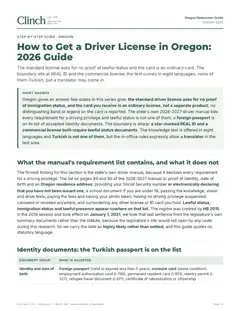
Oregon gives an answer that few states in this series give: the standard driver license asks for no proof of immigration status, and the card you receive is an ordinary license, not a separate product. The state's own 2026-2027 driver manual lists every requirement for a driving privilege, and lawful status is not one of them; a foreign passport is on its list of accepted identity documents. The boundary is sharp: a star-marked REAL ID and a commercial license both require lawful status documents. The knowledge test is offered in eight languages and Turkish is not one of them, but Oregon's in-office rules expressly allow a translator in the test area.
Steps, documents and official links
What the requirement list contains, and what it does not
The strongest official source here is the state's own driver manual, because it itemizes every requirement for a driving privilege. The list on pages 89 and 90 of the 2026-2027 manual reads:
- proof of identity, date of birth and Oregon residence address;
- provide your Social Security number or electronically certify that you do not have one;
- school certification if you are under 18;
- pass the knowledge, vision and drive tests;
- pay the fees and have your photo taken;
- not be suspended, revoked or canceled anywhere;
- surrender any other driving privilege or ID card you hold.
Lawful status, immigration status and legal presence do not appear on that list. We searched the full manual text for "legal presence" and "lawful status" and found no requirement language; the only related hit sits inside the identity-document list, where a naturalization or citizenship certificate is offered as one identity option among many. This regime was created by HB 2015 in the 2019 session and became operative on 1 January 2021; the law authorized ODOT to issue, renew and replace a non-commercial license, permit or ID card without proof of legal presence, accepted a written statement in place of a number, and added anti-discrimination and confidentiality provisions. That paragraph comes from the legislature's own measure summaries, not from the enrolled bill text: the legislature's website refused every connection attempt during this research, so we carry the date and content as highly likely rather than settled.
Identity documents: a Turkish passport is on the list
The manual's list of the most common proofs of identity and date of birth includes a foreign passport (valid, or expired no more than five years), a consulate card on the same terms, an Employment Authorization Card (I-766), a Permanent Resident Card (I-551), a Re-entry Permit (I-327), a Refugee Travel Document (I-571), and a Certificate of Naturalization or Citizenship. For a Turkish citizen with a passport and an address, the door is open.
On the Social Security side the agency's own sentence is this: everyone applying for a standard driver license, permit or ID card must provide a verifiable Social Security number, if one has been assigned to them. If no number was ever assigned, you certify that electronically. The rule tightens for REAL ID and commercial applicants: a verifiable number is mandatory, and a REAL ID applicant who is not eligible for one must provide proof of that ineligibility.
Proof of address
An ordinary card needs one document; an original REAL ID needs two printed documents from different agencies, businesses or institutions. The accepted list is unusually generous for someone who just arrived:
- a utility hook-up order or utility statement dated within the past six months;
- a rental or lease agreement signed by the landlord;
- a monthly rental receipt from a hotel, motel, inn, campground or RV park;
- a paycheck or pay stub dated within the past 12 months, or a W-2 or 1099 for the previous tax year;
- medical records within 12 months, or a health benefits card;
- a document from an educational institution showing current-year enrollment;
- a document from an insurance company or agent;
- an approved letter from the state hospital, a homeless shelter, a transitional service provider or a halfway house dated within 60 days;
- a letter on employer letterhead certifying that you live at a non-business address owned by the business;
- and the most practical one: a verbal statement from another person living at the same address who is present and shows their own proof of address.
The agency writes on its own page that accepted identity and residency documents may change without prior notice. Open the list once more the day before your appointment.
The tests and how they run
- The knowledge test is 35 multiple-choice questions and costs $7 per attempt. You can take it at home (on a desktop or laptop with a keyboard, mouse and webcam), at a DMV office by appointment, or on standby. The office version runs on a touch screen with audio.
- Testing stops one hour before the office closes. If you fail the knowledge test you may retest the same day if the office has capacity. Anyone caught cheating cannot retest for 90 days.
- The drive test costs $45 and is by appointment only. You must pass the knowledge test first and arrive in a passenger vehicle with current registration and valid proof of insurance; the examiner runs an equipment check. If you fail, you wait until the next business day.
- The drive test is waived if you completed an ODOT-approved driver education course within the past two years.
Which languages, and is Turkish among them?
No. In the agency's words the test can be read and heard in English, Spanish, Arabic, Chinese (Simplified Mandarin), Japanese, Korean, Russian and Vietnamese. The same eight languages apply online and in the office. The practice tests exist only in English and Spanish.
But Oregon leaves a door open that no earlier state in this series left open. The office testing rules say, in the agency's own words, that no one else may be in the test area unless you need a translator. So a Turkish speaker may bring an interpreter into an in-office test. We found no agency page describing that translator's qualifications or how to book one, so call 1-503-945-5000 before the appointment and have the translator request written into your file.
REAL ID: the ordinary card will not board a plane
Oregon issues both standard and REAL ID-compliant licenses, permits and ID cards; REAL ID cards carry a star in the upper right corner. Six things to know:
| Item | Rule |
|---|---|
| Surcharge | The REAL ID option costs $30 above the regular fees, every time you apply for an original, a renewal or a replacement. |
| How to apply | In person only. The agency's own formula: bring one proof of identity, two proofs of address, and allow three weeks for the card. |
| Documents for a non-citizen | An unexpired foreign passport with an unexpired U.S. visa attached, accompanied by an unexpired I-94 or I-797A documenting your most recent admission. |
| The temporary paper ID | After your documents are scanned you receive a temporary paper ID. The agency is blunt: TSA will not accept it at security. |
| Flying on a standard card | Since 7 May 2025 a standard, non-REAL ID Oregon license, permit or ID card is no longer accepted to board a U.S. commercial flight. |
| Arriving at the airport without accepted ID | Since 1 February 2026, passengers 18 and older who do not present an acceptable form of ID may verify their identity through TSA ConfirmID, which costs $45. |
The practical consequence: a person without status, or without complete REAL ID paperwork, can drive legally in Oregon but boards a plane on a passport. Carry the passport and plan travel around it.
Two official pages conflict, and we are not picking a side
The agency's identity-documents page carries a heading reading "Proof of Lawful Status for CDL and CLP, Non-Real ID and Real ID", and the list beneath it (U.S. passport, U.S. birth certificate, naturalization or citizenship certificate, consular report of birth abroad, Permanent Resident Card) is narrower than the REAL ID list. That heading appears to conflict with the manual's requirement list, because the manual never mentions lawful status while this heading names the non-REAL ID card too. Both pages are official. The most plausible reading is that the heading means "these are the documents accepted where lawful status is being proved", that is, for a commercial license and for REAL ID. But that is our reading, not the agency's sentence. If you run into this heading, or if you want more than the ordinary card, call 1-503-945-5000 before you apply and ask for a written answer for your own status.
We also could not verify whether Oregon issues a separate "limited term" card for people with time-limited immigration status. The fee page carries a "Limited Term" heading, the content under it never loads, and the related subpage returns a 404. We are not writing that such a card exists and we are not writing that it does not. Ask at the same number.
Fees: we left blank what we could not verify
| Transaction | Fee |
|---|---|
| Knowledge test, per attempt | $7 |
| Drive test | $45 |
| REAL ID surcharge, per transaction | $30 |
| Alternative identity verification at the airport | $45 (since 1 February 2026) |
| Original license, renewal, replacement, ID card, card terms | Not published in readable form |
We will be explicit about that last line: the driver fee page arrives as a collapsing panel whose contents never load, both on the live site and in the archived capture from 23 September 2026, so every figure other than the test fees and the REAL ID surcharge was unreadable. Rather than guess, we left it blank. Confirm the numbers at 1-503-945-5000. The agency also notes that its fees are set by the state legislature. Offices take cash, checks, money orders in the exact amount, mobile payments, debit cards, Discover, Mastercard and Visa; checks and money orders are payable to Oregon DMV.
Headquarters: Oregon DMV, 1905 Lana Ave NE, Salem, OR 97314. Phone 1-503-945-5000, statewide relay for the hearing impaired 711. The online account for appointments, registration renewal and plate work is DMV2U.
02 · Foreign license
Can a Turkish license be exchanged for an Oregon license?
Short answer
It cannot, and Oregon's waiver list is the shortest in this series. The knowledge and drive tests are waived only for licenses from another U.S. state, the District of Columbia, a U.S. territory, the U.S. Department of State, and Canada, Germany, Japan, South Korea and Taiwan. Türkiye is not on that list, so a Turkish license holder takes both tests and surrenders the Turkish license when the Oregon card is issued.
Steps, documents and official links
The agency's two sentences run like this. On the waiver side: you may not have to take a knowledge test or drive test if you are new to Oregon and surrender your license from another state, the District of Columbia, a U.S. territory, the U.S. Department of State, Canada, Germany, Japan, South Korea or Taiwan. On the requirement side: you are required to take the knowledge test if your license is from a country other than those five. The waiver also requires that the license is not expired by more than one year.
The practical order
- Prepare for the knowledge test. Thirty-five questions, $7 per attempt. The practice tests are in English and Spanish, and the test itself comes in eight languages without Turkish, so plan from the start to take the office version with a translator.
- Book the drive test, $45. The car needs current registration and valid insurance, and proof of insurance is requested before the test.
- Surrender the Turkish license when the Oregon card is issued. The surrender rule covers every license, permit and ID card issued by Oregon, by another state or by another country.
There is a question this page cannot answer, and it is the first one a newly arrived family asks: may someone who just moved to Oregon drive on a Turkish license or an International Driving Permit until the Oregon license arrives, and for how many days? Oregon's pages are written around surrendering a foreign license rather than driving on one, and we found no official page describing a grace period or an IDP rule. We are not writing that none exists; we are writing that we did not find one. Getting an International Driving Permit before you leave Türkiye is still cheap insurance, but your first phone call after you move should be to 1-503-945-5000 to ask how long your window is.
A comparison, because you may have read a different answer in another guide: Michigan names Türkiye on an official reciprocity list, Connecticut names three countries, and Oregon names five. Türkiye appears on none of them, so for a Turkish reader the outcome is the same everywhere: both tests apply.
03 · Vehicles
How do you register a car in Oregon?
Short answer
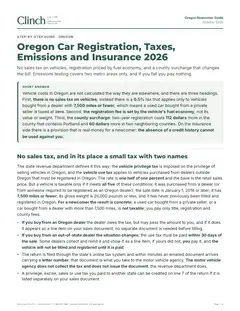
Oregon prices a car differently from every other state in this series. Three headings. First, there is no sales tax on a vehicle; instead a 0.5% tax applies only to a car bought from a dealer with 7,500 miles or fewer, which means a used car from a private seller is taxed at zero. Second, registration is priced by fuel economy, not by value or weight. Third, a county surcharge: Multnomah County, where Portland sits, adds $112 to a two-year registration, against $60 in the two neighboring counties.
Steps, documents and official links
No sales tax, but a small tax with two names
The state revenue agency defines them this way: the vehicle privilege tax is a tax for the privilege of selling vehicles in Oregon, and the vehicle use tax applies to vehicles purchased from dealers outside Oregon that must be registered and titled in Oregon. The rate is one-half of 1 percent (0.005) of the retail sales price.
A vehicle is taxable only if it meets all five of these:
- purchased from a dealer, or from someone who would have to be registered as an Oregon dealer;
- purchase date of 1 January 2018 or later;
- driven 7,500 miles or fewer, or sold with a manufacturer's certificate of origin if it has no odometer;
- gross vehicle weight rating of 26,000 pounds or less;
- never registered or titled in Oregon.
The consequence for a newcomer is concrete: a used car from a private seller, or a dealer car with more than 7,500 miles, is not a taxable vehicle. No sales tax, no privilege tax, no use tax. You pay only the title fee, the registration fee and the county fee.
Buying from an Oregon dealer, the dealer owes the tax but may pass the amount on to you, in which case it is itemized on your purchase documents; no separate certificate is needed before titling. Buying from an out-of-state dealer changes things: the use tax must be paid within 30 days of purchase. Some out-of-state dealers collect and remit it, itemized as Oregon Vehicle Use Tax; if the dealer did not collect it, you owe it, and DMV will not title or register the vehicle until it is paid. You file through Revenue Online and receive, within minutes by email, a certificate carrying an "L number", and that certificate is what you take to DMV. DMV does not collect this tax and does not issue the certificate: the revenue agency does. Privilege, excise, sales or use taxes you paid to another jurisdiction can be credited on line 7 of the return if they are separately stated on your sales documents.
What sits in the tax base is also written down. Added to the manufacturer-equipped price: separately stated dealer preparation (clear-coating, rustproofing), transportation and delivery charges, and charges for accessories, parts, add-ons and aftermarket products. Subtracted: separately stated discounts and rebates. Cash down payments and trade-ins are not deducted. Outside the base: warranties and optional maintenance contracts, gap insurance, document processing fees, registration and licensing fees, and ADA modifications. We could not locate any statutory cap on a dealer document processing fee, so no cap figure appears on this page.
Title and registration priced by fuel economy
| Item | Fee |
|---|---|
| Title, passenger vehicle or truck, combined 0-19 MPG | $101 |
| Title, combined 20-39 MPG | $106 |
| Title, combined 40+ MPG | $116 |
| Title, all-electric | $192 |
| Title, light trailer, travel trailer, motorcycle, moped, bus | $101 (an all-electric vehicle pays the electric title fee whatever its type) |
| Heavy vehicle title (over 26,000 lb) | $90 |
| Salvage title | $27 |
| Late title transfer, 31-60 days after sale | $25 |
| Late title transfer, after 60 days | $50 |
| Registration, two years, 0-19 MPG | $126 |
| Registration, two years, 20-39 MPG | $136 |
| Registration, two years, 40+ MPG and not enrolled in the per-mile program | $216 |
| Registration, two years, all-electric, same condition | $376 |
| Registration, two years, if enrolled in the per-mile program (OReGO) | $86 |
| Motorcycle or moped registration | $88 |
| New plates at initial registration | $26 |
| Moving plates to another vehicle | $30 |
| Light vehicle trip permit, 21 days | $35 |
| Registered vehicle trip permit, 10 days | $7.50 |
| Disabled person parking permit | No fee |
A few mechanics. Regular passenger registration is valid for two years; a brand-new vehicle arriving with a manufacturer's certificate of origin gets a four-year registration, and in that case the registration fee and the county fee both double. The agency uses the MPG rating the manufacturer assigned to the vehicle identification number, and you can look your own band up at fueleconomy.gov. Oregon charges no separate duplicate-title fee; the title chart covers duplicates and transfers. You may register a vehicle only if you hold, or have applied for, an Oregon title in your name. Passenger vehicles get two plates, front and rear, at the foremost and rearmost points; mopeds, motorcycles, trailers, campers and antique vehicles get one rear plate. Altering plates, or using a frame that covers numbers, letters or stickers, is not allowed.
The main form, used for registration, renewal, replacement and transfer of plates or stickers, is Form 268; custom plates use Form 205. Mail work to DMV Services, 1905 Lana Ave NE, Salem OR 97314. A fee calculator for the title and registration of most passenger vehicles sits inside DMV2U.
A dated change: in the agency's own words, starting 1 July 2027 drivers of used electric vehicles will pay an $86 two-year registration fee at renewal and must choose between a flat fee and paying by the mile. The same rule reaches new electric vehicles on 1 January 2028 and hybrids and plug-in hybrids on 1 July 2028.
One gap, stated plainly: we could not find how many days a new Oregon resident has to title and register an out-of-state vehicle. The 30-day and 60-day late fees above are written for the sale of an Oregon-titled vehicle, not for a car moving into the state, and the pages that would answer the question do not open. Do not delay the registration, and ask DMV for the deadline.
Emissions testing: two metro areas only, and free if you fail
Oregon's emissions program is run by the Department of Environmental Quality, not by DMV, and it covers only the Portland and Medford metropolitan areas. In the agency's words, the federally enforced state implementation plan requires non-exempt passenger vehicles to be tested every two years in those two areas.
- The Portland-area test fee is $25 and the Medford-area fee is $20. And here is a rule no earlier state in this series offered: the fee is due only after the vehicle passes and is issued a certificate of compliance, and there is no charge if the vehicle fails.
- Clean Air Stations take cash, PIN-less debit or credit cards (Visa, Mastercard, Discover) or money orders.
- The Portland-area stations the agency names: Clackamas, Gresham, Northeast (in northeast Portland), Sherwood, Sunset/Hillsboro and Scappoose. The Medford area has its own station. The agency also runs "DEQ Too" locations where private businesses perform the test; we were not able to read how those work in detail.
- Whether your address falls inside the boundary is answered by the agency's boundary lookup tool. No address or ZIP list is published, so the boundary cannot be reproduced on this page; use the tool. Your registration renewal notice may also state whether the vehicle needs a test.
- DMV's plate page says to get a certificate of compliance at first registration or renewal if you are in a testing area, but that newer vehicles do not have to test. We could not read the full exemption list (model-year cut-off, electric vehicles, newly purchased vehicles), because the agency pages that carry it did not open. No model-year band appears here; confirm through the lookup tool and by phone.
- Vehicles that do not need an emissions test, such as motorcycles, off-road vehicles and trailers, have their vehicle identification number inspected at DMV instead.
- Agency phones: Portland area 503-229-5066, Medford area 541-776-6145, toll-free within Oregon 877-476-0583, hearing impaired 711.
We found no statewide safety inspection requirement for private passenger cars; the only statewide inspection we located is the emissions program in those two metro areas. We are not writing that none exists, only that this is the one program we found.
Compulsory insurance: three coverages, not one
Oregon is one of the states in this series that does not stop at liability. The minimums on page 93 of the driver manual:
| Coverage | Minimum |
|---|---|
| Bodily injury and property damage liability | $25,000 per collision for one person; $50,000 per collision for injury to or death of two or more persons; $20,000 per collision for damage to the property of others |
| Personal injury protection (PIP) | $15,000 per person for reasonable and necessary expenses within two years of the date of injury |
| Uninsured motorist coverage | $25,000 per person, $50,000 per collision for bodily injury |
PIP covers the medical, dental and other services needed because of injury or death arising from the use, occupancy or maintenance of the vehicle. Driving uninsured is one of the agency's listed reasons for losing your driving privilege. Keep that in mind when you compare quotes: an Oregon quote is not the same product as a quote from a liability-only state, because two further coverages sit inside it.
Crash reporting. You must file DMV Form 735-32 within 72 hours if damage to the vehicle you drove exceeds $2,500, damage to someone else's property exceeds $2,500, any vehicle is damaged over $2,500 and towed from the scene, or anyone is injured or killed. The manual is explicit: a police report does not replace that filing.
What may price your policy: the absence of a credit history cannot be used against you
This heading is money for a newly arrived family, because in the first months you have no U.S. credit file at all. Oregon statute (ORS 746.661) addresses exactly that situation and gives a protection we have not seen earlier in this series.
- The absence of a credit history, or an inability to determine it, may not be used to decline coverage, calculate an insurance score or set premiums. The insurer must either show the regulator that the absence relates to risk and follow the regulator's rules, or treat you as having a neutral credit history, or exclude credit from the calculation entirely and use only other criteria.
- A personal policy that has been in force more than 60 days may not be canceled or non-renewed on the basis of credit history or an insurance score.
- In the initial underwriting decision, credit history may be used to decline coverage only in combination with other substantive underwriting factors.
- Also barred from the credit calculation: inquiries you did not initiate, your own credit pulls, inquiries relating to insurance coverage, multiple home-mortgage inquiries within 30 days of one another, multiple auto-lending inquiries within 30 days (unless counted once), and your total available line of credit (debt relative to the line may be considered).
- An insurer may not rerate a policy on credit history when your marital status changes through death or divorce.
- You may demand a credit rerate once a year, per insurer and per policy line. The insurer must rerate within 30 days, may not use the new credit information to raise any premium, and must reduce premiums if you qualify for a better category.
- Your employment driving record may not be used at all on a personally owned passenger vehicle policy: not for rates, not for issuance or renewal, not for cancellation (ORS 746.260).
- The look-back is capped: an insurer may not consider accidents or motor vehicle convictions that occurred more than three years before the application or renewal, driving-under-the-influence diversion agreements entered more than three years before, or certain suspensions based on a non-driving offense. The three-year cap does not apply where the record is used to give you a discount (ORS 746.265).
Against that, a gap we are not closing: we could not verify that Oregon prohibits the use of sex or gender, age, marital status, occupation, education or ZIP code in private passenger auto rating. ORS 746.021 bans discrimination on race, color, national origin, sex, sexual orientation, gender identity, age and disability, but only under a health benefit plan. On geography, the rule in ORS 746.018 that identical risks may not be treated differently solely because of the location of the property or the place of residence is written for burglary, theft and property-liability policies, expressly excludes motor vehicles, and applies only in cities of 300,000 or more. Bills to bar gender in auto rating were introduced in 2021, 2023 and 2025, and we could not confirm that any became law. So we are not writing that there is no ban; we are writing that we did not confirm one. The state's insurance regulator is the Division of Financial Regulation; its consumer pages refused every connection attempt during this research, so this page names the regulator without publishing a consumer helpline.
Can you pump your own gas? Half of it
Oregon's famous rule changed, and today it is neither the old story nor a plain repeal. Under a 2023 law (Oregon Laws 2023, chapter 607) self-service is legal across the state, but conditionally:
- The half-and-half cap: a station may not designate more pumps for customer self-service than it designates for attended service (ORS 480.332(1)).
- The station must post signs clearly readable by a driver showing which pumps are self-service and which are attended, and must designate at least one person to provide attended service.
- The hours condition: self-service may be offered only during hours when the station makes an owner, operator or employee available for dispensing. Outside the rural exception, an unstaffed overnight self-service forecourt is not allowed.
- Price parity: the statute requires the price to be identical at a self-service pump and at an attended one. There is no cheaper self-serve lane in Oregon.
- Motorcyclists may always fuel their own machine, whether or not the station offers self-service.
- Twenty counties are fully self-service and may be unattended: Baker, Clatsop, Crook, Curry, Gilliam, Grant, Harney, Hood River, Jefferson, Klamath, Lake, Malheur, Morrow, Sherman, Tillamook, Umatilla, Union, Wallowa, Wasco and Wheeler. If a station there also sells non-vehicle goods or services, an attendant must be available between 6 a.m. and 6 p.m. (ORS 480.341).
- Access for drivers with disabilities: any station with an attendant must provide equal access, post a clearly readable sign explaining how to request refueling help (a phone number plus another signaling method), provide the help on request, and charge no additional service fee (ORS 480.344).
- Diesel sits outside this scheme; the restrictions are written for gasoline.
- A temporary law allows fully unattended self-service at stations in Marion County cities hit by the 2020 wildfires, and it is repealed on 2 January 2029.
We read the statute text but could not verify its operative date, so no date appears here. In practice, in Portland, Beaverton, Hillsboro and the surrounding counties, half the pumps may be self-service at the same price either way, so you will sometimes be waved off a pump and sometimes handed the nozzle. In Hood River, Wasco, Tillamook, Clatsop and the other listed counties you pump your own.
Official sources
- Oregon DMV: title, registration, plate and permit fees
- Oregon DMV: plates and registration
- Oregon Department of Revenue: read the vehicle privilege and use tax rules
- Oregon DEQ: emissions test fees and stations
- Oregon DEQ: open the testing boundaries and address lookup tool
- 2026-2027 Oregon Driver Manual (insurance minimums and crash reporting)
PDF: Oregon Car Registration, Taxes, Emissions and Insurance 2026
04 · Tolls
Do you need a toll transponder in Oregon?
Short answer
There are no toll highways. The state built a toll program for the Portland metro area and then stopped it; the agency's tolling section is gone from its site today. The only tolls in Oregon sit on two Columbia River bridges run by port districts. Both share one small transponder, and it roughly halves the passenger-car toll. Nobody needs a transponder for daily life in Portland; it only matters to a family driving east into the Columbia Gorge.
Steps, documents and official links
The program stopped
The agency's notice of 11 March 2024 read: at the direction of the Governor and the Oregon Transportation Commission, work on the Regional Mobility Pricing Program has stopped and efforts on the I-205 toll project and the remainder of the Oregon toll program have been indefinitely postponed. Since then the tolling section has been removed from the live site: those addresses now return 404 and 502 errors. Secondary accounts say the 2025 legislature passed a law repealing the tolling authority; we could not read the bill text or confirm enactment, so no statute name or effective date appears on this page. What appears is what was observed: the program was stopped and the agency's pages were taken down. The Interstate Bridge Replacement program on the I-5 crossing into Vancouver, Washington, is a separate two-state effort, and whether tolls appear there is not Oregon's decision alone; we found no start date from a primary source.
Two bridges, two fee tables, one transponder
The Bridge of the Gods at Cascade Locks connects I-84 with SR-14 on the Washington side. It is owned and operated by the Port of Cascade Locks, open around the clock year round apart from maintenance and events, and open to pedestrians and cyclists. Most major credit cards are accepted, though the port's own note says additional fees apply.
| Class | Cash or card | With transponder |
|---|---|---|
| Class 0, motorcycles | $2.00 | $1.00 |
| Class 1, passenger autos and pickups | $3.00 | $1.25 |
| Class 1 plus 1 axle | $4.00 | $2.25 |
| Class 1 plus 2 axles | $5.00 | $3.25 |
| Class 1 plus 3 axles | $6.00 | $4.25 |
| Class 2 (RVs, commercial vehicles, box trucks) | $7.00 | $6.25 |
| Class 3 | $12.00 | $9.25 |
| Class 4 | $16.00 | Not captured |
The Hood River to White Salmon interstate bridge is run by the Port of Hood River and is all-electronic. In the port's words, toll payments are processed electronically through the transponder system; cash or check payments can be made at the port office during business hours or through the dropbox outside the main door. To avoid an unpaid toll invoice, payment must be received by the day of your crossing or within 14 days afterward. Maximum vehicle height is 14 feet 7 inches.
| Class | Cash or card | With transponder |
|---|---|---|
| Class 1, passenger autos and pickups | $3.50 | $1.75 |
| Passenger auto plus 1-axle trailer | $4.50 | $2.75 |
| Passenger auto plus 2-axle trailer | $5.25 | $3.50 |
| Passenger auto plus 3-axle trailer | $7.00 | $5.25 |
| Class 2, two-axle trucks | $8.00 | $6.00 |
| Class 2 plus 1 axle | $10.50 | $8.00 |
| Class 2 plus 2-axle trailer or car | $13.50 | $10.00 |
| Class 2 plus 3 axles | $16.00 | $12.00 |
| Class 3, three-axle trucks | $12.00 | $9.00 |
| Class 4, four-axle trucks | $16.00 | Not captured |
The transponder both bridges share is called BreezeBy and is administered through the Port of Hood River; the account, payment and dispute pages sit under the port's bridge section. We could not verify what opening an account requires: whether there is a deposit, whether a Social Security number or a U.S. credit card is needed, or how a new arrival signs up. The transponder's own website returned an empty page during this research. Call the port before you open an account. For the Port of Cascade Locks: 541-374-8619.
05 · Transit
How does public transport work in Oregon?
Short answer
In the Portland area transit is unusually easy for a newcomer with no paperwork: tap your phone or a contactless bank card and pay $2.80. No card to buy, no account to open, no number to give. The system caps you automatically at $5.60 a day and $100 in a calendar month, so there is no reason to buy a monthly pass up front. One fare covers buses, light rail and commuter rail, and it also covers the streetcar and local buses that cross into Washington state. The reduced fare, by contrast, requires an application and a photo-ID card.
Steps, documents and official links
The Portland area: one fare, three systems
The regional operator is TriMet, which runs buses, the MAX light rail system and the WES commuter train. The light rail lines connect the city center with Beaverton, Clackamas, Gresham, Hillsboro, Milwaukie, north and northeast Portland, and Portland International Airport. The lines are Blue (Hillsboro, city center, Gresham), Green (Clackamas, Gateway), Orange (Milwaukie, city center), Red (airport, city center, Hillsboro) and Yellow (Expo Center, city center, the university).
| Fare type | 2.5-hour ticket | Daily cap | Monthly cap |
|---|---|---|---|
| Adult | $2.80 | $5.60 | $100 |
| Reduced (Honored Citizen) | $1.40 | $2.80 | $28 |
| Youth | $1.40 | $2.80 | $28 |
The fare is the same on buses, light rail and commuter rail, and the caps run on the calendar month.
- You can start without a card. In the operator's words, you can tap with your phone or a contactless credit card to pay the $2.80 adult fare. Apple Pay, Google Pay, Samsung Pay or any contactless debit or credit card works, and the $5.60 daily and $100 monthly caps apply to those taps too.
- Tapping with a phone or bank card gets you the adult fare only; a reduced fare needs a personalized card.
- The system's card is called Hop Fastpass. A new card from a station machine costs $3, with a minimum load of $1.40.
- On a bus you can still pay cash: tell the operator whether you want a 2.5-hour or a one-day ticket and put the money in the farebox. On light rail and commuter rail there is no reader on board, so you must tap on the platform before boarding.
- How the fare works: the first tap deducts the 2.5-hour fare, and within those hours you may combine buses, trains and streetcars freely, but tap every time, because your tap is your proof of payment.
- The same fare also covers Portland Streetcar and C-TRAN local and regional buses, which serve Vancouver, Washington. Premium express services and paratransit may need an upgrade.
- Fares last rose on 1 January 2024 for the 2.5-hour and day tickets; monthly and annual pass prices did not change.
Who qualifies for the reduced fare, and what it takes
The reduced fare covers people 65 and older, Medicare holders, people with disabilities, people who qualify on income, veterans and active-duty military. There are two routes, and knowing the difference saves time:
- People 65 and older and Medicare holders apply for nothing in advance: carrying a government-issued photo ID or the Medicare card is enough.
- The disability, income and military routes require a personalized photo-ID card application first. On income, the operator's sentence is that if you are enrolled in the Oregon Health Plan, SNAP or TANF, or you meet the income requirements, you qualify. We could not read which documents that application asks for, or whether a Social Security number is requested; ask the operator before you apply.
- The youth fare covers ages 7 to 17 and students in high school or pursuing a general equivalency diploma, with no advance application; proof of age or student status is required for ages 15 to 17 and for equivalency students, who need an operator-issued ID card. Children 6 and under ride free with a paying passenger.
- High school students may get a free pass for the school year if their district takes part in the operator's high school pass program, so ask the school office. Colleges may offer free or discounted passes too.
Oregon outside Portland
This card is not a statewide card. The operator covers only the three Portland-area counties. Salem, Eugene, Corvallis and Bend each have their own agency and their own fare media, and the Portland card does not work there. Beaverton, Hillsboro and Bethany, by contrast, sit inside the district and use the same card at the same fares.
Intercity rail and bus
Amtrak Cascades is the state-supported corridor service; ODOT manages the Oregon portion and the neighboring state's transportation department manages the other, and the two states pay Amtrak to run the service between Eugene and Vancouver, British Columbia.
- The pattern: two daily round trips between Eugene and Portland, six between Portland and Seattle, and two between Seattle and Vancouver, British Columbia.
- Oregon stops: Portland, Oregon City, Salem, Albany and Eugene. The Portland stop is Union Station. End to end the route runs about 10 hours 25 minutes across 18 cities and 467 track miles.
- 951,397 passengers rode the corridor in 2025, and 2024 ridership rose 27%, the highest growth among state-supported services.
- Amtrak's long-distance Coast Starlight (Seattle to Los Angeles) and Empire Builder use the same corridor. We could not confirm the Coast Starlight's Oregon stop list from a primary source, so it is not listed here.
- Amtrak phone: 1-800-872-7245.
The state-supported intercity bus network is called The POINT; ODOT funds and manages it through contracts with private carriers, using state and federal money. What matters:
- Four routes: Cascades (Portland to Eugene), Eastern (Bend to Ontario), NorthWest (Portland to Astoria) and SouthWest (Klamath Falls to Brookings).
- It operates 365 days a year and connects at hubs including Union Station in Portland, Hawthorne Station in Bend and Front Street Station in Medford, and to interstate services like Amtrak.
- Tickets must be bought in advance. In the operator's words, it does not sell tickets on its own website and drivers do not sell tickets; each route uses a reservation system to hold a seat.
- On the Portland to Eugene route Amtrak is the exclusive ticket seller and adult fares run from $4 to $18. Monthly passes, good for up to two trips a day for a calendar month, and 10-ride passes valid for 90 days are also sold by Amtrak. On the Bend to Ontario route adult fares run from $17 to $48.
- You can generally buy up to about 30 minutes before departure; phone sales run through Amtrak at 1-800-872-7245.
- A naming trap: online sellers may not use the service's own name. Amtrak lists it as a "Connecting Bus" or "Thruway" bus with a four-digit schedule number.
- The operator's own warning: for safety reasons only the stops listed on its schedules are used, and there are no unscheduled or flag stops.
- Private carriers also serve Portland, but we read no official source for their current Oregon routes.
The airport and the Istanbul question
Portland International Airport (PDX) is owned and operated by the Port of Portland. From the city center you reach it on the Red Line, and the published fare table carries no airport surcharge: the same $2.80. On the research date part of the baggage claim area was closed for construction, with signs routing passengers around it.
On Istanbul we have to be honest. The airport's website renders its flight and airline data inside a page application, and we could not read that data by any route. So we are writing neither that a nonstop Portland to Istanbul flight exists nor that it does not: we found no official listing of one. In practice the routing is one stop, through a U.S. gateway or a European hub. Seattle's airport is about a three-hour drive north and is the nearest very large international gateway, but we could not confirm its airline list either, so we are not naming a carrier flying from there to Istanbul. Check directly on the airline's own website before you buy. Oregon's other commercial airports are Eugene (EUG), Medford (MFR), Redmond and the Bend area (RDM), North Bend (OTH) and Pendleton (PDT); we did not verify their current carriers this round.
Official sources
- TriMet: fares, daily and monthly caps, contactless payment
- TriMet: who qualifies for the reduced Honored Citizen fare
- TriMet: youth fare and school passes
- TriMet: light rail lines and the airport connection
- ODOT: review the Amtrak Cascades passenger rail service
- The POINT: intercity bus routes and ticketing rules
- Portland International Airport
06 · Regions
Which office handles what in Oregon?
Short answer
The most expensive wrong assumption a household makes in Oregon is "I live in the city, so the city handles me." Four layers of government sit on top of one another here, and which layer you are in changes your bill, your taxes and your rights as a tenant. The sharpest trap: not every Portland address is a Multnomah County address. Parts of the city fall in Clackamas and Washington counties, and taxes tied to the county do not apply to those homes.
Steps, documents and official links
Which layer does what
| Layer | What it does to you |
|---|---|
| City government | The water, sewer and stormwater bill; the garbage franchise; the 311 information line; the city's own renter ordinances; in Portland, a city arts education tax. |
| County government | Property assessment and tax collection; the public library; in Multnomah County, a county income tax for a preschool program. |
| Regional government (Metro) | An elected regional government covering the urban parts of three counties. For its supportive housing services income tax, the Metro boundary, not a city line, decides who pays. |
| School district | A separate elected board with its own boundary. The Portland school district is not the same as the city, and some Portland addresses fall into other districts. |
| The state | Income tax, the rent increase cap, the landlord-tenant act, the fair housing act, school immunization rules. |
| The public utility commission | Electricity and natural gas: the identity alternatives, the deposit cap and the disconnection moratoriums are this agency's rules. It does not cover water or garbage. |
The glossary of the state's own property tax report says it plainly: the Portland district includes the portions of the city located in Clackamas, Multnomah and Washington counties. So whenever a tax or a service is tied to a county, confirm which county you are in rather than inferring it from the city name. The same difference shows up as money in vehicle registration, where the county surcharge is $112 in Multnomah County and $60 in Washington and Clackamas counties.
Portland rebuilt its form of government on 1 January 2025
This is recent enough that older guides are wrong: a ballot measure approved by voters in November 2022 moved the city out of the commission form and, on 1 January 2025, into a structure where the mayor and the council are separate. Under the new arrangement:
- The council has 12 members, elected from four geographic districts, three per district, by ranked-choice voting. Previously four commissioners were elected citywide and a candidate could live anywhere in Portland.
- The mayor no longer sits on the council and instead leads the executive branch.
- Councillors no longer directly oversee bureaus. A professional City Administrator, appointed by the mayor and confirmed by the council, runs the bureaus while the council develops policy.
- The election calendar is split: the City Auditor and the councillors from districts 3 and 4 are elected at midterms (2026, 2030), while districts 1 and 2 and the mayor run on the presidential cycle, with the mayor's next race in 2028.
We carry this whole subsection as highly likely rather than settled: most of the city's transition pages did not open directly during this research, and the facts come from the city's indexed pages and its own fact sheet. Roles such as council president are elected by the council and can change, so open a live city page before you rely on a name.
311: one number, county-wide, but Turkish is not on the banner
Portland has a real 311 line, and its scope is the county rather than the city: in the agency's words, 311 is your first call for any question or local government service need within Multnomah County.
- Dial 3-1-1, or 503-823-4000 from outside the county or from an internet phone. Oregon Relay is 711.
- Hours: seven days a week, 7 a.m. to 6 p.m., excluding federal holidays.
- Email: [email protected]. In person: the Portland Building Customer Service Center, 1120 SW Fifth Avenue, weekdays 8 a.m. to 5 p.m.
- The page states that language interpretation is available, and prints the same offer in nine other languages: Spanish, Vietnamese, Chinese, Russian, Somali, Ukrainian, Romanian, Chuukese and Nepali. Turkish is not on that list. A Turkish speaker should expect to be routed to a telephone interpreter and should ask for one by name.
- The city states that it provides translation, interpretation, modifications, accommodations, alternative formats and auxiliary aids to ensure meaningful access to its programs and services. But the page does not state how many languages are supported or whether interpretation is free, and we are not claiming that it is.
A library card: no number asked, but no published list of accepted ID
A Multnomah County library card is free for people who live, teach, go to school or own property in the county, and people who pay certain property taxes in the service area also qualify. County residents can sign up online or at any branch. To pick the card up you need photo identification; ages 13 to 17 either show a photo ID or bring an adult, and children under 13 need an adult. A card signed up for online must be collected within six months. For people outside the service area there is a fee-based full-use card at $285 a year. Students in county school districts may be able to use their student ID number as a library card.
There is a gap here and we will be honest about it: the library's pages never ask for a Social Security number, and the stated requirements are a connection to the county plus photo ID. But we found no page listing which photo IDs are accepted, so we cannot promise that a Turkish passport or a Turkish consular ID will work. Call the branch and ask with the document in hand. We also found no statement about how the library handles patron records or immigration status.
Official sources
07 · Utilities
How do you put the utilities in your name, and is an SSN required?
Short answer
There is no single answer, because a household's four utilities sit in two different legal regimes in Oregon and your rights change with which side the bill comes from. Electricity and natural gas are regulated by the public utility commission: the company may ask for a number but must accept the alternatives listed in the rule, the deposit is capped at one-sixth of estimated annual billing, and there are four separate disconnection moratoriums. Water, sewer and stormwater come on a city bill, and the city's start-service page asks for no number, no ID and no deposit. Garbage, in a rental of one to four units, is the landlord's obligation: the tenant opens no account at all.
Steps, documents and official links
Get this distinction straight first, or everything else goes to the wrong door
| Service | Who provides it in Portland | Legal regime |
|---|---|---|
| Electricity | An investor-owned company (Portland General Electric) | Commission-regulated. The identity alternatives, the deposit cap and the disconnection moratoriums apply. |
| Natural gas | An investor-owned company (NW Natural) | The same commission rules. |
| Water, sewer, stormwater | The city's Water Bureau and Bureau of Environmental Services, on one combined city bill | Municipal. The commission rules do not apply here. |
| Garbage, recycling, compost | Private haulers the city franchises, assigned by address | Municipal franchise. The city sets prices and territories; the customer does not choose the company. |
Do not generalize this to the rest of Oregon. Outside Portland the electricity may come from another investor-owned company (also commission-regulated) or, in many towns, from a consumer-owned utility: a people's utility district, a municipal electric utility or an electric cooperative. Consumer-owned utilities are generally not rate-regulated by the commission, which means the identity, deposit and disconnection protections below do not automatically apply to them. Find out who supplies the electricity at your address on your first phone call.
Electricity and gas: a number may be asked for, but the alternatives are in the rule
The commission's rule (OAR 860-021-0009) sets this structure for energy utilities:
- The company may require: the name of the person responsible for payment, the account name if different, date of birth, Social Security number, a current valid Oregon driver license number, the service address, the billing address if different, and day and night telephone numbers.
- Instead of a number or an Oregon license, an applicant may provide: (a) a valid state or federal photo ID showing the payer's name; (b) an original or certified birth certificate plus a current school or employer photo ID plus the name, address and phone of someone who can verify your identity (a teacher, employer or caseworker); or (c) any other information the utility considers sufficient to establish identity.
- An applicant denied service for failure to provide acceptable identification may pursue conflict resolution under the commission's rules.
- The rule says nothing about immigration status and does not make status a condition of service.
One limit, written plainly: subsection (a) says "state or federal photo ID", and on its face that means a U.S.-issued document; a passport or a consular card is not named there. So we cannot promise that a Turkish passport will be accepted. But subsection (c) gives the company open discretion to accept something else, and if it refuses, subsection (5) gives you a complaint route to the commission. If you are refused, do not try to settle it on the phone with the company: go to the commission's consumer services team at 503-378-6600 or 800-522-2404, relay 711, [email protected].
Deposits: the cap is in the rule, and so is the realistic expectation for someone with no credit file
The commission's credit rule (OAR 860-021-0200) works like this. Credit may be established three ways: prior service history, a commission-approved credit score, or proof of ability to pay. A deposit may be required only when the applicant cannot establish credit, owes an unpaid balance to an Oregon energy or telecom utility, or was terminated for theft or tampering.
- Energy utility deposit cap: the deposit may not exceed one-sixth of reasonable estimated billing for 12 months at the rates then in effect, which in practice is about two months of bills.
- The estimate uses the premises' actual use over the prior 12 months, or the type and size of the equipment there if that use is unknown.
- In place of a deposit, two alternatives are named: a surety agreement from a responsible party sized to two months' average usage, or, for energy utilities, a demand limiter or pay-as-you-go metering.
- The rule permits credit scoring, through a third-party report or the utility's own formula, and never mentions immigration status.
- We could not read the rule governing when and how a deposit is refunded, so ask the company for the refund trigger and timeline.
What this means for a newcomer: with no U.S. credit file you will probably fall into the "could not establish credit" path, and a deposit of roughly two months of estimated billing is a realistic expectation. But that figure is capped by rule, and pay-as-you-go metering is a named alternative, so ask for it if you cannot pay a deposit up front.
The water side is far easier
Water, sewer and stormwater come on one account and one bill from the city. What it asks for:
- As a new owner: your name (or the party responsible for the bill), the service address, the date you became legally responsible for the property, a mailing address for bills, phone and email.
- As a tenant: the name of the person responsible for the bill, the service address, the account number if known, the date billing responsibility starts, the landlord's first and last name, a mailing address, phone and email.
- The start-service page never mentions a Social Security number, a photo ID or a deposit.
- Customer service: 503-823-7770, weekdays 8 a.m. to 5 p.m., [email protected].
- Billing is not monthly by default; a monthly statement option has to be registered for separately. The official page does not state what the default period actually is, so we could not verify it and are not printing one.
- There is a financial assistance discount program and application for the water, sewer and stormwater bill.
- The city has a separate account management policy; we could not read its deposit and shutoff provisions, so we make no claim about whether the city water bill carries a deposit.
Garbage: in a one-to-four-unit rental the landlord opens the account
This is a real departure from most states in the series. In the city's own words, owners of residential rental properties of one to four units are required to set up and pay for service. A Portland tenant in a house or a small multiplex therefore opens no garbage account at all.
- Homes of one to four units sit in an exclusive franchise system: the city sets rates and services, gives companies exclusive territories, and the customer is assigned a hauler by location, with no contract to sign.
- Buildings of five or more units, and businesses, are on the commercial system: the customer picks any city-permitted hauler and negotiates the price.
- Monthly residential rates effective 1 July 2026, by garbage cart size: 20 gallon $39.60, 35 gallon $45.25, 60 gallon $50.70, 90 gallon $57.95. In the city's words, your monthly charge is based on the size of your garbage container. One note: sources disagree on whether the $50.70 tier is labeled 60 or 65 gallons. The price is consistent, the label is not, so confirm the size verbally when you order the cart.
- Some homes on the west side of the city fall in a separate terrain area with a higher charge; the city confirms the area exists but publishes no figure on its announcement page, so we print no figure either.
- Collection calendars are published by address, and households land on one of two schedules.
- Two city pages contradict each other on how many franchised residential haulers there are (one says ten as of December 2025, another says nine). We publish no number; ask the city's planning and sustainability bureau which is current.
Disconnection moratoriums: four triggers, the broadest in the series
In other states this section is a single rule tied either to a season or to a forecast. Oregon has four separate triggers, and two of them turn on a season and a forecast at the same time. All of them bind energy utilities under commission regulation.
| Trigger | Rule | Who is covered |
|---|---|---|
| Cold | From November through March, no disconnection for non-payment when forecasts show a temperature below 32 degrees Fahrenheit or when a winter storm warning is issued. The moratorium lasts at least until the start of the next business day. An exception applies where the company runs a commission-approved winter protection program. | Energy utilities |
| Extreme heat | Electric utilities only. No disconnection for non-payment starting 24 hours before an extreme heat warning, extreme heat watch or heat advisory is forecast. If the alert arrives with less than 24 hours' notice, disconnections pause the moment it is posted. | Electricity |
| Air quality | No disconnection on any day the environmental quality agency issues an air quality advisory or the air quality index is forecast to reach 100 or higher. It covers both electricity and gas, and both residential and small commercial customers. | Electricity and gas |
| Wildfire evacuation | While customers are under a level 2 or level 3 wildfire evacuation notice from the state emergency management department, electric and gas utilities commit to making best efforts not to disconnect for non-payment, starting when the notice is issued. | Electricity and gas |
| Duration | Moratoriums generally remain in effect for 48 hours after a qualifying event ends. Customers disconnected shortly before a moratorium began may be eligible for no-cost reconnection; utilities must make best efforts to reconnect on request, but reconnection fees may apply. |
Two caveats we are printing rather than hiding. First: we could not read the currently codified text of the cold-weather rule. The only full text available to us was a temporary amendment that expired on 24 October 2025, and the state's administrative rules database returned an empty response during this research. So we carry the November to March window, the 32-degree threshold and the winter storm warning as highly likely rather than settled. The heat, air quality and wildfire triggers are solid, because they are stated directly in the commission's 2026 announcement.
Second, and this is a genuine conflict: the rule text we read says the moratorium applies when the air quality index is at or above 100 and lasts at least 24 hours; the commission's 2026 announcement says it applies when the index is forecast to reach 100 or higher and gives a general 48 hours. Measured versus forecast is a material difference. We are not picking a side: ask the commission's consumer services team which text is operative, at 503-378-6600.
And most importantly, none of this binds the city. These moratoriums are commission requirements on investor-owned companies. We found no equivalent weather moratorium for the city's water, sewer and stormwater bill. We are not saying one exists, and not saying none does.
Phone and internet
The state program that discounts a phone or internet bill is called Oregon Lifeline and is administered by the public utility commission, so the same consumer services numbers apply (503-378-6600 or 800-522-2404). We did not verify which internet providers serve which Portland addresses, or any provider's number or deposit policy, so no provider is named on this page.
Official sources
- Portland: start water, sewer and stormwater service
- Portland: read the residential garbage rates and recycling rules
- Oregon Public Utility Commission: disconnection moratoriums and the consumer line
- Oregon administrative rule 860-021-0009: documents accepted in place of a number
- Portland: download the water bill financial assistance application
08 · Renting
What are a tenant's rights in Oregon?
Short answer
Oregon is the strongest state for tenants in this series, and it rests on three legs. First, a provision in force since 2025 forbids a landlord from asking about immigration or citizenship status and bars rejecting an application because the applicant cannot produce a Social Security number; the statute also lists the identity documents a landlord must accept, including expired government ID and an ITIN card. Second, there is a statewide cap on rent increases: 9.5% for 2026, 10% for 2027, and no increase at all during the first year. Third, after the first year a landlord cannot terminate without cause. Portland layers its own ordinances on top of all of it.
Steps, documents and official links
Immigration status and the number: what the statute says
Oregon passed a dedicated law on this in the 2025 session, and the provisions now sit inside the landlord-tenant act itself, at ORS 90.306, ORS 90.303(6) and ORS 90.388.
ORS 90.306 reads in this order. The section applies except as required by a federal program that provides rent subsidies or affordable rents:
- A landlord may not inquire about the immigration or citizenship status of an applicant, a tenant, or a member of their household.
- If the landlord requires verification of identity, the landlord shall accept any of the following, or any combination of them, as necessary to verify name, date of birth and physical appearance: a Social Security card or evidence of a number; a certified copy of a record of live birth; a permanent resident card issued by the immigration service; an immigrant or nonimmigrant visa; an ITIN card issued by the tax service; a passport, driver license or other government-issued identification, regardless of expiration date; and any nongovernment identification, or combination of identifications, that would permit a reasonable verification of identity.
- A landlord may not discriminate against an applicant, tenant or household member on the basis of actual or perceived immigration or citizenship status.
ORS 90.303(6), the applicant evaluation section, separately provides that in evaluating an applicant a landlord may not inquire about immigration or citizenship status and may not reject an application because the applicant or a household member does not produce a Social Security number or prove lawful presence in the United States, provided the applicant agrees to provide identification as set out in ORS 90.306.
ORS 90.388 bars disclosure: a landlord may not, with the intent or purpose of harassing, retaliating against or intimidating, disclose or threaten to disclose the immigration or citizenship status of an applicant, tenant or household member. A violation of that section or of 90.306 counts as a violation of the landlord-tenant act and, only for the purposes of the statute providing civil remedies, as an unlawful practice subject to those remedies.
We state the two limits of the win just as plainly. First, the prohibition on inquiring yields where a federal rent-subsidy or affordable-rent program requires the question, so in voucher-type programs the question is still asked. Second, the enacted text does not include the earlier draft that would have made immigration status a general protected class under Oregon's fair housing act; the provision in force reaches rental housing. So we are not saying that immigration status is a protected class in Oregon real estate sales.
The statewide rent increase cap
Oregon is one of the few states that caps annual rent increases statewide. This is not a rent control board; it is a ceiling on the annual percentage.
- The formula: the lesser of 10% or 7% plus the 12-month average change in the consumer price index.
- The 2026 maximum is 9.5%. The 2027 maximum is 10%, already published. The 2025 maximum was 10%.
- The state administrative services department must calculate and publish the following year's figure by 30 September each year and keep the previous, current and following year figures on its site. The department issued a correction to its 2026 figures, so rely on the department's current page rather than an older release.
- For manufactured dwelling park or marina facilities with more than 30 spaces, the figure is a flat 6% rather than the formula; that changed in the 2025 session. Manufactured dwelling and floating home park tenancies are a separate regime, and the general rent increase section does not apply to them. Oregon has a large manufactured-home park population, so we separate it out.
Write this next to the cap, because it is where newcomers go wrong. There are four carve-outs:
| Carve-out | Effect |
|---|---|
| New buildings | The cap does not apply if the first certificate of occupancy for the unit was issued less than 15 years before the date of the notice. So rent in a brand-new apartment block can be raised by any amount. |
| Subsidized or certified affordable housing | The cap does not apply to units regulated or certified as affordable housing by a federal, state or local government where the tenant's share is unchanged, or where the change is required by program eligibility rules or by a change in the tenant's income. |
| Week-to-week tenancies | The first-year bar and the percentage cap do not apply; only a 7-day notice requirement does. |
| Between tenancies | The cap governs increases during a tenancy. We found no provision limiting what a landlord may ask a new tenant after the previous one leaves. We are not saying none exists, only that we did not find one. |
Notice periods: at least 7 days before the effective date in a week-to-week tenancy; at least 90 days in every other tenancy after the first year. During the first year of a non-week-to-week tenancy the landlord may not raise the rent at all. Every notice must state the amount of the increase, the new rent, the effective date and, where the increase exceeds the cap, the facts supporting the exemption.
After the first year there is no no-cause termination
This is the state's largest tenant protection after the rent cap. The statute defines the "first year of occupancy" to include all periods in which any of the tenants has resided in the unit for one year or less.
| Situation | Rule |
|---|---|
| Week-to-week | Either side may terminate on at least 10 days' written notice. |
| Month-to-month, tenant side | The tenant may terminate at any time on at least 30 days' written notice. |
| Month-to-month, landlord side, during the first year | May terminate on at least 30 days' notice, with no reason given. |
| Month-to-month, landlord side, after the first year | May terminate only for tenant cause, or for a qualifying landlord reason listed in the statute. |
| Fixed term | During the term the landlord may terminate only for cause. If the end date falls within the first year it can be ended without cause on 30 days' notice; if the end date falls after the first year the term automatically becomes month-to-month unless the parties agree a new term, the tenant gives 30 days' notice, or the landlord has a qualifying reason. |
The qualifying landlord reasons, on 90 days' notice: demolition or conversion to non-residential use; repairs or renovations that make the premises unsafe or unfit for occupancy; the landlord or a member of the landlord's immediate family will occupy it as a primary residence (and the landlord has no comparable unit available in the same building); and the landlord has accepted an offer to purchase from a buyer who in good faith intends to live there, with written evidence of the offer attached to the notice. On the purchase-offer ground the notice period drops to 60 days if the landlord also pays the tenant one month's rent when the notice is delivered.
Relocation payment: a landlord terminating for a qualifying reason must state the reason and the supporting facts in the notice and pay the tenant one month's rent when delivering it. But there is a small-landlord carve-out: that payment does not apply to a landlord with an ownership interest in four or fewer residential units subject to the act. Separately, where the unit is in the same building or on the same property as the landlord's primary residence and there are no more than two units in total, a month-to-month tenancy may be ended after the first year without cause on 60 days' notice (or 30 days where an accepted purchase offer from an intending owner-occupier is attached).
The cost of getting it wrong: a landlord who terminates in violation of these rules is liable to the tenant for three months' rent plus actual damages, and the tenant has a defense to an action for possession. The tenant must sue within one year of knowing or having reason to know.
Deposits: the state sets no cap, Portland does
This heading has to be written in two layers, because the answer changes at the city line. Oregon statute does not cap the size of a security deposit. The section says the landlord may require one and must give a receipt, but it does not limit the amount. We read the whole section and found no cap, so we are not writing "there is no cap" but that the statute does not set one. What the statute does set:
- The definition of "security deposit" includes any last month's rent deposit.
- A written rental agreement must list the deposit.
- No pet deposit may be charged for a service or companion animal a disabled tenant requires as a reasonable accommodation.
- A landlord may not raise or add a deposit during the first year of the tenancy (a narrow exception applies where both sides agree to modify the agreement, for instance to allow a pet). If it is increased after the first year, the landlord must give the tenant at least three months to pay.
- The deposit may be claimed only for the tenant's defaults, including unpaid rent, and damage beyond ordinary wear and tear; labor must be charged at a reasonable hourly rate.
- Carpet cleaning may be deducted only if it was done with a machine designed for carpets, the carpet was cleaned or replaced before the tenant moved in, and the written agreement says so.
- A landlord may not require forfeiture of the deposit for failing to stay a minimum number of months in a month-to-month tenancy.
- The 31-day rule: to claim any of it the landlord must deliver a written accounting within 31 days after the tenancy terminates and the tenant delivers possession, with separate accountings for the security deposit and for prepaid rent, and must return the unclaimed balance within the same 31 days. Delivery is by hand, by first-class mail, or by email where the statute allows it; electronic return to a bank account requires an addendum signed after the tenancy began.
Portland supplies the cap the state does not. Under city ordinance: if the deposit includes last month's rent, the additional portion may not exceed half a month's rent; if last month's rent is not required, the deposit may not exceed one month's rent. For an applicant conditionally approved on financial capacity or risk grounds, the landlord may add a deposit of half a month's rent, and the tenant may pay it in installments over up to three months. Deposit funds must go into a segregated account within two weeks. Before the start date the landlord must make reasonable efforts to schedule a walk-through; both parties sign the report and the landlord provides photos, and the tenant has seven days after the start date to submit a condition report addendum. The final inspection happens within one week of termination, with at least 24 hours' notice. Deductions are limited to costs reasonably necessary to return the premises to its condition at the start of the agreement: no deductions for routine maintenance, ordinary wear and tear, or anything covered by insurance or a product warranty, labor over $200 requires documentation that it is reasonable, and flooring deductions are limited to the discrete impacted area. A violation costs up to $250 per violation plus actual damages, reasonable attorney fees and costs. That cap stops at the city line: a reader in Beaverton or Hillsboro cannot rely on it.
Application fees and what a landlord may consider
Oregon regulates screening charges tightly:
- A screening charge may cover only the landlord's actual cost of obtaining information; the landlord must give a receipt and, promptly after each screening, a confirmation that includes a copy of the screening company's receipt.
- Only one screening charge per applicant in any 60-day period, however many of that landlord's units you applied for.
- The charge may not exceed the landlord's average actual cost or the customary amount screening companies charge for a comparable level of screening.
- Before taking the charge the landlord must have written screening criteria and give the applicant written notice of: the amount; the criteria; the process used (screening company, credit reports, public or criminal records, employer and landlord references); the right to dispute accuracy; any right of appeal; the nondiscrimination policy, expressly including that a landlord may not discriminate because of race, color, religion, sex, sexual orientation, gender identity, national origin, marital status, familial status or source of income; the rent and deposits; whether renters' liability insurance is required and in what amount; and the refund and damages rights.
- The landlord must also give an estimate of how many comparable units are or will be available and how many applications are already pending on them.
- A landlord may not take a charge when it knows no units are or will be available within a reasonable time, unless the applicant agrees in writing.
- Refund within 30 days if the landlord fills the unit before screening you, or had not conducted or ordered any screening before you withdrew in writing. If you refuse the landlord's offer to rent, you cannot recover the charge.
The evaluation limits are broad too. A landlord may not consider a previous eviction action that was dismissed, that ended in a judgment for the applicant, or that ended in a judgment against the applicant entered five or more years before the application. An arrest may be considered only where it led to a conviction on qualifying charges, or where charges are pending and the applicant is not in a diversion, conditional discharge or deferral program. Convictions and pending charges may be considered only for presently illegal conduct in listed categories: drug crimes (not solely marijuana use or possession), person crimes, sex offenses, financial fraud including identity theft and forgery, and crimes that would adversely affect the property or the health, safety or peaceful enjoyment of the premises. Possession of a medical marijuana card, or status as a patient, may not be considered. And unpaid rent that accrued between 1 April 2020 and 1 March 2022 may not be considered, including amounts in judgments or sent to collections. If the application is denied the landlord owes a statement of reasons. A dated change: parts of this section are amended operative 2 January 2028, when the 2020 to 2022 rent bar drops out and the eviction rule becomes a plain five-year rule.
Portland adds a layer here too, and this is the provision worth the most money to a newcomer. Under the city's rental ordinance:
- A landlord may not reject an application as incomplete for lacking a Social Security number or proof of lawful presence, and may not inquire about the immigration status of a member of the applicant's household. The accepted identification list follows the same logic as the statute: a Social Security card, a permanent resident card, an immigrant visa, an ITIN, a nonimmigrant visa, any government-issued ID regardless of expiration date, and any nongovernmental ID or combination permitting reasonable identity verification.
- Income-to-rent ceiling: where the rent is below the maximum corresponding to 80% of area median income, the landlord may require gross monthly income of up to 2.5 times rent; at or above that maximum, up to 2 times rent. This is a ceiling on what the landlord may demand. Newly arrived immigrants are routinely told they must earn three times the rent; in Portland that demand is unlawful.
- Credit score floor: a landlord may not reject an applicant for a credit score of 500 or higher.
- Criminal history: no rejection for misdemeanor convictions with sentencing dates older than three years, or felony convictions older than seven years; nor for arrests without conviction (unless charges are pending), participation in diversion or deferral, or certain expunged or dismissed convictions.
- Advertising rule: availability notices must be published at least 72 hours before the landlord starts accepting applications. Applications must be processed in order of receipt, and while a landlord may review several at once, it must accept, conditionally accept or deny in order of receipt. On accessible units, applicants with a mobility-disabled household member get priority during the first eight hours of the open application period.
- A violation costs up to $250 per violation plus actual damages, reasonable attorney fees and costs; an applicant materially harmed by intentional non-compliance may sue for further remedies.
A big increase or a no-cause termination in Portland: relocation assistance
The city's mandatory renter relocation assistance ordinance puts real money on top of the statute:
- A rent increase of 5% or more within a rolling 12-month period requires at least 90 days' written notice.
- On an increase of 10% or more, the tenant may request relocation assistance within 45 days of the notice, and the landlord must pay within 31 days of the request.
- On a no-cause or qualifying-reason termination, notice is due at least 90 days before the termination date and the assistance at least 45 days before it.
- Payment per dwelling unit: studio or single room $2,900, one bedroom $3,300, two bedrooms $4,200, three bedrooms or larger $4,500. A single bedroom rented within a dwelling unit counts as a single room.
- The exemption is not automatic: the ordinance ceases to apply only where the landlord has submitted an exemption application, the city housing bureau has issued an acknowledgment letter, and a copy has reached the tenant. A tenant may ask to see that letter.
- The exemption categories are listed and run to twelve: week-to-week tenancies; tenants sharing the landlord's dwelling unit; a unit in a duplex where the landlord lives in the other unit; certain accessory dwelling units; temporary rental of the landlord's principal residence for up to three years; temporary rental during active-duty military service; termination so an immediate family member can occupy; certain affordable housing units (for the rent-increase provisions only, not terminations); units subject to and compliant with a federal relocation act; units made uninhabitable through no action of landlord or tenant; units rented for under six months after a verified demolition permit; and fixed-term tenancies where the tenant was told before occupancy of an intent to sell or permanently convert.
The logic of this provision: the state cap limits the percentage, while the city ordinance turns an increase of 10% or more into a four-figure payment by the landlord, if it is requested. A tenant who does not request within 45 days loses it. Put it on the calendar.
Source-of-income discrimination: banned statewide, with no small-landlord exemption
Oregon bans this by statute, statewide, in the cleanest version this series has seen. The provision is ORS 659A.421.
- Because of a person's race, color, religion, sex, sexual orientation, gender identity, national origin, marital status, familial status or source of income, a person may not refuse to sell, lease or rent real property, expel a purchaser, make any distinction in price, terms, conditions or privileges, attempt to discourage a sale or rental, publish a discriminatory advertisement, assist or coerce another to do so, interfere with anyone exercising these rights, deny access to a multiple listing service or a brokers' organization, falsely represent that a dwelling is unavailable, or otherwise make a dwelling unavailable to a person.
- The definition: "source of income" includes federal rent subsidy payments, that is the housing choice voucher program, and any other local, state or federal housing assistance. It does not include income derived from a specific occupation, or income derived in an illegal manner.
- The ban reaches residential real estate related transactions too, not only rentals: making or purchasing loans or providing other financial assistance for purchasing, constructing, improving, repairing or maintaining a dwelling, loans secured by residential real estate, and the selling, brokering and appraising of residential real property. A real estate licensee may not accept or retain a listing with an understanding that a purchaser may be discriminated against on those grounds.
- There is no small-landlord exemption. The only owner-occupancy exemption covers renting space within a single-family residence that the owner actually maintains and occupies as a primary residence, where all occupants share some common space, and it suspends only the prohibitions based on sex, sexual orientation, gender identity and familial status. Source of income is not on that list, so it still applies there.
- The defense a landlord does have: the statute allows a refusal based on the prospective tenant's inability to pay rent, taking into account the value of their local, state and federal housing assistance, provided the refusal is consistent with fair housing law. Past conduct is a ground on the same proviso. These are the two arguments a landlord will actually make.
- Any violation of the section is an unlawful practice. Unlawful practices are administered by the state labor bureau's civil rights division, and the statute also provides a civil action. We could not read the bureau's own complaint procedure and timelines, so no deadline for that process appears here.
There is a side benefit: the written notice a landlord must give you before screening has to state that it may not discriminate on these grounds, source of income included, so the rule arrives on the paperwork in your hand.
Utilities inside a tenancy
- A rental agreement that does not create a week-to-week or fixed-term tenancy is a month-to-month tenancy by operation of law, and rent may not be treated as due before the first day of each rental period.
- The utility and service charges a landlord may bill are limited by statute: a landlord cannot invent a billing line.
- If a utility is the landlord's responsibility under the agreement and it is shut off over an unpaid balance, the tenant may either pay the balance and deduct it from rent or terminate; on termination the landlord must return within four days all rent, fees and the security deposit owed. A landlord who fails to return that money owes twice the amount wrongfully withheld.
Official sources
- Read the full text of Oregon landlord-tenant law, chapter 90
- Oregon administrative services: see the annual maximum rent increase
- Portland city code 30.01.085: mandatory relocation assistance amounts
- Portland city code 30.01.086: screening and identification rules
- Portland city code 30.01.087: the deposit cap and move-out inspection
- Oregon fair housing statute 659A.421 (the source-of-income ban)
09 · Property tax
Buying a home and property tax in Oregon
Short answer
Oregon's property tax is not a percentage of what you paid, which is why a buyer who budgets from the sale price is wrong in both directions. There are two values and the tax falls on the lower one; buying a house does not reset the taxable value to the sale price, and the statutory value grows at 3% a year. The county Portland sits in is the state's most expensive on both measures. And the blunt answer for a working-age buyer: there is no general homestead exemption for an owner-occupier, and the only general saving left is the 3% discount for paying the full year by 15 November.
Steps, documents and official links
Two values, and the tax falls on the lower one
The state revenue agency's sentence is this: property is taxed on its assessed value, and a property's assessed value is the lower of its real market value or its maximum assessed value.
- Real market value: the law requires the assessor to value all property at 100 percent of real market value, meaning the price it would sell for between a willing buyer and a willing seller as of 1 January, the assessment date.
- Maximum assessed value: this figure arrived with a constitutional measure. The first one was set for 1997-98 as the property's 1995-96 market value minus 10 percent. After that year the maximum is the greater of the prior year's maximum or the prior year's assessed value increased by 3 percent, so it grows at 3% a year unless market value falls below it.
- The maximum can rise by more than 3% only on a property event: new property or new improvements; partition or subdivision; rezoning used consistently with the rezoning; being taken into account for the first time as omitted property; or the loss of an exemption, partial exemption or special assessment.
- New construction affects the maximum only if it raises market value by more than $18,200 in one year or $45,000 within any five consecutive years. Those thresholds are indexed annually from the 2025-26 tax year, and the agency publishes the current figures.
The practical consequence for a buyer: buying a house does not reset its assessed value to the purchase price. Oregon has no acquisition-value reassessment. Two identical houses on the same street can carry very different tax bills depending on when each was last subject to a property event. So before you make an offer, ask the county assessor for the current assessed, maximum and market values of that specific parcel rather than estimating from the price.
Rate limits and "compression"
A constitutional measure also caps the rates: operating taxes are limited to no more than $10 per $1,000 of market value for general government districts and $5 per $1,000 for education districts. Note that those caps apply to market value, not assessed value. Where a property would exceed them the rates are reduced, which is called compression. In fiscal 2025-26 compression reduced taxes owed by $215 million statewide. Over 99.5 percent of general government compression happens inside cities, because it is city levies that push the total past the $10 general government limit.
The actual rates, and why Portland's county is the expensive one
| Area | Per $1,000 of market value | Per $1,000 of assessed value |
|---|---|---|
| Statewide average, 2025-26 | $9.40 | $17.52 |
| The county Portland sits in, 2025-26 | $12.03 | $23.63 |
So Portland's county is clearly above the statewide average on both measures. For comparison, in the decade before the constitutional measure the statewide average was about $23 per $1,000 of market value. The three counties of the Portland metro area hold 54 percent of Oregon's residential property value. The population row for Portland's county in the same report shows a figure far above its actual population, almost certainly a column alignment error, and we are not publishing it.
How it is paid
- The county tax collector sends a statement each year by 25 October, and that statement is also the value notice.
- You may pay in a lump sum or in three equal installments: 15 November, 15 February and 15 May.
- Paying in full by 15 November earns a 3 percent discount; paying two-thirds by 15 November earns 2 percent on the amount paid. The agency's own sentence: no other discounts are allowed.
- You must pay at least one-third by 15 November to avoid interest.
- Interest runs at 1.333% monthly, 16% annually, accruing from 16 December, 16 February and 16 May on the respective installments.
- A tax of less than $40 cannot be paid in installments. If a due date falls on a weekend or legal holiday it moves to the next business day.
- Taxes on both real and personal property become a lien on 1 July.
- To get a current-year discount, all delinquent taxes, penalty and interest must be paid in full first.
- If a taxing district boundary, such as the city limits, crosses your property you may receive two or more statements.
- Ownership changes after 1 July may not appear on the autumn statement. If you bought after 1 July and have no statement by 1 November, contact the tax collector: no statement does not postpone the debt.
- Appeals must be based on value, not on the amount of tax, and go to the county property value appeals board.
- Revenue agency help: 503-378-4988 or 800-356-4222, [email protected].
Relief and deferral: the blunt answer for a working-age buyer
We will not soften this: Oregon has no statewide general homestead exemption and no exemption based solely on age or income. Two programs exist, and both are narrow:
- Deferral for disabled and senior homeowners. This is not an exemption: the state pays your county property taxes on 15 November each year and places a lien on the property, and the money is repaid later. Eligibility as of 15 April 2026: 62 or older, or disabled and receiving or eligible to receive federal Social Security disability benefits; 2025 household income no more than $70,000; and net worth under $500,000. Household income counts all taxable and non-taxable income of the applicants and spouses living in the home, including business, rental and farm income. The filing window is 1 January to 15 April, with late filing from 16 April to 1 December for a fee. Annual statements go out on 15 December and recertification is required every two years after approval. The income limit changes annually: $70,000 is the 2026 figure, it was $60,000 for 2025 and $58,000 for 2024, so re-download the publication for your own year.
- Disabled veteran or surviving spouse exemption. It exempts $27,092 or $32,512 of the homestead's assessed value, and those amounts rise 3 percent each year. It requires certification of 40 percent or more disability, is not automatic, and does not transfer between properties. The claim is filed with the county assessor on or before 1 April preceding the tax year. There is a conflict here: the state veterans' affairs department describes this program in terms that do not match the revenue agency's current publications. We rely on the revenue agency's publications, and we tell a veteran reader to confirm with the county assessor before applying. A homeowner may hold both the veteran's exemption and deferred taxes.
So for a working-age immigrant buying a first home in Portland there is no exemption and no owner-occupancy discount. The only general saving left is paying the whole year by 15 November for the 3 percent discount. If your cash flow allows it, that is the most concrete saving available on an Oregon property tax bill.
And there is no sales tax, but the income tax has four layers
Oregon has no general retail sales tax; the equivalent is paid on the income side, and a Portland payslip accumulates four separate layers: the state income tax, the regional government's supportive housing tax, the county's preschool tax and the city's arts education tax. On the local layers, withholding is optional below a given wage threshold, which means a tax bill nobody withheld can build up. We set out the rates, the thresholds and that withholding trap separately in the tax section; work your property tax budget alongside those figures.
Official sources
- Oregon Department of Revenue: read the real property assessment and two-value rule
- Oregon Department of Revenue: property tax payment schedule and discounts
- Oregon Department of Revenue: review the list of property tax exemptions
- Oregon Department of Revenue: download the senior and disabled deferral publication
- Oregon property tax statistics report (rate limits and county rates)
10 · School
How do you enroll a child in school in Oregon?
Short answer
The Portland school district's own enrollment checklist gives a Turkish family exactly the answer it is looking for: a passport is expressly accepted as proof of age, and the list never asks for a Social Security number. Two address documents are requested, but the checklist carries an explicit escape hatch for families who cannot produce them. Two things need care: the immunization paperwork has a dated deadline, and the paper registration packet includes a Medicaid access consent form described as required and to be signed and returned. We could not verify what that form authorizes, and we tell you to ask before signing.
Steps, documents and official links
What is asked for, from the district's own list
| Item | As the district writes it |
|---|---|
| Proof of age | "Proof of age document (birth certificate, passport or similar document)". A passport is named outright. |
| Two address verification documents | Examples given are a mortgage, rental agreement, utility bills (dated within the last 30 days at the time of enrollment), and an insurance or governmental assistance statement. The parent name, home address and date must be visible on the document. |
| If you cannot produce two | The checklist's own sentence: if you cannot provide two proofs of address, contact the Enrollment and Transfer Center. The door does not close. |
| Immunization records | "All students must provide proof of immunization or a valid medical or non-medical exemption to enroll in school." You complete the state's Certificate of Immunization Status form and give the front office a copy of the vaccination record or other supporting immunity documents before the first day of school. |
| Vision and dental screening information | Required for new students aged 7 and under. |
| Emergency contact information | Required. |
| Previous school's contact information | Required, except at the start of kindergarten. |
| Social Security number | The checklist does not ask for one anywhere, and neither does the enrollment page. We read the full checklist. |
| Immigration status | The checklist and the enrollment page say nothing about immigration status, and the district's nondiscrimination statement does not list it. So we do not write that status is irrelevant; we write that the district's enrollment pages do not ask about it. |
Two ways to register
- Online: create an account in the district's parent portal, choose new student registration for the right school year, and upload the documents. Registration is completed at the school, and the school's administrative assistant follows up. Online registration enrolls the student at the school assigned to your home address, so confirm which school that is with the district's school finder first.
- Paper: hand the packet to the school administrative assistant. The packet contains the registration form, the Medicaid access consent and a technology agreement. In the district's words: the Medicaid access consent is a required form that must be signed and returned.
About that form we have to be honest. It is described as required, but we could not verify what exactly it authorizes, whether consent can be declined without affecting enrollment, or how the data is used. Given the federal Medicaid changes that took effect on 1 October 2026, this is worth asking the district before you sign. Ask the school administrative assistant or the Enrollment and Transfer Center, and ask for the answer in writing.
The enrollment office and the languages the district actually staffs
- Enrollment and Transfer Center, 501 N. Dixon St, Suite 140, Portland, OR 97227; [email protected].
- The district staffs its enrollment line in six languages: English, Spanish, Vietnamese, Chinese, Russian and Somali. Turkish is not among them. Chinese has its own number (503-916-3585); the other five share 503-916-3205.
- The district also publishes fully translated enrollment pages in Spanish, Vietnamese and Somali.
- The district has English language development, dual language immersion and language access services departments. We could not read those departments' pages, so we do not describe here how a newly arrived student is assessed or supported in the classroom; ask during enrollment.
- Families without a fixed address or in unstable housing call 503-916-5770. That is the right door for a newly arrived family that does not yet hold a lease: do not delay enrollment because you lack an address document.
One comparison, because the two lists come from the same city and get confused: the city's 311 line prints its interpretation offer in nine languages, while the school district staffs six. They are different lists, and Turkish is on neither.
Immunizations: the state rule and the dated deadline
- Required vaccines from 2 months of age through 12th grade: DTaP, Tdap, polio, varicella, measles mumps rubella, hepatitis B, hepatitis A and HIB. Dose counts depend on age and grade.
- The state's sentence: school immunization requirements are unchanged for the 2026-2027 school year. Re-check for the following year.
- Full-time college students born on or after 1 January 1957 must show measles vaccination.
- The non-medical exemption route: a parent watches the state's vaccine education module (roughly 15 to 60 minutes depending on how many vaccines are exempted) and prints the vaccine education certificate at the end; alternatively the parent meets a health care provider and gets a signed copy of the certificate. The parent then completes the exemption section of the immunization status form and submits both to the school. The education certificate must be dated within 12 months of being given to the school; once on file the exemption does not expire and transfers to a new school.
- "Exclusion Day" is a documentation deadline, not an automatic removal date: schools must exclude students who were sent exclusion orders if the paperwork has not arrived by then. The 2027 date is 24 February 2027, and exclusion orders are mailed to parents by local health departments on 3 February 2027. The date moved from the third to the fourth Wednesday in February; we take the date from the state's published calendar, because we could not find the adopted rule text.
- Schools must publish immunization and exemption rates twice a year: 30 days after the start of school and 30 days after Exclusion Day.
- The state has paused a proposal to rename "Exclusion Day", so the term may change.
The practical warning for a family arriving mid-year: Oregon does not merely ask for records, it runs a dated cut-off with an exclusion order posted three weeks ahead. Take a child arriving with Turkish vaccination records to a provider in your first weeks, not in February, and have the records transcribed onto the state's immunization status form.
Official sources
- Portland school district: the enrollment page, languages and office
- Portland school district: download the enrollment checklist
- Oregon Health Authority: see the required school immunizations
- Oregon Health Authority: download the certificate of immunization status form
- Oregon Health Authority: the steps for a non-medical immunization exemption
PDF: Enrolling a Child in School in Oregon: Documents and Vaccines 2026
11 · Health
I have no insurance in Oregon. Where do I go?
Short answer
Oregon has the broadest coverage answer in this series, and it is not a loophole but a named statute: the Healthier Oregon program provides the state's full Medicaid benefit package regardless of immigration status, at every age. The agency's own sentence: starting 1 July 2023, immigration and citizenship status no longer affects whether someone qualifies. Green card holders serve no five-year waiting period here either. Put two dates in your calendar now: on 1 November 2026 Oregon leaves the federal marketplace for its own state marketplace, and since 1 October 2026 federal Medicaid payment has narrowed.
Steps, documents and official links
The state Medicaid program and the status-blind door
Oregon's Medicaid program is called the Oregon Health Plan, and the full benefit package is OHP Plus. The status-blind door is Healthier Oregon, formerly called "Cover All People", created by HB 3352 in the 2021 session.
- The program provides the full benefit package, not a limited one. So do not confuse it with a discount scheme, a sliding fee clinic or a county program: what it gives is the Medicaid package itself.
- Every age can qualify. You must live in Oregon and meet the income and other criteria.
- It took effect on 1 July 2023. Before that date a person without a qualifying status could get emergency Medicaid only; adults aged 26 to 54 were moved to full benefits automatically.
- The program has no separate income threshold and no enrollment window: it follows the ordinary Oregon Health Plan income rules, and the plan has no annual enrollment period, so you can apply any day of the year.
- The one hard exclusion the state states: a person eligible for the full plan no longer qualifies for marketplace financial assistance and must report the new coverage to the marketplace. That is a rule about moving between programs; do not confuse it with anything else.
- The state publishes no list of excluded services for this program. It says "full benefits" and links to the general benefits page. So the limits are the ordinary benefit limits plus the loss of marketplace savings, and we are not inventing any other exclusion list.
- How to apply: the state's online system at ONE.Oregon.gov, a certified community partner, a state human services office, or 1-800-699-9075 (TTY 711), weekdays 7 a.m. to 6 p.m. Pacific. General questions: 1-800-273-0557. Hospitals can open temporary coverage through presumptive eligibility, so ask about that if you end up in an emergency room.
A note about income figures. The state's consolidated federal poverty level chart sits on a host that did not open by any route during this research. So we are not publishing an income table for the full plan on this page. The one set of figures we could read belongs to the fourth door described below. Confirm your own household against the state's eligibility checker or at 1-800-273-0557.
The fourth door: OHP Bridge, and this one does ask about status
Oregon has one more door, and it must be kept strictly apart from Healthier Oregon, because it is the only door that asks about status.
- For adults up to age 65, with income between 133% and 200% of the federal poverty level, no access to affordable health insurance, and eligible citizenship or immigration status.
- It covers medical, dental and behavioral health, with no member costs, the same as the full plan, plus extras such as transport to medical appointments.
- It does not include long-term services and supports, or housing and nutrition benefits. Do not transfer that exclusion to Healthier Oregon, which is a different program.
- The income band, as the state's page prints it: a household of one $21,228 to $31,920, two $28,788 to $43,280, three $36,336 to $54,640, four $43,896 to $66,000 a year. The page says those limits apply through February 2027.
So a reader without status goes to Healthier Oregon, not to Bridge.
1 October 2026: the federal Medicaid change and Oregon's answer
Federal law (Public Law 119-21, section 71109) now makes full Medicaid payment to a state only for a closed list: U.S. citizens and nationals, lawful permanent residents, Cuban and Haitian entrants, and people living here under a COFA agreement. The list is closed, and refugees, asylees and people granted parole are not on it. Two things survive: emergency Medicaid for everyone, and coverage of lawfully residing pregnant people and people under 21, which is left to each state's choice. The crucial point: the law cuts the federal payment to the state, not a person's coverage. The sentence "there is nothing left" is not true.
And Oregon's answer differs from other states, because its own status-blind program stands apart. In the state's own words:
- "The federal government will require some changes to the Oregon Health Plan for many noncitizens in late 2026 and 2027." The agency prints no specific cut-off date on that page.
- The agency's framing: "this does not mean people will lose OHP."
- The groups it names as affected: refugees, asylees, survivors of domestic violence or trafficking, some humanitarian parolees, Amerasian Vietnamese, and certain Canadian-born First Nations members without permanent resident status.
- October 2026: about 7,000 members, including adults with refugee or asylum status, moved to Healthier Oregon with the same benefits. Children, and adults who qualify for Bridge, are not affected.
- January 2027: Healthier Oregon members, including many with refugee or asylum status, move to "OHP Open Card". That arrangement does not run through coordinated care organizations, so benefits stay the same but the provider network may differ. If you do not want to lose your doctor, check before January whether they are in the network.
Oregon has also elected the federal option for lawfully residing children up to age 19 within Medicaid; on the federal table the state's children's health insurance column is blank and pregnant women are not listed. So the election is narrow, and the practical protection comes mainly from Healthier Oregon. One last note: the agency's page does not say that Healthier Oregon is paid for with state funds, and we do not assert that it is.
2027: work or activity rules and six-month renewals
This is new and will date quickly, so we write it with its dates. The state's sentence: starting in 2027, some adults aged 19 to 64 will need to meet work or activity rules when they apply for or renew coverage.
- Who: adults 19 to 64 who are not pregnant, have no Medicare or supplemental security income, and do not qualify on disability or certain other grounds.
- How it is met: household income of over $580 a month, or enrollment at least half-time in school, or at least 80 hours a month of work, volunteering, caregiving, school or training. Exemptions also apply.
- Notices went out to affected members in September 2026. Check your mail.
- If the rules are not met coverage can end, but a person may reapply at any time.
- From late 2027, adults 19 to 64 without Medicare or disability-based coverage renew every six months; everyone else renews yearly.
The marketplace: Oregon leaves the federal site on 1 November 2026
This paragraph has to read differently in Oregon, because the door changes. The federal site's own words: Oregon residents will use ExploreHealthOR.gov to enroll in 2027 coverage, starting 1 November. For 2026 coverage the federal site is still used. The marketplace's brand name is Explore Health and the agency is the Oregon Health Insurance Marketplace.
- Open enrollment for 2027 coverage: 1 November 2026 to 15 January 2027. We could not read those dates directly from the state's own site and took them through the search index of the state's financial regulation division, so we carry them as highly likely rather than settled and recommend re-checking after 1 November.
- People enrolled through the federal site receive renewal information before open enrollment and then sign in to the state's new marketplace.
- Some Oregon individual plans sold in 2026 will not exist in 2027, and the marketplace matched affected enrollees to another insurer's plan for automatic re-enrollment. So do not rely on auto-renewal without checking your plan in November.
- From 1 January 2027, marketplace premium tax credits are limited to three statuses: lawful permanent resident, Cuban or Haitian entrant, and COFA migrant. Until then a long list of statuses, including asylees, refugees, parolees, work permit holders, temporary protected status holders and others, can get both coverage and savings. After 2027 those same statuses can still buy coverage but without savings. DACA recipients are not eligible for marketplace coverage at all.
- We could not check whether the state's new marketplace restates those 2027 categories in the same words, because the site did not open during this research. Read it yourself in November.
Emergency care and the hospital bill
In an emergency call 911 or go to an emergency room: under federal rules a hospital with an emergency department must screen and stabilize you regardless of ability to pay or immigration status. Oregon adds its own statutory and automatic layer on top, and for an uninsured reader this is the practically important part.
Quoting the state's patient notice:
- "Hospital financial assistance means that a hospital waives the cost of all or part of a hospital bill."
- "In Oregon, state laws require nonprofit hospitals to provide minimum levels of financial assistance to Oregon residents based on household size and income."
- "Hospitals pay for financial assistance, not the state or federal government. There is no limit or cap to the amount of financial assistance a hospital may provide."
- "If your income is up to 400% of the federal poverty level, you qualify for some financial assistance."
- "A patient may qualify for financial assistance whether or not they have insurance, and regardless of the source of insurance."
| Household income against the poverty level | Level of assistance |
|---|---|
| Up to 200% | 100% of the patient's responsibility |
| 201% to 300% | 75% |
| 301% to 350% | 50% |
| 351% to 400% | 25% |
The percentage tiers in that table come from statute; the dollar columns in the notice are 2024 figures and are now stale, so no dollar threshold appears here. Those thresholds move each year with the federal poverty guidelines.
The automatic prescreening in force since 1 July 2024 is the most practical part of this section:
- Hospitals must prescreen certain patients to see whether they are eligible for financial assistance, and provide the assistance they are eligible for before the patient receives their first bill.
- You are prescreened if you are uninsured, enrolled in a state medical assistance program (Medicaid, the Oregon Health Plan, the Bridge plan), or owe the hospital $500 or more after insurance.
- The notice's own sentence: "You do not have to provide the hospital with any information for them to prescreen you."
- A patient may not opt out of being prescreened, but may decline the award afterwards.
- If prescreening does not give full assistance, the hospital must tell you how to apply and what income documentation is needed.
- Since 1 January 2025 you may appeal a decision on a financial assistance application; the prescreening result itself is not appealable.
And we state plainly that the notice says nothing about immigration status. Oregon's hospital discount scheme is written around residency, household size and income, and the state's patient notice never raises status. That is a silence, not a reassurance. Individual hospital policies may be more generous, so ask your own hospital.
Finally, one distinction again, because confusing it is expensive: hospital financial assistance is a bill discount, not insurance, and not a clinic. It does not protect you from future bills; it reduces the bill in your hand.
Official sources
- Oregon Health Authority: read about the Healthier Oregon program
- Oregon Health Authority: federal changes and what they mean for members
- Oregon Health Authority: OHP Bridge income band and conditions
- Oregon Health Authority: see eligibility and how to apply
- Check which marketplace each state uses
- Marketplace coverage by immigration status and the 2027 change
- The statutory text of the 1 October 2026 Medicaid change (section 71109)
- Oregon Health Authority: download the hospital financial assistance patient notice
12 · Health
Are there free or low-cost clinics in Oregon?
Short answer
The most important thing here is a distinction: a sliding fee clinic is never free. The Portland area's safety net is a county-run community health center network with 19 sites, including clinics inside schools. In the words of its payment page: "You will never be turned away due to inability to pay." But the same page also says fees are charged on a sliding scale. And note this: those pages say nothing about immigration status or a Social Security number. That is a silence, not a reassurance.
Steps, documents and official links
The provider's own sentences
The community health center run by the county Portland sits in is the region's safety-net provider. From its payment page:
- "We charge for care on a sliding scale. That means your fees are based on what you are able to pay."
- "If you don't have health insurance or are unable to pay, we will always provide the care you need."
- "You will never be turned away due to inability to pay."
And what that page does not say: it does not mention immigration status, it does not mention a Social Security number, it names no minimum fee, and it does not list the documents needed for the sliding fee discount. We report that as a silence. The only county statement on status we could find is a press statement from 2019, seven years old, and we are not publishing it as current policy. Ask on the phone which documents are needed before you apply for the discount.
Phones: the main line is 503-988-5558, and the sliding fee and payment line is 503-988-5270. The same main number serves every site, including help after the clinics close. In an emergency, 911.
The sites
The addresses below come from the county's own locations page, not from a federal search database.
| Center | Address |
|---|---|
| East County Health Center | 600 NE 8th St, Gresham, OR 97030 |
| Mid County Health Center | 12710 SE Division St, Portland, OR 97236 |
| North Portland Health Center | 9000 N Lombard St, Portland, OR 97203 |
| Northeast Health Center | 5329 NE MLK Jr Blvd, Portland, OR 97211 |
| Rockwood Health Center | 2020 SE 182nd Ave, Portland, OR 97233 |
| Southeast Health Center | 3653 SE 34th Ave, Portland, OR 97202 |
| Fernhill Health Center | 5530 NE 42nd Ave, Portland, OR 97218 |
| Billi Odegaard Dental Clinic | 33 NW Broadway, Suite 380, Portland, OR 97209 |
| HIV Health Services Center | 619 NW 6th Avenue, 3rd floor, Portland, OR 97209 |
| Westside Pharmacy | 619 NW 6th Avenue, 1st floor, Portland, OR 97209 |
The same page also lists school-based clinics, all booked through the main number: there is a clinic at Cleveland, David Douglas, Centennial, Franklin, Jefferson, McDaniel, Parkrose, Reynolds and Roosevelt high schools. If your child attends one of those schools, the nearest door to care may be inside the building; ask the school office.
The county also runs a mobile clinic whose calendar changes weekly, so we print no dates here. Open the calendar on the county's own page.
Which door for which need
| Need | The right door |
|---|---|
| Regular care, a family doctor, dental, behavioral health | Apply for the Oregon Health Plan first; in Oregon your status does not change the answer. If you qualify there are no member costs. |
| While that application is pending, or if you do not qualify | The county community health center, on a sliding scale. Not free, but nobody is turned away for inability to pay. |
| An emergency | 911 or the emergency room. The hospital must screen and stabilize regardless of ability to pay or status. |
| You already hold a hospital bill | Hospital financial assistance. This is not a clinic, it is a bill discount. Prescreening is automatic and the patient need not supply information. |
| You are going to buy insurance | From 1 November 2026, the state's own marketplace. Open enrollment for 2027 closes on 15 January 2027. |
One administrative sentence is worth having at the clinic counter: the state justice department's own page says Oregon state and local agencies may not ask for information about country of birth, immigration status or citizenship status, subject to exceptions the state does not list on that page. This is why we never write a flat "no number is required" anywhere: what we write is that the published page does not ask for one, and that Oregon law limits what state agencies may ask.
Official sources
- Multnomah County health center: paying for care and the sliding fee scale
- Multnomah County health center: see clinic addresses and school clinics
- Multnomah County health center: open the mobile clinic calendar
- Oregon Department of Justice: read what state agencies may not ask
- Oregon Health Authority: the hospital financial assistance patient notice
13 · Marriage
How do you get a marriage license in Oregon?
Short answer
In Oregon any county clerk can issue the license and the ceremony may take place anywhere in the state, but the fees vary by county. In the county Portland sits in the license is $60, and there is an unusual detail: a three-day waiting period applies after issuance, but it can be bought out for $5, so $65 at the counter lets you marry without waiting. A passport is accepted as photo ID, and the page never mentions a Social Security number. No appointments are scheduled, and both parties must be at the counter together before 4 p.m.
Steps, documents and official links
| Item | Rule |
|---|---|
| Fee | $60 |
| Waiving the three-day wait | $5 extra, so $65 at the counter |
| Payment | Cash, card (a 2% charge), a cashier's check or a money order payable to the county. Personal checks are not accepted. |
| Waiting period | 3 days after issuance before the ceremony |
| Validity | The license takes effect three days after issue, and the ceremony must happen within 60 days after the waiting period ends |
| Where the ceremony may be | In the county's words: your ceremony will take place somewhere in the State of Oregon. |
| Identification | Each person brings photo ID: a driver license, a state ID card or a passport. The names on the application must match the ID exactly. |
| Social Security number | The page does not mention one. We report that as a silence, not as a waiver. |
| Age | Both parties at least 18 |
| Who must appear | Both parties, together and in person, with a completed application. To buy a license that day you must be at the counter by 4 p.m. |
| Appointments | Not scheduled. |
| Office | 501 SE Hawthorne Blvd, Room 175, Portland, OR 97214, weekdays 8:30 a.m. to 4 p.m. |
The application can be started online, but both parties must still appear to sign. The fee is non-refundable and no extensions are given once the license is issued; we read those two points from the county's page through a search index, so we carry them as highly likely rather than settled.
A conflict we are printing
The county's current page sets no residency requirement for applicants; it only requires the ceremony to be in Oregon. The county's archived older pages, however, mention a six-month residency requirement. We are not deciding which applies today: get confirmation from the county clerk's marriage license section (501 SE Hawthorne Blvd, Room 175) before you go. For a couple newly arrived in Oregon and short of six months, that difference is exactly the answer to "can we marry now".
And note the county variation: any Oregon county clerk can issue the license and the ceremony may be held anywhere in the state, but the $60 fee and the $5 waiver belong to this county. People in Beaverton and Hillsboro deal with Washington County and people in Corvallis with Benton County; we did not research fees or whether appointments are taken there, so ask your own county.
14 · Vital records
How do you order a birth or death certificate in Oregon?
Short answer
Oregon holds vital records at the state health authority's center for health statistics, and there is a trap here that is rare in this series: the fee is per certificate, not per order. The $25 covers both the search and the first certificate, but every additional copy is another $25. There is no cheap second copy. Ordering online brings a single certificate to $47.50. And a second trap: the search fee is not refundable once the search begins, so searching for a record that does not exist still costs $25.
Steps, documents and official links
Where and how
The records are held at the state health authority's center for health statistics. The orders line is 888-896-4988, general information 971-673-1190, fax 971-673-1201, relay for the hearing impaired 711. Internet and phone orders run through an outside service provider. You can also order by mail, through a drop box, or in person by appointment.
One gap we state outright: we are not publishing an address for mail or in-person orders. The agency's vital records page shows a photo captioned with a building name, but the page does not state that as the office address and prints no mailing address. Do not put an order in the post before confirming the address; call the orders line.
Fees, and the same schedule covers five record types
The same fee schedule applies to birth, death, marriage, domestic partnership and divorce records.
| Order method | Search plus first certificate |
|---|---|
| By mail | $25.00 (non-refundable) |
| Drop box | $25.00 (non-refundable) |
| In person by appointment | $25.00 plus $3.00 identity authentication, total $28.00 |
| Online | $25.00 plus $7.00 expedite plus $15.50 vendor and security, total $47.50 |
| By phone | $25.00 plus $7.00 expedite plus $17.20 vendor and security, total $49.20 |
| Other charges | Amount |
|---|---|
| Each additional certificate, all methods | $25.00 |
| Overnight shipping within the United States, some regions excluded | $20.00 |
| Birth or death correction or amendment | $35.00 |
| Delayed registration of birth (certificate cost extra) | $35.00 |
| Correction expedite, by prior arrangement | $30.00 |
| Pre-adoption birth certificate | $30.00 |
| Commemorative stillbirth certificate | $25.00 |
| Certified "no record of marriage", five-year search | $25.00 |
| Each additional year of archive search | $1.00 |
One more Oregon-specific rule: for death, marriage and divorce records where the date of the event is unknown, the $25.00 covers a five-year search and each extra year is $1.00, unless the record is more than 50 years old. Birth records are not inside that rule.
Who may order, and which ID is accepted
We cannot answer these two questions, and we are not inventing an answer. Eligibility to order and the list of acceptable identification sit on separate agency pages, and those pages did not open during this research. So we are not setting out Oregon's eligibility tiers or ID list; we link the agency's page and tell you to read it before ordering. One thing to add: vital records are the one place where identity documents are definitely demanded, so the silence here is not like the silence in other sections. Call 888-896-4988 before ordering and ask whether the document you hold makes you eligible.
15 · Social Security
How do you get a Social Security number in Oregon?
Short answer
An SSN is issued only to people with work authorization or a legally required reason for one. If you arrived on an immigrant visa and asked for the number on the visa application, the card comes by mail. People who adjust status inside the United States with an I-485, or who check the SSN box on an EAD application, also receive the card automatically. Otherwise you start the application online and attend an appointment at an SSA office; there is no fee. We could not verify the address of any Oregon SSA office this round, so no address is printed here.
Steps, documents and official links
- What to bring: your current immigration document (green card, I-94 or EAD) and a valid passport, plus a birth certificate if you have one. Photocopies and notarized copies are not accepted. SSA suggests waiting a few days after entry so the DHS records settle.
- F-1 and J-1: the number is issued once a right to work exists (on-campus employment, CPT, OPT). It is not issued simply for school enrollment.
- Which office: we could not confirm Oregon office addresses from an official page this round, and we do not publish an address from an old archive capture. Enter your ZIP code in the SSA office locator to find the office that serves you. If you already hold an appointment notice, the address on that notice is the one that counts.
- General line: 1-800-772-1213. A replacement card is free and in most cases can be started online.
- After a name change through marriage: update your SSA record at any SSA office, free of charge.
What can you do in Oregon without an SSN?
This needs careful wording. Some Oregon official pages do not ask for an SSN. That is not the agency saying no number is needed; it is the page being silent on the subject. The lines below carry that silence as it stands.
- Driver license: the state's own 2026-2027 driver manual lists the requirements for a driving privilege and, next to the SSN item, offers this alternative: if you do not have a number, you electronically certify that you do not have one. Lawful status, immigration status and legal presence do not appear anywhere in that requirement list. The detail and the limit are in the driver license section: lawful status is still required for a REAL ID and for a commercial license.
- Health coverage: the state health authority's Healthier Oregon page lists no SSN requirement for an application. Applications go through ONE.Oregon.gov, a certified community partner, an ODHS office, or 1-800-699-9075. The coverage itself is in the health section.
- Marriage license: the Multnomah County marriage license page does not mention an SSN at all. Silence again, so do not plan around it without asking the county clerk. See the marriage section.
- Taxes: a person who cannot get an SSN but must file uses an ITIN (the tax section below).
Oregon adds one more layer. According to the state Attorney General's own guidance page, Oregon state and local agencies may not ask for information about country of birth, immigration status or citizenship status, in the agency's own words subject to exceptions. The Attorney General does not list those exceptions and neither do we. We set out the rule and its limits in the state law section.
16 · Taxes
How much is income tax in Oregon, and what is not withheld from your paycheck?
Short answer
Oregon has no general sales tax, and in exchange it has one of the higher income taxes in the country. In Portland four separate income taxes can touch the same paycheck: the state tax (4.75% to 9.9%), a regional housing services tax (1%), the Multnomah County preschool tax (1.5%, plus a further 1.5% above a higher threshold) and the flat-dollar Portland arts tax ($50 or $100). Here is the trap: withholding for the two local income taxes is mandatory only for employees earning more than $200,000 a year, and below that the employer withholds them only if you ask. Nothing being withheld does not mean nothing is owed.
Steps, documents and official links
Layer 1: the Oregon state income tax
The rate ladder is 4.75%, 6.75%, 8.75% and 9.9%. The boundaries below come from the state's own 2026 withholding tax formulas (publication 150-206-436).
| Rate | Single or married filing separately | Married filing jointly |
|---|---|---|
| 4.75% | up to $4,550 | up to $9,100 |
| 6.75% | up to $11,400 | up to $22,800 |
| 8.75% | up to $125,000 | up to $250,000 |
| 9.9% | above $125,000 | above $250,000 |
- The standard deduction used in the same formula is $2,910 for a single filer and $5,820 for a married couple filing jointly, with a personal exemption credit of $263 per allowance.
- A federal subtraction that disappears: the subtraction for federal tax withheld is capped at $8,750 and phases out to zero between $125,000 and $145,000 for a single filer, and between $250,000 and $290,000 for a married couple filing jointly. So as you approach the top band your effective rate rises for two reasons, not one.
- The brackets are indexed to inflation, which means these are 2026 tax year figures.
- An honest source note: the boundaries above are the withholding formula's boundaries. They track the return's own tables but are not identical to them, and on our research date the state revenue page still linked only 2025 charts. When you fill in your return, confirm that year's table on the Department of Revenue personal income tax page.
Layer 2: the regional supportive housing services tax
- 1%, and only on income above the threshold. The 2026 thresholds are $128,000 for a single filer and $205,000 filing jointly (they were $125,000 and $200,000 from 2021 to 2025).
- The thresholds rise in 2027 to $132,000 and $211,000.
- Who it covers: this is not a city tax. It belongs to the elected regional government and covers the parts of Multnomah, Washington and Clackamas counties that fall inside the regional boundary. So you may not live in Portland and still owe it, because the line is not the county line.
- It shows on the W-2 as a METRO line.
Layer 3: the Multnomah County preschool tax
- 1.5% on county taxable income above $125,000 for a single filer and $200,000 filing jointly, plus a further 1.5% above $250,000 and $400,000.
- The rate increases by 0.8 points in 2028. That is a date worth knowing now.
- It shows on the W-2 as a MULT line. It reaches only Multnomah County residents and people who work there; someone living in Beaverton or Hillsboro does not meet this layer.
Layer 4: the Portland arts tax
- A flat amount: $50, or $100 for a married couple filing jointly. It is charged by filing status, not per person.
- Who owes it: anyone 18 or older who lived in Portland more than 30 days during the year, is required to file an Oregon return, and is above the income threshold. The 2026 thresholds are $20,000 of Oregon taxable income (single or married filing separately) and $40,000 (joint, head of household, qualifying surviving spouse).
- Nobody withholds it. It is due with your federal return, generally on 15 April, so 15 April 2027 for the 2026 tax year. An Oregon extension extends the filing deadline, not the payment deadline.
- The penalty is small but it stacks: $15 if paid after the due date, and a further $20 if still unpaid after six months (generally by 16 October).
- Two things changed for 2026: the amounts will be inflation-adjusted starting with the 2027 tax year; and the old federal-poverty-level and under-$1,000 income exemptions applied only through the 2025 tax year, so the permanent filing exemptions for low-income seniors and people with permanent disabilities are no longer available for 2026.
The withholding trap, made concrete
Picture someone who moves to Portland, files as single, and earns $150,000. The state tax comes out of the paycheck, so no surprise there. But withholding for the two local taxes is mandatory only above $200,000 of wages and optional below it. If this person did not ask, neither tax is withheld. Both are still owed:
- the regional housing tax, 1% of the amount above $128,000;
- the preschool tax, 1.5% of the amount above $125,000;
- plus the $50 arts tax in full, because none of it is ever withheld.
The base is not gross salary but each tax's own definition of taxable income, so you cannot compute the exact amount from this page. The action is not arithmetic, it is a conversation: ask your employer to withhold both local taxes. You may opt in, and later out, by contacting your employer. The rates and thresholds are published on Portland's personal tax page.
No sales tax, but two vehicle taxes
In the revenue department's own words, Oregon does not have a general sales tax or a transaction tax. The shelf price is the price you pay, and you will not see a percentage added at the grocery store, the clothing shop or the restaurant. Oregon does, however, levy a vehicle use tax on new vehicles bought in the state and a vehicle privilege tax on new vehicles that residents buy out of state. The whole vehicle side is in the vehicle registration section.
How to get an ITIN
- Complete Form W-7 and attach it to your federal return unless an exception applies.
- Have your documents verified. Three routes: mail the application with your passport to the IRS address in Austin; use a Certifying Acceptance Agent; or make an appointment at an IRS office that reviews ITIN documents. On the last two routes your passport does not go into the mail.
- Wait. Processing normally takes about seven weeks, longer during filing season.
- Which IRS offices in Oregon: we could not confirm the list of Oregon offices that review ITIN documents in person this round. Confirm the office and book through the IRS office locator; the appointment line is 844-545-5640.
- Expiry: an ITIN not used on a return for three consecutive years expires.
- The state return: you file your Oregon return with the identification number on your federal return. We could not confirm this round whether any separate state rule limits which Oregon credits an ITIN filer may claim; check with the Department of Revenue or a tax adviser.
17 · Starting a business
How do you form an LLC in Oregon, and what does it cost?
Short answer
An LLC is formed by filing Articles of Organization with the Secretary of State's corporation division, and the fee is $100. Each year you file an annual report, again $100. The terminology matters here: what other states call a DBA, Oregon calls an assumed business name, and someone searching for "DBA" will not find the form. That filing is also made at state level rather than with a county, and it renews every two years. One caution covers every figure below: the Secretary of State's site was unreachable from our side this round, so confirm the amounts on the current fee schedule before you file.
Steps, documents and official links
- Assumed business name or LLC: if you will trade under anything other than your own legal name you need an assumed business name registration. If you want liability separation you form an LLC. They are two different filings, and both go to the Secretary of State.
- Articles of Organization: filed with the corporation division, $100, non-refundable. If you pay by check, the payee is the Corporation Division.
- EIN: free from the IRS on Form SS-4, and it does not require an SSN. A single-member LLC with no employees may use the member's own number, but banks and clients usually want an EIN.
- Annual report: $100 every year. The Secretary of State says the report can be filed on its own site in a few minutes with no extra fees, at sos.oregon.gov/renew.
- Business license: Oregon has no single statewide general business license; permits are spread across professions and activities. Local licensing depends on the city, so check your own city's page before you start trading.
| Item | Filed with | Amount |
|---|---|---|
| LLC formation (Articles of Organization) | Secretary of State, corporation division | $100 |
| Annual report (renewal) | Secretary of State | $100 every year |
| Assumed business name | Secretary of State | Fee could not be confirmed this round |
| EIN | IRS | Free |
Three Oregon-specific details
- The term: the trade-name registration is called an assumed business name. Searching "Oregon DBA" lands you on private sites; the official form sits under the state's own term.
- The renewal cycle differs: an assumed business name renews every two years, while other entity types renew annually. You end up keeping two calendars.
- The Secretary of State's own fraud warning: the office publishes a warning page about private mailings that imitate the official annual-report notice and charge many times the state fee, and it states that the required state fee is "only $100". This is one of the most common ways a new business loses money in its first year. If an official-looking renewal invoice reaches your mailbox, check the Secretary of State's own site before paying it.
One confusion and one gap in the fees
- Do not apply the $275 renewal line to yourself. That line exists on the fee schedule, but it sits under the foreign entity heading, meaning companies formed in another state that operate in Oregon. The annual report fee for an Oregon-formed LLC is $100.
- The assumed business name fee: we could not extract that line of the schedule legibly, so we print no number. Check the fee schedule before you file.
- Status requirement: this round we did not find any published lawful-presence requirement for forming an Oregon LLC on any Secretary of State page. We are not saying no status is required; we are saying we did not find one. And the rule above still stands here, in that what state agencies may ask is restricted. Ask your attorney about your own situation.
18 · Public benefits
Will using public benefits in Oregon affect my green card application?
Short answer
It can. The federal public charge rule that took effect on 18 September 2026 rescinded the 2022 regulations and, in the agency's own summary, restores broader discretion for officers to evaluate all pertinent facts. In other words the assessment widened, it did not narrow. We did not find any public charge guidance published by Oregon itself this round, so we pass on no reassurance from the state. Where Oregon really does differ is elsewhere: Healthier Oregon provides the full health benefit package regardless of immigration status. Speak with an attorney before applying for a benefit or dropping one you already have.
Steps, documents and official links
What changed in the public charge rule
- Dates: the rule was published on 20 July 2026, took effect on 18 September 2026, and rescinded the 2022 public charge regulations. The text and the agency's own abstract are in the Federal Register entry.
- Direction: the rule does not narrow which benefits can be counted; it widens the officer's discretion. The assessment is fact-specific and decided case by case.
- The Oregon side: the state health authority publishes a page about the federal changes, but that page describes program movement, not public charge. We could not confirm that the state publishes public charge guidance of its own.
- Who sits outside the rule: categories such as refugee and asylee status, U and T visas, VAWA, SIJ and naturalization applications are generally outside this assessment. Have your own category checked against your own file.
1 October 2026: federal Medicaid payment narrowed
Federal law now makes full Medicaid payment to a state for four groups only: U.S. citizens and nationals, green card holders, Cuban and Haitian entrants, and COFA migrants. The list is closed: refugees, asylees and people admitted on parole are not on it. Two things survive: emergency Medicaid for everyone, and coverage for lawfully residing pregnant people and under-21s, which is left to each state's option. The law cuts the federal payment to the state, not the person's coverage, so do not read it as nothing being left. The text is Public Law 119-21, section 71109.
Oregon's own answer: coverage is not cut, the program changes
Oregon stands apart in this round because it published its answer. The health authority's federal changes page sets out what happens group by group and, in its own framing, says that "this does not mean people will lose OHP".
| Date | What happens |
|---|---|
| October 2026 | About 7,000 members, among them adults with refugee or asylum status, moved to Healthier Oregon with the same benefits. Children, and adults who qualify for the bridge program, were not affected |
| January 2027 | Healthier Oregon members move to OHP Open Card. Benefits stay the same, but because it does not run through a coordinated care organization the provider network may differ. That is a network change, not a loss of benefits; still, ask before the switch whether your own doctor is in |
| 2027 | Work or activity rules begin for some adults aged 19 to 64 |
| Late 2027 | Six-month renewals begin for adults 19 to 64 without Medicare or disability-based coverage |
- What Healthier Oregon is: in the authority's own words, since 1 July 2023 immigration and citizenship status "no longer affects whether someone qualifies for OHP", and the program provides the full benefit package, not a discounted plan or a sliding fee scale. Every age qualifies. Green card holders serve no five-year waiting period. The detail is in the health section.
- One thing we do not claim: the authority does not state on that page that Healthier Oregon is paid for with state funds, so neither do we.
- The state's federal election is narrow: the federal table lists Oregon as covering lawfully residing children up to age 19; pregnant women are not listed and the CHIP column is blank. So there is a federal footing on the children's side and none on the pregnancy side. The practical protection comes from Healthier Oregon, not from the election.
- Do not confuse the bridge program: OHP Bridge, the fourth door, is for adults between 133% and 200% of the federal poverty level with no access to affordable insurance, and it does require eligible citizenship or immigration status. A person without status goes to Healthier Oregon, not to Bridge. They are not the same program.
- How the work rule is measured: according to the authority's page, earning over $580 a month in household income, being enrolled at least half-time in school, or completing at least 80 hours a month of work, volunteering, caregiving, school or training all count, and exemptions apply. Notices went out in September 2026. If the rule is not met coverage can end, but a person may reapply at any time.
The Marketplace: Oregon differs from the rest of this series
Pay attention here. The "go to healthcare.gov" sentence you read on other pages in this series is not correct for Oregon from 1 November 2026. Oregon is leaving the federal marketplace and will sell 2027 coverage on its own state marketplace.
- The new address: in the federal site's own words on its state page, Oregon residents will use ExploreHealthOR.gov to enroll in 2027 coverage, starting 1 November. For 2026 coverage, healthcare.gov still applies. The marketplace brand is Explore Health; the agency is the Oregon Health Insurance Marketplace.
- Open enrollment for 2027 coverage runs 1 November 2026 to 15 January 2027. We read those dates indirectly through the state financial regulation division's page, so confirm them when enrollment opens.
- If you are already enrolled federally: renewal information is sent before open enrollment, and then you sign in to the new marketplace. Some plans that exist in 2026 will not exist in 2027, and the marketplace is said to have matched affected enrollees to another insurer's plan for automatic re-enrollment. Check your own plan.
- 1 January 2027, savings narrow: the premium tax credit is limited to the same three categories, meaning green card holders, Cuban and Haitian entrants, and COFA migrants. Asylees, refugees, TPS holders and every nonimmigrant visa category lose the credit whatever their income; they can still buy a plan, but without savings. DACA recipients are not eligible for Marketplace coverage at all. The source is the federal immigration status page; the announcement sentence on that page is printed in truncated form, so read the categories from the page's own list.
- We could not confirm whether the new state marketplace restates those categories in the same words, because the state marketplace host was unreachable this round. Confirm it there after 1 November.
Other benefits
- Food assistance: applications run through the state Department of Human Services. Eligibility rules for noncitizens are narrow and move with federal law. We could not verify those rules for Oregon this round; before opening an application, ask ODHS and your attorney what applies to your own status.
- Citizen children in the household can receive benefits in their own right. A benefit a family member receives on their own account is generally not counted against the applicant, but that too is a case-by-case assessment.
- Full coverage and Marketplace savings do not go together: in the authority's own words, a person eligible for the full benefit package loses Marketplace financial assistance and must report the new coverage to the Marketplace. That is not a public charge question but an interaction between two programs; keep them apart, and do not skip the report.
- Application channels: ONE.Oregon.gov, certified community partners, ODHS offices, or 1-800-699-9075 (TTY 711), weekdays 7 a.m. to 6 p.m. Pacific. For general questions, 1-800-273-0557. Hospitals can grant temporary coverage through presumptive medical eligibility.
19 · Address change
I moved to Oregon. Do I have to report my address to USCIS?
Short answer
As a general rule most people who are not U.S. citizens, green card holders included, must report a new address to USCIS within 10 days of moving. The easiest route is the change of address screen in your USCIS online account; the paper AR-11 is also free. If you have a case in immigration court you additionally file Form EOIR-33 with the court within 5 days. Moving within Oregon also triggers the requirement.
Steps, documents and official links
- Sign in to your USCIS account and open the change of address screen. The online report satisfies the legal obligation, and you do not need to mail a paper AR-11 as well.
- Enter the receipt number of every pending application. Otherwise letters can still go to the old address.
- Tell the Postal Service separately. A postal change of address does not update the USCIS record, and the Postal Service does not forward USCIS letters to a new address.
- If you have a court case, file Form EOIR-33/IC within 5 days. The court changes an address only on that form. Oregon has one immigration court, so moving within the state does not move your case to a different court.
- If you have a reporting obligation to ICE, for example a regular check-in condition, report the address through the ICE Portal as well.
Holders of A and G visas and visitors who arrive under the visa waiver program are outside the USCIS reporting requirement.
The part that matters most in Oregon
Someone who moves to Oregon gives their address to three state agencies in the first week alone: the application system for health coverage, the DMV for a driver license, and the Secretary of State if they register a business. None of that is an AR-11. The AR-11 is a separate federal filing and the 10-day clock runs regardless of those three. Having given your address to state agencies does not satisfy the federal obligation.
One thing also changed in 2026. A federal rule that took effect on 29 June 2026 reworked the alien registration form and which documents count as evidence of registration; the text is in the Federal Register entry. Check that the document you carry still counts as evidence of registration.
20 · USCIS
Where are the USCIS offices in Oregon, and where do you go for biometrics?
Short answer
Oregon has one USCIS field office and one application support center, both in Portland. There is an unusual situation here and we state it plainly: USCIS does not publish the street address of the Portland field office on its own website. The agency's own sentence asks you to confirm the field office address from your interview or appointment notice. There are no walk-ins. We apply the same rule: this guide series does not publish the street address of any immigration, immigration enforcement, customs or Social Security Administration office, the support center included. The binding address is the one printed on your appointment notice.
Steps, documents and official links
| Office | Where to find it | What happens there |
|---|---|---|
| Portland Application Support Center | In Portland. We do not publish its street address; the binding address is the one on your appointment notice (Form I-797C) | Fingerprint and photograph appointments |
| Portland Field Office | USCIS does not publish the address either. The agency asks you to confirm it from your appointment notice | Green card and citizenship interviews, by appointment only |
- Why we are this careful: the USCIS pages were closed to automated access this round, and we do not publish these agencies' street addresses in any case. You can search offices in the USCIS office locator.
- Your appointment notice gives the support center's hours, and the center is closed at weekends; the agency's own page states that military personnel are served without an appointment.
- What the center does not do: in the agency's own words, application support centers cannot give information about your case or provide services other than collecting biometrics. Take case questions to the Contact Center, not to the center.
- Appointments and questions: USCIS Contact Center 1-800-375-5283. Appointments are free, and any intermediary site charging for one is a scam.
- Biometrics: you do not choose the center; it is named on your I-797C notice. If a center closes the appointment is rescheduled, and you can request a reschedule through your online account or the Contact Center. We explain what to bring in our article on the biometrics appointment.
- Office closings: snow, wildfire smoke or another emergency can close an office, and the agency publishes closings on its office closings page. In Oregon winter storms and summer smoke are two separate causes and both are real.
- Asylum interviews: we could not confirm a separate asylum office in Oregon this round. Form I-589 is not filed in person at an asylum office; it goes through the filing route USCIS designates.
- Processing times: on the USCIS processing times page, select the form, the category and the office holding your file. The figures are updated monthly.
PDF: Official Offices in Oregon: USCIS, Courts, Social Security and Passports 2026
21 · Court
Where is the immigration court in Oregon, and how do you check your case?
Short answer
Oregon has a single immigration court, in downtown Portland: 1220 SW 3rd Avenue, Suite 500, Portland, OR 97204, telephone 503-326-6341. Both the public hours and the window filing hours are 8 a.m. to 4 p.m. And the costliest mistake with this court is this: it does not accept faxes or electronic submissions it did not request, and unauthorized transmissions are discarded. A filing you fax in good faith is not returned to you; it is thrown away. You check your case with your A number through the EOIR online system or by calling 1-800-898-7180.
Steps, documents and official links
| Office | Where, and how to find it | Phone |
|---|---|---|
| Portland Immigration Court | 1220 SW 3rd Avenue, Suite 500, Portland, OR 97204 | 503-326-6341; public and window hours 8 a.m. to 4 p.m., weekdays, closed on federal holidays |
| ICE ERO Portland sub-office | In Portland. We do not publish its address; your own reporting instructions name the place you report to | (503) 326-4165 |
| Supervising field office | In Seattle. We do not publish its address; confirm offices on the agency's own field office page | (206) 277-2000; area of responsibility Alaska, Oregon and Washington |
| ICE outreach office, Eugene | In Eugene. We do not publish its address | (541) 434-3231 |
| Deferred inspection site (I-94 corrections) | In Portland. We publish neither its address nor its hours; the site is open only a few hours a week, so write or call before you set out. The list is on the agency's own page | (503) 335-2939 |
Apart from the court, we do not publish these agencies' street addresses on this page. Telephone before traveling, and if you hold an appointment or reporting notice, the address on that notice is the one that counts.
What to know on the court side
- Faxes and e-mailed filings are discarded. That is the court's own position: faxes and electronic submissions are not accepted unless court staff or the immigration judge specifically request them, and unauthorized transmissions are discarded. Faxing a document with a deadline produces the same result as never filing it. File in person within window hours, or ask your attorney which channel to use.
- The court can close unexpectedly, with weather and other emergencies named. Call on the day of a hearing to confirm it is open.
- There is no immigration court inside a detention facility in Oregon. The only court in the state is the one in Portland. If a family member has been detained, do not assume which court will hear the case; call the case information line. We could not verify this round where people detained in Oregon are taken, and we are not printing a guess.
- Online lookup: the EOIR case information system needs only your A number (A plus 8 or 9 digits). The official information is still the hearing notice, since the system can be slow to show new dates.
- Hearings are open to the public: no advance notice is needed to observe. If you want to see the courtroom before your own first hearing, you can.
The ICE side, and an address conflict
- The Portland office is a sub-office, supervised from Seattle, and one office handles three states. That means a Seattle address can appear in your correspondence and appointments.
- We are printing the conflict: the agency's current office page gives the Portland office as (503) 326-4165, while an older bond acceptance table from the same agency points to a different location and a different number, (503) 326-4143. Both cannot be current, and we could not resolve which is. If you need to post a bond, call (503) 326-4165 first and ask where bonds are taken that day. Arriving at the wrong building with money and paperwork costs hours.
- Detention information line: 1-888-351-4024. Reporting locations are on the agency's own check-in page. If you have a reporting obligation, speak with your attorney before you go.
Where do you find your I-94, and what if it is wrong?
You can download the I-94 for your most recent entry from the CBP site. Errors made at entry, such as the wrong visa class, the wrong name or the wrong admitted-until date, are corrected by deferred inspection offices. In Oregon that door is in Portland and open only a few hours a week. We publish neither its address nor its hours here; the telephone is (503) 335-2939, the I-94 correction e-mail is [email protected], and the list is on the agency's own page.
- E-mail first, drive second. Rather than turning up unannounced at a window open only a few hours a week, describe your situation by e-mail and ask which day, which time and where to come.
- These sites correct only errors made at the time of entry. They are not a general I-94 help desk. In the agency's framing, when a decision about an arriving traveller's status cannot be made at the port, the traveller is given an Order to Appear (Form I-546); this office handles the rest of that chain.
- There is a CBP office in Hillsboro too, and it works by appointment only, telephone (503) 326-3409. We do not publish its address; you are told where to come when you book.
22 · State law
Do Oregon's sanctuary laws protect me from federal immigration enforcement?
Short answer
No, and we do not have to be the ones saying it: the state's own Attorney General says it. The Attorney General's question and answer page states in three separate sentences that these laws do not stop deportations or federal prosecutions for immigration-related crimes, that ICE can and does operate in Oregon, and that schools, houses of worship and hospitals are not protected under Oregon law. What the laws do is place limits on Oregon's own agencies, not bind federal officers. Every line below comes from the Attorney General's summary; we could not open the statutory text this round and we quote no statutory language anywhere.
Steps, documents and official links
A source note, because in this section it has to come first
Oregon's provisions sit in ORS 180.805, ORS 180.810 and ORS 181A.820 through 181A.829, and the modern layer is the Sanctuary Promise Act of 2021, House Bill 3265. The state legislature's site was unreachable from our side this round, so the statutory text was not read. The prohibitions and exceptions you read below are the summary on the Attorney General's own guidance page. We do not blur that distinction: an Attorney General's summary and a statute are not the same thing, and it is the statute that will be applied to your file.
What the Attorney General lists as prohibited
- State and local agencies may not participate, directly or indirectly, in immigration enforcement without a judicial warrant.
- They may not let federal immigration authorities into non-public areas without a judicial warrant.
- Private immigration detention centers are prohibited.
- Police are barred from acting on non-judicial warrants.
- Agencies may not ask for information about country of birth, immigration status or citizenship status, subject to exceptions.
- Law enforcement may not investigate or interrogate a person for immigration purposes.
- Agencies should not store or share immigration or citizenship information, subject to exceptions.
- Federal requests for immigration enforcement without a judicial order must be documented, reported and denied.
- Police may not make civil immigration arrests in court facilities, or while a person is travelling to or from court, on a non-judicial immigration warrant.
- Except as required by state or federal law, a person in custody cannot be denied services, benefits or opportunities because of immigration status.
Enforcement: in the Attorney General's words, violations are subject to civil legal action by any person. Violations by officers, on or off duty, and by government workers, can be reported to the line below.
The state's own violation hotline, a first in this series
| Item | Detail |
|---|---|
| Telephone | 1-844-924-7829 (1-844-924-STAY); Spanish line 1-844-626-7276 |
| Online | SanctuaryPromise.Oregon.gov, reports accepted at any time |
| Live advocates | Weekdays 9 a.m. to 5 p.m. Pacific; voicemail outside those hours. Interpretation in more than 240 languages, and relay calls accepted |
| What the Attorney General can do | With the consent of the person targeted, sends an inquiry to the public body involved. It cannot force that body to respond |
| Reporting | De-identified data from completed inquiries goes into the criminal justice commission's annual report |
Calling the line is a reporting route, not a legal remedy. If something has gone wrong in your own case, calling the line does not replace speaking with an attorney; do both.
And in the same breath: what it does not prevent
Do not skip this part, because it is the most useful part of the page. The three sentences below come from the Attorney General's question and answer page.
- The laws do not stop deportations or federal prosecutions for immigration-related crimes.
- Federal immigration authorities like ICE can and do operate in Oregon.
- Other sensitive areas, such as schools, houses of worship and hospitals, are not protected under Oregon law.
The same pages say three more things. First, the laws grant certain exceptions depending on the agency involved and the exact situation of the person targeted, and the Attorney General does not list those exceptions; we do not list them either, because we do not know them. Second, the Attorney General writes that the court-arrest provision may not be enforceable against federal immigration authorities. Third, the agency's own caveat covers the whole page: it is for information only, it is not exhaustive, and it does not constitute legal advice.
The other direction: one narrowing and several bills that did not pass
Oregon stands out this round in one respect: in the same period the law was both tightened and given an exception. We read the lines below indirectly, from the legislature's measure pages rather than from enacted text, so we quote nothing from any of them and the chapter numbers and current status need to be confirmed by an attorney.
- One exception that was signed: Senate Bill 277, passed in the 2025 regular session, permits information to be provided, and an agreement to provide information to be made, to the extent required to effect an international extradition where an arrest warrant has been issued. The record shows Senate passage on 1 April 2025, House passage on 5 May 2025, and that the law took effect on passage. So there is a door with a defined edge inside the sanctuary provisions.
- Do not read bills that failed as if they were law: in 2025 there were three separate bills that would have removed the sanctuary provisions in whole or in part. House Bill 2191 would have repealed the limits on using public resources for federal immigration enforcement; Senate Bill 486 would have repealed the provisions outright; House Bill 3551 would have required public bodies to enforce federal immigration law against people convicted of certain serious crimes. All three appeared in committee and we found no record that any of them became law.
- The April 2026 package: on 9 April 2026 the Governor signed a set of immigrant-protection bills. We could read the subject of only one of them precisely enough to publish: House Bill 4079 directs school district boards and the governing bodies of higher education institutions to adopt policies on how they will respond when a federal immigration authority enters school property or a campus. We do not name the other bills in the package by number, because we could not read the governor's announcement directly. Note what this does and does not do: it does not mean a school will keep ICE out; it creates a duty to adopt a policy. The sentence above still stands, in that schools are not protected under Oregon law.
The tenant side is not in this section
Oregon's most concrete 2025 immigration-related reform is in fact not a law enforcement statute but a tenant rule, and it sits in a different section of this page. We cover what a landlord may and may not ask in the renting section, and we do not repeat it here, because the two bind different institutions and mixing them builds the wrong expectation.
Where Oregon stands in this series
What distinguishes Oregon is not the strength of the law but the honesty of the state's own language. The Attorney General runs a violation hotline and, on the same site, writes that the law does not stop deportations, that ICE operates here, and that schools, hospitals and houses of worship are not protected. Those are the strongest and most honest sentences in this series, precisely because they come from the state that wrote the law. And for exactly that reason: do not use this to decide where to live.
23 · Voting and jury duty
I am not a citizen. Can I register to vote in Oregon, and what if a jury summons arrives?
Short answer
Registering and voting belong to U.S. citizens only, green card holders included. Registering or voting without citizenship can have severe consequences for your immigration file and is also a crime. On the jury side we have to be honest: we could not verify this round how Oregon builds its juror source list, because the state courts and elections sites were unreachable from our side. So we are not telling you that no summons can arrive. If one does, do not ignore it; call the county court named on the letter.
Steps, documents and official links
Voter registration: the rule is clear
- Citizenship is the requirement. Registering and voting in federal and state elections belong to U.S. citizens. A green card holder, a work permit holder, a student or someone with a pending asylum application cannot register.
- The immigration consequence is serious. Registering or voting without citizenship is a direct problem in front of the officer assessing your eligibility and good moral character; the USCIS Policy Manual treats the subject in its own chapter. A citizenship or green card application failing for this reason is not a theoretical risk.
- Read the box on the form. If a driver license, ID card or public service application contains a voter registration section, signing that section counts in most states as a sworn statement, under penalty of perjury, that you are a U.S. citizen. We could not verify from an official source this round how an Oregon license application connects to voter registration, and that is exactly the reason to be careful: read every section of the form put in front of you at the counter, do not sign a section you do not understand, and do not answer yes to a citizenship question if you are not a citizen. If you are unsure, tell the clerk you are not a citizen and ask whether that section applies to you, and wait for the answer.
- Do not fill in voter registration forms handed to you by volunteers at doorsteps or at events, even if a campaign worker says it will not matter.
Jury summons: what we know and what we do not
- We say what we could not verify: we could not confirm which records Oregon uses to build its master jury list, that is whether driver license records feed it. The state courts site was unreachable from our side. In some states the license pool does feed the jury list and a summons can reach a lawfully present noncitizen; whether that is the case in Oregon, we do not know.
- If a summons arrives: do not ignore it and do not throw it away. Call the jury office of the county court named on the letter as soon as you can, or respond online as the letter directs, and tell them you do not meet the qualifications. The process varies by county, so use the number on your own letter rather than a general one.
- A summons is not a mistake about you: the lists are built from public records, and your name appearing does not mean a proceeding has been opened against you. It is not something to panic about, and it is not something to leave unanswered.
- Jury qualifications really do vary by state, and one state in this series treats lawful permanent residents as qualified to serve. We could not read Oregon's text on this, so we say neither that you are qualified nor that you are not. Ask the court, and ask for the answer in writing.
If you have just naturalized: you can register now. Confirm the requirements and the routes on the state elections office's own page, from a network that can reach that site, and take the current form from there.
Official sources
24 · New citizens
I became a citizen. How do I get a U.S. passport in Oregon?
Short answer
A first U.S. passport is applied for in person on Form DS-11: you take the original of your citizenship document to an acceptance facility. The good news is that Oregon has 76 acceptance facilities, so county and city counters do this work alongside post offices. The bad news is that Oregon has no passport agency. The nearest is in Seattle, and it exists only for travel within 14 days or a foreign visa needed within 28 days.
Steps, documents and official links
Acceptance facilities in and around Portland
| Facility | Address | Phone |
|---|---|---|
| Portland, NW Hoyt post office | 745 NW Hoyt St., Portland, OR 97208 | 503-200-7435 |
| Portland, Waterfront post office | 101 SW Madison, Portland, OR 97204 | 503-227-5697 |
| Portland, East Portland Station | 1020 SE 7th Ave., Portland, OR 97214 | 503-234-6182 |
| Portland, Multnomah Station | 7805 SW 40th Ave, Portland, OR 97219 | 503-452-3112 |
| Portland, Midway post office | 400 SE 103rd Dr, Portland, OR 97216 | 503-251-2727 |
| Washington County Assessment and Taxation | 155 N 1st Ave, Hillsboro, OR 97124 | 503-846-8741 |
| City of Beaverton, City Hall | 12725 SW Millikan Way, Beaverton, OR 97076 | 503-526-2509 |
| City of Lake Oswego | 380 A Ave., Lake Oswego, OR 97034 | 503-635-0260 |
| Clackamas County Records Management | 1810 Red Soils Ct Ste 120, Oregon City, OR 97045 | 503-655-8323 |
| Hillsboro post office | 125 S. 1st Ave, Hillsboro, OR 97123 | 503-615-2825 |
| Beaverton post office | 4550 SW Betts Ave, Beaverton, OR 97005 | 503-643-5263 |
| Oregon City post office | 19300 Molalla Ave., Oregon City, OR 97045 | 503-722-2086 |
- We do not print opening hours. The hours in the official dataset are encoded and we could not decode them into printable times. Book post office appointments through the Postal Service scheduler, and county or city counters through the office's own page.
- County counter rather than post office: judging by the hours fields in the dataset, county and city counters appear to be open across the working day while post office windows tend to be shorter. If you would rather not queue, try the Hillsboro, Beaverton, Lake Oswego and Oregon City counters as well.
- No facility in Gresham: the dataset shows no Gresham address. Coming from east county, use Midway or East Portland.
- Which transactions are in person: first-time adult applicants, children under 16, anyone whose passport was lost, stolen or damaged, and anyone whose passport was issued before they turned 16 or is more than 15 years old. Renewals go by mail and need no acceptance facility.
Fees
| Item | Department of State | Execution fee |
|---|---|---|
| Adult passport book | $130 | $35 |
| Adult passport card | $30 | $35 |
| Adult book and card | $160 | $35 |
| Book, under 16 | $100 | $35 |
| Card, under 16 | $15 | $35 |
| Expedited service | $60 extra | - |
You make two separate payments: the passport fee to the Department of State and the execution fee to the facility you visit. Ask before you go which payment methods the facility takes, because some counters do not take cards.
Urgent travel: the nearest agency is Seattle
- Who qualifies: international travel within 14 calendar days, or a foreign visa needed within 28 calendar days. Life-or-death emergencies are a separate category.
- The building: 300 5th Avenue, Seattle, WA 98104, by appointment only. We do not print a suite number, because two Department of State pages give two different floors. Confirm the floor from your booking confirmation.
- Appointments are free. The system holds a slot for 15 minutes, and if you do not confirm you start again. Any site charging for an appointment is fraudulent, and the Department states that it may not honor appointments booked through third-party services.
- After you have applied: 877-487-2778, weekdays 8 a.m. to 10 p.m. and weekends 10 a.m. to 3 p.m. Eastern. In a nine-digit locator number, the first two digits identify the reviewing agency, and 53 is Seattle.
- On the day: arrive 15 minutes early, and bring government ID to enter the building plus your appointment confirmation number.
One distinction: this section is about a U.S. passport, for someone who has naturalized or for a child born in the United States. A Turkish passport is not renewed at a post office; that goes through the Consulate General in Los Angeles.
Not sure about a step?
Ask before you do something that touches your immigration status
Applying for a benefit, changing your address, registering to vote or answering a jury summons can all show up in your file. You can speak with Attorney Asim Clinch, a Turkish-speaking immigration attorney working with clients in Oregon, in English or Turkish.
25 · Things to do
What are the places to visit in Oregon?
Short answer
Oregon's largest open space is its coast, and that is not a slogan but the result of a statute: the Beach Bill of 1967 created a permanent public easement for access and recreation along the ocean shore up to the vegetation line, regardless of who owns the land, for 362 miles. Add Crater Lake National Park in the south, Multnomah Falls forty minutes east of Portland, and 5,200-acre Forest Park inside the city itself. On cost, one sentence carries most of the weight: Oregon State Parks charge nothing for admission, only for parking.
Steps, documents and official links
| Place | Where | What is there | Cost |
|---|---|---|---|
| The Oregon coast | Along the Pacific shore | 362 miles of shoreline. The 1967 statute created a permanent public easement for access and recreation across the dry sand up to the vegetation line; an earlier 1913 law had opened only the wet sand. The whole shore is administered by the state parks department as a state recreation area | Walking the beach is free; the state park car park next to it may charge |
| Crater Lake National Park | Southern Oregon | A caldera lake formed in a collapsed volcano. The rim road and most facilities are shut by snow for a good part of the year; we could not verify the exact closure dates this round, so call the park before you drive | Summer (22 May to 31 Oct) $30 per vehicle, $25 motorcycle; winter (1 Nov to 21 May) $20 per vehicle, $15 motorcycle; $15 per person on foot or bicycle all year, free for ages 15 and under; the park's annual pass is $55 |
| Multnomah Falls | Columbia River Gorge, about 40 minutes east of Portland | A tall waterfall visible from beside the road. A timed use permit is required in summer. The restrooms are closed through November 2026, with a limited number of portable toilets on site. Cell service around the falls is poor, so download the permit before you leave home | Seeing the falls is free; the permit carries a $2 transaction fee |
| Oregon State Parks | Statewide | Where a park charges, what it charges for is parking, not entry. Visitors who walk, cycle or arrive by public transit pay nothing. The list of fee-charging parks changed in October 2025, February 2026 and on 30 March 2026, so older guides are wrong on both the price and the list | Daily permit: Oregon resident $10, non-resident $12. Twelve-month permit: resident $60, non-resident $75 |
| Forest Park | Northwest Portland | 5,200 acres and more than 80 miles of trails inside the city, including the 30-mile Wildwood Trail. Open 5 a.m. to 10 p.m. The nearest address to the accessible lower trail segment is 2960 NW Upshur Street | Park and parking are free, and no permit is required |
| Washington Park and the rose garden | West Portland | A large park holding the city's rose test garden, hiking trails and a playground. The rose garden is open 5 a.m. to 10 p.m., and from May through August it is closed from 5 a.m. to 10 a.m. every other Wednesday. A free seasonal shuttle runs inside the park, though we could not verify its 2026 operating dates | The park is pay to park and the city's page prints no rate; on warm sunny weekends spaces are very limited. We could not read the city's own sentence about admission to the rose garden, so rather than assuming it is free, call 503-823-2538 |
Multnomah Falls: the most commonly wasted Saturday in this series
This section is on the page for one reason: families new to Portland get in the car at the weekend, drive out to the falls, and cannot get into the car park. Here are the rules as they stand.
- Dates and hours: the timed use permit applies 22 May to 7 September 2026, daily from 9 a.m. to 6 p.m., for visitors arriving at the Exit 31 car park. Outside that window no permit is needed and the falls can be visited without a booking; the gorge is quieter in winter anyway.
- Not sold on site. That is the agency's own sentence: timed use permits are not sold on site, only online or through the recreation app. The transaction fee is $2.
- Free permits exist, in small numbers: a limited supply can be collected from the gorge visitor center in Troutdale and the historical museum in Cascade Locks.
- When they are released: in two waves, both at 7 a.m. Pacific, one 14 days before arrival and one 2 days before. Two permits a day per visitor.
- A permit is a one-hour entry slot: you may not enter before it, and it becomes invalid one hour after the stated time. You may stay longer than an hour, but you cannot leave and re-enter on an expired permit. Changes can be made until midnight on the day of arrival.
- One permit per vehicle, and it does not reserve you a parking space. The real-time capacity of the Exit 31 lot is published on the state transportation department's road conditions service. Carpooling is encouraged.
- Exemption: arriving by listed shuttle or gorge express transit needs no permit. In 2026 the permit is also not required on the historic gorge highway, but the small private lot there is limited, and when it fills, vehicles are not allowed to stop or wait for a space.
State park prices doubled in a year
- What happened: the twelve-month permit was $30 in August 2025 and $60 by February 2026, and the 24-month permit was withdrawn, with existing ones honored until they expire.
- The number of fee parks grew too: the permit used to cover the 25 parks that charged, 22 parks were added on 1 October 2025, and on 30 March 2026 the department stopped waiving the fee at 22 more. As of 2026 it states that a day-use parking permit is required at 46 parks. We read that last figure indirectly from the department's own newsroom.
- We do not print the list, because a list that has changed three times can change again. Check the page of the park you are driving to. Parks that charged before this expansion include Silver Falls, Smith Rock, Ecola, Fort Stevens, Cape Lookout, Heceta Head and Rooster Rock; the October 2025 additions included Beverly Beach, Bullards Beach, Oswald West and Harris Beach.
- Campers may use a current camping hangtag or a valid twelve-month permit. The daily permit is valid for one day only and cannot be used for camping or extra vehicle fees.
Fee-free days and the residency question
Read this part carefully, because for a newcomer it means money directly and the agencies' language here is blurred.
- The annual pass has two prices. The state parks daily permit is $10 for a resident and $12 for a non-resident; the twelve-month permit is $60 and $75. The same document is priced by residency.
- But who counts as a resident is not defined on any official page. The agencies use more than one phrasing, and none of them names a duration, a document or a status requirement. We are not inventing a definition. Ask at the counter which document is accepted and claim the lower price on that basis.
- National parks have fee-free days. For Crater Lake the 2026 dates are 16 February, 25 May, 14 June, 3 to 5 July, 25 August, 17 September, 27 October and 11 November. Entrance fees are not charged on those days, though timed entry or reservation fees may still apply.
- On who those days cover, we are not picking a side. The agency's own pages carry three different phrasings of the answer, and choosing between them is not ours to do. If you are not a citizen, before you set out relying on a fee-free day, call the park you are going to and ask whether that day is free for you, then plan around the answer. If you are buying an annual pass, ask the same question about the resident price.
A safety warning for the coast, which we are not skipping
The Oregon coast is dangerous in a way newcomers do not expect. Two things: waves that run much further up the beach than the ones before them, and heavy drift logs washed onto the sand. People die every year, and a guide that sells the coast as merely free and beautiful is doing its reader no favors. If you are going with children, do not turn your back on the water, stay off the logs, and read the state's own beach safety page before you go. We do not state the rules for driving on the beach on this page, because the management plan we could read is dated 2005 and we could not verify the current position.
26 · Free and family-friendly
What is free in Oregon, and where can you take children?
Short answer
Three things stand out for a family with children in Portland. First, Forest Park: 5,200 acres, more than 80 miles of trails, free parking, no booking. Second, the library card: Multnomah County Library lends cardholders free admission passes to cultural sites, and the Japanese garden pass covers two adults and eight children. Third, published low-income rates: $13 a head at the zoo with a benefits card, and $8 at the science museum, where one of the qualifying cards is the state health plan card itself.
Steps, documents and official links
The things that cost nothing
- Forest Park, where in the city's own words parking is free, open 5 a.m. to 10 p.m. With small children, the nearest address to the accessible lower entrance is 2960 NW Upshur Street.
- The Oregon coast, public up to the vegetation line. Walking is free; the state park car park beside it may charge. Read the safety warning in the section above.
- The rose test garden in Washington Park, 5 a.m. to 10 p.m., closed until 10 a.m. every other Wednesday morning from May through August. Do not drive: parking fills at the weekend. Come on light rail and use the seasonal in-park shuttle.
- Peninsula Park rose garden, the city's second rose garden, open from 5 a.m. to midnight. Quieter than Washington Park and easier to reach.
Your library card is a museum ticket
For a family with children in Portland this is the most concrete saving on the page. The library partners with local organizations to give cardholders free admission passes. You sign in with your card number and password, browse by date or venue, and download or print the pass shortly before the visit. Passes are limited, so reserve ahead.
- The Portland Japanese Garden pass admits two adults (18 and over) and eight children (17 and under); children 5 and under are always free. It covers garden admission only, not ticketed events. After reserving you are asked to call or e-mail the garden to confirm availability.
- The science museum pass is for community science nights only and admits two people.
- The Japanese American Museum of Oregon pass admits two; children 11 and under are free.
- We are not putting the zoo on this list, because we could not confirm it as a participating venue.
- Confirm the list: the main pass page appears several years old in the search index, so the participating venues may have changed. Trust the mechanism, not the list.
- Getting a card: the library publishes card options including options for people without a permanent address. Think about the documents required for a card alongside the proof-of-address logic we set out in the utilities section.
- One further finding: the county's own community resources document states that the Portland Art Museum and the Portland Japanese Garden offer free admission through the Multnomah, Washington and Clackamas county libraries. Ask your own county library.
The zoo and the science museum: published rates
Every price below was read indirectly from the institutions' own current pages, so confirm before you go.
| Institution | Full admission | Child | Low-income rate |
|---|---|---|---|
| Oregon Zoo (Washington Park) | $26 (ages 12 and up, advance purchase) | $21 (ages 2 to 11); under 2 free | $13 with the Oregon Trail food benefits card and other listed programs; up to four tickets for the holder and immediate family. Reserved online, with proof of benefits and residency asked for at the gate |
| OMSI (science and industry museum) | $22.50 (ages 14 and up); $20.50 for ages 63 and over | $15.50 (ages 3 to 13); under 3 free | $8 per ticket, up to four, for holders of food benefits, WIC, cash assistance and the state health plan card. In the museum's own words, it does not matter which state you live in |
- The line that joins two sections of this page: the museum's $8 rate counts the state health plan card. In Oregon that plan, thanks to Healthier Oregon as described in the public benefits section, covers families with no immigration status at all. So if you hold that card, museum tickets for four people are $32 rather than $76. Photo ID and documentation of eligibility may be asked for at entry, and food benefits credit cannot be used to buy the tickets.
- A separate program: the museum also runs $5 days, which are not tied to a benefits card and cost $5 per person. Do not confuse the two.
- One limit: the ticket dates for the $8 rate appear to have been tied to an exhibit ending on 18 October 2026. Confirm with the museum that the rate continues after that date.
- The name matters: this discount's official name is the museum's own program. Do not search for it under the name of a different nationwide program; we found no page under that name.
- Parking at the museum: $5 plus fees for two hours, $8 all day, and a flat $2 after 5 p.m. Designated accessible spaces with a permit are free.
- Correcting an old rumor about the zoo: the institution's question and answer page, updated 9 June 2026, states that it does not offer $5 admission on the second Tuesday of the month and that the old $2 Tuesdays are gone. What applies is the $13 benefits rate and the seasonal discount days, on which admission drops to as little as $13 but cannot be combined with other discounts, membership included.
- Parking at the zoo is paid and managed by the city; pay stations take coins or cards, and there is a phone app. Membership does not include parking, and the lot fills early. The free alternative is the park-and-ride at the transit center two stops west, which has more than 600 free spaces, and taking light rail in. The free weekend shuttle, however, closed for the season on 6 September 2026, so do not rely on it.
Fee-free days
The national parks' fee-free days, and the uncertainty we could not resolve about who those days cover, are in the section above. In short: the dates are clear, the coverage is not, and you need to call the park before you set out.
27 · Turkish consulate
Where are Turkish consular matters handled for Oregon?
Short answer
Oregon falls in the district of the Consulate General of the Republic of Türkiye in Los Angeles. Not Houston, not Chicago, and not the Washington Embassy. The mission's own page lists its district as twelve states plus the Pacific Islands, and Oregon is on that list. The practical consequence, said plainly: there is no Turkish mission within driving distance of Portland. Los Angeles is most of the length of the West Coast away. So begin not by planning a visit but by calling the 24-hour consular call center and looking at the online appointment system.
Steps, documents and official links
| Item | Detail |
|---|---|
| Mission | Consulate General of the Republic of Türkiye in Los Angeles |
| Address | 8500 Wilshire Blvd., Suite 900, Beverly Hills, CA 90211 |
| Main phone | +1 (424) 313 8800 |
| Duty officer, emergencies | +1 (310) 779 3288 |
| Consular call center, around the clock | +1 (888) 566 7656 |
| [email protected] | |
| Working hours | Monday to Friday, 8:30 a.m. to 12:30 p.m. and 2 p.m. to 5 p.m. |
| In-person application hours | 9 a.m. to 12:30 p.m. only |
We are not hiding a conflict: the prose on the mission's own about page mentions 9 a.m. to 5 p.m., while the structured working-hours block on the same site gives 8:30 a.m. to 12:30 p.m. and 2 p.m. to 5 p.m. We have printed the structured hours and the 9 a.m. to 12:30 p.m. in-person window, but telephone to confirm before you travel, because the conflict is on the mission's own page.
The district: twelve states, one mission
According to the mission's own page the district covers Alaska, Arizona, California, Colorado, Hawaii, Idaho, Montana, Nevada, Oregon, Utah, Washington and Wyoming, together with the Pacific Islands (the Northern Mariana Islands, Guam and American Samoa). There is no Turkish consulate in the Pacific Northwest, which means Portland, Seattle and Boise all belong to the same mission.
What is handled there
- Passport renewal and first passports
- Recording a birth that took place in Oregon, or a marriage performed here, in the Turkish civil registry
- Powers of attorney, signature certification, certificates of residence
- Reporting U.S. naturalization to the Turkish civil registry
- Visa pre-applications for people who are not Turkish citizens
Almost all of it runs by appointment. The site carries separate sections for booking, checking an appointment and cancelling one; cancel the moment you know you cannot attend, because at this distance an appointment slot is worth a great deal.
Three things to try before buying a plane ticket
- The Turkish e-government portal. Civil registry, address and some document steps can be done remotely; check there first which of your items does not need a counter at all.
- The call center, +1 (888) 566 7656. Open around the clock and the fastest way to learn which documents you need. Flying to Los Angeles with the wrong paperwork would be the most expensive mistake in this series.
- Courier or mail. Some matters are handled by sending documents. Ask the call center which ones are accepted rather than posting anything on your own initiative.
One thing we could not verify: we did not find any record on the mission's site of roving consular days being held in Oregon. That does not mean they are not held; it means we could not see it. If you are looking for a roving service announcement, follow the mission's own notices.
Other attaché offices in and near the same building
| Office | Address and contact |
|---|---|
| Religious Services Attaché | 8500 Wilshire Blvd. Suite 900, Beverly Hills, CA 90211, +1 (424) 313 9449 |
| Educational Attaché | 5455 Wilshire Blvd. Suite 804, Los Angeles, CA 90036, +1 310 342 5222, [email protected] |
| Commercial Attaché | 5455 Wilshire Blvd. Suite 1120, Los Angeles, CA 90036, +1 323 852 1894, [email protected] |
PDF: Turkish Consulate and Apostille Business from Oregon 2026
28 · Apostille
How do you get an Oregon document recognized in Türkiye?
Short answer
Türkiye is a party to the Hague Apostille Convention, so a document issued in Oregon needs an apostille, not consular legalization, to be used there. The Secretary of State issues apostilles and the fee is $10 per document. One caution about that figure: the Secretary of State's site was unreachable from our side this round, and we read the $10 indirectly from the office's own request form, so confirm it before you file. We could not verify the mailing address, the counter address or processing times, so no address is printed here.
Steps, documents and official links
How it works
- Get the document. If notarization is needed it comes first. Oregon vital records (birth, death and marriage certificates) do not need separate notarization, since the state issues the record itself.
- Complete the request form. Each notarized document needs its own apostille, but a single request form may cover several documents if they are clearly listed. The number of documents matters, not the number of forms.
- Include the fee. $10 per document. Cash is not accepted by mail.
- You provide the return route. The request must include either a self-addressed stamped envelope or a pre-paid, pre-printed courier label. A request sent without one does not come back.
Two Oregon-specific traps worth printing
- An apostilled birth certificate does not cost $10. In Oregon the certificate itself costs $25 from the state health authority (by mail or drop box; $28 in person, $47.50 online), and the apostille is another $10 on top. So a single apostilled Oregon birth certificate runs about $35 plus postage. And in Oregon a second copy is not cheaper: every additional copy is another $25. Work out how many certified copies Türkiye will want before you order. We cover vital records in full in the birth certificate section.
- The state does not apostille a federal document. A naturalization certificate or a U.S. passport does not go through the Secretary of State; those go to the Department of State's Office of Authentications. People who do not know this distinction mail documents to the wrong agency and lose weeks.
Notarization is a separate cost
The apostille fee does not include the notary. The Secretary of State's own question and answer page notes that many banks notarize for about $10 and that some banks do it free for account holders. If you have an account, that is the first place to ask.
Before you send anything
- Translation is a separate job. The apostille certifies the original; it does not translate the content. Ask the authority in Türkiye that will receive the document whether it wants a sworn translation.
- Rejection reasons are published. The Secretary of State publishes the common reasons a request is returned, and a tool for verifying an issued apostille, on the same site. Reading that list before you mail saves one round trip.
- Address and timing: the mailing address, the counter address, counter hours and processing times could not be verified this round. Before you seal the envelope, read the address and the current fee yourself on the Secretary of State's apostille page.
29 · Time and flights
What is the time difference between Oregon and Türkiye, and how do you fly to Istanbul?
Short answer
Most of Oregon runs on Pacific Time, so the difference with Istanbul is 10 hours in summer and 11 hours in winter. U.S. daylight saving ends on Sunday 1 November 2026, at which point the gap becomes 11 hours, and it returns to 10 on 14 March 2027. Türkiye stays on the same clock all year. On the flight side, let us be honest: we found no official listing showing a nonstop Portland to Istanbul flight, and we are not turning that into a claim that none exists.
Steps, documents and official links
The time difference
| Period | Oregon | Behind Istanbul by |
|---|---|---|
| 8 October 2026 to 31 October 2026 | Pacific Daylight Time | 10 hours |
| 1 November 2026 to 13 March 2027 | Pacific Standard Time | 11 hours |
| From 14 March 2027 | Pacific Daylight Time | 10 hours |
What that means in practice: if an office or a bank in Türkiye works 9 a.m. to 5 p.m. on weekdays, the window you can call from Portland in winter opens after midnight and closes at six in the morning. Family calls are easiest in the Portland morning: 7 a.m. here is 6 p.m. in Istanbul.
Not all of Oregon is on Pacific Time
Malheur County, in the far east of the state around Ontario and Nyssa, runs on Mountain Time, an hour ahead of the rest of Oregon and aligned with Idaho's Snake River Valley. If you are moving there, add an hour to the table above.
Two official Oregon sources conflict here, and we are printing the conflict. A state judicial department page for the county's circuit court states flatly that the county is in the Mountain zone. A site-visit report from another state body, however, says that only a small portion in the south of the county is in the Pacific zone. We could not open the federal text that would settle the boundary. If you are moving to an address in the southern part of the county, do not leave the clock to assumption: ask the county circuit court or the county government and ask for the answer in writing. School start, hearing times and the start of the working day all turn on that hour.
Flying to Istanbul
- What we know: Portland International Airport is owned and operated by the port authority. The airport's own flight and airline list is rendered inside an application on its site and could not be read this round.
- What we are not writing: any sentence saying there is, or is not, a nonstop flight between Portland and Istanbul. We saw no official list, and "there is no direct flight" would be as wrong as claiming there is one. Check the current position on the airline's own route page or the airport's flight list.
- In practice: a journey from Oregon to Istanbul is usually built as a single connection through a U.S. gateway or a European hub.
- The Seattle option: Seattle's airport is about a three-hour drive north and is the region's largest international gateway. We could not verify which airline flies from there to Istanbul either, so we name no carrier. Comparing Portland and Seattle departures side by side makes sense when you search, but remember you are adding a three-hour road leg.
- Getting to the airport: the Portland airport is on the light rail red line and the published fare table carries no airport surcharge, so the ordinary adult fare of $2.80 applies. The detail is in the public transit section.
- A construction note: on our research date part of the baggage claim area at the Portland airport was closed for construction and passengers were being routed around it by signage. Check the airport's own notices on the day you fly.
- Oregon's other commercial airports: Eugene, Medford, Redmond, North Bend and Pendleton. We did not verify which airline currently serves each of them.
Official sources