01 · Driver license
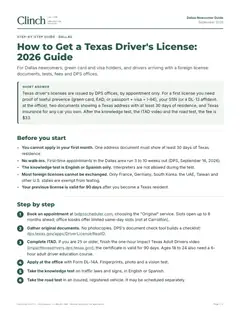
How do I get a Texas driver license?
Short answer
Licenses are issued by the Texas Department of Public Safety, and the card issued to a person in temporary status carries the words Limited Term on its face. The card expires when your lawful presence expires; if your stay is duration of status, the card is valid for one year. The fee does not discriminate: the eight-year regular license and the Limited Term license both cost $33. Testing is in English or Spanish; there is no Turkish, and an interpreter may not be used during the test. And two items are new: commercial license knowledge exams have been English only since June 1, 2026, and the agency's new virtual issuance service is open only to U.S. citizens.
Steps, documents and official links
Card types, terms and fees
From the agency's own fee schedule. The schedule's own note: these amounts already include a $1 administrative fee.
| Card | Term | Fee |
|---|---|---|
| Driver license, ages 18 to 84, new | Eight years, on your birthday | $33 |
| Limited Term driver license | When lawful presence expires; if the period is duration of status, one year | $33 |
| Driver license, under 18 | On your 18th birthday | $16 |
| Driver license, 85 and older | Two years | $9 |
| ID card, 59 and younger | Six years | $16 |
| Limited Term ID card | Same sentence: when lawful presence expires | $16 |
| Lost, stolen or damaged card | The current expiration date does not change | $11 |
| Commercial driver license, ages 18 to 84 | Eight years | $97 |
The agency's own definition: A temporary visitor is anyone who is not a U.S. citizen, U.S. national, lawful permanent resident, refugee or asylee. Most Turkish readers fall inside that definition and will receive a Limited Term card. Cards issued before September 2011 read Temporary Visitor; on renewal the wording changes to Limited Term.
Renewal is in person. The agency's sentence: when renewing a Limited Term license or ID, you must renew in person at any driver license office and provide documents verifying your lawful presence status. If the original period of lawful presence has expired, documents showing a change of status or an extension of stay are required; if the period is duration of status, documents confirming that your status has not changed are required.
One detail, do not mix two rows: the eight-year row above is for citizens and permanent residents. The statutory ceiling for a Limited Term card is six years and in practice it is capped by your stay; it sits on its own row for that reason.
Which documents are required
The list on the agency's first-time application page:
- Proof of U.S. citizenship or lawful presence if you are not a citizen.
- Proof of Texas residency.
- Proof of identity.
- Social Security number.
- Evidence of current Texas vehicle registration for each vehicle you own; the agency's own note says this applies only to new residents who are surrendering an out-of-state driver license.
- Proof of insurance for each vehicle you own, or a statement affirming that you do not own a vehicle.
- An Impact Texas Driver certificate; the agency requires it to be dated within 90 days of your driving skills test.
- A six-hour adult driver education course if you are 18 through 24 and applying for a first Texas license. New residents 18 or older who surrender a valid, unexpired license from another state are exempt. There is no driver education requirement at 25 and older.
Which document matches your status
The agency's lawful presence guide lists accepted documents status by status. The rows that matter most to Turkish readers:
| Status | What the agency accepts |
|---|---|
| F-1 | Unexpired foreign passport, or I-94, or I-20 |
| F-2 | Unexpired foreign passport or I-94 |
| J-1 | Unexpired foreign passport, or I-94, or DS-2019 |
| H-1B, H-4, L-1, L-2, O-1, P, R, TN, E-1, E-2, K-1, V, U, T | Unexpired foreign passport or I-94 |
| B-1 and B-2 | Unexpired foreign passport or I-94, plus the agency's own note: The applicant may not be able meet residency/domicile requirements. |
| Employment authorization holder | Employment Authorization Document (I-766) |
| Adjustment of status pending | Immigration documentation with an alien number or I-94 number; if the document has expired, an I-797 showing the pending filing is also accepted |
| Parole | Immigration documentation with an alien number or I-94 number, including an I-94 annotated with parole |
Hold on to that last row, because vehicle registration does the opposite. The public safety agency issues a license on a parole-annotated I-94. The motor vehicle agency does not accept the same document for vehicle registration. Two agencies, two regimes; the detail is in the vehicle registration section.
One more rule works in your favor: if you provide the lawful presence documentation, the department may not deny the application because of how short your authorized stay is. A short remaining period on your I-94 does not get your application refused; the card is issued with a short term.
Verification delay: the agency's own numbers
Your documents go to a federal verification system. The agency's sentence: Verification through SAVE is often instantaneous, but when it is not, receipt of the DL/ID may be delayed for up to 30 days. But the same document describes three tiers:
| Tier | Time the agency states |
|---|---|
| First tier | Within seconds |
| Second tier | 30 to 45 business days |
| Third tier | Up to 40 additional business days |
Additional documents may be requested at each tier, and the instruction letter goes out within 48 hours of the federal response. In the worst case your card may not arrive for months. If a job, a lease or a vehicle purchase depends on the card, build your calendar around that.
What happens if you have no Social Security number
The agency's own sentence: applicants must provide their number on the application form unless they are not eligible for one. Those who are not eligible complete a number affidavit provided at the office and certify four things at once:
- That they have never applied for a number.
- That they have never been issued or assigned one.
- That they are not eligible for one.
- That they applied and were denied due to ineligibility.
Here is a distinction all four city guides miss: this form is not an I do not have a number statement. It is an I never applied, I was never issued one, I am not eligible statement. A reader who is eligible for a number but whose card has not arrived yet cannot sign it; they have to obtain the number first. See the number section.
Two more warnings from the agency: a false statement in connection with the affidavit results in cancellation of the card and may result in criminal charges, and the affidavit is not acceptable for a commercial driver license. The agency's own sentence is blunt: if you are not eligible for a number, you are not eligible for a commercial driver license. The agency also states that numbers are neither stored in the bar code nor printed on the card.
Test language: no Turkish, and a contradiction we publish
The agency's sentence: DPS can only offer the driver license knowledge test in English or Spanish. You must be able to understand road signs written in English to pass the test(s). Because the number of bilingual specialists is limited, the agency also states that it cannot guarantee a Spanish driving test at every office.
The interpreter rule is firm: you may bring someone to translate, but that person may only help before and after the test. The agency's sentence: Translators are not allowed to help you during the tests. If you do not speak English, the specialist uses hand signals and other non-verbal cues during the driving test. A certified sign language interpreter may be requested for deaf applicants; the agency asks you to contact the local office at least four business days ahead.
Commercial license: the June 1, 2026 change, and a contradiction inside the agency
For a reader considering trucking, this item touches income directly. The agency's announcement dated June 1, 2026 reads:
- Effective today, all Texas CDL and commercial learner permit (CLP) knowledge examinations will be administered in English only.
- Previously, CDL knowledge tests were offered in both English and Spanish.
- Interpreters for these exams are prohibited.
The announcement adds that English language proficiency evaluations will continue at traffic stops and weigh stations, and that a commercial driver who does not meet the standard will be placed out of service.
We publish the contradiction and take no side: the agency's Testing in Other Languages page still states today that the commercial knowledge test is offered in English or Spanish. The announcement says English only. Both are the agency's own text. The announcement is newer and more specific, but call the office before you go.
Online application and virtual issuance: citizens only
The agency's page dated June 8, 2026 describes two separate changes, and none of the four city guides carries either:
- Paper forms are going away. The agency's sentence: Coming soon, paper forms for Driver License (DL)/Identification Card (ID) applications will no longer be used. Instead, all customers must complete their DL/ID application online before scheduling your appointment. So you will fill out the form online before booking an appointment, and this applies to everyone.
- Virtual issuance is for citizens only. For the service that completes renewals, replacements and address changes on a phone, the agency's own eligibility list says U.S. citizen, and for commercial license holders U.S. citizens. It is also open only to records that are already compliant with the federal identification standard.
We write the consequence plainly: a reader holding a Limited Term card cannot use this convenience and will keep going to an office for both first applications and renewals.
Appointments, offices and the two-card rule
- The agency's sentence: driver license offices provide services by appointment only; same day appointments may be available at select offices.
- We publish no wait-time figures. The day counts in the four city guides are dated September 16, 2026, and the source page could not be reached this round; the figures could not be verified. Check the agency's own wait time list.
- The agency's note: You may not hold both a DL and an ID card.
- The agency requires that a domicile be established in the state before a license or ID is issued. The two address documents, one from the last 30 days rule found in the four city guides is an administrative rule; it could not be verified from the agency's own page this round, so we publish no figure. Ask which address documents are accepted before you go.
For offices, appointments and local detail in your own city, see our Dallas, Houston, Austin and San Antonio guides.
Official sources
- Driver licenses and ID cards for temporary visitors (Limited Term)
- Driver license and ID fee schedule
- Applying for a first Texas driver license: required documents
- Verifying lawful presence guide (accepted documents by status)
- Social Security number rule and the number affidavit
- Testing languages and the interpreter rule
- Commercial knowledge testing announcement: June 1, 2026, English only
- Online application and virtual issuance (eligibility)
02 · Foreign license
Can I drive in Texas on my Turkish license?
Short answer
The agency's own sentence closes the question from both ends: with a valid, unexpired foreign license you may drive for up to one year or until you become a Texas resident, whichever comes first. Once you are a resident, you must apply for a Texas license within 90 days. The testing exemption is granted to five countries and Türkiye is not among them, so a Turkish applicant takes the exams. The agency also requires a license not issued in English or Spanish to be translated before arriving in Texas.
Steps, documents and official links
One year and 90 days: two clocks run at once
The reciprocity page's own sentence: Driving privilege reciprocity allows a person to use a valid, unexpired foreign license to operate a motor vehicle in Texas for up to one year or until a person becomes a Texas resident, whichever date is sooner. Once a person becomes a new Texas resident, they must apply for a Texas license within 90 days to continue to drive legally.
The general limits on the same page:
- Reciprocal privileges are limited to persons ages 18 to 75 and to one year from the date of entry into the United States.
- Privileges are limited to private vehicles.
- Every driver must hold a valid permit or license issued by an authorized authority, translated into English.
- On the commercial side the agency's sentence is absolute: Only commercial driver licenses from Canada and Mexico are recognized. A Turkish commercial license is not recognized.
Among the instruments the agency lists is the 1949 Geneva Convention on Road Traffic, and that is the basis for Türkiye. Türkiye does not appear on the separate country list the agency also publishes; that list is a different route.
The statute sets the same period and puts the burden of proof on the driver: a new resident may operate a vehicle for no more than 90 days after entering the state, and in a prosecution the person must prove that they have not resided in the state for more than 90 days. Keep evidence of your move-in date.
The testing exemption: five countries, and one condition
The agency's sentence: Texas has license reciprocity with France, Germany, South Korea, United Arab Emirates and Taiwan. If you have a valid, unexpired driver license from one of these countries, you are not required to take the knowledge or skills exam unless you choose to keep your out-of-country license.
Türkiye is not on the list, so there is no testing exemption for a Turkish applicant. We also publish the end of that sentence, because all four city guides drop it: the exemption depends on surrendering your own country's license. If you choose to keep it, the exemption does not apply.
When the translation has to be done
The agency's sentence does not merely impose the requirement, it sets the timing: Foreign licenses not in English or Spanish must be translated by a translation service or your consulate before arriving in Texas.
So have the translation done before you leave Türkiye. A consular translation is listed in the agency's own sentence, which is a route worth trying before you look for a translation service here.
Arriving from another state changes the rule
The agency draws the distinction by direction, not by country: a person 18 or older holding a valid license from another U.S. state or a license not expired more than two years is exempt from the knowledge exam, the skills exam, the Impact Texas Driver requirement and adult driver education. The agency also states that a person arriving from another state, territory, Canadian province or a qualifying country may drive on that license for up to 90 days after moving.
The consequence: a reader arriving directly from Türkiye and a reader arriving from another state are not on the same path. The first takes the exams, the second does not.
03 · Vehicle registration
How do I register my car, and how does the new ID rule affect me?
Short answer
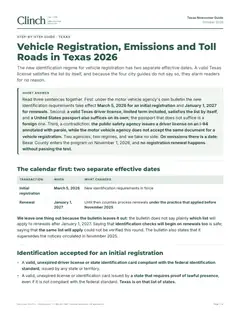
A new identification regime applies to vehicle registration, with two separate effective dates: March 5, 2026 for initial registration and January 1, 2027 for renewals. Read three sentences together. First, a U.S. passport is enough on its own; what is not enough is a foreign passport. Second, a valid Texas driver license, including a Limited Term one, satisfies the list by itself, and none of the four city guides says so. Third, there is a contradiction: the public safety agency issues a license to a person in parole status, while the motor vehicle agency does not accept a parole-annotated I-94 for registration. And on emissions there is a date: Bexar County enters the program on November 1, 2026.
Steps, documents and official links
The calendar first: two effective dates
The motor vehicle agency's own bulletin dated February 18, 2026 states:
- The revisions apply to both initial registration and registration renewal transactions but have different effective dates.
- The new ID requirements for initial registration took effect March 5, 2026.
- The new ID requirements for renewals do not take effect until January 1, 2027. Until then counties process renewals under the procedures in place before November 2025.
- The bulletin states expressly that it supersedes communications distributed in November 2025.
One thing we do not write, because the bulletin does not: it does not say which list applies to renewals after January 1, 2027. Saying an ID check will begin at renewal is safe; saying the same list will apply could not be verified this round.
Identification accepted for an initial registration
The list the agency publishes for initial registration, in its own order:
- A valid, unexpired driver license or state ID compliant with the federal identification standard, issued by any state or territory.
- A valid, unexpired driver license or state ID that does not meet that standard but was issued by a state that requires proof of legal presence. Texas is on that list of states.
- A driver license or ID issued by any state, plus a U.S. birth certificate, a Certificate of Naturalization or a Certificate of Citizenship.
- A valid, unexpired U.S. passport.
- A valid, unexpired foreign passport PLUS one of: Form I-94 (not in parole status), a current permanent resident card, or an unexpired immigrant visa.
- A valid, unexpired Texas license to carry a handgun.
Two sentences belong here, because readers are being alarmed for no reason:
- If you hold a valid Texas driver license, even a Limited Term one, the list is already satisfied for you. You do not need to bring a passport and an I-94 as well.
- The passport that is not enough is a foreign passport. A U.S. passport is enough on its own. Some of the four city guides say only passport, and that is incomplete.
The parole contradiction: two agencies, two answers
The motor vehicle agency's own definition of a valid passport says that an unexpired passport issued by another country is accepted with a Form I-94, unless the Form I-94 shows that the bearer only has parole status. The adopted rule states its own reason in writing: because that status can be revoked at any time.
By contrast, as shown in the driver license section, the public safety agency's lawful presence guide accepts a parole-annotated I-94 for a license.
Two official sources give two answers about the same document, and we take no side. The correct sentence is: the license can be obtained, the registration cannot. Do not compress this into Texas does not recognize parole; these are two agencies with two regimes.
Not every transaction uses the same list
The bulletin splits transactions in two, and the second list is far broader:
| Transaction | Which list |
|---|---|
| Initial registration | The narrow list above |
| Title only, without registration | The broad list |
| Off-highway vehicles | The broad list |
| Exempt vehicles, temporary plates, short-term permits, the 30-day plate | The broad list |
| Rental trailers, commercial registration, alternative registration such as agriculture | The broad list |
The broad list accepts a foreign passport on its own and also includes a state driver license or ID, a Texas license to carry a handgun, a U.S. passport, a military ID and several federal agency IDs. The bulletin's own note: only documents on the broad list may be expired, up to 12 months; nothing on the narrow list may be expired.
An agent filing on behalf of a business, trust or leasing company must present their own photo ID, and that ID only has to meet the broad list.
Deadlines, fees and renewal
The agency's own sentence: you have 30 days from the time you move here to register your vehicle. The order the agency recommends: inspection and insurance, then registration and plates, then the electric vehicle fee, then the driver license.
| Item | Amount |
|---|---|
| Base registration, car and light truck | $50.75 |
| Registration fee (including the insurance verification program share) | $51.75 |
| Pickup, 6,001 to 10,000 pounds | $54 |
| Trailer (up to 6,000 pounds) | $45 |
| Motorcycle and moped | $30 |
| Annual electric vehicle fee | $200 |
| Processing and handling | $4.75 |
| State fee in place of the inspection | $7.50 |
| Replacement sticker | $6 plus $0.50 automation |
The county share varies across the state, in the agency's own words: the local fee may range from $0 to $31.50; counties may charge up to $10 for the road and bridge fund, up to $20 for transportation, and up to $1.50 for a child safety fee. The same car produces two different bills in two counties.
- Renewal opens 90 days before the expiration date; if it has lapsed you may renew up to 12 months afterward provided you have not been penalized, and your expiration month does not change.
- A vehicle may be operated up to five working days after registration expires without penalty; after that a fine of up to $200 may be issued.
The new resident tax: $90 within 30 days
The comptroller's own publication: the $90 new resident tax is the new resident's responsibility and must be paid within 30 calendar days from the vehicle's first use in Texas. Active duty service members have 60 days. A person who has not previously registered the vehicle in their own name elsewhere instead pays motor vehicle use tax on the purchase price or on 80 percent of the standard presumptive value.
Inspection: safety inspection ended, emissions did not
The annual safety inspection for non-commercial vehicles ended January 1, 2025. The motor vehicle agency's sentence: As of January 1, 2025, non-commercial vehicles are no longer required to obtain a safety inspection. The environmental agency says the same thing with the same date. A $7.50 state item at registration replaced it.
We publish the contradiction: the public safety agency's own vehicle inspection section page still states as a general proposition that vehicles registered in Texas are required to pass an annual inspection. Two official sources conflict; the dated sentences from the motor vehicle and environmental agencies are newer and more specific.
And we do not say there is none: what ended was the safety inspection for non-commercial vehicles. The inspection regime for commercial vehicles and certain special classes was not measured this round.
Emissions testing: which counties, and the November 1, 2026 change
Emissions is a separate regime and it continues. The environmental agency's own list:
| Program area | Counties covered | Inspection cap |
|---|---|---|
| Houston, Galveston and Brazoria | Brazoria, Fort Bend, Galveston, Harris, Montgomery | $18.50 |
| Dallas and Fort Worth | Collin, Dallas, Denton, Ellis, Johnson, Kaufman, Parker, Rockwall, Tarrant | $18.50 |
| Austin | Travis, Williamson | $11.50 |
| El Paso | El Paso | $11.50 |
| San Antonio | Bexar, beginning November 1, 2026 | $18.50 |
The environmental agency's sentence: Enhanced inspections will begin in Bexar County on November 1, 2026. The motor vehicle agency's bulletin dated September 15, 2026 says the same and adds that in Bexar County the test fee is $18.50 paid at the station, plus a state share paid at registration renewal. Vehicles exempt by statute, such as electric vehicles and classic cars, remain exempt.
Two official sources conflict on the state share and we publish both: the environmental agency's own page puts it at $2.50, while the motor vehicle agency's Bexar bulletin and the sample breakdown on its registration page say $2.75. We take no side; your receipt will show which one you paid.
Other rules: gasoline vehicles are inspected annually from model year two through model year 24; electric vehicles, diesel vehicles, motorcycles and mopeds are not inspected. A vehicle that does not pass cannot renew its registration; if your renewal notice carries a compliance note, no renewal is processed until the issue is resolved. The environmental agency runs a registration denial line for this: 1-888-295-0141.
And a planning tip: renewals may be completed up to 90 days in advance of expiration, and a passing emissions test can be obtained within that window. If you live in Bexar County, spread a November renewal across that window.
For stations, county tax offices and local detail in your own city, see our Dallas, Houston, Austin and San Antonio guides.
Official sources
- Register your vehicle: fees, renewal window and penalty
- New to Texas: vehicle registration guide
- Registration ID bulletin: two effective dates and accepted documents
- Adopted ID rules and the stated reason on parole
- Emissions inspections: program areas and counties covered
- Emissions fee caps and the state share
- Bexar County emissions bulletin (September 15, 2026)
- New resident vehicle tax ($90, 30 days)
PDF: Vehicle Registration, Emissions and Toll Roads in Texas 2026
04 · Auto insurance
How does auto insurance work, and what are the minimum limits?
Short answer
The state's mandatory minimums are $30,000 for bodily injury to one person, $60,000 for bodily injury in one collision, and $25,000 for property damage. An insurance card on your phone screen is accepted as proof, and that is written into the statute itself. A first offense for driving uninsured carries a fine of $175 to $350. And one detail: in Texas financial responsibility can be established not only by insurance, but also by a surety bond or a deposit.
Steps, documents and official links
Minimum limits
| Coverage | Minimum |
|---|---|
| Bodily injury to or death of one person in one collision | $30,000 |
| Bodily injury to or death of two or more persons in one collision | $60,000 |
| Damage to or destruction of the property of others in one collision | $25,000 |
These amounts were read from the statute, and our source this round was an archived copy, because the state legislative site no longer serves text. The same figures appear in all four city guides and corroborate each other; still, have your agent confirm today's minimum limits when you buy the policy.
What counts as proof
Among the forms of proof the statute lists, the third one is useful to you:
- The policy itself or a photocopy.
- The standard proof form prescribed by the insurance regulator.
- An image displayed on a wireless communication device. So the insurance card on your phone is accepted, in the statute's own words.
- A binder.
- A surety bond.
- Evidence of a deposit made with the comptroller or a county judge.
- A certificate of self-insurance.
Penalty
Driving uninsured carries a fine of not less than $175 nor more than $350 for a first offense, and not less than $350 nor more than $1,000 on a repeat. A court may reduce the fine below $175 where it finds an inability to pay.
How the state verifies
Your registration fee includes a $1 item earmarked for the insurance verification program, and the motor vehicle agency lists it separately in the fee breakdown. So your policy and your registration move together. The practical order: start the policy first, then go to the registration counter; the agency's own step list gives the same order.
What we do not write, and why
Prohibited rating factors. Some states have detailed rules barring an insurance score from being calculated using income, sex, ZIP code, ethnic group, religion, marital status or nationality, and we wrote those into the guides for those states. No such rule was measured for Texas this round. We do not say there is none; we say the research did not measure this item. Do not carry sentences from our other state guides into this one.
Fault or no-fault comparisons. Not measured this round; ask your agent separately about the Texas regime when choosing a policy.
05 · Toll roads
How do toll roads work, and what happens if I drive through without a tag?
Short answer
Texas has the most complex toll regime in this series. In the transportation department's own counters: 872 miles of open toll facilities, 225 miles of planned facilities, and 12 toll road operators statewide. Three things matter to you. First, the agency that runs the road and the agency that bills you are usually not the same. Second, tags recognize one another and work across five states. Third, in one county there is no pay-by-mail route at all; a violation is issued directly. And the North Texas Tollway Authority's application page does not ask for a Social Security number — do not generalize this to the whole state; the other authorities' terms could not be measured.
Steps, documents and official links
Who runs the road, who sends the bill
The transportation department's own sentence is that Texas has more than a dozen toll operators and that each sets its own business rules, billing practices and toll rates. Its own table shows which agency bills for which road:
| Road operator | Region | Billing agency |
|---|---|---|
| Texas Department of Transportation | Austin, Houston, Dallas and Fort Worth | Harris County Toll Road Authority (Austin and Houston) or North Texas Tollway Authority (Dallas and Fort Worth) |
| Central Texas Regional Mobility Authority | Austin | Itself |
| SH 130 Concession Company | Austin | Harris County Toll Road Authority |
| Harris County Toll Road Authority | Houston | Itself |
| Brazoria County Toll Road Authority | Houston | Harris County Toll Road Authority |
| Fort Bend County Toll Road Authority | Houston | Harris County Toll Road Authority |
| Montgomery County Toll Road Authority | Houston | Harris County Toll Road Authority |
| North Texas Tollway Authority | Dallas and Fort Worth | Itself |
| LBJ Infrastructure Group | Dallas and Fort Worth | North Texas Tollway Authority |
| NTE Mobility Partners and NTE Mobility Partners Segments 3 | Dallas and Fort Worth | North Texas Tollway Authority |
| North East Texas Regional Mobility Authority | Dallas and Fort Worth | North Texas Tollway Authority |
| Cameron County Regional Mobility Authority | Rio Grande Valley | Itself |
The department's own share is approximately 263 centerline miles of toll roads and managed lanes. Why this matters: when a bill arrives, the agency on it may not be the agency on the signs. You dispute it with the agency that issued the bill.
Tags recognize one another
The shared program is the Central United States Interoperability Partners. The department's sentence: the program lets drivers use toll roads in Texas, Kansas, Oklahoma, Colorado and most toll roads in Florida with a single toll account. The tags in the program are TxTag, EZ TAG, TollTag, KTAG, PIKEPASS, ExpressToll and SunPass.
Two warnings from the department:
- Do not keep more than one tag in your vehicle; you can be charged twice for the same trip. Decide which account to keep, remove the other sticker from your windshield and close that account.
- Parking use is not shared. The department's own answer is that TxTag cannot be used for parking.
One brand is effectively retired
This is where a reader acting on old information walks up to the wrong counter:
- The old tag website no longer serves its own content; the address now redirects to the transportation department's toll roads page.
- The department's sentence: as of November 9, 2024, the Harris County Toll Road Authority processes toll transactions on the department's toll roads in the Austin and Houston regions. The department continues to own and maintain the roads and to set the rates.
- Existing TxTag stickers keep working, but the department's sentence is explicit: customers who need a new or replacement tag sticker will have to order an EZ TAG through the Harris County Toll Road Authority.
- Your old account may not have transferred. Only certain accounts moved across. We could not verify from an official source how many did not, and we publish no figure. If you hold an old account, ask whether it transferred.
- In-person payment is still possible at one point: the department states that the TxTag customer service center in Austin (12719 Burnet Road) accepts cash, check, money order and credit card, with the walk-up counter open weekdays 7 a.m. to 7 p.m. and Saturday 8 a.m. to 4:30 p.m.
Is a number required to open a tag account
The north Texas tolling agency's own sign-up page asks for only three things: the vehicle license plate number, the vehicle year, make and model, and a credit or debit card. The page says nothing about a Social Security number, a driver license or a card issued in the United States.
| Account | Scope | Auto-reload threshold |
|---|---|---|
| $40 | Up to three tags per account | When the balance falls below $10 |
| $20 | Narrower | Per the agency's own schedule |
| $10 | Single vehicle | When the balance reaches $5 |
The agency's own note: there is no monthly fee. Tags can also be picked up at customer service centers. So this door is open for a newcomer without a number; all you need is a bank or credit card. See also the number section.
We cannot say the same for the Houston-side tag: that agency's site could not be reached this round, and its account requirements, deposit amount and cash reload options could not be verified. We make no firm statement; ask the agency.
What happens if you drive through without a tag
Three regimes, and they do not resemble each other.
North Texas: billing from the plate
- Bills follow a 25-day cycle and are issued on or around the same date each month. Careful: that is a billing cycle, not a payment deadline. The agency's sentence on paying is that customers avoid fees by paying by the due date marked on the invoice. One of the four city guides says you have 25 days, which conflates the two.
- The steps: no fee on the first invoice; $10 on the first notice of nonpayment, a further $25 on the second; after that collections and legal process, with court costs added.
- The dispute window: the agency's own agreement requires disputes to be submitted in writing within 120 days of the date the item was invoiced; items not disputed in time are treated as final.
- All four city guides state that the untagged rate is twice the tag rate, and the agency's current rate page could not be reached this round. We carry the claim from a secondary source and hedge it; confirm the current difference with the agency.
Houston and Austin: an invoice, and in Austin two of them
- The transportation department's own answer: if you have a tag account but not enough balance, an invoice arrives by mail at the higher rates and with additional fees. You also receive an invoice if your tag was not detected and your plate does not match an existing account.
- The department's one-sentence summary: Under Texas law, the owner of the vehicle is responsible for any toll charges and fees, regardless of who was driving at the time. So whoever drives, the registered owner is liable. Keep that in mind when you lend your car.
- Double invoicing in Austin is real. The department's sentence: without a prepaid tag, driving on Austin-area toll roads can produce two separate invoices depending on which roads you use, and you must pay the amount due on both.
- The Houston-side fee steps could not be verified this round, so we publish no figures. The agency's customer service number for disputes is 281-875-3279.
Fort Bend County: no pay-by-mail route at all
This is the exception to the statewide drive through untagged and a bill arrives rule, and it is a warning item. From the county tolling authority's own pages:
- ELECTRONIC TOLL TAG ONLY and NO CASH, NO PAY BY MAIL
- The authority does not offer pay-by-mail or video tolling.
- A motorist driving these roads without a valid electronic tag may be issued a citation for failure to pay toll.
- Plates are photographed and the registered owner receives a toll violation notice by first class mail.
- The violation payment center number is (855) 999-2024, weekdays 8 a.m. to 5 p.m.
These findings were read indirectly from the authority's own pages; the regime is clear, the fee amounts were not measured.
The statute: the habitual violator regime and two critical deadlines
State law sets a framework that binds every toll entity. These are the two deadlines to memorize:
- A notice is presumed received on the fifth day after the date it is mailed.
- If a written request for a hearing is not received within 30 days of that presumed receipt, the determination becomes final and cannot be appealed.
The regime itself:
- Definition: a registered owner who has been issued at least two written notices of nonpayment containing, in the aggregate, 100 or more events of nonpayment within one year, and who has not paid in full, is determined to be a habitual violator. The notices must also carry a warning about the remedies.
- Rental and stolen vehicle transactions are subtracted from that count.
- The hearing is held in a justice court in the county where at least a quarter of the transactions occurred; failure to appear waives your rights.
- A justice court decision may be appealed to the county court within 30 days and tried anew; but an appeal alone does not stop the remedies, which requires posting security in the amount owed.
- The entity may prohibit the vehicle from using its toll roads; using them in violation of the ban is a misdemeanor. A banned vehicle may be impounded.
- The entity may notify the county tax assessor-collector or the motor vehicle agency and have vehicle registration refused.
- The entity may publish the name, city and state of residence, number of unpaid transactions and total amount owed.
- The right to a payment plan is in the statute: the entity may enter into an agreement with the registered owner to pay the outstanding amount over a specified period. This should be the first thing you ask about when a balance grows.
- A separate regime for out-of-state and foreign plates: notice may be served in person or handed over at an international bridge; nonpayment is an offense and each transaction is a separate offense, punishable by a fine not to exceed $250.
These provisions were read from archived copies, because the state legislative site no longer serves text. If a notice is in your own file, have your attorney confirm the deadlines against the current text.
Rental cars
The department's sentence: in a rental you pay tolls through your rental car agreement, and in most cases the charges go to the credit card used to rent the vehicle. Most rental agencies use third-party companies such as PlatePass and Highway Toll Administration; fees and policies vary from one agency to another. PlatePass is at 1-877-411-4300 and Highway Toll Administration at 1-866-285-6050.
You may add your own tag to a rental, but the north Texas agency's warning is that tolls are then charged at the higher untagged rate; remove the rental from your account when you return it.
Fake toll messages
The transportation department's own sentence is short and useful: TxTag/TxDOT does not send texts or emails for past due tolls. So if you receive a text or email saying you owe a toll, the message itself is the warning sign. Do not tap the link; if you think you owe something, call the agency directly.
One internal inconsistency, recorded as is
The department's page states there are four toll tag operators, but only three tag brands are named in Texas: TxTag, EZ TAG and TollTag. No official sentence identifying a fourth could be found. We do not resolve it; we record it.
Official sources
- Toll roads: operators, billing agencies and statewide counters
- Interoperability between tags (the shared program and the states covered)
- Paying tolls: invoices, double invoicing and rental cars
- How tags work and where to get one
- North Texas tag sign-up: information required and account types
- North Texas bill payment, fee steps and the habitual violator regime
- Fort Bend County: tag only, no pay-by-mail
- Fort Bend County violations page
06 · Severe weather
Driving in severe weather: this state has five regimes at once
Short answer
The transportation department's severe weather section lists five events: snow and ice, hurricanes, flash floods, tornadoes and wildfires. The easiest mistake a newcomer makes is skipping a winter plan because this is the south. But the state's number one weather hazard is not winter: the agency's own sentence says flash flooding is the leading cause of weather-related deaths in Texas. Driving around a barrier carries a fine of up to $2,000 and up to 180 days in jail.
Steps, documents and official links
Flash floods: the state's leading weather hazard
The department's own sentence: Flash flooding is the leading cause of weather-related deaths in Texas. If you encounter a flooded road, 'Turn Around, Don't Drown.'
- Never walk, swim or drive through still or moving flood waters. The agency's own measure: as little as six inches of fast-moving water can make a motorist lose control of a vehicle, even a pickup or an SUV.
- Be especially careful at night, when flood dangers are harder to see.
- If your vehicle stalls in deep water, leave it and move to higher ground if you can do so safely.
And the law appears under the agency's own heading:
- Driving around barriers blocking low water crossings or flooded roadways: a fine of up to $2,000 and/or up to 180 days in jail.
- Tampering with roadway warning signs or barriers: a fine of up to $1,000, up to two years in jail, or both.
Snow and ice: real, but the infrastructure is not a northern state's
The agency's sentence is direct: TxDOT strongly advises you to stay off the roads. If you must drive, the agency's own instructions:
- Slow down. Speed limits are based on normal road and weather conditions, not winter road conditions.
- Maintain at least three times the normal following distance on snow or ice.
- Watch carefully for snow removal equipment and, following the transportation department's own instruction, stay at least two hundred feet behind it. (That is the department's own safety parameter; it is not a distance between the places in this guide.)
- Bridges, ramps, overpasses and shaded areas tend to freeze first; use extra caution there.
- If your vehicle starts to slide, ease off the gas pedal or brakes and steer into the direction of the skid until you regain traction.
For road conditions the agency's own tool is DriveTexas, with a phone line at 800-452-9292. The roadside assistance line is 800-525-5555.
Tornadoes
The agency's instructions are short, and all three can run against instinct:
- When you hear a tornado watch or warning and you are traveling within the affected area, pull over and seek shelter immediately. Outside the area, stay aware of your surroundings.
- Listen to local reports and watch for flash floods and other rapidly changing conditions.
- Do not park under bridges. That sentence is in the agency's own text and runs against a common belief.
Hurricanes and evacuation
If you live on the Gulf coast, this section is a summer plan:
- Evacuation routes are published in the agency's own mapping tool and on its statewide planning map.
- The agency's own sentence: if you are elderly or disabled, call 2-1-1.
- Contraflow: in the agency's definition, during an evacuation from low-lying coastal areas existing lanes may be converted into contraflow lanes, so that all traffic moves inland and away from the Gulf coast. A wide shoulder may also be converted into an active through lane.
- The agency's evacuation areas: Beaumont (including Port Arthur), Corpus Christi (Aransas Pass, Port Aransas), Houston (Harris County and Galveston), Pharr (Brownsville, Laredo, McAllen) and Yoakum (Victoria, Matagorda Bay).
- A language note: the agency's contraflow brochures and instructional videos are in English and Spanish, and the page says so in its own words. There is no Turkish version.
Wildfires
The agency's explanation: because Texas sits in the sun belt, roadside vegetation dries out often, which creates wildfire risk especially after a run of sunny days and in windy conditions. If there is a fire, the agency's instructions:
- Keep your windows up and close your vehicle's air vents to keep smoke out.
- Turn on your headlights and keep your vehicle doors unlocked; the agency's stated reason is to avoid slowing down rescuers if you need help.
What we do not write
- Dust and sand storms: no separate agency page on this could be found. We do not say there is none; we say the research did not find one.
- The road condition tool's own description and closure regime: the tool's own page is a map application and no text could be read. We describe what the tool shows in the transportation department's words.
- A single agency page describing statewide emergency road closure authority and procedure could not be found.
- Snow tire or chain requirements: not measured this round.
Official sources
- Severe weather main page (five events)
- Flash floods: the agency instructions and the statutory penalties
- Snow and ice: driving instructions and the road condition line
- Tornadoes: pulling over and the bridge warning
- Hurricane preparation, evacuation routes and contraflow
- Wildfires: what to do inside the vehicle
07 · Transit
How does public transit work, and are there trains?
Short answer
The transportation department's own directory counts 75 transit agencies statewide in three categories: eight metropolitan authorities, thirty urban systems and thirty-seven rural transit districts. The third category is the one not to skip: if you live outside the big cities, a rural transit district serving your county very likely exists and its phone number is in the directory. On the intercity side, three passenger rail routes pass through Texas.
Steps, documents and official links
The state's own categories
The department's own definitions:
| Category | The agency definition | Records |
|---|---|---|
| Metropolitan transit authorities | Serve areas with populations of 200,000 or more | 8 |
| Urban transit systems | Serve populations over 50,000 | 30 |
| Rural transit districts | Cover areas outside the urbanized areas | 37 |
The eight metropolitan authorities: Capital Metro (Austin), Corpus Christi Regional Transportation Authority, DART (Dallas), Denton County Transportation Authority, Sun Metro (El Paso), Trinity Metro (Fort Worth), Houston METRO and VIA Metropolitan Transit (San Antonio).
The directory gives each agency's name, address, phone number, category and the county it serves. The count was taken on October 13, 2026.
Outside the big cities: you have a rural transit district
For a reader moving outside the four Texas cities, this is a door that appears in none of the four city guides. The department's own referral: for transportation under the mobility program for seniors and people with disabilities, contact the rural transit provider serving your county. The directory carries that provider's phone number.
But we do not generalize the regime: no single agency page could be found describing how the rural districts run demand-response service, how far ahead you must reserve, or what they charge. Each district sets its own rules; call and ask.
Intercity passenger rail: three routes
| Route | Endpoints | Texas stops | Frequency |
|---|---|---|---|
| Texas Eagle | Chicago to San Antonio | Marshall, Longview, Mineola, Dallas, Fort Worth, Cleburne, McGregor, Temple, Taylor, Austin, San Marcos, San Antonio | Daily |
| Sunset Limited | New Orleans to Los Angeles | Beaumont, Houston, San Antonio, Del Rio, Sanderson, Alpine, El Paso | Three days a week, each direction |
| Heartland Flyer | Oklahoma City to Fort Worth | Gainesville, Fort Worth | Daily |
Two warnings, written together. First, the northbound route is financed primarily through funds made available by the Oklahoma and Texas departments of transportation and is therefore decided year to year; it was contested through 2026 and we could not confirm an outcome from either agency's own announcement. Second, the rail operator's own page shows an active service announcement effective October 18, 2026 whose content could not be read. Check the operator's service announcements page before you buy a ticket.
What we do not write
- The state's passenger rail policy: the transportation department's page on the subject consists only of links, with no policy text.
- A statewide discounted or free transit pass: no state-level program for immigrants or low-income riders could be found. Local agencies may run their own reduced fares; see your own city's guide and agency.
For the four big cities' own networks, fares and reduced-fare cards, see our Dallas, Houston, Austin and San Antonio guides.
08 · Local government
Which government does my address fall under?
Short answer
Texas has 254 counties, and which government your address falls under changes almost every item in this guide: who sets the water rules, who collects the trash, which units levy your property tax, where you file a complaint. There is no single Texas answer; the statutes split authority between inside and outside city limits and hand many services to special purpose districts. And here is what surprises readers most: the tax on your bill is not one agency's tax but the sum of the rates of several overlapping taxing units.
Steps, documents and official links
Three layers exist at once, and each is a separate agency
- The state: driver licenses, vehicle registration, vital records, health programs, the framework for education rules.
- The county: the vehicle registration counter (the tax assessor-collector), the marriage license (the county clerk), the appraisal district, justice courts, and trash and certain services outside city limits.
- The city: water and sewer, trash, policing, zoning, the municipal court, and in some places electricity.
There is a fourth layer and it is very common in Texas: water districts, hospital districts, college districts, emergency services districts, drainage districts. These are separate legal entities, set their own rates and answer to their own boards. When you look at a home, ask which districts it sits inside; that is where the difference in the tax bill comes from.
Who sets the water rules: inside and outside the line
The state water code splits authority cleanly:
| Where your address is | Original jurisdiction over water rates | Appeal |
|---|---|---|
| Inside city limits | The city council (exclusive) | The state public utility regulator |
| Outside city limits | The state public utility regulator (exclusive) | The same agency |
And the statute carries its own limiting sentence: the regulator is not given authority to regulate the rates and services of a city's own water utility inside that city's limits. This provision was updated on May 30, 2025.
The practical consequence: if a city name appears on your bill, your counterpart is the city council; if a water district or a private company appears, your counterpart is the state regulator. You can read which door to knock on from the name on the bill.
There is no statewide trash regime
The statute says a public agency or a county may provide solid waste service to persons in its area, may require that the service be used, may charge fees and may establish the service as a separate public utility. A commissioners court may regulate collection, transport, storage and disposal in areas outside a city's limits and its extraterritorial jurisdiction.
So all three patterns are real in Texas: the city collects, the city contracts a private company, or the resident finds their own hauler. The detail is in the water and trash section.
Property tax: no state layer, only local ones
The comptroller's own sentence has two halves and they belong together: Texas has no state property tax and local governments set tax rates and collect property taxes. Appraisal is done by an appraisal district in each county, and value is set as of January 1 each year. The detail is in the homestead exemption section.
Your city's rule cannot override the state's
A general preemption statute adopted in 2023 barred cities and counties from regulating in a field occupied by state law and declared conflicting local rules void and unenforceable. The statute specifically names local rules regulating evictions as being in that field.
Where the litigation stands today, because what circulates is stale: a Travis County district court declared the entire statute unconstitutional on August 30, 2023 (D-1-GN-23-003474). The Third Court of Appeals (No. 03-23-00531-CV, Austin) reversed on July 18, 2025; the ground was not the merits but standing and the proper party, and the case was dismissed without prejudice. So the sentence that the statute was declared unconstitutional is not valid today. The court's own stamped opinion could not be reached this round, so we carry this item from a secondary source.
The four big cities, and where this guide sits
We publish separate guides for Texas's four largest cities, and this page does not replace them. This page writes what the four have in common: state law, state agencies and the rules that are the same across the state. For rates, counters, fees and local rules, go to your own city:
If you are moving somewhere other than these four, the fastest way to find your counterpart is to ask three questions: am I inside city limits, which county am I in, and which special purpose districts am I inside. All three answers are in the deed record and on the appraisal district's lookup page.
09 · Electricity
How do I put the power in my name, and can it be cut off if I cannot pay?
Short answer
The sentence that you choose your own electricity in Texas is wrong. Retail choice exists, but it does not cover customers of municipally owned utilities or cooperatives; which regime you are in depends on your address. On shutoffs, the calendar dates that circulate are wrong for this state: the protection is tied not to a fixed date but to the weather that day. And a structural finding: if you are a municipal utility customer, the body that administers the customer protection rules is, in the statute's own words, solely the governing body of that utility; not the state regulator.
Steps, documents and official links
Choice does not cover everyone
The statute grants retail choice to every customer except customers of electric cooperatives and municipally owned utilities that have not opted for customer choice. Whether a municipal utility opts in is decided by the city council or the board governing the utility, and the decision to opt in is irrevocable. In cooperatives the board decides, and an opt-in can be reversed only if no customer has used choice within four years.
The consequence for you: whether you are in the competitive market is not your preference, it follows the service territory your address sits in. Ask before you sign a lease: at this address, do I choose my electricity, or is there a single provider?
Two companies, one bill
In the competitive market the physical connection, the meter and outages are the transmission and distribution company's job; the retailer only issues the bill. One retailer's own electricity facts label says so plainly: the distribution company's monthly charges are passed through without mark-up.
The consequence: when your power goes out or something is wrong with the meter, the company you call is the distribution company, not the retailer; both names appear on the bill.
Deposits: the cap and the refund
From the regulator's rule, which we could read this round only in a secondary copy:
- The total of all deposits taken from a residential customer may not exceed the greater of one-fifth of your estimated annual billing or the sum of the estimated billings for the next two months.
- The deposit is refunded after 12 consecutive residential bills are paid without delinquency.
- If it is not refunded within 30 days, interest accrues.
- A written letter of guarantee must be offered as an alternative to a cash deposit, and the guarantor's liability is limited to the deposit amount.
- A customer 65 or older with no delinquency on the electric account, and a person determined to be a family violence victim under state law, are in the rule's own words deemed as having established satisfactory credit. That is not an exemption, it is a deeming; the result is the same.
Is a Social Security number required to start service
The honest answer is that no statewide answer could be measured, and for that reason we do not write that a number is not required. Three things could be measured:
- The regulator's rule gives a list of options. For the account access verification data a retailer must obtain at enrollment, the rule names one of the following: the last four digits of the Social Security number, mother's maiden name, city or town of birth, month and day of birth, or a driver's license or government issued identification number. So the number is only one of the options. We read this rule too in a secondary copy this round.
- But that does not stop a company from running its own credit evaluation; other rules set out other ways to establish credit, such as a letter of guarantee or a prepaid product.
- At one municipal utility the route is published. San Antonio's municipal electric and gas utility, CPS Energy, lists the identification it accepts on its moving page: a driver license issued by a U.S. state or territory; a state or territory ID card; a Social Security number; a federal tax identification number; and any other form of verifiable identification considered acceptable upon review. The number is one of five options.
On the Austin side the list could not be verified. The city's own utility page discusses fees and deposits but publishes no list of accepted identification. The list that appears in one of the four city guides could not be confirmed from the agency's page this round, so we do not repeat it. Before you open service, ask the right question: not I have no number, but what do you accept as alternative identification.
The shutoff ban: no calendar, only weather
The November 1 to March 31 style dates that circulate are wrong for this state. The statute says a provider of retail electric service may not disconnect a residential customer during an extreme weather emergency or on a weekend day. The same provision requires the provider to defer collection of bills that come due during the emergency and to work out a payment schedule with the customer.
The definition of an extreme weather emergency is in the statute and has two arms:
| Arm | The test the statute sets |
|---|---|
| Cold | The previous day's highest temperature did not exceed 32 degrees Fahrenheit and the temperature is predicted to remain at or below that level for the next 24 hours according to the nearest National Weather Service reports |
| Heat | The National Weather Service issues a heat advisory for any county in the relevant service territory, or such an advisory was issued on any one of the previous two calendar days |
The heat arm was added to this provision on September 1, 2023. The regulator's rule repeats the same test at county scale and makes a deferred payment plan mandatory on request. The same rule also provides that a disconnection for nonpayment may not be requested on a holiday, a weekend, or the day before either, with an exception where the company can take payment and reconnect on those days.
Health-based protections are written too:
- If a disconnection would cause someone living in the home to become seriously ill or more seriously ill, with physician certification and a written statement, no disconnection for nonpayment may occur for 63 days from the issuance of the bill, and a deferred payment plan is required.
- Where a chronic condition has been reported, 21 days' prior written notice is required before a disconnection.
- If an energy assistance agency has pledged payment, no disconnection may occur for that billing period, and the retailer must wait at least 45 days for the pledge to be honored.
Where you complain: the statute's own sentence for municipal utilities
This is the third time this series has met this pattern, but the first time it is written plainly in a statute. The law provides that where compliance with the customer protection provisions is by a municipally owned utility, it shall be administered solely by the governing body of that utility, which adopts, implements and enforces the relevant rules itself.
Two further provisions point the same way: the regulator's jurisdiction over municipally owned utilities is limited to eight enumerated purposes, and retail customer protection is not among them; six purposes are enumerated for cooperatives, again without customer protection.
| Your provider | Your complaint forum |
|---|---|
| A retailer in the competitive market | The state public utility regulator |
| A municipally owned utility | That utility's own governing body (the city council or the utility board) |
| An electric cooperative | The cooperative's own board |
So for a competitive-market customer in Dallas or Houston the door is the state regulator; for a municipal utility customer in Austin or San Antonio the door is the city's own body. Same state, two doors.
But the discrimination ban covers everyone
This is a protection that does not exist in renting, and it is directly usable. The statute lists among a customer's rights protection from discrimination on the basis of race, color, sex, nationality, religion, marital status, income level and source of income, and protection from unreasonable discrimination on the basis of geographic location. A separate provision bars a retailer from refusing service or otherwise discriminating because of race, creed, color, national origin, ancestry, sex, marital status, lawful source of income, disability or familial status. Enforcement sits with the state regulator, which may impose administrative and civil penalties.
Immigration status is not a protected class in renting (see the renting section), but national origin and source of income are protected in electric service by state law. Do not confuse the two.
Contract traps: two gains missing from the four city guides
- You do not get stranded when the contract ends. If the customer does nothing, the retailer must place them on a month-to-month product that can be canceled at any time without a fee.
- Moving removes the early termination fee. If you give the new address (and proof of the move if asked), no early termination fee applies. For a newcomer that is money.
Other rules: at least three written notices go out in the last third of a fixed-term contract; the final notice is at least 30 days before expiration for contracts longer than four months and at least 15 days for shorter ones. Where the end date is set as a calendar day, no termination penalty may be applied in the 14 days before expiration, and the notice must say so in at least 12-point bold type. If the retailer failed to give proper notice, it must keep serving you on the old fixed price terms until proper notice is given.
The free nights rate: the measured real cost
This type of plan is sold on an advertised average price, and the question to ask is what assumption that average rests on. Measured from one provider's electricity facts label dated September 30, 2026 (we name no brand, because the issue is the structure of the rate type, not the brand):
| Item on the label | Value |
|---|---|
| Advertised average price | 19.0 cents at 500 kilowatt hours; 18.5 cents at 1,000; 18.3 cents at 2,000 |
| The label's own assumption | 42 percent of consumption at nighttime |
| The free window | 8 p.m. to 6 a.m., every day |
| Daytime energy charge | 24.5248 cents |
| Daytime delivery charge | 6.5333 cents |
| Daytime unit cost (the two together) | 31.06 cents |
| Nighttime energy and delivery | $0.00 |
| Monthly distribution company charge | $4.90 |
| Early termination fee | $150 |
Read the arithmetic: the 18.5 cent average on the label only materializes if 42 percent of your consumption falls between 8 p.m. and 6 a.m. A household that is home during the day pays roughly twice the advertised price on this plan. If you have small children at home, if someone works from home, or if the air conditioning runs during summer days, this rate type may not be for you.
We also record a measurement gap: no separate labeling rule specific to time-of-use products could be found in the regulator's rules; the general rule only prescribes three consumption levels, and no standard was seen for a usage pattern. We do not say there is none; we say the research did not find one. Read the label and look for the assumption line.
What we could not reach
The state public utility regulator's site and the official rate comparison site could not be reached this round because of a bot wall. Those sites are linked in all four city guides and they are not wrong; we only say that we could not verify their contents ourselves. When you compare rates, download the label and read the assumption line yourself.
10 · Water and trash
How do water and trash work, and what happens in a drought?
Short answer
There is no single statewide regime for water or trash. The statutes split authority over water rates between inside and outside city limits, and in trash they give cities and counties the power to establish the service, require its use and charge for it. In drought the state imposes not the restriction itself but the duty to make a plan: the stages, the targets and the penalties are set by each water supplier in its own plan. So you will learn your watering day and your penalty schedule from your own supplier.
Steps, documents and official links
Your water counterpart depends on your address
The state water code gives exclusive original jurisdiction over water and sewer rates, operations and services inside city limits to the city council, with exclusive appellate jurisdiction at the state regulator. Outside city limits exclusive original jurisdiction sits with the regulator. And the statute does not give the regulator authority over the rates and services of a city's own water utility inside that city's limits.
The practical consequence: in Texas water comes sometimes from a city, sometimes from a water district (with names such as MUD or WCID), sometimes from a private company. Whichever agency's name is on the bill is your counterpart, and your complaint door changes accordingly.
All three trash patterns are real
The statute provides that a public agency or a county may provide solid waste service to persons in its area, may require that the service be used, may charge fees and may establish the service as a separate public utility. A commissioners court may regulate collection, transport, storage and disposal outside a city's limits and its extraterritorial jurisdiction.
| Pattern | Your counterpart | Where the bill comes from |
|---|---|---|
| The city collects | The city | Usually a separate line on the water bill |
| The city contracts a private company | The city and the contractor | The city bill or the company's own bill |
| You are outside city limits | County rules; you find the hauler | The private company's own bill |
Ask before you rent: is trash included in the bill, is the container extra, and are recycling and yard waste collected separately. These items vary city by city and are written out in our four city guides.
Drought and watering restrictions: the state makes the plan rule, the supplier makes the rule
State law requires the environmental agency to adopt rules obliging wholesale and retail public water suppliers and irrigation districts to make a drought contingency plan for periods of water shortage and drought. The content is written into the statute as well: specific, quantified targets for water use reductions, and reasonable procedures for enforcing mandatory water use restrictions, including fines, water rate surcharges, restriction of service, discontinuation of service or other penalties. The targets and the enforcement procedures are set by the entity preparing the plan.
The environmental agency's own schedule: suppliers with 3,300 or more connections submit their plans every five years, and the next submission date is May 1, 2029. Those with fewer connections must adopt a plan but do not submit it, keeping it available for inspection. A plan revised in the interim is submitted within 90 days of adoption.
In a drought or other emergency shortage the environmental agency's executive director may also temporarily suspend a water right according to priority, or adjust diversions.
That is why this page publishes no watering day, time window or penalty amount. No such regime exists statewide; stage numbers change through the year and each supplier sets its own thresholds. Go to your own supplier's drought page and learn two things: which stage are we in today and which watering day belongs to my address. The four big cities' own stage mechanics are in our city guides: Dallas, Houston, Austin, San Antonio.
Can a landlord shut off the water
The short answer: no, outside narrow exceptions. The landlord and tenant statute bars a landlord from interrupting a utility the tenant pays directly to the provider except for bona fide repairs, construction or an emergency; the same applies to water, wastewater, gas or electricity furnished by the landlord. The detail and the remedy are in the renting section; there is also an exception for submetered electricity there that matters if you live in an apartment.
11 · Renting and tenant rights
Leases, deposits and eviction: what does Texas law say?
Short answer
Texas landlord and tenant law is state law, and cities cannot expand it with local rules. Five numbers to know: the deposit is returned within 30 days after you move out; a landlord who retains it in bad faith owes $100 plus three times the portion wrongfully withheld plus attorney's fees; there is a rebuttable presumption that seven days is a reasonable time for repairs; the repair-and-deduct cap is one month's rent or $500, whichever is greater; and a justice court repair judgment may not exceed $20,000. In discrimination, national origin is on the list and immigration status is not. And the eviction procedure was rewritten effective January 1, 2026.
Steps, documents and official links
The security deposit
- The landlord must refund the deposit on or before the 30th day after the tenant surrenders the premises.
- A lease requirement to give notice before moving out is effective only if it is underlined or in conspicuous bold print. Look for the bold type when you sign.
- No deduction may be made for normal wear and tear.
- If deductions are made, a written description and itemized list must be provided; the list is not required if the tenant owes rent when they move out and there is no bona fide dispute over the amount.
- The landlord's obligation to refund and account does not arise until the tenant gives a written forwarding address; but failing to give one does not forfeit the right. Give your new address in writing anyway.
- The remedy is strong: a landlord who retains the deposit in bad faith is liable for $100 plus three times the portion wrongfully withheld plus reasonable attorney's fees. A landlord who in bad faith fails to provide the list forfeits the right to withhold any portion of the deposit and to sue for damages. The burden of proof is on the landlord, and a presumption of bad faith arises if neither a refund nor a written description is delivered within 30 days.
- The reverse applies too: a tenant may not apply the deposit to the last month's rent; doing so is presumed bad faith and makes the tenant liable for three times the rent wrongfully withheld plus attorney's fees.
- If there is no deposit and the tenant owes damages on move-out, the landlord must notify the tenant in writing before or at the same time as reporting the debt to a credit bureau or collection agency.
Late fees: the cap is in the statute
A late fee may be charged only if three conditions hold together: it is in a written lease, it is reasonable, and some portion of the rent remains unpaid two full days after the due date. The thresholds presumed reasonable:
| Structure | Upper limit presumed reasonable |
|---|---|
| A structure with four or fewer dwelling units | 12 percent of the rent for that rent period |
| A structure with more than four dwelling units | 10 percent of the rent for that rent period |
On a violation the landlord is liable for $100 plus three times the late fee wrongfully collected plus attorney's fees; a contrary lease provision is void. A tenant may also request a written statement of whether a late fee is owed and in what amount.
A copy of the lease: three business days
By the third business day after the lease is signed, the landlord must provide a complete copy to at least one of the parties. If they do not, eviction suits other than for nonpayment of rent are abated until the copy is provided. Ask for your copy and keep it.
Repairs: notice, seven days and two routes
- The landlord must make a diligent effort to repair a condition reported by the tenant that materially affects the physical health or safety of an ordinary tenant. The landlord must also keep in working order a facility capable of supplying hot water of at least 120 degrees Fahrenheit.
- You must not be delinquent in rent when the notice is given. If the lease is written and requires it, the notice must be in writing.
- As a rule a second written notice is required; but if the first was sent by certified mail, registered mail or another form of trackable delivery, no second notice is needed. Send the first notice by a trackable method and skip a step.
- In the statute's own words there is a rebuttable presumption that seven days is a reasonable time. It can be rebutted considering the severity of the condition and the availability of materials and labor.
- The tenant's options: terminate the lease; have the repair done and deduct the cost from the rent without a court order; or go to court.
- The lease must contain information about these rights in underlined or bold print.
- If the landlord does not give a written explanation of the delay within five days of the tenant's written request, the burden of proof shifts to the landlord.
The repair-and-deduct cap: the amount deducted may not exceed one month's rent or $500, whichever is greater. The process may be repeated as often as necessary so long as the total within one month stays under that limit. Before taking this route two more conditions apply: at least one of your notices must state that you will have the repair done and reasonably describe the work; and one of these four situations must exist:
- Raw sewage or flooding from broken pipes inside the dwelling has not been remedied.
- The drinking water the lease requires has been totally cut off.
- The heating or cooling equipment is malfunctioning and a local housing, building or health official has said so in writing.
- An official has stated in writing that the condition materially affects health or safety.
The court route and the current ceiling: a court may order the repair, order a proportionate reduction in rent until it is made, assess a civil penalty of one month's rent plus $500 against the landlord, award actual damages, court costs and attorney's fees. The hearing in justice court is held not before the sixth day nor after the tenth day after service. And a justice court may not award a judgment under this part, including an order of repair, that exceeds $20,000, excluding interest and court costs; that figure has been in force since September 1, 2023, and one of the four city guides still carries the old number. If the landlord knowingly contracts out of the repair duty the remedy is heavier: actual damages plus one month's rent plus $2,000 plus attorney's fees.
Utility interruption: the general ban, and a critical exception in apartments
A landlord may not interrupt a utility the tenant pays directly to the provider except for bona fide repairs, construction or an emergency; the same applies to water, wastewater, gas or electricity furnished by the landlord. On a violation the tenant may either recover possession or terminate the lease, and may recover actual damages plus one month's rent plus $1,000 plus attorney's fees and court costs. A contrary lease provision is void.
But there is an exception, and none of the four city guides carries it: a landlord who submeters or allocates electricity may cut off electricity for nonpayment of the tenant's electric bill. Three conditions apply together:
- The right must appear in the written lease.
- The bill must remain unpaid on the twelfth day after it was issued.
- A separate written notice, not combined with other content, with the words electricity termination notice underlined or in bold, stating the termination date, where payment may be made and the amount due, must be given in advance.
If you live in an apartment, look for this clause in your lease.
Security devices and the retaliation ban
Without the tenant asking, the dwelling must have: a window latch on each exterior window; a keyed dead bolt or doorknob lock on each exterior door; a pin lock and a handle latch or security bar on each sliding glass door; and a keyless bolting device and a door viewer on each exterior door. The installation cost falls on the landlord.
The retaliation ban runs six months: where a tenant in good faith exercises a right, gives a repair notice, complains to a government agency charged with enforcing building or housing codes, to a public utility or to a civic organization, or establishes or joins a tenant organization, the landlord may not within six months file an eviction suit, deprive the tenant of use, decrease services, increase the rent or terminate the lease, or engage in bad faith conduct that materially interferes with the tenant's rights.
The duties on deposits, security devices, disclosure of ownership and utility interruption cannot be waived by lease.
Eviction: rewritten effective January 1, 2026
The state's eviction procedure was reworked by a 2025 statute that took effect January 1, 2026. What matters most in the new regime:
- The notice period is three days, but the lease can change it. The statute's own sentence allows the parties to contract in a written lease for a shorter or longer notice period. So the period in your lease governs; do not memorize three days, read the lease.
- Where the only ground is nonpayment and the tenant had no prior delinquency, the notice must take the form of pay or vacate.
- In a building sold through tax or mortgage foreclosure, a buyer must give a residential tenant who pays rent on time at least 30 days' notice.
- Notice is given by at least one of: mail; leaving it inside the dwelling in a conspicuous place; personal delivery to a tenant over 16; or a method the parties agreed on.
- New and sharp: the landlord may file a request for judgment without a hearing together with the petition. If the tenant does not file a written response with facts and documents by the fourth day after service, the court may rule for the landlord without a hearing. Where there is a genuine dispute of fact, the hearing is set not before the tenth day nor after the twenty-first day after filing.
- Appeal: by the fifth day after the judgment is signed, a bond, a cash deposit or a statement of inability to afford payment is filed. The tenant must also swear, under penalty of perjury, to having a meritorious defense and that the appeal is not for delay. The county court must hold the hearing within 21 days of receiving the case.
- There is a route without a bond, and the court must provide a form: a residential tenant who cannot pay the costs may file, by the fifth day after the judgment is signed, a sworn statement of inability to afford payment before the clerk or a notary. The landlord may contest it within five days; if contested, the hearing is held within five days and the burden is on the tenant.
- If rent is not deposited during the appeal, an eviction order issues without a hearing. The justice court must state in the judgment the amount payable for each rental period during the appeal; where there is no lease, the amount is the greater of $250 or the fair rental value determined by the court. The court must give the tenant a written notice in bold or conspicuous type stating the amount, the method of payment, the final calendar day and a warning that failure can lead to eviction without a hearing. The tenant must deposit one rental period's rent into the court registry by the fifth day after filing the appeal, and at the start of each rental period thereafter.
- Execution: a writ of possession may not issue before the sixth day after judgment; issuing it is, in the statute's own words, a ministerial act not subject to review or delay, and the officer must execute it within five business days. Before execution a written warning at least 8.5 by 11 inches is posted on the door with a date and time at least 24 hours out. And a protection: belongings may not be removed while it is raining, sleeting or snowing.
- In a justice court eviction suit the parties may represent themselves or be represented by an authorized non-attorney agent.
And local authority in this field was removed. The same statute provides that only the legislature may modify or suspend the procedures prescribed in that chapter; the single exception is the Texas Supreme Court's authority to modify procedures in a declared disaster, and only where the change applies to all affected courts regardless of case type and the request was made in writing and publicly.
Discrimination: national origin is listed, immigration status is not
The protected classes in the state fair housing act are race, color, religion, sex, familial status and national origin. In the advertising, showing, blockbusting and intimidation provisions the list also includes disability, and disability has its own section with reasonable accommodation and reasonable modification duties.
The measurement is clear: in the full text of the Texas landlord and tenant, eviction and fair housing chapters, the root of the word immigration never appears. So the research found no provision directly protecting immigration status or requiring a landlord to verify it. We do not say there is none; we say none was found.
But national origin is protected and that matters in practice: asking only applicants of a particular origin for extra documents falls within national origin discrimination. That is not the same as immigration status being a protected class; do not conflate the two.
| Route | Deadline | Where |
|---|---|---|
| Administrative complaint | Within one year of the date the discrimination occurred or ended, whichever is later; written and under oath | Texas Workforce Commission |
| Lawsuit | Within two years of the date the conduct occurred or ended | District court |
The commission serves the respondent by the twentieth day after the complaint is filed. And there is one convenience worth knowing: on a party's application the court may appoint an attorney. The commission may also refer a case to a municipal agency certified by the federal housing agency as substantially equivalent.
Can cities expand the list? Three layers
- In general yes, but bounded by equivalence. A municipality may adopt fair housing ordinances providing rights, compliance duties and remedies that are substantially equivalent to federal law; enforcement procedures and remedies may vary from state or federal law. Ordinances in existence on January 1, 1991 that are more restrictive than federal law remain in effect.
- One item is expressly preempted: source of income. A municipality or county may not adopt or enforce a regulation prohibiting an owner from refusing to lease because the lawful source of income used to pay rent comes from a federal housing assistance program. The exception preserves a prohibition adopted for military veterans; and voluntary programs such as incentives, contractual commitments and density bonuses are untouched. This preemption has been in force since September 1, 2015.
- The third layer is the 2023 general preemption statute, which names local rules regulating evictions; where the litigation stands is in the local government section.
Rent control is effectively impossible: a municipality may impose it only if it finds a housing emergency resulting from a disaster as defined by state law and the governor approves.
How many people may live in a home: a state rule exists, but it does not cover the four big cities
We do not generalize here, because the scope is narrow. A 2025 statute effective September 1, 2025 limits occupancy regulation, but only for home-rule municipalities with a population under 250,000 that contain or adjoin the campus of an institution of higher education with more than 20,000 students.
Within that scope a municipality may not limit how many people live in a dwelling based on age, familial status, occupation, relationship status or degree of kinship; the most restrictive limit it may impose is one person per bedroom with a minimum of 70 square feet of floor area, plus one more person for each additional 50 square feet in the same bedroom. A municipality may not require a lease from a real estate agent or a third party in order to verify occupancy. Limits grounded in building, fire and health standards are unaffected.
Dallas, Houston, Austin and San Antonio fall outside this statute, because all four are far above the population threshold. In those four, occupancy rules remain entirely local (zoning, building and fire codes). Do not generalize that this is the Texas rule.
Short leases and foreign acquisition of property
A 2025 statute effective September 1, 2025 restricts acquisition of real property in Texas by persons domiciled in certain countries. For a renting reader the only important detail is this: the statute does not apply to leasehold interests of less than one year, and it excludes U.S. citizens and lawful permanent residents. The detail and the dynamic nature of the definition are in the homestead exemption section.
12 · Property tax
How does property tax work if I buy, and can I get the homestead exemption?
Short answer
Texas has no state property tax; the whole tax is local, and your bill is the sum of the rates of several overlapping taxing units. The homestead exemption turns directly into money: $140,000 exempt from school district taxes, with an additional $60,000 for people 65 and older or with a disability; both in force since November 4, 2025. There is no citizenship requirement, but a Texas driver license or state ID whose address matches the home is effectively mandatory, and that is the real obstacle for a newcomer. Two official sources conflict on the late filing deadline and we publish both.
Steps, documents and official links
The frame: no state tax, only local units
The comptroller's own sentences: Texas has no state property tax, and local governments set tax rates and collect property taxes. Appraisal districts appraise your property's value as of January 1 each year. The general payment rule: by January 31 of the following year; on February 1 penalty and interest begin to accumulate on most unpaid bills. Protest hearings begin around May 15.
We publish no rate, and here is why: there is no single statewide rate. Each taxing unit's governing body adopts its own, and your bill is the sum of the school district, the county, the city and, where applicable, the college, hospital, emergency services, drainage and water district rates. If you read a rate somewhere, check which unit and which year it belongs to.
Two statutory rules work in your favor: taxing a percentage of appraised value is prohibited, all property being taxed on 100 percent of value; and special taxing units and municipalities with a population of 30,000 or more that adopt a rate above the voter-approval rate must submit it to the voters at the November election.
Exemption amounts
| Exemption | Amount | Against which tax |
|---|---|---|
| Residence homestead exemption | $140,000 | School district tax |
| Additional exemption, 65 and older or disabled | An extra $60,000 | School district tax |
| Constitutional county exemption | $3,000 | County tax |
| Optional additional exemptions | At the taxing unit's discretion | That unit |
The amounts appear in both the constitution and the statute and took effect November 4, 2025, together with the voter-approved constitutional amendment.
A 65-and-older ceiling also exists, and it travels: for a person receiving the 65-and-older or disability exemption, the total amount of school taxes on the home may not be increased; if that person dies and the surviving spouse was 55 or older at the time of death, the ceiling continues. The legislature may allow the ceiling to be transferred to another homestead.
No citizenship requirement, but the identification requirement is a real obstacle
The measurement is clear: the statutory definition of a residence homestead asks only about ownership and occupancy as a principal residence. Neither the statute nor the comptroller's application form asks about citizenship, residence status or immigration status.
But a document must be attached to the application and the obstacle here is real: a copy of the driver's license or the state-issued personal identification certificate. There are only two exceptions: residents of a facility providing services related to health, infirmity or old age, and participants in the attorney general's address confidentiality program.
And there is a second requirement: the statute's own sentence says a chief appraiser may not allow the exemption unless the address on the driver's license or state-issued personal identification certificate corresponds to the address of the property. The waiver from the address match is very narrow: active duty military personnel and their spouses, and holders of certain special licenses.
We write the consequence for a newcomer plainly: for a homeowner who has a taxpayer identification number but no Texas driver license or ID card, there is no general route in the statute. The right order is: get the license or state ID first and change its address to your new home, then apply for the exemption. See the driver license section for the timeline; verification can run into months, which directly affects your exemption calendar.
The identification field on the form reads Driver's License, Personal ID Certificate or Social Security Number; but what must be attached is a copy of the license or ID, and the number does not substitute for that copy. Do not confuse the two lines.
The calendar, and two conflicting official sources
The application must be filed before May 1; in the form's own words, generally between January 1 and April 30. A chief appraiser may grant, for good cause, a single extension not to exceed 60 days.
On late filing two official sources conflict and we take no side:
| Source | What it says | In practice |
|---|---|---|
| The statute | A late application is accepted if filed not later than two years after the delinquency date for the taxes on the homestead | The delinquency date is February 1 |
| The comptroller form instruction | A late application may be filed up to two years after the filing deadline | The filing deadline is April 30 |
The form gives a window roughly nine months narrower than the statute. Do not memorize two years; ask your county appraisal district which date it runs from. (The same form also states that for disabled veterans a late application runs five years from the delinquency date, and two years for a surviving spouse.)
After it is granted
- Once the form is approved you do not need to reapply annually, unless the chief appraiser requires it.
- But there is a five-year review program: appraisers must operate a program to reconsider every granted residence homestead exemption at least once every five tax years. An exemption erroneously allowed within the last five years is back-assessed.
- If the appraiser requests more information you must respond within 30 days or the application is denied; a single extension not to exceed 15 days may be granted for good cause.
- In the application you declare that you do not claim an exemption of the same kind on another residence homestead in Texas or on a residence outside Texas. If you hold a similar exemption in Türkiye or another country, take that into account; the form's own warning is that a false statement is a misdemeanor or a state jail felony.
- The form's own note: file it not with the comptroller, but with the appraisal district office in each county in which the property is located.
- A person who acquires the property after January 1 may receive the exemption immediately for the applicable portion of that tax year, provided the previous owner did not receive the same exemption for that year.
The 10 percent appraisal cap
For a home with a residence homestead exemption, appraised value may not be increased beyond the lesser of market value, or last year's appraised value plus 10 percent plus the market value of new improvements. The cap begins on January 1 of the tax year following the first year you qualified; you are not protected in the first year. The definition of a new improvement excludes repair and ordinary maintenance, and a replacement structure built after disaster, wind or water damage is not a new improvement.
Protest: do not miss the date
A property owner may protest to the county's appraisal review board over appraised value, unequal appraisal, the denial of an exemption in whole or in part, and other actions of the appraiser that adversely affect them.
The deadline: the notice of protest is filed not later than May 15 or the 30th day after the notice was delivered to you, whichever is later. If you miss it, you may still obtain a hearing for good cause before the board approves the appraisal records.
One warning: the protest provision shows a different version taking effect January 1, 2027. If you will protest in 2027, confirm the rule against the text in force that day.
Foreign acquisition of property: in force since September 1, 2025
A 2025 statute restricts acquisition of real property in Texas by persons domiciled in designated countries and by entities they control. What you need to know:
- The statute does not apply to U.S. citizens or to lawful permanent residents who are individuals, nor to entities they own or control.
- Leasehold interests of less than one year are entirely outside its scope.
- A person domiciled in a designated country generally may not acquire real property; but if that person is lawfully present in and residing in the United States at the time of acquisition, they may acquire a residence to be used as a homestead.
- The definition is dynamic, not a fixed list: designated countries are those identified as a national security risk in at least one of the last three annual threat assessments of the director of national intelligence, or those designated by the governor. The statute's own statement of purpose names China, Russia, Iran and North Korea.
- The statute applies only to acquisitions after its effective date. On a violation the attorney general may sue, and the civil penalty is the greater of $250,000 or 50 percent of the fair market value of the property.
At the time of measurement Türkiye is not among the four countries named in the statute's statement of purpose. But we also write that the definition is tied to a federal document updated annually and to the governor's designation; we do not write that Türkiye can never fall within scope. Before you buy, have your attorney confirm this item.
For the income tax side and the sales tax see the taxes section; the absence of a state personal income tax explains why the burden shifts to property tax.
13 · School enrollment
How do I enroll my child in school, and which documents are required?
Short answer
State law closes the enrollment documents to three items: the child's birth certificate or another document suitable as proof of identity, the records from the school last attended, and the immunization record. A Social Security number is not on the list, nor is immigration status, a visa or citizenship. On the deadlines there is an age limit all four city guides miss: the ninety-day period applies only to children under 11; above that the period is thirty days. And one gain: the document showing only a date of birth, needed for school admission, is issued by the state without a fee.
Steps, documents and official links
The three documents the statute requires
The state education code's own list:
- The child's birth certificate or another document suitable as proof of the child's identity. The statute does not enumerate document types; the list is open-ended and the judgment sits with the district. A passport falls inside that definition and districts accept it. But there is no closed state list saying a passport is accepted; that follows from the statute being open-ended.
- A copy of the records from the school the child most recently attended.
- A record of immunizations.
Those three are all of it. Numbers, status and citizenship do not appear.
Deadlines, and the age limit that gets dropped
| Situation | Period |
|---|---|
| The parent furnishing the documents | 30 days after enrollment |
| The district sending requested records | 10 business days |
| A child under 11 who was not born in the United States | 90 days |
| A child 11 or older | 30 days |
The only source of the ninety-day period is a separate statute establishing the missing children regime, and that statute ties it expressly to a child under 11 years of age. So waiting ninety days for a high-school-age child is wrong information. None of the four city guides writes the age limit.
And the same statute carries a rescue route that appears in none of them: if a birth certificate cannot be produced, other reliable proof of the child's identity and age plus a signed statement explaining the inability to produce the certificate is sufficient. For a newly arrived family that is the most useful sentence in this section.
What happens if documents do not arrive: a step that alarms people but is not an immigration action
If the documents are not furnished in time, the school notifies law enforcement and has them check whether the child has been reported missing. Know this in advance: that is not an immigration action, it is a missing child check, and that is the statute's own purpose. The school must also inform the parent that presenting false documents is an offense and may create liability for tuition.
Can a school ask about immigration status
We will be honest here, because the basis matters. On the state education agency's own site, no direct sentence saying schools may not ask about immigration status could be found. Its enrollment page for parents says only this: find your school district, provide documentation showing residency, provide records establishing the student's identity, submit immunization records or a valid exemption, and school districts determine what documentation is required to show residency. Immigration and numbers never come up. We say the research did not find it; we do not say there is none.
But three grounds do exist, and all three are missing from the guides:
- The statute's own closed list. The three items above; status is not among them. The separate provision setting admission conditions looks only to residence.
- The state tried to pass a law in this direction and failed. In the 2025 legislative session a bill was filed on reporting students enrolled in public schools who are not lawfully present; it was referred to the public education committee on April 3, 2025 and stayed there. It did not become law. So today no Texas statute imposes a duty to ask about immigration status at enrollment.
- The federal frame: Plyler v. Doe, 457 U.S. 202 (1982). And the case itself is a Texas case: a 1975 Texas statute withheld state funds for the education of undocumented children and authorized districts to deny enrollment; the Supreme Court held it violated equal protection.
On the number: the statute's list contains no Social Security number. Districts may ask for it optionally and assign the state system's own alternative student number where there is none; no state page describing that procedure could be found, so we write that second sentence as district practice, not as a state rule.
Families staying with relatives: two routes, both in the statute
No single statewide notarized residency affidavit rule could be found in Texas. The statute sets up two routes:
- The grandparent route: even if the child does not live in the district, if a grandparent resides in the district and provides a substantial amount of after-school care (the measure set by the board), the district admits the child. This is a right given by statute.
- The board policy route: a board of trustees may by policy allow a person showing evidence of legal responsibility for the child other than a court order to substitute for a guardian. That is the legal basis for notarized powers of attorney or residency affidavits, but it is permissive, not mandatory. You have to check whether your district has such a policy.
The residency document list is set by the district, not the state: the statute gives the board or its designee the power to establish minimum proof of residency acceptable to the district and to make reasonable inquiries to verify eligibility. That is why this page does not give a list of documents that work in Texas; ask your own district, and see the local lists in our Dallas, Houston, Austin and San Antonio guides.
Two further routes are in the statute: a homeless child enrolls regardless of their own or their parent's residence; and for an active duty military family residence may be established by transfer orders with proof of residence deferred up to 90 days. A 2025 provision also brings flexibility in the age requirement for the child of foreign military personnel stationed in Texas; it took effect June 20, 2025.
Immunizations: a narrow exemption route with its own form rules
The state health agency lists three exemption routes: medical contraindications, reasons of conscience, including religious belief, and active duty with the armed forces. The form's own rules:
- The form comes only from the state health agency. Requests may be made by mail, commercial carrier, fax, online or in person; the agency's own sentence: phone and email requests are not accepted.
- Processing takes approximately three weeks for fax, online or in-person requests.
- Each blank exemption affidavit is valid for two years from the date it is notarized. So the form must be notarized.
- A child with an exemption may be excluded from school if there is an official emergency or outbreak designated by the school or the public health department.
We preserve a source distinction: many districts state that the form must be delivered to the school within 90 days of the notarization date. That ninety-day figure does not appear on the state health agency's own exemption page (measured). This is not a contradiction, it is a difference of source: treat the ninety days as district practice, not as a state rule.
Provisional enrollment also exists: a student transferring from another Texas school may enroll provisionally for up to 30 days while records are awaited; a student who has had at least one dose of each required vaccine and is not behind on the next dose may also enroll provisionally. The school must review the situation every 30 days and must exclude the student from attendance if the remaining doses are not completed. We reached the text of this item only in a secondary copy this round.
The free date-of-birth certificate: missing from all four guides
The statute's own sentence: on the request of a child's parent or guardian, the state registrar shall issue without fee a certificate necessary for admission to school or to secure employment; the certificate is limited to a statement of the child's date of birth.
So if an enrollment needs only a date of birth, you do not have to pay for the $22 certified copy. The detail and the other fee waivers are in the vital records section.
English language support and parent rights
In Texas the term for these students is emergent bilingual student; it replaced the earlier term in 2021. The definition: a student whose primary language is other than English and whose English skills make ordinary classwork in English difficult.
The program threshold is in the statute, and we write the consequence for Turkish honestly: a district with 20 or more emergent bilingual students in any language classification in the same grade level must offer a bilingual education or special language program. For Turkish, meeting that threshold in a Texas district is very unlikely in practice. So a Turkish child will most likely enter an English support program rather than a bilingual one. That is not a guess; it follows directly from the threshold.
What is offered by grade: bilingual in prekindergarten and elementary; bilingual, English support or a state-approved alternative through grade 8; English support in grades 9 through 12. A district that cannot find enough certified bilingual teachers may obtain a one-year exception from the state.
Parent rights, in the statute's own words:
- The parent must approve the student's entry into the program, exit from it and placement in it. The district or the parent may appeal the decision.
- The home language survey is conducted within the first four weeks of enrollment and, in the statute's words, is conducted in English and the home language. The parent signs through grade 8, the student from grade 9, and it is kept in the permanent record.
- The right to notice in your own language is in the statute, with a deadline: not later than the 10th day after the student is classified, the language proficiency assessment committee must give written notice of the classification to the parent, and the notice must be in English and the parent's primary language.
- The committee's required members include a parent of a student in the program; that parent may not be an employee of the district, and the district must provide them an orientation. We reached the text of this item in a secondary copy this round.
There is a Turkish letter packet, and you can ask for it
Two separate measurements, two separate answers. This is the finding in this guide that touches a Turkish parent most directly.
First: on October 13, 2026 the state education agency's own site was measured in four languages: Spanish, Vietnamese, Arabic and Simplified Chinese. There is no Turkish.
Second, and in your favor: the state education agency's English learner portal publishes ten standardized letters to be used statewide when communicating with parents, and language packets of those letters are posted there. A Turkish packet exists and is live; the file was downloaded and verified on October 13, 2026. The page also offers a request form for a language not on the list.
So here is what you can ask the school for: the Turkish version of the language proficiency assessment committee's standardized parent letters. The packet is published on the state education agency's portal and the school needs no separate approval to download it and hand it to you. None of the four city guides carries this.
One note on the portal's institutional affiliation: it runs on a .org domain and is linked from the state education agency's pages; the affiliation rests on a second-order source, while the existence and language of the letters were measured directly.
Official sources
PDF: School Enrollment in Texas 2026: The Statutory List Has Three Items
14 · Health
No insurance: which doors are open in Texas?
Short answer
There is no single low-income health program in Texas; there is a tiered structure, and for a reader without status or without complete documents three routes run independently of status: the perinatal program built around the unborn child, emergency coverage, and the family planning program. By contrast another women's health program does require status; do not confuse the two. And the freshest item is here: a federal change in force since October 1, 2026 moves certain status groups out of full coverage, while the state's own eligibility chart is still on the old version. We publish the contradiction.
Steps, documents and official links
The tiers
The state health agency's program list enumerates categories: children's coverage, the children's health insurance program, coverage for parents and caretakers, coverage for pregnant women, coverage for the elderly and people with disabilities, a buy-in program for workers, and managed care plans. We could not confirm from the agency's own words that the state did not expand coverage; so we describe it not as a claim but through the categories: Texas provides full coverage only in those categories.
Eligibility by immigration status
From the state's own eligibility handbook:
- For refugees, asylees, persons granted withholding of deportation, Cuban and Haitian entrants, Afghan and Iraqi special immigrants and victims of trafficking, the handbook grants eligibility for the first seven years after entry. That row conflicts with the federal change below; keep reading.
- A permanent resident card alone is not enough. A condition is required, such as being a veteran, an active duty service member or their spouse or minor child, or 40 qualifying work quarters plus five years since entry.
- A person who entered on parole may be eligible after five years of residence. A battered alien is also subject to a five-year bar.
- Children are separate, and in your favor: the handbook's own sentence reads All lawfully residing children with a valid immigration status are eligible. So Texas uses the federal option that removes the five-year bar for lawfully residing children.
- Whether the same option was taken for pregnant women is unclear: only children appear in the handbook's table, and no sentence could be found in the state's own text saying the option was not taken for pregnant women. A secondary national compilation indicates it was not. We make no firm statement.
- In the children's health insurance program the handbook's sentence is broader: children are eligible regardless of the date of entry.
Three routes independent of status
1. The perinatal program for the unborn child
This is Texas's most distinctive health item and it is missing from all four city guides. From the state's handbook (the version effective January 1, 2026):
- The program serves the unborn children of pregnant women, and the agency's own phrase is regardless of age.
- Status: if the pregnant woman falls out of the other programs because she is not a citizen or a qualified alien, this route stays open. The handbook's own sentence: Immigration or alien status is not applicable to CHIP perinatal.
- Duration: the unborn child receives 12 months of continuous eligibility from the month the determination is made, and those 12 months cover months before and after the birth.
- The limit must be stated to the reader: the agency's own sentence is that the mother receives coverage related to the birth only. She is not covered for her own health care; for a condition unrelated to the pregnancy she must apply separately for emergency coverage or a separate spend-down program.
- One narrow exception: a pregnant woman who could qualify for full coverage but does not provide citizenship or status documentation is not eligible for this program. So I have no status document and I did not provide my status document lead to different results.
- Income: it begins just above the full-coverage limit for pregnant women and runs to about 200 percent of the federal poverty level. We record a contradiction: an administrative rule still cites a lower threshold while the current handbook gives a higher figure; both are official. That is why we say about rather than a precise percentage, and suggest you ask the agency before applying.
2. Emergency coverage
- Aliens who meet all criteria other than citizenship and who have an emergency medical condition may be covered; coverage runs for the duration of the emergency period and prior months may also be covered.
- Under the rule's own terms an applicant may be either a qualified alien ineligible for full coverage under the state plan or an undocumented person; they must meet all other requirements and need treatment for an emergency medical condition.
- And this is the item to know: an undocumented applicant is, under federal regulation, exempt from providing status documentation and a Social Security number.
- The texts of this item could not be reached on the state's own site this round; they were read in secondary copies, and the state's own handbook page is dated 2012. Confirm with the agency before applying.
- Important: emergency coverage is one of the three preserved exceptions to the October 1, 2026 narrowing below. The narrowing does not remove it.
3. The family planning program
For a woman without status in Texas this is the only named, statewide routine health program that is accessible, and it is missing from all four city guides. From the agency's own policy manual (the version dated October 29, 2025), the eligibility criteria are:
- Countable income not exceeding 250 percent of the federal poverty level.
- Being 64 years old or younger.
- Living in Texas.
The eligibility list contains no citizenship or immigration status requirement. In the same manual a citizenship requirement appears only for a separate women's health program. Providers screen an applicant first for full coverage, then for that program, then for family planning.
The program that does require status: do not confuse them
The handbook for the state's other women's health program says plainly that applicants who are U.S. citizens and certain legally admitted alien residents are eligible if they meet all other criteria. So that program has a status requirement. The program that does not look at status is the family planning program. The relevant handbook section is dated 2020, that is, stale; confirm before applying.
The October 1, 2026 federal change, and the contradiction that must be published
The federal health agency's letter to state health officials dated April 8, 2026 provides that from October 1, 2026 federal financial participation in full coverage programs is available only for U.S. citizens and nationals, lawful permanent residents, Cuban and Haitian entrants, and migrants under the compacts of free association.
Those outside that list include refugees, asylees, victims of trafficking and persons admitted on humanitarian parole. States are not required to cover these groups with their own funds.
Three exceptions are preserved:
- Emergency coverage.
- The federal option for lawfully residing children and pregnant women (those eligible through that route, including refugees and asylees, are protected).
- The children's health program's health services initiatives.
The federal agency asked states to redetermine affected cases before October 1, 2026 and to submit plan amendments by December 31, 2026.
The measured result for Texas, and the contradiction:
- Texas uses the federal option for children, so lawfully residing children fall within the exception and are protected.
- But the state's own eligibility chart is still the January 1, 2025 revision and still lists refugees, asylees and victims of trafficking as eligible for the first seven years.
Two official sources conflict and we take no side. If you are a refugee, an asylee or a person admitted on humanitarian parole, ask the state health agency about the current position on your own case and ask for the answer in writing. The federal letter's own text could not be reached this round; its content was confirmed from a state health policy center's summary.
And one thing we write in neither direction: the effect of this change on the unborn child perinatal program was not measured. We do not say it is affected, and we do not say it is not. If you are pregnant, put that question directly to the agency.
The insurance marketplace and the enrollment calendar
Texas did not build its own exchange; the federal marketplace is used. The federal site's own calendar for the 2027 plan year, read on October 13, 2026:
| Date | What happens |
|---|---|
| November 1 | Open enrollment starts; you can apply for 2027 coverage |
| December 15 | Last day to enroll for coverage to start January 1 |
| January 1 | Coverage begins for those who selected a plan by December 15 and paid the first premium |
| January 15 | Open enrollment ends; after that only through a special enrollment period |
| February 1 | Coverage begins for those who selected between December 16 and January 15 |
The four city guides give this calendar only half: they write December 15 but not that enrollment closes January 15 and that selections after December 16 begin on February 1. A reader who misses December 15 should not assume it is over.
Who can enroll: the federal site's own sentence is that undocumented immigrants cannot get marketplace coverage; but the same page also states that they may apply for coverage on behalf of documented individuals. Those eligible are citizens, nationals and lawfully present immigrants. The lawfully present definition gathers into four headings: qualified non-citizen status; humanitarian statuses and circumstances; valid non-immigrant visas; and legal status conferred by other laws.
We write nothing about one subject: the federal page does not mention a particular deferred action program, so we make no statement about it on this page.
Status questions at the hospital
An executive order issued by the governor on August 8, 2024 took effect on November 1, 2024. It requires hospitals enrolled in the state's health programs to ask patients at intake whether they are a citizen or lawfully present and to report quarterly to the state health agency.
Read two sentences together:
- In the order's own words, the hospital must tell the patient that any response to such information requests will not affect patient care.
- The patient may decline to answer. The order does not make a response mandatory. Two of the four city guides carry this item but not this sentence.
And one limit: the order's status in 2026 could not be verified from the governor's or the health agency's own pages. There is also no finding that it was rescinded or stayed. So we give the item with its date and we do not say it is still in force.
The statewide help line
- A referral line operates under the state health agency's oversight: 2-1-1. It is free and gives information about state and local programs.
- If you cannot get through, the backup number is 877-541-7905.
- The agency's own warning: calls from outside Texas, from some cell phones and over internet telephony may fail.
- Language: the line's language service provides interpreters in more than 150 languages; pressing zero brings up the options. Whether Turkish is on that list was not separately measured; so you may request an interpreter is correct, while Turkish is available is not.
- Support for the state's application portal runs through the same numbers; after choosing a language it is option two.
Official sources
15 · Clinics
Sliding fee clinics: how many are there in Texas, and where are there none?
Short answer
A warning first, because the name misleads: these centers are never free. Centers in the federal program use a sliding fee scale based on income and a payment is collected at every visit. We measured the federal data set on October 13, 2026: Texas has 779 service sites and 80 separate organizations, and those sites sit in 130 of the state's 254 counties. But the gap between counties is real: one of the most populous metropolitan counties has only four sites.
Steps, documents and official links
The measurement
| Measure | Value |
|---|---|
| Federally funded service sites in Texas | 779 |
| Separate organizations | 80 |
| Counties with at least one site | 130 of 254 |
A note on method, and an explanation of one number: the count was taken by dividing the state bounding box into a grid and searching each point with a 60-mile query radius; results were deduplicated and no cell hit the data set's record cap, so the count is complete. That 60 miles is a parameter of a query; it is not a distance between two settlements and nothing on this page should be read as a distance to travel. The data stamp is October 12, 2026.
The gap between counties
| County | Sites | Organizations |
|---|---|---|
| Harris | 121 | 14 |
| Travis | 52 | 3 |
| Bexar | 50 | 2 |
| Dallas | 34 | 5 |
| Williamson | 11 | 2 |
| Collin | 6 | 3 |
| Denton | 6 | 3 |
| Tarrant | 4 | 2 |
The last row is useful to you: one of the most populous metropolitan counties in Texas has only four federally funded sites. So the sentence federally supported clinics are widespread in Texas is true statewide and not true for that side of the Dallas and Fort Worth area. If you are moving there, plan your health arrangements accordingly.
What these centers do and do not provide
- Fee: a payment is collected from the patient at every visit, and the amount is set by household income and household size.
- Services beyond the visit (laboratory, medication, dental, outside referrals) may be billed separately.
- A free clinic and a sliding fee federal health center are two different things; know the distinction before you go, and call to ask.
- The count is a count of service sites. Each site has its own service type, age limits and intake conditions; some are school based or open only to certain groups. Not all 779 sites are open to everyone.
How to find a site
We publish no center address on this page. The right route is to enter your own address in the federal center finder and call the sites that come up, asking first: are you taking new patients, what documents do you want for a sliding fee application, and when is the first appointment.
The second route is the statewide referral line described in the health section. The third is your own city's guide: Dallas, Houston, Austin, San Antonio.
16 · Marriage
How do I get a marriage license, and what if I have no number?
Short answer
The license is issued by the county clerk, and the statute's own sentence says it may be obtained from any county of this state: there is no county-of-residence requirement. On the number the answer is in the statute's own words: the provision setting the content of the application form says social security number, if any; and the closed list of grounds for refusing a license does not include the absence of a number. A valid Turkish passport is sufficient on its own, as is an original or certified copy of a Turkish birth certificate. And the course discount has a third condition all four guides drop: proving Texas residency.
Steps, documents and official links
Which county, and how long it lasts
- The statute's sentence: persons desiring to enter into a ceremonial marriage obtain the license from the county clerk of any county of this state. There is no county-of-residence requirement and no requirement to use the county of the ceremony.
- Both parties appear before the county clerk, present proof of identity and age, complete the application, check the boxes, take the oath and sign in the clerk's presence.
- The license expires if a ceremony has not been conducted before the 90th day after it was issued.
- A remote route may exist: in counties certified by the state judicial council, remote application and issuance are possible. Which counties are certified was not measured; do not assume it must be in person, ask your county.
- An applicant who cannot appear: if an applicant over 18 cannot appear, any adult or the other applicant may apply on their behalf with a notarized affidavit plus the identity and age proof. No license is issued if both are absent, except for a service member in a combat zone.
The waiting period and its four exemptions
The statutory rule: a ceremony may not take place during the 72-hour period immediately following issuance. There are four exemptions:
- Being on active duty with the U.S. armed forces.
- Being a non-military person employed by the Department of Defense or working under a Defense Department contract.
- Obtaining a written judicial waiver; a judge of a court with family law jurisdiction, a supreme court justice, a court of criminal appeals judge, a county judge, an appellate judge, an associate judge or a justice of the peace may sign it for good cause.
- Completing the premarital education course and presenting a completion certificate issued not more than one year before the application is filed.
The fee, and the three conditions of the course discount
The state fee is set in statute at $60; there is a separate fee for a declaration of informal marriage. But counties add their own items, so what you pay varies by county.
The statute attaches three conditions to the course discount, and all four city guides drop the third:
- Completing the premarital education course the statute describes.
- Providing the clerk a course completion certificate indicating completion not more than one year before the application is filed.
- Providing proof satisfactory to the county clerk that the applicant is a resident of this state.
The third condition is the one that bites for a newly arrived Turkish couple: even if you finish the course, if you do not yet have a Texas driver license or state ID you may be unable to prove residency, and the discount may not apply. Call the clerk first and ask what they accept as proof of residency.
And there is an item running the other way: the statute provides that if neither applicant proves Texas residency, the county clerk may collect an additional $100 for issuing the license. Note the word: may, so this is at the county's discretion. Some counties collect it. We make no firm statement that any particular county does or does not; some county pages could not be reached this round. Ask your own county.
The course itself
The statute encourages each applicant to take at least eight hours of premarital education within the year before the application; it is not mandatory. The content is listed in statute: conflict management, communication skills, and the key components of a successful marriage. Those who may provide it include marriage educators, members of the clergy and their designees, licensed mental health professionals, faith-based organizations and community-based organizations. The state health agency must maintain a website where instructors register. The provider must issue a signed and dated completion certificate naming the course, the provider and the completion date.
We do not write whether the course is free: the program site could not be reached this round, and provider pricing and online options could not be measured. We do not say free course.
A measured county example
To show how the fee varies, the Travis County clerk's own page was read on October 13, 2026:
| Item | Amount or rule |
|---|---|
| License fee | $80.00 |
| With a completed premarital education course | $20.00; the certificate is presented at issuance |
| Declaration of informal marriage | $45.00 |
| Validity | 89 days from issuance; it expires if not used before the 90th day |
| Returning the license after the ceremony | Within 30 days |
We record a contradiction and do not explain it: the statute says the license is issued without collecting a license fee from an applicant who completes the course, while this county collects $20. We offer no reason, because that would be an inference; we publish both texts and tell you to ask the clerk. The same county's page mentions neither the residency condition above nor the $100 additional fee.
For today's amount in your own county, see the county clerk's own page or our Dallas, Houston, Austin and San Antonio guides.
If you have no Social Security number: the statute's own words
State law sets the content of the application form, and the relevant provision requires spaces for each applicant's full name, address, social security number, if any, date of birth and place of birth. If any is the statute's own phrase, and the same phrase is repeated for the notarized affidavit of an absent applicant.
The second ground is stronger still: the statute enumerates the grounds for refusing a license as a closed list: failing to provide information; failing to present identification and proof of age; being under 18 without a court order; marking one of the declarations false; having been divorced within the last 30 days. The absence of a Social Security number is not on that list. So the statute does not treat the absence of a number as a ground for refusal.
Which identification is accepted
The statute gives a closed list of proof of identity and age. The items that matter to Turkish readers:
- A current passport issued by a foreign country or a consular document issued by a state or national government. So a valid Turkish passport is sufficient on its own.
- An original or certified copy of a birth certificate issued by a bureau of vital statistics for a state or a foreign government. So a Turkish birth certificate is also sufficient on its own.
- A U.S. passport.
- An unexpired Certificate of United States Citizenship, Certificate of Naturalization, United States Citizen Identification Card, Permanent Resident Card, Temporary Resident Card, Employment Authorization Card or another federal homeland security or state department document including an identification photograph.
- A driver license or identification card issued by this state, another state or a Canadian province that is current or has expired not more than two years before submission.
There is a sharp contrast here, and we also set it out in the vital records section: the same Turkish passport is accepted alone for a marriage license and is not accepted alone at the vital records office.
Translation and apostille: this provision of the statute says nothing about a translation or apostille requirement for a foreign document. Whether county clerks ask for an English translation in practice could not be measured this round. We do not say a translation is not needed; we say the statute does not impose one and that you should ask your county.
A certificate of no impediment: Texas law does not require a separate document of this kind; it handles the question as a declaration. You check the box stating you are not presently married, and a false declaration is an offense. Whether counties ask for a foreign singleness certificate in practice was not measured.
A provision still in the statute, and where the law stands
The text of the state family code still contains a sentence stating that a license may not be issued for the marriage of persons of the same sex. That sentence is unenforceable after the U.S. Supreme Court's decision in Obergefell v. Hodges (2015). This is not a conflict: a sentence that was never repealed does not become enforceable by staying in the text. We write it because a reader who looks up the statute will see that sentence.
17 · Vital records
How do I obtain a birth certificate and other vital records?
Short answer
The most important sentence in this section is a contrast, and no Texas guide has drawn it: a Turkish passport with a visa is sufficient on its own for a marriage license and not sufficient at the vital records office. The state vital records office takes identification in three tiers; a foreign passport with a visa sits in the second tier and requires a second document alongside it. A passport without a visa appears in none of the tiers. And one gain: the document showing only a date of birth, needed for school enrollment, is free.
Steps, documents and official links
Who may request
From the state vital records office's own page, read on October 13, 2026: the person named on the record, immediate family members (by blood, marriage or adoption), their guardian or their legal agent may request a certified copy. The agency's definition of immediate family member is closed: child, parent or guardian, brother or sister, grandparent, spouse.
All other applicants must provide legal documentation showing a direct, tangible interest in the record, such as a court order establishing guardianship or an insurance policy naming the applicant as beneficiary.
Requests to change or correct a record follow a separate list: for a birth record, only the person named, their parents, their legal guardian, a managing conservator or their legal representative.
And records are closed for a period: state law provides that a birth record is public information on and after the 75th anniversary of the date of birth, and a death record on and after the 25th anniversary of the date of death; for an unidentified decedent the period is one year.
Identification tiers: one, two or three documents
The agency's own rule gives three routes:
| Route | What you present |
|---|---|
| First | One document from Group A |
| Second | If you have none from Group A, two documents from Group B |
| Third | If you have neither, one from Group B plus two from Group C |
Group A (sufficient alone), the items relevant to foreign nationals: an employment authorization document, a permanent resident card, a re-entry permit, a refugee travel document, advance parole, a SENTRI card, a citizen identification card, a border crossing card, and a visa issued by the state department. Also a state driver license, a federal or state identification card, a military identification, a U.S. passport and certain professional identifications.
Group B (not sufficient alone): a foreign passport accompanied by a visa issued by the state department; a foreign passport under the visa waiver program; a Form I-94 accompanied by the applicant's visa or passport; foreign identification with an identifiable photograph; a student identification; an expired Group A document; a signed Social Security card; a health insurance card; certain federal consular birth documents; a private employer identification.
Group C (supporting): a current utility bill, a pay stub, an expired Group B document, public assistance applications and letters, a voter card, a police report for a stolen identification, an official school transcript, a bank statement, a certified birth certificate from a state other than Texas, the District of Columbia, or another country, auto insurance, a lease, a court order, a deed or vehicle registration, a library card, a current medical record or bill, a document signed by a member of the clergy, a rent receipt, tax records and homeland security correspondence.
Four consequences for Turkish readers
- A Turkish passport is not sufficient alone. And to get into Group B at all it must be accompanied by a U.S. visa.
- A passport without a visa appears in none of the groups. For a reader who has moved to permanent residence and whose passport no longer carries an old visa, that passport is not a document at this agency. (But the permanent resident card is in Group A, so that reader already holds a document that is sufficient alone.)
- A Turkish birth certificate sits only in Group C, the weakest tier. The same document is sufficient alone for a marriage license and is merely supporting here.
- There is an oddity inside the agency's own list and we take no side: the visa itself is Group A (sufficient alone), while a foreign passport accompanied by a visa is Group B (not sufficient). Both appear in the agency's own text.
One more measurement result: the phrase for a consular identification card does not appear on the page (measured). Do not carry that sentence from our other state guides into this one.
The contrast in one sentence: the same person, with the same passport and visa, can obtain a marriage license from a county clerk but cannot obtain a birth certificate from the state vital records office; a second document is required. Prepare that second document before you go.
Fees
| Item | Fee |
|---|---|
| Certified copy, long form | $22.00 |
| Certified copy, short form | $22.00 |
| Birth verification (not a certified copy) | $22.00 |
| Heirloom certificate | $60.00 |
| Correction: adding or removing a parent and sealing the old record | $25.00 |
| Correction: all other changes | $15.00 |
| New certified copy of a corrected record | $22.00 |
| First death certificate | $20.00 |
| Each additional death certificate ordered at the same time | $3.00 |
| Marriage verification letter | $20.00 |
| Divorce or annulment verification letter | $20.00 |
| Expedited processing | $25.00 (the agency's own note: the fee has changed from $5 to $25) |
| Expedited overnight courier within the United States | $16.00 |
| Credit card processing fee for in-person service at the central office | $2.25 |
Fee waivers, missing from all four city guides:
- For military personnel (a letter from the unit commander is required).
- For homeless youth (documentation required).
- For a birth certificate obtained for voter identification.
- For the document showing only a date of birth, needed for school admission or to secure employment. The statute's own sentence says it is issued without fee. If school enrollment is all you need it for, ask for that document instead of paying for the $22 certified copy.
Local offices: the statute provides that a local registrar or county clerk collects the same fees as the department, including a small additional item, and may add up to one dollar for records preservation, training and security. Local officials who charged more than the department on March 31, 1995 may continue to do so. So a local office charging slightly more than the state is within the rule.
Timing, and one agency distinction
The agency's own sentence is that at the central office you will in most cases get your record the same day, while some applications require 24 hours or more to process. Online and mail times are on a separate page and were not measured this round.
And a distinction readers frequently miss: the state vital records office does not issue certified marriage certificates; it issues only a verification letter. A certified marriage certificate comes from the county clerk. For an apostille or a filing abroad, ask first which one is required; getting the wrong document can cost you two weeks.
The number field on the birth certificate
One detail worth knowing: the birth certificate form contains spaces for the parents' Social Security numbers, but the statute's own sentence says those numbers are not part of the legal birth certificate. They are transmitted to the child support system and, in the statute's words, may not be used or disseminated for any purpose other than the establishment and the enforcement of child support orders; they are also transmitted to the social security agency. The section of the form marked for medical and health use only is likewise not part of the legal birth certificate and is confidential.
One item we do not carry
In the birth certificate notes of all four city guides, the same passage appears about a presidential order issued in summer 2026 and a federal court ruling. We could not verify that item this round: the order's number, its publication date in the federal register and the date stamped on the court order were not measured separately, and the text in all four guides appears to come from a single source. So we do not carry it onto this page. If you have heard of a federal development about birth certificates, confirm it against the document's own stamp and ask your attorney.
18 · Social Security
Social Security numbers in Texas, and the doors that open without one
Short answer
The number comes from a federal agency, the Social Security Administration. The state has no office that issues numbers or anything that stands in for one, and we publish no Social Security Administration street address on this page; if you hold an appointment notice, the address on that notice is the one that counts. What is genuinely useful on the Texas side is this: three doors have a written answer for people without a number, and all three come from an agency or a statute in its own words. For a driver license, the statute asks for the number or proof that you are not eligible for one. The statute describing the marriage license application says social security number, if any. For school enrollment, the state assigns a state-approved alternative student identification number. One further door we describe as half open, and one we do not describe at all; both are marked in the table below.
Steps, documents and official links
How the number is issued
- Who can get one: the number goes to people with work authorization or a legally required reason for having one. If you arrived on an immigrant visa and asked for the number in your visa application, the card arrives by mail; people who adjust status inside the United States and check the number box on the work permit application also receive the card without a separate step.
- What to bring: your current immigration document (green card, I-94 or work permit card) and a valid passport. The agency does not accept photocopies or notarized copies.
- F-1 and J-1: the number follows work authorization. It is not issued simply because you enrolled in school.
- Which office serves you: enter your ZIP code in the agency office locator. The general line is 1-800-772-1213.
- One Texas detail: the state is not in a single time zone. Say which zone you are in when you confirm an appointment time; see the time difference section.
A map of the doors, with the basis for each
| Door | Is a number required | Basis |
|---|---|---|
| Driver license and state ID card | There is a written path | The state transportation code requires the agency to ask for the number or proof that the applicant is not eligible for one, and the state public safety agency publishes an affidavit for that purpose. But the absence of a number alone does not open the door: a non-citizen applicant must also present documentation of lawful presence. See the driver license section |
| Marriage license | No | The family code, listing what goes on the application form, says "social security number, if any". The list of acceptable identity documents includes a current foreign passport and a birth certificate issued by a foreign government. See the marriage section |
| School enrollment | No, the state assigns an alternative number | The state education agency data standard: the student identifier is the Social Security number or a state-approved alternative identification number. The enrollment and attendance chapter of the state education code never uses the phrase social security at all. See the school enrollment section |
| Forming a company | No | The state filing office certificate of formation, revised in September 2026, has no field for a Social Security number or an ITIN. The office says in its own words: "Texas law does not restrict who can form or have an ownership interest in a business entity." See the business section |
| Employer identification number (EIN) | There is a written path | The federal tax agency form instructions say that if the responsible party is not eligible for a number, you write "foreign" or "N/A" on that line. This path is narrow; we explain the condition in the business section |
| Toll tag account | Clearly no at one operator | The account page of the northern toll authority asks only for vehicle and payment details and never mentions a number, a driver license or a card issued in the United States. The current terms of the other operator could not be read this round, so we do not generalize this to the whole state. See the toll roads section |
| Property tax homestead exemption | The door is half open | On the application form revised in February 2026, the number is one option alongside a driver license or state ID number. But the required documentation section asks for a state driver license or state ID card whose address matches the property for which the exemption is claimed. So the number is not required, the state ID effectively is. See the property tax section |
| Bank account | There is an option available to the bank | The federal customer identification rule lists, for a non-U.S. person, a passport number and country of issuance among the acceptable options. This is an option the bank may use, not an obligation: a bank may ask for more under its own policy |
| Public benefits application | Cannot be demanded from a non-applicant | From the state handbook: "Non-applicants are not required to provide an SSN", and if verification is not available electronically it must not be requested from the applicant. See the public benefits section |
| Electricity, water and gas accounts | Not measured this round | The state regulator consumer rights and deposit pages could not be opened this round. We do not write that a number is required, and we do not write that it is not. Ask the provider which documents it accepts before you open an account; see the utilities section |
The driver license row is the one most often misread, so we spell it out. The state affidavit is not an I do not have a number statement. The person signing it certifies that they have never applied for a number, that one has never been issued or assigned to them, that they are not eligible for one, or that they applied and were denied because they were not eligible. So a person who is eligible but whose card has not arrived yet cannot sign this form; they need to go to the Social Security Administration first. The agency also states that this affidavit is not acceptable for a commercial driver license, and that a false statement in it leads to cancellation of the license or ID and may lead to criminal charges.
ITIN: for tax, not for identity
People who cannot get a Social Security number but must file a federal return use an ITIN. The federal tax agency lists on its own page what an ITIN does not do, and the fourth item is the one most guides leave out:
- It does not qualify you for Social Security benefits or the earned income tax credit.
- It does not provide or change immigration status.
- It does not authorize you to work legally in the United States.
- It does not "serve as identification outside the federal tax system."
The honest framing is this: a bank may accept an ITIN, because the federal identification rule lists a taxpayer identification number among the options. But an ITIN is not an identity document, and this page does not present it as the key to a bank account. Who needs one is also in the agency's own sentence: people with a federal tax purpose who are not eligible for a Social Security number.
What this section does not say
- No Social Security Administration street address. The four Texas city guides print these addresses; this guide does not, and that is deliberate.
- What utility providers accept in place of a number. Not measured.
- The list of supporting documents accepted for an ITIN application. That separate agency page was not read this round; get the list from the agency before you apply.
19 · Taxes
Taxes in Texas: income tax, sales tax and property tax
Short answer
There is no individual income tax in this state, and the ban is constitutional. It is not a policy choice that a legislature can simply reverse: a constitutional amendment approved by voters on November 5, 2019 prohibits the legislature from taxing the net incomes of individuals, and the same amendment repealed the older provision that merely put an income tax to a vote. But this page will not say there are no taxes here, because the weight moves: it shifts onto property tax, and the rate you pay at the register is at the legal maximum in all four major cities. Below we separate three things: which taxing unit a rate belongs to, what is taxed and what is exempt at the grocery store, and which tax the homestead exemption actually works against.
Steps, documents and official links
Individual income tax: the ban is in the constitution
- The text is narrow and specific: the prohibition covers the net incomes of individuals, including an individual's share of partnership and unincorporated association income. It does not cover the franchise tax on business entities, which we describe below.
- The record: the house approved it on May 9, 2019, the senate on May 20, 2019, and voters on November 5, 2019. The ballot language described it as the constitutional amendment prohibiting the imposition of an individual income tax.
- What it means for you, with one honest caveat: the comptroller's list of taxes it administers contains no individual income tax; it lists the franchise tax, sales and use tax, hotel tax, motor vehicle taxes and similar items. The conclusion that you file no state individual return follows from that, but it is an inference: we could not find an agency sentence saying so in plain words this round. Nothing changes on the federal filing side.
Sales tax: the state share, the local share and the cap
In the comptroller's own words, the state imposes 6.25 percent on retail sales, leases and rentals of most goods. Local taxing units (cities, counties, special purpose districts and transit authorities) may add up to 2 percent, for a maximum combined rate of 8.25 percent.
| City | City share | Transit and additional unit | Total |
|---|---|---|---|
| Dallas | 1.0000 percent | transit authority 1.0000 percent | 8.2500 percent |
| Houston | 1.0000 percent | transit authority 1.0000 percent | 8.2500 percent |
| Austin | 1.0000 percent | transit authority 1.0000 percent | 8.2500 percent |
| San Antonio | 1.1250 percent | development district 0.3750 percent plus transit authority 0.5000 percent | 8.2500 percent |
- Read the composition, not the total. All four are at the cap, but they reach it differently: in three cities the local share is split between the city and the transit authority, while San Antonio splits it three ways and has a higher city share. What local government funds is readable inside the rate.
- 8.25 percent is not the Texas rate. It is the capped rate in these four cities; in places with little or no local add-on the rate is lower. Whenever you read a rate, ask which taxing unit it belongs to. The comptroller even keeps separate rate rows for parts of the same city that fall in different counties.
- Large purchases are taxed at the same rate, but motor vehicles carry a separate tax; see the vehicle registration section.
What is taxed at the grocery store
This item appears in none of the four Texas city guides, even though it is the one tax a family meets every week.
- Exempt: food products for human consumption are exempt by statute, and the scope is broad: grains, milk and dairy products, meat, poultry, fish, eggs, vegetables, fruit, spices, sugar, coffee, tea and cocoa. On the health side, prescription medicine, insulin, any drug the federal food and drug agency requires to be labeled with a drug facts panel, prescription or not, syringes and needles, braces, hearing aids, prosthetic devices and prescription eyeglass lenses are exempt.
- Taxable: prepared and hot food, candy and gum, beer and wine, snack items sold in an individual-sized portion or from a vending machine, ice, and carbonated, energy and sports drinks that contain no milk and fall below the fruit juice threshold. Bakery items sold by a bakery are exempt; the same item sold heated or with eating utensils by a store that is not a bakery becomes taxable.
- One fine distinction: dietary supplements are exempt, but the comptroller publication states that products containing cannabidiol are not classified as dietary or nutritional supplements and are therefore taxable.
Property tax: no state share, and the exemption applies to school taxes
- The comptroller's own sentence: "Texas has no state property tax." The same office neither sets rates nor collects the tax; local taxing units do both. So property tax here is never one number: for a single address it is the sum of school district, county, city and special district levies.
- The homestead exemption is real money: school districts must provide a $140,000 exemption on a residence homestead, with an additional $60,000 for owners who are 65 or older or disabled.
- Where the amount comes from, and why it reaches back: the exemption rose from $100,000 to $140,000 with the constitutional amendment approved by voters on November 4, 2025, and the amendment's temporary provision states that it takes effect for the tax year beginning January 1, 2025. The senate approved it unanimously on February 13, 2025, and the house on May 20, 2025 with one abstention.
- The accurate sentence is this: not $140,000 of your home is tax free, but a $140,000 exemption against school district taxes. County, city and special district exemptions are separate and usually smaller; they were not measured item by item this round, and no figures for them appear on this page.
- Timing: applications are filed between January 1 and April 30 with the appraisal district in the county where the property sits, and the comptroller gives the general deadline as before May 1. A late filing path exists, and once granted the exemption does not have to be reclaimed every year.
- For a newcomer the real obstacle is the document requirement: the application asks for a copy of each owner's driver license or state ID certificate, and requires the address on that document to correspond to the property address for which the exemption is requested. Narrow exceptions exist (residents of health care or senior living facilities, people enrolled in the attorney general address confidentiality program, active duty service members and their spouses among them). See the property tax section and the driver license section.
- And one thing we will not write: neither the form nor the comptroller exemption page contains a single sentence about citizenship or immigration status. That silence is not an agency statement that status is irrelevant. What can be said is this: the conditions the agency lists are ownership, use as a principal residence, and a state ID; citizenship is not mentioned.
Franchise tax
- What it is: a privilege tax on taxable entities formed in Texas or doing business in Texas. It is not a payroll deduction.
- No tax due threshold: $2,650,000 in total revenue for the 2026 and 2027 report years (it was $2,470,000 for 2024 and 2025).
- Rates: 0.375 percent for retail and wholesale, 0.75 percent for other activity, and a simplified calculation rate of 0.331 percent available up to $20 million in total revenue.
- Calendar: the annual report is due May 15, moving to the next business day when that falls on a weekend or holiday.
- Below the threshold you still file. The comptroller discontinued the no tax due report for reports originally due after January 1, 2024; in its place entities file either a public information report or an ownership information report, depending on entity type. Which type files which could not be measured this round, so ask your accountant about both.
- We do not state when a newly formed entity files its first report. The four city guides give a date for this; the comptroller pages read this round contain no such sentence.
20 · Starting a business
Forming a company in Texas, and which permits you actually need
Short answer
Entities are formed with the Texas Secretary of State, and the filing fee is $300. The office states that the state places no restriction on who may form a company: "Texas law does not restrict who can form or have an ownership interest in a business entity." The certificate of formation has no field for a Social Security number or an ITIN. Two requirements do affect newcomers directly: the registered agent must have a physical address in Texas, and a mailbox service address does not satisfy that requirement. There is good news from the governor's office as well: "A general business license is not required in Texas." But the most important sentence in this section is the last one: forming a company does not give you work authorization.
Steps, documents and official links
Formation: fee, name and registered agent
- The fee is $300, printed on the filing office certificate of formation itself (the form was revised in September 2026).
- Name rule: the name must contain "limited liability company" or "limited company" or an abbreviation of one of those phrases.
- A name filing gives less protection than people assume. In the office's own explanation, registering a name does not stop someone else from using it; its only effect is that the office will reject a later filing it finds "not distinguishable in the records." For names containing engineering terms, the office asks you to consult the relevant licensing board first.
- The registered agent is either an organization or an individual resident of the state, and the entity cannot serve as its own agent. On the form, the state box of the agent's address line is preprinted as Texas.
- And the practical warning is in the office's own words: the registered office must be a physical address in Texas, and "It cannot solely be the address of a mailbox service or telephone answering service." This sentence appears in none of the four Texas city guides, and it is the single item that most often stops people forming a company from abroad.
- The agent's consent is confirmed under signature, so you cannot list someone without their knowledge.
- Assumed name (DBA): the filing with the state office costs $25. Sole proprietors filing with a county clerk pay a county fee that varies and was not measured this round; ask your own county.
- We do not publish a credit card convenience fee. The four city guides give a percentage; the office fee page could not be opened this round and the certificate of formation contains no such language.
The EIN: free, and with a written path for a founder without a number
- It is free, and the agency says so itself: "You never have to pay a fee for an EIN." The same page warns specifically about websites that charge for one. This is among the most common traps for newcomers.
- A founder with no legal residence, principal place of business or principal office in the United States cannot use the online application. The path the agency gives for that situation is the telephone: 267-941-1099 (not a toll free number), Monday through Friday, 6:00 a.m. to 11:00 p.m. Eastern time.
- If the responsible party has no number: the form instructions say that where the responsible party is not eligible for either a Social Security number or an ITIN, you enter "foreign" or "N/A" on that line, and that an entry is required. This path is narrow: a person who owes United States tax is usually eligible for an ITIN, so do not generalize it into no number means write foreign.
- An EIN does not replace your personal number: in the agency's own words it is for use in connection with your business activities only, and is not used in place of a Social Security number or ITIN.
- If the responsible party changes, you notify the agency within 60 days.
Licensing: no general license, but three separate levels
- The governor's office business page says it plainly: a general business license is not required in Texas.
- Permits are still sought at three levels: federal, state and local. A state permits guide is published for the 2026 and 2027 period, and it states that it lists state permits only; federal and local permits are separate.
- We do not list which occupations require a state license, because that was not measured item by item this round. If you are considering work such as barbering, real estate or contracting, ask the licensing question before you form the entity.
- Local permits and certificates of occupancy vary by city and are not within the scope of a state guide; check your own city guide.
Forming a company does not give you work authorization
We do not attribute this sentence to the state filing office, because that office says nothing at all about immigration or work authorization. The basis is federal and comes from two agency statements: the federal tax agency writes that an ITIN does not authorize you to work legally in the United States, and that an EIN is for use in connection with your business activities only. An open state door is not an open federal door. Owning a Texas company and working in that company are two different questions, and the second one is an immigration question.
21 · Public benefits
Public benefits in Texas, mixed status households and the public charge rule
Short answer
Food and cash assistance are run by Texas Health and Human Services, and applications go through a single portal, YourTexasBenefits.com. We separate three things here, because conflating them either costs people benefits they are entitled to or exposes them to risk they did not understand. First: food assistance eligibility works in tiers by immigration status, and the date it took effect in Texas is February 14, 2026; the July 4, 2025 date in the four city guides is the day the federal law was signed, not the state implementation date. Second: a non-applicant household member cannot be required to provide a number, and the state says so in its own handbook; this is the question mixed status households ask most. Third: the public charge rule changed on September 18, 2026, but this is not a new rule, it is the repeal of the 2022 rule. And we deliberately do not publish a list of benefits that are excluded from the public charge analysis; the reason is below.
Steps, documents and official links
Food assistance: the status tiers and the state's own date
The state policy bulletin dated February 5, 2026 sets eligibility as a three step question:
| Step | Question | Result |
|---|---|---|
| 1 | Is the person a non-citizen United States national, a Cuban or Haitian entrant, or a citizen of a country with a compact of free association | Eligible immediately |
| 2 | Is the person a lawful permanent resident whose prior status was one of these: withholding of removal, Iraqi or Afghan special immigrant, refugee, asylee, or Afghan and Ukrainian nationals paroled within specified date ranges | Eligible with no waiting period, with a second document proving the prior status |
| 3 | Is the person a lawful permanent resident | Eligible after a five year wait running from the date qualified status was obtained or entry was made in that status |
- Do not cut this short: writing that refugees and asylees cannot get food assistance costs people a benefit they are entitled to. The state's own table treats people who moved from those statuses to permanent residence as eligible with no waiting period.
- Parole works the other way: only Afghan and Ukrainian parolees within specified date ranges are immediately eligible; in the bulletin's own words, all other parolees are subject to the five year waiting period.
- Those exempt from the five year wait are listed individually in the bulletin: people under 18, people with forty qualifying work quarters, people who are blind or disabled, people lawfully residing in the United States on August 22, 1996 who are over 65, people with United States military connections, and several historical categories.
- The date matters in practice: in the state's own words the policy applies to applications, redeterminations and changes received on or after February 14, 2026. A case approved in 2025 or in January 2026 may have been processed under the earlier rule.
- Documents: the bulletin defines acceptable verification as documents that can be checked through the federal verification system, and states that an expired document is not accepted.
- Do not confuse two separate things: there is also a change, effective April 1, 2026, in what can be purchased with food benefits. That is a purchasing rule, not an eligibility rule.
Cash assistance
- Who it is for: families with children aged 18 and younger. A family can be parents and their children, or relatives caring for related children.
- What is examined: the family's money, the value of what it owns or is paying for, and child care and child support payments.
- Amounts from the state's own page. For a three person household with one parent or caretaker, the monthly income limit is $188 and the maximum monthly payment is $382; for a three person household with two parents the limit is $206 and the maximum is $418. Child only cases are lower. A one time payment to a relative is $1,000, available once a year.
- The obligations accepted in return are listed on the page: job training or job search, following child support rules, not quitting a job, a parenting class, keeping children's immunizations current and keeping children in school.
- Do not plan around third party tables: a research organization's 2025 and 2026 profile gives different figures for the same households. We used the state's own page.
- Child care assistance sits with the state workforce agency, whose pages could not be opened this round. We write nothing about its income limits, parent activity requirements or status requirements.
Mixed status households: three sentences from the state handbook
This is the most useful part of the section, and all three sentences come from the state's own handbook:
- "Non-applicants are not required to provide an SSN or proof of an application for an SSN." So a parent applying for a United States citizen child while not applying for themselves is a non-applicant and is not required to give a number.
- "If verification is not available through electronic data sources, verification of the non-applicant's SSN must not be requested from the applicant." So the state cannot ask the applicant to verify a non-applicant's number.
- "Undocumented aliens are not required to apply for an SSN."
Emergency coverage carries an even clearer sentence: the handbook states that undocumented people applying for Emergency Medicaid do not have to meet citizenship status eligibility requirements, and adds that they are not required to provide a number. For the whole health picture see the health section, where the federal change effective October 1, 2026 and the contradiction in the state's own eligibility table are written out.
One limit, stated plainly: whether the state's own (non-federal) programs run a separate status attestation or verification regime could not be measured this round. The gap is widest in the child care program.
Public charge: not a new rule, a repeal of the old one
The framing has to be right, because the wrong framing produces the wrong decision. The rule published on July 20, 2026 and effective September 18, 2026 removes the 2022 rule from the code of federal regulations. No new limit arrived; the limiting rule was taken away, and officer discretion widened.
- The rule's own date sentence: it applies to applications for admission made on or after September 18, 2026 and to adjustment of status applications postmarked or electronically submitted on or after that date; benefits received before that date are considered under the 2022 rule.
- Before and after: for benefits received before September 18, 2026, only public cash assistance for income maintenance and long term institutionalization at government expense are considered. For means tested benefits received on or after that date, in the rule's own words, there is no limit on which ones officers can consider.
- Retrospective protection: apart from long term institutionalization, officers will not consider non-cash benefits received before the effective date, including information in the record that the person applied for or was approved for such benefits.
- Family members: in the rule's own words, officers will generally not consider benefits received by a person's family members, unless that family member is themselves applying and subject to the public charge ground.
- Exemptions now come from statute, not the regulation. The new rule removed the regulatory section that listed exemptions and waivers. The rule's own text names people seeking T and U nonimmigrant status and certain qualified crime victims as examples. So the exemption lists circulating in older guides should no longer be sought inside the rule itself.
And we state openly what we are deliberately not doing: we publish no list of benefits that fall outside the public charge analysis. The reason is that the rule's own text says there is no limit on which means tested benefits can be considered after the effective date, and the agency declined the exclusions that commenters asked for. For the nutrition program for women, infants and children, the agency's response was that receipt of it is one consideration in the totality of the circumstances, which means it was not excluded; school meal and summer food programs were likewise not excluded. No official exclusion list could be found this round, because the agency website and policy manual could not be opened. The right step is to get the list from the agency itself and to talk to a lawyer.
Litigation status, with the date we checked
Three cases are pending before the same judge in the Southern District of New York, all brought under the Administrative Procedure Act:
- State of New York v. United States Department of Homeland Security, No. 1:26-cv-07978, filed September 14, 2026.
- City of New York v. United States Department of Homeland Security, No. 1:26-cv-07982, filed September 14, 2026.
- Make the Road New York v. United States Department of Homeland Security, No. 1:26-cv-08129, filed September 17, 2026.
As of October 13, 2026, the date of this measurement, no order halting or suspending the rule could be found in the public dockets, and none of the cases has been terminated. We do not write that no court has stopped the rule: the absence of an entry in a docket mirror is not proof that nothing happened. We also do not repeat the party counts circulating in press summaries; what was verified is the case numbers and the dates.
22 · Address change
Reporting a move within Texas or into Texas
Short answer
A move is not reported in one place; it is reported separately, and the deadlines differ. For the immigration agency the federal regulation says 10 days. If you have a case pending in immigration court the deadline is far shorter: the regulation says five days, while the agency's own page says five working days. Two official sources say different things; we print both, and you should act on the shorter one. The most expensive line in this section is here as well: failing to give the court your address can lead to a hearing held in your absence and an order entered against you.
Steps, documents and official links
Reporting to the immigration agency: 10 days
- The regulation in its own words: non-citizens required to register must report each change of address and the new address within 10 days of the change, following the instructions the agency provides. A narrow group is exempted by statute.
- Where it is done: the agency's address change page and its paper form page. Because the agency pages could not be read this round, we do not state that the paper form is free; the four city guides say so, and we could not verify it.
- If you have an online account, filing there leaves a record of the date. Whichever route you use, keep a copy of the filing.
Reporting to the immigration court: five days, and a contradiction
- The regulation: within five days of any change of address, written notice goes to the court where the charging document was filed, or to the new court if venue has changed. The same regulation requires written notice within five days of service if the address on the document is missing or wrong.
- The agency's own page describes the same duty as "within five working days." Those are not the same thing. We do not pick a side; act on the shorter one and file within five calendar days.
- Form and channel: the notice is filed on the court's own form, which can be completed online through the agency's respondent access system, or delivered in person or by mail. A separate form is required for every pending case.
- In absentia risk: the charging document states that the respondent must notify the court of a current address and telephone number, and that failing to do so may result in a hearing held in their absence. This is the most costly omission on this page.
Instructions given on release
The Austin and San Antonio guides give a separate reporting deadline for people released by the federal agency. That could not be verified this round (the agency site could not be opened), so no deadline appears on this page. We say the research could not confirm it; we do not say it does not exist. If you were given paperwork on release, the instruction and the deadline on that paperwork govern; if you have lost it, ask your lawyer.
What else to update when you move
- Driver license and vehicle registration: the state has its own deadlines; see the driver license and vehicle registration sections.
- Voter registration: if you are a citizen, name and address changes can be updated through the state's online system; see the voting and jury section.
- School district, health program and benefits case: none of these update automatically, and reporting an address change in a benefits case is a duty of its own.
- Mail forwarding is not a substitute for notice. Notify each agency separately.
23 · Immigration agency
Immigration agency offices in Texas, appointments, and the 100 air mile federal zone
Short answer
We publish no street address on this page for the immigration agency, the border agency, the immigration enforcement agency or the Social Security Administration. The four Texas city guides print those addresses in tables; that is a known defect and this guide does not carry it forward. What governs is the address on the notice you received, because office assignments change and an address in a guide can send you to the wrong door. How many field offices and support centers exist in Texas could not be measured this round, and we do not publish a number; the agency's own office locator is below. One verified change does matter to readers: since May 28, 2026 a second location in Texas is used for asylum interviews.
Steps, documents and official links
Where to confirm an office and an appointment
- Office locator: the agency's own page. A separate list page exists for field offices, and the contact center number for appointments is 800-375-5283.
- Processing times: the agency's own tool. Do not plan around averages published by third party sites.
- Why we publish no count: the agency office list pages could not be reached by any route this round, and search results returned template data in place of real addresses and telephone numbers. We do not say there are none; we say we could not measure it.
- The claim that online filing became mandatory for certain forms in September 2026 could not be verified this round either; it appears in the four city guides and not here. Confirm how a particular form must be filed on the agency's own form page.
Asylum interviews: a second location
- From the agency's own announcement dated June 5, 2026: beginning May 28, 2026, people who live in the Houston asylum office jurisdiction and have filed an asylum application with the agency may be interviewed in either Houston or San Antonio. San Antonio is not a separate office; it is an additional location that expands the Houston office's capacity.
- The agency's own warning: where you are to appear is stated on your interview notice; read it carefully.
- We can say that Texas sits in the Houston asylum office jurisdiction. The full list of states that office covers comes from secondary sources and the agency's own 2026 page could not be read, so we do not enumerate it.
Correcting an entry record
If there is an error in your entry record (wrong status, wrong date, a missing record), the border agency's deferred inspection sites handle corrections. We publish no location and no opening hours: the four city guides give days and times for three different cities, and one of those guides even notes that the terminal information in the agency's own list is inconsistent. The agency page could not be opened this round and none of it could be verified. The right step is to find the nearest site on the agency's own list page and call before you travel there. You can view and print your entry record through the agency's own lookup page.
The 100 air mile federal zone: a regulatory parameter
This item is discussed a great deal in Texas and usually described incorrectly. First, what it is: it is not a distance between places, it is a parameter in a regulation.
- The regulation's own definition: a reasonable distance means within 100 air miles of any external boundary of the United States, or such shorter distance as the responsible federal official sets.
- External boundary is not only the land border: the same regulation defines it as the land boundaries and the territorial sea extending twelve nautical miles from the baselines determined under international law. Texas has two external boundaries: the land border in the southwest and the gulf territorial waters in the southeast. So the zone covers both the river corridor and the entire gulf coastline.
- The ceiling is not absolute. A further provision states that where the responsible official concludes that a distance greater than 100 air miles is reasonable because of unusual circumstances, a full report goes to headquarters, which may declare that distance reasonable. The regulation also lists what is weighed in setting distances: topography, the convergence of transportation arteries from the boundary, population density and the inconvenience to the traveling public.
- We publish no city by city in or out list. The research did that only as an inference; the published sector distances could not be read, and the regulation allows both shorter and longer distances by sector. We do not present an inference as a fact.
- What it means in practice: the south and southeast of the state fall broadly within the zone, while the north and center fall outside it. If you are taking a long drive, carry your documents and know in advance what you would do at a checkpoint; that is a legal question and the answer differs from person to person.
PDF: Official Offices in Texas: Immigration, Courts and Jury Duty 2026
24 · Court
Immigration courts in Texas: which court, which hearing, which interpreter?
Short answer
Texas has thirteen immigration courts, and four of them sit inside detention facilities. But the most important sentence in this section is a negative finding: the agency publishes no geographic jurisdiction for any of these courts. The Dallas and San Antonio court pages were read in full; there is not a single line listing the counties they serve. So this page does not build a rule that says people who live in this city go to that court. The agency's own answer is this: the hearing notice you receive determines where your hearing is held, and the agency states on its own page that court documents are the official source of case information. The most solid distinction we can draw is this: detained cases and non-detained cases are heard in different buildings.
Steps, documents and official links
The courts in the state
| Court | Address | Note |
|---|---|---|
| Conroe Immigration Court | 806 Hilbig Road, Suite 2-300, Conroe, TX 77301 · 936-520-5400 | Inside a detention facility |
| Dallas Immigration Court | 1100 Commerce Street, Suite 1060, Dallas, TX 75242 · 214-767-1814 | 7:30 a.m. to 4:30 p.m., window filing until 4:00 p.m. |
| El Paso Immigration Court | 700 E. San Antonio Avenue, Suite 750, El Paso, TX 79901 | |
| El Paso SPC Immigration Court | 8915 Montana Avenue, Suite 100, El Paso, TX 79925 · 915-771-1600 | Inside a detention facility |
| Fort Worth Immigration Adjudication Center | 819 Taylor Street, Suite 600, Fort Worth, TX 76102 | Read the warning below |
| Harlingen Immigration Court | 2009 West Jefferson Avenue, Suite 300, Harlingen, TX 78550 · 956-427-8580 | 8:00 a.m. to 4:30 p.m., filing 8:30 a.m. to 4:00 p.m. |
| Houston Jefferson Street Immigration Court | 500 Jefferson Street, Suite 300, Houston, TX 77002 · 713-286-4300 | Additional courtrooms at 1919 Smith Street |
| Houston Greenspoint Park Immigration Court | 16800 Greenspoint Park Drive, Houston, TX 77060 · 281-765-5900 | Second floor |
| Houston South Gessner Road Immigration Court | 8701 S. Gessner Road, Houston, TX 77074 · 713-995-3900 | Tenth floor |
| Laredo Immigration Court | 1406 Jacaman Road, Suite B, Laredo, TX 78041 · 956-523-6200 | Its page does not describe a detention facility |
| Pearsall Immigration Court | 566 Veterans Drive, Pearsall, TX 78061 · 210-368-5700 | Inside a detention facility |
| Port Isabel Immigration Court | 27991 Buena Vista Blvd., Los Fresnos, TX 78566 · 956-254-5700 | Inside a detention facility |
| San Antonio Immigration Court | 800 Dolorosa, Suite 300, San Antonio, TX 78207 · 210-472-6637 | 8:00 a.m. to 4:00 p.m. |
- Four courts sit inside detention facilities and their pages say so plainly. If a relative is detained, it is ordinary for their case to be heard in one of those buildings, while non-detained cases are heard in the downtown courts.
- A separate warning about Fort Worth: the unit there appears in the agency's list as an adjudication center, and it has no court page of its own. Whether it holds hearings open to the public could not be verified this round. If that address appears on your notice, call the court before you travel there.
- Hours vary from court to court, and in most of them the filing window closes before the building does. If you must file on a deadline day, use the morning, not the afternoon.
Is your hearing in person or online
- The agency's own sentence, and one of the most useful lines on this page: a respondent without a representative of record always has a default hearing medium of in person. So if you have no lawyer, you go to the courtroom unless you are told otherwise.
- The agency publishes a separate online meeting link for each judge, along with telephone access through a single dial in number.
- If you are not sure, call the court handling your case; the agency says the same thing on its own page.
- Observers watch in the courtroom, and photographing or recording a hearing is strictly prohibited.
Interpreters: the right exists, the language list does not
- Interpreters are provided at government expense for respondents whose English is not sufficient to participate. The court uses staff interpreters, contract interpreters and telephonic interpretation services.
- The request is made by the respondent or their attorney of record and must be filed at least 30 days before the hearing at which the interpreter will be needed. Missing that deadline can lead to a continuance.
- We make no claim about Turkish interpreters. The agency lists no languages at all in this chapter, and whether Turkish interpretation is provided could not be verified this round. We do not say it is available, and we do not say it is not.
- But there is an indirect basis you can use: the federal regulation lists, among the information the charging document must give the court, the language that the respondent understands. So your language is recorded at the very start of the case. If the language on your document is wrong or blank, file your request in writing without missing the 30 day deadline.
Changing the place of your hearing
- It is not automatic: venue changes only on a party's motion and on a showing of good cause, and the decision rests with the judge.
- A fixed street address is required: the regulation states that venue will not be changed without a fixed street address including city, state and ZIP code. If you cannot document where you have moved, the motion can be denied.
- The motion cannot be decided without notice to the opposing party, and until it is granted you must attend every hearing on the current schedule.
- If your address changed, a separate address notice is also filed; see the address change section.
Checking case status
- By telephone: 1-800-898-7180 or 304-625-2050; for callers who are deaf or hard of hearing, 800-828-1120.
- Online: the agency's automated case information system.
- Two agency warnings: the system will not show a new hearing date until the court has set one, and court documents such as hearing notices are the official source of case status information. If the telephone record conflicts with the notice in your hand, call the court; do not skip the hearing.
25 · State law
Where do Texas immigration-related laws stand today?
Short answer
We describe three state laws and one court ruling, and for each one we separate three layers: what the law says, whether it is in force today, and which court said what on which date, and whether that ruling is final or temporary. We do this because most of what circulates about these laws collapses the three layers into one. One sentence in particular never appears on this page: that a court upheld the state law. It did not. The appeals court vacated a preliminary injunction on standing grounds only, and the ruling says in its own words that it did not reach the merits of the preemption claim. There is also a provision that directly helps readers, and we set it out separately: enforcement is prohibited in certain places.
Steps, documents and official links
A warning about two laws with the same name
Two different Texas laws on immigration are publicly known by the same bill number: one from 2017, governing cooperation between local agencies and federal authorities, and one from 2023, creating state entry offenses. When you read a sentence online, identify which one it refers to by its year; their legal postures today are different.
The 2023 law: state entry offenses
What it says:
- It is an offense for a non-citizen to enter or attempt to enter this state directly from a foreign nation at any location other than a lawful port of entry. A lower offense class for a first offense, a higher one where there is a prior conviction.
- Separate and more serious offenses cover reentry after removal and failure to comply with an order to return.
- A magistrate may issue an order to return to the country of origin after a probable cause finding.
- Affirmative defenses are listed in the statute: that the federal government granted the person lawful presence or asylum, that the conduct does not constitute the corresponding federal offense, or that the person was granted deferred action approval between June 15, 2012 and July 16, 2021.
- The provision that helps readers directly: a peace officer may not arrest or detain a person for the purpose of enforcing this chapter while the person is on the premises of: a primary or secondary school (when there for educational purposes), a church, synagogue or other established place of religious worship, a health care facility or the office of a health care provider, where the person is there to receive treatment, and a facility that performs forensic medical examinations for sexual assault survivors.
Is it in force today: yes, it is being enforced. But that is not a ruling on its constitutionality.
Which court, which date:
- April 24, 2026: the Fifth Circuit, sitting en banc in United States of America v. State of Texas and the consolidated Las Americas Immigrant Advocacy Center; American Gateways; County of El Paso, Texas v. Freeman F. Martin (No. 24-50149), vacated the preliminary injunction. The ground was standing. The opinion's own sentence: "we vacate the preliminary injunction without addressing the merits of the preemption claim."
- May 14, 2026: in L.M.L. and K.G.S. v. Freeman F. Martin (Western District of Texas, No. 1:26-cv-01170-DAE, Judge David A. Ezra) a preliminary injunction was granted.
- May 29, 2026: the Fifth Circuit stayed that injunction pending appeal (Nos. 26-50418 and 26-50469, later consolidated). That is a temporary order.
- As of October 13, 2026: the opening brief on appeal has not even been filed, and there is no ruling on the merits.
- One claim we do not repeat: a single secondary source states that the Supreme Court rejected remaining challenges in March 2026. That could not be verified anywhere.
The 2025 law: sheriffs must enter into agreements
- It is mandatory, not optional: the law requires the sheriff of each county that operates a jail or contracts with a private vendor to operate one to request and enter into an immigration law enforcement agreement with the federal agency.
- There is no population threshold. Parts of the press still describe it as applying to counties above a certain population; that was the bill's original form. The enacted text contains no population limit.
- Timing: the law took effect on January 1, 2026, and the compliance deadline is December 1, 2026. A sheriff who cannot obtain an agreement must request one again each year and document the attempt to the attorney general, who may sue a non-complying sheriff.
- A grant program is tiered by county population, including a tier for the largest counties. The state comptroller's own page states that as of September 29, 2026, 78 grants totaling $6.5 million had been awarded.
- A notable fact, and a caution: the counties of the four largest Texas cities do not appear on that grant list. But not receiving a grant is not the same as not having an agreement (a grant requires an application), and the reverse does not follow either. No sentence can be built saying that all large counties joined, or that they did not.
- We publish no total number of agreements in the state. The federal agency's participant list could not be read this round, and the figures in secondary sources contradict one another.
The 2017 law: local agencies and detainer requests
- What it says: local entities and campus police may not adopt a policy that prohibits or materially limits the enforcement of immigration laws, and may not prevent officers from asking about the immigration status of a person lawfully detained or under arrest, from sharing that information with federal agencies, or from assisting federal immigration officers.
- On detainers the statute contains an exception that matters to readers: where the person provides proof of United States citizenship or lawful immigration status, the agency is not required to comply with the detainer. The statute's own example is "such as a Texas driver's license or similar government-issued identification." That is a written consequence of carrying a state license or ID.
- A separate limit protects crime victims and witnesses: during a criminal investigation an officer may ask about a victim's or witness's nationality or immigration status only where it is necessary to investigate the offense or to provide information about federal visas that protect people who assist law enforcement.
- Litigation: City of El Cenizo, Texas v. State of Texas, Fifth Circuit, No. 17-50762, decided May 8, 2018 (reported at 890 F.3d 164). The ruling largely vacated the injunction and limited the law only in one narrow respect. Developments after 2018 were not measured this round.
In-state tuition
- What happened: on June 4, 2025 the federal government sued the state, and within roughly six hours the parties settled; the district court entered a consent judgment declaring the state provisions unconstitutional to the extent they apply to people not lawfully present in the United States and permanently enjoining their enforcement.
- On appeal: United States of America v. State of Texas, Fifth Circuit, No. 25-10898, decided July 9, 2026. The court affirmed the denial of intervention and held that federal law preempts the challenged provisions. One judge dissented.
- Where that leaves things: the in-state tuition benefit cannot be applied to students who are not lawfully present. Whether any rehearing or further petition followed July 9, 2026 was not measured this round.
What this section deliberately does not say
- We never use the sanctuary label or its opposite. Laws are described by what they do.
- Whether a general private sector work authorization verification requirement exists was not measured this round; we write nothing in either direction.
- A state rule tying rental housing to immigration status could not be found this round. We do not say none exists; we say the research did not find one. The rental rules that were measured are in the renting section.
26 · Voting and jury duty
Voter registration and jury summonses in Texas: what to do if you are not a citizen
Short answer
The first condition for voter registration is on the state's own page: you must be a United States citizen. Registering to vote or voting without citizenship can carry severe consequences, and that is the clearest warning on this page. On the jury side this guide contains a genuine trap. The jury wheel is built from two sources: voter registration lists and the state records of people holding a valid Texas driver license or ID card. The statute requires the list to be filtered, but the filtering works imperfectly and people who are not citizens do receive summonses. Ignoring a summons carries a penalty of $100 to $1,000. And here is the real trap: the names and addresses of people excused or disqualified because they are not citizens are sent every month to election officials and to the prosecutor, who investigates. What to do is set out step by step below.
Steps, documents and official links
Voter registration
- The conditions, from the state's own page: be a United States citizen; be a resident of the county where the application is filed; be at least 17 years and 10 months old at the time of application and 18 by election day; not be disqualified by a felony conviction as defined by law; and not have been declared mentally incapacitated by a court in a way that removes voting rights.
- The permanent rule: Texas law requires voters to register 30 days before election day. We do not print the deadline for a particular election on this page, because those dates pass; check your own election calendar on the state's page.
- Registration is county based and goes to the county voter registrar. People whose name or address has changed can update their registration through the state's online system.
- Am I registered: you can check through the state's own lookup page.
Why a jury summons reached you
- The list has two sources: the current voter registration lists for all precincts in the county, and a list supplied by the state public safety agency showing people with a valid Texas driver license or identification card.
- So you can land on the list without ever registering to vote. If you obtained a state license or ID, your name can come in through that second source.
- The statute contemplates filtering, but summonses still arrive. All four Texas city guides, relying on county sources, state that non-citizens do receive summonses, and county online response systems offer an I am not a United States citizen option. This is not a contradiction; it shows that the filtering is imperfect.
- The statute lists the qualifications, and the second one is being a citizen of the United States. The others are: being at least 18, residing in the state and in the county of service, being qualified to vote in that county, being of sound mind and good moral character, being able to read and write, not having served as a petit juror for a set period, and not having been convicted of or charged with the listed offenses.
What to do when a summons arrives
- Do not ignore it. A person who fails to answer a summons, or who knowingly gives false information in a claim of exemption or excuse, may face contempt proceedings carrying a fine of $100 to $1,000, and criminal penalties are also possible.
- When you answer, state that you are not a citizen. This is not an excuse; in the statute's own terms it is a disqualification: a person who is not a citizen cannot serve.
- Never state anywhere that you are a citizen, and never tick a box on a guess. If there is a field in the online system you are unsure about, leave it and call the clerk of the court.
- Keep a copy of your response: date, time, any confirmation number and a screenshot. The reason follows below.
- Do not skip this step: if you have a pending immigration case or an application coming up, speak to an immigration lawyer before you send the response.
The real trap: where the name and address go
The state statute requires the following: the clerk of the court must keep a list of the name and address of every person excused or disqualified from jury service because they are not a citizen, and must send that list each month to three places: the county voter registrar, the state filing office, and the county or district attorney, who receives it in order to investigate whether the person committed an offense under the election laws.
What that means for you: the answer you give on a jury form is not just a box you tick; it is a statement that is recorded and circulated between agencies. A correct answer protects you; a careless or incorrect one can become the subject of an investigation. This is especially serious for anyone who has registered to vote in the past or is unsure whether they did: if you are not certain of your situation, do not fill out a form on your own, ask your lawyer.
A jury summons and an immigration hearing notice are not the same thing
| Question | Jury summons | Immigration hearing notice |
|---|---|---|
| Who sends it | The clerk of a county court, a state court | Federal authorities issue it and a federal immigration court runs the case |
| Why it reached you | Your license or voter registration entered the list | Removal proceedings were started against you |
| If you are not a citizen | You are disqualified: you answer and say so | There is no disqualification; you must attend |
| If you do not go | Contempt proceedings with a fine | A removal order entered in your absence |
| Address changes | To the county jury system | To the court within five days, on a separate form |
27 · New citizens
Getting a U.S. passport in Texas after naturalization
Short answer
There are two separate doors and people confuse them. Passport agencies handle urgent cases only and work by appointment only; Texas has three: Houston, Dallas and El Paso. There is no agency in Austin or San Antonio. If your case is not urgent, you go to an acceptance facility instead, and these are spread across the state: the State Department data file lists 447 facilities in 297 different cities in Texas. We publish no acceptance facility address on this page, because hours and appointment practices vary from one facility to the next; the department's own search tool is below. And one fraud warning: an agency appointment is free.
Steps, documents and official links
Passport agencies and the appointment threshold
| Agency | Hours |
|---|---|
| Houston Passport Agency | Monday through Friday, 7:00 a.m. to 3:00 p.m. |
| Dallas Passport Agency | Monday through Thursday 8:00 a.m. to 3:00 p.m., Friday 9:00 a.m. to 3:00 p.m. |
| El Paso Passport Agency | Monday through Friday, 7:30 a.m. to 3:00 p.m. |
- The appointment threshold: urgent international travel within 14 calendar days, or a foreign visa need within 28 calendar days. If you do not meet that threshold you cannot get an agency appointment.
- Appointments are free. The department's own page states that any request for payment for an appointment should be considered fraud. Third party appointment sites are not affiliated with the department and the appointments they obtain may not be honored.
- If you have not yet applied, appointments are made through the department's own online system; up to seven household members can be scheduled at once, and after the verification codes you must confirm within 15 minutes.
- If you have already applied, the appointment line is 877-487-2778 (weekdays 8:00 a.m. to 10:00 p.m., weekends 10:00 a.m. to 3:00 p.m. Eastern time); for callers who are deaf or hard of hearing, 888-874-7793.
- We note that Dallas opens an hour later on Friday, because it appears in none of the four city guides and directly affects anyone making the trip.
Acceptance facilities
- Where to look: the department's own search tool. Most facilities operate inside post offices, county clerk offices or city departments.
- The counts were measured, the addresses were not published: the department's data file shows 447 facilities in Texas across 297 different cities. Houston, Austin, San Antonio and El Paso are among the cities with the most facilities.
- Call before you go: some facilities are appointment only, some are closed on certain days, and not all offer photo services on site.
Fees
- Adult passport book: $130, plus a $35 acceptance fee.
- Child book, under 16: $100, plus the $35 acceptance fee.
- Expedited service: $60.
- One to three day return shipping: $26.87. This item changed: one of the four city guides still carries the old figure; the department's fee page updated on March 19, 2026 gives this amount.
What to do after naturalization, in order
- Apply for the passport early: your naturalization certificate stays with the agency during the application and takes time to come back. Factor that in if you have urgent travel.
- Update your Social Security record, especially if your name changed with naturalization.
- Voter registration is now open to you; the conditions and the permanent 30 day rule are in the voting and jury section.
- Do not forget the Türkiye side: for registering your United States citizenship with the Turkish civil registry and what that means, see the consulate section.
28 · Things to do
State parks and state historic sites in Texas: how is admission charged?
Short answer
This guide covers the state scale; the places inside each city are in the four Texas city guides and we do not repeat them. The real work here is this: none of those four guides explains how the state park system actually works, and that is exactly where the easiest mistake is made. At a state park, admission is charged per person for everyone 13 and older, and children 12 and under are free. At a national park, the fee is charged per vehicle. The two systems are the reverse of each other, and for a family of five that difference is real money. There is one more layer: state historic sites are run by a different agency with a different fee logic, right down to a different free-child age. Every figure below was read from the agencies' own pages on October 13, 2026.
Steps, documents and official links
State parks: per person, and free for 12 and under
The entrance fee pages of twelve parks were read individually, and the structure is the same in all of them: the adult rate is per person, 13 years and older, and children 12 and under are free.
| Park | Adult (13 and older), daily |
|---|---|
| Enchanted Rock State Natural Area | $8 |
| Palo Duro Canyon State Park | $8 |
| Garner State Park | $8 |
| Dinosaur Valley State Park | $8 |
| Balmorhea State Park | $7 (two separate entry time windows) |
| Brazos Bend State Park | $7 |
| Cedar Hill State Park | $7 day use, $5 overnight |
| Government Canyon State Natural Area | $6 |
| Lake Livingston State Park | $6 |
| Galveston Island State Park | $5 |
| Caddo Lake State Park | $4 |
| Sheldon Lake State Park | No entrance fee |
- How the arithmetic changes: a household of two adults and three young children pays two admissions, not five, at a park charging $8 per person. The same household pays one vehicle fee at a national park. Do not budget without knowing which system you are in.
- The agency's own note sits at the bottom of every fee page: information and prices can change, and unless otherwise stated, parks charge a daily entrance fee in addition to any facility fees. Paying for a campsite or an activity does not cover entry.
- One park charges nothing, with a detail that matters: Sheldon Lake State Park has no entrance fee, but the agency's own page states that the annual pass is not sold at that park. You may arrive at a park intending to buy a pass and not find one.
- We print a contradiction and pick no side: the address of the entrance fee page for Honey Creek State Natural Area reads as though there is no entrance fee, while the content of the page states a $2 daily fee plus the daily entrance fee of the neighboring park. Do not read the address and assume free.
- We do not state how many state parks there are. The agency's own pages give four different numbers: 88 in one place, more than 85 in another, more than 80 in a third, and all Texas state parks in a fourth. All four are the same agency, and all of them describe the reach of the annual pass rather than the size of the system. No sentence can be written saying Texas has a given number of parks.
The annual pass: $70, a second card for $25, and ID at the gate
- The Texas State Parks Pass is $70 a year and is issued to one named person. A second card for someone at the same address costs $25, but it can only be bought at a park, not online. The agency's condition: the second pass holder must live at the same address, as verified with matching addresses on IDs.
- What it covers: free entry to state parks for one year; in the agency's own words, some parks do not charge an entry fee and activity and camping fees still apply. It also covers guests riding with you in the same noncommercial car or boat.
- If you arrive without a car, the coverage is wider: entering on foot, by bicycle or by motorcycle, the agency allows as many as 14 guests entering the same way.
- Other terms: two or more consecutive nights at the same site make the second night half price; there is a 10 percent discount at the park store; a customer may hold only one active annual pass at a time; the card can be replaced once for $10; and there are no refunds.
- And the most useful line in this section is the agency's own: the pass does not have your name printed on it, so you must show identification when you use the card, and the pass holder must be present and provide valid identification.
- But the agency does not say which identification is accepted. There is no definition beyond valid identification on its pages, and nothing at all about foreign passports. The research could not find a published list. So this page says neither a passport is enough nor a passport is not enough. Carry more than one document and call the park before you go.
- There is also a contradiction about duration: the agency's printed rules brochure, still online, describes the pass as covering a calendar year, while the web page says one year. Those are not the same thing; rely on the web page.
- Another pass will not help you: on its own FAQ the agency states plainly that Texas does not recognize the annual pass programs of other state park systems or of the National Park Service. The reverse is equally true. Two systems, two payments.
- There is a separate pass for youth groups: $100 a year for nonprofit groups serving children aged 13 to 17, covering up to fifty people; the application must be sent at least six weeks ahead, and if the card is not shown the park charges the standard fee.
The free pass categories, and what the statute requires on residency
The agency issues seven kinds of Texas Parklands Passport, all free, available at any state park rather than online.
| Category | What it gives | Residency condition | Asked for at the gate |
|---|---|---|---|
| Age 65 and over, partial | 50 percent discount for the holder and one companion | Yes: being a Texas resident | Driver license, birth certificate, discharge papers, or other papers confirming age, identity and home address |
| Born before a set date, full | Free entry for the holder and one companion | Not stated on the page | Documents confirming age and identity |
| Disability | 50 percent discount for the holder and a companion; renewed each year | Not stated | Photo ID plus one of the listed disability documents |
| Active duty | Free for the holder only | Not stated | Photo ID plus an active duty ID |
| Veterans | Free for the holder only | Not stated | Photo ID plus one of the listed veteran documents, including a state driver license or ID card bearing a veteran designation |
| Disabled veterans | Free for the holder and a companion | Not stated | Photo ID plus a document showing the disability rating |
| Gold Star family | Free for the holder only; each family member applies separately | Not stated | The list of acceptable photo IDs names a passport and a passport card explicitly, alongside a driver license and a state ID |
- The last row is the one that matters most to readers here: this is the only category where the agency enumerates the acceptable photo IDs, and it names a passport without saying a United States passport. Do not generalize that to the other categories: there the agency says only photo ID and does not name a passport.
- The statutory residency test was measured, and it matters: for people 65 and over, the state statute requires having resided continuously in the state for six consecutive months preceding the date of application. The statutory text contains no citizenship or immigration status requirement. The same provision sets no residency condition for the veteran, active duty and Gold Star categories.
- The agency admits its own printed card may be wrong: for the disabled veteran category it states on its own page that some cards carry incorrect information about the companion's entry fee and should be ignored. If there is a dispute at the gate, show the agency's page.
- The statute allows one thing the agency does not do: the text permits waiving the entrance fee for people who are at least 70 years of age and for students enrolled in the fifth grade. No such waiver appears on the agency's current pages. The power exists and is unused. Do not plan on fifth graders entering free.
- The research found no income-based discount at this agency. The documented discounts turn on age, disability, military status and group character. We do not say none exists; we say it was not found. The one income-based program that was measured is in the free admissions section below.
Reservations: not required, but effectively required at a popular park
- The agency's own answer: a day pass is not required and can be bought at the park if any are available. However, many parks have capacity limits and close to drop-in day visitors once they reach them.
- Some parks sell out days in advance. The Enchanted Rock alert page states that advance reservations are required on weekends, school breaks and holidays, and that the park usually reaches capacity on ordinary weekdays as well. The Garner State Park fee page states that when the park reaches capacity it can close to day visitors as early as 10 a.m. and reopens by 6 p.m.
- A pass is no guarantee: in the agency's own words, capacity limits apply to pass holders and entry is not guaranteed once a park is full. Pass holders reserve day passes at no cost, but they do have to reserve.
- Practical details: day passes can be bought up to 30 days ahead; online purchases are limited to eight people per vehicle and at most two vehicles per arrival day; larger groups go through the call center. Overnight visitors do not buy a separate day pass, because entrance fees are included in the reservation.
- Some parks have entry time windows: arriving outside the window printed on your day pass can mean not being admitted.
- Cancellation: free five days or more before arrival; closer than that, the fee is forfeited. Camping is generally limited to 14 consecutive days.
State historic sites: a different agency, a different logic
The state's historic sites are run by an agency separate from the one that runs the parks, which in its own words preserves and operates 42 state historic sites. The state park annual pass does not work at these sites, and the research could not find an annual pass of this agency's own.
| Historic site | Admission |
|---|---|
| Acton, Lipantitlan and Fannin Battleground | Free |
| San Jacinto Battleground | Grounds free; museum and monument ticketed: adult $14, 11 and under $6, senior and veteran $10 |
| Sabine Pass Battleground | $5 per vehicle, the only per vehicle fee in the system |
| Fort Griffin, Caddo Mounds, Monument Hill, Bush Family Home, Landmark Inn | Adult $5, senior and veteran $3, child (6 to 17) $2, 5 and under free, family rate $8 |
| Magoffin Home and French Legation | Adult $7, $6, child $4, 5 and under free; where a family rate applies, $14 |
| Washington-on-the-Brazos, San Felipe de Austin, Star of the Republic Museum | Adult $10, $8, child $5 to $6, 5 and under free, family rate $22 |
| Port Isabel Lighthouse | Adult $5, senior $4, child $3 |
- The free-child age differs between the two agencies, and it costs money: at a state park the line is 12 and under, at a historic site it is 5 and under. An eight year old enters a state park free and pays at a state historic site.
- Only the historic sites have a family rate: a single price for two adults and one child, with a dollar for each additional child. The parks have nothing equivalent.
- And we print a difference in institutional behavior: the parks agency lists, discount by discount, exactly what has to be shown at the gate. The historic sites agency, across the eleven pages read, states nowhere what is required for its discounts. So if you intend to use a senior, veteran, teacher or first responder discount, carry photo ID, but know that this is not a written rule of the agency, and that it says nothing at all about whether a foreign passport is accepted.
- The two agencies also diverge on residency: the parks agency ties its age 65 discount to being a Texas resident, while the historic sites agency sets no residency condition for its senior discount. Two state agencies, two different conditions for the same age group.
Before you go: alerts and weather
- There is no single statewide closure list. Alerts are park specific: each park has its own alert page, and a park with active alerts shows that in its heading. The agency keeps a separate general notices page.
- Closures are real and are announced: some parks are open on certain dates only to permitted hunters and closed to general visits. Check the date you plan to travel on that park's own alert page.
- Burn bans come from the county: in the agency's own explanation, counties can impose a countywide burn ban at any time, and a park must observe its county's ban unless it has an exemption. If you plan a campfire, check the current county map.
- No refunds for weather: in the agency's own words, all pass sales are final and there are no refunds or extensions for weather or park closures.
- The full severe weather rules are not in this section: the agency texts and penalties covering flash floods, tornadoes and hurricanes are in the severe weather driving section. Read that before you head outdoors; the message here is only this: check the park's own alert page and call the park.
What this section does not say
- How many state parks Texas has. The agency's own pages give four different numbers.
- Fishing and hunting license fees. The agency fee pages could not be opened; we publish no figures.
- Whether the historic sites agency has an annual pass or free days. The research did not find one.
- The list of identification accepted for the annual pass. The agency does not publish one.
- The places inside the four cities, including the state park already covered in the Austin guide. Use the city guide table in the next section.
- Any distance or driving time figure, because none was collected this round.
- Any place of worship, and the name of any association or cultural center whose 2026 activity was not verified from its own site.
29 · Free and family-friendly
Free admissions in Texas, families with children, and the new condition at national parks
Short answer
This section lists only what the institution itself calls free. At the state scale the only income-based program that was measured is at the state history museum: families receiving food assistance or women, infants and children nutrition benefits enter free along with the family and guests who come with them, and the only thing asked for at the door is the benefits card. Capitol tours are free, and the agency says to call in advance to request a tour in a foreign language, which is a directly usable sentence for a Turkish speaking family. Fishing inside a state park requires no license at all, year round and for every visitor. But the most critical item is a restriction: the National Park Service states on its own page that beginning in 2026, free entrance days are for United States citizens and residents only, and the annual pass now has two prices. The same page contradicts itself, and we print both sentences.
Steps, documents and official links
Free doors measured at the state scale
| Door | What it gives | Asked for at the door |
|---|---|---|
| State history museum, low income program | Families receiving food assistance or nutrition benefits enter free along with the family and guests with them | In the museum's own words, presenting the benefits card at the ticketing counter; nothing else is listed |
| Same museum, first Sunday of the month | Free exhibit admission | No condition stated |
| Same museum, second Sunday in July | Free exhibit admission | No condition stated |
| Same museum, military program | During a set summer period, active duty service members and five family members enter free | The research did not find it; the museum does not say |
| State Capitol tours | Guided tours are free, about forty minutes, every fifteen to thirty minutes | No condition; a foreign language tour is requested by calling in advance |
| Fishing inside a state park | No license or stamp required, year round; in the agency's words any visitor to a state park is exempt | No document, but the park entrance fee is still paid |
| Free fishing day | On the first Saturday in June everyone may fish without a license | No condition stated |
| State parks and historic sites with no admission charge | A few sites charge no entrance fee at all | No document |
| Statewide library card program | Borrowing privileges at almost 500 libraries | Photo ID, your home library card and your program card |
| Digital resource pool for school students | Access for public and open-enrollment charter school students and their immediate families | How access is granted is not stated on the page; ask your school |
| Summer meals program | Meals at no cost for children and teens 18 and younger in low income areas | The research did not find it: the page does not say whether registration, ID or proof of income is required |
- Free museum admission with a benefits card is the most useful item of this round, because no other income-based program was measured at the state scale. At the parks agency and the historic sites agency, an income-based discount was not found by the research; we do not say none exists.
- The fishing item is broader than it looks: the agency's own FAQ states that fishing licenses will not be required of anyone fishing within the boundaries of any state park and that any visitor to a state park is exempt. No citizenship or residency condition appears. At coastal parks the saltwater stamp is waived as well. But the entrance fee is still paid, and bag and length limits continue to apply. The exemption does not extend to city, county or other agency parks; there a license is required. Many parks lend fishing equipment.
- Where a license is required, the residency test was also measured: the statute defines a resident as a person who has resided continuously in this state for more than six months immediately before applying, and says nothing about citizenship or immigration status. A five day temporary license exists for non-residents. We publish no license fee figures; the agency fee page could not be opened.
- Beach access is a constitutional right: the state constitution gives the public an unrestricted right to use and to enter and leave a public beach, dedicated as a permanent easement in favor of the public, and the statute prohibits signs claiming that a public beach is private property. But we do not call it free: the same statute allows local governments to charge reasonable fees, so long as they do not exceed the cost of the facilities and services and do not unfairly limit public access. So reaching the shore is a right; parking and beach user fees are a local government matter.
What changed at national parks in 2026, and the contradiction we print
This is the most critical item in this section and it bears directly on this guide's readers. The National Park Service page carries this sentence:
- The agency's own words: free entrance days only apply to US citizens and permanent residents; nonresidents must pay entrance and any nonresident fees unless they have the non-resident annual pass. The same page states separately that this applies beginning in 2026, and adds that all other America the Beautiful passes are for US citizens and residents only.
- THE CONTRADICTION, and we pick no side: the paragraph immediately above it on the same page states that all sites charging an entrance fee will offer free admission to everyone on those days. Free admission to everyone and only US citizens and permanent residents sit side by side on one page. If you are planning around a fee free day, call the park before you go and be ready to pay the regular entrance fee.
- And one measurement that should reduce worry: the list of parks that charge nonresidents an additional fee is published on the agency's own page, and no park in Texas is on it. So that surcharge is not paid at the federal areas in this state. The fee free day restriction, however, applies nationwide.
- The pass now has two prices: under the structure effective January 1, 2026, the annual pass is $80 for citizens and residents and $250 for non-residents (the second covers the entire vehicle, or the pass holder plus three additional adults). Passes bought before January 1, 2026 are honored on their original terms for twelve months from purchase.
- How residency is proved: the documents the agency names are a U.S. passport, a U.S. government (state or territory) issued driver's license or state ID, and a permanent resident card. The agency also states that a photo ID is shown at the time of use, and that a purchaser who is not eligible will be asked to upgrade to the non-resident pass.
- We do not present an inference as a fact: the agency's list does not distinguish between types of state issued license or ID. Whether the limited term license and ID card that Texas issues to immigrants is accepted at that gate was not measured. Do not treat it as a guarantee; the license regime itself is in the driver license section.
- Whether the free federal pass for fourth graders carries a citizenship or residency condition could not be measured, so we write nothing in either direction. The program's own site also warns that not every site accepts the paper pass and that an adult should call before you go.
- National park fees are per vehicle, state park fees are per person. At the federal areas in this state a private vehicle fee can cover up to a week, while at one area the fee is charged per person for everyone 16 and older and children under 16 are free. So the free-child age is different there too. See the section above.
The first month: three measured steps for a household with children
- Get a library card. The statewide card program gives borrowing privileges at almost 500 libraries, provided you hold a card from your own library; the library you visit asks for photo ID, your home library card and your program card. Each library sets its own rules on material types, quantities and minimum age, and the program card usually does not cover downloading ebooks. The card also serves one measured purpose beyond books: among the documents accepted by the state vital records office, at the supporting document tier, a library card is listed by name (vital records section). We do not list what is required to obtain a card: the state level rule could not be measured this round, and the rule may be local. Call your branch.
- Do not delay school enrollment. In this state no Social Security number is required to enroll, a student without one is assigned a state-approved alternative number, and there is a no cost route to the birth date record needed for enrollment (school enrollment section). School also opens two doors above: the digital resource pool covers the student's immediate family, and in summer there is a free meals program for children 18 and under.
- Start the state driver license or ID card process. It is the document asked for at many of the doors measured in this guide: ID is required when using a park pass, a state ID whose address matches your home is effectively required for the property tax homestead exemption (taxes section), and a state issued license or ID appears on the federal residency proof list. Because the application goes through a federal status verification, the result can take weeks.
If you have no camping equipment
The only route measured at the state scale for a household with no gear is the parks agency's family workshops: in the agency's own description, a one night workshop starts at $75 and gives a family or group of up to six people a campsite together with a tent, cots for two adults, foam sleeping pads for children, a lantern, a camp stove, cooking pots and utensils and a coffee press; you bring bedding, personal items and food. Workshops are held at state parks across Texas and the agency states that no experience is necessary. This is not a free program, so we do not present it as one, and the amount varies by workshop.
What to check before going somewhere that says free
- What is asked for at the door: among the examples measured this round the answer came out three different ways. The museum's low income program asks for the benefits card only; the park pass requires a valid identification the agency never defines; the library program asks for photo ID plus two cards. The historic sites agency lists nothing at all.
- Is a reservation required: at popular state parks day passes can sell out days in advance, and holding a pass does not guarantee entry.
- Free admission can still come with a cost next to it: at a park where no fishing license is needed you still pay the entrance fee, and at a beach with a constitutional right of access you may still pay local beach and parking fees.
- The free-child age varies by institution: 12 and under at a state park, 5 and under at a state historic site, 5 for exhibits and 3 for films at the state museum, and under 16 at one federal area. Do not carry one institution's threshold to another.
- Do not plan around a fixed date: the museum's free day follows a first Sunday of the month rule and free fishing day follows a first Saturday in June rule. Confirm on the institution's page before you put a date in your calendar.
- A page with no price does not mean free admission, and in this state the reverse was measured too: a page whose address reads as though there is no entrance fee can still charge one.
Language
- Two items were measured and both depend on asking: for Capitol tours the agency asks visitors to call in advance to request a foreign language tour (which languages are offered is not stated, and the research did not find a list), and the summer meals information line operates in English and Spanish.
- The most useful language item for a household with children is elsewhere in this guide: the state education agency publishes a Turkish version in its parent information package (school enrollment section).
- Beyond that we do not write that Turkish service is available; institutional translation menus are usually machine translation, and you should not read anything important there.
What this section does not say
- A park pass lent through a library. No official source for one could be found. We do not say none exists; individual library practice was not measured.
- What documents a library card requires. The state level rule text could not be reached this round.
- An income-based discount at the parks or historic sites agencies. Not found.
- The dates and theme of the summer reading program. The program is supported statewide, but the calendar and registration are local; the state does not set a single date.
- Whether documents are required at a summer meals site, and whether the fourth grade federal pass carries a citizenship condition.
- Fishing and hunting license fees, and whether a free hunting day exists.
- Any distance or driving time figure.
Lists for each city
| City | Guide |
|---|---|
| Dallas and surroundings | Dallas city guide |
| Houston and surroundings | Houston city guide |
| Austin and surroundings | Austin city guide |
| San Antonio and surroundings | San Antonio city guide |
Official sources
30 · Turkish consulate
Which Turkish mission handles consular matters for Texas?
Short answer
All of Texas falls under the Turkish Consulate General in Houston. This comes from the mission's own contact page, where the consular district covers eight states: Arkansas, Alabama, Louisiana, Mississippi, New Mexico, Oklahoma, Tennessee and Texas. So it makes no difference whether you live in Dallas, Austin, San Antonio or El Paso; passport renewals, powers of attorney, civil registry matters and military service applications all run through the same door. In person applications are handled on weekdays between 9:00 a.m. and 12:30 p.m., and each type of transaction requires its own appointment. Do not count on a regular mobile consular service in Dallas: the most recent mobile consular announcement in the mission's archive is dated December 19, 2024, and no new one has appeared since.
Steps, documents and official links
Consulate details
- Address: 5333 Westheimer Road, Suite 1050, Houston, TX 77056.
- Telephone: +1-346-439 65 60. Emergency line: +1-832-774 18 61. Email: [email protected]
- In person hours: Monday through Friday, 9:00 a.m. to 12:30 p.m. Appointments are made through the ministry's consular appointment system, and each transaction needs its own appointment.
- The consular call center operates 24 hours a day, seven days a week: +1 888 566 76 56 from the United States and Canada, +90 312 292 29 29 from Türkiye. This is the first place to call if you cannot find an appointment or are unsure which mission handles a given transaction.
Attached offices at the same address
- Education Attaché: +1-713-325 28 62, [email protected]. This is the office for diploma equivalency and student matters.
- Religious Affairs Attaché: +1-832-798 01 35.
- Commercial Attaché: +1-832-623 71 44; from Türkiye +90 312 204 81 79, [email protected].
- Note: the attaché offices share the address but are separate units. Confirm which one handles your matter before you book an appointment.
Closure days in 2026 and early 2027
The mission's own holiday list shows these days closed: January 1, January 19, February 16, March 20, May 25, May 27, June 19, July 3, September 7, October 12, October 29, November 11, November 26, December 24 and December 25, 2026; and in 2027, January 1 and January 18. Because the list combines Turkish and United States holidays, the office can be closed on a day you would not expect. If you are traveling a long way, check your appointment date against this list.
Mobile consular service
- We state a negative finding plainly: the mission's announcement archive was read from end to end, and the most recent mobile consular announcement for Dallas is dated December 19, 2024. No mobile consular announcement has appeared since.
- We do not say the service no longer exists: it is announced when it happens, so it can return. The right step is to follow the announcements page and to call the consular call center before planning a transaction around a mobile visit.
What this section does not say
- Transaction fees. Consular fees are updated at the start of each year and were not measured this round; ask before you book.
- Document lists for powers of attorney and civil registry transactions. They vary by transaction and appear in the appointment system once you select the transaction.
- Apostilles are not issued here. Certification of American documents runs through a state office; see the apostille section.
PDF: Turkish Consulate and Apostille Matters from Texas 2026
31 · Apostille
How do you get an apostille on a Texas document for use in Türkiye?
Short answer
The only competent authority is the Office of the Texas Secretary of State, which states that it is the only agency in the state that can certify Texas public records for use abroad. Two things changed this round, and all four Texas city guides still describe the old versions. First the terminology: the office now issues a single combined certificate called a Universal Apostille, which in the office's own words serves both the authentication and the apostille function and is accepted in every country. The form name changed accordingly. Second, the office's web domain changed. The fee is $15 per document, and the office stresses the point: per document, not per page. There is also a reassuring negative finding: there is no separate county clerk pre-certification step.
Steps, documents and official links
Fee and routes
| Route | Days | Turnaround | Note |
|---|---|---|---|
| In person, by appointment | Tuesday, Wednesday, Thursday | Same day | Up to 10 documents per person, company or transaction; one appointment per day; a confirmation email is required |
| In person, walk-in | Monday and Friday | Same day | Up to 10 documents; the office warns that the wait can exceed one hour; groups of at most two people |
| Bulk drop box | Weekdays | 72 hours | For more than 10 documents; registration in the drop box system and a separate bulk request form are required |
| About two weeks | Request form and payment; a check or money order must be drawn on a United States bank and payable to the office |
- Fee: $15 per document. Adoption documents use a separate form at $10 per document, capped at $100 per adoption.
- Address and hours: Authentications Unit, 400 West 15th Street, Austin, TX 78701; weekdays 8:00 a.m. to 5:00 p.m.; telephone (512) 463-5705.
- Payment: in person the office accepts check, money order, credit or debit card, or cash in the exact amount. Credit cards are not accepted by mail.
- The bulk drop box route appears in none of the four city guides and is the most practical option if you have many documents.
- We do not carry over the post office box address from the Dallas guide: that box does not appear anywhere on the office's current request page. If you are mailing documents, confirm the address on the office's own page.
The rules: which document, which condition
- Naming the country is mandatory: the request form asks in which country the document will be used. The office does not issue certificates for documents to be used inside the United States or its territories.
- The five year rule: certified records must have been issued within the past five years; older documents cannot be verified and therefore cannot be certified. So you go with a newly issued certified copy, not the old certificate in your file.
- Recordable documents (marriage licenses and applications, divorce decrees, court orders, birth and death certificates, state criminal history records, county criminal history records signed by a sheriff) cannot be certified through a notary; they require a certified copy issued by the state or county official.
- Non-recordable documents (powers of attorney, copies of diplomas and transcripts, passport copies, driver license copies, corporate documents, translations) can be notarized by a Texas notary. Such documents must carry a written, properly notarized statement by the person issuing or signing them, summarizing the content and purpose of the document.
- Translations carry an extra requirement: the translation must include the translator's statement of the translation service with a notarized signature, and the original or a copy of the translated document must be attached.
- Documents that are refused: those bearing the phrase "Notario Publico", and those containing added statements beyond a notary's authority. A Texas notary may witness signatures, administer oaths, take depositions and certify copies of non-recordable documents, but cannot verify the authority or legal capacity of a signer and cannot draft documents.
- Remote online notarization can be certified, but the notary ledger and a correctly worded certificate referring to two way audio and visual communication are required. The office warns that some countries do not accept remotely notarized documents; ask the receiving institution first.
- Documents the office will not certify: original corporate filings (handled by another unit), federal documents, and documents from another state or country.
- One change in appearance: the office states that certificates are now issued with a black and white seal and that the gold seal has been discontinued. If your document does not look the way you expected, that may be why.
Is county clerk pre-certification required
A negative finding that saves readers a step: neither of the two office pages read this round contains a separate county clerk certification step. What is required is that the document be an original or certified copy issued by a state or county official, or properly notarized by a Texas notary. So you obtain a certified copy from the office that issued your birth or marriage record, and send it directly to the state office.
The Türkiye side
- Türkiye is a party to the convention: ratification on July 31, 1985, entry into force on September 29, 1985. For the United States, accession on December 24, 1980 and entry into force on October 15, 1981. So the apostille route between the two countries is open, and no additional State Department certification is needed.
- The other direction, a Turkish document used in the United States: in Türkiye, physical apostilles are issued by governorates and district governorates. An electronic apostille system has been in place since January 1, 2019; it began with criminal record certificates and court decisions, extended to civil registry extracts from June 2021, and since late 2023 can be used through the national e-government portal.
- One fine point: the United States is not among the states party to the convention that waives apostilles for multilingual civil status extracts. So a Turkish civil registry document used in the United States does need an apostille.
- Consulates do not issue apostilles. This sentence appears in all four city guides; it was not separately verified this round, but it is consistent with how the system is structured.
Federal documents
The state office does not apostille federal documents and directs people to the United States Department of State authentications office. The four city guides give a form name and a fee for this; neither could be verified this round and neither appears on this page. If you have a federal document such as a federal criminal history record, confirm the procedure and the fee on the department's own page.
32 · Time and flights
Time difference between Texas and Türkiye, and flights to Istanbul
Short answer
Texas is not in a single time zone, and none of the four Texas city guides says so. Under the federal regulation, the boundary between the Central and Mountain zones runs south along the eastern boundary of Hudspeth County. So El Paso and Hudspeth counties are in the Mountain time zone while the rest of the state is in the Central time zone. The consequence is this: the time difference with Türkiye splits in two inside the state. Dallas, Houston, Austin and San Antonio are on Central time; El Paso is one hour further behind. On flights we publish only what was measured: the research found two nonstop routes from Texas to Türkiye, and no distance or flight duration figure appears anywhere on this page.
Steps, documents and official links
The time difference
| Part of Texas | During daylight saving time | During standard time |
|---|---|---|
| Central time: Dallas, Houston, Austin, San Antonio and most of the state | 8 hours behind | 9 hours behind |
| Mountain time: El Paso and Hudspeth counties | 9 hours behind | 10 hours behind |
- The United States daylight saving calendar is set by statute: it begins on the second Sunday in March and ends on the first Sunday in November. So in 2026 daylight saving time ends on November 1, 2026 and in 2027 it begins on March 14, 2027.
- Türkiye stays on the same offset all year and does not change clocks. The difference therefore shifts twice a year only because of the change on the United States side.
- One detail for communities on the line: the same federal regulation provides that municipalities lying on the zone boundary are deemed to be in the Mountain zone.
What the difference means day to day
- The consulate window: the in person hours in Houston run on Central time, so for a reader in El Paso that window starts an hour earlier in local terms. Say which zone you are in when you confirm an appointment.
- Calling institutions in Türkiye: when the working day ends in Türkiye it is still early morning on Central time. Put calls to a bank, a lawyer or a government office in Türkiye at the very start of your Texas morning.
- Appointments and hearings run on local time. If you are traveling from the west of the state to the east, remember that you lose an hour.
- Online systems: some federal lines publish their hours in Eastern time; you are one hour behind on Central and two hours behind on Mountain time.
Flights to Istanbul
- What was measured: the research found two nonstop routes from Texas to Türkiye, both operated by Turkish Airlines: Istanbul to Houston and Istanbul to Dallas Fort Worth.
- We do not publish days or frequencies. That information came from third party flight data sites, varies by season, and the airports' own pages could not be opened this round. Check the current schedule on the airline's own site.
- For Austin, San Antonio and El Paso the research found no nonstop route. We do not say there is none, we say we did not find one; from those cities you will most likely connect.
- We publish no distance and no flight duration figure. The four city guides give durations; none of them was verified from a source this round.
- One warning about connections: if you connect through Europe, check transit visa rules and what your status means in that country in advance. That is not a flight question, it is a visa question.
Official sources