01 · Driver license
How do you get a driver license in Wisconsin?
Short answer
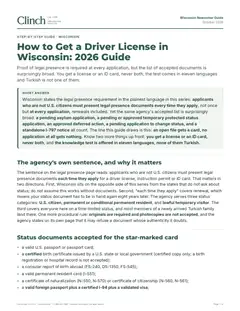
Wisconsin states the legal-presence requirement in the plainest language in this series: applicants who are not U.S. citizens must present their legal-presence documents every time they apply, not just the first time. But the list of what counts is unusually generous: a pending asylum application, a pending or approved temporary protected status application, approved deferred action, a pending adjustment-of-status application, and even a bare form I-797 Notice of Action are all accepted. The line falls here: a person with a filed, undecided case can hold a Wisconsin card; a person with nothing filed cannot. Two more things to know up front: you may hold a driver license or an ID card, not both, and the knowledge test comes in eleven languages, none of them Turkish.
Steps, documents and official links
The agency's own sentence, and why it matters
The legal-presence page reads: applicants who are not U.S. citizens must present their legal-presence documents every time they apply for a driver license, instructional permit or identification card. That sentence matters in two directions. First, Wisconsin sits at the opposite end of the series from the states that ask about no status at all; do not expect to get through this without documents. Second, "every time" includes renewal, so keep your status documents where you can find them.
The agency serves three status categories: U.S. citizen; lawful permanent or conditional permanent resident; and lawful temporary visitor. That third category covers anyone in the country on time-limited status, which is where most members of a newly arrived Turkish family will fall.
One procedural rule: documents must be originals and photocopies are not accepted. The agency also writes that it may decline a document whose authenticity it suspects and may require additional review.
Status documents for the federally compliant (star-marked) card
- a valid U.S. passport or passport card;
- a certified birth certificate issued by a U.S. state or local government (certified copy only; birth registrations and hospital certificates are not accepted);
- a Consular Report of Birth Abroad (FS-240, DS-1350, FS-545);
- a valid permanent resident card (I-551);
- a Certificate of Naturalization (N-550, N-570) or Certificate of Citizenship (N-560, N-561);
- a valid foreign passport with an approved form I-94 and an authenticated visa;
- a valid Employment Authorization Document (I-766).
For a Turkish reader the practical upshot is that a valid passport, visa and I-94 complete the star-marked card's paperwork. If you were not given a paper I-94, the agency points you to cbp.gov/I94 to print the electronic one, and tells you to do that before you apply for a license, an ID card or a Social Security number.
The non-compliant card: the list widens here
For the card without a star, everything above still counts, and these are added:
| Additional accepted document | What it means |
|---|---|
| Conditional permanent resident status plus an alien registration number | A conditional green card holder qualifies for the non-compliant card. |
| A nonimmigrant visa or nonimmigrant visa status | Visa-based statuses come through this door. |
| An approved asylum application, or documentation of entry in refugee status | An approved case counts. |
| A pending asylum application | An undecided case counts. One of the widest provisions in the series. |
| A pending or approved temporary protected status application | You do not have to wait for the decision. |
| Approved deferred action status | Named outright. |
| A pending adjustment-of-status application | You can get the card while the case is open. |
| A refugee travel document, including form I-512T | On the accepted list. |
| Form I-797 Notice of Action | Accepted on its own. If all you hold is a receipt notice, the door is not closed. |
| A Department of State Reception and Placement Program Assurance form with form I-94 | For people who were resettled. |
That is the line this page draws: in Wisconsin, a person with an open case can get the card; a person with nothing filed cannot. The list is not really a status test, it is a filing test. If you hold a receipt notice for a pending application, take that paper to the appointment.
One note: Puerto Rican birth certificates certified before 1 July 2010 are not accepted.
The limited-term card: a date restriction, not a usability restriction
The agency's wording is this: for lawful temporary visitors, the expiration date of the card matches the date the documented legal presence expires (up to an eight-year renewal cycle) and the card is marked "limited term." Do not misread that phrase: the card is not an unusable card, it is a card that expires early. Whether you can board a domestic flight with it turns not on the "limited term" wording but on the star, which in turn depends on which status document you used. A limited-term card issued on a document from the compliant list (a passport plus visa plus I-94, or an I-766) carries the star.
The agency gives the federal enforcement date as 7 May 2025 and marks compliant products with a star. An out-of-state star-marked card does not carry over: you present the documents again in Wisconsin.
Driver license or ID card, not both
The sentence is literal: in Wisconsin you can either have a driver license or an ID card, not both. This is the first time the series has met it this plainly, and the practical consequence is that holding a state ID card while you study for the road test does not mean holding two cards; the ID lapses when the license is issued. The ID card also requires the same legal-presence documents as the license, so it is not a way around the status requirement. An ID card costs $28 for eight years.
For applicants who cannot produce the standard documents at all, the agency runs an ID card petition process. We confirmed such a process exists but could not read its contents; we are not publishing its requirements, its timeline or when it applies. Ask the agency.
Proof of residency: two documents, both with a street address
Wisconsin requires two proofs of residency, each showing your name and your current Wisconsin street address. PO boxes and commercial receiving agencies are not accepted. What works for a newcomer:
- a utility bill (water, gas, electric, cable, internet, telephone, including bundled; electronic printouts are fine);
- a paycheck, paystub or earnings statement showing the employer's name and address;
- a bank, credit union, savings institution or brokerage statement;
- a rental or lease agreement that includes the landlord's name and phone number; any age during the initial term, and photocopies are acceptable;
- a homeowner's, renter's or motor-vehicle insurance policy or billing statement dated within the past year;
- federal, state, county or municipal correspondence issued within the past year (Quest and Forward cards excepted);
- a certified school record or transcript;
- college enrollment documentation or form DS-2019 (the J-1 Certificate of Eligibility for Exchange Visitor);
- an unexpired photo ID from an accredited Wisconsin university, college or technical college;
- an employer photo ID;
- a signed letter on letterhead from a homeless shelter or homeless-services organization naming you and the physical address.
One trap: a renewal or extension of a lease more than one year old "may not be considered." That does not bite a newcomer, but it bites someone renewing in their second year. For a person aged 26 or younger, a parent's or guardian's Wisconsin license or ID also works as proof of residency, provided the address matches both the document and the agency's records.
Deadlines, tests and fees
The agency's residency test has three prongs: your principal residence is in the state, you pay your income taxes there, or you are registered to vote there. Someone moving to Madison meets the first prong on the day they arrive. After that the clock runs:
| Item | Rule or fee |
|---|---|
| Deadline for a regular license | 60 days after establishing residence |
| Deadline for a commercial license | 30 days |
| Knowledge and signs tests | $0 |
| Skills (road) test | $15, and it is charged for every appointment not canceled 24 hours in advance |
| Instruction permit (Class D, 18 months) | $35; renewal $35 |
| Original regular Class D license (8 years) | $42.50 |
| Renewal (8 years) | $42.50; a $5 late fee if you renew after your birthday |
| Duplicate license | $14 |
| ID card, original and renewal / duplicate | $28 / $16 |
| Card payments | A convenience fee of up to 2.35%; where ACH is offered there is no added fee |
One detail deserves its own sentence: the knowledge test is free, but a road-test appointment you miss still costs $15. Cancel more than 24 hours ahead. Tests are given on a touch-screen computer at most customer service centers, answers are scored as you go, and the agency writes that an audio assist is available on request.
After a move the agency's own recommended order is: change your address with the postal service first, then do the license or ID card, then the title and plates. Applications can be pre-filled and submitted electronically and appointments booked online. The printable document handout is form BDS316, in English and Spanish. Mailing address: Wisconsin DMV, Driver Information Section, P.O. Box 7983, Madison, WI 53707-7983.
What languages is the knowledge test given in? Is Turkish one of them?
No. According to the agency's language table, the Class D knowledge test and the signs test are offered in eleven languages: English, American Sign Language, Burmese, Chinese (Mandarin), Croatian, Hmong, Polish, Russian, Serbian, Somali and Spanish. Croatian and Serbian are on the list and Turkish is not, which is a concrete difference for a Turkish reader, so we say it plainly. The motorcycle knowledge test is English and Spanish only, and several commercial tests are English only.
Two cautions about that table. First, the source document is stamped "11/2020", six years old; we cannot promise all eleven are offered today, we can only report that the published table says so. Confirm at the service center when you book. Second, we could not verify whether you may bring your own interpreter: the only agency statements we found on the subject are in reference guides from 1998 and 2000, and we are not going to describe a right to you on the strength of a document that old. The only support the current page names is an audio assist on request. If you want an interpreter, ask when you book and get the answer recorded.
For a commercial license the list narrows
For a commercial license or commercial learner's permit the legal-status list is noticeably narrower: no employment authorization document, no pending applications. An unexpired foreign passport with a valid unexpired U.S. visa and an approved I-94 is accepted, but only in classes H-2A, H-2B and E-2. Proof is required at original issuance, at renewal, on an out-of-state transfer, and whenever a class, endorsement or restriction is added or removed. The wide door that is open for an ordinary license closes here.
Official sources
- Wisconsin DMV: read the accepted proofs of citizenship and legal status
- Wisconsin DMV: see the document categories required at application
- Wisconsin DMV: review the accepted proofs of Wisconsin residency
- Wisconsin DMV: compare license and ID card fees
- Wisconsin DMV: download the table of knowledge-test languages
02 · Foreign license
Can a Turkish license be exchanged for a Wisconsin license?
Short answer
No. Türkiye does appear on Wisconsin's convention-country list, which lets someone visiting as a tourist or a foreign student drive on a Turkish license for up to one year from the date of arrival. But Wisconsin waives the tests only for France, Germany, South Korea and Taiwan, and Türkiye is not on that list. More important, the one-year rule is written for visitors: once you have settled in Wisconsin the deadline is not a year but 60 days, and you take both tests.
Steps, documents and official links
Two separate lists, two separate outcomes
The agency's foreign-license page carries two lists, and this is exactly where readers get confused.
The first list is the convention countries. Türkiye is on it, and with no asterisk, meaning it is treated as a party to the 1949 Geneva Convention itself. In the agency's words, motorists from convention countries who are here as tourists may drive legally on their valid domestic license "for a period not to exceed one year from the date of arrival," in a personal or a rental car. The same rule lets them drive their own private car on home-country plates and registration tags for up to a year. There is a separate sentence for students: a student from a convention country attending school in the United States, at least 16, whose Wisconsin driving privilege is not suspended, revoked, canceled or disqualified, may drive on the home license for up to a year. And the sentence that follows matters: "After one year, they must meet the same licensing requirements as a Wisconsin resident."
The second list is the test waiver. The agency writes that applicants for a Class D license holding a license from France, Germany, the Republic of Korea or Taiwan (Republic of China) may be eligible to have the knowledge and skills tests waived under a reciprocal agreement. Türkiye is not among those four.
What that means for a newly arrived Turkish family
Before you apply the one-year convention rule to yourself, check one thing: are you still a visitor? The agency's residency test has three prongs and any one is enough: your principal residence is in Wisconsin, you pay your income taxes there, or you are registered to vote there. Someone who moves to Madison with their family, signs a lease and enrolls a child in school meets the first prong on day one. From that moment the applicable deadline is 60 days.
- Prepare for the knowledge test. It is free, but it is not offered in Turkish; Turkish is not among the eleven languages. You can request the audio assist.
- Book the road test, $15. A missed appointment is charged too, so cancel more than 24 hours ahead.
- Bring your legal-presence documents and your two proofs of residency. Originals are required.
Getting an International Driving Permit before you leave Türkiye is still a cheap precaution. The agency's own page calls it "advised," offers an English translation attached to the national license as the alternative, and clarifies one thing: an International Driving Permit is not a license, it is a translation used together with the national license. On its own it does nothing.
A comparison, because you may have read a different answer in another guide: Michigan's official agreement list names Türkiye, Wisconsin's waiver list does not. So this genuinely varies state by state, and the Wisconsin answer is no.
We will also note what Wisconsin does not say: the pages say nothing about whether your Turkish license will be surrendered, and we are not going to answer in either direction. Do not plan on keeping the card and do not plan on losing it; ask at the appointment.
03 · Vehicles
How do you register a car in Wisconsin, and what does it cost a year?
Short answer
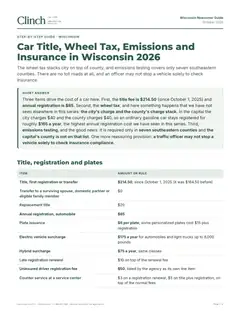
Three items drive the cost. First, the title fee is $214.50 (since 1 October 2025) and annual registration is $85. Second, the wheel tax, where something happens that we have not seen elsewhere in this series: the city fee and the county fee stack on the same car. In Madison the city charges $40 and the county charges $40, so an ordinary gasoline car costs about $165 a year to keep registered, the highest effective annual registration cost in the series. Third, emissions testing, and here the news is good: testing applies only in seven southeastern counties, and Madison's county is not one of them.
Steps, documents and official links
Title, registration and plates
| Item | Amount or rule |
|---|---|
| Title, original or transfer | $214.50 beginning 1 October 2025 (it was $164.50) |
| Transfer to a surviving spouse, registered domestic partner or qualifying family member | $0 |
| Replacement title | $20 |
| Annual registration, automobile | $85 |
| Plate issuance | $6 per plate; some special plates carry a $15 issuance fee plus registration |
| Replacement plates | $6 each since 1 October 2025; $5 each for special plates |
| Electric vehicle surcharge | $175 a year for autos and light trucks up to 8,000 lbs |
| Hybrid surcharge | $75 a year, same classes |
| Late registration renewal | $10 on top of the renewal fee |
| Uninsured motorist registration fee | $50, as a separate agency line item |
| Counter service at a customer service center | $3 for a registration renewal, $5 for title plus registration, on top of the regular fees |
| Third-party service providers | Maximum service fee $16.25 for a registration renewal, $38 for a title transaction |
| Card payments | Up to 2.35% convenience fee; a returned payment is $20 plus the amount owed, and a further $25 if not paid by the due date |
The obligation after a move is stated plainly: when you become a Wisconsin resident you must apply for a Wisconsin title and license plates for your vehicle. With an out-of-state title in hand you can apply online; without it you apply by mail or in person. The paper form is MV1, the online service is mv1.wi.gov, and an eligible applicant can print a temporary plate for a car or SUV. One caution: when we read the agency's page it carried a banner saying the online title and registration service and all online payment services were temporarily unavailable. So we are not telling you to do it online; check whether the service is up first.
The wheel tax stacks: city plus county
The agency's wording: Wisconsin law allows a town, village, city or county to collect an annual municipal or county vehicle registration fee in addition to the regular annual registration fee paid for a vehicle. State law does not set the amount, but the municipality or county must spend all of it on transportation purposes. The fee is collected at first registration and at every renewal, and the agency writes: your certificate of registration will indicate that a municipal and/or county fee was paid.
That "and" is money. On the agency's current list Madison appears under municipalities at $40 and Dane County appears under counties at $40, so a car kept in Madison pays both:
| Item | Per year |
|---|---|
| State registration, automobile | $85 |
| Municipal wheel tax | $40 |
| County wheel tax | $40 |
| Ordinary gasoline car, total | About $165 before any card fee |
| Add for a hybrid | $75 |
| Add for a fully electric car | $175 |
Read those three lines together so the renewal notice does not surprise you. Elsewhere in the state the total is different: some cities are not on the list at all, some counties are not, and in some places only one applies. The list also changes every year; one township's $25 fee, for example, took effect for registrations beginning 1 October 2026. Re-read the list for your own address once a year.
A final warning: giving a false or fictitious location for where the vehicle is customarily kept is an offense, punishable by a fine of not more than $200 or up to six months' imprisonment or both. Because the wheel tax follows the address, this line item matters; update your address for real when you move.
Emissions testing: seven counties, and Madison is not among them
The agency's sentence is literal: vehicles customarily kept in one of these seven southeastern Wisconsin counties require an emissions test: Kenosha, Milwaukee, Ozaukee, Racine, Sheboygan, Washington and Waukesha. Dane County is not in the program, so a car registered in Madison needs no emissions test. A car registered in Milwaukee or Waukesha County does. This is the sharpest county split in Wisconsin's transportation rules.
If you are in the program, here is what to know:
- The program is the Wisconsin Vehicle Inspection Program at WisconsinVIP.org, administered by the state transportation agency and managed by a private contractor.
- Coverage: vehicles with auto or light-truck plates, model years 1996 through 2006 under 8,501 lbs (gasoline, natural gas or hybrid) and model years 2007 and newer up to 14,000 lbs (including diesel).
- Triggers: when a vehicle is purchased and registered, within 45 days; when an owner is added to or removed from a title, within 45 days; every other year before plates can be renewed; and for new residents transferring a vehicle to Wisconsin, within 45 days.
- When a test is due the agency writes to you; you do not have to track the calendar yourself.
- Bring any one of: the mailed renewal statement or the email renewal notice, the certificate of registration, the agency's emission letter, a prior emission inspection report, form MV2016, or the Wisconsin title.
- Out-of-state emissions tests are accepted. Send a copy of the passed results with the renewal payment.
- If the car is temporarily kept in a county with no testing, or is not drivable, you can get a written temporary exemption; for a car that cannot be driven the form is MV2472.
- Two testing-only facilities have self-service kiosks open around the clock, able to test 2007-and-newer vehicles; staffed hours are Tuesday through Saturday, 10 a.m. to 6 p.m.
- If the vehicle has failed or been rejected twice in a row, or repairs were done between inspections, the contractor's help line is 1-866-623-8378.
On the fee we will be honest: the agency's page describes the whole program but names no fee, and research found none. Even so we are not writing that the test is free, because we also found no page saying it is. If you are in the program, call the number above before you go.
We write the periodic safety inspection question with the same care: the agency's vehicle inspection menu covers only ambulances, motor buses, school buses, human-service vehicles, reconstructed vehicles, farm vehicles and salvage titles. For an ordinary passenger car we found no statewide periodic safety inspection. That is an argument from absence, not a quoted provision, so we are not saying flatly that none exists.
Mandatory insurance, and the most reassuring line for a newcomer
Liability insurance is mandatory in Wisconsin: in the statute's words, no person may operate a motor vehicle on a highway in the state unless the owner or operator has a liability policy in effect for that vehicle. The minimum limits:
| Coverage | Minimum limit |
|---|---|
| Bodily injury or death of one person | $25,000 |
| Bodily injury or death of two or more people in one accident | $50,000, subject to the per-person limit |
| Damage to the property of others in one accident | $10,000 |
| Uninsured motorist coverage (mandatory) | $25,000 per person, $50,000 per accident |
| Underinsured motorist coverage | Not mandatory, but must be offered when the policy is delivered; if you request it, the minimum is $50,000 / $100,000 |
| Medical payments coverage | Must be offered at a minimum of $1,000 per person; the named insured may reject it |
Note two things. Uninsured motorist coverage is mandatory in Wisconsin and it covers bodily injury, not damage to your own car. And when you do request underinsured motorist coverage, its minimum is higher than the mandatory liability limits. So a Wisconsin quote is not directly comparable to a quote from a pure liability state.
Three practical rules:
- Proof of insurance must be in the vehicle, in your immediate possession, and shown on demand to a traffic officer. The statute expressly allows electronic proof on a phone, and adds one more sentence: producing it is not considered consent for the officer to view any other content on the device.
- Driving uninsured is a forfeiture of not more than $500. Not having the proof with you is $10, and the statute leaves an exit: if you produce proof that you were insured at the time of the citation, either in court or at the issuing officer's office, on paper or on a phone, there is no conviction.
- And the provision this series has not seen before: a traffic officer may not stop or inspect a vehicle solely to determine insurance compliance, and may not take a person into physical custody solely for that violation. A citation for a violation observed during a stop made for other reasons is still allowed, but insurance cannot be the reason for the stop. For a newcomer worried about police contact, this is the most reassuring sentence in Wisconsin's vehicle code.
We also record a conflict on the numbers: research surfaced an older proposed agency order asserting that the limits for proof of financial responsibility had been lowered to $20,000 / $40,000. The current statute reads $25,000 / $50,000 / $10,000 and the regulator's current consumer page says the same, so those are the figures on this page. If anyone disputes them, the question goes to the insurance regulator or to counsel admitted in Wisconsin.
Rating: Wisconsin sits at the permissive end
On how a premium is set, Wisconsin is among the most permissive states in this series. The regulator's own consumer page lists the classification criteria: age and gender, marital status, where the vehicle is garaged, driving record, make and model of the vehicle, prior insurance coverage and annual miles driven. The same page, listing what drives the premium, uses the phrase "where you live", and says outright that some criteria, such as age and sex, are outside your control.
On credit the regulator's wording is this: insurers may use credit information; and it is the position of the regulator that insurers should not use credit information, whether through credit reports or credit scoring mechanisms, as the sole reason to refuse an application, cancel a new policy in its first 60 days, or nonrenew an existing policy.
Read that sentence exactly as it stands: this is a position, not a statute and not an administrative rule. The regulator's page on the subject describes its own work as a continuing study and refers to an informational hearing held in 2009; no rule was made, and the page was last updated 23 March 2021. There is also a 1997 bulletin on credit reports, and we are not going to present a document that old as a current requirement. And we could not read the text of the unfair-discrimination provision that governs whether a rating classification is lawful; we note that the provision exists but we do not quote its language. In short: this page does not say that anything is "prohibited" in Wisconsin rating, because we found no prohibition.
One more item, about your household: in the regulator's words, the driving record of any licensed driver in the household can affect the company's decision, and their records can cause you to be turned down or to pay more. For a newly arrived family that means another adult at the same address is part of the calculation.
A newcomer's concrete problems, answered
- No U.S. credit file, no prior U.S. policy. Wisconsin may use both freely, so expect a high first-year quote and expect to be asked whether you had insurance before.
- If no insurer will take you, there is a last door: the regulator's own page says that a person who has tried several companies without finding coverage may be insured through the Wisconsin Automobile Insurance Plan, applying through any licensed property and casualty insurance agent. Address and phone: 20700 Swenson Drive, Suite 100, Waukesha, WI 53186, 1-800-827-5964.
- The first 60 days are fragile. An insurer may cancel a new policy at any time in the first 60 days without giving a reason. After that, cancellation requires non-payment, fraud or material misrepresentation in obtaining the insurance, a fraudulent claim, or significant changes in insuring characteristics, and no cancellation takes effect until at least 10 days after written notice. Nonrenewal requires at least 60 days' notice and the notice must state the reason.
- Auto policies have no grace period. If the premium is not received by the due date the policy terminates automatically. On a financed car, a lapse means the bank force-places coverage, adds it to the loan, and that coverage protects only the bank, at a much higher cost.
- Hitting a deer is covered by comprehensive, not collision. The regulator says so expressly because it happens often in Wisconsin, and flood damage sits on the same side. Someone who buys collision without comprehensive is covered for neither.
- Wisconsin has a comparative negligence rule: you may recover if your negligence is not greater than the other party's, reduced by your percentage, and you recover nothing if your negligence is greater. You have three years to settle an injury claim or file suit.
Official sources
- Wisconsin DMV: see title, registration and plate fees
- Wisconsin DMV: look up the municipal and county wheel tax list for your address
- Wisconsin DMV: which seven counties require an emissions test
- Wisconsin insurance regulator: automobile insurance questions and answers
- Wisconsin statute 344.65: read the bar on insurance-only traffic stops
PDF: Car Title, Wheel Tax, Emissions and Insurance in Wisconsin 2026
04 · Tolls
Are there toll roads and transponders in Wisconsin?
Short answer
There is nothing to set up. We found no toll roads in Wisconsin: the transportation agency's road-travel menu and its fee schedule contain no tolling, transponder or toll-account item anywhere. So no device to buy, no account to open, and no toll bills in the mail from Wisconsin roads. One caution: driving to Chicago takes you onto Illinois toll roads, and that account is opened with Illinois, not Wisconsin.
Steps, documents and official links
We will also say how we reached the answer
This section has to be written differently from the others, because we do not have an official sentence saying "Wisconsin has no toll roads." What we do have is this: the agency's travel-by-road menu lists 511 travel information, commemorative highways and bridges, highway maps, out-of-state travel, a flex lane, park and rides, rest areas, a rideshare program and scenic byways. Nowhere in that menu is there a toll, a transponder or a toll account, and there is no such line on the agency's vehicle fee schedule.
So our answer is an argument from absence: research found no toll road. In practice that is enough for a newcomer, because it tells you there is nothing to do; but we are not saying flatly that none exists.
The flex lane in the Milwaukee area is not a toll facility: it is a shoulder lane opened and closed according to traffic, and it is free. We read that from the agency's menu structure; we could not open the page for the facility itself.
But the neighboring state's roads are tolled
Anyone driving from Madison to Chicago or to O'Hare airport enters Illinois's tolling system. That is an Illinois matter: the account, the device and the rates all belong to Illinois's own tolling authority, not to Wisconsin. We are not publishing Illinois rates on this page. If you go a few times a year, know that passing without a device can generate a bill in the mail; if you will go often, open the account before the trip.
The only Wisconsin items that could be charged would be separate facilities such as certain bridges or park entrances; research found no tolled route on Wisconsin highways.
05 · Transit
How do transit, rail and flights work in Wisconsin?
Short answer
Madison's bus system has something this series has rarely seen: there is no pass to buy, and the fare caps itself. A single ride is $2, and once you reach $5 in a day, $16.25 in a week or $65 in a month, your card stops being charged for that period. Better still, getting a card or tapping your bank card requires no number, no application and no proof of residency; it is one of the few things you can do on day one. On the other side there are two gaps: Madison has no train station, and the airport has no international nonstop service at all, so there is no nonstop to Istanbul.
Steps, documents and official links
The Madison bus: fare capping has replaced passes
| Fare | Adult | Reduced |
|---|---|---|
| Single ride | $2.00 | $1.00 |
| Day cap | $5.00 | $2.50 |
| Week cap | $16.25 | $7.00 |
| Month cap | $65.00 | $28.00 |
- Fare capping replaces passes. There is no standalone day pass and no 31-day pass to buy; once a card hits the cap it is not charged again for the rest of that day, week or month.
- The reduced fare covers ages 5 to 17 (or anyone still in high school), seniors, people with disabilities and people with low incomes. Half-price fare requires verified eligibility.
- Children under 5 ride free with a chaperone.
- Transfers: tapping the same card or virtual wallet for a connecting ride opens a two-hour window; in the operator's words, your fare acts like a two-hour pass.
- Payment: the operator's own mobile app and card, or contactless Mastercard, Visa and Discover credit and debit cards, Apple Pay, Google Pay and Samsung Pay.
- Cash is accepted only at ordinary stops with blue metal signs. At bus rapid transit stations you must buy a ticket from the machine before boarding.
- University campus routes 80 through 84 are free to students, employees, affiliates and university visitors.
For an immigrant reader the clearest sentence is this: getting a card or tapping a contactless bank card requires no Social Security number, no application and no proof of residency. Only the reduced-fare categories require verification. Unlike most of the tasks on this page, this is one you can do the day you arrive with nothing but cash or a card.
Airport bus: the D2 branch of the operator's route D serves the county regional airport; the D1 branch does not. Buses leave from outside the terminal, from a stop on the roadway median near door 6. The fare is the ordinary $2 with the two-hour transfer window. We read these details indirectly from the operator's and the airport's pages rather than fetching them in full, and the airport's page was visibly the older of the two. So we are publishing no frequency figure: open the current timetable on the operator's page before you rely on it. We did not research paratransit service or county-wide regional bus service this round, so this page says nothing about either.
The airport: twenty-three routes, all domestic
Madison's airport is the county regional airport, operated by the county. The airport advertises 19 nonstop routes and its own flight page lists 23 destinations. But the only sentence that matters is this: every destination listed is inside the United States. There is no international nonstop flight from Madison, and therefore no nonstop to Istanbul.
The workable route for a Turkish reader: Madison has nonstop service to Chicago on two major airlines, and the Istanbul connection is made there. We will draw one boundary plainly: we could not confirm from an official source which airline flies Chicago to Istanbul, so we are not naming an airline. Check the airline's own site before you buy.
Two more cautions about the destination list. Some routes are seasonal; confirm the route is operating in your travel period before booking. And the page is internally inconsistent: some cities have sections but are missing from the destination menu, and some booking links name airlines the heading does not. For that reason we are not publishing the full destination list; we publish the count and the route that matters.
Rail: Madison has no station
Wisconsin is served by three rail routes:
- Hiawatha, a corridor service with six round trips a day between Chicago and Milwaukee;
- Empire Builder, a long-distance train with one round trip a day between Chicago and Seattle or Portland;
- Borealis, a newer corridor service with one round trip a day between the Twin Cities and Chicago via Milwaukee.
The agency's station list runs: La Crosse, Tomah, Wisconsin Dells, Portage, Columbus, the Milwaukee downtown station, the Milwaukee airport station, Sturtevant, plus stations in Minnesota and Illinois. Madison is not on that list. Madison has no train station. The two nearest stations are Columbus and Portage, both northeast of the city.
The gap is filled by the rail operator's Thruway motorcoach connections, and in the agency's words a combined rail and bus ticket can be booked. The connecting corridors that touch Madison are: Madison to Janesville, South Beloit, Rockford and Chicago; Madison to Columbus, Fond du Lac, Oshkosh, Appleton and Green Bay; and Madison to Portage, Stevens Point and Wausau.
By road to Chicago and O'Hare: a private coach operator runs between Madison and Chicago and O'Hare and has two Madison stops, one at a park and ride on the east side and one on the university campus. The scheduled running time between the airport and Madison is about 2 hours 50 minutes. We read this indirectly from the operator's own schedule pages, and three differently dated timetable versions were in circulation when we looked, so we are publishing no departure times. Confirm with the operator before you buy.
Still, this is the most useful sentence in the section: for a Turkish family living in Madison the route to Istanbul almost certainly runs through Chicago, and Chicago is reachable both by a nonstop flight and by road. Choosing between them is a question of baggage, time and price; both exist.
06 · Regions
Which office handles what in Wisconsin?
Short answer
The most expensive wrong assumption a newly arrived household makes in Wisconsin is that the city will do something for them. Authority here is largely concentrated at the state level, and the statutes expressly forbid cities from legislating in several areas: no city may levy an income tax, no city may regulate how a landlord screens a tenant, and no city may impose an eviction moratorium. Your electricity, gas and water rules come not from the city but from the state's public service commission. The practical consequence: on a utility problem your counterpart is not city hall, it is the commission. And one Madison-specific difference: there is no 311 line.
Steps, documents and official links
Which layer does what
| Layer | How it touches you |
|---|---|
| State legislature and statutes | Income tax; landlord-tenant law; fair housing law; a landlord's right to screen you; eviction procedure. On the tenant side, nearly all the authority sits here. |
| Public service commission | Application rules, identification alternatives, deposits and disconnection limits for electricity, natural gas and water. Binds both investor-owned and municipally owned utilities. Consumer line 1-800-225-7729. |
| Consumer protection agency | Residential rental practices: deposits, the 21-day return, the move-in inspection right, prohibited practices. |
| County government | Vital records and marriage licenses; part of property assessment; the county share of the wheel tax; county human services. |
| City government | Water, sewer, stormwater, refuse and urban forestry charges (in Madison on one bill); property tax collection; streets; the library; housing complaint inspection. |
| School district | A separately elected board with its own boundary. Enrollment documents and languages vary by district. |
Three things a city cannot do, and why they belong here
Three statutory provisions define how far a Wisconsin city's hand reaches, and all three touch a newly arrived family directly:
- No county, city, village, town or other unit of government with taxing authority may assess, levy or collect any tax on income, and in the statute's words any such tax is void. So there is no local income tax in Wisconsin and there cannot be one; your payroll carries a single state withholding. The full tax mechanics are in the taxes section.
- No local government may limit a landlord's obtaining and use of information about a prospective tenant. The statute's list includes monthly household income, occupation, rental history, credit information, publicly accessible court records, and a Social Security number or other proof of identity. What that means for an immigrant reader is spelled out in the renting section.
- No local government may impose a moratorium on a landlord pursuing an eviction action.
Read that not as a list of failures but as an authority map: if you are pursuing a right in Madison, the right door is usually not the city but a state statute or a state commission. When the city tells you it has no authority on a question, that is not a brush-off; it is what the statute says.
Electricity, gas and water: all three under the same agency's rules
Wisconsin shows us a structure this series has not met before: the municipally owned water utility is inside the state regulator's rulebook. The water chapter's own sentence says the rules shall be observed by "all water public utilities, both privately and publicly owned." So Madison's own water utility follows the same identification, deposit and disconnection rules as an investor-owned electric company. That is the reverse of the familiar pattern in which a city water utility writes its own policy.
There is one divergence, and the regulator names it itself: municipal utilities are not required to offer deferred payment agreements to tenants, though many still do. In Madison that affects the water utility, not the electric and gas company. The detail sits in the utilities section.
Refuse is a different regime. In Madison refuse and recycling are a city streets function and the cost reaches the household as a special charge on the municipal services bill; the commission's electricity, gas and water rules do not apply to it. Internet is also outside the regime: the commission's rulebook covers electricity, gas and water, not internet, so the identification alternatives do not bind an internet contract, which is a private credit decision. We could not confirm from an official source which internet providers serve a given Madison address or what they require, so this page names no provider.
Madison has no 311
Someone arriving from Denver, Detroit or Phoenix dials 311 and gets nothing. We write that as a difference, not a gap: the city's own contact page lists no 311 number. In its place are two things: the city's report a problem form (with sub-forms for potholes, graffiti, sidewalks, housing problems and drinking-water concerns) and the departments' direct lines.
| Task | Number |
|---|---|
| Housing problems (the most useful number for a tenant) | 608-266-4551 |
| Housing authority | 608-266-4675 (Spanish 608-266-4868) |
| Water utility customer service | 608-266-4651 |
| Sewer and stormwater | 608-266-4751 |
| Refuse and recycling | East side 608-246-4532, west side 608-266-4681 |
| Noise | 608-266-4275 |
| Graffiti | 608-246-4532 |
| Mayor's office / alders | 608-266-4611 / 608-266-4071 |
| Statewide relay service | 711 |
The city and the county share one building: 210 Martin Luther King Jr. Blvd., Madison, WI 53703, weekdays 8:00 a.m. to 4:30 p.m. The city is run by a mayor and a council of alders elected from 20 districts, meeting on Tuesdays; a mid-term vacancy is filled by appointment by the council itself, not by a special election. You can find your district's alder with the search tool on the council's site. The non-emergency police number we found came from an indirect source, so we are not printing it here; in an emergency, 911.
A library card: photo ID yes, proof of address not necessarily
The first Madison public library card is free. The ordinary route is an application form, photo ID and proof of current address. Accepted proof of address: a driver license showing the address; or photo ID plus an envelope of current mail postmarked within the last 30 days, a current lease, or a current utility bill or bank statement. PO boxes and business addresses do not qualify.
There are two more doors, and both matter to a newcomer:
- Applying online removes the address document entirely. In the library's words the card is mailed to the address on the form, and receipt of the card from the postal service serves as proof of address.
- If you have a photo ID but cannot prove an address, you can get an Easy Access card at any branch. Its limits: 3 items checked out and 2 holds. It expires every 12 months and renews on photo ID, and you can bring proof of address later to convert it to a full-use card.
Nowhere on the page is a Social Security number mentioned, and no immigration or citizenship status is requested. Full-use cards expire every 4 years, Easy Access cards every 12 months; renewing within 6 months of expiry needs only photo ID, after 6 months photo ID and proof of address. If you forget your card, photo ID gets you a one-time checkout. The first card is free, one replacement is free every 12 months, and additional replacements cost $1.00. The application form is published in English, Spanish and Hmong; there is no Turkish version.
There is a conflict we are going to print. The same library page describes the Easy Access card in one answer as being for someone "with a photo ID but no proof of address", and in another says the Easy Access card "requires that you provide an acceptable address." Those are not the same thing: one treats stating an address you cannot document as enough, the other tells the reader no document is needed. We are not picking a side; call the circulation desk at 608-266-6357 before you travel to a branch and ask about the document you actually hold, because the trip is not worth wasting.
The regional library system covers several counties, and residents of those counties who have no card from their own library may apply at a Madison branch. Residents elsewhere in Wisconsin can get a reciprocal borrowing card, which is issued in person only and requires identification showing the current address.
Official sources
- Wisconsin statute 66.0611: read the ban on local income taxes
- Wisconsin statute 66.0104: the provision barring cities from limiting tenant screening
- City of Madison: see the department phone list and the report-a-problem form
- Madison Public Library: review the documents required and the Easy Access card
- Madison Common Council: open the 20 districts and the meeting calendar
07 · Utilities
How do you put the utilities in your name in Wisconsin, and is an SSN required?
Short answer
This is the section of the Wisconsin page that gives a newcomer the most useful answer. The state commission's rule limits the identification the utility may ask for at application to four options, and the utility must accept any of them: a driver license number, a state ID card number, a passport number, or a Social Security number or its last four digits. Better still, the utility must tell you all the acceptable options and let you choose. The second piece of good news is the deposit: a new customer who does not owe a Wisconsin utility money from the last six years cannot be charged a deposit, so the answer is not "capped" but zero. There is no credit-score test and no immigration-status test.
Steps, documents and official links
First, establish the regime
| Service | Who provides it in Madison | Legal regime |
|---|---|---|
| Electricity and natural gas | An investor-owned utility (1-800-245-1125) | Under the commission's rules. Identification options, deposit and disconnection rules all apply. |
| Drinking water | The city water utility (608-266-4651) | City-owned but still under the commission's rules. The water chapter says the rules bind publicly owned utilities too. |
| Sewer and stormwater | City engineering (608-266-4751) | Line items on the municipal services bill. |
| Refuse, recycling, urban forestry | The city streets division | Municipal regime, billed as a special charge. The commission's rules do not apply. |
| Internet | Private providers | Unregulated for this purpose. The identification alternatives do not apply here. |
One more Madison detail: the city does not send separate water, sewer and refuse bills. A single municipal services bill arrives carrying water, sewer, stormwater, an urban forestry charge, a resource recovery charge and a landfill line. The billing office is 608-266-4641 and payment by phone is 1-877-822-8414. Keeping that bill current matters especially for a tenant, because where the landlord becomes liable for a tenant's non-payment, the cost of a government-owned utility service can be withheld from the security deposit.
What the utility may ask for at application
The rule limits the information the utility may require in an application to an enumerated list: the legal name and birthdate of the user and of the bill-payer if different; a telephone number (from those who have telephone service, and the rule says expressly that "lack of telephone service is not grounds for service refusal"); the service address; a mailing address if different; the requested start date; the bill-payer's most recent previous address; and the identification datum.
On identification the rule's sentence is this: the utility shall accept any of the following items as adequate initial identification data, although it may accept other forms:
- a driver license number;
- a state identification card number;
- a passport number;
- a Social Security number or the last four digits of it.
And one more sentence: if the utility requests this data, it shall inform the applicant of all acceptable forms and allow the applicant to choose which to provide. So "we cannot do it without a number" is contrary to the rule. A passport number is enough on its own, and the rule says so in writing.
The most useful sentence in this section: declining the identifier is not a ground for refusal
The rule enumerates the omissions for which a utility may refuse or disconnect service: the legal name and birthdate, the service address, the requested start date and the most recent previous address. The identification datum is not on that list. The rule's own note sends the reader elsewhere: declining to give the identifier is not a ground for refusal but a trigger for verification. So if you do not give a number, service is not refused; the utility moves to the verification path.
If verification is escalated
The utility may require verification only in one of three situations: a bill at that premises is unpaid for service in the previous 24 months; the bill-payer claims an outstanding bill was identity theft; or the applicant did not give the identification datum, or the utility finds with reasonable certainty that it is inaccurate.
What verification accepts is again built on "any of the following":
| Identity: any one of | Or any two of |
|---|---|
| A valid driver license or other photo ID issued by a state, U.S. or tribal governmental entity | A Social Security card |
| A valid U.S. military or military-dependent ID card | A certified copy of a marriage certificate |
| A valid passport | A certified copy of a judgment of divorce or legal separation |
| Military discharge papers | |
| A valid student ID with a photo | |
| A current employee photo ID with verifiable employer contact | |
| A letter of identification from a social service agency or an employer, with verifiable contact information |
For residency verification, any one of these is accepted: a current utility bill; a current financial institution statement; a rental agreement; documents indicating a home purchase; a current paycheck or pay stub showing your name, your address and the employer's name; or verification of address provided by a social service or government agency.
The same sentence repeats here too: the utility shall inform the applicant of all acceptable items and allow the applicant to choose. Only if the applicant refuses to provide anything, or the verification is falsified, may the utility request an additional item, refuse or disconnect.
The timelines are written down as well: the utility must approve or deny within 10 calendar days of receiving the required information, and the rule closes off one excuse in advance: "An expected high volume of requests for service shall not constitute exceptional circumstances." A denial must be in writing within 5 days, and it must state both the reason for refusal and your right to ask commission staff to review it.
Deposits: zero for a newcomer
The rule's sentence is direct: for electricity, a utility may not require a cash deposit or other guarantee as a condition of new residential service unless the customer has an outstanding balance with a Wisconsin electric utility or cooperative that accrued within the last six years and is not under an honored payment arrangement. The water rule is written more broadly: the arrears may be with any Wisconsin gas, electric, water or sewer utility.
A newly arrived Turkish family's situation is exactly this: you have never held a Wisconsin account, so you cannot owe anything. The answer is therefore not "capped" but zero. The rule contains no credit-score test and no immigration-status test.
If a deposit does come up anyway, what to know:
- No deposit at all from a customer who shows gross quarterly income at or below 200% of the federal poverty guidelines.
- Even where a deposit is lawful it is capped: on a new electric account, the highest estimated gross bill for any two consecutive billing periods; for water, the highest estimated gross bill for a period not exceeding four months.
- A guarantor contract may be accepted in place of cash, for a term of at most one year.
- Deposits bear interest, at a rate the commission sets each year by 15 December for the following calendar year. We could not locate the rate for 2026, so we are not publishing one.
- An electric deposit must be refunded after 12 consecutive months of prompt payment; if the account closes it is credited to the final bill with interest and the balance returned within 30 days.
- If a deposit is demanded for an old balance, you have the right to ask for a deferred payment agreement instead of cash, and the utility must give you a written explanation plus notice of your right to appeal the deposit to the commission.
The disconnection rule: not seasonal, but income- and health-tested
Wisconsin's winter protection is the fifth distinct pattern in this series and the most often misread. The rule concerns disconnection for non-payment of the service that provides a home's primary heat source or the energy affecting it, between 1 November and 15 April, and it applies "for all occupied residences." But the text sets a condition, not a ban:
A utility may disconnect only those households whose gross quarterly incomes are above 250% of the federal income poverty guidelines, and where health and safety would not be endangered because of the infirmities of age, developmental or mental disabilities or like infirmities incurred at any age, or the frailties associated with being very young, if service were terminated or not restored.
The two tests operate together, not as alternatives. And the most important sentence: the burden of proving that a household is eligible for disconnection rests on the utility.
Here is the conflict we are going to print. The regulator's own press release describes the same period this way: "The annual winter moratorium from November 1st to April 15th prohibits all utility providers from disconnecting residential heating services for nonpayment." That is an absolute prohibition. The rule text is conditional. Both are official, and they do not say the same thing.
We are not picking a side, but on this page we follow the rule text, because that is the legally operative version and the safer advice: a household above the income threshold should not assume immunity. At the same time we record that the regulator describes the moratorium publicly as a blanket ban. If you are threatened with a winter disconnection, call the commission's consumer line immediately: 1-800-225-7729, and the question to ask is this: is there any current commission order authorizing any Wisconsin utility to disconnect occupied dwellings during the moratorium?
The rule's procedural protections are concrete for a newcomer, and we list all of them:
- No disconnection on a Friday, Saturday, Sunday or holiday, and none on any day when utility personnel are not readily available 24 hours to negotiate restoration.
- A utility representative shall meet personally with a responsible adult member of the household to discover circumstances deserving special attention, such as medical problems or disabilities.
- If the household previously asked that a specific third party be notified, the utility contacts that person first.
- One or more executives designated by 1 November each year must give final approval and certify compliance; at a municipal utility that person is the general manager or the chair of the governing board.
- Every disconnection of an occupied dwelling must be reported to the commission's consumer services bureau by 3:30 p.m. the same day.
- A utility intending to disconnect under this section must file its identification procedures each year and receive commission approval by order; 60 days of silence counts as disapproval.
- By the end of the next working day the utility must visit in person to check on the household, and the rule says: if a danger to human health or life due to the disconnection is observed, the utility shall immediately restore service.
- One protection runs all year: service shall not be disconnected or refused because of a disputed matter while that dispute is being pursued under the dispute procedure, and at least 7 days must pass between commission staff's notice of settlement terms and any disconnection.
On the natural gas side we saw the titles of the parallel sections but could not read their text; parity is likely but we are publishing no gas-specific figure. We also could not read the section governing refusal and disconnection of water service, so this page says nothing about the water-side notice period or any water cold-weather rule.
Help with the bill
The state runs an energy assistance program covering emergency energy needs, emergency furnace repair, conservation services and weatherization. Apply at energybenefit.wi.gov or call the statewide customer care center: 1-800-506-5596. The regulator reports that roughly 190,000 Wisconsin households used the program in the last full fiscal year. The regulator also flags that the program depends on federal funding and could change; we pass that along not as a forecast but as a reason to confirm before you apply.
Official sources
- Commission rule 113.0408: read the identification options accepted at application
- Commission rule 113.0402: see the ban on deposits for new customers
- Commission rule 113.0304: review the conditions in the winter disconnection rule
- Commission rule 185.11: the provision binding municipal water utilities to the state rules
- Apply to the Wisconsin energy assistance program
- See the line items on the Madison municipal services bill and how to pay it
08 · Renting
What are tenant rights in Wisconsin, and can a landlord ask for an SSN?
Short answer
On the tenant side Wisconsin sits at both ends at once: strong consumer rules and almost no local authority. The strong half: the deposit comes back within 21 days with an itemized written statement, nothing may ever be charged for normal wear and tear, and before taking a deposit the landlord must notify you in writing of your right to inspect the unit. The weak half: state law forbids cities from interfering with how a landlord screens a tenant, and the list of forbidden subjects includes a Social Security number or other proof of identity. So a landlord may ask for a number, may decline an applicant who does not produce one, and Madison cannot prohibit it locally. There is also a fee trap: one application can lawfully carry two separate screening fees.
Steps, documents and official links
Two layers, and what each does
Wisconsin has written its tenant law in two places. The first is the tenancy statute: termination, notice periods, eviction. The second is the consumer protection agency's residential rental rule: deposits, disclosure duties, prohibited practices. The second layer matters, because a violation is tied to a provision that opens the door to double damages plus fees for a tenant.
A scope warning: the rule does not apply to a dwelling unit owned and operated by government or a subdivision or agency of government. So a public housing tenant's deposit and notice rights come not from this rule but from the authority's own lease and from federal law. The rule also excludes institutional housing incidental to detention, medical, geriatric, educational, counseling or religious services; fraternal or social organization units; units occupied under a contract of sale; hotel, motel and boarding-house rooms rented only to tourists or transients; units provided free of charge or as consideration to an employee who maintains the premises; and units occupied by a tenant engaged in commercial agriculture.
The deposit: we could not find a cap, but the return is tightly ruled
| Item | Rule |
|---|---|
| Return deadline | 21 days. From the termination date if you left on time; from termination or from the new tenant's tenancy beginning if you left early or were evicted; or from the date the landlord learned you had vacated, if later. |
| Itemized written statement | Every amount withheld must be itemized in writing within the same 21 days. Intentionally falsifying a claim against a deposit is separately prohibited. |
| Normal wear and tear | May never be charged. |
| What may be withheld | Amounts reasonably necessary for tenant damage, waste or neglect; unpaid rent for which the tenant is legally responsible (subject to the landlord's duty to mitigate); utility service the landlord provided but did not include in rent; the cost of direct utility service from a government-owned utility where the landlord becomes liable for the tenant's non-payment; certain unpaid monthly municipal permit fees; or anything in a separate signed document headed "NONSTANDARD RENTAL PROVISIONS." |
| Cap on the amount | We found no cap on the amount of a Wisconsin security deposit. The rule governs the return and the withholdings, not the size. We are not saying none exists; we are saying we could not find one. Treat the amount as negotiable before you sign. |
Look for that extra document in your lease. For anything outside the statutory list to be withheld from the deposit, it has to appear in a separately signed document whose heading carries that phrase. Read what is in it before you sign; whatever it lists becomes withholdable from your money.
The cheapest protection on this page for a newcomer: the move-in inspection
Before taking a security deposit the landlord must notify you in writing that by a deadline set not less than 7 days after the start of the tenancy you may inspect the unit and report pre-existing damage, and that you may request the list of damages charged to the previous tenant's deposit. If you ask, the list must be supplied within 30 days of the request, or 7 days after the previous tenant was notified, whichever is later.
Using this right costs you nothing and saves hundreds of dollars at move-out. Photograph every room on the day you move in, report what you find in writing, and keep a copy.
Earnest money and screening fees: two charges for one application
On earnest money the rule is clear: a landlord may not accept earnest money or a security deposit until the specific units under consideration have been identified to the applicant. If the application is rejected, if the applicant withdraws before acceptance, or if the landlord fails to approve the application by the end of the third business day after taking the money, the earnest money must be refunded in full by the end of the next business day; the period may be extended in writing to at most 21 calendar days.
On screening fees Wisconsin has two tiers, and a newcomer meets both:
| Fee | Cap | Way out |
|---|---|---|
| Credit report fee | The landlord's actual cost, up to $25, with advance notice and a copy of the report to the applicant | Yes. If you first supply your own nationwide-agency credit report less than 30 days old, the landlord may not charge it at all. |
| Background check for an out-of-state applicant | In the statute's words, a landlord may require a prospective tenant "who is not a resident of this state" to pay the actual cost, up to $25, for a background check | No. We found no provision letting you defeat this one by bringing your own report. |
So a family arriving from another state or from abroad can lawfully pay up to $50 in screening fees for a single application, and only half of that can be prevented by bringing your own credit report. Across several applications the cost adds up fast; carry a current credit report and ask at every application which fee you are being charged.
Notice periods and eviction
Notice periods for termination depend on the kind of tenancy:
- Month-to-month or week-to-week: a 5-day pay-or-vacate notice for rent, or a straight 14-day vacate notice while in default. For a non-rent breach, a 5-day cure-or-vacate; on a repeat within the same year, a 14-day notice with no right to cure.
- A lease of one year or less, and year-to-year tenancies: a 5-day pay-or-vacate for rent, 14 days on a repeat within a year; the same cure structure for other breaches.
- A lease longer than one year: a 30-day cure notice.
Two other routes exist and neither carries a right to cure. The first is criminal activity: termination on a 5-day notice, with no arrest or conviction required, but if contested the landlord must prove the allegation, and the notice must advise the tenant that they may seek legal counsel, a volunteer legal clinic or a tenant resource center; this route also does not apply to a tenant who is the victim of that activity. The second is the nuisance route, based on written notice from a law enforcement agency or district attorney: a 5-day vacate notice, contestable in an eviction action.
One detail runs against the tenant: a notice stating the wrong amount due is still valid, unless the landlord's statement was intentionally incorrect or the tenant paid or tendered what the tenant believed was due. So do not set aside a notice with a wrong figure as void; the clock is running.
We could not read the statutory text on the notice required for a no-cause termination of a periodic tenancy, so this page publishes no day count for it. The same goes for the section listing void lease provisions: we know it exists but we are not reporting its contents.
Source-of-income discrimination: protected, but undefined
Wisconsin's open housing statute, in declaring the state's policy of equal opportunity in housing, includes "lawful source of income" among the protected classes, and the same phrase is carried into the operative definitions of "discriminate" and "member of a protected class." The prohibited acts include refusing to rent or to negotiate terms, exacting different or more stringent price, terms or conditions, discriminatory advertising, refusing to renew a lease, causing an eviction, harassing a tenant, falsely representing that housing is unavailable, and otherwise making housing unavailable.
And here Wisconsin sits somewhere this series has not seen: the statute expressly extends to owner-occupied single-family residences, so we found no small-landlord exemption. The statute is administered by the state workforce agency's equal rights division.
But we are not going to paper over a gap: the phrase "lawful source of income" is nowhere defined in the statute, the definitions subsection has no paragraph for it, and the statute never mentions a housing voucher, rental assistance or any similar program. So we could not settle from the statutory text whether a landlord's blanket refusal to accept a housing voucher violates it. For that reason this page does not say that a landlord must accept a voucher. If you will rent with a voucher, put the question to the agency that administers the statute, the equal rights division, and ask for a written answer.
Immigration status: we found no protection, and that is an authority question
This has to be written plainly. We found no Wisconsin law protecting a tenant's or applicant's immigration status. The open housing statute's protected classes are sex, race, color, sexual orientation, disability, religion, national origin, marital status, family status, status as a victim of certain crimes, lawful source of income, age and ancestry. National origin and ancestry are on the list; immigration or citizenship status is not.
The second half matters more: the state also closes off the local fix. The statute bars any city, village, town or county from prohibiting or limiting a landlord's obtaining and use of a prospective tenant's monthly household income, occupation, rental history, credit information, publicly accessible court records (including arrest and conviction records), and Social Security number or other proof of identity. The same provision also bars cities from adding deposit, earnest-money or inspection requirements beyond the state rule, from licensing rental property (beyond a bare registration capped at $10 per building), and from charging an occupancy or transfer-of-tenancy fee. A separate provision bars local eviction moratoria.
Read that as an authority question, not as a shortcoming. In another state, Oregon for example, there is a reform prohibiting a landlord from asking about immigration status and from rejecting an applicant for lacking a number. In Wisconsin such a provision could not lawfully be enacted by the City of Madison, because the statute has taken that authority from cities. If such a rule comes, it has to come from the state legislature. So there is no point asking city hall why it does not protect you; the question is a state-level question.
What do you have? Three things:
- National origin protection. A landlord who demands documents only of foreign-born applicants, or applies a harsher standard to them, is exposed under both the state open housing statute and the federal Fair Housing Act. To make that concrete, keep a written record of what you were asked, what others were asked, and the dates.
- The lawful source of income class, for income that is not wages.
- The utility-side rules, which are far more generous than the housing-side rules: for electricity, gas and water a passport number alone is enough, and declining to give a number is not a ground for refusal. So without a number finding a home may be hard, but putting the utilities in your name is not.
One more thing, because you may read otherwise on third-party sites: research could not confirm any 2025 or 2026 Wisconsin act changing landlord-tenant law, eviction or utility disconnection. We do not repeat claims about "2025 changes" that cite no act number. The history notes on the primary texts we read end in 2017 or earlier.
Rent increases and rent control
Research found no statewide cap on rent increases in Wisconsin, and a local cap cannot lawfully be created either; the preemption provisions above cover it. So in a periodic tenancy the limit on an increase is your contract: if you sign a fixed-term lease the rent is fixed for that term, while in a month-to-month tenancy an increase can be made by observing the notice period. The practical advice for a newly arrived family: if you can, spend the first year on a fixed-term lease.
Official sources
- Rental practices rule 134.06: read the 21-day deposit rule and the withholding list
- Rental practices rule 134.05: see the earnest money rules and refund deadlines
- Wisconsin statute 704.085: review the two-tier screening fee text
- Wisconsin statute 704.17: compare the notice periods for termination
- Wisconsin statute 106.50: read the open housing law and its protected classes
- Wisconsin statute 66.0104: see the bar on cities limiting tenant screening
09 · Property tax
How does property tax work in Wisconsin, and is there any relief?
Short answer
One thing has to be corrected up front: Wisconsin has no exemption that reduces an owner-occupier's assessed value. Relief arrives as dollar credits applied to the bill, and only one of the three asks anything of you. That one is the lottery and gaming credit: provided the home is your primary residence on the 1 January certification date, you must file an application with the local office, and nobody files on your behalf. There is also an income-tested credit that reaches renters: a Wisconsin resident with household income under $24,680 can claim it with the state return whether they own or rent.
Steps, documents and official links
When and how you pay in Madison
| Item | Rule |
|---|---|
| Paying in full | By 31 January, to the city treasury |
| Paying in installments | 31 January, 31 March, 31 May, 31 July |
| Year-end rule | Payments postmarked on or before 31 December are processed as paid in that year. That date matters if you plan to take the federal deduction. |
| Paying online | Free from a bank account; a credit or debit card carries a 2.45% service fee, minimum $3.50 |
| In person, by mail or by drop box | At the building the city shares with the county: 210 Martin Luther King Jr. Blvd. |
We could not find Madison's net mill rate or a typical bill for the 2026 tax year: the assessor's page we retrieved carried no rate table and we found no rates page. So we are publishing no rate and no sample bill. Before you make an offer, ask two offices: the city assessor for the current assessment on the parcel you are interested in, and the city treasury for the amount actually billed on that parcel this year.
Three credits applied to the bill
| Credit | How it works | What you do |
|---|---|---|
| School levy tax credit | A state credit distributed to municipalities and shown on the tax bill; applies to all taxable real property, with no primary-residence test | Nothing. Automatic. |
| First dollar credit | Applies to every taxable parcel containing a real-property improvement, regardless of whether the owner lives there | Nothing. Automatic. |
| Lottery and gaming credit | The only one with a residence test: the home must be your primary residence on the 1 January certification date. Only one primary residence may be claimed, and it cannot be claimed on business property, rental units, vacant land or a garage. The amount is set each November and varies by school district. | File an application. You file with the local office; once approved you need not re-apply until your primary residence changes. |
We read the details of the first two credits not from the state revenue agency or the statutory text but from Wisconsin municipal and county treasurer pages; we saw the titles of the relevant statutory sections but could not open their text. So we report the mechanics of these three credits as likely rather than certain, and we say this: in the year you buy, call the city treasury and ask about the lottery and gaming credit application, because missing the 1 January date is money lost. We publish no figure for the amount of that credit; it changes every year and by school district.
And let us use the right word: these are not a "homestead exemption." Wisconsin does not reduce an owner-occupier's assessed value; it applies dollar credits to the bill. A reader arriving from another state goes looking for an exemption application and cannot find one, because there is none.
The credit that also reaches renters
Wisconsin's income-tested housing credit is the most commonly missed item on this page for a low-income newcomer household. The conditions the state revenue agency publishes, for the 2025 claim year:
- you are a legal resident of Wisconsin for all of the year, 1 January to 31 December;
- you are 18 or older on 31 December;
- your household income is less than $24,680;
- you meet one of these: you (or your spouse in the same household) had positive earned income during the year; you or that spouse are disabled; or you or your spouse are 62 or older at year end;
- you own or rent your Wisconsin homestead and it is subject to Wisconsin property taxes (mobile or manufactured homes and nursing homes subject to property taxes may also qualify);
- you are not claimed as a dependent on someone else's federal return;
- you are not claiming the farmland preservation credit or the veterans and surviving spouses property tax credit for the same year;
- you have not received the state's work-based assistance payments in any amount, or county relief payments of $400 or more, for each month of the year.
Watch the wording here: the test is "legal resident of Wisconsin", which is a domicile test, not a citizenship test. The revenue agency's page states no citizenship or immigration condition. Do not translate "legal resident" as "lawful permanent resident"; they are not the same thing. There is also a public-housing note from the agency: property owned by a municipal housing authority is not treated as tax-exempt for this credit if the authority makes payments in place of property taxes to the city or town, and the agency tells a tenant in public housing to check with their rental manager.
One item we could not verify: whether rental assistance received by the tenant counts in household income. The agency's page has exactly that question but we could not read the answer. If you receive rental assistance and will claim this credit, get the answer directly from the revenue agency. The figures and the age tests are for the 2025 claim year; they change annually, so open that year's conditions before you file.
A note if you are opening a business
From 1 January 2024 Wisconsin exempted business personal property from property tax: equipment, furniture and fixtures are no longer assessed and no separate property tax bill arrives for them. If you are opening a small business, the "personal property tax" item you will see in older guides no longer applies.
10 · School
What does it take to enroll a child in school in Wisconsin?
Short answer
The Madison school district's answer is the strongest school-side finding in this series: the district writes on its own page that "the district no longer collects students' social security numbers," and it accepts a passport outright as a parent's photo ID. Enrollment is entirely online and is redone every year. What is asked for: a photo ID, proof of the child's name and date of birth (the original birth certificate, a passport or a health record), one proof of residence in the parent's name, immunization records, and academic history if the child studied abroad. The immunization requirement can be waived for health, religious or personal conviction reasons. One gap too: the languages the district actually staffs are English, Spanish and Hmong; Turkish is not among them.
Steps, documents and official links
How enrollment works
Enrollment is 100% online through the district's student information system. Know two things up front. First: you must enroll each child every year; returning families use their existing credentials. Second: you can upload the documents to the online application, and if you do, no school visit is needed; alternatively you can book an in-person or virtual appointment with your attendance-area school and verify them there.
The enrollment office is at 545 W Dayton St., Madison, WI 53703; phone (608) 663-4957, weekdays 8 a.m. to 4 p.m. The office keeps student records, monitors residency and guardianship, and runs the internal transfer, open enrollment and lottery processes. The district also publishes enrollment assistance sites for families who need help applying; we could not read their locations and hours, so we publish no address here and tell you to call the office instead.
The documents, in the district's own list
| Item | What is accepted |
|---|---|
| Valid photo ID | A driver license, a passport or a government-issued photo ID, showing the full name and date of birth. |
| The child's name and date of birth (one of) | The original birth certificate (the district is explicit: no photocopies are accepted, and schools will neither make copies nor keep the original), a passport, or a health record. |
| Proof of residence (one, in the parent or guardian's name) | A lease, a mortgage document or a recent utility bill. |
| Proof of immunizations | Wisconsin immunization records if the parent does not grant access to the state immunization registry; all out-of-state immunization records. |
| Academic history for a student educated outside the United States | The most recent report card, transcript, withdrawal form or special education information. The last report card is required for an incoming 9th-grade student, to help with scheduling. |
| Parent-student relationship verification | An official photo ID (driver license, passport or government-issued ID) plus the student's birth certificate or court documentation of the relationship. The district's sentence: "If you are unable to provide verification, please contact the enrollment office." |
| If medication will be given at school | A parent or guardian consent form (published in English, Spanish and Hmong) plus an order for medication administration completed by the healthcare provider. That order form is not translated. |
If both parents are named on the birth certificate, both are added as parents in the student information system unless documentation shows otherwise, and the enrolling parent can confirm the other parent's identity verification where that parent is named on the certificate.
Age rules: the four-year-old program requires a child to be 4 on or before 1 September; the five-year-old program requires age 5; first grade requires age 6 and proof of successful kindergarten completion. If you have no proof, the district tells you to contact the principal.
Social Security numbers and immigration status
This is where Wisconsin gives the clearest answers in the series, and all of them are the district's own sentences:
- "The district no longer collects students' social security numbers." Just before that sentence the district writes that Wisconsin state law and the federal law on the privacy of education records prohibit it from sharing this information.
- "All students have the right to a free and equitable K-12 education, regardless of immigration status." The district cites the federal Supreme Court decision on the point.
- "You never need to disclose your immigration status."
- The district writes that it does not permit law enforcement agents to have contact with or interview students unless a parent or guardian permits it.
- In April 2017 the school board adopted a resolution declaring every district site a safe place for students and their families to seek help, and outlining conduct for district staff. We did not read the resolution text, so we do not quote it; we report the district's own summary.
One caveat: these sentences are school district policy, not statute, and policy can change. But this is the clearest written statement we have seen in the series, and it is worth having in hand on the way to an appointment.
Immunization: three separate waiver grounds
The requirement comes from the state's student immunization law, and the district writes that school requirements are minimum requirements and do not include everything recommended. Wisconsin's waiver is among the widest in this series: the requirements can be waived for health, religious or personal conviction reasons, and a properly signed waiver filed with the school is enough. Forms come from the school nurse or from the district's immunization record page.
Other details:
- COVID-19 and influenza vaccination are encouraged but are not required by the state student immunization law, and their dates need not be reported.
- If you authorize it during enrollment, the district can pull the record directly from the state immunization registry; if you do not, you complete the paper or online immunization record yourself. Parents can also look their own child up in that registry, and the public portal works in the user's preferred language.
- Uninsured children can be immunized at the local public health department; the Madison and county public health unit is (608) 266-4821.
- The vaccine and dose table by age and grade is in a separate document; we did not read it and this page publishes no dose table. Ask the school nurse for it.
Language support, and an honest answer on Turkish
The district runs an English as a Second Language program and a language support function. There are two named bilingual tracks: a dual-language immersion program allocated by lottery, and a separate Hmong bilingual program. The district also lists a migrant education program.
But every parent-facing document we saw, from the enrollment materials to the medication consent form, the immunization table and the emergency contact brochure, is published in the same three languages: English, Spanish and Hmong. The parent lines are built on the same three: Spanish (608) 663-5428, Hmong (608) 663-8433, and multilingual programs and services 608-663-8440. The district also lists American Sign Language interpreting. Turkish is not a language the district staffs. So do not expect Turkish materials; when you book, state your interpreter request explicitly and have it recorded.
A final note: the district's immigrant families page also lists several named community organizations and hotlines. Because we did not verify those organizations' 2026 activity on their own sites, we do not name them on this page; read the list from the district's own page.
Official sources
- Madison school district: open the enrollment page and the online application
- Madison school district: read the seven items on the enrollment checklist
- Madison school district: see the written statements for immigrant students and families
- Madison school district: review the immunization requirements and waiver grounds
- Look your child up in the Wisconsin immunization registry
PDF: School Enrollment in Wisconsin: Documents, Immunizations and the 2026 Guide
11 · Health
I have no insurance. Where can I turn in Wisconsin?
Short answer
One thing has to be understood correctly here: Wisconsin did not take the full ACA Medicaid expansion, but unlike the other non-expansion states in this series there is no classic income gap. The state covers all adults, including adults without children, up to 100% of the poverty guidelines; the adult limit in a one-person household is $1,330 a month (for the period 1 February 2026 to 31 January 2027). In other words, the gap in Wisconsin is not about income, it is about status. And that status door narrowed on 1 October 2026 because of a federal change in the law. In exchange, the state did use the option federal law left to it: coverage continues for pregnant people, those under 19, and those under 21 living in an institution.
Steps, documents and official links
The program's name and who it covers
In Wisconsin the Medicaid branch for low-income families and adults is called BadgerCare Plus. The state describes it as full coverage Medicaid, it serves ages 0 to 64, and doctor visits, prescriptions, emergency and urgent care and laboratory services are covered. There is a separate branch for the elderly, blind and disabled, and separate programs for long-term care and prescription help.
Two practical points: there is no open enrollment window, so you can apply any day of the year; and applications go through the state's online system or the county income maintenance agency.
Income limits, 1 February 2026 to 31 January 2027
| Household size | Adult, monthly | Child premium threshold, monthly | Pregnant and children, monthly |
|---|---|---|---|
| 1 person | $1,330.00 | $2,673.30 | $4,069.80 |
| 2 people | $1,803.33 | $3,624.69 | $5,518.19 |
| 3 people | $2,276.67 | $4,576.11 | $6,966.61 |
| 4 people | $2,750.00 | $5,527.50 | $8,415.00 |
A warning about the arithmetic: the limit in the adult column already includes the 5% income disregard. So do not reason that "my income is 103%, I will still get in"; the limit is the figure in the table. The numbers took effect on 1 February 2026 after the federal poverty guidelines were published on 13 January 2026, and they end on 31 January 2027; reopen the page at the start of February for the 2027 update.
The route the state chose in 2013 is called a partial expansion: eligibility for parents and childless adults was set at 100% of the poverty guidelines. Because the full ACA expansion is 133%, the state does not receive the enhanced federal match, but an adult below 100% is not left uncovered. We read this part from the legislature's fiscal bureau informational paper and could not open that domain, so we report the dates and mechanics as likely rather than certain. The part that coverage stops at 100% and that there is no income gap comes from the state's own income table.
1 October 2026: the federal change and Wisconsin's answer
From 1 October 2026 federal law makes full Medicaid payments to a state for only four groups: U.S. citizens and nationals, green card holders, Cuban and Haitian entrants, and people living here under certain Pacific compacts. The list is closed; refugees, people granted asylum and parolees are not on it. The law cuts the federal payment to the state rather than a person's coverage, but in practice the result can be a loss of coverage. The source is section 71109 of Public Law 119-21.
Wisconsin's own table applies this directly. On the state's page on health coverage for non-citizens, the statuses marked "No" as of 1 October 2026 are:
- a person granted asylum;
- a refugee, parolee or special immigrant;
- a conditional entrant;
- a person granted withholding of removal;
- a person paroled for at least one year;
- a victim of trafficking and their family, including a T-1 visa holder;
- a self-petitioner under the domestic violence legislation;
- a foreign-born member of a tribal nation;
- Amerasian status.
And two hard details: people approved before 1 October 2026 lost it on that date too, and existing members verified as holding an ineligible status also lose coverage.
But Wisconsin used the option federal law left to the states. The state's own page says coverage continues for three groups: pregnant people, those under 19, and those under 21 living in an institution for mental diseases. That was the real question we set out to research this round, and Wisconsin's answer is yes.
We also report an omission exactly as it stands, because it is an omission rather than a conflict: the state's page does not list who remains eligible after 1 October 2026; it marks every row in the table "No." Federal law leaves four groups open, but the state's page has no row at all for Cuban and Haitian entrants or for Pacific compact migrants. If you are in one of those two groups, this page does not say you are eligible; it says the state page does not say. Get the answer not from the page but from the state's member services or the county income maintenance agency, and ask for it in writing. We also could not verify how Wisconsin applies the five-year waiting period to adult green card holders; the state's page says nothing about it.
Two doors for people whose status is ineligible or lapsed
Two programs remain, and neither requires a Social Security number; the state marks that on its own page:
| Program | What it covers |
|---|---|
| The prenatal program | For pregnant people who cannot enroll in full coverage because of immigration status. Clinic visits, delivery, prenatal care and prescription drugs are covered. No number required. |
| Emergency services | Helps pay for emergency conditions that could cause serious harm if care is not received immediately. No number required. |
Recognize both correctly: these are not general health insurance. For undocumented people and people with deferred-action status the state says plainly that you cannot enroll in full coverage, and points to these two doors in limited situations. The coverage detail of the emergency services program sits in a separate chapter of the state's eligibility handbook; we did not read that chapter, so we publish no list of what is paid for. What we can say safely is: the program exists, it does not ask for a number, and it covers only emergency medical conditions.
The emergency room: going does not put your status at risk
The federal floor is the same in every state and we found no Wisconsin-specific deviation: a hospital that participates in Medicare and has an emergency department must screen everyone who arrives without regard to ability to pay or immigration status and stabilize an emergency condition. So in an emergency, call 911. The bill is not asked about beforehand, but it does come afterward. Three doors shrink it, in order: the state's emergency services program, the hospital's financial assistance, and the hospital's own self-pay discount. The financial assistance detail is in the clinics section.
If you are buying insurance, and what changes on 1 January 2027
Wisconsin has no state marketplace of its own; the federal site is used. Research also found no state subsidy program that disregards status; we are not saying none exists, we are saying we did not find one.
In the federal site's own words, from 1 January 2027 the premium tax credit is limited to three statuses: green card holders, Cuban or Haitian entrants, and certain Pacific compact migrants. Other statuses can still buy a plan but without the discount; people granted asylum, refugees and holders of temporary protected status fall into that group.
The space between those two dates is the reader's most urgent planning problem. A refugee or person granted asylum who lost full coverage on 1 October 2026 could move to a subsidized marketplace plan through 2026; on 1 January 2027 that door becomes unsubsidized too. So the choice you make during the 2026 enrollment period will set your 2027 premium. Sit down with an adviser during enrollment and have the end of the subsidy calculated.
1 January 2027: a work requirement for childless adults
There is one more date, and we write it hedged. According to the legislature's fiscal bureau assessment, unless an extension is granted, from 1 January 2027 coverage for non-exempt childless adults will be conditioned on demonstrating compliance with at least 80 hours a month of paid work or an equivalent activity. We took this provision from the fiscal bureau's summary rather than the text of the law; that domain did not open during research and we did not quote statutory language. If you are a childless adult on this program, call the state's member services in December and ask what changes for your own case.
Official sources
- Wisconsin health agency: see the Medicaid program coverage and how to apply
- Wisconsin health agency: read the coverage table for non-citizens and the 1 October 2026 change
- Wisconsin health agency: open the 2026-2027 income limit table
- Federal marketplace: review the subsidy rules by immigration status
- Read section 71109 of Public Law 119-21
12 · Health
Are there free or low-cost clinics in Wisconsin?
Short answer
The most important sentence in this section is a distinction: a sliding-fee clinic is never free. Madison's federally supported community health center network provides medical, dental and behavioral health services on a sliding fee scale, writes on its own page that patients may be asked to pay a minimum amount at the appointment, and describes no service as free. A clinic that is genuinely free, with 2026 activity verified on its own site, we did not find this round; we are not saying none exists. On the hospital side there is the widest financial assistance threshold we have seen in this series, up to 600% of the poverty guidelines, but one condition hits a newly arrived family directly: at least one year of residence in the county.
Steps, documents and official links
The community health center, in its own words
The federally funded health center network in Madison has three clinics in the city and two dental clinics outside the county. Quotations from its payment page:
- "We offer medical, dental, and behavioral health services on a sliding scale."
- "Patients may be asked to pay a minimum amount at the time of their appointment."
- "Our staff will work with you to determine your eligibility for our sliding fee discount."
- The organization writes that it does not deny requested health care services and that it will not discriminate in the provision of services because of inability to pay.
And what the page does not say: it describes no service as free, and it says nothing at all about immigration status or Social Security numbers. We report that as a silence, not a reassurance. An update page on the discount scheme says the program has moved from a percentage scale to a flat fee structure and that patients above 200% of the poverty guidelines have also become eligible; because that page does not state the year it took effect, we report it as likely rather than certain.
| Line | Number |
|---|---|
| General medical appointments | (608) 443-5480 |
| General dental appointments | (608) 443-5482 |
| Appointments at the family medical center in Madison | (608) 263-3111 |
| Administrative office | (608) 443-5500 |
We will state an omission plainly about addresses: the organization does not publish clinic street addresses on its own clinic and contact pages, only clinic names and phone numbers. A federal health center search database does hold addresses, but this page publishes no address taken from that database. Call the number above for the address before you go.
We add a risk note as well, because it is useful at the clinic door. The organization's own annual report describes a federal policy change that could require community health centers to determine a person's or family's immigration status before providing care, and says that 21 states, Wisconsin among them, sued over the proposal. The report does not say whether the change took effect, and we could not verify where the litigation stands today. So we write this not as a rule but as a caution: before you book, ask on the phone which documents will be requested at the appointment. Asking is free, and the answer may change your plan.
Hospital financial assistance: not a clinic, a bill discount
The financial assistance policy of Madison's large hospital system has been in effect since 1 January 2026 and carries the widest threshold we have seen in this series. The policy's own sentence commits the system to providing financial assistance to uninsured and underinsured individuals who need emergency or medically necessary treatment and have a household income up to 600% of the federal poverty level. The plain-language summary adds: if household income is at or below 300% you may not have to pay for the care; between 300% and 600% a discount applies, and nobody who qualifies for financial assistance is charged more for emergency or other needed care than those with insurance.
| Household | 300% threshold | 400% threshold | 600% threshold |
|---|---|---|---|
| 1 person | $47,880 | $63,840 | $95,760 |
| 2 people | $64,920 | $86,560 | $129,840 |
| 3 people | $81,960 | $109,280 | $163,920 |
| 4 people | $99,000 | $132,000 | $198,000 |
But here is the hardest condition for a newly arrived family, and we are emphasizing it. The policy requires the patient to have resided primarily in the system's eligibility area for at least one year; that area covers Madison's county in Wisconsin, specific ZIP codes in several neighboring counties, and one county in a neighboring state. Beyond that, the policy's own sentence reads: "Internationally traveling/visiting patients who seek non-emergent treatment are not eligible for Financial Assistance."
We will state the consequence plainly: a family newly arrived in Madison is outside this door for the first twelve months. It is the widest door in the series, but for you it opens after a year. Do not build your first-year plan around this assistance; look at the state's emergency services program and the hospital's self-pay discount instead.
Other details:
- An application can be made up to 240 days after discharge or the date of service.
- The policy covers emergency and medically necessary care; elective services are excluded.
- The patient must first have applied to other financial assistance programs, such as the state program or marketplace insurance.
- There is an alternative eligibility route: income under 600% or excessive medical debt exceeding 50% of gross income.
- Uninsured patients who do not qualify may still receive a self-pay discount.
- Financial counselor line (877) 278-6437; language assistance (608) 262-9000. Spanish translations of the policy, the application form and the plain-language summary are available on request, and the summary also carries a Hmong notice; there is no Turkish.
- Mail: PO Box 620993, Middleton, WI 53562.
One clarification: in the 54-page policy the words "immigration," "citizenship" and "social security number" appear zero times. So the policy says nothing about status. This page does not write that status is not asked about; it writes that the policy does not mention status, but that it does carry a one-year residence requirement and does exclude visiting patients.
Madison's two other large hospital systems also publish their own financial assistance policies. We did not read their thresholds this round, so we give no figures. Practical advice: if one turns you down, look at the other's policy, because the thresholds and conditions differ.
Which door for which need
| Need | The right door |
|---|---|
| Routine care, a family doctor, dental, behavioral health | First an application to the state program; if your status is ineligible, the community health center, on the sliding fee. |
| Pregnancy | The state's prenatal program, for people who cannot enroll in full coverage because of immigration status, and it asks for no number. |
| An emergency | 911 or the emergency room. The hospital must screen and stabilize without regard to ability to pay or status. |
| The bill for an emergency | The state's emergency services program; no number required. |
| You are holding a hospital bill | Hospital financial assistance. This is not a clinic but a bill discount, and it carries a one-year residence requirement. Deadline: 240 days. |
| A child's immunizations | The local public health department for uninsured children, (608) 266-4821. |
Official sources
- Madison community health center: read the payment options and the sliding fee scale
- Madison community health center: see the clinic names and appointment lines
- Download the full text of the hospital financial assistance policy
- Review the plain-language summary and income thresholds for hospital financial assistance
13 · Marriage
How do you get a marriage license in Wisconsin?
Short answer
This section has to be written differently from the others, because it holds Wisconsin's biggest gap this round. What we know: the license is issued by the county clerk, in Madison's county the application is handled by appointment only and over a remote video meeting, the fee is $150 plus a service charge and is the highest figure we have seen in this series, there is a three-day statutory wait that can be waived for an extra $25, and the license is valid for 60 days and can be used in any county in the state. What we do not know is not small: we could not verify which documents are required.
Steps, documents and official links
A source warning first, because this section is unlike the others
The county clerk's and the county register of deeds' own domains, and the state statute site, would not open by any route during research, and the usual archive fallback was down this round. All of the figures below were read indirectly from those official domains, meaning we did not open the pages themselves. For that reason we report this entire section as likely rather than certain, and we say one thing: call the clerk's office before you book, at (608) 266-4121. We also do not quote statutory language.
What we do know
| Item | Rule |
|---|---|
| Who issues it | The county clerk. After the ceremony the paper is filed by the county register of deeds. |
| How you apply | By appointment only, over a remote video meeting. Both applicants must attend. The first place in this series where the license process runs by video. |
| Fee | $150 plus a service charge. Credit and debit cards accepted; payment is made at the appointment and is not refunded. |
| Waiting period | 3 days. The license is issued on the 4th calendar day after the application date. |
| Waiving the wait | For an extra $25. The waiver lets the license be used on the day you apply. |
| Validity and reach | The license is valid 60 days and authorizes a ceremony anywhere in the state. Before 2018 validity was 30 days, so you may see that figure in older guides. |
| When to apply | At least 4 full days before the wedding date, but not more than 60 days before. |
| What must be settled before you apply | The officiant, the date and time, and the location. The application is not taken until those are set. |
| Finding an appointment | The calendar fills quickly between May and October; the office suggests booking two to three weeks ahead. |
| After the ceremony | The officiant must file the license with any register of deeds in the state within 3 business days. |
| Certified marriage certificate | Search plus the first copy $20, each additional copy $3. Detail in the vital records section. |
| Financial hardship | The office says to contact it: (608) 266-4121. |
The address to visit in person in Madison is the county register of deeds, in the building the city shares with the county: 210 Martin Luther King Jr. Blvd., Room 110, weekdays 8 a.m. to 4 p.m.
The conflict we are going to print: 45 days or 60?
The clerk's own pages do not agree on this. One page says the appointment system books 45 days out; another says the license may be obtained up to 60 days in advance. Those are not the same thing: if your wedding is 55 days away, one page suggests that date may not yet be open in the appointment system while the other says the license can be obtained.
We are not picking a side. We print both numbers and tell you to put the question to the clerk's office: (608) 266-4121. The sentence to ask is: "My wedding date is this; is an appointment open for that date in the system, and how far in advance can I obtain the license?" Get both answers before you finalize the date.
Documents: we could not find them, and we say so
This is the most important part of the section and the part where we have to be most honest. Research could not verify which documents are required for the license. The unanswered questions, one by one:
- Is a certified birth certificate mandatory?
- Is a foreign birth certificate accepted, and is a translation required?
- Is a foreign passport enough on its own as identification?
- Is a Social Security number asked for?
- Where does a couple who are not Wisconsin residents apply?
- What is the minimum age?
- Are witnesses required, and how many?
- Who may officiate?
We are not answering any of these by guesswork on this page. We are also not saying there is no requirement; we are saying we could not find it. The clerk's pages would not open during research and we could not reach a statutory text either, so rather than inventing a document list we are leaving it blank.
What you should do: before you book, call the clerk's office and go through this list item by item, then repeat the same questions by email and ask for a written answer. Take that written answer to the appointment. We stress this because the application runs over a remote video meeting and the fee is not refunded: stopping halfway through the meeting for want of a document you do not have means losing $150 and weeks. If you hold documents from Türkiye, ask about translation and authentication on the same call.
14 · Vital records
How do you order a birth or death certificate in Wisconsin?
Short answer
For a Turkish reader there is direct good news here: a foreign passport is expressly on the list of accepted identification. The one condition is that the document must not be expired; no expired card or document is accepted. The second thing to know is procedural: the state vital records office has closed its in-person counter. There is no state office to queue at; the channels are mail, an online ordering service and the phone, or the register of deeds in each of the 72 counties. In Madison, anyone who wants to go in person goes to the county register of deeds. The fee is $20 for the first copy and $3 for each additional copy of the same record.
Steps, documents and official links
Which door
The state vital records office holds birth, death, marriage and divorce records, and the records run from October 1907 to the present. But the office's in-person counter is closed. The channels are:
| Channel | How it works |
|---|---|
| Application form, identification and fee to: State Vital Records Office, PO Box 309, Madison, WI 53701-0309. Processing takes up to 2 weeks plus mail time. | |
| Online | Through the state's contracted ordering service, which charges an added fee; an online order is processed in roughly 5 business days. |
| Phone | Through the same service: 877-885-2981. |
| County registers of deeds | The register of deeds in each of the 72 counties, plus two city health offices. Not every record is held everywhere; check the relevant office's page before you go. In Madison that office is at 210 Martin Luther King Jr. Blvd., Room 110, weekdays 8 a.m. to 4 p.m. |
On whether records are split by age we cannot give a clear answer, so we hedge: the state office's records begin in October 1907, and on the local channel it is written that not every record is held at every office. But we could not find a rule explaining which years sit in which office. If you are looking for an older record, call first and ask which office holds it; otherwise you risk paying the fee and coming away empty.
Fees
| Item | Fee |
|---|---|
| Search plus the first copy of each record | $20 |
| Each additional copy of the same record | $3 |
| Expedited service | +$20 |
| If you do not know the record details, a search of the older single-year indexes | $20 per five-year period, and it is not refunded |
Two points to watch. First, an additional copy is $3, so a second copy in Wisconsin really is cheap; if you need separate certified copies for school enrollment, consulate business, an apostille and insurance, order them all in the same order. Second, if the record cannot be found the fee is not refunded and cancellation requests are not accepted, so make sure the record is in Wisconsin before you spend money on a search. Payment is by check or money order payable to the state vital records office, and cash is also accepted.
Accepted identification: a foreign passport is on the list
The identification the office accepts: a state driver license or ID card; a photo ID issued by a U.S. government agency; a U.S. or foreign passport; a tribal or military ID. If you have no photo ID, you may instead send two documents from the list. And the firm rule: an expired card or document is not accepted.
The clearest sentence in this section for a Turkish reader is this: a valid Turkish passport is accepted identification for ordering a birth or death certificate in Wisconsin. If your passport has expired the order will not be processed; check the date before you order.
Who may order, and the certified versus uncertified distinction
Do not skip this distinction, because ordering the wrong copy costs money and time:
- A certified copy is issued only to those who fall within the statutory definition of a "direct and tangible interest." This is what official business requires: school, consulate, apostille, insurance.
- An uncertified copy is for information only and cannot be used for identification or legal purposes.
If the person named in the record has no acceptable identification, they may authorize someone else to apply by a written statement; that person sends their own identification. Correcting or amending a record is a separate procedure with its own agency page.
A Spanish version of the application form is published; there is no Turkish version. One note: some of the fee, identification and procedural details in this section were read indirectly from the agency's pages, so we suggest confirming the figures on the agency's own page before you order.
Finally, a reminder about the chain: for a Wisconsin vital record you will use in Türkiye you need two separate tasks, first obtaining the certified copy here and then placing the apostille order. The two fees are paid separately and it is not one transaction.
Official sources
- Wisconsin health agency: read how to order a record, the identification list and the fees
- Wisconsin health agency: see the vital records main page and the available channels
- Wisconsin health agency: review the procedure for amending a record
- Madison county register of deeds: compare the vital record fees
15 · Social Security
How do I get a Social Security number (SSN) in Wisconsin?
Short answer
An SSN goes only to people with work authorization or another legally valid reason. If you arrived on an immigrant visa and asked for the number during visa processing, the card arrives by mail. People who get a green card inside the United States through Form I-485, and people who check the SSN box on an EAD application, also receive the card automatically. Otherwise you start the application online and go to an SSA office by appointment. There is no fee. There is an SSA field office in Madison, but we could not verify its address from an official source this round, and we do not publish addresses from old archive records. If you hold an appointment notice, the address on that notice is the one that counts.
Steps, documents and official links
- What to bring: your current immigration document (green card, I-94 or EAD) and a valid passport, plus a birth certificate if you have one. Photocopies and notarized copies are not accepted. SSA suggests waiting a few days after entering the country so that DHS records settle.
- F-1 and J-1: an SSN becomes available only once you have the right to work (on-campus employment, CPT, OPT). It is not issued simply because you enrolled in school.
- Which office: you can find out which office serves you by entering your ZIP code in the SSA office locator. The general line is 1-800-772-1213.
- If your last name changed after marriage: update your SSA record at an SSA office, free of charge.
- A lost card is replaced free and in most cases the request can start online.
Which doors are open in Wisconsin without an SSN?
We use careful language here. In some of the lines below the agency says explicitly that no SSN is required. In others the page is simply silent on the question. Those are not the same thing and we do not blur the difference.
- Two health doors that explicitly require no SSN: the state health department's page for non-citizens marks two programs as not requiring an SSN: the prenatal program for pregnancy, and the emergency services coverage for emergencies. Neither is general health insurance; we explain the scope and the limits in the health section.
- Vital records do not ask for an SSN, and a foreign passport is accepted: the list of acceptable identification for a birth or death certificate request does not include an SSN, and it does include a U.S. or foreign passport in plain words. Expired documents are not accepted. We cover the detail in the birth certificate section.
- On the driver license side the line is clear, and it is not good news: Wisconsin asks for proof of legal presence every time you apply for a license or an ID card. We explain how surprisingly wide the list of accepted documents is, and exactly where the line falls, in the driver license section.
- Taxes: someone who cannot get an SSN but must file a return uses an ITIN (the tax section below).
- Library cards and utility applications have their own identification logic, and we set out the rule text in the utilities section.
16 · Taxes
How much is income tax in Wisconsin, and what comes out of my paycheck?
Short answer
The most reassuring sentence about Wisconsin is this: there is no local income tax, and by statute there cannot be one. State law says that no county, city, village, town or other unit of government authorized to levy taxes may assess, levy or collect any tax on income or measured by income, and then adds that any tax so levied is void. So the stacked city and county income tax layers that hit a paycheck in some states simply do not exist here; you file one state return. The state rate has four brackets: 3.50%, 4.40%, 5.30% and 7.65%. On the bracket thresholds, let us be honest: we could not verify the 2026 schedule, so the table below is the 2025 tax year schedule.
Steps, documents and official links
No local income tax: what the statute says
Section 66.0611 of the Wisconsin statutes prohibits political subdivisions from levying a tax on incomes. The text says three things in one sentence: no county, city, village, town or other unit of government authorized to levy taxes may assess, levy or collect any tax on income or measured by income, and any tax so assessed or levied is void. The history note goes back to 1999, so this is not a recent change.
- What it means in practice: a worker living in Madison sees no local income tax line on the paycheck beyond state withholding. If a municipality sends you an income tax filing, that is not normal; check where it came from before you pay anything.
- What gets confused: no local income tax does not mean no local taxes. Local money in Wisconsin comes from property tax and from certain local sales and use taxes. We cover the property side in the property tax section and the vehicle wheel tax in the vehicle registration section.
State income tax: four brackets
The rates are 3.50%, 4.40%, 5.30% and 7.65%. We read the thresholds below from the state revenue department's own rate page, but as of the research date that page was still publishing the 2025 schedule. The brackets are indexed to inflation, so the 2026 figures will differ.
| Rate | Single, head of household, estates and trusts | Married filing jointly |
|---|---|---|
| 3.50% | Up to $14,680 | Up to $19,580 |
| 4.40% | $14,680 to $50,480 | $19,580 to $67,300 |
| 5.30% | $50,480 to $323,290 | $67,300 to $431,060 |
| 7.65% | Over $323,290 | Over $431,060 |
- This table is for the 2025 tax year. When you fill in your return, confirm that year's schedule on the revenue department's rate page. We are not inventing a 2026 number.
- The second bracket is wide: its ceiling in the table above is $50,480 for a single filer and $67,300 for joint filers, so income in that range is taxed at 4.40% rather than 5.30%. We read that from the department's schedule and not from any act text, which is why we cite no act number here.
- For a middle-income household most of a salary lands in the first three brackets and the top rate starts at a high threshold. So the tax surprise in Wisconsin is not on the rate side, it is on the reciprocity and withholding side below.
Living in a neighboring state and working in Wisconsin: a separate form is required
Wisconsin has reciprocity agreements with four neighboring states: Illinois, Indiana, Kentucky and Michigan. A resident of one of those four who works in Wisconsin has no Wisconsin withholding. But this does not happen on its own: written verification is required, and that verification is Form W-220, the nonresident employee's withholding reciprocity declaration. If you do not file it, your employer keeps withholding Wisconsin tax and you have to file a return to get it back.
- The withholding rule: an employer must withhold Wisconsin income tax when it pays wages to a Wisconsin resident wherever the services were performed, and when it pays a nonresident for services performed in Wisconsin.
- The employee's form: the state equivalent of the federal W-4 is Form WT-4. We could not verify this round whether that form requires an SSN, so we say nothing about it; ask your employer's payroll office before you fill it in.
- The employer side: you register for a withholding tax account number with the revenue department, report deposits on Form WT-6 and file the annual reconciliation on Form WT-7. If the account closes mid-year the reconciliation is due within thirty days. If you are starting your own company, put both forms on your calendar from day one.
How do I get an ITIN?
- Fill in Form W-7 and attach it to your federal return unless an exception applies.
- Get your documents verified. There are three routes: mail your passport with the application to the IRS address in Austin, use a Certifying Acceptance Agent, or go by appointment to an IRS office that reviews ITIN documents. The last two routes mean you do not put your passport in the mail.
- Wait. Processing normally takes about seven weeks, and longer during filing season.
- Which IRS offices in Wisconsin: we could not verify this round which Wisconsin offices review ITIN documents. Confirm the office and the appointment through the IRS office locator; the appointment line is 844-545-5640.
- Expiry: an ITIN not used on a return for three consecutive years expires.
- State return: you file the Wisconsin return with the identification number on your federal return. We could not verify this round whether any separate rule limits which state credits an ITIN filer may claim; confirm on the revenue department's question pages or with a tax adviser.
17 · Starting a business
How do I form an LLC in Wisconsin, and what does it cost?
Short answer
Two things need separating from the start, because the habit people bring from other states sends them to the wrong door here. First: business entities are filed not with the secretary of state but with the state financial institutions department. Second: the Wisconsin counterpart of the county DBA filing used elsewhere is not a county filing at all but a trademark registration at that same department, costing $15 per name. The department says in plain words on its own page that this filing does not protect the entity name. An online LLC formation is $130. One warning on all of these figures: the department's site was closed to us this round, so confirm the amounts on its own fee schedule before you file.
Steps, documents and official links
The order and the fees
- Choose the structure. If you want to separate liability you form an LLC; if you will trade under a name other than your own legal name you also need to look at the trade name side. They are two different tasks.
- File the formation document. For an LLC that is the Articles of Organization: $130 online, nonrefundable. If you want next business day processing, add $100, for a total of $230.
- Paper filing costs more. Older department material puts a paper LLC formation at $170. There is a student fee waiver, but it requires filing on paper; anyone filing online pays the $130.
- Get an EIN. Free from the IRS on Form SS-4, and it does not require an SSN. A single-member LLC with no employees can also use the member's own number, but banks and customers usually want an EIN.
- Open a withholding account. If you will hire, you register for a withholding account number with the state revenue department; the forms are in the tax section above.
- Local licenses: there is no single statewide general business license, only permits spread across professions and activities. Local licensing depends on the municipality, so check your own city's page before you start trading.
| Item | Where | Amount |
|---|---|---|
| LLC formation, online (Articles of Organization) | State financial institutions department | $130 |
| Next business day processing (optional) | Same department | +$100 |
| LLC formation, on paper | Same department | $170 (from older material) |
| Trade name, filed as a trademark | Same department | $15, separately for each name or design |
| Name reservation | Same department | $15 for 120 days |
| Registration of an out-of-state LLC | Same department, Form 521 | Fee not verified this round |
| EIN | IRS | Free |
| Annual report | Same department | Fee not verified this round |
The trade name: the most misunderstood item in Wisconsin
Readers arriving from other states think they will pick up a DBA at the county. No such county filing exists here. In Wisconsin a trade name is filed as a trademark registration with the state financial institutions department, and the department says three things in its own words:
- It is not mandatory. The department describes the filing as a good way to let the public know a name is in use, not as an obligation.
- The fee is $15 per name and each name or design is a separate registration with a separate fee. Trademark services all have to be done online or in person.
- It does not protect the entity name. The department's own warning reads: filing a trade name for an entity is not the same as registering that entity to do business in Wisconsin, and the filing does not reserve the entity name for exclusive use in state records. So paying the $15 and assuming your name is protected is one of the more expensive misunderstandings available on this page.
If you actually want to hold a name there are two routes: form the LLC and have the name recorded as the entity's name, or file a separate name reservation at $15 for 120 days. This page promises no third route.
One fee gap and one status question
- We could not verify the annual report fee this round and we are not printing a number. After forming an LLC, get both the due date and the fee from the department's own fee schedule and put them on your calendar; a missed annual report damages the entity's standing.
- Solicitation warning: newly formed companies receive official-looking mail demanding many times the state fee. If such a renewal invoice arrives, check the department's own site before paying anything.
- Status requirement: this round we did not find any provision requiring legal presence to form an LLC in Wisconsin. We are not saying none exists; we are saying we did not find one. Ask your attorney about your own situation.
18 · Public benefits
Will receiving public benefits in Wisconsin affect my green card application?
Short answer
It can. The federal public charge rule that took effect on September 18, 2026 rescinded the 2022 regulations and, in the agency's own summary, gave officers broader discretion to weigh all relevant facts. So the assessment did not narrow; it widened. We did not find any published Wisconsin guidance on public charge this round. What matters on the Wisconsin side is something else: after October 1, 2026 the state health department's own eligibility table marks every listed immigration status as "No," and what remains standing is the federal option the state does take up, plus two limited doors that require no SSN. Talk to an attorney before applying for a benefit or dropping one you already have.
Steps, documents and official links
What changed in the public charge rule?
- Dates: the rule was published on July 20, 2026, took effect on September 18, 2026 and rescinded the 2022 public charge regulations. You can read the text and the agency's own summary in the Federal Register entry.
- Direction: the rule does not narrow which benefits count; it widens the officer's discretion. The assessment is fact-specific and decided case by case.
- Who sits outside it: categories such as refugee and asylee status, U and T visas, VAWA, SIJ and naturalization applications are generally not subject to this assessment. Have your own category checked against your own file.
- The Wisconsin side: we could not verify that the state publishes guidance on public charge, so we pass along no reassurance from the state.
October 1, 2026: federal Medicaid payment narrowed
Federal law now makes full Medicaid payment to a state for only four groups: U.S. citizens and nationals, green card holders, Cuban and Haitian entrants, and people living here under a COFA agreement. The list is closed: refugees, people granted asylum and people admitted on parole are not on it. Two things remain standing: emergency Medicaid for everyone, and coverage for lawfully residing pregnant people and people under 21, which is left to each state's option. The law cuts the federal payment to the state, not a person's coverage as such, so nobody should read it as "nothing is left." The text is Public Law 119-21, section 71109.
Wisconsin's own answer: it takes the option, but the table reads "No" all the way down
The state health department's page for non-citizens explains this change under its own name and marks every listed status as "No" after October 1, 2026. The groups named in that table as no longer eligible include people granted asylum, conditional entrants, people granted withholding of removal, people paroled for at least one year, refugees, special immigrants, trafficking victims and their families, VAWA self-petitioners, and foreign-born members of a Tribal nation.
- What stays: in the department's own words, coverage continues for people who are pregnant, people under 19, and people under 21 living in an institution for mental diseases. So Wisconsin does take up the option left to the states.
- Existing members are affected too: current members verified as holding an ineligible status also lose coverage, with the same three exceptions.
- We print a gap exactly as it stands: of the four groups the federal law leaves open, Cuban and Haitian entrants and COFA migrants do not appear in the state's table at all. That is not a conflict, it is an omission. If you are in either group, get the answer not from this page but directly from the state's member services or your county income maintenance agency, and ask for it in writing. We are not saying you are eligible.
- The five-year bar: the department's page says nothing at all about a five-year waiting period or a similar restriction for adult green card holders. We could not settle how Wisconsin applies it this round; ask before you apply.
Two doors that require no SSN, and what they are not
- The prenatal program: for pregnant people who cannot enroll in full coverage because of immigration status. Clinic visits, delivery, prenatal care and prescription drugs are covered, and no SSN is required.
- Emergency services coverage: helps pay for emergency medical conditions that would cause serious harm without immediate care, and no SSN is required.
- Neither one is general health insurance. The department states that undocumented people and DACA holders cannot enroll in full coverage, and that in limited situations these two doors remain open. We could not read the handbook text for the emergency services chapter this round, so we do not write out the scope here.
- We cover the coverage and the application routes in the health section.
Two dates: January 1, 2027
| Date | What happens |
|---|---|
| October 1, 2026 (past) | The listed immigration statuses turned to "No" in the state's eligibility table; pregnant people, people under 19 and people under 21 in an institution kept coverage |
| January 1, 2027 | Marketplace help narrows. The premium tax credit is limited to green card holders, Cuban and Haitian entrants and COFA migrants. People granted asylum, refugees and TPS holders can buy a plan but without the discount |
| January 1, 2027 | Unless an extension is granted, non-exempt childless adults will have to show compliance with at least 80 hours a month of paid work or other qualifying activity. We read this from the legislature's fiscal bureau assessment rather than from any act text, so we give no act number and suggest you have it confirmed by your attorney |
The gap between those dates is your planning problem. A refugee or asylee who lost coverage on October 1, 2026 could still move to a subsidized marketplace plan through 2026. On January 1, 2027 that door becomes unsubsidized too. In other words, the choice you make in the 2026 enrollment period sets your 2027 premium. Read the categories on the federal immigration status page; Wisconsin has no state marketplace of its own, so enrollment runs through the federal site.
Other benefits
- Food assistance: the program is called FoodShare in Wisconsin, with a separate employment and training arm. Cash assistance, child care assistance and the caretaker supplement are separate programs, all applied for through the state's own application system. We could not verify the immigration eligibility rules for food assistance this round and we write nothing about them. The one thing to know is this: the status rules for food assistance are separate from the Medicaid rules, so do not reason from one to the other. Ask the application system or your county agency about your own situation.
- Citizen children in the household can receive benefits in their own right. A benefit a family member receives in their own name is generally not counted against the applicant, but this too is a case-by-case assessment.
- Hospital financial assistance is not a benefit program, it is a bill discount. We explain the distinction and the thresholds in the clinics section.
19 · Address change
I moved to Wisconsin. Do I have to report my address to USCIS?
Short answer
As a general rule most non-citizens, green card holders included, must report a new address to USCIS within 10 days of moving. The easiest route is the address change screen in your USCIS online account; the paper AR-11 is also free. If you have a case in immigration court you also notify the court within 5 days on Form EOIR-33. Moving within Wisconsin, for example from Madison to Milwaukee, requires the same notice.
Steps, documents and official links
- Sign in to your USCIS account and open the address change screen. The online notice satisfies the legal obligation; you do not also need to mail a paper AR-11.
- Enter the receipt number of every pending application. AR-11 is a change of address notice; the address on a pending application has to be updated separately, and neither substitutes for the other.
- Tell the post office separately. A postal change of address does not update the USCIS record, and the post office does not forward USCIS mail to a new address.
- If you have a court case, file Form EOIR-33/IC within 5 days. The court address changes only through that form.
- If you have a reporting obligation to ICE, for example a check-in requirement, report the address to ICE as well through the ICE Portal.
A and G visa holders and visitors who enter under the visa waiver program fall outside the USCIS reporting requirement.
Where this matters in Wisconsin: four separate notices
Someone moving to Madison gives an address to three state channels in the first week: the transportation department for a license or ID card, the state application system for health coverage, and voter registration. None of those is AR-11. AR-11 is a separate federal notice and the 10 day clock runs independently of all three. Giving your address to state agencies does not satisfy the federal obligation, and the reverse is true as well: filing AR-11 does not update your state records.
One warning comes with this in the same breath: on the transportation department's own new resident page, voter registration appears as one of the three tests it uses to treat someone as a Wisconsin resident. That test is written for citizens. If you are not a citizen you do not register to vote and you do not touch that box. We explain why and what the risks are in the voter registration section.
One more thing changed in 2026: take account of the federal rule that took effect on June 29, 2026 and reorganized the alien registration form and the documents that count as evidence of registration. You can read the text in the Federal Register entry. Check that the document you carry still counts as evidence of registration.
20 · USCIS
Where is the USCIS office in Wisconsin, and where do biometrics appointments happen?
Short answer
There is no USCIS office in Madison. Wisconsin's field office and its biometrics center are both in Milwaukee, roughly 80 miles from Madison and an hour and a half by car. This page deliberately prints no address, and the reason is concrete: USCIS pages were closed to automated access this round, the office locator endpoints were closed as well, and the agency itself says it recently relocated the Milwaukee biometrics center. The former location now circulates as another federal agency's address. So there is only one correct sentence here: the address you go to is the address on your appointment notice.
Steps, documents and official links
- Two offices, two jobs: the biometrics center is for fingerprint and photograph appointments, while green card and naturalization interviews happen at the field office. In Wisconsin both are in Milwaukee.
- No walk-ins. USCIS field offices do not accept visitors without an appointment; appointments are arranged through the Contact Center.
- Why we print no address: we could not open the biometrics center page directly this round, and the page's last update appears to be about a year and a half old. We could not verify the field office street address at all. We do not publish addresses from old archive records. If you want to search yourself, use the USCIS office locator.
- Take the relocation warning seriously: by the agency's own account the biometrics center moved. Trusting an address you found online can waste a three hour round trip from Madison. Read the address on your appointment notice, and confirm it by phone before you set out.
- What the center does not do: biometrics centers do not give information about your case and offer no service other than collecting biometrics. Ask case questions of the Contact Center, not the center.
- Appointments and questions: the USCIS Contact Center is 1-800-375-5283. Appointments are free; sites that charge for one are a scam.
- You do not choose your biometrics location: the center is named on your I-797C notice and you must attend on or before the date it gives. To reschedule, use your online account or the Contact Center. We explain what to bring in our article on the biometrics appointment.
- Winter closures are a real risk: offices can close in a snowstorm or another emergency, and the agency publishes closures on its own office closings page. In January and February leave early and allow for the drive between Madison and Milwaukee.
- Asylum interviews: we could not verify this round that Wisconsin has a separate asylum office. Form I-589 is not filed in person at an asylum office; it goes through the filing route USCIS designates.
- Processing times: on the USCIS processing times page, choose the form, the category and the office holding your case. The figures update monthly.
PDF: Official Offices in Wisconsin: USCIS, the Court, ICE and Passports 2026
21 · Court
Where is the immigration court for Wisconsin, and how do I check my case?
Short answer
Wisconsin has no immigration court. Wisconsin cases are heard at the Chicago Immigration Court: 55 E. Monroe St., Suite 1500, Chicago, IL 60603, telephone 312-220-0965. That is roughly 150 miles from Madison, two and a half to three hours by car. Check-in appointments, on the other hand, do not require leaving the state, because ICE has its own sub-office in Wisconsin and its area of responsibility is written as Wisconsin. Here is the most expensive mistake up front: the court does not docket faxed or electronic filings it did not ask for, and discards them without notifying the sender.
Steps, documents and official links
The court
| Item | Detail |
|---|---|
| Court | Chicago Immigration Court, 55 E. Monroe St., Suite 1500, Chicago, IL 60603. The building can also be entered from E. Adams St. |
| Phone and email | 312-220-0965 · [email protected] |
| Hours | Public hours and window filing 8:00 a.m. to 4:00 p.m., weekdays; closed on federal holidays |
| Case status | Automated Case Information System online, or 800-898-7180 |
| Asylum EAD clock | A separate email address exists for that subject only: [email protected] |
| Judges | Twenty immigration judges sit at this court |
- Read your hearing location off your hearing notice, and the reason is a concrete conflict: the Justice Department's operational status page lists two separate locations for Chicago and shows both as open; one is the Monroe Street address above, the other a Clark Street site. We could not settle whether the second is active as of 2026. So do not go by that page: the address on your hearing notice governs, and if you are unsure, call the court before the hearing.
- Faxed and emailed filings are discarded. This is the court's own statement: unless staff or the judge specifically asked for it, fax and electronic submissions are not accepted, unauthorized submissions are not docketed, and they are discarded without notice to the sender. Faxing a time-sensitive document produces the same result as not filing it at all. File in person during window hours, or ask your attorney which channel they will use.
- Hearings are open to the public and, aside from the limited exceptions in the statute, no advance notice is needed to observe one. If you want to see the courtroom before your own first hearing, you can.
- Security: every visit involves a metal detector and bag screening, you may be asked to remove your shoes, food and drink are prohibited, and cameras and recording are prohibited in the courtroom.
- Getting there: there is paid parking in the building, another garage nearby, and a transit stop adjacent to the building. If you drive from Madison, budget for downtown parking; we cover intercity bus and rail options in the transit section.
- Which court holds your case: the administrative control list also names the state corrections department under Chicago, and a Wisconsin correctional institution appears on the detained calendar. Because that list uses "may have jurisdiction" language, the court has to be confirmed in a specific case. You can search by ZIP code on the operational status page, but still treat your notice as controlling.
The ICE side: sub-office in Wisconsin, decisions in Chicago
- Check-in stays inside Wisconsin: the area of responsibility of ICE's Milwaukee sub-office is written as Wisconsin, and check-in appointments are given on Tuesdays and Thursdays, 8:00 a.m. to 2:00 p.m. That differs from some states in this series: you do not leave the state to check in, but you do to attend a hearing.
- We print no address. ICE pages were closed to automated access this round and we could not confirm the addresses directly. If you have a check-in obligation, the place you go is the place named on your check-in document. The agency also publishes locations on its check-in page.
- There is a conflict in the phone number and we print it: two different ICE pages give two different numbers for Milwaukee. The check-in page updated in 2026 gives (414) 792-7198; a bond page from roughly 2020 gives a different number, which we do not publish. If you are posting a bond, call the current number first and ask where and at what hours bonds are accepted that day. Arriving at the wrong building with money and documents costs a day.
- The deciding higher office is in Chicago and its area of responsibility covers six states, Wisconsin among them. The DHS legal side also runs out of Chicago. So seeing both Milwaukee and Chicago named in your correspondence is normal.
- Detention information: if a relative has been detained, do not assume which facility holds them. Ask through ICE's information channels and speak with an attorney immediately. No list of which facilities hold immigration detainees in Wisconsin could be verified this round, and we do not print guesses.
- 287(g) agreements vary at the county level and we could not verify this round which Wisconsin counties have one. Check your own county against the participant list ICE publishes; this page names no county.
The Border Patrol map: Wisconsin is not an interior state
This item does not come up for most interior states in the series. It does for Wisconsin, and we print it as it stands. Wisconsin sits inside the Border Patrol's Grand Forks Sector. The sector covers eight states and consists of seven stations along 861 miles of land and water border with Canada. Wisconsin's Lake Superior and Lake Michigan shorelines count as part of that water border.
- What we are writing is a jurisdiction map, not a claim about enforcement. We could not verify this round what that sector structure means in daily life, or whether interior checkpoints are used, and we make no claim about it. We also could not verify which of the seven stations are in Wisconsin.
- Customs has seven ports of entry in Wisconsin and all of them report to the same field office: Milwaukee, Green Bay, Marinette, Manitowoc, Racine, and the Appleton, Kenosha and Sheboygan airports. We could not verify the street addresses this round and do not print them.
- One phone conflict: two customs pages give two different numbers for the Green Bay port. So we print no single number; confirm it on the agency's list of Wisconsin ports.
- Practical upshot: if you travel in the northern and eastern lakeshore counties, carry your immigration document. That is not an alarm; it is a document you should be carrying anyway.
Where do I find my I-94, and what if it is wrong?
You can download the I-94 for your most recent entry from the customs agency's site. Errors made at entry, meaning the wrong visa class, the wrong name or the wrong period of admission, are corrected by offices known as deferred inspection sites. We could not verify this round whether such a site exists in Wisconsin and we print no address or hours. Find the nearest one on the agency's list of deferred inspection sites, and before you travel there, email your situation and ask what to bring.
22 · State law
Will Wisconsin law protect me, or does it require the sheriff to work with ICE?
Short answer
Neither, and that is precisely the message of this section: as of October 8, 2026 we found no state law in force in Wisconsin either requiring or restricting cooperation between state and local agencies and immigration authorities. There were bills in both directions and neither became law. The one that would have required cooperation passed the Assembly, the Senate rejected a substitute amendment, and the Governor vetoed it on April 3, 2026 and the veto was sustained. The one that would have restricted cooperation failed to pass on March 23, 2026. What that means in your life: there is no mandate and no protection, and the choice is left to the sheriffs of 72 counties.
Steps, documents and official links
A source note first, because it belongs at the top of this section
The legislature's document site was closed to us this round. Everything below comes from the official summary and status pages of the bills and from the Assembly journal; the bill texts were not read and no statutory or bill language is quoted on this page. We also say this plainly: claims circulating on third-party sites about 2025 and 2026 Wisconsin legislation that come with no act number are not on this page, because we could not verify any of them against a primary source.
Direction one: the bill that would have required cooperation, vetoed
The 2025 session Assembly bill would have placed two duties on sheriffs. First, to request proof of legal presence from people held on a felony charge. Second, to comply with federal immigration detainers and administrative warrants for people held on criminal charges. Compliance would have been documented annually to the state revenue department, and a county that failed to document it would have had its state shared revenue payment cut by 15 percent the following year. Sheriffs would also have kept a record that would go to the state justice department on request.
| Date | What happened |
|---|---|
| March 18, 2025 | The Assembly passed the bill 51 to 43 |
| March 17, 2026 | A substitute amendment in the Senate was rejected 19 to 14 |
| April 3, 2026 | The Governor vetoed the bill in its entirety; the Assembly's bill status page shows the veto as sustained |
The veto message was about money, not about immigration. The Governor pointed out that the bill cut state shared revenue payments to every county by 15 percent the following year if a local sheriff did not comply, referred to recent increases for most municipalities, and said he could not sign a bill that stepped back from the commitment to support local law enforcement, first responders and communities. Do not read past that distinction: the veto does not mean law enforcement will not work with immigration authorities.
The Senate companion was identical in substance, and we found no record of it becoming law.
Direction two: the bill that would have restricted cooperation, failed
A pair of bills ran the other way in the same session. They would have prohibited state and local agencies from assisting with a detention based solely on immigration status, and prohibited entering into or continuing 287(g) agreements. The Assembly bill failed to pass on March 23, 2026. We could not settle the final status of the Senate companion this round, so we say neither "it passed" nor "it failed"; we say we could not settle it.
Which is why this page carries three sentences
- The first sentence that would be wrong: "Wisconsin sheriffs are required to cooperate with immigration authorities." They are not. The bill that would have created that duty was vetoed.
- The second sentence that would be wrong: "Local law enforcement in Wisconsin cannot assist with a detention based on immigration status." No law says they cannot; the bill that would have created that prohibition failed.
- The sentence that is right: state law does not regulate this subject, the choice falls to the county, and Wisconsin's 72 counties do not all behave the same way. Ask your own sheriff's office about its policy; this page names no county, because we verified none.
Why we spend this much space on the distinction: secondary sources miss it constantly. Someone reading the news of a veto easily concludes that protection arrived. It did not. All a veto does is prevent a new duty from coming into being; it does not change existing practice, it does not bind federal authorities, and it does not give you a right.
One date: the 2027 session
Bills in both directions can be reintroduced in a new session. So this section is not a settled state of affairs; it is a snapshot dated October 8, 2026. If you are making a decision about this in Wisconsin, look at the date of the news item and whether it carries an act number. A news item with no number is not yet law.
So what do you actually do
- Find out about your own county. What is the sheriff's policy where you are moving, and is there a 287(g) agreement. Those are questions you can ask by phone, and ask for the answer in writing.
- If you are detained, ask to speak with an attorney before saying anything about your status, and if you are a Turkish citizen, ask that the consulate be notified.
- Keep the federal side separate. The absence of a state law does not mean federal authorities do not operate in Wisconsin; as written above, ICE has its own sub-office in the state and the state sits inside a Border Patrol sector.
- And most importantly: do not use this to decide where to live. The absence of a law can change just as its presence can, it is applied differently county by county, and it does not touch federal authority at all. Choose where to live on work, family, schools and cost, and run your immigration case with an attorney.
23 · Voting and jury duty
I am not a citizen. Can I register to vote in Wisconsin, and what do I do about a jury summons?
Short answer
Registering and voting belong to U.S. citizens only, green card holders included. Registering or voting without being a citizen can have severe consequences for your immigration file and is also a crime. This section carries extra weight in Wisconsin: on the transportation department's new resident page, a couple of lines below the license instructions, sits the sentence that you will need to show identification at the polls and can use your Wisconsin driver license or ID, and voter registration is one of the same agency's tests for Wisconsin residency. Two facts sitting side by side make a wrong inference very easy. So let us be plain: holding a Wisconsin license or ID card does not give you the right to vote.
Steps, documents and official links
Voter registration: the rule is clear
- Citizenship is the requirement. Voting and registering in federal and state elections belong to U.S. citizens. A green card holder, someone with work authorization, a student or someone with a pending asylum application cannot register.
- Do not confuse the card with the right. Wisconsin asks for photo identification at the polls and the most commonly used document is the state license or ID card. But holding the card does not create the right to vote; the right comes from citizenship and registration. Getting the card is not a step toward voting.
- The immigration consequence is serious. Registering or voting without being a citizen is a direct problem in front of the officer who assesses eligibility and good moral character; the USCIS policy manual treats the subject in its own chapter. A naturalization or green card application failing for this reason is not a theoretical risk.
- Read the form at the counter. If a license, ID card or public service application has a voter registration portion, signing that portion counts in most states as a sworn statement that you are a citizen. We could not verify from an official source this round how a Wisconsin license application is linked to voter registration, and that is exactly the point: read every part of the form put in front of you, do not sign a part you do not understand, and do not answer yes to a citizenship question if you are not a citizen. If you are unsure, tell the clerk you are not a citizen, ask whether you need to complete that part, and wait for the answer.
- Do not fill in voter registration forms handed to you at the door or at events. Do not fill them in even if a campaign worker says it will be fine.
- For the full list of photo IDs accepted at the polls the authority is the state elections commission, and we could not read that agency's pages this round. If you do have the right to vote, confirm the list on the commission's own page; we print no list here.
Jury summons: what we know and what we do not
- We say what we do not know: we could not verify this round which records Wisconsin builds its jury master list from, meaning whether driver license records feed into it. In some states the license pool does feed the jury list and a lawfully present non-citizen can receive a summons; we do not know whether that is the case in Wisconsin. So we are not telling you no summons will arrive.
- If one arrives: do not ignore it and do not throw it away. Call the jury office of the county court named at the top of the letter as soon as you can, or respond online as the letter instructs, and state that you do not meet the requirements for jury service. The process varies from county to county, so use the number on your letter and not a general one.
- A summons is not a mistake: lists are built from public records and your name appearing on one does not mean any action has been opened against you. It is not something to panic about; it is also not something to leave unanswered.
- Eligibility rules for jury service genuinely vary between states, and in this series one state treats permanent residents as eligible. We could not read Wisconsin's text, so we write neither "you are eligible" nor "you are not." Ask the court and ask for the answer in writing.
If you have recently naturalized: you can now register. Confirm the requirements and the routes on the state elections commission's own page.
24 · New citizens
I just became a citizen. How do I get a U.S. passport in Wisconsin?
Short answer
A first U.S. passport is applied for in person on Form DS-11: you take the original of your citizenship document to an acceptance facility. There are 180 acceptance facilities registered across Wisconsin and nine of them in and around Madison. One detail reverses a question that comes up often in this series: the county clerk in Madison is not an acceptance facility, so they are all post offices. If your travel is urgent, the nearest passport agency is in Chicago and you cannot walk in; an appointment is required.
Steps, documents and official links
Acceptance facilities in and around Madison
The list below comes from the State Department's own machine-readable facility file, downloaded on October 8, 2026. You book through the postal appointment system; every record in the file points there.
| Facility | Address | Phone | Hours |
|---|---|---|---|
| Madison main post office | 3902 Milwaukee Street, Madison, WI 53714 | (608) 246-1250 | Weekdays 9 a.m. to 2 p.m.; Saturday 8 a.m. to noon |
| Madison, west station | 733 Struck Street, Madison, WI 53711 | (608) 274-1793 | Weekdays 10 a.m. to 3 p.m.; Saturday 10 a.m. to 1 p.m. |
| Madison, south station | 820 W. Wingra Drive, Madison, WI 53715 | (608) 250-6514 | Weekdays 10 a.m. to 3 p.m.; Saturday 10:30 a.m. to 12:30 p.m. |
| Middleton post office | 7613 Elmwood Ave., Middleton, WI 53562 | (608) 831-5501 | Weekdays 10 a.m. to 3 p.m.; Saturday 10:30 a.m. to 12:30 p.m. |
| Sun Prairie post office | 1715 Linnerud Dr., Sun Prairie, WI 53590 | The number in the official data file is incomplete, so we do not publish it | Weekdays 10 a.m. to 3 p.m.; Saturday 10 a.m. to noon |
| Waunakee post office | 101 N. Klein Dr., Waunakee, WI 53597 | (608) 850-4177 | Weekdays 10 a.m. to 3 p.m.; Saturday 9 a.m. to 11:30 a.m. |
| Oregon post office (Dane County) | 102 Alpine Pkwy, Oregon, WI 53575 | (608) 835-1705 | Weekdays 9 a.m. to 3 p.m., closed noon to 1 p.m. |
| DeForest post office | 619 S. Main Street, DeForest, WI 53532 | (608) 846-5910 | Weekdays 9:15 a.m. to 2:15 p.m. |
| Stoughton post office | 246 E. Main St., Stoughton, WI 53589 | (608) 877-9020 | Weekdays 9:30 a.m. to 4:30 p.m., closed 12:30 to 2:30 p.m.; Saturday 10 a.m. to noon |
- We report a data error as it stands: the phone field in the Sun Prairie record is printed short in the official file, nine digits. So we do not publish that number. Book through the appointment system instead.
- The county clerk is not an acceptance facility: the Dane County clerk does not appear in this file as one, so in Madison this is a post office errand only. In some states in this series county and municipal counters provide the service too; in Wisconsin the Milwaukee county clerk is registered, but Dane County has no such counter. To avoid queues, consider the two facilities with a Saturday window.
- Which transactions must be in person: adults applying for the first time, children under 16, anyone whose passport was lost, stolen or damaged, and anyone whose passport was issued before they turned 16 or is more than 15 years old. Renewals go by mail and need no acceptance facility.
- We do not print the fees on this page. The State Department's fee page was closed to us this round and we are not inventing a figure; confirm the passport fee and the acceptance fee on the Department's passport pages. What we can say: you make two separate payments, the passport fee to the Department and the acceptance fee to the facility you visit. Ask which payment methods are accepted before you go; some counters do not take cards.
Urgent travel: the nearest agency is Chicago
- The building: the Chicago passport agency, 101 Ida B. Wells Drive, 9th floor, Chicago, IL 60605. We read this indirectly from the Department's page, because the site was closed to automated access this round; treat the information in your appointment confirmation as controlling.
- The mailing address differs from the building and the Department says so plainly: do not send documents to the agency's physical address. Use the mailing address on its own page.
- There are two appointment types. A life-or-death emergency appointment is for people who must travel abroad within 14 days because of the death, terminal illness or hospice care, or life-threatening illness or injury, of an immediate family member abroad. An urgent appointment is for urgent international travel within 14 calendar days or a foreign visa needed within 28 calendar days.
- You cannot walk in. That is the Department's own sentence, and appointment slots may not be available immediately. The appointment line is 877-487-2778.
- There is a conflict in the weekend hours and we print it: one Department page says the appointment line is open on Saturday and Sunday, another says it is closed on weekends and federal holidays. The only thing we can state safely is the weekday window; if you plan to call at the weekend, confirm first.
- We could not verify which agency officially serves Wisconsin residents. Chicago is the only agency in the region, but we could not find the coverage list; whichever agency the system routes you to when you book is the one that governs.
A planning advantage: Chicago holds the passport agency, the Turkish Consulate General and the region's largest international airport. You can fit more than one errand into a single trip, but the consulate's in-person appointment window is a morning window only; the detail is in the consulate section.
One distinction: this section is about a U.S. passport, meaning for someone who has naturalized or for a child born here. A Turkish passport is not renewed at a post office; that is handled by the Consulate General in Chicago.
Not sure about a step?
Ask before you do something that touches your immigration status
Applying for a benefit, changing your address, registering to vote or answering a jury summons can all show up in your file. You can speak with Attorney Asim Clinch, a Turkish-speaking immigration attorney working with clients in Wisconsin, in English or Turkish.
25 · Things to do
What is there to see in Wisconsin?
Short answer
The money logic of getting out in Wisconsin fits in one sentence: there is no per-person charge to enter a state park, there is a per-vehicle admission sticker, and the price of that sticker looks at your license plate. A Wisconsin-plated car pays $28 a year; a car with an out-of-state plate pays $50. So registering your car in Wisconsin converts directly into money here. In the north of the state, on Lake Superior, a national park unit has no entrance fee at all, tours of the State Capitol in downtown Madison are free, and once a year every state park opens free to everyone for a weekend.
Steps, documents and official links
The state park vehicle sticker: the plate difference is real money
| Vehicle | Twelve month | Twelve month, additional vehicle | Daily |
|---|---|---|---|
| In-state plate | $28 | $15.50 | $13 |
| In-state plate, over 65 | $13 | - | $3 |
| Out-of-state plate | $50 | $32.50 | $16 |
- For a newcomer the arithmetic is this: if you are still driving on another state's plate the annual sticker is $50, and once you switch to a Wisconsin plate it is $28. The difference is $22, and a day pass costs $13 instead of $16. There are many reasons to register your car; this is one of them and it is the measurable one. We cover the registration steps in the vehicle registration section.
- The additional-vehicle discount is conditional: the discounted twelve month sticker is only for additional vehicles registered to the same household address and must be bought together with a full-price one. It is not sold on its own.
- The over-65 difference is one of the sharpest in this series: $13 a year and $3 a day. If an older family member is in the household, registering the car in their name makes a meaningful difference.
- We hedge the figures: the department's own page labels these rates as effective as of August 19, 2025 and does not call them 2026 rates. So the table above reflects what is published today, but confirm on the department's admission page before you buy.
- Groups listed as exempt: the department's page names the free weekend in June, Wisconsin active-duty service members on Veterans Day and Memorial Day weekend, disabled veterans and former prisoners of war, conservation patron holders, schools, universities, nonprofit organizations, official business and towed vehicles.
Free days: one weekend a year for everything, two weekends a year for fishing
| What | When | What it covers |
|---|---|---|
| Free fun weekend | In 2026 it was June 6 and 7 and has passed; the 2027 date has not been announced | No vehicle sticker, fishing license or trail pass required at 50 state parks and 15 state forests. The trail pass is waived for residents and out-of-state visitors alike. That weekend most parks and trails were open from 6 a.m. to 11 p.m. |
| Free fishing weekend, winter | The third full weekend in January, every year | No license and no trout or salmon stamp required; all fishing rules, bag and length limits still apply |
| Free fishing weekend, summer | The first full weekend in June, every year | Likewise no license required, rules still apply |
Having a free family activity even in winter is particular to Wisconsin. Confirm the January weekend's date each year on the department's own page; "the third full weekend" shifts with the calendar.
A national park unit with no entrance fee: the Lake Superior shore
- No entrance fee. For the national lakeshore in the north of the state, the agency's own sentence is that it does not have an entrance fee.
- But not everything is free and we spell out the difference. A campsite is $15 a night, a group site $30 a night, and the camping reservation fee $10 per trip. For boaters, overnight docking is $15 under 40 feet and $30 at 40 feet and above. One beach parking lot, interpretive programs and special recreation permits are charged.
- This is not a day trip. The site is at the far northern end of the state and a long drive from Madison; think of it as a weekend, not as somewhere to set out for on a Saturday morning.
Three things that stay free in downtown Madison
- State Capitol tours are free and run six times a day: 9, 10 and 11 a.m. and 1, 2 and 3 p.m. On Sundays there are three, at 1, 2 and 3 p.m. In the summer season, from the late-May holiday to the early-September holiday, a 4 p.m. weekday tour is added. A tour runs 45 to 50 minutes.
- Small groups need no reservation: under 10 people you do not need to reserve; reservations are required for 10 or more, by phone at (608) 266-0382, weekdays 7:30 a.m. to 4:30 p.m. On weekends and holidays the building admits at most 130 people an hour.
- Building hours: weekdays 8 a.m. to 6 p.m., weekends 8 a.m. to 4 p.m.; on state and federal holidays it closes at 4 p.m. Free tours run every day except New Year's Day, Easter, Thanksgiving, Christmas Eve and Christmas. Tours leave from the information desk on the ground floor of the rotunda.
- The outdoor gardens at the botanical garden are free: 10 a.m. to 6 p.m. from April to September and 10 a.m. to 4 p.m. from October to March. Its indoor conservatory is charged and has two free windows; the detail is in the section below.
Seasons: the list does not shrink in winter, it moves indoors
The list of places to go in Wisconsin splits sharply by season, and the plan has to be built around that.
- April to November: the botanical garden's outdoor areas until 6 p.m., the Saturday producers' market, the zoo, the state parks and the lakeshore unit.
- November to March: the botanical garden closes at 4 p.m., the outdoor market becomes a winter market, and access to the northern lakeshore is limited. What stands are the indoor places: the university art museum, the university geology museum, the Capitol tours, the children's museum on Thursday evenings and the library. Plus the free fishing weekend in January.
National park fees and the "resident" question: we take no side
Read this part carefully, because it means money for a newcomer and the agencies' language here is murky.
- National parks do have free entrance days, and annual pass pricing is split by residency; the non-resident price of the annual pass is different.
- But who counts as a "resident" is not defined on any official page. The agency uses more than one phrasing and none of them names a duration, a document or a status requirement. We are not inventing a definition.
- On who the free entrance days cover, there are three separate statements across the agency's own pages and choosing between them is not ours to do. We take no side.
- The one right thing to do: if you are not a citizen and you are relying on a free entrance day or a resident price, call the park you are going to before you set out and ask whether that day is free for you and which document they accept for the resident price. Plan after you have the answer.
- The practical weight of this question is lower in Wisconsin, because the national lakeshore unit in the state has no entrance fee at all. The question mainly comes up when you travel to parks in other states.
What we did not write on this page
We could not verify from their own official pages this round the state's other known regions, its peninsula, its water-park destination area, Milwaukee's lakefront and museums, the football stadium, one large state park and the caves. So this page prints no fee, no hours and no address for any of them. We are not saying they do not exist; we are saying we could not verify them. We also could not read the fee regime for the historic sites run by the state historical organization.
26 · Free and family-friendly
What is free to do with children in Wisconsin?
Short answer
Four things stand out for a family with children in Madison, and all four are clear on the money side. First, the zoo is completely free; its own page takes pride in having been the city's free zoo since 1911, and a zoo with no admission charge at all is a first in this series. Second, the university art museum, in its own words, is open daily and always free. Third, the children's museum: free every Thursday from 4 p.m. to 8 p.m., and on other days there is a $4 per person access admission with no documentation required. Fourth, the Saturday market: the money you withdraw from a food assistance card is matched dollar for dollar up to $20.
Steps, documents and official links
The ones that ask for nothing
| Place | Cost | Hours and address |
|---|---|---|
| Henry Vilas Zoo | Admission is free. But we do not say "everything is free": the page does not state parking, carousel or train fees. It only says the carousel is free during one autumn event. Ask before you go | Daily 9:30 a.m. to 5 p.m., may vary on holidays · 702 S. Randall Avenue, Madison, WI 53715 · (608) 266-4732 |
| The university art museum | Open daily, always free (the institution's own wording) | Main building weekdays 8 a.m. to 7 p.m., weekends 11 a.m. to 5 p.m. The secondary gallery is open weekdays 10 a.m. to 7 p.m. and closed on campus holidays. We could not read the 2026 holiday calendar, so check before you go |
| The university geology museum | Admission is free; only a guided tour costs $3 per person | Weekdays 8:30 a.m. to 4:30 p.m., Saturday 9 a.m. to 1 p.m. Groups larger than ten contact the museum in advance |
| State Capitol tours | Free, six times a day, 45 to 50 minutes | Detail in the section above |
| The botanical garden's outdoor areas | Free | April to September 10 a.m. to 6 p.m., October to March 10 a.m. to 4 p.m. · 3330 Atwood Avenue, Madison, WI 53704 |
The indoor conservatory: charged, but with two free windows
General admission to the botanical garden's indoor conservatory is $6, ages 6 to 12 are $3, age 5 and under are always free, and garden society members are free. There are two further free routes and both are concrete for a lower-income family:
- Free on Wednesdays and Saturdays from 10 a.m. to noon. Two morning windows a week, no documentation asked.
- Free with a food assistance card and photo identification. The conservatory takes part in a national museum program for lower-income families, and the card plus identification makes entry free.
- One caution: special exhibitions change the price. A butterfly exhibition last summer had its own separate ticket and that exhibition closed on August 16, 2026; even during it the outdoor areas stayed free. So in exhibition periods, check the conservatory ticket, not the price of walking into the gardens.
- We hedge every conservatory figure: the institution's site was closed to us this round and we could not render the numbers directly. Confirm them on its own visit page before you go.
The children's museum: free on Thursday evenings, $4 and no paperwork otherwise
- Free every Thursday from 4 p.m. to 8 p.m. For an evening with a child in a Madison winter, this is the clearest answer there is.
- The access admission is $4 per person and valid any day the museum is open to the public. The most important detail: no documentation is required. The staff member at the desk only asks which program you qualify through; you do not have to show a card or a letter. This is the lowest-friction discount in the series.
- Do not conflate the two programs: this $4 ticket is the museum's own program. The museum's page makes no mention of the national museum program we referred to above for the conservatory. They are two separate things and the rules of one do not transfer to the other.
- There is a conflict in the open days and we print it: one of the museum's pages says it is open Wednesday through Sunday, while another museum listing says Tuesday through Sunday. Confirm before you go, by phone at (608) 256-6445.
The Saturday market: food assistance money is doubled
This is the most concrete saving for a lower-income family in Madison, and we pass it along in the organization's own terms.
- How it works: you take your food assistance card to the market's information booth, have it swiped and enter your PIN, and receive market dollars that are good at the market.
- The match: in the organization's own sentence, every shopper gets a dollar-for-dollar match up to $20 on what they withdraw, doubling it. The match is capped at $20 per market day.
- The matched money can only be spent on fruit and vegetables. That limit matters; you cannot buy anything else with the matched portion.
- Market dollars cannot be used for non-food items or hot food, so prepared food at the stands is out of scope.
- Market dollars do not expire and any unused amount can be loaded back onto the card. So you are not obliged to spend what you withdrew on a given weekend.
- It runs at the winter markets too: food assistance service continues at both winter markets, so the program does not stop when the outdoor season ends.
- A separate program: the farmers market nutrition program checks for seniors and for women and children are an entirely different program, and vendors who accept them display a yellow sign. Do not mix the two.
- There is a conflict about the match program's dates, which is why we print none: one part of the organization's own page gives one year's dates while its heading says the program starts in a different year. Confirm the program's dates for the current year at the information booth.
What to know before you go to the market
| Item | Detail |
|---|---|
| Season and hours | April 11 to November 14, 2026, Saturdays 6:15 a.m. to 1:45 p.m., on the square around the Capitol |
| Saturday information booth | At the top of a main street, at the corner of two streets; 7 a.m. to 1 p.m. |
| Wednesday market information booth | Across from the entrance of the municipal building; 8:30 a.m. to 1 p.m. |
| Vehicle traffic | On Saturdays three streets around the square are closed to vehicles roughly 8 a.m. to 2 p.m. |
| Animals | No animals other than service animals, at the Saturday market |
The library card: free, but we promise one thing less
- Membership and borrowing are free, and the library also runs a bike share program.
- We claim no museum pass program. In some cities in this series a library card lends free museum admission passes; we looked for such a program at the Madison library and did not find one. We saw only a ticket distribution for children at the botanical garden. So do not plan the library card as a museum ticket; ask the library through its own page.
- Which documents the card requires, and the options without an SSN, are covered in the utilities section.
Free entrance days
The national parks' free entrance days, and the uncertainty we could not resolve about who they cover, are in the section above. In short: the dates exist, the coverage is unclear, no official page defines "resident," and you need to call the park before you set out.
27 · Turkish consulate
Where are Turkish consular matters handled for Wisconsin?
Short answer
Wisconsin falls in the district of the Consulate General of the Republic of Türkiye in Chicago. This time the intuitive answer turns out to be right, but we verified it against the list rather than assuming: the mission's own page states its district as 13 Midwest states, and Wisconsin appears explicitly on the list on both the about page and the contact page. The distance is the real fact: Chicago is roughly 150 miles from Madison, two and a half to three hours by car. And here is the planning detail that matters most: in-person service by appointment runs only from 9:30 a.m. to noon, two and a half hours a day. Seen from Madison, a consular errand is a full-day plan and a morning appointment is not optional.
Steps, documents and official links
| Item | Detail |
|---|---|
| Mission | Consulate General of the Republic of Türkiye in Chicago |
| Address | 455 N. Cityfront Plaza Dr. (NBC Tower), Suite 2900, Chicago, IL 60611, 29th floor |
| Switchboard | +1 312 263 0644 |
| Duty officer, emergencies | +1 773 386 3213 |
| Fax | +1 312 263 1449 |
| [email protected] | |
| Consular call center, 24 hours a day | +90 312 292 29 29 |
| Office hours | Weekdays 9 a.m. to 12:30 p.m. and 1:30 p.m. to 4:30 p.m. |
| In-person service by appointment | 9:30 a.m. to noon only |
| Telephone applications | 2 p.m. to 4 p.m. |
| Consul General | Tahir Bora Atatanir |
The district: thirteen states, one mission
By the mission's own list, the district covers Illinois, Indiana, Iowa, Kansas, Kentucky, Michigan, Minnesota, Missouri, Nebraska, North Dakota, Ohio, South Dakota and Wisconsin. One mission serves the entire Midwest, which makes an appointment slot genuinely valuable at this distance.
There is no mission in Wisconsin. There is an honorary consul general in the Midwest and that post is in Detroit. So there is no Turkish authority inside the state where you can walk in and get something done.
What is handled here
- Passport renewal and first passports
- Civil registry extracts and birth, marriage and death reports
- Powers of attorney and signature certification for matters in Türkiye
- Military service registration, deferral and paid-service matters
- Reporting U.S. citizenship to the Turkish civil registry, blue card and renunciation matters
- Visa pre-applications for people who are not Turkish citizens
- Matters involving a Turkish driver license
Almost all of it runs by appointment. Booking, checking and cancelling an appointment sit as separate items in the same menu on the mission's site; cancel the moment you know you cannot attend.
We do not print a document list on this page. The mission's consular services subpages did not open this round and we could not verify which documents each transaction requires. Traveling to Chicago with the wrong papers would be the most expensive advice this page could give you; confirm the list through the appointment menu and the call center.
Three things to try before you travel
- The Turkish e-government portal. Civil registry, address and some document matters can be handled remotely; check here first which transactions can.
- The call center, +90 312 292 29 29. Open 24 hours a day, seven days a week, and the fastest way to learn which documents are needed.
- Courier or mail. Some transactions run on documents sent in. Ask the call center or the mission which ones are accepted; do not send documents on your own initiative.
The attaché offices in the same building
| Office | Contact |
|---|---|
| Education attaché | Same address, +1 312 263 0644 extension 811, [email protected] |
| Trade attaché | Same address, +1 312 263 0644 extensions 888 and 812 |
| Press attaché | Same address, +1 312 263 0644 extension 835, [email protected] |
The education attaché being in the same building is a concrete convenience for a family in Wisconsin: school registration and equivalence matters in Türkiye do not require a trip to a different city and can be added to the same appointment day.
PDF: Turkish Consulate, Apostilles and Document Work from Wisconsin 2026
28 · Apostille
What do I do to use a Wisconsin document in Türkiye?
Short answer
Türkiye is a party to the Hague Apostille Convention, so a document issued in Wisconsin needs an apostille, not consular legalization, to be used there. And here Wisconsin stands apart in this series: the state has a secretary of state and that office issues the apostille, right in the center of Madison, in Room B41W of the State Capitol. The fee is $10 per document for standard service and $35 for expedited. One small but useful detail: the counter stays open until 6 p.m. on Thursdays, which is the one day you can go after work.
Steps, documents and official links
Where, how much, how long
| Item | Detail |
|---|---|
| Issuing office | The secretary of state's certification desk |
| Counter | Room B41W, State Capitol, Madison, WI 53703 |
| Counter hours | Monday, Tuesday, Wednesday and Friday 8 a.m. to 4:30 p.m.; Thursday 8 a.m. to 6 p.m. |
| Standard service | $10 per document, estimated 7 to 10 business days or more |
| Expedited service | $25 on top of the standard fee, so $35 per document, 1 to 3 business days |
| Mailing address | P.O. Box 7848, Madison, WI 53707-7848 |
| Courier address | State Capitol Mailroom, 17 W. Main Street, Madison, WI 53703-3960. Shipments by DHL are not handled |
| Contact | [email protected] · (608) 266-8888 |
- Two figures exist for the turnaround: one page puts standard service at 7 to 10 business days or more, while the question page says 7 to 20 business days. Do not leave a document bound for Türkiye to the last week.
- The fee is per certificate issued, not per page: a multi-page document that receives a single certificate pays a single fee. So what counts is how many certificates are needed, not how many pages there are.
- Online ordering exists but requires an account: you sign in through the state's own identity system, pay there, and the document is mailed back in a prepaid envelope or collected in person.
- Checks and money orders are made out to the secretary of state.
A conflict in the payment methods, and who to ask
We print this as it stands: the office's English order form says it accepts cash, check, money order, a mobile payment and credit cards (with one brand excluded), while the same office's Spanish order form says credit cards are not accepted. Both are that office's own forms and they do not say the same thing. So this page does not write a one-sided sentence saying credit cards are accepted. Before you prepare an envelope or go to the counter, write to [email protected] or call (608) 266-8888 and ask which payment method is accepted that day.
Three things to know so you are not rejected
- The document has to be from Wisconsin. The notary or the official who issued it has to be a Wisconsin one; a document issued or notarized in another state cannot be processed by this office. For a document you brought with you from another state, you go to that state's own office.
- The document has to be an original, a certified copy or a properly notarized photocopy. The office's list of rejection reasons sets that out.
- A state does not apostille a federal document. Federal documents such as a certificate of naturalization or a U.S. passport do not go through the state; they go to the authentications office of the U.S. Department of State. People who do not know this distinction mail documents to the wrong agency and lose weeks.
Apostilling a vital record: two offices, two fees, at the same time
If you need an apostille on a Wisconsin birth, death or marriage certificate, the route the secretary of state's own question page describes is this: you send to two offices at the same time. The application and its fee go to the vital records office, and the apostille order with its fee plus a self-addressed stamped envelope go to the secretary of state. So the cost of an apostilled birth certificate is the sum of the two.
- Where the document itself comes from: the state vital records office's in-person counter is closed, so anyone in Madison who wants to collect a record in person goes to the county register of deeds. We set out the channels, the fees and the accepted identification in the birth certificate section; let us repeat the one sentence here, because it is the first link in the apostille chain: a foreign passport is explicitly on the list of accepted identification and expired documents are not accepted.
- For a marriage certificate the same chain applies; we cover the license and the certificate in the marriage section.
- Translation is a separate job. An apostille certifies the original; it does not translate the contents. Ask the authority in Türkiye that will receive the document whether they require a sworn translation.
29 · Time and flights
What is the time difference between Wisconsin and Türkiye, and how do I get to Istanbul?
Short answer
All of Wisconsin is on Central time and there is no time zone split inside the state. Türkiye is currently 8 hours ahead of Wisconsin; when U.S. daylight saving time ends on November 1, 2026 the gap becomes 9 hours. Türkiye stays on the same time all year and does not observe daylight saving, so the gap shifts twice a year on its own. On flights the answer is clear and comes from the airport's own page: there is no international nonstop service from Madison, and therefore none to Istanbul. The realistic routing is through Chicago.
Steps, documents and official links
The time difference
| Period | Wisconsin | Difference to Türkiye |
|---|---|---|
| October 8, 2026 to October 31, 2026 | Central daylight time | Türkiye is 8 hours ahead |
| After November 1, 2026 | Central standard time | Türkiye is 9 hours ahead |
- The practical window: 9 a.m. in Madison is currently 5 p.m. in Türkiye, and 6 p.m. after November. So the easiest time to speak with family or an office in Türkiye is a Madison morning. If someone in Türkiye is calling you, the comfortable window is between 5 p.m. and 10 p.m. their time.
- The trap in the other direction: if a bank or a public office in Türkiye works weekdays 9 a.m. to 5 p.m., the window for calling from Madison opens after midnight and closes at eight in the morning. This is why handling consular and Turkish matters through the e-government portal and the call center also solves the time difference; the call center is open around the clock.
- Daylight saving began on March 8, 2026 and ends on November 1, 2026. Put that date in your calendar, because it is very easy to slip an hour while working out a connection in your head.
Istanbul flights: nothing nonstop from Madison
- The airport's own answer: Madison's airport advertises about nineteen nonstop routes and every one of them is domestic. There is no international nonstop service from Madison at all, and therefore no nonstop option to Istanbul. We write that sentence from the airport's own route page rather than from a guess.
- The realistic routing: there is nonstop service from Madison to Chicago, so the sensible way to search is a short leg between Madison and Chicago and the long leg from Chicago to Istanbul. Chicago's large airport is about two and a half hours from Madison by car, and roughly three hours by intercity coach.
- We print no airline name. We could not verify this round, from an airline's or the airport's own page, which carrier flies from Chicago to Istanbul. Saying "this airline flies it" would be as wrong as saying it does not; check the current situation on the airline's own route page.
- Watch for seasonal routes: some of Madison's nonstop routes are seasonal, and the airport's own page carries internal inconsistencies, with some cities appearing in the page but missing from the selection list. That is why we print no route list here, only the count and the Chicago connection. Confirm that a route operates in your month before you buy.
- Milwaukee's airport and whether it has any international nonstop service were not researched this round, so we write nothing about it.
- A planning advantage: the airport, the Turkish Consulate General and the passport agency are all in Chicago. You can combine a trip to Türkiye with a consular appointment, but in-person service runs in the morning window only; see the consulate section.
We cover the bus and rail options between Madison and Chicago, and getting to the airport, in the transit section.