01 · Driver's license
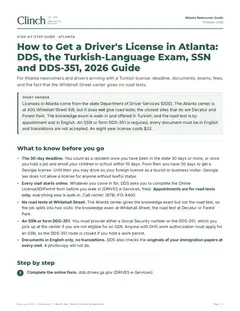
How do I get a driver's license in Atlanta, and which office do I go to?
Short answer
Licenses come from the state Department of Driver Services (DDS), and the Atlanta center is at 400 Whitehall Street SW. One detail matters more than any other: this center does not give road tests, and the closest ones that do are Decatur and Forest Park. The knowledge exam is walk-in and offered in Turkish; the road test is by appointment and in English. An SSN or form DDS-351 is required, and every document must be in English.
Steps, documents and official links
- Fill in the online form first. Whatever you come in for, DDS asks you to complete the Online License/ID/Permit form before you walk in. It is free, on DRIVES e-Services. The call center is (678) 413-8400.
- Take the knowledge exam at Whitehall Street. No appointment is needed for the knowledge exam, but you must start at least 30 minutes before the center closes. It has two parts, road rules and road signs, with 20 questions each and 15 correct answers needed to pass.
- Book the road test at a different center. The Atlanta center gives no road tests. Book through DRIVES e-Services at Decatur, Forest Park, Lithonia, Marietta, Kennesaw, Norcross or Lawrenceville. Bring a four-wheel vehicle with valid plates, registration and liability insurance; the car gets a safety check on the spot. The pass mark is 75 out of 100.
- Prepare your documents in English. One identity document, an SSN (or form DDS-351 if you are not eligible for one), two proofs of address from separate sources and, for non-citizens, a document showing lawful status. DDS does not accept translations and checks the originals of your immigration papers at every visit. The full document list is in our Georgia guide.
- Wait for the card. You leave with an interim paper document; the permanent card arrives by mail within 30 days. TSA does not accept the paper interim, so carry your passport on domestic flights until the card comes.
The Atlanta DDS center and the nearest road-test sites
| Center | Address | Hours | Road test |
|---|---|---|---|
| Atlanta (Fulton) | 400 Whitehall Street SW, Atlanta GA 30303 | Tue-Fri 7:30 a.m.-6:30 p.m., Sat 7:30 a.m.-noon. Closed Sunday and Monday. | No |
| Decatur (DeKalb) | 2801 Candler Rd, Ste 82, Decatur GA 30034 | Same hours | Yes |
| Forest Park (Clayton) | 5036 State Route 85, Forest Park GA 30297 | Same hours | Yes |
| Lithonia (DeKalb) | 8040 Rockbridge Rd, Lithonia GA 30058 | Same hours | Yes |
| Marietta (Cobb) | 1605 County Services Pkwy, Marietta GA 30008 | Same hours | Yes |
| Kennesaw (Cobb) | 3690 Old 41 Hwy NW, Kennesaw GA 30144 | Same hours | Yes, motorcycle too |
| Norcross (Gwinnett) | 2211 Beaver Ruin Rd, Norcross GA 30071 | Same hours | Yes |
| Lawrenceville (Gwinnett) | 310 Hurricane Shoals Rd NE, Lawrenceville GA 30046 | Same hours | Yes |
| Alpharetta (Fulton) | 11575 Maxwell Rd, Alpharetta GA 30009 | Same hours | No |
What the Atlanta center does handle: first issuance, renewals, replacing a lost or stolen card, out-of-state transfers, reinstatements, driving records (MVR), the car and motorcycle knowledge exams and CDL written exams. Holiday closures are posted on the DDS home page, and a Saturday can be closed, so check before you go. The page also carries a scam warning: DDS does not text or call you to ask for fees.
Is the knowledge exam really available in Turkish?
The DDS language list says the road rules and road signs parts of the non-commercial knowledge exam are offered in 26 languages, Turkish among them. The road test is in English. There is a conflict worth knowing about: the 2023-2024 driver manual text still on the DDS site says the road signs section is given in English only, while the newer language list and exam page say both sections are translated. Call (678) 413-8400 before you go to Whitehall Street and confirm you can take the signs section in Turkish. One person, an interpreter included, may accompany you.
What it costs
| Item | Fee |
|---|---|
| License (Class C, 8 years; printed LIMITED-TERM for non-citizens, max 5 years) | $32 |
| Instructional permit | $10, payable before each attempt |
| State ID card (8 years) | $32 |
| Replacement card | $10 |
| Online transaction discount | $5 less |
Every Georgia license and ID issued since 2012 is a REAL ID at no extra cost, with a star in the top right corner. A card issued to a non-citizen is printed LIMITED-TERM and expires with the approved period of stay, at most five years. If your immigration paperwork is pending an extension, you can get one 120-day extension with an original I-797C.
02 · Foreign license
Can I drive in Atlanta on my Turkish license?
Short answer
Yes until you count as a resident, and then you have 30 days. A Turkish license is not exchanged for a Georgia one: the only reciprocal jurisdictions on the DDS list are South Korea (with a consulate letter) and Taiwan. So you take the vision test, the knowledge exam and the road test. Your Turkish license is shown during the transaction and handed back to you rather than surrendered.
Steps, documents and official links
When do you become a resident?
- Being in the state for 30 days or more, or
- holding a job and enrolling your children in school within 10 days.
Once either is true, you need a Georgia license within 30 days. Until then you may drive on your foreign license as a tourist or business visitor. Georgia law does not allow a license to be issued to someone without lawful status.
The practical order in Atlanta
- Knowledge exam: walk in at 400 Whitehall Street SW and take it in Turkish. Join the line at least 30 minutes before closing.
- Road test: by appointment only, and not at Whitehall Street. The closest sites are Decatur (2801 Candler Rd) and Forest Park (5036 State Route 85).
- The car: you bring your own vehicle. If your car is not registered in Georgia yet, you can use someone else's insured and registered car, as long as the insurance and registration papers are with you.
- International Driving Permit: it is not a license on its own. It is a translation you carry alongside the foreign license and cannot be used for a DDS transaction.
- Retakes: after a first road-test failure you can try again the next day, after a second failure in 7 days, and after a failure caused by an accident or violation in 30 days.
For adults getting a first license, DDS can ask those who go straight for a Class C license to sign an affidavit of 40 hours of supervised driving, six of them at night. Whether a Turkish license holder is excused from that affidavit is not stated on the DDS pages we read, so call (678) 413-8400 and ask; the answer can differ from center to center.
Can you manage without a car?
If you live on a MARTA rail line, the first months without a car are workable: the airport, downtown and most federal buildings sit on the network (see public transit). Off the rail lines the network thins out quickly, which is why most families find it easier to get the license done inside the first 30 days. Documents and fees are in the license section above.
03 · Car
Where do I register a car in Atlanta, and do I need an emissions test?
Short answer
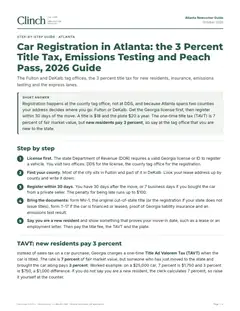
Registration happens at the county tag office rather than at DDS, and because Atlanta spans two counties your address decides where you go: the Fulton side uses the Fulton County Tax Commissioner, the DeKalb side the DeKalb County Tax Commissioner. A title is $18, the plate $20 a year, and the one-time title tax (TAVT) is 7 percent of fair market value, but new residents pay 3 percent. Fulton and DeKalb are both emissions-test counties.
Steps, documents and official links
Order matters: license first, then registration
The state Department of Revenue (DOR) requires a valid Georgia license or ID to register a vehicle, so you visit two separate offices: DDS for the license (above) and the county tag office for the registration. You have 30 days after the move, or 7 business days if you bought the car from a private seller, and the penalty for being late runs up to $100.
Fulton County tag offices
The Motor Vehicle Division of the Fulton County Tax Commissioner runs registrations. Phone 404-613-6100; all offices open weekdays 8 a.m. to 4:30 p.m.
| Office | Address |
|---|---|
| Government Center (downtown) | 141 Pryor Street SW, Suite 1113, Atlanta GA 30303 |
| North Fulton Service Center | 7741 Roswell Road NE, Sandy Springs GA 30350 |
| South Fulton Service Center | 5600 Stonewall Tell Road, College Park GA 30349 |
| Greenbriar Mall Service Center | 2841 Greenbriar Parkway, Suite 124, Atlanta GA 30331 |
| Customer Service Center (Maxwell Road) | 11575 Maxwell Road, Alpharetta GA |
DeKalb County tag offices
Part of the City of Atlanta lies in DeKalb County, and those residents go to the DeKalb County Tax Commissioner. Phone 404-298-4000; motor vehicle offices open weekdays 8 a.m. to 4:30 p.m. You can book an appointment online or join a same-day virtual waitlist.
| Office | Address |
|---|---|
| Central | 4380 Memorial Drive, Suite 100, Decatur GA 30032 (at I-285 and Memorial Dr) |
| North | 3653 Clairmont Road, Chamblee GA 30341 |
| South | 2801 Candler Road, Suite 66, Decatur GA 30034 (inside the Gallery at South DeKalb) |
What to bring and what it costs
- Documents: form MV-1, the original out-of-state title (or the registration if you come from a state that does not issue titles), form T-17 if the car is financed or leased, proof of Georgia liability insurance and an emissions test result.
- Fees: title $18, plate and registration $20 a year, replacement title $8. Late renewal adds 10 percent of the ad valorem tax plus 25 percent of the plate fee.
- TAVT: charged once, at titling. The rate is 7 percent of fair market value, but someone who has just moved to the state and brought the car along pays 3 percent. On a $25,000 car that is a $1,000 difference. Say at the tag office that you are a new resident and bring something that shows your move-in date, such as a lease or an employment letter.
- Insurance: the minimums are $25,000 per person and $50,000 per accident for bodily injury, plus $25,000 for property damage. A lapse costs a $25 fine and a $60 reinstatement fee.
- Renewal: the registration expires on the birthday of the first person listed on it. Renewal opens 30 days before that birthday, or 90 days before online.
- Renewal kiosks: Fulton has 24-hour kiosks in Atlanta-area Kroger stores, for example at 2685 Metropolitan Pkwy SW, 227 Sandy Springs Pl, 3330 Piedmont Rd NE, 800 Glenwood Ave SE and 725 Ponce de Leon Ave NE. Credit cards add 3.95 percent and debit cards 2.95 percent, plus a service fee. Kiosks handle renewals only, not a new resident's first titling.
Emissions: Fulton and DeKalb are both covered
- Georgia's Clean Air Force runs the program in 13 metro counties and both Fulton and DeKalb are on the list. The test is annual, before your registration renewal date (your birthday), and doing it four to six weeks early is recommended.
- Which cars: for 2026 registration, 2002 to 2023 model-year gasoline cars and light trucks. Exempt: the three newest model years (2024 and newer in 2026), vehicles 25 model years or older, diesels, motorcycles and RVs. The window moves up a year on January 1, 2027, when 2003 to 2024 models are tested.
- Cost: up to $25, with the price posted at the station. It is an OBD test plus a visual check of the catalytic converter. If you fail, you get one free retest at the same station within 30 days. You do not have to test in the county where the car is registered.
- Cars new to the area: if you move to Fulton or DeKalb with a 2003 to 2024 model vehicle, you need proof of a passing test within the last 12 months and must register within 30 days. Help line 1-800-449-2471. The program's materials come in Spanish, Korean, Vietnamese and Mandarin, but not Turkish.
- No general safety inspection. Georgia has no annual vehicle inspection; the only check is the safety look at the car you bring to the road test.
The statewide detail on TAVT, fees and insurance is in our Georgia guide.
04 · Tolls
Do I need a Peach Pass in Atlanta, and how do the express lanes work?
Short answer
There are no express lanes inside the city itself; the tolled lanes start outside the I-285 perimeter. So if you stay inside the city you may never need a Peach Pass. If you drive north or south regularly, opening an account makes sense: the transponder is free and the account needs a $20 prepaid balance. Without a transponder, a $25 administrative fee is added to each toll.
Steps, documents and official links
Which roads are tolled near Atlanta?
| Express lane | Where |
|---|---|
| I-85 Express Lanes | 15 miles, Chamblee Tucker Rd (just south of I-285) to Old Peachtree Rd (Gwinnett) |
| I-85 Extension | 10 miles, Old Peachtree Rd to Hamilton Mill Rd; priced and charged separately from the I-85 Express Lanes |
| I-75 South Metro | 12 miles, reversible; McDonough Rd (SR 155, Henry) to Stockbridge Hwy (SR 138, Clayton) |
| Northwest Corridor | 30 miles, reversible; I-75 Akers Mill Rd to Hickory Grove Rd and I-575 to Sixes Rd (Cobb and Cherokee) |
The way the segments are described, all of them begin outside the city limits: the nearest is on I-85 just north of I-285, the next on the Cobb side at Akers Mill Rd. The reversible lanes run 24 hours and GDOT flips the direction during the day, so check the direction notice on the peachpass.com home page before you set off. The lanes are open to vehicles with two axles and no more than six wheels, and there are no toll booths and no cash.
Opening an account
- Where: peachpass.com, by phone on 1-855-724-7277, or in person at the Peach Pass Retail Center, 245 Peachtree Center Ave NE, ground floor, Atlanta GA 30303 (weekdays 8 a.m. to 5 p.m.). The DDS centers at Lawrenceville, Kennesaw and Locust Grove also open accounts, Tuesday to Friday 8 a.m. to 6 p.m. and Saturday 8 a.m. to noon.
- What is asked for: name, address, phone, email and the vehicle's year, color, make, model and plate. A personal account needs at least a $20 prepaid balance, paid by card; cash and money orders are accepted only at the Retail Center.
- Temporary plate: tick the "temporary plate" box when you open the account and enter the temporary number, then update it when the permanent plate arrives.
- Transponder: free, and it is a sticker. It goes on the center of the windshield, about three quarters of an inch from the mirror and two inches from the top edge; a headlamp sticker is issued for metalized windshields. It cannot be moved between vehicles, and a new one arrives by mail in 7 to 10 business days.
- No credit card? BancPass Pay n Go is a licensed cash-reloadable alternative. The starter kit is $20 ($5 activation plus $15 in tolls), a reload card costs $2, and they are sold at Kroger, CVS, Walgreens and Costco. This option does not qualify for the carpool exemption.
Prices and exemptions
- Dynamic pricing: the toll rises with demand, with a floor of 10 cents a mile. The sign before the entrance shows two prices, the upper one to the next exit and the lower one to the last exit. Once you enter, the rate does not change. We do not publish dollar amounts here because they move constantly.
- Who rides free: on the I-85 express lanes, carpools of three or more with a Peach Pass account and the free Peach Pass Verify app (verification at the start and end of the trip, with at least $5 on the account). Certified motorcycles, state-registered MARTA and Xpress buses and registered vanpools also ride free. The I-75 lanes have no carpool exemption.
- Electric cars no longer ride free: since September 30, 2025, alternative-fuel and electric vehicles pay in the I-85 express lanes. A paragraph repeating the old rule is still on the Peach Pass FAQ page; the newer rule is the one in force.
- Other states' transponders: E-ZPass, Florida SunPass, E-Pass and NC Quick Pass work in the Georgia express lanes, and a Peach Pass works in 19 E-ZPass states.
What happens if you do not pay
If no transponder is detected, a camera photographs the plate and SRTA mails a violation notice to the registered owner. A $25 administrative fee per violation is added on top of the toll. Unpaid notices go to collections, the Attorney General and the Office of State Administrative Hearings, and can reach a civil penalty of up to $70 per violation and suspension of the vehicle registration. To pay or dispute: 1-855-724-7277 or 1-833-448-4398 from inside Georgia, mail P.O. Box 92386, Atlanta GA 30314. For an out-of-state plate, 1-833-426-2406 or SRTA, PO Box 2644, Atlanta GA 30301-2644. An expired card on the account can also trigger a violation, so keep your payment details current.
05 · Public transit
How do I use MARTA in Atlanta, and how do I get from the airport into the city?
Short answer
A single ride is $2.50 with up to four free transfers in three hours. In 2026 the system moved to "better Breeze": the old silver Breeze cards and the old app no longer work. You can tap a contactless bank card or your phone straight at the gate, or buy an orange card for $2. The airport station is inside the Domestic Terminal, so you never leave the building with your bags.
Steps, documents and official links
Fares
| Fare | Price |
|---|---|
| Single ride (rail, bus, Rapid, MARTA Reach) | $2.50, up to 4 free transfers within 3 hours |
| Reduced fare (65+, Medicare, disability) | $1.00 |
| Atlanta Streetcar | $1.00, no transfers |
| 1-day pass | $9.00 |
| 7-day pass | $23.75 |
| 30-day pass | $95 |
| 10-trip / 20-trip | $25 / $42.50 |
| MARTA Mobility (paratransit) | $4.00 |
| Children | 46 inches and under ride free, up to 2 per paying adult |
better Breeze: do not miss October 30, 2026
- Old cards are dead: the new system is live, and the old silver Breeze cards, paper tickets and the Breeze Mobile 2.0 app no longer work. New physical cards are orange; reduced-fare and Mobility cards are black.
- If you have an old balance: transfers from an old card or the old app end on Friday, October 30, 2026. You buy an orange card first, then move the balance at breezecard.com. After that date there is no transfer route left.
- How to pay: tap a contactless bank card or your phone or watch wallet (Apple, Google, Samsung) directly at faregates and bus validators; you do not have to buy a Breeze card at all. A physical orange card costs $2 once, a virtual Breeze card in a phone wallet also $2, and a paper ticket $1 with a 90-day expiry.
- The new app does not pay fares: the new Breeze Mobile app is for account management only. You can also manage the account at breezecard.com.
- Transfer rule: free transfers require the same payment method. Tap the same card or the same phone wallet going bus to bus and bus to rail; you cannot transfer using your spouse's card.
Hours
Trains run 4:45 a.m. to 1 a.m. on weekdays and 6 a.m. to 1 a.m. at weekends. Frequency is 10 minutes at rush hour (6 to 9 a.m. and 3 to 7 p.m.), 15 minutes midday and 20 minutes at night and at weekends. Buses run 5 a.m. to 1 a.m. on weekdays and 5 a.m. to 12:30 a.m. at weekends. Routes and customer service: 404-848-5000. MARTA Police non-emergency: 404-848-4900.
The airport: Hartsfield-Jackson (ATL)
- The station is inside the terminal: MARTA's Airport Station sits inside the Domestic Terminal, between the North and South baggage claims. The Red and Gold lines serve it directly, and there is a RideStore at the station.
- Evening transfer: after 8:30 p.m., passengers heading to Buckhead, Medical Center, Dunwoody, Sandy Springs or North Springs transfer at Lindbergh Center.
- International Terminal: take the free shuttle from outside Domestic baggage claim, or the Plane Train to Concourse F. International arrivals cannot re-enter the secure area, so a free 24-hour connector runs to the Domestic Terminal and the Rental Car Center, a ride of about 15 minutes.
- Parking tip: nine MARTA stations offer long-term parking for airport travelers, at $7 a day (Sandy Springs, Dunwoody, Medical Center, Lenox, Kensington) or $10 a day (North Springs, Doraville, Lindbergh, College Park). That undercuts the airport lots.
- The airport itself: 6000 North Terminal Parkway, Atlanta GA 30320, about 10 miles south of downtown. The Plane Train connects both terminals and every concourse about every two minutes. Turkish Airlines flies nonstop between ATL and Istanbul Airport, averaging about 11 hours (see time and flights).
Streetcar, suburban systems and the train
- Atlanta Streetcar: a short downtown loop run by MARTA. The fare is $1.00 and it gives no transfer to MARTA rail or bus. Check current hours on the MARTA site before you go.
- If you move to the suburbs: MARTA runs the buses in Fulton, DeKalb and Clayton. Gwinnett has Ride Gwinnett (local one-way $2.50, monthly $80) and Cobb has CobbLinc (local $2.50, 31-day pass $72), and both are moving to the new Breeze platform. A Breeze card is needed for the free transfer between CobbLinc and MARTA.
- Amtrak: Atlanta's only rail station is Peachtree Station, 1688 Peachtree Street NW, Atlanta GA 30309 (Brookwood). The single route is the Crescent, one train a day each way between New York, Washington, Atlanta and New Orleans. The station has a waiting room, and long-term parking is across the street at a hotel, paid at the hotel desk. Amtrak has posted service adjustments south of Washington, D.C. for October 16 to 26, 2026, so check before you book.
06 · Power and gas
How do I turn on electricity and gas in Atlanta, and do I need an SSN?
Short answer
The two work completely differently. You cannot choose your electric company: the address decides, and inside the Atlanta city limits that means Georgia Power. Natural gas is deregulated in the Atlanta Gas Light territory: AGL owns the pipes, you choose the marketer that sells you the gas, and a residential deposit is capped by rule at $150. Starting service without an SSN is possible, but it usually costs you a deposit or a prepaid plan.
Steps, documents and official links
Electricity: your address decides
The state Public Service Commission (PSC) is clear that residential electricity is not deregulated in Georgia, so a household cannot pick a supplier. Inside the City of Atlanta the supplier is Georgia Power, and the city has no electric utility of its own. Move out into the metro area and the picture changes: depending on the address you may get Georgia Power, a member-owned co-operative (an EMC such as Sawnee EMC or Jackson EMC) or a city system such as Marietta Power and Water. Check which company covers your address on the PSC territorial maps; we cannot give that list address by address.
- Georgia Power residential line: 1-888-660-5890, weekdays 7 a.m. to 7 p.m. Connections are made on weekdays, and an order placed by midnight generally gets next-day service unless digging or new line work is needed.
- Deposit: on the standard billed plan a deposit depends on your credit score and can run to twice the residence's average monthly bill. It is refunded with 3 percent simple interest after 12 consecutive on-time payments, and a refund check is mailed 30 to 45 days after the final bill. You can pay the deposit in cash at authorized locations such as Kroger, Walmart and Publix for a $1.50 fee.
- No SSN: the route with written proof is PrePay. Georgia Power's PrePay page asks for "a Social Security Number (SSN) or a photo ID" plus proof of residency such as a phone bill, with $40 of initial funding and a $30 account-establishment fee, so $70 to start. There is no credit check. Sign up by phone on 1-877-506-3905. For the standard post-paid plan, the public pages do not say what documents are asked of someone with no SSN and no credit history, so we do not state it: call and ask.
- Rates: the PSC approved a plan freezing Georgia Power's base rates through at least the end of 2028. The freeze does not cover fuel costs or storm-recovery costs, so your bill can still move.
Natural gas: you pick the marketer
- How it works: Georgia deregulated retail gas in 1998, but only in the Atlanta Gas Light (AGL) territory, which covers metro Atlanta. AGL runs the pipes, reads the meter, delivers the gas, repairs the lines and connects or disconnects at the marketer's request. It does not sell gas. The marketer bills you, and AGL's delivery charge appears on that same bill.
- Starting service: if the home already has a meter, call a certified marketer directly. If there is no meter, fill in AGL's online form and AGL replies within two business days. Stopping or transferring service also goes through the marketer.
- Deposit cap: Commission Rule 515-7-9-.04 says a marketer's residential deposit shall not exceed $150. A newcomer with no U.S. credit file can be asked for a deposit up to that cap by some companies.
- Marketers and phone numbers (PSC list, September 2026): Gas South 877-472-4932 (which describes itself as requiring no deposit); Georgia Natural Gas 770-850-6200 inside Atlanta or 877-850-6200; SCANA Energy 877-467-2262; Constellation 866-743-5576; Fuel Georgia 833-903-3835 (678-774-6010 inside Atlanta); True Natural Gas 770-502-0226; Walton EMC Natural Gas 770-267-2505; XOOM Energy 855-203-3808; Stream Energy 866-447-8732; Town Square Energy 888-998-1928. Georgia Natural Gas, SCANA, Constellation, Fuel Georgia and Walton EMC describe their deposits as "based on credit information", while True Natural Gas, XOOM and Stream say no deposit for customers with good credit.
- Comparing prices: the PSC publishes a monthly price-comparison chart. The bill has three parts, AGL's delivery charge (regulated by the PSC), the marketer's price per therm and sales tax, plus the marketer's customer-service charge. Plans are variable or fixed, usually for 12 months and sometimes 24. Leaving a fixed plan early costs a cancellation fee that the PSC page says generally does not exceed about $100, and an expired fixed plan can roll onto a variable price.
- Switching marketer: sign up by the 19th of the month and the switch can take effect on the 1st of the next month; if it is not processed by 3 a.m. on the 20th it slips a month.
- If every marketer turns you down: the PSC's Regulated Provider is the fallback for low-income customers and anyone rejected. Those pages are out of date and we could not confirm who the current provider is, so call the PSC before you apply.
- Gas leak: AGL answers 24 hours a day. The PSC page lists 770-907-4231 for metro Atlanta, but that number comes from an older page, so confirm it on AGL's own safety page before you rely on it. If you smell gas, leave the building and call from outside; if you suspect carbon monoxide, get out and call 911.
If you cannot pay the bill
- LIHEAP and immigration status: this needs saying plainly. Federal energy assistance is run in Georgia by local Community Action Agencies, and the applicant must be a U.S. citizen or a lawfully admitted immigrant. On top of that, a Social Security number is requested for every household member, with no ITIN alternative on the program page. Someone without status cannot get through this door, and it is better to know that before making the trip.
- Where you apply depends on your county: on the Fulton side it is the Fulton Atlanta Community Action Authority, 341 Kelly Street, Atlanta GA 30312; on the DeKalb side, Partnership for Community Action, 3597 Covington Hwy, Decatur GA 30032. You cannot apply online; you book an appointment with the agency for the county where you live.
- Other LIHEAP rules: household gross income at or below 60 percent of the state median, and you must be responsible for the main heating or cooling bill. In the 2026 cooling season the limit was $34,549 for a household of one and $77,071 for a household of five. The heating season normally opens on the first working day of December for people 65 and over and those who are medically homebound, and on the first working day of January for everyone else. One heating and one cooling benefit a year; keep paying the bill while the application is pending, and note that LIHEAP cannot pay water bills.
- Georgia Power Income-Qualified Discount: $33.50 a month off the bill. You need household income at or below 200 percent of the federal poverty guidelines and either age 65 or over or a federal Housing Choice Voucher (Section 8). The discount applies only to the metered electric and fuel-cost parts of the bill, not to sales tax.
- For seniors: Georgia Power's EASE program gives free insulation and HVAC servicing to homeowners 65 and over with income at or below 200 percent of poverty (1-877-310-5607). On the gas side, AGL's senior discount takes up to $14 a month off the AGL base charge for households aged 65 and over under 200 percent of poverty.
Internet
- Google Fiber, AT&T and Xfinity (Comcast) all serve parts of Atlanta, but you have to check coverage address by address.
- Xfinity Internet Essentials: for qualifying households, $14.95 a month for up to 75 Mbps or $29.95 for up to 100 Mbps, with low-cost laptops and Chromebooks at $149.99. Apply at internetessentials.com/apply.
- Access from AT&T: for households under 200 percent of the federal poverty guideline or on a qualifying program such as LIHEAP or Medicaid. Income is verified automatically; otherwise you upload a W-2 or an SSA-1099.
- Lifeline: a federal discount of up to $9.25 a month on phone, internet or a bundle. You need household income at or below 135 percent of the poverty guideline or participation in a program such as Medicaid or SNAP. Apply at lifelinesupport.org and recertify every year. The old federal ACP discount ended in 2024, so do not count on it.
- Library branches have free computers and Wi-Fi with a card (below).
07 · Water and trash
How do I open a water account in Atlanta, and which bill has the trash fee?
Short answer
Water and sewer come from the city's Department of Watershed Management (DWM). To open an account you need the application, a deed or a lease, a government-issued ID, an $80 deposit and a $15 account-establishment fee, and neither an SSN nor an ITIN is on the list. Trash is not on the water bill: in Atlanta the trash fee is charged once a year on the property tax bill and follows the property, not the tenant.
Steps, documents and official links
Water and sewer: the Department of Watershed Management
- Check your address first. DWM only opens accounts for addresses in its service area, and it does not open accounts for buildings on a master meter, which covers most apartments, condos and HOA properties. In that case water belongs to the owner or the management company, so ask the property manager.
- If you own: a completed New Service Application, the closing statement (or HUD document) or the warranty deed, and a valid government-issued ID. Only the person named on the deed can apply, and purchase contracts are not accepted.
- If you rent: the application and your current lease, including the terms page and the signature page. Only the leaseholder can apply, and subleases are not accepted. The ID list is the same.
- Which ID: the DWM page lists accepted ID as "State-issued ID, State-issued driver's license and/or a U.S. passport". No SSN, no ITIN and no credit check appear on the page, which is good news. But a foreign passport is not named either, and we could not confirm whether a Turkish passport alone is accepted, so call 404-546-0311 and ask, or apply after you have your Georgia license.
- Cost: an $80 deposit (it varies with meter size) plus a $15 account-establishment fee. Applying online or by fax puts them on the first bill; applying in person means paying on the spot.
- Where: the online application, fax 404-979-6787, or in person weekdays 9 a.m. to 4 p.m. at 55 Trinity Ave., Suite 1650, Atlanta GA 30303 or 72 Marietta St., Atlanta GA 30303. The application form exists in English and Spanish. Customer service is 404-546-0311, the same number as ATL311; administrative offices are at 72 Marietta Street NE, weekdays 8:15 a.m. to 5 p.m.
- What delays service: missing documents, an expired ID, an unpaid utility bill at the property and false documents.
Why the bill feels high
DWM's own explanation is straightforward: the bill carries a separate base charge for water and another for sewer (its page puts each at $6.56), then tiered usage on top, and the sewer charge is calculated on the same usage all over again. The tiers are 1 to 3, 4 to 6 and 7 or more CCF, where 1 CCF is 748 gallons, and the price per CCF rises in the higher tiers. The good news: rates are fixed from July 1, 2024 through June 30, 2028, and DWM says Atlanta's water and sewer rates have not risen since 2012.
Leaks are a separate matter. DWM's own table puts a running toilet at about 2.5 gallons a minute, which is roughly 108,000 gallons a month. A leak like that lands on the bill in full unless you apply for an adjustment.
Disputing a bill: three clocks run at once
- 12 months: an Account Adjustment Request must reach DWM in writing within 12 months of the bill's payment due date. You can file through ATL311.com, by email, by mail (Attn: Office of Customer Care and Billing Services, 2 City Plaza, 72 Marietta St., Atlanta GA 30303) or in person at 55 Trinity Ave. or 72 Marietta St.
- 20 days: DWM sends an acknowledgement letter, and you must pay the "Temporary Payment Amount" set by the Commissioner within 20 days of it, or the request is not processed. Charges you are not disputing stay due as normal.
- 14 days: after the decision letter, you have 14 days to appeal to the Water and Sewer Appeals Board.
- Leak claims: you have to prove the leak existed and was repaired, with receipts showing payment, photos, and a police report in the case of vandalism.
If paying is hard
- PromisePay: DWM offers interest-free installment plans on past-due balances. No interest and no late fees on the installments; transaction fees are $0.50 by ACH and $3.00 by card or phone wallet up to $150, or 3 percent above that. The plan covers the balance on the day you enroll, and you keep paying new bills to DWM directly. Enroll at atlantawatershed.promise-pay.com.
- Care and Conserve: bill assistance and plumbing help for low-to-moderate-income Atlanta ratepayers, renters included. The conditions: the bill comes directly from the City, you live at the property, service is on and the account is active, the account has gone through six billing cycles, and there is a past-due amount of $300 or more. Renters have to give the landlord's contact details; the program does not cover bills in a landlord's name or single-meter duplexes and triplexes. Phone 404-546-3620, and do not send documents until a representative contacts you.
- Senior discount: 30 percent off for customers 65 and over with household income no more than $25,000 a year, plus a toilet-replacement program.
- Late fee: the Atlanta City Code adds 5 percent of the balance or $5, whichever is greater, to a delinquent water and sewer bill.
Trash: once a year, on the property tax bill
Do not skip this, because it is where newcomers go wrong most often. In Atlanta the trash fee is not on the water bill. The city's Department of Public Works provides the service, but the fee is collected once a year by the county tax commissioner on the property tax bill: the Fulton County Tax Commissioner on the Fulton side and the DeKalb County Tax Commissioner on the DeKalb side. In other words the fee follows the property. If you rent, looking for a trash line on your water bill is wasted effort; that fee sits on the owner's property tax bill, and whether it is passed into your rent depends on your lease.
| Item | Annual fee |
|---|---|
| Residential collection and disposal (FY2026) | $432.26 |
| Residential recycling (FY2026) | $126.87 |
| Residential collection and disposal (FY2027) | $440.90 |
| Residential recycling (FY2027) | $129.41 |
The City also has a 2026 solid waste rate study under way, so the figures after FY2027 may change.
How collection works
- Weekly: garbage in a 96-gallon green roll cart and recycling in a blue cart on the same day. Yard trimmings go in paper bags, up to 20 bags per collection, and plastic bags are not accepted. Bulk waste is collected by appointment.
- Timing: put carts out before 7 a.m. on collection day and bring them in by 9 a.m. the next day. Find your day with the City's "Find My Collection Day" tool.
- Missed pickup: if you have not been serviced by 8 p.m., report it to 3-1-1.
- New residents and extra carts: request through the City's cart forms or 3-1-1; for extra carts, email [email protected].
- Billing questions: [email protected] and 404-546-1796. Fulton County Tax Commissioner 404-613-6100, 141 Pryor St., Atlanta GA 30303; DeKalb County Tax Commissioner 404-371-2886, 3720 Leroy Scott Drive, Decatur GA 30032.
- Disputes: file at least 7 days before the due date, and appeal to the Solid Waste Appeals Board within 7 business days of the notice.
08 · City services
What is ATL311, and how do I get an Atlanta library card?
Short answer
ATL311 is the city's customer service center for everything that is not an emergency: dial 3-1-1 inside the city or 404-546-0311 from outside, and there is also atl311.com, a mobile app and an email address. Trash, water bills, potholes and street lights all go through it. A library card is free and no SSN is requested: an ID, a lease or a utility bill showing your name and address is enough.
Steps, documents and official links
ATL311
- What it is for: non-emergency city services, the status of a request you opened, and information about city programs. Water and sewer matters go through it too, because DWM uses the same customer number (404-546-0311). If there is a danger to life or an incident in progress, call 911.
- How to reach it: dial 3-1-1 inside the city or 404-546-0311 from outside; email [email protected]; fax 404-221-9518; web atl311.com; the Android and iPhone app; the chatbot on the site; and @ATL311 on social media. For hearing-impaired callers, dial 711 (Georgia Relay).
- Hours: ATL311's own contact article says live chat runs weekdays 7 a.m. to midnight, while DWM's customer service page says the center is open weekdays 7 a.m. to 7 p.m. The two pages conflict, so check the current hours on atl311.com before you call. Online requests are open around the clock.
- Tracking a request: use "Case Status" on ATL311.com; log in and you can see all of your cases in one place.
- Trash, carts and collection days: all handled through 311 (see water and trash).
- A door for newcomers: the Mayor's Office includes an Office of International and Immigrant Affairs. We could not read a detailed official page on what it offers, but if you are looking for a city-level contact as a newcomer, you can ask ATL311 about it.
A library card is the easiest document to get
- Which system: the system once known as the Atlanta-Fulton Public Library System now uses the name Fulton County Library System and has 34 branches (fulcolibrary.org).
- Who gets a free card: anyone living in Fulton County and anyone living inside the legal City of Atlanta limits, including the part of Atlanta in DeKalb County. People who teach in, attend school in, or own property or a business in that area also qualify. Non-residents pay a non-refundable $40 per person per year. A replacement card is $1. Cards are generally valid for two years, with up to 50 items out at once.
- Which documents: the library asks for "a form (or forms) of identification that shows who you are and where you live". Its list includes a driver's license, a student ID, a voter registration card, printed checks with your current address, rent receipts or a lease, social services identification, Fulton County property tax receipts and a current utility bill. No SSN is mentioned and no photo ID is strictly required. A foreign passport is not named on the list, but a lease or utility bill with your name and address is on it, so take both; you can also call the branch before you go.
- Children: a parent or guardian signs for children under 13 and can use their own ID.
- Online: register at fulcolibrary.org/register and you get a temporary digital card for OverDrive and Libby, which you convert into a physical card at a branch with ID showing your current name and address.
- Computers and internet: you need a card to use branch computers; Wi-Fi is free. Materials at the Auburn Avenue Research Library are for in-library use only.
- Privacy: the system says it follows federal and state confidentiality law for library records.
Other information lines
211 for social services and referrals, 811 before you dig, 511 for road conditions. In a mental health crisis, the 988 line works with interpreters.
09 · Renting
How much deposit can an Atlanta landlord ask for, and is there a cap on rent increases?
Short answer
There is a cap on deposits but none on rent. The Safe at Home Act limits a deposit to two months' rent, and the deposit must come back within 30 days of the end of the tenancy. Rent control is banned by state law, so Atlanta cannot cap rent, and no agency can step into a dispute: the route runs through magistrate court.
Steps, documents and official links
First thing to know: nobody intervenes
The Georgia Department of Community Affairs (DCA) says it plainly in its own handbook: there is no government agency in Georgia that can intervene in a landlord-tenant dispute or force either side to behave in a particular way. There is no city department in Atlanta to complain to either; a case is filed in the magistrate court of the county where the property sits, Fulton or DeKalb. The practical consequence is that the side with written evidence wins, not the side that is right.
Deposit rules
| Item | Rule |
|---|---|
| Cap | Two months' rent on leases entered into or renewed on or after July 1, 2024 |
| Return | Within 30 days of the end of the tenancy or of your moving out, whichever is later |
| Move-in damage list | Required of landlords with more than ten rental units or a management agent: a written list before the deposit is accepted, which the tenant may check, both sides sign and the tenant keeps a copy |
| Move-out inspection | The same landlords must inspect within 3 business days of the end of the lease and prepare a list of damage and estimated cost |
| Escrow account | The same landlords must hold the deposit in a separate escrow account or post a bond with the superior court clerk, and tell the tenant in writing |
| Wrongful withholding | Large landlords can owe three times the amount withheld plus attorney fees |
Note the limit on those duties: the move-in list and the move-out inspection bind only landlords with more than ten units or a management agent. Rent from a large management company in Atlanta and these rules apply; rent from a small landlord and the formal list is not required. In that case, do it yourself: photograph every room the day you move in and email the photos to the landlord with the date. In a deposit dispute that is the only evidence you will have.
The refund check goes to the last address the landlord has for you. If it comes back undeliverable and the landlord cannot find you, the deposit belongs to the landlord 90 days after mailing, so give your new address in writing when you leave. Normal wear and tear cannot be deducted.
Rent increases and ending a tenancy
- No rent control: O.C.G.A. 44-7-19 bars any county or municipality from regulating the rent charged for privately owned residential rental property. There is no cap on rent increases in Atlanta, Fulton or DeKalb, and there cannot be one.
- Increases during a lease: only if the lease allows them. When a property changes hands, existing leases generally bind the new owner too.
- Month-to-month: the landlord gives 60 days' notice to end it or to change the rent, and a rent increase starts a new tenancy at will after 60 days. The tenant gives 30 days' notice.
- Breaking a fixed lease early: only as the lease provides, with limited exceptions for military members and victims of family violence. Otherwise you can owe the remaining rent.
How eviction (a dispossessory) works
- Written notice first: for unpaid rent the landlord must give at least 3 business days' written notice before filing.
- The case and your answer: the case goes to the county magistrate court. You have 7 days from service to file an answer, and paying all the rent, fees and court costs within that time ends the case. Fail to answer and the court can enter a default. An appeal must be filed within 7 days of judgment.
- What is not allowed: changing the locks or cutting off power, water or heat without a court order.
- Repairs and habitability: the landlord must keep the structure, electrical system, heating, cooling and plumbing working. Report a fault immediately and in writing where you can. Retaliation for a repair request is illegal and is presumed if an eviction, rent increase or service cut follows a protected tenant action within three months; the remedy is one month's rent plus $500.
- Help: the handbook's legal resources include the Georgia Senior Legal Hotline on 404-389-9992 for people 60 and over, and organizations such as the Salvation Army give emergency rent and utility help.
The application stage, and being asked for an SSN
Landlords commonly ask for your legal name, a Social Security number, employment and income details, references and consent to credit and criminal checks, and application fees are usually not refunded even if you are turned down. The handbook does not say an SSN is mandatory, so this is the landlord's own choice. A practical approach without an SSN or a credit file: ask whether they accept a passport or an ITIN, offer a larger deposit up to the two-month cap, a co-signer or proof of income (an offer letter, bank statements), and take a receipt for every payment. Fair housing law covers most housing, and discrimination complaints go to HUD at federal level.
10 · Property tax
When is property tax due in Atlanta, and how do I get the homestead exemption?
Short answer
Property tax in Atlanta arrives with two separate due dates: in 2026 the City of Atlanta portion was due September 30 and Fulton County and every other jurisdiction October 15. The 2026 bills are temporary bills issued at 2025 millage rates. You have 45 days from the assessment notice to appeal, the homestead deadline is April 1, and Fulton asks for a valid Georgia driver's license or ID.
Steps, documents and official links
Who does what
The county Board of Assessors values your home and grants exemptions; the county Tax Commissioner issues and collects the bill. The bill lists the county, school district and city levies separately. For most of Atlanta those offices are Fulton County; for the DeKalb part of the city they are DeKalb County. The annual trash fee rides on the same bill (see water and trash).
The 2026 oddity: temporary bills
Fulton County's 2026 property tax bills are temporary bills. Because the tax digest was delayed, the county obtained court approval on August 4, 2026 and mailed bills on August 15 based on the preliminary 2026 digest and each jurisdiction's 2025 millage rates. The due dates:
| Jurisdiction | 2026 due date |
|---|---|
| City of Atlanta | September 30, 2026 |
| Fulton County and all other jurisdictions | October 15, 2026 |
If your bill had not arrived by September 15, call the Fulton County Tax Commissioner on 404-613-6100; bills are also online at fultoncountytaxes.org. The county proposed keeping its general-fund rate at 8.87 mills for a fifth straight year. Whether a corrected bill follows once the rates are final is not stated on the official pages, so keep watching county announcements even after you pay the first one. Interest starts the day after a missed due date, and Fulton says an extra 5 percent penalty is added 120 days after the due date and again every 120 days, up to 20 percent. Partial payments are accepted.
The homestead exemption: April 1 and a Georgia ID
- The deadline is April 1. To have the exemption on that year's bill, apply by April 1. In 2026 Fulton also opened a second window during the 45-day appeal period.
- What Fulton asks for: a valid Georgia driver's license or Georgia state ID (which may be supplemented by a prior-year utility bill or a Fulton voter registration), vehicle registrations for the owner and spouse, a trust affidavit if the home is held in trust, and income tax returns or a Social Security award letter. Whether the application itself requires an SSN is not stated on the official list, so ask the office.
- What that means in practice: because a Georgia license or ID is required, you need to finish the DDS visit before April 1. Re-apply after buying a home, a name change on the deed, an inheritance or a refinance.
- Where: online at fultonassessor.org/exemptions, or at a Fulton County Board of Assessors office: Peachtree Center, 235 Peachtree St. NE, Suite 1400, Atlanta; Fulton County Government Center, 141 Pryor St., Suite 1018, Atlanta; Greenbriar Mall, 2841 Greenbriar Pkwy, Suite 124, Atlanta; North Fulton Service Center, 7741 Roswell Road NE, Suite 210, Sandy Springs; South Fulton Service Center, 5600 Stonewall Tell Road, Suite 224, Atlanta; Fulton Customer Service Center, 11575 Maxwell Road, Suite 102, Alpharetta. Assessors: [email protected], 404-612-6440.
A cap on value growth: the floating homestead exemption
HB 581, passed in 2024, created a statewide floating homestead exemption from the 2025 tax year: the taxable value of a primary residence can rise only by inflation, with the 2024 value as the base year. The Fulton County government voted unanimously on January 8, 2025 to opt in, and the assessor automatically applies whichever exemption benefits the owner more, Fulton's own floating exemption of roughly 20 years' standing or the HB 581 one. Owners who already have a homestead exemption need no new application. Only one floating exemption applies per bill, but it stacks with non-floating exemptions. We could not confirm on an official page whether the City of Atlanta and Atlanta Public Schools stayed out of the program, so we make no claim about it here; ask the assessor's office about the lines on your own bill.
Two 2026 laws extended the system. SB 33 broadened the floating base-year exemption, set uniform homestead rules for all counties, cities and school systems, and created a local homestead option sales tax of up to 1 percent that may begin on January 1, 2028. SB 566 requires owners to report when they stop being eligible for a homestead exemption, with a penalty of 50 percent of the benefit, and requires bills to show each taxing authority separately.
Age 65 and over: the APS school-tax exemption
New school-tax exemptions with no income test took effect in 2026 and reduce only the school portion of the bill. In the Atlanta Public Schools district, homeowners 65 and over get up to $50,000 off assessed value; the amount varies with the total number of applicants because there is an annual aggregate cap. It is applied automatically to people who already have a basic exemption and qualify. In the Fulton County School District the exemption is 25 percent of assessed value at 65 and 50 percent at 70. Fulton's low-income 50 percent exemption must be renewed every two years, and more than a dozen further exemptions based on age, income and disability exist.
If you are on the DeKalb side of the city
The DeKalb County Board of Assessors values the property and the DeKalb County Tax Commissioner issues the bill: 3720 Leroy Scott Drive, Decatur GA 30032, 404-371-2886. We could not verify DeKalb's due dates and exemption details in this round, so do not assume the Fulton dates apply there; call the office or check the county's own page.
The statewide framework for appeals, assessments and exemptions is in our Georgia guide.
11 · School
How do I enroll my child in school in Atlanta, and do I need an SSN?
Short answer
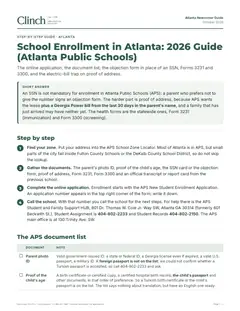
No, an SSN is not mandatory: Atlanta Public Schools (APS) takes a signed objection form from a parent who prefers not to give the number. The harder part is proof of address, because APS wants the lease plus a Georgia Power bill from the last 30 days in the parent's name, and a family that has just arrived may have neither yet. The health forms are the statewide ones, Form 3231 and Form 3300.
Steps, documents and official links
- Find your zone. Put your address into the APS School Zone Locator to see which school you are assigned to. Most of Atlanta is in APS, but small parts of the city fall inside Fulton County Schools or the DeKalb County School District, so do not skip the lookup.
- Gather the documents. What is asked for: the parent's photo ID, proof of the student's age, the SSN card or the objection form, proof of address, immunization records (Form 3231), the screening certificate (Form 3300) and an official transcript or report card from the previous school.
- Complete the online application. Enrollment starts with the APS online New Student Enrollment Application. An application number appears in the top right corner of the form; write it down.
- Call the school. With that application number you call the school for the next steps. For help with registration and records there is the APS Student and Family Support HUB, 601 Dr. Thomas W. Cole Jr. Way SW, Atlanta GA 30314 (formerly 601 Beckwith St.). Student Assignment is 404-802-2233 and Student Records 404-802-2150. The APS main office is at 130 Trinity Ave. SW.
The APS document list
| Document | Detail |
|---|---|
| Parent ID | Any valid government-issued photo ID: a state or federal ID (the free Georgia Voter ID card included), a Georgia driver's license even if expired, a government employee photo ID, a valid U.S. passport, a U.S. military photo ID or a tribal photo ID. A foreign passport is not on the list; we could not confirm whether a Turkish passport is accepted, so call 404-802-2233 and ask. If the child lives with a relative, a kinship-caregiver affidavit exists in English and Spanish. |
| Proof of the student's age | In order: a birth certificate or certified copy, a certified hospital birth record, a military ID, a driver's license, the student's passport, an adoption record, a signed religious record, a school transcript, and as a last resort a sworn parent affidavit plus a physician's certificate of age. So a Turkish birth certificate or the child's passport is on the list. The list says nothing about translation, but have an English translation ready anyway. |
| Social Security | The enrolling person provides either a copy of the student's SSN card or the Objection to Provide the Social Security Number form. The number is therefore not mandatory. APS prints one caveat: a student with no SSN on file by 10th grade is not eligible for the HOPE Scholarship. |
| Proof of address | Dated within the last 30 days, showing the parent's name and street address; no P.O. box. Details below. |
| Health | DPH Form 3231 for immunization and DPH Form 3300 for vision, hearing, dental and nutrition screening. |
| Previous school | An official transcript or report card from the previous school. |
Proof of address: the real trap for newcomers
| Your situation | What is required |
|---|---|
| If you own | Photo ID plus the deed or a mortgage statement plus a Georgia Power bill from the last 30 days in your name |
| If you rent | Photo ID plus the lease (or a HUD certificate) plus a Georgia Power bill from the last 30 days in your name |
| If you live with someone else | Photo ID, the owner's or primary renter's deed or lease, a Georgia Power bill, a signed and notarized Affidavit of Residency (a Spanish version exists) and three supporting documents in your own name |
The problem is plain: the electricity bill has to be in the parent's name. A family that has just arrived may have signed the lease but not yet received a Georgia Power bill, or the account may be in the landlord's name because electricity comes with the rent. Three things help: open the account in your own name the day you move in (the electricity section explains how that works without an SSN), start enrollment early so there is time for the first bill to arrive, and if electricity is included in the rent, call 404-802-2233 beforehand and ask which alternative document they accept.
Immunization and screening forms
- Form 3231 (immunization): required for every student including pre-K, and it must be on file within 30 days of the start of the program. A medical exemption goes on the form itself and lasts one year; a separate doctor's letter is not enough. A religious exemption uses the notarized Form 2208. For lost records, there is the Georgia Immunization Registry.
- Form 3300 (screening): the certificate of vision, hearing, dental and nutrition screening, required the first time a child enrolls at any grade level, pre-K included. A physician, a qualified provider or the county health department completes it.
- Statewide rule: the same two forms apply in every Georgia district, and schools may allow up to 90 days to submit them. Tdap and a meningococcal dose are needed at 7th grade entry, and an MCV4 booster at 11th grade for students 16 or older.
- Where to get the shots: county health departments and clinics give childhood vaccinations. If you have no insurance, see the free and low-cost clinics section.
English support and other programs
If a language other than English is spoken at home, the child is referred to APS ESOL and its Title III program, grounded in state law O.C.G.A. 20-2-156 and the WIDA standards. The APS Multilingual Programs and Services office provides interpretation and translation, and board policy (LEBB) requires all school-to-home communication to be in a language parents understand. Contact [email protected]. Adult ESL and GED classes sit under APS Adult Education. APS also runs an Open Enrollment lottery for schools outside your zone, has a page for families without permanent housing, and publishes information about DACA; we could not verify the details of those this round, so ask the school or the HUB.
PDF: School Enrollment in Atlanta: 2026 Guide (Atlanta Public Schools)
12 · Health
Where can I get care in Atlanta if I have no insurance?
Short answer
In a life-threatening emergency call 911 or go to an ER: under the federal EMTALA law an emergency department must screen and stabilize you regardless of your ability to pay or your immigration status. Atlanta's widest door is the Grady Health System financial assistance program, which discounts care for Fulton and DeKalb residents up to 400 percent of the poverty level and accepts a consular ID as photo ID. It does, however, exclude visitor-visa holders.
Steps, documents and official links
What happens in an emergency
The federal EMTALA law of 1986 requires every Medicare-participating hospital with an emergency department to give anyone who asks a medical screening exam and stabilizing treatment, regardless of ability to pay. You are not turned away at the door. The bill is a separate matter: before discharge, ask to speak to the hospital's financial counselor and ask for the financial assistance application.
The Grady Financial Assistance Program
- Who qualifies: residents of Fulton and DeKalb counties with household income up to 400 percent of the federal poverty level. There are two tiers, Tier 1 up to 250 percent and Tier 2 from 251 to 400 percent. People approved for Medicaid are deemed qualified, and if you are eligible for Medicaid or a similar program you are expected to apply for that first.
- What is excluded: elective cosmetic surgery, accounts with unresolved third-party coverage and visitor-visa (B-1 or B-2) holders. That last point matters: a parent or sibling visiting from Türkiye cannot use this program, so do not skip travel health insurance.
- If you live outside Fulton or DeKalb: the program covers only emergency care, related inpatient care and post-discharge follow-up. Non-emergency outpatient care must be paid in full before you are seen.
- Which ID is accepted: a Georgia license or state ID, any consular ID, a photo credit card, a school photo ID, or a visa, green card or other U.S. immigration document. A Turkish consular ID card counts as valid photo ID here.
- Proof of residence: you have to show you have lived in the county for more than 30 days, and a P.O. box is not accepted.
- How to apply: through "Financial Assistance" in MyChart, or by mail to Grady Memorial Hospital, Financial Assistance Program, 80 Jesse Hill Jr. Drive SE, PO Box 26071, Atlanta GA 30303. Counselor appointments (404) 616-6920, Patient Financial Services (404) 616-2991 weekdays 8 a.m. to 4:30 p.m., hospital main line (404) 616-1000.
Grady copays
| Service | Fulton / DeKalb, up to 250% FPL | Fulton / DeKalb, 251-400% |
|---|---|---|
| Outpatient visit | $20 / $30 | $40 / $50 |
| Ambulatory surgery, CT, MRI | $60 / $70 | $80 / $90 |
| Emergency and observation | $100 / $110 | $120 / $130 |
| Inpatient | $200 / $250 | $300 / $350 |
This is a discount at Grady's own hospitals and clinics, not insurance. The policy was revised on March 20, 2026, so check the current figures on Grady's page before you apply.
Children, pregnancy and adults
- Children: income-based Medicaid and PeachCare for Kids cover children under 19 (up to 247 percent of the poverty level, with no premium or copay under age 6). Apply at gateway.ga.gov or on 1-877-427-3224. Since January 1, 2024, lawfully residing children and pregnant women are exempt from the five-year waiting period.
- Adults: Georgia did not adopt the ACA Medicaid expansion for adults. For a low-income adult the only route is Georgia Pathways, which requires 80 hours a month of work, study or volunteering; federal approval runs through December 31, 2026 and the rules change on January 1, 2027. Anyone above the poverty line buys on the state marketplace, Georgia Access: open enrollment for 2027 opens on November 1, 2026, December 15, 2026 is the last day for coverage starting January 1, and the period closes on January 15, 2027. The consumer line is 888-687-1503. We cover the detail in our Georgia guide.
- Hard news for visa holders: under Georgia policy, people in nonimmigrant status such as visitors, students, temporary workers and treaty investors do not qualify even for emergency Medicaid, because they are not treated as passing the state residency test. Grady's program also leaves visitor-visa holders out. For guests arriving from Türkiye, travel health insurance is a genuine necessity.
- A special enrollment right for newcomers: moving to the United States from another country opens a special enrollment period on Georgia Access, and no proof of prior coverage is required, so you do not have to wait for open enrollment.
- Mental health crisis: the 988 line works with interpreters.
Addresses and phone numbers for free and sliding-fee clinics are in the next section, under free and low-cost clinics.
13 · Health
Where can I find free or low-cost clinics in Atlanta?
Short answer
Atlanta has three different things and it matters not to mix them up. A free clinic gives care at no charge and bills no insurance. Federally funded community health centers (FQHCs) charge an income-based fee, so they are not free. Grady's financial assistance program is a hospital discount. The list below follows that split; confirm your eligibility and the cost by phone before you go.
Steps, documents and official links
Why the definitions matter
By the Georgia Charitable Care Network's definitions, a free clinic provides all goods and services at no charge and bills no third-party insurance; a charitable clinic charges a fee or uses a sliding scale and bills no insurance; hybrid clinics work on a free or charitable basis but may bill Medicaid; and an FQHC is a separate federally funded category that bills insurance, Medicare and Medicaid and charges uninsured patients on a sliding scale. Clinics may ask for donations, most serve only uninsured patients and set income limits, and because many run on volunteers their hours can be irregular.
Free (with a voluntary donation)
Physicians’ Care Clinic · Decatur, DeKalb County
This clinic, which operates inside the T.O. Vinson Health Center, provides care at no charge and asks for a voluntary donation; its own page says no one is turned away. The eligibility rules are specific: you must be a DeKalb County resident, 18 or older, uninsured, ineligible for Medicare or Medicaid, with household income at or below 200 percent of the federal poverty level. Appointments are on Tuesday and Wednesday evenings, by appointment only, with no walk-ins. Accepted ID includes a driver's license, a visa, a passport, a green card or a state ID, and you also bring proof of residency (a lease, a utility bill or a letter from your landlord) and proof of income. The clinic does not provide emergency care.
Address: T.O. Vinson Health Center, 440 Winn Way, Decatur GA 30033.
(404) 501-7940 · Become a patient
If you live on the Fulton side, this clinic is not open to you, because DeKalb residency is required. In that case the sliding-fee centers below and Grady's financial assistance program are the options.
Centers with income-based fees (not free)
Mercy Care · Atlanta
Mercy Care describes itself as Atlanta's only FQHC with a dedicated Healthcare for the Homeless program. It accepts insurance, Medicare and Medicaid, and charges uninsured patients on an income-based sliding fee scale. Fees come down with income, but the care is not free. Call to ask about new patients and which services are offered at which site.
(678) 843-8501 · mercyatlanta.org
Southside Medical Center · Atlanta
An HHS-funded community health center. It applies a Sliding Fee Scale for uninsured and under-insured patients based on household income and family size. Its main Atlanta site is at 1046 Ridge Avenue SW. You apply for the sliding scale with proof of income when you register.
404-688-1350 · Paying for services
The hospital discount: Grady
Grady Health System's financial assistance program is not a free clinic. It is an income-based discount at Grady's hospitals and clinics, running up to 400 percent of the poverty level for Fulton and DeKalb residents, accepting a consular ID as photo ID and excluding visitor-visa holders. The detail and the copay table are in the health section above.
Questions to ask before booking
- Are you accepting new patients? Are there age, income, insurance or residency requirements?
- Are visits, lab tests, medications, dental care and outside referrals charged separately?
- Which documents should I bring, and is an interpreter available?
For more options, search the HRSA health center finder; none of the centers on that list is free, as they all work on a sliding scale. For hospital bills and emergency care, see the health care without insurance section.
14 · Marriage
How do I get a marriage license in Atlanta?
Short answer
County probate courts issue the license, and because Atlanta spans two counties you have a choice: in Fulton the fee is $68.50, or $28.50 if you bring a premarital education certificate; in DeKalb it is $66 or $26, and by appointment only. Both applicants must appear in person. There is no blood test, the license does not expire, and the ceremony must take place in Georgia.
Steps, documents and official links
Which county?
If either applicant lives in Georgia, you may apply in any Georgia county, so an Atlanta resident can choose between Fulton and DeKalb. If neither of you is a Georgia resident, you may apply only in the county where the ceremony will take place.
Fulton County Probate Court
- Address: 136 Pryor St SW, Suite C-230 (2nd floor), Atlanta GA 30303. The license line is 404-613-4583 and the main number 404-612-4640. There are also the North Service Center, 7741 Roswell Rd Ste 219, Sandy Springs 30350 (404-613-7638) and the South Service Center, 5600 Stonewall Tell Rd Ste 218, College Park 30349 (404-612-3048).
- A warning: the court's home page carries a notice that the Licensing Division has moved, so the license office may be at a different address. Confirm the current address on the site or by phone before you go.
- Fee: $68.50, which includes one certified copy mailed to you. Bring a certificate from a qualifying premarital education program in hand and the fee drops to $28.50; you cannot produce the certificate later and get a refund.
- Payment: cards are accepted but American Express is not. The annex locations are cashless; cash is taken only at the downtown office.
- Appointments: the court's site explains how to make one, so check before you set out.
- After the ceremony: mail the signed license to Fulton County Probate Court, Attn: License Division, 136 SW Pryor St, 2nd floor C230. Recording can take up to 30 days, and extra certified copies are $10 each.
DeKalb County Probate Court
- Appointment only, in two steps: you complete the online application (a Tyler portal) and then schedule your own appointment.
- Where: marriage licenses are handled at B190 Judicial Tower (basement level) at the DeKalb County Courthouse; the mailing address is 556 North McDonough Street, 1100 Judicial Tower, Decatur GA 30030. Hours are weekdays 8 to 11:30 a.m. and 12:30 to 4 p.m. An older emergency notice still sits on the court's home page, so check the live page.
- Fee: $66 including one certified copy, or $26 with a premarital education certificate, plus $2 shipping and a 2.75 percent card fee (minimum $2). Money orders, Visa, MasterCard and Discover are accepted; personal checks are not. The education program must run at least six hours (O.C.G.A. 19-3-30.1).
- Translation: DeKalb requires documents in another language to come with a certified translator's translation.
What is required
- Both parties in person: both applicants attend with current ID.
- Proof of age: a Georgia license or ID, an original or certified birth certificate (with a certified English translation), a valid passport or a military ID. The minimum age is 17, with emancipation, a 15-day wait and premarital counselling conditions attached.
- A previous marriage: a certified and sealed final divorce decree, annulment or death certificate is required.
- No blood test, and the license does not expire, but it is valid only for a ceremony held in Georgia.
- Waiting period: neither the Fulton nor the DeKalb page mentions one. We do not say Georgia has no waiting period, only that the court pages are silent about it, so confirm with the county before you plan a date.
Changing your name
- Through marriage: the license shows your pre-marriage name, and no court order is needed to change it. The marriage certificate is the legal document: take it to the Social Security Administration first, then to DDS (see the license section; DDS wants name changes reported within 60 days), then to your passport and USCIS filings.
- Through court: a name change outside marriage goes by petition to the Superior Court of the county where you live (O.C.G.A. 19-12-1). Notice runs once a week for four weeks in the county legal organ, there is a 30-day wait and then a hearing; georgia.gov describes the process as taking about five to seven weeks. Each clerk sets its own fees. An older Fulton instruction sheet requires six months of residence in the county before filing, but that document is not current, so ask the clerk. Note that georgia.gov writes this page for a "U.S. citizen or legal permanent resident", so if you are in another status, ask your attorney before filing.
15 · Birth
How do I get a birth certificate for a baby born in Atlanta?
Short answer
The fastest route is a county vital records counter. The Fulton County Board of Health office on Pryor Street and the DeKalb office on Winn Way both take walk-ins and usually print the document on the spot. The fee is $25, which includes one certified copy, and $5 for each extra copy. Mail and online orders through the state office can take up to 10 weeks, so going in person is worth it. The hospital does not order it for you.
Steps, documents and official links
The two county offices in Atlanta
| Office | Address and hours | Fees and notes |
|---|---|---|
| Fulton County Board of Health, Vital Records | 141 Pryor Street, Suite 1029A (Fulton County Government Center), Atlanta GA 30303; weekdays 8 a.m. to 4:30 p.m., walk-in. Also College Park Regional Health Center, 1920 John Wesley Ave, College Park 30337, and Health and Human Services North, 4700 North Point Parkway, Alpharetta 30022. Phone 770-520-7500. | The $25 search fee includes one certified copy; extra copies $5. Cash, certified check, money order, Visa and MasterCard are accepted; American Express is not. Most records print on demand, a few take up to 72 hours. Any birth or death registered in Georgia can be printed here. |
| DeKalb County Vital Records | Richardson Health Center, Suite 191, 445 Winn Way, Decatur GA 30030; weekdays 8:15 a.m. to 4:30 p.m. Phone (404) 294-3857. | $25 search fee (a multi-year search covers three years), extra copies $5, online orders add $5. Accepted ID includes a foreign passport, a Resident Alien Card and a matricula card, so a Turkish passport is explicitly on the list. For a newborn you wait two weeks. |
The most useful difference between the two offices is the ID list: DeKalb names a foreign passport. If a Turkish passport is the only ID you hold, the DeKalb office is the safer choice.
The state office (State Office of Vital Records)
- Fees (the page was updated on March 11, 2026): a birth certificate is $25 plus $5 for each extra copy; a death certificate $25 plus $5; a marriage certificate $10 plus $5; an amendment $10 plus the cost of the certificate, with corrections within the same year free.
- Online and mail: online orders go through the state ROVER system at $25 plus an $8 processing fee, and FedEx expedited delivery is $16 (that shortens delivery only, not processing). Processing for mail and online orders can run up to 10 weeks.
- Payment: personal checks are not accepted, and walk-in service takes cash only.
- Who may order: the person named, a legal spouse, parents named on the record, grandparents, adult children, adult siblings and a legal guardian or representative. A physical photo ID is required; digital IDs are not accepted. The state form asks for the requester's SSN, so if you do not have one, call the county office and ask what alternative they accept.
- Amendments: State Office of Vital Records, 1680 Phoenix Boulevard, Suite 100, Atlanta GA 30349. Customer line (404) 679-4702.
Practical notes
- At the hospital: you sign the birth registration form there, but the first certified copy is not free and the hospital does not order it for you. You have to request it yourself.
- Ask for at least two copies: one stays with the U.S. passport application and one goes off for the apostille for use in Türkiye. At $5 an extra copy, taking a few usually makes sense.
- Apostille: a certified copy is required for an apostille. In Georgia the apostille comes not from the Secretary of State but from the Georgia Superior Court Clerks' Cooperative Authority, at $3 per document (see apostille).
- The baby's SSN: a separate process, covered in the SSN section.
- Vaccinations: county health departments give childhood immunizations; if you have no insurance, see the clinics section.
16 · Social Security
How do I get a Social Security number in Atlanta?
Short answer
SSNs are issued only to people with work authorization or a legally required reason. If you asked for an SSN in your immigrant visa application, the card is mailed to you. People who adjust status with Form I-485, and EAD applicants who checked the SSN box, also get the card automatically. Otherwise you start online and visit an SSA office by appointment; it is free. National line: 1-800-772-1213, weekdays 7 a.m. to 7 p.m.
Steps, documents and official links
- Your ZIP code decides which office you belong to, not the distance. SSA's Georgia list shows Atlanta Downtown, Atlanta West and Decatur for the metro area. The Atlanta Downtown office is in the Peachtree Summit building: Suite 2860, 401 W Peachtree St NW, Atlanta GA 30308. We could not verify the street addresses of the Atlanta West and Decatur offices from a current official source this round, so we are not printing them; check the address and whether you need an appointment with the SSA office locator before you go.
- What to bring: current immigration documents (green card, I-94 or EAD) with a valid passport, and a birth certificate if you have one. No photocopies or notarized copies. SSA suggests waiting a few days after arrival so DHS records can be verified.
- Appointments: SSA recommends booking one. Without an appointment the office may not be able to see you the same day. The Peachtree Summit building is about a block from the MARTA Civic Center station, so you can reach the downtown office by train.
- F-1 and J-1: an SSN is available only once you are authorized to work (on-campus job, CPT, OPT), not just for enrolling in school.
- Lost card: free, and in most cases the request can be started online.
What can I do in Atlanta without an SSN?
- Driver's license: Georgia asks applicants who are not eligible for an SSN to file form DDS-351. A missing SSN does not make a license impossible, but it adds a form and a document chain. See the driver's license section.
- School enrollment: an SSN is not required to enroll your child in school. See the school enrollment section.
- Marriage license: the Fulton and DeKalb probate courts accept a valid passport as proof of age and identity, and both parties must appear in person. See the marriage license section.
- Taxes: people who must file but cannot get an SSN use an ITIN (see the tax section below).
- Homestead exemption: Fulton County asks homeowners for a Georgia driver's license or Georgia ID card, so if you bought a home in Atlanta it makes sense to finish the license first. See the property tax section.
- Energy assistance (LIHEAP): this program does require an SSN, for every member of the household, and the page offers no ITIN alternative. See the public benefits section.
Two IRS offices in Atlanta review ITIN documents in person, both by appointment. Their addresses and the booking line are in the tax section below.
17 · Taxes
What taxes do I pay in Atlanta, and how do I get an ITIN?
Short answer
Atlanta has no city income tax. Georgia's flat state income tax is 4.99 percent for tax year 2026, with a standard deduction of $15,000 single and $30,000 married filing jointly, and the state return is Form 500, due April 15. The sales tax is high instead, at 8.9 percent inside the city limits. If you must file but cannot get an SSN, apply for an ITIN with Form W-7.
Steps, documents and official links
Which taxes exist in Atlanta?
- State income tax: a flat 4.99 percent for tax year 2026, down from 5.19 percent in 2025. The cut came with HB 463, signed on May 11, 2026, and the law provides for further annual reductions. The 3.99 percent figure you may see in summaries is the long-run floor in the bill, not the 2026 rate. Check the current position on the Georgia Department of Revenue tax updates page.
- No city income tax: the city raises money through property tax, local sales tax, vehicle taxes, franchise fees and the business occupation tax. If you are moving from New York City or Philadelphia, that line disappears from your pay stub.
- Two returns: unlike Texas and Florida, Georgia has you file a state return (Form 500) alongside the federal return (Form 1040). Both are due April 15.
| Where | Sales tax (October 1, 2026) |
|---|---|
| Atlanta city limits (Fulton side) | 8.9 percent |
| Atlanta city limits (DeKalb side) | 8.9 percent |
| Fulton County outside Atlanta | 7.75 percent |
| Hapeville, College Park, East Point | 8.75 percent |
| DeKalb County outside Atlanta | 8 percent |
| Cobb and Gwinnett | 6 percent |
| Clayton | 8 percent |
| Cherokee and Forsyth | 7 percent |
The state share is 4 percent and the rest is local: MARTA, LOST, education and T-SPLOST. Alpharetta, Johns Creek and Roswell sit in the part of Fulton County outside Atlanta, so 7.75 percent. The current chart is on the Department of Revenue sales tax page.
Property tax and vehicles
- 2026 was an unusual year in Atlanta: because the tax digest was delayed, Fulton County issued temporary bills under a court order of August 4, 2026, using 2025 millage rates. City of Atlanta property taxes were due September 30, 2026, and Fulton County and the other jurisdictions October 15, 2026. If a bill did not reach you, call the Fulton County Tax Commissioner on 404-613-6100. A corrected bill is possible once the final rates are set.
- Homestead exemption: if you bought a home, the deadline is April 1 and the application goes to your county Board of Assessors. See the property tax section.
- Vehicles: new residents pay a 3 percent title ad valorem tax instead of 7 percent. See the car registration section.
How do I get an ITIN?
- Complete Form W-7 and attach it to your federal return unless an exception applies.
- Get documents verified. Mail originals to the IRS in Austin, use a Certifying Acceptance Agent (CAA), or book an appointment at an IRS office that reviews ITIN documents. With a CAA or an IRS office, your passport does not go in the mail; documents are returned at the end of the appointment.
- Wait. Processing takes about 7 weeks, or 9 to 11 weeks during tax season (January 15 to April 30).
- IRS offices in Atlanta: the IRS list shows two Atlanta offices that review ITIN documents in person: Atlanta-Summit Building (401 W. Peachtree St NW) and Atlanta-Woodcock (2888 Woodcock Blvd). We read those street addresses from the list's summary text, so confirm the address and floor with the IRS office locator before your appointment.
- Appointments: IRS offices work by appointment only, on 844-545-5640, and it can take several weeks to get one.
- Expiration: an ITIN not used on a federal return for three years in a row expires.
18 · Starting a business
How do I start an LLC in Atlanta, and what does a business license require?
Short answer
An LLC is formed with the Secretary of State's Corporations Division on Form CD 030: a $100 filing fee plus a $10 service charge, with a $50 annual registration (plus $10) due between January 1 and April 1. The decisive step is not the company but the license: an Atlanta Occupational Tax Certificate requires a notarized SAVE affidavit and an E-Verify affidavit. People who are not lawfully present cannot sign that affidavit.
Steps, documents and official links
Who can get an Atlanta business license?
Georgia makes the SAVE check mandatory for every agency that issues a business license. On the notarized SAVE affidavit in the city's application, the applicant checks one of two boxes: being a U.S. citizen or lawful permanent resident aged 18 or over, or being a qualified alien or a nonimmigrant lawfully present in the U.S. (the second box also asks for your alien number). A copy of a government photo ID goes with it.
- Who can sign: citizens, green card holders, people who count as qualified aliens such as refugees and asylees, and nonimmigrants here in lawful status, for example E-2 or H-1B holders.
- Who cannot: anyone without lawful presence. In that case an Atlanta business license is not available.
- A separate question: being able to sign for the license does not mean you may work in the business. An E-2 investor can work in their own company; F-1 and H-1B holders generally cannot be self-employed. That is an immigration-law question, not a licensing one.
- E-Verify affidavit: private employers with 11 or more employees must be registered with E-Verify and give their user number on a notarized affidavit. Employers with fewer than 11 file an affidavit claiming the exemption. A prior-year affidavit is not accepted; a new one is filed every year.
Step by step
- Form the LLC: Articles of Organization (Form CD 030) are filed with the Secretary of State through eCorp. The fee is $100 plus a $10 service charge, and annual registration is $50 plus $10. The Secretary of State's fee schedule PDF is closed to automated access, so confirm these figures in eCorp before you pay.
- Trade name (DBA): if you do business under a name other than your own, you register it not with the state but with the Clerk of Superior Court of the county where the business is (O.C.G.A. 10-1-490). In Fulton County that is 136 Pryor Street, Suite C155, Atlanta GA 30303, phone (404) 613-5313; Fulton's fee schedule shows $175 for the filing, which is high for a Georgia county. If your business is on the DeKalb side, file with the DeKalb Clerk of Superior Court and check its own fee.
- Business license: every business inside the Atlanta city limits must hold an Occupational Tax Certificate, and it is not transferable. Applications, renewals and payments go through the ATLBIZ portal. Mailing address: City of Atlanta Business License, P.O. Box 932053, Atlanta GA 31193-2053.
- The tax itself: a flat $50 on the first $10,000 of gross receipts, plus a rate set by business tax class (Atlanta Code section 30-62), plus $25 per employee (the first employee is exempt). Payment is by card or ACH, with no installment plans. Operating without a certificate draws a citation.
- Renewal: every year, with last year's gross receipts, employee count and financial documents, plus a fresh SAVE and E-Verify affidavit.
| Item | Where | Cost |
|---|---|---|
| LLC filing (CD 030) | Secretary of State, Corporations Division | $100 + $10 service charge |
| Annual registration (Jan 1 to Apr 1) | Secretary of State | $50 + $10 service charge |
| Trade name (DBA) | County Clerk of Superior Court | $175 on Fulton's schedule |
| Atlanta business license | ATLBIZ (City of Atlanta Office of Revenue) | $50 on the first $10,000 + class rate + $25 per employee |
| SAVE affidavit | Part of the license application | Must be notarized |
| E-Verify affidavit | Part of the license application | Registration required at 11+ employees |
19 · Public benefits
Can immigrants in Atlanta get food assistance, Medicaid or PeachCare?
Short answer
Georgia has not adopted the ACA Medicaid expansion for adults. As of October 1, 2026 the only route for low-income adults is Georgia Pathways, which asks for 80 hours a month of work, study or volunteering. Children have Medicaid and PeachCare for Kids, and lawfully residing children and pregnant women are exempt from the five-year wait. Visitor and student visa holders cannot get Medicaid at all. Apply at gateway.ga.gov.
Steps, documents and official links
Children
- Children's Medicaid: through the end of the month of the 19th birthday, with no resource test and income limits that vary by age.
- PeachCare for Kids: uninsured children under 19 in families between 134 and 247 percent of the federal poverty level. Premiums start at $11 a month for one child and reach $36 in the top band, with a family cap of $16 to $72. There is no premium or copay for children under 6, foster children or American Indian and Alaska Native children. You have 45 days to pay the first premium, and after that first payment coverage is not lost for non-payment.
- Status: both Medicaid and PeachCare require a Medicaid-qualifying citizenship or immigration status. Since January 1, 2024, lawfully residing children under 19 and pregnant women are exempt from the five-year bar, and Georgia keeps that option.
- Apply: gateway.ga.gov or 1-877-427-3224.
Adults
- Georgia Pathways to Coverage: ages 19 to 64, income up to 100 percent of the poverty level ($15,960 a year for one person in 2026), U.S. citizen or, in the state's words, a legally residing noncitizen, not eligible for another Medicaid category, and 80 hours a month of work, community service, education or job training. Since October 1, 2025 that activity is documented at application and at annual renewal rather than every month.
- How long Pathways lasts: the temporary extension CMS approved runs through December 31, 2026. From January 1, 2027, H.R. 1 renames the condition a community engagement requirement, adds monthly income of at least $580 as an alternative, and changes the exemption list (parents and caregivers of a child 13 or under, pregnancy and the postpartum period, the medically frail, veterans and others). Keep proof of your activities from December 2026 onward. Current members are not affected until their 2027 renewal.
- The gap: an adult who is not a parent, not pregnant, not disabled and cannot meet the 80 hours has no public coverage. Traditional parent and caretaker Medicaid stops at roughly $310 a month for a household of one. Above the poverty line the route is the state's own marketplace, Georgia Access; we cover it in the health section.
- Emergency Medicaid (EMA): people who meet every Medicaid requirement except status and SSN can get Medicaid for the treatment of an emergency medical condition only. Labor and delivery count; routine prenatal and postpartum care and organ transplants do not. A physician has to certify the condition, and EMA is not approved in advance of an emergency.
- Nonimmigrants: visitors, students, temporary workers and treaty traders and investors do not meet Georgia's residency requirement, so they are ineligible for Medicaid, emergency Medicaid included.
What Atlanta actually offers
- Grady Health System's financial assistance: open to Fulton and DeKalb residents with household income up to 400 percent of the poverty level. Alongside a Georgia license it accepts a consular ID card, a passport, a visa or a green card as photo identification, plus proof of 30 days of residence (a PO Box is not accepted). B-1 and B-2 visitor visa holders are excluded. Residents outside Fulton and DeKalb get help only for emergencies and related treatment. Counselor appointments (404) 616-6920; Patient Financial Services (404) 616-2991. See the health section.
- LIHEAP (energy assistance): the applicant must be a U.S. citizen or a lawfully admitted immigrant, and a Social Security number is requested for every member of the household, with no ITIN alternative on the page. You do not apply online; you book an appointment with the Community Action Agency for your county: Fulton Atlanta Community Action Authority (341 Kelly St, Atlanta GA 30312) for Fulton, and Partnership for Community Action (3597 Covington Hwy, Decatur GA 30032) for DeKalb. One heating and one cooling benefit per year.
- SNAP (food assistance): under federal law, since July 4, 2025, SNAP is limited to U.S. citizens, green card holders and a few other statuses. Refugees and asylees no longer qualify on that status alone; once they get a green card they qualify without the five-year wait. U.S.-citizen children in the household may still receive benefits in their own right.
The federal change on October 1, 2026
Section 71109 of Public Law 119-21 limits federal Medicaid and CHIP matching funds, from October 1, 2026, to citizens, lawful permanent residents, Cuban and Haitian entrants and COFA migrants. Categories such as refugees and asylees fall outside that federal funding. According to CMS, emergency medical conditions and the state option for lawfully residing children and pregnant women are not affected. Georgia's own policy manual had not been updated as these lines were written, so check your own situation through Gateway or on 1-877-427-3224 before you apply.
The public charge rule
- September 18, 2026 and after: for green card applications filed on or after that date, officers may consider any means-tested benefit (SNAP, Medicaid, housing assistance and others) received on or after that date. Benefits received earlier count only if they were cash assistance or long-term institutional care. Benefits received by family members, such as a child in their own right, are generally not counted.
- Who is exempt: humanitarian categories such as asylees and refugees, T and U visa holders, VAWA self-petitioners and TPS. Family-based, most employment-based and diversity visa applicants are subject to it.
- The state's own warning: the official Pathways page says enrolling may or may not make a person a public charge, and tells applicants to contact USCIS first.
20 · Address change
I moved to Atlanta. Do I have to report my address to USCIS?
Short answer
As a general rule most noncitizens, green card holders included, must report a new address to USCIS within 10 days of moving. The easiest way is the change-of-address screen in your USCIS online account; the paper Form AR-11 is free too. If you have a case in immigration court, you also file Form EOIR-33 with the court within 5 days. Moving within the metro, or out to Decatur, counts.
Steps, documents and official links
- Sign in to your USCIS account and open the Change of Address screen. Filing online satisfies the legal duty, and you do not also need to mail a paper AR-11.
- Enter the receipt number of every pending case. Otherwise letters can still go to the old address.
- Tell USPS separately. A post office change of address does not update USCIS records, and USPS does not forward USCIS mail.
- If you have a court case, file Form EOIR-33/IC within 5 days. The court changes an address only with that form. Atlanta has two immigration courts in two different buildings, so make sure the form goes to the court that holds your case.
- If you have an ICE reporting obligation (for example a check-in condition imposed on release), also update your address with ICE through the ICE Portal.
Holders of A and G visas and visitors who enter under the Visa Waiver Program are outside the USCIS reporting requirement.
21 · USCIS
Where is the USCIS office in Atlanta, and where do I go for biometrics?
Short answer
Atlanta has one USCIS field office and one Application Support Center (ASC), and they are in different buildings. Interviews happen at the field office on Parklake Drive, biometrics at the center on Chamblee Tucker Road. Asylum interviews are handled by the Atlanta Asylum Office in the Peachtree Summit building. The field office takes no walk-ins, so always go to the address and time on your appointment notice.
Steps, documents and official links
| Office | Address | What happens there |
|---|---|---|
| USCIS Atlanta Field Office | 2150 Parklake Drive NE, Atlanta GA 30345 (we could not confirm this address directly on the official page, so rely on your appointment notice) | Green card and citizenship interviews, by appointment only |
| Atlanta Application Support Center (ASC) | 3358B Chamblee Tucker Road, Atlanta GA 30341 | Biometrics (fingerprint) appointments |
| Atlanta Asylum Office | Peachtree Summit Federal Building, 401 W. Peachtree Street NE, Atlanta | Asylum interviews |
- Why we hedge the address and leave out the hours: the USCIS office pages were closed to automated access this round. We are not printing office hours for that reason. Whichever office you are called to, the address, floor and time are on your I-797C notice. You can also search the offices in the USCIS office list.
- Three offices, three locations: the field office is on Parklake Drive east of the I-85 corridor, the support center on Chamblee Tucker Road, the asylum office downtown. Treat the address on your notice as its own place; there is no single building called USCIS Atlanta.
- Getting there: the Peachtree Summit building is about a block from the MARTA Civic Center station. Driving to the ASC, the center is on the right after the Chamblee Tucker Road exit; if you see Buckeye Road you have gone about a tenth of a mile too far. For Parklake Drive and Chamblee Tucker Road a car or a ride is the practical option.
- Appointments and questions: the USCIS Contact Center on 800-375-5283 (TTY 800-767-1833), or request an appointment online. Appointments are free.
- Biometrics: you do not choose the center; it is on your I-797C notice. If the center closes, the appointment is rescheduled automatically. To reschedule yourself, use your USCIS online account or the Contact Center. We wrote about what to bring in our biometrics appointment article.
- Processing times: on the USCIS processing times page, pick the form, the category and Atlanta as the office. The figures are updated monthly.
- Asylum applications: Form I-589 is not handed in at the asylum office; it goes through the filing route USCIS sets. The asylum office does not discuss cases by phone, so call the Contact Center.
If you are coming from elsewhere in the state, this is worth knowing: we could not confirm a separate USCIS field office or support center in Savannah, Augusta or Macon this round, so Georgia appointments in practice come to Atlanta. For statewide detail, see our Georgia guide.
22 · Court
Where is the immigration court in Atlanta, and how do I check my case?
Short answer
Atlanta has two immigration courts and they are in two different buildings: 180 Ted Turner Drive SW, Suite 241, and 401 W. Peachtree Street, Suite 2600, in the Peachtree Summit building. Detained cases go to the Stewart court inside the detention center in Lumpkin. Your hearing notice decides which court and courtroom. Check your case with your A number through EOIR's online system (ACIS) or on 1-800-898-7180.
Steps, documents and official links
| Court | Address | Phone and email |
|---|---|---|
| Atlanta - Ted Turner Drive | 180 Ted Turner Drive SW, Suite 241, Atlanta GA 30303 | 404-653-2140, [email protected] |
| Atlanta - W. Peachtree Street | Peachtree Summit Federal Building, 401 W. Peachtree Street, Suite 2600, Atlanta GA 30308 | 404-554-9400, [email protected] |
| Stewart (detained cases) | Inside Stewart Detention Center, 146 CCA Road, PO Box 248, Lumpkin GA 31815 | 229-838-1324, [email protected] |
- Two courts, two buildings: the addresses are in the same city but not the same place, more than two miles apart. Read the address and the suite number on your notice again the day before your hearing; going to the wrong building can mean missing it.
- Hours: all three courts are open weekdays 8 a.m. to 4:30 p.m., with window filing until 4 p.m., closed on federal holidays.
- Transit and parking: the Ted Turner Drive court is about a block from the MARTA Garnett station, with metered parking nearby. The W. Peachtree Street court is about a block from Civic Center station. The Stewart court in Lumpkin has free on-site parking, but the building is a DHS-controlled detention facility southwest of Atlanta and a long drive.
- Hearings are open to the public: no advance notice is needed to observe. If you want to see a courtroom before your own first hearing, you can.
- Checking online: ACIS needs only your A number (A plus 8 or 9 digits). The official information is still the hearing notice; the system can be slow to show new dates.
ICE Atlanta and check-ins
- ICE ERO Atlanta Field Office: 180 Ted Turner Dr. SW, Suite 522, Atlanta GA 30303, phone (404) 893-1290. Its area of responsibility is Georgia, North Carolina and South Carolina, so three states are handled from this one office.
- Same building, different floor: the Ted Turner Drive court is in Suite 241 and the ICE ERO office is in Suite 522 of the same building. Going to a hearing and going to an ICE check-in are not the same thing; read the suite number on your letter.
- Check-in: ICE's own page gives this office as the reporting location for Georgia and lists appointment times as Tuesday to Thursday, 8 a.m. to 3 p.m. If you have a check-in obligation, speak with your attorney before you go.
- Detention: Stewart Detention Center in Lumpkin; the detainee message line is (229) 838-5000 and the immigration court information line 1-800-898-7180.
Where do I find my I-94, and what if it is wrong?
You can download the I-94 for your latest entry from CBP's site. Mistakes made at entry (wrong visa class, wrong name, wrong period of admission) are corrected by CBP's Deferred Inspection office. The Atlanta office is in the Hartsfield-Jackson airport area: 157 Tradeport Drive, Suite C, Atlanta GA 30354, phone (404) 675-1239, email [email protected]. Hours are Tuesday to Thursday 7:30 a.m. to 3:30 p.m.; conviction and court-judgment records are handled only on Wednesdays from 8 a.m. to 2 p.m. The office corrects only errors made at entry, so call before you go.
23 · State law
Can Atlanta shield immigrants from federal enforcement?
Short answer
No, and the reason is state law rather than city policy. O.C.G.A. 36-80-23 bars a local government from adopting a "sanctuary policy", and HB 1105, in force since May 2024, added a criminal penalty for breaking that ban and a status check within 48 hours of any jail booking. Atlanta describes itself as a welcoming city, but that cannot carry the legal effect the Cambridge or Evanston ordinances have. More to the point, a person arrested by Atlanta police is booked into a county jail run by the Fulton or DeKalb sheriff, and the 48-hour duty bites exactly there.
Steps, documents and official links
The city's stance does not reach the booking desk
Do not miss this distinction: the statute puts the 48-hour check and the duty to honor a detainer on the custodial authority, and at a county jail that authority is the sheriff. Once someone stopped by Atlanta police is booked into the county jail, the process runs on the sheriff's duties whatever the city's own policy says. So do not expect living in Atlanta to put you in a different legal position from living in a neighboring suburb.
What the law does, in brief
- The ban: O.C.G.A. 36-80-23 forbids policies that stop local officials from complying with a detainer notice or from sharing status information with federal officials. Its definition of a local governing body separately names a school district, a sheriff's office and a law enforcement agency.
- The penalty: a knowing and willful violation is punished as for a misdemeanor, a repeat as a misdemeanor of a high and aggravated nature, with state funding withheld and a certificate of compliance required as a funding condition.
- 287(g): O.C.G.A. 35-1-17 gives a local agency a duty to apply every year in which no agreement is in effect, so today's list of agreements is not a permanent picture.
- 48 hours: O.C.G.A. 42-4-14 requires a reasonable effort within 48 hours, for anyone booked into a county or municipal jail for any period however short, to determine nationality and lawful presence. Where the person's own documents do not settle it, a query goes to the Law Enforcement Support Center at DHS.
- The document list: a state license or ID from the approved list, a Form I-94, a permanent resident card (Form I-551), a valid Nexus or Global Entry card, or a valid passport showing US citizenship, an issued visa, or citizenship of a visa waiver country. Turkey is not in the Visa Waiver Program, so a Turkish passport meets that item only together with a visa record.
- What must be told to you: where a detainer exists, O.C.G.A. 42-1-11.5 requires both compliance with it and that the person be told they are being held under it.
- The consulate: the statute frames confinement as complying with Article 36 of the Vienna Convention on Consular Relations. If you are a Turkish citizen you can ask that the consulate be notified.
The full breakdown with official source links is in the same section of the Georgia state guide.
24 · Voting and jury duty
I'm not a citizen. Can I register to vote in Atlanta, and what if I get a jury summons?
Short answer
Registering and voting are for U.S. citizens only, green card holders included. A jury summons is different: Georgia builds its statewide jury list from Department of Driver Services license and ID records plus the voter list, so a lawfully present license holder can be summoned. Tell the county jury office right away and never ignore it. On a license application, read the voter registration section and tick Opt-Out.
Steps, documents and official links
- The jury list is more than the voter roll: Georgia law builds one statewide master jury list. It combines DDS records for everyone aged 18 or over who holds a license or personal ID card with the Secretary of State's list of registered voters, and each county clerk then draws names from its own county list at random (O.C.G.A. 15-12-40.1). So a lawfully present noncitizen with a Georgia license can be summoned without ever registering to vote. People without lawful status cannot get a Georgia license, so they do not enter the list that way. A summons is not evidence that anyone made a mistake.
- Which court the summons comes from: most of Atlanta is in Fulton County and part of it is in DeKalb County. A summons comes from the court of the county you live in, and it can also come from federal court. The heading on the letter tells you which, and who to call.
- Jurors have to be citizens: Fulton County Superior Court lists the qualifications as being a U.S. citizen, 18 or older, a resident of the county for at least 6 months, and not a convicted felon whose voting rights have not been restored. If you do not qualify, notify the county jury office as soon as possible: the Fulton County Jury Clerk on 404-612-4600, 185 Central Avenue SW, Suite T-7000, Atlanta (Jury Duty). Gwinnett County, as another example, gives [email protected] and 770-822-7170 (Jury Services). The procedure varies by county, so follow the instruction printed on your summons. Never ignore the letter or throw it away.
- The trap on the license application: DDS says every license and ID application has a voter registration section. It tells you that your information will be used for voter registration unless you tick the Opt-Out box (DDS Drivers Manual, Section 4). As the form words it, signing that section is a sworn statement, under penalty of perjury, that you are a U.S. citizen. If you are not a citizen, read that part, do not sign it, and tick Opt-Out.
- A license does not give you the vote: a Georgia license or ID card is an identity document and has nothing to do with voter eligibility. The requirements for registering are in the Secretary of State's guide to registering to vote, and the first one is U.S. citizenship.
- The penalty is heavy: registering while knowing you do not have the qualifications the law requires, or knowingly giving false information when registering, is a felony in Georgia, punishable by one to ten years in prison or a fine of up to $100,000, or both (O.C.G.A. 21-2-561). The Secretary of State announced in 2024 that it checks voter rolls against DDS records and the federal SAVE system. Registering or voting without citizenship can also have serious immigration consequences (USCIS Policy Manual).
- Do not fill out voter registration forms handed out door to door or at events, even if a campaign worker tells you it is fine.
- Scams: courts do not ask for a Social Security number by phone or email and do not demand a fine or bond payment over the phone. If you get a call like that, hang up and call the court yourself on the official number printed on your letter.
If you have just naturalized: to register you must be a U.S. citizen living in Georgia and in your county, at least 17 and a half to register and 18 to vote. Online registration needs a valid DDS license or ID. Check the details and the deadlines in the Secretary of State's guide or with your county election office.
25 · New citizens
I just became a citizen. How do I get a U.S. passport in Atlanta?
Short answer
A first U.S. passport is applied for in person on Form DS-11: you take the original of your citizenship document to an acceptance facility. In Atlanta the usual one is the Fulton County Clerk of Superior and Magistrate Courts. The acceptance fee is $35 per application and it is payable by cash or money order only, with no credit or debit cards. An adult passport book is another $130.
Steps, documents and official links
Fulton County Clerk offices
| Office | Address | Hours and payment |
|---|---|---|
| Downtown | 136 Pryor Street, Suite C155 J2-101, Atlanta GA 30303, (404) 613-5313 | Weekdays 8:30 a.m. to 5 p.m.; appointments to 4:30, last walk-in 4:45. Cash or money order |
| North Service Center | 7741 Roswell Rd, Suite 253, Atlanta GA 30350 | Money order only |
| South Service Center | 5600 Stonewall Tell Rd, Room 219 Suite B, College Park GA 30349 | Appointments to 4 p.m., last walk-in 3:45; closed 1 to 2 p.m. Money order only |
- Cards are not accepted for the $35 execution fee. Downtown takes cash or a money order; the North and South service centers take a money order only. Bringing a money order from home is the safest plan.
- What they handle: first-time adult applicants, children under 16, lost, stolen or damaged passports, and passports issued before age 16 or more than 15 years ago. If you qualify, a renewal goes by mail and needs no acceptance facility.
- Two separate payments: the $35 acceptance fee goes to the clerk of court, the passport fee to the State Department.
- Appointments: the Fulton Clerk books through its own appointment system. For post offices and other acceptance facilities use the passport acceptance facility search; on the DeKalb side of the city a closer facility may come up.
- What to bring: the original of your naturalization certificate and your photo ID.
| Fee | State Department | Acceptance fee |
|---|---|---|
| Adult passport book | $130 | $35 |
| Adult passport card | $30 | $35 |
| Adult book and card | $160 | $35 |
| Book, under 16 | $100 | $35 |
| Card, under 16 | $15 | $35 |
| Expedited service | +$60 | - |
- Urgent travel: you have to document travel within 14 days, or the need for a foreign visa within 28 days. Passport agencies work by appointment only.
- Atlanta Passport Agency: there is a passport agency in Atlanta, but we could not open its official page this round. Take the address and the hours from your appointment confirmation, not from third-party listings online.
- Appointments are free: book through the online appointment system or on 877-487-2778. Sites that charge for an appointment are scams.
Not sure about a step?
Ask before you do something that touches your immigration status
Applying for a benefit, changing your address, registering to vote or answering a jury summons can all show up in your file. You can speak with Attorney Asim Clinch, a Turkish-speaking immigration attorney serving clients in Atlanta, in English or Turkish.
26 · Things to do
What are the places to visit in Atlanta?
Short answer
Start with the Atlanta BeltLine: walking and cycling trails built on an old rail corridor, and free. Midtown has the High Museum of Art, the Centennial Park area has the Georgia Aquarium and Grant Park has Zoo Atlanta. Families with children have Fernbank and the Children's Museum. Out of town there is the Chattahoochee River national recreation area and Stone Mountain Park in DeKalb, with the north Georgia mountains and Savannah as day trips.
Steps, documents and official links
| Place | Area | What is there | Admission |
|---|---|---|---|
| Atlanta BeltLine | Eastside and Westside | Walking and cycling trails built on an old rail corridor. The Eastside Trail runs 2.4 miles (Monroe Drive near Piedmont Park to the Krog Street Tunnel), the Westside Trail 3.2 miles (I-20 to W Marietta Street). Along the way are what the project calls the largest free public art exhibition in the Southeast, and free fitness events. The full 22-mile loop is planned for 2030. | Free |
| High Museum of Art | Midtown | The largest art museum in the state. Free for everyone on the second Sunday of the month (UPS Second Sunday), noon to 5 p.m., and free for adults on the third Wednesday under Access for All. | Regular adult ticket around $23.50 (ages 6 and up), under 5 free; check the price on the official site |
| Georgia Aquarium | Centennial Park area | One of the largest aquariums in the country. Georgia residents get a discount on entry after 4 p.m., and holders of a SNAP or eWIC EBT card get a discounted ticket seven days a week. | Ticketed, fixed-date tickets from $54.99; 2 and under free |
| Zoo Atlanta | Grant Park | The city zoo. With a SNAP/EBT or WIC card and photo ID, tickets are $9 plus tax per person, up to 6 at a time. | Regular adult (12+) $39.95, child (3-11) $31.95; under 3 free |
| Fernbank Museum of Natural History | DeKalb County, east of the city | Natural history museum with a giant screen theatre, the WildWoods outdoor play area and Fernbank Forest. Open daily 10 a.m. to 5 p.m. | Weekday adult $25.95, child (3-12) $23.95; weekend $27.95 and $25.95 |
| Atlanta History Center | Buckhead | A museum, historic houses and gardens on 33 acres. | Weekday adult $31, ages 4-12 $27; weekend $35 and $31; ages 0-3 free |
| Children's Museum of Atlanta | Downtown | A hands-on museum aimed at preschool and early school age. SNAP EBT cardholders get $5 tickets for up to four people, and there are four Family Free Days a year. | Regular child (1-18) $19.95, adult $21.95; under 1 free |
| Atlanta Botanical Garden | Midtown, next to Piedmont Park | The city botanical garden. Scarecrows in the Garden in autumn, and the Garden Lights display in November and December. | Ticketed, varies by event date |
| Chattahoochee River National Recreation Area | North metro Atlanta | Linked national park units along the river: hiking trails, paddling and riverbank. Kennesaw Mountain National Battlefield Park has the same fee structure. | $5 per vehicle per day, $40 annual; no cash accepted |
| Stone Mountain Park | DeKalb County, east of the city | A large park with a year-round events calendar: Scottish games and a pumpkin festival in October, a light display from November to January. | Parking and event tickets are separate; check the official site |
| Helen | North Georgia mountains (day trip) | A town built to look like an Alpine village, known for its autumn Oktoberfest. Festival evenings are at the Helen Festhalle; daytime is family-friendly. | Walking around town is free; the festival is ticketed |
| Tallulah Gorge State Park | North Georgia (day trip) | Rim trails and overlooks, plus a suspension bridge 80 feet above the gorge. Going down to the gorge floor needs a free permit: 100 a day, none issued after 4 p.m. (3 p.m. during daylight saving) or on water-release days. | Parking is paid (ParkPass); the gorge-floor permit is free |
| Savannah and Tybee Island | Atlantic coast (long day trip or weekend) | The historic Landmark District with its 22 squares, and Fort Pulaski and the Tybee lighthouse nearby. Tybee Island is 18 miles from the historic district, about 20 minutes. | Walking the district is free; museums and the fort are ticketed |
How park fees work
National park units: at Chattahoochee River NRA and Kennesaw Mountain in metro Atlanta, entry is $5 per vehicle per day or $40 a year, and no cash is accepted, so you pay by card. The America the Beautiful pass, valid at every federal site, is free for families with a fourth grader.
State parks run on a separate system. Georgia State Parks sites such as Tallulah Gorge need a ParkPass for the vehicle. The fee rose on January 1, 2026, from $5 to $10 a day, with a $70 annual pass (50 percent off for ages 62 and over, 25 percent off for military and veterans). We read those dollar figures from a search summary of the official page rather than the page itself, so confirm them on the ParkPass page before you set off. ParkPass is not valid at Historic Sites.
Free with a library card: Georgia residents can borrow a ParkPass with a public library card. Getting a library card does not involve a question about immigration status, which makes this the cheapest park option for a family that has just arrived.
For the rest of the state, the north mountains and the coast, see our Georgia guide.
27 · Free and family-friendly
What are free things to do in Atlanta, and where can I go with kids?
Short answer
Always free: the Atlanta BeltLine trails. The High Museum is free for everyone on the second Sunday of the month and for adults on the third Wednesday. For families the biggest savings come from EBT discounts: $9 a person at Zoo Atlanta, $5 for up to four people at the Children's Museum, and a discount seven days a week at the Georgia Aquarium. National parks are fee-free on October 27 and November 11.
Steps, documents and official links
Always free
- Atlanta BeltLine: the Eastside and Westside trails are open to everyone, with public art installations along the way and free fitness events. The Eastside Trail runs 2.4 miles from near Piedmont Park to the Krog Street Tunnel, which is enough for a full day of walking or cycling.
- Library card: Georgia residents can borrow a ParkPass for the state parks with a public library card, and getting a card does not involve a question about immigration status.
Free on certain days
- High Museum of Art: free for everyone on the second Sunday of the month (UPS Second Sunday), noon to 5 p.m., and free for adults on the third Wednesday under Access for All. Children 5 and under are always free.
- Children's Museum of Atlanta: there are four Family Free Days a year. Registration opens at 7 a.m. the day before and is split into two sessions, so watch the museum's page for the dates.
- National parks: October 27 and November 11, 2026 are fee-free days. NPS defines those days as being for U.S. citizens and residents, so visitors who do not live here still pay.
With children
- Children's Museum of Atlanta: with a SNAP EBT card and photo ID in the same name, tickets are $5 for up to four people, bought online. EBT cards from other states work; WIC and P-EBT do not. Regular tickets are $19.95 for a child (1-18) and $21.95 for an adult, with under 1 free.
- Zoo Atlanta: with a SNAP/EBT or WIC card and photo ID, $9 plus tax per person for up to 6 tickets at a time; a SNAP/WIC family membership is $60. Under 3 free.
- Georgia Aquarium: children 2 and under are always free. Georgia residents get a discount on entry after 4 p.m., and SNAP or eWIC cardholders get a discount seven days a week. In 2026 some Tuesdays carry a $20 plus tax price; check the official site for the dates.
- Fernbank and the Atlanta History Center: at Fernbank the giant screen theatre, the WildWoods play area and the forest walk are all included in the ticket, and the museum is open daily 10 a.m. to 5 p.m. At the Atlanta History Center ages 0 to 3 are free and 4 to 12 pay a reduced price.
- National parks and fourth graders: families with a child in fourth grade get the America the Beautiful pass free with an Every Kid Outdoors voucher, which removes the vehicle fee at Chattahoochee River and Kennesaw Mountain.
- Stone Mountain: the pumpkin festival runs on weekend evenings through November 1, and the Christmas program with two million lights starts November 7. On December 31 there is an early countdown for children at 9 p.m.
28 · Turkish consulate
Is there a Turkish consulate in Atlanta, and how do I book an appointment?
Short answer
There is no Turkish consulate in Atlanta. Turkish citizens in Georgia are served by the Turkish Consulate General in Miami: 80 SW 8th St, Suite 2700, Miami FL 33130, phone +1 786 655 03 15. The mission's own contact page gives its district as Florida, Georgia, North Carolina, South Carolina and Puerto Rico. Georgia does not appear on the Houston consulate's or the Washington embassy's list. In-person applications are taken weekdays 9 a.m. to 1 p.m.
Steps, documents and official links
| Detail | Information |
|---|---|
| Address | 80 SW 8th St, Suite 2700, Miami FL 33130 (building entrance at the corner of 1st Avenue and 9th Street) |
| Phone | +1 786 655 03 15 |
| After-hours emergency line | +1 305 646 82 08 |
| Fax | +1 786 310 75 84 |
| [email protected] | |
| In-person applications | Weekdays 9 a.m. to 1 p.m. |
| Phone and mail services | Weekdays 2 p.m. to 5 p.m. |
What a trip from Atlanta to Miami actually costs you
Passports are issued in person by appointment only and cannot be handled by mail. Because all of Georgia belongs to the Miami district, renewing a Turkish passport means a trip from Atlanta to Miami: about two hours by plane, more than ten hours by car. In-person applications stop at 1 p.m., so a same-day round trip is hard for most people; an early morning flight or an overnight stay is the realistic plan.
- Group everything that needs you in person into one appointment: a passport, an ID card, a power of attorney and a military service matter all on the same day. One missing document means a new appointment and another plane ticket, so go through the required documents item by item on the consulate's page before you book.
- Do not count on a mobile consulate: we found no announced mobile consular visit to Atlanta on the consulate's announcements page. Never make an urgent matter depend on one appearing.
- What can be done by mail or online: birth and marriage registrations can be done in person or by mail, and documents such as Formula A, B and C extracts and civil registry records can be requested by mail through online.konsolosluk.gov.tr. So not every matter needs the trip; take the ones that do in one visit and use the mail and online routes for the rest.
- Power of attorney: issued only inside the consulate building. If you need one for a sale, an inheritance or a case in Türkiye, putting it on the same day as your passport appointment saves a journey.
- Holidays: check the days the consulate is closed before you book, and do not buy the plane ticket until the appointment is confirmed.
| Service | How |
|---|---|
| Passport | In person only, by appointment |
| Turkish ID card | In person, by appointment |
| Birth registration | In person or by mail |
| Marriage registration | In person or by mail |
| Military service (deferment, paid service, exemption) | By appointment |
| Citizenship, death, criminal record, service of process | By appointment |
| Power of attorney | At the consulate building only |
Appointments are booked from the Make Appointment menu on the consulate's own site, under Consular Operations for Turkish Citizens. Fees and required documents change from time to time, so check the consulate's site before your appointment.
Registering a child born in Atlanta with the Turkish civil registry
For a birth registration you use a certified copy of the birth certificate. In Atlanta you can get it from the Fulton County Board of Health vital records office (141 Pryor Street, Suite 1029A) or, on the DeKalb side, from the DeKalb office at the Richardson Health Center (445 Winn Way, Decatur); the fee is $25, with $5 for each additional copy. Walk-in requests are usually printed the same day, but mail and online orders at the state office can take up to 10 weeks. Have the certificate in hand before you book the Miami appointment. See the birth certificate section.
Military service (askerlik)
Men born in 2007, and anyone without a deferment, must complete their registration (yoklama) by December 31, 2026, through the consulate or e-Devlet. For July to December 2026 the paid military service option (dövizle askerlik) is the foreign-currency equivalent of 472,653.60 TL, collected in U.S. dollars at the Turkish central bank rate on the day of payment; ask the consulate whether a transfer fee applies. The amount changes on January 1, 2027. It requires a U.S. residence or work permit, at least 3 years (1,095 days) of work abroad excluding time in Türkiye, the MSB online training and an in-person appointment. Atlanta is in the Miami district. Dual citizens born in the U.S., or who came before turning 18, can defer until the end of age 35 once their U.S. citizenship is registered in Türkiye. F-1 students defer through an Education Attaché; ask the consulate which one serves Atlanta. Because flights and appointments take time to arrange, do not leave this to the last week of December.
PDF: Turkish Consulate Services for Atlanta: the Miami Consulate General, 2026 Guide
29 · Apostille
Where do I get an apostille in Atlanta?
Short answer
The Secretary of State does not issue apostilles. In Georgia the only authority is the Georgia Superior Court Clerks' Cooperative Authority (GSCCCA), and its only office is in Atlanta: 1875 Century Blvd, Suite 100, Atlanta GA 30345, phone 404-327-6023. The fee is $3 per document, the office is open weekdays 9 a.m. to 4 p.m. and no appointment is needed. Walk-ins usually take under 20 minutes.
Steps, documents and official links
Why the Secretary of State is the wrong address
Search for "Georgia apostille Secretary of State" and you land on the Secretary of State's pages, but apostilles are not issued there. The Secretary of State only does Great Seal certification, for countries that are not parties to the Hague Apostille Convention (phone 404-656-2871). Türkiye has been a party since 1985, so your document goes to the GSCCCA. Start on the GSCCCA page and you save yourself a round of correspondence.
- Get the right certified copy. An apostille goes only on a certified copy. Birth and death records come from the Fulton or DeKalb vital records office, a marriage license or certificate from the county probate court, a divorce decree from the Clerk of Superior Court. The GSCCCA recommends a copy issued since the year 2000, because the signature is on file.
- Prepare payment. $3 per document: a check or money order payable to GSCCCA, or a credit card through the Authentication Pre-payment Voucher system.
- Submit. In person: 1875 Century Blvd, Suite 100, weekdays 9 a.m. to 4 p.m., no appointment. By mail: Attn: Notary Division at the same address, with a self-addressed stamped envelope or a prepaid return label, and the name of the destination country. Email: [email protected].
| Route | Time | Fee |
|---|---|---|
| In person (walk-in), 9 a.m. to 4 p.m. | Usually under 20 minutes | $3 per document |
| By mail | 1 to 2 business days after it arrives | $3 per document plus return postage |
- The advantage of living in Atlanta: the office is on Century Blvd in the northeast of the city. People elsewhere in the state use the mail route; you can finish it over the counter the same day. Take the certified document with you, since a photocopy is not accepted.
- Federal documents do not go to the GSCCCA: an FBI background check and other federal documents go to the U.S. State Department's Authentications Office.
- Out-of-state documents cannot be apostilled in Georgia; they go to the authority of the state that issued them.
- Translations: no translation is needed for the apostille itself, and a foreign-language document can be apostilled. To apostille a translation, the translator has to sign an affidavit before a Georgia notary.
30 · Time and flights
What is the time difference between Atlanta and Türkiye, and is there a nonstop flight?
Short answer
Türkiye stays on UTC+3 all year, while Atlanta is on Eastern Time with daylight saving. So Türkiye is 7 hours ahead until November 1, 2026, and 8 hours ahead from then to March 14, 2027. At 9 a.m. in Atlanta it is 4 p.m. in Istanbul in summer and 5 p.m. in winter. Turkish Airlines flies nonstop between Hartsfield-Jackson (ATL) and Istanbul Airport (IST), averaging about 11 hours.
Steps, documents and official links
- U.S. clock changes: daylight saving time starts on the second Sunday of March and ends on the first Sunday of November: November 1, 2026 and March 14, 2027. The gap therefore shifts twice a year.
- Calling Türkiye: a 7 or 8 hour difference means using early mornings in Atlanta to catch a Turkish office during its working day. When offices close at 5 p.m. in Türkiye it is 10 a.m. in Atlanta in summer, 9 a.m. in winter.
- Atlanta to Istanbul: the airline's own page says there are direct flights between ATL and IST, averaging about 11 hours. We could not find the weekly frequency on an official page, so check current days and times on the airline's Atlanta page. U.S. reservations: (800) 874-8875.
- At the airport: ATL has two terminals, Domestic (concourses T, A, B, C, D) and International (E, F). The MARTA train reaches the west end of the Domestic Terminal, so getting to the International Terminal needs the free shuttle or the Plane Train inside security. Coming back, you cannot re-enter the secure area after international baggage claim, so you take the free 24-hour shuttle to MARTA, a ride of about 15 minutes.
- The Miami connection: if you are flying to Miami for a consulate appointment, those are domestic flights out of the Domestic Terminal, so you avoid the terminal change altogether.
Official sources