01 · Driver's license
How do I get a driver's license in San Diego?
Short answer
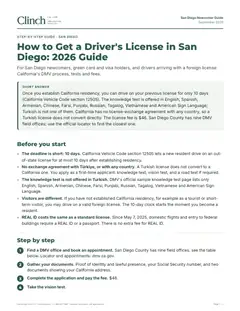
California driver's licenses are issued by DMV (Department of Motor Vehicles) field offices. Once you become a California resident, you can drive on your previous license for only 10 days, so look for an appointment right away. San Diego County has nine DMV field offices. You prove your identity and California residency, then take a vision test, a written knowledge test and, if required, a drive test. The license fee is $46.
Steps, documents and official links
- Pick the closest office. San Diego County's nine DMV offices are spread across the region: Normal Street in central San Diego, Clairemont, Chula Vista, two offices in El Cajon, Poway, San Marcos, Oceanside and San Ysidro near the border. If you live in the South Bay or North County, you do not need to drive to the central office. Addresses and current wait times are in the DMV office locator.
- Book an appointment. Waits vary a lot from office to office. With only 10 days to work with, check for appointments as soon as your documents are ready. Some grocery stores also have DMV kiosks for quick tasks such as renewals and registration.
- Pick your card. California issues three kinds of cards: a standard license, a REAL ID and an AB 60 license. Since May 7, 2025, you need a REAL ID (or a passport) to board domestic flights or enter federal facilities. A REAL ID costs the same as a standard card.
- Gather documents. For a REAL ID you need proof of identity (such as a passport), your SSN and two documents proving California residency. Check which documents are accepted on DMV's REAL ID page before you go.
- Take the tests. The office gives the vision test and the written knowledge test, plus a drive test when required. The written test is not offered in Turkish; see the language list below. A driving retest costs $9.
| Office | Address |
|---|---|
| San Diego (Normal Street, main office) | 3960 Normal Street, San Diego, CA 92103. Monday, Tuesday, Thursday and Friday 8 a.m. to 5 p.m., Wednesday 9 a.m. to 5 p.m., closed weekends |
| San Diego Clairemont | 4375 Derrick Drive, San Diego, CA 92117 |
| Chula Vista | 30 N Glover Avenue, Chula Vista, CA 91910 |
| El Cajon (2), Poway, San Marcos, Oceanside, San Ysidro | See the DMV office locator |
Who can get which card?
- Standard license and REAL ID: for applicants who can prove lawful presence in the U.S. The only difference is that a REAL ID also works as federal ID.
- AB 60 license: AB 60 licenses are for residents who cannot prove lawful presence but can prove identity and California residency. They are not REAL ID compliant and do not work for domestic flights or federal facilities. If your status changes, you may be able to upgrade to a REAL ID.
- ID card: family members who will not drive can get a California ID card for $40, free for seniors 62 and older. A reduced-fee ID costs $11.
| Item | Fee |
|---|---|
| Driver's license (original or renewal) | $46 |
| REAL ID license | $46 (no surcharge) |
| California ID card | $40 (free at 62 and older) |
| Replacement or information change | $37 |
| Driving retest | $9 |
02 · Foreign license
Can I drive in California with a foreign license?
Short answer
As a visitor, yes: nonresidents 18 and older may drive in California on a valid license from their home country. Once you move to San Diego and become a California resident, that ends after 10 days. California has no license-exchange agreement with any foreign country, including Türkiye, so every new resident with a foreign license takes the written test, the vision test and, if required, the drive test.
Steps, documents and official links
- No Turkish test: DMV's official list offers the knowledge test in English, Spanish, Armenian, Chinese, Farsi, Punjabi, Russian, Tagalog, Vietnamese and American Sign Language. Some test-prep sites claim California offers it in Turkish; as of September 28, 2026, that is not true.
- The 10-day rule: it is written into Vehicle Code section 12505 and starts on the day you establish California residency. Texas gives new residents 90 days; California gives 10.
- Visitors: nonresidents may drive on a valid foreign license for as long as they remain nonresidents (section 12502).
- International Driving Permit: it is not a California license. It works as an English translation and is recommended, not required, for visitors and for renting a car. Get it in your home country before you travel.
- Renting a car: rental companies may ask for the International Driving Permit as well, so check when you book.
Coming from Türkiye? Your Turkish license will not convert, so the first-license steps above apply. If you read Russian more comfortably than English, you can pick that language for the test.
03 · Car
How do I register my car in San Diego, and do I need a smog check?
Short answer
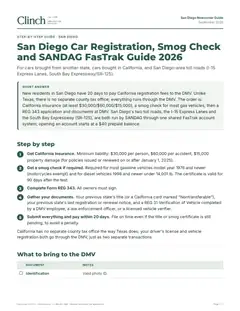
New residents must pay California registration fees to the DMV within 20 days. San Diego County has no separate registration office or county-specific registration system: the state DMV handles both your license and your registration. Most gasoline vehicles from 1976 on need a smog certificate, which is valid for 90 days. Minimum insurance is $30,000/$60,000/$15,000. Pay the fees on time even if some documents are still missing.
Steps, documents and official links
- Buy California insurance. For policies issued or renewed on or after January 1, 2025, minimum liability is $30,000 per person, $60,000 per accident and $15,000 property damage (Vehicle Code 16056). Older policies move to these limits at their next renewal. From January 1, 2035, the minimums rise to $50,000/$100,000/$25,000.
- Get a smog check. A smog certificate is required for gasoline vehicles from model year 1976 on, diesel vehicles from 1998 on under 14,001 lb, and natural gas or propane vehicles. Motorcycles and electric vehicles are exempt. Some newer vehicles pay a $20 smog abatement fee instead of testing; check yours on DMV's smog page. The certificate is valid for 90 days from the inspection.
- Get the vehicle verified. A car from another state or country needs a vehicle verification on form REG 31, done by a DMV employee, a law enforcement officer or a licensed vehicle verifier.
- Apply. Bring form REG 343 signed by all owners, the last title, the last registration, the verification, the smog certificate and proof of insurance. You also turn in the old plates. Even if the title or smog certificate is not ready yet, pay the fees within 20 days. Late penalties start at about $10 for 1 to 10 days late and grow from there.
| Item | Amount |
|---|---|
| Registration base fee | about $76 |
| Vehicle License Fee | 0.65% of the vehicle's value |
| CHP fee | $34 |
| Transportation Improvement Fee | $33 to $231, by value |
| Smog abatement fee (if applicable) | $20 |
| County and district fees | vary by address |
See the full breakdown on DMV's registration fees page. The license and the registration are handled by the same agency but filed as separate transactions.
Bringing a car from abroad
California does not allow residents to bring in or register a vehicle that is less than 2 years old with fewer than 7,500 miles unless it was built to California emissions standards or qualifies for an exemption (REG 256F). Check this before you ship a car.
PDF: San Diego Car Registration, Smog Check and SANDAG FasTrak Guide 2026
04 · Toll roads
What is FasTrak in San Diego, and how do the I-15 Express Lanes and SR-125 work?
Short answer
San Diego's two toll facilities, the I-15 Express Lanes and the South Bay Expressway (SR-125), are both run by the regional agency SANDAG and share one FasTrak account system. On I-15, tolls change every 3 minutes with traffic, from $0.50 to $8. Carpools, vanpools, motorcycles and transit vehicles ride free. Solo drivers need a FasTrak account to use the lanes at all.
Steps, documents and official links
- One agency, one account: in Los Angeles, Metro ExpressLanes is a separate system. In San Diego, SANDAG runs both roads, and you open the account at myfastrak.511sd.com. A FasTrak transponder from elsewhere in California also works on both roads at the FasTrak rate. SANDAG FasTrak customer service: (888) 889-1515.
- I-15 Express Lanes: about 20 miles of lanes. Tolls run from $0.50 to $8 depending on distance and real-time traffic, recalculated every 3 minutes. Carpools, vanpools, motorcycles and transit vehicles use the lanes free without an account. Solo drivers must have a FasTrak account.
- South Bay Expressway (SR-125): a toll road of about 10 miles from Spring Valley to Otay Mesa near the border. FasTrak customers pay a discounted toll based on distance; drivers who pay at a booth or after the trip pay more. Current tolls are on the South Bay Expressway site.
- Opening an account: accounts are prepaid, with a $40 minimum opening balance ($20 per transponder if the account has more than two). With auto-replenishment, when the balance drops below $10 or one week's average use, your card is charged $40 or one month's average use, whichever is greater. SANDAG's account terms allow a monthly minimum toll fee on low-use accounts, so check the amount when you sign up.
05 · Public transit
How does public transit work in San Diego, and how do I get from the airport into the city?
Short answer
MTS runs the buses and the Trolley in San Diego, and NCTD runs North County buses and the COASTER train. Fares rise on October 1, 2026: an adult one-way ride goes from $2.50 to $3.00, the day pass from $6 to $7 and the regional monthly pass from $72 to $85. From the airport, MTS Route 992 reaches downtown in about 15 minutes, and the free San Diego Flyer shuttle goes to Old Town.
Steps, documents and official links
| Fare (adult) | Through Sept. 30, 2026 | From Oct. 1, 2026 | From Oct. 1, 2027 |
|---|---|---|---|
| One-way | $2.50 | $3.00 | $3.25 |
| Day pass | $6 | $7 | $7 |
| Regional monthly pass | $72 | $85 | $95 |
| COASTER train | $5 to $6.50 by zone | single zone, $6.50 | $7 |
SANDAG, MTS and NCTD approved the increase in 2026, and it comes in two phases. You pay with PRONTO, the region's fare system, by card or app. The full table is on MTS's final approved fares page.
- Seniors, riders with disabilities, Medicare cardholders and youth: pay about half. From October 1, 2026, a one-way ride is $1.50 (was $1.25) and the regional monthly pass is $28 (was $23). With a PRONTO Youth Opportunity Pass, anyone 18 and under rides the bus, Trolley, COASTER and SPRINTER free.
- PRONTO LIFE: a new reduced-fare program for adults enrolled in CalFresh, Medi-Cal or CalWORKs. It starts October 1, 2026, and in practice keeps today's prices: $2.50 one-way, $6 for a day pass and $72 for the regional monthly pass, paid with a PRONTO card or virtual card. You apply and verify your program enrollment with MTS or NCTD.
- From the airport on Route 992: MTS Route 992 stops at both terminals and reaches Santa Fe Depot downtown in about 15 minutes. From Santa Fe Depot you can connect to all three Trolley lines, the COASTER and Amtrak. The route runs daily from about 4:30 a.m. to 1 a.m., at the standard MTS fare.
- From the airport on the San Diego Flyer: the airport's free, all-electric San Diego Flyer shuttle runs from the terminals to the Old Town Transit Center in about 10 minutes. There you can catch the Trolley, MTS buses, the COASTER and Amtrak's Pacific Surfliner.
- No train at the terminals: San Diego International Airport has no Trolley or rail station at the terminals. Free shuttle buses run from both terminals to the Rental Car Center.
06 · Power and gas
How do I start electricity and gas service in San Diego?
Short answer
In San Diego, one company supplies both electricity and natural gas: SDG&E (San Diego Gas & Electric). You start service online on SDG&E's website or by calling Customer Care at 1-800-411-7343. An SSN is optional when you apply online, but without one you may need to visit a payment location in person and pay a deposit. Because SDG&E is a private, state-regulated utility, the statewide CARE and FERA discounts apply here.
Steps, documents and official links
- Apply online. On SDG&E's website, enter your move-in date and address to start service. Electricity and gas are set up on one account.
- The SSN question. An SSN is optional online. If you give one, SDG&E uses it for an identity and credit check. If you do not, expect to finish at a payment or service location in person instead of online, and most likely to pay a deposit.
- Call and ask. Customer Care is 1-800-411-7343. With no U.S. credit history, ask how much the deposit will be and which ID they accept before you apply; the amount is not published on a public page.
- Apply for a discount. SDG&E takes part in the statewide CARE and FERA programs. You apply through your SDG&E account.
| Program | Discount | Annual income limit, household of 4 |
|---|---|---|
| CARE (electric) | 30-35% | $66,000 (+$11,360 per extra person) |
| CARE (gas) | 20% | $66,000 |
| FERA (electric only) | 18% | $82,500 |
Income limits apply from June 1, 2026 to May 31, 2027 and are updated every June. Unlike LADWP, the city-owned utility in Los Angeles, SDG&E is part of these programs, so any eligible San Diego household can apply.
Water: water is not an SDG&E service. If you rent, ask your landlord whose name the water account is in and how the bill is paid.
Official sources
07 · Trash and recycling
When is trash pickup in San Diego, and how do I get a bin?
Short answer
In the City of San Diego, the Environmental Services Department collects residential trash using three bins: black for trash, light blue for recycling and green for organics. Trash and organics are picked up weekly, recycling every other week. Collection runs Monday to Friday, 6 a.m. to 5:30 p.m., and your day depends on your address. Bin orders and missed pickups go through the Get It Done app.
Steps, documents and official links
- Bins: black for trash, light blue for recycling (paper, cardboard, plastics #1-7, glass and metal), green for organics (yard waste, food scraps and food-soiled paper).
- Your pickup day: enter your address on the city's collection schedule page. Trash and organics are weekly, recycling every other week.
- Ordering or swapping a bin: green bins come in 35, 65 and 95 gallons. Request or exchange a bin through Get It Done or by calling 858-694-7000.
- Missed pickups and illegal dumping: report them in the Get It Done app or website. Residents who need help getting bins to the curb can request assisted collection there too.
- Organics rollout: under the state's SB 1383 law, the city is rolling out organics collection neighborhood by neighborhood. If your address has no green bin yet, check the schedule on the Environmental Services page.
- Bulky items: ask Get It Done or Environmental Services about the rules and any fee for large-item pickup.
Official sources
08 · City services
What is Get It Done in San Diego, and how do I get a library card?
Short answer
Get It Done is the City of San Diego's app and website for non-emergency city requests: missed trash, bin orders, illegal dumping and similar issues. A San Diego Public Library card is free for California residents and for people who own property in the City of San Diego. Anyone who does not qualify pays $32.50 a year. You apply in person at a branch; there is no online sign-up.
Steps, documents and official links
Get It Done: open a request in the app or on the website and track its status. Trash and bin issues, illegal dumping reports and other city service requests all go through it. In a life-threatening emergency, always call 911.
San Diego Public Library card: the card is free for California residents, for people who own property in the City of San Diego and for active-duty military stationed in San Diego County. Everyone else pays $32.50 a year. You apply in person at a city library branch. If your photo ID does not show your current address, bring recent official mail with your address, such as a bank statement or insurance bill.
City or county: San Diego County also has a separate San Diego County Library system, which serves unincorporated areas and some smaller cities. Check which system serves your address.
09 · Renting
How much can rent go up in San Diego, and when do I get my deposit back?
Short answer
In California, most landlords may charge no more than one month's rent as a deposit and must return it, with an itemized list of deductions, within 21 days after you move out. San Diego has no rent cap of its own; the state's AB 1482 cap applies: 5% plus regional inflation or 10% a year, whichever is lower. The city's Tenant Protection Ordinance adds just-cause eviction protection from the first day of the tenancy.
Steps, documents and official links
State rules
- Deposit cap: since July 1, 2024 (AB 12), most landlords may charge a deposit of no more than one month's rent (Civil Code 1950.5). Certain small landlords who meet the law's conditions may charge up to two months.
- Refund: the landlord must send the remaining deposit and an itemized statement within 21 days after you move out. Deductions over $125 need receipts or a description of the work.
- Rent cap (AB 1482): a yearly increase may not exceed 5% plus inflation (CPI) or 10%, whichever is lower, measured from the lowest rent in the prior 12 months, and it can be taken in no more than two steps in 12 months (Civil Code 1947.12). For the San Diego region that works out to about 8.2% for August 1, 2026 to July 31, 2027. Buildings with a certificate of occupancy from the last 15 years, owner-occupied duplexes and some single-family homes not owned by a corporation are exempt.
- Just cause (state): under state law, after 12 months the landlord may end a tenancy only for reasons listed in the law (Civil Code 1946.2). These are at-fault reasons such as nonpayment or a lease violation, or no-fault reasons such as the owner moving in, taking the unit off the rental market or a substantial remodel.
San Diego: Tenant Protection Ordinance
- Just cause from day one: the City of San Diego's tenant protection rules (Municipal Code Chapter 9, Article 8, Division 7) require just cause for ending a tenancy from the first day, with no 12-month wait. For no-fault terminations, the notice must state the reason and the tenant's right to relocation assistance.
- Rent increases: the ordinance does not set its own percentage. Rent increases in San Diego follow the state AB 1482 cap. There is no separate rent control system like the RSO that covers older buildings in Los Angeles.
- Written notice: landlords must give tenants a written notice in the city's wording, in at least 12-point type, together with a copy of the city's Tenant Protection Guide. The state AB 1482 notice alone is not enough.
- On top of state law: the city's rules add to the rights tenants already have under state and federal law; they do not replace them.
- Outside city limits: Chula Vista and Imperial Beach have their own tenant protection rules. If you are looking just outside San Diego, check that city's rules.
10 · Home ownership
I bought a home in San Diego. How is property tax calculated, and is there an exemption?
Short answer
California property tax follows Proposition 13: your home's taxable value is set by the purchase price and then rises by at most about 2% a year. If you live in the home you own, the Homeowners' Exemption takes $7,000 off the taxable value, which is about $70 off your bill each year. In San Diego the county's ARCC office handles the exemption; file form BOE-266 by February 15 for the full exemption.
Steps, documents and official links
- Taxable value: the value is reset to market value on a purchase, new construction or change in ownership, and after that rises only by an inflation factor (Revenue and Taxation Code 110.1). Two similar homes on the same street can pay very different taxes depending on when they were bought.
- Tax rate: the base rate is 1% of taxable value, plus voter-approved local add-ons such as bonds, which vary by area.
- $7,000 or $70: the exemption takes $7,000 off the taxable value (section 218). At the 1% base rate, that is about $70 less tax a year. If the county's page mentions "a savings of $70", it is describing the same thing.
- Where to file: San Diego County combines the Assessor, Recorder and County Clerk in one office, the Assessor/Recorder/County Clerk (ARCC). File form BOE-266 with ARCC. A claim filed by February 15 gets the full exemption for that year. General line: (619) 236-3771.
- File once: you do not refile each year; the exemption continues as long as the home is your principal residence. It does not apply to homes you rent out, leave empty or use as a vacation home.
11 · School
How do I enroll my child in school in San Diego?
Short answer
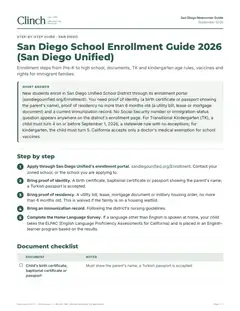
Most of the City of San Diego is served by San Diego Unified School District. Enrollment takes three documents: proof of the child's identity (a birth certificate, or a passport showing a parent's name), proof of residency (a utility bill or lease) and a current immunization record. In California, an SSN is never required to enroll. For 2026-27, transitional kindergarten (TK) requires turning 4 by September 1, 2026, and kindergarten requires turning 5.
Steps, documents and official links
- Check your district. Enrollment is based on your address. Separate cities and some areas in San Diego County have their own school districts; if your address is not in San Diego Unified, enroll through that district instead.
- Start enrollment. San Diego Unified's enrollment page has a New Student Online Enrollment section. If you get stuck, contact your neighborhood school or the district's enrollment office.
- Gather documents. San Diego Unified's enrollment requirements page lists three items. For identity: a birth certificate, baptismal certificate or passport that shows the parent's name. For residency: a utility bill, rental agreement, mortgage document or military housing orders. Third, a current immunization record. The page asks for no SSN and no immigration document.
- Language screening. At first enrollment, families fill out a Home Language Survey. If a language other than English is spoken at home, the child takes the state ELPAC test, which decides English language support.
- Transitional kindergarten (TK): in California, TK is the first year of a two-year kindergarten program, and state law sets the age cutoff for every district. For 2026-27, a child must turn 4 by September 1, 2026, with no exceptions. Kindergarten requires turning 5 by September 1.
- Vaccines: California ended personal-belief exemptions from school vaccines in 2016 (SB 277). Only a medical exemption from a licensed physician is accepted. Texas-style conscientious exemptions do not exist here.
- Your rights in one document: the California Attorney General's "Know Your Educational Rights" guide explains in plain language what schools may and may not ask at enrollment.
PDF: San Diego School Enrollment Guide 2026 (San Diego Unified)
12 · Health
Where can I get care in San Diego without insurance?
Short answer
In a life-threatening emergency, call 911 or go to the nearest ER: under the federal EMTALA law, emergency rooms must screen and stabilize you regardless of insurance, ability to pay or immigration status. San Diego County's program for uninsured low-income adults is County Medical Services (CMS). It is not insurance but a program of last resort that funds care through community health centers, private physicians and hospitals. In a mental health crisis, call 988.
Steps, documents and official links
For checkups, see the list of free and low-cost clinics.
- County Medical Services (CMS): a program of the county's Health and Human Services Agency (HHSA). In the county's words, it funds medical care for uninsured indigent adult county residents and covers only necessary medical services. Income limits and application rules are on the program's own pages; call CMS at 1-800-587-8118 before you apply. Do not assume the limits of Los Angeles County's Ability to Pay program apply here.
- Medi-Cal: California's Medicaid program opened to all income-eligible adults regardless of immigration status in 2024. Since January 1, 2026, however, adults 19 and older without a satisfactory immigration status cannot newly enroll in full-scope Medi-Cal. New applicants in that group get restricted Medi-Cal covering emergency and pregnancy services only. Children (0-18) and pregnant people are not affected. People already enrolled keep full coverage if they renew on time; anyone who misses the deadline has 90 days to re-enroll.
- Applying: apply for Medi-Cal and other benefits through BenefitsCal. San Diego County HHSA Access Customer Service Call Center: (866) 262-9881.
- Asset limit: Medi-Cal brought back an asset test in 2026: $130,000 for one person, plus $65,000 for each additional household member. Your home, one car and household goods do not count. The rule mostly affects people 65 and older and people with disabilities.
- Covered California: the state's health insurance marketplace. Lawfully present immigrants (green card holders, refugees, asylees and many visa holders) can buy a plan; undocumented people cannot. DACA recipients lost Marketplace eligibility in 2025 but may qualify for Medi-Cal. From 2027, some lawfully present immigrants will lose premium help under the federal H.R. 1 law.
- Low-cost health centers: find sliding-fee centers near your address with the HRSA health center finder. Not every listed center is free.
- 988: the Suicide and Crisis Lifeline works 24/7 by call, text and chat, with interpreters available by phone.
13 · Health
Where can I find free or low-cost clinics in San Diego?
Short answer
San Diego has a free clinic run by UC San Diego students and health centers with reduced fees for people without insurance. The UC San Diego Student-Run Free Clinic gives priority to patients who qualify for no other program and also serves people seeking asylum and refugees. Family Health Centers of San Diego offers a reduced fee to uninsured patients. The county's CMS program is a separate option. Confirm eligibility and fees with each organization before you go.
Steps, documents and official links
Free care
UC San Diego Student-Run Free Clinic Project · four sites
A nonprofit, student-run free clinic affiliated with UC San Diego's Department of Family Medicine. In its own words, its priority is caring for patients who do not qualify for any other health care program or resource. It serves uninsured people in San Diego, including people seeking asylum, refugees and low-income people without insurance. New patients with a serious medical need and no access to care are occasionally accepted; they are asked to arrive before the clinic opens to speak with the team. Besides general medical care, it offers mental health, pharmacy, acupuncture, dental, social work and legal services.
Sites: downtown San Diego, Pacific Beach, near National City and Lemon Grove. Ask which site is open on which day before you go.
Phone: (858) 534-6110 · Email: [email protected] · About the clinic
Centers with income-based fees
Family Health Centers of San Diego (FHCSD) · many neighborhoods
A large federally qualified health center (FQHC) network. FHCSD says it has a special commitment to uninsured, low-income and medically underserved people, and it offers a reduced fee to patients who do not qualify for insurance. Ask about the amount when you book. Locations are in the location finder on its website; 823 Gateway Center Way is an administrative office with no patient services.
Main line: (619) 515-2300 · Family Health Centers of San Diego
County program
County Medical Services (CMS) · San Diego County HHSA
Not a clinic but a county program: it funds care for uninsured, low-income adult county residents through community health centers, private physicians and hospitals. It is not health insurance. Ask the program about income limits and how to apply.
Phone: 1-800-587-8118 · County Medical Services
Questions to ask before booking
- Are you accepting new patients? Are there age, income, insurance or residency requirements?
- Are visits, lab tests, medications, dental care and outside referrals charged separately?
- Which documents should I bring, and is an interpreter available?
For more options, use the HRSA health center finder; not every listed center is free. See health care without insurance for Medi-Cal and emergency care.
14 · Marriage
How do I get a marriage license in San Diego?
Short answer
In San Diego County, marriage licenses come from the Assessor/Recorder/County Clerk (ARCC). You both apply together with valid, unexpired photo ID. The 2026 fees are $129 for a public license, $144 for a confidential license and $107 for a civil ceremony. That is more than in Los Angeles County, so check the current fees on ARCC's site before you go. California has no waiting period, and the license is valid for 90 days.
Steps, documents and official links
- Where: San Diego County handles property records, vital records and County Clerk services in one office, ARCC. You can start the application on the online application page before your visit. General line: (619) 236-3771.
- ID: you both need valid, unexpired, government-issued photo ID. If a foreign passport is your only ID, check ARCC's list of accepted IDs before you go.
- Public or confidential: a public license needs at least one witness at the ceremony. A confidential license requires both of you to be 18 or older and already living together as a married couple. No witness is needed, and the record is not public.
- Fees: public license $129, confidential license $144, civil ceremony $107, and $58 if the County Clerk provides the witness. Cash, check, money order and cards are accepted; card payments carry a $2.50 surcharge.
- Civil ceremony: by appointment only. County Clerk staff perform ceremonies only in English or Spanish, and both of you must understand the language used.
- Timing: California has no waiting period, so you can marry the day you get the license. The license is valid for 90 days, and the ceremony must take place within that time.
15 · Birth
How do I get my baby's birth certificate in San Diego?
Short answer
San Diego County has two county offices for birth certificates, and the age of the record decides which one you use. For births in the last 2 years, go to the county HHSA Office of Vital Records and Statistics (OVRS); for older San Diego County records, go to the County Clerk at ARCC. Both charge $34 per certified copy, a fee set by the state. Your baby's SSN is usually requested at the hospital along with the birth registration.
Steps, documents and official links
- Newborns (last 2 years): HHSA Office of Vital Records and Statistics, 5530 Overland Avenue, Suite 170, San Diego, CA 92123, weekdays 9 a.m. to 5 p.m., (619) 692-5733. $34 per copy. In person you can pay by cash, card, check or money order; by mail, send a check or money order payable to "County of San Diego".
- Older records (more than 2 years): ARCC, $34 per copy, at its downtown San Diego, Chula Vista, Santee or San Marcos offices (not Kearny Mesa), no appointment needed. Card payments carry a $2.50 surcharge. Mail requests go to San Diego Recorder/County Clerk, ATTN: Vital Records, P.O. Box 121750, San Diego, CA 92112-1750, with a check or money order payable to "San Diego Recorder/County Clerk".
- State office: the California Department of Public Health Vital Records office (CDPH) in Sacramento issues certificates by mail for anyone born in California, $31 per copy since January 1, 2026. It is slower than the county offices; use it for births outside San Diego County.
- Which copy: for a U.S. passport and for registering the birth in Türkiye, ask for an authorized certified copy. A copy marked "informational" does not work for identity purposes. Authorized copies go to the person named, their parents, a legal guardian or someone with a court order. Mail requests for a certified copy usually need a notarized statement.
- SSN: if you request an SSN at the hospital when the birth is registered, the card arrives by mail and you do not need to visit an SSA office.
16 · Social Security
How do I get a Social Security number in San Diego?
Short answer
SSNs are issued only to people with work authorization or a legally required reason. If you asked for an SSN in your immigrant visa application, the card is mailed to you. People who adjust status with Form I-485, and EAD applicants who checked the SSN box, also receive the card automatically. Otherwise, start online and visit an SSA office by appointment within 45 days; it is free.
Steps, documents and official links
- What to bring: current immigration documents (green card, I-94 or EAD) with a valid passport, and a birth certificate if you have it. No photocopies or notarized copies. SSA suggests waiting 10 days after arrival so DHS records can be verified.
- F-1 and J-1: an SSN is available only once you are authorized to work (on-campus job, CPT, OPT), not just for enrolling in school.
- Appointments: since 2025, SSA expects you to book before an in-person visit. Call the office or the national line, 1-800-772-1213.
- Offices in the City of San Diego: Downtown (1333 Front St, San Diego, CA 92101, (855) 820-0097) and Kearny Mesa (8505 Aero Dr, San Diego, CA 92123, (866) 331-6397), both open weekdays 9 a.m. to 4 p.m.
- Elsewhere in the county: La Mesa (7961 University Ave), El Cajon (846 Arnele Ave), National City (700 E. 24th St), Chula Vista (626 L St, Suite 1) and Oceanside (2160 S. El Camino Real). Your ZIP code decides which office serves you, so confirm with the SSA office locator before you go.
- Replacement card: free, often started online; the card arrives in 5 to 10 business days.
According to SSA, you do not need an SSN for school registration or private health insurance. California law also bars schools from asking for one.
17 · Taxes
Does California have a state income tax, and how do I get an ITIN in San Diego?
Short answer
California has a state income tax: you file a federal return with the IRS and a state return (Form 540) with the Franchise Tax Board (FTB). People who must file but cannot get an SSN, such as H-4 spouses without an EAD, get an ITIN with Form W-7 and use it on both returns. Unlike the federal EITC, California's CalEITC is open to ITIN filers. An ITIN does not authorize work.
Steps, documents and official links
- Complete Form W-7 and attach it to your federal return unless an exception applies.
- Get documents verified. Mail originals to the IRS in Austin, use a Certifying Acceptance Agent (CAA), or book a document review at an IRS office that offers ITIN review. With a CAA or IRS office, your passport does not go in the mail; documents are returned at the end of the appointment.
- Wait. Processing takes about 7 weeks, or 9 to 11 weeks during tax season (January 15 to April 30).
The California return and CalEITC
- Form 540: most California residents who file a federal return also file a state return with the FTB. If you have no SSN, an ITIN is enough.
- CalEITC: according to the FTB, for tax year 2025 (returns filed in 2026) workers earning up to $32,900 can get up to $3,756. ITIN filers can claim it, but qualifying children need a valid SSN. The Young Child Tax Credit and the Foster Youth Tax Credit are also open to ITIN filers who meet the other rules.
- Free help: the FTB points filers to VITA sites, where volunteers prepare returns for free; many handle ITIN returns.
IRS offices and ITIN expiration
- Appointments: IRS offices work by appointment only, at 844-545-5640. Find the office nearest you with the IRS office locator, and check the IRS list for offices that review ITIN documents. Appointments can take several weeks.
- Expiration: an ITIN not used on a federal return for three years in a row expires.
18 · Starting a business
How do I start an LLC in San Diego, and what are a DBA and a business tax certificate?
Short answer
A California LLC is formed online with the Secretary of State (Articles of Organization, Form LLC-1) for $70, and every LLC owes at least $800 a year in franchise tax, starting in its first year. To do business under a name without your surname, file a fictitious business name (DBA) with the San Diego County ARCC: $54. Every business operating in the City of San Diego also needs a city business tax certificate: $34 a year with 12 or fewer employees.
Steps, documents and official links
Forming an LLC
- LLC: Form LLC-1 is filed online only, $70. Owners do not need to be U.S. citizens or California residents, but you need a registered agent with a California address.
- Statement of Information: due within 90 days of formation, then every two years; online, $20.
- The $800 tax: per the FTB, every LLC organized or doing business in California owes at least $800 a year, even with no activity, until it is cancelled. The first payment is due on the 15th day of the 4th month after filing with the Secretary of State. The first-year exemption covered only tax years 2021 to 2023, so an LLC formed in 2026 pays in its first year. Older articles online still say otherwise.
- Higher revenue: LLCs with more than $250,000 in California income also owe an extra fee of $900 to $11,790.
Where do I file a DBA?
- Who needs one: anyone doing business for profit under a name that does not include the owner's surname files in the county of the principal place of business. In San Diego that is the San Diego County ARCC, which combines the Assessor, Recorder and County Clerk.
- Fees: $54 for an original or renewal filing, plus $5 for each additional name on the same statement, more than LA County's $26. Cash in person only; check or money order in person or by mail; cards carry a $2.50 surcharge.
- Newspaper publication is required: within 45 days of filing, publish the statement in a newspaper of general circulation in the county once a week for four weeks in a row (Business and Professions Code 17917; ARCC states the same deadline and provides a list of newspapers). File the affidavit of publication with the County Clerk within 45 days after the last run. Some older sources still say 30 days; the current statute says 45. This step is easy to miss.
- No immigration requirement: filing a DBA does not require citizenship or any particular status.
San Diego business tax certificate
- Who needs it: per the city, every business operating in the City of San Diego, including home-based businesses, self-employed people and independent contractors.
- Fees: $34 a year for 12 or fewer employees; $125 plus $5 per employee for 13 or more. A $4 state-mandated accessibility fee applies to every certificate, and Business Improvement District assessments may apply in some areas.
- How to apply: through the city's online Business Tax portal, or the City Treasurer at (619) 615-1500, [email protected].
- Separate from the DBA: the ARCC does not issue business licenses. If you work in another city in the county, such as Chula Vista or El Cajon, get your license from that city.
19 · Public benefits
Can immigrants in San Diego get CalFresh or Medi-Cal, and does it affect a green card?
Short answer
In California, CalFresh (SNAP) and Medi-Cal applications go through BenefitsCal.com; San Diego County's phone line is (866) 262-9881. Since April 1, 2026, refugees, asylees and parolees can no longer get federal CalFresh, while most green card holders remain eligible. And under the new public charge rule in effect since September 18, 2026, benefits received on or after that date may be held against you in a future green card application.
Steps, documents and official links
- What changed in CalFresh: on April 1, 2026, refugees, asylees, parolees, trafficking survivors, people granted withholding of removal and some battered noncitizens lost federal CalFresh eligibility. People in these groups who already receive benefits keep them until their next recertification.
- Who still qualifies: U.S. citizens, most green card holders, Cuban/Haitian entrants and citizens of Micronesia and the Marshall Islands. California waives the federal 5-year waiting period for most green card holders.
- CFAP: the state-funded California Food Assistance Program covers some, but not all, of the groups cut from federal CalFresh. Check eligibility before assuming your category is out.
- Medi-Cal: since January 1, 2026, adults 19 and older without a satisfactory immigration status can no longer newly enroll in full-scope Medi-Cal; they get restricted coverage for emergencies and pregnancy only. People already enrolled keep coverage if they renew on time. Children and pregnant people are not affected by the freeze. More in the health section.
- U.S.-citizen children in the household may still receive benefits in their own right.
- The new public charge rule: for green card applications filed on or after September 18, 2026, officers may consider any means-tested benefit (CalFresh, Medi-Cal, housing assistance and others) received on or after that date. Benefits received earlier count only if they were cash assistance or long-term institutional care. Benefits received by family members are generally not counted.
- Who is exempt: humanitarian categories such as asylees and refugees, T and U visa holders, VAWA self-petitioners and TPS. Family-based, most employment-based and diversity visa applicants are subject to it.
- Litigation: on September 14, 2026 a coalition of more than 20 states sued, and California is one of the plaintiff states. As of September 25, 2026, no court has blocked the rule.
20 · Address change
I moved to San Diego. Do I have to report my new address to USCIS?
Short answer
Generally, most noncitizens in the U.S., including Green Card holders, must report a new address to USCIS within 10 days of moving. The easiest way is the change-of-address tool in your USCIS online account; the paper Form AR-11 is also free. If you have a case in immigration court, you must also notify the court within 5 days on Form EOIR-33. Moving within San Diego counts too.
Steps, documents and official links
- Log in to your USCIS account and open Change of Address. Reporting online satisfies the legal requirement; no paper AR-11 is needed.
- Enter the receipt number of every pending case. Otherwise notices may still go to the old address.
- Tell USPS separately. A post office change of address does not update USCIS, and USPS does not forward USCIS mail.
- If you are in court proceedings, file Form EOIR-33/IC within 5 days. The court changes your address only through this form.
- If you have ICE reporting obligations (for example, regular check-ins), update ICE too through the ICE Portal. ICE's page asks for updates within 5 business days of moving.
A and G visa holders and Visa Waiver visitors are exempt from the USCIS requirement.
21 · USCIS
Where is the USCIS office in San Diego, and where do I go for biometrics?
Short answer
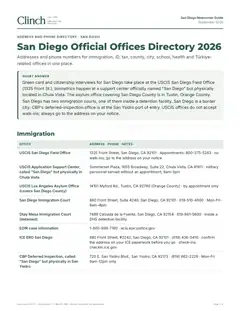
Green card and citizenship interviews for San Diego County take place at the USCIS San Diego Field Office, 1325 Front Street, San Diego, CA 92101. For fingerprints and photos (biometrics), the center USCIS calls "San Diego" is actually in Chula Vista, at 1655 Broadway, Suite 22. USCIS offices do not accept walk-ins; always go to the address on your appointment notice.
Steps, documents and official links
| Office | Address | What happens there |
|---|---|---|
| USCIS San Diego Field Office | 1325 Front St, San Diego, CA 92101 (follow the address on your notice) | Green card and citizenship interviews, oath ceremonies, service appointments |
| ASC San Diego (building in Chula Vista) | Sommerset Plaza, 1655 Broadway, Suite 22, Chula Vista, CA 91911 | Biometrics, weekdays 8 a.m. to 4 p.m. |
| Los Angeles Asylum Office | 14101 Myford Rd, Tustin, CA 92780 | Affirmative asylum interviews for San Diego County, by appointment only |
- Appointments and questions: USCIS Contact Center at 800-375-5283, or book online. Appointments are free.
- Processing times: on the USCIS processing times page, pick the form, category and "San Diego CA" as the office. Times update monthly.
- Biometrics: even though the notice says "San Diego," the building is in Chula Vista, so do not head downtown. The center is assigned on your I-797C notice; you do not choose it. Active-duty military can walk in weekdays from 9 a.m. to 3 p.m. Our biometrics guide covers what to bring.
- The old Chula Vista field office: you may see a separate "Chula Vista Field Office" address online. USCIS announced in 2016 that it was moving to 1325 Front Street. Do not go there unless your interview notice says so.
- Your attorney at the interview: since May 18, 2026, attorneys may no longer join field-office or affirmative asylum interviews remotely, except in limited circumstances. Your attorney has to attend in person.
- The asylum office is not in San Diego: the Los Angeles Asylum Office, which covers San Diego County, is in Tustin, Orange County, roughly 100 miles away. Plan for the drive.
22 · Court
Where is the San Diego immigration court, and how do I check my case?
Short answer
San Diego has two immigration courts: the San Diego Immigration Court downtown (880 Front St., Suite 4240) and the Otay Mesa Immigration Court (7488 Calzada de la Fuente), which hears detained cases. Both are open weekdays 8 a.m. to 4 p.m. Your hearing notice tells you which court and courtroom. Check your case with your A-number on EOIR's online portal (ACIS) or at 1-800-898-7180.
Steps, documents and official links
| Court | Address | Phone |
|---|---|---|
| San Diego Immigration Court | 880 Front St, Suite 4240, San Diego, CA 92101 | 619-510-4500 |
| Otay Mesa Immigration Court (detained) | 7488 Calzada de la Fuente, San Diego, CA 92154 (inside a DHS detention facility) | 619-661-5600 |
- Hours: both courts keep public and filing hours weekdays 8 a.m. to 4 p.m.
- Otay Mesa: the court sits inside a DHS detention facility and hears cases of detained people. Its mailing address is different (P.O. Box 438150, San Ysidro, CA 92143-8150), so check your notice for where to send filings.
- One building, several offices: the federal building at 880 Front Street houses other federal offices too. Check the suite number on your notice.
- Online lookup: ACIS needs only your A-number (A + 8 or 9 digits). Your hearing notice is still the official source; the system may show new dates late.
- ICE check-ins: scheduled at checkin.ice.gov; the ICE office you report to is on the paperwork you were given. If you have a check-in, talk to your attorney before you go.
Where do I find my I-94, and how do I fix an error?
Download your most recent I-94 from CBP's website. Errors made at entry (wrong visa class, name or admit-until date) are corrected by CBP Deferred Inspection. San Diego's office is not at the airport but at the Mexican border crossing in San Ysidro: 720 E. San Ysidro Blvd., San Ysidro, CA 92173, open weekdays 9 a.m. to noon only, (619) 662-2229. It fixes only mistakes made at the time of entry. Any deferred inspection office can help no matter where you entered, and the Los Angeles office keeps longer hours.
23 · Voting and jury duty
I'm not a citizen. Can I register to vote in San Diego, and what if I get a jury summons?
Short answer
No. In San Diego only U.S. citizens 18 and older may register and vote, and that includes local elections; green card holders and other noncitizens may not. Checking the citizenship box on a voter form is a false claim of citizenship for USCIS. If the San Diego Superior Court summons you for jury duty, do not ignore it: California law bars noncitizens from serving, so respond and say you are not a U.S. citizen.
Steps, documents and official links
- At the DMV: if you are offered voter registration while applying for a license or ID card and you are not a citizen, decline.
- Consequences: registering or voting as a noncitizen is a federal crime (18 U.S.C. 611 and 1015(f)). In immigration law it can mean permanent inadmissibility, deportability and denial of naturalization.
- Do not fill out voter registration forms handed out door to door or at events.
- Jury summons: California Code of Civil Procedure §203 makes noncitizens, people under 18 and people not domiciled in California ineligible for jury service, and the San Diego Superior Court lists citizenship as a qualification. If you are summoned, complete the Disqualification section on the online Juror Portal; do not leave it unanswered. The court's jury postponement line is (619) 844-2800.
Recently naturalized? The deadline to register for the November 3, 2026 election is October 19, 2026 (online, or postmarked by that date). In San Diego, voter registration and elections are run by the San Diego County Registrar of Voters (sdvote.com). California's elections line is (800) 345-VOTE (8683).
24 · New citizens
I just became a citizen. How do I get a U.S. passport in San Diego?
Short answer
A first U.S. passport is applied for in person on Form DS-11, at an acceptance facility such as the San Diego City Clerk's counter at 202 C Street, with your original proof of citizenship. An adult passport book costs $130 plus a $35 acceptance fee. If you must travel abroad within 14 days, the San Diego Passport Agency downtown handles urgent cases by appointment.
Steps, documents and official links
- San Diego City Clerk: City Administration Building lobby, 202 C Street, San Diego, CA 92101. Weekdays 8 a.m. to 5 p.m., by appointment only (no walk-ins); the last slot is 2:40 p.m. and appointments open up to 10 days ahead. Optional photo $12.50. Per the City Clerk, the application fee is paid by check or money order to the U.S. Department of State, and the acceptance and photo fees by exact cash, check or money order to the City Treasurer. No cards.
- Other acceptance facilities: find post offices, libraries and other locations with the passport facility locator. They accept new applications (DS-11) only; appointments and hours vary.
- What to bring: your original proof of citizenship, valid ID and a passport photo.
- Children: a passport book for a child under 16 costs $100 plus the $35 acceptance fee.
- Urgent travel: the San Diego Passport Agency is at 1 Columbia Place, 401 West A Street, 10th Floor, San Diego, CA 92101, weekdays 8 a.m. to 4 p.m. Appointment only, with proof of travel within 14 days (or a foreign visa needed within 28 days), plus the $60 expedite fee. Appointments are free at passportappointment.travel.state.gov or (877) 487-2778; third parties charging for them are scams.
- Online renewal: for adults 25 and older with a 10-year passport, only at opr.travel.state.gov.
Not sure about a step?
Ask before you do something that touches your immigration status
Applying for a benefit, changing your address, registering to vote or answering a jury summons can all show up in your file. You can speak with Attorney Asim Clinch, a Turkish-speaking immigration attorney serving clients in San Diego, in English or Turkish.
25 · Things to do
What are the places to visit in San Diego?
Short answer
Start at Balboa Park: the park itself is free, and it is home to the San Diego Zoo and 17 museums. Kids 11 and under get into the zoo free throughout October. For the coast, visit La Jolla Cove, Sunset Cliffs and Coronado Beach. For history, there is the free Old Town San Diego State Historic Park and the USS Midway Museum aboard an aircraft carrier. Torrey Pines' trails are closed until February 2027.
Steps, documents and official links
| Place | Area | What it is | Admission |
|---|---|---|---|
| Balboa Park | Balboa Park | 17 museums, gardens and walking paths; the San Diego Zoo is inside the park. | Park free; museums ticketed, some Tuesdays free for residents |
| San Diego Zoo | Balboa Park | Large zoo with animals from around the world. | Ticketed, prices vary by date; kids 11 and under free in October |
| USS Midway Museum | Navy Pier, Downtown | Naval museum aboard a retired aircraft carrier. Open daily; closed Thanksgiving and Christmas. | Ticketed |
| Cabrillo National Monument | Point Loma | Lighthouse, tide pools and views of the city and ocean. | $20 per vehicle (valid 7 days), $10 on foot or by bike; under 16 on foot free |
| Old Town San Diego State Historic Park | Old Town | Where San Diego began: historic buildings and small museums. Open daily 10 a.m. to 5 p.m. | Free; parking free for up to 4 hours |
| La Jolla Cove | La Jolla | Seals and sea lions on the rocks; a favorite for snorkeling and diving. | Free; street parking is limited |
| Sunset Cliffs Natural Park | Point Loma | Sunsets from clifftops over the Pacific. | Free; stay back from the edges |
| Gaslamp Quarter | Downtown | Historic buildings, restaurants and nightlife. | Free to walk |
| Coronado Beach | Coronado | Wide beach in front of the historic Hotel del Coronado, reached by the bridge or by ferry. | Free |
| Mission Beach and Belmont Park | Mission Beach | Beach boardwalk and an amusement park with the wooden Giant Dipper coaster. | Beach free; rides ticketed |
| SeaWorld San Diego | Mission Bay | Marine animals and theme park rides. | Ticketed; prices vary by date |
| LEGOLAND California | Carlsbad (about 35 miles north) | Theme park aimed at younger kids. | Ticketed; prices vary by date |
Torrey Pines State Natural Reserve: all trails and the upper parking lots are closed for construction from September 22, 2026 through February 2027. The South and North Beach lots and Torrey Pines State Beach stay open. Leave the trail hike off your list for now and check the reopening date in California State Parks' announcement before you go.
26 · Free and family-friendly
What are free things to do in San Diego, and where can I go with kids?
Short answer
Always free: Balboa Park's gardens, Old Town San Diego State Historic Park, La Jolla Cove, Sunset Cliffs, the Gaslamp Quarter, Coronado Beach and Mission Beach. Balboa Park's museums take turns being free for San Diego residents on Tuesdays. With kids: the San Diego Zoo (free for kids 11 and under in October), Balboa Park's science and air and space museums, the USS Midway Museum, Belmont Park, SeaWorld and LEGOLAND California.
Steps, documents and official links
Free
- Balboa Park: gardens and walking areas are always free; museums are ticketed.
- Old Town San Diego State Historic Park: free entry and free parking for up to 4 hours. Individual museum hours can vary with staffing.
- La Jolla Cove, Sunset Cliffs, Coronado Beach and Mission Beach: the coast and the views are free. Arrive early for parking.
- Gaslamp Quarter: free to walk; liveliest in the evenings and on weekends.
Free on certain days
Balboa Park Resident Free Days: residents of the City and County of San Diego and active-duty military get free entry to these museums on set Tuesdays with a photo ID showing their address. Some museums make only the permanent collection free; special exhibits may cost extra.
- 1st Tuesday: Fleet Science Center and San Diego Natural History Museum.
- 2nd Tuesday: San Diego Air & Space Museum, The Veterans Museum and the Comic-Con Museum.
- 3rd Tuesday: San Diego Museum of Art, Japanese Friendship Garden and Museum, and Mingei International Museum.
- 4th Tuesday: San Diego Automotive Museum and Museum of Us.
- San Diego Zoo: kids 11 and under free from October 1 to 31, 2026, up to 6 kids per paying adult.
- Cabrillo National Monument: the remaining fee-free days in 2026 are October 27 and November 11, for U.S. citizens and residents.
With kids
- San Diego Zoo: October is the cheapest month for families with young kids.
- Balboa Park museums: Fleet Science Center, the Natural History Museum and the Air & Space Museum. Put their free Tuesdays on your calendar.
- USS Midway Museum: aircraft on the flight deck and areas of the ship you can walk through.
- Belmont Park: the amusement park at Mission Beach; rides are ticketed.
- SeaWorld San Diego: ticketed; prices vary by date.
Nearby
- LEGOLAND California (Carlsbad): about 35 miles north of San Diego, ticketed. Check hours and prices on its official site before you go.
- Torrey Pines State Beach: the reserve's trails are closed until February 2027, but the beach and beach lots are open.
27 · Turkish consulate
Where is the nearest Turkish consulate to San Diego, and how do I book an appointment?
Short answer
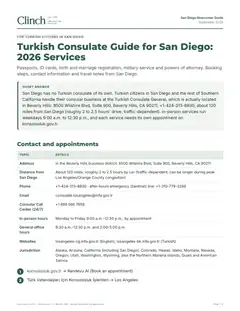
San Diego has no Turkish consulate. Like the rest of California, it is served by the Turkish Consulate General in Los Angeles, which is actually in Beverly Hills: 8500 Wilshire Blvd., Suite 900, Beverly Hills, CA 90211, phone +1-424-313-8800, about 120 miles from San Diego. Each service needs its own appointment on konsolosluk.gov.tr, and in-person hours are weekday mornings only, 9:00 a.m. to 12:30 p.m. Passports and powers of attorney require a visit.
Steps, documents and official links
To book: konsolosluk.gov.tr → Randevu Al → Türk Vatandaşları İçin Konsolosluk İşlemleri → Los Angeles. The 24/7 Consular Call Center: +1 888 566 76 56. Emergency line: +1 310 779 3288. Email: [email protected]. The consulate's English site is losangeles-cg.mfa.gov.tr.
| Service | How |
|---|---|
| Passport | In person only, by appointment |
| Turkish ID card | In person, by appointment |
| Birth registration | By appointment; document list in the consulate's information notes |
| Marriage registration | By appointment; do it before applying for a new ID card |
| Power of attorney | At the consulate building only |
Check current fees and which services can be done by mail in the consulate's information notes before your appointment.
Tips for the trip from San Diego
- The drive: Beverly Hills is about 120 miles from San Diego via I-5, and Los Angeles and Orange County traffic can stretch it a lot. Applications are taken in the morning only, so book one of the first slots of the day and plan a full day for the round trip.
- Several errands? Book a separate appointment for each one. It saves you a second trip.
- Location: the consulate is not in downtown Los Angeles but in an office building on Wilshire Boulevard. Arrive early for building security and parking.
- Hours: general office hours are weekdays 8:30 a.m. to 12:30 p.m. and 2 to 5 p.m., but applications are taken only from 9:00 a.m. to 12:30 p.m.
- Holiday: the consulate is closed on October 29, 2026 (Republic Day). Check its site for other closures before booking.
- Birth registration: to register a U.S.-born child in the Turkish civil registry, bring the original birth certificate, the parents' IDs and a marriage certificate if any. Parents' names must match Turkish records. For a baby born in San Diego, the birth certificate comes from San Diego County.
- Jurisdiction: besides California, the consulate serves Alaska, Arizona, Colorado, Hawaii, Idaho, Montana, Nevada, Oregon, Utah, Washington and Wyoming, plus Guam, the Northern Mariana Islands and American Samoa. Book early.
- Military service (askerlik): men born in 2007 must complete their registration (yoklama) by December 31, 2026. The paid military service option (dövizle askerlik) for July to December 2026 is the foreign-currency equivalent of 472,653.60 TL, paid in U.S. dollars at the Turkish central bank rate of the payment day; ask the consulate about any transfer fee before your appointment. The amount changes on January 1, 2027. Applicants must have U.S. residence or work authorization, 3 years (1,095 days) of work abroad, the Ministry of Defense online training and residence in the consular district, and must apply in person in Beverly Hills. Dual citizens born in the U.S. or who came before 18 can defer until the end of age 35 after registering their U.S. citizenship. F-1 students defer through an education attaché; ask the consulate which one.
28 · Apostille
How do I get an apostille on a California document in San Diego?
Short answer
California vital records such as birth and marriage certificates, and documents notarized in California, get their apostille from the California Secretary of State. There is no everyday apostille office in San Diego: apply by mail to Sacramento, or walk in at the Los Angeles or Sacramento office for same-day service. The fee is $20 per document, plus a $6 special handling fee in person. A one-day apostille event is planned in San Diego on December 2, 2026.
Steps, documents and official links
- By mail: Notary Public Section, P.O. Box 942877, Sacramento, CA 94277-0001 (couriers: 1500 11th Street, 2nd Floor, Sacramento, CA 95814). $20 per document, no $6 fee by mail. Requests are processed in the order received; there is no expedited mail service.
- Los Angeles office: 300 South Spring Street, Room 12513, Los Angeles, CA 90013. As of September 25, 2026 it is temporarily in Suite 1215 on the 1st floor because of an elevator outage, so check the room before you go. Walk-in, same day. No cash; bring a card, check or money order.
- Sacramento office: 1500 11th Street, 3rd Floor, Sacramento, CA 95814. Walk-in with a queue number, same day. Cash accepted.
- In-person fee: $6 for each different public official whose signature is on your documents.
- One-day event in San Diego: the Secretary of State plans a pop-up apostille event in San Diego on December 2, 2026. Venue and requirements are posted on the SOS apostille page closer to the date.
- Which documents qualify: California birth and death certificates signed by a county clerk, county recorder or the State Registrar, notarized documents and documents signed by a California public official. Documents signed by a local health officer may first need certification by the county clerk.
- Marriage certificates: the apostille for a certified marriage certificate from San Diego County comes from the Secretary of State, not the county.
- Federal documents: FBI background checks and naturalization certificates go to the U.S. Department of State, Office of Authentications, Form DS-4194, $20 per document.
- Turkish documents: Turkish criminal records and civil registry extracts can get an e-Apostil through e-Devlet (eapostil.gov.tr). Consulates do not issue apostilles.
29 · Time and flights
What is the time difference between San Diego and Türkiye, and is there a nonstop flight?
Short answer
Türkiye stays on UTC+3 all year, while San Diego is on Pacific Time and changes its clocks. So Türkiye is 10 hours ahead until November 1, 2026, and 11 hours ahead from November 1, 2026 to March 14, 2027. When it is 9 a.m. in San Diego, it is 7 p.m. in Istanbul in summer and 8 p.m. in winter. There is no nonstop flight from San Diego (SAN) to Istanbul; for a nonstop, drive about 2 hours to LAX.
Steps, documents and official links
- U.S. clock changes: daylight saving time starts on the second Sunday of March and ends on the first Sunday of November: November 1, 2026 and March 14, 2027.
- Calling home: early morning in San Diego is the easiest time. At noon in San Diego it is already 10 p.m. in Istanbul in summer and 11 p.m. in winter.
- From San Diego: flights from SAN to Istanbul connect, usually through a large U.S. airport or a European hub, and even the shortest options take more than 15 hours in total. Schedules vary.
- Nonstop option: Turkish Airlines flies nonstop from Los Angeles (LAX) and San Francisco (SFO) to Istanbul Airport (IST), about 13 hours from LAX. LAX is about 2 hours' drive from San Diego without traffic. Frequency changes by season, so check turkishairlines.com.