01 · Driver's license
How do I get a driver's license in Illinois, and what if I have no SSN?
Short answer
Illinois licenses come from the Secretary of State (SOS), under the same rules from Chicago to Springfield. Every application needs one document from each of four groups: signature, date of birth and lawful status, Social Security number, and Illinois residency. Since September 1, 2023 an appointment is required for driver services. A 4-year license costs $30 for ages 21 to 68. There is a separate route for people who cannot get an SSN, but it is no longer the TVDL.
Steps, documents and official links
- Book an appointment. Under Skip-the-Line, appointments have been required since September 1, 2023 at the state's 44 busiest facilities, including every Chicago and suburban office, for REAL ID, license and ID services and in-car road tests. Book through the SOS appointment tool, and check which office offers which service on the facility finder.
- Collect one document from each group. A standard license needs one each from Groups A, B, C and D; a REAL ID needs one each from A, B and C and two from D. Bring originals, not copies. One document can satisfy more than one group.
- Surrender any other license. New residents must hand in all out-of-state and foreign licenses and ID cards.
- Take the tests. A vision screening, a written exam of at least 35 questions for Class D (80 percent to pass) and, if the Secretary of State requires it, a road test. The exam fee covers up to three attempts within a year of applying. Bring the insurance card for the car you use on the road test.
- Wait for the card. You leave with a secure paper license valid 90 days; the permanent card is mailed within 15 business days (status line 217-782-7044). A license is valid 4 years for ages 21 to 86, a State ID 5 years. Report any address change within 10 days.
What are the four document groups?
| Group | What it proves | Common choices for a foreign national |
|---|---|---|
| A | Written signature | Passport, credit card, signed bank card |
| B | Date of birth and lawful status | Green card (I-551), employment authorization card (I-766), I-797A, I-94 with a valid passport, U.S. visa. A foreign passport is accepted only together with another Group B item. |
| C | Social Security number | Social Security card, W-2, SSA-1099, pay stub showing the full number |
| D | Illinois residency | A lease, utility bill, bank statement, credit card statement or official mail dated within 90 days. A REAL ID needs two, in original hard copy. |
The full list is in the SOS acceptable-identification booklet of June 17, 2025. Note one detail: the only consular IDs it accepts are from Brazil, Colombia, Ecuador, Guatemala and Mexico. Türkiye is not on that list, so as a Turkish citizen you rely on your passport.
If you cannot get an SSN: the TVDL is gone
Illinois no longer issues the Temporary Visitor Driver's License (TVDL). Public Act 103-0210 amended 625 ILCS 5/6-105.1 so that no TVDL could be issued after July 1, 2024. People who are not eligible for an SSN now apply for the standard 4-year license instead. The card is marked "Federal Limits Apply", so it is not REAL ID compliant.
- If you have USCIS documents: the statute lets an applicant who is ineligible for an SSN and has DHS or USCIS documentation authorizing their presence present that documentation instead of an SSN.
- If you do not: per the SOS leaflet of June 17, 2025, a first standard license requires proof of 12 months of Illinois residency, a passport that is valid or expired by no more than 2 years (or a consular ID from the five countries listed above), proof of auto insurance and a current proof of residency dated within 90 days, plus the vision, written and behind-the-wheel tests. The fee is $30. The same documents get you a standard State ID for $20 with no tests.
- If you still hold an old TVDL: switching it to a standard license costs $5, online or at a facility, with no testing.
- If you have lawful status: the statute also defines a "Limited Term REAL ID" tied to your authorized stay. A consular ID cannot be used to get a REAL ID.
What does it cost?
| Item | Fee |
|---|---|
| Driver's license (ages 21-68) | $30 |
| Driver's license (ages 18-20 and 69-80) | $5 |
| Class D instruction permit (first / renewal) | $20 / $10 |
| State ID card (ages 18-64) | $20 |
| Duplicate license | $5 |
| Certified driving record | $20 |
Current amounts are on the SOS driver fee page. A State ID is free at 65 and older.
Do I need REAL ID?
Domestic flights and some federal buildings require REAL ID or another accepted document such as a passport. A REAL ID card has a gold star in the top right corner. According to the SOS REAL ID page, TSA accepts only the permanent printed card, not the temporary paper license you leave the counter with. The REAL ID Supercenter at 191 N. Clark St. in Chicago takes walk-ins (weekdays 7:30 a.m. to 5 p.m.), but only for renewals, duplicates and REAL ID; first-time licenses and testing are not done there, and the page says the walk-in arrangement runs through the end of 2026. The full list of Chicago facilities is in our Chicago guide.
02 · Foreign license
Can I drive in Illinois with a Turkish license?
Short answer
Yes, for 90 days. The Secretary of State says new arrivals may drive on a valid license from their home state or country for 90 days. Illinois does not recognize the International Driving Permit, so an IDP on its own does not help. A Turkish license cannot be swapped for an Illinois one either: Türkiye is not among the countries whose licenses Illinois exchanges without testing. You surrender the license and take a vision screening and the written exam.
Steps, documents and official links
- Test language: the written exam is given in English. The rule (92 Ill. Adm. Code 1030.80) allows it in "any other languages deemed necessary by the Secretary of State, based upon an identifiable demand", but we found no Turkish exam and no Turkish Rules of the Road. A facility supervisor may provide an interpreter "if readily available"; otherwise you bring your own (interpreters are not allowed for commercial license tests).
- Road test: the SOS text for new residents says "possibly a drive exam". We found no official statement waiving the road test for foreign-license holders, so plan on taking it.
- Apply before the 90 days run out: appointments are mandatory, and gathering documents (or proving 12 months of residency, if that applies to you) takes time. Check the appointment calendar early.
- Visitors: people who do not plan to become Illinois residents may use their foreign license for their whole stay, and so may the spouse and children of someone attending an Illinois college.
- Moving from Texas or another state: the window is the same 90 days. For an Illinois license you surrender the old one, pass the vision screening and take the written exam; the SOS materials set out no separate shortcut for out-of-state licenses versus foreign ones.
Documents, appointments and fees are in the license section above.
03 · Car
How do I register a car in Illinois, and does it need an inspection?
Short answer
New residents have 30 days to apply for Illinois title and registration, using form VSD-190 at a Secretary of State facility. The title is $165 and a standard passenger plate is $151, so the first transaction totals $316; the plate then renews at $151 a year. Minimum liability insurance is $25,000 / $50,000 / $20,000. Illinois has no annual safety inspection, and emissions testing is free every two years in certain counties only.
Steps, documents and official links
- Buy Illinois insurance first. Coverage is mandatory and you carry the card in the car. The minimums are in the table below.
- Book an appointment. Title and plate work runs through a vehicle services appointment at an SOS facility; at offices such as the Chicago Flagship Center a vehicle appointment is required. Book through the SOS appointment tool.
- Bring your documents. The out-of-state title (or, if an out-of-state lienholder holds it, copies of the title, registration and bill of sale plus a copy of the loan agreement), the odometer reading, the VIN and vehicle description, lienholder details and owner signatures. A leased car also needs the lease agreement, the out-of-state registration and title, and the bill of sale. An Illinois title does not need notarizing.
- File the tax form. A vehicle titled and registered elsewhere for at least 3 months before you moved is exempt from Illinois tax, but you still file the Department of Revenue form showing the exemption (RUT-50 if you bought from an individual, RUT-25 from an out-of-state dealer). A recently bought car that was never registered needs the bill of sale and tax paid to Illinois.
- Pay the fees. See the table below. Facilities take credit and debit cards with a bank processing fee. Registrations expire at the end of the month.
- Test for emissions if you are in the area. Illinois EPA enforces the rule through the Secretary of State by blocking plate renewal for a vehicle that has not complied.
| Item | Fee |
|---|---|
| Title (original issuance) | $165 |
| Standard passenger plate and annual renewal | $151 |
| Personalized / vanity plate | $158 / $164 |
| Motorcycle plate | $41 |
| Duplicate or corrected title | $50 |
| Replacement renewal sticker | $20 |
What are the insurance minimums?
| Coverage | Minimum |
|---|---|
| Injury or death of one person | $25,000 |
| Injury or death of more than one person | $50,000 |
| Property damage | $20,000 |
These are legal minimums, not a recommended amount. Driving uninsured costs at least $500 and suspends your plates, with a $100 reinstatement fee and a 4-month suspension for a repeat. Driving on suspended plates starts at $1,000. The Secretary of State mails random insurance questionnaires to owners, so answer yours. An accident with more than $500 in damage, or any injury, must be reported to IDOT.
Is emissions testing required everywhere?
No. Illinois has no general annual safety inspection. Emissions testing applies only in the Chicago area and the Metro-East area across from St. Louis: all of Cook, DuPage and Lake counties, plus parts of Kane, Kendall, Madison, McHenry, Monroe, Will and St. Clair. Vehicles in the area are tested every 2 years; gasoline passenger cars from model year 1996 on start once they are 4 model years old, the test month follows the plate expiry month, and even model years test in even calendar years. Illinois EPA says the test is free, with high-capacity stations, partner repair sites, self-service kiosks and mobile units, and no appointment needed. Repairs after a failure are at the owner's expense. Check whether your car is covered by plate or VIN on the Illinois Air Team site, or call 844-258-9071. Stations inside Chicago are listed in our Chicago guide.
PDF: Illinois Car Registration, Emissions Testing, I-PASS and the Chicago City Sticker: 2026 Guide
04 · Toll roads
How do I get I-PASS in Illinois, and how do I pay a toll I missed?
Short answer
The Illinois Tollway's 294-mile network (I-90, I-88, I-294, I-355, IL 390 and others) is all-electronic, with no cash lanes. There are three ways to pay: I-PASS, an E-ZPass transponder from another state, or Pay By Plate. In the 2026 rate table the no-transponder rate is double the I-PASS rate, and the Tollway says I-PASS customers enjoy 50 percent off. If you miss a toll, setting up Pay By Plate within 14 days keeps you out of fees.
Steps, documents and official links
- How to sign up: I-PASS is a prepaid account. The sticker transponder is free at a Tollway Customer Service Center or ordered online; retail outlets such as Jewel-Osco and Road Ranger charge a service fee. A transponder bought online or at retail has to be activated (1-800-824-7277 or online).
- Auto-replenishment: linking the account to automatic top-ups is the simplest way to avoid fees. You can also add funds online, in the app, by phone or at a service center.
- Pay By Plate: with no transponder, you can open a Pay By Plate account within 14 days of the trip and backdate it to the first travel date, with no fine or fee. It works for rentals, borrowed cars and visitors. Tolls are charged to the card twice weekly and can take up to 30 days to appear.
- If you miss the 14 days: an invoice is mailed 30 days after the unpaid toll, with further invoices at 60 and 90 days, each adding a fee per toll. The first invoice carries a $3 fee per toll for passenger vehicles. Pay By Plate will not process the trip (and a mailed invoice follows) if the 14 days have passed, there is no valid card on file, or the plate is wrong.
- Upgrading: a Pay By Plate account can be migrated to an I-PASS account in its settings. Customer service is 1-800-824-7277.
- Unpaid tolls are taken seriously: the Secretary of State lists a tollway suspension among its license reinstatement categories, with a $70 reinstatement fee.
Rates vary by segment; the current table is on the Tollway rate page, with separate daytime (6 a.m. to 10 p.m.) and overnight rates.
05 · Public transit
How does public transit work in Illinois, and how do I get to O'Hare?
Short answer
Transit is strongest in the Chicago region. CTA runs the 'L' trains and buses inside the city, Metra runs commuter rail between the suburbs and downtown, and Pace runs suburban buses. On CTA the 'L' is $2.50 and a bus is $2.25, with a 30-day pass at $75. Metra is a four-zone system, $3.75 to $6.75 one way. The CTA Blue Line runs to O'Hare 24 hours a day, and boarding at the airport costs $5.
Steps, documents and official links
How do CTA and Ventra work?
- Fares: $2.50 on the 'L', $2.25 on a bus; reduced fares $1.25 and $1.10, student $0.75. Two transfers are free within 2 hours, and a full-fare transfer from a Pace bus is 25 cents.
- Passes: 1-day $5, 3-day $15, 7-day $20, 30-day $75. They are valid on CTA and Pace.
- With a bank card: you can tap a contactless card, Apple Pay or Google Pay straight at the gate, but that only buys single rides at the full or reduced fare, not passes.
- No bank account or smartphone: buy a Ventra card for $5 at any vending machine in an 'L' station and load it with cash. Register the card within 90 days and the $5 comes back as transit value. Cash on a bus is $2.50 with no transfer. Ventra customer service is 1-877-669-8368.
Current fares are on the CTA fares page. For getting around inside the city, see our Chicago guide.
Metra and Pace
Metra commuter rail is priced across four zones: Zone 1 is downtown and the city stations, and Naperville on the BNSF line is Zone 4. One-way fares run from $3.75 (zones 1-2) to $6.75 (zones 1-4), day passes $7.50 to $13.50 and monthly passes $75 to $135. A $7 day pass covers the whole system on Saturdays, Sundays and holidays, and a weekend pass in the Ventra app is $10. Monthly pass holders can add the $30 Regional Connect Pass to ride CTA and Pace too. Buy at a station vending machine, in the Ventra app or from the conductor; boarding without a valid ticket can mean a citation and removal. Children under 7 ride free, up to three per paying adult. Metra customer service is 312-696-3872. On Pace, the suburban bus operator, a regular fixed-route fare is $2.25 in cash and premium routes are $4.50.
How do I get to the airports?
According to CTA, the Blue Line runs to O'Hare 24 hours a day, 7 days a week. The station is on the lower-level concourse linking Terminals 1, 2 and 3; from Terminal 5, where international flights depart, take the free Airport Transit System to Terminal 2 and follow the signs (there is no Terminal 4). The trip downtown takes 40 to 45 minutes, and $5 is deducted when you board at O'Hare, or nothing with an unlimited pass. The Orange Line serves Midway, 20 to 25 minutes to the Loop for $2.50, with the N62 Archer bus as the overnight alternative. CTA's own comparison puts a taxi at about $40 from O'Hare and $25 from Midway, and rideshare at $35 to $50 from O'Hare, which can surge past $140.
Flights to Istanbul, and trains
Turkish Airlines lists nonstop service between Chicago O'Hare (ORD) and Istanbul on its own site. Check frequency, departure times and the terminal on Turkish Airlines' site before you book. Midway is mainly domestic. Intercity trains leave from Chicago Union Station, 255 S. Clinton St., which Amtrak calls its midwestern hub. The ticket office is open 6 a.m. to 9:20 p.m. daily and the waiting room 5:30 a.m. to 11:59 p.m.; arrive 30 minutes before departure, or 60 if you are checking baggage, and gates close 5 minutes before departure. See the Türkiye section for the time difference.
06 · Cities
What changes depending on where you live in Illinois?
Short answer
License rules, car registration, school rights and the 4.95 percent state income tax are the same everywhere. What changes is your electric and gas utility, whether your car needs an emissions test, your tenant protections, your property tax office and your transit options. Most of the population lives in Chicago, Cook County and the five collar counties; central and southern Illinois, known as downstate, runs on different utilities and county offices. Chicago has its own guide.
Steps, documents and official links
| Region | Highlights | Official business |
|---|---|---|
| Chicago (Cook County) | The state's largest city. Electricity from ComEd, and most natural gas from Peoples Gas, which the city owns. Water, sewer and, in buildings of up to 4 units, the garbage fee arrive on one city bill. There is a separate city vehicle sticker and the city has its own tenant protections (the RLTO and Fair Notice ordinances). | Home to the Turkish Consulate General, the state's only immigration court, the USCIS field office, the apostille office and the Cook County Clerk's vital records offices. Details in our Chicago guide. |
| Suburban Cook County (Des Plaines, Skokie, Schaumburg, Evanston) | Water, trash and the library come from your own village. Gas is mostly Nicor Gas, with North Shore Gas in parts of the north suburbs. Chicago's city sticker and RLTO do not apply, though some villages run stickers of their own. | Tenant rights follow Cook County's RTLO. Property tax still runs through the Cook County Assessor and Treasurer. Emissions testing applies. |
| Collar counties (DuPage, Lake, Will, Kane, McHenry) | Naperville, Aurora, Joliet and the Schaumburg area. Metra and Pace serve them, CTA does not. Electricity from ComEd, gas mostly from Nicor. | Property tax runs through each county's own treasurer and assessment office, not Cook County's. USCIS biometrics centers in Naperville and Waukegan. |
| Springfield, Peoria, Champaign, Decatur, Bloomington | Central Illinois. Ameren Illinois supplies electricity and, in many areas, gas. No emissions testing here. | Springfield is the state capital: the second apostille counter at the Secretary of State and the state birth records office (IDPH Vital Records) are here. |
| Metro East (Madison, Monroe, St. Clair) | The Illinois side of St. Louis. Electricity and gas from Ameren Illinois. | Parts of these counties are the only emissions-testing area outside the Chicago region. |
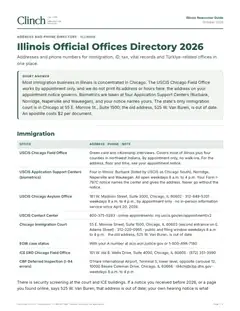
- Which USCIS office: the USCIS Chicago Field Office (101 W. Ida B. Wells Drive) covers most of Illinois plus four counties in northwest Indiana, and it works by appointment only, with no walk-ins. Southern Illinois counties are said to be handled by a field office outside the state, but we could not confirm which. See USCIS offices.
- Immigration court: Illinois has exactly one, in Chicago at 55 E. Monroe St., Suite 1500. It moved in 2026, so older sources still show 525 W. Van Buren (see immigration courts).
- Turkish consulate: in Chicago. Wherever in Illinois you live, that is the mission you belong to (see below).
- Apostille: the Secretary of State's Index Department handles it in Chicago (160 N. LaSalle St., Suite 100) and in Springfield (see apostille).
07 · Electricity and gas
How do I set up electricity and gas in Illinois, and do I need an SSN?
Short answer
No SSN is needed. In northern Illinois, including Chicago and Cook County, ComEd delivers electricity; central and southern Illinois get it from Ameren Illinois. For gas, Peoples Gas serves Chicago, North Shore Gas parts of the north suburbs, and Nicor Gas most of the rest of the north. ComEd asks for two IDs and the accepted list includes a foreign passport, an ITIN and a consular ID. Low-income households cannot be charged a deposit, and there is a winter shut-off ban from December 1 to March 31.
Steps, documents and official links
- Find your utility. PlugIn Illinois is the official electric shopping site of the Illinois Commerce Commission (ICC). Enter your ZIP code to see your distribution utility and suppliers' rates. The utility always owns the wires and the meter and is the number you call for an outage, whoever supplies the energy; switching suppliers changes only the supply part of the bill.
- Start service without an SSN (ComEd). ComEd's Start Service Guide says the applicant must be 18 or older and show two forms of ID, at least one a government photo ID. The accepted list includes a foreign passport, an ITIN, a consular ID (Matricula Consular), a military ID and an SSN. So an SSN is not required. ComEd's phone number is 800-334-7661.
- Gas service (Peoples Gas and North Shore Gas). The account holder may be asked to prove identity in person at a payment location within 14 days of applying: two primary IDs, or one primary plus one secondary. The primary list names a foreign-issued passport and a consular ID outright. Customer line 866-556-6001; gas leak and emergency 866-556-6002 (North Shore Gas 866-556-6004). If you smell gas, leave the building; if you suspect carbon monoxide, get out and call 911.
- If you are in Nicor Gas territory. Nicor starts service through an online form and runs a Low-Income Discount Program worth 5 to 77 percent; a household that self-certifies into it pays no deposit and no late fees. Phone 888-642-6748.
- Do not rush a supplier offer. Choosing an alternative electric supplier (an ARES) is optional. You can rescind a new enrollment within 10 days, and since January 1, 2020 residential customers can end any supplier contract at any time with no termination fee. A "savings" claim applies only to the supply part of the bill, and the number to measure it against is the utility's Price to Compare. Complaints: ICC 800-524-0795.
Can my power be cut off in winter?
Illinois has a protection Texas does not. According to the ICC, between December 1 and March 31 electric and gas utilities may not disconnect for non-payment any household receiving LIHEAP or PIPP, any electric space-heating customer, or military personnel and veterans. Other residential customers who used gas or electricity as their main heat the previous winter cannot be disconnected unless the utility first offered a deferred payment arrangement. Disconnection is also barred on days when the forecast is at or below freezing, and since January 1, 2024 on days forecast at 90 F or above (or under an excessive-heat watch or warning) where the utility is the only source of cooling.
Help with the bill: LIHEAP
- Dates: applications for 2026-27 open on October 1, 2026 for households with someone 60 or older, a person with a disability, a child aged 5 or under, or a disconnection, and on November 1, 2026 for every other income-eligible household. The period runs to August 13, 2027 unless the funds run out first.
- Income limit: 300 percent of the federal poverty level (30-day gross: $3,990 for one person, $8,250 for four, plus $1,420 per extra person).
- No SSN or ITIN? The program page says it plainly: residents without an ITIN or SSN can still apply, and the local administering agency will advise.
- If heat is included in the rent: renters can apply too, with a lease showing that heat is included, the rent amount and the landlord's contact details.
- How to apply: at helpillinoisfamilies.com or by calling 1-833-711-0374. In Chicago the application goes through the city's Department of Family and Support Services (DFSS); in Cook County outside Chicago, through CEDA.
- Separate discount rates: income-based discounts from all four gas utilities, ComEd's 5 to 80 percent electric discount and Ameren's electric discount are separate from LIHEAP. The state's starting point is powerbilldiscount.com.
Water and trash depend on your municipality. In Chicago, water, sewer and (for buildings of up to 4 units) the garbage fee come on one city bill, and the city's 50 percent low-income program, Utility Billing Relief, does not ask for an SSN. But it is open only to someone who owns and lives in a building of 1, 2 or 3 units: renters are not eligible. In most Chicago apartments water is included in the rent and the account is in the owner's name. Details are in our Chicago guide. In the suburbs and other cities, water and trash come from your own village or city hall.
08 · Renting
How much can an Illinois landlord charge as a security deposit, and when is it returned?
Short answer
Illinois state law sets no cap on security deposits (one month's rent is the norm) and there is no statewide rent control. The Security Deposit Return Act does impose a strict timetable: an itemized list and paid receipts within 30 days of your move-out, or the full deposit back within 45 days. A landlord acting in bad faith can owe twice the deposit. Most important of all: a landlord may not turn you down because you have no SSN.
Steps, documents and official links
- The 30 and 45 day rule: to withhold anything for damage, the landlord must send an itemized statement of the damage, with estimated or actual costs and paid receipts, within 30 days of the day you vacated. If it does not, the full deposit must come back within 45 days. A landlord who refuses the statement, or acts in bad faith and does not return the money on time, can owe twice the deposit plus court costs and attorney's fees. The statement may go by mail or to a verified email address.
- The Act now covers everyone: since P.A. 103-224 took effect on January 1, 2024 it applies to every lessor of residential real property. The "five or more units" limit still visible in the Attorney General's older fact sheet is out of date.
- Interest on the deposit: only landlords with 25 or more units in one building or a contiguous complex owe interest, and only on deposits held longer than 6 months.
- Ending a tenancy: 30 days' written notice for month-to-month, 60 days for year-to-year. Rent cannot be raised during a fixed-term lease. Eviction requires a court case after a 5-day notice for unpaid rent or a 10-day notice for other violations, and only the sheriff can physically remove a tenant. Changing the locks or cutting off utilities is illegal.
- A new fee law: P.A. 104-0479 caps rental application fees at $50, requires every non-optional fee to appear on the first page of the lease, and bans fees for lease renewal, eviction notices, contacting the landlord and similar items. The General Assembly's bill page gives the effective date as January 1, 2027, while the enrolled text still says July 1, 2026; treat 2027 as the date and check the current position.
I have no SSN. Can a landlord refuse me?
No. Since January 2024 the Illinois Human Rights Act bars housing discrimination on the basis of immigration status, actual or perceived citizenship or immigration status included. The Illinois Department of Human Rights (IDHR) lists as unlawful examples: screening out applicants who have no Social Security number, refusing applicants whose status has an expiration date, and threatening to report tenants to immigration authorities. The department tells housing providers to accept alternatives to an SSN, such as an ITIN, for background and credit checks. Lawful source of income, including rental assistance, has also been protected since 2023. You can file with IDHR within one year, free and without an attorney (Chicago 312-814-6200), or sue in state court within two years.
Extra rules in Chicago and suburban Cook County
- Chicago (RLTO): a written receipt for the deposit, the money held in a separate interest-bearing account at an Illinois bank, written notice within 14 days of which bank holds it, interest every year on deposits held more than 6 months (0.01 percent for 2026), an itemized damage statement within 30 days and return within 45. Violations cost twice the deposit. The Fair Notice ordinance requires 30, 60 or 120 days' notice, depending on how long you have lived there, to raise the rent, decline to renew or end a month-to-month tenancy. Details in our Chicago guide.
- Suburban Cook County (RTLO): in force since June 1, 2021. The deposit is capped at one and a half months' rent and must be returned within 30 days of move-out, with the itemized statement also due in 30 days; violations bring double damages and attorney's fees. Free legal aid line: 855-956-5763.
- Other municipalities: some have rules of their own, so check your village or city before you sign.
09 · Property tax
How does property tax work in Illinois, and how do I claim the homeowner exemption?
Short answer
Property tax is run by the county, not the state. In Chicago and Cook County the Assessor sets the value and grants exemptions, the Clerk calculates the rates, and the Treasurer mails and collects the bills. Tax is paid in two installments and in arrears, with the first installment set at 55 percent of last year's total bill. The Homeowner Exemption, which takes $10,000 off your home's taxable value, asks for no SSN and accepts a consular ID.
Steps, documents and official links
- The calendar is not fixed. In Cook County the first installment for tax year 2025 was due April 1, 2026 and the second on October 1, 2026. In earlier years the dates fell in March, August and December. The Treasurer's older pamphlet, which says the first business day of March and of August, is out of date, so check the Treasurer's due dates page.
- Late interest: 0.75 percent a month (9 percent a year) for tax year 2023 and later. Interest runs for about 13 months before the annual tax sale, and the 2026 annual tax sale is December 15, 2026.
- How to pay: online from a bank account for free, by card with a 2.1 percent convenience fee, by mail, at any Chase branch in Illinois, or in person at 118 N. Clark St. Only a USPS postmark counts for mail, not a postage meter. Payments from foreign banks are returned, so do not send money from your account in Türkiye. If your mortgage includes an escrow, the lender pays the bill.
- The Homeowner Exemption: it cuts $10,000 from the home's equalized assessed value (EAV), so the saving is $10,000 times the local tax rate (roughly $800 at the 8 percent rate in the Assessor's example). You qualify by owning the home, or holding a lease or contract that makes you liable for the tax, and living in it as your main residence on January 1 of the tax year. Once granted it renews automatically, and it shows up on the second-installment bill issued in the summer.
- Which ID does the exemption need? The Assessor's page asks for no SSN. You bring one photo ID from List A: an Illinois driver's license or state ID, a consular ID (Matricula Consular), or a City of Chicago ID card. If the address on the ID does not match the property, List B applies instead (U.S. military ID, passport, naturalization certificate, green card, refugee travel document, employment authorization card I-766) together with a List C proof of occupancy such as a bank statement, a landline or internet bill, or a pay stub. Paper forms come in English, Spanish and Polish.
- Other exemptions: the Assessor also lists exemptions for seniors 65 and older, a senior assessment freeze, persons with disabilities, longtime homeowners, home improvements and veterans. Check the Assessor for amounts and conditions.
- Outside Cook County: the collar counties (DuPage, Lake, Will, Kane, McHenry) each have their own treasurer and assessment office, with their own calendars and forms.
When is a home reassessed?
Cook County reassesses on a three-year cycle. Chicago was reassessed in 2024 and comes up again in 2027; the south and west suburbs were reassessed in 2026 and the north suburbs in 2025. A reassessment shows up on the following year's second-installment bill. Appeals run through the Assessor and the Board of Review.
10 · School
How do I enroll my child in school in Illinois, and do I need an SSN?
Short answer
No SSN is needed. Public Act 104-0288, effective January 1, 2026, writes into Illinois law that no child may be denied a free public education because of the child's or the parent's immigration status. Under the State Board of Education's August 2026 guidance, districts must not inquire about a student's or parent's immigration status. You enroll in the district your address belongs to, and a student is entitled to enroll up to age 21. Immunization and health papers are due by October 15.
Steps, documents and official links
- Find your district. Illinois has hundreds of separate elementary, high school and unit districts, and your address decides which one you belong to, not your village. Check it with the State Board of Education's school and district finder or on the district's own site.
- Get proof of age and identity ready. Under the Missing Children Records Act a certified birth certificate is due within 30 days of enrollment; if you do not have one, alternative identification such as a passport, visa or government ID is accepted. A Turkish passport works for this.
- Bring proof of residency. The guidance is explicit: the residency documents a district requires, taken together, may not amount to a requirement for proof of legal presence such as a Social Security number. A district may not demand a visa, a green card, an Illinois driver's license or state ID, or anything else that requires an SSN, and it cannot insist on one particular document such as a lease.
- Book the immunizations and health exams. Under state law (105 ILCS 5/27-8.1), proof of the required vaccines and a school physical are due by October 15 of the school year or the child can be excluded from school. A religious exemption certificate is also filed by October 15, and a medical exemption needs a clinician's letter. The required vaccines include DTP/Td, polio, MMR, hepatitis B, varicella, Hib for young children and meningococcal MCV4 in the older grades. Book early: you do not have to wait for the records to enroll, but October 15 is a real deadline.
- Fill out the home language survey. Every student's first enrollment includes a Home Language Survey, and the answers decide whether your child takes the WIDA English proficiency screener. Where a school has 20 or more English learners who share a home language, it runs Transitional Bilingual Education; with fewer, a Transitional Program of Instruction. Turkish-speaking children are usually supported through the latter. The State Board's multilingual department is at 312-814-3850.
- Students in temporary housing: students covered by McKinney-Vento can enroll immediately, without waiting for documents. In Chicago the program is called STLS and it covers families new to the country whose housing is not yet settled.
- Up to what age: the State Board's guidance recognizes free public education through grade 12 until age 21.
- School safety: Public Act 104-0288 also required schools to adopt, by July 1, 2026, a procedure for reviewing requests from law enforcement agents who want to enter a school. You can ask your school's administration whether it has one.
- Chicago: in Chicago Public Schools every K-12 student is entitled to a seat at their neighborhood school, with no application; non-neighborhood schools go through GoCPS, and 3- and 4-year-olds through Chicago Early Learning. Details in our Chicago guide.
PDF: Illinois School Enrollment Guide 2026 (No SSN Needed, Immunization Deadline October 15)
11 · Health
I don't have health insurance. Where can I turn in Illinois, and can my kids get covered?
Short answer
In an emergency, call 911 or go to the nearest ER: emergency departments must screen and stabilize you regardless of insurance or immigration status. For children there is good news: anyone under 19 can enroll in All Kids regardless of immigration status, and pregnant people are covered by Moms & Babies, including the 12 months after birth. For adults the picture is narrower, because HBIA, the program for undocumented adults, closed on July 1, 2025.
Steps, documents and official links
- All Kids: the state's children's coverage takes children under 19 who live in Illinois, regardless of immigration status. The Department of Healthcare and Family Services (HFS) states that it does not report undocumented children and that All Kids does not count for public charge purposes except for long-term institutional care. The All Kids unit is 1-877-805-5312, and applications go through ABE.illinois.gov or 1-800-843-6154.
- HBIA has closed for adults: Health Benefits for Immigrant Adults, which covered undocumented and some other immigrants aged 42 to 64, closed on July 1, 2025, with June 30, 2025 the last day of coverage. HBIS for people 65 and older continues, but the HFS page still live on October 1, 2026 says enrollment into HBIS has been paused and no new applications should be submitted. Re-check that page on the day you need it.
- The October 1, 2026 federal change: under the federal HR 1, refugees, asylees, humanitarian parolees and survivors of domestic violence and trafficking no longer qualify for federally funded Medicaid; those groups now get emergency Medicaid only. HFS mailed notices in July, August and September 2026 and said the change comes from federal law, not from the state. Green card holders who have met or are exempt from the 5-year bar generally keep coverage. Help lines: ABE 1-800-843-6154, ICIRR 1-855-435-7693.
- If you lost HBIA coverage: Emergency Medical for Noncitizens continues for genuine emergencies, and hospitals can file the application on a patient's behalf. HFS also points people to free clinics, sliding-fee community health centers and hospital financial assistance.
- Adults who want to buy a plan: Illinois now runs its own marketplace, Get Covered Illinois. Open enrollment for 2027 runs November 1, 2026 to January 15, 2027, and the customer center is 1-866-311-1119. One warning: from January 1, 2027 premium tax credits are limited to green card holders, certain Cuban and Haitian entrants and citizens of the COFA nations, so people in statuses such as TPS lose them. Undocumented adults can buy private insurance directly from insurers.
- Free clinic or sliding fee? They are not the same. Free and charitable clinics are staffed by volunteers and provide care at no cost or for a nominal fee; the state association (IAFCC) describes typical fees of $10 to $20 per medical visit and says none of them turns away a patient who cannot pay. Community health centers (FQHCs) are federally funded, bill insurance and charge the uninsured on an income-based sliding scale, so they are not free. Find free clinics in the IAFCC directory and health centers with the IPHCA locator. Chicago's free and low-cost clinics are collected in our Chicago guide.
- If a hospital bill arrives: Illinois' Hospital Uninsured Patient Discount Act bars hospitals from charging uninsured Illinois residents with family income and assets up to 600 percent of the poverty level more than cost plus 35 percent (300 percent at rural and critical-access hospitals), and caps what you pay in a year at 25 percent of family income. You apply within 60 days of the service or discharge, and it covers medically necessary hospital services over $300. The hospital may first ask you to apply for Medicaid. The Attorney General's Health Care Bureau hotline is 877-305-5145.
- Mental health crisis: 988 is the Suicide and Crisis Lifeline, with interpreters available.
12 · Marriage
How do I get a marriage license in Illinois?
Short answer
In Illinois marriage licenses come from the county clerk, not the state. Both of you apply together and in person. The license becomes effective one day after it is issued, stays valid for 60 days, and works only for a ceremony in the county that issued it. In Cook County, which covers Chicago and its suburbs, the fee is $60 and the license is printed while you wait. Other counties set their own fees, so call yours first.
Steps, documents and official links
- Where: at one of the Cook County Clerk's four Vital Records offices. The Chicago office is at 118 N. Clark St., Room 120, phone (312) 603-7790, weekdays 9 a.m. to 5 p.m. The others are Skokie (5600 W. Old Orchard Rd., Room 149), Markham (16501 S. Kedzie Ave., Room 238) and Maywood (1311 Maybrook Dr., Room 104). You can start the application online and finish it in the office.
- Timing: the license takes effect the day after it is issued, not the same day, so a same-day wedding is not possible. It is valid 60 days, and the signed license must be returned to the Clerk within 10 days of the ceremony.
- ID: on the Clerk's marriage-specific list, a foreign passport appears among the documents accepted on its own. That detail comes from an older capture of the page, so call the office to confirm before you go. The other single-document IDs are a U.S. driver's license or state ID, a U.S. passport, a military ID, a FOID card and Global Entry. Otherwise you bring two documents from the list: a certified birth certificate with a notarized English translation, a naturalization certificate, a green card, a consular ID or an employment authorization card.
- Special cases: if you divorced within the last 6 months, bring the certified decree. Applicants aged 16 and 17 need parental consent. First cousins may marry only if both are over 50.
- Where the ceremony happens: in Cook County, civil ceremonies are performed at Marriage Court, 119 W. Randolph St., on the lower level.
- Name change: optional. Changing your name through marriage is not a court case: take the marriage certificate to the Social Security Administration and update your record for free.
Changing a name outside marriage
An adult name change through the courts got easier on March 1, 2025: the county residency requirement dropped from 6 months to 3, and newspaper publication is no longer required. In Cook County you file with the County Division at the Richard J. Daley Center, 50 W. Washington St., Room 1202, weekdays 8:30 a.m. to 4:30 p.m., information line (312) 603-5710. Sources give different filing fees, so confirm the current amount with the clerk of the court; a fee waiver is available if you cannot pay.
13 · Birth
How do I get a birth certificate for a baby born in Illinois?
Short answer
There are two routes. If the birth happened in Cook County, the fastest is the Cook County Clerk: a certified copy is $15 for the first and $4 for each additional copy, and in person it is printed while you wait. For someone born elsewhere in Illinois you go to the Department of Public Health's Division of Vital Records: the long form is $15 for the first copy, the short form $10, and $2 for each additional copy, but mail orders take about 12 weeks.
Steps, documents and official links
- Cook County Clerk (births in Chicago and Cook County): order online through VitalChek with a $13.45 extra fee, by phone at (866) 252-8974, by mail to the Bureau of Vital Records, PO Box A3390, Chicago, IL 60690 (about 20 working days), or in person. In person the office takes cash, debit and credit cards, but not checks. Orders placed at a Currency Exchange add $5. Death certificates appear to cost $17 for the first copy and $6 for each additional one at the Clerk, but confirm those two amounts with the office.
- IDPH (anywhere in Illinois): a certified death certificate is $19 for the first copy and $4 for each additional; a record correction or legal name-change amendment is $15 plus $2. Pay by check or money order to IDPH, and bring a readable, unexpired government photo ID. The IDPH Springfield office moved on September 14, 2026 from 925 E. Ridgley Ave to 110 W. Lawrence Ave, Springfield, so do not mail documents to the old address. Email [email protected].
- Ask for certified copies: a U.S. passport application and registering the birth in Türkiye both need a certified copy, not a photocopy. Since extra copies are cheap, ordering a few at once usually makes sense.
- Apostille: for use in Türkiye, the Secretary of State's Index Department apostilles the certificate, and it costs only $2 per document. IDPH points to the same office on its own page (see apostille).
- The baby's SSN: if you request a Social Security number when the birth is registered at the hospital, the card arrives by mail and you do not need to visit an SSA office.
- Vaccines: if you live in Chicago, the city health department's immunization clinics give routine childhood vaccines at no out-of-pocket cost to uninsured, underinsured and Medicaid children aged 0 to 18 (see our Chicago guide).
14 · Social Security
How do I get a Social Security number in Illinois?
Short answer
SSNs are issued only to people with work authorization or a legally required reason. If you asked for an SSN in your immigrant visa application, the card is mailed to you. People who adjust status with Form I-485, and EAD applicants who checked the SSN box, also receive the card automatically. Otherwise you start online and visit an SSA office by appointment; it is free.
Steps, documents and official links
- What to bring: current immigration documents (green card, I-94 or EAD) with a valid passport, and a birth certificate if you have it. No photocopies or notarized copies. SSA suggests waiting 10 days after arrival so DHS records can be verified.
- F-1 and J-1: an SSN is available only once you are authorized to work (on-campus job, CPT, OPT), not just for enrolling in school.
- Which office: Illinois has more than 45 SSA field offices, and your ZIP code decides which one serves you, not which is closest. Confirm with the SSA office locator before you go. All of them are open weekdays 9 a.m. to 4 p.m.
- Chicago and the suburbs: eleven offices are inside the city limits, including the Loop office at 605 W. Washington Blvd., Chicago, IL 60661, the north office at 2127 W. Lawrence Ave., the west office at 5130 W. North Ave. and the northwest office at 4849 N. Milwaukee Ave. Suburban Cook County has offices in Evanston, North Riverside, Hillside, Mount Prospect and Chicago Heights. Downstate, there are offices in Springfield, Peoria, Champaign, Rockford, Joliet, Aurora, Elgin and Waukegan.
- National line: 1-800-772-1213. A replacement card is free and can often be started online.
- Name change after marriage: in Illinois a marriage name change is not a court case. Take your marriage certificate to any SSA office and update the record free of charge.
What can I do in Illinois without an SSN?
- Driver's license: Illinois abolished the Temporary Visitor Driver's License on July 1, 2024. Applicants without an SSN now get a standard four-year license marked "Federal Limits Apply" after proving 12 months of Illinois residency. The consular IDs the state accepts come from five Latin American countries only, and Türkiye is not among them, so a Turkish applicant relies on a passport. See the driver's license section.
- Electricity and gas: ComEd accepts a foreign passport, a consular ID or an ITIN as identification for a new account. Peoples Gas and North Shore Gas count a foreign passport or consular ID as primary identification.
- Renting: since January 1, 2024 an Illinois landlord may not screen out an applicant simply for having no SSN, and is expected to accept an ITIN.
- School: an SSN is not required to enroll a child. See the school enrollment section.
- Taxes: people who must file but cannot get an SSN use an ITIN (see the tax section below).
According to SSA, you do not need an SSN for a driver's license, school registration or private health insurance.
15 · Taxes
Does Illinois have a state income tax, and how do I get an ITIN?
Short answer
Yes. Unlike Texas, Illinois taxes personal income, and the rate is flat for everyone: 4.95% of net income. There are no brackets. The personal exemption is $2,925 per person for tax year 2026. Chicago has no separate city income tax. People who must file but cannot get an SSN apply for an ITIN with Form W-7; an ITIN is a tax number only and does not authorize work or change status.
Steps, documents and official links
State income tax
- Flat rate: the Illinois Department of Revenue taxes individual income at 4.95% of net income, with no brackets. Earning more or less does not change the rate.
- Exemption: the personal exemption allowance is $2,925 per person for the tax year beginning January 1, 2026 (it was $2,850 for 2025), with an extra $1,000 for people 65 or older and for blind filers. It is not allowed if federal adjusted gross income is over $500,000 on a joint return or $250,000 otherwise.
- Two returns: the federal return goes to the IRS and the state return (IL-1040) to the Illinois Department of Revenue. The 2026 return is due in April 2027. Illinois has no separate state tax number; your federal SSN or ITIN is used on the state return too.
- No city income tax: Illinois taxes income only at the state level, and Chicago does not levy a city income tax. Local governments instead receive a share of state income tax collections.
- Credits with an ITIN: Illinois gives the state Earned Income Tax Credit to ITIN filers, and filers with a child under 12 can also claim a state Child Tax Credit worth 40% of that credit. This is different from the federal rule.
- Sales tax: the state rate on general merchandise is 6.25%. On August 1, 2026 the regional transit tax rose by 0.25 point in Cook, DuPage, Kane, Lake, McHenry and Will counties, which puts Chicago's combined rate at roughly 10.5%. Check the exact rate for your address with the state's MyTax Illinois rate finder. The state's 1% grocery tax ended on January 1, 2026.
- Moving from Texas? Texas has no state income tax. Build the 4.95% into your budget when you compare salary offers.
How do I get an ITIN?
- Complete Form W-7 and attach it to your federal return unless an exception applies.
- Get documents verified. Mail originals to the IRS in Austin, use a Certifying Acceptance Agent (CAA), or book an appointment at an IRS office that reviews ITIN documents. With a CAA or an IRS office, your passport does not go in the mail; documents are returned at the end of the appointment.
- Wait. Processing takes about 7 weeks, or 9 to 11 weeks during tax season (January 15 to April 30).
- Illinois offices that review ITIN documents in person: per the IRS list, Bloomington, Champaign, Chicago, Decatur, Downers Grove, Fairview Heights, Galesburg, Orland Park, Peoria, Quincy, Rockford, Schiller Park and Springfield. The Chicago office is at 230 S. Dearborn Street, Chicago, IL 60604; Orland Park is at 14479 John Humphrey Drive, Orland Park, IL 60462; Rockford is at 4920 E. State Street.
- Appointments: IRS Taxpayer Assistance Centers are appointment only, on 844-545-5640. Confirm the address and hours with the IRS office locator.
- Expiration: an ITIN not used on a federal return for three years in a row expires.
16 · Starting a business
How do I start an LLC in Illinois, and where do I register a business name?
Short answer
An Illinois LLC is formed by filing Articles of Organization with the Secretary of State's Business Services department. The fee is $150 and processing takes about 10 business days; filing online with 24-hour service costs $250. Every LLC then files a $75 annual report. A registered agent and a registered office with an Illinois street address are mandatory, and a PO box alone is not enough.
Steps, documents and official links
- Articles of Organization: filed with the Illinois Secretary of State for $150 (about 10 business days), or $250 online for 24-hour service. A series LLC is $400, or $500 with 24-hour service. Expediting by mail or in person adds $100 and is available only at the Springfield and Chicago offices.
- Registered agent: required. It can be an individual who lives in Illinois or an entity authorized to act as an agent. The registered office must have an Illinois street address; a PO box on its own is not accepted.
- Annual report: $75 every year, plus $50 to expedite. Missing it puts the company out of good standing.
- Assumed name: an LLC that will trade under a different name files Form LLC 1.20 with the Secretary of State. Sole proprietors and general partnerships instead register an assumed business name with the county clerk where they do business. In Cook County that filing is listed at $50; confirm the current amount with the clerk, and confirm the LLC 1.20 fee with the Secretary of State before you file.
- City license: the state filing is not a business license. Almost every line of work in Chicago needs a city license, applied for through Chicago Business Direct or at the Small Business Center, 121 N. LaSalle St., 8th Floor, Room 800, on 312-744-6249. Check zoning before you sign a lease. More in our Chicago guide.
| Item | Where | Cost |
|---|---|---|
| Articles of Organization (LLC) | Secretary of State | $150 (about 10 business days) |
| Articles of Organization, 24-hour | Secretary of State (online) | $250 |
| Series LLC | Secretary of State | $400 ($500 with 24-hour service) |
| Annual report | Secretary of State | $75 (expedite +$50) |
| Sole proprietor assumed name | County clerk | Varies by county |
Illinois allows an LLC with foreign members; there is no requirement that members be U.S. citizens or Illinois residents.
17 · Public benefits
Can immigrants in Illinois get SNAP or Medicaid, and does it affect a green card?
Short answer
Illinois runs SNAP and Medicaid through Healthcare and Family Services (HFS) and Human Services (IDHS), with applications on the ABE portal. Federal law narrowed both: SNAP on July 4, 2025 and Medicaid on October 1, 2026. The state's own health program for immigrant adults (HBIA) closed on July 1, 2025. And under the public charge rule in effect since September 18, 2026, benefits received after that date may be held against a green card application.
Steps, documents and official links
- Where to apply: SNAP, Medicaid and cash assistance applications go through ABE (Application for Benefits Eligibility) or a local IDHS office. The ABE Call Center is 1-800-843-6154. Every noncitizen applicant's status is checked at application and at each renewal.
- SNAP: the federal law that took effect on July 4, 2025 narrowed SNAP for noncitizens. Broadly, green card holders (after the five-year bar or with an exception), Cuban and Haitian entrants and COFA citizens remain eligible, while refugees, asylees and some humanitarian categories lost eligibility. Confirm your own category before you apply.
- Medicaid, October 1, 2026: the same law removed refugees, asylees, humanitarian parolees and survivors of domestic violence and trafficking from full Medicaid as of that date, leaving them emergency Medicaid only. Green card holders who have met or are exempt from the five-year bar generally keep coverage. HFS mailed notices in July, August and September 2026 to the people affected; do not ignore that letter. HFS states plainly that the change is required by federal law and was not a state decision.
- The state's own programs: Health Benefits for Immigrant Adults (HBIA, ages 42 to 64) closed on July 1, 2025, with June 30, 2025 the last day of coverage. Health Benefits for Immigrant Seniors (HBIS, 65 and over) continues, but the HFS page says enrollment is paused and new applications should not be submitted. In short, Illinois is not currently running a health program open to undocumented adults.
- Children and pregnancy: children under 19 can get All Kids coverage regardless of immigration status, and pregnant people can get Moms & Babies coverage during pregnancy and for 12 months after birth. HFS says All Kids does not create a public charge problem except for long-term institutional care, and that it does not report undocumented children. All Kids Unit: 1-877-805-5312.
- Buying insurance: Illinois runs its own marketplace. Get Covered Illinois open enrollment runs November 1, 2026 to January 15, 2027; the help line is 1-866-311-1119. From January 1, 2027 premium tax credits are limited to green card holders, Cuban and Haitian entrants and COFA citizens.
- The new public charge rule: for green card applications filed on or after September 18, 2026, officers may consider any means-tested benefit (SNAP, Medicaid, housing assistance and others) received on or after that date. Benefits received earlier count only if they were cash assistance or long-term institutional care. Benefits received by family members, such as a child's own coverage, are generally not counted.
- Who is exempt: humanitarian categories such as asylees and refugees, T and U visa holders, VAWA self-petitioners and TPS. Family-based, most employment-based and diversity visa applicants are subject to it.
- Free help: the ICIRR family support hotline is 1-855-435-7693 and the IDHS Immigrant Family Resource Program is 312-793-7120.
18 · Address change
I moved to Illinois. Do I have to report my new address to USCIS?
Short answer
As a general rule, most people who are not U.S. citizens, green card holders included, must report a new address to USCIS within 10 days of moving. The easiest way is the change of address screen in your USCIS online account; the paper Form AR-11 is free too. If you have a case in immigration court, you also file Form EOIR-33 within 5 days. Moving within the state still counts.
Steps, documents and official links
- Sign in to your USCIS account and open the Change of Address screen. Reporting online satisfies the legal requirement, so you do not also need to mail a paper AR-11.
- List the receipt number of every pending application. Otherwise notices can still go to the old address.
- Tell USPS separately. A post office change of address does not update USCIS records, and USPS does not forward USCIS mail.
- If you have a court case, file Form EOIR-33/IC within 5 days. The court changes an address only with that form.
- If you report to ICE (for example because you have scheduled check-ins), update your address through the ICE Portal as well. ICE asks for the update within 5 business days of the move.
A and G visa holders and visitors who entered under the Visa Waiver Program are exempt from the USCIS reporting requirement.
19 · USCIS
Where are the USCIS offices in Illinois, and where do I go for biometrics?
Short answer
Green card and citizenship interviews for Illinois are held at the USCIS Chicago Field Office, in downtown Chicago, by appointment only. Fingerprints and photos are taken at four Application Support Centers in the state: Burbank, Norridge, Naperville and Waukegan. Asylum work is handled separately, by the Chicago Asylum Office at 181 W. Madison Street, Suite 3000. For every appointment, the address, floor and time on your notice are what count.
Steps, documents and official links
Which office does what?
- Chicago Field Office: where green card and citizenship interviews happen. It covers most of Illinois plus four counties in northwest Indiana. There are no walk-ins, and forms are not mailed to it. The USCIS page for this office is currently broken, so we do not print its address or hours here: the address, floor and time on your appointment notice govern. If you live in the far southern counties, check with USCIS which office handles your case.
- Chicago Asylum Office: 181 W. Madison Street, Suite 3000, Chicago, IL 60602. Phone 312-849-5201, e-mail [email protected]. Weekdays 8 a.m. to 4 p.m., by appointment only. Since April 20, 2026 the office no longer provides in-person information services, so turning up at the door to ask about a case does not work; call the Contact Center on 800-375-5283 instead.
- Application Support Centers (biometrics): Illinois has four, in Burbank (listed by USCIS as Chicago South), Norridge, Naperville and Waukegan, all open weekdays 8 a.m. to 4 p.m. You do not choose which one; your Form I-797C notice names it and gives the address. If a center closes unexpectedly, the appointment is rescheduled automatically.
- Appointments and questions: USCIS Contact Center 800-375-5283, or request an appointment online. Appointments are free. Track a case at uscis.gov/casestatus.
- Processing times: on the USCIS processing times page, pick your form, category and "Chicago IL" as the office. The figures update monthly.
- What to bring: we list what to take to a biometrics appointment in our article on the fingerprint appointment. Never go to a center without the notice.
- Attorneys at interviews: since May 18, 2026, attorneys can no longer appear remotely at field office interviews except in limited cases. If your attorney will attend, they must come in person with you.
20 · Court
Where is the immigration court in Illinois, and how do I check my case?
Short answer
EOIR lists one immigration court in Illinois: the Chicago Immigration Court, 55 E. Monroe Street, Suite 1500, Chicago, IL 60603, phone 312-220-0965. The court moved from its old address on West Van Buren, so older paperwork may still show the wrong place. Public and filing window hours are weekdays 8 a.m. to 4 p.m. Check your case with your A number on ACIS or by calling 1-800-898-7180.
Steps, documents and official links
| Office | Address | Phone |
|---|---|---|
| Chicago Immigration Court | 55 E. Monroe Street, Suite 1500, Chicago, IL 60603 (second entrance on E. Adams Street) | 312-220-0965 |
| ICE ERO Chicago Field Office | 101 W. Ida B. Wells Drive, Suite 4000, Chicago, IL 60605 | (872) 351-3990 |
| CBP Deferred Inspection | O'Hare International Airport, Terminal 5, lower level, opposite carousel 12, 10000 Bessie Coleman Drive, Chicago, IL 60666 | [email protected] |
- The address changed: the court is now at 55 E. Monroe Street. If a notice you received before 2026, or a page you found online, says 525 W. Van Buren, that address is out of date. Confirm on EOIR's court page, but your own hearing notice is what controls.
- At the building: there is security screening on every visit. The building has paid parking, the Adams & Wabash Self-Park is nearby at 17 E. Adams, and the CTA Adams/Wabash station is a short walk. E-mail [email protected].
- Internet-based hearings: some hearings are held over Webex. Your notice says whether yours is in person or online.
- Checking online: ACIS needs only your A number (A plus 8 or 9 digits). The hearing notice is still the official record; the system can be slow to show new dates.
- ICE: the Chicago field office covers Illinois, Indiana, Wisconsin, Missouri, Kentucky and Kansas. Check-ins are scheduled through ICE's own systems. If you have a check-in obligation, speak with your attorney before you go.
Where do I find my I-94, and what if it is wrong?
You can download the I-94 for your most recent entry from CBP's website. Mistakes made at entry, such as the wrong visa class, a misspelled name or the wrong period of stay, are corrected by CBP Deferred Inspection. The Illinois office is on the lower level of Terminal 5 at O'Hare, opposite carousel 12, open weekdays 8 a.m. to 4 p.m.; correction requests can also go to [email protected]. The office only fixes errors made at the time of entry.
21 · Voting and jury duty
I'm not a citizen. Can I register to vote in Illinois, and what if I get a jury summons?
Short answer
Registering and voting are for U.S. citizens only, green card holders included. A jury summons is a different matter. Illinois jury lists add driver's license and state ID holders, and even unemployment insurance claimants, to the registered voters. Do not ignore the summons. In Cook County, if you do not meet all the qualifications, contact the Office of Jury Administration on (312) 603-5879 before your service date.
Steps, documents and official links
- The jury list is more than the voter roll: Illinois law puts holders of an Illinois driver's license, an Illinois Identification Card or a Person with a Disability ID card, and people who claimed unemployment insurance, into the list alongside registered voters (705 ILCS 310/2 and 705 ILCS 305/1). Cook County says the same thing about its own process: each year its jury office takes lists from the Secretary of State and from the county and city election boards, merges them and draws names at random. So a noncitizen who never registered to vote can surface through the license file, and a summons is not evidence that somebody made a mistake.
- Jurors have to be citizens: the qualifications are county residence, being 18 or over, understanding English and being a U.S. citizen. The Cook County court states it plainly: if you do not meet all of them, contact the Office of Jury Administration before the date you are supposed to serve, on (312) 603-5879. In other counties the instruction and the number are printed on the summons itself, so follow those. Never ignore the letter or throw it away.
- A license is not voting eligibility: since 1 July 2024 Illinois issues a four-year standard license to applicants without an SSN, marked "Federal Limits Apply". It is an identity and driving document and has nothing to do with voter eligibility.
- Watch the REAL ID application: an application for a license or ID that meets REAL ID requirements also serves as a voter registration application. If you do not want the registration you have to tick the box declining it, and no reason is needed; if you leave it unticked, your signature attests under penalty of perjury that you meet the voter qualifications. The Secretary of State checks the identity documents you handed over, and if they show the applicant is not qualified the application is marked incomplete and no registration is sent (10 ILCS 5/1A-16.1). A standard license applied for without an SSN is left out of that dual-purpose process altogether.
- What to do at the counter: read the voter registration part of the form. If you are not a citizen, do not sign that part and do not tick its box; tick the decline box if there is one. The same goes for volunteers handing out forms door to door or at events: do not take one and do not fill it in.
- The penalty is heavy: a false statement in an affidavit, certificate or sworn declaration required by the Election Code is perjury in Illinois, a Class 3 felony (10 ILCS 5/29-10). Registering or voting without citizenship can also have serious immigration consequences (USCIS Policy Manual). As the State Board of Elections puts it, automatic registration does not allow noncitizens to be registered automatically.
- Scams: courts do not ask for your SSN by phone or email, and never ask for a fine or a bail payment over the phone. If you get a call like that, hang up and call the court yourself on the official number printed on the letter.
Recently naturalized? You can register through the Illinois State Board of Elections or your county election authority. Online registration usually asks for an Illinois driver's license or state ID and the last four digits of your SSN.
22 · New citizens
I just became a citizen. How do I get a U.S. passport in Illinois?
Short answer
A first U.S. passport is applied for in person on Form DS-11, at an acceptance facility such as a post office, with your original proof of citizenship. An adult book costs $130 plus a $35 acceptance fee. For travel within 14 days, Illinois has its own passport agency: the Chicago Passport Agency at 101 Ida B. Wells Drive, 9th Floor, by appointment only.
Steps, documents and official links
- Find an acceptance facility: wherever you live in the state, use the passport facility locator. Post offices and many suburban public libraries, such as River Grove, Northlake and Prospect Heights, offer this service. These locations accept new applications (DS-11) only, and the acceptance fee is paid separately from the passport fee.
- Routine applications in Chicago: the Clerk of the Circuit Court of Cook County runs Passport Services at the Richard J. Daley Center, Room 1202, 50 W. Washington Street. Call before you go to confirm hours and whether an appointment is needed; the clerk's page is not up to date.
- Children: a passport book for a child under 16 costs $100 plus the $35 acceptance fee.
- Urgent travel: you need proof of travel within 14 days, or of a foreign visa needed within 28 days. The expedite fee is an extra $60.
| Passport agency | Address | Hours |
|---|---|---|
| Chicago Passport Agency | 101 Ida B. Wells Drive (formerly 101 W. Congress Parkway), 9th Floor, Chicago, IL 60605 | Mon, Tue, Wed and Fri 8 a.m. to 3 p.m.; Thu 10 a.m. to 3 p.m.; appointment only |
- Appointments: free, at passportappointment.travel.state.gov, for up to seven people in one household. If you have already applied, call 877-487-2778. Third-party sites that charge to book an appointment are scams. The agency is closed on weekends and federal holidays.
- Watch for a stale address: the Cook County Circuit Clerk's passport page still lists the agency at 230 South Dearborn Street. That address is out of date; go to 101 Ida B. Wells Drive.
Official sources
Not sure about a step?
Ask before you do something that touches your immigration status
Applying for a benefit, changing your address, registering to vote or answering a jury summons can all show up in your file. You can speak with Attorney Asim Clinch, a Turkish-speaking immigration attorney serving clients in Illinois, in English or Turkish.
23 · Things to do
What are the places to visit in Illinois?
Short answer
Every Illinois state park is free: no entrance fee and no parking pass. Starved Rock, about two hours from Chicago, is the right first trip for its canyons and waterfalls, and Illinois Beach State Park to the north has miles of Lake Michigan shoreline. Chicago's big museums go a step further and give Illinois residents free admission on set days.
Steps, documents and official links
| Place | Region | What it is | Admission |
|---|---|---|---|
| Starved Rock State Park | Utica, LaSalle County (1.5 to 2 hours from Chicago) | Eighteen canyons along the Illinois River, waterfalls in spring and late winter, and rock overlooks. The visitor center and park office open daily 9 a.m. to 4 p.m., closed on state holidays; trails are open 7 a.m. to sunset. | Free |
| Illinois Beach State Park | Zion, north of Chicago | 4,160 acres with 6.5 miles of Lake Michigan shore, dunes, marsh, hiking trails, a campground and a resort. | Free |
| Chicago lakefront | Chicago | The Park District's open lakefront and the Lakefront Trail: 18 miles for bikes and 18.5 for walkers, from Ardmore Avenue to 71st Street. Repairs that started on September 14, 2026 may close sections. The swim season is over; the 2027 season starts May 28. | Free |
| Field Museum | Chicago, Museum Campus | Natural history museum at 1400 S. DuSable Lake Shore Drive, open daily 9 a.m. to 5 p.m. with last entry at 4. General admission is free for Illinois residents on Wednesdays from October 14, 2026 to March 31, 2027. | Free for Illinois residents on Wednesdays |
| Shedd Aquarium | Chicago, Museum Campus | Aquarium. Free for Illinois residents on Tuesday evenings, 5 to 9 p.m., all exhibits included. Online reservations add a $5 convenience fee per order; booking by phone on 312-939-2438 is free. | Free for Illinois residents on Tuesday nights |
| Griffin Museum of Science and Industry | Chicago, Hyde Park | Science and industry museum, formerly MSI. General admission is free for Illinois residents on selected days. The giant dome theater, the coal mine tour and the U-505 submarine are ticketed separately. | Free on selected days |
| Adler Planetarium | Chicago, Museum Campus | Planetarium and astronomy exhibits. Free for Illinois residents on selected days; you enter your ZIP code as the discount code at checkout. | Free on selected days |
| Art Institute of Chicago | Chicago, Michigan Avenue | One of the great art museums. Free for Illinois residents on the third Thursday of the month, 5 to 8 p.m., with tickets reserved online in advance. Children under 14 are always free. | Free on third Thursday evenings |
| Springfield and the Lincoln museum | Springfield (state capital) | The state capitol and the Abraham Lincoln Presidential Library and Museum, about 3.5 hours from Chicago by car. | Check ticket prices on the museum's site |
| Chicago | Cook County | Millennium Park, Navy Pier, the Chicago Cultural Center, Lincoln Park Zoo and architecture tours. Details in our Chicago guide. | Mixed; much of it free |
How do park fees and the resident free days work?
According to the Illinois Department of Natural Resources, every state park is free: no entrance fee and no parking pass. If you are coming from New York or Texas that is a real difference, because there a vehicle fee is standard. Camping, boat rentals and some facilities still cost money.
The museums' Illinois resident days need proof. Adults bring an Illinois driver's license, a state ID, or a photo ID together with an Illinois utility bill, lease or pay stub. A license marked "Federal Limits Apply" still shows your Illinois address, so it works as residency proof. Children do not need ID if they are with a resident adult. Free slots are limited, so reserve tickets in advance.
24 · Free and family-friendly
What are free things to do in Illinois, and where can I go with kids?
Short answer
All state parks are free. In Chicago, Lincoln Park Zoo is free 365 days a year, the Lincoln Park Conservatory and the Chicago Cultural Center are free, and Millennium Park is open daily 6 a.m. to 11 p.m. with no admission. Illinois residents also get free days at the Field Museum, Shedd, Griffin MSI, Adler and the Art Institute, and a public library card unlocks museum passes.
Steps, documents and official links
Always free
- State parks: Starved Rock, Illinois Beach and the rest. Entry and parking cost nothing.
- Lincoln Park Zoo: free 365 days a year, no reservation needed, on the north side within walking distance of the lake.
- Lincoln Park Conservatory: four display houses of palms, ferns, orchids and seasonal shows at 2391 N. Stockton Drive, open daily 10 a.m. to 5 p.m. Admission is free, and it is a warm stop in winter.
- Millennium Park: open daily 6 a.m. to 11 p.m., no admission, with free events all year. Parts of the park may be closed for construction.
- Chicago Cultural Center: 78 E. Washington Street, open daily 10 a.m. to 5 p.m., no ticket needed, with exhibitions and free concerts. Closed on Thanksgiving Day, November 26, 2026.
- Navy Pier: entry to the pier is free and there are free fireworks displays through the year. Rides and attractions are ticketed.
- The lakefront: Chicago's 26 miles of lakefront and its beaches are free. The swim season has ended and the 2027 season starts May 28; there is no swimming without lifeguards.
Free days for Illinois residents
- Field Museum: Wednesdays, from October 14, 2026 to March 31, 2027.
- Shedd Aquarium: Tuesday evenings 5 to 9 p.m. (October 6, 13, 20 and 27; November 3, 10, 17 and 24; December 1, 8 and 15).
- Griffin Museum of Science and Industry: October 5, 6, 7, 13, 14 and 18, 2026. The museum adds later dates to its page.
- Adler Planetarium: October 26, 27 and 28, and November 9, 10, 16, 17 and 18, 2026.
- Art Institute of Chicago: the third Thursday of the month, 5 to 8 p.m. (October 15, November 19 and December 17, 2026). Children under 14 are always free.
- With a library card: Illinois public library members can reserve free or discounted passes to many museums, the Art Institute and Griffin MSI among them, through Explore More Illinois. Chicago Public Library members use chipublib.org/digitalpasses.
- Lower-income families: through Museums for All, households with a LINK, EBT or WIC card get in free or at a deep discount at the Art Institute, Griffin MSI and Adler. At Griffin MSI it covers up to two adults and six children; call (773) 684-1414.
With kids
- Lincoln Park Zoo: free all day, every day. ZooLights runs November 20, 2026 to January 3, 2027, free on Mondays except December 21 and 28, with free tickets released a week ahead at 11 a.m.
- Maggie Daley Park in the Loop: 20 acres with a climbing wall, mini golf and playgrounds. The ice skating ribbon runs November 13, 2026 to March 7, 2027. If you bring your own skates, the 11 a.m. weekday session and the 8 a.m. weekend session are free and other sessions are $5; rental skates are $17 on weekdays and $21 at weekends. Each session is booked separately.
- Field Museum and Griffin MSI: the dinosaur halls, the space exhibits and the coal mine tour are what children remember.
- Starved Rock: the canyon trails are short enough to walk with children, though a 2026 trail improvement project has some of them closed or limited. Check the park page before you drive out.
- Farmers markets: Green City Market runs outdoors in Lincoln Park (1817 N. Clark St) and the West Loop (900 W. Monroe St) through November 21, 2026.
25 · Turkish consulate
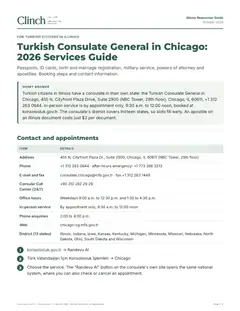
Where is the Turkish Consulate General in Chicago, and how do I book an appointment?
Short answer
Turkish citizens in Illinois have a consulate in their own state: the Turkish Consulate General in Chicago, 455 N. Cityfront Plaza Drive, Suite 2900 (NBC Tower, 29th floor), Chicago, IL 60611. Phone +1 312 263 0644, with an after-hours emergency line on +1 773 386 3213. In-person service is by appointment only, 9:30 a.m. to 12:00 noon, booked at konsolosluk.gov.tr. The consulate's district covers thirteen states.
Steps, documents and official links
That is a real advantage over most states in this series: you do not have to travel to another state to renew a passport, sign a power of attorney or register a birth. The district covers Illinois, Indiana, Iowa, Kansas, Kentucky, Michigan, Minnesota, Missouri, Nebraska, North Dakota, Ohio, South Dakota and Wisconsin. Because people from the other twelve states also come to Chicago, appointment slots fill early, so look well ahead.
To book: konsolosluk.gov.tr → Randevu Al → Türk Vatandaşları İçin Konsolosluk İşlemleri → Chicago. The "Randevu Al" button on the consulate's own site opens the same national system, where you can also check or cancel an appointment. The 24/7 Consular Call Center is +90 312 292 29 29. E-mail [email protected], fax +1 312 263 1449.
| Item | Details |
|---|---|
| Address | 455 N. Cityfront Plaza Dr., Suite 2900, Chicago, IL 60611 (NBC Tower, 29th floor) |
| Phone | +1 312 263 0644 |
| After-hours emergency | +1 773 386 3213 |
| Office hours | Weekdays 9:00 a.m. to 12:30 p.m. and 1:30 to 4:30 p.m. |
| In-person service | By appointment only, 9:30 a.m. to 12:00 noon |
| Phone enquiries | 2:00 to 4:00 p.m. |
| District | 13 states (Illinois, Indiana, Iowa, Kansas, Kentucky, Michigan, Minnesota, Missouri, Nebraska, North Dakota, Ohio, South Dakota, Wisconsin) |
Which service works how?
- Passport: in person only, by appointment, because fingerprints are taken.
- Turkish ID card: in person, by appointment.
- Birth and marriage registration: when you register a U.S.-born child or a U.S. marriage with the Turkish civil registry, use a certified long-form copy. For an Illinois birth you get that copy from the county clerk where the birth happened or from the state Department of Public Health, then have it apostilled.
- Power of attorney: issued at the consulate building only.
- Fees: these change by service and by year. Confirm the current schedule with the Chicago consulate or the call center before your appointment rather than relying on figures found online.
- Closures: the consulate is closed on U.S. federal holidays as well as Turkish public holidays. Its online announcements page is not kept current, so if you are travelling a long way, call the call center to check.
- Military service (askerlik): men born in 2007 must complete their registration (yoklama) by December 31, 2026. The paid military service option (dövizle askerlik) for July to December 2026 is the foreign-currency equivalent of 472,653.60 TL, collected in U.S. dollars at the Turkish central bank rate on the day of payment, plus a transfer fee (ask the consulate for the current amount); the amount changes on January 1, 2027. All of Illinois is in this consulate's district. Dual citizens born in the U.S., or who came before 18 and naturalized, can defer until the end of age 35 after registering their U.S. citizenship. F-1 students defer through the Education Attaché at the same address, [email protected].
PDF: Turkish Consulate General in Chicago: 2026 Services Guide
26 · Apostille
How do I get an apostille on an Illinois document for use abroad?
Short answer
Illinois documents, including birth, marriage and divorce records, school papers and anything notarized by an Illinois notary, get their apostille from the Secretary of State's Index Department. The fee is only $2 per document, the cheapest in this series. The Chicago office does it while you wait; by mail it takes 7 to 14 business days.
Steps, documents and official links
- Get the original first. An apostille goes only on an original certified by the official who issued it. For a birth record, that is a certified copy from the county clerk, the local registrar or the Illinois Department of Public Health; for a marriage record, a certified copy from the county clerk; for a divorce, a certified copy from the circuit clerk.
- If notarization is needed: a private document such as a power of attorney, affidavit or declaration must be notarized by an Illinois notary. Illinois cannot certify the signature of an out-of-state official or notary. Do not take a document signed by a circuit clerk or a judge to a notary; it is already an official record.
- Apostille: Illinois Secretary of State, Index Department. The Chicago office is at 160 N. LaSalle Street, Suite 100, Chicago, IL 60601, phone 312-814-8218, weekdays 8 a.m. to 4:30 p.m. (the last half hour, 4:00 to 4:30, is document review only). The Springfield office is at 2701 S. Dirksen Parkway, Springfield, IL 62723, phone 217-782-7017.
- Fee: $2 for each apostille or certificate, and every document needs its own. Pay with a single check or money order made out to the Illinois Secretary of State.
| Route | How | Time |
|---|---|---|
| In person, Chicago | 160 N. LaSalle St., Suite 100 (Index Department), or the Chicago Flagship center at 125 W. Monroe St., 312-814-5896 | While you wait, first come first served |
| In person, elsewhere | Melrose Park (1903 N. Mannheim Rd), Lake Zurich (951 S. Rand Rd), Aurora (970 N. Lake St, Suite B), Champaign (2012 Round Barn Rd) and Springfield | While you wait |
| By mail | Application for Authentication form, the original documents and a self-addressed stamped envelope to Index Department, 160 N. LaSalle St., Suite 100, Chicago, IL 60601 | 7 to 14 business days |
- The Chicago locations authenticate documents for foreign use only, which is exactly what a document bound for Türkiye needs.
- Federal documents: an FBI background check or a naturalization certificate is apostilled by the U.S. Department of State's Office of Authentications instead, on Form DS-4194, at $20 per document.
- Translation: an apostille does not translate the document. A sworn translation may still be needed where you use it.
27 · Time and flights
What is the time difference between Illinois and Türkiye, and is there a nonstop flight?
Short answer
Türkiye stays on UTC+3 all year, while Illinois is on Central Time with daylight saving. So Türkiye is 8 hours ahead until November 1, 2026, and 9 hours ahead from then until March 14, 2027. At 9 a.m. in Chicago it is 5 p.m. in Istanbul now, and 6 p.m. after November 1. Turkish Airlines flies nonstop from Chicago O'Hare (ORD) to Istanbul, about 10 hours 40 minutes.
Steps, documents and official links
- U.S. clock changes: daylight saving time starts on the second Sunday of March and ends on the first Sunday of November: November 1, 2026 and March 14, 2027. Türkiye does not change its clocks, so the gap shifts twice a year on its own.
- Planning a call: Turkish government offices and banks generally work 9 a.m. to 5 p.m., which is 1 a.m. to 9 a.m. in Illinois. Scheduling consular or family calls for the Illinois morning is the practical answer.
- ORD to Istanbul: Turkish Airlines' own route page says it offers two direct flights a day between Chicago O'Hare and Istanbul Airport (IST). Frequencies change by season, so check the current schedule before you book.
- Elsewhere in the state: there is no nonstop from Springfield, Peoria or Champaign; connections normally run through O'Hare.
Official sources