01 · License
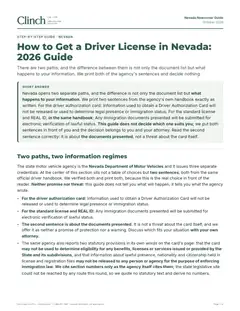
How do you get a driver's license in Nevada?
Short answer
Nevada opens two doors, and what separates them is not only the document list but what happens to your information. On the standard license and REAL ID path, the agency's own handbook states that immigration documents presented will be submitted for electronic verification of lawful status. On the driver authorization card path, open to people who cannot meet the identity requirements for a standard license, the same handbook states that information used to obtain the card will not be released or used to determine legal presence or immigration status. This page does not decide which path suits you; it puts both sentences in front of you, and the decision is yours and your attorney's.
Steps, documents and official links
Three separate credentials, and the names matter
The state agency is the Nevada Department of Motor Vehicles. It issues three different cards:
| Credential | For whom | Term |
|---|---|---|
| Standard or REAL ID driver license | Anyone who can meet the identity and lawful presence requirements | 8 years, 4 years over age 65 |
| Identification card | People who do not drive but need identification | 8 years or 4 years |
| Driver Authorization Card | In the agency's own words, eligible Nevada residents who cannot meet the identification requirements for a standard license | 4 years, expiring on your birthday, renewed in person only |
The two sentences at the center of this page, side by side
Both sentences below come from the same official driver handbook. We verified both and print both, because this is the real choice in front of the reader.
- For the driver authorization card: Information used to obtain a Driver Authorization Card will not be released or used to determine legal presence or immigration status.
- For the standard license and REAL ID: Any immigration documents presented will be submitted for electronic verification of lawful status.
Read the second sentence precisely: it is about the documents presented, not a threat about the card itself. We present neither sentence as a promise of protection nor as a warning. These are the agency's own words; whether either path fits your circumstances is a legal question, and you should discuss it with your own attorney. This page is not legal advice.
On its card page the same agency also quotes two provisions of state law in its own voice: that the card may not be used to determine eligibility for any benefits, licenses or services issued or provided by the State or its political subdivisions, and that information relating to legal presence, immigration status, nationality or citizenship held in license, identification card, title or registration files may not be released to any person or to any federal, state or local entity for any purpose relating to the enforcement of immigration laws. We cite the section numbers as the agency itself cites them. The state legislative site could not be opened by any route during this research, so we quote no statutory text and invent no section numbers.
What is printed on the card
The agency's own sentence: there are only two differences between the driver authorization card and a standard Nevada license. The card states Not Valid for ID in the top portion, and the blue banner reads Driver Authorization Card rather than Driver License. The agency then adds: the appearance is otherwise identical.
There is no colored stripe of the kind you may have seen in other states; the difference is one legend and one banner line. An officer holding the card can see it, but at a glance it looks like an ordinary license.
| Card | Legend on the face |
|---|---|
| REAL ID license | Gold state outline with a star cut-out |
| Standard license and identification card | NOT FOR REAL ID PURPOSES |
| Card issued on temporary status documents | Additionally Limited Term |
| Driver authorization card | Not Valid for ID and the card name in the blue banner |
A limited term card expires with your status: it ends on the departure date verified electronically through the federal system, or after one year if no date is verified, and never runs longer than eight years. So on the day your extension or change of status is approved, add a second line to your calendar: another appointment at the license office.
Where the driver authorization card works and where it does not
| Door | Status |
|---|---|
| Driving on Nevada roads | Works |
| Registering and insuring a vehicle | Works. The agency says so on its own page |
| As identification on the agency's own forms | Works |
| Boarding an aircraft | Does not work. Invalid for federal purposes |
| Entering a federal building where identification is required | Does not work |
| Benefits, licenses and services of the State and its subdivisions | Does not work. A statutory provision, in the agency's own quotation |
| A passport application | Does not work. The county clerk says so in writing; a standard Nevada license is accepted |
| Private businesses (check cashing, alcohol sales, a notary) | At the business's discretion. The agency's own words: private businesses have the right to accept or deny the card |
And for five doors we have no honest answer. A reduced transit fare identification card, a work card application, opening a bank account, the federal form completed when you start a job, and county social assistance. All five are part of the reader's real life and in all five the research could not find a definite answer. We do not say they are closed and we do not guess: call each of those offices before you go and write down what they tell you.
The one-sentence summary: this card says you may drive; it does not say you are identified.
Is lawful presence required: two sentences conflict, and we print both
We take no side here, because two pages of the same agency do not point the same way.
- On one side: the published document list for the driver authorization card contains no lawful status document. None of the three identity options requires proof of lawful presence, and the third can be satisfied entirely with foreign government documents. The agency also describes the card as the route for people who do not qualify for a REAL ID or a standard identification card, and writes that the information will not be used to determine legal presence.
- On the other side: the same agency's new resident page states that foreign nationals may or may not be eligible for a license or a driver authorization card depending on their specific immigration status. So the agency does not declare eligibility to be independent of status.
We do not resolve the conflict; we place it in front of you. The accurate sentence is this: the document list contains no status document and the agency says the information will not be used to determine status, but the same agency also writes that eligibility may depend on status. Discuss your own situation with an attorney before you book an appointment.
Documents for the driver authorization card
All documents must be originals; photocopies and scans are not accepted, and documents with an expiry date must be current.
Identity, one of three options:
- One document is enough: another US state's REAL ID credential, a US passport or passport card, a US birth certificate, a consular report of birth abroad, a certificate of citizenship or naturalisation, a permanent resident card, a foreign passport carrying a valid US visa and entry record, or an employment authorization card.
- One document is enough: a US military identification card, a military dependant card, a discharge document, or a specific tribal identification card.
- Any two of these together: another state's license or identification card, another state's driver authorization card, a foreign passport, a foreign birth certificate, a consular identification card, or another document issued by a foreign government.
The critical line for a Turkish reader is in the third option: a foreign passport plus a foreign birth certificate, or a foreign passport plus a consular identification card, is accepted in writing. This is where the door opens for someone holding no US document at all.
And the system is deliberately two-doored. The agency's standard license page lists the documents not accepted as proof of name and age, and that list includes foreign driver licenses, foreign birth certificates and consular identification cards. Immediately below it, the agency adds: many of these are acceptable for a driver authorization card. The same document is refused at one counter and accepted at the other.
The translation requirement affects Turkish readers directly: any document not in English must be translated by a translator from the agency's own approved translator list. The translation must be complete (a summary is not accepted), written, and accompanied by the translator's signed statement including their agency-issued approved translator number.
Two Nevada residency documents are required, each showing your name and a street address; a post office box is not accepted. Accepted items include a lease, a rent receipt, a utility bill, a bank statement, a pay stub, a school record, a hotel, motel or recreational vehicle park record longer than thirty days, and a notarised affidavit from a Nevada resident. The agency also publishes its own forms for this purpose. For a newcomer spending the first month in a hotel or without a bill in their own name, those last two items are a real way through.
The Social Security number question
The distinction is clean and the same in all our Nevada guides: the route for someone without a number is the driver authorization card, not the standard license. The handbook states plainly that a Social Security number is not necessary to obtain the card, and the agency separately notes that customers without a number can use its online services for a duplicate card or an address change. On the standard license and identification card side, proof of the number is required: a Social Security card, a tax form carrying the full number, or a pay stub carrying the full legal name. Someone who has applied for but not yet received a number may attest to that on the application, with no proof required.
Tests and language
| Situation | Tests required |
|---|---|
| Arriving with a Turkish license (a foreign license other than Canadian) | Vision, knowledge and skills |
| Never licensed anywhere | Vision, knowledge and skills |
| Valid license from another US state, over 21 | Vision screening only |
Language of the knowledge test: the agency's own page says the test is available in English and Spanish. The research found no record of the test being offered in Turkish. We do not say it is unavailable; we say we could not find it, and the real answer is below.
There is an interpreter route and it is the agency's own rule: an applicant whose English or Spanish is insufficient may use an interpreter during the written examination for a non-commercial license, a driver authorization card or an instruction permit. The conditions are set out: the interpreter must bring a letter of approval from a public agency, a court, an educational institution or a non-profit advocacy organization, must sign a declaration at each testing session and complete the agency's affidavit of oath, may not interpret for a family member, is paid by the applicant, and is not permitted during the skills test.
Reciprocity: the only published license reciprocity program is for Taiwan. The research found no such program with Türkiye. Again, not a statement that none exists, only that we could not find one.
Fees, and two recorded conflicts
| Transaction | Agency fee page, read 10 October 2026 |
|---|---|
| Driver authorization card, first issue and renewal (4 years) | $22.50 |
| Standard license, first issue (8 years) | $41.50 |
| Identification card, ages 18 to 64, first issue | $21.50 |
| First knowledge and skills test | $25 |
| Each retest | $10 |
| Address change only | $3.50 |
First conflict: the agency's own driver handbook shows every one of these items twenty-five cents lower than the website. We used the website figures because the handbook itself points to the website as the current source, but we are not hiding the conflict. Second conflict: the duplicate card fee appears as $17 on one agency page and as $17.50 in the same page's frequently asked questions and on the fee page. Open the fee page yourself before your appointment and ask about payment methods too.
Practical sequence for a new resident
- Thirty days for someone moving from another US state. That is the handbook's own sentence. We could not find an agency sentence setting the same period for someone arriving directly from abroad, so we do not generalise: ask the agency about your own case.
- You must surrender an out-of-state license. The agency punches it void and returns it to you until your new card arrives by mail.
- Someone whose license is suspended cannot get a driver authorization card either until the suspension clears. Point, suspension and revocation rules apply to the card in the same way.
- Driving in other states: even the agency gives no guarantee and tells you to check with law enforcement wherever you will drive. We do not write that this card lets you drive in every state.
- License and registration business can be done in one visit; all cards arrive by mail and an interim document is issued at the counter.
- Commercial licensing is separate and narrower: you cannot drive a commercial vehicle on the driver authorization card, and no commercial equivalent of the card is issued.
Official sources
- State motor vehicle agency: driver authorization card, documents and the information rule
- Official driver handbook: the document and information rules on both paths
- Identity and residency documents, and the list of documents not accepted
- New resident page: deadlines, surrender rule and the eligibility sentence
- Current fee schedule
02 · Foreign license
Can a Turkish license be exchanged for a Nevada license?
Short answer
The short answer: there is no exchange, there are tests. The agency's own table requires an applicant licensed in a foreign country other than Canada to take all three tests: vision, knowledge and skills. The only published reciprocity program is for Taiwan; the research found none with Türkiye. And one thing we could not establish at all: how many days a newcomer may drive on a Turkish license. We do not say there is no such period; we say the research could not confirm one.
Steps, documents and official links
What we know
The table on the agency's first-license page is clear: someone arriving with a valid license from another US state, a US territory or Canada and over the age of 21 needs only a vision screening. Anyone else licensed in a foreign country takes all three tests. The page notes separately that applicants from Taiwan may be granted a skills test waiver; no other country is named.
The conditions of the Taiwan program are published as well: age 21 or over, a valid license of a specified class, and a verification certificate. We found no equivalent program for Türkiye.
What we do not know
We could not find an agency sentence stating how many days a newly arrived resident may drive on a foreign license. The handbook gives thirty days for people moving from another US state, but that sentence is not written to cover someone arriving from abroad. We do not generalise on our own. This should be one of the first questions you put to the agency in the week you arrive, and ask for the answer in writing.
What to do
- Get an international driving permit before you leave Türkiye. It is not a license; it is a translation of your license, and the United States does not issue it. It costs little and earns its keep in your first weeks when you are talking to an official.
- Prepare for all three tests. Planning on the assumption that there is no waiver costs you nothing; the opposite assumption costs you time.
- Ask about language before you book. The knowledge test is offered in English and Spanish, but the agency has an interpreter rule for the written test. Have your interpreter's letter of approval ready in advance.
- Start your translations early. The agency wants documents that are not in English translated by someone on its own approved translator list; hunting for that list on the morning of your appointment wastes a day.
Do not let the gap in this section stop you
Whether your Turkish license is recognized is not an obstacle to getting a Nevada credential; it is only a question of speed. What actually decides the outcome is one section above: which card you apply for and what documents you hold. One more thing: when you collect the new card you are asked to surrender a license from another US state. We read no such surrender requirement for a Turkish license, but ask at the counter beforehand what will happen to it.
03 · Vehicles
How do you register a vehicle in Nevada, and is there emissions testing?
Short answer
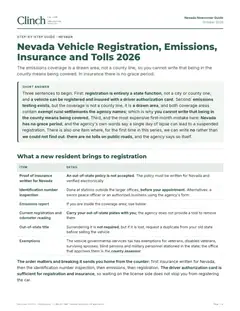
Read two sentences together. First: registration is entirely a state function, not a city or county one, and a driver authorization card is enough to register and insure a vehicle. Second: there is emissions testing, and the coverage is not a county line but a drawn area. Both of the state's large metropolitan basins are covered, but each of the two counties contains exempt rural pockets. That is why you cannot write that being in the county means being covered.
Steps, documents and official links
What a new resident brings to registration
| Item | Detail |
|---|---|
| Evidence of insurance written for Nevada | An out-of-state policy is not accepted. The policy must be written for Nevada and verified electronically |
| Vehicle identification number inspection | At stations outside the large offices, done before your appointment. Alternatives: a sworn law enforcement officer, or an authorized business using the agency's form |
| Emissions report | If you are inside the covered area; see below |
| Current registration and current odometer reading | Bring the out-of-state plates with you; the agency does not supply a screwdriver |
| Out-of-state title | Not required to be surrendered; but if it is lost, request a duplicate from the former state before you sell |
The door for tax exemptions is at the county: exemptions from the governmental services tax exist for veterans, disabled veterans, surviving spouses, blind persons and certain military personnel stationed in the state, and the office that approves them is the county assessor. There is no exemption based on age or on the value of the vehicle.
Emissions: a drawn area, not a county line
The program is run by the state motor vehicle agency. A test is required when four conditions are met together: the vehicle is located in the urban area of one of the two large counties, it is a 1968 model or newer, it is petrol-powered or a diesel up to a specified weight, and its registration status calls for it.
- In the south the testing area is, in the agency's own words, the Las Vegas Valley together with a five-mile buffer zone around it. Mountain roads inside the valley are included, but three rural settlements the agency names are exempt.
- In the north the testing area covers Reno, Sparks, Washoe Valley and the part of the county south of the fortieth parallel. Here too five settlements the agency names are exempt, two of them in the lakeside resort area.
The practical consequence: if your address sits at the edge of the buffer zone, the answer may change. The agency publishes the telephone number of its own laboratory for exactly this question; ask before you buy the car if you are not sure.
Frequency and validity: the test is annual, and a result is valid for ninety days (one hundred and eighty days for a vehicle bought from a dealer in the state).
Exemptions: new vehicles are exempt for their first three registrations and tested at the fourth; hybrids are exempt for their first five model years; 1967 and earlier models, motorcycles and mopeds, electric vehicles, diesels above a specified weight, trailers and certain classic plates are also exempt. A transfer between spouses does not trigger a new test.
Fees and the waiver regime: two counties, two rules
The agency sets maximum test fees each year through a station survey, and those ceilings differ between the two counties. For 2026 the ceiling for a light-duty petrol vehicle is $75.50 in the south and $71.50 in the north; for diesel the gap is wider, $90 in the south and $74 in the north. Vehicles registered in those two counties also pay a $7 pollution control fee. Stations must post their fees and may not charge a new fee without notifying the agency and receiving approval.
If the vehicle fails, the waiver regime differs between the two counties, and the difference reaches the reader's wallet directly:
| Question | South | North |
|---|---|---|
| Who may carry out the repairs | A licensed authorized station only. Repairs done anywhere else, or by you, earn no waiver no matter what they cost | A licensed authorized station or the registered owner |
| Minimum spend | At least $450 | At least $200 |
| Validity | A waiver lasts one year only | A waiver lasts one year only |
In both counties no waiver is granted to a visibly smoking vehicle or to one whose emissions equipment has been tampered with; those must be repaired without a spending cap. The south also runs a repair assistance program that contributes to emissions repairs on vehicles of certain model years, but we could not verify its income threshold, so we do not state its conditions. We found no equivalent in the north; we do not say none exists.
The one rule that applies outside the covered area too: whatever county you are in, a petrol vehicle may not emit visible smoke. The agency runs a public reporting program for smoking vehicles and states that it investigates reports about any Nevada-plated vehicle, including those in rural areas.
Is there a periodic safety inspection? The research did not find one. The agency's new resident and emissions pages mention only the identification number inspection and the emissions test. We do not say none exists.
The hidden cost of delaying registration
This item appeared for the first time in this series and it touches money directly: state park entry and camping fees are tied to the plate. A vehicle without Nevada plates pays a higher rate at every gate; the parks agency's own fee page lists day use at $5 for a Nevada-plated vehicle and $10 for one without, and the gap repeats for every night of camping. There is no free pedestrian entry either. The annual permits the agency sells are also tied to plate numbers.
So delaying registration is not merely an administrative lapse; for a family planning weekends it means paying the visitor rate at every gate. The detail is in the things to do section.
PDF: Nevada Vehicle Registration, Emissions, Insurance and Tolls 2026
04 · Insurance
Mandatory insurance and rating rules in Nevada
Short answer
Three sentences. First: the minimum limits are 25/50/20 and the regime is at fault. Second: there is no grace period. The agency's own language warns that even a one day lapse can lead to registration suspension and reinstatement fines. Third: state law forbids calculating an insurance score using income, gender, sexual orientation, gender identity, address, zip code, ethnic group, religion, marital status or nationality. That is the longest prohibition list in this series, but the prohibition reaches inside the score.
Steps, documents and official links
Minimum limits
| Coverage | Minimum |
|---|---|
| Bodily injury, one person, one accident | $25,000 |
| Bodily injury, two or more people, one accident | $50,000 |
| Property damage to another, one accident | $20,000 |
Do not compare quotes from other states line for line. In a neighboring state the property damage minimum may be higher; and the agency's page says nothing at all about personal injury protection or a no-fault regime. Since we found no direct official sentence for Nevada, we do not put the words in the agency's mouth; what we can say is that personal injury protection does not appear on the agency's published list of required coverages.
No grace period: the most expensive first-month mistake here
Two of the agency's own sentences: Nevada has no grace period, and cancel your registration before you drop liability insurance for any reason. The registered owner must be a named insured on the policy, the coverage must be verified electronically by a company licensed in the state, and evidence of insurance must be kept in the vehicle at all times. Out-of-state insurance is not accepted.
| Length of lapse | Total for a first offense |
|---|---|
| 1 to 30 days | $250 reinstatement fee |
| 31 to 90 days | $500 |
| 91 to 180 days | $750 plus a three-year proof of financial responsibility requirement |
| 181 days or more | $1,250 plus a three-year proof requirement |
A second offense within five years raises the fee; a third can mean a license suspension even for a thirty-day lapse. The process runs like this: first a verification request arrives and must be answered within fifteen days; if coverage really lapsed, a certified letter follows and the registration is suspended ten days after that letter is mailed.
And driving on a suspended registration carries a heavy consequence: the agency's own language states that Nevada law enforcement officers must seize the plates and may impound the vehicle. We return to this in the impound section.
Prohibited rating factors, and one critical boundary
State law forbids an insurer that uses a consumer credit report from using an insurance score calculated with income, gender, sexual orientation, gender identity or expression, address, zip code, ethnic group, religion, marital status or nationality as a factor. Other subsections of the same provision protect a newcomer directly:
- The absence of a credit history cannot be used against you by default. The insurer must choose one of three routes: show the regulator that the absence is predictive and act as the regulator approves, treat the person as though they had neutral credit information, or exclude credit entirely and use only non-credit factors.
- Not having a credit card cannot on its own support an adverse action.
- Collection accounts relating to medical treatment and inquiries you did not initiate cannot be used as negative factors.
- Someone whose credit was damaged by a declared disaster, serious illness, the death of a close family member, divorce, identity theft, involuntary unemployment of three months or more, or military deployment abroad may request a reasonable exception in writing.
Now the critical boundary, because getting it wrong would make this page wrong. The prohibition is aimed at how an insurance score is calculated. A zip code is prohibited when it goes inside the score. An insurer pricing differently by territory is not prohibited by this provision. It is not the same as the rule you may have read about in another state that bans territorial rating outright, and we do not present it that way.
A scope note: these provisions apply to individual policies; they do not reach commercial or business policies.
A source note: the state's official legislative site could not be opened by any route during this research. We were able to read these provisions only through a secondary source, and that copy is a snapshot dated 4 August 2026. We cite section numbers as agencies themselves cite them, and we quote no statutory text and invent no numbers. The state insurance regulator's own consumer guide would not open either, so we cannot describe the complaint route in the agency's own words.
05 · Tolls
Are there toll roads in Nevada?
Short answer
For the first time in this series we can write no rather than we could not find out, because the sentence comes from the agency itself. In a bulletin warning against fake toll messages, the state motor vehicle agency writes: Nevada does not have tolls on public roads, which means any payment toward such a fine is illegitimate. The practical consequence is very clear: every toll penalty message you receive is a scam.
Steps, documents and official links
The one exception is a park road
In the federal inventory of toll facilities, the only entry recorded for Nevada is a six-mile park road running through a state park. The table shows no toll motorway, bridge, tunnel or ferry for the state. The inventory data is as of 1 January 2023; even so, there is no toll crossing you will meet in daily driving.
Scam messages: the agency's own warning
The agency has published two separate bulletins, and both are directly useful to a newcomer.
- The first concerns text messages demanding payment of a supposed toll penalty. The agency writes that it never sends unsolicited text messages or emails and lists the signs of a scam: poor spelling and grammar, coercive or threatening language, a sense of urgency, and a link that does not match the agency's real address.
- The second concerns messages posing as a final collection notice backed by a court order. These threaten license suspension, a registration block or legal action if payment is not made. The agency's answer is two sentences: these notices are not legitimate, and we will never ask for payment this way.
Where to report: the agency asks that these messages be reported to the federal trade commission, with the number the message came from and the link it contained. You can also use your carrier's spam reporting system.
Why this belongs in a newcomer guide
Because it is the item a newcomer falls for most easily. The message looks official, asks for a small sum, and the instinct is to pay and be done with it. The test here is simple: there is no road toll to pay in this state. Do not touch the link, do not pay, and report the message before you delete it. The same instinct will serve you in other disguises: in the vital records section for third-party sites selling to process official documents at a markup, and in the water and utilities section for fake payment demands.
06 · Seasons
What is winter driving like in Nevada, and are snow tyres needed?
Short answer
There is no single answer in this state, because the north and the south are not in the same climate. In the southern desert basin a snow regime barely arrives at all; in the north, where the mountain passes are, winter is a real driving question. But we have to be honest about one thing: this research could not read an official rule on snow tyres, chain requirements or pass closures for Nevada. We do not say none exists; we say we could not find one, and below we separate what we do know.
Steps, documents and official links
Set the distinction first: there are two Nevadas
Most of the state's population lives in the southern desert basin. There the winter problem is not snow but flash flooding when rain does arrive and dry washes fill. In the north the picture is entirely different: altitude, mountain passes and regular snow. Do not carry winter advice you read for one end of the state to the other.
There is an official trace of this split in an unexpected place: the electricity disconnection rules. The state's moratorium is triggered by temperature rather than by the calendar and the rule contains both a heat threshold and a cold threshold. Even the regulator, in other words, has defined a two-way seasonal risk in this state.
What we do not know, stated plainly
- Any snow tyre or chain requirement. The state transportation department's pages opened only partially during this research and we could not read a rule on winter equipment. If you are heading for a mountain pass, check the department's own road conditions service before you set out.
- Pass closure procedures and snow control rules. Unverified for the same reason.
- Municipal rules such as parking bans during snow clearance. Municipal code texts did not open this round.
We invent none of this. If you will live in the north and use mountain roads, put those three questions to your own city and to the state transportation department; and when you have the answers, check them again at the start of every winter, not just once.
What we do know, and what applies in both regions
- Whatever the season, leave no gap in your insurance. Crash risk rises in winter conditions and this state has no grace period.
- Your vehicle must not emit visible smoke. That rule is county-independent and we set it out in the emissions section; a poorly maintained car crosses that line easily in cold weather.
- The risk of being towed rises in winter and who you deal with depends on where you are; see the impound section.
- In the south the real seasonal risk is heat. Agencies' own warnings ask visitors to carry four litres of water per person per day in natural areas in summer and note that some facilities close in the middle of the day. Factor that into travel plans; the detail is in the things to do section.
A note for readers arriving from Türkiye
In Türkiye winter tyres are known as a calendar-based obligation. We read no such calendar rule here, but that is not a reason to relax: being stuck on a northern mountain pass without winter tyres is a safety problem regardless of whether a rule exists. The second house rule: keep water in the boot. In this state being stranded is a genuine risk in both cold and heat, and in both cases water is the first thing you need.
07 · Towing
What happens if your vehicle is towed in Nevada?
Short answer
Find the right office first, because the law enforcement map in this state splits three ways and being in the same county does not mean going to the same door. Tow operators are licensed, and their tariffs filed, at state level; each licensed operator files its own tariff and must itemise every charge on the invoice. But we could not verify the consumer-facing maximum charges, so we publish no figures.
Steps, documents and official links
Who covers you: three separate regimes
| Area | Law enforcement |
|---|---|
| The largest city and the unincorporated areas around it | Las Vegas Metropolitan Police Department, headed by the elected county sheriff |
| The second city in the south | Henderson Police Department, which did not join the merger and runs its own force |
| The large city in the north | Reno Police Department, with the Washoe County Sheriff in county areas outside the city |
This is one of the most useful tables in the guide, because the number you call when your car disappears comes from it. If you live in an unincorporated area in the south, your counterpart is not a city hall, because there is no city there; we explain what that means in the government section.
The two most concrete causes of a tow
- Driving on a suspended registration. The agency's own language states that if you drive on a suspended registration, law enforcement officers must seize the plates and may impound the vehicle. The commonest cause of suspension is an insurance lapse, and in this state a single day can start the chain. So under this heading a tow is the consequence not of a parking mistake but of a paperwork gap.
- An abandoned vehicle report. The sheriff's office in the north runs a dedicated abandoned vehicle reporting service on its own site. We could not read the procedure or the timescale, so we do not state how many days pass before action begins.
Fees: why we publish no figure
Tow operators are licensed, and their tariffs approved, by the state's transportation authority; the authority publishes model tariff templates requiring that every item on a tow invoice be itemised and that all charges be documented in writing and attached to the invoice. The authority's own description also sets out that the charge begins when the truck is dispatched and ends when it returns to the operator's yard.
But the authority's own site never opened during this research. We could read the material only indirectly and could not verify the maximum charge tables in any way. Publishing conflicting or unverified figures does not help you; it gives you the wrong budget. The right move is this: ask for the invoice item by item, and if you are not given an itemised breakdown, note the company's name and complain to the regulator.
What actually helps at the impound gate
- Proof that the vehicle is yours. The registration document and your identification. The driver authorization card counts as identification at a limited set of doors; carry your passport as well.
- Valid proof of insurance. If the tow followed a registration suspension, recovering the vehicle requires insurance written again, and written for Nevada.
- A means of payment. We could not verify operators' payment rules; ask on the telephone and go prepared for cash.
- Time. Storage charges normally run daily; a day of delay is money. Try to find out where the vehicle is the same day.
Identification number inspection: a second who-does-it difference
One detail connected directly to towing and storage: in the south the identification number inspection is done at stations outside the large license offices, while in the north the sheriff's office also performs it. If the vehicle needs registration work after you recover it, knowing that saves you a trip.
08 · Transit
Public transport, trains and airports in Nevada
Short answer
There are two regional authorities and their fares, cards, apps and discount documents are entirely different; you cannot write a single paragraph beginning buses in Nevada work like this. Two pieces of good news: no official page we read requires identification or a number to pay a full fare, and service exists in settlements that have no city government, because transit was never a municipal function here. One sharp divide: passenger rail exists only in the north.
Steps, documents and official links
Two authorities, two systems
| Region | Authority | Payment |
|---|---|---|
| Southern metropolitan area | Regional Transportation Commission of Southern Nevada | Cash on board (no change given), the authority's own app, retail agents and ticket machines |
| Northern metropolitan area | Regional Transportation Commission of Washoe County | Cash on board (no change given), a different mobile ticketing app, printed passes, online pass orders |
In the south passes are not sold on board. Paying cash requires exact change; the cover of the authority's own pocket guide says so in capitals. Weekly and fifteen-day passes are available only through the authority's app. In the north neither the farebox nor the driver gives change; an overpayment is returned as credit.
Fares: do not mix the two tables
| Item | South | North |
|---|---|---|
| Single ride, full fare | $2 | $2 |
| Single ride, reduced | $1 | $1 (75 cents with a specific accessibility card) |
| Day pass | 24-hour pass, $5 | $3 |
| Monthly pass | 30-day, $65 | 31-day, $65 |
| Resort corridor pass | A separate category exists and covers all local routes too | No such category |
We also print a conflict: the southern authority's mobile fare page shows a single ride at $1 while the same authority's main fare page and printed pocket guide give $2 (reduced $1). The two pages do not agree. Open the authority's own fare page and confirm before you travel.
The north has something the south does not: all students, faculty and staff of the region's university and colleges ride the fixed-route services free; showing an institutional identification card to the driver is enough. If you move north as a student or an academic, that is a real line in your monthly budget.
Identification and the number question
| Question | Answer |
|---|---|
| Is identification or a number required to pay a full fare | No official page we read sets such a requirement. You can board with exact cash, or pay by phone |
| Is a Social Security number required for a reduced fare card | The research found no such requirement on either authority's document list. What is asked for is photo identification plus proof of age, disability or veteran status. We do not say it is not required; we say we did not find it on the list |
| Does a driver authorization card serve as photo identification for a reduced fare application | The research could not find out, and this is a real risk: both authorities say a driver license or agency identification card, while that card carries a legend stating it is not valid for identification. Ask the authority before you go |
Who qualifies for a reduced fare: in the south, young people aged six to seventeen, people aged sixty and over, local veterans, people with disabilities and holders of a specific health insurance card; in the north, young people, people aged sixty and over, people with disabilities, veterans and holders of the same health card. Children aged five and under ride free with an adult in both regions. In the north the reduced fare card is issued free at the authority's office.
Is there service where there is no city government
The central question of this round of guides reappears here, and the answer is reassuring: transit was never a municipal function. A single regional authority serves the whole urban area in the south, so I have no city, therefore I have no bus is simply not true. The authority also runs demand-responsive micro-transit zones and a door-to-door service for passengers with disabilities.
A note on evidence: the large airport's own page names the bus service by that regional authority's name, and one of the authority's ticket machines stands inside the terminal. The proof of service in unincorporated areas comes from the institutions' own texts.
Intercity rail: present in the north, absent in the south
This is one of the sharpest divides in the state. According to the national passenger rail company's own state fact sheet, a single route serves Nevada and it runs through the large northern city, once a day in each direction. All three stops in the state are in northern and central Nevada. The large southern city has no rail station, and this is not a guess; it comes from the company's own state list.
A careful distinction: the company writes that some routes have bus connections and that these can serve additional communities, Nevada among them. We could not verify whether such a connection exists to the south, so we do not write that there is no service at all; the accurate sentence is that the large southern city has no rail station.
Airports and flights to Istanbul
| Region | Airport | Operator |
|---|---|---|
| South | Harry Reid International Airport | Clark County Department of Aviation |
| North | Reno-Tahoe International Airport | Reno-Tahoe Airport Authority |
The southern airport is not inside any city's boundaries. When the terminal coordinate is queried against the federal geocoder's incorporated places layer it returns no result at all; the airport sits in the county's unincorporated area and is run by a county department. In the statistical boundaries drawn by the census it falls inside a census designated place. Do not confuse the two: a statistical boundary is not a jurisdiction. The postal address still carries the big city's name, which is this round's commonest trap; we set it out at length in the government section.
Direct flights to Istanbul: the research found no nonstop service to Istanbul from either airport. The northern airport's own published nonstop destination list shows a single international destination, a city in Mexico. The southern airport's own airline list does not include Turkish Airlines; the European carriers on it serve points such as London, Paris, Amsterdam and Zurich. We do not state flatly that none exists, because we could not open the southern airport's route-by-route destination list. The practical conclusion is the same: reaching Istanbul means connecting through a European or US hub.
Private systems in the resort corridor
Several private transport systems operate in the southern resort corridor and none of them belongs to the transit authority; separate tickets, separate management. The most widely known is a seven-station monorail, and it does not serve the airport: the airport's own frequently asked questions page says so in one sentence. At the airport there is a free inter-terminal shuttle and walking between terminals is not possible; ride-hailing pick-up areas are on specified levels of the car parks.
Official sources
09 · Regions
How does local government work in Nevada?
Short answer
The first thing to learn in this state: where you live may have no city government at all. Alongside incorporated cities Nevada has unincorporated towns, and in them there is no mayor, no council, no municipal code enforcement, no municipal court and no city tax. The county's own document puts it this way: in Nevada, county commissioners are the legally constituted town boards for all unincorporated towns, and all official governmental decisions are made by the board of county commissioners. The town advisory board that exists there is not a decision-making body: it cannot issue a license or impose a penalty.
Steps, documents and official links
The city name on your envelope is not proof of jurisdiction
This is the most expensive misunderstanding of this round. Your postal address may carry the name of the big city, and statistical tables may count you with that city, but the place you live may have no municipality, and that city's government may have nothing to do with your address.
It has to be separated into three layers, because all three are true and all three are different things:
| Layer | What it says | How it should be written |
|---|---|---|
| The administrative fact | Some densely settled areas are not inside any city boundary; they are the county's unincorporated area | Definite. Two independent sources confirmed it: the county's own text and the county's own mapping service |
| The county's own town name | In the county's map data that area appears under a particular town name | With a qualifier. Never written flatly as that place is in such and such a town |
| The statistical layer | Another layer of the same service, and the postal address, give the big city's name | The trap itself. Not a jurisdiction |
The practical consequence: this trio is precisely what confuses people. Your envelope says one thing, the statistics say another, but zoning, licensing, code enforcement and policing all answer to the county.
Where there is no city, the chain of contacts has three links
- Law enforcement: around the large southern city, the unincorporated surroundings are policed by a merged department; in the north, areas outside the city fall to the county sheriff. The detail is in the impound section.
- Political contact: the county commission. Budget, zoning and licensing decisions are made there. The advisory board only gives an opinion.
- Litigation: with no municipal court, county and state courts, and for immigration matters the federal structure.
But not everything is different, and we say that plainly too. Licensing, vehicle registration, insurance and emissions are already state functions; transit belongs to a regional authority; the school district is county-wide; property tax offices are at the county; landlord and tenant law is statewide. Having no city government creates no gap in any of those, because they were never municipal functions. The difference shows up mainly in home services and complaints.
No state income tax, but do not say there is no tax
Nevada has no personal income tax, no state return, and no state equivalent of the federal form you fill in when you start a job. That is a real advantage, but there are items that take its place, and ignoring them will leave your budget wrong:
- Sales tax. The rate varies by county: 8.375 percent in the large southern county and 8.265 percent in the northern one. Do not carry that rate from one county to another.
- The components inside the rate differ as well. In the south the rate contains two separate law enforcement components and a water authority component; in the north it contains a school facilities component approved at the ballot. In other words, what the locality spends on can be read inside the rate.
- Property tax and employer-side taxes. The detail is in the property tax section and the tax section.
Complaints and reports: three channels, and not one single number
The single three-digit number you may be used to in other states does not exist here. There are three separate doors:
| Where you live | Channel | Watch for |
|---|---|---|
| Inside the large southern city | The city's own online form and a reporting app; a separate line for code enforcement | There is a separate number for out-of-hours emergencies |
| In the unincorporated areas of the south | The county's own reporting system | The county's own warning: your information may be disclosed even if you asked to remain anonymous |
| In the large northern city | The city's named service center and online form | The city's own warning: what you submit enters the public record, and in a business license or code complaint you may be called as a witness |
Take those warnings seriously. Before you file a report about a neighbor, know that your name may surface and will be recorded. For a household in a sensitive situation that is not a minor detail.
Library cards: not one system, and there is a fallback for incomplete documents
There is no single library system in the state. The large southern city and the unincorporated areas around it belong to one district; the second city in the south has its own separate library district; the large northern city sits in the county system. Being in the same county does not mean belonging to the same library.
What we verified as common to both systems: we found no statement that a Social Security number is required. What is asked for is photo identification and proof of address. And both have a fallback for someone whose documents are incomplete, though the logic differs:
- In the south the problem is defined as the absence of an address: a separate card exists for people without a residential address or unable to verify one, with borrowing limited to five items at a time. The published text sets no expiry.
- In the north the problem is defined as missing documents: a conditional card is issued, limited to two items and expiring after three months. The north also accepts a notarised affidavit from a property owner as proof of address, which is a concrete door for a newcomer living in someone else's home.
Our confidence here is low and we are not hiding it: neither library system's website could be reached at all during this research; we read the above from the institutions' own documents but only indirectly. Telephone the branch before you go and ask which documents are accepted.
Who does what, at a glance
| Task | Who handles it |
|---|---|
| Licensing, vehicle registration, emissions | State agency |
| Buses and demand-responsive transport | Regional transit authority |
| School enrollment | County-wide school district |
| Birth and death certificates | State office plus two county health districts |
| Marriage license | County clerk |
| Property tax and abatements | County assessor |
| Water, sewer, trash | Varies from settlement to settlement, see below |
| Zoning, business licensing, code enforcement | The city where there is one, otherwise the county |
Official sources
10 · Utilities
Electricity and gas accounts, deposits and disconnection rules in Nevada
Short answer
The one-sentence summary: a single household sits under three separate legal regimes, and you can tell which door to use from the provider's name. Electricity and gas are inside the regulator's rule book; water utilities and trash collection are outside it, and the regulator names them one by one. On disconnection, for the first time in this series there is no calendar: the trigger is temperature, and the moratorium works in both heat and cold.
Steps, documents and official links
The provider map first, because north and south are not the same
| Service | South | North |
|---|---|---|
| Electricity | Nevada Power Company, trading as NV Energy | Sierra Pacific Power Company, trading as NV Energy |
| Natural gas | Southwest Gas Corporation, a separate company and a separate bill | The same company as electricity |
This difference is not cosmetic. In the south two separate companies send two separate bills; in the north one company applies two separate tariffs. So the sentence you will get two bills is wrong in the north. How many accounts you open depends on the region you move to.
Three regimes, and the rule of reading the name
The regulator states on its own page exactly what it regulates and what it does not:
- Electricity and gas: inside its rule book. Deposit ceiling, notice periods, right to installments, temperature thresholds, all present; complaints go to the regulator itself.
- Water: outside it. The regulator names the state's two large water districts and the regional water authority and directs complaints to the county commission, even publishing the commissions' telephone numbers on its own page.
- Trash collection: no authority at all; the counterpart is the local business licensing department.
And the regulator gives a rule based on names: it does not regulate entities whose names contain authority, district or mutual. So you can tell which door to use by looking at the name on your bill. That is the single most practical sentence on this page.
Is a number required to open an account
The regulator's own answer is not hedged, which is exactly why it is useful: companies set out what they require in their own tariffs; some may require a Social Security number, but many provide an alternative such as a driver's license number.
The practical consequence: your first question on the phone should not be I have no number, is that all right; it should be what do you accept as alternative identification. The answer differs from company to company.
The southern electricity company's tariff names a driver license, a passport and a state identification card among identity documents. Two further provisions of the same tariff help the reader directly: the company may not require a customer to use a guarantor, and the deposit is waived for a customer who enrols in automatic payment and maintains it. For a newcomer with no US credit file, that second item is real money.
Whether an individual taxpayer identification number is accepted could not be verified. It appears neither in the tariff nor in the privacy text. We do not say it works or that it does not; ask the company.
Deposits: ceiling, installments and refund are defined in the rules
| Rule | Content |
|---|---|
| Ceiling | A residential deposit may not exceed 150 percent of the estimated average monthly bill. The regulator's own example: if the previous occupant used 100 dollars of electricity a month, the new customer's deposit may not exceed 150 dollars |
| Instalments | An electricity or gas company must allow the deposit to be paid in installments |
| Refund | A customer who pays on time for twelve consecutive months must have the deposit returned, with interest |
| Elderly customers | The deposit ceiling is halved |
| Exemption | Certain customers receiving specified disability or retirement payments cannot be asked for a deposit if they have no disconnection history |
| Establishing credit without a deposit | Having been a customer of another municipal or regulated energy utility within the last two years and paid the last twelve months on time is also a route |
That last line matters for a newcomer: if you have a good payment record with an electricity company in another state, that record can reduce your deposit here. Ask your former company for a payment history letter before you move.
One more procedural detail: applications can be made by post, but a first-time customer, or one who has not taken service from that company for two years, may be asked to apply in person where that does not cause undue hardship. And if you ask, the company must give you the range of past energy use at that address; that is where the answer to what will the bill be at the house I am renting comes from.
The disconnection moratorium: triggered by temperature, and two sources do not quite agree
For the first time in this series there is no calendar window. The rule says that if the forecast for a twenty-four hour period shows a specified temperature, a disconnection for non-payment is postponed. Multi-unit residential buildings are expressly covered.
The thresholds we can state with confidence, because both sources agree on them:
- A forecast of 105 degrees Fahrenheit or above postpones the disconnection.
- A forecast of 15 degrees Fahrenheit or below postpones the disconnection.
And here there is a conflict we must be honest about. The state regulation defines lower thresholds for a household that includes an elderly person or a person with a disability; the tariffs the companies filed with the regulator carry none of those tiers and give only the two thresholds above. The tariff sheets are stamped 2005 and 2006, while the tiers entered the regulation in 2011. We take no side: if your household includes someone over 62 or a person with a disability, the threshold may be lower, and you should ask your company.
Three nuances not to skip:
- This is a postponement, not a cancellation. The debt remains.
- The heat exemption on the gas side is conditional. The tariff's own sentence says the general heat-related moratorium does not apply to the gas utility unless natural gas is essential for air conditioning. So if your home is cooled with natural gas, the exemption falls away. Do not skip that condition.
- Water and trash are outside this regime. Water utilities are not under the regulator's supervision.
Protections other than temperature
| Rule | Content |
|---|---|
| Weekends and holidays | No disconnection on a weekend, a public holiday or the day before one, absent a safety issue |
| Notice | Ten days of written notice before disconnection (reason, the amount that would prevent it, and the earliest date), and if unpaid, a second notice at least 48 hours before |
| Life support equipment | No disconnection where the household includes someone dependent on life support equipment requiring electricity at that address and the company knows of it |
| Small balances | No disconnection where the debt is 50 dollars or less; with a remotely read meter the threshold is 100 dollars |
| Reconnection | If payment arrives at or before 10 a.m., the same day; later, within 24 hours. The gas company's rule is weaker: as soon as conditions permit |
A thirty-day medical postponement
This is the most concrete tool for a household that cannot pay, and it requires two documents together:
- A medical statement: a written statement signed by a licensed physician, a public health official or an advanced practice registered nurse, certifying that disconnection would be particularly dangerous to a person's health and would create an emergency. It must include the service address, the name of the person whose health is at risk, a description of the emergency, and the signer's name, title and signature. The statement can be made by telephone, but written confirmation must follow within five days.
- A customer statement: signed, declaring that you cannot pay the bill or can pay only in installments. In the second case the company must offer installments of up to ninety days.
The postponement runs thirty days, and if a renewed statement arrives before it expires it extends by another thirty. A postponement does not erase the debt; the regulator says so on its own page and adds that a payment plan will be signed. The regulator describes this protection for electricity, gas, water and telecommunications together, so it is worth asking on the water side as well.
11 · Water and trash
How do water, sewer and trash services work in Nevada?
Short answer
These three items have no single statewide answer. The provider changes from settlement to settlement; all three sit outside the utility regulator, so the complaint route differs from electricity. And there are two structural surprises for tenants: in some places there is no sewer account for you to open, because the owner is the counterpart from the start; and on the trash bill the named party is, in most places, the property owner.
Steps, documents and official links
The provider map
| Service | Large southern city and its surroundings | Second southern city | Large northern city |
|---|---|---|---|
| Water | The valley water district | The city's own utility department | The regional water authority |
| Sewer | The city inside city limits, a separate reclamation district in unincorporated areas | Same account as water, one bill | The city, a separate quarterly bill |
| Trash | A private company under an exclusive franchise | Becomes mandatory once you open a water account | A private company under a franchise, with mandatory container service |
There is only one reflex to take from this table: ask which provider serves your address before you sign the lease. Two neighborhoods in the same county can answer to different doors.
Identification for a water account: the clearest answer in this series
The sentence on the southern water district's own page is one of the clearest statements in this guide for a reader without a number: resident aliens may be required to provide a passport, a state identification number and or a consular identification card, and international customers may be required to provide their passport number. The district adds one limit: passports are not acceptable if expired.
The full list for a residential application is: legal name, date of birth, the last four digits of a Social Security number, telephone numbers, the service address, the mailing address and the previous address, plus a government-issued photo identification if you apply in person.
But we draw a distinction plainly: the district's binding service rules require only a full name and valid identification information and do not name a Social Security number; the thing that asks for the number is the web form. Whether the district will open an account on photo identification alone could not be verified. We do not say it will or it will not; telephone and ask.
In the second southern city the answer is in writing, and it is one of the most useful single sentences in this guide: the city states on its own page that a person who does not wish to give identifying information over the telephone for an identity check may open the account in person with photo identification at its office in the city building. That is the most concrete practical difference between two settlements.
For the northern water authority we found no answer to the same question, because its site could not be reached at all during this research. We do not write that a number is required or that it is not; the authority's own rules must be consulted and the question asked by telephone.
Deposits: the water rule differs from electricity
Because the water district sits outside the regulator, the 150 percent ceiling used for electricity does not apply here. Under the southern district's own service rules a deposit may be required of a new customer with no credit history with the district, and the amount is defined as about two and a half times the highest monthly bill assessed in a twelve-month period. If the deposit is not paid in full on the day it is assessed, service may not be activated on the day requested; the district may allow installments at its discretion. A surety bond may be offered in place of a cash deposit, and deposits earn interest quarterly.
One trap: a customer with accounts at two or more residences is treated as commercial, and a commercial application requires a legal business name registered with the state and an employer identification number. If you will rent out more than one property, know that from the start.
Sewer: there may be no account for a tenant to open
In the unincorporated areas of the south, sewer sits with a separate district and the district's own answer is this: the legal owner of a property is responsible for all sewer bills. The owner remains responsible even with a tenant in place, and changes of ownership or occupancy must be reported within thirty days. The bill is issued annually and can be paid in quarterly installments.
And there is a protection: service cannot be shut off for unpaid sewer charges; the unpaid balance plus penalties is added to the property tax roll.
The practical consequence for a tenant: if someone tells you to set up water, power, gas, trash and sewer and you live in that area, there is nothing to set up for sewer. By contrast, in the second southern city sewer is the same account as water, so a tenant there does open a sewer account. In the large northern city the city bills the property quarterly, so again it is not an account you open separately.
We could not verify the regular residential sewer bill amount on the southern side, so we publish no figure.
Trash: the named party on the bill is usually the owner
In the unincorporated areas of the south, trash collection is a franchised service administered by the county's franchise division, and the relevant county code makes subscription mandatory for all premises. For a single-family home the charge is calculated monthly and billed quarterly in advance, and the county's own text says: the property owner is responsible for all charges even if the owner does not live there, with the owner named on each quarterly bill.
The consequence for a tenant: you may be paying for trash inside your rent and never see an account. Ask who this item belongs to before you sign the lease.
We publish no trash rate: the only fee schedule we could verify is four years old and we could not open the current ones. Publishing an old figure would only give you the wrong budget.
In the second southern city the logic runs the other way: opening the water account creates the trash obligation, so you do not set up a separate trash account.
Where complaints go
- Water: not the utility regulator but the county commission. The regulator says so on its own page and publishes both commissions' telephone numbers.
- Trash: the local business licensing department.
- Internet and cable: outside the regulator's authority; internet complaints go to the federal communications commission and cable complaints to the county commission. We name no internet providers, because we could not verify from an official source which company serves which address.
Official sources
- Southern water district: starting service, documents required and the passport rule
- Southern water district: service rules, deposits and fee schedules
- Second southern city: water and sewer account, and the in-person photo identification route
- Sewer district for the unincorporated area: who is responsible for the bill
- Regulator: water and trash outside its authority, and where complaints go
12 · Water rules
Water restrictions and water waste penalties in Nevada
Short answer
This is a metropolis built in a desert, and the irrigation rule is a permanent regime, not a temporary drought measure. Watering days are assigned to the property, daytime sprinkler irrigation is prohibited in summer, and penalties are tiered, rising according to an eighteen-month history. The most commonly missed detail: there is no exemption at all for water running off your property. And a structural warning: the northern rule is not the southern rule, and on some days it is the exact opposite.
Steps, documents and official links
In the south: a seasonal calendar plus an assigned day
| Season | Irrigation allowed |
|---|---|
| Winter, 1 November to the end of February | One assigned day a week |
| Spring, 1 March to 30 April | Three assigned days a week |
| Summer, 1 May to 31 August | Every day except Sunday |
| Autumn, 1 September to 31 October | Three assigned days a week |
Outdoor watering is prohibited on Sundays in every season. Watering days are assigned to the address and the district notifies you; your neighbor's day may not be yours.
The six acts that count as water waste
- Water supplied by the district running or spraying off the property.
- Failing to repair a faulty device or supply line you have known about for forty-eight hours.
- Breaching the rules on washing vehicles, equipment, driveways, car parks, pavements and streets.
- Draining pool or spa water off the property where discharge to the sewer is available.
- Spray irrigation between 11 a.m. and 7 p.m. from 1 May to 31 August.
- Breaching the misting rules and the assigned irrigation group.
The penalty schedule: a warning first, then tiers
The district's own language: on a first violation the customer is notified and given a period to take corrective action; subsequent violations result in a fee. The tier is set by the violation history over the preceding eighteen months.
| Violation | Typical residential meter |
|---|---|
| First | Warning and a period to correct |
| Second | $80 |
| Third | $160 |
| Fourth | $320 |
| Fifth | $640 |
| Sixth and beyond | $1,280 |
The schedule rises with meter size, and on large meters the top tier goes far higher. Water theft is a separate item, where a first violation is $5,000 and later ones $10,000, plus twelve times the tariff value of the estimated use and the actual cost of damage to facilities.
And a fee is not the only sanction: the district writes in its own rules that it may, within the appropriate jurisdictions, issue a misdemeanour citation and may discontinue service. There is an appeal route and it is independent: a customer may appeal both the violation and the fee to an independent hearing officer.
And a conflict rule: where the district's rules and a municipal ordinance overlap, the stricter applies.
Exemptions, and the one thing with no exemption
| Activity | Exempt from time limits | Exempt from assigned day | Exempt from the run-off rule |
|---|---|---|---|
| Watering with a hand-held hose | Yes | Yes | No |
| Drip and low-flow irrigation | Yes | Yes, without exceeding the weekly maximum number of days | No |
| Watering newly planted landscaping | Yes, for up to fourteen days | Yes, for up to fourteen days | No |
| Supervised testing of an irrigation system | Yes | Yes | Yes |
Read the table from the last column. You may water with a hand-held hose any day, which is true; but water running onto the pavement or into the street has almost no exemption at all. This is the mistake a newcomer makes most easily in the first month, and the second time it happens the schedule begins.
Tenant or owner: both
The fee is charged to whoever holds the account. In a single-family home the water is usually in the tenant's name, so the fee reaches the tenant; in a block where the operator holds the account, the fee reaches the operator while the water is used by the tenant.
But the story does not end there, and this item appeared for the first time in this series. Under the district's own rules, where waste is not resolved the district may require the owner shown in the county property records to take over the account; and the resulting debt belongs to both the customer and the owner, and creates a lien on the real property. So the bill is with the tenant, but unresolved waste pulls the landlord in.
Read that together with your lease: Nevada law requires a written lease to set out how utility charges are divided between the parties. The answer to this question must therefore be in the lease.
In the north the rule is entirely different, and on some days the reverse
The northern water authority's regime has no seasonal calendar and no penalty schedule by meter size; the system runs on the last digit of the street number. Even-numbered addresses water on one set of three days, odd-numbered addresses on another, and one day of the week is the system's rest day with no watering at all. In summer a daytime window is closed to sprinklers, and in drought conditions that window widens. Hand-held hoses and drip systems are not subject to the day restriction.
And here is the reverse case: in the south Sunday is prohibited in every season, while in the north Sunday is a watering day for odd-numbered addresses and Monday has no watering at all. The same behavior complies with the rule in one city and breaches it in the other. This is the most concrete proof of the rule against carrying the southern answer north.
We could not verify the northern penalty amounts or tiers, because the authority's site could not be reached at all. We are not copying the southern schedule north, and nor should you.
Removing decorative grass: a dated rule
The state has a law requiring the removal of nonfunctional decorative turf, and the prohibition is on using a particular water source to irrigate it. Separate two things:
- Single-family homes are outside it. The rule is framed for properties not zoned exclusively for single-family residences; a homeowner's own yard and recreational turf at schools and parks fall outside.
- But homeowners association common areas are not outside it. So if you rent or buy inside an association, removal of the common-area turf, assessments levied for the conversion and landscaping disputes can affect you directly.
The timetable falls around the end of 2026 and the start of 2027. If you will take a home inside an association, ask the management about dues and the common-area plan; that is something to learn before you sign.
13 · Renting
What are tenants' rights in Nevada?
Short answer
On this question Nevada resembles neither pole. In some states cities could pass their own tenant protection ordinances; in others the state had barred them from doing so by statute. In Nevada we could verify neither. What we do have for certain: the state's fair housing provision lists neither source of income nor immigration status among protected classes, and no section of the landlord and tenant statute refers to a tenant's status. But that is a finding about a gap, not a guarantee.
Steps, documents and official links
First the certainties: the rights the statute gives a tenant
| Topic | Rule |
|---|---|
| Deposit ceiling | A landlord may not demand or receive a deposit whose total value, including the last month's rent, exceeds three months' rent |
| Return of the deposit | However the tenancy ends, the landlord may deduct only unpaid rent, damage beyond normal wear and reasonable cleaning; must give the tenant an itemised written accounting and return the balance within thirty days |
| If it is not returned | A landlord who fails to return it within thirty days may be liable for damages equal to the entire deposit plus a further amount awarded by the court, not exceeding the deposit |
| Late fee ceiling | A reasonable late fee may be charged if written into the lease, but it may not exceed 5 percent of the periodic rent, and may not be increased by reference to a previously imposed late fee |
| Surety bond | If the landlord agrees, a surety bond may replace the deposit; the landlord need not accept one, but may not compel the tenant to buy one either |
| Copy of the lease | The landlord must give the tenant a free copy at signing |
| If no term is stated | Week to week where rent is paid weekly, and month to month in all other cases |
The statute also lists what a lease must contain, and reading the list gives you bargaining power: the term; the amount of rent and how and when it is paid; children and pets; services included in the rent; mandatory fees and their reasons; deposits and the conditions for their return; late payment and returned check charges; the landlord's right of inspection; the names or number of occupants; how utility charges are divided between the parties; a signed inventory of fixtures; and how the tenant may notify the relevant authorities.
Do not leave the utilities clause blank. As you will see in the water restrictions section, water penalties are a serious item in this state and who pays them is read from the lease.
The retaliation prohibition: the most concrete protection
A landlord may not, in retaliation, terminate a tenancy, refuse to renew, increase the rent, reduce essential services required by law or the lease, bring an eviction action or threaten one, where:
- The tenant has complained in good faith to a public agency about a building, housing or health code violation affecting health and safety.
- The tenant has reported in good faith, to the landlord or to law enforcement, a violation of the tenancy statute or of a provision carrying criminal penalties.
- The tenant has organized or joined a tenants' union.
- The tenant has been a party to a judicial or administrative proceeding about habitability.
- The tenant has complained in good faith about a violation of the state's fair housing provisions or the federal fair housing act, or has exercised rights under them.
- The tenant or a household member is a victim of domestic violence, harassment, sexual assault or stalking.
The fifth item matters for our reader: a claim of national origin discrimination falls inside the fair housing provisions, so a tenant who complains on that basis comes within the retaliation prohibition.
The exceptions are written too: it is not retaliation where the code violation arose principally from the tenant's own neglect, where the tenancy was ended for good cause, where compliance requires the dwelling to be vacated, or where the rent increase is applied to all tenants in the same way.
Protected classes: what is on the list and what is not
The protected classes in the state's fair housing provision are: race, religious creed, color, national origin, disability, sexual orientation, gender identity or expression, ancestry, familial status and sex.
Not on the list: source of income and immigration status. We write that plainly, because if you read a different answer in one of our other state guides, that answer does not apply here.
| Question | What we found |
|---|---|
| Is there a provision barring a landlord from asking about immigration status | The research found none. All section headings of the tenancy statute were reviewed; there is no section on status or tenant screening |
| Is source of income discrimination prohibited | No statewide prohibition was found. It is not among the protected classes |
| May cities pass their own tenant protection ordinances | We could not find the answer. The kind of express preemption clause we saw in another state was not found, but its absence could not be verified either: the state legislative site was closed and municipal codes could not be read. We do not write that there is none |
One item must not be confused: the handbook published by the southern county for housing projects it funds itself says owners may not reject an applicant on the ground that they hold a particular housing assistance voucher. That is a funding condition, not a general rule; it binds only projects that have taken money from those programs. Do not read it as statewide protection of source of income.
On past bills: the legislature has considered bills adding source of income to the protected class list, but we could not verify their fate, and the current list text does not contain it. We do not refer to those bills as if they were in force.
Three verified things we can give the reader
- There is a retaliation prohibition and it covers fair housing complaints.
- The state has an equal rights commission, and the county's own fair housing page names it as the complaint body.
- The rights the tenancy statute gives are not tied to status. Deposit return, the thirty-day rule, the 5 percent late fee ceiling and the retaliation prohibition are all defined without reference to a tenant's status.
A source note: we could not read these provisions on the state's official legislative site; we read the text through a secondary mirror whose access stamp is 26 May 2025. We cite section numbers as agencies themselves cite them.
Rental licensing
In the large northern city, renting three or more dwelling units on a single parcel appears among the activities requiring a license; but the city's own fee schedule also contains a separate item for one to three units, and the two documents do not agree. We print the conflict and take no side: whether someone renting one or two units needs a license does not follow from these sources. For the large southern city and the county we could not verify any license requirement for long-term residential renting; we found only a separate regime for short-term rentals in the county.
Official sources
14 · Property tax
Buying a home and the property tax cap in Nevada
Short answer
Nevada limits property tax with a cap rather than a deduction: the annual increase on the tax bill of an owner's primary residence is limited to 3 percent, while other property can receive a cap of up to 8 percent. There are two traps and both hit a new buyer: the cap does not arrive automatically, and recording a deed removes the previous cap. On top of that, the paperwork differs from county to county.
Steps, documents and official links
How the cap works
- The 3 percent cap applies to the owner's primary residence. Eligible property types: a single-family home, a townhouse, a condominium and a manufactured home.
- Only one property statewide may be designated the primary residence. If you own two homes you must choose.
- Some rentals let below specified rent limits can also qualify for the 3 percent cap; this requires an annual rental affidavit.
- Property not occupied by the owner, land, commercial buildings and business personal property receive a cap of up to 8 percent.
- Newly built property, or property whose use has changed, receives no cap at all for that fiscal year; it becomes eligible from the following fiscal year. If you are buying new construction, plan the first year's bill accordingly.
Two counties, the same statute, two different procedures
| Item | Large southern county | Northern county |
|---|---|---|
| How the claim is made | The assessor mails a postcard to qualifying owners; you sign it and send it back | You complete a separate partial abatement claim form; a different form is used to appeal |
| Rental affidavit | Letters go out each year in April or May; the page gives no firm deadline | Affidavits must be filed every year and returned by 15 June |
| Correction date | The deadline to correct the cap for the fiscal year is the following 30 June | The page gives no deadline for the claim form |
| If circumstances change | Notice is required when the property is no longer the primary residence | The same; the owner must notify the assessor |
We also note that the 8 percent figure does not appear at all on the northern county's page; it refers only to a higher cap for other property without giving the rate. We could not read the rate on that page.
The two most critical sentences for a new buyer
- The 3 percent cap does not arrive automatically in the year you buy. Recording the deed removes the previous owner's cap. Re-establishing it in your name requires the card or the form to be sent back. Put that in your calendar immediately after closing.
- A refinance alone does not affect the cap, because it does not create a conveyance. But if the document number in the records changes, a new card must be completed to keep the cap the following year.
The number question
Here we could not find an honest answer. Neither county's page lists which identification or number documents the claim form requires. Whether an individual taxpayer identification number is sufficient, or a Social Security number is required, could not be verified. We do not say it is enough or that it is not: if you are buying, call the county assessor before closing and ask which number they want. It is a short call set against the loss of a year's cap.
Which office does what
- The assessor: sets the value of the property and receives cap claims and rental affidavits. This is the office you call when you buy.
- The treasurer: collects the tax.
- The board of equalization: hears appeals on valuation and on the cap.
And a boundary: this section is about the property tax cap. Nevada has no personal income tax, but there are items that take its place and taxes that fall on employers; the detail is in the tax section. The other items you will meet when buying, transfer fees and closing costs, were not verified in this research, so we publish no figures.
15 · School
How do you enroll a child in school in Nevada?
Short answer
There is no single school answer in this state: school districts are county-wide and the two large districts do not ask for the same documents. There is also an asymmetry, and we state it plainly: the southern district writes on its own page that it does not collect or verify immigration status and cites a statutory section; the northern district says nothing at all about immigration status. Silence is not an answer, and we do not treat it as one.
Steps, documents and official links
The southern district: an express statement
The school district of the large southern county writes on its own enrollment page that it does not collect or verify students' immigration status, and ties that to a section of state law. It is one of the clearest sentences on this page and it is the institution's own statement.
| Item | What is required |
|---|---|
| Parent identification | A valid driver license or other photo identification bearing your name |
| Child identification | The original of one of three: a birth certificate, a passport, or a certified birth card from a health district. The page says plainly: photocopies will not be accepted |
| Immunisation record | Required; exemptions exist on religious belief or medical grounds |
| Proof of address | A current utility bill, rent receipt, or lease or purchase agreement. A driver license, a telephone bill and a cable bill are not accepted. If all you hold is a future-dated agreement, a second proof of address is required within thirty days |
| Temporary housing | There is a separate option and a separate line for families who cannot produce proof of address |
| Age and grade | Grade placement by age as of 1 August: age five on or before that date for kindergarten |
| Social Security number | Does not appear on the page at all. That does not mean it is not asked for; it means the page does not say so |
The passport detail matters for a Turkish reader: a passport is listed on the district's own main enrollment page as one of three options for the child's identification. So for a family that has not had time to translate a Turkish birth certificate, the door can open with a passport.
The northern district: different answers to the same questions
| Item | What is required |
|---|---|
| Procedure | Online registration first, then attending your zoned school with documents |
| Child identification | A certified US birth certificate or a certified state or county birth abstract; photocopies will not be accepted. Some schools also accept a passport |
| Foreign documents | The district accepts a foreign birth certificate and a consular report of birth |
| Immunisation record | From a health care provider or the statewide immunisation registry; additional vaccines are required for middle and high school |
| Proof of address | Acceptable documents are at the principal's discretion. Examples include a utility bill, a lease or purchase agreement, a mortgage agreement, a payslip, a rent receipt, vehicle insurance and vehicle registration. Documents must be dated within the last twelve months |
| Living in someone else's home | Some schools ask for a letter from the homeowner plus proof of address in the owner's name |
| Living with someone other than a parent | The district's temporary guardianship form; a court order if guardianship came from a court |
| Immigration status | The district says nothing on the subject. Read that as an absence of an answer, not as an absence of a practice |
Three points where the two districts diverge
- Discretion over proof of address. The southern district lists exactly what is not accepted and refuses a driver license; the northern district leaves the decision to the principal and gives vehicle registration among its examples. The same document works in one city and not in the other. For a newcomer this is a real difference and worth asking about before you move.
- The birth certificate alternative. In the south a passport is listed on the main page; in the north the main list carries a US birth certificate and a passport appears on some schools' pages. A family arriving with a passport may get different answers at different schools in the north.
- The age cut-off. The south publishes 1 August; for the north no date could be verified in this research.
Two things are common to both districts and should not be skipped: no Social Security number appears on either enrollment page, and in both districts the two items that actually decide enrollment are the immunisation record and proof of address, with photocopies refused in both. Bring the immunisation record and the original birth certificate with you from Türkiye.
Language: the right sentence is not that Turkish services exist
There are three separate lists here and we do not average them:
- The southern district's online registration system works only in English and Spanish.
- The district's list of languages it translates documents into is separate and longer; the languages in which its family support unit actually provides interpreters are separate again and shorter.
- The state's document on the rights of English learner students is published in around nineteen languages.
Turkish appears on none of these lists. We write that as we found it, and we do not say that no Turkish interpreter will be provided, because the right is not tied to a language: state law gives the parent of an English learner student the right to a qualified interpreter in their own native language in significant interactions with the district, and obliges districts to provide information in a language and form the parent can understand. The southern district publishes its own page explaining that right and names the unit to ask.
So the sentence is this: not that Turkish services exist, but that there is a right to be requested and this is the door. Make the request in writing and make it before enrollment day.
A practical list for enrollment day
- The original of the child's identity document. Photocopies are refused in both districts.
- The immunisation record. Bring it from Türkiye; reconstructing it here takes time.
- Two separate proofs of address. Telephone the school before you go to ask which documents are accepted, because the two districts' lists differ.
- The interpreter request. Put it in writing and note who you gave it to.
- For a high school age child, a leaving certificate and transcript from the previous school. Obtain and translate them before you leave Türkiye.
PDF: Enrolling a Child in School in Nevada: Documents, Address Proof and 2026
16 · Health
How do you get health care without insurance in Nevada?
Short answer
Do not copy this section from another of our state guides, because Nevada took an option. The federal rule narrowed full coverage to four status groups from 1 October 2026; but Nevada took up the option left open for lawfully residing children and pregnant people years ago, and the federal agency's own implementation document states that a state which has taken that option must still determine those people eligible for full benefits. Do not merge two things: the age limit is 21 on the medical assistance side and 19 in the children's health program.
Steps, documents and official links
Names first, because they changed in 2025 and the old one is still everywhere
| What | Name |
|---|---|
| The state agency running the program | Nevada Health Authority, created by statute in 2025; older documents and letters still carry the former division name |
| The state medical assistance program | Nevada Medicaid |
| The separate program for children | Nevada Check Up |
| The insurance marketplace | Nevada Health Link, operated by the Silver State Health Insurance Exchange |
| The application portal | Access Nevada; eligibility is determined by the welfare and supportive services division |
All four names are correct but they are not the same thing. Do not be surprised if a letter arrives carrying the old agency name; the structure changed and the documents have not all caught up.
The marketplace is the state's own, not the federal site. If you read about the federal marketplace in another of our state guides, that address does not apply here. Open enrollment for 2027 coverage is announced on the state's own site as running from 1 November to 15 January.
The 1 October 2026 change, and what makes Nevada different
The federal side: from 1 October 2026 federal funding for non-emergency medical assistance is limited to four status groups: citizens and nationals, aliens lawfully admitted for permanent residence, Cuban and Haitian entrants, and people covered by a compact of free association. Refugees, asylees, people with temporary protected status, parolees and visa holders are not on that list.
But the federal rule leaves three exceptions, and the second is decisive for Nevada: emergency coverage, the state option for children and pregnant people, and health services initiatives. The federal agency's own implementation document says that a state which has taken that option must determine lawfully residing children and pregnant women eligible for full benefits, and must maintain full benefits for those already covered.
Nevada took the option and the paperwork exists: state plan amendments for children were approved in 2018; a separate amendment for pregnant people was approved in 2023, and its text says it covers all lawfully present pregnant individuals, including those who would otherwise face the five-year waiting period. An independent state tracker also records Nevada as yes in both columns.
| Who | After 1 October 2026 |
|---|---|
| Citizens, permanent residents, Cuban and Haitian entrants, compact migrants | Full coverage |
| A lawfully residing child | Full coverage. The age limit is 21 on the medical assistance side and 19 in the children's program |
| A lawfully present pregnant person | Full coverage, without the five-year waiting period |
| Everyone else | No full coverage; what remains is emergency coverage |
Three warnings, none of them to be skipped:
- Lawfully residing does not mean any immigration status. Someone with no status is not reached by this door.
- Do not merge the ages. Two separate programs, two separate limits. If your child is between nineteen and twenty-one, ask specifically which program they are in.
- There is no emergency equivalent in the children's program. The federal document states that for people outside the option there is no authorization for coverage of emergency services in a separate children's program. For a child who is not lawfully residing, that is a real gap.
Emergency coverage survives the change
The federal document lists emergency coverage as the first of the three exceptions and states that federal funding remains available for emergency coverage after 1 October 2026. A separate section of the same act lowers the federal matching rate for emergency coverage; that does not change eligibility, it changes what the state pays. Do not read it as a loss of rights.
And one open end: if Nevada has its own name for its emergency benefit package, we could not find it. If you saw package names in another of our state guides, do not carry them here.
Applying, and documents
- Applications go through the state's own portal, which has a pre-screening tool showing whether you would be directed to medical assistance, the children's program or the marketplace.
- The agency's published document list is a generic one naming proof of citizenship, a Social Security card and proof of income. Do not let that list put you off: emergency coverage and the children and pregnancy pathway do not turn on the applicant's own citizenship.
- We could not find Nevada's own policy sentence lifting the number and status requirements for emergency coverage. Other states had such a sentence; here we say the research did not find one, not that none exists.
- We found no source at all on whether the Nevada health agency reports applicants to immigration authorities. We write no sentence in either direction. If that question is decisive for you, talk to us before you apply.
- We publish no telephone number: two official documents give two different toll-free lines and we could not establish which is current.
What the children's program costs
The program's own text says the only cost to an enrolled child is a quarterly premium, that no co-payments, deductibles or other charges are made for covered services, and that the premium is set by family size and income.
We publish no income limit figure. We saw two different percentages in two official sources and could not establish which is current. Publishing a conflicting figure would mislead you; find out your eligibility through the portal's pre-screening tool.
1 January 2027: the second date
There is a separate narrowing on the marketplace side and it comes from federal law: after that date premium help and cost-sharing reductions are limited to permanent residents, Cuban and Haitian entrants and compact migrants; other statuses may buy a plan but without the discount. We could not find a page on the state marketplace restating how this is applied here; we present it as the federal rule and tell you to ask the state marketplace about the application.
One more open end, honestly: we could not find Nevada's own announcement about the 1 October 2026 change. We looked for the kind of bulletin other states published and did not find one, but three of the state's health hosts could not be reached at all in this research, so that is an access failure, not a finding.
17 · Health
Where do you go in Nevada without insurance?
Short answer
Correct one misconception first, because it is the sentence we repeat most in this guide: a sliding-fee clinic is never a free clinic. The discount is calculated on household income and family size, but there is still a charge. In an emergency a separate federal duty applies: a hospital emergency department must screen and stabilise regardless of ability to pay or immigration status.
Steps, documents and official links
Community health centers: how they work
The membership body bringing these centers together in the state is the Nevada Primary Care Association, and its own page states that the centers provide services regardless of a patient's ability to pay and charge for services on a sliding fee scale. Another sentence on the same page: anybody can receive care at these centers.
But we state two limits in the same breath:
- A sliding fee is not free. Take proof of income with you and ask before your appointment what the discount scale means you will pay.
- The organizations' page says nothing at all about immigration status. So we cannot add the sentence status is not asked; we found no such statement. Put that question to the clinic directly.
For the northern reader there is one organization we can name: Community Health Alliance states on its own site that it is a grantee under the federal health center program and that it operates six health centers across the two northern cities. The sliding fee claim for this organization comes from the membership body's general description rather than its own page, so ask them about charges directly.
For the southern reader the membership list includes a community health center associated with the county health district; we could not open its own site in this research, so we do not state its fee policy or its service points. The southern reader will also see University Medical Center named as the local public hospital, and county social service documents state that its discharge planners work with county staff.
We publish no addresses. We do not publish addresses taken from a federal health center database on these pages; get the current address and hours from the clinic's own site. For the same reason we publish no count of centers or sites: two official sources give two different numbers, from different years and using different counting methods.
The emergency room: the federal duty and the payment route are different things
Separate two concepts, because when they are confused people either stay away in fear or do not expect the bill:
- The federal emergency care duty. A hospital emergency department must screen and stabilise anyone who arrives, regardless of ability to pay or immigration status. That is a duty of care, not a guarantee of payment.
- Emergency coverage. This is the payment route behind it for people who do not qualify for full coverage, and we set it out in the health section. It can be applied for after the visit.
So order it this way: in an emergency do not hesitate to go; afterwards, before taking on the bill alone, apply for emergency coverage and speak to the hospital's financial counselling unit.
There is an identity barrier at the county assistance door
The southern county has a social service unit, but the research found no county indigent medical care program there; what its documents describe is financial assistance for items such as rent, burial and out-of-state transport.
And there is a hard identity requirement at that door: the verification list requires two forms of identification for each household member, and for adults one of them must be a valid, unexpired, state-issued photo identification showing an address in that county. For a newcomer this is the most likely point of refusal, and it connects straight to the card question in the license section: we could not verify whether the driver authorization card opens this door and we will not guess. The applicant is also required to have applied first for medical assistance, unemployment insurance and other federal programs.
The northern county's equivalent was not examined in this research. We do not say there is none; our research did not reach it.
Where to go about a disputed bill
The county's own referral document sends insured and uninsured people alike to a consumer health assistance office for hospital bills, provider bills, prescription needs, health benefits and appeals. We could not verify that office's current full official name or which agency houses it after the 2025 restructuring, so we do not name it; get the current name from the county's own referral document or by telephone. The referral itself genuinely works, so do not give up on it for the sake of a missing name.
A practical order for a newcomer
- Measure your eligibility first: use the pre-screening tool on the state portal.
- If you are pregnant or have children, look separately. The option Nevada took protects those two groups; go back to the health section.
- If you are going to a sliding-fee center, take proof of income and ask in advance what you will pay.
- Go in an emergency. The emergency room duty does not look at status; settle the payment question afterwards.
- Negotiate when the bill arrives. Use the hospital's financial assistance program and the consumer help line the county points to.
18 · Marriage
How do you get a marriage license in Nevada?
Short answer
Nevada is the outlier of this series on this item: no waiting period, no blood test, and the southern county's bureau is open seven days a week until midnight. But what you really need to know is not the convenience, it is the divergence: the two counties do not accept the same identity documents. The southern county lists a foreign passport, a consular identification card and an official foreign government identification card in writing; the northern county's published list contains no foreign government identification.
Steps, documents and official links
Who issues it and where
The license is a county function, not a municipal one. In the south the county clerk's marriage license bureau issues it; in the north the county clerk's own division does. In settlements without a city government there is no municipal counter to visit, and none is needed: the counterpart is the county directly.
Being in the same county does not mean using the same counter. The southern county has several offices and not all of them issue licenses; the county government center writes on its own page in capitals that you cannot obtain a marriage license at that location. In the second large southern city the county clerk has its own branch, but with narrower days, closed over lunch, and cash is not accepted.
Waiting, blood tests and appearing in person
| Question | Southern county | Northern county |
|---|---|---|
| Waiting period | None | None |
| Blood test | Not required | Not required |
| Both parties present | Required, at the same time | Required; a single-signature license only with management approval |
| Fee | $102. Cards carry an additional charge and checks are not accepted | $85. Cash, card, money order or cashier's check |
| Online | Pre-application available and held in the system for one year | Pre-fill available |
An online pre-application is not a license. The northern county says so expressly: the license is not issued online and both of you must be present at the office; only copies of the application can be ordered online. Fill in the form in advance, then go together, with original photo identification.
Identification: where the two counties part company
The southern county lists foreign documents in writing. Among the documents it accepts as proof of name and age are a passport, a consular identification card and an official foreign government identification card or driver license showing a date of birth. It adds three conditions: documents must be originals (no digital copies or photocopies), must carry a photo, and a foreign birth certificate must be translated into English with the translation notarised.
The northern county's published list is narrower: a driver license, a driver instruction permit, a state identification card, a passport, a military identification card, a military dependant card, a certificate of citizenship or naturalisation, and a permanent or temporary resident card. Foreign government identification is not on the list, and passport appears without qualification. Other documents may be accepted case by case with managerial approval.
We write a very careful sentence here and so should you: because the list says passport without qualification, a Turkish passport is very likely to be accepted in the north, but the county does not say so in writing and we found no page of theirs addressing foreign documents. We do not write that the northern county accepts a foreign passport. The right move: telephone before you go and ask by naming the document you hold.
One more detail that affects Turkish readers directly: both counties issue the license in exactly the name shown on the identification. If your passport shows your full middle name, that is what appears; if it shows an initial, the license carries the initial. Correcting it afterwards is a separate task.
The Social Security number: two counties, two different wordings
| County | Its own wording | How to read it |
|---|---|---|
| South | If you are a United States citizen and have been issued a Social Security number, you must provide it | The obligation is tied to both US citizenship and having been issued a number. We found no page saying what a non-citizen or a person with no number does |
| North | The information taken under oath includes a Social Security number, documentation is not required; an applicant without one must state that fact | The number is asked for, no proof is demanded, and I do not have one is an answer the form anticipates |
And here we refrain from writing two things. No Nevada source says a license is refused for lack of a number; none says it is granted either. We do not promise the outcome. The northern county ties the requirement to a statutory section and cites it on its own page; we could not read the text of that section, because the state legislative site did not open in this research.
Age, ceremony and certificate
- The minimum age is eighteen. At seventeen, parental consent plus a certified court order is required; marriage under seventeen is prohibited.
- A license is not a marriage. The ceremony must be performed by someone authorized in Nevada and one witness is required by law. A ceremony performed outside Nevada on a Nevada license is not valid.
- The state performs ceremonies too: each county has a public office for civil marriage.
- The office that issues the license and the office that issues the certificate are different. The county clerk issues the license; after the ceremony the county recorder records the certificate and issues certified copies. The officiant must return the certificate within ten days.
- What you need for a name change is not the license but a certified marriage certificate. The northern county says so on its own page: a certified certificate is required to change a name with the social security administration and the motor vehicle agency. Order several copies; getting them one at a time later costs both time and money.
- A domestic partnership is a different thing at a different agency; do not confuse it with a marriage license.
A recorded conflict
An older page of the southern county surfaces in search results showing a lower license fee. That address belongs to the county's old site structure and the current requirements page says $102. We rely on the current page, but we record it because you will meet it: when you see an older figure, check the county's current page.
19 · Vital records
How do you get a birth or death certificate in Nevada?
Short answer
The system is a hybrid: a statewide vital records office plus two county health districts. And the two districts do not hold the same years: the southern district holds county births from 1973, the northern one from the late 1800s. So a southern birth before 1973 cannot be obtained from that county at all. For a reader without a number this is the strongest door in the series: the state office's published identification list names a foreign passport and a consular identification card, and no Social Security number appears anywhere on those lists.
Steps, documents and official links
Three doors, and which one you use depends on what you need
| Office | What it holds | Fee |
|---|---|---|
| State vital records office | The statewide register; amendments and corrections are made here | $45 through the online channel, $25 in person; expedited delivery costs extra |
| Southern county health district | County births from 1973, deaths from 1988 | $38 for the first copy, $25 each additional; a $10 search fee is non-refundable if no record is found |
| Northern county health district | County births and deaths from the late 1800s | $25 per copy; $10 per name for a search, whether or not a record is found |
The figures differ and that is not a contradiction: three offices with three fee schedules. When you see a price, look at which office it belongs to. The southern district notes that the first-copy fee includes a share for registering with the state registrar, and that a customer who can show that share was paid previously will not be charged it on later purchases.
The sharpest county difference: in the south a person born before 1973 cannot obtain the certificate from that county at all and is directed to the state office; in the north someone born in the same years can obtain it from the county.
Who may request one
Nevada restricts these records by statute and the test is a direct and tangible interest. The administrative rule defines it as a direct relationship by blood or marriage within the second degree to the person named on the certificate, a legal relationship to that person, or a requirement imposed by law or facilitating a legal process.
And the single most useful sentence for a Turkish family is here: a parent requesting a child's birth certificate must only prove their identity. No further document of relationship is required. So for a child born in Nevada, acceptable identification is enough.
For others the rule is narrower: grandparents, siblings, grandchildren and step-parents must either be named on the certificate or supply their own birth certificate; a spouse, former spouse or domestic partner must supply proof of marriage or divorce. And the office's own rule: identification is required for all requests.
The identification list names foreign documents
The primary section of the state office's published identification list, that is the documents sufficient on their own, names the following expressly:
- A foreign passport (the list's own note: may be verified with the embassy, consulate or immigration authority)
- A consular identification card
- An employment authorization card
- A permanent resident card and a temporary resident card
- A specific US visa accompanied by a valid entry record
- Also a US passport, a state driver license or identification card, a military identification card, certificates of citizenship and naturalisation, a tribal identification card, a US school or college identification card, and an identification card from a homeless support service
For people without a primary document there is a secondary list, from which two documents are required.
And the sentence that will be repeated most in this section: no Social Security number appears anywhere on either list. We write that as an observation: the state office's published proof and identification lists do not include a Social Security number. It is not a statement that no Nevada vital records form asks for one.
An important boundary: these are the state office's lists. We could not read the two county districts' own identification lists and we are not copying this list onto them. The southern district links separately to its own acceptable identification list; the northern district's page does not say whether a foreign passport or a consular card is accepted. Telephone the county before you go.
Beware one misreading: the southern district writes that someone who cannot upload valid photo identification with an online application may order by post. Read it carefully: that sentence is about an upload problem, not about having no identification, and the same sentence asks for a copy of identification to be enclosed.
Payment and timing traps
- Personal checks are not accepted. The southern district says so plainly; cards, money orders, cashier's checks and business checks are accepted. For postal and drop-box orders specifically, a money order or business check is required.
- Timing: the southern district says two to four weeks for online, postal and drop-box orders and states that there is no same-day or overnight service. Certificates are held for only sixty days from the date of payment.
- The search fee is non-refundable. If no record is found you receive a certificate of no record and your money does not come back. This is the classic item that makes a newcomer feel cheated; know it in advance.
- You must know both parents' full names. Completing an order requires the name at birth, date of birth, place of birth and the parents' full names. Ask your family in Türkiye in advance.
The scam warning, in the agency's own words
The southern district writes on its own page that it has received an increased number of calls about third-party vendors selling birth and death certificates, and that these companies charge high fees to process or help apply for certificates. It names the state attorney general's consumer protection bureau as the place to complain.
The one authorized online vendor is a company all three offices name; the northern district calls it its partner and warns that other internet vendors are not authorized. Use the same reflex we described in the fake payment messages section: type the agency's own address by hand.
Marriage and divorce records are not held here
The state page says so expressly: marriage and divorce records are held at county level. If you know the date and the county you contact that county directly; if not, the state office will run a search for a fee per search and post the result. In practice: the county clerk issues the license and the county recorder records the certificate.
A child born in Türkiye, a child born in Nevada
This section is about Nevada records. A certificate for a child born in Türkiye does not come through this door; it comes from Türkiye and, if it will be used in the United States, needs an apostille on the Turkish side. The reverse is also true: to use a Nevada-born child's certificate in Türkiye you will follow the route in the apostille section. Registering your child's Turkish citizenship is consular business and is covered in the consulate section.
20 · Social Security
How do you get a Social Security number in Nevada?
Short answer
An SSN is issued only to people with work authorization or a legally required reason for one, and the agency that issues it is federal. If you arrived on an immigrant visa and asked for the number on the visa application, the card comes by mail. People who adjust status inside the United States with an I-485, or who check the SSN box on an EAD application, also receive the card automatically. Otherwise you start the application online and attend an appointment; there is no fee. Two things about Nevada, said up front: the state has no office that issues an SSN or anything that stands in for one, and no Social Security Administration street address appears on this page, because we could not verify a single one from an official source this round. If you hold an appointment notice, the address on that notice is the one that counts.
Steps, documents and official links
- What to bring: your current immigration document (green card, I-94 or EAD) and a valid passport, plus a birth certificate if you have one. Photocopies and notarised copies are not accepted.
- F-1 and J-1: an SSN becomes available only once you have a right to work (on-campus employment, CPT, OPT). Enrolment alone does not qualify.
- Which office covers you: enter your ZIP code in the agency's own office locator. Nevada sits in a single time zone, so there is no conversion to do on your appointment time; see the time difference section.
- General line: 1-800-772-1213. A replacement card is free and usually starts online.
- If your surname changed on marriage, update the record at an office, free of charge.
The Nevada map for a person with no identity number
In this state the answer changes from counter to counter, and some of those counters are the most open the series has found. We separate what was verified from what was not.
| Counter | Is a number required? | Basis |
|---|---|---|
| Driver Authorization Card | No | The state driver handbook says in its own words that a Social Security number is not necessary to obtain a Driver Authorization Card. The agency's residency certification form repeats that the number field is not required for this card |
| Birth and death certificates | No | A Social Security number appears nowhere in either identification list published by the State of Nevada Office of Vital Records, while a foreign passport is named as primary identification |
| Marriage license, Washoe County | Asked under oath, no documentation required | The county's own words: documentation is not required, and a person with no number must state that fact |
| Marriage license, Clark County | The obligation is tied to citizenship | The county's own sentence requires the number only from a United States citizen who has been issued one. Nothing is published about anyone else |
| School enrollment | Not on either district's published document list | This is an absence, not a stated exemption. See the school enrollment section |
| Medicaid or child health application | Not established | The state's generic document list names a Social Security card. No Nevada text lifting the number requirement for emergency coverage was found this round |
| Forming an LLC, a work card, a bank account | Not established | No official answer was found for any of the three. We do not guess; see the business section below |
The line in that table that is most often misread is the Driver Authorization Card. The card does not require a number, but the top portion of the card reads Not Valid for ID, which in the agency's own words means it is not an identity document. So you can hold a license to drive and still have no identity card, and that distinction is one of the hardest facts of life in this state. What the card does, what it does not do and how the information on the application is handled are set out in the driver license section; do not decide anything from this line without reading it.
ITIN: for tax, not for identity
Someone who cannot get an SSN but must file a federal return uses an ITIN. The application is Form W-7, attached to your federal return unless an exception applies. In the agency's own words an ITIN does not provide or change immigration status and does not authorize you to work in the United States. It is not an identity document either.
- Three ways to have documents verified: post them with your passport to the address the agency gives, go to an authorized acceptance agent, or attend an appointment at a tax office that reviews ITIN documents. The last two mean your passport never goes in the post.
- Which Nevada offices do that review was not established this round, and no federal tax office address appears on this page. Confirm the office and the appointment through the federal tax agency's own locator; the appointment line is 844-545-5640.
- We do not publish the supporting-document list, because the agency keeps it on a separate page that we did not read. Take the list from the agency's own page before you apply.
- One Nevada difference, and it is in your favor: there is no state income tax, so you do not file a state return and the problem of filing a state return on an ITIN does not arise here. The federal obligation is unchanged.
21 · Tax and working
What comes out of a Nevada paycheck, and what do you need before you start work?
Short answer
Nevada levies no personal income tax: no state income tax is withheld from your pay, you file no state return, and there is no state counterpart to the federal withholding form you fill in on your first day. But this page will not tell you there is no tax, because that is not true: the tax exists, it has moved. In its place you pay one of the higher sales tax rates in the country on every purchase, a large share of local services is funded by property tax, and separate state taxes sit on your employer. And starting work in this state carries a precondition the series has not met before: some jobs require a separate card issued by law enforcement, and you cannot get it before you have the job.
Steps, documents and official links
Sales tax: two counties, two rates, and the real information is inside the rate
| Where | Sales and use tax |
|---|---|
| Clark County (Las Vegas and the valley) | 8.375 percent |
| Washoe County (Reno and the north) | 8.265 percent |
- Do not carry a rate from one county to another. Both figures come from the state tax department's own components document and each was verified separately. Other Nevada counties differ; read your own county's rate from the department's own document.
- The two rates are close but their contents are completely different, and that is where local priorities show. The Clark rate contains two separate police components and a water authority component. The largest local component in the Washoe rate is a school facilities share approved at the ballot box. In the same state, what local government spends on can be read out of the rate you pay at the till.
- This is a tax on purchases, so it does not scale with income. For a low-income household the burden can be proportionally heavier than in a state with an income tax. Do not base a move on the words "no income tax" alone.
What stands in place of an income tax
- Property tax. Charged on your home or on the property behind your rent, and it funds much of local services. Increase caps, abatements and the differences in county procedure are in the property tax section.
- The Modified Business Tax on employers, 1.17 percent statewide. This is not a line on your payslip but a tax your employer pays; it can come up in a pay negotiation.
- Commerce Tax, on businesses above a revenue threshold. If you are starting a small business, ask about the threshold up front.
- Federal tax is unchanged. Living in Nevada does not remove your federal filing obligation. If you have no SSN you file on an ITIN; see the SSN section above.
Working across the state line: a gap we leave open
Because Nevada has no income tax, there is no state tax for a reciprocity agreement to address. But whether a person who works in California and lives in Nevada must file a California return was not established this round, and we do not invent an answer. This matters most to readers near the western state line. Ask a tax adviser before you take the job; if withholding is set up wrongly, the difference arrives in one lump in April.
The work card: a requirement the series has not met before
In Nevada some jobs require a separate card issued by law enforcement before you can work in them. It is not a professional license and it is not federal work authorization; it is a separate document the police or the sheriff issues. And it carries a sequence that directly shapes a newcomer's first weeks:
- You cannot get the card before you have the job. The southern agency's own answer is explicit: you must first obtain employment, your prospective employer gives you the application form, and the employer signs it. So the order is: job offer first, card second. Anyone who queues for a card without an offer in hand has wasted the trip.
- Two regions, two agencies, two procedures. In the south the card is issued by the Las Vegas Metropolitan Police Department and is commonly called a sheriff card; the department's own FAQ states that the two names mean the same thing. In the north it is the Washoe County Sheriff's Office, and there is no single card: there are separate permits by type of work, for liquor service, locksmithing and peddling or soliciting.
- A person born abroad is asked for an extra identity document. The southern agency's own list reads: if born outside the United States or a U.S. territory, bring one additional form of identification, and the three options named are a United States Passport, a Naturalization Certificate and Authorization to Work documents. We do not rephrase the agency; the requirement is written as those three options, not as a general "lawful status" test.
- And a caution: the photo identity documents the agency lists include a driver license issued by the motor vehicle department, but whether a Driver Authorization Card is accepted at this counter was not established. Given that the card itself says it is not valid for identification, this is a real risk. We do not write that it is sufficient; ask the agency before you collect the form.
- Validity, scope and bars. In the south the card lasts five years, there is no renewal and you reapply. It is valid only for the type of work printed on it; if your employer changes you file a notice within five days, and if the type of work changes a new employer-signed application is required. Fingerprints are taken at the agency without exception. A felony conviction is a bar, as is a false statement on the application; for other convictions the decision follows the rule governing the position and there may be a right of appeal.
- Fee: in the south, $67 from 1 October 2026, plus $40 for a federal background check where one is needed, so up to $107. Fees are not refunded. We publish no northern figure, because that agency's fee schedule could not be read this round.
- In the north everything runs by appointment. The Washoe permits are processed by appointment only: you complete the application online, receive a booking link, and bring the printout and your documents. An employer-signed authorization form is required here too and fingerprints are taken. The accepted identity documents are listed as one of three: a valid driver license, a state-issued identification card, or a current U.S. passport. A shorter list does not mean there is no work-authorization requirement in the north; the two agencies simply publish different document lists.
Three cards that send people to the wrong counter
This paragraph saves a day. The southern agency lists on its own page the cards it no longer issues, and stale information online still sends people there.
| Card | Who issues it now | What the police still do |
|---|---|---|
| Casino employee registration | Nevada Gaming Control Board. The police stopped handling it on 1 July 2004 | Electronic fingerprint submission only, $75.25 |
| Private security guard and private investigator cards | Nevada Private Investigators Licensing Board, (702) 486-3003 | Electronic fingerprint submission only, $58.00 |
| Child care work card | The state health agency's child care licensing unit, (702) 486-3822. It changed in the north too: the sheriff's office stopped issuing child care permits on 3 January 2022 | None |
- We do not list which jobs need a card. The agency's own answer is that city and county ordinances and state statute decide which positions require one, and the agency publishes no list of occupations. So ask your employer, when the offer comes, whether the position requires a card; they will know.
- For large events the application is not accepted from an individual, only through a registered employer.
- Henderson's own procedure was not established. Henderson did not join the 1973 policing consolidation, so do not assume the southern answer applies there; ask your employer.
22 · Starting a business
How do you set up a company (LLC) in Nevada, and what should you watch for?
Short answer
Formation goes to the Nevada Secretary of State, through the state's own business portal SilverFlume. We publish no fee figure in this section, and the reason is concrete: every one of that office's sites sat behind a bot wall this round and we could not read a single number from the agency itself. We do not publish third-party figures, because agreeing with each other is not the same as being verified. What we can state with certainty is that Nevada has two separate registrations filed with two separate authorities: the entity goes to the state, and the trade name goes to the clerk of every county you do business in.
Steps, documents and official links
Two registrations, two authorities
- The entity is a state filing. LLC or corporate formation, the state business license and the periodic lists all go to the state office, through the portal.
- The trade name is a county filing. If you trade under a name that does not show the owner's real name, you file a fictitious firm name certificate with the county clerk. The statute cited by the clerk's own guidance requires the filing in every county where the business is conducted. A business operating in both Clark and Washoe opens two files.
- Local licensing is a third counter. In the south the county runs its own business licensing department, separate from the clerk's trade-name filing and separate from the state business license. If you live in an unincorporated place your counterparty is the county only; in an incorporated city the city's own regime applies as well. Which authority licenses a business at your address is covered in the local services section.
The lines to read in a trade-name filing
- The filing does not give you the name. The clerk's own warning is that filing a certificate for an assumed or fictitious name does not give exclusive rights to the use of that name. Most readers assume the opposite.
- In the southern county a new filing or renewal is $25, a termination $20, and a mailing-address update is free. Payment is cash in person, check or money order. Validity is five years, with a reminder posted to the address on file roughly 60 days before expiry.
- There is no online filing. The clerk keeps an original signed form, so the filing goes by post or in person and a self-addressed stamped envelope is required for the return.
- The signature rule raises the identity question. An older clerk page requires the form to be either notarised or signed in front of a deputy clerk, and the second route requires government-issued photo identification. Whether a foreign passport satisfies that requirement was not established. Ring the clerk before you complete the form, (702) 455-4431.
- The wrong form means rejection. There are separate forms for a sole proprietorship, a general partnership, a registered entity, a trust and a series LLC. The owner name on the trade-name certificate must also match the entity name on the state business license exactly.
- The northern county takes the same filing and publishes its own form; its fee and validity period were not read this round, so we publish no figure.
What we are not writing, and why
- No LLC fee at all. Not for the articles of organization, the initial list of managers, the state business license, the annual list or a name reservation. Third-party guides also disagree among themselves: one says there is no online processing surcharge while another gives a percentage, and they differ on late penalties. Read the figures from the state office's own pages before you pay anything.
- We also decline to state the registered-agent rule flatly. A registered agent with a Nevada street address is reported to be required, and that is an ordinary rule across this series; but it came only from third-party sources this round and could not be confirmed from the agency's own text. Ask the portal before you open the formation form.
- No official answer was found on whether an SSN or ITIN is needed to form a Nevada LLC. That is exactly this readership's question and we do not fill it with a guess. Ask the portal's support line and ask for the answer in writing.
Two free things to do before you pay anyone
- Check the standing of the name and the entity. Before you become a partner in, or pay a deposit to, a business, check its record through the portal or by telephone. It is the first thing to do before any money moves.
- Ask about county and city licensing up front. For a restaurant, a salon, child care and similar activities the state formation alone is not enough, and a missing local permit pushes an opening back by weeks.
23 · Public benefits
Will taking a public benefit in Nevada affect my green card application?
Short answer
It can. The federal public charge rule that took effect on 18 September 2026 rescinded the 2022 regulations and, in the agency's own summary, gave officers broader discretion to weigh all relevant facts. The assessment did not narrow; it widened. But the same rule contains one concrete sentence for a worried reader: benefits received before 18 September 2026 are considered under the older, narrower rule. On the Nevada side the most important fact in this section is this: the option the federal change of 1 October 2026 left to the states is one Nevada took years ago, for both children and pregnant people. That is the opposite of the position in some other states in this series, and we set it out separately below.
Steps, documents and official links
What changed in the public charge rule
- Dates and reach: the rule was published on 20 July 2026 and took effect on 18 September 2026. In its own words it applies to applications for admission made on or after that date and to adjustment applications postmarked or submitted electronically on or after it. You can read it in the Federal Register record.
- Not retroactive: the rule's own sentence says receipt of means-tested public benefits before 18 September 2026 will be considered consistently with the 2022 rule. If you received a benefit in the past, that sentence is for you.
- The direction: the rule does not list which benefits count; it removes the old list and returns to a totality-of-the-circumstances test. That is why no clean "these benefits count" list can be published here.
- Statutory exemptions survive. The agency says so itself while deleting the regulatory list, and its footnotes name them: refugees and asylees adjusting status, the special immigrant juvenile category, temporary protected status applicants and re-registrants, and the special statutes for Cuban and Haitian nationals.
- Whether Emergency Medicaid counts: the comments raising that question are recorded in the preamble, but we could not locate the agency's binding response. We say neither that it counts nor that it does not. The question weighs more in Nevada, because emergency coverage is the remaining door for everyone outside the four groups below.
- Form change: adjustment applications submitted on or after 18 September 2026 are reported to require a new edition of Form I-485. We could not confirm that from the rule's own text; check the form edition before you file.
1 October 2026: federal payment narrowed to four groups, but Nevada held an option
Federal law now pays the state for full Medicaid only for four groups: U.S. citizens and nationals, green card holders, Cuban and Haitian entrants, and people here under a compact of free association. The list is closed: refugees, asylees, holders of temporary protected status and parolees are not on it. The statute cuts the federal payment to the state, not a person's coverage; the text is in Public Law 119-21.
- The federal implementation deck names three exceptions: emergency Medicaid, coverage under the CHIPRA 214 option, and health services initiatives. Its critical sentence is this: a state that has elected that option must determine lawfully residing children and pregnant women eligible for full benefits, and must maintain full benefits for current beneficiaries covered under it.
- And Nevada elected that option. Two state plan amendments approved in 2018 cover children, and a further amendment effective in 2023 covers pregnant people; that amendment's own summary says it covers all lawfully present pregnant individuals, including those who would otherwise face the five-year waiting period. An independent state tracker records Nevada as yes on both counts.
- What that means in practice: in Nevada after 1 October 2026 a lawfully residing child and a lawfully residing pregnant person can remain in full coverage. Do not merge the two age limits: by the federal deck's own definition the option reaches up to age 21 for Medicaid and up to age 19 for CHIP. Two programs, two ages.
- One limit, and the page is wrong without it: lawfully residing is not the same as any immigration status. A person with no status is not reached by this option.
- Two open ends, both written: we could not find Nevada's own announcement about the 1 October 2026 change (other states have published one), and the conforming state plan amendment the federal agency expects from every state by 31 December 2026 had not appeared. Neither was verified as at the date of this page; confirm for your own file.
- Emergency Medicaid survives, listed first among the three exceptions. But there is no emergency equivalent in CHIP: the federal deck states that for a child not covered by the option there is no payment after 1 October 2026, because separate CHIP carries no authority for emergency services coverage. For a child outside the option that is a real gap.
- A budget item, not a coverage cut: the same statute also lowers the federal matching rate the state receives for emergency Medicaid. It does not change who is eligible; it changes what the state pays.
- No state-funded health program open regardless of immigration status was found. We do not write that none exists: both of the state's health hosts were unreachable this round, so this may be an access failure.
Where applications go, and the agency changed its name in 2025
- Four names are all correct and none of them means the same thing. The state's Medicaid program now sits under the Nevada Health Authority, following a 2025 statute; the older abbreviation still appears throughout the paperwork. The children's program is called Nevada Check Up. Applications run through the Division of Welfare and Supportive Services using the Access Nevada portal. Keep them apart; saying which program you mean speeds up a phone call.
- There is a conflict in the portal address and we take no side: a 2024 agency brochure gives one address and older agency material gives another. If one does not open, try the other, or ring the agency.
- The portal has a pre-screening button that indicates whether you may be eligible for Medicaid, the children's program, or coverage through the marketplace. Look there before you open an application.
- The generic document list frightens people off, so we print two sentences side by side. The agency's brochure asks for proof of citizenship, a Social Security card and two recent payslips; that is the generic list. But emergency coverage and the option above do not turn on the applicant's own citizenship. We could not find a Nevada text lifting the number requirement for emergency coverage; another state in this series has such a sentence, and Nevada's equivalent was not located.
- No source was found on whether Nevada Medicaid reports applicants to immigration authorities. Another state in this series has an explicit non-reporting sentence in its policy manual; no Nevada equivalent was found and none should be assumed.
- Food assistance, cash assistance and maternal nutrition rules for noncitizens were not researched this round. We invent no rule and we do not say there is none.
The marketplace is the state's own
- Nevada runs its own health insurance marketplace: Nevada Health Link, operated by the Silver State Health Insurance Exchange. In some states in this series the plan is bought on the federal site; Nevada is not one of them, and the steps written for those states do not apply here.
- 1 January 2027, subsidies narrow: in the federal source's own words, from that date only three statuses qualify for premium reductions: green card holders, Cuban or Haitian entrants, and compact of free association migrants. What follows matters: other statuses may still qualify for marketplace coverage but not for the subsidy. An asylee, a refugee, a parolee and a holder of temporary protected status can buy a plan, but at full price regardless of income.
- The 2027 enrollment window opens in autumn 2026, and that restriction affects the plan you choose in exactly that window.
One door we do not send readers to, and we say why plainly
The state has a body called the Governor's Office for New Americans, created by statute in 2019. This page does not send readers there for immigration paperwork, and the reason is not a guess: a federal memorandum of understanding records that the office ceased providing legal assistance referrals for DACA, temporary protected status and permanent residence, and ended certain services for undocumented populations. By the same document the office now coordinates with resettlement agencies, works with the federal immigration agency to help people prepare for naturalisation, and leads a restructuring of the state's refugee program. That description is the document's description and is dated 2025; the office's own site did not connect at all this round, so its current position could not be checked. Read none of it as a protection or a service guarantee; for your own file the door is a lawyer, or the organizations named in the state law section.
24 · Address change
I moved to Nevada. Do I have to report my address?
Short answer
As a general rule most non-citizens, green card holders included, must report a new address within 10 days of moving. This is not an administrative preference but a statutory duty: federal law requires a registered noncitizen to notify each change of address in writing within ten days of the change. The easiest route is the address-change screen in your online account; the paper AR-11 is also free. If you have a case in immigration court you additionally notify the court within 5 days on Form EOIR-33. Nevada adds a trap of its own, and it comes from your envelope: in this state you can move house and the city name on your post may never change at all.
Steps, documents and official links
- Sign in to your online account and open the address change screen. The online notice satisfies the legal duty; you do not also need to post an AR-11.
- Enter the receipt number of every pending application. Filing an AR-11 does not by itself change the address on a pending case; each file needs its own update.
- Tell the post office separately. A postal redirect does not update an agency record, and the post office does not forward these letters.
- If you have a court case, file Form EOIR-33/IC within 5 days. The court address changes only through that form.
- If you are subject to regular check-ins, report the address through the agency's own portal as well.
Holders of A and G visas and visitors traveling under the visa waiver program are outside this reporting duty.
Where this bites in Nevada: moving without the envelope changing
What triggers the duty is the move itself, not crossing a city or county line. In this state that distinction is unusually invisible:
- Across much of the valley the postal address reads Las Vegas, yet a large share of those addresses lie inside no city at all. Someone who moves from one unincorporated area to another has still moved, even though the city name on the envelope is identical. Which address belongs to which government is set out in the local services section.
- Moving into an incorporated city creates the same duty. Even a short move within the valley is reportable.
- Moving north or south matters separately, because in this state everything from the school district to the police agency, the water utility and the court notice differs between north and south.
Add one more thing: a person arriving in Nevada gives their address to several state and county bodies in the first week, from the motor vehicle counter to the benefits portal. None of that is an AR-11. Giving an address to a state or county agency does not satisfy the federal duty.
And one errand specific to this state: if you hold a Driver Authorization Card, an address change on that card must be done in person, so you have two tasks and one of them needs an appointment. The detail is in the driver license section.
Something else changed in 2026: take account of the federal rule that took effect on 29 June 2026 and re-set which documents count as registration and as evidence of registration. You can read it in the Federal Register record. Check that the document you carry still counts as evidence of registration.
25 · Immigration agency
Where are the immigration agency's offices in Nevada, and where do biometrics happen?
Short answer
No address appears in this section, deliberately, and the reason is concrete: the agency's pages were closed to both direct and automated access this round, and the archive service was entirely offline. We do not publish an office address from an old archive capture, because that is exactly the mistake that sends people on a wasted journey. The only correct sentence is this: the address you go to is the address on your appointment notice. What you do need to know is the office types: a field office conducts interviews, an application support center takes fingerprints and a photograph, and they are not the same place. The agency's own locator tells you which one covers you.
Steps, documents and official links
- Two offices, two jobs: green card and citizenship interviews happen at field offices, while fingerprints and a photograph are taken at application support centers. Confusing the two costs an appointment day.
- No walk-ins. Field offices do not take visitors without an appointment; appointments are arranged through the Contact Center. Use your online account for case status and appointment requests.
- You do not choose the biometrics location: the center is named in your I-797C notice. To reschedule, use your online account or the Contact Center. What to bring is set out in our biometrics appointment post.
- For readers in the north one question stays open and we leave it open: whether a Washoe County resident's biometrics appointment is in Nevada or across the state line was not established, because the agency's jurisdiction pages did not open. And this is not a formality: as the court section below shows, a federal list assigns records issued in the north to a court in another state. We do not guess; do not set off without reading the notice.
- If you live in an unincorporated place, do not assume either that the center in your notice is the one nearest your postal address. Whatever the notice names is what applies.
- What the center does not do: support centers give no information about your case and provide no service beyond taking biometrics. Ask case questions at the Contact Center, not at the center.
- Appointments are free: the Contact Center is 1-800-375-5283. Any site charging for an appointment is a scam.
- Asylum interviews: we could not verify this round that there is a separate asylum office in Nevada. Form I-589 is not handed in at an asylum office; it goes through the filing route the agency sets. The office list is on the agency's own page.
- Processing times: on the processing times page, select the form, the category and the office holding your case. Figures update monthly.
Do not confuse the three agencies, and the court itself says so
The immigration court in Las Vegas points readers on its own page to the locators of the immigration services agency, the enforcement arm and its chief counsel, and adds a reminder: the services agency and the enforcement arm are part of the Department of Homeland Security, while the court belongs to the Department of Justice. Readers conflate the three constantly; the court will not answer what the agency decides, and the agency will not answer what the court decides.
PDF: Official Offices in Nevada: USCIS, Court and Passports 2026
26 · Court
Where is the immigration court in Nevada, and how do I check my case?
Short answer
Nevada has one immigration court and it is in Las Vegas: 110 North City Parkway, Suite 400, Las Vegas, NV 89106, telephone 702-458-0227. Three things up front. First, window filing runs in a single continuous window, 7:30 a.m. to 4 p.m. Some courts in this series split the day into three separate windows; do not carry that warning here. Second, the court does not make faxes and electronic submissions part of the record unless it asked for them, and discards them without notice to the sender. Third, and this matters most to readers in the north: which court hears your case cannot be worked out from geography, because the federal list itself points in two directions for northern Nevada.
Steps, documents and official links
| Item | Detail |
|---|---|
| Court | The only immigration court in Nevada, in Las Vegas |
| Address | 110 North City Parkway, Suite 400, Las Vegas, NV 89106 |
| Telephone | 702-458-0227 |
| Open | Monday to Friday, closed on federal holidays; the court may close unexpectedly for severe weather or another emergency |
| Public and window hours | 7:30 a.m. to 4 p.m., one continuous window |
| General e-mail | [email protected] |
| Asylum work permit clock requests | [email protected]. Include the name, the alien registration number and why the clock should be adjusted. The court states this mailbox is only for these requests and will not respond to anything else |
| Faxes and electronic submissions | Not accepted unless court staff or the judge asked for them. In the court's own words, unauthorised transmissions are not made part of the record and are discarded without consideration of the document or notice to the sender |
| Parking and transit | The court's own text: a privately owned self-parking garage nearby charges $3.00 per half hour, and a delicatessen immediately in front of it offers one hour of validation. The rest of that sentence matters: parking and public transportation are very limited in this area. That is the court's statement, not ours |
| Building access | A guard escorts all visitors from the entrance lobby to the fourth-floor courtroom lobby, and visitors check in at the fourth-floor guard station. All electronic devices must be switched off before entering the court lobby |
| Security | Magnetometer and bag screening at every visit; shoes, hats and sunglasses may have to be removed; no food or drink except as the judge permits; cameras and recording devices prohibited |
| Hearings | Open to the public, and in the court's own words you do not need to notify the court in advance of your visit |
Which court: the question geography cannot answer
This is the most important line in the immigration section for this state, and it bears on readers in the north in particular.
- The federal administrative control list ties a case to jurisdiction, not distance. It sets out which court may hear a case by reference to the federal office that issued the charging document and to named detention facilities. You can see the list on the agency's own page.
- The Las Vegas entry names the Las Vegas federal office and its sub-offices, plus almost every detention and correctional facility in Nevada, including the Henderson Detention Center and the Washoe County Jail.
- But records issued by the federal office in Reno, and by the Reno remote site, appear in the list under a court in another state. So for a reader in the north, two entries point in two directions: one by reference to the issuing office, the other by reference to the detention facility.
- That is not a contradiction, but it cannot be derived from geography. The list's own wording is may have jurisdiction over, and the two columns describe two different things: who issued the papers, and where a person is held. We are not saying a Nevada resident's hearing will be in another state. What we are saying is this: read the notice you were sent; it names the court and the address.
- We publish no distance figure, because none came from a source this round. If you need to plan a journey, measure it yourself.
An internet-based hearing is a possibility, not a right
- The agency publishes a hearing link and a telephonic access code for each judge, which makes a real difference for anyone traveling. Telephonic access runs through a single number plus the judge's code.
- But the agency's own note says this: respondents without a representative of record have a default hearing medium of in person, regardless of what is published. So a reader without a lawyer should expect to attend in person, and that weighs most on anyone traveling a distance.
- Whether any particular case is heard remotely is the judge's decision; this page promises nothing. Make the request through your lawyer.
- Attorneys and accredited representatives must register with the agency's own system. Check that the person representing you is registered.
- Checking a case: the case information system needs only your A number, and the telephone line is 1-800-898-7180. The official information is still the hearing notice; the system can show new dates late.
- Check for closures on the morning of a hearing: the agency's operational status page and the court's own social media accounts.
Enforcement and customs: no addresses, just the rule
- No enforcement or customs office address, telephone number or office name appears on this page. Those agencies' pages were closed to automated access this round and the archive was offline. Confirm check-in locations on the agency's own check-in page, and if you hold an appointment notice, the address on it is the one that counts.
- Detention information line: 1-888-351-4024. If you have a reporting obligation, speak to your lawyer before you go.
- The federal list does establish one thing and we state it carefully: the facilities whose immigration cases the court may control include the detention center in Henderson, the county jail in Washoe, two facilities in Pahrump, and facilities at Lovelock, Carson City, Indian Springs and Ely. That does not mean any of them holds a detention contract; the list says where a case is controlled from, nothing more. The contract question was not researched this round.
- And one distinction, because it is constantly muddled: the court and the immigration agencies are not in the same department. The court belongs to the Department of Justice; the immigration and customs agencies to the Department of Homeland Security.
The border-zone question: we make no claim for Nevada
In states with a land border this series has explained the federal reasonable-distance rule. Nevada has no international land border and no coastline; every one of its boundaries is a line with another U.S. state. Whether any part of Nevada nevertheless falls inside a zone measured from another state's external boundary could not be verified from any source this round, and we assert nothing in either direction. The one thing that is certain and needs no source: a state line inside the United States is not an external boundary. We also write nothing about how an officer will behave; this page makes no behavioral prediction.
Where do I find my I-94, and what if it is wrong?
You can download the I-94 for your most recent entry from the customs agency's site. Mistakes made at entry, such as the wrong visa class, a misspelled name or the wrong period of admission, are corrected by deferred inspection offices. We could not verify the location or hours of such an office in Nevada this round, so we publish no address or day; read the list on the agency's own page.
- Write first, travel second. Some of these offices open only a few hours a week.
- They correct only errors made at the moment of entry. They are not a general I-94 help desk.
- Why it matters: the duration of your work permit and some filing eligibilities depend on what the I-94 says, and in this state the validity of identity and driver cards can be tied to the document you present. See the driver license section.
27 · State law
What does Nevada law say about federal immigration enforcement?
Short answer
Nevada resembles neither of the two poles this series has seen, and this page's job is to describe it as its own shape. In one state a statute commanded local bodies to cooperate; in another there were limits running the other way. Nevada is a third thing: state law places a duty on the Attorney General to publish model policies, not a command on local agencies. And there is a conflict here, which we print: the Governor has declared those model policies non-binding, and the Attorney General's office rejects that characterisation. Read none of the lines below as either a promise or a threat; this section does not tell you what will happen, it tells you what the documents say. And we use no label: this page pins no such word on the state, in either direction.
Steps, documents and official links
A source warning, because it belongs at the top of this section
The text of the state statute could not be read this round by any route. The legislature's own site blocked every attempt, commercial and non-profit mirrors returned nothing, and the archive service was entirely offline. The consequence: we cite statute numbers only as the institutions themselves cite them, we quote no statutory text, and we derive no section number. Most of what follows comes from a federal document: a memorandum of understanding dated 26 September 2025 between the Department of Justice and the Governor's office, published on the department's own site. The document was read with two separate text-extraction methods and the two readings agreed on every figure.
And we state what kind of document it is: it records the commitments and assertions of a federal department and a state Governor's office. Where it characterises a statute, that is the parties' characterisation, not the statute's own text.
What the document establishes, each item with what it does and does not do
| Item | What the document says | What it does not say |
|---|---|---|
| State statute | Two sections place a duty on the Attorney General to draft model policies on public employees' obligations when interacting with federal immigration enforcement | It does not say the statute commands local agencies. We could not read the statute, so this characterisation is the document's |
| The model policies | They were issued on 24 February 2025. The document calls them non-binding and says they did not align with the Governor's direction | We could not read the policies themselves. The Attorney General's office is reported to dispute that characterisation; we take no side |
| The southern police agency and 287(g) | The document states that on 4 June 2025 the main southern police department rejoined the federal 287(g) program | The model and scope of the agreement were not established. A 287(g) agreement is not a general power to stop people and ask about status, and the scope varies with the model. We do not describe the scope |
| The northern sheriff's office | The document twice refers to a review of that office's policy on interactions with the federal agency | It does not say the northern office holds a 287(g) agreement. And that silence is not a protection: the same document states that the jail there already works with the federal agency |
| Federal funding | Two figures: $895,889.60 toward intelligence and information-sharing capability for the southern department, and $430,000 to fit the northern county jail with federal holding cells and office space. Approved 8 August 2025 | Whether the work was completed was not established. And a grant says nothing about any individual's case |
| National Guard | On 8 August 2025 the Governor authorized the Guard to assist immigration operations in an administrative support capacity | Administrative support is not law-enforcement authority, and the document does not claim the latter |
| Corrections | A memorandum of 27 March 2025 records that the department screens all new offenders for citizenship status at intake, shares information on foreign-born offenders, tracks federal holds and coordinates custody transfers before release | This is a corrections procedure; it describes nothing about arrest or day-to-day policing |
| A bill about schools | Vetoed on 5 June 2025. It would have barred federal immigration officers from school property and barred sharing student information without a court-issued warrant or order | It did not become law. Do not read it as a state rule for schools; what was verified is the veto itself |
| The federal list | Read on 10 October 2026, the list the Department of Justice publishes does not include Nevada, nor any Nevada county or city | This is not a reassurance. The department's own page says the list will be reviewed regularly |
| The document's own terms | Effective on signature, continues until rescinded, and either party may terminate on 30 days' written notice | It expressly creates no right or benefit enforceable by any person |
What could not be established, and why the gaps are left
- The federal agency's own participant list could not be read. Its 287(g) page and its data file were closed this round. So we hold no agency-sourced, current status for any Nevada county or city. We do not write that there is none; we say we could not confirm it, and those are not the same thing.
- Nothing was established for the Henderson or the Reno police departments. And a structural warning: the southern agency's answer does not apply to Henderson, which stayed out of the 1973 consolidation and has its own department. In the north there is no consolidation at all; the city police and the county sheriff are two separate agencies. Which agency covers which settlement is set out in the local services section.
- A challenge to the southern agreement is reported to be pending on appeal. We know that only from news reporting; no court record was read. We do not predict the outcome and we do not describe what the agreement authorizes on the basis of a party's pleading.
- Sources disagree even on the date the agreement was signed; the federal document dates the rejoining to 4 June 2025. We record the conflict rather than resolving it.
Free and low-cost legal help: two doors in the south, a gap in the north
- Legal Aid Center of Southern Nevada is the main southern door. Its own site footer gives 725 E. Charleston Blvd., Las Vegas, NV 89104, (702) 386-1070, TDD (702) 386-1059. Its immigration arm is the Immigration Advocacy Project, whose published topics include know-your-rights material, a family preparedness plan, immigration status, law enforcement and detention and bonds, schools and employers, parole in place for military families, Violence Against Women Act petitions and the U visa. It also runs free classes, ask-a-lawyer sessions, self-help materials, a tenant rights project and family law projects.
- But in the same breath as the word free: we could not read its eligibility rules this round. We publish no income test and no status test, and we promise no representation. The honest instruction is: apply and find out. The site also carried a notice about a street closure near the main office; check before going.
- The UNLV Immigration Clinic sits in the law school and is narrow but genuinely different. In the clinic's own words the three groups it serves are: unaccompanied children in deportation proceedings, detained adults in deportation proceedings, and certain members of the university community. Its own sentences: all of our services are free, we never charge a fee, and, immediately alongside it, our capacity is limited and we cannot guarantee to be able to assist everyone. For the first two groups the line is 702-895-3000, Monday to Friday 10 a.m. to 3 p.m. This is not a general immigration advice service: a reader seeking help with a family petition is outside its scope.
- We name no northern provider, and that is not a finding about Reno. The sites of two organizations thought to serve the north would not connect at all this round, and the archive was offline. This is an access failure. Do not read it as there being no free legal help in the north; start with the state bar's own lawyer referral service.
- One free thing the court itself provides, and it reaches all five settlements: the agency publishes self-help materials and an online court resource explaining what happens at a hearing and how to prepare. That is general information, not representation.
- We found no state board, council or program specific to Türkiye, and no Nevada-based Turkish association whose 2026 activity could be verified on its own site. We do not say there is none; we say the research did not find one.
How not to use this section
We say this plainly. The state statute could not be read; the current status of local arrangements was not confirmed from the agency for any settlement; two senior state officers have taken opposite public positions on the same question; and the federal document we rely on can be terminated by either party on 30 days' notice. Do not use this page to decide where to live. Choosing a county on the strength of these lines will not win you an outcome and will give you either false confidence or false fear. Ask a lawyer about your own situation.
28 · Voting and jury duty
I am not a citizen. Can I register to vote in Nevada, and what do I do about a jury summons?
Short answer
Registering and voting belong to U.S. citizens only, green card holders included. Registering or voting without citizenship can have serious consequences for your immigration file and is also a crime. On jury duty we have to be honest: we could not verify this round which public records Nevada builds its master jury list from, so we do not know whether driver records feed into it. What to do if a summons arrives is clear, and is set out below.
Steps, documents and official links
Voter registration: the rule is clear
- The requirement is citizenship. Registering and voting in federal and state elections belong to U.S. citizens. A green card holder, a person with work authorization, a student or someone with a pending asylum application cannot register.
- The immigration consequence is serious. Registering or voting without citizenship is a direct problem in front of the officer assessing eligibility and good moral character; the policy manual treats it in a dedicated chapter. A citizenship or green card application failing for this reason is not a theoretical risk.
- Read the box on the form. If a driver license, identity card or public service application contains a voter registration section, signing it counts in most states as a sworn statement that you are a citizen. How a Nevada driver license application connects to voter registration was not verified from an official source this round; read every section of the form put in front of you, do not sign a section you do not understand, and do not answer yes to a citizenship question if you are not a citizen. If you are unsure, tell the clerk your situation, ask whether you need to complete that section, and wait for the answer.
- Do not fill in voter registration forms handed to you by volunteers at the door or at events, even if a campaign worker says it will not be a problem.
- One distinction, because it is easily muddled here: some local decisions in this state are taken at the ballot box and end up inside the rate you pay at the till, as set out in the tax section. But being affected by a ballot measure does not give you a vote on it.
Jury summons: what we know and what we do not
- We say what we do not know: we could not verify which public records Nevada's master jury list is drawn from. In some states the driver pool feeds the jury list and a lawfully present non-citizen can receive a summons; whether that is so in Nevada we do not know.
- If a summons arrives: do not ignore it and do not throw it away. Ring the jury office of the court named on the letter as soon as possible, or respond online as the letter instructs, and tell them you do not meet the requirements. The process varies by county, so use the number on your letter rather than a general one.
- A summons is not a mistake: lists are built from public records, and your name appearing is not a sign that any action has been opened against you. It is not something to panic about, and it is not something to leave unanswered.
- Jury eligibility genuinely varies by state, and one state in this series treats permanent residents as eligible. We could not read Nevada's text on this, because the state's legislative site did not open by any route this round, so we write neither that you are eligible nor that you are not. Ask the court and ask for the answer in writing.
If you have just naturalised: you can now register. Confirm the requirements and routes from the state elections office's own page and take the current form from there.
29 · New citizens
I have naturalised. How do I get a U.S. passport in Nevada?
Short answer
A first U.S. passport is applied for in person on Form DS-11: you take your original citizenship document to an acceptance facility. Nevada has 47 acceptance facilities, and the most useful sentence on this page is this: take the hours from the agency, not from the federal data file. The reason is concrete; one counter run by the county clerk in the south operates in windows that do not appear in the federal file at all, and one of those windows is walk-in. In the north the county clerk is the only facility among our five settlements that the federal data shows accepting applications at weekends. And there is an honest gap: we could not verify the nearest passport agency this round and we name no agency and no distance.
Steps, documents and official links
An acceptance facility and an agency are two different things
This is the distinction readers most often get wrong. An acceptance facility may be a post office, a county clerk, a library or a city clerk, and it takes a routine or expedited application and sends it on. A passport agency is for urgent travel and is an entirely different thing. Everything below is an acceptance facility only.
The widest window in the south, from the agency's own page
The Clark County Clerk takes passport applications at two locations. The lines below come from the agency's own page, not from the federal file.
| Item | What the agency publishes |
|---|---|
| Government center counter | 500 S Grand Central Pkwy, Las Vegas, NV 89155. Appointments Monday to Thursday, 7:30 a.m. to 4:15 p.m. |
| Marriage license counter | 201 E Clark Ave, Las Vegas, NV 89101. Appointments: seven days a week, 8:15 to 10 a.m. · Appointments: Sunday to Thursday, 3:15 to 7:45 p.m. · Walk-ins: seven days a week, 8:30 to 10 p.m. |
| County execution fee | $35; cash, credit card, check, money order or cashier's check. Cheques not made payable to the county clerk are not accepted |
| Federal fee and the cash trap | The federal application fee is paid only by check, money order or cashier's check, payable to the U.S. Department of State; cash and credit cards are not accepted. So at one counter there are two fees, two payees and two payment rules |
| What they will not do | No renewals. The agency writes on its own page that it receives many calls about renewals and does not provide that service, because renewals are done by post only |
| Identification, and this is the critical line | The agency's own words: a Nevada driver license bearing the notation that it is not for federal official use is acceptable as primary identification; a Driver Authorization Card is not acceptable for a passport application |
| Booking | Appointments are released up to 15 days in advance. The agency's own advice: do not ring if you see no availability, check the site daily. Cancellations on (702) 671-0600 |
| Photographs | Both locations have a photo booth: $14.99, credit card only, two 2x2 inch photographs. Arrive at least 20 minutes before your appointment. The agency's own warning is that an unacceptable photograph is the most common reason appointments are rescheduled |
| Children | Every child needs their own passport regardless of age and the child must be present; both parents or guardians should attend. Sixteen and seventeen year olds with their own identification may apply alone, though the agency still recommends a parent attends |
And a recorded conflict: the federal file prints one ZIP code for the government center and the agency's own page prints another. Use the agency's own ZIP code for the agency's own building; we record the discrepancy rather than resolving it.
Other facilities, and what each settlement gets
- Henderson has its own counter: the city clerk's office, 240 S Water Street, Henderson, NV 89015, (702) 267-1400, with a published appointment window of 8:30 to 11 a.m. That counter does not take cash; prepare your payment accordingly.
- Library branches in the valley are acceptance facilities too. The Windmill and Rainbow branches work by appointment; Rainbow's published window is Tuesday, Wednesday and Thursday, 2 to 6 p.m., by appointment only. The Sunrise branch's record carries no note and no link at all, so ring before going. One record's opening-hours string is visibly corrupt; do not set off on the strength of that line.
- The valley also has a counter at the southern Nevada health district (which offers photocopying), the university's own passport office (by appointment, weekdays 9 a.m. to 3 p.m., inside the student union) and several post offices.
- In the north the strongest option is the county clerk: Washoe County Clerk, 1001 E. 9th Street, Bldg A, Reno, NV 89512, (775) 328-2003. Its own note in the federal data reads: by appointment only on Saturday and Sunday. That is the only record among our five settlements showing weekend availability, and for a reader who cannot take a weekday off it is a real difference.
- For readers in unincorporated places this section has a trap: your own town's name does not appear in the federal data at all. All 47 Nevada records are listed under incorporated-city or census-place mailing names. Searching for your own town's name finds nothing; search for Las Vegas, or search by ZIP code.
- Do not choose a facility from a line on this page. The same state contains facilities open only a few hours a week and a counter open seven days a week until late evening. Ring before you go.
- We publish no fee. We could not read federal passport fees from the agency's own page this round. Read current figures from the State Department's fee page. The county's $35 execution fee is separate from that.
- Which transactions are in person: first-time adult applicants, children under 16, anyone whose passport was lost, stolen or damaged, and anyone whose passport was issued before they turned 16 or more than 15 years ago. Renewals go by post.
Urgent travel: we do not name a nearest agency
- The State Department's agency list could not be read by any route this round. So we do not say which agency is nearest, we give no address or hours, and we use no distance figure. Read the list on the department's own page.
- The general conditions for an urgent appointment must be confirmed from the same page: nothing we could read this round about the travel-window rules, the expedite fee or the appointment system came from a primary source. We publish no figure and no number of days here.
- But one warning needs no source: do not pay any site that charges for a passport appointment. Appointments are free, and this is exactly the pattern of the fake payment messages that are common in this state; see the scam warnings and the travel section.
- Do not overlook the option that needs no journey: routine and expedited applications go by post through the national passport center.
One distinction: this section is about a U.S. passport, for someone who has naturalised or for a child born in the United States. A Turkish passport is not renewed at a post office; that goes through the Consulate General.
Not sure about a step?
Ask before you do something that touches your immigration status
Applying for a benefit, changing your address, registering to vote or answering a jury summons can all show up in your file. You can speak with Attorney Asim Clinch, a Turkish-speaking immigration attorney working with clients in Nevada, in English or Turkish.
30 · Things to do
What is there to see in Nevada, and what does it cost to get in?
Short answer
In this state the answer to the budget question comes from two unusual places, and both hit a newcomer directly. First: the state park entry fee follows the license plate, not the person. Every park's tariff carries a separate, higher figure for a vehicle without Nevada plates, which means anyone who has not yet re-registered their car pays the tourist rate at every gate. Second: there is no free walk-in; the agency's own rule charges $2 per person to anyone walking, cycling or riding into a park that has an entrance fee. Against that, this state also holds one of the strongest free items in the series: a park pass you borrow on a library card. It is rationed, and we say so honestly below.
Steps, documents and official links
State parks: the fee looks at the plate
The parks are run by the Nevada Division of State Parks, within the Nevada Department of Conservation and Natural Resources, branded Nevada State Parks. Headquarters telephone (775) 684-2770. The tariff below comes from the agency's own fee page, read on 10 October 2026.
| Park | Day-use entry | Note |
|---|---|---|
| Valley of Fire State Park | $10.00 per vehicle, non-Nevada vehicles $15.00 | Camping $20 / $25 per vehicle per night, plus $10 for a hook-up site. Bike-in $2 |
| Spring Mountain Ranch State Park | $10.00, out-of-state plates $15.00 | One of the closest state parks to the west side of the valley |
| Old Las Vegas Mormon Fort State Historic Park | Museum admission $3.00, children 12 and under free | The state park physically inside the City of Las Vegas. Charged as a museum admission, not a per-vehicle gate fee |
| Ice Age Fossils State Park | $3.00 per person, children 12 and under free | The only park on this list priced per person rather than per vehicle. The state's newest park |
| Washoe Lake State Park | $5.00, out-of-state plates $10.00 | The closest park to the north. Boat launch $10 / $15, camping $15 / $20 |
| Sand Harbor State Park | $10.00, out-of-state plates $15.00 | Reservations required for vehicle entry before 10:30 a.m. from 15 April to 15 October. Arriving at nine on a July morning without one does not work |
| Spooner Lake and Cave Rock State Parks | $10.00, out-of-state plates $15.00 | At Cave Rock a 15-minute photo stop is $2 |
| Dayton State Park | $5.00, out-of-state plates $10.00 | In the north, between two cities |
| Van Sickle Bi-State Park | No fees | The one park the agency lists as charging nothing at all |
| Berlin-Ichthyosaur State Park | $5.00 / $10.00 per vehicle | Cash or check only, no credit cards. Tours $5, children 12 and under free |
- The plate rule connects directly to vehicle registration. Delaying registration has an invisible cost, and for a household that visits a few parks a year that is real money. How and when registration is done is set out in the vehicle registration section.
- There is no free walk-in. The agency's own sentence charges $2 per person to anyone who walks, rides or cycles into any park with an entrance fee. In some states in this series walking in was free; here it is not.
- Do not arrive without cash. At least one park in the system plainly does not take cards, and the agency publishes a separate $10 collection fee for anyone who does not deposit the required fee in a self-service device. Allow for self-pay stations at the smaller parks.
Annual permits, and the mechanics not to copy from other states
| Permit | Price | What it covers |
|---|---|---|
| All Access | $250 | Entry, camping and boating for 12 months without those fees; assignable to up to 2 vehicles, usable by one at a time. A $10 per vehicle charge still applies for a hook-up campsite |
| Annual Day Use | $100 | Entry to all parks for 12 months; camping, boating, hook-ups, group areas and special events excluded |
| Senior Citizen, Nevada resident | $30.00 annual administrative fee | Aged 65 or over. Unlimited entrance plus camping and boat launch |
| Disabled Veteran, Nevada resident | $30.00 annual administrative fee | Proof of a permanent service-connected disability and an honorable discharge required |
| Veteran annual entrance and tribal member annual entrance | We publish no figure | The agency's own page names both permits and gives no price |
- Permits run 12 months from the date of issue, not a calendar year. In one state in this series it was a calendar year; do not carry that sentence here.
- All of them are physical placards sent by post, so there is no instant download. Applications go through the reservation site and faxed applications are no longer accepted.
- There is no renewal: the agency's own sentence says a new application is required for all permit requests.
- A second vehicle costs 50 percent less, but the conditions are tight: at the time of purchase or within 30 days and before 31 December, the second vehicle must be registered to the same owner, and the discount is not available online.
- Have the plate numbers of up to 2 vehicles with you when you buy. A replacement permit is $10 and only from the division office.
- Two separate one-dollar discounts exist and neither is free entry: $1 off the daily entrance fee on presentation of a disability placard, and $1 off for active military and veterans. Some states in this series give veterans free entry; Nevada does not, it takes a dollar off at the gate, and the veteran annual permit above is a separate thing. Do not blur the two.
The library park pass: real, but two per library
The program is called the Nevada State Parks Library Park Pass and was read on the agency's own page. It is the most valuable free item in this file, but we do not write that it is available; we explain the structure and tell you to ask.
| Question | The agency's answer |
|---|---|
| What it is | A free day-use entry permit a Nevada public library card holder can check out, for one vehicle carrying eight people or fewer |
| Where it works | All 27 Nevada state parks. It does not cover federal, regional or other public lands |
| Loan period | One week, checked out at your own public library |
| Museum fees | Covered. The agency names three state parks where the museum admission is included, one of them the historic park inside Las Vegas |
| Camping and boating | Not covered, day-use entry only |
| Guaranteed entry? | No. The agency states pass holders are not given priority and admittance is subject to available space |
| Lost or stolen | Tell the lending library; you may be subject to library fines for the cost of a replacement |
| Where to get one | The agency's own words: at participating Nevada public libraries, and ask your local library whether it is participating this year |
- And here is the number that matters: the agency's own press release of 13 January 2023 states that each public library in Nevada has been provided with two passes. Two passes, a one-week loan, and a population in the millions. The pass is rationed; this page is not promising you a free weekend.
- The program is still described as a pilot, launched on 1 January 2023. We could not verify this year's participation for any of the three library systems serving our five settlements, because none of the three systems' own sites could be read this round. We do not write that every Nevada library lends a pass; ring your own branch.
- Five settlements, three systems, and the split is not where you would expect: most of the valley sits in one county library district, but Henderson has its own separate district, and the north has its own county system. A Henderson reader sent to a valley branch will be turned away.
- One conflict is recorded: the state agency's page describes the pass as being for Nevada public library card holders, while the material reported for the northern system adds a Nevada residency test on top. Two official levels describe eligibility differently; we take no side. We also publish no per-branch count and no non-return fee for the northern system, because none of it could be read on the library's own page.
- And one limit, because this is where readers go wrong: the pass does not work on federal land. It is no use at the big federal landscape west of the valley, at the federal recreation area around the lake, or at the national park in the east.
Federal lands: two of them charge nothing
- The fossil monument at the north end of the valley is free. The agency's own sentence: no fees or passes are currently required for access. But there is an address trap: the agency publishes a mailing address and labels it, in its own words, not to be used for navigation purposes. That address is not where the monument is; do not put it into a map. Information line 702-293-8853.
- The national park in the east charges no entrance fee either, in the agency's own words. But the cave tours are ticketed: tours run from 30 minutes to 3 hours and adult prices range from $8 to $40, with separate youth rates; under-fives are free on some tours and not permitted on others. Reservations are strongly recommended, payment is cashless, you check in at the visitor center at least 15 minutes ahead, and a ticket is forfeited if you have not checked in within five minutes of the start time. A geography warning: this park is in eastern Nevada and is nowhere near any of our five settlements. It is a holiday, not a day out.
- The federal recreation area around the lake does charge: a private vehicle is $25.00 covering 1 to 7 days; a motorcycle $20; walking or cycling in is $15.00 per person; and a park-specific annual pass is $45.00, good for a year from the month of purchase. The line a family needs: in the agency's own words children under 16 do not need an entrance pass, and on foot a pass covers the holder plus three people aged 16 or over. There are separate annual and daily passes for vessels.
- At the big federal landscape west of the valley the structure was verified but the price was not. The agency's own pages state that entering the scenic drive requires a timed entry reservation from 1 October to 31 May for entry between 8 a.m. and 5 p.m., and that each vehicle needs its own reservation. The reservation is separate from the entrance fee and is required even if you already hold a pass. We publish no figure, because the agency publishes no price on any readable page and the reservation site renders its prices in the page. Which means the finest landscape west of the valley is not somewhere you can decide to visit on impulse for eight months of the year.
Name traps, and this round they run in both directions
| What gets confused | What is actually the case |
|---|---|
| The museum named after the county | It is in Henderson, not in Las Vegas. At 1830 S. Boulder Highway, free, open daily 9 a.m. to 4:30 p.m. It is the strongest free cultural item in the county and it is not in the biggest settlement |
| The state historic park with Las Vegas in its name | It really is in Las Vegas and is the city's founding site. Do not try to correct this one |
| County parks with a Las Vegas postal address | A postal address proves nothing about jurisdiction. Large parks the county itself runs also carry a Las Vegas postcode. Look at who runs it, not at the envelope |
| The corridor the world calls Las Vegas | Most of it is not inside the Las Vegas city limits, but in the county's unincorporated area. The city's own center is elsewhere. We set out the three layers in the local services section |
| The northern member of the state museum system | Currently closed to the public for renovation, with no reopening date given. Its research library runs by appointment. A family following the state museum list could drive to a closed building |
Heat: the agencies' own warnings
We write this section as a planning item, not as decoration, and we use the agencies' own language.
- The National Park Service, for the lake area, with its own capital letters: it writes that it cannot be emphasised enough that hiking from late spring to early autumn can be VERY DANGEROUS because of extreme heat, and advises delaying hiking plans to cooler seasons.
- Water: the same agency says to carry at least one gallon, that is 4 litres, of drinking water per person per day, and to drink even when you are not thirsty. Stay on paved roads in summer, stay with your car if it breaks down, and carry extra water in the vehicle.
- Swimming: the same page states there are no lifeguards and no designated swim beaches. It also states that pool toys, inflatable or not, are prohibited and that visitors can be fined for having them. In late summer and early autumn there is a blue-green algae warning: do not touch bright green or yellow scum, do not swim where there is algae, do not drink untreated lake water, rinse off afterwards.
- Summer monsoon: the agency warns that a downpour elsewhere can cause flash flooding in areas untouched by rain; avoid hiking and camping in a wash or other low-lying area.
- Paid venues have a heat rule too. A large culture and nature site in Las Vegas states on its own ticket page that during summer months and extreme heat advisories outdoor areas may close early and that the playground, trails, train and trolley rides may not be available. The bird viewing preserve in Henderson closes at midday in summer.
What we are not writing in this section
- Any figure for the federal landscape west of the valley. We wrote the structure, not the price.
- Any hotel, show or attraction price on the resort corridor. None of it was researched this round and those prices change constantly. Check each venue's own site and ask about the minimum age before you pay; the reason is in the section below.
- Any entrance fee in the northern county park system. The county's own page lists more than twelve thousand acres, 49 parks and many specialty facilities but prices none of them.
- Any distance or driving time, because none came from a source this round.
31 · Free and family-friendly
What is free to do in Nevada, and where can you take children?
Short answer
In this state the answer to where can we take the children looks like no other, and the reason is not a list of parks but an age limit. The legal gambling age here is 21, and the regulator's own text defines a class of venue on a resort property that prohibits patrons under the age of 21 from entering. And the same text lists that venue's dancing area as possibly being a swimming pool or a pool deck. So a hotel pool can legally be an over-21 venue: a family that books a hotel on the strength of its pool photographs may find their children cannot go in. That is the single most expensive mistake on this page and it is written into the state's own regulation. Beyond that there are genuinely free things, and we separate them below.
Steps, documents and official links
The age limit: the question to ask before you book
- The regulator's own text, defining a class of venue on the premises of a resort licensee, lists among its characteristics that it prohibits patrons under the age of 21 from entering the venue. The same definition contemplates the dancing area being a designated dance area, a swimming pool or a pool deck.
- What that means in practice: if a hotel's pool falls into that class, your child cannot use it. Do not decide from photographs and a star rating; ring the hotel before booking and ask whether the pool has an age restriction, and ask whether the same property has a separate pool open to children.
- The gambling age is a separate and stricter item: for under-21s it is not only playing that is barred but also loitering in gaming areas. We could not read the statute's text, because the state's legislative site did not open by any route this round, so we quote nothing and publish no penalty figure. What a reader needs in practice is this: a child may walk through a casino floor with a parent to get from one place to another, but may not stop, stand or sit at the machines or tables.
- There is also a night-time curfew rule, but we publish no hours. Clark County is reported to operate a curfew for under-18s, with stricter rules on the resort corridor; but the sources disagree on the time and on which nights it applies, and we could not read the county code. We write no clock. If you are planning a late evening with children, check the current county code or ask the Las Vegas Metropolitan Police Department.
Genuinely free
- A library card and everything behind it. All five settlements sit inside a named library system, but there are three separate systems: most of the valley in the county district, Henderson in its own separate district, and the north in its own county system. We publish no card conditions or document lists, because none of the three systems' own sites could be read this round; ring your branch. The card is also the door to the park pass above.
- The county wetlands park at the east end of the valley is free. The county's own sentence: the park is free to visit. It spans 2,900 acres with a 210-acre nature preserve and five trailheads; trails, trailhead parking and trailhead restrooms are open daily dawn to dusk, holidays included. The nature center opens Tuesday to Sunday, 9 a.m. to 3 p.m., with an exhibit gallery and a picnic room for children. There is a free app as well.
- But that same park has closures that will expire: a restroom on one preserve trail is closed, pond maintenance from September 2026 through February 2027 temporarily closes some preserve trails, water reclamation pipeline work may continue through 2027, and the main loop trail does not currently complete a loop. Ring the county before going, (702) 455-7522.
- The county museum in Henderson is free and open every day. A 30-acre site: a modern exhibit hall, a street of historic homes restored from the 1910s to the 1970s, a 1932 railway depot with a 1918 steam engine, a mining exhibit, a reconstructed ghost town and a half-mile nature trail. 9 a.m. to 4:30 p.m., closed Thanksgiving, Christmas and New Year's Day. One warning we state plainly: the museum holds a memorial collection of more than 22,000 items gathered after a mass shooting. We name it here so a parent can decide, rather than meet it unprepared.
- The bird viewing preserve in Henderson is free, but every visitor signs in at the visitor center and first-time visitors sign a liability waiver. No pets, no cycling or running around the facility, no feeding the wildlife. 702-267-4180. We do not print the hours as settled: four separate seasonal schedules were reported and it closes at midday in summer; the city's own site did not open this round, so ring before you go.
- The whitewater course running through the middle of the northern city is free to look at, and here we write a safety sentence because the city itself does: all users need to wear helmets and flotation jackets. The city notes random boulders in the channels, water that does not freeze but is cold, and a course rated two to three on a scale of six. The city gives no hours and does not say entry is free, so neither do we. This is not a pretty river park; it is moving water with boulders in it.
- The northern county's parks and specialty facilities exist as a list: an arboretum and museum, a visitor center, a campground, a pool, splash parks, dog parks, archery and shooting facilities and golf courses. We publish no entry price for any of them, because the county's own page prices none of them. The splash parks and the visitor center are the most likely free items on that list, but likely is not verified.
- The federal fossil monument at the north of the valley is free to enter, in the agency's own words. For a household with school-age children it pairs naturally with the state's newest park, but the two are separate places run by separate governments; do not merge them. Do not put the monument's administrative mailing address into a map; the agency says so itself.
- Federal fee-free days: the two remaining in 2026 after this page is published are 27 October 2026 and 11 November 2026. Put them in the calendar. Free admission applies, in the agency's words, to U.S. citizens and residents, and other charges such as timed entry can still apply on those days. The 2027 list will differ; do not freeze a year.
- The Henderson library system's outdoor reading trails. The pages of a children's picture book are mounted on boards along a path: at one park a 1.05-mile loop, 18 boards, about 30 minutes; at the bird viewing preserve, around a pond, 18 boards, about 15 minutes; and along a street in the city center, 15 boards, about 20 minutes. The library does not say these are free, so we do not say it on the library's behalf; they are boards standing in public places. For a Turkish-speaking family with small children this is the most usable item here, needing neither a ticket nor strong English. The idea is credited on the library's own page to an American librarian.
Cheap but not free: three discount routes
We write all three as discounts, not as free entry.
| Route | What it gives | What it asks for |
|---|---|---|
| A national museum discount scheme | $3 per person, for up to four people, at the large culture and nature site in Las Vegas | A maternal nutrition program, food assistance or EBT card |
| The northern children's museum's own rate | $5 per person daily admission, up to six people | An EBT, food assistance, maternal nutrition or temporary assistance card. The museum also states it applies the same rate to recipients of support from a variety of community organizations |
| A bank's museum program | One free general admission at the same Las Vegas site | An active credit or debit card from that bank plus photo identification; the first full weekend of every month only |
- A separate national program for military families gives free general admission to serving personnel and up to five family members from Armed Forces Day to Labor Day; it was verified both at the valley site and across the state museums.
- And one limit, stated plainly: the door to the first two routes is enrollment in a benefit program. This page does not advise anyone to enrol in one; the immigration consequences of a benefit application are a separate matter and are covered in the public benefits section. Here we name the discount and the card, and stop.
- Do not look for a statewide low-income culture card: one state in this series had one, and research did not find a Nevada equivalent. We do not say none exists; we say we did not find one.
Places to go knowing they charge
- The large culture and nature site in Las Vegas and the state museum on the same campus share one ticket. For Nevada residents an adult is $9.95 and a child aged 3 to 17 is $4.95; for non-residents an adult is $18.95 and a child $10.95; children 2 and under are free but still need a ticket. So being able to show Nevada residency roughly halves the price here; what counts as proof is not stated on the ticket page, so ask before you go. The site is cashless, taking only cards or mobile payment; anyone arriving without a card is turned away. Open Thursday to Monday, 9 a.m. to 4 p.m.
- We correct a widespread error: several travel sites say children 17 and under are free at the state museum on that campus. The museum's own page prices children 3 to 17. That sentence belongs to other members of the state museum system; do not copy it here.
- We publish no price for the children's museum in Las Vegas, because its own visit page carries none. It opens Tuesday to Saturday 10 a.m. to 5 p.m. and Sunday noon to 5 p.m., and also on Mondays during holidays, summer and school breaks. Ask about prices and discounts on (702) 382-3445.
- The art museum in the north: general admission $15, students and over-65s $13, children 6 to 14 $3, children 5 and under free. Open Tuesday to Sunday 10 a.m. to 6 p.m., Thursday until 8 p.m.; closed Mondays and national holidays. Nevada high school students and students of the three named institutions enter free with student identification. The museum's page lists no free-admission day and no benefit-card discount.
- The children's museum in the north: ages 1 to 5 $13.95, 6 to 17 $15.95, adult $17.95, over-65s $15.95, under one free. Open Tuesday and Thursday to Sunday 10 a.m. to 5 p.m., Wednesday until 8 p.m., closed Monday, with Monday openings in summer, on holidays and during school breaks. The $5 benefit-card rate above applies here.
- The state museum system has seven members, but only two are within reasonable reach of our five settlements, and the system's northern member is currently closed. Do not set off from the system list alone.
What is not on this list, and why
- We name and price no hotel, show or attraction on the resort corridor. None was verified this round and both prices and age limits change constantly. Check each venue on its own site and ask about the age limit before you pay.
- We publish no figure for the federal landscape west of the valley, and we explained in the section above that a timed entry reservation is required there for eight months of the year.
- We do not call the northern county's splash parks and visitor center free. The county's page prices none of them, but not publishing a price is not the same as saying it is free.
- We do not call the outdoor reading trails free, because the library does not.
- We do not write seasonal items as if they ran all year. Splash parks, outdoor events and some park hours are seasonal; fire restrictions at state parks are seasonal too, and the agency's site carried such a notice on the day this page was written.
- We name no community association, cultural center or place of worship. We could not verify a single one from its own site this round.
32 · Turkish consulate
Where are Turkish consular matters handled for Nevada?
Short answer
Nevada falls within the jurisdiction of the Consulate General of the Republic of Türkiye in Los Angeles. We verified that from a list rather than by assumption: the mission's own site names 12 states plus the Pacific Islands as its area of responsibility, and Nevada appears eighth on that list on two separate pages. There is no Turkish mission inside Nevada. And two traps are worth stating before you travel. First, the Consulate General is not in the City of Los Angeles but in Beverly Hills, an address that works exactly like this state's own postal trap. Second, two pages of the mission's own site disagree with each other on the e-mail address and on the working hours, and we print both.
Steps, documents and official links
| Item | Detail |
|---|---|
| Mission | Consulate General of the Republic of Türkiye in Los Angeles, operating since 1968 |
| Address | 8500 Wilshire Blvd., Suite 900, Beverly Hills, CA 90211. The mission has been at this address since June 2020 |
| Switchboard | +1 (424) 313-8800 |
| Duty officer, out of hours | +1 (310) 779-3288 |
| Consular Call Center, 24/7 | +1 (888) 566-7656 |
| E-mail, conflict recorded | The contact page prints [email protected]; the about page prints a spelling missing a letter, [email protected]. Try the contact page address first, then the other if there is no reply |
| Working hours, conflict recorded | The contact page says weekdays 08:30 to 12:30 and 14:00 to 17:00; the about page says 09:00 to 17:00. We take no side; confirm with the call center before you ring |
| In-person application hours, the two pages agree | 09:00 to 12:30 |
| Telephone enquiry hours | 14:00 to 17:00 |
| Consul General | Menekşe Onuk |
Two traps, and both mean a wasted journey
- The building is not in Los Angeles. The mission's own contact page prints the address as Beverly Hills, CA 90211. Typing Los Angeles into a map and setting off can cost you the appointment. This is exactly another instance of this state's own postal trap: a place's postal address does not tell you which city it sits inside. We explain the same logic for Nevada in the local services section.
- The attaché offices are in a different building. The Office of the Attaché for Religious Services is in the same building as the Consulate General (+1 (424) 313-9449), but the Office of the Educational Attaché and the Office of the Commercial Attaché are at a different address: 5455 Wilshire Blvd. The education office is Suite 804, +1 310 342 5222, [email protected]; the commercial office is Suite 1120, +1 323 852 1894, [email protected]. Do not go to the Consulate General for your child's school equivalence paperwork; book two appointments at two addresses, and work out in advance whether they fit into one day.
Jurisdiction: twelve states, one mission
By the mission's own list the area of responsibility covers Alaska, Arizona, California, Colorado, Hawaii, Idaho, Montana, Nevada, Oregon, Utah, Washington and Wyoming, plus the Pacific Islands. The mission's own page also states that it is one of six Turkish consular missions in the United States, the others being in Boston, Chicago, Houston, Miami and New York, and that the Embassy in Washington also has a consular section.
And we say one thing plainly: for everyone living in Nevada the nearest Turkish mission is in another state. We publish no distance figure, because none came from a source this round. What we can say is this: the journey from the south of the state and the journey from the north are not the same journey; plan from your own city.
What is handled there
The procedure categories on the mission's own enquiry form show in practice what runs through it:
- Birth notification and civil registry matters
- Marriage notification
- Passport matters
- Military service matters
- Notarial work, powers of attorney and signature certification
- Turkish citizenship matters
- Estate matters
- Education and visa headings, information requests and appointments
Booking, checking and cancelling appointments run through the mission's own menu, split into consular procedures for Turkish citizens and visa pre-application for foreign nationals.
We do not publish a document list on this page. Each procedure has its own fee and its own document list, and we could not verify which procedure requires what this round. Travelling to another state with the wrong documents would be the most expensive advice this page could give; confirm the list from the appointment menu and the call center.
Three things to try before you travel
- e-Devlet. Civil registry, address and some document matters can be done remotely; check there first which procedure can be handled without a journey.
- The call center. Open 24 hours a day, seven days a week, so there is no time difference problem, and it is the fastest route to finding out which documents you need. It is also the fastest way to settle the hours conflict above.
- Courier or post. Some procedures run on documents sent in. Ask the call center or the mission which ones are accepted; do not post documents on your own initiative.
2026 closures
The 2026 holiday list published on the mission's own contact page contains dates falling after this page goes live, and two are immediately ahead: 12 October and 29 October. The list also carries 11 November, 26 November and 25 December 2026, and 1 January 2027. The list is annual, so check the current one before you book.
PDF: Turkish Consular and Apostille Matters from Nevada 2026
33 · Apostille
How do I use a Nevada document in Türkiye?
Short answer
Both Türkiye and the United States are parties to the Hague Apostille Convention, so using a Nevada document in Türkiye requires an apostille, not consular legalisation. In the Hague Conference's own register of competent authorities, the authority shown for Nevada is the Nevada Secretary of State, together with the Chief Deputy and the Deputy. We publish no fee, no processing time and no address in this section, and the reason is concrete: all of that office's sites sat behind a bot wall this round and we could not read the procedure from the agency itself. What we can state with certainty is the thing that actually costs time and money: Nevada has not one apostille counter but four, and sending a document to the wrong one means the packet comes back.
Steps, documents and official links
Four counters, and which document goes to which
| Type of document | Which authority |
|---|---|
| A document issued by the State of Nevada or a Nevada county (birth, death, marriage, a court order, a notarised document) | Nevada Secretary of State, or the Chief Deputy or Deputy Secretary of State |
| A document issued by a federal agency, such as a naturalisation certificate | The U.S. Department of State's Office of Authentications. It does not go to the state |
| A consular report of birth, death or marriage abroad | The Vital Records Section of the Department of State's Bureau of Consular Affairs |
| A document issued by a U.S. federal court | The clerk or a deputy clerk of that court. The Hague list names the relevant federal district court for Nevada |
Why this table matters to a Turkish reader in particular: a newcomer household's apostille packet is usually mixed. A Nevada birth certificate for a child born here goes to the state, but a naturalisation certificate in the same envelope goes to the federal office, not to Carson City. Putting them all in one envelope and sending them to one authority means the packet arrives back a month later untouched.
What we are not writing, and why
- No fee. We could not read the per-document charge from the state authority's own page.
- No processing time. We could not read the standard turnaround or whether an expedited option exists.
- No address or counter. We could not read whether applications go by post or in person, where any in-person counter is, or whether an appointment is required.
- No pre-certification chain. In some states in this series a document first needed certification by a county clerk or a state registrar. Whether Nevada has such a preliminary step was not established, and we write nothing in either direction.
- Nothing about how foreign-issued documents are treated.
Ask all of it in one place: the state authority's own site. Confirm by telephone before you prepare the envelope, and ask for the answer in writing.
Do not break the order
- Obtain the document. For Nevada birth and death certificates the state office and two county health agencies operate separately, and even the years they hold differ. Which counter to use is set out in the birth certificate section; the apostille chain starts there.
- Translate and notarise the translation if needed. None of the apostille authorities in this series does translation. We could not read the Nevada authority's own rule on translation, so we state no firm requirement; ask about it before you send the envelope.
- Get the apostille last. Nothing can be altered on a document after it has been apostilled.
The other direction: using a Turkish document in the United States
For Turkish documents you will use in the United States for your immigration file the direction reverses: those documents are apostilled in Türkiye and submitted here with a certified English translation. No authority in Nevada performs that step.
34 · Time and flights
What is the time difference between Nevada and Türkiye, and how do I get to Istanbul?
Short answer
Nevada observes Pacific time, and that produces one of the largest gaps in this series: Türkiye is 10 hours ahead in summer and 11 in winter. Türkiye stays on the same clock all year and does not observe daylight saving; Nevada does, so the gap changes by an hour twice a year on its own. The practical consequence is sharp: there is almost no window in which you and a Turkish government office or bank are awake at the same time. On flights we write this: we did not find a direct flight to Istanbul from either of the state's two main airports, so the journey begins with a connection.
Steps, documents and official links
How many hours, and when it changes
| Period | Difference | If it is 9 a.m. here, in Türkiye it is |
|---|---|---|
| Daylight saving period | Türkiye 10 hours ahead | 7 p.m. |
| Standard time period | Türkiye 11 hours ahead | 8 p.m. |
- Clocks go back on the first Sunday in November at 2 a.m. For 2026 that is 1 November 2026. So in the days this page goes live the gap is 10 hours, and from the first week of November it becomes 11 hours. Because Türkiye does not shift its clock, the change happens on one side only.
- Clocks go forward on the second Sunday in March at 2 a.m.
- The whole state is in one zone, and that is a convenience. This series has covered a state split across two time zones, where converting agency hours was real work. In Nevada all five settlements share a clock; there is no north-south time difference. The one exception is verified, and the regulation draws it by name: the federal rule describing the boundary between the mountain and Pacific zones runs down the Utah line and then around the northern, western and southern boundaries of the City of West Wendover before returning to that line. So that single city on the state's eastern edge sits on the mountain side, and none of our five settlements is there.
- The consulate is in the same time zone. The Consulate General in Los Angeles is on Pacific time, so its published appointment and telephone hours are already your hours and need no conversion. It is the one consular advantage of this state; the detail is in the consulate section.
The practical window for calling Türkiye
- The trap runs the other way: if a bank, hospital or government office in Türkiye works 09:00 to 17:00 on weekdays, the window in which you can ring them opens in the early hours of the night here and closes before dawn. This series has covered differences of seven and eight hours; here it is ten and eleven, so the window is narrower still.
- Two channels solve it: e-Devlet and the 24-hour consular call center. Both remove the time difference entirely.
- Tell the people who will ring you from Türkiye this: an afternoon hour there is the middle of the night here. Plan appointments and family calls accordingly.
Flights to Istanbul
- The southern airport: Harry Reid International Airport, code LAS, operated by the Clark County Department of Aviation. Its own airline list carries 31 airlines and the Turkish flag carrier is not among them. The European carriers on that list fly to other points.
- The northern airport: Reno-Tahoe International Airport, code RNO, operated by the Reno-Tahoe Airport Authority. On its own non-stop destination list the only international point is Guadalajara; the remaining twenty-plus destinations are domestic.
- The conclusion, written carefully: research did not find a direct flight to Istanbul from either of Nevada's two main airports. In the north the airport's own list settles it; in the south our basis is the absence of the Turkish flag carrier from the airline list. We do not write flatly that no direct flight exists, because we could not read the southern airport's route-by-route destination list this round. When searching for tickets, look at connecting options and confirm the route from the carrier's own site.
- One jurisdictional distinction, and this state's trap works here too: the southern airport lies within no city limits at all, sits in the county's unincorporated area, and is operated by the county. Its postal address reads Las Vegas, but it is not an airport run by the City of Las Vegas. That it falls inside a different place name in the statistical boundaries is a separate layer again; we set out all three layers in the local services section.
- A time-limited warning: the southern airport has announced on its own site that lane closures in its connector tunnels run until December 2026 and asks travellers to allow extra time. A large construction program is also under way at the northern airport. Allow extra time on the day you fly.
- Baggage and identification: the identity document for an international flight is a passport. Where the state's own cards are and are not accepted is set out in the driver license section; you cannot board a flight on a Driver Authorization Card.