01 · Driver license
How do I get a Tennessee driver license?
Short answer
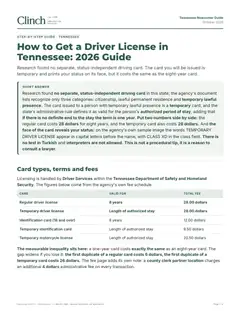
Research found no separate, status-independent driving card in this state; the agency's document lists recognize only three categories: citizenship, lawful permanent residence and temporary lawful presence. The card issued to someone with temporary lawful presence is a temporary card, and its face carries the words TEMPORARY DRIVER LICENSE in capital letters. The price is the same, the term is not: a regular card costs 28 dollars for eight years, and the temporary card also costs 28 dollars but is valid only for the length of your authorized stay. There is no test in Turkish and interpreters are not allowed; a printed dictionary is. Below are the agency's own sentences and its own numbers.
Steps, documents and official links
Card types, terms and fees
Licensing is handled by Driver Services within the Tennessee Department of Safety and Homeland Security. From the agency's own fee schedule:
| Card | Valid for | Total fee |
|---|---|---|
| Regular driver license | 8 years | 28.00 dollars |
| Temporary driver license | Length of authorized stay | 28.00 dollars |
| Identification card (18 and over) | 8 years | 12.00 dollars |
| Temporary identification card | Length of authorized stay | 9.50 dollars |
| Temporary motorcycle license | Length of authorized stay | 20.50 dollars |
The measurable inequality sits here: a one-year card costs exactly the same as an eight-year card. And the gap widens if you lose the card: the first duplicate of a regular card costs 6 dollars, the first duplicate of a temporary card costs 26 dollars. The fee page adds its own note: a county clerk partner location charges an additional 4 dollars administrative fee on every transaction.
What length of stay means, in the agency's own words
The state's administrative rule defines the temporary card as one valid for the person's authorized period of stay in the United States, and adds that if there is no definite end to the authorized stay, the term is one year. The same rule repeats the identical term for the temporary photo identification card.
The practical consequence: the date on your visa or arrival record is also the expiration date of your card. If your status is extended the card does not extend itself; you apply again.
The face of the card reveals your status
On the sample card image the agency publishes, the words TEMPORARY DRIVER LICENSE appear in capital letters before the name, and the class field reads CLASS XD. That means every time you show the card, the person looking at it sees at a glance that you are not a citizen: at a bank, when starting a job, when renting a car, anywhere your age is checked.
The sample card also shows the federal identification star in the corner, so a temporary card can be compliant with the federal identification standard. We read that only from the sample image and could not confirm it with a written sentence from the agency.
Documents accepted for temporary lawful presence
From the agency's own list:
- Conditional resident alien card.
- A valid foreign passport with a valid visa and the attached arrival record. The agency's note reads: The passport must have an English translation. So an English translation of your Turkish passport may be required, and this is written on the agency's own page.
- A valid foreign passport with the attached record for visa waiver entries.
- Students must also present their student certificate, exchange visitors their program certificate.
The agency's only written caution about documents concerns verification: All documents are subject to further verification with the issuing agency or source.
Social Security number
| Situation | What the agency asks for |
|---|---|
| Card without the federal star | You may state the number verbally; it is verified electronically with the federal agency |
| Card with the federal star | A certified document showing the full number is required |
| If you were never issued a number | A sworn affidavit signed before an examiner or a notary |
So for an applicant without a number, the agency publishes a written path and that path runs on an affidavit.
Test languages: no Turkish, and we publish a contradiction
The agency's official driver handbook states that at service centers with computerized testing the exam is offered in three alternate languages: Spanish, Korean and Japanese. Several news sources report five languages instead. We publish the contradiction and take no side; but Turkish appears in neither version.
- Allowed: a printed translation dictionary, provided its pages carry no notes or handwriting.
- Not allowed: smartphones, electronic dictionaries and similar devices. And the agency's own sentence: Interpreters are NOT allowed to assist with any of the driver license testing.
- The oral test is not a language accommodation: the agency gives it only to applicants with a learning disability or who cannot read, by appointment and at selected centers. A certified sign language interpreter is provided for deaf applicants.
Choosing a language carries a cost, but you are not in that lane
A law passed in 2026 and effective January 1, 2027 allows an applicant who cannot speak and read English to take the written exam in another language; but a license issued that way is non-renewable and valid for only thirty-six months. When it expires the applicant retakes the written exam in English only and may not use a dictionary, an electronic device or an interpreter. The law also does not oblige the agency to add new languages.
The practical consequence for a Turkish-speaking reader is subtle and we write it as it is: there is no Turkish exam to begin with, so a Turkish applicant will take the test in English and will not fall into the thirty-six month non-renewable regime. That is not a convenience; it is the absence of one. Your real burden is that the exam is in English and interpreters are banned.
Two states' documents are not valid here
On its own page the agency names two states that issue a particular class of license and states that those documents are invalid in Tennessee: Connecticut and Delaware. If you are moving from either state, check which class your document is before you go.
Where you will go
The agency's location list contains two kinds of sites and the difference matters to you: full service Driver Service Center locations give tests, while Express locations carry the note No testing is done at this location. If this is your first license or you have arrived from abroad, you need a center that gives tests. Beyond those there are county clerk partner offices and kiosks; kiosk density varies a great deal from one city to another, and in one city there are kiosks open around the clock.
Is there a restriction by office: the state's office data contains no field of the kind seen in some states indicating whether foreign national transactions are handled. The agency's only written distinction is between full service and testing-free centers. That does not prove there is no restriction; it means no record of one was found. Call the center before your appointment.
Appointments, pre-review and the calendar
- The agency runs an appointment system; appointments are not available everywhere and the transaction types vary by location.
- The agency recommends that new and returning residents complete the application online before visiting. Documents can be sent for pre-review, with a response in roughly five business days; but you must still bring the original documents to the center.
- Arrive fifteen minutes early; if you are late the appointment is canceled and you join the walk-in line.
- Centers are closed on state holidays.
- On a digital license in your phone the agency is clear: currently not available in Tennessee.
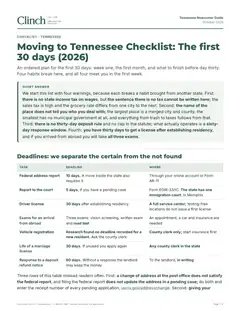
And one deadline: once you establish residency in the state you have thirty days to obtain a Tennessee license.
Official sources
- Driver license and identification fee schedule (including the county clerk surcharge)
- First-time license application: documents, tests and the number rule
- Citizenship and lawful presence document list
- Types of licenses, the temporary card sample and invalid out-of-state documents
- Official driver handbook (test languages, interpreter ban, winter rules)
- Location list: full service centers, testing-free centers and kiosks
02 · Foreign license
Can I drive in Tennessee on my Turkish license?
Short answer
The agency's own sentence closes this question: New residents from other countries must take the vision screening, Tennessee knowledge test and road skills test. So a new resident arriving from another country takes all three exams, including the road skills test. Research found no reciprocity list naming Türkiye, and the agency's dividing line is not country by country but between inside and outside the United States.
Steps, documents and official links
The dividing line is direction, not country
| Where you are coming from | Which tests |
|---|---|
| Another state, with a valid document | Vision screening only |
| Another country | Vision screening, knowledge test and road skills test |
| No prior license at all | All three |
The table in the agency's driver handbook says the same thing. Research found no exception, waiver or reciprocity record for Türkiye. We do not say there is none; we say research did not find one. Ask the center before you go.
You keep your Turkish license
The rule is this: an out-of-state license is surrendered, but Only foreign country licenses/IDs may be retained, meaning a foreign license is not taken from you. The agency also writes explicitly that new residents from other countries are allowed to keep the license issued by that country. That detail matters when you go back and rent a car.
An international permit is not enough on its own
The handbook's own warning reads: Possession of an International Driving Permit does not mean that the holder is valid to operate an automobile in Tennessee or any other state. In other words, the international permit is a translation document, not a driving privilege. On top of that, it must be obtained in your home country; you cannot get one after arriving. Get it before you leave Türkiye.
The translation requirement shows up twice
- On the passport: the note in the agency's document list requires the passport to have an English translation.
- On the license and birth certificate: for documents not issued in English the agency asks for a translation accompanied by a certificate of accurate translation, or a valid international driving permit.
A practical plan: get your international driving permit before you leave Türkiye, have your passport and license translated, call a full service center in your first week after arrival, and put the thirty-day deadline on your calendar. Road tests are not given after dark during the winter months and are canceled in bad weather; build that into the plan.
03 · Vehicle registration
How do I register a vehicle and get plates?
Short answer
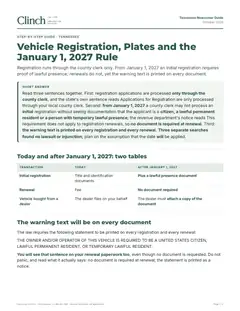
Registration applications are processed only through the county clerk; the state's own sentence reads Applications for Registration are only processed through your local county clerk. And on January 1, 2027 the rule changes: from that date a county clerk may not process an initial registration until the applicant provides documentation that they are a citizen, a lawful permanent resident or a person with temporary lawful presence. Renewals do not require the document, but the warning text is printed on every registration and every renewal. Research found no lawsuit or injunction; the date stands as of today.
Steps, documents and official links
Today and after January 1, 2027: two tables
| Transaction | Today | After January 1, 2027 |
|---|---|---|
| Initial registration | Title and identification documents | Plus a lawful presence document |
| Renewal | Fee | No document required |
| Vehicle bought from a dealer | The dealer files on your behalf | The dealer must attach a copy of the document |
The revenue department's own notice adds: This requirement does not apply to registration renewals.
The warning text will be on every document
The law requires the following statement to be printed on every registration and every renewal:
THE OWNER AND/OR OPERATOR OF THIS VEHICLE IS REQUIRED TO BE A UNITED STATES CITIZEN, LAWFUL PERMANENT RESIDENT, OR TEMPORARY LAWFUL RESIDENT.
You will see that sentence on your renewal paperwork too, even though no document is requested. Do not panic, and read what it actually says: no document is required at renewal; the statement is printed as a notice.
Which documents are accepted
- Sufficient on their own: a license compliant with the federal identification standard, a Tennessee driver license, a Tennessee temporary driver license, a Tennessee photo identification license and a Tennessee temporary photo identification license.
- If you hold no Tennessee document, the citizenship, permanent residence and temporary lawful presence lists are the same as the license lists: foreign passport, visa and arrival record; students and exchange visitors also present their program certificate; with the passport's English translation.
- The document may be paper or electronic; the agency accepts an image on your phone.
The most practical result: if you hold a valid Tennessee temporary driver license you can still register a vehicle after 2027 without carrying anything else. A newcomer with no Tennessee document will need to bring passport, visa and arrival record, with a translation if required.
Where the data goes: we say neither yes nor no here
The same law also provides for data sharing between the state agency and county clerks, and that part of the law took effect immediately. The document is recorded, and a dealer transaction puts a copy in the file.
But we write two things exactly as they are. First, there is no provision in the text of the law transferring that data to the immigration enforcement unit. Second, the separate law that creates the state's verification and reporting regime runs on the concept of a public benefit, and driver licensing and vehicle registration do not appear to be items that fall inside that definition. So we can say neither that the data goes to the immigration unit nor that it does not: a channel has been created, and the regulation that will fill it does not exist yet. The right thing to do after reading this section is not to look for a definitive answer but to ask your attorney about your own file.
Emissions testing: the program ended
Emissions testing used to be required in six counties. It ended in five counties on January 14, 2022, and in Davidson County emissions testing has not been required for registration, renewal or plate transactions since February 5, 2022. Shelby County, where Memphis sits, had already withdrawn from its own program earlier.
There is one thing we deliberately do not write here. The page of the agency that ran the program is no longer published, and no sentence from an agency stating that emissions testing does not exist could be obtained. So this page does not say there is none; it says the program ended, and gives the dates. For periodic safety inspection no official item could be found either; the registration and renewal pages list only the fee and, from 2027, the document. We say research did not find it, not that it does not exist.
County wheel tax: a twofold difference inside one state
Your county wheel tax is collected together with registration. The mechanism: the tax is owed if the owner resides in that county, it is collected by the county clerk at the same time as the state registration fee, and no plate decal is issued until it is paid. The county legislative body sets the rate.
| County | Annual amount for an automobile |
|---|---|
| Williamson County | 25.75 dollars |
| Sumner County | 51.00 dollars |
| Rutherford County | 52.50 dollars |
| Davidson County and Shelby County | Research found no verified figure |
The figures come from the table published by the counties' technical assistance service; secondary sources circulate different numbers and we relied on the table. We publish no figure for the two large counties because none could be verified. Changing counties changes this item directly; ask the county clerk before you move.
The current amount of the state registration fee could not be verified in this research either, so we give no figure.
Official sources
PDF: Vehicle Registration, Plates and the January 1, 2027 Rule
04 · Auto insurance
How does auto insurance work and how does the state verify it?
Short answer
The state runs a program that verifies mandatory insurance electronically; it is called Drive Insured TN and it is administered by the Tennessee Department of Revenue. If your policy does not appear in the system you receive a notice, and that notice carries a number you will need. Minimum coverage amounts could not be confirmed from the agency's own page in this research, so we publish no figures.
Steps, documents and official links
How the system works
- The state verifies policies electronically using records sent by insurance carriers.
- You can check your own status with your plate number and vehicle identification number.
- To respond to the agency or to pay, you need your plate number and the number printed on the notice the agency sent. So do not throw the notice away.
- Self-insurance is possible in two ways: one route for religious organizations and one for corporations. A form is completed and sent to the verification unit.
The right order for a newcomer
Registration and insurance run together. In practice the correct order is: start the policy first, then go to the registration counter. Make sure the policy is written for Tennessee; a policy opened in another state does not automatically become valid when you move.
What we do not write, and why
Minimum coverage amounts: the agency's program page explains the mechanism but gives no figures, and the text of the underlying statute could not be reached in this round. Do not carry coverage figures from our other state guides into this one; they differ in every state, and a wrong figure costs real money when you choose a policy. Ask your agent for the state's current minimum coverage and see it written in the policy.
Prohibited rating factors: some states publish detailed rules on which information may not be used to calculate an insurance score. No such rule was measured for Tennessee in this research. We do not say there is none; we say we did not measure it.
05 · Tolls
Are there toll roads in Tennessee?
Short answer
Research found no toll highway, bridge or tunnel in operation today. But this item is changing: under a road funding law passed in 2023 the state opened the door to optional tolled express lanes. The logic of the model is that the general purpose lanes stay free and a driver may choose to move into a tolled lane. Two of the first corridors proposed run between Nashville and Murfreesboro and between Nashville and Spring Hill.
Steps, documents and official links
Where things stand today
- Toll roads: none in operation was found. An older state law prohibits charging tolls on roads and bridges built before that law.
- The new model: optional tolled express lanes. A tolled lane is not a mandatory passage but a separate lane you may choose.
- Proposed first corridors: between Nashville and Murfreesboro and between Nashville and Spring Hill, with two more corridors proposed in the eastern part of the state. Memphis does not appear on that first list.
What we do not write
The transportation department's own page describing this program could not be reached in this research. So opening dates, toll levels and the status of contracts could not be verified, and we give no figures or dates here. We also do not write the flat sentence there are no toll roads in Tennessee; the accurate sentence is that no toll road in operation was found and that the state is launching an optional tolled lane program.
Fake toll messages
A widespread scam nationwide sends text messages claiming an unpaid toll and pushes you to a link that harvests card details. Because no toll road was found in this state, receiving such a message is itself a signal. Do not tap the link; if you believe you owe something, type the agency's own address into your browser yourself.
06 · Winter and severe weather
Winter driving, ice and severe weather: here you get both
Short answer
This state has both a real winter regime and a tornado regime, and you need to plan for them together. The transportation department's statement of January 25, 2026 describes the icing event as statewide: crews were clearing roads on the fourth day, 3,500 tons of salt had been used, 861 incidents had been managed, and the agency asked drivers to stay home. At the same time, research found no mandatory snow tire or chain requirement; the state's own handbook treats winter equipment as advice.
Steps, documents and official links
January 2026: a measured winter event
Statewide response figures from the transportation department's own statement:
| Item | Figure |
|---|---|
| Equipment hours | 10,000 |
| Labor hours | 15,000 |
| Salt | 3,500 tons |
| Brine | 1.4 million gallons |
| Lane miles treated | More than 290,000 |
| Incidents managed | 861 |
In the agency's own words the event was across the state, not only in the eastern part. The easiest mistake a newcomer makes is to treat this as a southern state and skip winter planning.
Salt has a limit, and that limit concerns you
The agency's own sentence says that if road surface temperatures fall below 16 degrees Fahrenheit the salt will not be strong enough. Below that threshold the agency switches to calcium chloride and a heated brine mixture, then breaks the ice with underbody blade trucks, and finally runs the plows.
The priority order is written down too: primary routes and mostly interstates first, along with places prone to freezing: hills, curves, ramps, bridges and interchanges. Secondary state routes come next. Your neighborhood street is at the end of the list.
No mandatory equipment rule, but there is advice
Research found no mandatory snow tire or chain requirement in this state. The driver handbook treats winter equipment as advice: it notes that snow tires help in winter driving, lists a scraper for iced windows and snow tires or tire chains in the emergency kit, and says to pull as far to the right of the roadway as possible before installing chains. All of it is advisory language. Hold both facts together: there is no rule, but the event is real.
Winter affects your road test
The agency's own rule sets two limits on road tests:
- No tests in extreme weather: heavy rain or snow, dense fog, hail, high winds and icy roads.
- During winter months road tests are not given in the dark.
So a reader scheduling a road test in winter should know in advance that the appointment may be canceled for weather and that evening slots will not be available.
Tornadoes: the shelter regime varies by city
In this state your outdoor plan and your severe weather plan are the same plan. But the five cities are not in the same place on public shelters, and the result reverses expectations:
| City | What is published |
|---|---|
| Rockvale (unincorporated) | The county publishes five buildings with addresses and rules as public tornado shelters, and one of them is in Rockvale |
| Nashville | No standing shelter list was found; the emergency management office instead publishes guidance on how to pick the safest area inside a building |
| Brentwood and Hendersonville | No standing public list was found; what exists is a system for registering your own private shelter with the agency |
| Memphis | No list published by either the city or the county could be found |
So the city with no municipal government is better off on this item than two cities that have one. And there is a terminology trap: a private shelter registry is not a shelter list. One county writes in its own words that it collects the information to reach disaster victims; it is not a place you can go, it is information you give so the agency can find you.
Rules at the published shelters
From the county that publishes a shelter list:
- Sign in on arrival, sign out on departure.
- Follow the instructions of the volunteers on duty, and stay until the official all clear is announced.
- No pets, including emotional support animals. Service animals as defined in law are admitted.
- The county states that these rules are consistent with federal emergency management guidelines.
Timing: you leave at the watch, not the warning
Severe weather uses two different words and they are not the same thing: a watch means conditions could develop, a warning means the event has been spotted or indicated on radar. If you plan to go to a community shelter, the moment to go is the watch; traveling after a warning is issued is not advised. At the warning, what you do is move to the safest interior area of the building you are in.
We publish no risk ratio figure, because none could be verified from an agency page. And one note on alerting: the five cities use different alert platforms, and the languages in which alerts are sent could not be read from any agency page.
What to do
- Keep wireless emergency alerts turned on, and register for your city's own alert system with your correct home address; one county states plainly that messages go only to people in the geographic area of the event.
- Before you move, ask where the windowless interior space of the building is. Ask that question before you sign a lease.
- In winter, check the road conditions page or the phone information line before you set out.
- If you are considering a manufactured or mobile home, make it part of your decision that such structures are not considered safe in severe weather and that moving to a sturdy building is advised.
07 · Transit
How does public transit work, and is there a train?
Short answer
The transportation department's own sentence reads: Public Transportation is available in every county in Tennessee, with a wide range of services. But the five cities are served by five different agencies and the formats do not resemble each other: the two large cities have their own bus networks, while the smaller places rely on demand-response service you call for by phone. Transit in Memphis is free today, but that is a pilot program with no announced end date; it is not a permanent rule. Intercity passenger rail exists only in Memphis, with one train a day.
Steps, documents and official links
Five cities, five arrangements
| City | Format | Base fare today |
|---|---|---|
| Nashville | Its own bus network, regional buses and a commuter train | 2.00 dollars for two hours, daily cap 4.00, monthly cap 65.00 |
| Memphis | Its own bus network, downtown trolleys and demand-response service | 0.00 dollars today (pilot); standard fare 1.00 dollar |
| Hendersonville | A regional bus route that carries the city name, plus county demand-response service | Regional 4.25 dollars; demand-response 3.00 dollars |
| Brentwood | No municipal system was found; a fixed-route system in a neighboring city and county demand-response service | 1.00 dollar in the neighboring system; demand-response 3.00 dollars |
| Rockvale | Demand-response only, by phone; no fixed stops | Between 2.00 and 3.00 dollars |
The assumption that a small place has no transit turned out wrong again in this series. Rockvale has no fixed route, but the county runs a demand-response program and it works.
Nashville: capped fares and a discount card
- Local service is 2.00 dollars for two hours of unlimited riding; the daily cap is 4.00 and the calendar-month cap is 65.00 dollars.
- On cash the agency's own note reads: Exact cash only. No change or transfers given. So no change is given and cash riders get no transfer.
- Children four and under ride free.
- There is a discounted fare, but it carries a critical condition: you must first obtain a discount identification card, and the application is made in person. The agency warns that discounts are not applied until the rider holds the card.
- Regional buses have their own fare; the commuter train fare depends on the station you board at.
- Door-to-door service for riders with disabilities exists; it requires an eligibility certification first, and reservations are made one to seven days ahead.
Memphis: free today, but we write no permanent sentence
The city's transit agency launched a zero fare pilot on November 16, 2025. It was initially ninety days, then extended, and it remains in force today; the agency's own sentence is all rides are currently available at no cost. The scope is wide: fixed-route buses, downtown trolleys, paratransit service and demand-response options.
But we write two things together. First, by the agency's own account a determination on the future of the program will be made once the evaluation is complete, and the end date is uncertain. Second, even if fares return, eligibility, assessment and reservation processes for paratransit continue unchanged. The fare that would return has already been published: 1.00 dollar for an adult. That is why we do not write that transit in Memphis is free; we write that it is free today and that this is a pilot program.
Demand-response service: a system that runs on the phone
A regional agency serving the counties of the three smaller cities provides demand-response transportation. Its rules hit the reader's budget directly:
| Item | Amount or rule |
|---|---|
| One way inside the county seat | 2.00 dollars |
| One way within the city and county | 3.00 dollars |
| Each additional stop on a scheduled route | 2.00 dollars |
| Each county line crossed | 5.00 dollars |
| Flat fare to Nashville, one way | 10.00 dollars |
| Payment | Cash or bus card only; personal checks are not accepted |
| Reservations | 24 hours ahead for local trips, 72 hours for out-of-county trips |
In this system a county line converts directly into money. And the reservation window is a genuine constraint: someone who needs to see a doctor the same day cannot use this service.
We publish a contradiction
The state transportation directory includes the county of Nashville in this regional agency's service area. The agency's own site states plainly that it does not serve that county. Two official sources conflict and we take no side. The practical outcome does not change, because transit in Nashville is provided by the city's own agency; but do not treat the state directory alone as proof of coverage and confirm by calling the agency for the county you will use.
Trains
- Intercity passenger rail exists only in Memphis. The route runs one train a day in each direction and has two stations in the state.
- Research found no intercity passenger train in Nashville. Nashville's rail connection is a commuter train running only along the corridor east of the city; do not confuse the two.
- No passenger rail station was found in Hendersonville, Brentwood or Rockvale.
Official sources
08 · Local government
Which local government covers my address, and who do I deal with?
Short answer
In this state the name of the place does not tell you who you deal with. The largest city is a merged city and county, and the smallest place has no municipal government at all. In between there is a city that elects its mayor directly and a city that never elects a mayor. In one place the city bills your water; in another the city runs none of the utilities. The first thing to do on day one is find out which government your address falls under; trash, taxes, schools and policing all follow from it.
Steps, documents and official links
Four different forms of government in one state
| City | Structure | Mayor |
|---|---|---|
| Nashville | Merged city and county government, jurisdiction covering the whole county | Elected |
| Memphis | City and county are separate legal entities | Elected |
| Hendersonville | Mayor and board charter | Directly elected |
| Brentwood | Manager and commission charter | Not elected |
| Rockvale | Unincorporated; the county provides services | None |
Merged city and county: one door, but two divisions
Nashville's charter defines the territory of the metropolitan government as the whole of the county. The same charter lists, item by item, which service is provided where, and places the following county-wide: general administration, police, courts, assessment, health, schools, parks, library, planning, building code, transit and refuse disposal. So for schools, libraries and courts the question city or county simply does not arise here.
But there are two divisions, and both touch you directly.
First, six cities inside the county that kept their own municipal governments: Belle Meade, Berry Hill, Forest Hills, Goodlettsville, Oak Hill and Ridgetop. The charter preserves them, forbids the creation of any new city, and obliges the metropolitan government to serve them. Three of them also levy their own property tax. The government's own open data portal says it plainly: the portions of these satellite cities inside the county are considered part of the merged government, each nonetheless retaining its own municipal government.
Second and the real trap, the two service districts: the general services district covers the entire county, while the urban services district covers the former city limits. The charter assigns additional police protection, fire protection, water, sewer, storm sewer, street lighting, street cleaning and refuse COLLECTION to the urban district only. So refuse disposal is county-wide, refuse collection is not. The government's waste page applies that rule and tells residents of the general services district that they must contract with a private hauler.
And here is the surprise: the tax difference between the two districts is tiny. In 2025 the additional urban district burden was only 0.0320 dollars per 100 dollars of assessed value. A year earlier the gap was ten times larger; 2025 was a reappraisal year and the two districts' rates were recalculated separately. So the difference is not in the tax; it is in the service.
How to find your own address
The government publishes the boundary between the two districts in its own open data portal; the layer contains exactly two polygons, named Urban Services District and General Services District. The satellite cities layer sits in the same portal. The layer was last updated in January 2023 and the urban district boundary can expand by annexation, so keep that date in mind while reading the map.
Research found no official tool that answers the question from a typed address. You can locate your address on the map, but there is no search box that returns a definitive answer. The second route to a definitive answer is the city's own information line; trash service sign-up also runs through it.
Memphis: the trap is not annexation but deannexation
Memphis has its own version of the am I inside the city limits question, but the cause is reversed. The description of the city's own boundary data states that boundary adjustments follow deannexation ordinances and names three areas. So a home with a Memphis mailing address may have been removed from the city limits.
The cost is not small: a home outside the city limits does not pay the city property tax, but it also does not get the city's trash service or the city's police department. The city publishes the boundary data in its own open data portal and the layer opens without a key.
A city that does not elect its mayor
In Brentwood the mayor is not directly elected. All seven commissioners are elected at large, and then the commission appoints a mayor and a vice mayor from among its own members for two years. Daily administration is run by an appointed city manager. The city has a municipal court and its own police department.
In Hendersonville the picture is reversed: the mayor is elected at large for four years, the city is divided into six wards and each ward elects two board members. There is a municipal court, a city police department and a city fire department.
And we publish a date contradiction: two official sources give two different years for when Hendersonville was incorporated. The state's municipal technical advisory unit gives one date, the city's own page gives another, and the year the current charter was granted is cited separately. We take no side.
There is also a domain trap: the city's official domain in the federal registry does not resolve today; the site the city actually uses sits on a different extension. Use the working address when you search.
The place with no municipal government
Rockvale's unincorporated status was confirmed by three independent sources: the census classification, the absence of any agency record under that name in Tennessee in the federal domain registry, and the absence of a city row in the state sales tax rate file. A place without legal incorporation cannot set its own sales tax rate.
The right sentence here is not there is none, it is the county provides it. A mayor, a board, a police department, a municipal court and a municipal tax were searched for and not found, because those offices were never created. The chain of contacts runs like this: policing through the county sheriff's office, building permits and zoning through the county building codes department, trash through the county convenience centers, schools through the county school district, libraries through the county library system.
One naming trap: the federal domain registry lists a town with the same name, but it is in another state. Do not confuse the two when you search.
And one item that reverses expectations: this place without a municipal government has a standing, publicly listed tornado shelter with an address, while no such list was found in two cities that do have municipal governments. The detail is in the winter and severe weather section.
One rule changed for applying to local services
A state law effective July 1, 2026 requires state agencies, local governmental entities and local health departments to verify that every applicant eighteen or older who requests a public benefit is a citizen or lawfully present. The law expressly includes a county with a metropolitan or charter form of government in the definition of a local governmental entity; in other words, being merged is not an exemption.
The most important detail for you is in the timing: for local governmental entities the law starts the obligation at the moment that entity first reprints the relevant forms after July 1, 2026 or first updates its electronic systems. So a declaration that is not on a form today may be on it tomorrow, and within the same city one service's form may carry the clause while another's does not yet. As of October 12, 2026, no such clause was visibly found on the service pages of any of the five cities; whether that is because those services fall outside the definition or because the forms have not yet been reprinted could not be measured, and we do not pick between the two. The scope of the law and what it means for you is in the benefits section.
Official sources
- Merged government service districts layer (urban and general services districts)
- Separate municipalities inside the county (satellite cities layer)
- Memphis jurisdiction boundary layer (including deannexation ordinances)
- Brentwood mapping applications: city limits, ZIP code and utility district maps
- State municipal technical advisory unit: city directories and forms of government
09 · Power and gas
How do I put the power and gas in my name?
Short answer
In this state the institutional type of your provider decides where you can complain, and across the five cities it splits four ways: a private regulated company, a utility district, an electric cooperative and a municipal utility. The city-owned multi-service utility in Memphis falls outside the regulator's definition, which means research found no state-level complaint forum for power, gas or water there, and the rules are the utility's own policy; the policy text itself says those rules may be changed without notice. In Nashville gas is supplied by a private company under the regulator, so there is a state forum for gas. Same service, two regimes.
Steps, documents and official links
Learn the institutional type first, then the door
| Type of provider | Where you meet it | Who to go to |
|---|---|---|
| Private, regulated company | Natural gas, in most cities | State utility commission |
| Utility district | Water and sewer, in smaller places | State utility board |
| Electric cooperative | Power, in smaller places | Its own member board |
| Municipal utility | Power and water, in the large cities | The municipality; no state forum found |
The practical rule is this: look at the name and the type of the entity on your bill. An entity whose name includes district, cooperative or city department is not answerable to the same forum as one that is a private company.
One city where three services sit in one entity
In Memphis power, natural gas and water all come from the city's own multi-service utility, on one bill. That is convenient in practice, but it has two legal consequences and we write both:
- City-owned utilities sit outside the state's regulatory definition. The state's own municipal technical advisory unit writes that the regulator has only limited authority over city-owned utilities. Research found no state-level complaint forum for a dispute with this utility.
- The rules are the utility's own policy. The policy text states that the rules may from time to time be revised, amended, supplemented or otherwise changed without notice, and that once effective the changes carry the same force as the existing rules. It also provides that no employee other than the most senior officer has authority to waive any provision.
The opposite example in the same state: a state forum for gas
In Nashville natural gas comes from a private company, and the company's own filings state that the natural gas distribution business is subject to the regulation and supervision of the state commission. Its right to operate in the city rests on a franchise agreement with the metropolitan government. So in Nashville there is a state-level door for a gas problem; in Memphis there is not. In Brentwood gas is split between two private companies, both regulated; which one serves which neighborhood could not be found, so you will have to ask by address.
Identification and numbers at sign-up: two cities, two levels of clarity
The Memphis utility publishes an accepted document list, and for a reader with limited documents that clarity is a real advantage. From the utility's own table, two documents are required and one of them must carry a photo:
- State issued: driver license, the state driver certificate, official state identification card and others.
- Federally issued: Social Security card, passport or passport card, permanent resident or alien registration card, a government-issued visa, an individual taxpayer identification number, and a health program identification card.
- Other: certified copy of a birth certificate, voter registration card and a consular identification card.
The point to read here: the Social Security card is only one of the options on that list. In other words, a path to service without a number sits in writing in the utility's own list.
The Nashville power utility's policy is more closed: it asks for two current forms of identification, one of which must be government issued, and a photo identification may be requested. But the accepted document list is not published; a passport, a taxpayer identification number or a consular card are neither required nor expressly accepted by name in the policy. The same policy states that no new service is provided to minors and that the utility is obliged to serve applicants who have no prior delinquent balance and who provide satisfactory proof of identification.
Deposit rules diverge as well
| Item | Memphis utility | Nashville power utility |
|---|---|---|
| Who is asked | Applicants presenting a credit risk | Those who cannot show ability to pay through credit bureau reporting |
| Amount | Minimum 200 dollars | No more than twice the highest monthly bill of the rate class |
| Installments | Eight installments of 25 dollars for new customers | No separate installment item in the policy |
| Refund | Credited after 24 months of good payment history | After 12 months of satisfactory payment history |
| Interest | Not paid | Paid, with the formula written in the policy |
In the smaller cities this item could not be measured. For none of the three smaller places could the identification documents required at sign-up, whether a path without a number exists, or any deposit ceiling be read from a first-hand source. So we do not write that there is no deposit or that no number is required; call your provider and ask: not I have no number, but what do you accept as alternative identification.
In the smaller places the provider changes with the address
Hendersonville's own sentence is blunt: the city does not own or operate any of these utilities. Within that one city two separate water districts and two separate electricity providers are listed, and which one serves you depends on the address. In Brentwood power is split between a municipal utility and a cooperative, and the city has no authority to regulate that provider. In Rockvale water comes from a utility district and power from a cooperative.
So the question to ask before you move is not the name of the city but the address itself. Brentwood's own mapping application even includes a utility district map.
Weather-based shutoff protection: not measured
Some states prohibit disconnecting service for nonpayment in cold or heat. Whether such a rule exists in Tennessee, what triggers it, which services it covers, and whether municipal utilities and cooperatives fall outside it could not be confirmed from a first-hand source in this round. There is a claim circulating online resting on November and March dates; it is not official and could not be confirmed with any agency source, so we do not publish those dates. The only related item found in the regulator's rules for electric companies governs a customer's own request to stop service and requires at least three days' notice; it does not govern disconnection for nonpayment.
What has been measured, and is strong, runs against the landlord: the landlord and tenant act bars a landlord from recovering the dwelling by cutting off electricity, gas or any other essential service, and gives the tenant a three-way remedy if service is interrupted. The detail is in the renting section.
10 · Water and trash
Water, sewer and trash: five cities, five models
Short answer
On trash this state recognizes no single model. In one city collection is included in taxes and free, but only in the urban district; in another it is provided across the whole city for 41.96 dollars a month. One city contracts a single firm, another lets the resident choose the hauler because the city code forbids a monopoly in solid waste, and in one place there is no collection at all; trash goes to a county convenience center. Ask about this item before you move; the annual difference is large.
Steps, documents and official links
Five models side by side
| City | Who collects | Cost |
|---|---|---|
| Nashville | The city, only in the urban services district; a private hauler outside it | Inside the district no separate fee, included in taxes |
| Memphis | The city solid waste division, across the whole city | 41.96 dollars a month per residential unit |
| Hendersonville | The city manages it and has contracted collection to a private firm | There is also a separate stormwater fee |
| Brentwood | No municipal collection; the resident picks a private firm | Whatever the firm you choose charges |
| Rockvale | No collection; the county convenience centers | You haul it yourself |
Nashville: free, but only in one district
The waste department's own sentences are clear: curbside collection is available to single-family homes in the urban services district; trash is collected weekly and recycling every other week. If you live in the general services district or in a multi-family property anywhere in the county, you must go to your property manager or to a private hauler; the page states that residents outside the urban services district must contract with a private hauler for disposal.
The other rules matter so you do not lose money:
- Carts go out by 6:00 a.m. on collection day, collection runs 6:00 a.m. to 5:00 p.m., and carts must be back in by 7:00 p.m. and stored out of sight from the street.
- Nothing placed outside the cart is collected. Trash must be bagged; recycling must not be.
- New homes receive one trash cart per address; a second cart costs 65.00 dollars. Up to two recycling carts are free.
- Replacing a lost, stolen or unrepairable cart costs 65.00 dollars and is the owner's responsibility.
Memphis: everyone gets it, but for a separate fee
The city's own code sets the schedule item by item and settles figures that circulate wrongly in secondary sources:
| Customer | Monthly fee |
|---|---|
| Residential unit (single-family homes, duplexes, triplexes, quadplexes and apartment buildings of seven or fewer units, per unit) | 41.96 dollars |
| Additional rented cart, each | 10.00 dollars |
| Reduced rate | 9.23 dollars |
Four conditions for the reduced rate apply together: being head of household, holding an active utility account in your own name, being at least 65 years old or totally disabled, and an annual gross household income of 25,000 dollars or less. Applications take at least forty-five days, and no notarization is required if brought in person.
The fee appears on the multi-service utility bill; the sewer charge is on the same bill and subject to the same discount program. The city also operates convenience centers, open Friday, Saturday and Sunday from 9:00 a.m. to 3:00 p.m., where you are asked to bring your most recent bill and a photo identification. In addition to weekly collection, bagged yard waste is collected; yard waste must be organic only and cannot be construction debris. Twice a month bulky items outside the cart are collected.
Brentwood: monopolies are banned, so you pick the firm
In Brentwood there is no municipal collection of residential trash. The city provides only a monthly brush program and spring and fall oversize item cleanups. The reason is not a preference but the city's own code: it provides that no person may hold an exclusive right to collect and haul solid waste within the city limits.
The same code requires haulers to register with the city manager and to maintain a certificate of insurance; changes in information must be reported in writing within fifteen days. And there is a useful exception: a person hauling their own waste to an approved site need not register or provide insurance.
Rockvale: no collection, but a calendar
There is no curbside collection in the unincorporated area; the county runs a network of convenience centers with narrow rules:
- Hours: Tuesday, Wednesday and Friday 9:30 a.m. to 5:00 p.m.; Saturday and Sunday 7:30 a.m. to 3:00 p.m. Closed Monday and Thursday.
- County residents only. One visit a day and about one pickup truck bed of household waste.
- Construction and demolition debris is not accepted. Bulky items are limited to three a day.
- Yard waste and brush are not accepted.
One site also takes electronics, oil-based paint and fluorescent bulbs. We publish a phone number contradiction: the county's own page lists one number for the solid waste line, while a neighboring city's page lists a number differing by one digit; rely on the county's own number.
Water and sewer
There is no single model on water either: in one city water is a city department, in another the city bills you but does not operate a treatment plant (the city's own sentence says it does not operate water or wastewater treatment plants), and in the smaller places utility districts with separate legal personality are in charge.
Measured items for water service in Nashville:
- Service start fee: 35 dollars for guaranteed same-day service, 25 dollars for any later day, and the fee is nonrefundable. Transfers within the same service area cost the same.
- Stopping service: call customer service one day before the date you want it stopped, and keep the confirmation number until the final bill arrives.
- No deposit requirement for residential customers appears on that page; commercial customers must post security.
- No identification or number requirement appears on the page either. That does not mean there is none; it means it is not written on the page.
Irrigation and water use restrictions: research found no regime in this state assigning watering days or applying tiered penalties. Do not carry the watering rules from our other state guides into this one.
11 · Renting and tenant rights
Leases, security deposits and tenant rights
Short answer
Two items in this section are widely believed and wrong, and we write both. First, there is no thirty-day rule on security deposits, and the statute sets no ceiling either. The real mechanism is a separate account, disclosure of where that account is held in the lease, and the landlord's right to keep the money if no response arrives within sixty days of the refund notice. Second, eviction law hardened in 2024: the maximum continuance dropped from fifteen days to seven, and appealing an eviction judgment now requires a bond equal to one year's rent. And a single clause in bold type in a lease can remove your right to receive a pay-or-quit notice entirely.
Steps, documents and official links
The statute does not apply in every county
The state's landlord and tenant act applies only in counties above a certain population threshold. All five cities' counties are far above it, so the rules on this page apply in all five. But in the state's smaller counties this act does not apply at all; if you move to another county inside Tennessee, your protection set can change completely. Check that before you move.
And in covered counties nothing can be added locally: the act occupies the whole field of landlord and tenant regulation, and a county or city council may not enact a rule that conflicts with or adds to it. So the state rule is the rule. The only new local authority measured outside that preemption is a narrow 2025 grant allowing local governments to regulate sober living homes.
Security deposits: the common belief is wrong
| Commonly said | What the statute says |
|---|---|
| There is a cap on deposits | There is no cap |
| The landlord must refund within 30 days | No such rule appears in this section |
| Deposits earn interest | The statute does not require interest |
The real mechanism:
- The landlord must hold all deposits in an account used solely for that purpose.
- At the moment the tenant signs the lease and pays the deposit, the landlord must disclose where that account is held. The account number need not be given. You have the right to ask, so ask when you sign.
- If you leave owing nothing and a refund is due, the landlord sends notice of the amount to the last known or reasonably determinable address. If no response arrives from the tenant within sixty days of that notice, the landlord may keep the money.
- The strongest item for tenants: if the landlord neither held the deposit in a separate account nor provided the damage list, the landlord has no right to retain any part of it. Both conditions are required.
The direct consequence for you: after you move, tell the landlord your new address in writing. A tenant who does not, and who does not respond within sixty days, can lawfully lose the deposit.
Move-out inspection: not attending can cost you
- The tenant has the right to inspect the premises to determine the physical damage to be deducted.
- Within five days of receiving your notice to vacate the landlord may inform you of that right; the inspection takes place on the day you fully vacate or within the following four calendar days.
- At a joint inspection both sides sign the damage list and the estimated cost of repairs, and the signatures are conclusive evidence of the list's accuracy. If you do not sign, you must specify each disputed item in writing, because any later lawsuit is limited to the items you disputed in writing.
- If you fail to attend a scheduled inspection you may waive your objections to the damage found, but only if that waiver is written into the lease.
- Damage discovered later has a cutoff: thirty days after you move out or seven days after a new tenant moves in, whichever comes first.
Rent, grace period and late fees
- There is a five-day grace period and the due date counts in it. No late fee may be charged before five days pass.
- If the fifth day falls on a Sunday or a legal holiday, no late fee may be charged at all as long as rent is paid the next business day.
- The late fee may not exceed ten percent of the delinquent rent, whatever the fee is called.
- A lease may not provide that the tenant waives the rights given by the act. The landlord must also state in writing that no insurance is provided for the tenant's belongings.
Notice periods
| Situation | Period |
|---|---|
| A breach curable by payment (rent, repair cost, damage) | 14 days from receipt of notice |
| Repetition of the same breach within six months | 7 days, with no right to cure |
| A breach not curable by payment | At least 14 days |
| Termination of a week-to-week tenancy (either side) | At least 10 days written notice |
| Termination of a month-to-month tenancy (either side) | At least 30 days written notice |
| Violence, or a real and present danger to persons or property | 3 days |
Look for the bold type in the lease
This is the single most important sentence in the section. If the tenant waives the right to receive notice, the landlord may file an eviction action with no notice at all when rent is unpaid. For the waiver to be valid it must appear in the lease in bold type of twelve points or larger.
So read every clause set in bold before you sign. The waiver cannot shorten the five-day grace period, but it can remove your fourteen-day notice entirely.
Eviction law hardened in 2024
These changes appeared in no secondary summary and they affect you directly:
- The continuance shrank: the maximum period a judge may continue an eviction hearing was cut from fifteen days to seven. The time you can gain to prepare was cut in half.
- One appellate route was closed: these cases can no longer be removed to the circuit court by a particular writ; a party seeking review goes on appeal instead.
- And the heaviest item: if the tenant appeals, the appeal is accepted only on posting a bond, a cash deposit, an irrevocable letter of credit or two sufficient sureties in the amount of one year's rent for the property. In other words, challenging an eviction judgment requires putting up a year's rent in advance.
And one change in your favor: for leases made, amended or renewed on or after January 1, 2025, the landlord must disclose in writing at or before the beginning of the tenancy: the name and address of the agent authorized to manage the property, the name and address of an owner or of a person authorized to accept service of process and receive notices and demands on the owner's behalf, and either a phone number or an email address for maintenance or an online portal. If that information is missing from your lease, the lease is incomplete.
What a landlord may not do
- Self-help eviction is barred: a landlord may not recover the dwelling by cutting off electricity, gas or any other essential service.
- If essential services are cut, after written notice the tenant may choose one of three remedies: procure the service and deduct the actual and reasonable cost from rent, stay and recover damages equal to the reduction in fair rental value, or procure reasonable substitute housing and pay no rent for that period. Reasonable attorney fees may be sought in any case. The act's own definition of essential services covers utility services including gas, heat and electricity, and other duties that materially affect the tenant's health and safety.
- Entry is narrow: no consent is needed in an emergency; otherwise entry is limited to listed situations, and entry during the last thirty days of the lease to show the unit to prospective tenants requires both a lease clause and at least twenty-four hours' notice. A landlord may not use the right of entry to harass.
- There is a retaliation ban, but it is narrow: it covers only complaints made to the landlord about a violation and the use of remedies under the act, and it has three exceptions; the most important of them is the tenant being behind on rent. A retaliation defense does not work while you owe rent.
- In domestic violence only the perpetrator may be evicted; the landlord may not evict victims, children under eighteen or innocent occupants on that ground alone.
Housing discrimination: what is on the list and what is not
The protected classes named in the law in force: race, color, creed, religion, sex, disability, familial status and national origin.
- National origin is on the list. If you believe you were refused because of your accent, your name or the country you came from, this is the provision you rely on.
- Source of income is not on the list. State law does not prohibit a landlord from refusing a housing voucher.
- Immigration status is not on the list.
- And because of preemption, a city or county cannot add them locally.
But a city's own ordinance can be broader, and there is one example here: the list in Memphis's own fair housing ordinance also includes national origin, age and source of income. That is that city's ordinance alone and does not carry over to the other places; the entire municipal codes of Brentwood and Hendersonville were searched and no such ordinance was found, and the relevant Nashville chapter, despite the word housing in its title, regulates only employment in its operative provisions.
And the complaint door has changed: the state human rights commission was abolished effective July 1, 2025. Housing discrimination complaints now go to the civil rights enforcement division of the attorney general's office. That office may cooperate with the federal housing agency and has authority to conduct testing to measure housing accessibility. Any source pointing you to the old commission is stale; do not rely on referrals dated 2024 or earlier.
The new text adds two provisions: coercing, intimidating, threatening or interfering with a person because they exercised a right, or helped someone else exercise one, is a separate discriminatory practice; and it is prohibited to induce a property transaction by claiming that the composition of a neighborhood is changing. The law also provides for tiered civil penalties.
We write the limits of the protection too: renting in a building of no more than two families where the owner or a family member lives there, renting a single room in a person's own home, religious organizations not operated for commercial purposes giving preference to their own members, and single-sex dormitory style rentals are outside the scope. And the law expressly preserves reasonable local restrictions on the maximum number of occupants in a dwelling.
How many people may live in one home: this is entirely local, and the gaps are wide
| City | Limit on unrelated persons |
|---|---|
| Nashville | 4 in a unit with three or fewer bedrooms, 5 with four or more; a mix of related and unrelated people is expressly allowed |
| Hendersonville | 5; domestic servants housed on the premises are not counted |
| Brentwood | 1 |
| Memphis and Rockvale | Zoning texts could not be reached; not measured |
The figure circulating online that Nashville allows at most three unrelated people is outdated; the current text of the code reads as above.
The limit of one in Brentwood deserves particular attention, because the city uses the concept of a permanent occupant instead of family, and there are five triggers for being counted as one: residing in the dwelling more than twenty-one days in any twelve-month period, registering to vote at that address, receiving mail at that address, using it to register a vehicle or apply for a license, and being enrolled in school at that address. So the person you thought was a guest can be counted as a permanent occupant the moment mail arrives for them or a child is enrolled from that address. The same city prohibits leases shorter than three months, and if more than one meter of the same utility type is installed, the structure is presumed not to be used as a single-family residence. There is an emergency exception administered by the city manager: people displaced by a formally declared emergency may be housed temporarily.
A note on sources
The codified text of the state statutes could not be reached directly in this research; the section texts were read from a secondary compilation stamped January 2, 2024. That gap was separately closed: the official list of enacted laws across two legislative assemblies was searched for landlord, tenant, deposit, eviction and human rights terms, and the full text of every law found was read. No law changing the periods, rates and prohibitions above after January 2, 2024 appeared; the 2024 and 2025 changes are on the eviction and mandatory disclosure side and are set out separately above.
12 · Property tax
Buying a home, property tax and resident relief
Short answer
This state has no state-level property tax; the tax is entirely local and the rates vary by more than threefold from one city to another. The residential assessment ratio is 25 percent. And one expectation is reversed: among the five cities the lowest rate belongs to the wealthiest suburb. Research found no general homestead exemption open to all homeowners; the only relief found is a reimbursement program tied to age, disability or veteran status.
Steps, documents and official links
2025 rates, per 100 dollars of assessed value
| City | Total rate | Note |
|---|---|---|
| Brentwood | 1.4900 | Lowest of the five |
| Rockvale | 1.8762 | County share only; no city share |
| Hendersonville | 2.0093 | County share plus city share |
| Nashville, general services district | 2.7820 | |
| Nashville, urban services district | 2.8140 | Additional burden 0.0320 |
| Memphis | 5.2708 | County 2.6900 plus city 2.5808 |
The figures come from the relevant table in the state comptroller's 2025 tax aggregate report. Never write a rate without a year label; these rates change substantially in reappraisal years. Brentwood's city share, for instance, was higher a year earlier and the outdated figure can still be seen on the city's own page; its county rate also fell after the reappraisal. The rate falls because values rise; it does not mean your bill falls.
How the calculation works
Residential property is assessed at 25 percent of the appraised value. So:
- A home appraised at 500,000 dollars has an assessed value of 125,000 dollars.
- The annual tax is roughly 1,863 dollars in Brentwood, roughly 2,512 dollars in Hendersonville and roughly 2,345 dollars in Rockvale.
- The same home inside the Memphis city limits would run about 6,589 dollars, and in the Nashville urban services district about 3,518 dollars.
That is a difference of several thousand dollars a year for the same home inside one state, and it can matter more than the listing price. The assessment ratio is 40 percent for commercial property and 55 percent for public utility property.
Who bills you, and where you apply
| City | Number of doors |
|---|---|
| Brentwood | One door: the county trustee bills and collects both the city and the county tax |
| Hendersonville | Two doors: the county trustee or the city's own collecting official |
| Rockvale | One door: only the county trustee; there is no city tax |
| Memphis | The county program runs through the county trustee; applying separately to the city for the city share is reported but could not be verified |
A measured example on due dates and penalties: in one county the tax is paid without penalty from October 1 through February 28 of the following year, and after that date a penalty and interest of 1.5 percent a month accrues. Appraisal is done by the county property assessor.
Resident relief: a reimbursement, not an exemption
Research found no general homestead exemption open to all homeowners in this state. The only program found is a reimbursement program funded by a legislative appropriation. There is also a separate program for older homeowners that freezes the rate.
| Group | Requirement | 2026 limits |
|---|---|---|
| Elderly homeowner | Turning 65 before year end, owning the home as a primary residence, income declaration | Income no more than 38,470 dollars; maximum value used in the calculation 33,600 dollars |
| Disabled homeowner | Being disabled before year end, ownership and primary residence, income declaration | Same limits |
| Disabled veteran | Ownership and primary residence, the relevant consent form, meeting one of the listed disability conditions | No income limit; maximum value 175,000 dollars |
| Surviving spouse of a disabled veteran | The relevant form, a copy of the death certificate and a form of personal identification, married at the time of death and not remarried | Maximum value 175,000 dollars |
- Applications go to the county trustee; if the property is inside a city, you may also apply to the city collecting official.
- The calendar is narrow: an application may be filed up to thirty-five days after the delinquency date, and the tax must also be paid by that date.
- Tax returns and similar documents are required as income proof; if income is close to the limit, documentation of all sources is mandatory.
Identification numbers and status: not verified
We write this item exactly as it stands. The full text of the program's 2026 brochure contains no Social Security number, citizenship or immigration status requirement; the only identification language in it is a form of personal identification requested from the surviving spouse of a disabled veteran. For the veteran group, verification runs through an information-sharing consent form with the federal veterans agency.
But the brochure is a summary document, and the county trustee's own application form may ask for identification separately. So we do not say there is no requirement; we say the brochure contains no requirement. One more thing belongs here: the verification regime that began for local governments on July 1, 2026 takes effect form by form, at the first reprint of each form. Because this program is applied for at a local government counter, it may well fall within scope. Ask the trustee before you apply.
Other items to keep in mind when buying
- Do not budget from the seller's tax bill: rates change in reappraisal years and last year's figure can still be sitting on agency pages.
- The county wheel tax is a separate item and varies by more than twofold between counties; the detail is in the vehicle registration section.
- The tax on grocery food also varies by city, which is a hidden cost item in a housing decision; the detail is in the taxes section.
- Trash service is a separate item for owners too: free in one city, a monthly charge in another, nonexistent in a third. See the water and trash section.
13 · School enrollment
How do I enroll my child in school, and is a number required?
Short answer
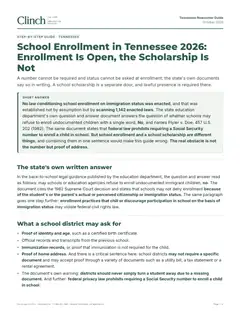
No law conditioning school enrollment on immigration status was enacted, and that was established not by assumption but by scanning 1,142 enacted laws. The state education department's own question and answer document answers the question of whether schools may refuse to enroll undocumented children with a single word, No, and names Plyler v. Doe, 457 U.S. 202 (1982). The same document states that federal law prohibits requiring a Social Security number to enroll a child in school. But school enrollment and a school scholarship are different things, and combining them in one sentence would make this page wrong.
Steps, documents and official links
The state's own written answer
In the back-to-school legal guidance published by the education department, the question and answer read as follows: may schools or education agencies refuse to enroll undocumented immigrant children, no. The document cites the 1982 Supreme Court decision and states that schools may not deny enrollment because of the student's or the parent's actual or perceived citizenship or immigration status. The same paragraph goes one step further: enrollment practices that chill or discourage participation in school on the basis of immigration status may violate federal civil rights law.
What a school district may ask for
The same document lists what a district may require:
- Proof of identity and age, such as a certified birth certificate.
- Official records and transcripts from the previous school.
- Immunization records, or proof that immunization is not required for the child.
- Proof of home address. And there is a critical sentence here: school districts may not require a specific document and may accept proof through a variety of documents such as a utility bill, a tax statement or a rental agreement.
The document's own warning: districts should never simply turn a student away due to a missing document. And further: federal privacy law prohibits requiring a Social Security number to enroll a child in school.
A second state document is even more explicit: a school cannot deny enrollment based on the inability to produce Social Security cards or numbers, health forms, birth certificates or other information; only immunization records may be required. That same text adds that if additional documentation is requested, the school must immediately state that no documentation will be used in relation to immigration status.
If there is no birth certificate, the school decides what will serve as proof of birth. Students in foster care and students experiencing homelessness are enrolled immediately, without waiting for documents.
Enrollment is open; the scholarship is not
This distinction is one of the most important sentences on this page. The state's education scholarship law provides that a student who cannot establish lawful presence will have the scholarship application denied, and it counts the scholarship as a public benefit. Being a public benefit means that the verification and reporting regime that took effect in 2026 attaches to the scholarship application.
Status is not asked and cannot be asked for enrollment; lawful presence is required for the scholarship application. Do not confuse the two, and if you are considering a scholarship application, talk to your attorney first. The scope of the regime is described in the benefits section.
What happened in the legislature
So that incomplete information does not frighten you, here is the sequence. In 2025 a bill appeared that would have given school authorities the power to refuse to enroll or charge tuition to a student without lawful presence, and it did not become law. In 2026 the bill returned with the refusal and tuition provisions removed, reshaped as a requirement to collect status data at enrollment, and that did not become law either. No such law in force was found, and the education department's written guidance from 2023 is still in place.
Districts differ; do not carry one to another
The state rule is one, but the document list differs in every district. Measured differences:
| District | Parent identification | Proof of address | Families staying with relatives |
|---|---|---|---|
| Nashville | Parent or guardian photo identification | Lease, mortgage statement, utility bill and similar | A separate enrollment center route for those with no proof in their own name |
| Hendersonville district | Driver license, state identification, passport or passport card | Two documents; cell phone bills, bank and credit card statements are not accepted | A notarized residency affidavit |
| Brentwood district | Driver license, passport or passport card | The householder's document plus two separate documents belonging to the parent | A notarized residency verification affidavit, on a separate nine-item checklist |
| Rockvale district | Custody documentation required | Two documents, and not from the same source; post office boxes are not accepted | No affidavit procedure was found on the page; ask the school |
| Memphis district | The district's own page could not be reached; research found no document list | ||
Four details concern you directly:
- A passport is accepted by name as photo identification in two districts. For a parent without a driver license, that is a real door.
- One district does not accept the hospital copy of a birth certificate given to the mother; a certified copy is required.
- One district counts a Tennessee driver license and a Tennessee vehicle registration as proof of address; completing your license and registration file early makes school enrollment easier too.
- The immunization certificate is required on the state's own form; shots given in another state or abroad must be transferred onto that form. One county health department will do that transfer and send the certificate to the parent by email.
Which school you belong to is not simple everywhere
In Nashville the merger means the entire county is a single school district; children living in the six separate municipalities inside the county attend the same district. Memphis is the opposite: alongside the county district there are six municipal school districts that began taking students in 2014. So which district a home with a Memphis mailing address falls into depends on the address. In the three smaller places no separate city school district was found; all three belong to their county district.
School zone lookup tools vary by district; one county district offers both a school zone map and a bus route lookup by address.
Language: Turkish is in none of them
| District | Languages actually translated |
|---|---|
| Nashville | Amharic, Arabic, Burmese, Kurdish, Nepali, Somali, Spanish, Swahili, Vietnamese |
| Rockvale district | Spanish and Arabic, plus an interpreter line reached by calling the language center |
| Hendersonville district | Only the Spanish version of one health form |
| Brentwood district | No translated language or interpreter service was found |
Turkish is on none of these lists. And a warning: the translate menu on district websites is machine translation, not material the agency prepared. Do not read it as a Turkish-language service. One district's family information center states that it can answer questions and connect you to an interpreter if needed; there is something to request, and that is the door.
Official sources
PDF: School Enrollment in Tennessee 2026: Enrollment Is Open, the Scholarship Is Not
14 · Health
How do I get health care without insurance?
Short answer
Start with the structural fact: this state did not expand Medicaid and the coverage gap is real. The program is categorical; an adult without children generally cannot qualify at any income, while marketplace subsidies begin at 100 percent of the federal poverty level. Second, from October 1, 2026 refugees and asylees are leaving the program; the agency director's own figure is roughly 8,500 people. Third, and in your favor: emergency medical care, immunization and treatment of communicable disease sit outside the verification regime, and for a pregnant woman the agency's sentence today still reads: If you are pregnant, no immigration documents are required.
Steps, documents and official links
Who falls into the coverage gap
The state program runs categorically: children, pregnant women, very low income parents and caretakers, older adults and people with disabilities are covered. An adult without children who works but earns below the federal poverty level enters neither the program nor the marketplace subsidy. Estimates circulate for how many people this is; we publish no figure because none could be verified from an official source, but the mechanism is certain.
One addition for 2026: the enhanced marketplace subsidies ended on January 1, 2026, and the threshold at which support cuts off entirely has returned.
The October 1, 2026 change and the state's own document
The federal agency's official letter to states states that from October 1, 2026 federal funding for full coverage is narrowed to a small group. The letter's own sentence says that asylees, refugees, parolees and victims of trafficking are outside those funded groups.
And here one thing differs from most comparable states: the state's own agency has published the reconciling document. A policy dated September 10, 2026 was added to the agency's policy manual, limiting eligibility to the narrow federally funded group.
But an older document still sits on the same server with no warning attached. A policy text dated 2014 still states that refugees and asylees qualify in the same manner as any other applicant. That document is not valid today and this page does not cite it. If you come across that text online, check its date.
Pregnant women and children: two different outcomes in one household
The federal option that removes the five-year waiting period for lawfully residing immigrant children and pregnant women was not taken in this state. But the state covers pregnant women through a different federal door: the unborn child category of the children's health program. The agency's own policy states explicitly that this category remains available to pregnant women in the group that is not federally funded. And the children's health program eligibility page still says today: if you are pregnant, no immigration documents are required.
On the child's side there is a condition: the child must be a citizen or a member of the federally funded group.
We write the plain consequence as it is: in the same household the mother may be covered while the child is not. That is not an error but two categories with two different rules. Plan your applications accordingly and file them separately.
One item to watch: early in 2026 it was reported that state officials were considering ending prenatal care for pregnant women without status. As of today the agency's page still states that no documents are required; check that page periodically.
Status and numbers in emergency care
There are two separate written bases and both favor you:
- The agency's own policy states that people in the group that is not federally funded, people who are lawfully present and undocumented people may be eligible for emergency medical services.
- The state's 2026 verification law refers to the federal list of items excluded from the definition of a public benefit. That list covers health care items and services necessary for the treatment of an emergency medical condition, short-term non-cash in-kind disaster relief, immunization and the testing and treatment of symptoms of communicable diseases, as well as programs such as soup kitchens, crisis counseling and short-term shelter that are not conditioned on income and are necessary for the protection of life or safety.
So the state's verification and reporting regime does not apply to emergency care, immunization and communicable disease treatment. Research also found no state provision requiring a number for emergency care.
What changed at local health departments
The law effective July 1, 2026 requires state agencies, local governmental entities and local health departments to verify that applicants eighteen or older for a public benefit are citizens or lawfully present. The same law also requires people who are not lawfully present and who receive assistance to be reported, with all identifying information, to the state's centralized immigration enforcement division, and provides a criminal penalty for an official who knowingly fails to report. The only exemption goes to the children's services department. The attorney general may withhold state funds, including shared taxes, from a local government that does not comply.
Two details in your favor: a document presented is treated as presumptive evidence of eligibility until final verification arrives, and the agency may not delay a benefit solely because verification is pending. Second, for local entities the obligation begins not on July 1, 2026 but at the first reprinting of the relevant forms after that date.
There is a court order, but it is narrow and temporary
The state program that provides comprehensive medical care to children with disabilities from birth to age twenty-one runs through all ninety-five local health departments, which means it binds all five cities at once. On June 1, 2026 the health department sent letters to parents and providers stating that if the program continued paying, information would be shared with the safety department.
Then the court stepped in. We give the caption: Snader v. Tennessee Dept. of Health, No. 26-0825-I, Davidson County Chancery Court Part I, before Chancellor Patricia Head Moskal. The temporary restraining order is dated June 24, 2026 and the agreed temporary injunction July 14, 2026. The order stops the health department from reporting identifying information about patients receiving services through that program to the immigration enforcement division and requires certain steps regarding those enrolled as of June 1, 2026.
Now the limits: the order covers only that program, not the whole statute. It is temporary and there is no trial date. That is why this page does not say stopped: the accurate sentence is temporarily halted, with no decision on the merits.
Rides to medical appointments
For people enrolled in the state health program, rides to appointments are arranged not through municipal transit but through the health plan's transportation broker; each plan has its own number, and there is a separate relay line for people with hearing difficulties. So you request that service from your plan, not from the bus agency.
Turkish: found at no state agency
Research found no material published in Turkish by state agencies. The concrete document measured is this: the health program's own multilingual language assistance notice contains fifteen languages and Turkish is not among them. The notice's English text, however, places no limit on language: if you speak a language other than English, it says free interpretation and translation services are available and can be requested by phone.
And a warning: the translate menu on state websites is machine translation, not the agency's own Turkish text. This page does not present it as Turkish-language material. The accurate sentence is: no published Turkish material was found, but free interpretation is a right to be requested and the door is the agency's own line.
Official sources
- State health program: eligibility and applications
- Children’s health program eligibility page (document rule for pregnant women)
- Federal agency letter to states: the October 1, 2026 change
- State health department: children with disabilities program and the court order notice
- Language assistance notice (fifteen languages; Turkish is not listed)
- Federal health insurance marketplace
15 · Clinics
Care without insurance: sliding fee clinics
Short answer
First let us close the thing people misunderstand: a sliding fee clinic is never free. Federally funded health centers reduce the charge according to household income and household size; you still pay, the amount simply drops. Being uninsured and your immigration status are not grounds for refusal, but the fee does not fall to zero. And this is the item on which the five cities diverge most sharply: what produces the divergence is not income but distance.
Steps, documents and official links
Measured on October 12, 2026
The federal health center database was queried separately for each of the five cities. No addresses are published here; only presence, counts and the number of operating organizations.
| City | 5 miles | 10 miles | 25 miles |
|---|---|---|---|
| Nashville | 12 sites | 14 sites, 3 organizations | 31 sites |
| Memphis | 8 sites | 21 sites, 5 organizations | 28 sites |
| Brentwood | 1 site | 18 sites, 4 organizations | 31 sites |
| Hendersonville | 0 sites | 2 sites, 1 organization | 22 sites |
| Rockvale | 0 sites | 0 sites | 29 sites |
Three things the table says
- There is no site within ten miles of Rockvale. Five separate organizations appear within twenty-five miles, but that means a car is required. And transit there runs on demand with at least a day's notice, so reaching a doctor the same day is not possible through that system. Read the transit section together with this one.
- There is no site within five miles of Hendersonville; the two sites within ten miles are not even in its own county.
- Of the twenty-one sites within ten miles of Memphis, five are in a neighboring state. The twenty-five mile circle reaches yet another neighboring state. So for a Memphis reader the nearest sliding fee clinic may be in another state, which is a separate matter for insurance, referrals and state programs; before you go, ask whether that clinic accepts the programs in your state.
And the item that disproves an expectation: Brentwood, the wealthy suburb, sees eighteen sites within ten miles and has a federally funded center inside its own county. So the assumption that a wealthy suburb has no clinics was not confirmed; the real gap is in the rural place.
How a sliding fee works
- The fee is set on a schedule based on household income and household size. Income documentation is requested; pay stubs, a tax return or a letter from an employer may be accepted.
- Being uninsured and your immigration status are not grounds for refusal of service. But research found no sentence in the centers' published texts that expressly addresses immigration status; in other words we cannot pass along a reassurance sentence on that point.
- There is usually a minimum charge. Before your appointment, call and ask for the income schedule and the lowest payment amount.
- Dental and vision services are not offered everywhere; which services are provided varies by organization.
Where to find them
We publish no addresses on this page. The federal agency's own search tool shows the nearest centers for your address and its data is kept current. When you search, note the name of the organization, call, and ask two things: are you accepting new patients and which documents do you need for your sliding fee schedule.
And a naming trap: not every organization with clinic or health center in its name is a federally funded center, and it is not obliged to apply a sliding fee schedule. Rely on results from the federal agency's own search tool.
16 · Marriage
How do I get a marriage license, and what if I have no number?
Short answer
This state does issue a marriage license and the county clerk issues it. The most important detail: the license may be obtained from any county in the state; there is no residency requirement and no requirement to use the county where the ceremony will take place. The guidance found in many popular guides saying it must come from your county of residence is wrong. The license is valid for thirty days. And for an applicant without a number the agency has a written answer: the form asks for the number, but an applicant who was never issued one is not required to provide it.
Steps, documents and official links
You choose the county, and that converts into money
The counties' technical assistance service writes that the license may be issued by the county clerk in any county in Tennessee, without regard to the residence of the parties or the county where the ceremony is to be performed. Part of the fee is set by the county legislative body, which is why it varies by county.
| County | Fee | Payment note |
|---|---|---|
| Rutherford County | 107.50 dollars | The course certificate must be notarized |
| Williamson County | 100.00 dollars | Cash only |
| Davidson County | 99.50 dollars | No checks accepted; a small surcharge applies on cards |
| Shelby County | 97.50 dollars | |
| Sumner County | Research found no verified figure |
So the same document costs more than ten dollars more in one county than another inside one state, and the choice is yours. The fee is made up of state privilege taxes, the county's optional tax, the clerk's issuance fee and a separate state fee.
A sixty-dollar discount, and a contradiction to publish
The way to cut 60 dollars from the fee is to complete a four-hour premarital preparation course and present a certificate of completion filled out by the instructor and obtained within one year before the application. The instructor may be a psychologist, a clinical social worker, a licensed marriage and family therapist, a clinical pastoral therapist, a professional counselor, a psychological examiner, an official representative of a religious institution, or another instructor approved by the county's judicial district.
For the second route two official sources conflict and we publish the conflict. The revenue department's page says the discount also applies to out-of-state residents and sets no county limitation. The counties' technical assistance service says that waiver applies only in counties containing a municipality of a certain tourist-resort character and that today this covers a single county. None of the five cities is in that county. We take no side; if you live out of state the difference is 60 dollars and you need to ask the clerk.
If you have no number
This is one of the clearest written answers for readers in this state. The statute asks for a Social Security number on the application form. But the state's published legal guidance, relying on an attorney general opinion, states: the statute does not require that an applicant have a Social Security number, so applicants who have not been issued one are not required to provide one in order to obtain a marriage license.
In practice: the field is left blank and no alternative number is requested. An older and narrower opinion required an applicant without a number to state the reason on the form; that practice may persist with some clerks. So go knowing the written rule and cite the state's own guidance if you are told otherwise at the counter. An older civil rights organization report said nearly every clerk was requiring the number; the gap between the rule and the counter has come up repeatedly in this series.
Waiting period: another contradiction
State sources contain no waiting period item; the text listing the conditions for issuing a license mentions none, and some county clerks state that there is no waiting period. But a marriage license document published by one county states a three-day waiting period, and the file information shows it was prepared in 2010; the same county's current clerk page says nothing about a waiting period. We publish the contradiction and take no side: if you will marry in that county, ask the clerk.
The validity period is clear: thirty days. Figures of sixty and ninety days circulating on third-party sites conflict with the state source and were not used on this page.
Who may perform the ceremony
The statutory list is broad. In part: regular ministers of any faith over eighteen who have the care of souls; county legislative body members and former members; county mayors and executives; state and federal judges and municipal court judges, current and former; the governor; every county's county clerk; mayors and city council members; law enforcement chaplains; notaries public; district attorneys general.
- Elected officials may solemnize in any county in the state.
- The county clerk is not required to, and may not, police the qualifications of the person solemnizing.
- No formula is required for the ceremony; it is enough that the parties declare, in the presence of the officiant, that they accept each other in marriage. The parties must be present in person and together; a ceremony by telephone is not accepted. The only exception allowing video conference is for armed forces members on certain deployments abroad.
- Research found no witness requirement. We do not say there is none; the county clerk's own form may ask for something different, so ask before you go.
What to bring
- Photo identification and a birth certificate if you have one; county clerks publish their own lists and the lists are not identical.
- Watch the payment method: one county takes cash only, another does not take checks. Call before you go.
- If you will use the course discount, bring the certificate with you; one county requires it to be notarized.
- If an earlier marriage has ended, related documents may be requested.
Getting a copy of the marriage certificate later
There is one detail about copies of the marriage certificate that will save you a wasted trip: birth and death certificates can be obtained from any county health department in the state, but no such sentence exists for marriage and divorce certificates. The detail is in the birth certificate section. If you will use the document in Türkiye, plan the apostille step as well.
17 · Vital records
How do I obtain a birth certificate and other vital records?
Short answer
Thanks to an electronic issuance system, birth and death certificates can be obtained from any of the ninety-five county health departments; the agency's own sentence says you no longer have to travel to the county where the event occurred. But that sentence does not cover marriage and divorce certificates; for those there is the central office or the mail. On identification there is good news: a current passport is sufficient on its own, and the list does not say a U.S. passport. And there is an exit door: if the application is notarized, no identification documents are required at all.
Steps, documents and official links
Which document comes from where
| Record | Where |
|---|---|
| Birth | Any of the ninety-five county health departments, the central office, or by mail |
| Death | The same |
| Marriage | Central office or mail; there is no statement that county health departments issue them |
| Divorce | The same |
That distinction is one of the practical traps on this page. For a birth certificate you can go to the nearest county health department; do not assume the same for a marriage certificate.
The central office is in Nashville, open weekdays from eight in the morning until four in the afternoon, and no appointment is needed. Births more than a hundred years old are referred to the state archives. The agency does not take online orders directly; there is a single authorized vendor and it charges an additional fee.
The identification list: a passport is enough on its own
Any one of the following is sufficient alone:
- A valid driver license, provided the issue and expiration dates are visible.
- A current passport. The list reads Current passport; it does not say U.S. passport, and there is no record excluding a foreign passport.
- A military identification card.
- An alien, temporary or permanent resident card.
- An employment authorization card.
- A certificate of naturalization, a certificate of citizenship or a citizen identification card.
Items counted in pairs include: a current pay stub, a vehicle registration bearing the name and address, a voter registration card, a military discharge document, a bill or bank statement bearing the name and address, a health insurance card, a medical record, the application page of an insurance policy, a signed Social Security card, and a police report for people whose identification was stolen.
Read three things in particular:
- A passport is a primary document. Whatever your status, if you hold a valid foreign passport you can complete the transaction with one document. The list also counts a resident card and an employment authorization card as sufficient alone.
- A Social Security card is not sufficient alone; it counts only if it is signed and only together with a second document.
- Expired documents: the list asks for current documents and requires the expiration date to be visible on a license. Research found no statement that an expired document is accepted or that any number of days of tolerance is allowed. We do not say there is none; we say it has not been stated.
A notarized application removes the identification requirement
The agency's own exception reads: if the application is signed and notarized, no additional identification documents are required. That is one of the most practical exits on this page for a reader with limited documents. Consider having the application notarized and mailing it in.
Who may obtain a copy: birth and marriage follow the same list
The entitled persons are the same for both records: the person, mother, father, son, daughter, husband and wife. Guardians, legal representatives and attorneys may obtain them by presenting documentation.
This differs from some states, so do not confuse them: in one state a birth certificate is restricted while a marriage certificate is open to anyone; here both are subject to the same restricted list. A marriage certificate is not a freely issued record.
There is a special rule for birth certificates: a father not listed on the child's certificate is not entitled to it.
If you are not an entitled person: an authorization to release from an entitled person is required, and identification is requested from both the entitled person and the person collecting the document. If the authorization is notarized, only the collecting person's identification is needed.
What we do not write
Document fees and processing times could not be verified in this research, so we give no amounts or day counts. Confirm how long mail and in-person requests take from the agency's own help center.
If you will use the documents in Türkiye
If you will use these documents in Türkiye, an apostille is a separate step at a separate office. One useful detail: the certified copy in your hand does not have to be reissued for apostille purposes; an existing certified copy can be sent directly. The detail and the fee are in the apostille section.
Official sources
- Vital records help center: how to apply and frequently asked questions
- Identification requirements and the notarized application exception
- Entitlement rules: who may obtain birth and marriage certificates
- Birth and death certificates from any county health department
- Adding an apostille to a certificate (an existing certified copy may be sent)
- Directory of local health departments
18 · Social Security
How do you get a Social Security Number (SSN) in Tennessee?
Short answer
An SSN is issued only to people with work authorization or a legally required reason for one, and the agency that issues it is federal: the Social Security Administration. If you arrived on an immigrant visa and requested the number on your visa application, the card arrives by mail. People who adjust status inside the United States and check the number box on a work permit application also receive the card automatically. Otherwise you start the application online and go to an office by appointment. There is no fee. Two things about Tennessee up front: the state has no office that issues an SSN or any number that substitutes for one, and this page publishes no street address for any Social Security Administration office. If you hold an appointment notice, the address on that notice governs. On the other hand there is something concrete here that helps: for a person who has never been issued a number, the driver license process has a written path.
Steps, documents and official links
- What to bring: your current immigration document (green card, I-94 or work permit card) and a valid passport, plus a birth certificate if you have one. Photocopies and notarized copies are not accepted.
- F-1 and J-1: an SSN becomes available only once a work right exists. It is not issued merely for school enrollment.
- Which office covers you: enter your ZIP code in the agency's own office locator. One Tennessee detail matters here: the state is not in a single time zone. The five places in this guide are on Central time, but the eastern part of the state is not; we wrote the detail in the time difference section. Say which zone you are in when you confirm an appointment time.
- General line: 1-800-772-1213. A replacement card is free and in most cases can be started online.
- If your surname changed after marriage: update your record at an office, free of charge. In this state the marriage license comes from the county clerk, and the document you will use for the name change is the certified marriage certificate from that record; details in the marriage section. Do not postpone this step; the reason is in the work authorization verification part below.
A map of the doors for someone without a number
In this state the answer changes from counter to counter. We write separately what was verified and what was not.
| Door | Is a number required | Basis |
|---|---|---|
| Driver license and state ID | There is a written path | On a non-star document the number can be stated verbally and verified electronically with the Social Security Administration; a star-marked document requires a certified document showing the full number. For a person who has never been issued a number there is a separate written path: a sworn affidavit signed before an examiner or a notary. Details in the driver license section |
| Marriage license | The field exists, but is left blank | A published opinion of the state attorney general says that although the form asks for a number, applicants who have never been issued one are not required to supply one. No substitute document is requested either; details in the marriage section |
| Birth, death and marriage certificates | Secondary on the ID list | The ID list treats a current passport as sufficient on its own and does not say U.S. passport; a foreign identity or residence card and a work permit card are also accepted on their own. By contrast a Social Security card counts only as a secondary document and only if it is signed. Details in the vital records section |
| School enrollment | No | In the school district enrollment document lists read this round, a Social Security number never appears, and neither do citizenship or immigration status. Details in the school enrollment section |
| Library card | Not in the published requirements | The card requirements of the two large systems read this round do not mention a number; what they ask for is photo ID and proof of address. This is an absence, not a stated exemption; details in the library card section |
| Power, gas and water accounts | It depends on the city | In the large city in the west of the state the utility's published ID list names a passport, a residence card, a government issued visa, an ITIN and a consular identification card; the Social Security card is only one option among them. In the capital the provider does not publish a list of accepted documents. Details in the utilities section |
| State income tax return | The question does not arise | This state does not tax wage income, so no state return arises for an employee. Details in the tax section below |
| Public benefit application | Yes, and there is a new law | A law that took effect in 2026 requires state agencies and also local governments and local health departments to verify an applicant's lawful presence. Among the things an agency may use to verify are a Tennessee driver license or state photo ID, or a number the agency can verify with the Social Security Administration. Do not evaluate this row without reading the whole public benefits section |
| Property tax relief program | Not mentioned in the brochure | The full text of the state's 2026 brochure does not mention a number or a citizenship requirement. But a brochure is a summary document; the county's own application form may ask for ID and the verification regime above may reach that form. Details in the property tax section |
| Forming a company | Could not be verified | No statement in either direction was found on the state filing office's formation pages; we wrote this separately in the starting a business section below |
The most valuable row in this table is the driver license, and here is why: in several states in this series no published path at all could be found for a person without a number. In Tennessee the path is written down and it has a name: if a number has never been issued, the applicant signs a sworn affidavit. But do not read that as an exemption. The same agency's document regime tightened in 2026: a person whose presence is authorized by a federal agency for a defined period receives a temporary card that is distinguishable on its face, and the card type can change at renewal. Do not go to the counter without reading both together; the driver license section is the most important thing to read before this one.
And on the question of where your information goes, this state has no gap, it has three provisions pointing the other way. In some states in this series the agency's own publication contained a clear protective sentence meaning this information will not be used to determine status. In Tennessee the research found no such sentence. What it found points the other way: the law that created the state immigration enforcement division says the records the division gathers may be kept confidential, and another law that took effect in 2026 requires state agencies to close immigration enforcement information to public inspection. So the flow of information is closed on the agency side, not the reader's. We wrote the detail in the state law section, and we wrote it there as a reason to see a lawyer, not as a procedural tip.
ITIN: for taxes, not for identification
A person who cannot get an SSN but must file a federal return uses an ITIN. The application is made on Form W-7, attached to a federal return unless an exception applies. In the agency's own words an ITIN does not provide or change immigration status and does not authorize work in the United States; it is not an identity document either.
- Three ways to have documents verified: mailing them with your passport to the address the agency specifies, going to a certifying acceptance agent, or going by appointment to a tax agency office that performs ITIN document review. The last two mean you do not put your passport in the mail.
- Which offices in Tennessee perform that review could not be verified this round, and this page publishes no federal tax office address. Confirm the office and the appointment through the federal tax agency's own office locator; the appointment line is 844-545-5640.
- We do not list the supporting documents, because we did not read the separate page the agency keeps for that list. Get the list from the agency's own page before you apply.
- In this state an ITIN works at one written door: the municipal utility of the large city in the west names an ITIN explicitly among the identity documents it accepts when opening an account. That is one of the few examples in this series of an ITIN being accepted in writing at a service counter; details in the utilities section.
19 · Tax and working
What comes out of your pay in Tennessee, and what do you need before starting work?
Short answer
This state does not tax wage income. The state's only personal income tax applied to interest and dividends, and it was fully repealed as of January 1, 2021. Even so, this page never says there is no tax here, because the burden moves: the rate you pay at the register is high, and the rate you pay at the grocery store differs from place to place within the same state. On the employment side there are two features specific to Tennessee and we wrote both below: private sector work authorization verification has an employee count threshold, while public employers have had no threshold since July 1, 2026. And inside the statute there is a defense that works against the reader; that is the most important line in this section.
Steps, documents and official links
No state income tax on wages, but other items take its place
- Wage and salary income is not subject to state income tax. The state's interest and dividend tax was phased down and fully repealed as of January 1, 2021; the revenue department's own guidance says so. So no annual state return arises for an employee.
- A local wage tax was searched for and not found. In some states in this series cities withheld an occupational fee directly from pay. For the cities and counties of the five places in this guide, the research found no such item. We do not write that none exists: not every city ordinance was read. The right step is to ask your employer whether there is a local deduction on the payroll.
- But there is a state level privilege tax and it hits five professions. According to the revenue department's own page it is 400 dollars a year, due each year on June 1, and only five professions pay it: attorney, securities agent, broker-dealer, investment adviser and lobbyist. If you are registered in more than one, you pay once a year. Physicians, engineers and accountants are not on that list. A person practicing law in Tennessee pays this regardless of income.
- The federal side does not change: federal income tax and Social Security and Medicare withholding apply here too, independent of the state.
Sales tax: the rate is high, and the five places split on groceries
According to the revenue department's own pages the state share is 7 percent on general goods and 4 percent on food and food ingredients. A local share sits on top; the local share is capped at 2.75 percent and must be a multiple of a quarter point. The rates below were read on October 12, 2026 from the department's own machine readable rate file and its own notice.
| Place | General goods | Food |
|---|---|---|
| Nashville-Davidson | 9.75 percent | 5.75 percent, from November 1, 2026 |
| Hendersonville | 9.75 percent | 6.25 percent |
| Brentwood | 9.75 percent | 6.75 percent |
| Rockvale | 9.75 percent | 6.75 percent |
| Memphis (inside the city limits) | 9.75 percent | 6.75 percent |
| Unincorporated Shelby County | 9.25 percent | 6.25 percent |
- The line to read is food, not general. All five places have the same general rate. The difference is only at the grocery store, and it reaches a full point. For a large household with high monthly grocery spending that is a real item to weigh when choosing an address.
- One place went the other way on food and we do not write why. Hendersonville raised its local rate in 2024 but brought the food rate back down effective February 1, 2025. It is one of only a few jurisdictions among the hundreds of city rows in force whose general rate differs from its food rate. We publish the rate; the research could not find the mechanism that makes it possible, and neither do we.
- In Nashville the date matters. The revenue department's September 2026 notice says the local rate on food and food ingredients in Davidson County is reduced effective November 1, 2026, and that the reduction applies in all cities inside the county. All other goods and services stay at the earlier local rate.
- What does not count as a food ingredient: per that same notice, alcoholic beverages, tobacco, candy, dietary supplements and prepared food do not get the reduced rate. So the prepared meal in your cart is taxed differently from the rice next to it.
- On a single expensive item the tax is not a flat rate. Under the department's own rule, the local share applies only to the first 1,600 dollars of the sales price of a single article; a special state rate applies to the slice between 1,600 and 3,200 dollars, and anything above 3,200 dollars is not subject to that tax. When you buy a car, furniture or an appliance the number on the receipt may not be what you expected.
And we print a conflict without taking a side. The revenue department's local rate map page says the transit surcharge in Davidson County also raised the food rate to 2.75 percent. The same department's official September 2026 notice calls the general local rate 2.25 percent, computes food as the state share plus the reduced local rate, and never mentions the surcharge. Two official texts do not line up on the same question. The practical result for you: the food rate on your receipt may come out between 5.75 and 6.25 percent. Check which one was applied on your own receipt.
Property tax is not this section's subject but it lands in the same budget. In this state property tax is entirely local and the rates of the five places differ sharply; we wrote the residential assessment ratio and the full rate table in the property tax section. On the vehicle side counties levy their own wheel tax and registration is not renewed until it is paid; we covered that in the vehicle registration section.
Work authorization verification: there is a threshold, and one provision works against the reader
We write this part carefully, because it is both the most misunderstood item and the one that most clearly calls for legal advice. This is not an information section, it is a call to speak with a lawyer.
| Employer type | Rule |
|---|---|
| Private sector | Employers with 35 or more full-time equivalent employees under the same employer tax number must use the federal verification system as of January 1, 2023. The agency's own sentence says this applies to employees working outside the state as well |
| Private employers under 35 | Optional: either use the system, or take and keep copies of the identity and work authorization documents the statute lists. Being under the threshold does not mean no documents are requested |
| Public employers | Mandatory with no threshold since July 1, 2026. The statutory definition covers the state and every political subdivision: counties, municipalities, consolidated governments, boards, public universities and school districts. No hire may be made without pre-employment verification |
| A local government that does not comply | The attorney general investigates; if a violation is found, all money the state sends that local government, including shared taxes, can be withheld |
- This threshold is not a first in the series, but its direction matters: in the state covered in the previous round there was no threshold at all and the rule covered every employer. Here the private sector has a threshold. But there is none on the public side, so the verification step is certain for city, county, school district and public university jobs.
- The employer does not make the decision. Complaints are reviewed by the state labor department, and the agency's own page says that any lawful resident of Tennessee may file one. So an employer who tells you the system says so is relaying a result, not making a determination.
- And here is the hardest line in this section: the statute expressly says an employer is not in violation if the employer acts on a false result generated by the system. That means the cost of the system's error falls on the employee, not the employer. For a reader from Türkiye the concrete risks are these: a difference in name order between a passport or green card and the Social Security record (a middle name, a patronymic, transliteration of Turkish letters), a surname change after marriage that was never reported to the agency, and a day and month swapped in a date of birth. Fix these before a job offer, not after.
- There is no termination immunity here, there is the opposite. In some states in this series the statute gave an employer immunity for firing an employee in order to comply. In Tennessee the research found no such immunity. What it found points the other way: if an employer receives a final nonconfirmation for an employee and does not terminate that employee, the department may weigh that fact against the employer in a determination. The statute pushes employers toward termination.
- Two protective provisions sit in the same statute: a person who alleges a violation of this part is covered by the state's anti-retaliation protections, and the statute says it is applied without regard to race, color or national origin. If you were terminated and the reason you were given is a document mismatch, talk to a lawyer before accepting that reason.
- The document list contains two traps, both from the agency's own page: a Social Security card and an I-9 form are not among the documents the state statute accepts. And a driver license from another state is accepted only if that state's issuance requirements are at least as strict as Tennessee's; the department publishes the list of those states on its own page. A REAL ID marked document is accepted from every state.
- Coverage is not limited to employees. The statute also reaches people who are not directly employed but are paid directly by the employer for their labor or services, and documents are requested and kept for them too. If you invoice as a freelancer, read this line.
- Enforcement is real and public. The state publishes its final orders on this subject by employer name, monthly, with the worksite, city, violation and penalty. Whether an employer follows this rule is visible in a public record.
- We do not write the federal procedure on this page. How many days you have when a tentative nonconfirmation notice arrives, which form is filed and in what order are on the federal agency's own page; we publish no deadline and no number of days. Read the current procedure on the federal system's own site. And remember this: the federal verification system does not replace the I-9 form, and the statute says so explicitly.
Official sources
- Tennessee Department of Revenue: sales tax rates
- Tennessee Department of Revenue: local sales tax
- Tennessee Department of Revenue: professional privilege tax
- Revenue department notice on the food rate (PDF)
- Tennessee Department of Labor and Workforce Development: employment verification
- E-Verify: the federal system
20 · Starting a business
How do you form a company (LLC) in Tennessee, and what should you watch for?
Short answer
Formation is filed with the business services division of the Tennessee Secretary of State, whose office is in Nashville. We do not publish the filing fees on this page, because the office's fee page was not read this round and this series does not publish a number it has not read. What we could measure are three things that matter more than the fee: there is no state tax on wages here but there is a separate tax on businesses; a large number of professional licenses have been tied to a lawful presence requirement since 2026; and the work authorization verification duty arises with your first employee.
Steps, documents and official links
The state filing: sequence and office
- The entity is formed at the state level. The office is the business services division of the Tennessee Secretary of State, in Nashville, at 312 Rosa L. Parks Avenue. The same office runs the authentication process described in the apostille section; you send two kinds of work to the same office but not in the same file.
- We do not write the fees. The formation fee, the registration fee for a company formed in another state and the annual report fee were not read this round. Get the amounts from the office's own page and add them to your budget.
- We do not state the registered agent, name availability or annual report requirements in firm terms, because they could not be confirmed from the office's own text this round. Ask before you open the formation form, and ask for the answer in writing.
- No official answer was found on whether a number is required to form an LLC. That is exactly the question this page's reader has, and we are not filling it with a guess. Ask the business services division.
The tax that hits the business here is not the one that hits the employee
- No wage income tax, but there is a business tax. State law provides for a business tax levied on the privilege of engaging in a vocation, occupation or business, and cities may levy it at the rate and in the manner the statute allows. It is a gross receipts tax, calculated on turnover rather than profit. It is not a deduction for a salaried employee; it is an item a first-year founder does not expect.
- We do not write the rates or the filing calendar, because they were not measured this round. Ask an accountant at the formation stage which class your activity falls into and whether your city levies this tax.
- Five professions also pay a state privilege tax: 400 dollars a year, each June 1. Attorney, securities agent, broker-dealer, investment adviser and lobbyist. Details in the tax section.
- If you will collect sales tax, remember that the rate depends on the address and works differently for food; the table is in the tax section.
Professional licensing: a new requirement arrived in 2026
This item touches the reader starting a business directly and is easy to miss. The General Assembly passed a law in 2026 requiring that, for a long list of professional licenses, certificates, permits and authorizations, the applicant be a United States citizen or a qualified alien within the meaning of federal law. The law took effect on the day it became law and applies to applications and renewals filed after that date.
- This is not a new direction, it is an existing one hardening. A 2022 law had already moved professional and commercial licenses outside the state's definition of a public benefit and attached a separate requirement to them: citizenship, or work authorization confirmed through the federal verification system. The 2026 law widens that chain.
- The practical result: if you will work in a licensed occupation or open a licensed business, the license application is a status door. We do not list which professions are covered, because the list is long and was not measured item by item this round.
- The right step: talk to an immigration attorney before you file a license application, and ask the licensing board in writing which document is required. This page does not tell you which form to fill in; it tells you that this door is a legal door.
The duty that arises with your first employee
- In the private sector the threshold is 35 full-time equivalent employees. Below it the employer is in an optional regime: either use the federal verification system, or take and keep copies of the documents the statute lists. So even a one-person business is not exempt from requesting and keeping documents.
- The threshold is computed across the same employer tax number, not per location. A business with two branches may wrongly believe it is under the threshold.
- People you do not directly employ are covered too: documents are requested and kept for people you pay directly for their labor or services.
- If you will bid for public work the regime is stricter: public employers have been in a no-threshold mandatory regime since July 1, 2026, and a local government that fails to comply can have its state money withheld. The three sentences that matter to the worker and the two traps in the document list are in the tax and working section; that is what to read at the formation stage.
If you will run a charity: a liability provision arrived in 2025
This item concerns a charitable organization rather than a business, and we write it here because forming associations and foundations is common in Turkish communities. The General Assembly passed a law in 2025 providing that a charitable organization that provides housing to a person it knows is not lawfully present in the United States may be held liable for harm arising from a crime that person commits while receiving the service.
- Liability is not automatic and the text sets its own threshold: the organization's conduct in providing the housing must amount to negligence, gross negligence or intentional and reckless conduct. The provision targets a conduct threshold, not the act of providing a service.
- And what is excluded is written explicitly: the statute's housing definition covers long-term shelter and help obtaining or signing a lease; temporary overnight shelter of the kind a homeless shelter provides is outside its scope. Do not skip that distinction; one night of shelter is not the subject of this provision.
- This is not an item meant to frighten the reader, it is an item for a board member. If you sit on the board of an association or foundation that provides housing assistance, show this provision to a lawyer. The provision was not written for an individual tenant or landlord; the rules on that side are in the renting section.
21 · Public benefits
Does receiving public benefits in Tennessee affect a green card application?
Short answer
It can, and in this state the question has a second layer. On the federal side the public charge rule that took effect on September 18, 2026 rescinded the 2022 regulations and gave the officer broader discretion to weigh all relevant facts; the assessment did not narrow, it widened. On the state side a law that took effect on July 1, 2026 is the heaviest item of this round: it requires state agencies and also local governments and local health departments to verify the lawful presence of applicants aged 18 and over, and to report a person who is not verified to the state's centralized immigration enforcement division. The statute also provides a penalty for an official who fails to report. But the same law has an exemption list that works in the reader's favor, and we set it out in full below. This is not a section that makes a decision for you; talk to your lawyer before applying for any benefit.
Steps, documents and official links
What changed in the public charge rule
- Date and scope: the rule was published on July 20, 2026 and took effect on September 18, 2026. By its own terms it applies to admission applications filed on or after that date and to adjustment applications postmarked or filed electronically on or after that date. You can read the text in the Federal Register record.
- It is not retroactive: the rule's own sentence says that means-tested public benefits received before September 18, 2026 are evaluated under the 2022 rule.
- Direction: the rule does not list which benefits count; it removes the old list and returns to a totality of the circumstances assessment. That is why no clean list of counted benefits can be published on this page. We explained the detail in our public charge article.
- Statutory exemptions remain: refugees and asylees adjusting status, the special immigrant juvenile category, people applying for or re-registering for temporary protected status, and the special statutes covering Cuban and Haitian nationals.
The state side: on July 1, 2026 verification reached local governments
The full text of this law was read first-hand this round. What follows are the statute's own provisions.
| Provision | What it does |
|---|---|
| Verification | Unless federal law prohibits it, every state agency, every local governmental entity and every local health department must verify that each applicant aged 18 or older who requests a federal, state or local public benefit from it is a United States citizen or is lawfully present under federal immigration law |
| Attestation | Agencies place on all forms and automated telephone systems a written or spoken statement in which the applicant declares, under penalty of perjury, that they are a citizen or a lawfully present alien |
| Document retention | The agency must retain a copy of every document submitted for verification, in line with its own retention rules |
| Pending verification | The provision in the reader's favor: a submitted document counts as proof of eligibility until final verification arrives, and the agency may not delay distribution of any benefit solely because verification is pending |
| If final verification is negative | The agency must terminate the recurring benefit and begin the action the statute provides for |
| Reporting | Every state agency, local governmental entity and local health department must report people who receive a benefit from it and are not lawfully present, along with all of their identifying information, to the centralized immigration enforcement division within the state safety department. Cases where a federal nutrition regulation already creates a reporting duty are excepted |
| Penalty for an official | An employee or official who knowingly fails to report a person they know is not lawfully present commits a misdemeanor offense under the statute |
| Sanction on a local government | The attorney general may investigate a local governmental entity or local health department alleged not to comply, and on finding a violation may cause all money the state sends that entity, including shared taxes, to be withheld |
| The only institutional exemption | The state's department of children's services is not required to furnish information that would directly or indirectly identify a child or family receiving its services |
The part in the reader's favor: the statute's own exemption list
The law defines what falls outside public benefit by reference to federal law. The scope of that reference is as follows:
| Service outside the verification regime |
|---|
| Medical assistance necessary to treat an emergency medical condition (other than items related to organ transplant) |
| Immunizations, and testing and treatment of symptoms of communicable diseases |
| Short-term, non-cash, in-kind emergency disaster relief |
| Programs such as soup kitchens, crisis counseling and intervention, and short-term shelter, that deliver in-kind services at the community level, are not conditioned on the person's income or resources, and are necessary for the protection of life or safety |
- This has a concrete counterpart here and we write it: one county in this state publishes its public tornado shelters with addresses and rules. Short-term shelter is on the statute's exemption list, so entering such a shelter falls, by the letter of the law, outside this verification regime. We are not writing that you will certainly not be asked; we are writing that it falls outside the statute's definition. We covered shelters and the severe weather regime in the severe weather section.
- The list says verification is not required; it does not say free, and it does not say everyone qualifies. Each program's own eligibility rules still apply. Do not confuse this with the sliding-fee clinics section: there the message runs the other way and none of those centers is free.
- Emergency medical care being on the exemption list matters especially here, because Medicaid was not expanded in this state and the coverage gap is real; details in the health section.
The effective date is not flat, and that changes the form you see
The statute's transition provision contains a fine point that, if skipped, makes the page wrong. For local governmental entities the duty does not begin everywhere at once on July 1, 2026: it begins when that entity first reprints the relevant forms after that date, or first updates its electronic or automated telephone systems.
- What this means for you in one sentence: in the same city one service's form may carry the attestation while another's does not yet, and a clause that is not on a form today may be there tomorrow. The absence of an attestation on a form you see is not an exemption, it is a schedule.
- This was measured this round and the honest result is: as of October 12, 2026 the attestation clause was not visibly found on the service pages of the five places. There are two possible explanations: those services may not fall within the statute's definition of a public benefit, or those forms may not yet have been reprinted. We could not measure which is true and we do not pick one.
- Consolidation is not an exemption. In defining a local governmental entity the statute names a county, including a county with a metropolitan or charter form of government, as well as an incorporated city or town. So a city that has merged with its county is still inside the definition. A reader living in an unincorporated place meets this regime through the county; we wrote the structures in the local government section.
There is a court order, but it is narrow, temporary and not on the merits
This is the part of the section most open to being misread, so we write the three layers together.
- Case citation: Snader v. Tennessee Dept. of Health, No. 26-0825-I, Davidson County Chancery Court, Chancellor Patricia Head Moskal. Temporary restraining order June 24, 2026, agreed temporary injunction July 14, 2026.
- The scope is narrow: the order enjoins the health department from reporting the identifying information of patients receiving care from one children's health program only, and halts disenrollment from that program on lawful presence grounds. The provision as a whole is not enjoined. For all other state agencies, all local governments and all local health departments the verification and reporting regime is operating.
- It is temporary and the merits were not reached. The order says by its own terms until further orders of the court, and there is no hearing date on the merits. The case, including discovery, is stayed pending the outcome of an administrative petition the plaintiffs filed with the department. The parties agreed, the defendants admitted no liability or fault, and the order is not a ruling of invalidity on the merits.
- That is why this page does not say the law was stopped. The correct sentence is: as of October 12, 2026 it is temporarily enjoined as to one children's health program only; the merits have not been decided and there is no hearing date. The order itself sits on the state health agency's own site, because one of its paragraphs requires the agency to publish it.
- One paragraph of the order touches the reader directly: the agency must notify patients and providers of the injunction in the patient's recorded primary language. So if you are in that program, read the notice you receive.
School enrollment and a school scholarship are different things
Any page that merges these two into one sentence is wrong, so we write them separately.
- On the enrollment side the state has not imposed a status requirement. All of the 114th General Assembly's acts were scanned this round and no law was enacted denying school enrollment or allowing a fee based on immigration status; bills in that direction did not become law. The education agency's own written answer points the same way and names Plyler v. Doe, 457 U.S. 202 (1982). Details in the school enrollment section.
- On the scholarship side the requirement is explicitly in the statute. The education scholarship act passed in 2025 says the department shall deny the scholarship application of a student who cannot establish lawful presence, and it treats the scholarship as a state or local public benefit. Read together, the chain is: the scholarship is a public benefit, so the verification and reporting regime above applies to the scholarship application too. The court order above does not cover that program.
- So: enrollment is open, the scholarship is not. Enrolling your child in school and applying for a scholarship in your child's name are not the same door; talk to a lawyer before you walk through the second one.
The October 1, 2026 federal narrowing and what it means here
- Federal law now makes full Medicaid and children's health program payments to a state for only four groups: U.S. citizens and nationals, green card holders, Cuban and Haitian entrants, and people living here under a compact of free association. Refugees, asylees, holders of temporary protected status, parolees and visa holders are not on that list. You can read the text in Public Law 119-21.
- Tennessee published the document implementing this change. The state health coverage program wrote in its own manual policy that refugees and asylees fall outside coverage as of October 1, 2026; the program director's own figure is about 8,500 people. Details and what each group should do are in the health section.
- One warning: a 2014 document still sits on the same server without any notice and still shows refugees as eligible. This page does not cite that document and neither should you; confirm the agency's current policy by phone and ask for the answer in writing.
- On pregnancy the agency's own sentence today is still this: if you are pregnant, no immigration documents are required. The same is not true for the child; the child must be a citizen or an eligible immigrant. So in the same household the mother may be covered while the child is not. That is the most misread line in this guide and we wrote it out in the health section.
22 · Address change
I moved to Tennessee. Do I have to report my address?
Short answer
As a general rule most non-citizens, including green card holders, must report a new address within 10 days of moving. That is not an administrative preference, it is a statute: federal law requires a registered noncitizen to report each change of address in writing within ten days of the change. The easiest route is the address change screen in your online account; the paper AR-11 form is free as well. If you have a case in immigration court you also notify the court within 5 days on Form EOIR-33. In this state the section has a local face too: changing counties inside the state changes several things at once, and some of them reach your wallet and your file directly.
Steps, documents and official links
- Sign in to your online account and open the address change screen. Reporting online satisfies the legal duty; you do not also need to mail a paper AR-11.
- Enter the receipt number of every pending application. Filing an AR-11 does not by itself change the address on a pending application; each file needs its own update.
- Tell the post office separately. A postal change of address does not update the agency's record, and the post office does not forward those letters.
- If you have a court case, file Form EOIR-33/IC within 5 days. The court address changes only through that form.
- If you have a regular check-in requirement, also report your address through the enforcement agency's own portal.
Holders of A and G visas and visitors arriving under the visa waiver program are outside this reporting duty.
What an in-state move actually changes here
What triggers the duty is the move itself, not crossing a city or county line. Changing homes within the same city is a move. But in Tennessee changing counties also has concrete consequences, and it is better to know them before you move:
- The rate you pay at the grocery store changes. The five places share one general sales tax rate but not one food rate, and the gap reaches a full point; the table is in the tax section.
- The county's own wheel tax changes, and registration is not renewed until it is paid; details in the vehicle registration section.
- The property tax rate changes, and the gap among the five places is not small; the table is in the property tax section.
- The price of a library card changes. This is rare in the series: within the same state, the same service can cost anywhere from nothing to a hundred and thirty dollars depending on which boundary you live inside; details in the library card section.
- And whether the sheriff has an agreement with federal immigration authorities depends on the county. The state's own list names counties one by one and one county is not on it; but we wrote what that does and does not mean for you, point by point, in the state law section. Do not decide where to move based on that list.
Add one more thing: in your first week in Tennessee you will give your address to several state and county agencies, from the driver license office to school enrollment. None of those is an AR-11. Giving your address to a state or county agency does not satisfy the federal duty.
One thing also changed in 2026: account for the federal rule that took effect on June 29, 2026 and reorganized noncitizen registration and what counts as evidence of registration. You can read the text in the Federal Register record. Check that the document you carry still counts as evidence of registration.
23 · Immigration agency
Where is the immigration agency's office in Tennessee, and where do you go for biometrics?
Short answer
This section deliberately contains no address, and the reason is a rule: in this guide series no street address is published for any immigration agency, immigration enforcement division, customs agency or Social Security Administration office. In this state there is a concrete reason too: the customs agency's site did not open this round even with a full browser header set, so no first-hand verification was possible. The only correct sentence is this: the address you go to is the address on your appointment notice. What you do need to know is the office types: a field office conducts interviews, an application support center takes fingerprints and a photo, and they are not the same place. The court is none of these, and in this state there is a court; we wrote it in the next section.
Steps, documents and official links
- Two offices, two jobs: green card and citizenship interviews happen at field offices, fingerprint and photo appointments at application support centers. Confusing them costs you an appointment day.
- No walk-ins. Field offices do not accept visitors without an appointment; appointments are arranged through the Contact Center. Get office information and appointments from the agency's own office locator, and track your file on the case status page.
- You do not pick the biometrics location: the center you go to is named in your I-797C notice. To reschedule, request it through your online account or the Contact Center. We explained what to bring in our biometrics article.
- What the center does not do: application support centers do not give information about your case and provide no service other than collecting biometrics. Ask case questions at the Contact Center, not the center.
- Appointments are free: Contact Center 1-800-375-5283. Intermediary sites that charge for an appointment are a scam.
- Asylum interviews: we could not verify this round that there is a separate asylum office in Tennessee. Form I-589 is not handed in at an asylum office; it goes through the filing route the agency specifies. The office list is on the agency's own page.
- Processing times: on the processing times page select the form, the category and the office holding your file. The times are updated monthly.
- Enforcement and customs: confirm check-in locations and offices through the agency's own office page; there is a search page for locating a person in custody. Questions for the customs agency go through its information center. We could not verify how these agencies are organized in Tennessee from a primary source this round, and we do not name a field office.
Do not confuse the three agencies, and here the distinction covers a fourth
The immigration services agency and the enforcement agency are part of the department of homeland security, while the immigration courts belong to the department of justice and are a separate institution. Readers constantly mix these three up; the agency does not answer what you asked the court, and the court does not answer what you asked the agency.
In Tennessee there is a fourth institution and it is not federal: a centralized immigration enforcement division created in 2025 inside the state's own safety department. It is not a branch of a federal agency; it is a state unit that coordinates cooperation between the state, local governments and federal authorities, and it has its own page. It appears in front of the reader in three places: in a public benefit application, in contact with a county jail or local law enforcement, and through grants distributed to local law enforcement. We wrote what it does and does not do in the state law section; read that section before filing an application.
And one verified detail about that unit: its reporting form is closed to the public and, in its own page's words, is not available for public download; only authorized agencies may request access. So it is not a form members of the public fill in, it is a form agencies fill in. We write this because the opposite reading circulates online.
PDF: Official Offices in Tennessee: Immigration, Court and Passports 2026
24 · Court
Where is the immigration court in Tennessee, and how do I check my case?
Short answer
The answer this round is clear: Tennessee has an immigration court, and it is the only one in the state. According to the federal agency's own operational status list the court is in Memphis and it is open: Brinkley Plaza, 80 Monroe Avenue, Suite 501, Memphis, TN 38103. The same list shows one court for Tennessee in its state count. There is no immigration court in Nashville and no entry under that name appears on the list. For a reader living at the other end of the state that is the single largest difference among the five places. We publish no distance or drive time figure, because none was measured from a source this round; but plan from the start that a hearing means travel, lodging and time off work.
Steps, documents and official links
Where the court is, and two more things the list says
- The Memphis Immigration Court appears as open on the federal agency's own list. We publish it because it is a court address; this guide does not publish administrative agency addresses, but it does publish court addresses.
- The same court also has a hearing location outside the state and it appears as a separate row on the federal list. So the court does not serve Tennessee alone.
- Internet-based hearing links are published on the agency's own page, and there are two separate blocks under the Tennessee heading. But remote participation is a possibility and the judge decides; this page does not promise it to you. Make the request through your attorney.
The name trap was checked and came back clean this round
In an earlier state in this series, facilities carrying that state's city names were found on the federal list and all of them were in another state. The same scan was done line by line for Tennessee and no such trap was found: there is no immigration court in another state carrying the names Memphis, Nashville, Knoxville, Chattanooga, Franklin, Brentwood, Hendersonville or Murfreesboro, and the only Memphis entry on the list is the one in Tennessee. So we are not carrying that earlier warning over to this guide. Even so, as a general habit, write the state code next to any federal facility name you note down.
The 100-mile border zone: no part of Tennessee is inside it
In states in this series with a land border or a coast we explained the reasonable distance rule created by a federal regulation. For Tennessee the regulation's full text was read this round and the answer came back definite.
- The regulation's test is geographic: an external boundary means the land boundaries and the territorial sea of the United States, and reasonable distance is defined as 100 air miles from such an external boundary.
- Tennessee has neither an international land border nor a coast. No part of the state is therefore inside that zone.
- But we write two warnings in the same breath, and both come from the regulation itself. First: a paragraph of the same section says that in unusual circumstances a distance greater than 100 miles may be deemed reasonable, so that number is not an absolute ceiling. Second and more important: the zone relates only to a particular search and stop authority. Other immigration enforcement powers apply nationwide. So do not conclude that because Tennessee is outside the zone there is no immigration enforcement here; in fact a federal case in this state concerns traffic stops inside the state, and we wrote it in the state law section.
If you are going to court: the agency's own rules
- Faxes and unauthorized electronic filings are not accepted. Unless staff or the judge specifically asks for them, documents sent that way are not entered into the record and, in the agency's own words, are discarded without review and without notice to the sender. That is a real way to lose a case.
- Security screening at every visit: metal detector and bag search; you may be asked to remove your shoes; food and drink are not allowed except where the judge permits; cameras and recording devices are prohibited.
- Hearings are open to the public and, in the agency's own words, no advance notice is needed for your visit.
- Anyone representing you must be registered in the agency's registry system. Check that when you hire an attorney or accredited representative.
- Plan the trip from the start. There is one court in the state and it sits at one end of it; treat the hearing day as a journey, not an errand. And in this state winter and severe weather are a real cause of closures; the transportation department's January 2026 statement describes icing as statewide. We wrote the detail in the severe weather section.
Case status and closures
- Online lookup: your A number is enough for the case information system; the phone line is 1-800-898-7180. The official information is still the hearing notice; the system can show new dates late.
- Check closures on the morning of your hearing: the agency's operational status page. The same page shows whether the court is open and how many courts the state has.
- Report an address change to the court separately, within 5 days, on Form EOIR-33. The court address changes only through that form.
Where do I find my I-94, and what if it is wrong?
You can download the I-94 for your most recent entry from the customs agency's site. Errors made at entry, meaning a wrong visa class, a wrong name or a wrong period of stay, are corrected by offices known as deferred inspection sites. We could not verify the location or the hours of that office in Tennessee this round, so we publish no address or day here; read the list on the agency's own page.
- Write first, then travel. Some of these offices are open only a few hours a week.
- These offices correct only errors made at the moment of entry. They are not a general I-94 help desk.
- Why it matters: the duration of your work permit and some filing eligibilities depend on what the I-94 says. In this state the driver license regime is tied to it directly: the length of your lawful stay determines how long your card is valid. Details are in the driver license section, and that section should be read before this one.
25 · State law
What does Tennessee law say about federal immigration enforcement?
Short answer
The job of this section is not to produce a fear or a promise; it is to separate the text that sits in the code from the rule that is actually in force today. And in this state the answer differs from earlier rounds in this series: nearly all of the immigration-related laws passed in 2025 and 2026 are in force today. The research identified fifteen separate acts and all but three pieces are operating. Those three are: a reporting duty temporarily enjoined as to one narrow program by a court order, an offense whose text sits in the code but which never took effect, and a penalty provision aimed at local government officials that is not being enforced because of a settlement to which the state's own prosecuting authorities are parties. We set out all three separately below. Read this as neither a promise nor a threat; this section does not tell you what will happen, it tells you what the documents say. And this page attaches no label to the state in either direction.
Steps, documents and official links
A note on sources: the signed full text of the acts was read this round
In some rounds of this series state statutory text could not be reached at all. In Tennessee the main door was closed but a side door was open: the state's own secretary of state publishes the signed, dated full text of enacted laws on its publications server. In addition, the subject and summary list of every act of the 114th General Assembly can be downloaded as a single file. Every provision below was read from those texts and cross-checked against the agencies' own pages.
That looks like a methodological detail but it has two consequences, and both reach the reader. First: the provisions on this page come from the legislature's own text, not a secondary commercial law site. Second, and more important: the fact that a law was never passed can only be proven by scanning the list of all laws, and that is exactly what was done this round. The one item below where we say it did not pass was measured that way.
First layer: what is in force today
Reading the act passed in the 2025 extraordinary session together with the package from the 2026 regular session, the regime operating today consists of the following headings. We do not cite section numbers; the provisions are attributed by agency and date.
| Subject | What the act does | Effective |
|---|---|---|
| Centralized immigration enforcement division | Created inside the state safety department, headed by a chief officer appointed by the governor. Its duties are listed in the text: oversight of state, local and federal cooperation, coordination of local law enforcement participation in federal immigration programs, grant distribution, and an annual report to the governor and the General Assembly each January 31. The text also says the records the division gathers may be kept confidential | 2025, in force |
| Grant program | Only a local government or law enforcement agency with an effective, signed federal cooperation agreement may apply; one grant per agency, quarterly reporting, and clawback from an agency that does not meet the conditions | 2025, in force |
| Driver license and ID regime | A person whose presence is authorized by a federal agency for a specific purpose and a specific period receives a temporary license or ID; the document is valid only for that period of stay or the validity of the card, and its face must carry a visually distinguishable class marking. And the provision that touches the reader directly: a permanent resident who renews or reinstates and cannot present evidence of citizenship receives a temporary document in place of the standard one | January 1, 2026, in force |
| Verification and reporting in public benefits | Alongside state agencies, local governments and local health departments must verify the lawful presence of applicants aged 18 and over, and must report a person who is not verified to the centralized immigration enforcement division. A misdemeanor offense is provided for an official who fails to report; state funds to a non-complying local government may be withheld | July 1, 2026, in force (see the court order below) |
| Work authorization verification by public employers | All state and local public employers, including school districts, must use the federal verification system; there is no threshold. State money to a non-complying local government may be withheld | July 1, 2026, in force |
| Overstay offense | Treats the failure of a person aged 18 or over with a final order of removal to leave the state within 90 days of the order as a misdemeanor | July 1, 2026, in force |
| Cooperation by courts | Requires every court to cooperate with federal immigration authorities; a judge who obstructs may be referred to the judicial conduct board. The provision itself sunsets on February 1, 2029 | 2026, in force |
| Information closed to the public | Requires state agencies and officials to keep immigration enforcement information confidential and closed to public inspection | July 1, 2026, in force |
| Deadline for sheriffs | Every county sheriff must enter one of the federal immigration cooperation programs by January 1, 2027; state money to those who do not may be withheld | 2026 in force, deadline January 1, 2027 |
| Documents for vehicle registration | A county clerk may not process a registration without seeing evidence of citizenship, permanent residence or authorized stay; the document is recorded | Immediately for forms and data sharing; the main part January 1, 2027 |
| Professional licenses | A requirement that the applicant be a citizen or a qualified alien under federal law for a long list of professional licenses, certificates and permits | 2026, in force |
| Commercial vehicles | Offenses relating to a person not lawfully present operating a commercial vehicle and to that person's direct employer; a duty on law enforcement to notify federal authorities | July 1, 2026, in force |
| Charity liability | Liability of a charitable organization that provides housing to a person it knows is not lawfully present, subject to a negligence or gross negligence threshold; short-term overnight shelter is excluded. Details in the starting a business section | 2025, in force |
- The column to read in this table is the right one. In some states in this series the law sat in the code but a court had stopped it. Here it is the reverse: almost all of the text is operating, and each of the three pieces that is not has its own separate reason.
- Put two dates on your calendar: January 1, 2027 and January 20, 2029. On the first, three things change at once: the main part of the vehicle registration document regime, the language regime for the driver license exam, and the deadline for every sheriff to enter a federal cooperation agreement. We wrote the second one separately below.
Second layer: there is a court order, but it is narrow and temporary
This is the only court order actually stopping a provision that is otherwise in force, and it is not understood correctly unless its three layers are read together.
- Citation: Snader v. Tennessee Dept. of Health, No. 26-0825-I, Davidson County Chancery Court, Chancellor Patricia Head Moskal. Temporary restraining order June 24, 2026, agreed temporary injunction July 14, 2026.
- The scope is narrow. The order enjoins the health department from reporting the identifying information of patients receiving care from one children's health program only, and halts disenrollment from that program on lawful presence grounds. The provision as a whole is not enjoined. For every other state agency, every local government and every local health department the verification and reporting regime has been operating since July 1, 2026.
- It is temporary, and the merits were not reached. The order says by its own terms until further orders of the court, and there is no hearing date on the merits. The case, including discovery, is stayed pending the outcome of an administrative petition the plaintiffs filed with the department. The parties agreed, the defendants admitted no liability or fault, and the order is not a ruling of invalidity on the merits.
- That is why this page does not say the law was stopped. The only correct sentence is: as of October 12, 2026 it is temporarily enjoined as to one children's health program only; the merits have not been decided and there is no hearing date.
- And one more detail: the order requires the agency to notify people of the injunction in the patient's recorded primary language and to publish the order on its own page. The order does in fact sit today on the defendant agency's own site.
Three federal injunction requests were denied, and what that denial means has to be written accurately. Three separate preliminary injunction motions were heard in federal court in this state in 2026 and all three were denied: Lucy v. Skrmetti, No. 3:26-cv-00763 (June 26, 2026), a second case filed under the same name, No. 3:26-cv-00998 (September 16, 2026), and TIRRC v. Tennessee Highway Patrol, No. 3:26-cv-00832 (September 23, 2026). But in two of them the ground for denial was standing, not the merits: the court said the plaintiffs had not established standing in a pre-enforcement case. So whether the law is preempted by federal law has not been decided on the merits, and this page does not say the law was upheld. The dismissal of the first case is on appeal and the second is continuing; this can change, and this page is dated October 12, 2026.
One date warning, because secondary sources get it wrong: widespread reporting dates the September 16, 2026 decision to September 18. The court's own stamp says September 16. The date of a court decision is read from the decision's own stamp; a press date is not a decision date.
Third layer: an offense whose text sits in the code but is not in effect
This is the easiest part of the section to misread, so we write two sentences in the same breath.
- One section of an act passed in 2026 makes re-entering the state after removal an offense, and its text sits in the code.
- But that section is not in effect, and it is conditional. The act's own transition provision says it takes effect only if one of two things happens: the Supreme Court overrules Arizona v. United States, 567 U.S. 387 (2012) in whole or in part, or Congress enacts a provision removing the federal preemption of states' authority in this area. Even then it takes effect not immediately but thirty days after the attorney general gives written notice to the code commission.
- So no such offense is enforceable today, and it does not become enforceable without a court ruling or an act of Congress. A reader who finds the statute online and reads that section should not panic; but equally, do not assume it will never take effect. The trigger is a real trigger.
- By contrast the first section of the same act is in force and we listed it in the table above: it sets a 90-day period for a person with a final order of removal. Do not confuse the two: one is operating, the other is not.
Fourth layer: a penalty provision aimed at local officials, and a settlement
The act passed in the 2025 extraordinary session provided a felony and removal from office for members of a local governing body who vote for a policy limiting federal immigration enforcement. Seven metropolitan council members sued the district attorney and the state attorney general over those provisions on June 24, 2025; the case is Capp v. Funk, Davidson County Chancery Court. The ground was freedom of speech.
- Outcome: in February 2026 an agreed order was reported between the state and the plaintiffs, in which the state stopped defending the provisions and neither the attorney general nor the district attorney will bring proceedings against any local official under them. So the text sits in the code but these provisions are not being enforced.
- We print a conflict and take no side: some news sources frame the outcome as held unconstitutional, while the plaintiffs' own page calls it a settlement. Those two framings are not the same, and we are not choosing between them. The docket number and the text of the order could not be found this round, because the relevant court's records system could not be reached by any route. We do not say it does not exist; we say we could not verify it.
- And do not widen the scope. The complaint covered only two provisions relating to local government officials. The parallel provisions of the same act relating to state officials were not part of the complaint, and whether the settlement reaches them is unknown. Saying the penalty provision in the 2025 act was struck down would be wrong.
- This provision is not the reader's provision anyway. It is about the members of a local governing body; it says nothing about your file. We write it here to show that the text sitting in the code is not the same as the rule operating today.
And something no secondary source carries: a sunset date
The effective date section of the act passed in the 2025 extraordinary session provides a self-executing sunset for four of its provisions: unless the General Assembly renews them, those provisions expire on January 20, 2029. Among the provisions that sunset are the centralized immigration enforcement division itself, its federal cooperation duty and the grant program.
- We do not write this as a reassurance. The General Assembly can renew, and most of the other laws in this section are not covered by that sunset. There is also a separate date for the cooperation-by-courts provision: February 1, 2029.
- Why we write it: because a law carrying its own expiry date shows that everything you read about it must be dated. This page is dated October 12, 2026, and in this area do not rely on an undated source.
Local cooperation: the list, and what the list does not say
The state's own immigration enforcement division names the counties participating in the federal cooperation program one by one on its page. As read on October 12, 2026 the list contains 93 of the state's 95 counties. For the counties of this guide's five places the result is:
| County | On the list |
|---|---|
| Davidson (Nashville) | No |
| Shelby (Memphis) | Yes |
| Sumner (Hendersonville) | Yes |
| Williamson (Brentwood) | Yes |
| Rutherford (Rockvale) | Yes |
And three things cannot be concluded from this; we write all three in the same breath, because reading that row alone will mislead you.
- First, a county's absence from the list is not a protection. These programs concern a local sheriff being given federal authority; federal immigration enforcement applies everywhere in the state. In fact one of the federal cases filed in this state concerns traffic stops carried out by the state highway patrol.
- Second, today's position is not permanent. An act passed in 2026 requires every county sheriff to enter a program by January 1, 2027 and allows state money to be withheld from those who do not. The current state of this list has a limited life under the statute's own calendar.
- Third, the body that decides is not the local council. The statute says expressly that the agreement is not subject to the approval of the local government the sheriff serves. So the council of a consolidated city and county government, or a city council, has no authority here; the decision belongs to the sheriff.
The list is also undated. The rows above are as read on October 12, 2026 and should not be quoted without that date. Which county holds which model of agreement was not verified this round; we do not say there is none, and we do not say which.
What could not be verified, and why it is left blank
- The scope of the data sharing created around vehicle registration. The statute records the document and provides for data sharing between a state department and county clerks; in a dealer registration a copy of the document goes into the file. But the text contains no provision for transferring that data to the immigration enforcement division or to any federal authority. The statutory chain was also read, and a driver license and a vehicle registration do not fall within the public benefit definition. So we write neither that the data goes to the enforcement division nor that it is not shared. The correct sentence is: the document is recorded, sharing is provided for by statute, and the scope of the channel will be filled in by regulation, with the act putting that rulemaking authority into effect immediately. We wrote the registration procedure in the vehicle registration section.
- No case or injunction against the vehicle registration act was found. Three separate scans were run and all came back empty. We do not say there is none; we say the research did not find one, and the federal dockets above show how quickly things can change in this area.
- The current agreement model of the five counties and the current position of one county's sheriff were not measured.
- We name no organization offering free or low-cost immigration legal services, because none was researched this round. We do not say there are none; we say the research did not look. You can start with the state bar's lawyer referral service.
- The second extraordinary session of 2026 is not about immigration, and that was scanned too: the acts from that session concern redistricting, the election calendar and appropriations.
And a door, written as a lawyer warning rather than a procedural tip
What the provisions in this section have in common is this: several everyday transactions are now status doors. Vehicle registration, driver license renewal, a professional license application, a public benefit application, a school scholarship application, and getting hired in the public sector. In each of these the statute asks for a document or a verification.
- This page does not tell you which form to fill in. It tells you that these doors are legal doors.
- If there is any uncertainty about your status, talk to an immigration attorney before you walk through one of them, and do not act on a prediction of what will happen at the counter. This page makes no such prediction either.
- If you are detained, ask to speak with an attorney before discussing your status, and if you are a Turkish citizen ask that the consulate be notified.
26 · Voting and jury duty
I am not a citizen. Can I register to vote in Tennessee, and what do I do about a jury summons?
Short answer
Voter registration and voting belong to U.S. citizens only, green card holders included. Registering or voting without being a citizen can have serious consequences for your immigration file and is also a crime. Two extra things apply in this state and we write both: the temporary license and ID issued since January 1, 2026 are not accepted as valid identification for rights and benefits limited to citizens, voting included; and an act passed in 2026 gives the portal used by the state election coordinator access to a federal eligibility verification data source. On the jury side we have to be honest: we could not verify this round which public records Tennessee builds its jury master list from.
Steps, documents and official links
Voter registration: the rule is clear
- The requirement is citizenship. Voting and registering in federal and state elections belong to U.S. citizens. A green card holder, a work permit holder, a student or a person with a pending asylum application cannot register.
- The immigration consequence is serious. Registering or voting without being a citizen is a direct problem in front of the officer assessing eligibility and good moral character; the policy manual treats this in a separate chapter. A citizenship or green card application failing for this reason is not a theoretical risk.
- The face of your card says something about this. Since January 1, 2026 the document issued in this state to a person whose presence is authorized by a federal agency for a defined period is temporary, and the statute says expressly that it may not be accepted as valid identification for rights and benefits limited to United States citizens, including voting. We described the card type and how it looks in the driver license section.
- Read the box on the form. If a driver license, ID card or public service application has a voter registration portion, signing that portion counts in most states as a sworn statement that you are a citizen. We could not verify from an official source this round how a driver license application in Tennessee is linked to voter registration; read every portion of the form put in front of you, do not sign a portion you do not understand, and do not answer yes to a citizenship question if you are not a citizen. If you are unsure, tell the clerk your situation, ask whether you need to complete that portion, and wait for the answer.
- In this state that warning carries extra weight: the law that took effect in 2026 requires agencies to place on public benefit forms a citizenship or lawful presence attestation signed under penalty of perjury. So an attestation form in front of you is not always a voter form; read which one you are signing. Details in the public benefits section.
- And one statutory change for the record: an act passed in 2026 allows the portal used by the state election coordinator to access a federal eligibility verification system. The research did not measure how this works in an individual file and we state no conclusion; we record only that the statute creates that access.
- Do not fill in voter registration forms handed to you by volunteers at the door or at events. Do not fill them in even if a campaign worker says it will not be a problem.
Jury summons: what we know and what we do not
- We say what we do not know: we could not verify which public records Tennessee's jury master list is built from. In some states the driver license pool feeds the jury list and a lawfully present noncitizen can receive a summons; we do not know whether that is the case here and we make no claim.
- What to do if a summons arrives: do not ignore it and do not throw it away. Call the jury office of the court named on the letter as soon as possible, or respond online as the letter instructs, and state that you do not meet the requirements for jury service. The process varies from county to county, so use the number on your letter, not a general number.
- A summons is not a mistake: lists are built from public records and your name appearing on one does not mean anything has been started against you. It is not something to panic about; it is also not something to leave unanswered.
- Jury eligibility requirements really do vary by state. We did not read Tennessee's text on this round, so we write neither that you are eligible nor that you are not. Ask the court and ask for the answer in writing.
If you have just become a citizen: you can now register. Confirm the requirements and the routes on the state election authority's own page and get the current form there.
27 · New citizens
I became a citizen. How do I get a U.S. passport in Tennessee?
Short answer
A first U.S. passport is obtained in person on Form DS-11: you take the original of your citizenship document to an acceptance facility. The acceptance facilities in Tennessee were not counted this round, so this page publishes no facility count, no name and no address. The two most useful things this section can give you are these: search by ZIP code, not by city name, and get the hours from the institution itself rather than the federal data file. The cost of both rules has been measured in this series: the city in a facility's mailing address can differ from the city it is physically in, and institutions' own pages can publish more restrictive hours than the federal file.
Steps, documents and official links
An acceptance facility and an agency are two different things
This is the distinction readers confuse most. An acceptance facility can be a post office, a clerk's counter in a county courthouse, a library or a university desk, and it takes and forwards a routine or expedited application. A passport agency is a completely separate network, for urgent travel, operating by appointment. We could not verify the nearest passport agency to Tennessee this round and we publish no agency name, city or distance; get the current list and the appointment rules from the federal agency's own site.
Search by ZIP code, not by city name
- The reason was measured in this series: an acceptance facility can carry a city's name and sit physically inside that city while being listed in the federal file under another city's postal name. Someone searching by their own city's name can miss a facility in their own city.
- In this state there is a further reason and it runs the other way: some mailing addresses here extend outside the city limits, and one city's own institution publishes a warning about exactly that on its page. So a city name on an envelope does not mean the address is inside that city. We explained how to check in the local government section.
- A ZIP code removes both of these errors.
Get the hours and the payment rule from the institution
- The federal file gives hours as a code and can understate an institution's own rule. In the examples measured in this series the institution's own page was more detailed and more restrictive than the file: some facilities run some weekdays by appointment only and others on a walk-in basis, and some require a separate appointment for each applicant.
- The payment trap costs real money. One county counter read in this series wrote that the federal passport fee cannot be paid by debit or credit card, only by check or money order, while accepting other forms for its own processing fee. So you make two separate payments at the same counter and the two may not accept the same payment method. Ask before you go.
- We do not write the fee amounts here, because both the federal fee and the local processing fee change; read both from the institution's own page.
- Language: no Turkish material was found at any institution in Tennessee this round; the institutional second language is Spanish without exception. We do not say there is none; we say the research did not find any, and we wrote the detail in the language access part.
Going to your appointment
- A first passport is obtained in person. Form DS-11 is completed but not signed; you sign it in front of the official. The original citizenship document is taken and submitted during the process; it comes back with the passport.
- ID and a photocopy: the original of your photo ID and a photocopy are requested. Some acceptance facilities provide photos, copying and mailing on site; ask in advance whether yours does.
- For a child's application both parents must be present, or you must have the consent document the agency requires. We wrote where to get the child's birth certificate in the vital records section; in this state that certificate can be obtained from any county health department, which is a real convenience for a family in a small place.
- If you are traveling to Türkiye, settle in advance how you will report your U.S. citizenship to the Turkish civil registry and which passport you will enter on as a dual citizen; the process runs through the consulate, and in this state the consulate is in another state.
28 · Things to do
What is there to visit in Tennessee, and what does admission cost?
Short answer
The clearest item in a travel budget here is in the parks, and it comes from the agency's own words: state parks charge no entrance fee. The agency that runs the parks asks the question on its own page and answers no; there is no per-vehicle or per-person distinction either, because there is no entrance fee at all. Indoors the picture is mixed and there are two separate doors: discounts tied to a benefits card, and residency-based free days. The second looks broader, but it has its own condition and for a newly arrived family it can be a real obstacle: some institutions ask at the door for a state-issued photo ID. All the prices below were read from the institutions' own pages on October 12, 2026.
Steps, documents and official links
State parks: no entrance fee, and the agency says so itself
On the frequently asked questions page of the agency that runs the parks, both the question and the answer are its own: "Do Tennessee State Parks charge an access fee? No. There is no access fee charged for any state park. All state parks in Tennessee are free to enter and enjoy." The same page adds that hiking and enjoying the natural environment are always free, that some activities may require permits or reservations, and that donations are accepted instead of access fees.
- The opening pattern is from the same page: parks are open to the public seven days a week, 365 days a year. Park offices, museums, visitor centers and historic sites may be closed two days a week and their hours vary. Most parks run from half an hour before sunrise to half an hour after sunset.
- Winter does not close them: the agency's own sentence says all state parks are open for recreational activities during the winter. That is worth noting for a family looking for something to do in cold months.
- Walking in is free too, because there is no entrance fee line at all. If you have not registered your car yet, that is an advantage; in some states the park fee was tied to the license plate, and there is nothing like that here.
And we print a conflict without taking a side. In the gift card item on the same page, the cards are said to be accepted for overnight stays and day-use fees. So the system says in one item that there is no access fee while naming a day-use fee line in another. The correct framing for you is this: there is no charge to enter a park; some facilities and activities inside a park may charge. No single list showing which facility charges what could be found; check the page of the park you plan to visit.
Park discounts: none of them is tied to income or benefits status
The items on the agency's discount page are lodging, camping, golf and restaurant discounts, not admission discounts, because admission is already free. The doors are: disability, age, active military service, state employee and teacher ID, and state-resident veterans.
- The disability discount has no residency requirement and the agency says so explicitly: it is available to residents and non-residents alike.
- For most of the other items the door is proof of Tennessee residency. That is a question of residency, not status, and that distinction governs the rest of this section too.
- But the agency does not say which document proves residency and it could not be verified this round. Ask your own park, and take more than one document with you.
- We print another conflict: the agency's frequently asked questions page lists the senior discount as being for Tennessee seniors, while the discount page states only an age requirement for the same item and never mentions residency. Both are on the agency's own site. We take no side; go assuming proof of residency will be requested at the gate.
An indoor venue with no admission charge: the state's own museum
This is the strongest item in this section, and in two ways. The state's own museum says on its own visit page, "Admission to the Tennessee State Museum is free.", and the same page says parking is free too: there is no charge in the lot the museum shares with the adjacent market, and there is two-hour free street parking on two nearby avenues.
- Access depends on neither status nor residency. That sets it apart from most items in this file: no card and no state ID is asked for at the door.
- Hours: closed Monday; Tuesday through Saturday 10:00 a.m. to 5:00 p.m.; Sunday 1:00 p.m. to 5:00 p.m. Closed on New Year's Day, Easter, Thanksgiving and Christmas.
- Address: 1000 Rosa L. Parks Blvd, Nashville, TN 37208. The shared lot fills quickly on weekends; that warning is the page's own.
- Language help is by request and in advance: the museum asks a visitor who needs language assistance to contact it at least five business days before a program. Which languages are provided is not stated on the page, and whether Turkish is among them could not be verified. Do not expect an interpreter waiting at the door; write ahead.
- For a newly arrived family with children this is the first institution to write down in this state: no admission charge, no parking charge, an indoor venue, and no document asked for at the door.
Other indoor venues on the Nashville side
| Institution | Admission | Watch for |
|---|---|---|
| An art museum | No charge for guests aged 18 and younger. Adults 20 dollars; over 65, military ID holders and college students 16 dollars | Discounted tickets are available in person only, not online. There is a separate free window for college students on Thursday evenings; it is not a free day open to the general public |
| A landmark building and park museum | Adults 15 dollars; over 62 and ages 4 to 17 10 dollars; under 4 free | Cash, check and card are accepted but there is a 2.3 percent convenience fee on card transactions; the kiosk does not accept phone wallets |
| A science center | Adults 22 dollars; ages 2 to 12 18 dollars; under 2 free. The planetarium is separate and in addition to general admission | Child-focused and a high budget item; the page does not say which document is required for a discount |
And for one of these institutions we record a conflict: the art museum's current visit page and an older page still reachable on its site give different figures for both the adult ticket and the benefits card discount. The institution's current visit page should govern, but confirm by phone before traveling for a discount. Likewise the landmark museum's own page and some secondary compilations give different adult prices; we have written the institution's own page.
The Memphis side: one museum closed, another opens in December
This is the item older travel guides will get flatly wrong this round. The city's large art museum is closed. Its own visit page says so in its own words and says it has moved downtown. The new institution opens on December 6, 2026, under a new name at a new address, and its own page says it will be free for Shelby County residents.
- That is a residency requirement, not a status requirement. For a family living in the county it will be a free institution once it opens.
- But two things are not stated and we do not state them either: which document proves county residency at the door, and what people living outside the county will pay. Neither is on the institution's page. For a reader outside the county that gap matters directly.
- And a warning: the closed institution's old prices still sit on the same page as the closure notice. Those figures belong to a closed institution; we do not publish them and you should not plan around them.
| Institution | Price and free window | Condition at the door |
|---|---|---|
| A civil rights museum | Adults 25 dollars; ages 5 to 17 22 dollars; over 65 and college students 23 dollars. Free for Tennessee residents Mondays from 3:00 p.m. until closing | A state-issued ID is required; the scope is one adult and up to five children. The free window does not apply to groups and is not in effect on listed holidays. There is no price category on the page for children under 5 |
| A zoo | Free admission for Tennessee residents every Tuesday, year-round, from 9:00 a.m. until the gates close | Three doors at once: a valid Tennessee photo ID for anyone 17 and over; advance online reservation (tickets open each Wednesday at 9:00 a.m. for the following Tuesday, with a weekly limit and up to six tickets per reservation); and 10 dollars per vehicle for parking. Guests aged two and older need a ticket |
| A children's museum | General admission 20 dollars; carousel 5 dollars; water area 7 dollars; parking 6 dollars for non-members. Under 1 free | No benefits card discount or free day is mentioned on the page; the research found no discount |
| A large park | Open sunrise to sunset, 365 days a year; there is a separate discovery playground for families with children | The park is run by a nonprofit organization, not a city or county. There is no sentence at all about admission or parking fees on the institution's own page, so we do not call it free. Third-party travel lists do; we go by the institution's page |
The zoo row is the most important row in this section, so we write it out. Admission is free, but that does not make it a free outing: you cannot enter without a reservation, the quota is weekly, and you pay per vehicle to park. Most importantly, what is asked for at the gate is not a benefits card but a state photo ID. A family that does not yet have a Tennessee license or ID cannot pass through that door; we wrote that in the driver license section, and that regime changed in this state in 2026.
The park picture in the smaller places: what we found and what we did not
- One city's park regulations page does not mention an entrance fee. We do not write free either, because the institution does not say so; we say the research found no entrance fee. The same page lists items requiring a permit and one touches the reader directly: running a fee-based activity in a park, such as private lessons or group training, requires a permit. If you are thinking of working in a park, ask the city.
- In the same city, residents and non-residents pay different rates for tennis courts and reservations are made days in advance. That information could not be read first-hand from the institution's page, so we publish no figure; ask the city.
- Another city's parks page likewise does not mention an entrance fee, a resident difference or free programs. The page covers facility reservations only and lists no rental price. Several parks are named, and for one of them the city's own page describes more than six miles of trails and a historic building. Again we say the research found nothing on admission.
- In the unincorporated place the answer takes a different shape: there is no city park there because there is no city. The county's park list could not be found this round either, and the county's site could not be reached. We do not say there is none; we say it could not be found. And one caution against confusion: the playgrounds, walking trails and pools named in residential development marketing in that area are private amenities, not public parks.
- On the indoor side, however, there is an item for that reader: a discovery center in the county seat is free for 12 months and under and charges 15 dollars for ages 1 and up. Closed Mondays and major holidays. Whether this institution offers a benefits card discount could not be verified, and we do not publish the figure a secondary source gives; ask the institution.
Language: a free assistance commitment exists, no Turkish material was found
- The footer of every page of the parks agency carries a language assistance sentence directing a visitor who finds it hard to read, speak or understand English to the agency's language assistance page. The state agency it belongs to says it offers free language assistance services.
- But that agency's language access plan is published in two languages: English and Spanish. No Turkish material was found.
- And we say one thing plainly: state sites carry a translate menu and the agency's own sentence says it is Google Translate. That is machine translation, not the institution's own Turkish text, and this page does not present it as Turkish material is available.
- We also record an absence, because it means something for you: in another state in this series a parks agency published an accuracy warning for its own machine translation, to the effect that it may include incorrect or offensive language. In Tennessee the research found no such warning: translation is offered but no disclaimer sits next to it. We do not say there is none; we say it could not be found. But the practical result is this: do not read anything important through machine translation, use the agency's language assistance door or call.
What we did not write in this section
- The list and amounts of day-use fees inside state parks. No single list could be found.
- Which documents the agency accepts as proof of Tennessee residency, and which engine the translation tool on the parks interface uses and how many languages it offers.
- The admission and parking fees of a large park. The institution's own page says nothing; not publishing a price is not the same as saying it is free.
- The price structure of the museum opening in December and which document proves county residency.
- The price and discount structure of a zoo in the capital and of an estate garden; they were not read this round.
- Any distance or drive time, because none came from a source this round.
- Any place of worship, and the name of any association or cultural center whose 2026 activity was not verified from its own site.
29 · Free and family-friendly
What is free to do in Tennessee, and where can you take children?
Short answer
There are three separate doors to free in this state and each asks for something different. The first asks for nothing: state parks charge no entrance fee, and at the state's own museum both admission and parking are free. The second asks for a benefits card, and behind that card is an eligibility chain. The third asks for residency, but in most places the way to prove residency is a state-issued photo ID, and that is the real obstacle for a newly arrived family. There is also a fourth, quieter door that may be the most useful of all: a library card. But in this state the price of a library card depends on which boundary you live inside, and the gap runs from nothing to 130 dollars.
Steps, documents and official links
First door: the items that ask for nothing
- State parks. No entrance fee, open seven days a week, open in winter, and no document requested at the gate. For a family with children this is the safest free plan in the state. Details in the section above.
- The state's own museum. In the institution's own words admission is free, and parking is free too. An indoor venue suitable for a weekend with children, and access depends on neither status nor residency.
- At an art museum there is no charge for guests aged 18 and younger. So a visit there costs only the adult tickets. For a large household with children that is a real difference.
- And an age threshold table, because it varies by institution: at a landmark museum under 4, at a science center under 2, at a children's museum under 1, and at a discovery center 12 months and under are free. Do not carry one institution's threshold to another.
Second door: discounts tied to a benefits card, and the question underneath
This is the part of the section that needs the most care, and we write it as it is.
- The structure is this: all the museum discounts measured in this state run through a national discount program, and the institutions ask at the door for a benefits card. Some also accept the cards of two other programs.
- But what it is worth varies by institution and cannot be generalized. In the examples read this round: at an art museum it is zero per adult for up to four adults; at a landmark museum it is free for up to four people; at a science center it is not free but 5 dollars per person for up to four people. Same program name, different value.
- The whole chain is this: the discount depends on showing a card at the door; holding the card depends on being enrolled in that program; enrollment depends on meeting that program's own eligibility rules, and those rules look at the applicant's status as well as income.
- So the sentence that has to be said is this: these discounts are not open to everyone with a low income, they are open to people enrolled in a particular program. A family that cannot enroll in that program cannot get the discount even on a low income. The institutions ask for a card, not an income statement. In other words underneath the question can I get this discount sits a status question, and it is better to know that in advance than at the ticket desk.
- One door stays open and is worth noting: one institution writes explicitly that the card may be from another state. For a family that has just moved from elsewhere that makes a difference. The other two institutions' pages contain no such wording and we do not write that sentence for them.
- This page does not recommend that anyone enroll in a benefits program, and it makes no assessment here of the consequences of an application. If you are considering such a step, talk to a lawyer first.
Third door: residency, and the ID requirement at the gate
This door looks broader because it is not tied to a benefits program. But it has its own condition, and for a newly arrived family that is the real obstacle.
| Institution | Requirement | What is asked at the door |
|---|---|---|
| The museum opening in December 2026 | County residency | No document stated, could not be verified |
| Civil rights museum, Monday afternoon | State residency | A state-issued ID |
| Zoo, every Tuesday | State residency | A valid Tennessee photo ID (17 and over), plus an advance reservation, plus a per-vehicle parking fee |
| A city's own residency card | City residency | One identity document and two proofs of residency |
| Library cards | City or county residency | The table below |
And the column to read in that table is the ID column. The residency doors do not ask for a benefits card, but some of them ask for a state-issued photo ID. A newly arrived family without a Tennessee license or ID card cannot pass through them. That ties this section directly to the driver license section, and that regime changed in this state in 2026: a person whose presence is authorized for a defined period receives a temporary card that is distinguishable on its face. We wrote the card type and how long it is issued for in the driver license section, and that section should be read before this one.
A city's own residency card, and one line we hedge
In the large city in the west of the state there is a single card issued to city residents, and several services sit behind it: the city's community centers, aquatics centers, zoo admission on Tuesdays, and, in the library page's own words, the ability to activate it as a library card.
- The card is free; there is a fee for a replacement card.
- The application asks for one identity document and two current proofs of residency. Accepted proofs include a lease, a utility bill, a bank statement, school records, a vehicle registration and a pay stub; how recent the documents must be is also written out.
- And the document guide lists a foreign passport and a photo consular identification card. But which tier they fall into was not clear from the document, so we do not write definitively that a foreign passport is accepted. The right step: call the institution and ask which tier your document falls into.
- The institution also says the card is not an identity document: it does not replace a driver license or any state or federal ID. So you cannot use this card to pass through a door that asks for a state ID.
- No equivalent was found in the other four places.
Fourth door: the library card, and here its price depends on a boundary
A library card in this state is not only about books: in one system a card can be turned into a museum pass, in another there is a collection of things to borrow, and in a third the listed services include notary service and job search support. But the price runs on five different regimes across the five places.
| Place | Free for whom | For those outside | ID threshold |
|---|---|---|---|
| Nashville-Davidson | County residents | Two official pages conflict, see below | Passport expressly accepted; a Tennessee license is not required. The page never mentions a number or status |
| Memphis | Residents and property owners of the city and two named areas | 50 dollars a year outside the service area, in person | A Tennessee license or a two document route showing an address. The form is bilingual and asks for neither a number nor status |
| Hendersonville | Any resident of Tennessee | No fee is mentioned on the page; a replacement card is 1 dollar | Passport expressly accepted, listed alongside a license, a state ID and a military ID |
| Brentwood | City residents aged 5 and over; people operating a business inside the city; educators employed at schools in the county; volunteers | 75 dollars a year inside the county, 130 dollars a year outside it | Only government issued photo ID is stated, with no type specified; whether a foreign passport is accepted could not be verified |
| Rockvale | County residents | 25 dollars a year outside the county; military personnel and students exempt | Proper identification is stated, with no list |
- What this table says in one sentence: within the same state the same service costs anywhere from nothing to 130 dollars, and what decides is which boundary you live inside. But that boundary is not the same boundary everywhere: in one place it is the city line, in another the county line, and in a third it is no local line at all, because the scale is the state.
- And in one place there is a postal address trap, in the institution's own words: the library page says "Please know, some Brentwood addresses lie outside the city limits." So a home with that city's name on the envelope can fall into one of three different price tiers. We wrote how to check whether your address is inside the city limits in the local government section; look there before going for a card.
- We print a conflict and take no side: in the capital's library system two official pages disagree about whether people living outside the county can reach online resources. One grants access for an annual fee; the other says out-of-county cards cannot access online services and never mentions that fee. We do not fix a figure; if you live outside the county, ask the library directly. The boundary of the service area is also not defined on any page and could not be verified.
- A second conflict: two versions of one library's card page give different age thresholds for a parent signature. We take no side; call if you are getting a card for a child. That institution's card page also could not be read first-hand this round, so we have written every line from it as a line to confirm by phone.
- In the unincorporated place the library belongs to the county and none of its six branches is in that place. The card is free because you are a county resident, but you have to travel to a branch. So there the county line decides two things at once: the money and the trip.
- What sits behind the card also differs: in the capital a card can be turned into a museum pass, but the institution's own page shows only two items today while secondary sources count more. The institution's page governs, and because the partner list changes we do not publish a fixed list of institutions here. In the Memphis system no museum or park pass lending was found.
- A collection of things to borrow exists in two large systems and may be the cheapest way for a family that arrived with two suitcases to manage a first repair or a first picnic; no such collection was found in the three smaller places.
- No state park pass lending was found in any of the five places, and that is an expected result: with no entrance fee at state parks such a pass would serve no function.
Branch status: where older guides get it wrong
- The capital's main library closed after a fire in the summer of 2025 and reopened on March 30, 2026. At reopening the collection, borrowing, card applications, public computers and wireless access were working; the conference center on the first floor remained closed and event programming at the main branch was suspended. Another branch of the same system closed for renovation in early 2026.
- So information circulating online about an institution that was closed for nine months may be wrong today. If you are going for an event, check the branch's own page.
Language: the institutional second language is Spanish, no Turkish was found
- No Turkish material was found at any of the institutions read this round. The institutional second language is Spanish without exception: a state agency's language access plan is in English and Spanish, an art museum has a separate Spanish information page, one library's card form is bilingual and another library has a genuine Spanish page rather than machine translation.
- Turkish is not among the ten most spoken languages named by the capital's own new-arrivals office. A human relations commission in that city has published a language access guide, but its own study found a language access coordinator in only a minority of departments. So institutional language access is still being built and this page makes no service promise.
- There is a telephone interpreter line but its coverage could not be verified. The city was seen to have a contract with an interpreting provider claiming a large number of languages; whether Turkish is within that coverage was not verified. The same applies to a language learning service at one library that claims hundreds of languages.
- The framing for this page is this: do not expect Turkish institutional material; but there is a right you can ask for and its door is identifiable. The state health coverage program commits in its own multilingual notice to free interpretation and translation services without limiting the language and gives a phone number. Turkish is not among the fifteen languages listed in that notice, but the commitment does not limit the language. Details in the health section.
What is not on this list, and why
- The capital's city parks, community center memberships and children's programs: we publish no prices; the city's own site could not be reached this round and whether they are free could not be verified.
- The admission and parking regime of one central park.
- Whether one county has a parks and recreation department and a list of its parks; the county's site could not be reached. We do not say there is none.
- A discovery center's benefits card discount, any discounted admission program at a children's museum, and a price category for children under 5 at a civil rights museum; none of these is on the institutions' pages.
- The scope of a statewide online resource pool and an interlibrary loan program, who can access them, and the card requirement; not verified.
- Whether one library belongs to a city or a county. Its name appears in two forms and its email sits on the county's domain; the affiliation could not be verified.
- Any distance or drive time, because none came from a source this round.
30 · Turkish consulate
Where do Turkish consular matters run from in Tennessee?
Short answer
Tennessee falls in the consular district of the Turkish Consulate General in Houston. We write that from a two-way verification rather than an assumption: the consulate's own site lists its district as eight states and Tennessee appears on four of its pages; in addition, the pages of the other five Turkish consulates general in the United States were scanned in the same round and Tennessee appears on none of them. Two things are worth knowing before you travel, and both are about hours: there is a single published window for general consular business, 9:00 a.m. to 12:30 p.m., and visa applications are taken in a separate thirty-minute window.
Steps, documents and official links
| Item | Details |
|---|---|
| Mission | Consulate General of the Republic of Türkiye in Houston |
| Address | 5333 Westheimer Road, Suite 1050, Houston, TX 77056 |
| Switchboard | +1 346 439 65 60 |
| After-hours emergency and duty officer | +1 832 774 18 61 |
| Consular call center, 24 hours a day | +1 888 566 76 56 |
| Opening hours | Weekdays 9:00 a.m. to 12:30 p.m. The mission publishes no afternoon counter hours for general consular business; this is the only published window |
| Visa application hours | 2:00 p.m. to 2:30 p.m., a separate thirty-minute window. The mission's own instruction asks you to book an appointment before coming |
| Appointments | Every transaction needs an appointment booked in advance through the mission's own system |
| Holiday calendar | The mission publishes its 2026 and 2027 holiday calendar on its own page, covering both U.S. and Turkish public holidays, including October 29. Check it before booking |
One comparison, because it has a practical consequence for a reader traveling from Tennessee: some consulates general publish two windows a day, morning and afternoon. In Houston the afternoon holds only the thirty-minute visa window. What that means is this: your chances of fitting two transactions into one day are narrow. Factor that in when you plan the trip.
The attaché offices are in the same building, in fact the same suite
In one round of this series the attaché offices were in a different building from the consulate general, and that page sent the reader to two separate addresses. Here the situation is different and we are not carrying that warning over: all three attaché offices publish the consulate's address and the same suite number.
- Office of the Attaché for Religious Services
- Office of the Educational Attaché
- Office of the Commercial Attaché
So you can handle your child's credential recognition and your consular business in the same building. But the appointments are booked separately; work out in advance whether they fit into one day, because the general window is mornings only.
The district: eight states, and a neighboring-state trap
According to the consulate's own list the district covers Alabama, Arkansas, Louisiana, Mississippi, New Mexico, Oklahoma, Tennessee and Texas. The mission's pages print the list in different orders but the content is the same; that is an ordering difference, not a conflict.
And there is a trap here, because geographic intuition misleads on this question. The Consulate General in Chicago lists its district as thirteen Midwestern states, and neighboring Kentucky is on that list. Tennessee is not. In other words the state just across the northern line belongs to a different mission. The consulate your neighbor goes to may not be yours; confirm which mission covers your own state before you start.
And we say one thing plainly: for everyone living in Tennessee the nearest Turkish authority is in another state. We publish no distance or drive time figure, because none was measured from a source this round. This much we can say: Houston lies to the southwest of the state and the trip leaves the state from all five places; a trip from the west of the state and one from the middle are not the same trip, so build your plan around your own city.
What runs through this office
The headings in the mission's own application menu show what actually runs from here:
- Birth notification and civil registry transactions
- Marriage registration
- Passport matters
- Military service matters, under four separate sub-headings in the menu
- Notarial acts: powers of attorney, revocations, consents, undertakings and contracts
- Certification: attestation of signatures and seals on documents issued by foreign authorities, and attestation of translations made by sworn translators
- Turkish citizenship matters
- Estate matters
- Visa headings, information requests and appointment transactions
Transactions that can be done by mail: one of the most valuable items in this state
Almost every transaction in the mission's menu carries the line that you must apply in person after booking an appointment. But two exceptions were found, and for a reader traveling from Tennessee that can mean canceling a trip:
- Registration of a marriage performed before foreign local authorities is marked in the menu as something you may apply for by mail.
- An international marriage record extract can be obtained either by appointment or through an online link with delivery to your address.
The right step: before booking, call the call center and ask whether your own transaction can be done by mail. There may be an exception the menu does not list, and a phone call is cheaper than a trip.
We do not list the required documents on this page. Each transaction has its own fee and its own document list, and we could not verify them one by one this round. Traveling to another state with the wrong documents would be the most expensive advice this page could give you; confirm the list from the appointment menu and the call center.
Three routes to try before you travel
- e-Devlet. Civil registry, address and some document transactions can be done remotely; check there first which ones can.
- The call center. Open 24 hours a day, so the time difference is not a problem, and it is the fastest way to learn which documents you need.
- Courier or mail. Apart from the exceptions above, ask the call center which transactions run on document submission; do not mail documents on your own initiative.
PDF: Turkish Consulate and Apostille Matters from Tennessee 2026
31 · Apostille
What do I do to use a Tennessee document in Türkiye?
Short answer
The office that does this is the authentication unit inside the Tennessee Secretary of State, in Nashville at 312 Rosa L. Parks Avenue, 6th floor. In-person service is at the customer service desk on the 3rd floor, weekdays 8:00 a.m. to 4:15 p.m., and same-day service requires arriving before 2:00 p.m. The fee is 2 dollars per document. And there is a convenience here that differs from earlier rounds: the document does not have to have been reissued for the purpose of an apostille; you can send the certified copy you already hold. On the other hand there is a subtlety that sends packages back: for notarized private documents the county certification is mandatory, and the test is the county where the notary was commissioned.
Steps, documents and official links
The office and how it works
| Item | Details |
|---|---|
| Unit | Tennessee Secretary of State, authentications office in the business services division |
| Address | 312 Rosa L. Parks Avenue, 6th floor, Nashville, TN 37243 |
| In person | Customer service desk, 3rd floor, weekdays 8:00 a.m. to 4:15 p.m. |
| Same-day service | If you arrive before 2:00 p.m. This creates a real difference among the five places: a reader in Nashville or Brentwood can walk out the same day, while for the others it is a trip or a mailing |
| Fee | 2.00 dollars per document. Since this is a fee figure, confirm it on the office's own page before paying |
| Scope | The office issues an apostille or an authentication for documents executed, issued or certified by county clerks, the state registrar and the Secretary of State |
There are two routes; know which one you are on
Route A: a notarized private document. Here the county certification is mandatory.
- Take the document to a Tennessee notary public and have it notarized.
- Take the notarized document to the county clerk of the county where the notary was commissioned and have the notary's signature certified.
- Then send the office's own application form, the document, the name of the certifying county and the fee to the Secretary of State.
The test at that step is easy to misread, so we spell it out: what controls is not where the document was signed or which county you live in, but the county where the notary was commissioned. If you signed before a notary who lives in another county, you take the county certification from that notary's county. The county clerk's certification fee varies by county; the figures seen this round came from secondary sources, so we publish no amount. Ask your own county.
Route B: a vital record. Here no county certification is needed, and this state offers a convenience.
- The office's own sentence says this: if you already have a certified copy of your certificate and need an apostille added, you may send your request and your certificate directly to the Secretary of State, with the 2-dollar-per-document fee.
- That is not the case everywhere in this series. In some states a birth or death certificate had to be reissued for an apostille and to carry a particular signature. Tennessee has no such requirement: the certified copy you obtained years ago at a counter or by mail can go straight into the process.
- If you do not hold a certified copy the route is still easy: you send two separate payments to the vital records unit, one to the unit for the copies and one to the Secretary of State for the apostille, and the vital records unit forwards the document, the payment and the request to the Secretary of State itself. You do not visit two offices.
- And obtaining a vital record is already easy in this state: birth and death certificates can be obtained from all 95 county health departments. Details are in the vital records section; read that before starting an apostille.
Apostille or authentication: we do not answer that for you
The office's own distinction is this: if a document needs an authentication, the U.S. Department of State must also certify the state's signature; that step is not necessary for an apostille. So the difference between the two is one more leg of travel.
- The office does not publish its own country list and its own direction is plain: if you are unsure which type of certification you need, contact the consulate of the receiving country or the U.S. Department of State office of authentications.
- That is why this page makes no claim about which category Türkiye falls into. The right step is to follow the office's own direction: call the consulate general's call center and ask which one is required for your document, or ask the federal authentications office. Requesting the wrong process means the package comes back.
Out-of-state documents and a timing warning
- Only documents issued in Tennessee qualify. The office's own sentence says that if your document was issued in another state you must contact that state's office. Do not send the certificate of a child born in another state to Nashville.
- Federal documents are not authenticated at the state level. For a federal document such as a certificate of naturalization, the office to contact is the U.S. Department of State office of authentications. This is an expensive and very common mistake.
- We publish no figure for mail processing time. The office's page gives none, and the estimates seen this round were not official. Do not leave this to the last week, and if you can, go in person and collect the same day.
Do not break the sequence
- Get the document. Any county health department for a birth or death certificate; a notary for a private document.
- For a notarized document, get the county certification, and go to the county where the notary was commissioned.
- Have it translated and the translation notarized if required. Ask the Turkish institution that will receive the document, or the consulate, which translation is needed.
- Take the certification last. A certified document cannot be altered afterwards.
The other direction: using a Turkish document in the United States
For Turkish documents you will use in the United States for your immigration file, the direction reverses: those documents are apostilled in Türkiye and submitted here with a certified English translation. No office in Tennessee performs that step.
And we make no claim about sequence. For U.S. documents going to Türkiye, consular certification and an apostille are alternative routes, not two links in the same chain. Which one is required for which document depends on the office that issued it and on the Turkish institution that will receive it. No official guidance note answering the question of apostille first or translation first was found this round, so this page imposes no order; ask the call center and get the answer in writing.
32 · Time and flights
What is the time difference between Tennessee and Türkiye, and how do you fly to Istanbul?
Short answer
Here we have to write one sentence in two parts, because writing it in one would be wrong. Tennessee is not in a single time zone: the federal time zone boundary runs through the state and the eastern part sits in a different zone. But all five places in this guide are on Central time. So for you the difference is single: Türkiye is 8 hours ahead in summer and 9 hours ahead in winter, and the change happens one-sidedly twice a year because Türkiye does not observe daylight saving time. On the flight side we write this: no scheduled nonstop flight to Istanbul was found from either of the state's large airports. And do not be misled by their names: both of them carry the word international.
Steps, documents and official links
The state is not in one time zone, but the five places share one
- The federal time zone regulation runs the boundary through the state and describes it along county lines. East of that line is Eastern time, west of it is Central time.
- The counties of the five places sit entirely west of that line, so all five are on Central time. The large cities in the east of the state are in the other zone.
- Practical result: when you travel east inside the state, or call an institution in the eastern part, account for the difference. This is the second example in this series where writing a single statewide time difference would have been a mistake.
How many hours, and when it changes
| Period | Difference | If it is 9:00 a.m. here |
|---|---|---|
| Daylight saving period | Türkiye is 8 hours ahead | 5:00 p.m. in Türkiye |
| Standard time period | Türkiye is 9 hours ahead | 6:00 p.m. in Türkiye |
- Clocks go back on the first Sunday in November at 2:00 a.m. For 2026 that date is November 1, 2026. So in the days this page is published the gap is 8 hours, and after the first week of November it is 9 hours. Because Türkiye does not shift, you experience the change one-sidedly.
- Clocks go forward on the second Sunday in March at 2:00 a.m.
- The consulate is in the same time zone. The Consulate General in Houston is on Central time, so its published appointment and phone hours are your own hours and you do not need to convert. But remember the window is narrow: the only published window for general business is 9:00 a.m. to 12:30 p.m., detailed in the consulate section.
- And November 1, 2026 changes two things at once in this state: the clocks go back, and in one place the tax rate on groceries goes down. We wrote the second one in the tax section.
The practical window for calling Türkiye
- The trap runs the other way: if a bank, hospital or government office in Türkiye works weekdays from 9:00 a.m. to 5:00 p.m., the window in which you can call opens very early in the morning here and closes before noon. In summer, when it is 5:00 p.m. in Türkiye it is 9:00 a.m. here.
- Two channels solve it: e-Devlet and the 24-hour consular call center. Both remove the time difference.
- Tell people calling you from Türkiye this: an evening hour there is midday here, and midnight there is afternoon here. Plan appointments and family calls accordingly.
Flights to Istanbul, and a name trap
- The airport in the capital announced in fiscal year 2026 that it had reached the highest nonstop destination count in its history, and it does have international routes. But Türkiye does not appear among its known international destinations; the routes run toward Canada, Iceland, Mexico, the Caribbean and the United Kingdom.
- For the airport in the west the picture is sharper: its name carries the word international but today it is primarily a domestic passenger and cargo airport. The only international nonstop passenger route traceable in recent years was a seasonal Mexico route, and no announcement was found that it will return for 2026.
- The conclusion, written carefully: the research found no scheduled nonstop flight from Tennessee's airports to Istanbul or to any point in Türkiye. Our basis is the airports' published destination lists and a flight tracking record; we do not write definitively that there is none. When searching for tickets, look at connecting options and confirm the routing on the carrier's own site.
- And the name trap: both airports carry the word international in their names, but that does not mean scheduled international passenger service. When booking, look at the flight list rather than the airport's name.
- Which airport you use depends on your place, and the five places in this guide split in two on this item. We wrote which place uses which airport, and the transit connections, in the transit section. We publish no distance or drive time figure.
- Baggage and ID: the identity document for an international flight is a passport. We wrote where the cards issued by the state are accepted on aircraft and in federal buildings in the driver license section; that section changed in 2026 in this state and needs to be read.
- Weather: when planning a travel day in this state, account for winter. The transportation department's January 2026 statement describes icing as statewide, and there was a period when the public was asked to stay home. We wrote the detail in the severe weather section.